4 Chicago Tribune | Health & Family | Section 5 | Wednesday, July 8, 2015 NNW
When he first got on a
mountain bike 20 years
ago, Fred Schmid could
barely pedal up the 100-
foot hill leading to his
house. Today the 82-year-
old Schmid logs 200-mile
training weeks on the dirt
roads around his home in
Waco, Texas, and is work-
ing toward his ultimate
goal: to be the first 80-
plus-year-old to complete
the annual Leadville Trail
100 mountain bike race in
less than 12 hours.
A retired surveyor who
wasn’t particularly athletic
before taking up cycling,
Schmid has a resume
packed with age-group
titles.
“I feel like I’m at the
forefront of older athletes
competing,” he said, “and
it looks like there’s a whole
tsunami of athletes follow-
ing me.”
He also is living proof
that aging doesn’t have to
be a barrier to getting fitter
and faster than ever.
“The fact that you’re
older doesn’t mean you
have to stop exercising or
that you can’t start,” said
Schmid, who took up
cycling at age 61, when his
wife, Suzanne, got him a
bike for Christmas. “I’d get
to the top of the hill at our
house, and my legs were
like rubber, and I was ex-
hausted. Now I look for-
ward to going up that hill.”
Without a doubt, aging
affects athletic perform-
ance. Muscle mass de-
clines, body fat increases
and aerobic capacity de-
creases, which diminishes
an athlete’s speed, power
and pace. We don’t recover
as fast from hard efforts.
But the more active we are,
the slower those changes
take place.
“Aging is associated
with inevitable and ines-
capable structural changes
that have consequences in
virtually every system of
the body: muscles, cardio-
vascular, bones,” said Woj-
tek J. Chodzko-Zajko,
head of the department of
kinesiology and communi-
ty health at the University
of Illinois at Urbana-
Champaign and spokes-
man for the American
Council of Sports Medi-
cine. “But the good news is
the rate at which this aging
occurs varies enormously,
and lifestyle plays a huge
factor at which the rate
and the extent of those
changes occur.”
People who remain
physically active or train
regularly are much less
likely to observe the same
levels of deterioration than
people who do nothing
and/or participate in risky
behaviors such as smok-
ing, drinking and being
overweight.
The variation can be
dramatic. Imagine devel-
oping an activity appropri-
ate for a classroom of
4-year-olds. For the most
part, the kids would per-
form physically at around
the same level. But if you
tried developing a physical
activity for a random
group of 80-year-olds, the
task would be much hard-
er.
“You have 80-year-olds
who can run a marathon,
and you have those who
can’t get out of bed,”
Chodzko-Zajko said. “Elite
older athletes are inter-
esting to study because
they give us an indication
of our physiological pos-
sibilities.”
At age 71, Joe Friel is a
longtime triathlon and
cycling coach and author
of several books, including
“Fast After 50: How to
Race Strong for the Rest of
Your Life” (VeloPress).
“When we’re young, we
release lots of anabolic
(tissue-building) hor-
mones, such as testoster-
one, growth hormone and
insulinlike growth factor,”
he explained. “These have
a lot to do with recovery
and damage control. As we
age, the body gradually
produces less and less,
which means slower heal-
ing and slower recovery.”
(It’s why testosterone is so
popular with endurance
athletes who dope.)
Older athletes who
want to remain fit and fast
must adjust to these hor-
monal changes, concen-
trating on longer and bet-
ter recovery, paying atten-
tion to injury, decreasing
training volume and inten-
sity, and getting good sleep
and proper nutrition.
Legendary pro moun-
tain biker Ned Overend,
59, who retired from full-
time racing in 1996, still
trains and races (about
twice a month) while
promoting products for his
company sponsor, Special-
ized.
“The changes happen
slowly, year to year,” he
said. “Recovery takes long-
er, so I have to train with
less volume. I train with a
lot of intensity but not as
much as I used to, and I
allow more recovery days.”
In the past, for example,
a recovery day might be an
easy, 21
⁄2-hour ride; now
Overend, based in Du-
rango, Colo., might do half
that at half the pace. He
also emphasizes high-
intensity interval training,
which is shorter, demand-
ing efforts. “I don’t like to
do a lot of volume because
it takes a lot of recovery
and makes it hard for me to
do my HIIT rides,” he said.
He no longer has the
endurance he once had,
although in shorter events,
“I can still produce some
pretty good times, similar
to what I had when I was
younger,” he said. “I think
it’s because my preferred
method of training is
HIIT.”
Overend also listens to
his body. “Injuries really
get a lot of older athletes,”
he said. “If I feel that my
knee is tight or a hip is sore,
I’ll pull the plug on a hard
workout. It’s really impor-
tant to catch those things
early and take time off.” He
then ices the area, gets a
massage or does whatever
treatment is necessary to
heal.
Gale Bernhardt, 57, is a
former top triathlete who
coaches endurance ath-
letes. The Colorado-based
coach and fitness author
still competes, having com-
pleted the grueling Lead-
ville 100 ten times.
“Successful older ath-
letes understand that you
can’t be as haphazard
about training as you once
might have been,” she said.
“You can’t get away with as
much — staying out late,
drinking, poor diet — when
you’re older.”
Nevertheless, she said,
you’re never too old to start
training. “You’re only lim-
ited by your belief system,”
she said. “If you believe you
can be a better you than
you are today, I believe you
can make that happen.
Surround yourself with
positive people who will
help you strive to be your
best.”
Anne Stein is a freelance
reporter.
Age not slowing them down
By Anne Stein
Tribune Newspapers
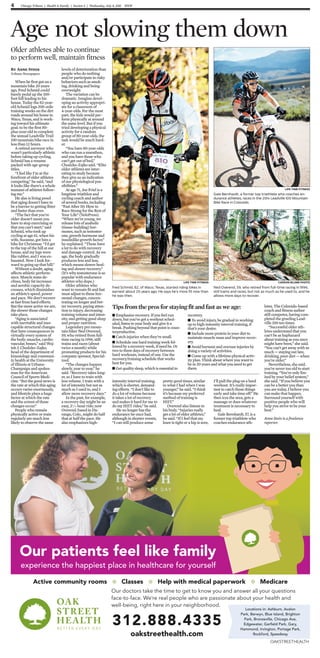
Fred Schmid, 82, of Waco, Texas, started riding bikes in
earnest about 20 years ago. He says he’s more fit now than
he was then.
LIFE TIME FITNESS
Gale Bernhardt, a former top triathlete who coaches en-
durance athletes, races in the 2014 Leadville 100 Mountain
Bike Race in Colorado.
LIFE TIME FITNESS
Ned Overend, 59, who retired from full-time racing in 1996,
still trains and races, but not as much as he used to, and he
allows more days to recover.
CARSON BLUME PHOTO
Older athletes able to continue
to perform well, maintain fitness
Tips from the pros for staying fit and fast as we age:
■ Emphasize recovery. If you feel run
down, but you’ve got a workout sched-
uled, listen to your body and give it a
break. Pushing beyond that point is coun-
terproductive.
■ Catch injuries when they’re small.
■ Schedule one hard training week fol-
lowed by a recovery week, if need be. Or
two to three days of recovery between
hard workouts, instead of one. Use the
recovery/training schedule that works
best for you.
■ Get quality sleep, which is essential to
recovery.
■ To avoid injury, be gradual in working
up to high-intensity interval training, if
that’s your desire.
■ Include more protein in your diet to
maintain muscle mass and improve recov-
ery.
■ Avoid burnout and overuse injuries by
doing a variety of activities.
■ Come up with a lifetime physical activ-
ity plan. Think about where you want to
be in 20 years and what you need to get
there.
Our patients feel like family
experience the happiest place in healthcare for yourself
OAK
STREET
HEALTH
B E T T E R E V E R Y D A Y
Our doctors take the time to get to know you and answer all your questions
face-to-face. We’re real people who are passionate about your health and
well-being, right here in your neighborhood.
312.888.4335
oakstreethealth.com
Active community rooms i Classes i Help with medical paperwork i Medicare
OAKSTREETHEALTH
Locations in: Ashburn, Avalon
Park, Berwyn, Blue Island, Brighton
Park, Bronzeville, Chicago Ave,
Edgewater, Garfield Park, Gary,
Hammond, Irvington, Portage Park,
Rockford, Speedway

OlderAthletes

  • 1.
    4 Chicago Tribune| Health & Family | Section 5 | Wednesday, July 8, 2015 NNW When he first got on a mountain bike 20 years ago, Fred Schmid could barely pedal up the 100- foot hill leading to his house. Today the 82-year- old Schmid logs 200-mile training weeks on the dirt roads around his home in Waco, Texas, and is work- ing toward his ultimate goal: to be the first 80- plus-year-old to complete the annual Leadville Trail 100 mountain bike race in less than 12 hours. A retired surveyor who wasn’t particularly athletic before taking up cycling, Schmid has a resume packed with age-group titles. “I feel like I’m at the forefront of older athletes competing,” he said, “and it looks like there’s a whole tsunami of athletes follow- ing me.” He also is living proof that aging doesn’t have to be a barrier to getting fitter and faster than ever. “The fact that you’re older doesn’t mean you have to stop exercising or that you can’t start,” said Schmid, who took up cycling at age 61, when his wife, Suzanne, got him a bike for Christmas. “I’d get to the top of the hill at our house, and my legs were like rubber, and I was ex- hausted. Now I look for- ward to going up that hill.” Without a doubt, aging affects athletic perform- ance. Muscle mass de- clines, body fat increases and aerobic capacity de- creases, which diminishes an athlete’s speed, power and pace. We don’t recover as fast from hard efforts. But the more active we are, the slower those changes take place. “Aging is associated with inevitable and ines- capable structural changes that have consequences in virtually every system of the body: muscles, cardio- vascular, bones,” said Woj- tek J. Chodzko-Zajko, head of the department of kinesiology and communi- ty health at the University of Illinois at Urbana- Champaign and spokes- man for the American Council of Sports Medi- cine. “But the good news is the rate at which this aging occurs varies enormously, and lifestyle plays a huge factor at which the rate and the extent of those changes occur.” People who remain physically active or train regularly are much less likely to observe the same levels of deterioration than people who do nothing and/or participate in risky behaviors such as smok- ing, drinking and being overweight. The variation can be dramatic. Imagine devel- oping an activity appropri- ate for a classroom of 4-year-olds. For the most part, the kids would per- form physically at around the same level. But if you tried developing a physical activity for a random group of 80-year-olds, the task would be much hard- er. “You have 80-year-olds who can run a marathon, and you have those who can’t get out of bed,” Chodzko-Zajko said. “Elite older athletes are inter- esting to study because they give us an indication of our physiological pos- sibilities.” At age 71, Joe Friel is a longtime triathlon and cycling coach and author of several books, including “Fast After 50: How to Race Strong for the Rest of Your Life” (VeloPress). “When we’re young, we release lots of anabolic (tissue-building) hor- mones, such as testoster- one, growth hormone and insulinlike growth factor,” he explained. “These have a lot to do with recovery and damage control. As we age, the body gradually produces less and less, which means slower heal- ing and slower recovery.” (It’s why testosterone is so popular with endurance athletes who dope.) Older athletes who want to remain fit and fast must adjust to these hor- monal changes, concen- trating on longer and bet- ter recovery, paying atten- tion to injury, decreasing training volume and inten- sity, and getting good sleep and proper nutrition. Legendary pro moun- tain biker Ned Overend, 59, who retired from full- time racing in 1996, still trains and races (about twice a month) while promoting products for his company sponsor, Special- ized. “The changes happen slowly, year to year,” he said. “Recovery takes long- er, so I have to train with less volume. I train with a lot of intensity but not as much as I used to, and I allow more recovery days.” In the past, for example, a recovery day might be an easy, 21 ⁄2-hour ride; now Overend, based in Du- rango, Colo., might do half that at half the pace. He also emphasizes high- intensity interval training, which is shorter, demand- ing efforts. “I don’t like to do a lot of volume because it takes a lot of recovery and makes it hard for me to do my HIIT rides,” he said. He no longer has the endurance he once had, although in shorter events, “I can still produce some pretty good times, similar to what I had when I was younger,” he said. “I think it’s because my preferred method of training is HIIT.” Overend also listens to his body. “Injuries really get a lot of older athletes,” he said. “If I feel that my knee is tight or a hip is sore, I’ll pull the plug on a hard workout. It’s really impor- tant to catch those things early and take time off.” He then ices the area, gets a massage or does whatever treatment is necessary to heal. Gale Bernhardt, 57, is a former top triathlete who coaches endurance ath- letes. The Colorado-based coach and fitness author still competes, having com- pleted the grueling Lead- ville 100 ten times. “Successful older ath- letes understand that you can’t be as haphazard about training as you once might have been,” she said. “You can’t get away with as much — staying out late, drinking, poor diet — when you’re older.” Nevertheless, she said, you’re never too old to start training. “You’re only lim- ited by your belief system,” she said. “If you believe you can be a better you than you are today, I believe you can make that happen. Surround yourself with positive people who will help you strive to be your best.” Anne Stein is a freelance reporter. Age not slowing them down By Anne Stein Tribune Newspapers Fred Schmid, 82, of Waco, Texas, started riding bikes in earnest about 20 years ago. He says he’s more fit now than he was then. LIFE TIME FITNESS Gale Bernhardt, a former top triathlete who coaches en- durance athletes, races in the 2014 Leadville 100 Mountain Bike Race in Colorado. LIFE TIME FITNESS Ned Overend, 59, who retired from full-time racing in 1996, still trains and races, but not as much as he used to, and he allows more days to recover. CARSON BLUME PHOTO Older athletes able to continue to perform well, maintain fitness Tips from the pros for staying fit and fast as we age: ■ Emphasize recovery. If you feel run down, but you’ve got a workout sched- uled, listen to your body and give it a break. Pushing beyond that point is coun- terproductive. ■ Catch injuries when they’re small. ■ Schedule one hard training week fol- lowed by a recovery week, if need be. Or two to three days of recovery between hard workouts, instead of one. Use the recovery/training schedule that works best for you. ■ Get quality sleep, which is essential to recovery. ■ To avoid injury, be gradual in working up to high-intensity interval training, if that’s your desire. ■ Include more protein in your diet to maintain muscle mass and improve recov- ery. ■ Avoid burnout and overuse injuries by doing a variety of activities. ■ Come up with a lifetime physical activ- ity plan. Think about where you want to be in 20 years and what you need to get there. Our patients feel like family experience the happiest place in healthcare for yourself OAK STREET HEALTH B E T T E R E V E R Y D A Y Our doctors take the time to get to know you and answer all your questions face-to-face. We’re real people who are passionate about your health and well-being, right here in your neighborhood. 312.888.4335 oakstreethealth.com Active community rooms i Classes i Help with medical paperwork i Medicare OAKSTREETHEALTH Locations in: Ashburn, Avalon Park, Berwyn, Blue Island, Brighton Park, Bronzeville, Chicago Ave, Edgewater, Garfield Park, Gary, Hammond, Irvington, Portage Park, Rockford, Speedway