Prof. Neeraj Bhargava
Pooja Dixit
Department of Computer Science
School of Engineering & System Sciences
MDS, University Ajmer, Rajasthan, India
1
Definitions
 A service-oriented grid architecture is
descriptive: it provides a common vocabulary
for use when describing grid systems.
 A grid architecture is normative: it provides
guidance and identifies key areas in which
services are required.
 A grid architecture is also prescriptive: it
defines standard “Intergrid” protocols and
application programmer interfaces (APIs) to
facilitate creation of interoperable grid systems
and portable applications.
2
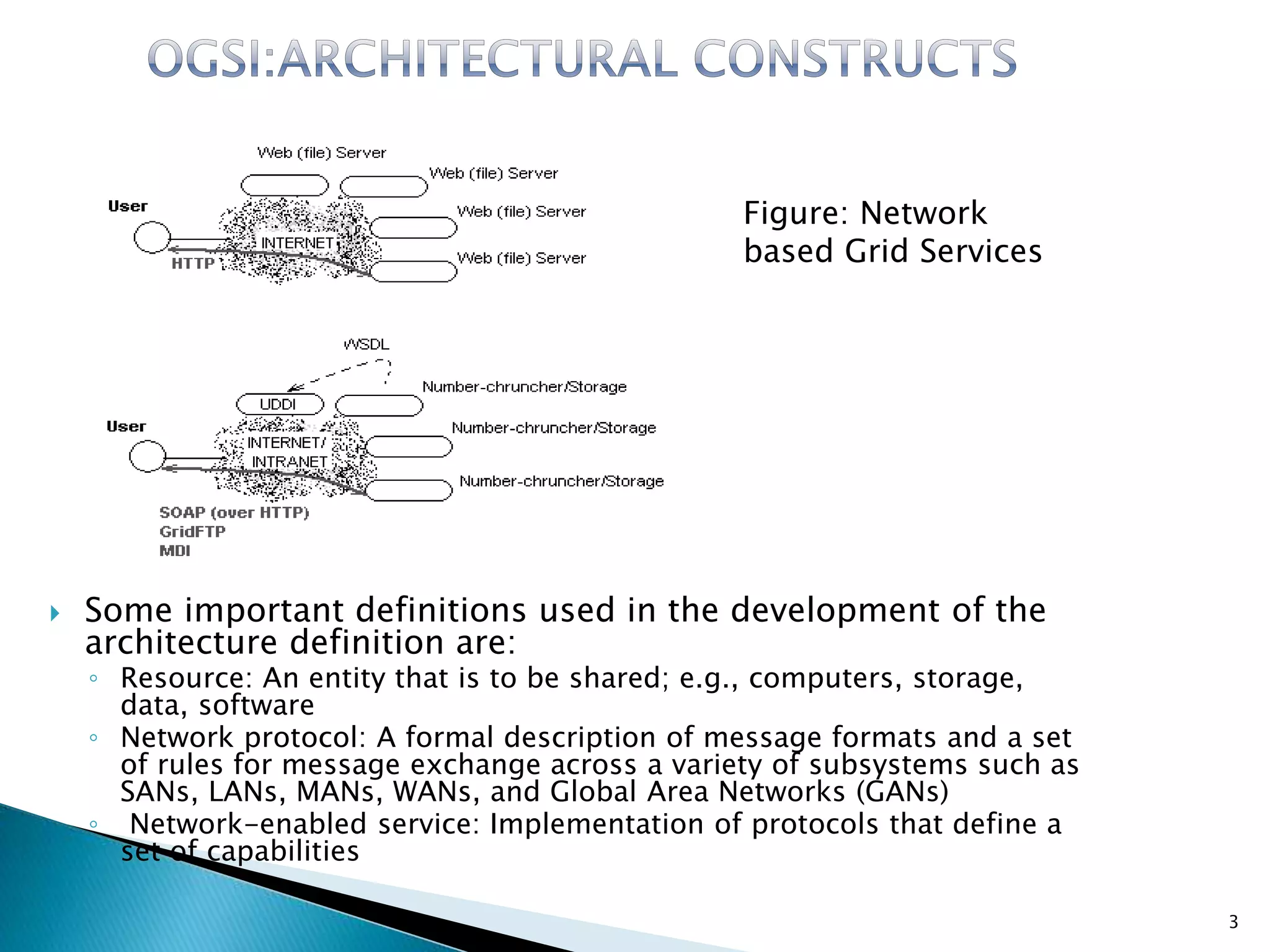
 Some important definitions used in the development of the
architecture definition are:
◦ Resource: An entity that is to be shared; e.g., computers, storage,
data, software
◦ Network protocol: A formal description of message formats and a set
of rules for message exchange across a variety of subsystems such as
SANs, LANs, MANs, WANs, and Global Area Networks (GANs)
◦ Network-enabled service: Implementation of protocols that define a
set of capabilities
Figure: Network
based Grid Services
3
 API: A specification for a set of routines to facilitate application development.
 Examples include GSS API (Generic Security Service API) and MPI
 (Message Passing Interface). A protocol can have multiple APIs (e.g., TCP/IP
 APIs include BSD sockets, Winsock, and System V streams). The protocol
 provides interoperability: programs using different APIs can exchange information
 and one does not need to know the remote APIs. An API can have
 multiple protocols. For example, MPI provides portability: any correct program
 compiles and runs on a platform. MPI does not provide interoperability:
 all processes must link to same SDK (e.g., MPICH and LAM versions of
 MPI).
 Software Development Kit (SDK): A particular instantiation of an API (it
 may consists of libraries and tools). Examples of SDKs include MPICH and
 Motif Widgets.
 Syntax: Rules for encoding information. Examples include XML, Condor
 ClassAds, Globus RSL, X.509 certificate format [Request For Comments
 (RFC) 2459], Cryptographic Message Syntax (RFC 2630), and ASN.1. Syntaxes
 are distinct from protocols in the sense that a syntax may be used by
 many protocols (e.g., XML), and be useful for other purposes. Syntaxes may
 be layered (e.g., Condor ClassAds uses XML, which uses ASCII.)
4
 API: A specification for a set of routines to facilitate application
development. Examples include GSS API (Generic Security Service
API) and MPI (Message Passing Interface). A protocol can have
multiple APIs (e.g., TCP/IP APIs include BSD sockets, Winsock, and
System V streams). The protocol provides interoperability:
programs using different APIs can exchange information and one
does not need to know the remote APIs. An API can have multiple
protocols. For example, MPI provides portability: any correct
program compiles and runs on a platform. MPI does not provide
interoperability: all processes must link to same SDK (e.g., MPICH
and LAM versions of MPI).
 Software Development Kit (SDK): A particular instantiation of an API
(it may consists of libraries and tools). Examples of SDKs include
MPICH and Motif Widgets.
 Syntax: Rules for encoding information. Examples include XML,
Condor ClassAds, Globus RSL, X.509 certificate format [Request For
Comments (RFC) 2459], Cryptographic Message Syntax (RFC 2630),
and ASN.1. Syntaxes are distinct from protocols in the sense that a
syntax may be used by many protocols (e.g., XML), and be useful
for other purposes. Syntaxes may be layered (e.g., Condor ClassAds
uses XML, which uses ASCII.)
5

Ogsi architectural constructs

  • 1.
    Prof. Neeraj Bhargava PoojaDixit Department of Computer Science School of Engineering & System Sciences MDS, University Ajmer, Rajasthan, India 1
  • 2.
    Definitions  A service-orientedgrid architecture is descriptive: it provides a common vocabulary for use when describing grid systems.  A grid architecture is normative: it provides guidance and identifies key areas in which services are required.  A grid architecture is also prescriptive: it defines standard “Intergrid” protocols and application programmer interfaces (APIs) to facilitate creation of interoperable grid systems and portable applications. 2
  • 3.
     Some importantdefinitions used in the development of the architecture definition are: ◦ Resource: An entity that is to be shared; e.g., computers, storage, data, software ◦ Network protocol: A formal description of message formats and a set of rules for message exchange across a variety of subsystems such as SANs, LANs, MANs, WANs, and Global Area Networks (GANs) ◦ Network-enabled service: Implementation of protocols that define a set of capabilities Figure: Network based Grid Services 3
  • 4.
     API: Aspecification for a set of routines to facilitate application development.  Examples include GSS API (Generic Security Service API) and MPI  (Message Passing Interface). A protocol can have multiple APIs (e.g., TCP/IP  APIs include BSD sockets, Winsock, and System V streams). The protocol  provides interoperability: programs using different APIs can exchange information  and one does not need to know the remote APIs. An API can have  multiple protocols. For example, MPI provides portability: any correct program  compiles and runs on a platform. MPI does not provide interoperability:  all processes must link to same SDK (e.g., MPICH and LAM versions of  MPI).  Software Development Kit (SDK): A particular instantiation of an API (it  may consists of libraries and tools). Examples of SDKs include MPICH and  Motif Widgets.  Syntax: Rules for encoding information. Examples include XML, Condor  ClassAds, Globus RSL, X.509 certificate format [Request For Comments  (RFC) 2459], Cryptographic Message Syntax (RFC 2630), and ASN.1. Syntaxes  are distinct from protocols in the sense that a syntax may be used by  many protocols (e.g., XML), and be useful for other purposes. Syntaxes may  be layered (e.g., Condor ClassAds uses XML, which uses ASCII.) 4
  • 5.
     API: Aspecification for a set of routines to facilitate application development. Examples include GSS API (Generic Security Service API) and MPI (Message Passing Interface). A protocol can have multiple APIs (e.g., TCP/IP APIs include BSD sockets, Winsock, and System V streams). The protocol provides interoperability: programs using different APIs can exchange information and one does not need to know the remote APIs. An API can have multiple protocols. For example, MPI provides portability: any correct program compiles and runs on a platform. MPI does not provide interoperability: all processes must link to same SDK (e.g., MPICH and LAM versions of MPI).  Software Development Kit (SDK): A particular instantiation of an API (it may consists of libraries and tools). Examples of SDKs include MPICH and Motif Widgets.  Syntax: Rules for encoding information. Examples include XML, Condor ClassAds, Globus RSL, X.509 certificate format [Request For Comments (RFC) 2459], Cryptographic Message Syntax (RFC 2630), and ASN.1. Syntaxes are distinct from protocols in the sense that a syntax may be used by many protocols (e.g., XML), and be useful for other purposes. Syntaxes may be layered (e.g., Condor ClassAds uses XML, which uses ASCII.) 5