REDEFINING REFINING
With Dr Eion Turnbull, Deputy CEO of Bapco
FIELD OF DREAMS
KOC’s exploration chief, Khalid Al-Sumaiti,
outlines the company’s 2030 vision
BRIGHT SPARK
Gerald Schotman, CTO of Shell, on the oil
giant’s innovation strategy
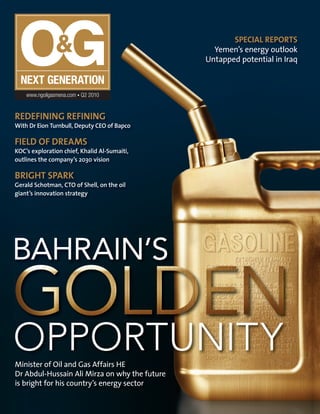
BAHRAIN’S
OPPORTUNITYMinister of Oil and Gas Affairs HE
Dr Abdul-Hussain Ali Mirza on why the future
is bright for his country’s energy sector
SPECIAL REPORTS
Yemen’s energy outlook
Untapped potential in Iraq
www.ngoilgasmena.com • Q2 2010
Final Cover-HIGH RES.indd 1 12/3/10 16:34:58
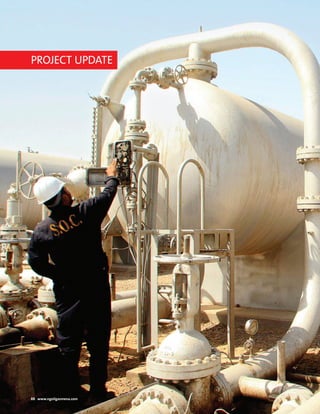
PROJECT UPDATE
88 www.ngoilgasmena.com
BP Rumaila.indd 88 12/3/10 17:27:19
www.ngoilgasmena.com 89
Rebirth of RumailaJust to the south of the fertile lands of Al-Qurnah, the meeting point of the Tigris and Euphrates
rivers, and 60 km west of Basra in south-eastern Iraq lies a stony desert with a bleak landscape
that is decorated only by oases of small shrubs, isolated sand hills and dry river beds. However,
underneath this wasteland lies Iraq’s biggest treasure – the supergiant Rumaila field, estimated
to contain 15 percent of the country’s oil reserves. Maxim Lyashko reports.
improvement, and for the past two decades
Rumaila remained damaged from over-drill-
ing and poor reservoir management.
Now all that is about to change after BP
and its partner China National Petroleum
Corporation (CNPC) won the right to develop
the field in a historic televised auction in June
2009 and later in November of that year it for-
mally signed a 20-year technical service con-
tract – the first long-term oilfield development
contract of the post-Saddam era.
The workhorse of Iraq’s oil
industry
It seems that Rumaila is as important to
Iraq as it is to BP. The British oil major helped
to discover the field back in 1953 and gained
further information on its structure through a
reservoir study contract awarded by the Iraqi
Oil Ministry in 2005. This early interest by BP is
not surprising – Rumalia is among the world’s
last remaining pockets of so-called ‘easy oi’,
meaning that it does not require expensive
ultradeep drilling or pioneering production
techniques. Its estimated recoverable reserves
of 17.77 billion barrels are larger than the total
proven oil reserves of China, Qatar or Algeria.
So it is no wonder that BP has agreed to develop
Rumaila without getting an ownership stake in
the field while also accepting the government’s
low remuneration fee of only US$2 per barrel
once the production has been raised by 10 per-
cent from its current level.
The Rumaila field is an 80 km long anti-
clinal structure that was found to be trending
from south to north and historically divided
into two parts. “When Rumaila was discovered
it was believed to be a single domal structure
R
umaila’s turbulent history
started over half a century
ago when it was discovered
by Basra Petroleum Co. in
1953. Since then the de-
velopment of the field has
been closely linked with Iraq’s transformation
into the world’s major oil producer and ex-
porter as well as with the country’s infamous
war conflicts in the not so distant past. Oil
production at Rumaila started just a year after
its discovery at a rate of 20,000 barrels per day
(bpd) and reached its peak of about 1.6 million
bpd in 1980, which represented an astonishing
45percent of Iraq’s total output that year. How-
ever, the subsequent history of oil extraction at
this field had a cyclical nature due to numerous
military conflicts starting with the Iran-Iraq
War, during which the production from the
field was completely halted. Moreover, it was
Rumaila that became one of the main reasons
for Iraq’s invasion of Kuwait who were accused
of using directional drilling technologies to
pump oil from underneath the border and al-
legedly stealing US$2.4 billion worth of Iraqi
crude. Finally, it was on this oilfield where the
last battle of the Gulf War took place in 1991.
Bearing strategic importance to Iraq’s
economy, Rumaila was the first field in the
country to restart production after the Gulf
War; however, subsequent years of UN sanc-
tions, post-2003 violence and long-term un-
derinvestment in Iraq’s petroleum sector took
their toll on the field’s development. Even water
injection system projects at Rumaila, which
were part of US-directed aid programmes
aimed at the reconstruction of Iraqi oil sector
in the 1990’s, have not resulted in the expected
BP Rumaila.indd 89 15/3/10 09:06:54
90 www.ngoilgasmena.com
achieved in 1980, but still accounted for almost
half of Iraq’s annual oil production. The con-
sortium led by BP (38 percent) with partners
CNPC (37 percent) and State Oil Marketing
Organisation, the sales arm of the Iraqi Min-
istry of Oil (25 percent), has agreed to nearly
triple the Rumaila field’s output to 2.85 million
bpd in only six years. This would make it the
world’s second largest producing oilfield after
Saudi Arabia’s Ghawar and would alone lift
Iraq’s total oil production capacity from about
2.5 million bpd to 5.35 million bpd.
The 20-year contract, however, comes
with a spending commitment of US$15 billion.
The first stage is the 33-month remedial pro-
gramme involving three steps starting with a
halt to any non-optimal operations that Iraqi
oil engineers had to revert to in past years, often
due to the lack of other options; then arresting
the production decline; and finally achieving
a sustainable and improved production rate
of 10 percent above the initial rate prevailing
at the start of the contract. BP is looking to
spend a minimum US$300 million in order to
carry out the appraisal programme including
acquiring, processing and interpreting 1500
square km of 3D seismic survey over the two
confined to the south of extensive marshland to
the north,” explains Michael Daly, Group Vice
President for Exploration at BP. “This area later
became South Rumaila as prospecting moved
northwards and discovered the North Rumaila
continuation in 1961.” The total reserves of
North Rumaila are estimated at some 31 bil-
lion barrels with only just over three billion
barrels produced so far. This section has three
reservoirs in development including the Mish-
rif limestone, Upper Zubair sandstone and the
heterogeneous Nahr Umr Formation. Mishrif is
the biggest reservoir in North Rumaila account-
ing for over 70 percent of its reserves. The South
Rumaila section is thought to have 30 billion
barrels, but because of the inclined nature of
the formation it has so far produced three times
more oil than its northern part. There are four
reservoir units that have already been appraised
and produced from and which are distributed
between the Mishrif and Zubair formations.
The Zubair reservoirs are the Upper Shale and
Upper Sandstone (collectively known as the
Main Pay) and Lower Sandstone members.
Currently, according to Daly, the volumes are
well-described only in the Main Pay and Mish-
rif reservoirs. “Other reservoirs still require
significant definition before a definitive volume
can be determined,” he says. “Suffice to say the
volume is large.” Moreover, there are additional
hidden treasures for BP. First, there are discov-
ered but undeveloped reservoirs – Nahr Umr,
Upper Shale Member, Yamama, Najma, Alan
and Mus/Adaiya in North Rumaila and Lower
Fars, Nahr Umar, Fourth Pay and Yamama in
the South. Second, there are the undiscovered
potential reservoirs that the consortium can
explore and develop over the course of their 20-
year redevelopment project.
Path to recovery
At the end of 2009, the struggling field
was producing approximately one million bpd,
which is far from its potential and the peak
fields’ area and preparing the much needed
geological and reservoir engineering studies
and 3D simulation for the reservoirs. The most
important objective for BP is achieving an im-
proved production target rate, since it will be
able to recover its costs and receive US$2 bil-
lion worth of oil once this initial incremental
production is brought on stream. “The current
infrastructure in place on the field consists of
over 800 wells – over 550 producers and more
than 150 injection wells – feeding 10 gathering
and degassing centres,” says Daly. “Just over
half of the producing wells are flowing today;
but it is the wells that are not flowing where the
short-term oil opportunity lies.”
Since the Rumaila service contract entered
into effect on December 17, BP hasn’t been
wasting time – in January the consortium held
the first joint management committee meeting
and decided on a US$1.7 billion budget for 2010
with the target to add between 150,000-200,000
bpd by December 2010. On top of that, 10 firms
(including Halliburton, Schlumberger, Baker
Hughes, Weatherford, Iraq Drilling Company
as well as companies from China and Turkey)
were invited to drill 56 new wells and do work-
over projects on 30 others. Currently, the field
has 10 rigs (six belonging to Iraq Drilling Com-
pany and four to Weatherford and Akkad). BP’s
plan is to add five new rigs this year and another
10 in 2011. The consortium is also looking to
drill 200 additional wells next year to pump
output at Rumaila up to 1.5 million bpd. This
rehabilitation and expansion project is man-
aged by the Rumaila Field Operating Organisa-
tion (ROO) staffed mainly by employees from
“Rumaila is clearly a brownfield development with a
huge amount of kit in the ground and on the surface.
This fact has important implications for our confidence
in our ability to reach the initial production target”
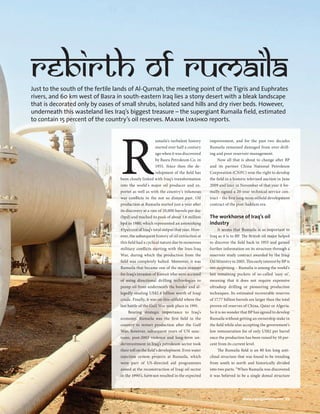
Excess gas is burned off at the Rumala oil field
BP Rumaila.indd 90 12/3/10 17:27:27
92 www.ngoilgasmena.com
use a number of its proprietary technologies,
including its smart field or Field of the Future
technology to provide real time management
and remote monitoring of wells; Bright Water
injection of a polymer to help improve the
efficiency of water flooding; and POWERlift
ESPs which will allow for downhole repair and
replacement. But in addition to refurbishing
the production plants and the water injection
facilities, another important task BP is facing
is to first supply all 12 production units and
10 water injection plants in North and South
Rumaila with an internet connection.
BP has a lot of experience of taking on
brownfield developments, so Daly is confi-
dent in achieving ambitious targets set by
the contract. However, there are a number
of key challenges. “Regionally several large
development issues remain such as access to
sufficient water for large water flood projects,
gas capture and utilisation and sufficient
export ullage for the oil production growth”,
he explains. “A number of logistical issues
could also impact the pace of development.
There will now be 10 developments compet-
ing for resources; skilled people, oil field
services etc.” Despite these challenges, which
are currently being addressed by the con-
sortium, Rumaila is finally entering the 21st
century after over 50 years in development.
Iraq is currently the world’s eleventh biggest
oil producer, but the invitation of foreign oil
majors with their cash and expertise and the
rehabilitation of its supergiant oilfields give it
the potential to climb to third place or higher,
rivalling Russia and Saudi Arabia. An in-
crease in production to just over four million
bpd in the next five years will also pour ap-
proximately US$1.7 trillion into the country’s
battered economy and would finance major
infrastructure projects across Iraq. Both BP
and CNPC see rejuvenation of Rumaila as a
key step in the post-war reconstruction of the
country, and with such remarkable history
this field is without doubt going to play a cru-
cial role in Iraq’s future.
Dr Michael C Daly is Group Vice President for Exploration,
BP, responsible for the renewal of BP’s oil and gas
resource base, which includes accessing new resources,
identifying new areas of exploration potential, and
leading the company’s exploration drilling programme.
He began his career as a field geologist in the Geological
Survey of Zambia, later joining BP as a structural
geologist in the mid-1980s. Prior to his appointment
as the head of exploration, Daly was BP’s President of
Middle East and South Asia.
Daly continues: “A full field surveillance pro-
gramme will be established on the existing
Rumaila well stock. From our earlier work we
have more than a year’s work of well workovers
already identified, largely involving the addi-
tion of electric submersible pumps (ESPs) to
improve well deliverability and workovers of
the old wells.
Longer term we will enter the enhanced
redevelopment phase, which will grow the
well stock through a major drilling campaign,
eventually deploying 20-25 drilling rigs and a
number of workover rigs. This early work will
focus on the Main Pay reservoir and also start
the full field development of the Mishrif. The
Main Pay will be the main story in the early
years; the Mishrif peak will follow and sus-
tain the field. This will be accompanied by a
field-wide waterflood campaign to maintain
field pressure.” According to Daly, BP will
South Oil Company (field’s original operator)
and a small number of technical experts and
managers from BP and CNPC. “The job BP
has now taken on is to work with the South Oil
Company and our partners to renew invest-
ment in the field and to bring new and innova-
tive technology with the singular intent to grow
production beyond the previous peak; sustain
it for several years; and in doing so increase the
expected recovery factor of Rumaila”, explains
Daly. “Rumaila is clearly a brownfield develop-
ment with a huge amount of kit in the ground
and on the surface. This fact has important
implications for our confidence in our ability to
reach the initial production target.”
The BP solution
BP’s development plan starts with a focus
on securing the base production from both
the Main Pay and the Mishrif reservoirs.
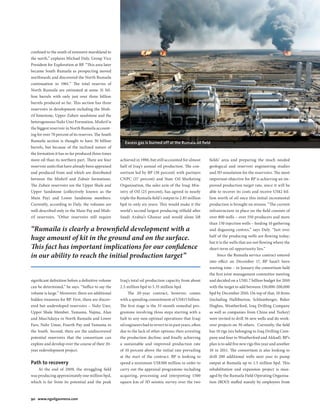
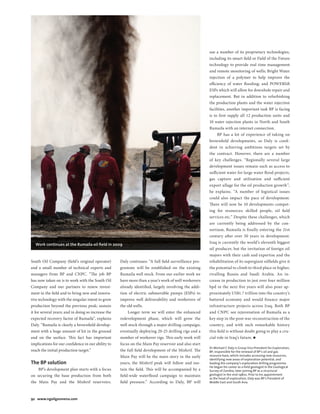
Work continues at the Rumaila oil field in 2009
BP Rumaila.indd Sec1:92 15/3/10 09:07:10

Rebirth of Rumaila

  • 1.
    REDEFINING REFINING With DrEion Turnbull, Deputy CEO of Bapco FIELD OF DREAMS KOC’s exploration chief, Khalid Al-Sumaiti, outlines the company’s 2030 vision BRIGHT SPARK Gerald Schotman, CTO of Shell, on the oil giant’s innovation strategy BAHRAIN’S OPPORTUNITYMinister of Oil and Gas Affairs HE Dr Abdul-Hussain Ali Mirza on why the future is bright for his country’s energy sector SPECIAL REPORTS Yemen’s energy outlook Untapped potential in Iraq www.ngoilgasmena.com • Q2 2010 Final Cover-HIGH RES.indd 1 12/3/10 16:34:58
  • 2.
    PROJECT UPDATE 88 www.ngoilgasmena.com BPRumaila.indd 88 12/3/10 17:27:19
  • 3.
    www.ngoilgasmena.com 89 Rebirth ofRumailaJust to the south of the fertile lands of Al-Qurnah, the meeting point of the Tigris and Euphrates rivers, and 60 km west of Basra in south-eastern Iraq lies a stony desert with a bleak landscape that is decorated only by oases of small shrubs, isolated sand hills and dry river beds. However, underneath this wasteland lies Iraq’s biggest treasure – the supergiant Rumaila field, estimated to contain 15 percent of the country’s oil reserves. Maxim Lyashko reports. improvement, and for the past two decades Rumaila remained damaged from over-drill- ing and poor reservoir management. Now all that is about to change after BP and its partner China National Petroleum Corporation (CNPC) won the right to develop the field in a historic televised auction in June 2009 and later in November of that year it for- mally signed a 20-year technical service con- tract – the first long-term oilfield development contract of the post-Saddam era. The workhorse of Iraq’s oil industry It seems that Rumaila is as important to Iraq as it is to BP. The British oil major helped to discover the field back in 1953 and gained further information on its structure through a reservoir study contract awarded by the Iraqi Oil Ministry in 2005. This early interest by BP is not surprising – Rumalia is among the world’s last remaining pockets of so-called ‘easy oi’, meaning that it does not require expensive ultradeep drilling or pioneering production techniques. Its estimated recoverable reserves of 17.77 billion barrels are larger than the total proven oil reserves of China, Qatar or Algeria. So it is no wonder that BP has agreed to develop Rumaila without getting an ownership stake in the field while also accepting the government’s low remuneration fee of only US$2 per barrel once the production has been raised by 10 per- cent from its current level. The Rumaila field is an 80 km long anti- clinal structure that was found to be trending from south to north and historically divided into two parts. “When Rumaila was discovered it was believed to be a single domal structure R umaila’s turbulent history started over half a century ago when it was discovered by Basra Petroleum Co. in 1953. Since then the de- velopment of the field has been closely linked with Iraq’s transformation into the world’s major oil producer and ex- porter as well as with the country’s infamous war conflicts in the not so distant past. Oil production at Rumaila started just a year after its discovery at a rate of 20,000 barrels per day (bpd) and reached its peak of about 1.6 million bpd in 1980, which represented an astonishing 45percent of Iraq’s total output that year. How- ever, the subsequent history of oil extraction at this field had a cyclical nature due to numerous military conflicts starting with the Iran-Iraq War, during which the production from the field was completely halted. Moreover, it was Rumaila that became one of the main reasons for Iraq’s invasion of Kuwait who were accused of using directional drilling technologies to pump oil from underneath the border and al- legedly stealing US$2.4 billion worth of Iraqi crude. Finally, it was on this oilfield where the last battle of the Gulf War took place in 1991. Bearing strategic importance to Iraq’s economy, Rumaila was the first field in the country to restart production after the Gulf War; however, subsequent years of UN sanc- tions, post-2003 violence and long-term un- derinvestment in Iraq’s petroleum sector took their toll on the field’s development. Even water injection system projects at Rumaila, which were part of US-directed aid programmes aimed at the reconstruction of Iraqi oil sector in the 1990’s, have not resulted in the expected BP Rumaila.indd 89 15/3/10 09:06:54
  • 4.
    90 www.ngoilgasmena.com achieved in1980, but still accounted for almost half of Iraq’s annual oil production. The con- sortium led by BP (38 percent) with partners CNPC (37 percent) and State Oil Marketing Organisation, the sales arm of the Iraqi Min- istry of Oil (25 percent), has agreed to nearly triple the Rumaila field’s output to 2.85 million bpd in only six years. This would make it the world’s second largest producing oilfield after Saudi Arabia’s Ghawar and would alone lift Iraq’s total oil production capacity from about 2.5 million bpd to 5.35 million bpd. The 20-year contract, however, comes with a spending commitment of US$15 billion. The first stage is the 33-month remedial pro- gramme involving three steps starting with a halt to any non-optimal operations that Iraqi oil engineers had to revert to in past years, often due to the lack of other options; then arresting the production decline; and finally achieving a sustainable and improved production rate of 10 percent above the initial rate prevailing at the start of the contract. BP is looking to spend a minimum US$300 million in order to carry out the appraisal programme including acquiring, processing and interpreting 1500 square km of 3D seismic survey over the two confined to the south of extensive marshland to the north,” explains Michael Daly, Group Vice President for Exploration at BP. “This area later became South Rumaila as prospecting moved northwards and discovered the North Rumaila continuation in 1961.” The total reserves of North Rumaila are estimated at some 31 bil- lion barrels with only just over three billion barrels produced so far. This section has three reservoirs in development including the Mish- rif limestone, Upper Zubair sandstone and the heterogeneous Nahr Umr Formation. Mishrif is the biggest reservoir in North Rumaila account- ing for over 70 percent of its reserves. The South Rumaila section is thought to have 30 billion barrels, but because of the inclined nature of the formation it has so far produced three times more oil than its northern part. There are four reservoir units that have already been appraised and produced from and which are distributed between the Mishrif and Zubair formations. The Zubair reservoirs are the Upper Shale and Upper Sandstone (collectively known as the Main Pay) and Lower Sandstone members. Currently, according to Daly, the volumes are well-described only in the Main Pay and Mish- rif reservoirs. “Other reservoirs still require significant definition before a definitive volume can be determined,” he says. “Suffice to say the volume is large.” Moreover, there are additional hidden treasures for BP. First, there are discov- ered but undeveloped reservoirs – Nahr Umr, Upper Shale Member, Yamama, Najma, Alan and Mus/Adaiya in North Rumaila and Lower Fars, Nahr Umar, Fourth Pay and Yamama in the South. Second, there are the undiscovered potential reservoirs that the consortium can explore and develop over the course of their 20- year redevelopment project. Path to recovery At the end of 2009, the struggling field was producing approximately one million bpd, which is far from its potential and the peak fields’ area and preparing the much needed geological and reservoir engineering studies and 3D simulation for the reservoirs. The most important objective for BP is achieving an im- proved production target rate, since it will be able to recover its costs and receive US$2 bil- lion worth of oil once this initial incremental production is brought on stream. “The current infrastructure in place on the field consists of over 800 wells – over 550 producers and more than 150 injection wells – feeding 10 gathering and degassing centres,” says Daly. “Just over half of the producing wells are flowing today; but it is the wells that are not flowing where the short-term oil opportunity lies.” Since the Rumaila service contract entered into effect on December 17, BP hasn’t been wasting time – in January the consortium held the first joint management committee meeting and decided on a US$1.7 billion budget for 2010 with the target to add between 150,000-200,000 bpd by December 2010. On top of that, 10 firms (including Halliburton, Schlumberger, Baker Hughes, Weatherford, Iraq Drilling Company as well as companies from China and Turkey) were invited to drill 56 new wells and do work- over projects on 30 others. Currently, the field has 10 rigs (six belonging to Iraq Drilling Com- pany and four to Weatherford and Akkad). BP’s plan is to add five new rigs this year and another 10 in 2011. The consortium is also looking to drill 200 additional wells next year to pump output at Rumaila up to 1.5 million bpd. This rehabilitation and expansion project is man- aged by the Rumaila Field Operating Organisa- tion (ROO) staffed mainly by employees from “Rumaila is clearly a brownfield development with a huge amount of kit in the ground and on the surface. This fact has important implications for our confidence in our ability to reach the initial production target” Excess gas is burned off at the Rumala oil field BP Rumaila.indd 90 12/3/10 17:27:27
  • 5.
    92 www.ngoilgasmena.com use anumber of its proprietary technologies, including its smart field or Field of the Future technology to provide real time management and remote monitoring of wells; Bright Water injection of a polymer to help improve the efficiency of water flooding; and POWERlift ESPs which will allow for downhole repair and replacement. But in addition to refurbishing the production plants and the water injection facilities, another important task BP is facing is to first supply all 12 production units and 10 water injection plants in North and South Rumaila with an internet connection. BP has a lot of experience of taking on brownfield developments, so Daly is confi- dent in achieving ambitious targets set by the contract. However, there are a number of key challenges. “Regionally several large development issues remain such as access to sufficient water for large water flood projects, gas capture and utilisation and sufficient export ullage for the oil production growth”, he explains. “A number of logistical issues could also impact the pace of development. There will now be 10 developments compet- ing for resources; skilled people, oil field services etc.” Despite these challenges, which are currently being addressed by the con- sortium, Rumaila is finally entering the 21st century after over 50 years in development. Iraq is currently the world’s eleventh biggest oil producer, but the invitation of foreign oil majors with their cash and expertise and the rehabilitation of its supergiant oilfields give it the potential to climb to third place or higher, rivalling Russia and Saudi Arabia. An in- crease in production to just over four million bpd in the next five years will also pour ap- proximately US$1.7 trillion into the country’s battered economy and would finance major infrastructure projects across Iraq. Both BP and CNPC see rejuvenation of Rumaila as a key step in the post-war reconstruction of the country, and with such remarkable history this field is without doubt going to play a cru- cial role in Iraq’s future. Dr Michael C Daly is Group Vice President for Exploration, BP, responsible for the renewal of BP’s oil and gas resource base, which includes accessing new resources, identifying new areas of exploration potential, and leading the company’s exploration drilling programme. He began his career as a field geologist in the Geological Survey of Zambia, later joining BP as a structural geologist in the mid-1980s. Prior to his appointment as the head of exploration, Daly was BP’s President of Middle East and South Asia. Daly continues: “A full field surveillance pro- gramme will be established on the existing Rumaila well stock. From our earlier work we have more than a year’s work of well workovers already identified, largely involving the addi- tion of electric submersible pumps (ESPs) to improve well deliverability and workovers of the old wells. Longer term we will enter the enhanced redevelopment phase, which will grow the well stock through a major drilling campaign, eventually deploying 20-25 drilling rigs and a number of workover rigs. This early work will focus on the Main Pay reservoir and also start the full field development of the Mishrif. The Main Pay will be the main story in the early years; the Mishrif peak will follow and sus- tain the field. This will be accompanied by a field-wide waterflood campaign to maintain field pressure.” According to Daly, BP will South Oil Company (field’s original operator) and a small number of technical experts and managers from BP and CNPC. “The job BP has now taken on is to work with the South Oil Company and our partners to renew invest- ment in the field and to bring new and innova- tive technology with the singular intent to grow production beyond the previous peak; sustain it for several years; and in doing so increase the expected recovery factor of Rumaila”, explains Daly. “Rumaila is clearly a brownfield develop- ment with a huge amount of kit in the ground and on the surface. This fact has important implications for our confidence in our ability to reach the initial production target.” The BP solution BP’s development plan starts with a focus on securing the base production from both the Main Pay and the Mishrif reservoirs. Work continues at the Rumaila oil field in 2009 BP Rumaila.indd Sec1:92 15/3/10 09:07:10