Gold miner to use hi-tech to lower
costs, boost production
Metals & Mining - Gold
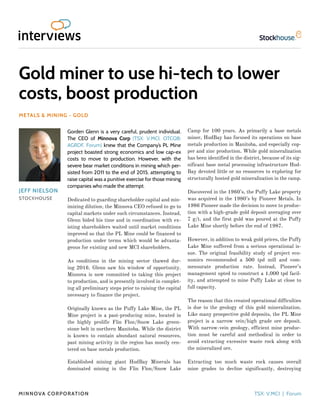
Gorden Glenn is a very careful, prudent individual.
The CEO of Minnova Corp (TSX: V.MCI, OTCQB:
AGRDF, Forum) knew that the Company’s PL Mine
project boasted strong economics and low cap-ex
costs to move to production. However, with the
severe bear market conditions in mining which per-
sisted from 2011 to the end of 2015, attempting to
raise capital was a punitive exercise for those mining
companies who made the attempt.
Dedicated to guarding shareholder capital and min-
imizing dilution; the Minnova CEO refused to go to
capital markets under such circumstances. Instead,
Glenn bided his time and in coordination with ex-
isting shareholders waited until market conditions
improved so that the PL Mine could be financed to
production under terms which would be advanta-
geous for existing and new MCI shareholders.
As conditions in the mining sector thawed dur-
ing 2016; Glenn saw his window of opportunity.
Minnova is now committed to taking this project
to production, and is presently involved in complet-
ing all preliminary steps prior to raising the capital
necessary to finance the project.
Originally known as the Puffy Lake Mine, the PL
Mine project is a past-producing mine, located in
the highly prolific Flin Flon/Snow Lake green-
stone belt in northern Manitoba. While the district
is known to contain abundant natural resources,
past mining activity in the region has mostly cen-
tered on base metals production.
Established mining giant HudBay Minerals has
dominated mining in the Flin Flon/Snow Lake
Camp for 100 years. As primarily a base metals
miner, HudBay has focused its operations on base
metals production in Manitoba, and especially cop-
per and zinc production. While gold mineralization
has been identified in the district, because of its sig-
nificant base metal processing infrastructure Hud-
Bay devoted little or no resources to exploring for
structurally hosted gold mineralization in the camp.
Discovered in the 1960’s, the Puffy Lake property
was acquired in the 1980’s by Pioneer Metals. In
1986 Pioneer made the decision to move to produc-
tion with a high-grade gold deposit averaging over
7 g/t, and the first gold was poured at the Puffy
Lake Mine shortly before the end of 1987.
However, in addition to weak gold prices, the Puffy
Lake Mine suffered from a serious operational is-
sue. The original feasibility study of project eco-
nomics recommended a 500 tpd mill and com-
mensurate production rate. Instead, Pioneer’s
management opted to construct a 1,000 tpd facil-
ity, and attempted to mine Puffy Lake at close to
full capacity.
The reason that this created operational difficulties
is due to the geology of this gold mineralization.
Like many prospective gold deposits, the PL Mine
project is a narrow vein/high grade ore deposit.
With narrow-vein geology, efficient mine produc-
tion must be careful and methodical in order to
avoid extracting excessive waste rock along with
the mineralized ore.
Extracting too much waste rock causes overall
mine grades to decline significantly, destroying
Minnova Corporation TSX: V.MCI | Forum
Jeff Nielson
stockhouse
profit margins. Many otherwise economical mines have been
forced to shut down for precisely this reason.
Eventually, this operational mistake caught up with Pioneer
Metals and mining operations ceased in April 1989. The mine
was placed on care and maintenance at that point and has
remained closed ever since. In May 2010; the project was ac-
quired by Auriga Gold Corp along with Pioneer’s 54% inter-
est in the adjacent Nokomis property. In May 2014; Auriga
changed its name to Minnova Corp., and the Company now
holds a 100% interest in Nokomis.
Minnova has since updated the resource estimate in order to
comply with NI 43-101 standards. The latest resource esti-
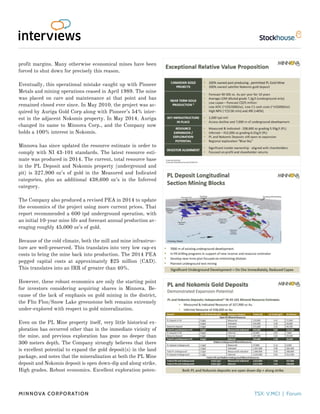
mate was produced in 2014. The current, total resource base
in the PL Deposit and Nokomis property (underground and
pit) is 327,900 oz’s of gold in the Measured and Indicated
categories, plus an additional 438,600 oz’s in the Inferred
category.
The Company also produced a revised PEA in 2014 to update
the economics of the project using more current prices. That
report recommended a 600 tpd underground operation, with
an initial 10-year mine life and forecast annual production av-
eraging roughly 45,000 oz’s of gold.
Because of the cold climate, both the mill and mine infrastruc-
ture are well-preserved. This translates into very low cap-ex
costs to bring the mine back into production. The 2014 PEA
pegged capital costs at approximately $25 million (CAD).
This translates into an IRR of greater than 40%.
However, these robust economics are only the starting point
for investors considering acquiring shares in Minnova. Be-
cause of the lack of emphasis on gold mining in the district,
the Flin Flon/Snow Lake greenstone belt remains extremely
under-explored with respect to gold mineralization.
Even on the PL Mine property itself, very little historical ex-
ploration has occurred other than in the immediate vicinity of
the mine, and previous exploration has gone no deeper than
300 meters depth. The Company strongly believes that there
is excellent potential to expand the gold deposit(s) in the land
package, and notes that the mineralization at both the PL Mine
deposit and Nokomis deposit is open down-dip and along strike.
High grades. Robust economics. Excellent exploration poten-
Minnova Corporation TSX: V.MCI | Forum
tial. Many mining companies would be content to rely upon
those positive fundamentals. However, CEO Glenn was still
not satisfied.
Having learned from the error of the previous mine operator,
Minnova’s corporate head was driven by the desire to improve
the potential economics of the project still further. Glenn’s
commitment to efficiency is a product of his background.
He started his career as a geologist and spent 9 years in that
field. During that time, Glenn worked with industry veterans
who would go on to stellar careers with such household names
in mining as Falconbridge, Barrick Gold, Cyprus Amax Min-
erals and Inmet Mining.
While that experience provided Glenn with a solid foundation
on the operations side of gold mining, he was driven to become
equally conversant with the business side of the industry.
Glenn moved on to accumulate another 15 years of financial
experience as a mining analyst and mining investment bank-
er. Pouring over the balance sheets, crunching numbers for
countless mining companies, and providing strategic advice on
M+A and financing helped to educate the Minnova CEO on
the do’s and don’ts in the business end of mining.
With those lessons in mind, Glenn focused on one additional
factor as he planned moving the PL Mine to production: tech-
nology, specifically innovative technology. With his experi-
ence as a geologist, the CEO knew that a new generation of
innovative mining equipment was being engineered, to bring
mining technology into the 21st century. In fact he named the
company to reflect this core strategy of Mining + Innovation
= Minnova.
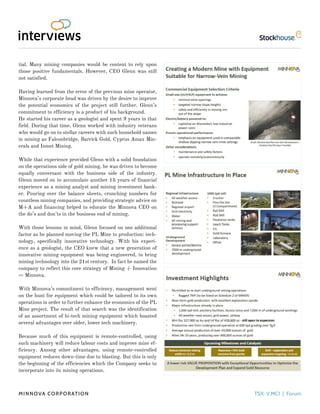
With Minnova’s commitment to efficiency, management went
on the hunt for equipment which could be tailored to its own
operations in order to further enhance the economics of the PL
Mine project. The result of that search was the identification
of an assortment of hi-tech mining equipment which boasted
several advantages over older, lower tech machinery.
Because much of this equipment is remote-controlled, using
such machinery will reduce labour costs and improve mine ef-
ficiency. Among other advantages, using remote-controlled
equipment reduces down-time due to blasting. But this is only
the beginning of the efficiencies which the Company seeks to
incorporate into its mining operations.
Minnova Corporation TSX: V.MCI | Forum
Another advantage of this state-of-the-art equipment is a signif-
icant reduction in the amount of operating space required. This
translates into the ability to reduce the dimensions of access
ramps and drifts. In turn, reducing the dimensions decreases
the volume of waste rock extracted in mining operations.
This improved mine efficiency will translate into improved per-
formance on Minnova’s bottom line in two related ways. First,
reducing mine development dimensions has a corresponding
benefit of decreasing the amount of waste rock extracted and
in turn can boost average grades.
In conventional mining, typically the minimum mining width
is approximately 2 meters. With the low profile, remote-con-
trolled equipment which Minnova plans on utilizing, minimum
mining widths can potentially be reduced to as little as 1.5
meters diameter. Reducing the total volume of rock extracted
by 25% (while extracting the same quantities of gold) trans-
lates into a commensurate improvement in the average grade
that is mined.
Using conventional mining equipment and a minimum mining
width of 2 meters, the average diluted grade of the PL Mine
deposit was estimated at over 7 g/t. Upgrading to low-profile,
remote-controlled equipment has the potential to boost aver-
age grades closer to 10 g/t. Increasing the average grades of
the ore that is mined directly implies significantly lower cash
costs.
However, because these higher grades can be achieved with-
out any reduction in the rate of production, using this hi-tech
machinery will also translate into a higher gold production
rate. The previous PEA produced in 2014 was modeled on
the use of conventional mine machinery. Through upgrading
the Company’s technology in operations at the PL Mine, those
economics can be significantly improved.
As a further element of efficiency, all of this state-of-the-art
mine equipment is electric powered. In addition to the PL
Mine Project boasting excellent infrastructure, Minnova will
also benefit from the low rates for electricity in Manitoba due
to the abundance of hydroelectric power.
With MCI’s operational strategy in place, all that remains for
management is execution. Minnova has initiated a program
of exploration and infill drilling, in preparation for compiling
a new resource estimate which it anticipates will be finished
by mid-2017. The Company is confident that it can boost the
total resources in the project above 1 million ounces.
Minnova recently completed a financing of over $4 million,
with the final tranche closing on December 2, 2016. The Com-
pany presently sits with approximately $2.5 million in cash,
sufficient to fund upcoming exploration and the new resource
estimate. With less than 35 million shares fully diluted, Min-
nova’s capital structure is very attractive.
Once the new resource estimate is in place, management will
go to the capital markets for the $25 million necessary to fi-
nance the project to production. While the Company is willing
to consider bringing in a partner for the project, it would only
go that route if the terms were clearly advantageous to MCI’s
shareholders.
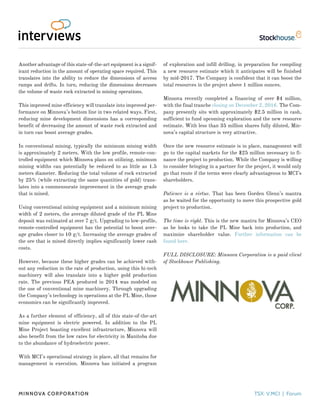
Patience is a virtue. That has been Gorden Glenn’s mantra
as he waited for the opportunity to move this prospective gold
project to production.
The time is right. This is the new mantra for Minnova’s CEO
as he looks to take the PL Mine back into production, and
maximize shareholder value. Further information can be
found here.
FULL DISCLOSURE: Minnova Corporation is a paid client
of Stockhouse Publishing.
Minnova Corporation TSX: V.MCI | Forum

Minnova - Stockhouse CEO Interview - December 2016

  • 1.
    Gold miner touse hi-tech to lower costs, boost production Metals & Mining - Gold Gorden Glenn is a very careful, prudent individual. The CEO of Minnova Corp (TSX: V.MCI, OTCQB: AGRDF, Forum) knew that the Company’s PL Mine project boasted strong economics and low cap-ex costs to move to production. However, with the severe bear market conditions in mining which per- sisted from 2011 to the end of 2015, attempting to raise capital was a punitive exercise for those mining companies who made the attempt. Dedicated to guarding shareholder capital and min- imizing dilution; the Minnova CEO refused to go to capital markets under such circumstances. Instead, Glenn bided his time and in coordination with ex- isting shareholders waited until market conditions improved so that the PL Mine could be financed to production under terms which would be advanta- geous for existing and new MCI shareholders. As conditions in the mining sector thawed dur- ing 2016; Glenn saw his window of opportunity. Minnova is now committed to taking this project to production, and is presently involved in complet- ing all preliminary steps prior to raising the capital necessary to finance the project. Originally known as the Puffy Lake Mine, the PL Mine project is a past-producing mine, located in the highly prolific Flin Flon/Snow Lake green- stone belt in northern Manitoba. While the district is known to contain abundant natural resources, past mining activity in the region has mostly cen- tered on base metals production. Established mining giant HudBay Minerals has dominated mining in the Flin Flon/Snow Lake Camp for 100 years. As primarily a base metals miner, HudBay has focused its operations on base metals production in Manitoba, and especially cop- per and zinc production. While gold mineralization has been identified in the district, because of its sig- nificant base metal processing infrastructure Hud- Bay devoted little or no resources to exploring for structurally hosted gold mineralization in the camp. Discovered in the 1960’s, the Puffy Lake property was acquired in the 1980’s by Pioneer Metals. In 1986 Pioneer made the decision to move to produc- tion with a high-grade gold deposit averaging over 7 g/t, and the first gold was poured at the Puffy Lake Mine shortly before the end of 1987. However, in addition to weak gold prices, the Puffy Lake Mine suffered from a serious operational is- sue. The original feasibility study of project eco- nomics recommended a 500 tpd mill and com- mensurate production rate. Instead, Pioneer’s management opted to construct a 1,000 tpd facil- ity, and attempted to mine Puffy Lake at close to full capacity. The reason that this created operational difficulties is due to the geology of this gold mineralization. Like many prospective gold deposits, the PL Mine project is a narrow vein/high grade ore deposit. With narrow-vein geology, efficient mine produc- tion must be careful and methodical in order to avoid extracting excessive waste rock along with the mineralized ore. Extracting too much waste rock causes overall mine grades to decline significantly, destroying Minnova Corporation TSX: V.MCI | Forum Jeff Nielson stockhouse
  • 2.
    profit margins. Manyotherwise economical mines have been forced to shut down for precisely this reason. Eventually, this operational mistake caught up with Pioneer Metals and mining operations ceased in April 1989. The mine was placed on care and maintenance at that point and has remained closed ever since. In May 2010; the project was ac- quired by Auriga Gold Corp along with Pioneer’s 54% inter- est in the adjacent Nokomis property. In May 2014; Auriga changed its name to Minnova Corp., and the Company now holds a 100% interest in Nokomis. Minnova has since updated the resource estimate in order to comply with NI 43-101 standards. The latest resource esti- mate was produced in 2014. The current, total resource base in the PL Deposit and Nokomis property (underground and pit) is 327,900 oz’s of gold in the Measured and Indicated categories, plus an additional 438,600 oz’s in the Inferred category. The Company also produced a revised PEA in 2014 to update the economics of the project using more current prices. That report recommended a 600 tpd underground operation, with an initial 10-year mine life and forecast annual production av- eraging roughly 45,000 oz’s of gold. Because of the cold climate, both the mill and mine infrastruc- ture are well-preserved. This translates into very low cap-ex costs to bring the mine back into production. The 2014 PEA pegged capital costs at approximately $25 million (CAD). This translates into an IRR of greater than 40%. However, these robust economics are only the starting point for investors considering acquiring shares in Minnova. Be- cause of the lack of emphasis on gold mining in the district, the Flin Flon/Snow Lake greenstone belt remains extremely under-explored with respect to gold mineralization. Even on the PL Mine property itself, very little historical ex- ploration has occurred other than in the immediate vicinity of the mine, and previous exploration has gone no deeper than 300 meters depth. The Company strongly believes that there is excellent potential to expand the gold deposit(s) in the land package, and notes that the mineralization at both the PL Mine deposit and Nokomis deposit is open down-dip and along strike. High grades. Robust economics. Excellent exploration poten- Minnova Corporation TSX: V.MCI | Forum
  • 3.
    tial. Many miningcompanies would be content to rely upon those positive fundamentals. However, CEO Glenn was still not satisfied. Having learned from the error of the previous mine operator, Minnova’s corporate head was driven by the desire to improve the potential economics of the project still further. Glenn’s commitment to efficiency is a product of his background. He started his career as a geologist and spent 9 years in that field. During that time, Glenn worked with industry veterans who would go on to stellar careers with such household names in mining as Falconbridge, Barrick Gold, Cyprus Amax Min- erals and Inmet Mining. While that experience provided Glenn with a solid foundation on the operations side of gold mining, he was driven to become equally conversant with the business side of the industry. Glenn moved on to accumulate another 15 years of financial experience as a mining analyst and mining investment bank- er. Pouring over the balance sheets, crunching numbers for countless mining companies, and providing strategic advice on M+A and financing helped to educate the Minnova CEO on the do’s and don’ts in the business end of mining. With those lessons in mind, Glenn focused on one additional factor as he planned moving the PL Mine to production: tech- nology, specifically innovative technology. With his experi- ence as a geologist, the CEO knew that a new generation of innovative mining equipment was being engineered, to bring mining technology into the 21st century. In fact he named the company to reflect this core strategy of Mining + Innovation = Minnova. With Minnova’s commitment to efficiency, management went on the hunt for equipment which could be tailored to its own operations in order to further enhance the economics of the PL Mine project. The result of that search was the identification of an assortment of hi-tech mining equipment which boasted several advantages over older, lower tech machinery. Because much of this equipment is remote-controlled, using such machinery will reduce labour costs and improve mine ef- ficiency. Among other advantages, using remote-controlled equipment reduces down-time due to blasting. But this is only the beginning of the efficiencies which the Company seeks to incorporate into its mining operations. Minnova Corporation TSX: V.MCI | Forum
  • 4.
    Another advantage ofthis state-of-the-art equipment is a signif- icant reduction in the amount of operating space required. This translates into the ability to reduce the dimensions of access ramps and drifts. In turn, reducing the dimensions decreases the volume of waste rock extracted in mining operations. This improved mine efficiency will translate into improved per- formance on Minnova’s bottom line in two related ways. First, reducing mine development dimensions has a corresponding benefit of decreasing the amount of waste rock extracted and in turn can boost average grades. In conventional mining, typically the minimum mining width is approximately 2 meters. With the low profile, remote-con- trolled equipment which Minnova plans on utilizing, minimum mining widths can potentially be reduced to as little as 1.5 meters diameter. Reducing the total volume of rock extracted by 25% (while extracting the same quantities of gold) trans- lates into a commensurate improvement in the average grade that is mined. Using conventional mining equipment and a minimum mining width of 2 meters, the average diluted grade of the PL Mine deposit was estimated at over 7 g/t. Upgrading to low-profile, remote-controlled equipment has the potential to boost aver- age grades closer to 10 g/t. Increasing the average grades of the ore that is mined directly implies significantly lower cash costs. However, because these higher grades can be achieved with- out any reduction in the rate of production, using this hi-tech machinery will also translate into a higher gold production rate. The previous PEA produced in 2014 was modeled on the use of conventional mine machinery. Through upgrading the Company’s technology in operations at the PL Mine, those economics can be significantly improved. As a further element of efficiency, all of this state-of-the-art mine equipment is electric powered. In addition to the PL Mine Project boasting excellent infrastructure, Minnova will also benefit from the low rates for electricity in Manitoba due to the abundance of hydroelectric power. With MCI’s operational strategy in place, all that remains for management is execution. Minnova has initiated a program of exploration and infill drilling, in preparation for compiling a new resource estimate which it anticipates will be finished by mid-2017. The Company is confident that it can boost the total resources in the project above 1 million ounces. Minnova recently completed a financing of over $4 million, with the final tranche closing on December 2, 2016. The Com- pany presently sits with approximately $2.5 million in cash, sufficient to fund upcoming exploration and the new resource estimate. With less than 35 million shares fully diluted, Min- nova’s capital structure is very attractive. Once the new resource estimate is in place, management will go to the capital markets for the $25 million necessary to fi- nance the project to production. While the Company is willing to consider bringing in a partner for the project, it would only go that route if the terms were clearly advantageous to MCI’s shareholders. Patience is a virtue. That has been Gorden Glenn’s mantra as he waited for the opportunity to move this prospective gold project to production. The time is right. This is the new mantra for Minnova’s CEO as he looks to take the PL Mine back into production, and maximize shareholder value. Further information can be found here. FULL DISCLOSURE: Minnova Corporation is a paid client of Stockhouse Publishing. Minnova Corporation TSX: V.MCI | Forum