Oceans of Opportunity
Harnessing Europe’s largest domestic energy resource


A report by the European Wind Energy Association
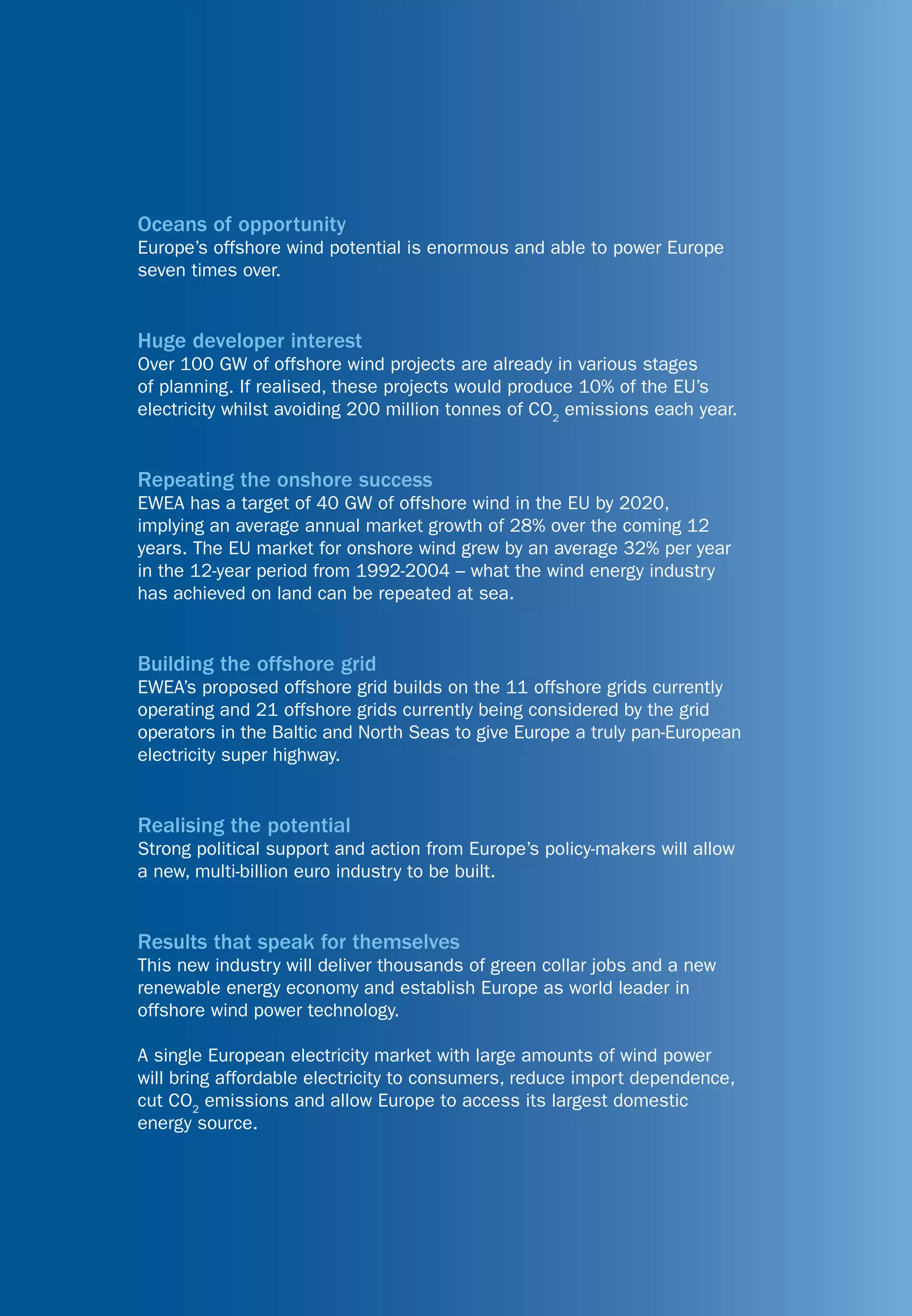
Oceans of opportunity
Europe’s offshore wind potential is enormous and able to power Europe
seven times over.


Huge developer interest
Over 100 GW of offshore wind projects are already in various stages
of planning. If realised, these projects would produce 10% of the EU’s
electricity whilst avoiding 200 million tonnes of CO2 emissions each year.


Repeating the onshore success
EWEA has a target of 40 GW of offshore wind in the EU by 2020,
implying an average annual market growth of 28% over the coming 12
years. The EU market for onshore wind grew by an average 32% per year
in the 12-year period from 1992-2004 – what the wind energy industry
has achieved on land can be repeated at sea.


Building the offshore grid
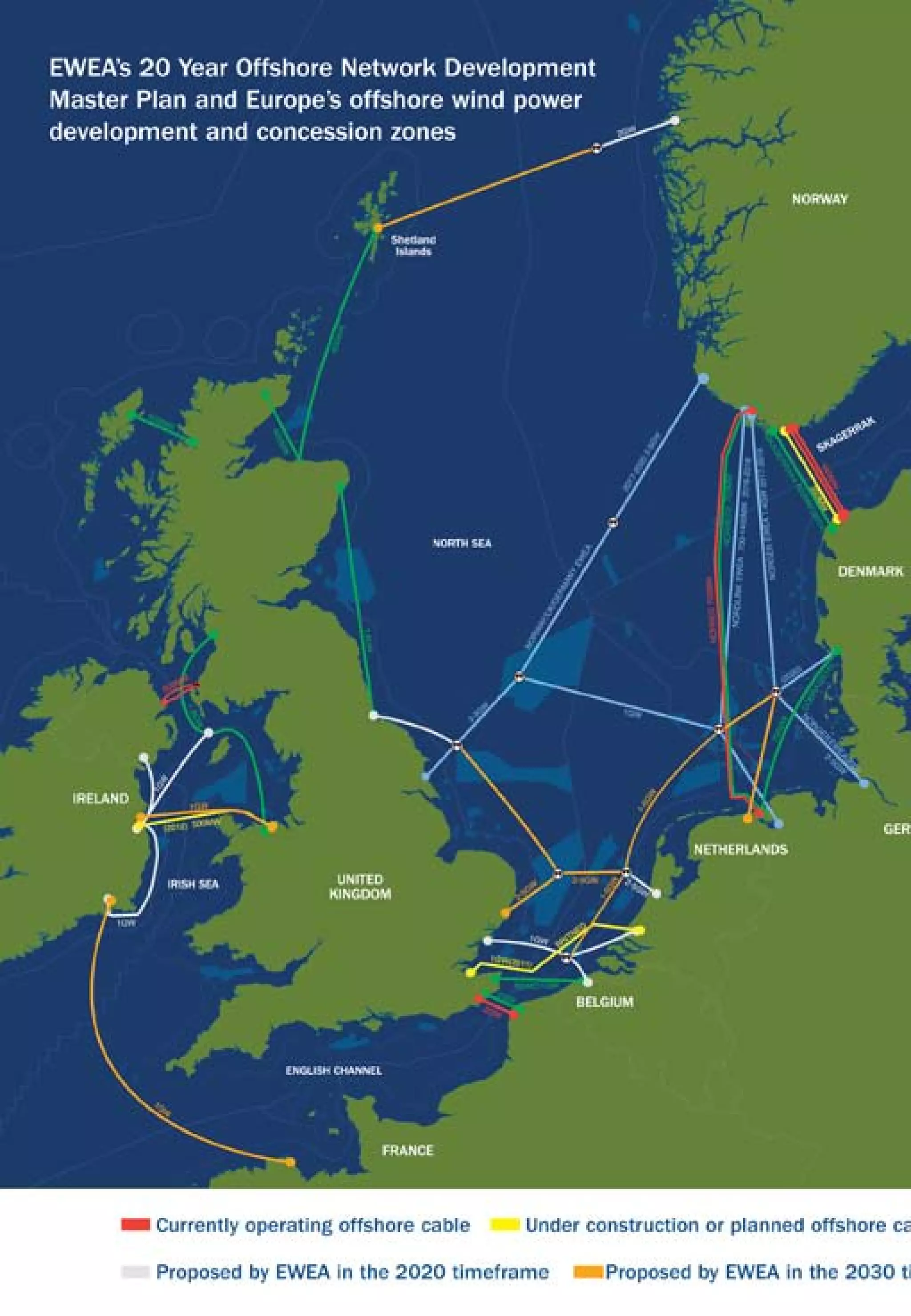
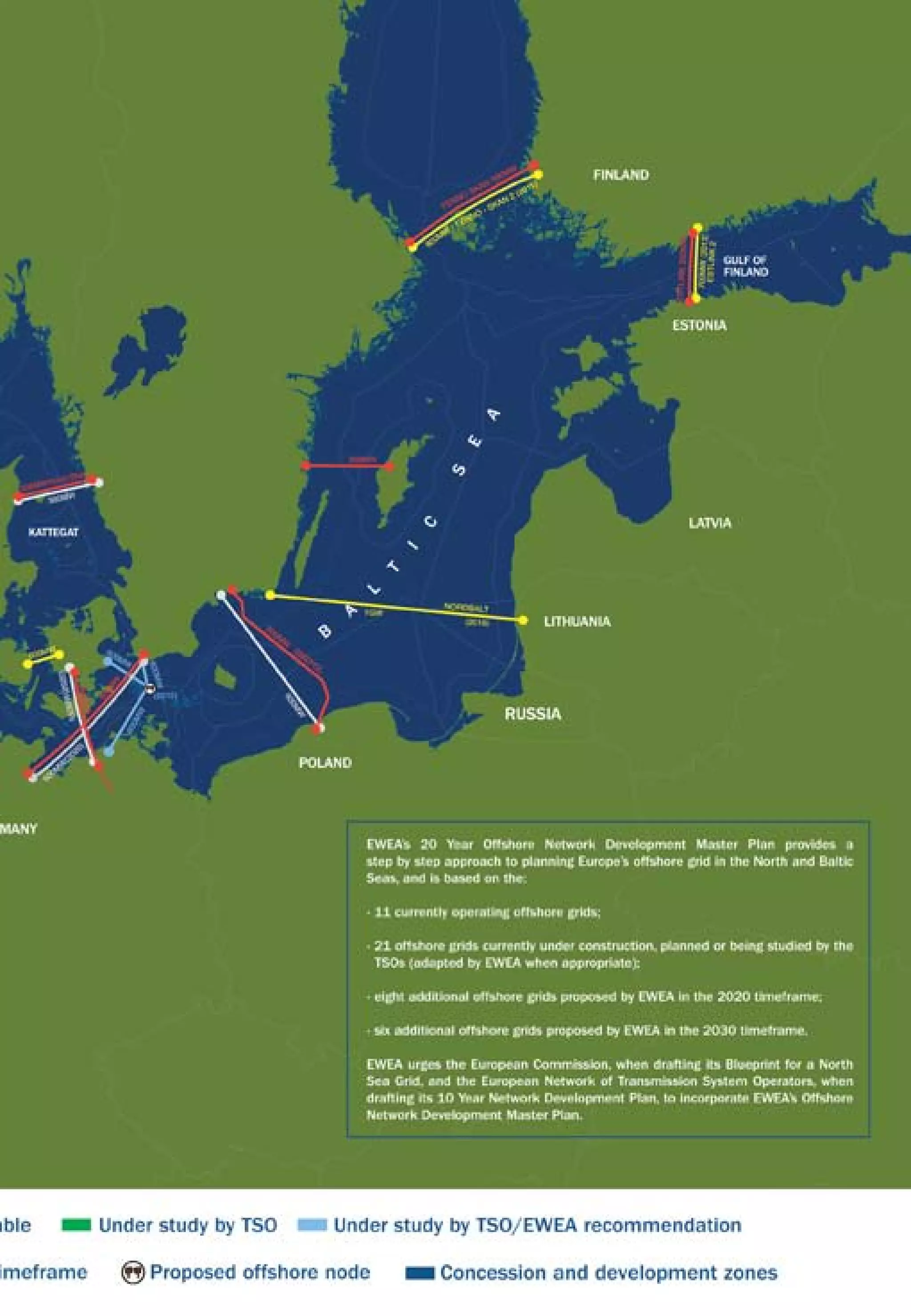
EWEA’s proposed offshore grid builds on the 11 offshore grids currently
operating and 21 offshore grids currently being considered by the grid
operators in the Baltic and North Seas to give Europe a truly pan-European
electricity super highway.


Realising the potential
Strong political support and action from Europe’s policy-makers will allow
a new, multi-billion euro industry to be built.


Results that speak for themselves
This new industry will deliver thousands of green collar jobs and a new
renewable energy economy and establish Europe as world leader in
offshore wind power technology.

A single European electricity market with large amounts of wind power
will bring affordable electricity to consumers, reduce import dependence,
cut CO2 emissions and allow Europe to access its largest domestic
energy source.
Oceans of Opportunity
Harnessing Europe’s largest domestic energy resource

By the European Wind Energy Association


September 2009


Coordinating and main authors: Dr. Nicolas Fichaux (EWEA) and Justin Wilkes (EWEA)


Main contributing authors: Frans Van Hulle (Technical Advisor to EWEA) and Aidan Cronin (Merchant Green)


Contributors: Jacopo Moccia (EWEA), Paul Wilczek (EWEA), Liming Qiao (GWEC), Laurie Jodziewicz (AWEA), Elke Zander (EWEA),
Christian Kjaer (EWEA), Glória Rodrigues (EWEA) and 22 industry interviewees


Editors: Sarah Azau (EWEA) and Chris Rose (EWEA)


Design: Jesus Quesada (EWEA)


Maps: La Tene Maps and EWEA


Cover photo: Risø Institute


                                                                             OCEANS OF OPPORTUNITY OFFSHORE REPORT     3
Contents
                  Executive Summary  .  .  .  .  .  .  .  .  .  .  .  .  .  .  .  .  .  .  .  .  .  .  .  .  .  .  .  .  .  .  .  .  .  .  .  .  .  .  .  .  .  .  .  .  .  .  .  .  .  .  .  .  .   7
                  EWEA target . . . . . . . . . . . . . . . . . . . . . . . . . . . . . . . . . . . . . . . . . . . . . . . . . . . . . . . . . . .                                                  7
                  Unlimited potential . . . . . . . . . . . . . . . . . . . . . . . . . . . . . . . . . . . . . . . . . . . . . . . . . . . . . .                                                    7
                  Over 100 GW already proposed . . . . . . . . . . . . . . . . . . . . . . . . . . . . . . . . . . . . . . . . . . . . .                                                             8
                  Grids . . . . . . . . . . . . . . . . . . . . . . . . . . . . . . . . . . . . . . . . . . . . . . . . . . . . . . . . . . . . . . . .                                              8
                  2010 will be a key year for grid development planning . . . . . . . . . . . . . . . . . . . . . . . . . . . . .                                                                    9
                  Supply chain . . . . . . . . . . . . . . . . . . . . . . . . . . . . . . . . . . . . . . . . . . . . . . . . . . . . . . . . . . .                                                 9
                  Technology . . . . . . . . . . . . . . . . . . . . . . . . . . . . . . . . . . . . . . . . . . . . . . . . . . . . . . . . . . . .                                                 9
                  Spatial planning . . . . . . . . . . . . . . . . . . . . . . . . . . . . . . . . . . . . . . . . . . . . . . . . . . . . . . . .                                                   9

1 .               The Offshore Wind Power Market of the Future  .  .  .  .  .  .  .  .  .  .  .  .  .  .  .  .  .  .  .  .  .  .  .  .  .  .  .  .  .  .  .  .                                   10
                  2008 and 2009: steady as she goes . . . . . . . . . . . . . . . . . . . . . . . . . . . . . . . . . . . . . . . .                                                              11
                  2010: annual market passes 1 GW . . . . . . . . . . . . . . . . . . . . . . . . . . . . . . . . . . . . . . . . .                                                              11
                  2011-2020 . . . . . . . . . . . . . . . . . . . . . . . . . . . . . . . . . . . . . . . . . . . . . . . . . . . . . . . . . . .                                                12
                          Annual installations. . . . . . . . . . . . . . . . . . . . . . . . . . . . . . . . . . . . . . . . . . . . . . .                                                      12
                          Wind energy production . . . . . . . . . . . . . . . . . . . . . . . . . . . . . . . . . . . . . . . . . . . .                                                         13
                          Offshore wind power investments . . . . . . . . . . . . . . . . . . . . . . . . . . . . . . . . . . . . .                                                              13
                          Avoiding climate change . . . . . . . . . . . . . . . . . . . . . . . . . . . . . . . . . . . . . . . . . . .                                                          13
                  2021-2030 . . . . . . . . . . . . . . . . . . . . . . . . . . . . . . . . . . . . . . . . . . . . . . . . . . . . . . . . . . .                                                14
                          Annual installations. . . . . . . . . . . . . . . . . . . . . . . . . . . . . . . . . . . . . . . . . . . . . . .                                                      14
                          Wind energy production . . . . . . . . . . . . . . . . . . . . . . . . . . . . . . . . . . . . . . . . . . . .                                                         14
                          Offshore wind power investments . . . . . . . . . . . . . . . . . . . . . . . . . . . . . . . . . . . . .                                                              14
                          Avoiding climate change . . . . . . . . . . . . . . . . . . . . . . . . . . . . . . . . . . . . . . . . . . .                                                          15
                  Offshore development – deeper and further. . . . . . . . . . . . . . . . . . . . . . . . . . . . . . . . . . . .                                                               16
                  Europe’s first mover advantage. . . . . . . . . . . . . . . . . . . . . . . . . . . . . . . . . . . . . . . . . . . . .                                                        17
                  The United States: hot on Europe’s heels . . . . . . . . . . . . . . . . . . . . . . . . . . . . . . . . . . . . .                                                             17
                  China: the first farm is developed . . . . . . . . . . . . . . . . . . . . . . . . . . . . . . . . . . . . . . . . . . .                                                       18

2 .               Spatial Planning: Supporting Offshore Wind and Grid Development  .  .  .  .  .  .  .  .  .  .  .  .  .  .  .  .  .  .                                                          20
                  Maritime spatial planning. . . . . . . . . . . . . . . . . . . . . . . . . . . . . . . . . . . . . . . . . . . . . . . . .                                                     21
                  Recommendations. . . . . . . . . . . . . . . . . . . . . . . . . . . . . . . . . . . . . . . . . . . . . . . . . . . . . .                                                     23
                  Offshore wind synergies with other maritime activities . . . . . . . . . . . . . . . . . . . . . . . . . . . .                                                                 23

3 .               Building the European Offshore Grid  .  .  .  .  .  .  .  .  .  .  .  .  .  .  .  .  .  .  .  .  .  .  .  .  .  .  .  .  .  .  .  .  .  .  .  .  .  .  .  .                    24
                  Introduction . . . . . . . . . . . . . . . . . . . . . . . . . . . . . . . . . . . . . . . . . . . . . . . . . . . . . . . . . .                                               25
                  Mapping and planning the offshore grid. . . . . . . . . . . . . . . . . . . . . . . . . . . . . . . . . . . . . . .                                                            25
                          Drivers for planning . . . . . . . . . . . . . . . . . . . . . . . . . . . . . . . . . . . . . . . . . . . . . . .                                                     25
                          Planning in the different maritime areas . . . . . . . . . . . . . . . . . . . . . . . . . . . . . . . .                                                               26
                          Planning approach. . . . . . . . . . . . . . . . . . . . . . . . . . . . . . . . . . . . . . . . . . . . . . . .                                                       26
                          Policy processes supporting the planning . . . . . . . . . . . . . . . . . . . . . . . . . . . . . . .                                                                 26
                  Offshore grid topology and construction . . . . . . . . . . . . . . . . . . . . . . . . . . . . . . . . . . . . . .                                                            26
                          No lack of ideas . . . . . . . . . . . . . . . . . . . . . . . . . . . . . . . . . . . . . . . . . . . . . . . . .                                                     27
                          Offshore grid technology . . . . . . . . . . . . . . . . . . . . . . . . . . . . . . . . . . . . . . . . . . .                                                         27
                          Offshore grid topology . . . . . . . . . . . . . . . . . . . . . . . . . . . . . . . . . . . . . . . . . . . . .                                                       28
                  Spotlight on specific EU-funded projects . . . . . . . . . . . . . . . . . . . . . . . . . . . . . . . . . . . . . .                                                           29


4     OCEANS OF OPPORTUNITY OFFSHORE REPORT
EWEA’s 20 Year Offshore Network Development Master Plan . . . . . . . . . . . . . . . . . . . . . . .                                                                                     29
              How an offshore grid will evolve . . . . . . . . . . . . . . . . . . . . . . . . . . . . . . . . . . . . . .                                                                      31
              Kriegers Flak. . . . . . . . . . . . . . . . . . . . . . . . . . . . . . . . . . . . . . . . . . . . . . . . . . . .                                                              31
              Offshore grid construction timeline – staged approach . . . . . . . . . . . . . . . . . . . . .                                                                                   34
      Onshore grid upgrade . . . . . . . . . . . . . . . . . . . . . . . . . . . . . . . . . . . . . . . . . . . . . . . . . . .                                                                35
      The operational and regulatory aspects of offshore grids . . . . . . . . . . . . . . . . . . . . . . . . . .                                                                              35
              Network operation: close cooperation within ENTSO. . . . . . . . . . . . . . . . . . . . . . . .                                                                                  35
              Combining transmission of offshore wind power and power trading . . . . . . . . . . . . .                                                                                         36
              Regulatory framework enabling improved market rules . . . . . . . . . . . . . . . . . . . . . .                                                                                   36
      Economic value of an offshore grid . . . . . . . . . . . . . . . . . . . . . . . . . . . . . . . . . . . . . . . . . .                                                                    37
              Intrinsic value of an offshore grid . . . . . . . . . . . . . . . . . . . . . . . . . . . . . . . . . . . . .                                                                     37
              Value of an offshore grid in the context of a stronger European transmission network .                                                                                            38
      Investments and financing . . . . . . . . . . . . . . . . . . . . . . . . . . . . . . . . . . . . . . . . . . . . . . . .                                                                 39
              Investment cost estimates. . . . . . . . . . . . . . . . . . . . . . . . . . . . . . . . . . . . . . . . . .                                                                      39
              Financing the European electricity grid . . . . . . . . . . . . . . . . . . . . . . . . . . . . . . . . .                                                                         40
      Recommendations. . . . . . . . . . . . . . . . . . . . . . . . . . . . . . . . . . . . . . . . . . . . . . . . . . . . . .                                                                41

4 .   Supply Chain  .  .  .  .  .  .  .  .  .  .  .  .  .  .  .  .  .  .  .  .  .  .  .  .  .  .  .  .  .  .  .  .  .  .  .  .  .  .  .  .  .  .  .  .  .  .  .  .  .  .  .  .  .  .  .  .  .   42
      Building a second European offshore industry . . . . . . . . . . . . . . . . . . . . . . . . . . . . . . . . . .                                                                          43
      Supply of turbines . . . . . . . . . . . . . . . . . . . . . . . . . . . . . . . . . . . . . . . . . . . . . . . . . . . . . .                                                            44
      The future for wind turbine designs . . . . . . . . . . . . . . . . . . . . . . . . . . . . . . . . . . . . . . . . . .                                                                   47
      Supply of substructures . . . . . . . . . . . . . . . . . . . . . . . . . . . . . . . . . . . . . . . . . . . . . . . . . .                                                               49
      Vessels – turbine installation, substructure installation and other vessels . . . . . . . . . . . . . .                                                                                   53
      Recommendations. . . . . . . . . . . . . . . . . . . . . . . . . . . . . . . . . . . . . . . . . . . . . . . . . . . . . .                                                                55
      A brief introduction to some vessels used in turbine installation . . . . . . . . . . . . . . . . . . . . .                                                                               56
                Vessels status for European offshore wind installation . . . . . . . . . . . . . . . . . . . . .                                                                                57
      Future innovative installation vessels . . . . . . . . . . . . . . . . . . . . . . . . . . . . . . . . . . . . . . . .                                                                    58
      Ports and harbours . . . . . . . . . . . . . . . . . . . . . . . . . . . . . . . . . . . . . . . . . . . . . . . . . . . . .                                                              58
                Harbour requirements . . . . . . . . . . . . . . . . . . . . . . . . . . . . . . . . . . . . . . . . . . . . .                                                                  58
                Existing facilities . . . . . . . . . . . . . . . . . . . . . . . . . . . . . . . . . . . . . . . . . . . . . . . . .                                                           59
                Showcase: Bremerhaven’s success story . . . . . . . . . . . . . . . . . . . . . . . . . . . . . . .                                                                             60
                Harbours of the future . . . . . . . . . . . . . . . . . . . . . . . . . . . . . . . . . . . . . . . . . . . . .                                                                61
      Future trends in manufacturing for the offshore wind industry . . . . . . . . . . . . . . . . . . . . . . .                                                                               62

5 .   Main Challenges .  .  .  .  .  .  .  .  .  .  .  .  .  .  .  .  .  .  .  .  .  .  .  .  .  .  .  .  .  .  .  .  .  .  .  .  .  .  .  .  .  .  .  .  .  .  .  .  .  .  .  .  .  .  . 64

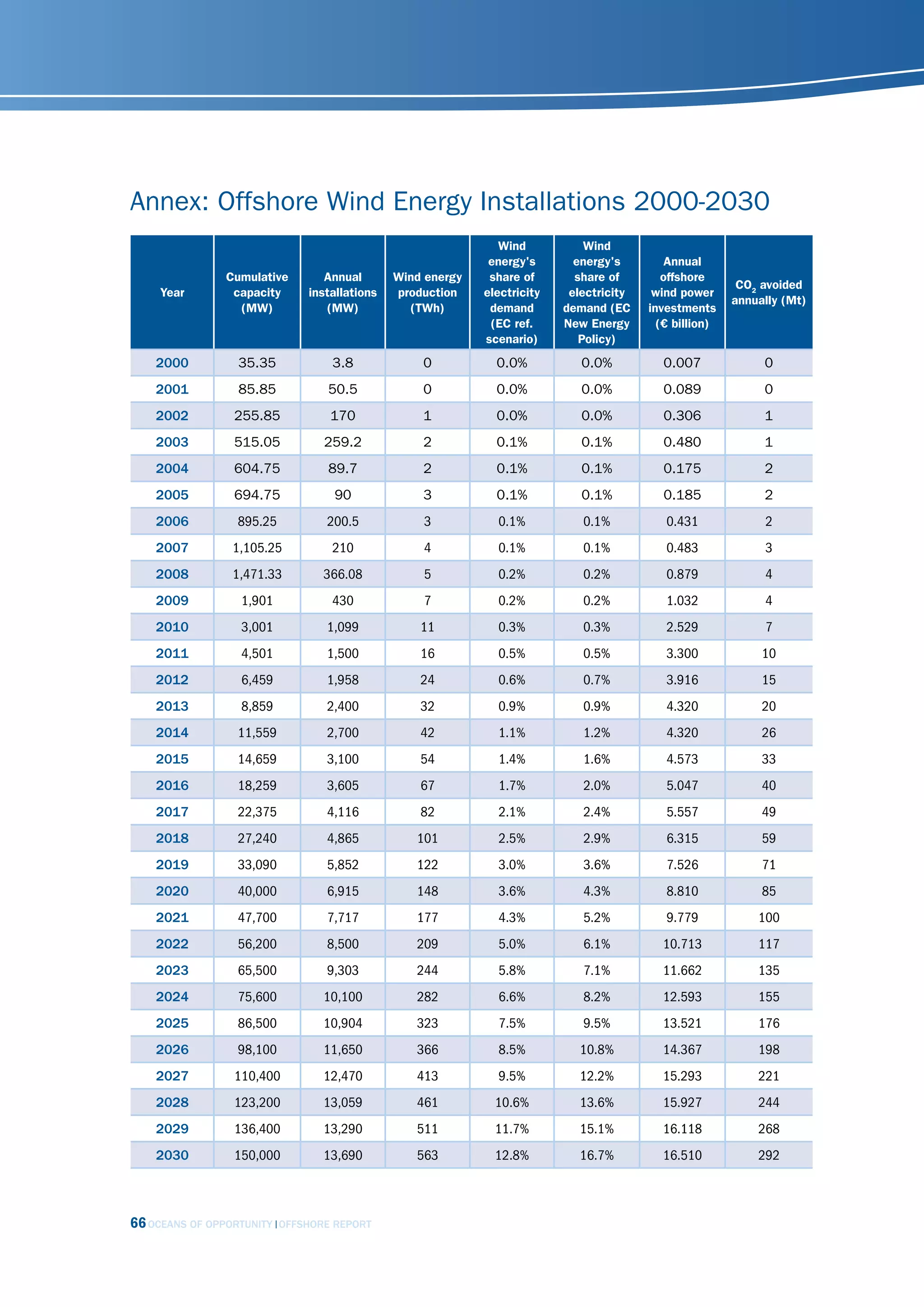
      Annex: Offshore Wind Energy Installations 2000-2030 .  .  .  .  .  .  .  .  .  .  .  .  .  .  .  .  .  .  .  .  .  .  .  .  .  .  . 66


                                                                                                                      OCEANS OF OPPORTUNITY OFFSHORE REPORT                                      5
Executive
                 Summary


                     6   OCEANS OF OPPORTUNITY OFFSHORE REPORT


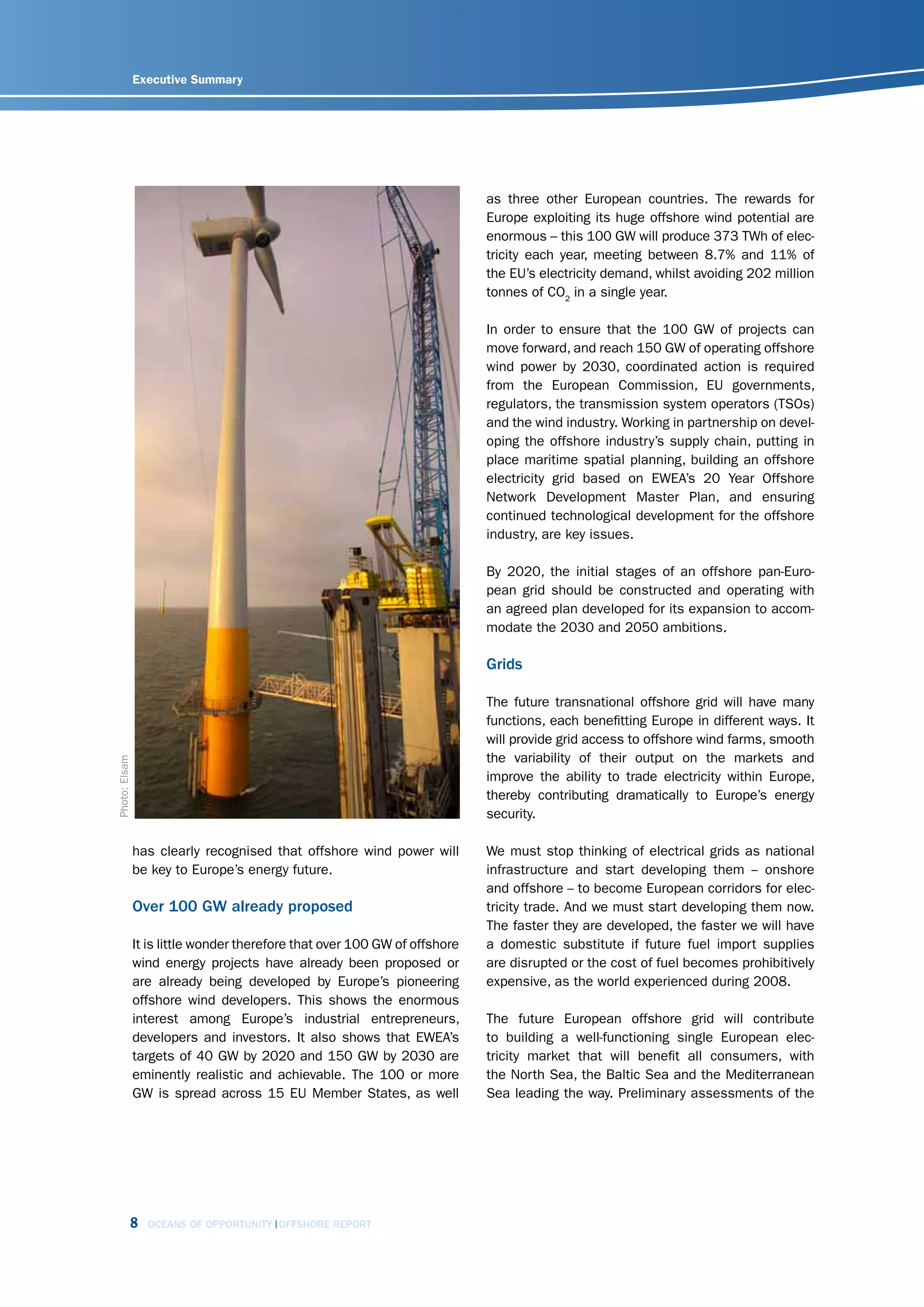
Photo: Dong Energy
Offshore wind power is vital for Europe’s future.                  will match that of the North Sea oil and gas endeavour.
Offshore wind power provides the answer to Europe’s                However, the wind energy sector has a proven track
energy and climate dilemma – exploiting an abundant                record onshore with which to boost its confidence,
energy resource which does not emit greenhouse                     and will be significantly longer lived than the oil and
gases, reduces dependence on increasingly costly                   gas sector.
fuel imports, creates thousands of jobs and provides
large quantities of indigenous affordable electricity.             To reach 40 GW of offshore wind capacity in the EU
This is recognised by the European Commission in its               by 2020 would require an average growth in annual
2008 Communication ‘Offshore Wind Energy: Action                   installations of 28% - from 366 MW in 2008 to 6,900
needed to deliver on the Energy Policy Objectives for              MW in 2020. In the 12 year period from 1992-2004,
2020 and beyond’(1).                                               the market for onshore wind capacity in the EU grew
                                                                   by an average 32% annually: from 215 MW to 5,749
Europe is faced with the global challenges of climate              MW. There is nothing to suggest that this historic
change, depleting indigenous energy resources,                     onshore wind development cannot be repeated at
increasing fuel costs and the threat of supply disrup-             sea.
tions. Over the next 12 years, according to the
European Commission, 360 GW of new electricity                     Unlimited potential
capacity – 50% of current EU capacity – needs to be
built to replace ageing European power plants and                  By 2020, most of the EU’s renewable electricity
meet the expected increase in demand. Europe must                  will be produced by onshore wind farms. Europe
use the opportunity created by the large turnover in               must, however, use the coming decade to prepare
capacity to construct a new, modern power system                   for the large-scale exploitation of its largest indig-
capable of meeting the energy and climate challenges               enous energy resource, offshore wind power. That
of the 21st century while enhancing Europe’s competi-              the wind resource over Europe’s seas is enormous
tiveness and energy independence.                                  was confirmed in June by the European Environment
                                                                   Agency’s (EEA) ‘Europe’s onshore and offshore wind
EWEA target                                                        energy potential’(2). The study states that offshore
                                                                   wind power’s economically competitive potential in
In March, at the European Wind Energy Conference                   2020 is 2,600 TWh, equal to between 60% and 70%
2009 (EWEC 2009), the European Wind Energy                         of projected electricity demand, rising to 3,400 TWh
Association (EWEA) increased its 2020 target to 230                in 2030, equal to 80% of the projected EU electricity
GW wind power capacity, including 40 GW offshore                   demand. The EEA estimates the technical potential
wind. Reaching 40 GW of offshore wind power capacity               of offshore wind in 2020 at 25,000 TWh, between
in the EU by 2020 is a challenging but manageable                  six and seven times greater than projected electricity
task. An entire new offshore wind power industry and               demand, rising to 30,000 TWh in 2030, seven times
a new supply chain must be developed on a scale that               greater than projected electricity demand. The EEA

(1)
    European Commission, 2008. ‘Offshore Wind Energy: Action needed to deliver on the Energy Policy Objectives for 2020 and
    beyond’. Available at: http://eur-lex.europa.eu/LexUriServ/LexUriServ.do?uri=COM:2008:0768:FIN:EN:PDF.
(2)
    EEA (European Environment Agency), 2009. ‘Europe’s onshore and offshore wind energy potential’. Technical report No 6/2009.


                                                                                   OCEANS OF OPPORTUNITY OFFSHORE REPORT          7
Executive Summary


                                                                            as three other European countries. The rewards for
                                                                            Europe exploiting its huge offshore wind potential are
                                                                            enormous – this 100 GW will produce 373 TWh of elec-
                                                                            tricity each year, meeting between 8.7% and 11% of
                                                                            the EU’s electricity demand, whilst avoiding 202 million
                                                                            tonnes of CO2 in a single year.

                                                                            In order to ensure that the 100 GW of projects can
                                                                            move forward, and reach 150 GW of operating offshore
                                                                            wind power by 2030, coordinated action is required
                                                                            from the European Commission, EU governments,
                                                                            regulators, the transmission system operators (TSOs)
                                                                            and the wind industry. Working in partnership on devel-
                                                                            oping the offshore industry’s supply chain, putting in
                                                                            place maritime spatial planning, building an offshore
                                                                            electricity grid based on EWEA’s 20 Year Offshore
                                                                            Network Development Master Plan, and ensuring
                                                                            continued technological development for the offshore
                                                                            industry, are key issues.

                                                                            By 2020, the initial stages of an offshore pan-Euro-
                                                                            pean grid should be constructed and operating with
                                                                            an agreed plan developed for its expansion to accom-
                                                                            modate the 2030 and 2050 ambitions.

                                                                            Grids

                                                                            The future transnational offshore grid will have many
                                                                            functions, each benefitting Europe in different ways. It
                                                                            will provide grid access to offshore wind farms, smooth
                                                                            the variability of their output on the markets and
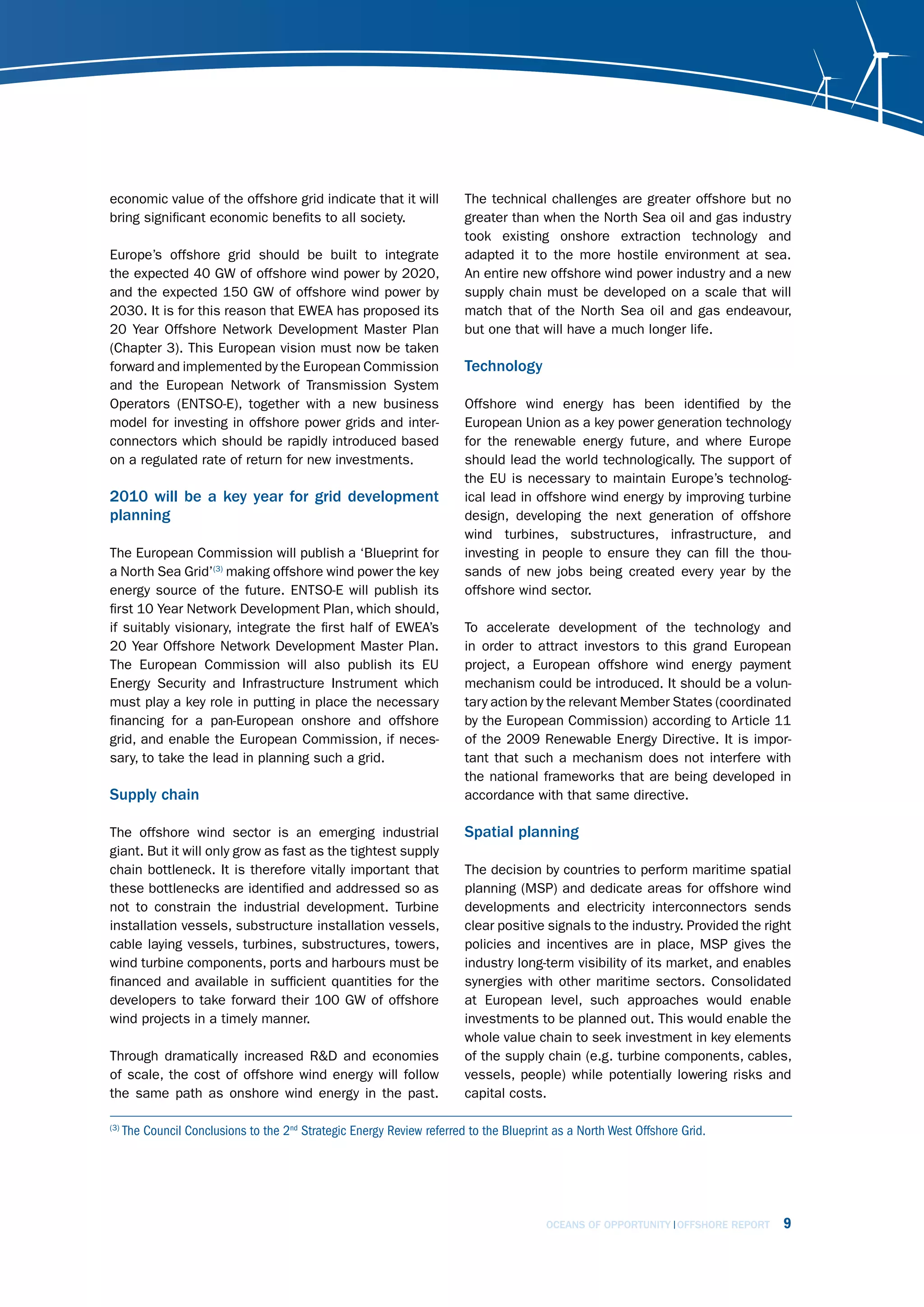
Photo: Elsam


                                                                            improve the ability to trade electricity within Europe,
                                                                            thereby contributing dramatically to Europe’s energy
                                                                            security.

               has clearly recognised that offshore wind power will         We must stop thinking of electrical grids as national
               be key to Europe’s energy future.                            infrastructure and start developing them -- onshore
                                                                            and offshore -- to become European corridors for elec-
               Over 100 GW already proposed                                 tricity trade. And we must start developing them now.
                                                                            The faster they are developed, the faster we will have
               It is little wonder therefore that over 100 GW of offshore   a domestic substitute if future fuel import supplies
               wind energy projects have already been proposed or           are disrupted or the cost of fuel becomes prohibitively
               are already being developed by Europe’s pioneering           expensive, as the world experienced during 2008.
               offshore wind developers. This shows the enormous
               interest among Europe’s industrial entrepreneurs,            The future European offshore grid will contribute
               developers and investors. It also shows that EWEA’s          to building a well-functioning single European elec-
               targets of 40 GW by 2020 and 150 GW by 2030 are              tricity market that will benefit all consumers, with
               eminently realistic and achievable. The 100 or more          the North Sea, the Baltic Sea and the Mediterranean
               GW is spread across 15 EU Member States, as well             Sea leading the way. Preliminary assessments of the


           8     OCEANS OF OPPORTUNITY OFFSHORE REPORT
economic value of the offshore grid indicate that it will                The technical challenges are greater offshore but no
bring significant economic benefits to all society.                      greater than when the North Sea oil and gas industry
                                                                         took existing onshore extraction technology and
Europe’s offshore grid should be built to integrate                      adapted it to the more hostile environment at sea.
the expected 40 GW of offshore wind power by 2020,                       An entire new offshore wind power industry and a new
and the expected 150 GW of offshore wind power by                        supply chain must be developed on a scale that will
2030. It is for this reason that EWEA has proposed its                   match that of the North Sea oil and gas endeavour,
20 Year Offshore Network Development Master Plan                         but one that will have a much longer life.
(Chapter 3). This European vision must now be taken
forward and implemented by the European Commission                       Technology
and the European Network of Transmission System
Operators (ENTSO-E), together with a new business                        Offshore wind energy has been identified by the
model for investing in offshore power grids and inter-                   European Union as a key power generation technology
connectors which should be rapidly introduced based                      for the renewable energy future, and where Europe
on a regulated rate of return for new investments.                       should lead the world technologically. The support of
                                                                         the EU is necessary to maintain Europe’s technolog-
2010 will be a key year for grid development                             ical lead in offshore wind energy by improving turbine
planning                                                                 design, developing the next generation of offshore
                                                                         wind turbines, substructures, infrastructure, and
The European Commission will publish a ‘Blueprint for                    investing in people to ensure they can fill the thou-
a North Sea Grid’(3) making offshore wind power the key                  sands of new jobs being created every year by the
energy source of the future. ENTSO-E will publish its                    offshore wind sector.
first 10 Year Network Development Plan, which should,
if suitably visionary, integrate the first half of EWEA’s                To accelerate development of the technology and
20 Year Offshore Network Development Master Plan.                        in order to attract investors to this grand European
The European Commission will also publish its EU                         project, a European offshore wind energy payment
Energy Security and Infrastructure Instrument which                      mechanism could be introduced. It should be a volun-
must play a key role in putting in place the necessary                   tary action by the relevant Member States (coordinated
financing for a pan-European onshore and offshore                        by the European Commission) according to Article 11
grid, and enable the European Commission, if neces-                      of the 2009 Renewable Energy Directive. It is impor-
sary, to take the lead in planning such a grid.                          tant that such a mechanism does not interfere with
                                                                         the national frameworks that are being developed in
Supply chain                                                             accordance with that same directive.

The offshore wind sector is an emerging industrial                       Spatial planning
giant. But it will only grow as fast as the tightest supply
chain bottleneck. It is therefore vitally important that                 The decision by countries to perform maritime spatial
these bottlenecks are identified and addressed so as                     planning (MSP) and dedicate areas for offshore wind
not to constrain the industrial development. Turbine                     developments and electricity interconnectors sends
installation vessels, substructure installation vessels,                 clear positive signals to the industry. Provided the right
cable laying vessels, turbines, substructures, towers,                   policies and incentives are in place, MSP gives the
wind turbine components, ports and harbours must be                      industry long-term visibility of its market, and enables
financed and available in sufficient quantities for the                  synergies with other maritime sectors. Consolidated
developers to take forward their 100 GW of offshore                      at European level, such approaches would enable
wind projects in a timely manner.                                        investments to be planned out. This would enable the
                                                                         whole value chain to seek investment in key elements
Through dramatically increased R&D and economies                         of the supply chain (e.g. turbine components, cables,
of scale, the cost of offshore wind energy will follow                   vessels, people) while potentially lowering risks and
the same path as onshore wind energy in the past.                        capital costs.

(3)
      The Council Conclusions to the 2nd Strategic Energy Review referred to the Blueprint as a North West Offshore Grid.


                                                                                         OCEANS OF OPPORTUNITY OFFSHORE REPORT   9
Chapter 1


                 The Offshore
                 Wind Power
                 Market of
                 the Future


                     10 OCEANS OF OPPORTUNITY   OFFSHORE REPORT


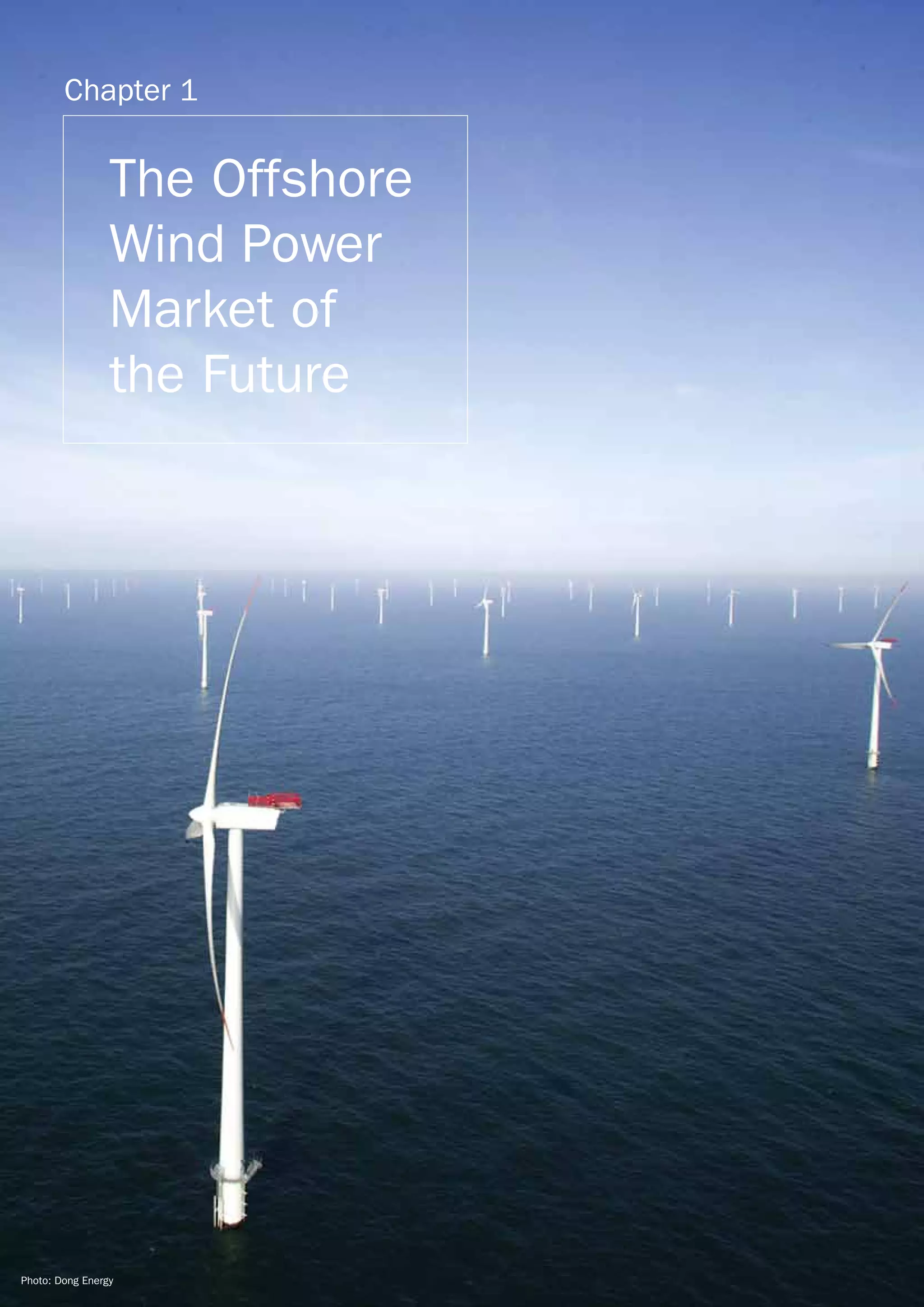
Photo: Dong Energy
2008 and 2009: steady as she goes                          2009 has seen strong market development with a
                                                           much larger number of projects beginning construc-
2008 saw 366 MW of offshore wind capacity installed        tion, under construction, expected to be completed, or
in the EU (compared to 8,111 MW onshore) in seven          completed during the course of the year. EWEA antici-
separate offshore wind farms, taking the total installed   pates an annual market in 2009 of approximately 420
capacity to 1,471 MW in eight Member States. The UK        MW, including the first large-scale floating prototype
installed more than any other country during 2008 and      off the coast of Norway.
became the nation with the largest installed offshore
capacity, overtaking Denmark. Activity in 2008 was         By the end of 2009 EWEA expects a total installed
dominated by ongoing work at Lynn and Inner Dowsing        offshore capacity of just under 2,000 MW in Europe.
wind farms in the UK and by Princess Amalia in the
Netherlands.                                               2010: annual market passes 1 GW

In addition to these large projects, Phase 1 of Thornton   Assuming the financial crisis does not blow the
Bank in Belgium was developed together with two near-      offshore wind industry off course, 2010 will be a
shore projects, one in Finland and one in Germany. In      defining year for the offshore wind power market in
addition, an 80 kW turbine (not connected to the grid)     Europe. Over 1,000 MW (1 GW) is expected to be
was piloted on a floating platform in a water depth        installed. Depending on the amount of wind power
of 108m in Italy. Subsequently decommissioned, this        installed onshore, it looks as if Europe’s 2010
turbine was the first to take the offshore wind industry   offshore market could make up approximately 10%
into the Mediterranean Sea, which, together with           of Europe’s total annual wind market, making the
developments in the Baltic Sea, North Sea and Irish        offshore industry a significant mainstream energy
Sea, highlights the pan-European nature of today’s         player in its own right.
offshore wind industry.


  Summary of the offshore wind energy market in the EU in 2010:

  • Total installed capacity of 3,000 MW                   • Meeting 0.3% of total EU electricity demand

  • Annual installations of 1,100 MW                       • Avoiding 7 Mt of CO2 annually

  • Electricity production of 11 TWh                       • Annual investments in wind turbines of €2.5 billion


                                                                         OCEANS OF OPPORTUNITY OFFSHORE REPORT   11
Chapter 1 - The Offshore Wind Power Market of the Future


      100 GW and counting…

      In summer 2009 EWEA surveyed those of its mem-                           phase or proposed by project developers or govern-
      bers active in developing and supplying the offshore                     ment proposed development zones. This 100 GW of
      wind industry, in order to underpin its scenario devel-                  offshore wind projects shows tremendous developer
      opment for 2030. The project pipelines supplied                          interest and provides a good indication that EWEA’s
      by offshore wind developers are presented in the                         expectation that 150 GW of offshore wind power will
      Offshore Wind Map and outlined in this report. In all,                   be operating by 2030 is both accurate and credible(4).
      EWEA has identified proposals for over 100 GW of
      offshore wind projects in European waters - either                       To see the updated Offshore Wind Map:
      under construction, consented, in the consenting                         www.ewea.org/offshore


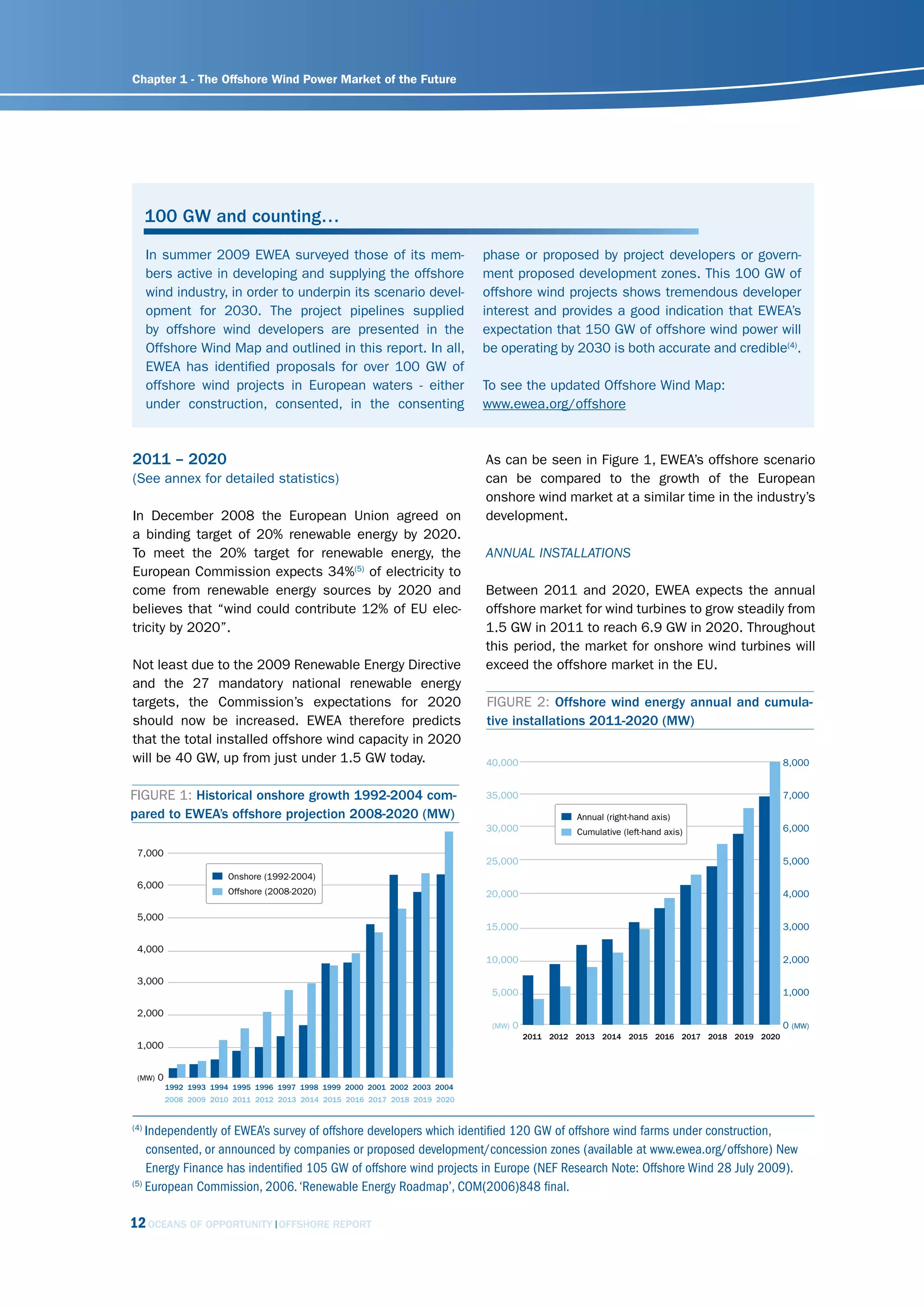
2011 – 2020                                                                    As can be seen in Figure 1, EWEA’s offshore scenario
(See annex for detailed statistics)                                            can be compared to the growth of the European
                                                                               onshore wind market at a similar time in the industry’s
In December 2008 the European Union agreed on                                  development.
a binding target of 20% renewable energy by 2020.
To meet the 20% target for renewable energy, the                               AnnuAl instAllAtions
European Commission expects 34%(5) of electricity to
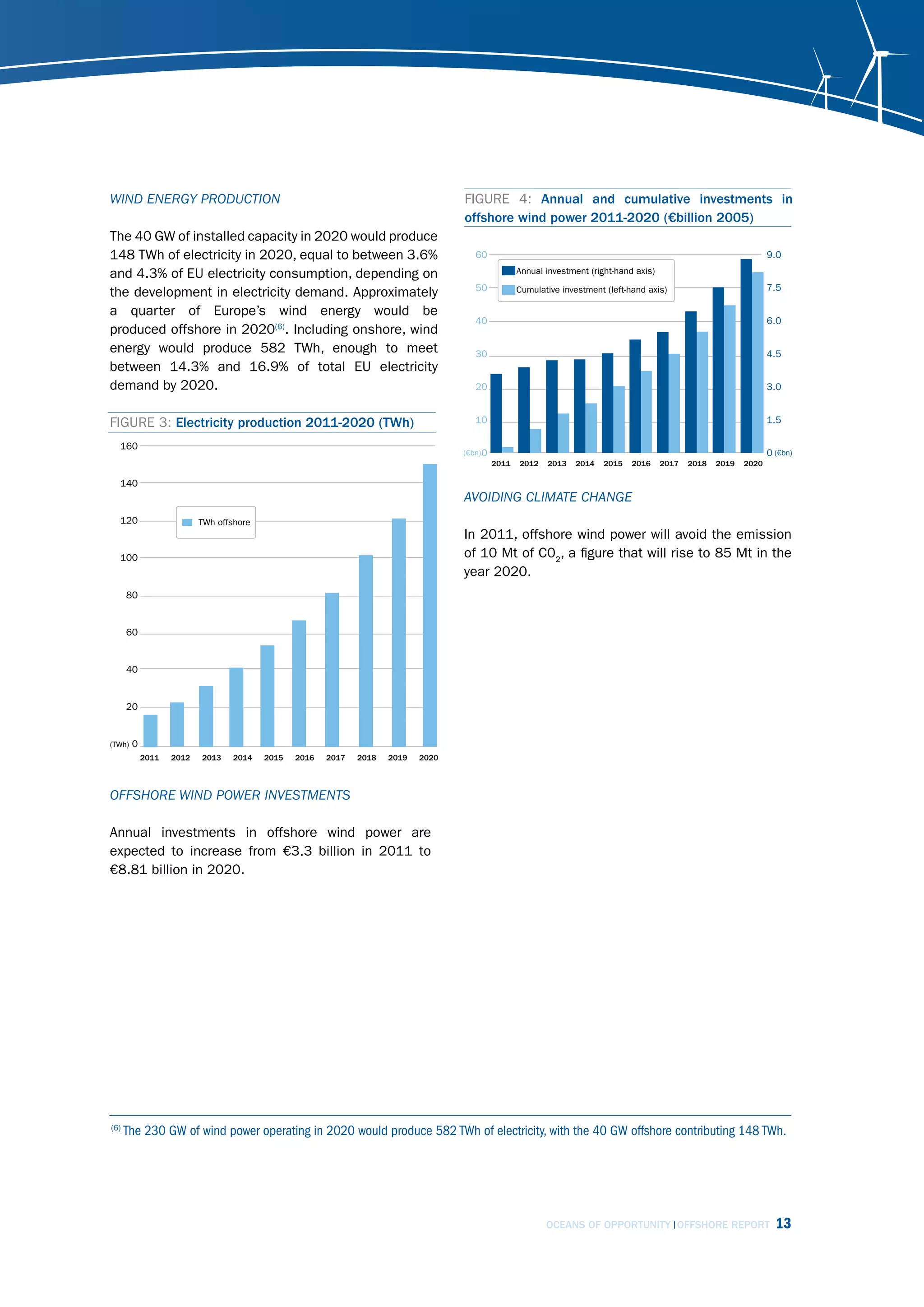
come from renewable energy sources by 2020 and                                 Between 2011 and 2020, EWEA expects the annual
believes that “wind could contribute 12% of EU elec-                           offshore market for wind turbines to grow steadily from
tricity by 2020”.                                                              1.5 GW in 2011 to reach 6.9 GW in 2020. Throughout
                                                                               this period, the market for onshore wind turbines will
Not least due to the 2009 Renewable Energy Directive                           exceed the offshore market in the EU.
and the 27 mandatory national renewable energy
targets, the Commission’s expectations for 2020                                FIGURE 2: Offshore wind energy annual and cumula-
should now be increased. EWEA therefore predicts                               tive installations 2011-2020 (MW)
that the total installed offshore wind capacity in 2020
will be 40 GW, up from just under 1.5 GW today.                                40,000                                                          8,000


FIGURE 1: Historical onshore growth 1992-2004 com-                             35,000                                                          7,000
pared to EWEA’s offshore projection 2008-2020 (MW)                                                   Annual (right-hand axis)
                                                                               30,000                Cumulative (left-hand axis)               6,000

 7,000
                                                                               25,000                                                          5,000
                         Onshore (1992-2004)
 6,000
                         Offshore (2008-2020)                                  20,000                                                          4,000

 5,000
                                                                               15,000                                                          3,000

 4,000
                                                                               10,000                                                          2,000

 3,000
                                                                                5,000                                                          1,000

 2,000
                                                                                (MW)   0                                                       0 (MW)
                                                                                           2011 2012 2013 2014 2015 2016 2017 2018 2019 2020
 1,000


 (MW)   0
            1992 1993 1994 1995 1996 1997 1998 1999 2000 2001 2002 2003 2004
            2008 2009 2010 2011 2012 2013 2014 2015 2016 2017 2018 2019 2020


(4)
    Independently of EWEA’s survey of offshore developers which identified 120 GW of offshore wind farms under construction,
    consented, or announced by companies or proposed development/concession zones (available at www.ewea.org/offshore) New
    Energy Finance has indentified 105 GW of offshore wind projects in Europe (NEF Research Note: Offshore Wind 28 July 2009).
(5)
    European Commission, 2006. ‘Renewable Energy Roadmap’, COM(2006)848 final.

12 OCEANS OF OPPORTUNITY             OFFSHORE REPORT
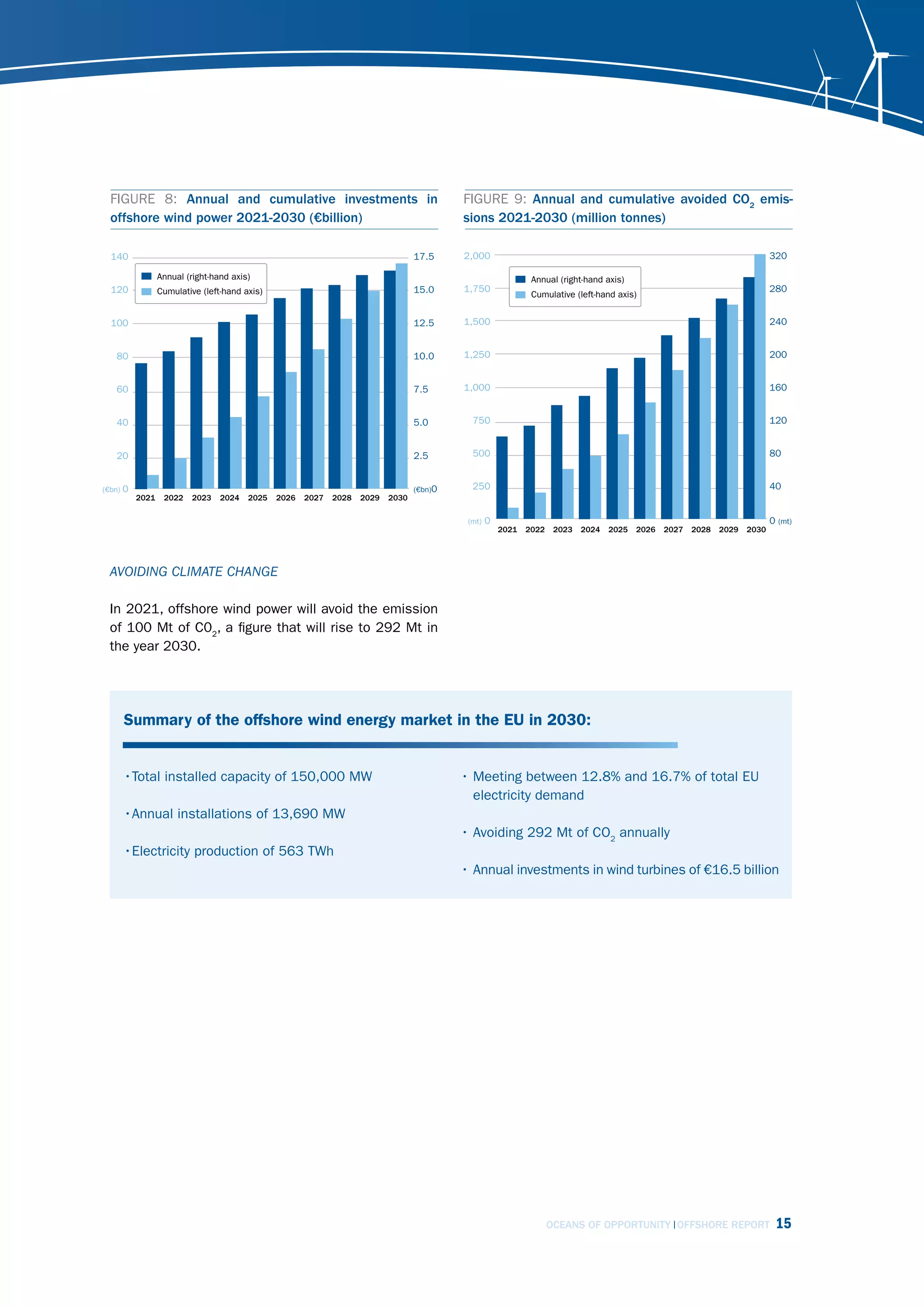
Wind EnErgy Production                                                             FIGURE 4: Annual and cumulative investments in
                                                                                   offshore wind power 2011-2020 (€billion 2005)
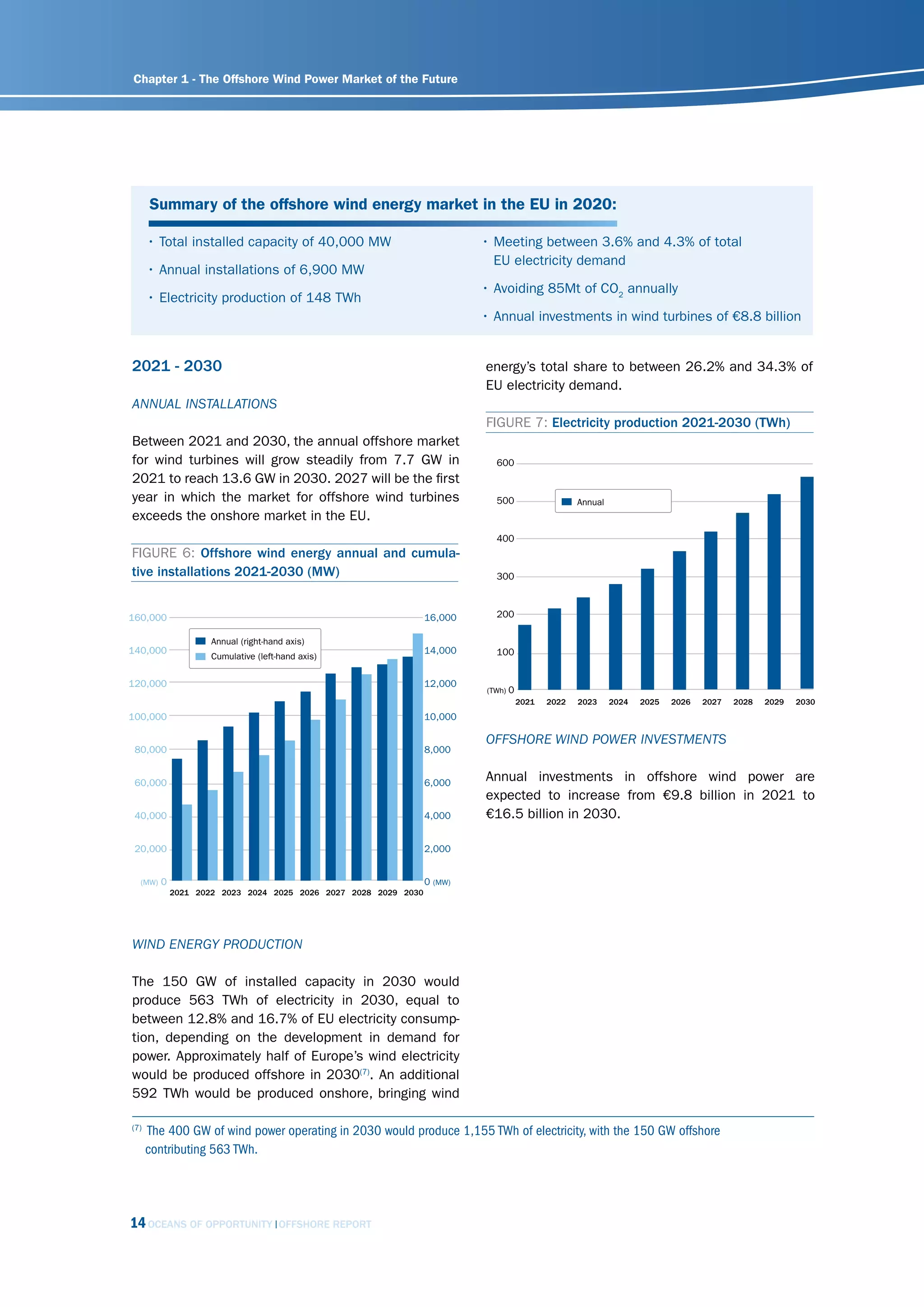
The 40 GW of installed capacity in 2020 would produce
148 TWh of electricity in 2020, equal to between 3.6%                                 60                                                                              9.0

and 4.3% of EU electricity consumption, depending on                                                Annual investment (right-hand axis)
                                                                                      50                                                                              7.5
the development in electricity demand. Approximately                                                Cumulative investment (left-hand axis)

a quarter of Europe’s wind energy would be
                                                                                      40                                                                              6.0
produced offshore in 2020(6). Including onshore, wind
energy would produce 582 TWh, enough to meet                                          30                                                                              4.5
between 14.3% and 16.9% of total EU electricity
demand by 2020.                                                                       20                                                                              3.0


FIGURE 3: Electricity production 2011-2020 (TWh)                                      10                                                                              1.5

  160
                                                                                   (€bn) 0                                                                            0 (€bn)
                                                                                             2011   2012   2013   2014    2015   2016     2017   2018   2019   2020

  140
                                                                                   Avoiding climAtE chAngE
  120                     TWh offshore
                                                                                   In 2011, offshore wind power will avoid the emission
  100                                                                              of 10 Mt of C02, a figure that will rise to 85 Mt in the
                                                                                   year 2020.
      80


      60


      40


      20


(TWh)   0
            2011   2012   2013    2014   2015   2016   2017   2018   2019   2020


offshorE Wind PoWEr invEstmEnts

Annual investments in offshore wind power are
expected to increase from €3.3 billion in 2011 to
€8.81 billion in 2020.


(6)
      The 230 GW of wind power operating in 2020 would produce 582 TWh of electricity, with the 40 GW offshore contributing 148 TWh.


                                                                                                           OCEANS OF OPPORTUNITY OFFSHORE REPORT                        13
Chapter 1 - The Offshore Wind Power Market of the Future


      Summary of the offshore wind energy market in the EU in 2020:

      • Total installed capacity of 40,000 MW                               • Meeting between 3.6% and 4.3% of total
                                                                              EU electricity demand
      • Annual installations of 6,900 MW
                                                                            • Avoiding 85Mt of CO2 annually
      • Electricity production of 148 TWh
                                                                            • Annual investments in wind turbines of €8.8 billion


2021 - 2030                                                                 energy’s total share to between 26.2% and 34.3% of
                                                                            EU electricity demand.
AnnuAl instAllAtions
                                                                            FIGURE 7: Electricity production 2021-2030 (TWh)
Between 2021 and 2030, the annual offshore market
for wind turbines will grow steadily from 7.7 GW in                           600
2021 to reach 13.6 GW in 2030. 2027 will be the first
year in which the market for offshore wind turbines                           500                   Annual
exceeds the onshore market in the EU.
                                                                              400
FIGURE 6: Offshore wind energy annual and cumula-
tive installations 2021-2030 (MW)                                             300


160,000                                                          16,000       200

                     Annual (right-hand axis)
140,000                                                          14,000       100
                     Cumulative (left-hand axis)


120,000                                                          12,000
                                                                            (TWh) 0
                                                                                      2021   2022   2023     2024   2025   2026   2027   2028   2029   2030
100,000                                                          10,000

                                                                            offshorE Wind PoWEr invEstmEnts
 80,000                                                          8,000


 60,000                                                          6,000
                                                                            Annual investments in offshore wind power are
                                                                            expected to increase from €9.8 billion in 2021 to
 40,000                                                          4,000      €16.5 billion in 2030.

 20,000                                                          2,000


  (MW)   0                                                       0   (MW)
             2021 2022 2023 2024 2025 2026 2027 2028 2029 2030


Wind EnErgy Production

The 150 GW of installed capacity in 2030 would
produce 563 TWh of electricity in 2030, equal to
between 12.8% and 16.7% of EU electricity consump-
tion, depending on the development in demand for
power. Approximately half of Europe’s wind electricity
would be produced offshore in 2030(7). An additional
592 TWh would be produced onshore, bringing wind

(7)
      The 400 GW of wind power operating in 2030 would produce 1,155 TWh of electricity, with the 150 GW offshore
      contributing 563 TWh.


14 OCEANS OF OPPORTUNITY              OFFSHORE REPORT
FIGURE 8: Annual and cumulative investments in                                           FIGURE 9: Annual and cumulative avoided CO2 emis-
  offshore wind power 2021-2030 (€billion)                                                 sions 2021-2030 (million tonnes)

  140                                                                             17.5     2,000                                                                              320

                 Annual (right-hand axis)                                                                      Annual (right-hand axis)
  120            Cumulative (left-hand axis)                                      15.0     1,750                                                                              280
                                                                                                               Cumulative (left-hand axis)


  100                                                                             12.5     1,500                                                                              240


   80                                                                             10.0     1,250                                                                              200


   60                                                                             7.5      1,000                                                                              160


   40                                                                             5.0        750                                                                              120


   20                                                                             2.5        500                                                                              80


(€bn) 0                                                                           (€bn)0     250                                                                              40
          2021    2022    2023   2024   2025   2026   2027   2028   2029   2030

                                                                                            (mt)   0                                                                          0 (mt)
                                                                                                       2021   2022    2023   2024   2025   2026   2027   2028   2029   2030


 Avoiding climAtE chAngE

 In 2021, offshore wind power will avoid the emission
 of 100 Mt of C02, a figure that will rise to 292 Mt in
 the year 2030.


     Summary of the offshore wind energy market in the EU in 2030:


     •Total installed capacity of 150,000 MW                                               • Meeting between 12.8% and 16.7% of total EU
                                                                                             electricity demand
     •Annual installations of 13,690 MW
                                                                                           • Avoiding 292 Mt of CO2 annually
     •Electricity production of 563 TWh
                                                                                           • Annual investments in wind turbines of €16.5 billion


                                                                                                                     OCEANS OF OPPORTUNITY OFFSHORE REPORT                     15
Chapter 1 - The Offshore Wind Power Market of the Future


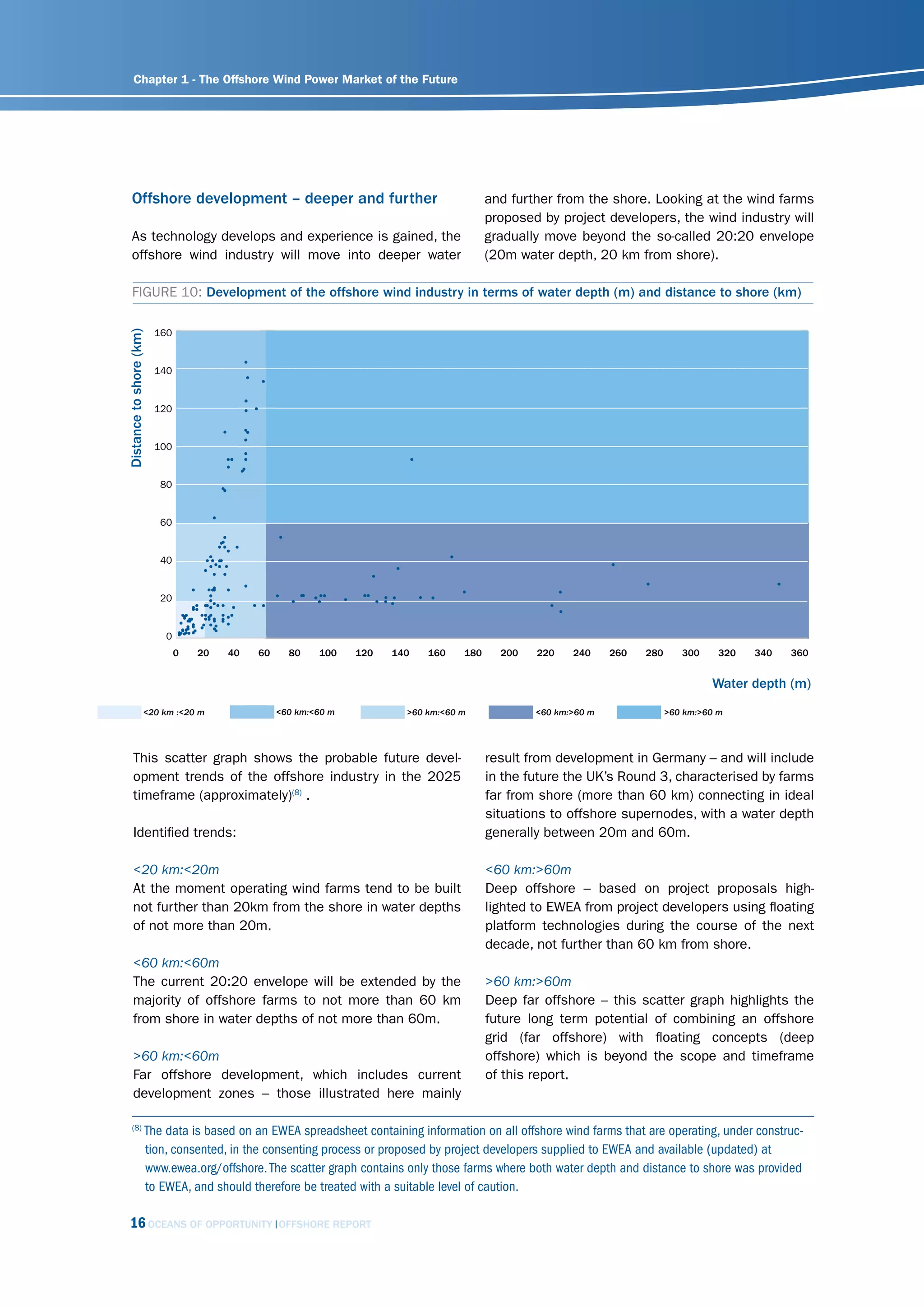
    Offshore development – deeper and further                                               and further from the shore. Looking at the wind farms
                                                                                            proposed by project developers, the wind industry will
    As technology develops and experience is gained, the                                    gradually move beyond the so-called 20:20 envelope
    offshore wind industry will move into deeper water                                      (20m water depth, 20 km from shore).

     FIGURE 10: Development of the offshore wind industry in terms of water depth (m) and distance to shore (km)

                          160
Distance to shore (km)


                          140


                          120


                          100


                            80


                            60


                            40


                            20


                             0
                                 0   20   40   60     80    100    120   140   160    180     200   220    240     260   280      300     320   340   360


                                                                                                                                        Water depth (m)
                    <20 km :<20 m                   <60 km:<60 m           >60 km:<60 m             <60 km:>60 m               >60 km:>60 m


      This scatter graph shows the probable future devel-                                   result from development in Germany – and will include
      opment trends of the offshore industry in the 2025                                    in the future the UK’s Round 3, characterised by farms
      timeframe (approximately)(8) .                                                        far from shore (more than 60 km) connecting in ideal
                                                                                            situations to offshore supernodes, with a water depth
      Identified trends:                                                                    generally between 20m and 60m.

      <20 km:<20m                                                                           <60 km:>60m
      At the moment operating wind farms tend to be built                                   Deep offshore – based on project proposals high-
      not further than 20km from the shore in water depths                                  lighted to EWEA from project developers using floating
      of not more than 20m.                                                                 platform technologies during the course of the next
                                                                                            decade, not further than 60 km from shore.
      <60 km:<60m
      The current 20:20 envelope will be extended by the                                    >60 km:>60m
      majority of offshore farms to not more than 60 km                                     Deep far offshore – this scatter graph highlights the
      from shore in water depths of not more than 60m.                                      future long term potential of combining an offshore
                                                                                            grid (far offshore) with floating concepts (deep
      >60 km:<60m                                                                           offshore) which is beyond the scope and timeframe
      Far offshore development, which includes current                                      of this report.
      development zones – those illustrated here mainly

     (8)
                         The data is based on an EWEA spreadsheet containing information on all offshore wind farms that are operating, under construc-
                         tion, consented, in the consenting process or proposed by project developers supplied to EWEA and available (updated) at
                         www.ewea.org/offshore. The scatter graph contains only those farms where both water depth and distance to shore was provided
                         to EWEA, and should therefore be treated with a suitable level of caution.

  16 OCEANS OF OPPORTUNITY                          OFFSHORE REPORT
Europe’s first mover offshore advantage                              Rhode Island and New Jersey each conducted compet-
                                                                     itive processes to choose developers to work on
To date, all fully operational offshore wind farms are               projects off their shores, demonstrating that state
in Europe. However, two countries outside Europe in                  leadership is driving much of the interest in offshore
particular are determined to exploit their offshore                  wind projects in the U.S.
wind potential, providing European companies with
significant opportunities for manufacturing and tech-                A Delaware utility signed a Power Purchase Agreement
nology exports, experienced developers, project                      with a developer, committing that state to a project in
planners, infrastructure experts, and installation                   the near future.
equipment.
                                                                     The wind industry welcomed the release of a new
The United States: hot on Europe’s heels(9)                          regulatory framework from the Minerals Management
                                                                     Service (MMS) of the Department of the Interior after
The prospects for wind energy projects off the coasts                much delay. President Bush signed the Energy Policy
of the United States brightened in 2008 and 2009. A                  Act of 2005 setting MMS as the lead regulatory agency
government report(10) recognised significant potential               for projects in federal waters, but the final rules were
for offshore wind’s contribution. Two states completed               not released until April 2009.
competitive processes for proposed projects, one
company signed a Power Purchase Agreement with                       And not to be left behind, states surrounding the
a major utility, and a final regulatory framework was                Great Lakes have also showed interest over the past
released by the Obama Administration in its first 100                two years in pursuing projects in America’s fresh
days(11).                                                            water. Michigan and Wisconsin both completed major
                                                                     studies regarding the potential for offshore wind, Ohio
In May 2008, the U.S. Department of Energy released                  is conducting a feasibility study for a small project in
“20% Wind Energy by 2030: Increasing Wind Energy’s                   Lake Erie, and the New York Power Authority asked
Contribution to U.S. Electricity Supply”, which investi-             for expressions of interest for projects in Lake Ontario
gated the feasibility of wind energy providing 20% of                and Lake Erie in the first half of 2009.
U.S. electricity. The report found that more than 300
GW of wind energy capacity would need to be installed,               On 22 April 2009, President Barack Obama said “…
including 54 GW offshore.                                            we are establishing a programme to authorise -- for


                                                                                                                                        Photo: Siemens


(9)
   Contribution from Laurie Jodziewicz, American Wind Energy Association.
(10)
    U.S. Department of Energy, 2008. ‘20% Wind Energy by 2030: Increasing Wind Energy’s Contribution to U.S. Electricity Supply’
   http://www.20percentwind.org/20p.aspx?page=Report. May 2008.
(11)
    http://www.doi.gov/news/09_News_Releases/031709.html.

                                                                                     OCEANS OF OPPORTUNITY OFFSHORE REPORT         17
Chapter 1 - The Offshore Wind Power Market of the Future


Photo: Siemens


             the very first time -- the leasing of federal waters for   coastline to 20m out to sea covers about 157,000
             projects to generate electricity from wind as well as      km2. Assuming 10% to 20% of the total amount of sea
             from ocean currents and other renewable sources.           surface were to be used for offshore development, the
             And this will open the door to major investments in        total offshore wind capacity could reach 100-200 GW.
             offshore clean energy. For example, there is enormous      However, in the coastal zone to the south of China,
             interest in wind projects off the coasts of New Jersey     typhoons may be a limiting factor for the deployment
             and Delaware, and today’s announcement will enable         of offshore wind turbines, especially in the Guangdong,
             these projects to move forward.”                           Fujian and Zhejiang Provinces.

             China: the first farm is developed(12)                     In 2005, the nation’s Eleventh Five Year Plan
                                                                        encouraged the industry to learn from international
             With its large land mass and long coastline, China         experience on offshore wind development and to
             is exceptionally rich in wind resources. According         explore the offshore opportunities in Shanghai,
             to the China Coastal Zone and Tideland Resource            Zhejiang and Guangdong Province. The plan also sets
             Investigation Report, the area from the country’s          a target of setting up one to two offshore wind farms

            (12)
                 Contribution from Liming Qiao, GWEC.


           18 OCEANS OF OPPORTUNITY      OFFSHORE REPORT
of 100 MW by 2010. In the same year, the National          country’s largest offshore oil producer, with an invest-
Development and Reform Commission (NDRC) also              ment of 40 million yuan ($5.4 million).
put offshore wind development as one of the major
R&D priorities in the “Renewable Energy Industry           Construction of the first offshore wind farm in China
Development Guideline”.                                    started in 2009, close to Shanghai Dongdaqiao. The
                                                           first three machines were installed in April 2009. It is
At provincial level, offshore wind planning also started   expected to be built by the end of 2009 and to provide
to take place in Jiangsu, Guangdong, Shanghai,             electricity to the 2010 Shanghai Expo. The wind farm
Zhejiang, Hainan, Hebei and Shangdong. Among them,         will consist of 34 turbines of 3 MW.
the most advanced is Jiangsu province, with a theoret-
ical offshore potential of 18 GW and a littoral belt of    In terms of R&D, the government has put offshore wind
over 50 km, which is an excellent technical advantage      energy technology into the government supported
for developing offshore wind. In its Wind Development      R&D programme. Meanwhile, domestic turbine manu-
Plan (2006-2010), Jiangsu province stipulated that by      facturers are also running their own offshore R&D.
2010, wind installation in the province should reach
1,500 MW, all onshore, and by 2020, wind installation      The development of offshore wind in China is still at an
should reach 10 GW, with 7,000 MW offshore. The            early stage. Many key issues need to be addressed.
plan also foresees that in the long term, the province     At national level, there is still no specific policy or
will reach 30 GW of onshore wind installation capacity     regulation for offshore wind development. All current
and 18 GW offshore capacity.                               policies are for onshore wind. Meanwhile, the approval
                                                           of offshore wind projects involves more government
The first offshore wind turbine in China was installed     departments than for onshore wind projects, with a
and went online in 2007, located in Liaodong Bay           lack of clarity over the different government depart-
in the northeast Bohai Sea. The test turbine has a         ments’ responsibility for approving offshore wind
capacity of 1.5 MW. The wind turbine was built by          projects. Grid planning and construction is another
the China National Offshore Oil Corp (CNOOC), the          key issue, with grid constraint hindering development.


                                                                        OCEANS OF OPPORTUNITY OFFSHORE REPORT   19
Chapter 2

       Spatial Planning:
       Supporting
       Offshore Wind and
       Grid Development


               20 OCEANS OF OPPORTUNITY   OFFSHORE REPORT


Photo: Elsam
Maritime spatial planning                                  Germany, Denmark, Belgium and the Netherlands,
                                                           each of which has its own approach. A few coun-
Increased activity within Europe’s marine waters has       tries, such as the UK, Germany and Denmark, have
led to growing competition between sectors such as         integrated the deployment of offshore wind energy
shipping and maritime transport, the military, the oil     into a global approach that encompasses industrial,
and gas sector, offshore wind and ocean energies, port     research and policy aspects, and they are seen as the
development, fisheries and aquaculture, and environ-       most promising markets.
mental concerns. The fact that the different activities
are regulated on a sectoral basis by different agen-       Most other countries use existing marine plan-
cies, each with its own specific legislative approach      ning laws, which can delay projects considerably as
to the allocation and use of maritime space, has led       offshore wind is a newly developing and unique energy
to fragmented policy making and very limited EU coor-      resource. Drawn out and imprecise planning can
dination. In contrast to spatial planning on land, EU      increase the costs of offshore projects significantly.
countries generally have limited experience of inte-
grated spatial planning in the marine environment,         With no integrated approach, offshore wind energy
and sometimes the relevant governance structures           deployment is caught between conflicting uses,
and rules are inadequate.                                  interest groups and rules from different sectors and
                                                           jurisdictions (both at inter-state and intra-state level).
In addition to the wide range of sectoral approaches       This creates project uncertainty, increases the risk
to the use of the sea, there are very different plan-      of delays in, or failure of offshore wind projects, and
ning regimes and instruments in the different              impairs the sector’s potential for growth.
Member States. For example, in Germany there are
regional plans for the territorial seas and national EEZ   These barriers are further aggravated by the absence
(Exclusive Economic Zones) plans, whereas in France,       of an integrated and coordinated approach to mari-
sea “Enhancement Schemes” have been used in                time spatial planning (MSP) between the different
some areas as the main instrument.                         Member States and regions. There are potential
                                                           synergies between offshore projects and cross-border
Only a few European countries currently have defined       inter-connectors that are currently not being exploited
dedicated offshore wind areas, including the UK,           and taken into consideration in MSP regimes. Without


                                                                         OCEANS OF OPPORTUNITY OFFSHORE REPORT    21
Chapter 2 - Spatial planning: Supporting offshore wind and grid development


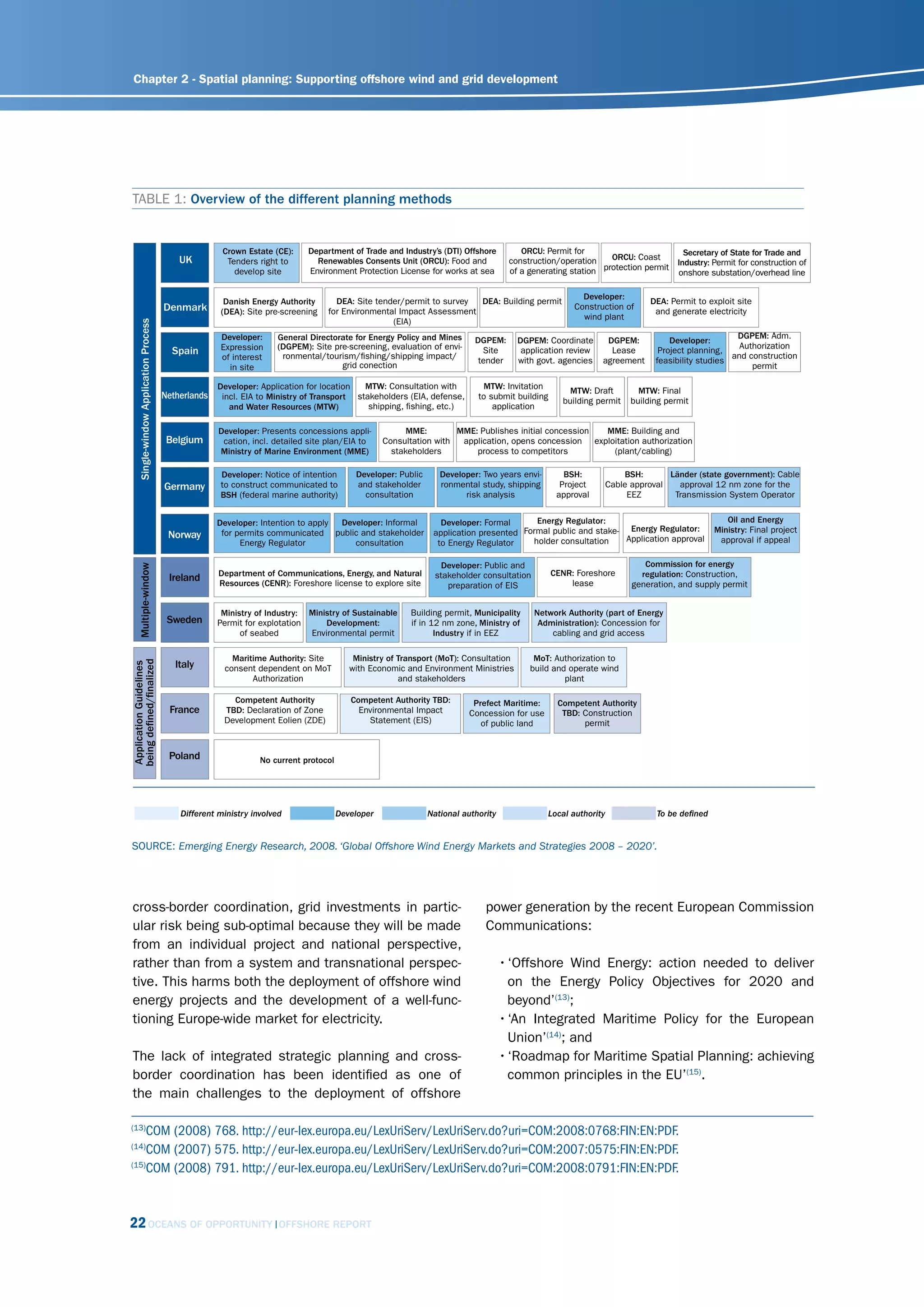
TABLE 1: Overview of the different planning methods


                                                         Crown Estate (CE):    Department of Trade and Industry’s (DTI) Offshore          ORCU: Permit for                         Secretary of State for Trade and
                                              UK          Tenders right to       Renewables Consents Unit (ORCU): Food and             construction/operation    ORCU: Coast
                                                                                                                                                                                 Industry: Permit for construction of
                                                            develop site       Environment Protection License for works at sea         of a generating station protection permit onshore substation/overhead line

                                                                                                                                                          Developer:
                                                         Danish Energy Authority      DEA: Site tender/permit to survey DEA: Building permit                                  DEA: Permit to exploit site
                                          Denmark       (DEA): Site pre-screening   for Environmental Impact Assessment
                                                                                                                                                        Construction of
                                                                                                                                                                               and generate electricity
                                                                                                                                                          wind plant
                                                                                                    (EIA)
      Single-window Application Process


                                                        Developer:     General Directorate for Energy Policy and Mines                                                                              DGPEM: Adm.
                                                                                                                             DGPEM:      DGPEM: Coordinate      DGPEM:             Developer:
                                                        Expression     (DGPEM): Site pre-screening, evaluation of envi-                                                                              Authorization
                                            Spain                       ronmental/tourism/fishing/shipping impact/
                                                                                                                               Site       application review     Lease          Project planning,
                                                                                                                                                                                                   and construction
                                                        of interest                                                           tender     with govt. agencies   agreement       feasibility studies
                                                          in site                      grid conection                                                                                                   permit

                                                        Developer: Application for location   MTW: Consultation with           MTW: Invitation
                                                                                                                                                       MTW: Draft          MTW: Final
                                          Netherlands    incl. EIA to Ministry of Transport stakeholders (EIA, defense,       to submit building
                                                                                                                                                     building permit     building permit
                                                           and Water Resources (MTW)           shipping, fishing, etc.)           application

                                                        Developer: Presents concessions appli-             MME:        MME: Publishes initial concession MME: Building and
                                           Belgium       cation, incl. detailed site plan/EIA to     Consultation with  application, opens concession exploitation authorization
                                                        Ministry of Marine Environment (MME)           stakeholders        process to competitors          (plant/cabling)

                                                        Developer: Notice of intention       Developer: Public      Developer: Two years envi-        BSH:             BSH:       Länder (state government): Cable
                                          Germany       to construct communicated to         and stakeholder        ronmental study, shipping        Project       Cable approval   approval 12 nm zone for the
                                                        BSH (federal marine authority)         consultation               risk analysis             approval            EEZ        Transmission System Operator


                                                        Developer: Intention to apply Developer: Informal           Developer: Formal      Energy Regulator:                                      Oil and Energy
                                           Norway        for permits communicated public and stakeholder          application presented Formal public and stake- Energy Regulator:             Ministry: Final project
                                                              Energy Regulator           consultation              to Energy Regulator    holder consultation    Application approval           approval if appeal

                                                                                                                    Developer: Public and                                   Commission for energy
      Multiple-window


                                                        Department of Communications, Energy, and Natural         stakeholder consultation         CENR: Foreshore         regulation: Construction,
                                           Ireland      Resources (CENR): Foreshore license to explore site                                            lease
                                                                                                                     preparation of EIS                                  generation, and supply permit


                                                         Ministry of Industry: Ministry of Sustainable     Building permit, Municipality     Network Authority (part of Energy
                                           Sweden       Permit for explotation     Development:            if in 12 nm zone, Ministry of      Administration): Concession for
                                                              of seabed        Environmental permit               Industry if in EEZ             cabling and grid access

                                                           Maritime Authority: Site          Ministry of Transport (MoT): Consultation       MoT: Authorization to
                                             Italy
being defined/finalized
Application Guidelines


                                                         consent dependent on MoT           with Economic and Environment Ministries        build and operate wind
                                                                Authorization                            and stakeholders                            plant

                                                           Competent Authority              Competent Authority TBD:        Prefect Maritime:       Competent Authority
                                           France        TBD: Declaration of Zone             Environmental Impact         Concession for use        TBD: Construction
                                                         Development Eolien (ZDE)               Statement (EIS)               of public land              permit


                                           Poland                  No current protocol


                                              Different ministry involved                Developer               National authority              Local authority               To be defined


SOURCE: Emerging Energy research, 2008. ‘global offshore Wind Energy markets and strategies 2008 – 2020’.


cross-border coordination, grid investments in partic-                                                                          power generation by the recent European Commission
ular risk being sub-optimal because they will be made                                                                           Communications:
from an individual project and national perspective,
rather than from a system and transnational perspec-                                                                                  • ‘Offshore Wind Energy: action needed to deliver
tive. This harms both the deployment of offshore wind                                                                                   on the Energy Policy Objectives for 2020 and
energy projects and the development of a well-func-                                                                                     beyond’(13);
tioning Europe-wide market for electricity.                                                                                           • ‘An Integrated Maritime Policy for the European
                                                                                                                                        Union’(14); and
The lack of integrated strategic planning and cross-                                                                                  • ‘Roadmap for Maritime Spatial Planning: achieving
border coordination has been identified as one of                                                                                       common principles in the EU’(15).
the main challenges to the deployment of offshore

(13)
    COM (2008) 768. http://eur-lex.europa.eu/LexUriServ/LexUriServ.do?uri=COM:2008:0768:FIN:EN:PDF.
(14)
    COM (2007) 575. http://eur-lex.europa.eu/LexUriServ/LexUriServ.do?uri=COM:2007:0575:FIN:EN:PDF.
(15)
    COM (2008) 791. http://eur-lex.europa.eu/LexUriServ/LexUriServ.do?uri=COM:2008:0791:FIN:EN:PDF.


22 OCEANS OF OPPORTUNITY                                                OFFSHORE REPORT
Recommendation:

                 If Member States decided to perform maritime spatial     Maritime spatial planning approaches should be
                 planning (MSP), and dedicate areas for offshore wind     based on a common vision shared at sea basin level.
                 developments and electricity interconnectors, it would   In this regard, cross border cooperation on MSP is
                 send clear positive signals to the industry. Provided    key for building a common and streamlined planning
                 the right policies and incentives are in place, MSP      approach and making optimal use of the maritime
                 gives the industry long term visibility of its market.   space. Cross-border cooperation on MSP would aid
                 Consolidated at European level, such approaches          projects crossing several Economic Exclusive Zones
                 would enable investments to be planned out. This         such as large-scale offshore wind projects, and the
                 would enable the entire value chain to seek invest-      interconnectors of the future pan-European grid.
                 ment in key elements of the supply chain (e.g. turbine
                 components, cables, vessels, people) while poten-
                 tially lowering the risks and capital costs.


               Offshore wind synergies with other maritime                started in Denmark to combine offshore wind parks
               activities                                                 with aquaculture. Offshore wind parks could also be
                                                                          combined with large desalination plants, or be used
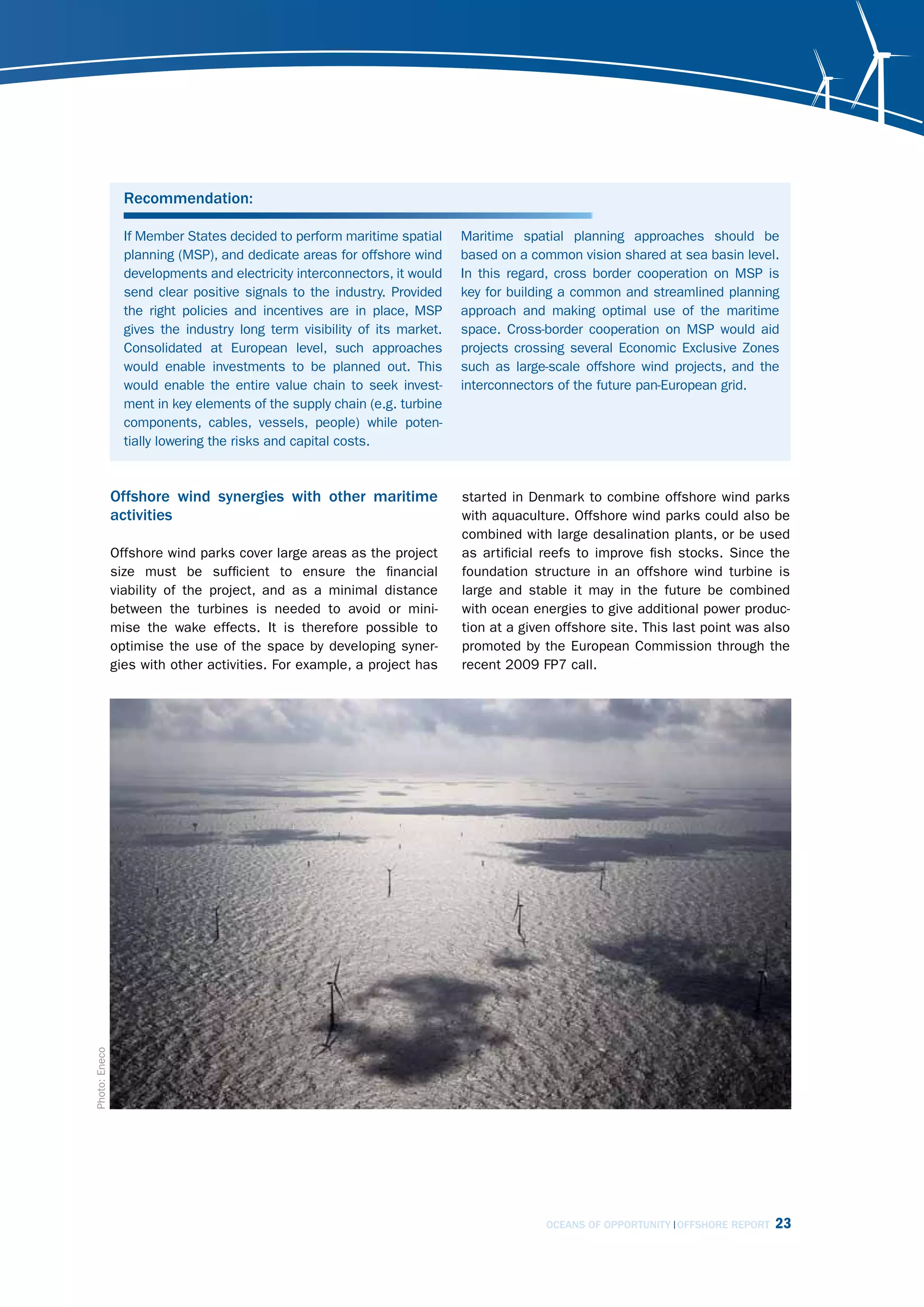
               Offshore wind parks cover large areas as the project       as artificial reefs to improve fish stocks. Since the
               size must be sufficient to ensure the financial            foundation structure in an offshore wind turbine is
               viability of the project, and as a minimal distance        large and stable it may in the future be combined
               between the turbines is needed to avoid or mini-           with ocean energies to give additional power produc-
               mise the wake effects. It is therefore possible to         tion at a given offshore site. This last point was also
               optimise the use of the space by developing syner-         promoted by the European Commission through the
               gies with other activities. For example, a project has     recent 2009 FP7 call.
Photo: Eneco


                                                                                        OCEANS OF OPPORTUNITY OFFSHORE REPORT   23
Chapter 3

                 Building the
                 European
                 Offshore Grid


                 24 OCEANS OF OPPORTUNITY   OFFSHORE REPORT


Photo: Siemens
Introduction                                                           • increased interconnection capacity will provide
                                                                         additional firm power (capacity credit) from the
The deployment of offshore wind energy requires a                        offshore wind resource.
dedicated offshore electricity system. Such a system
will provide grid access for the more remote offshore                The future European offshore grid will therefore
wind farms, and additional interconnection capacity to               contribute to building a well-functioning single European
improve the trading of electricity between the differing             electricity market that will benefit all consumers.
national electricity markets. The transnational offshore             Because of the prominent concentration of planned
grid of the future will have many functions, each bene-              offshore wind farms in the North Sea, the Baltic Sea
fitting Europe in different ways:                                    and the Mediterranean Sea, a transnational offshore
                                                                     grid should be built first in those areas. In many of
   • the geographically distributed output of the                    the offshore grid designs that have already been
     connected offshore wind farms will be aggregated                proposed, an offshore grid has branches reaching as
     and therefore smoothed, increasing the predict-                 far as Ireland, France and Spain.
     ability of the energy output and diminishing the
     need for additional balancing capacity(16);                     This section will address planning issues, technology
   • wind farm operators will be able to sell wind farm              aspects, possible topologies, and the consequences
     output to more than one country;                                for the European network in general. Furthermore it
   • power trading possibilities between countries will              will briefly discuss the operational, regulatory and
     increase;                                                       economic aspects of an offshore grid.
   • it will minimise the strengthening of onshore
     (mainland) interconnectors’ high-voltage networks,              Mapping and planning the offshore grid
     which can be difficult due to land-use conflicts;
   • connecting offshore oil and gas platforms to                    drivErs for PlAnning
     the grid will enable a reduction of their GHG
     emissions;                                                      Building an offshore grid is different from building an
   • it will offer connection opportunities to other                 onshore grid in many ways – not least technically and
     marine renewable energy sources;                                economically. Perhaps the greatest challenge is the
   • shared use of offshore transmission lines leads                 international aspect. The two basic drivers throughout
     to an improved and more economical utilisation of               the planning (and later in the implementation stage)
     grid capacity and its economical exploitation;                  of a transnational offshore grid are its role in interna-
   • European energy security will be improved, due to               tional trade and the access it provides to wind power
     a more interconnected European grid;                            and other marine energy sources.

   TradeWind, 2009. “Integrating Wind - Developing Europe’s power market for the large-scale integration of wind power.”
(16)

   Available at: http://www.trade-wind.eu.


                                                                                     OCEANS OF OPPORTUNITY OFFSHORE REPORT   25
Chapter 3 - Building the European Offshore Grid


The basis for planning the offshore grid is therefore a       modular way, i.e. that it is made up of modules
combination of an ambitious - but realistic - vision of       that can feasibly be exploited;
future offshore wind power capacities and a common          • take into account time-dependent aspects such as
stakeholder vision on the future necessary expansion          realistic implementation scenarios for wind power
of the European transmission network. This report             development, supply chain issues and financing
seeks to develop and implement such a vision.                 possibilities;
                                                            • coordinate the implementation of the offshore
The future projections for offshore wind power capacity       network with the upgrade of the onshore network;
are discussed in Chapter 1.                                 • present a coordinated approach to implementing
                                                              the common vision shared by the relevant stake-
The future development of the European transmission           holders throughout the process.
grid is described in different publications (TDP UCTE
2008, Nordic Grid Master Plan 2008) and various           Partners in the planning and work process are the TSOs,
national studies (the Netherlands, the UK, Denmark).      governments, regulators, technical suppliers, wind farm
Some international studies (TradeWind) have explored      developers, consultants and financing bodies.
the implications of offshore wind for grid require-
ments. At present, issues related to the joint planning   Policy ProcEssEs suPPorting thE PlAnning
of offshore wind power development and grid rein-
forcement arise in markets with significant offshore      Because of the complexity of transnational planning
wind development (Germany, the UK). Finding practical     processes, the planning of an offshore grid requires
solutions for these issues will be very helpful for the   strong policy drivers and supra-national control mecha-
process of international joint planning.                  nisms. In the present political framework, transmission
                                                          lines through different marine zones are forced to
PlAnning in thE diffErEnt mAritimE ArEAs                  seek regulatory and planning approval with the rele-
                                                          vant bodies of each Member State through which the
At present, offshore grid ideas are being developed       line passes. Multiple country reviews impose delays of
above all for northern Europe, especially for the North   years to an approval process that is already complex
Sea and the Baltic Sea. However, offshore wind farms      enough.
are expected to be developed in most European
waters, and so the grid aspects of developments along     Offshore grid topology and construction
the Atlantic Coast and in the Mediterranean area also
have to be considered in pan-European planning. In the    no lAck of idEAs
longer term, and depending on further technological
developments enabling the industry to reach deeper        There is no shortage of ideas from academics, grid
waters, the offshore network should be expanded to        companies and various industries on how to construct
areas that have not yet been investigated, including      a dedicated offshore transmission grid. Because of
the northern part of the North Sea.                       the concentration of planned offshore wind farms in
                                                          the North Sea and the Baltic Sea, a transnational
PlAnning APProAch                                         offshore grid will be constructed in those areas first.

A realistic schedule for a transnational offshore grid    Proposals have been put forward by several different
should:                                                   bodies, including the following:

  • closely follow existing plans and ideas from          • TradeWind
    national transmission system operators (TSOs) to      • Airtricity (see Figure 11)
    enable a smooth start, for example the different      • Greenpeace
    planned connections between the Nordic area and       • Statnett
    UK, the Netherlands and Germany;                      • IMERA
  • ensure the network is conceived and built in a        • Mainstream Renewable Power (Figure 12)


26 OCEANS OF OPPORTUNITY   OFFSHORE REPORT
FIGURE 11: Airtricity Supergrid concept                              This report seeks to build on these approaches and
                                                                     propose an optimal long-term development plan for
                                                                     the future pan-European offshore electricity grid.

                                                                     offshorE grid tEchnology

                                                                     The utilisation of HVDC (High Voltage Direct Current)
                                                                     technology for the offshore grid is very attractive
                                                                     because it offers the controllability needed to allow the
                                                                     network both to transmit wind power and to provide
                                                                     the highway for electricity trade, even between different
                                                                     synchronous zones. Moreover, HVDC offers the possi-
                                                                     bility of terminating inside onshore AC grids, and thus
                                                                     avoiding onshore reinforcements close to the coast.

                                                                     There are two basic types of HVDC transmission
                                                                     links: HVDC-LCC (conventional HVDC) and the recent
                                                                     HVDC-VSC (Voltage Source Convertor). HVDC-LCC has
                                                                     been extensively used worldwide, operating over 6 GW
                                                                     per line, at voltages of up to 800 kV. 60 GW had been
   SuperNode                                                         installed by the end of 2004(17).
   (Mainstream Renewable Power)
                                                                     Today, the drivers for the offshore grid favour HVDC
   The SuperNode configuration, developed by                         VSC as the best option(17b) for the following reasons:
   Mainstream Renewable Power, is a first step
   for the development of the European Supergrid.                      • the technology is suitable for the long distances
   It would allow the three-way trading of power                         involved (up to 600 km), with minimal losses;
   between the UK, Norway and Germany, and                             • the compactness (half the size of HVDC LCC)
   include two 1 GW offshore wind farms, one in the                      minimises environmental impact and construction
   UK and one in Germany. Depending on the wind                          costs, for example of the HVDC platforms;
   farm output at any given time, the capacity for                     • the system is modular. A staged development is
   trade would go up to 1 GW between each pair of                        possible, and stranded investments can more
   countries in the combination.                                         easily be avoided;
                                                                       • the technology – because of its active controllability
    FIGURE 12: Mainstream Renewable Power                                - is able to provide flexible and dynamic voltage
                                                                         support to AC and therefore can be connected to
                                                                         both strong and weak onshore grids. Moreover, it
                                          Norway                         can be used to provide black start(18), and support
                                                                         the system recovery in case of failure;
                                                                       • multi-terminal application is possible, which makes
                                                                         it suitable for meshed(19) grids.

                                                                     In this way the HVDC VSC technology seems to offer
                      1GW
                                                                     the solution for most of the offshore grid’s technical
                                   1GW
                                                                     challenges.
               UK                             Germany

                                                                     There are two major manufacturers of HVDC VSC
                                                                     technology. ABB uses the brand name HVDC Light,
                                                                     whereas Siemens has branded its technology HVDC

         European Academies Science Advisory Council, 2009. ‘Transforming EU’s Electricity Supply – An infrastructure strategy for
(17) & (17b)

         a reliable, renewable and secure power system’.
(18)
    Black start is the procedure for recovering from a total or partial shutdown of the transmission system.
(19)
    Meshed topology offshore grids are able to cope with the failure of a line by diverting power automatically via other lines.

                                                                                     OCEANS OF OPPORTUNITY OFFSHORE REPORT           27
Chapter 3 - Building the European Offshore Grid


                                                                                                                        Photo: Elsam
Plus. The technologies are not identical, and efforts         HVDC circuit breakers, load flow control concepts and
are needed to make them compatible and jointly oper-          very fast protection schemes. Also, operational experi-
able, when used together in the future offshore grid.         ence has to be collected to optimise the interface with
For that purpose, two major conceptual decisions have         wind power generation in the HVDC environment.
to be taken – namely, to agree to standardise the DC
working voltage levels and to agree on the largest            offshorE grid toPology
possible plug and play boundary. In addition, other
players such as Areva are also developing HVDC VSC            There are three basic elements which will form the
technology.                                                   backbone of the future offshore transmission network.
                                                              These are:
Although all technologies for the offshore grid already
exist in principle, there are several aspects of HVDC           • lines/branches: these consist of submerged
VSC technology which require technical development                cables characterised by transmission capacity;
in the short term in order to achieve the necessary             • offshore nodes (hubs or plugs): these offshore
technical maturity - such as the availability of ultra fast       nodes consist of offshore platforms containing


28 OCEANS OF OPPORTUNITY   OFFSHORE REPORT
HVDC conversion equipment, switchgear and other           Regarding electricity loss, HVDC has significant
    electrical equipments, and will serve as:                 losses at converter station level, but lower losses
          - common connection points for a number of          per km than AC. There is thus a trade off in the
             offshore wind farms;                             use of DC versus AC. Therefore, the nodes of the
          - common connection points for a number of          grid should be located near spatially clustered wind
             other marine generators; and                     farms, as in this way a few nodes per country can be
          - intersections (junctions) of network branches     determined, but offshore wind clusters not too far
           allowing the electricity to be dispatched to the   from the coast should be directly connected to shore
            different electricity markets.                    with an AC line.
  • Onshore nodes: connection points between the
    offshore transmission grid to the onshore trans-          EWEA’s 20 Year Offshore Network Development
    mission grid.                                             Master Plan

The offshore grid topology basically builds upon the          EWEA’s 20 Year Offshore Network Development Master
following types of transmission highways:                     Plan is based on the necessary grid upgrades that
                                                              would allow all planned, proposed, under construction
  • A. interconnectors developed by TSOs (in principle        and operating offshore wind farms to transport all the
    through bilateral cooperation) for the purpose of         electricity produced to European electricity consumers
    cross border exchange between electricity markets         in an economically sound way. It is underpinned by
    (current state of play);                                  the TradeWind study and existing TSO plans, and is
  • B. lines specifically developed for connection of         designed, in addition to connecting offshore wind
    offshore wind farms, and offshore facilities (current     farms to the grid, to increase electricity trading oppor-
    state of play); and                                       tunities and improve Europe’s energy security.
  • C. lines developed in a coordinated effort for the
    purpose of connecting offshore wind, marine tech-         EWEA urges other stakeholders, particularly the
    nologies and the promotion of cross border trade.         European Commission in its Blueprint for a North Sea
                                                              Grid and ENTSO-E’s System Development Committee,
The capital costs of the HVDC converter stations are          to incorporate EWEA’s 20 Year Offshore Network
higher than corresponding substations in AC, while the        Development Master Plan, taking into account
cost of cables is lower for DC than for AC.                   the results of European-funded projects such as
                                                              WindSpeed (www.windspeed.eu) and OffshoreGrid
                                                              (www.offshoregrid.eu).


  Spotlight on specific EU-funded projects

  offshoregrid will develop a scientifically-based view       The main objective of the WINDSPEED project is to
  on an offshore grid in northern Europe along with           identify a roadmap to the deployment of offshore
  a suitable regulatory framework that takes all the          wind power in the central and southern North Sea.
  technical, economic, policy and regulatory aspects          The roadmap includes the definition of an offshore
  into account. The project is targeted at European           wind energy target and a set of coordinated policy
  policy makers, industry, transmission system opera-         recommendations for the deployment of offshore
  tors and regulators. The geographical scope is firstly      wind in this specific sea basin. WINDSPEED delivers
  the regions around the Baltic and North Sea, the            a decision support system for the evaluation of the
  English Channel and the Irish Sea. Secondly, the            physical potential for offshore wind, having inputs
  results will be transferred by qualitative terms to the     such as policy targets for all users of the sea, alloca-
  Mediterranean region.                                       tion rules and calculation rules for the assessment
                                                              of impacts on offshore wind economics.


                                                                             OCEANS OF OPPORTUNITY OFFSHORE REPORT   29
hoW An offshorE grid Will EvolvE                           In the 2030 timeframe the UK link to Ireland will be
                                                           improved, as will its link to the node off the coast of
In northern Europe the offshore grid spans around          Norway via the Shetland Islands; Ireland will be directly
Great Britain and Ireland, the North Sea including the     connected with France, and the nodes off the coast of
Channel and the Baltic Sea.                                Belgium and the Netherlands are interconnected with
                                                           German and UK nodes.
north sea and irish sea
                                                           Baltic area
The topology in this area links the countries bordering
the North Sea: the UK, Norway, Denmark, Germany,           In the Baltic Sea the main offshore grid elements are
the Netherlands, Belgium and the north of France.          the following:
                                                             • on the western side, the Kriegers Flak 1,600
The future North Sea offshore grid will evolve out of          MW wind farms will be considered to be the first
existing TSO plans. Improving Norway’s connection to           nucleus for an international offshore grid once it is
the European grid will allow offshore wind farms in the        successfully connected to three markets (Germany,
North Sea to connect to these interconnectors, and             Denmark, Sweden);
will at the same time improve the connection of Nordic       • further main grid elements are the NordBalt
hydro to northern Europe. EWEA therefore proposes              Interconnection between Sweden and Lithuania,
to take the best practice example of Kriegers Flak in          preferably built with HVDC-VSC technology, together
the Baltic Sea and apply this principle to the intercon-       with a second line between Finland and Estonia
nectors already being studied - NorGer, Nord Link and          (Estlink II) and a reinforcement of the Swed-Pol line;
Norway/UK. EWEA proposes a three-legged solution             • further strengthening between Germany/Sweden,
for each of the planned lines:                                 Germany/Denmark, and Denmark/Sweden.

  • NorGer: planned as a link between Norway and            Kriegers Flak
    Germany but EWEA proposes also linking it to
    Denmark and having a trajectory and node in the         Kriegers Flak is seen as a flagship project at European
    German EEZ(21) to enable offshore wind farms to         level. It is located on a sandbank (Kriegers Flak) in
    be connected.                                           the Baltic Sea, and is likely to consist of a combi-
  • Nord Link: planned as a link between Norway and         nation of three wind farms connected to Sweden,
    Germany but EWEA proposes also linking it to            Germany and Denmark, for a total capacity of 1.6
    the UK and having a trajectory and node in the          GW. Three different TSOs are involved: Vattenfall,
    German EEZ to enable offshore wind farms to be          Energinet.dk and Svenska Kraftnätt.
    connected;
  • Norway/UK: planned as a link between Norway             FIGURE 17: Vattenfall Europe Transmission,
    and the UK but EWEA proposes also linking it            Energinet.dk, Svenska Kraftnät, 2008
    to Germany via a node, which would also allow
    UK Round 3 farms to connect in UK waters and
    provide an additional node for Norwegian offshore
    wind farms (and oil and gas platforms).

EWEA also proposes additional three-legged solutions
and other lines for the 2020 timeframe:

  • a link between Ireland, Northern Ireland and Wales;
  • a link between Belgium, the UK and the Netherlands;
  • a cable off Northern Norway linking to an offshore
    node;
  • an upgrade between Denmark and Sweden                                         sourcE:“kriegers flak progress report”.


(21)
       EEZ: Exclusive Economic Zone


                                                                         OCEANS OF OPPORTUNITY OFFSHORE REPORT        31
Chapter 3 - Building the European Offshore Grid


TABLE 2: EWEA’s 20 Year Offshore Network Development Master Plan (North and Baltic Seas)

                                                                                            Capacity
 Name, description and timeframe                                               Status
                                                                                             (MW)
 Existing - 11 offshore grids
 NorNed linking Norway and the Netherlands                                   Operating        700
 Skagerrak linking Norway and Denmark                                        Operating        940
 HVDC linking France and the UK                                              Operating       2,000
 Kontek linking Germany and Denmark                                          Operating        600
 HVDC linking Germany and Sweden                                             Operating        600
 Konti-Skan linking Denmark and Sweden                                       Operating        300
 SwePol linking Sweden and Poland                                            Operating        600
 HVDC Linking Swedish mainland and Gotland                                   Operating        260
 Estlink linking Finland and Estonia                                         Operating        350
 Fenno Skan linking Sweden and Finland                                       Operating        500
 Moyle Interconnector linking N. Ireland and Scotland                        Operating        500
 In the 2020 timeframe
 Planned/under construction - seven offshore grids
 Great Belt, internal Denmark                                             Planned by 2010     600
 Fenno Skan II linking Sweden and Finland                                 Planned by 2011     800
 BritNed linking the UK and the Netherlands                               Planned by 2011    1,000
 East-West Interconnector linking Ireland and north Wales                 Planned by 2012     500
 Estlink II linking Finland and Estonia                                   Planned by 2013     700
 Upgrade linking Norway and Denmark (Skagerrak)                               Planned         350
 NordBalt linking Sweden and Lithuania, possibly as HVDC-VSC (formerly                       700 to
                                                                          Planned by 2016
 SwedLit)                                                                                    1,000
 Under study - 14 offshore grids
 Internal HVDC between Scotland and England                                 Under study      1,800
 Internal HVDC between Scotland and Wales                                   Under study      1,800
 Internal HVDC between Scotland and Shetland Islands                        Under study       600
 Internal HVDC between Scotland and Isle of Lewis                           Under study       600
 Internal HVDC in Scotland                                                  Under study       600
 Nemo HVDC linking Belgium and UK                                           Under study      1,000
 Upgrade linking UK and France (EFA)                                        Under study      2,000
                                                                           Under study by
 Skagerrak 4 linking Norway and Denmark                                                       600
                                                                               2014
                                                                           Under study by
 Cobra Cable linking the Netherlands and Denmark                                              700
                                                                               2016
                                                                            Under study
 NorNed 2 linking Norway and the Netherlands                                                  700
                                                                            2015 - 2016


32 OCEANS OF OPPORTUNITY   OFFSHORE REPORT
Capacity
 Name, description and timeframe (North and Baltic Seas)                                                Status
                                                                                                                              (MW)
 (Under study with EWEA recommendation – four offshore grids)
 Kriegers Flak linking Denmark, Sweden and Germany.
 EWEA recommendation: The EU and countries involved should push
                                                                                                     Under study            600 each
 forward with the project for a three-legged solution as outlined by the
 recent TSO pre-feasibility study(22)
 NorGer linking Norway and Germany.
 EWEA recommendation: NorGer should be developed as a three-legged
 HVDC-VSC line linking Norway, Germany and Denmark, as a modular
                                                                                                    Under study
 connection with a higher capacity potential. With appropriate financial                                                       1,400
                                                                                                    2017 - 2018
 support from the Commission it should be able to plug in offshore wind
 farms in Norwegian EEZ waters bordering the Danish EEZ, and offshore
 wind farms in the northern part of the German EEZ
 Nord Link linking Norway and Germany.
 EWEA recommendation: Nord Link should be developed as a three-legged
 HVDC-VSC line linking Norway, Germany and the UK), as a modular connec-
                                                                                                    Under study               700 to
 tion with a higher capacity potential. With appropriate financial support
                                                                                                    2016 - 2018               1,400
 from the Commission it should be able to plug in offshore wind farms in
 Norwegian EEZ waters bordering the Danish EEZ and offshore wind farms
 in the norther-western part of the German EEZ
 Norway/UK linking Norway and the UK.
 EWEA recommendation: This line should be developed to become
                                                                                                     Under study
 a three-legged HVDC-VSC linking the UK, Norway and Germany with
                                                                                                    2017 – 2020
 possibly three nodes as a modular connection, with a higher capacity                                                        1,000 to
                                                                                                  (characterised by
 potential and with appropriate financial support from the Commission.                                                        5,000
                                                                                                  Statnett as low+
 The node in the Norwegian EEZ could allow offshore wind farms to plug
                                                                                                      maturity)
 in, together with the Ekofisk and Valhall platforms, and could link to the
 north-western node in German EEZ
 EWEA recommendation - eight offshore grids
                                                                                                       EWEA
 Three-legged HVDC-VSC line linking Ireland, Northern Ireland and Wales                                                        1,000
                                                                                                  recommendation
                                                                                                       EWEA
 Three-legged HVDC-VSC line linking Belgium, UK and the Netherlands                                                            1,000
                                                                                                  recommendation
                                                                                                       EWEA                  2,000 to
 HVDC Netherlands linking to offshore node
                                                                                                  recommendation              5,000
                                                                                                       EWEA
 HVDC North Norway linking to offshore node                                                                                    2,000
                                                                                                  recommendation
                                                                                                       EWEA
 Upgrade linking Denmark and Sweden (Konti-Skan II)                                                                             360
                                                                                                  recommendation
                                                                                                       EWEA
 Upgrade linking Germany and Sweden                                                                                             600
                                                                                                  recommendation
                                                                                                       EWEA
 Upgrade linking Poland and Sweden                                                                                              600
                                                                                                  recommendation
                                                                                                       EWEA
 Upgrade linking Germany and Denmark                                                                                            550
                                                                                                  recommendation


(22)
       Energinet.dk, Svenska Kraftnät, Vattenfall Europe Transmission, 2009. ‘An analysis of Offshore Grid Connection at Kriegers Flak in
       the Baltic Sea’.


                                                                                          OCEANS OF OPPORTUNITY OFFSHORE REPORT        33
Chapter 3 - Building the European Offshore Grid


                                                                                                            Capacity
 Name, description and timeframe (North and Baltic Seas)                                  Status
                                                                                                             (MW)
 In the 2030 timeframe
 EWEA recommendation – six offshore grids
                                                                                         EWEA
 Upgrade linking the UK and Ireland                                                                           1,000
                                                                                    recommendation
                                                                                         EWEA
 HVDC linking the UK (Shetland Islands) and north Norway node                                                 2,000
                                                                                    recommendation
 HVDC linking the UK and the Netherlands (as a modular connection,                       EWEA               2,000 to
 possibly also linking Belgian node)                                                recommendation           5,000
                                                                                         EWEA               1,000 to
 HVDC linking the Netherlands with NorGer node
                                                                                    recommendation           5,000
                                                                                         EWEA               1,000 to
 HVDC linking the Netherlands node with Nord Link node
                                                                                    recommendation           5,000
                                                                                         EWEA
 New HVDC linking Ireland and France                                                                          1,000
                                                                                    recommendation

offshorE grid construction timElinE - stAgEd                   Onshore connection points are identified. Dedicated
APProAch                                                       (HVDC) offshore lines are built by TSOs to inter-
                                                               connect clustered wind power capacity. Dedicated
Most of the electricity grids in the world have been           regulatory regimes are established for offshore
put together from the bottom up, connecting local              transmission, enabling TSOs to recover investments
producers with nearby off-take points, and this will not       via the national electricity market. The process
be different with the offshore grid. The construction          starts towards the internationalisation of regula-
of an offshore grid is a process that will take many           tory regimes. The necessary onshore transmission
years to be fully accomplished. Even the implementa-           reinforcements are identified. The multilateral grid
tion process of a single line is very lengthy (around 10       planning process is prepared. Work on the stand-
years), involving several stages (Figure 18).                  ardisation and technical development of HVDC VSC
                                                               technology speeds up.
FIGURE 18: Stages in a typical timeline for building
an offshore interconnector total process duration is           stAgE ii: trAnsition to trAnsnAtionAl grid
around 10 years
                                                               A process of multilateral grid planning is in place. Long-
                                                               distance lines dedicated to offshore wind are planned
                                                               and implemented. Implementation of pilot projects for
                                                               connecting offshore wind power to different markets
                                                               (Kriegers Flak, super-node). HVDC VSC technologies
                                                               are optimised, based on operational experience.
                                                               Adaptation of trajectories of planned offshore inter-
                                      sourcE: statnett, 2009   connectors to connect offshore wind power.
A possible timeline for the construction of a trans-
national offshore grid is sketched in Figure 18. The           stAgE iii: trAnsnAtionAl grid
timeline falls naturally into three main stages:
                                                               Step by step implementation of the transnational
stAgE i: locAl (nAtionAl) grids                                offshore grid. The planned lines are built. The maps
                                                               illustrate a proposed grid scenario for the short term
Countries establish and implement coordinated                  (present situation to 2010), the medium term (2020)
connection for offshore wind power at national level.          and the long term (2030 and beyond).


34 OCEANS OF OPPORTUNITY   OFFSHORE REPORT
FIGURE 19: Stages in the development of a transna-                     • operating and maintaining the grid in a secure and
tional offshore grid. The actual rate of development of                  equitable way, whilst granting fair access to the
offshore wind power capacity might follow a more step                    connected parties; and
by step development                                                    • scheduling the HVDC lines for the predicted
                                                                         amounts of wind power and the nominated
                                                                         amounts of power for trade.

                                                                    The operation of the offshore grid will, however, be an
                                                                    integral part of the operation of the interconnected
                                                                    European grid and therefore very close coordination
                                                                    is required between the various connected power
                                                                    systems, which is a challenging task for the newly
                                                                    formed ENTSO-E. It is therefore vital that ENTSO-E
                                                                    establishes a structure that is suited to such coop-
                                                                    eration, for example through the North Sea Regional
                                                                    Group, as well as within the System Operations and
                                                                    Market Committees.


                                         sourcE: XPWind, EWEA


Onshore grid upgrade

The offshore grid cannot be isolated from the rest of
the network. The rational development of such a grid
for the purposes of promoting trade and connecting
offshore renewable power has to be part of an overall
planning process for the European networks.

The consequence in the short to medium term is that                                           proceed         invest
onshore reinforcements have to be implemented on
specific transmission corridors and lines. The exact
locations of corridors and lines to be upgraded need
to be identified by detailed studies(23).

One of the first studies that looked into this issue was
the TradeWind project. On the basis of wind power
scenarios, the study identified upgrades that would
significantly alleviate the congestions in the European
grid for wind power scenarios up to 2030.

The operational and regulatory aspects of
offshore grids

nEtWork oPErAtion: closE cooPErAtion Within
Entso
                                                                                                                                     Photo: Siemens


The principal operational tasks concerning the
offshore grid are:

   Such as the German study: DENA, 2005. ‘Integration into the national grid of onshore and offshore wind energy generated in
(23)

   Germany by the year 2020’. Available at: http://www.dena.de/en/topics/thema-esd/publications/publikation/grid-study.


                                                                                    OCEANS OF OPPORTUNITY OFFSHORE REPORT       35
Chapter 3 - Building the European Offshore Grid


Beside these organisational developments, one of                      variability introduced by the offshore wind resource.
the first tasks for the TSOs and industries involved is               As an example, north-west Germany is identified as an
to set up a system of standards and grid connection                   energy surplus area with high internal congestions on
requirements. New standardisation efforts are needed                  the mainland grid. Taking into account the fact that the
in the field of HVDC, more specifically to agree on a                 Netherlands and Belgium will benefit from increased
common system of voltage levels. Furthermore, in                      imports, and that Norway has large amounts of control-
order to enable a smoothly and efficiently constructed                lable and storable hydro power, an offshore grid which
grid, it will be essential that parties agree on a system             linked these countries together would bring consider-
of plug and play and standard – interchangeable                       able economic, environmental and system benefits(24).
building blocks.
                                                                      In the Baltic Sea, linking the wind farm clusters in
comBining trAnsmission of offshorE Wind                               the Kriegers Flak together would enable flexibility for
PoWEr And PoWEr trAding                                               transporting higher amounts of offshore wind power to
                                                                      areas with higher electricity prices. Furthermore, such
The capacity of the offshore grid should be suffi-                    a link would make it possible to trade power effec-
cient to transport the maximum expected output of                     tively between Sweden, east Denmark and Germany in
the connected offshore wind farms. However, this                      periods with low wind speeds.
maximum is only produced for a certain amount of
hours each year. On average (annual basis or longer),                 rEgulAtory frAmEWork                EnABling         imProvEd
the capacity factor of the offshore wind farms, and                   mArkEt rulEs
so the capacity usage of the line by the wind farm, is
approximately 40%. The offshore wind farms should                     At present, there are significant barriers in the elec-
have first call on the rights to use the grid connec-                 tricity market in Europe, which hamper an efficient
tion, as:                                                             combination of trade and offshore wind power trans-
                                                                      mission via a transnational offshore grid:
   • in a properly functioning electricity market, wind
     power’s very low marginal cost will ensure it is                   • the differences in regulatory regimes and market
     the cheapest (and environmentally most benign)                       mechanisms of the countries involved;
     electricity at any time on the market place; or                    • a lack of proper rules with respect to priority
   • in the absence of a properly functioning electricity                 feed-in for wind power versus nomination of day-
     market (as is currently the case) priority access                    ahead and intra-day trade.
     would need to be granted to wind power, as stip-
     ulated in the EU Renewable Energy Directive                      These issues should be taken up in the ongoing
     2009/28/EC.                                                      Regional Initiative for the integration of European
                                                                      power markets as pursued by ERGEG. In order to
Either way, wind farm operators would specify their                   ensure that sufficient grid capacity is built in time,
grid requirements to the grid operator on a day-ahead                 a common regulatory regime should be put in place
basis, together with functioning intra-day markets.                   to incentivise the organisations responsible for wind
The remaining capacity would then be available for                    farm connection (TSOs) and organisations responsible
interconnection users at day-ahead nomination,                        for planning interconnection (TSOs, market parties) to
together with functionioning intra-day markets.                       plan and construct the most economically efficient
                                                                      grid system.
The benefits of the operation of such a grid for the
market have been outlined by the TradeWind project.                   It is necessary to establish a legal and regulatory
The offshore grid enables the different electricity                   framework that enables an efficient use of the different
markets to be interconnected in a much better way                     lines of the offshore grid in all its stages. In order
and with a significant surplus, with markets relying                  to ensure an efficient allocation of the interconnec-
on import and at the same time providing access                       tors for cross-border trade, they should be allocated
to cheap balancing power to deal with the added                       directly to the market via implicit auction.

   TradeWind, 2009. ‘Integrating Wind - Developing Europe’s power market for the large-scale integration of wind power.’
(24)

   Available at: http://www.trade-wind.eu.


36 OCEANS OF OPPORTUNITY     OFFSHORE REPORT
Photo: Siemens
Further market integration and the establishment of                   at EU level of market mechanisms favouring wind
intra-day markets for cross border trade are of key                   power integration, leading to the following results:
importance for market efficiency in Europe when inte-
grating large amounts of offshore wind power. In this                   • flexibility of rescheduling dispatch decisions in the
way, the market will respond more adequately to the                       generation mix: accepting intraday wind power
characteristic properties of wind energy(25):                             forecasts by shortening gate-closure times would
                                                                          result in a reduction in the total operational costs
   • its predictability, which improves with a shorter                    of power generation of at least €260 million per
     forecasting horizon and as the size of the area for                  year;
     which the forecast is organised increases;                         • flexibility of cross-border exchange (assuming suffi-
   • its variability, which decreases as the size of                      cient transmission capacity): allowing the intraday
     the geographical area increases due to spatial                       rescheduling of cross border exchange would lead
     de-correlation;                                                      to annual savings in system operation costs of
   • its low marginal costs and low CO2 emissions                         €1-2 billion per year.
     which favour the use of wind power whenever
     wind is available, even at times which can be chal-              Economic value of an offshore grid
     lenging in situations of low load, near minimum
     generation level.                                                intrinsic vAluE of offshorE grid

Taking these properties into account, TradeWind used                  There are several ways of evaluating the economic
market models to help estimate the economic benefits                  value of an offshore grid. A basic distinction can be

   TradeWind, 2009. ‘Integrating Wind - Developing Europe’s power market for the large-scale integration of wind power.’ Available at:
(25)

   http://www.trade-wind.eu.


                                                                                      OCEANS OF OPPORTUNITY OFFSHORE REPORT         37
Chapter 3 - Building the European Offshore Grid


made between the purely market orientated approach
which looks at economic benefits for specific interested
parties (for example investors) and the ‘regulated’
approach, which looks at the benefits to society.

A preliminary assessment of the costs/benefits of a
transnational offshore grid in the regulated approach
indicates that it brings high economic value to society.
This can be concluded from the TradeWind analysis,
with an estimated reduction in operational cost of
power generation at the European level of €326 million
per year, as brought about by a meshed offshore grid.
The benefits are to a great extent due to the added
flexibility introduced when including an HVDC network
that links many countries (Norway, Denmark, Germany,
the Netherlands, Belgium and the UK in the North
Sea and Sweden, Denmark and Germany in the Baltic
Sea). Because HVDC connections are controllable,
bottlenecks in the AC grid can be avoided when trans-
porting offshore wind power to consumers in areas
with an energy deficit or high local generating costs.

As demonstrated by TradeWind, a €326 million reduc-
tion in annual total power generating costs can be
interpreted as a very conservative estimate of the
break-even cost for the extra investments needed
to realise a meshed transnational offshore network,
compared to a more nationally orientated approach.

Taking into account factors that are not covered in the
TradeWind cost model, such as the start-up cost of
thermal generators, internal grid constraints and the
balancing of wind power, the operational benefits of a
meshed offshore grid could very well be significantly                   Photo: GE
higher than estimated by the model. It is also impor-
tant to note that the offshore grid structure was by no
means optimised in the TradeWind study.                               Apart from the economic benefits highlighted above,
                                                                      the actual implementation will create high social
This conclusion is in line with findings of the study by              benefits in terms of economic growth, industrial devel-
Veal(26), which looked into the economics of combining                opment and employment.
offshore connections with interconnectors for trade.
The combination appears to be cost-effective in                       thE vAluE of An offshorE grid in thE contEXt
many scenarios, depending on the distance from                        of A strongEr EuroPEAn trAnsmission nEtWork
the offshore wind farm cluster to shore. Certainly for
distances of more than 90km from shore, there is                      On a European level, the benefits of the transmission
always some economic benefit gained from integrating                  network upgrades – such as building subsea intercon-
those wind farms that lie among the interconnector’s                  nectors linking offshore wind farms - are even more
route, or where this route can easily be diverted to                  significant. A preliminary evaluation has been made
pass through the wind farm area.                                      within the TradeWind project, which calculated the

   C. Veal, C. Byrne, S. Kelly, 2007. ‘The cost-benefit of integrating offshore wind farm connections and subsea interconnectors in the
(26)

   North Sea’. Proc. European Offshore Wind Conference and Exhibition, Berlin, Germany.


38 OCEANS OF OPPORTUNITY     OFFSHORE REPORT
Investments and financing

                                                                      invEstmEnt cost EstimAtEs

                                                                      Until now, few studies have published estimates on
                                                                      investment costs for a Europe-wide offshore grid. Two
                                                                      recent reports made some preliminary calculations
                                                                      which allow ballpark figures to be estimated for the
                                                                      total investment cost of a transnational offshore grid.

                                                                        • Greenpeace(27): this study proposed a grid in the
                                                                          North Sea for 68 GW of offshore wind power, to
                                                                          be in place by around 2025. The topology consid-
                                                                          ered for the study has a total single line length of
                                                                          6,200 km. Assuming 1 GW capacity per line, the
                                                                          proposed grid would cost €15-20 billion;
                                                                        • TradeWind(28): the additional investment costs were
                                                                          estimated for a meshed offshore grid connecting
                                                                          the “far” offshore wind farm clusters with a total
                                                                          installed capacity of 80 GW in the North Sea to
                                                                          those in the Baltic Sea, according to the 2030 high
                                                                          scenario. The additional investment costs for the
                                                                          topology were estimated to be around €9 billion,
                                                                          taking into account specific cable lengths and
                                                                          transmission capacities (not including the costs
                                                                          of the interconnectors envisaged already now for
                                                                          trading purposes);
                                                                        • for comparison purposes: the UK’s East Coast
                                                                          Transmission study(29) looked at an offshore
                                                                          network along the east coast of GB linking in the
                                                                          Shetland and Orkney Islands in 2020. It estimated
                                                                          a total investment cost of €5.5 billion.

                                                                      Taking into account the fact that the offshore network
                                                                      discussed in this chapter is more extensive than the
                                                                      topologies used in the studies mentioned above, a safe
reduction in the operational costs of power generation                bottom line assumption for investments in offshore
caused by dedicated grid upgrades.                                    transmission up to 2030 is in the range of €20-30
                                                                      billion. This number would include both the ‘trade’
For TradeWind’s 2020 grid and wind power scenario,                    interconnectors and the dedicated lines for wind power
the savings in operational costs amount to €1.5                       connection. For comparison, the International Energy
billion per year, allowing for an average investment                  Agency (IEA) estimates total investments in European
cost of €490 million for each of the 42 transmis-                     electricity transmission grids of €187 billion in the
sion upgrade projects that were proposed, including                   period 2007-2030(30). The economic projections and
several offshore HVDC lines. Because this estimate                    budgeting should be made within the framework of a
assumed a less strong interconnection between                         total upgrade of the European transmission network,
the countries around the North Sea than the one                       which also comprises the required onshore upgrades.
proposed in this report, it should be considered as                   It is evident that a detailed assessment has to be
conservative.                                                         based on detailed network designs. Furthermore in

(27)
    Greenpeace, 2008. ‘A North Sea Electricity Grid [R]evolution’. Available at: http://www.greenpeace.org/belgium.
(28)
    TradeWind, 2009. ‘Integrating Wind - Developing Europe’s power market for the large-scale integration of wind power.’
     Available at: http://www.trade-wind.eu.
(29)
    Seanergy: East Coast Transmission (January 2008).
(30)
    International Energy Agency, 2008. ‘World Energy Outlook’.
                                                                                      OCEANS OF OPPORTUNITY OFFSHORE REPORT   39
Chapter 3 - Building the European Offshore Grid


                                                                                                                Photo: Vestas
the assessment of the economics, the cost of elec-       investments with higher risks and longer return rates.
trical losses and operation and maintenance costs        Upfront guarantees are needed, possibly in combina-
should be taken into account.                            tion with regulated returns. Such guarantees should
                                                         be based on the cumulative number of consumers
finAncing thE EuroPEAn ElEctricity grid                  on the interconnected markets. The final cost for the
                                                         consumers, however, would be lowered by the fees
The financing of the future pan-European offshore grid   collected by the network operators through the use
will involve significant investments. Therefore a good   of the interconnector. Therefore, as the European
understanding of the transiting electricity volumes,     electricity market becomes fully operational, trading
which will come from the production of the offshore      develops, and the grids are used at full capacity, the
wind parks and the development of trading, is neces-     cost for the final consumer would be minimal.
sary to ensure a sustainable return on investment.
                                                         If allowed by regulators, merchant interconnectors
Investments in regulated interconnectors, performed      could represent additional profits for TSOs, which
and operated by TSOs should prioritise meshed grids.     would incentivise their construction. Private compa-
In this respect, the regulators should allow these       nies investing in these face higher risks, in particular


40 OCEANS OF OPPORTUNITY   OFFSHORE REPORT
for the connection of large offshore wind arrays, as       dedicated streamlined legislation, support should
the profitability of the interconnector would then         be provided to the investments. In this respect, the
depend on the development speed in the area. In            European Economic Recovery Plan is a welcome small
these cases, the investment could be guaranteed by         step in the right direction. But existing EU instruments,
a specific instrument, for example by the European         such as the funds for Trans-European Networks,
Investment Bank Risk Sharing Finance Facility              or the forthcoming ‘Marguerite fund’, managed by
(RSFF).                                                    the European Investment Bank, should be directed
                                                           towards offshore wind power, key components of the
As described previously, the bankability of the future     value chain, and electricity infrastructure for offshore
pan-European electricity grid seems ensured, but           wind power. At regional level, structural funds should
investments should happen in a timely manner. In           also be directed towards the development of electricity
order to speed up the process, and in addition to          infrastructures.


 Recommendations:

 It is recommended that a transnational offshore grid      issues. Appropriate standardisation work should be
 infrastructure be built to connect the predicted 40 GW    carried out in the short term.
 by 2020, 85 GW by 2025 and 150 GW of offshore
 wind power by 2030, together with the promotion of        Preliminary topologies will be presented, including
 trade between electricity markets. A realistic planning   possible time frames (short, medium and long term).
 schedule for the offshore grid should closely follow      Ongoing studies like the European Commission
 existing initiatives for offshore interconnectors, and    funded OffshoreGrid project are expected to provide
 would conceive a grid in a modular and methodical way.    more detailed analyses in the short term. These
 The transnational offshore grid must be planned as an     proposals should be taken up as soon as possible
 integral part of the European transmission system and     in the planning process of ENTSO.
 involve onshore reinforcements where necessary.
                                                           A common regulatory regime should be put in place
 An ambitious European vision must be established          to incentivise the organisations responsible for wind
 using EWEA’s 20 Year Offshore Network Development         farm connection (TSOs) and the organisations respon-
 Master Plan; the planning and implementation process      sible for planning interconnection (TSOs, market
 should involve close cooperation and efficient coordi-    parties) to plan and construct the most economically
 nation between the stakeholders (European TSOs).          efficient grid system.
 ENTSO-E should provide the appropriate forum for coop-
 eration, should a sufficiently ambitious vision emerge    Preliminary assessments of the economic value of
 in ENTSO’s 10 Year Network Development Plan.              the offshore grid indicate that it will bring significant
                                                           economic benefits to all society.
 HVDC VSC is a promising technology and R&D should
 be accelerated to address the remaining technical


                                                                          OCEANS OF OPPORTUNITY OFFSHORE REPORT    41
Chapter 4


                 Supply Chain


                  42 OCEANS OF OPPORTUNITY   OFFSHORE REPORT


Photo: Vestas
Building a new European offshore industry                parallel. In the development of offshore, the door is
                                                         still wide open for innovative concepts and designs.
In the last few years, the offshore wind energy sector
has emerged as a distinct sector of the wind industry.   Therefore, the European offshore wind industry
In terms of technology, the onshore market is            should be seen as a specific industry, distinct from
approaching maturity, with well established processes    onshore wind industry development. Reaching 40 GW
and reliable mass-produced products. Onshore, tech-      of offshore wind energy by 2020 will mean manufac-
nological improvements are focused on delivering         turing, installing and operating approximately 10,000
large numbers of wind turbines and ensuring cost         wind turbines, which corresponds to an average of
competitiveness through the optimisation of the          three to four offshore turbines being installed per
manufacturing process and supply chain manage-           working day over the next 12 years. Currently, the wind
ment. Research is focused on further improving the       power industry installs 20 onshore wind turbines in
products’ reliability and efficiency.                    the EU per working day. Developing a new European
                                                         offshore industry is a challenge, but the development
The offshore wind energy sector is at a much earlier     of onshore technology and markets serves as a strong
stage of development. In terms of annual installa-       indicator and benchmark for what can be achieved.
tions, offshore wind energy is where onshore wind
was in the early 1990s. With 1.5 GW installed today,     This industry will also develop in partnership with
the sector will shortly leave the demonstration phase    related industries, such as the oil and gas sector, the
to enter a phase of strong industrial growth. In the     shipbuilding industry and the steel sector, and be a
coming years, the main focus will be on standardising    driver for their future development. Offshore wind
the installation processes and developing dedicated      energy provides an historic opportunity to create a
offshore turbines from a dedicated supply chain, just    new heavy industry in which Europe is a technology
as it was for onshore wind 15 years ago.                 leader, uniting existing heavy industries in a common
                                                         effort to tackle climate change and improve the secu-
Whereas the size of onshore wind turbines, and           rity of Europe’s energy supply, whilst reducing energy
onshore turbine technology, seem to be reaching an       imports, creating new jobs and ensuring European
optimum, offshore wind turbine technology is still       technology leadership.
progressing and evolving fast, to reflect the require-
ments of conditions specific to offshore, such as        Cost reductions for the offshore wind energy sector
market evolution and economies of scale. In this         will arise in particular from higher market volumes
field, incremental technology innovations are taking     and longer production series from the industry. The
place, but technological breakthroughs are sought in     project scale will increase, and the trend will continue


                                                                       OCEANS OF OPPORTUNITY OFFSHORE REPORT   43
Chapter 4 - Supply Chain


towards larger offshore wind farms in the 200-300                    manufacturers and developers, this causes bottle-
MW range and beyond, using dedicated and standard-                   necks in periods of high onshore demand.
ised offshore turbines. This will enable streamlined,
repeatable installation processes, and provide incen-                MAKE consulting(31) (Figure 20) indicates that there is
tives to build the necessary installation vessels and                currently more production capacity in Europe than is
access technologies. Regarding access, dedicated                     needed to fulfill European demand. Total onshore and
harbours will be necessary to support the implementa-                offshore demand is forecast to reach 10 GW in 2010,
tion of a large number of offshore wind turbines and                 compared to a production capacity of approximately
foundations.                                                         12 GW, if castings are considered as the limiting
                                                                     elements. That would leave room for production
In the following sections, some of the major cost                    capacity to be available for offshore manufacturing.
drivers are addressed: turbine supply, the available
substructures, vessels and harbours.                                 In addition, offshore wind turbine manufacturers are
                                                                     increasing their capacity. A minimum offshore turbine
Supply of turbines                                                   capacity of 5,750 MW by 2013 (Table 3), will be suffi-
                                                                     cient to supply the increase in the offshore market
Today, six turbine manufacturers are already supplying               demand from 1.7 GW in 2011 to 6.8 GW in 2020.
the offshore market: Siemens, Vestas, REpower, BARD,
Multibrid and Nordex.                                                2008 was characterised first by component and then
                                                                     turbine supply shortages which led to growth in wind
Most current offshore turbines are adaptations of                    turbine prices, partly due also to an increase in the
onshore designs. The production capacity for offshore                price of raw materials. The market will now see signs
wind turbines is therefore dependent on the growth in                of relaxation, including offshore turbine availability,
the onshore market. Given that the onshore market                    and increased competition, which may drive the costs
is less risky than the offshore market for turbine                   down in the medium term.

TABLE 3: Turbine supply estimates four years ahead


                                                         Offshore
                                  Turbine supply                               Projected production             Offshore capacity
 Manufacturer                                           capacity
                                   2008 (MW)                                    (MW) and timeline                     (MW)
                                                       2008 (MW)
 Siemens                               1,947               649(32)                     6,000                           2,000
 Vestas                                5,581                   -                 10,000 by 2010                       2,000(33)
 REpower                                 943                   -                2,600 by 2010(34)                        850(35)
 BARD Engineering                          -                   -                   400 by 2010                           400
 Multibrid                               50                  50                         505                              505
 Nordex                                1,075                150                   4,450 by 2011                           n.a.

                                     source: Btm consult, 2008. “World market update 2008” for the supplied capacity in 2008, and EWEA.


The economics of offshore wind tends to favour                       significant modification of onshore machines by the
larger machines. The offshore environment may allow                  offshore sector, and in the medium and long term, to
the relaxation of a number of constraints on turbine                 the development of specific offshore turbine designs.
design, such as aesthetics and sound emission level.
However, addressing marine conditions, corrosion                     This trend is reflected by the new generation of offshore
and reliability issues creates new challenges in the                 wind turbines which are coming on the market. These
offshore sector. In the near term this will lead to a                larger designs (in the 5 MW range) are dedicated to the

(31)
    MAKE Consulting, 2009. ‘The wind forecast, supply side’.
(32)
    Siemens reserved one third of its capacity for offshore wind.
(33)
    No data available. Estimate assumes Vestas delivers as much as Siemens.
(34)
    Based on Reuters Article Repower Plans Capacity Expansion April 2, 2008.
(35)
    Assume 1/3 of capacity.
44 OCEANS OF OPPORTUNITY    OFFSHORE REPORT
FIGURE 20: Domestic production capacity in Europe                     focus is reliability and cost efficiency. In this regard, a
                     compared to demand (MW)                                               global approach to the value chain is needed. In the
                                                                                           past, upscaling was a major cost driver for the wind
                                                                                           industry. However, while large wind turbine designs (up
                                                                                           to 10 MW) are often cited, this raises the issue of the
                                                                                           availability of the installation vessels and cranes able
                                                                                           to install and operate these machines. The main driver
                                                                                           for offshore wind technology continues to be economic
                                                                                           efficiency, rather than generator size.

                                                                                           For future applications, the key element will be to
                                                                                           further improve turbine reliability, as the accessibility
                                                                                           of offshore wind farms for repair and maintenance is
                                                                                           lower than for offshore. Two philosophies are currently
                                                                                           emerging in this regard:

                                                                                             1. improving wind turbine intelligence, imple-
                        source: mAkE consulting, 2009. ‘the wind forecast. supply side.’     menting redundancy, advanced control algorithms,
                                                                                             condition monitoring, and preventive maintenance
                     offshore environment, and are aimed at addressing its                   algorithms;
                     major challenges, such as marinisation, corrosion, reli-                2. developing simple, robust wind turbines
                     ability and maintainability.                                            including as few moving parts as possible to limit
                                                                                             the risk of failure (two-bladed, downwind, direct-
                     There is no consensus within the sector regarding the                   drive turbines, variable speed with new generator
                     optimal size of an offshore wind turbine as the main                    concepts).
Photo: Dong Energy


                                                                                                         OCEANS OF OPPORTUNITY OFFSHORE REPORT    45
Chapter 4 - Supply Chain


TABLE 4: Offshore wind turbine manufacturers

   Manufacturer        Power output                                          Record

                                        Siemens Wind Power has stated that it is prepared to reserve up to one third of its
                                        production capacity for offshore wind turbines. In offshore development, Siemens
                                        has taken a lead position, with the SWT3.6 107. This position was further strength-
                                        ened in 2008, when the company signed an agreement with Denmark’s DONG
                                        Energy for the supply of up to 500 offshore turbines.
                                        Bonus – now Siemens Wind Power - pioneered the offshore installation of wind
                                        turbines with the world’s first offshore wind farm at Vindeby, Denmark, installed in
 Siemens                   3.6 MW
                                        1991. Since then, its track record includes Nysted Havmøllepark, Burbo Offshore
                                        Wind Farm and Greater Gabbard. Siemens Energy will supply 175 of its SWT-3.6-
                                        107 (3.6 MW) wind turbines to the 1 GW London Array offshore windfarm owned by
                                        DONG Energy, E.ON and Masdar.
                                        Siemens is currently developing its next generation of offshore turbines, and
                                        testing 3.6 MW direct drive concept, suitable for offshore applications, with the
                                        aim to improve reliability and reduce costs.

                                        Vestas is one of the few players that has experience in the offshore sector. In
                                        late 2008 the company won a large order of 300 MW for Warwick Energy’s Thanet
                                        project in the UK. Vestas will increase its total production capacity (onshore and
 Vestas                     3 MW
                                        offshore) to 10 GW in 2010. No reservation of capacity has been announced for
                                        offshore. The offshore turbine supply will rely on the developments of the onshore
                                        market.

                                        The N90 offshore is an adaptation of the onshore design. This turbine is designed
 Nordex                    2.5 MW
                                        for offshore use.
                                        REpower manufactures some of the largest wind turbines in the world suitable for
                                        offshore use, the 5M (5 MW) and the 6M (6 MW).
                                        REPower will install six 5M in 2009 at the test project Alpha Ventus. The 5M
                                        serial production begun in autumn 2008 in a new construction hall in Bremerhaven.
                                        In the beginning of 2009, the first three 6M turbines were erected close to the
                                        Danish-German border, where they are to be tested for offshore operation and
 REpower               5 and 6 MW       where they will be subjected to a type certification.
                                        REpower is participating in the “Beatrice Demonstrator Project” to test the perform-
                                        ance of the 5 MW turbine on the open sea 25 km off the east coast of Scotland
                                        and at a water depth of over 40m. REpower recently signed an agreement with
                                        Vattenfall to supply 150 MW to the Ormonde wind farm. Delivery is scheduled to
                                        start in 2010.

                                        BARD has developed a specific offshore design. Their development focuses on
                                        the Deutsche Bucht. In the first phase BARD has planned three wind farms each
 BARD Engineering           5 MW        with 80 turbines of 5 MW. The permit for the project “Bard Offshore 1” has already
                                        been obtained.

                                        Multibrid developed a specific offshore design based on a 5 MW permanent
                                        magnet generator and a single stage planetary transmission, currently being tested
 Multibrid                  5 MW        at Alpha Ventus. Multibrid will supply 80 M5000 turbines for the offshore Global
                                        Tech 1 wind farm (400 MW). Global Tech 1 is located 90 kilometres from the coast
                                        in the German North Sea. Delivery is scheduled for 2011-2012.


                                                                                      sourcE: mAkE consulting, own elaboration.


46 OCEANS OF OPPORTUNITY   OFFSHORE REPORT
In addition to the current market players, newcomers
are taking an interest in the market, such as Acciona,
which is participating in the UK’s Round 3 with a
marinised 3 MW turbine(36), and Gamesa, which may
produce a 3.5 MW offshore turbine before 2015,
depending on market dynamism. In addition, the
upcoming large market volumes may also attract non-
European newcomers.

The future for wind turbine designs

In order to establish large production volumes,
several pressing demands have to be met. This can
be realised through a strategy focused on producing
continuous, incremental improvements in the current
basic concepts of wind turbine systems. Besides this
strategy of incremental improvement, offshore project
designers and operators, for instance, are requesting
the development of completely new concepts. This
second approach is also an opportunity to make signif-
icant reductions in the cost of energy by developing
innovative concepts. These two strategies should be


                                                                                                                                   Photo: Dong Energy
developed in parallel.

This dual approach is illustrated Figure 21, through
the evolution of maintenance costs as a function of
concept lifetime. A typical learning process demon-
strates an increase of maintenance and repair cost
immediately after putting a new concept into operation.               This dual approach applies for offshore wind energy.
Through incremental technological improvements, the                   On the one hand, manufacturers focus on incremental
maintenance and repair costs decrease. For an innova-                 innovation by improving product reliability, increasing
tive concept, it is likely that a new learning trajectory             component lifetime and developing preventive main-
with the same characteristics will be followed.                       tenance strategies. On the other hand, breakthrough
                                                                      concepts are discussed, with the objective to make
 FIGURE 21: Illustration of problem-solving and inno-                 offshore turbines as simple and robust as possible.
 vation orientated research
                                                                      Offshore operation and maintenance of wind turbines
                                                                      is still very much in its infancy with each project
                                                                      having its own approach. As the amount of operational
                                                                      offshore units increases, the operation and mainte-
                                                                      nance (O&M) function will have to be certified and
                                                                      unified to create a unified O&M industry. Some ideas
                                                                      that may be introduced into the O&M market are as
                                                                      follows:
                                                                        • swing off systems enabling a spare nacelle to
                                                                          replace a nacelle in need of service;
                                                                        • preventive and automatic systems that can carry
                                                                          out oil, brush and filter changes independently of
                                     courtesy: Jos Beurskens, Ecn.        human presence;

   Recharge, 12 June. ‘Taking our turbines offshore will be a breeze says Acciona’.
(36)


                                                                                      OCEANS OF OPPORTUNITY OFFSHORE REPORT   47
Chapter 4 - Supply Chain


                                                                                                                      Photo: Stiftung Offshore Windenergie
  • multi–coated blades keeping blade maintenance to       number of major overhauls during their lifetimes to
    a minimum;                                             ensure efficient operation, as does any conventional
  • modular drive trains should be introduced making       power generation plant. Wind turbines are currently
    heavy part replacement easier. Service schedules       designed in such a way that the exchange of main
    should be modelled on those from the conven-           components or sub assemblies is difficult. More
    tional power industry with proper life time analysis   efficient and newer drive train concepts are needed
    of the different components.                           to bring turbine reliability up to the required level. A
                                                           more modular build up of drive trains with more built
Improving the reliability of offshore wind turbines is     in redundancy could help faster, cheaper and more
paramount to the success of offshore wind energy in        efficient turbine maintenance. The need for extremely
the future. The larger the machine and further away        reliable machines offshore can also be an extra driver
from the coast, the larger the economic loss for non-      for the reliability of onshore machines.
operation and associated maintenance. Vintage wind
turbines often have the same gearbox for their entire      Innovative concepts, such as variable speed, direct-
working lives. Modern wind turbines are much larger        drive offshore wind turbines are currently emerging,
and optimised by weight and efficiency. They need a        with the aim of limiting the number of moving parts


48 OCEANS OF OPPORTUNITY   OFFSHORE REPORT
and lowering maintenance costs, as gearboxes are                      The offshore wind industry will need to deploy upwards
expensive to replace offshore. A multi-pole gearless                  of 10,000 structures by 2020. The offshore manu-
machine also operates at lower drive train speeds and                 facturing industry cannot deliver this in its current
thus creates less stress on components. A main chal-                  form. The industry currently has insufficient capacity,
lenge for these concepts is to reduce the weight on top               and the processes adapted from oil and gas manu-
of the tower, in order to optimise the use of material                facturing are not capable of delivering the volumes
and limit the transport and installation costs. So far,               required. Therefore the offshore wind industry must
gearless machines have been heavier and more expen-                   take urgent steps to rectify this situation. In addition,
sive to produce than their geared equivalent. Lighter                 the supply of substructures should not been seen as
gearless technology is now being tested onshore.                      independent from their transport and installation as
                                                                      an integrated approach is taken, taking into account
Larger machines (5 to 10 MW), specifically designed                   unique site conditions and the location of the wind
for offshore could bring benefits in terms of econo-                  farm.
mies of scale by placing fewer larger machines on
fewer foundations, or increasing the wind farm’s                      Substructures represent a significant proportion of
power output. For example, economies of scale                         offshore development costs. In the case described
could also be realised by increasing the lifetime to                  by Papalexandrou(37), the foundation represents 25%
30 years, provided it does not negatively affect the                  (5 MW turbine) to 34% (2 MW turbine) of investment
design.                                                               costs in 25m water depth. Thus, novel sub-structure
                                                                      designs and/or improved manufacturing processes
Concepts such as two-bladed downwind turbines                         that reduce costs will be critical to improving the
could emerge in the medium term. Two-bladed                           economics of offshore developments.
machines are louder in operation making them less
appropriate onshore, but not offshore. A two-bladed
machine would be easier to install as nacelles can
be stacked with the full rotor mounted, whereas the
single blade lifts of the third blade for the bunny
eared configuration are highly dependent on calm
weather. No large two-bladed offshore turbine is
currently in operation.

Supply of substructures

The offshore manufacturing industry was originally
developed by the oil and gas industry to supply a limited
quantity of bespoke structures. It established a number
of facilities around Europe to manufacture these struc-
tures, and over the last 40 years it has built several
hundred of them. However, as oil and gas technology
has moved towards subsea developments, offshore
manufacturing capacity has been significantly reduced.

Today the main actors in the offshore wind industry are
civil marine engineering firms such as MT Højgaard,
Per Aarsleff, Bilfinger and Berger, Hochtief, Züblin,
Dredging International, Van Oord and Ballast Nedam.
                                                                                                                                        Photo: Elsam


The same goes for the vessels used: Buzzard, Jumping
Jack, Vagant, Excalibur, Eide, Rambiz and Svanen are
mainly used for marine works.

   Papalexandrou, 2008. ‘Economic analysis of offshore wind farms. KTH School of Energy and Environment, in partnership with Ecofys’.
(37)


                                                                                      OCEANS OF OPPORTUNITY OFFSHORE REPORT        49
Chapter 4 - Supply Chain


TABLE 5: Overview of the different types of substructures

                       Brief
 Type of                              Suitable
                     physical                               Advantages                       Limitations
 substructure                       water depths
                    description
                        One                        Easy to manufacture, experi-    Piling noise, and competitive-
 Monopile steel      supporting      10 – 30m        ence gained on previous        ness depending on seabed
                       pillar                                projects              conditions and turbine weight
                                                      Combination of proven
 Monopile
                        One                          methods, Cost effective,
 concrete,
                     supporting      10 – 40m       less environmental (noise)           Heavy to transport
 installed by
                       pillar                        impact. Industrialisation
 drilling
                                                             possible
                     Concrete                                                       Transportation can be prob-
                     structure,                                                    lematic for heavy turbines. It
                                     Up to 40m
 Gravity base        used at´                      No piling noise, inexpensive    requires a preparation of the
                                     and more
                     Thornton                                                       seabed. Need heavy equip-
                        bank                                                             ment to remove it
                        Steel
                    cylinder with
                     sealed top                    No piling, relatively easy to      Very sensitive to seabed
 Suction bucket                         n.a.
                    pressed into                     install, easy to remove                 conditions
                     the ocean
                         floor
 Tripod /            3/4-legged      Up to 30m     High strength. Adequate for       Complex to manufacture,
 quadropod            structure      and more       heavy large-scale turbines         heavy to transport
                                                                                      Expensive so far. Subject
                                                                                     to wave loading and fatigue
                                                                                    failure. Large offshore instal-
                       Lattice                     Less noise. Adequate for
 Jacket                                > 40m                                        lation period (first piles, later
                      structure                     heavy large-scale turbines
                                                                                     on placing of structure and
                                                                                   grouting) therefor sensitive for
                                                                                            weather impact
                       Not in                      Suitable for deep waters,
                                                                                   Weight and cost, stability, low
 Floating           contact with       > 50m       allowing large energy poten-
                                                                                   track record for offshore wind
                      seabed                           tials to be harnessed
                      Floating
 Spar buoy              steel
 hywind being         cylinder      120 - 700m      Very deep water, less steel       Expensive at this stage
 tested             attached to
                      seabed
                      Floating
                                       Blue H
                        steel
 Semi                                Prototype
                      cylinder                        Deep water, less steel          Expensive at this stage
 submersible                        being tested
                    attached to
                                      in 113m
                      seabed
                                                                                    source: carbon trust, EWEA, companies


50 OCEANS OF OPPORTUNITY   OFFSHORE REPORT
FIGURE 22: Shallow water and medium depth                            first prototype has been built and has been opera-
foundations                                                          tional since June 2009;
                                                                   • the Blue H concept (Figure 25), recently tested
                                                                     in Italy, has been selected by the UK’s Energy
                                                                     Technology Institute (ETI) as one of the first
                                                                     projects to receive funds as part of its £1.1 billion
                                                                     initiative. This UK based project aims to develop
                                                                     an integrated solution for a 5 MW floating turbine
                                                                     deployed offshore in waters between 30 and 300
                                                                     meters deep. In addition, Blue H was recently
                                                                     selected under the Italian framework “Industria
                                                                     2015” to develop a hybrid concrete/steel 3.5 MW
                                                                     floating wind turbine ideal for the deep waters of
                                                                     the Mediterranean Sea;
                                                                   • the Sway concept is developed in partnership with
                                                                     Statkraft and Shell in particular. It is based on a
                                                                     floating elongated pole far below the water surface,
        sourcE: carbon trust as published in recharge 26/06/09.      with ballast at the bottom part. The centre of gravity
                                                                     being far below the centre of buoyancy, the system
Today, there is no standard offshore substructure                    remains stable. It is designed for turbines of up to
design, and at depths of over 25m the foundation                     5 MW and water depth from 80 to 300m.
costs start to increase dramatically. Most offshore
structures developed to date use 2–3 MW turbines                  FIGURE 23: Tripod foundation for the Multibrid
in water depths of up to 20m, and most of those to                turbines at the RAVE test site
be developed in the near future will do the same.
These will be largely based on monopile technology
and gravity-based structures (Figure 22). However, as
turbine size increases and the industry migrates into
deeper waters, additional sub-structure designs will
be required. Different concepts will compete, such as
fixed structures with three or four legs (tripods/quad-
ropods) (Figures 22, 23 and 24), gravity structures
or jackets. Such technologies are suitable for water
depths of up to 50-60m, depending on the project
economics, and site conditions and would be therefore
well adapted to countries with medium depth waters.

In order to harness the offshore wind potential of
deeper waters such as those off the Norwegian coast,
the Atlantic Ocean, or the Mediterranean Sea, floating
designs are required (Figure 23). Three demonstrators
are available in Europe today:
  • the Hywind concept from Statoil Hydro (Figure 26),
    consists of a steel jacket filled with ballast. This
    floating element extends 100 metres beneath
    the surface and is fastened to the seabed by
    three anchor piles. The turbine itself is built by
    Siemens. The total weight is 1,500 tonnes. The
                                                                                                  sourcE: www.alpha-ventus.de


                                                                               OCEANS OF OPPORTUNITY OFFSHORE REPORT     51
Chapter 4 - Supply Chain


FIGURE 24: Medium and high depth foundations                         FIGURE 25: Blue H technology


                                                                     necessary quantities, on schedule and to the required
         sourcE: carbon trust as published in recharge 26/06/09.     standards, at an acceptable price. This will require
                                                                     significant investment in new manufacturing yards
                                                                     and in the associated supply chain. It will also mean
                                                                     the deployment of new and improved manufacturing
                                                                     processes, procedures and equipment to increase
                                                                     production efficiency and reduce costs.

                                                                     FIGURE 26: The Hywind concept


  sourcE: recharge simon Bogle and offshore stiftung / Jan oelker.


In the short term, standard, easy to manufacture sub-
structure design is essential for large-scale offshore
wind deployment. However, to reduce the unit cost of
substructures, new and improved materials and manu-
facturing technologies are required for welding, casting
and pouring concrete. These must be coupled with
more efficient manufacturing processes and proce-
dures, making use of automation and robotics, for
example. Unique concrete/steel hybrids may also be
developed in the future.

In the near term, the major deployment issue is the
development of the production facilities and equip-
ment for manufacturing the sub-structures in the


52 OCEANS OF OPPORTUNITY    OFFSHORE REPORT
Vessels - turbine installation, substructure                             multi-turbine vessels that can fully exploit the available
installation and other vessels                                           weather windows. A number of ambitious plans exist
                                                                         to build new large capacity ships. The Gaoh Offshore
The current market for offshore wind turbine installa-                   vessel (Figure 32 on p.58) is an ideal example, as it
tion makes use of a number of different vessels for                      has a planned capacity of 18 x 3.6 MW wind turbines
different projects, and also draws on some vessels                       including towers and rotors. However many of the
from the oil and gas sector and civil marine sector.                     planned vessels lack sufficient finance to build due to
A critical element of the offshore supply chain will be                  the increased reluctance of banks to take risks due to
the availability of installation vessels to facilitate the               the financial crisis and the lack of support work in the
installation of 10,000 offshore wind turbines, together                  oil and gas industry.
with the necessary substructures and cables by 2020.
                                                                         New Energy Finance (Figure 27) forecasts a shortage
Compared to existing offshore sectors (oil and gas,                      of installation capacity after 2011, with an installation
marine installation), the installation processes for                     capacity of 2 GW per year.
the offshore wind industry are extremely demanding,
due to a higher number of operation days, and repeti-                    In addition to the turbine and tower installation vessels,
tive installation processes. Many installation vessels                   only a few vessels are available for heavy foundation
are not ideal for such conditions. Their equipment is                    installation(39). Heavy lift vessels from the oil and gas
often not up-to-date(38) as most up-to-date vessels are                  industry are not suited to serial installation of foun-
booked by the oil and gas industry.                                      dations, largely because of their cost. The industry
                                                                         will therefore rely on scarce equipment to achieve its
The installation of offshore wind turbines has fostered                  objectives.
the creation of specialised jack up vessels to ensure
the turbines can be quickly and efficiently installed.                   An additional barrier to offshore wind deployment
Initially the firm A2SEA converted two feeder vessels                    will be having sufficient offshore personnel trained
to install the Horns Rev I wind farm, which were again                   to operate these boats at the required security
used for the major repairs. The record for putting up                    level. Another factor that can complicate the use of
the tower, nacelle and blades of one turbine on Horns                    vessels is the need to be able to operate in different
Rev was close to eight hours. The second generation                      jurisdictions.
of offshore wind installation ships was pioneered by
the MPI Resolution. This vessel is also able to install                 FIGURE 27: Project, turbine and vessel supply forecasts
foundations and lay cables. Currently there are three                   compared to annual government targets (MW)
factors which are driving the current development of
Turbine Installation Vessels (TIV):
  • wind turbine size, as larger turbines imply larger
     ships;
  • water depth, as the deeper the water, the more
     expensive and larger a turbine installation ship
     needs to be;
  • distance from shore, as the further a site is from
     the supply harbour (and the larger the capacity of
     the turbines) the higher the transport costs to site;
  • optimisation of installation in a given weather
                                                                          note: turbine demand derived from developers’ estimates after 2011.
     window.
                                                                                                               sourcE: new Energy finance.
The current technology trend will favour large-scale
vessels able to carry multiple pre-assembled wind                        The type of vessel to be developed depends greatly
turbines. Turbine installation vessels have the advan-                   on the strategy to be chosen for deploying the future
tage of being custom built, fast-moving, self-propelled,                 parks. A key conclusion of the Beatrice project is that

(38)
       Dynamic positioning systems are of vital importance for the precise positioning of wind turbines and safe installation offshore.
(39)
       http://www.bnoffshore.com.


                                                                                         OCEANS OF OPPORTUNITY OFFSHORE REPORT           53
Chapter 4 - Supply Chain
                                                                                                      2   WF                       M
                                                                                              C
                                                                                                                    1


most of the offshore assembly should be done on                          FIGURE 29: High speed jack-up vessel shuttles from
land. Previous experience has led to the bunny ear                       manufacturing site
configuration whereby nacelles have the hub and
two blades mounted on shore and the third blade
stacked onboard a ship for installation. However, as
installing the third blade at sea is a sensitive and time                                                  WF                         M

consuming element of the lifting operation, a trend
should emerge towards the ‘one lift concept’ of fully
erected turbines. This means that the offshore wind                                               2       WF                      M
industry should be located near harbours, in order                                        C
                                                                                                                1
to optimise operation and lower costs (see harbours
section).
                                                                                                                        sourcE: Bvg Associates
Three installation strategies are illustrated below:
                                                                         AssEmBly offshorE
                                                                                                           WF                         M
PrE-AssEmBly At hArBour
                                                                         Using this method, feeder vessels supply an offshore
Turbines, substructures and towers are shipped to a                      jack-up vessel to the installation site. The advantage
support harbour(40). At this support harbour final fitting               of this method is that the installation vessel does
                                                                                               WF                     M
and assembly takes place. When the pre-assembly                          not need to be used for transport. However, an extra
work is finished the turbines are transported and                        loading operation has to be used to load the feeder
installed at site by a turbine installation vessel. This                 vessels or barges.
was the installation configuration used for Horns Rev
1, for example.
                                                                         FIGURE 30: Feeder barge shuttles from manufac-
                                                                         turing site to jack-up at wind farm site
FIGURE 28: Ship turbines to local construction port,
jack-up vessel shuttles from there
                                                                                                          WF                       M


                           2   WF                        M
                       C
                                         1


                                                                                                                        sourcE: Bvg Associates


                                         sourcE: Bvg Associates (40b)    The choice of a given installation strategy depends on
                                                                         the economic balance between the number and type of
                                                                         ships used, the distance to the coast, and the trans-
mAnufActurE And PrE-AssEmBly At hArBour
                  WF                M
                                                                         portation / operation risks involved. For instance, the
                                                                         third strategy limits the transition times of the instal-
This approach entails the setting up of an assembly                      lation vessel. However, it requires a second ship, and
operation close to the site. A second approach is                        means the wind turbines have to be handled a second
shipping the pre-assembled turbines directly from the                    time from the feeder to the installation vessel. A2SEA
turbine manufacturer to the site. Suppliers based in                     demonstrated that such a strategy could be economi-
Bremerhaven, for example, are able to deliver this type                  cally viable compared to the first and second options
of service.                                                              for UK Round 3, involving longer distances to the coast.

(40 & 40b)
             BVG Associates for UK Department of Energy and Climate Change, 2009. ‘UK Ports for the Offshore Wind Industry: Time to Act’.
                                WF                        M


54 OCEANS OF OPPORTUNITY         OFFSHORE REPORT
In addition to installation vessels, effective access      FIGURE 31: Two new access systems, Windcat
systems will be essential for the operation of the         Workboat (top) and Ampelmann (below)
offshore facilities and the safety of personnel involved
in the installation, hook-up, commissioning and opera-
tions and maintenance (O&M) of the turbines. These
systems must be capable of transferring people and
equipment safely to the turbine. They must provide a
suitable means of escape and casualty rescue and be
robust in northern European weather conditions.

A variety of access solutions will be needed. These
will range from helicopters through to an array of
different-sized boats and jack-ups capable of lifting
the heaviest components into and out of the nacelle.
This will require the development of specialist vessels
that can replace and repair major equipment, such as
gearboxes and blades.

Figure 31 shows two of the access systems devel-
oped: the access catamaran developed by Windcat
Workboats and the Ampelmann system by TU Delft.


.


    Recommendations:

    The installation of 40 GW by 2020 will require dedi-   cost in the region of €200 million, with a total invest-
    cated offshore installation vessels for the offshore   ment of €2.4 billion. Accessing capital to build such
    wind energy sector. Such vessels should be able to     vessels requires strong and stable market conditions
    install offshore wind farms in medium water depths     to guarantee return on investments. To speed up the
    (30-40m and beyond), and operate in harsh condi-       process and enable the timely delivery of the neces-
    tions, in order to increase the number of days of      sary number of installation vessels, specific financial
    operation from an estimated 180 days a year to         measures are required. The European Investment
    260-290 days. Ideally, these vessels should be able    Bank in particular should take the necessary meas-
    to carry assembled subsystems, or even a set of        ures to support the risk related to these significant
    assembled turbines in order to limit the number of     investments. Through the European Investment
    operations performed at sea.                           Bank, the necessary financing instruments exist for
                                                           renewable energies. As key elements for the deploy-
    On the basis of a minimum capacity of 10 turbines,     ment of offshore wind power, installation vessels
    10 sets of blades and 10 tower sections, 12 instal-    should be eligible for such instruments, expanded
    lation vessels will be required. Each vessel could     accordingly.


                                                                         OCEANS OF OPPORTUNITY OFFSHORE REPORT    55
Chapter 4 - Supply Chain


A brief introduction to some vessels used in                            heavy-lift vessels when suited can be used for foun-
turbine installation                                                    dation, turbine, and cable installation, such as Eide
                                                                        (installation at Nysted I, II and Lillegrunden), Rambiz
The tables below present a non-exhaustive list                          (Beatrice, Thornton Bank), or HLV Svanen (Egmond
of vessels that can be used for foundation and                          aan Zee, Gunfleets Sand and Rhyl Flats).
turbine installation. In addition to those presented,


TABLE 6: A selection of vessels and jack-up barges currently active in wind installation with an operating depth of
>30m(41)

                                                                                             JB-114 and
                            JB-109      SEA Jack         Resolution            LISA                          Kraken       Titan 2
                                                                                               JB-115
                                                                                            Jack-up barge    Seajacks
 Owner                      A2SEA        A2SEA           MPI Vroon             SMIT
                                                                                                 NV             int
                                                      Max 35 with leg
 Operation depth             50m          35m                                   50m              50m           40m          50m
                                                        extensions
 Crane max.                  280t         600t              300t               600t              280t          700t        180t

                                           Self                                                                              Self
                                                                                                             Self
                           Jack-up      propelled      Jack-up crane          Jack-up                                     ropelled
 Configuration                                                                              Jack-up barge propelled
                            barge        jack-up            ship               barge                                       jack-up
                                                                                                           vessel
                                          barge                                                                             barge


                             160           38                                                                  60
 Accommodation                                          50 incl. crew         Max 60        160 optional                     na
                           optional     standard                                                             optional


The MPI Resolution and the Kraken are the only dedi-                    currently working in the oil and gas sector. The Kraken
cated turbine installation vessels currently capable of                 is to return to wind installation shortly and is to be
working at more than 30m water depth. The Kraken is                     joined by a new sister ship.


TABLE 7: Selection of vessels currently active in wind turbine installation with an operating depth of <30m


  Attribute                                Sea Energy                    Sea Power                          Excalibur
  Owner                                       A2SEA                         A2SEA                            Seacore
  Operation depth                              27m                          14.3m                             30m
  Crane max                                    120t                          120t                             220t
  Configuration                        Jack-up crane ship            Jack-up crane ship                   Jack-up barge
  Accommodation                           36 incl. Crew                 36 incl. crew                      20 plus crew


Sea Energy and Sea Power are the original turbine in-                   though optimised for wind, is not self propelling.
stallation vessels used at Horns Rev 1. The Excalibur,

(41)
       The Bard Wind Lift vessel is not included as this will be used by BARD Engineering themselves.


56 OCEANS OF OPPORTUNITY        OFFSHORE REPORT
TABLE 8: Some vessels due to enter service in the near term

                                                                          Wind
 Attribute          Adventure      Discover    Shamal        Scirocco                 Inwind   Gaoh         Blue Ocean
                                                                         Carrier
                                               Seajacks     Seajacks       Wind
 Owner                   MPI         MPI                                              Inwind     Gaoh
                                                 Int          Int         carrier
 Operation depth         40m         40m         40m           40m          na          na       40m             60m
 Crane max.           1,000t        1,000t       700t          200t         na          na      1,600t         1,200t

                        Self          Self        Self         Self                               Self
                                                                                                              Self
                     propelled     propelled   propelled    propelled                          propelled
 Configuration                                                              na          na                 propelled
                      jack-up       jack-up     jack-up      jack-up                            jack-up
                                                                                                         jack-up ship
                    crane ship        ship        ship         ship                               ship

                                                             52 incl.
                     120 incl.                 60 incl.                                        121 incl.
 Accommodation                     Max 120                    crew          na          na                        na
                       crew                     crew                                             crew


                                                                                               Awaiting
 In service          Q1 2011       Q3 2011        na            na          na          na                    Q3 2011
                                                                                               finance


TABLE 9: Vessel availability (for European offshore wind installation) by type of application

                     Vessel type                                                    Vessel supply
 Survey vessels
 Used to survey the sea floor in preparation for the
 installation of an offshore wind farm.
                                                           Currently sufficient for market.
 Smaller survey vessels are used to perform
 Environmental Impact Assessment studies and
 post-evaluation.
 Turbine Installation Vessels                          Three out of four in operation, three being built, 12
 Custom built self propelled installation vessels that needed in total.
 can carry multiple turbines at a time.                Extremely difficult to finance in the current climate.
 Construction support vessels
 Used to assist in the construction of offshore wind       Sufficient but supply dependent on demand from oil
 parks. Includes motorised and non-motorised jack          and gas sector.
 up barges, barges, pontoons and platforms.
 Work boats
 Support the work of other vessels by providing            Sufficient vessels.
 supplies of tools and consumables to other boats.
                                                           Sufficient for scheduled maintenance work.
 Service vessels                                           Construction and installation vessels are often used for
                                                           major service work.
 Crew transfer vessels                                     Sufficient vessels and quick to build.

                                                                            sourcE: own elaboration, EWEA members’ expertise.


                                                                            OCEANS OF OPPORTUNITY OFFSHORE REPORT        57
Chapter 4 - Supply Chain


Future innovative installation vessels                            FIGURE 33: Blue Ocean Ships multiple carrier concept

As previously described, the installation of 40 GW
by 2020 will require dedicated offshore installation
vessels for the offshore wind energy sector. On the
basis of a minimum capacity of 10 turbines, 10 sets of
blades and 10 tower sections, 12 installation vessels
will be required.

These vessels should be able to install offshore wind
farms in medium depths (30-40m and beyond), and
operate in harsh conditions, in order to increase the
number of days of operation to 260-290 days. In the
best configuration, these vessels should be able to
carry assembled sub-systems, or even a set of assem-
bled turbines, in order to limit the number of operations
performed at sea.                                                  Ports and harbours

Such vessels are currently under development, such                 A number of specially adapted ports is critical for
as the concepts illustrated in Figures 32 and 33. A                supplying the offshore market. These facilities should
market visibility over five years is required to secure            possess deep water and reinforced quaysides to take
the financing. In the current financial situation, the             the large weight of turbines, and large storage areas
financing of these major supply chain components is                with low premium fees and suitable space to move
problematic.                                                       foundations and cranes.

FIGURE 32: Example of the Gaoh concept. This boat                  Within the next 10 years, manufacturers will have
is designed to lift 18 3.6 MW turbines in 45m depth,               moved close to or located outlets at port facili-
including seabed penetration                                       ties, as is the case in Bremerhaven (see Showcase:
                                                                   Bremerhaven’s success story on p.60). In the near
                                                                   future, the Bremerhaven facilities will produce 1 GW
                                                                   of offshore wind turbines every year. The success
                                                                   of Bremerhaven is built on a strong political push
                                                                   for economic diversification, such as an integrated
                                                                   approach towards offshore wind energy: this approach
                                                                   is based on a strong manufacturing capacity, testing
                                                                   facilities, demonstration sites, research and training
                                                                   facilities, and a dedicated harbour. Such an integrated
                                                                   approach enables offshore wind turbines to be tested
                                                                   and demonstrated in near-offshore conditions, manu-
                                                                   factured on site, and shipped directly to the offshore
                                                                   site. If this development continues then large trans-
                                                                   port and installation vessels could collect foundations
                                                                   and turbines directly from a manufacturing facility
                                                                   quayside and install them directly.
                                  sourcE: ole steen knudsen As.
                                                                   hArBour rEquirEmEnts

                                                                   One of the main conclusions of the DOWNVInD(42) project
                                                                   is a strong recommendation to perform pre-assembly

   The objective of DOWNVInD (Distant Offshore Windfarms with No Visual Impact in Deepwater) is to make the step change in tech-
(42)

   niques, technologies and processes needed to enable the development of large capacity windfarms offshore in deep water
   (http://www.downvind.com).


58 OCEANS OF OPPORTUNITY    OFFSHORE REPORT
activities onshore (see section on vessels). In order to           UK ports. The UK Department of Energy and Climate
do this suitable ports and harbours need to be able to             Change’s recent report(44) identifies UK harbours as
fulfil the following requirements(43), including:                  potential candidates for the large-scale deployment
  • an area of storage of 6 to 25 ha (60,000 to                    of offshore wind energy. This brochure also proposes
     250,000m2);                                                   supporting wind turbine manufacturers and developers
  •a private dedicated road between storage and quay               that wish to launch activities in these areas, thereby
     side;                                                         promoting an integrated industrial approach.
  • quay length: approximately 150m to 250m;
  • quay bearing capacity; 3 to 6 tons/m2;                         In Greater Yarmouth, for instance, which is one of the
  • a seabed with sufficient bearing capacity near the             main UK facilities for the offshore oil and gas industry,
     pier;                                                         specific actions are being taken to adapt and extend
  • draft of minimum 6m;                                           the harbour infrastructures and services to support
  • warehouse facilities of 1,000 to 1,500m2;                      offshore wind development.
  • access for smaller vessels (pontoon bridge, barge
     etc);
  • access for heavy/oversize trucks;                             FIGURE 34: Identified harbours suitable for future
  •potentially license/approvals for helicopter transfer;         offshore wind developments
  • being available for the project installation.

Concerning operation and maintenance, the specific
requirements include:
  • full time access for service vessels and service
    helicopters;
  • water, electricity and fuelling facilities;
  • safe access for technicians, and
  • loading/unloading facilities.

EXisting fAcilitiEs

Ports able to service offshore wind power develop-
ments in the North Sea are illustrated in Figure 24.
A total of 27 harbours are identified, which could be
adapted to the specific needs of the offshore wind
sector. Only a few, however, would be suitable for the
installation of substructures.
                                                                   1. Newhaven                       11. Peterhead Bay
                                                                   2. Ramsgate                       12. Cromarty Firth (Nigg Bay
Germany and the UK, in particular, are very active in port
                                                                   3. Medway (Sheemess and               and Highland Deephaven)
development, which is considered as a way to diversify
                                                                     Isle of Grain)                  13. Hunterston
harbour activities, attract companies and create local
                                                                   4. Great Yamouth                  14. Belfast (Harland & Wolff)
employment. In the case of Bremerhaven, Germany,
                                                                   5. Humber                         15. Barrow-in-Furness
an integrated industrial approach was implemented,
                                                                   6. Hartlepool and Tees            16. Mostyn
leading to promising successes (see showcase on
                                                                   7. Tyneside                       17. Milford Haven
Bremerhaven on p.60). Such an approach bases the
                                                                   8. Methil (Fife Energy Park)      18. Swansea/Port Talbot
developments in port activities on strong local part-
                                                                   9. Dundee                         19. Portland
nerships with wind turbine manufacturers, component
                                                                   10. Montrose                      20. Southampton
suppliers, research institutes and developers.

The same trend is emerging in the UK, where initiatives
are underway to improve the “offshore readiness” of

(43)
    UK Ports and offshore wind Siemens´Perspective, Presentation by Chris Ehlers, MBA, MD Renewables Division, Siemens plc - 30
   March 2009.
(44)
    UK Department of Energy and Climate Change. ‘UK Offshore Wind Ports Prospectus’.


                                                                                      OCEANS OF OPPORTUNITY OFFSHORE REPORT     59
Chapter 4 - Supply Chain


   Showcase: Bremerhaven’s success story(45)

   Bremerhaven has attracted half of the €500 million                                      The industrial development is supported by research
   invested in offshore wind power development along the                                   facilities such as Deutsche Windguard, which oper-
   German North Sea coastal region during the past years.                                  ates one of the largest wind tunnels in the world,
   Its economy, based on shipping, shipbuilding, and a                                     with special acoustical optimisation for rotor blades.
   commercial fishery faced a strong economic downturn                                     Another example is the Fraunhofer Institute, which
   in the 1990s. In the early 2000s, the local authorities                                 operates a new rotor blade test facility for blades up
   evaluated possible means of economic diversification.                                   to 70m long. In future this blade testing capability
   The historical strengths of this area included compre-                                  will be expanded to include 100m long blades.
   hensive maritime technology know-how and a skilled
   workforce specialised in shipbuilding, heavy machinery                                  Specific support was provided for wind turbine
   design and manufacture. Offshore wind energy was                                        demonstration, with fast and streamlined permit-
   chosen as an alternative development.                                                   ting processes (6 weeks for the Multibrid M5000
                                                                                           prototype). Today five 5 MW turbines (four Multibrid
   So far, Bremerhaven has attracted (see Figure 35):                                      M5000s and one REpower 5M) are demonstrated
     • two offshore wind turbine manufacturers REpower                                     within the Bremerhaven city limits, with specific foun-
       and Multibrid;                                                                      dations designed for offshore implantations.
     • two onshore wind turbine manufacturers,
       PowerWind and Innovative wind;                                                      The success of Bremerhaven is said(46) to be due
     • powerBlades, which is manufacturing blades up                                       to a clear and integrated industrial strategy, public
       to 61.5m long for REpower 5 and 6 MW turbines;                                      ownership of land, and significant clustering of compe-
     • WeserWind Offshore Construction weorgsmarien-                                       tencies. Bremerhaven’s companies have already
       hütte, specialised in the design and manufacturing                                  created some 700 new jobs in the past three years,
       of heavy steel offshore foundation structures.                                      this is expected to rise to 1,000–1,200. In order to
       It has designed the tripod support structures                                       continue this growth, these established and newer
       for Multibrid turbines, the jacket-foundations for                                  companies require new workers in both blue and
       REpower, and tripods for BARD Engineering.                                          white collar positions. Dedicated training schemes
                                                                                           were put in place internally in the companies them-
   Regarding the harbour’s facilities, an additional                                       selves, through the Fachhochschule Bremerhaven,
   terminal is planned for 2011. This terminal will be                                     or the co-operation between the technical universi-
   capable of directly handling large, heavy and bulky                                     ties of Oldenburg, Bremen and Hannover, involved in
   components, and/or complete assemblies – like                                           ForWind, or the Bremerhaven Economic Development
   nacelles weighing over 250 tonnes and large rotor                                       Company through the POWER Cluster project(47).
   blades with lengths of 61.5 metres and up.

FIGURE 35: Bremerhaven site description

       Fraunhofer CWMT
       rotor blade test
       facility (2008)                                                                                                                  Rotor blade joint venture
                                                                      Produktion facility WeserWind                                                                       Railroad
                          River Weser                                                                                                   Repower Systems AG
                          32 m Locks                                  GmbH Offshore Construction                                        Abelong & Rasmussen
                                                                      Georgsmarienhuttle (option)                                       (Start 2008)
                                                                                                      Multibrid Production
                                                                                                      hall for M5000                                                B71 3 km
                                                                                                      (Existing)                                                    to Motorway
                                                                                                                              Tower production
                                                                                                                              (reservation)
                                          Heavy load quay

                                        Wind energy heavy load
                                        terminal Luneort                                              Offshore construction
                                        (decided, building in 2008)                                   Center (Existing)


                                                                                                                   Luneort: Fisherie harbour development for offshore wind
                                                                             Repower Systems AG                    - Started in 2003
                                                                             production hall for 5M                - Sand depositing finished, heavy load capable
                                                                             (construction started)
                                                                                                                   - Space now completely sold/booked
source: Windenergie Argentur
(45)
    Based on Renewable Energy World, 13 March 2009.
(46)
    The role of the RDAs and the Devolved Administrations, March 2009, DECC port seminar.
(47)
    http://www.power-cluster.net.


60 OCEANS OF OPPORTUNITY                OFFSHORE REPORT
Photo: Dong Energy
hArBours of thE futurE                                      other functions:

As discussed in this chapter, offshore manufacturing          • aquaculture of raw materials for food, energy and
capacities are likely to be increasingly located near the       materials;
harbour facilities, in order to facilitate transport and      • shelter in emergency situations;
installation, in particular for large machines.               • recreation (yachting marina);
                                                              • ‘gas-to-wire’ units;
New concepts are emerging for servicing the future            • logistics centre for the fishing sector;
offshore wind farms, such as the Dutch ‘harbour at sea’       • coastguard service;
concept. This concept is currently being developed to         • lifeboat service;
service the future large offshore arrays implemented          • harbour for offshore.
far from shore. Such multi-purpose platforms could          sourcE: We@sea
allow sailing times to be reduced for installation and
maintenance. They could also allow host crews and           FIGURE 36: Harbour at Sea concept. Courtesy of
technicians on site, spare parts storage, and provide       We@Sea
for offshore installation of transformer stations.

for wind energy:

  • a station for transporting, assembling and main-
    taining offshore wind turbines;
  • accommodation for personnel (hotel);
  • storage of spare parts;
  • workplaces;
  • foundations for commissioning of assembled wind
    turbines;
  • test site for new offshore wind turbines (five
    places),
  • transformer station;
  • electrical substation for connections on land (elec-
    trical hub);
  • heliport.                                                                         sourcE: www.haveneilandopzee.nl.


                                                                         OCEANS OF OPPORTUNITY OFFSHORE REPORT    61
Chapter 4 - Supply Chain


Photo: Elsam


               Future trends in manufacturing for the offshore                        • the predominant offshore market is planned for
               wind industry                                                            the North and Baltic Seas in the short to medium
                                                                                        terms. Countries in this area can expect to reap
                  • Production of offshore wind turbines can be                         the benefits of offshore wind development.
                    expected to remain in the established clusters
                    in the short term as a stable and reliable supply              Bremerhaven has attracted a large number of offshore
                    chain is in place;                                             players due to its integrated approach towards
                  • as offshore machines increase in size, more manu-              offshore wind energy(48) (see Harbour section on p.58).
                    facturers will be relocated directly to or close               A similar trend may emerge in Dutch and UK ports.
                    to harbour facilities to ease transportation of                The current schemes will however not be sufficient
                    machines and delivery of components;                           to supply the necessary number of workers to deliver
                  • as offshore foundations increase in size and                   40 GW offshore wind by 2020, as the market already
                    complexity they will be built closer to offshore wind          faces shortages of project managers and electrical
                    sites;                                                         engineers in particular.
                  • as offshore installations increase, a large number
                    of offshore-ready personnel will be needed for the             In this chapter, some of the major cost drivers of
                    installation and later for the O&M of the offshore             offshore wind energy were addressed: turbine supply,
                    wind farms;                                                    available substructures, vessels and harbours. Cost
                  • independent offshore O&M companies will emerge                 reductions for the offshore wind energy sector will be
                    as soon as the market is large enough to support               brought about above all from higher market volumes
                    them;                                                          and a more established track record from industry.

                  Bremerhaven has put nine separate initiatives in place to encourage offshore wind turbine manufacturers to relocate there.
               (48)

                  Green Jobs ippr, page 39. 2009.


           62 OCEANS OF OPPORTUNITY        OFFSHORE REPORT
Project scale will increase, and the trend will continue
towards larger offshore wind farms in the 200-300 MW
range and beyond, using dedicated and standardised
offshore turbines and installation processes. This will
enable the industry to implement streamlined, repeat-
able installation processes, and build the necessary
installation vessels and access technologies.


                                                           OCEANS OF OPPORTUNITY OFFSHORE REPORT   63
Chapter 5


               Main Challenges


                64 OCEANS OF OPPORTUNITY   OFFSHORE REPORT


Photo: E.ON
Wind energy is one of six “European Industrial               through the development of advanced measure-
Initiatives” proposed by the European Commission to          ment techniques and systems, and developing a
accelerate innovation and deployment of strategically        high resolution offshore wind atlas;
important technology. These initiatives are intended to    • next generation of wind turbines: developing the
facilitate European leadership in energy technologies.       next generation of offshore wind turbines, including
                                                             exploring concepts of very large scale turbines in
The offshore wind energy resource will never become          the 10-20 MW range; and optimising manufac-
a limiting factor. There is enough energy over the seas      turing processes and developing the necessary
of Europe to meet total European electricity demand          test facilities;
several times over. In a recent study, the European        • manufacturing: supporting the take-off of offshore
Environment Agency (EEA) estimates the technical             by developing the necessary substructure concepts
potential of offshore wind energy in the EU to be            and corresponding manufacturing processes and
30,000 TWh annually. The European Commission                 capacities, including boats and harbours; devel-
estimates total EU electricity demand of between             oping standard and replicable installation and
4,279 TWh and 4,408 TWh in 2030.                             operation processes; improving knowledge of the
                                                             physical environment to reduce development risks
It would require eight areas of 100 km times 100             and uncertainty;
km (10,000 km2.) to meet all of the EU’s electricity       • maritime spatial planning: developing spatial
demand, or less than 2% of Europe’s sea area not             planning instruments, in particular offshore, to
including the Atlantic. The combined area of the             facilitate the planning of the future offshore wind
North, Baltic and Irish Seas and the English Channel         energy developments. A foreseen benefit of mari-
is more than 1,300,000 km2. The Mediterranean is             time spatial planning is to provide guarantees to
an additional 2,500,000 km2.                                 the supply chain on the future market volumes
                                                             at European level. Therefore, investments in the
Although the offshore wind energy resource will never        corresponding manufacturing capacities, harbours,
become a limiting factor, it will be a challenge to          boats, testing capacities, or human resources
develop a new offshore wind industry in the EU. Some         could be performed in advance, while providing
of the main challenges are:                                  guarantees to investors, lowering the risk, and
                                                             potentially the cost of capital;
  • wind measurements and characteristics: acquiring       • personnel: making sure a sufficient number of
    more detailed knowledge of the wind on complex           people are trained to supply the demand of the
    structures for improving wind turbine designs; gath-     offshore market.
    ering detailed knowledge of wind characteristics


                                                                       OCEANS OF OPPORTUNITY OFFSHORE REPORT   65
Annex: Offshore Wind Energy Installations 2000-2030
                                                                Wind           Wind
                                                              energy's       energy's         Annual
                Cumulative        Annual       Wind energy    share of       share of        offshore
                                                                                                           CO2 avoided
     Year        capacity      installations   production    electricity    electricity    wind power
                                                                                                          annually (Mt)
                  (MW)            (MW)           (TWh)        demand       demand (EC     investments
                                                              (EC ref .    New Energy       (€ billion)
                                                             scenario)        Policy)
    2000          35.35            3.8             0           0.0%           0.0%          0.007              0
    2001          85.85            50.5            0           0.0%           0.0%          0.089              0
    2002         255.85            170             1           0.0%           0.0%          0.306              1
    2003         515.05           259.2            2           0.1%           0.1%          0.480              1
    2004         604.75            89.7            2           0.1%           0.1%          0.175              2
    2005         694.75             90             3           0.1%           0.1%          0.185              2
    2006          895.25          200.5            3           0.1%           0.1%           0.431             2
    2007         1,105.25          210             4           0.1%           0.1%           0.483             3
    2008         1,471.33         366.08           5           0.2%           0.2%           0.879             4
    2009          1,901            430             7           0.2%           0.2%           1.032             4
    2010          3,001           1,099            11          0.3%           0.3%           2.529             7
    2011          4,501           1,500            16          0.5%           0.5%           3.300             10
    2012          6,459           1,958            24          0.6%           0.7%           3.916             15
    2013          8,859           2,400            32          0.9%           0.9%           4.320             20
    2014          11,559          2,700            42          1.1%           1.2%           4.320             26
    2015          14,659          3,100            54          1.4%           1.6%           4.573             33
    2016          18,259          3,605            67          1.7%           2.0%           5.047             40
    2017          22,375          4,116            82          2.1%           2.4%           5.557             49
    2018          27,240          4,865           101          2.5%           2.9%           6.315             59
    2019          33,090          5,852           122          3.0%           3.6%           7.526             71
    2020          40,000          6,915           148          3.6%           4.3%           8.810             85
    2021          47,700          7,717           177          4.3%           5.2%           9.779            100
    2022          56,200          8,500           209          5.0%           6.1%          10.713            117
    2023          65,500          9,303           244          5.8%           7.1%          11.662            135
    2024          75,600          10,100          282          6.6%           8.2%          12.593            155
    2025          86,500          10,904          323          7.5%           9.5%          13.521            176
    2026          98,100          11,650          366          8.5%          10.8%          14.367            198
    2027         110,400          12,470          413          9.5%          12.2%          15.293            221
    2028         123,200          13,059          461          10.6%         13.6%          15.927            244
    2029         136,400          13,290          511          11.7%         15.1%          16.118            268
    2030         150,000          13,690          563          12.8%         16.7%          16.510            292


66 OCEANS OF OPPORTUNITY   OFFSHORE REPORT
OCEANS OF OPPORTUNITY OFFSHORE REPORT   67

Offshore Report 2009 - EWEA

  • 1.
    Oceans of Opportunity HarnessingEurope’s largest domestic energy resource A report by the European Wind Energy Association
  • 4.
    Oceans of opportunity Europe’soffshore wind potential is enormous and able to power Europe seven times over. Huge developer interest Over 100 GW of offshore wind projects are already in various stages of planning. If realised, these projects would produce 10% of the EU’s electricity whilst avoiding 200 million tonnes of CO2 emissions each year. Repeating the onshore success EWEA has a target of 40 GW of offshore wind in the EU by 2020, implying an average annual market growth of 28% over the coming 12 years. The EU market for onshore wind grew by an average 32% per year in the 12-year period from 1992-2004 – what the wind energy industry has achieved on land can be repeated at sea. Building the offshore grid EWEA’s proposed offshore grid builds on the 11 offshore grids currently operating and 21 offshore grids currently being considered by the grid operators in the Baltic and North Seas to give Europe a truly pan-European electricity super highway. Realising the potential Strong political support and action from Europe’s policy-makers will allow a new, multi-billion euro industry to be built. Results that speak for themselves This new industry will deliver thousands of green collar jobs and a new renewable energy economy and establish Europe as world leader in offshore wind power technology. A single European electricity market with large amounts of wind power will bring affordable electricity to consumers, reduce import dependence, cut CO2 emissions and allow Europe to access its largest domestic energy source.
  • 5.
    Oceans of Opportunity HarnessingEurope’s largest domestic energy resource By the European Wind Energy Association September 2009 Coordinating and main authors: Dr. Nicolas Fichaux (EWEA) and Justin Wilkes (EWEA) Main contributing authors: Frans Van Hulle (Technical Advisor to EWEA) and Aidan Cronin (Merchant Green) Contributors: Jacopo Moccia (EWEA), Paul Wilczek (EWEA), Liming Qiao (GWEC), Laurie Jodziewicz (AWEA), Elke Zander (EWEA), Christian Kjaer (EWEA), Glória Rodrigues (EWEA) and 22 industry interviewees Editors: Sarah Azau (EWEA) and Chris Rose (EWEA) Design: Jesus Quesada (EWEA) Maps: La Tene Maps and EWEA Cover photo: Risø Institute OCEANS OF OPPORTUNITY OFFSHORE REPORT 3
  • 6.
    Contents Executive Summary . . . . . . . . . . . . . . . . . . . . . . . . . . . . . . . . . . . . . . . . . . . . . . . . . . . . . 7 EWEA target . . . . . . . . . . . . . . . . . . . . . . . . . . . . . . . . . . . . . . . . . . . . . . . . . . . . . . . . . . . 7 Unlimited potential . . . . . . . . . . . . . . . . . . . . . . . . . . . . . . . . . . . . . . . . . . . . . . . . . . . . . . 7 Over 100 GW already proposed . . . . . . . . . . . . . . . . . . . . . . . . . . . . . . . . . . . . . . . . . . . . . 8 Grids . . . . . . . . . . . . . . . . . . . . . . . . . . . . . . . . . . . . . . . . . . . . . . . . . . . . . . . . . . . . . . . . 8 2010 will be a key year for grid development planning . . . . . . . . . . . . . . . . . . . . . . . . . . . . . 9 Supply chain . . . . . . . . . . . . . . . . . . . . . . . . . . . . . . . . . . . . . . . . . . . . . . . . . . . . . . . . . . . 9 Technology . . . . . . . . . . . . . . . . . . . . . . . . . . . . . . . . . . . . . . . . . . . . . . . . . . . . . . . . . . . . 9 Spatial planning . . . . . . . . . . . . . . . . . . . . . . . . . . . . . . . . . . . . . . . . . . . . . . . . . . . . . . . . 9 1 . The Offshore Wind Power Market of the Future . . . . . . . . . . . . . . . . . . . . . . . . . . . . . . . . 10 2008 and 2009: steady as she goes . . . . . . . . . . . . . . . . . . . . . . . . . . . . . . . . . . . . . . . . 11 2010: annual market passes 1 GW . . . . . . . . . . . . . . . . . . . . . . . . . . . . . . . . . . . . . . . . . 11 2011-2020 . . . . . . . . . . . . . . . . . . . . . . . . . . . . . . . . . . . . . . . . . . . . . . . . . . . . . . . . . . . 12 Annual installations. . . . . . . . . . . . . . . . . . . . . . . . . . . . . . . . . . . . . . . . . . . . . . . 12 Wind energy production . . . . . . . . . . . . . . . . . . . . . . . . . . . . . . . . . . . . . . . . . . . . 13 Offshore wind power investments . . . . . . . . . . . . . . . . . . . . . . . . . . . . . . . . . . . . . 13 Avoiding climate change . . . . . . . . . . . . . . . . . . . . . . . . . . . . . . . . . . . . . . . . . . . 13 2021-2030 . . . . . . . . . . . . . . . . . . . . . . . . . . . . . . . . . . . . . . . . . . . . . . . . . . . . . . . . . . . 14 Annual installations. . . . . . . . . . . . . . . . . . . . . . . . . . . . . . . . . . . . . . . . . . . . . . . 14 Wind energy production . . . . . . . . . . . . . . . . . . . . . . . . . . . . . . . . . . . . . . . . . . . . 14 Offshore wind power investments . . . . . . . . . . . . . . . . . . . . . . . . . . . . . . . . . . . . . 14 Avoiding climate change . . . . . . . . . . . . . . . . . . . . . . . . . . . . . . . . . . . . . . . . . . . 15 Offshore development – deeper and further. . . . . . . . . . . . . . . . . . . . . . . . . . . . . . . . . . . . 16 Europe’s first mover advantage. . . . . . . . . . . . . . . . . . . . . . . . . . . . . . . . . . . . . . . . . . . . . 17 The United States: hot on Europe’s heels . . . . . . . . . . . . . . . . . . . . . . . . . . . . . . . . . . . . . 17 China: the first farm is developed . . . . . . . . . . . . . . . . . . . . . . . . . . . . . . . . . . . . . . . . . . . 18 2 . Spatial Planning: Supporting Offshore Wind and Grid Development . . . . . . . . . . . . . . . . . . 20 Maritime spatial planning. . . . . . . . . . . . . . . . . . . . . . . . . . . . . . . . . . . . . . . . . . . . . . . . . 21 Recommendations. . . . . . . . . . . . . . . . . . . . . . . . . . . . . . . . . . . . . . . . . . . . . . . . . . . . . . 23 Offshore wind synergies with other maritime activities . . . . . . . . . . . . . . . . . . . . . . . . . . . . 23 3 . Building the European Offshore Grid . . . . . . . . . . . . . . . . . . . . . . . . . . . . . . . . . . . . . . . . 24 Introduction . . . . . . . . . . . . . . . . . . . . . . . . . . . . . . . . . . . . . . . . . . . . . . . . . . . . . . . . . . 25 Mapping and planning the offshore grid. . . . . . . . . . . . . . . . . . . . . . . . . . . . . . . . . . . . . . . 25 Drivers for planning . . . . . . . . . . . . . . . . . . . . . . . . . . . . . . . . . . . . . . . . . . . . . . . 25 Planning in the different maritime areas . . . . . . . . . . . . . . . . . . . . . . . . . . . . . . . . 26 Planning approach. . . . . . . . . . . . . . . . . . . . . . . . . . . . . . . . . . . . . . . . . . . . . . . . 26 Policy processes supporting the planning . . . . . . . . . . . . . . . . . . . . . . . . . . . . . . . 26 Offshore grid topology and construction . . . . . . . . . . . . . . . . . . . . . . . . . . . . . . . . . . . . . . 26 No lack of ideas . . . . . . . . . . . . . . . . . . . . . . . . . . . . . . . . . . . . . . . . . . . . . . . . . 27 Offshore grid technology . . . . . . . . . . . . . . . . . . . . . . . . . . . . . . . . . . . . . . . . . . . 27 Offshore grid topology . . . . . . . . . . . . . . . . . . . . . . . . . . . . . . . . . . . . . . . . . . . . . 28 Spotlight on specific EU-funded projects . . . . . . . . . . . . . . . . . . . . . . . . . . . . . . . . . . . . . . 29 4 OCEANS OF OPPORTUNITY OFFSHORE REPORT
  • 7.
    EWEA’s 20 YearOffshore Network Development Master Plan . . . . . . . . . . . . . . . . . . . . . . . 29 How an offshore grid will evolve . . . . . . . . . . . . . . . . . . . . . . . . . . . . . . . . . . . . . . 31 Kriegers Flak. . . . . . . . . . . . . . . . . . . . . . . . . . . . . . . . . . . . . . . . . . . . . . . . . . . . 31 Offshore grid construction timeline – staged approach . . . . . . . . . . . . . . . . . . . . . 34 Onshore grid upgrade . . . . . . . . . . . . . . . . . . . . . . . . . . . . . . . . . . . . . . . . . . . . . . . . . . . 35 The operational and regulatory aspects of offshore grids . . . . . . . . . . . . . . . . . . . . . . . . . . 35 Network operation: close cooperation within ENTSO. . . . . . . . . . . . . . . . . . . . . . . . 35 Combining transmission of offshore wind power and power trading . . . . . . . . . . . . . 36 Regulatory framework enabling improved market rules . . . . . . . . . . . . . . . . . . . . . . 36 Economic value of an offshore grid . . . . . . . . . . . . . . . . . . . . . . . . . . . . . . . . . . . . . . . . . . 37 Intrinsic value of an offshore grid . . . . . . . . . . . . . . . . . . . . . . . . . . . . . . . . . . . . . 37 Value of an offshore grid in the context of a stronger European transmission network . 38 Investments and financing . . . . . . . . . . . . . . . . . . . . . . . . . . . . . . . . . . . . . . . . . . . . . . . . 39 Investment cost estimates. . . . . . . . . . . . . . . . . . . . . . . . . . . . . . . . . . . . . . . . . . 39 Financing the European electricity grid . . . . . . . . . . . . . . . . . . . . . . . . . . . . . . . . . 40 Recommendations. . . . . . . . . . . . . . . . . . . . . . . . . . . . . . . . . . . . . . . . . . . . . . . . . . . . . . 41 4 . Supply Chain . . . . . . . . . . . . . . . . . . . . . . . . . . . . . . . . . . . . . . . . . . . . . . . . . . . . . . . . . 42 Building a second European offshore industry . . . . . . . . . . . . . . . . . . . . . . . . . . . . . . . . . . 43 Supply of turbines . . . . . . . . . . . . . . . . . . . . . . . . . . . . . . . . . . . . . . . . . . . . . . . . . . . . . . 44 The future for wind turbine designs . . . . . . . . . . . . . . . . . . . . . . . . . . . . . . . . . . . . . . . . . . 47 Supply of substructures . . . . . . . . . . . . . . . . . . . . . . . . . . . . . . . . . . . . . . . . . . . . . . . . . . 49 Vessels – turbine installation, substructure installation and other vessels . . . . . . . . . . . . . . 53 Recommendations. . . . . . . . . . . . . . . . . . . . . . . . . . . . . . . . . . . . . . . . . . . . . . . . . . . . . . 55 A brief introduction to some vessels used in turbine installation . . . . . . . . . . . . . . . . . . . . . 56 Vessels status for European offshore wind installation . . . . . . . . . . . . . . . . . . . . . 57 Future innovative installation vessels . . . . . . . . . . . . . . . . . . . . . . . . . . . . . . . . . . . . . . . . 58 Ports and harbours . . . . . . . . . . . . . . . . . . . . . . . . . . . . . . . . . . . . . . . . . . . . . . . . . . . . . 58 Harbour requirements . . . . . . . . . . . . . . . . . . . . . . . . . . . . . . . . . . . . . . . . . . . . . 58 Existing facilities . . . . . . . . . . . . . . . . . . . . . . . . . . . . . . . . . . . . . . . . . . . . . . . . . 59 Showcase: Bremerhaven’s success story . . . . . . . . . . . . . . . . . . . . . . . . . . . . . . . 60 Harbours of the future . . . . . . . . . . . . . . . . . . . . . . . . . . . . . . . . . . . . . . . . . . . . . 61 Future trends in manufacturing for the offshore wind industry . . . . . . . . . . . . . . . . . . . . . . . 62 5 . Main Challenges . . . . . . . . . . . . . . . . . . . . . . . . . . . . . . . . . . . . . . . . . . . . . . . . . . . . . . . 64 Annex: Offshore Wind Energy Installations 2000-2030 . . . . . . . . . . . . . . . . . . . . . . . . . . . 66 OCEANS OF OPPORTUNITY OFFSHORE REPORT 5
  • 8.
    Executive Summary 6 OCEANS OF OPPORTUNITY OFFSHORE REPORT Photo: Dong Energy
  • 9.
    Offshore wind poweris vital for Europe’s future. will match that of the North Sea oil and gas endeavour. Offshore wind power provides the answer to Europe’s However, the wind energy sector has a proven track energy and climate dilemma – exploiting an abundant record onshore with which to boost its confidence, energy resource which does not emit greenhouse and will be significantly longer lived than the oil and gases, reduces dependence on increasingly costly gas sector. fuel imports, creates thousands of jobs and provides large quantities of indigenous affordable electricity. To reach 40 GW of offshore wind capacity in the EU This is recognised by the European Commission in its by 2020 would require an average growth in annual 2008 Communication ‘Offshore Wind Energy: Action installations of 28% - from 366 MW in 2008 to 6,900 needed to deliver on the Energy Policy Objectives for MW in 2020. In the 12 year period from 1992-2004, 2020 and beyond’(1). the market for onshore wind capacity in the EU grew by an average 32% annually: from 215 MW to 5,749 Europe is faced with the global challenges of climate MW. There is nothing to suggest that this historic change, depleting indigenous energy resources, onshore wind development cannot be repeated at increasing fuel costs and the threat of supply disrup- sea. tions. Over the next 12 years, according to the European Commission, 360 GW of new electricity Unlimited potential capacity – 50% of current EU capacity – needs to be built to replace ageing European power plants and By 2020, most of the EU’s renewable electricity meet the expected increase in demand. Europe must will be produced by onshore wind farms. Europe use the opportunity created by the large turnover in must, however, use the coming decade to prepare capacity to construct a new, modern power system for the large-scale exploitation of its largest indig- capable of meeting the energy and climate challenges enous energy resource, offshore wind power. That of the 21st century while enhancing Europe’s competi- the wind resource over Europe’s seas is enormous tiveness and energy independence. was confirmed in June by the European Environment Agency’s (EEA) ‘Europe’s onshore and offshore wind EWEA target energy potential’(2). The study states that offshore wind power’s economically competitive potential in In March, at the European Wind Energy Conference 2020 is 2,600 TWh, equal to between 60% and 70% 2009 (EWEC 2009), the European Wind Energy of projected electricity demand, rising to 3,400 TWh Association (EWEA) increased its 2020 target to 230 in 2030, equal to 80% of the projected EU electricity GW wind power capacity, including 40 GW offshore demand. The EEA estimates the technical potential wind. Reaching 40 GW of offshore wind power capacity of offshore wind in 2020 at 25,000 TWh, between in the EU by 2020 is a challenging but manageable six and seven times greater than projected electricity task. An entire new offshore wind power industry and demand, rising to 30,000 TWh in 2030, seven times a new supply chain must be developed on a scale that greater than projected electricity demand. The EEA (1) European Commission, 2008. ‘Offshore Wind Energy: Action needed to deliver on the Energy Policy Objectives for 2020 and beyond’. Available at: http://eur-lex.europa.eu/LexUriServ/LexUriServ.do?uri=COM:2008:0768:FIN:EN:PDF. (2) EEA (European Environment Agency), 2009. ‘Europe’s onshore and offshore wind energy potential’. Technical report No 6/2009. OCEANS OF OPPORTUNITY OFFSHORE REPORT 7
  • 10.
    Executive Summary as three other European countries. The rewards for Europe exploiting its huge offshore wind potential are enormous – this 100 GW will produce 373 TWh of elec- tricity each year, meeting between 8.7% and 11% of the EU’s electricity demand, whilst avoiding 202 million tonnes of CO2 in a single year. In order to ensure that the 100 GW of projects can move forward, and reach 150 GW of operating offshore wind power by 2030, coordinated action is required from the European Commission, EU governments, regulators, the transmission system operators (TSOs) and the wind industry. Working in partnership on devel- oping the offshore industry’s supply chain, putting in place maritime spatial planning, building an offshore electricity grid based on EWEA’s 20 Year Offshore Network Development Master Plan, and ensuring continued technological development for the offshore industry, are key issues. By 2020, the initial stages of an offshore pan-Euro- pean grid should be constructed and operating with an agreed plan developed for its expansion to accom- modate the 2030 and 2050 ambitions. Grids The future transnational offshore grid will have many functions, each benefitting Europe in different ways. It will provide grid access to offshore wind farms, smooth the variability of their output on the markets and Photo: Elsam improve the ability to trade electricity within Europe, thereby contributing dramatically to Europe’s energy security. has clearly recognised that offshore wind power will We must stop thinking of electrical grids as national be key to Europe’s energy future. infrastructure and start developing them -- onshore and offshore -- to become European corridors for elec- Over 100 GW already proposed tricity trade. And we must start developing them now. The faster they are developed, the faster we will have It is little wonder therefore that over 100 GW of offshore a domestic substitute if future fuel import supplies wind energy projects have already been proposed or are disrupted or the cost of fuel becomes prohibitively are already being developed by Europe’s pioneering expensive, as the world experienced during 2008. offshore wind developers. This shows the enormous interest among Europe’s industrial entrepreneurs, The future European offshore grid will contribute developers and investors. It also shows that EWEA’s to building a well-functioning single European elec- targets of 40 GW by 2020 and 150 GW by 2030 are tricity market that will benefit all consumers, with eminently realistic and achievable. The 100 or more the North Sea, the Baltic Sea and the Mediterranean GW is spread across 15 EU Member States, as well Sea leading the way. Preliminary assessments of the 8 OCEANS OF OPPORTUNITY OFFSHORE REPORT
  • 11.
    economic value ofthe offshore grid indicate that it will The technical challenges are greater offshore but no bring significant economic benefits to all society. greater than when the North Sea oil and gas industry took existing onshore extraction technology and Europe’s offshore grid should be built to integrate adapted it to the more hostile environment at sea. the expected 40 GW of offshore wind power by 2020, An entire new offshore wind power industry and a new and the expected 150 GW of offshore wind power by supply chain must be developed on a scale that will 2030. It is for this reason that EWEA has proposed its match that of the North Sea oil and gas endeavour, 20 Year Offshore Network Development Master Plan but one that will have a much longer life. (Chapter 3). This European vision must now be taken forward and implemented by the European Commission Technology and the European Network of Transmission System Operators (ENTSO-E), together with a new business Offshore wind energy has been identified by the model for investing in offshore power grids and inter- European Union as a key power generation technology connectors which should be rapidly introduced based for the renewable energy future, and where Europe on a regulated rate of return for new investments. should lead the world technologically. The support of the EU is necessary to maintain Europe’s technolog- 2010 will be a key year for grid development ical lead in offshore wind energy by improving turbine planning design, developing the next generation of offshore wind turbines, substructures, infrastructure, and The European Commission will publish a ‘Blueprint for investing in people to ensure they can fill the thou- a North Sea Grid’(3) making offshore wind power the key sands of new jobs being created every year by the energy source of the future. ENTSO-E will publish its offshore wind sector. first 10 Year Network Development Plan, which should, if suitably visionary, integrate the first half of EWEA’s To accelerate development of the technology and 20 Year Offshore Network Development Master Plan. in order to attract investors to this grand European The European Commission will also publish its EU project, a European offshore wind energy payment Energy Security and Infrastructure Instrument which mechanism could be introduced. It should be a volun- must play a key role in putting in place the necessary tary action by the relevant Member States (coordinated financing for a pan-European onshore and offshore by the European Commission) according to Article 11 grid, and enable the European Commission, if neces- of the 2009 Renewable Energy Directive. It is impor- sary, to take the lead in planning such a grid. tant that such a mechanism does not interfere with the national frameworks that are being developed in Supply chain accordance with that same directive. The offshore wind sector is an emerging industrial Spatial planning giant. But it will only grow as fast as the tightest supply chain bottleneck. It is therefore vitally important that The decision by countries to perform maritime spatial these bottlenecks are identified and addressed so as planning (MSP) and dedicate areas for offshore wind not to constrain the industrial development. Turbine developments and electricity interconnectors sends installation vessels, substructure installation vessels, clear positive signals to the industry. Provided the right cable laying vessels, turbines, substructures, towers, policies and incentives are in place, MSP gives the wind turbine components, ports and harbours must be industry long-term visibility of its market, and enables financed and available in sufficient quantities for the synergies with other maritime sectors. Consolidated developers to take forward their 100 GW of offshore at European level, such approaches would enable wind projects in a timely manner. investments to be planned out. This would enable the whole value chain to seek investment in key elements Through dramatically increased R&D and economies of the supply chain (e.g. turbine components, cables, of scale, the cost of offshore wind energy will follow vessels, people) while potentially lowering risks and the same path as onshore wind energy in the past. capital costs. (3) The Council Conclusions to the 2nd Strategic Energy Review referred to the Blueprint as a North West Offshore Grid. OCEANS OF OPPORTUNITY OFFSHORE REPORT 9
  • 12.
    Chapter 1 The Offshore Wind Power Market of the Future 10 OCEANS OF OPPORTUNITY OFFSHORE REPORT Photo: Dong Energy
  • 13.
    2008 and 2009:steady as she goes 2009 has seen strong market development with a much larger number of projects beginning construc- 2008 saw 366 MW of offshore wind capacity installed tion, under construction, expected to be completed, or in the EU (compared to 8,111 MW onshore) in seven completed during the course of the year. EWEA antici- separate offshore wind farms, taking the total installed pates an annual market in 2009 of approximately 420 capacity to 1,471 MW in eight Member States. The UK MW, including the first large-scale floating prototype installed more than any other country during 2008 and off the coast of Norway. became the nation with the largest installed offshore capacity, overtaking Denmark. Activity in 2008 was By the end of 2009 EWEA expects a total installed dominated by ongoing work at Lynn and Inner Dowsing offshore capacity of just under 2,000 MW in Europe. wind farms in the UK and by Princess Amalia in the Netherlands. 2010: annual market passes 1 GW In addition to these large projects, Phase 1 of Thornton Assuming the financial crisis does not blow the Bank in Belgium was developed together with two near- offshore wind industry off course, 2010 will be a shore projects, one in Finland and one in Germany. In defining year for the offshore wind power market in addition, an 80 kW turbine (not connected to the grid) Europe. Over 1,000 MW (1 GW) is expected to be was piloted on a floating platform in a water depth installed. Depending on the amount of wind power of 108m in Italy. Subsequently decommissioned, this installed onshore, it looks as if Europe’s 2010 turbine was the first to take the offshore wind industry offshore market could make up approximately 10% into the Mediterranean Sea, which, together with of Europe’s total annual wind market, making the developments in the Baltic Sea, North Sea and Irish offshore industry a significant mainstream energy Sea, highlights the pan-European nature of today’s player in its own right. offshore wind industry. Summary of the offshore wind energy market in the EU in 2010: • Total installed capacity of 3,000 MW • Meeting 0.3% of total EU electricity demand • Annual installations of 1,100 MW • Avoiding 7 Mt of CO2 annually • Electricity production of 11 TWh • Annual investments in wind turbines of €2.5 billion OCEANS OF OPPORTUNITY OFFSHORE REPORT 11
  • 14.
    Chapter 1 -The Offshore Wind Power Market of the Future 100 GW and counting… In summer 2009 EWEA surveyed those of its mem- phase or proposed by project developers or govern- bers active in developing and supplying the offshore ment proposed development zones. This 100 GW of wind industry, in order to underpin its scenario devel- offshore wind projects shows tremendous developer opment for 2030. The project pipelines supplied interest and provides a good indication that EWEA’s by offshore wind developers are presented in the expectation that 150 GW of offshore wind power will Offshore Wind Map and outlined in this report. In all, be operating by 2030 is both accurate and credible(4). EWEA has identified proposals for over 100 GW of offshore wind projects in European waters - either To see the updated Offshore Wind Map: under construction, consented, in the consenting www.ewea.org/offshore 2011 – 2020 As can be seen in Figure 1, EWEA’s offshore scenario (See annex for detailed statistics) can be compared to the growth of the European onshore wind market at a similar time in the industry’s In December 2008 the European Union agreed on development. a binding target of 20% renewable energy by 2020. To meet the 20% target for renewable energy, the AnnuAl instAllAtions European Commission expects 34%(5) of electricity to come from renewable energy sources by 2020 and Between 2011 and 2020, EWEA expects the annual believes that “wind could contribute 12% of EU elec- offshore market for wind turbines to grow steadily from tricity by 2020”. 1.5 GW in 2011 to reach 6.9 GW in 2020. Throughout this period, the market for onshore wind turbines will Not least due to the 2009 Renewable Energy Directive exceed the offshore market in the EU. and the 27 mandatory national renewable energy targets, the Commission’s expectations for 2020 FIGURE 2: Offshore wind energy annual and cumula- should now be increased. EWEA therefore predicts tive installations 2011-2020 (MW) that the total installed offshore wind capacity in 2020 will be 40 GW, up from just under 1.5 GW today. 40,000 8,000 FIGURE 1: Historical onshore growth 1992-2004 com- 35,000 7,000 pared to EWEA’s offshore projection 2008-2020 (MW) Annual (right-hand axis) 30,000 Cumulative (left-hand axis) 6,000 7,000 25,000 5,000 Onshore (1992-2004) 6,000 Offshore (2008-2020) 20,000 4,000 5,000 15,000 3,000 4,000 10,000 2,000 3,000 5,000 1,000 2,000 (MW) 0 0 (MW) 2011 2012 2013 2014 2015 2016 2017 2018 2019 2020 1,000 (MW) 0 1992 1993 1994 1995 1996 1997 1998 1999 2000 2001 2002 2003 2004 2008 2009 2010 2011 2012 2013 2014 2015 2016 2017 2018 2019 2020 (4) Independently of EWEA’s survey of offshore developers which identified 120 GW of offshore wind farms under construction, consented, or announced by companies or proposed development/concession zones (available at www.ewea.org/offshore) New Energy Finance has indentified 105 GW of offshore wind projects in Europe (NEF Research Note: Offshore Wind 28 July 2009). (5) European Commission, 2006. ‘Renewable Energy Roadmap’, COM(2006)848 final. 12 OCEANS OF OPPORTUNITY OFFSHORE REPORT
  • 15.
    Wind EnErgy Production FIGURE 4: Annual and cumulative investments in offshore wind power 2011-2020 (€billion 2005) The 40 GW of installed capacity in 2020 would produce 148 TWh of electricity in 2020, equal to between 3.6% 60 9.0 and 4.3% of EU electricity consumption, depending on Annual investment (right-hand axis) 50 7.5 the development in electricity demand. Approximately Cumulative investment (left-hand axis) a quarter of Europe’s wind energy would be 40 6.0 produced offshore in 2020(6). Including onshore, wind energy would produce 582 TWh, enough to meet 30 4.5 between 14.3% and 16.9% of total EU electricity demand by 2020. 20 3.0 FIGURE 3: Electricity production 2011-2020 (TWh) 10 1.5 160 (€bn) 0 0 (€bn) 2011 2012 2013 2014 2015 2016 2017 2018 2019 2020 140 Avoiding climAtE chAngE 120 TWh offshore In 2011, offshore wind power will avoid the emission 100 of 10 Mt of C02, a figure that will rise to 85 Mt in the year 2020. 80 60 40 20 (TWh) 0 2011 2012 2013 2014 2015 2016 2017 2018 2019 2020 offshorE Wind PoWEr invEstmEnts Annual investments in offshore wind power are expected to increase from €3.3 billion in 2011 to €8.81 billion in 2020. (6) The 230 GW of wind power operating in 2020 would produce 582 TWh of electricity, with the 40 GW offshore contributing 148 TWh. OCEANS OF OPPORTUNITY OFFSHORE REPORT 13
  • 16.
    Chapter 1 -The Offshore Wind Power Market of the Future Summary of the offshore wind energy market in the EU in 2020: • Total installed capacity of 40,000 MW • Meeting between 3.6% and 4.3% of total EU electricity demand • Annual installations of 6,900 MW • Avoiding 85Mt of CO2 annually • Electricity production of 148 TWh • Annual investments in wind turbines of €8.8 billion 2021 - 2030 energy’s total share to between 26.2% and 34.3% of EU electricity demand. AnnuAl instAllAtions FIGURE 7: Electricity production 2021-2030 (TWh) Between 2021 and 2030, the annual offshore market for wind turbines will grow steadily from 7.7 GW in 600 2021 to reach 13.6 GW in 2030. 2027 will be the first year in which the market for offshore wind turbines 500 Annual exceeds the onshore market in the EU. 400 FIGURE 6: Offshore wind energy annual and cumula- tive installations 2021-2030 (MW) 300 160,000 16,000 200 Annual (right-hand axis) 140,000 14,000 100 Cumulative (left-hand axis) 120,000 12,000 (TWh) 0 2021 2022 2023 2024 2025 2026 2027 2028 2029 2030 100,000 10,000 offshorE Wind PoWEr invEstmEnts 80,000 8,000 60,000 6,000 Annual investments in offshore wind power are expected to increase from €9.8 billion in 2021 to 40,000 4,000 €16.5 billion in 2030. 20,000 2,000 (MW) 0 0 (MW) 2021 2022 2023 2024 2025 2026 2027 2028 2029 2030 Wind EnErgy Production The 150 GW of installed capacity in 2030 would produce 563 TWh of electricity in 2030, equal to between 12.8% and 16.7% of EU electricity consump- tion, depending on the development in demand for power. Approximately half of Europe’s wind electricity would be produced offshore in 2030(7). An additional 592 TWh would be produced onshore, bringing wind (7) The 400 GW of wind power operating in 2030 would produce 1,155 TWh of electricity, with the 150 GW offshore contributing 563 TWh. 14 OCEANS OF OPPORTUNITY OFFSHORE REPORT
  • 17.
    FIGURE 8: Annualand cumulative investments in FIGURE 9: Annual and cumulative avoided CO2 emis- offshore wind power 2021-2030 (€billion) sions 2021-2030 (million tonnes) 140 17.5 2,000 320 Annual (right-hand axis) Annual (right-hand axis) 120 Cumulative (left-hand axis) 15.0 1,750 280 Cumulative (left-hand axis) 100 12.5 1,500 240 80 10.0 1,250 200 60 7.5 1,000 160 40 5.0 750 120 20 2.5 500 80 (€bn) 0 (€bn)0 250 40 2021 2022 2023 2024 2025 2026 2027 2028 2029 2030 (mt) 0 0 (mt) 2021 2022 2023 2024 2025 2026 2027 2028 2029 2030 Avoiding climAtE chAngE In 2021, offshore wind power will avoid the emission of 100 Mt of C02, a figure that will rise to 292 Mt in the year 2030. Summary of the offshore wind energy market in the EU in 2030: •Total installed capacity of 150,000 MW • Meeting between 12.8% and 16.7% of total EU electricity demand •Annual installations of 13,690 MW • Avoiding 292 Mt of CO2 annually •Electricity production of 563 TWh • Annual investments in wind turbines of €16.5 billion OCEANS OF OPPORTUNITY OFFSHORE REPORT 15
  • 18.
    Chapter 1 -The Offshore Wind Power Market of the Future Offshore development – deeper and further and further from the shore. Looking at the wind farms proposed by project developers, the wind industry will As technology develops and experience is gained, the gradually move beyond the so-called 20:20 envelope offshore wind industry will move into deeper water (20m water depth, 20 km from shore). FIGURE 10: Development of the offshore wind industry in terms of water depth (m) and distance to shore (km) 160 Distance to shore (km) 140 120 100 80 60 40 20 0 0 20 40 60 80 100 120 140 160 180 200 220 240 260 280 300 320 340 360 Water depth (m) <20 km :<20 m <60 km:<60 m >60 km:<60 m <60 km:>60 m >60 km:>60 m This scatter graph shows the probable future devel- result from development in Germany – and will include opment trends of the offshore industry in the 2025 in the future the UK’s Round 3, characterised by farms timeframe (approximately)(8) . far from shore (more than 60 km) connecting in ideal situations to offshore supernodes, with a water depth Identified trends: generally between 20m and 60m. <20 km:<20m <60 km:>60m At the moment operating wind farms tend to be built Deep offshore – based on project proposals high- not further than 20km from the shore in water depths lighted to EWEA from project developers using floating of not more than 20m. platform technologies during the course of the next decade, not further than 60 km from shore. <60 km:<60m The current 20:20 envelope will be extended by the >60 km:>60m majority of offshore farms to not more than 60 km Deep far offshore – this scatter graph highlights the from shore in water depths of not more than 60m. future long term potential of combining an offshore grid (far offshore) with floating concepts (deep >60 km:<60m offshore) which is beyond the scope and timeframe Far offshore development, which includes current of this report. development zones – those illustrated here mainly (8) The data is based on an EWEA spreadsheet containing information on all offshore wind farms that are operating, under construc- tion, consented, in the consenting process or proposed by project developers supplied to EWEA and available (updated) at www.ewea.org/offshore. The scatter graph contains only those farms where both water depth and distance to shore was provided to EWEA, and should therefore be treated with a suitable level of caution. 16 OCEANS OF OPPORTUNITY OFFSHORE REPORT
  • 19.
    Europe’s first moveroffshore advantage Rhode Island and New Jersey each conducted compet- itive processes to choose developers to work on To date, all fully operational offshore wind farms are projects off their shores, demonstrating that state in Europe. However, two countries outside Europe in leadership is driving much of the interest in offshore particular are determined to exploit their offshore wind projects in the U.S. wind potential, providing European companies with significant opportunities for manufacturing and tech- A Delaware utility signed a Power Purchase Agreement nology exports, experienced developers, project with a developer, committing that state to a project in planners, infrastructure experts, and installation the near future. equipment. The wind industry welcomed the release of a new The United States: hot on Europe’s heels(9) regulatory framework from the Minerals Management Service (MMS) of the Department of the Interior after The prospects for wind energy projects off the coasts much delay. President Bush signed the Energy Policy of the United States brightened in 2008 and 2009. A Act of 2005 setting MMS as the lead regulatory agency government report(10) recognised significant potential for projects in federal waters, but the final rules were for offshore wind’s contribution. Two states completed not released until April 2009. competitive processes for proposed projects, one company signed a Power Purchase Agreement with And not to be left behind, states surrounding the a major utility, and a final regulatory framework was Great Lakes have also showed interest over the past released by the Obama Administration in its first 100 two years in pursuing projects in America’s fresh days(11). water. Michigan and Wisconsin both completed major studies regarding the potential for offshore wind, Ohio In May 2008, the U.S. Department of Energy released is conducting a feasibility study for a small project in “20% Wind Energy by 2030: Increasing Wind Energy’s Lake Erie, and the New York Power Authority asked Contribution to U.S. Electricity Supply”, which investi- for expressions of interest for projects in Lake Ontario gated the feasibility of wind energy providing 20% of and Lake Erie in the first half of 2009. U.S. electricity. The report found that more than 300 GW of wind energy capacity would need to be installed, On 22 April 2009, President Barack Obama said “… including 54 GW offshore. we are establishing a programme to authorise -- for Photo: Siemens (9) Contribution from Laurie Jodziewicz, American Wind Energy Association. (10) U.S. Department of Energy, 2008. ‘20% Wind Energy by 2030: Increasing Wind Energy’s Contribution to U.S. Electricity Supply’ http://www.20percentwind.org/20p.aspx?page=Report. May 2008. (11) http://www.doi.gov/news/09_News_Releases/031709.html. OCEANS OF OPPORTUNITY OFFSHORE REPORT 17
  • 20.
    Chapter 1 -The Offshore Wind Power Market of the Future Photo: Siemens the very first time -- the leasing of federal waters for coastline to 20m out to sea covers about 157,000 projects to generate electricity from wind as well as km2. Assuming 10% to 20% of the total amount of sea from ocean currents and other renewable sources. surface were to be used for offshore development, the And this will open the door to major investments in total offshore wind capacity could reach 100-200 GW. offshore clean energy. For example, there is enormous However, in the coastal zone to the south of China, interest in wind projects off the coasts of New Jersey typhoons may be a limiting factor for the deployment and Delaware, and today’s announcement will enable of offshore wind turbines, especially in the Guangdong, these projects to move forward.” Fujian and Zhejiang Provinces. China: the first farm is developed(12) In 2005, the nation’s Eleventh Five Year Plan encouraged the industry to learn from international With its large land mass and long coastline, China experience on offshore wind development and to is exceptionally rich in wind resources. According explore the offshore opportunities in Shanghai, to the China Coastal Zone and Tideland Resource Zhejiang and Guangdong Province. The plan also sets Investigation Report, the area from the country’s a target of setting up one to two offshore wind farms (12) Contribution from Liming Qiao, GWEC. 18 OCEANS OF OPPORTUNITY OFFSHORE REPORT
  • 21.
    of 100 MWby 2010. In the same year, the National country’s largest offshore oil producer, with an invest- Development and Reform Commission (NDRC) also ment of 40 million yuan ($5.4 million). put offshore wind development as one of the major R&D priorities in the “Renewable Energy Industry Construction of the first offshore wind farm in China Development Guideline”. started in 2009, close to Shanghai Dongdaqiao. The first three machines were installed in April 2009. It is At provincial level, offshore wind planning also started expected to be built by the end of 2009 and to provide to take place in Jiangsu, Guangdong, Shanghai, electricity to the 2010 Shanghai Expo. The wind farm Zhejiang, Hainan, Hebei and Shangdong. Among them, will consist of 34 turbines of 3 MW. the most advanced is Jiangsu province, with a theoret- ical offshore potential of 18 GW and a littoral belt of In terms of R&D, the government has put offshore wind over 50 km, which is an excellent technical advantage energy technology into the government supported for developing offshore wind. In its Wind Development R&D programme. Meanwhile, domestic turbine manu- Plan (2006-2010), Jiangsu province stipulated that by facturers are also running their own offshore R&D. 2010, wind installation in the province should reach 1,500 MW, all onshore, and by 2020, wind installation The development of offshore wind in China is still at an should reach 10 GW, with 7,000 MW offshore. The early stage. Many key issues need to be addressed. plan also foresees that in the long term, the province At national level, there is still no specific policy or will reach 30 GW of onshore wind installation capacity regulation for offshore wind development. All current and 18 GW offshore capacity. policies are for onshore wind. Meanwhile, the approval of offshore wind projects involves more government The first offshore wind turbine in China was installed departments than for onshore wind projects, with a and went online in 2007, located in Liaodong Bay lack of clarity over the different government depart- in the northeast Bohai Sea. The test turbine has a ments’ responsibility for approving offshore wind capacity of 1.5 MW. The wind turbine was built by projects. Grid planning and construction is another the China National Offshore Oil Corp (CNOOC), the key issue, with grid constraint hindering development. OCEANS OF OPPORTUNITY OFFSHORE REPORT 19
  • 22.
    Chapter 2 Spatial Planning: Supporting Offshore Wind and Grid Development 20 OCEANS OF OPPORTUNITY OFFSHORE REPORT Photo: Elsam
  • 23.
    Maritime spatial planning Germany, Denmark, Belgium and the Netherlands, each of which has its own approach. A few coun- Increased activity within Europe’s marine waters has tries, such as the UK, Germany and Denmark, have led to growing competition between sectors such as integrated the deployment of offshore wind energy shipping and maritime transport, the military, the oil into a global approach that encompasses industrial, and gas sector, offshore wind and ocean energies, port research and policy aspects, and they are seen as the development, fisheries and aquaculture, and environ- most promising markets. mental concerns. The fact that the different activities are regulated on a sectoral basis by different agen- Most other countries use existing marine plan- cies, each with its own specific legislative approach ning laws, which can delay projects considerably as to the allocation and use of maritime space, has led offshore wind is a newly developing and unique energy to fragmented policy making and very limited EU coor- resource. Drawn out and imprecise planning can dination. In contrast to spatial planning on land, EU increase the costs of offshore projects significantly. countries generally have limited experience of inte- grated spatial planning in the marine environment, With no integrated approach, offshore wind energy and sometimes the relevant governance structures deployment is caught between conflicting uses, and rules are inadequate. interest groups and rules from different sectors and jurisdictions (both at inter-state and intra-state level). In addition to the wide range of sectoral approaches This creates project uncertainty, increases the risk to the use of the sea, there are very different plan- of delays in, or failure of offshore wind projects, and ning regimes and instruments in the different impairs the sector’s potential for growth. Member States. For example, in Germany there are regional plans for the territorial seas and national EEZ These barriers are further aggravated by the absence (Exclusive Economic Zones) plans, whereas in France, of an integrated and coordinated approach to mari- sea “Enhancement Schemes” have been used in time spatial planning (MSP) between the different some areas as the main instrument. Member States and regions. There are potential synergies between offshore projects and cross-border Only a few European countries currently have defined inter-connectors that are currently not being exploited dedicated offshore wind areas, including the UK, and taken into consideration in MSP regimes. Without OCEANS OF OPPORTUNITY OFFSHORE REPORT 21
  • 24.
    Chapter 2 -Spatial planning: Supporting offshore wind and grid development TABLE 1: Overview of the different planning methods Crown Estate (CE): Department of Trade and Industry’s (DTI) Offshore ORCU: Permit for Secretary of State for Trade and UK Tenders right to Renewables Consents Unit (ORCU): Food and construction/operation ORCU: Coast Industry: Permit for construction of develop site Environment Protection License for works at sea of a generating station protection permit onshore substation/overhead line Developer: Danish Energy Authority DEA: Site tender/permit to survey DEA: Building permit DEA: Permit to exploit site Denmark (DEA): Site pre-screening for Environmental Impact Assessment Construction of and generate electricity wind plant (EIA) Single-window Application Process Developer: General Directorate for Energy Policy and Mines DGPEM: Adm. DGPEM: DGPEM: Coordinate DGPEM: Developer: Expression (DGPEM): Site pre-screening, evaluation of envi- Authorization Spain ronmental/tourism/fishing/shipping impact/ Site application review Lease Project planning, and construction of interest tender with govt. agencies agreement feasibility studies in site grid conection permit Developer: Application for location MTW: Consultation with MTW: Invitation MTW: Draft MTW: Final Netherlands incl. EIA to Ministry of Transport stakeholders (EIA, defense, to submit building building permit building permit and Water Resources (MTW) shipping, fishing, etc.) application Developer: Presents concessions appli- MME: MME: Publishes initial concession MME: Building and Belgium cation, incl. detailed site plan/EIA to Consultation with application, opens concession exploitation authorization Ministry of Marine Environment (MME) stakeholders process to competitors (plant/cabling) Developer: Notice of intention Developer: Public Developer: Two years envi- BSH: BSH: Länder (state government): Cable Germany to construct communicated to and stakeholder ronmental study, shipping Project Cable approval approval 12 nm zone for the BSH (federal marine authority) consultation risk analysis approval EEZ Transmission System Operator Developer: Intention to apply Developer: Informal Developer: Formal Energy Regulator: Oil and Energy Norway for permits communicated public and stakeholder application presented Formal public and stake- Energy Regulator: Ministry: Final project Energy Regulator consultation to Energy Regulator holder consultation Application approval approval if appeal Developer: Public and Commission for energy Multiple-window Department of Communications, Energy, and Natural stakeholder consultation CENR: Foreshore regulation: Construction, Ireland Resources (CENR): Foreshore license to explore site lease preparation of EIS generation, and supply permit Ministry of Industry: Ministry of Sustainable Building permit, Municipality Network Authority (part of Energy Sweden Permit for explotation Development: if in 12 nm zone, Ministry of Administration): Concession for of seabed Environmental permit Industry if in EEZ cabling and grid access Maritime Authority: Site Ministry of Transport (MoT): Consultation MoT: Authorization to Italy being defined/finalized Application Guidelines consent dependent on MoT with Economic and Environment Ministries build and operate wind Authorization and stakeholders plant Competent Authority Competent Authority TBD: Prefect Maritime: Competent Authority France TBD: Declaration of Zone Environmental Impact Concession for use TBD: Construction Development Eolien (ZDE) Statement (EIS) of public land permit Poland No current protocol Different ministry involved Developer National authority Local authority To be defined SOURCE: Emerging Energy research, 2008. ‘global offshore Wind Energy markets and strategies 2008 – 2020’. cross-border coordination, grid investments in partic- power generation by the recent European Commission ular risk being sub-optimal because they will be made Communications: from an individual project and national perspective, rather than from a system and transnational perspec- • ‘Offshore Wind Energy: action needed to deliver tive. This harms both the deployment of offshore wind on the Energy Policy Objectives for 2020 and energy projects and the development of a well-func- beyond’(13); tioning Europe-wide market for electricity. • ‘An Integrated Maritime Policy for the European Union’(14); and The lack of integrated strategic planning and cross- • ‘Roadmap for Maritime Spatial Planning: achieving border coordination has been identified as one of common principles in the EU’(15). the main challenges to the deployment of offshore (13) COM (2008) 768. http://eur-lex.europa.eu/LexUriServ/LexUriServ.do?uri=COM:2008:0768:FIN:EN:PDF. (14) COM (2007) 575. http://eur-lex.europa.eu/LexUriServ/LexUriServ.do?uri=COM:2007:0575:FIN:EN:PDF. (15) COM (2008) 791. http://eur-lex.europa.eu/LexUriServ/LexUriServ.do?uri=COM:2008:0791:FIN:EN:PDF. 22 OCEANS OF OPPORTUNITY OFFSHORE REPORT
  • 25.
    Recommendation: If Member States decided to perform maritime spatial Maritime spatial planning approaches should be planning (MSP), and dedicate areas for offshore wind based on a common vision shared at sea basin level. developments and electricity interconnectors, it would In this regard, cross border cooperation on MSP is send clear positive signals to the industry. Provided key for building a common and streamlined planning the right policies and incentives are in place, MSP approach and making optimal use of the maritime gives the industry long term visibility of its market. space. Cross-border cooperation on MSP would aid Consolidated at European level, such approaches projects crossing several Economic Exclusive Zones would enable investments to be planned out. This such as large-scale offshore wind projects, and the would enable the entire value chain to seek invest- interconnectors of the future pan-European grid. ment in key elements of the supply chain (e.g. turbine components, cables, vessels, people) while poten- tially lowering the risks and capital costs. Offshore wind synergies with other maritime started in Denmark to combine offshore wind parks activities with aquaculture. Offshore wind parks could also be combined with large desalination plants, or be used Offshore wind parks cover large areas as the project as artificial reefs to improve fish stocks. Since the size must be sufficient to ensure the financial foundation structure in an offshore wind turbine is viability of the project, and as a minimal distance large and stable it may in the future be combined between the turbines is needed to avoid or mini- with ocean energies to give additional power produc- mise the wake effects. It is therefore possible to tion at a given offshore site. This last point was also optimise the use of the space by developing syner- promoted by the European Commission through the gies with other activities. For example, a project has recent 2009 FP7 call. Photo: Eneco OCEANS OF OPPORTUNITY OFFSHORE REPORT 23
  • 26.
    Chapter 3 Building the European Offshore Grid 24 OCEANS OF OPPORTUNITY OFFSHORE REPORT Photo: Siemens
  • 27.
    Introduction • increased interconnection capacity will provide additional firm power (capacity credit) from the The deployment of offshore wind energy requires a offshore wind resource. dedicated offshore electricity system. Such a system will provide grid access for the more remote offshore The future European offshore grid will therefore wind farms, and additional interconnection capacity to contribute to building a well-functioning single European improve the trading of electricity between the differing electricity market that will benefit all consumers. national electricity markets. The transnational offshore Because of the prominent concentration of planned grid of the future will have many functions, each bene- offshore wind farms in the North Sea, the Baltic Sea fitting Europe in different ways: and the Mediterranean Sea, a transnational offshore grid should be built first in those areas. In many of • the geographically distributed output of the the offshore grid designs that have already been connected offshore wind farms will be aggregated proposed, an offshore grid has branches reaching as and therefore smoothed, increasing the predict- far as Ireland, France and Spain. ability of the energy output and diminishing the need for additional balancing capacity(16); This section will address planning issues, technology • wind farm operators will be able to sell wind farm aspects, possible topologies, and the consequences output to more than one country; for the European network in general. Furthermore it • power trading possibilities between countries will will briefly discuss the operational, regulatory and increase; economic aspects of an offshore grid. • it will minimise the strengthening of onshore (mainland) interconnectors’ high-voltage networks, Mapping and planning the offshore grid which can be difficult due to land-use conflicts; • connecting offshore oil and gas platforms to drivErs for PlAnning the grid will enable a reduction of their GHG emissions; Building an offshore grid is different from building an • it will offer connection opportunities to other onshore grid in many ways – not least technically and marine renewable energy sources; economically. Perhaps the greatest challenge is the • shared use of offshore transmission lines leads international aspect. The two basic drivers throughout to an improved and more economical utilisation of the planning (and later in the implementation stage) grid capacity and its economical exploitation; of a transnational offshore grid are its role in interna- • European energy security will be improved, due to tional trade and the access it provides to wind power a more interconnected European grid; and other marine energy sources. TradeWind, 2009. “Integrating Wind - Developing Europe’s power market for the large-scale integration of wind power.” (16) Available at: http://www.trade-wind.eu. OCEANS OF OPPORTUNITY OFFSHORE REPORT 25
  • 28.
    Chapter 3 -Building the European Offshore Grid The basis for planning the offshore grid is therefore a modular way, i.e. that it is made up of modules combination of an ambitious - but realistic - vision of that can feasibly be exploited; future offshore wind power capacities and a common • take into account time-dependent aspects such as stakeholder vision on the future necessary expansion realistic implementation scenarios for wind power of the European transmission network. This report development, supply chain issues and financing seeks to develop and implement such a vision. possibilities; • coordinate the implementation of the offshore The future projections for offshore wind power capacity network with the upgrade of the onshore network; are discussed in Chapter 1. • present a coordinated approach to implementing the common vision shared by the relevant stake- The future development of the European transmission holders throughout the process. grid is described in different publications (TDP UCTE 2008, Nordic Grid Master Plan 2008) and various Partners in the planning and work process are the TSOs, national studies (the Netherlands, the UK, Denmark). governments, regulators, technical suppliers, wind farm Some international studies (TradeWind) have explored developers, consultants and financing bodies. the implications of offshore wind for grid require- ments. At present, issues related to the joint planning Policy ProcEssEs suPPorting thE PlAnning of offshore wind power development and grid rein- forcement arise in markets with significant offshore Because of the complexity of transnational planning wind development (Germany, the UK). Finding practical processes, the planning of an offshore grid requires solutions for these issues will be very helpful for the strong policy drivers and supra-national control mecha- process of international joint planning. nisms. In the present political framework, transmission lines through different marine zones are forced to PlAnning in thE diffErEnt mAritimE ArEAs seek regulatory and planning approval with the rele- vant bodies of each Member State through which the At present, offshore grid ideas are being developed line passes. Multiple country reviews impose delays of above all for northern Europe, especially for the North years to an approval process that is already complex Sea and the Baltic Sea. However, offshore wind farms enough. are expected to be developed in most European waters, and so the grid aspects of developments along Offshore grid topology and construction the Atlantic Coast and in the Mediterranean area also have to be considered in pan-European planning. In the no lAck of idEAs longer term, and depending on further technological developments enabling the industry to reach deeper There is no shortage of ideas from academics, grid waters, the offshore network should be expanded to companies and various industries on how to construct areas that have not yet been investigated, including a dedicated offshore transmission grid. Because of the northern part of the North Sea. the concentration of planned offshore wind farms in the North Sea and the Baltic Sea, a transnational PlAnning APProAch offshore grid will be constructed in those areas first. A realistic schedule for a transnational offshore grid Proposals have been put forward by several different should: bodies, including the following: • closely follow existing plans and ideas from • TradeWind national transmission system operators (TSOs) to • Airtricity (see Figure 11) enable a smooth start, for example the different • Greenpeace planned connections between the Nordic area and • Statnett UK, the Netherlands and Germany; • IMERA • ensure the network is conceived and built in a • Mainstream Renewable Power (Figure 12) 26 OCEANS OF OPPORTUNITY OFFSHORE REPORT
  • 29.
    FIGURE 11: AirtricitySupergrid concept This report seeks to build on these approaches and propose an optimal long-term development plan for the future pan-European offshore electricity grid. offshorE grid tEchnology The utilisation of HVDC (High Voltage Direct Current) technology for the offshore grid is very attractive because it offers the controllability needed to allow the network both to transmit wind power and to provide the highway for electricity trade, even between different synchronous zones. Moreover, HVDC offers the possi- bility of terminating inside onshore AC grids, and thus avoiding onshore reinforcements close to the coast. There are two basic types of HVDC transmission links: HVDC-LCC (conventional HVDC) and the recent HVDC-VSC (Voltage Source Convertor). HVDC-LCC has been extensively used worldwide, operating over 6 GW per line, at voltages of up to 800 kV. 60 GW had been SuperNode installed by the end of 2004(17). (Mainstream Renewable Power) Today, the drivers for the offshore grid favour HVDC The SuperNode configuration, developed by VSC as the best option(17b) for the following reasons: Mainstream Renewable Power, is a first step for the development of the European Supergrid. • the technology is suitable for the long distances It would allow the three-way trading of power involved (up to 600 km), with minimal losses; between the UK, Norway and Germany, and • the compactness (half the size of HVDC LCC) include two 1 GW offshore wind farms, one in the minimises environmental impact and construction UK and one in Germany. Depending on the wind costs, for example of the HVDC platforms; farm output at any given time, the capacity for • the system is modular. A staged development is trade would go up to 1 GW between each pair of possible, and stranded investments can more countries in the combination. easily be avoided; • the technology – because of its active controllability FIGURE 12: Mainstream Renewable Power - is able to provide flexible and dynamic voltage support to AC and therefore can be connected to both strong and weak onshore grids. Moreover, it Norway can be used to provide black start(18), and support the system recovery in case of failure; • multi-terminal application is possible, which makes it suitable for meshed(19) grids. In this way the HVDC VSC technology seems to offer 1GW the solution for most of the offshore grid’s technical 1GW challenges. UK Germany There are two major manufacturers of HVDC VSC technology. ABB uses the brand name HVDC Light, whereas Siemens has branded its technology HVDC European Academies Science Advisory Council, 2009. ‘Transforming EU’s Electricity Supply – An infrastructure strategy for (17) & (17b) a reliable, renewable and secure power system’. (18) Black start is the procedure for recovering from a total or partial shutdown of the transmission system. (19) Meshed topology offshore grids are able to cope with the failure of a line by diverting power automatically via other lines. OCEANS OF OPPORTUNITY OFFSHORE REPORT 27
  • 30.
    Chapter 3 -Building the European Offshore Grid Photo: Elsam Plus. The technologies are not identical, and efforts HVDC circuit breakers, load flow control concepts and are needed to make them compatible and jointly oper- very fast protection schemes. Also, operational experi- able, when used together in the future offshore grid. ence has to be collected to optimise the interface with For that purpose, two major conceptual decisions have wind power generation in the HVDC environment. to be taken – namely, to agree to standardise the DC working voltage levels and to agree on the largest offshorE grid toPology possible plug and play boundary. In addition, other players such as Areva are also developing HVDC VSC There are three basic elements which will form the technology. backbone of the future offshore transmission network. These are: Although all technologies for the offshore grid already exist in principle, there are several aspects of HVDC • lines/branches: these consist of submerged VSC technology which require technical development cables characterised by transmission capacity; in the short term in order to achieve the necessary • offshore nodes (hubs or plugs): these offshore technical maturity - such as the availability of ultra fast nodes consist of offshore platforms containing 28 OCEANS OF OPPORTUNITY OFFSHORE REPORT
  • 31.
    HVDC conversion equipment,switchgear and other Regarding electricity loss, HVDC has significant electrical equipments, and will serve as: losses at converter station level, but lower losses - common connection points for a number of per km than AC. There is thus a trade off in the offshore wind farms; use of DC versus AC. Therefore, the nodes of the - common connection points for a number of grid should be located near spatially clustered wind other marine generators; and farms, as in this way a few nodes per country can be - intersections (junctions) of network branches determined, but offshore wind clusters not too far allowing the electricity to be dispatched to the from the coast should be directly connected to shore different electricity markets. with an AC line. • Onshore nodes: connection points between the offshore transmission grid to the onshore trans- EWEA’s 20 Year Offshore Network Development mission grid. Master Plan The offshore grid topology basically builds upon the EWEA’s 20 Year Offshore Network Development Master following types of transmission highways: Plan is based on the necessary grid upgrades that would allow all planned, proposed, under construction • A. interconnectors developed by TSOs (in principle and operating offshore wind farms to transport all the through bilateral cooperation) for the purpose of electricity produced to European electricity consumers cross border exchange between electricity markets in an economically sound way. It is underpinned by (current state of play); the TradeWind study and existing TSO plans, and is • B. lines specifically developed for connection of designed, in addition to connecting offshore wind offshore wind farms, and offshore facilities (current farms to the grid, to increase electricity trading oppor- state of play); and tunities and improve Europe’s energy security. • C. lines developed in a coordinated effort for the purpose of connecting offshore wind, marine tech- EWEA urges other stakeholders, particularly the nologies and the promotion of cross border trade. European Commission in its Blueprint for a North Sea Grid and ENTSO-E’s System Development Committee, The capital costs of the HVDC converter stations are to incorporate EWEA’s 20 Year Offshore Network higher than corresponding substations in AC, while the Development Master Plan, taking into account cost of cables is lower for DC than for AC. the results of European-funded projects such as WindSpeed (www.windspeed.eu) and OffshoreGrid (www.offshoregrid.eu). Spotlight on specific EU-funded projects offshoregrid will develop a scientifically-based view The main objective of the WINDSPEED project is to on an offshore grid in northern Europe along with identify a roadmap to the deployment of offshore a suitable regulatory framework that takes all the wind power in the central and southern North Sea. technical, economic, policy and regulatory aspects The roadmap includes the definition of an offshore into account. The project is targeted at European wind energy target and a set of coordinated policy policy makers, industry, transmission system opera- recommendations for the deployment of offshore tors and regulators. The geographical scope is firstly wind in this specific sea basin. WINDSPEED delivers the regions around the Baltic and North Sea, the a decision support system for the evaluation of the English Channel and the Irish Sea. Secondly, the physical potential for offshore wind, having inputs results will be transferred by qualitative terms to the such as policy targets for all users of the sea, alloca- Mediterranean region. tion rules and calculation rules for the assessment of impacts on offshore wind economics. OCEANS OF OPPORTUNITY OFFSHORE REPORT 29
  • 33.
    hoW An offshorEgrid Will EvolvE In the 2030 timeframe the UK link to Ireland will be improved, as will its link to the node off the coast of In northern Europe the offshore grid spans around Norway via the Shetland Islands; Ireland will be directly Great Britain and Ireland, the North Sea including the connected with France, and the nodes off the coast of Channel and the Baltic Sea. Belgium and the Netherlands are interconnected with German and UK nodes. north sea and irish sea Baltic area The topology in this area links the countries bordering the North Sea: the UK, Norway, Denmark, Germany, In the Baltic Sea the main offshore grid elements are the Netherlands, Belgium and the north of France. the following: • on the western side, the Kriegers Flak 1,600 The future North Sea offshore grid will evolve out of MW wind farms will be considered to be the first existing TSO plans. Improving Norway’s connection to nucleus for an international offshore grid once it is the European grid will allow offshore wind farms in the successfully connected to three markets (Germany, North Sea to connect to these interconnectors, and Denmark, Sweden); will at the same time improve the connection of Nordic • further main grid elements are the NordBalt hydro to northern Europe. EWEA therefore proposes Interconnection between Sweden and Lithuania, to take the best practice example of Kriegers Flak in preferably built with HVDC-VSC technology, together the Baltic Sea and apply this principle to the intercon- with a second line between Finland and Estonia nectors already being studied - NorGer, Nord Link and (Estlink II) and a reinforcement of the Swed-Pol line; Norway/UK. EWEA proposes a three-legged solution • further strengthening between Germany/Sweden, for each of the planned lines: Germany/Denmark, and Denmark/Sweden. • NorGer: planned as a link between Norway and Kriegers Flak Germany but EWEA proposes also linking it to Denmark and having a trajectory and node in the Kriegers Flak is seen as a flagship project at European German EEZ(21) to enable offshore wind farms to level. It is located on a sandbank (Kriegers Flak) in be connected. the Baltic Sea, and is likely to consist of a combi- • Nord Link: planned as a link between Norway and nation of three wind farms connected to Sweden, Germany but EWEA proposes also linking it to Germany and Denmark, for a total capacity of 1.6 the UK and having a trajectory and node in the GW. Three different TSOs are involved: Vattenfall, German EEZ to enable offshore wind farms to be Energinet.dk and Svenska Kraftnätt. connected; • Norway/UK: planned as a link between Norway FIGURE 17: Vattenfall Europe Transmission, and the UK but EWEA proposes also linking it Energinet.dk, Svenska Kraftnät, 2008 to Germany via a node, which would also allow UK Round 3 farms to connect in UK waters and provide an additional node for Norwegian offshore wind farms (and oil and gas platforms). EWEA also proposes additional three-legged solutions and other lines for the 2020 timeframe: • a link between Ireland, Northern Ireland and Wales; • a link between Belgium, the UK and the Netherlands; • a cable off Northern Norway linking to an offshore node; • an upgrade between Denmark and Sweden sourcE:“kriegers flak progress report”. (21) EEZ: Exclusive Economic Zone OCEANS OF OPPORTUNITY OFFSHORE REPORT 31
  • 34.
    Chapter 3 -Building the European Offshore Grid TABLE 2: EWEA’s 20 Year Offshore Network Development Master Plan (North and Baltic Seas) Capacity Name, description and timeframe Status (MW) Existing - 11 offshore grids NorNed linking Norway and the Netherlands Operating 700 Skagerrak linking Norway and Denmark Operating 940 HVDC linking France and the UK Operating 2,000 Kontek linking Germany and Denmark Operating 600 HVDC linking Germany and Sweden Operating 600 Konti-Skan linking Denmark and Sweden Operating 300 SwePol linking Sweden and Poland Operating 600 HVDC Linking Swedish mainland and Gotland Operating 260 Estlink linking Finland and Estonia Operating 350 Fenno Skan linking Sweden and Finland Operating 500 Moyle Interconnector linking N. Ireland and Scotland Operating 500 In the 2020 timeframe Planned/under construction - seven offshore grids Great Belt, internal Denmark Planned by 2010 600 Fenno Skan II linking Sweden and Finland Planned by 2011 800 BritNed linking the UK and the Netherlands Planned by 2011 1,000 East-West Interconnector linking Ireland and north Wales Planned by 2012 500 Estlink II linking Finland and Estonia Planned by 2013 700 Upgrade linking Norway and Denmark (Skagerrak) Planned 350 NordBalt linking Sweden and Lithuania, possibly as HVDC-VSC (formerly 700 to Planned by 2016 SwedLit) 1,000 Under study - 14 offshore grids Internal HVDC between Scotland and England Under study 1,800 Internal HVDC between Scotland and Wales Under study 1,800 Internal HVDC between Scotland and Shetland Islands Under study 600 Internal HVDC between Scotland and Isle of Lewis Under study 600 Internal HVDC in Scotland Under study 600 Nemo HVDC linking Belgium and UK Under study 1,000 Upgrade linking UK and France (EFA) Under study 2,000 Under study by Skagerrak 4 linking Norway and Denmark 600 2014 Under study by Cobra Cable linking the Netherlands and Denmark 700 2016 Under study NorNed 2 linking Norway and the Netherlands 700 2015 - 2016 32 OCEANS OF OPPORTUNITY OFFSHORE REPORT
  • 35.
    Capacity Name, descriptionand timeframe (North and Baltic Seas) Status (MW) (Under study with EWEA recommendation – four offshore grids) Kriegers Flak linking Denmark, Sweden and Germany. EWEA recommendation: The EU and countries involved should push Under study 600 each forward with the project for a three-legged solution as outlined by the recent TSO pre-feasibility study(22) NorGer linking Norway and Germany. EWEA recommendation: NorGer should be developed as a three-legged HVDC-VSC line linking Norway, Germany and Denmark, as a modular Under study connection with a higher capacity potential. With appropriate financial 1,400 2017 - 2018 support from the Commission it should be able to plug in offshore wind farms in Norwegian EEZ waters bordering the Danish EEZ, and offshore wind farms in the northern part of the German EEZ Nord Link linking Norway and Germany. EWEA recommendation: Nord Link should be developed as a three-legged HVDC-VSC line linking Norway, Germany and the UK), as a modular connec- Under study 700 to tion with a higher capacity potential. With appropriate financial support 2016 - 2018 1,400 from the Commission it should be able to plug in offshore wind farms in Norwegian EEZ waters bordering the Danish EEZ and offshore wind farms in the norther-western part of the German EEZ Norway/UK linking Norway and the UK. EWEA recommendation: This line should be developed to become Under study a three-legged HVDC-VSC linking the UK, Norway and Germany with 2017 – 2020 possibly three nodes as a modular connection, with a higher capacity 1,000 to (characterised by potential and with appropriate financial support from the Commission. 5,000 Statnett as low+ The node in the Norwegian EEZ could allow offshore wind farms to plug maturity) in, together with the Ekofisk and Valhall platforms, and could link to the north-western node in German EEZ EWEA recommendation - eight offshore grids EWEA Three-legged HVDC-VSC line linking Ireland, Northern Ireland and Wales 1,000 recommendation EWEA Three-legged HVDC-VSC line linking Belgium, UK and the Netherlands 1,000 recommendation EWEA 2,000 to HVDC Netherlands linking to offshore node recommendation 5,000 EWEA HVDC North Norway linking to offshore node 2,000 recommendation EWEA Upgrade linking Denmark and Sweden (Konti-Skan II) 360 recommendation EWEA Upgrade linking Germany and Sweden 600 recommendation EWEA Upgrade linking Poland and Sweden 600 recommendation EWEA Upgrade linking Germany and Denmark 550 recommendation (22) Energinet.dk, Svenska Kraftnät, Vattenfall Europe Transmission, 2009. ‘An analysis of Offshore Grid Connection at Kriegers Flak in the Baltic Sea’. OCEANS OF OPPORTUNITY OFFSHORE REPORT 33
  • 36.
    Chapter 3 -Building the European Offshore Grid Capacity Name, description and timeframe (North and Baltic Seas) Status (MW) In the 2030 timeframe EWEA recommendation – six offshore grids EWEA Upgrade linking the UK and Ireland 1,000 recommendation EWEA HVDC linking the UK (Shetland Islands) and north Norway node 2,000 recommendation HVDC linking the UK and the Netherlands (as a modular connection, EWEA 2,000 to possibly also linking Belgian node) recommendation 5,000 EWEA 1,000 to HVDC linking the Netherlands with NorGer node recommendation 5,000 EWEA 1,000 to HVDC linking the Netherlands node with Nord Link node recommendation 5,000 EWEA New HVDC linking Ireland and France 1,000 recommendation offshorE grid construction timElinE - stAgEd Onshore connection points are identified. Dedicated APProAch (HVDC) offshore lines are built by TSOs to inter- connect clustered wind power capacity. Dedicated Most of the electricity grids in the world have been regulatory regimes are established for offshore put together from the bottom up, connecting local transmission, enabling TSOs to recover investments producers with nearby off-take points, and this will not via the national electricity market. The process be different with the offshore grid. The construction starts towards the internationalisation of regula- of an offshore grid is a process that will take many tory regimes. The necessary onshore transmission years to be fully accomplished. Even the implementa- reinforcements are identified. The multilateral grid tion process of a single line is very lengthy (around 10 planning process is prepared. Work on the stand- years), involving several stages (Figure 18). ardisation and technical development of HVDC VSC technology speeds up. FIGURE 18: Stages in a typical timeline for building an offshore interconnector total process duration is stAgE ii: trAnsition to trAnsnAtionAl grid around 10 years A process of multilateral grid planning is in place. Long- distance lines dedicated to offshore wind are planned and implemented. Implementation of pilot projects for connecting offshore wind power to different markets (Kriegers Flak, super-node). HVDC VSC technologies are optimised, based on operational experience. Adaptation of trajectories of planned offshore inter- sourcE: statnett, 2009 connectors to connect offshore wind power. A possible timeline for the construction of a trans- national offshore grid is sketched in Figure 18. The stAgE iii: trAnsnAtionAl grid timeline falls naturally into three main stages: Step by step implementation of the transnational stAgE i: locAl (nAtionAl) grids offshore grid. The planned lines are built. The maps illustrate a proposed grid scenario for the short term Countries establish and implement coordinated (present situation to 2010), the medium term (2020) connection for offshore wind power at national level. and the long term (2030 and beyond). 34 OCEANS OF OPPORTUNITY OFFSHORE REPORT
  • 37.
    FIGURE 19: Stagesin the development of a transna- • operating and maintaining the grid in a secure and tional offshore grid. The actual rate of development of equitable way, whilst granting fair access to the offshore wind power capacity might follow a more step connected parties; and by step development • scheduling the HVDC lines for the predicted amounts of wind power and the nominated amounts of power for trade. The operation of the offshore grid will, however, be an integral part of the operation of the interconnected European grid and therefore very close coordination is required between the various connected power systems, which is a challenging task for the newly formed ENTSO-E. It is therefore vital that ENTSO-E establishes a structure that is suited to such coop- eration, for example through the North Sea Regional Group, as well as within the System Operations and Market Committees. sourcE: XPWind, EWEA Onshore grid upgrade The offshore grid cannot be isolated from the rest of the network. The rational development of such a grid for the purposes of promoting trade and connecting offshore renewable power has to be part of an overall planning process for the European networks. The consequence in the short to medium term is that proceed invest onshore reinforcements have to be implemented on specific transmission corridors and lines. The exact locations of corridors and lines to be upgraded need to be identified by detailed studies(23). One of the first studies that looked into this issue was the TradeWind project. On the basis of wind power scenarios, the study identified upgrades that would significantly alleviate the congestions in the European grid for wind power scenarios up to 2030. The operational and regulatory aspects of offshore grids nEtWork oPErAtion: closE cooPErAtion Within Entso Photo: Siemens The principal operational tasks concerning the offshore grid are: Such as the German study: DENA, 2005. ‘Integration into the national grid of onshore and offshore wind energy generated in (23) Germany by the year 2020’. Available at: http://www.dena.de/en/topics/thema-esd/publications/publikation/grid-study. OCEANS OF OPPORTUNITY OFFSHORE REPORT 35
  • 38.
    Chapter 3 -Building the European Offshore Grid Beside these organisational developments, one of variability introduced by the offshore wind resource. the first tasks for the TSOs and industries involved is As an example, north-west Germany is identified as an to set up a system of standards and grid connection energy surplus area with high internal congestions on requirements. New standardisation efforts are needed the mainland grid. Taking into account the fact that the in the field of HVDC, more specifically to agree on a Netherlands and Belgium will benefit from increased common system of voltage levels. Furthermore, in imports, and that Norway has large amounts of control- order to enable a smoothly and efficiently constructed lable and storable hydro power, an offshore grid which grid, it will be essential that parties agree on a system linked these countries together would bring consider- of plug and play and standard – interchangeable able economic, environmental and system benefits(24). building blocks. In the Baltic Sea, linking the wind farm clusters in comBining trAnsmission of offshorE Wind the Kriegers Flak together would enable flexibility for PoWEr And PoWEr trAding transporting higher amounts of offshore wind power to areas with higher electricity prices. Furthermore, such The capacity of the offshore grid should be suffi- a link would make it possible to trade power effec- cient to transport the maximum expected output of tively between Sweden, east Denmark and Germany in the connected offshore wind farms. However, this periods with low wind speeds. maximum is only produced for a certain amount of hours each year. On average (annual basis or longer), rEgulAtory frAmEWork EnABling imProvEd the capacity factor of the offshore wind farms, and mArkEt rulEs so the capacity usage of the line by the wind farm, is approximately 40%. The offshore wind farms should At present, there are significant barriers in the elec- have first call on the rights to use the grid connec- tricity market in Europe, which hamper an efficient tion, as: combination of trade and offshore wind power trans- mission via a transnational offshore grid: • in a properly functioning electricity market, wind power’s very low marginal cost will ensure it is • the differences in regulatory regimes and market the cheapest (and environmentally most benign) mechanisms of the countries involved; electricity at any time on the market place; or • a lack of proper rules with respect to priority • in the absence of a properly functioning electricity feed-in for wind power versus nomination of day- market (as is currently the case) priority access ahead and intra-day trade. would need to be granted to wind power, as stip- ulated in the EU Renewable Energy Directive These issues should be taken up in the ongoing 2009/28/EC. Regional Initiative for the integration of European power markets as pursued by ERGEG. In order to Either way, wind farm operators would specify their ensure that sufficient grid capacity is built in time, grid requirements to the grid operator on a day-ahead a common regulatory regime should be put in place basis, together with functioning intra-day markets. to incentivise the organisations responsible for wind The remaining capacity would then be available for farm connection (TSOs) and organisations responsible interconnection users at day-ahead nomination, for planning interconnection (TSOs, market parties) to together with functionioning intra-day markets. plan and construct the most economically efficient grid system. The benefits of the operation of such a grid for the market have been outlined by the TradeWind project. It is necessary to establish a legal and regulatory The offshore grid enables the different electricity framework that enables an efficient use of the different markets to be interconnected in a much better way lines of the offshore grid in all its stages. In order and with a significant surplus, with markets relying to ensure an efficient allocation of the interconnec- on import and at the same time providing access tors for cross-border trade, they should be allocated to cheap balancing power to deal with the added directly to the market via implicit auction. TradeWind, 2009. ‘Integrating Wind - Developing Europe’s power market for the large-scale integration of wind power.’ (24) Available at: http://www.trade-wind.eu. 36 OCEANS OF OPPORTUNITY OFFSHORE REPORT
  • 39.
    Photo: Siemens Further marketintegration and the establishment of at EU level of market mechanisms favouring wind intra-day markets for cross border trade are of key power integration, leading to the following results: importance for market efficiency in Europe when inte- grating large amounts of offshore wind power. In this • flexibility of rescheduling dispatch decisions in the way, the market will respond more adequately to the generation mix: accepting intraday wind power characteristic properties of wind energy(25): forecasts by shortening gate-closure times would result in a reduction in the total operational costs • its predictability, which improves with a shorter of power generation of at least €260 million per forecasting horizon and as the size of the area for year; which the forecast is organised increases; • flexibility of cross-border exchange (assuming suffi- • its variability, which decreases as the size of cient transmission capacity): allowing the intraday the geographical area increases due to spatial rescheduling of cross border exchange would lead de-correlation; to annual savings in system operation costs of • its low marginal costs and low CO2 emissions €1-2 billion per year. which favour the use of wind power whenever wind is available, even at times which can be chal- Economic value of an offshore grid lenging in situations of low load, near minimum generation level. intrinsic vAluE of offshorE grid Taking these properties into account, TradeWind used There are several ways of evaluating the economic market models to help estimate the economic benefits value of an offshore grid. A basic distinction can be TradeWind, 2009. ‘Integrating Wind - Developing Europe’s power market for the large-scale integration of wind power.’ Available at: (25) http://www.trade-wind.eu. OCEANS OF OPPORTUNITY OFFSHORE REPORT 37
  • 40.
    Chapter 3 -Building the European Offshore Grid made between the purely market orientated approach which looks at economic benefits for specific interested parties (for example investors) and the ‘regulated’ approach, which looks at the benefits to society. A preliminary assessment of the costs/benefits of a transnational offshore grid in the regulated approach indicates that it brings high economic value to society. This can be concluded from the TradeWind analysis, with an estimated reduction in operational cost of power generation at the European level of €326 million per year, as brought about by a meshed offshore grid. The benefits are to a great extent due to the added flexibility introduced when including an HVDC network that links many countries (Norway, Denmark, Germany, the Netherlands, Belgium and the UK in the North Sea and Sweden, Denmark and Germany in the Baltic Sea). Because HVDC connections are controllable, bottlenecks in the AC grid can be avoided when trans- porting offshore wind power to consumers in areas with an energy deficit or high local generating costs. As demonstrated by TradeWind, a €326 million reduc- tion in annual total power generating costs can be interpreted as a very conservative estimate of the break-even cost for the extra investments needed to realise a meshed transnational offshore network, compared to a more nationally orientated approach. Taking into account factors that are not covered in the TradeWind cost model, such as the start-up cost of thermal generators, internal grid constraints and the balancing of wind power, the operational benefits of a meshed offshore grid could very well be significantly Photo: GE higher than estimated by the model. It is also impor- tant to note that the offshore grid structure was by no means optimised in the TradeWind study. Apart from the economic benefits highlighted above, the actual implementation will create high social This conclusion is in line with findings of the study by benefits in terms of economic growth, industrial devel- Veal(26), which looked into the economics of combining opment and employment. offshore connections with interconnectors for trade. The combination appears to be cost-effective in thE vAluE of An offshorE grid in thE contEXt many scenarios, depending on the distance from of A strongEr EuroPEAn trAnsmission nEtWork the offshore wind farm cluster to shore. Certainly for distances of more than 90km from shore, there is On a European level, the benefits of the transmission always some economic benefit gained from integrating network upgrades – such as building subsea intercon- those wind farms that lie among the interconnector’s nectors linking offshore wind farms - are even more route, or where this route can easily be diverted to significant. A preliminary evaluation has been made pass through the wind farm area. within the TradeWind project, which calculated the C. Veal, C. Byrne, S. Kelly, 2007. ‘The cost-benefit of integrating offshore wind farm connections and subsea interconnectors in the (26) North Sea’. Proc. European Offshore Wind Conference and Exhibition, Berlin, Germany. 38 OCEANS OF OPPORTUNITY OFFSHORE REPORT
  • 41.
    Investments and financing invEstmEnt cost EstimAtEs Until now, few studies have published estimates on investment costs for a Europe-wide offshore grid. Two recent reports made some preliminary calculations which allow ballpark figures to be estimated for the total investment cost of a transnational offshore grid. • Greenpeace(27): this study proposed a grid in the North Sea for 68 GW of offshore wind power, to be in place by around 2025. The topology consid- ered for the study has a total single line length of 6,200 km. Assuming 1 GW capacity per line, the proposed grid would cost €15-20 billion; • TradeWind(28): the additional investment costs were estimated for a meshed offshore grid connecting the “far” offshore wind farm clusters with a total installed capacity of 80 GW in the North Sea to those in the Baltic Sea, according to the 2030 high scenario. The additional investment costs for the topology were estimated to be around €9 billion, taking into account specific cable lengths and transmission capacities (not including the costs of the interconnectors envisaged already now for trading purposes); • for comparison purposes: the UK’s East Coast Transmission study(29) looked at an offshore network along the east coast of GB linking in the Shetland and Orkney Islands in 2020. It estimated a total investment cost of €5.5 billion. Taking into account the fact that the offshore network discussed in this chapter is more extensive than the topologies used in the studies mentioned above, a safe reduction in the operational costs of power generation bottom line assumption for investments in offshore caused by dedicated grid upgrades. transmission up to 2030 is in the range of €20-30 billion. This number would include both the ‘trade’ For TradeWind’s 2020 grid and wind power scenario, interconnectors and the dedicated lines for wind power the savings in operational costs amount to €1.5 connection. For comparison, the International Energy billion per year, allowing for an average investment Agency (IEA) estimates total investments in European cost of €490 million for each of the 42 transmis- electricity transmission grids of €187 billion in the sion upgrade projects that were proposed, including period 2007-2030(30). The economic projections and several offshore HVDC lines. Because this estimate budgeting should be made within the framework of a assumed a less strong interconnection between total upgrade of the European transmission network, the countries around the North Sea than the one which also comprises the required onshore upgrades. proposed in this report, it should be considered as It is evident that a detailed assessment has to be conservative. based on detailed network designs. Furthermore in (27) Greenpeace, 2008. ‘A North Sea Electricity Grid [R]evolution’. Available at: http://www.greenpeace.org/belgium. (28) TradeWind, 2009. ‘Integrating Wind - Developing Europe’s power market for the large-scale integration of wind power.’ Available at: http://www.trade-wind.eu. (29) Seanergy: East Coast Transmission (January 2008). (30) International Energy Agency, 2008. ‘World Energy Outlook’. OCEANS OF OPPORTUNITY OFFSHORE REPORT 39
  • 42.
    Chapter 3 -Building the European Offshore Grid Photo: Vestas the assessment of the economics, the cost of elec- investments with higher risks and longer return rates. trical losses and operation and maintenance costs Upfront guarantees are needed, possibly in combina- should be taken into account. tion with regulated returns. Such guarantees should be based on the cumulative number of consumers finAncing thE EuroPEAn ElEctricity grid on the interconnected markets. The final cost for the consumers, however, would be lowered by the fees The financing of the future pan-European offshore grid collected by the network operators through the use will involve significant investments. Therefore a good of the interconnector. Therefore, as the European understanding of the transiting electricity volumes, electricity market becomes fully operational, trading which will come from the production of the offshore develops, and the grids are used at full capacity, the wind parks and the development of trading, is neces- cost for the final consumer would be minimal. sary to ensure a sustainable return on investment. If allowed by regulators, merchant interconnectors Investments in regulated interconnectors, performed could represent additional profits for TSOs, which and operated by TSOs should prioritise meshed grids. would incentivise their construction. Private compa- In this respect, the regulators should allow these nies investing in these face higher risks, in particular 40 OCEANS OF OPPORTUNITY OFFSHORE REPORT
  • 43.
    for the connectionof large offshore wind arrays, as dedicated streamlined legislation, support should the profitability of the interconnector would then be provided to the investments. In this respect, the depend on the development speed in the area. In European Economic Recovery Plan is a welcome small these cases, the investment could be guaranteed by step in the right direction. But existing EU instruments, a specific instrument, for example by the European such as the funds for Trans-European Networks, Investment Bank Risk Sharing Finance Facility or the forthcoming ‘Marguerite fund’, managed by (RSFF). the European Investment Bank, should be directed towards offshore wind power, key components of the As described previously, the bankability of the future value chain, and electricity infrastructure for offshore pan-European electricity grid seems ensured, but wind power. At regional level, structural funds should investments should happen in a timely manner. In also be directed towards the development of electricity order to speed up the process, and in addition to infrastructures. Recommendations: It is recommended that a transnational offshore grid issues. Appropriate standardisation work should be infrastructure be built to connect the predicted 40 GW carried out in the short term. by 2020, 85 GW by 2025 and 150 GW of offshore wind power by 2030, together with the promotion of Preliminary topologies will be presented, including trade between electricity markets. A realistic planning possible time frames (short, medium and long term). schedule for the offshore grid should closely follow Ongoing studies like the European Commission existing initiatives for offshore interconnectors, and funded OffshoreGrid project are expected to provide would conceive a grid in a modular and methodical way. more detailed analyses in the short term. These The transnational offshore grid must be planned as an proposals should be taken up as soon as possible integral part of the European transmission system and in the planning process of ENTSO. involve onshore reinforcements where necessary. A common regulatory regime should be put in place An ambitious European vision must be established to incentivise the organisations responsible for wind using EWEA’s 20 Year Offshore Network Development farm connection (TSOs) and the organisations respon- Master Plan; the planning and implementation process sible for planning interconnection (TSOs, market should involve close cooperation and efficient coordi- parties) to plan and construct the most economically nation between the stakeholders (European TSOs). efficient grid system. ENTSO-E should provide the appropriate forum for coop- eration, should a sufficiently ambitious vision emerge Preliminary assessments of the economic value of in ENTSO’s 10 Year Network Development Plan. the offshore grid indicate that it will bring significant economic benefits to all society. HVDC VSC is a promising technology and R&D should be accelerated to address the remaining technical OCEANS OF OPPORTUNITY OFFSHORE REPORT 41
  • 44.
    Chapter 4 Supply Chain 42 OCEANS OF OPPORTUNITY OFFSHORE REPORT Photo: Vestas
  • 45.
    Building a newEuropean offshore industry parallel. In the development of offshore, the door is still wide open for innovative concepts and designs. In the last few years, the offshore wind energy sector has emerged as a distinct sector of the wind industry. Therefore, the European offshore wind industry In terms of technology, the onshore market is should be seen as a specific industry, distinct from approaching maturity, with well established processes onshore wind industry development. Reaching 40 GW and reliable mass-produced products. Onshore, tech- of offshore wind energy by 2020 will mean manufac- nological improvements are focused on delivering turing, installing and operating approximately 10,000 large numbers of wind turbines and ensuring cost wind turbines, which corresponds to an average of competitiveness through the optimisation of the three to four offshore turbines being installed per manufacturing process and supply chain manage- working day over the next 12 years. Currently, the wind ment. Research is focused on further improving the power industry installs 20 onshore wind turbines in products’ reliability and efficiency. the EU per working day. Developing a new European offshore industry is a challenge, but the development The offshore wind energy sector is at a much earlier of onshore technology and markets serves as a strong stage of development. In terms of annual installa- indicator and benchmark for what can be achieved. tions, offshore wind energy is where onshore wind was in the early 1990s. With 1.5 GW installed today, This industry will also develop in partnership with the sector will shortly leave the demonstration phase related industries, such as the oil and gas sector, the to enter a phase of strong industrial growth. In the shipbuilding industry and the steel sector, and be a coming years, the main focus will be on standardising driver for their future development. Offshore wind the installation processes and developing dedicated energy provides an historic opportunity to create a offshore turbines from a dedicated supply chain, just new heavy industry in which Europe is a technology as it was for onshore wind 15 years ago. leader, uniting existing heavy industries in a common effort to tackle climate change and improve the secu- Whereas the size of onshore wind turbines, and rity of Europe’s energy supply, whilst reducing energy onshore turbine technology, seem to be reaching an imports, creating new jobs and ensuring European optimum, offshore wind turbine technology is still technology leadership. progressing and evolving fast, to reflect the require- ments of conditions specific to offshore, such as Cost reductions for the offshore wind energy sector market evolution and economies of scale. In this will arise in particular from higher market volumes field, incremental technology innovations are taking and longer production series from the industry. The place, but technological breakthroughs are sought in project scale will increase, and the trend will continue OCEANS OF OPPORTUNITY OFFSHORE REPORT 43
  • 46.
    Chapter 4 -Supply Chain towards larger offshore wind farms in the 200-300 manufacturers and developers, this causes bottle- MW range and beyond, using dedicated and standard- necks in periods of high onshore demand. ised offshore turbines. This will enable streamlined, repeatable installation processes, and provide incen- MAKE consulting(31) (Figure 20) indicates that there is tives to build the necessary installation vessels and currently more production capacity in Europe than is access technologies. Regarding access, dedicated needed to fulfill European demand. Total onshore and harbours will be necessary to support the implementa- offshore demand is forecast to reach 10 GW in 2010, tion of a large number of offshore wind turbines and compared to a production capacity of approximately foundations. 12 GW, if castings are considered as the limiting elements. That would leave room for production In the following sections, some of the major cost capacity to be available for offshore manufacturing. drivers are addressed: turbine supply, the available substructures, vessels and harbours. In addition, offshore wind turbine manufacturers are increasing their capacity. A minimum offshore turbine Supply of turbines capacity of 5,750 MW by 2013 (Table 3), will be suffi- cient to supply the increase in the offshore market Today, six turbine manufacturers are already supplying demand from 1.7 GW in 2011 to 6.8 GW in 2020. the offshore market: Siemens, Vestas, REpower, BARD, Multibrid and Nordex. 2008 was characterised first by component and then turbine supply shortages which led to growth in wind Most current offshore turbines are adaptations of turbine prices, partly due also to an increase in the onshore designs. The production capacity for offshore price of raw materials. The market will now see signs wind turbines is therefore dependent on the growth in of relaxation, including offshore turbine availability, the onshore market. Given that the onshore market and increased competition, which may drive the costs is less risky than the offshore market for turbine down in the medium term. TABLE 3: Turbine supply estimates four years ahead Offshore Turbine supply Projected production Offshore capacity Manufacturer capacity 2008 (MW) (MW) and timeline (MW) 2008 (MW) Siemens 1,947 649(32) 6,000 2,000 Vestas 5,581 - 10,000 by 2010 2,000(33) REpower 943 - 2,600 by 2010(34) 850(35) BARD Engineering - - 400 by 2010 400 Multibrid 50 50 505 505 Nordex 1,075 150 4,450 by 2011 n.a. source: Btm consult, 2008. “World market update 2008” for the supplied capacity in 2008, and EWEA. The economics of offshore wind tends to favour significant modification of onshore machines by the larger machines. The offshore environment may allow offshore sector, and in the medium and long term, to the relaxation of a number of constraints on turbine the development of specific offshore turbine designs. design, such as aesthetics and sound emission level. However, addressing marine conditions, corrosion This trend is reflected by the new generation of offshore and reliability issues creates new challenges in the wind turbines which are coming on the market. These offshore sector. In the near term this will lead to a larger designs (in the 5 MW range) are dedicated to the (31) MAKE Consulting, 2009. ‘The wind forecast, supply side’. (32) Siemens reserved one third of its capacity for offshore wind. (33) No data available. Estimate assumes Vestas delivers as much as Siemens. (34) Based on Reuters Article Repower Plans Capacity Expansion April 2, 2008. (35) Assume 1/3 of capacity. 44 OCEANS OF OPPORTUNITY OFFSHORE REPORT
  • 47.
    FIGURE 20: Domesticproduction capacity in Europe focus is reliability and cost efficiency. In this regard, a compared to demand (MW) global approach to the value chain is needed. In the past, upscaling was a major cost driver for the wind industry. However, while large wind turbine designs (up to 10 MW) are often cited, this raises the issue of the availability of the installation vessels and cranes able to install and operate these machines. The main driver for offshore wind technology continues to be economic efficiency, rather than generator size. For future applications, the key element will be to further improve turbine reliability, as the accessibility of offshore wind farms for repair and maintenance is lower than for offshore. Two philosophies are currently emerging in this regard: 1. improving wind turbine intelligence, imple- source: mAkE consulting, 2009. ‘the wind forecast. supply side.’ menting redundancy, advanced control algorithms, condition monitoring, and preventive maintenance offshore environment, and are aimed at addressing its algorithms; major challenges, such as marinisation, corrosion, reli- 2. developing simple, robust wind turbines ability and maintainability. including as few moving parts as possible to limit the risk of failure (two-bladed, downwind, direct- There is no consensus within the sector regarding the drive turbines, variable speed with new generator optimal size of an offshore wind turbine as the main concepts). Photo: Dong Energy OCEANS OF OPPORTUNITY OFFSHORE REPORT 45
  • 48.
    Chapter 4 -Supply Chain TABLE 4: Offshore wind turbine manufacturers Manufacturer Power output Record Siemens Wind Power has stated that it is prepared to reserve up to one third of its production capacity for offshore wind turbines. In offshore development, Siemens has taken a lead position, with the SWT3.6 107. This position was further strength- ened in 2008, when the company signed an agreement with Denmark’s DONG Energy for the supply of up to 500 offshore turbines. Bonus – now Siemens Wind Power - pioneered the offshore installation of wind turbines with the world’s first offshore wind farm at Vindeby, Denmark, installed in Siemens 3.6 MW 1991. Since then, its track record includes Nysted Havmøllepark, Burbo Offshore Wind Farm and Greater Gabbard. Siemens Energy will supply 175 of its SWT-3.6- 107 (3.6 MW) wind turbines to the 1 GW London Array offshore windfarm owned by DONG Energy, E.ON and Masdar. Siemens is currently developing its next generation of offshore turbines, and testing 3.6 MW direct drive concept, suitable for offshore applications, with the aim to improve reliability and reduce costs. Vestas is one of the few players that has experience in the offshore sector. In late 2008 the company won a large order of 300 MW for Warwick Energy’s Thanet project in the UK. Vestas will increase its total production capacity (onshore and Vestas 3 MW offshore) to 10 GW in 2010. No reservation of capacity has been announced for offshore. The offshore turbine supply will rely on the developments of the onshore market. The N90 offshore is an adaptation of the onshore design. This turbine is designed Nordex 2.5 MW for offshore use. REpower manufactures some of the largest wind turbines in the world suitable for offshore use, the 5M (5 MW) and the 6M (6 MW). REPower will install six 5M in 2009 at the test project Alpha Ventus. The 5M serial production begun in autumn 2008 in a new construction hall in Bremerhaven. In the beginning of 2009, the first three 6M turbines were erected close to the Danish-German border, where they are to be tested for offshore operation and REpower 5 and 6 MW where they will be subjected to a type certification. REpower is participating in the “Beatrice Demonstrator Project” to test the perform- ance of the 5 MW turbine on the open sea 25 km off the east coast of Scotland and at a water depth of over 40m. REpower recently signed an agreement with Vattenfall to supply 150 MW to the Ormonde wind farm. Delivery is scheduled to start in 2010. BARD has developed a specific offshore design. Their development focuses on the Deutsche Bucht. In the first phase BARD has planned three wind farms each BARD Engineering 5 MW with 80 turbines of 5 MW. The permit for the project “Bard Offshore 1” has already been obtained. Multibrid developed a specific offshore design based on a 5 MW permanent magnet generator and a single stage planetary transmission, currently being tested Multibrid 5 MW at Alpha Ventus. Multibrid will supply 80 M5000 turbines for the offshore Global Tech 1 wind farm (400 MW). Global Tech 1 is located 90 kilometres from the coast in the German North Sea. Delivery is scheduled for 2011-2012. sourcE: mAkE consulting, own elaboration. 46 OCEANS OF OPPORTUNITY OFFSHORE REPORT
  • 49.
    In addition tothe current market players, newcomers are taking an interest in the market, such as Acciona, which is participating in the UK’s Round 3 with a marinised 3 MW turbine(36), and Gamesa, which may produce a 3.5 MW offshore turbine before 2015, depending on market dynamism. In addition, the upcoming large market volumes may also attract non- European newcomers. The future for wind turbine designs In order to establish large production volumes, several pressing demands have to be met. This can be realised through a strategy focused on producing continuous, incremental improvements in the current basic concepts of wind turbine systems. Besides this strategy of incremental improvement, offshore project designers and operators, for instance, are requesting the development of completely new concepts. This second approach is also an opportunity to make signif- icant reductions in the cost of energy by developing innovative concepts. These two strategies should be Photo: Dong Energy developed in parallel. This dual approach is illustrated Figure 21, through the evolution of maintenance costs as a function of concept lifetime. A typical learning process demon- strates an increase of maintenance and repair cost immediately after putting a new concept into operation. This dual approach applies for offshore wind energy. Through incremental technological improvements, the On the one hand, manufacturers focus on incremental maintenance and repair costs decrease. For an innova- innovation by improving product reliability, increasing tive concept, it is likely that a new learning trajectory component lifetime and developing preventive main- with the same characteristics will be followed. tenance strategies. On the other hand, breakthrough concepts are discussed, with the objective to make FIGURE 21: Illustration of problem-solving and inno- offshore turbines as simple and robust as possible. vation orientated research Offshore operation and maintenance of wind turbines is still very much in its infancy with each project having its own approach. As the amount of operational offshore units increases, the operation and mainte- nance (O&M) function will have to be certified and unified to create a unified O&M industry. Some ideas that may be introduced into the O&M market are as follows: • swing off systems enabling a spare nacelle to replace a nacelle in need of service; • preventive and automatic systems that can carry out oil, brush and filter changes independently of courtesy: Jos Beurskens, Ecn. human presence; Recharge, 12 June. ‘Taking our turbines offshore will be a breeze says Acciona’. (36) OCEANS OF OPPORTUNITY OFFSHORE REPORT 47
  • 50.
    Chapter 4 -Supply Chain Photo: Stiftung Offshore Windenergie • multi–coated blades keeping blade maintenance to number of major overhauls during their lifetimes to a minimum; ensure efficient operation, as does any conventional • modular drive trains should be introduced making power generation plant. Wind turbines are currently heavy part replacement easier. Service schedules designed in such a way that the exchange of main should be modelled on those from the conven- components or sub assemblies is difficult. More tional power industry with proper life time analysis efficient and newer drive train concepts are needed of the different components. to bring turbine reliability up to the required level. A more modular build up of drive trains with more built Improving the reliability of offshore wind turbines is in redundancy could help faster, cheaper and more paramount to the success of offshore wind energy in efficient turbine maintenance. The need for extremely the future. The larger the machine and further away reliable machines offshore can also be an extra driver from the coast, the larger the economic loss for non- for the reliability of onshore machines. operation and associated maintenance. Vintage wind turbines often have the same gearbox for their entire Innovative concepts, such as variable speed, direct- working lives. Modern wind turbines are much larger drive offshore wind turbines are currently emerging, and optimised by weight and efficiency. They need a with the aim of limiting the number of moving parts 48 OCEANS OF OPPORTUNITY OFFSHORE REPORT
  • 51.
    and lowering maintenancecosts, as gearboxes are The offshore wind industry will need to deploy upwards expensive to replace offshore. A multi-pole gearless of 10,000 structures by 2020. The offshore manu- machine also operates at lower drive train speeds and facturing industry cannot deliver this in its current thus creates less stress on components. A main chal- form. The industry currently has insufficient capacity, lenge for these concepts is to reduce the weight on top and the processes adapted from oil and gas manu- of the tower, in order to optimise the use of material facturing are not capable of delivering the volumes and limit the transport and installation costs. So far, required. Therefore the offshore wind industry must gearless machines have been heavier and more expen- take urgent steps to rectify this situation. In addition, sive to produce than their geared equivalent. Lighter the supply of substructures should not been seen as gearless technology is now being tested onshore. independent from their transport and installation as an integrated approach is taken, taking into account Larger machines (5 to 10 MW), specifically designed unique site conditions and the location of the wind for offshore could bring benefits in terms of econo- farm. mies of scale by placing fewer larger machines on fewer foundations, or increasing the wind farm’s Substructures represent a significant proportion of power output. For example, economies of scale offshore development costs. In the case described could also be realised by increasing the lifetime to by Papalexandrou(37), the foundation represents 25% 30 years, provided it does not negatively affect the (5 MW turbine) to 34% (2 MW turbine) of investment design. costs in 25m water depth. Thus, novel sub-structure designs and/or improved manufacturing processes Concepts such as two-bladed downwind turbines that reduce costs will be critical to improving the could emerge in the medium term. Two-bladed economics of offshore developments. machines are louder in operation making them less appropriate onshore, but not offshore. A two-bladed machine would be easier to install as nacelles can be stacked with the full rotor mounted, whereas the single blade lifts of the third blade for the bunny eared configuration are highly dependent on calm weather. No large two-bladed offshore turbine is currently in operation. Supply of substructures The offshore manufacturing industry was originally developed by the oil and gas industry to supply a limited quantity of bespoke structures. It established a number of facilities around Europe to manufacture these struc- tures, and over the last 40 years it has built several hundred of them. However, as oil and gas technology has moved towards subsea developments, offshore manufacturing capacity has been significantly reduced. Today the main actors in the offshore wind industry are civil marine engineering firms such as MT Højgaard, Per Aarsleff, Bilfinger and Berger, Hochtief, Züblin, Dredging International, Van Oord and Ballast Nedam. Photo: Elsam The same goes for the vessels used: Buzzard, Jumping Jack, Vagant, Excalibur, Eide, Rambiz and Svanen are mainly used for marine works. Papalexandrou, 2008. ‘Economic analysis of offshore wind farms. KTH School of Energy and Environment, in partnership with Ecofys’. (37) OCEANS OF OPPORTUNITY OFFSHORE REPORT 49
  • 52.
    Chapter 4 -Supply Chain TABLE 5: Overview of the different types of substructures Brief Type of Suitable physical Advantages Limitations substructure water depths description One Easy to manufacture, experi- Piling noise, and competitive- Monopile steel supporting 10 – 30m ence gained on previous ness depending on seabed pillar projects conditions and turbine weight Combination of proven Monopile One methods, Cost effective, concrete, supporting 10 – 40m less environmental (noise) Heavy to transport installed by pillar impact. Industrialisation drilling possible Concrete Transportation can be prob- structure, lematic for heavy turbines. It Up to 40m Gravity base used at´ No piling noise, inexpensive requires a preparation of the and more Thornton seabed. Need heavy equip- bank ment to remove it Steel cylinder with sealed top No piling, relatively easy to Very sensitive to seabed Suction bucket n.a. pressed into install, easy to remove conditions the ocean floor Tripod / 3/4-legged Up to 30m High strength. Adequate for Complex to manufacture, quadropod structure and more heavy large-scale turbines heavy to transport Expensive so far. Subject to wave loading and fatigue failure. Large offshore instal- Lattice Less noise. Adequate for Jacket > 40m lation period (first piles, later structure heavy large-scale turbines on placing of structure and grouting) therefor sensitive for weather impact Not in Suitable for deep waters, Weight and cost, stability, low Floating contact with > 50m allowing large energy poten- track record for offshore wind seabed tials to be harnessed Floating Spar buoy steel hywind being cylinder 120 - 700m Very deep water, less steel Expensive at this stage tested attached to seabed Floating Blue H steel Semi Prototype cylinder Deep water, less steel Expensive at this stage submersible being tested attached to in 113m seabed source: carbon trust, EWEA, companies 50 OCEANS OF OPPORTUNITY OFFSHORE REPORT
  • 53.
    FIGURE 22: Shallowwater and medium depth first prototype has been built and has been opera- foundations tional since June 2009; • the Blue H concept (Figure 25), recently tested in Italy, has been selected by the UK’s Energy Technology Institute (ETI) as one of the first projects to receive funds as part of its £1.1 billion initiative. This UK based project aims to develop an integrated solution for a 5 MW floating turbine deployed offshore in waters between 30 and 300 meters deep. In addition, Blue H was recently selected under the Italian framework “Industria 2015” to develop a hybrid concrete/steel 3.5 MW floating wind turbine ideal for the deep waters of the Mediterranean Sea; • the Sway concept is developed in partnership with Statkraft and Shell in particular. It is based on a floating elongated pole far below the water surface, sourcE: carbon trust as published in recharge 26/06/09. with ballast at the bottom part. The centre of gravity being far below the centre of buoyancy, the system Today, there is no standard offshore substructure remains stable. It is designed for turbines of up to design, and at depths of over 25m the foundation 5 MW and water depth from 80 to 300m. costs start to increase dramatically. Most offshore structures developed to date use 2–3 MW turbines FIGURE 23: Tripod foundation for the Multibrid in water depths of up to 20m, and most of those to turbines at the RAVE test site be developed in the near future will do the same. These will be largely based on monopile technology and gravity-based structures (Figure 22). However, as turbine size increases and the industry migrates into deeper waters, additional sub-structure designs will be required. Different concepts will compete, such as fixed structures with three or four legs (tripods/quad- ropods) (Figures 22, 23 and 24), gravity structures or jackets. Such technologies are suitable for water depths of up to 50-60m, depending on the project economics, and site conditions and would be therefore well adapted to countries with medium depth waters. In order to harness the offshore wind potential of deeper waters such as those off the Norwegian coast, the Atlantic Ocean, or the Mediterranean Sea, floating designs are required (Figure 23). Three demonstrators are available in Europe today: • the Hywind concept from Statoil Hydro (Figure 26), consists of a steel jacket filled with ballast. This floating element extends 100 metres beneath the surface and is fastened to the seabed by three anchor piles. The turbine itself is built by Siemens. The total weight is 1,500 tonnes. The sourcE: www.alpha-ventus.de OCEANS OF OPPORTUNITY OFFSHORE REPORT 51
  • 54.
    Chapter 4 -Supply Chain FIGURE 24: Medium and high depth foundations FIGURE 25: Blue H technology necessary quantities, on schedule and to the required sourcE: carbon trust as published in recharge 26/06/09. standards, at an acceptable price. This will require significant investment in new manufacturing yards and in the associated supply chain. It will also mean the deployment of new and improved manufacturing processes, procedures and equipment to increase production efficiency and reduce costs. FIGURE 26: The Hywind concept sourcE: recharge simon Bogle and offshore stiftung / Jan oelker. In the short term, standard, easy to manufacture sub- structure design is essential for large-scale offshore wind deployment. However, to reduce the unit cost of substructures, new and improved materials and manu- facturing technologies are required for welding, casting and pouring concrete. These must be coupled with more efficient manufacturing processes and proce- dures, making use of automation and robotics, for example. Unique concrete/steel hybrids may also be developed in the future. In the near term, the major deployment issue is the development of the production facilities and equip- ment for manufacturing the sub-structures in the 52 OCEANS OF OPPORTUNITY OFFSHORE REPORT
  • 55.
    Vessels - turbineinstallation, substructure multi-turbine vessels that can fully exploit the available installation and other vessels weather windows. A number of ambitious plans exist to build new large capacity ships. The Gaoh Offshore The current market for offshore wind turbine installa- vessel (Figure 32 on p.58) is an ideal example, as it tion makes use of a number of different vessels for has a planned capacity of 18 x 3.6 MW wind turbines different projects, and also draws on some vessels including towers and rotors. However many of the from the oil and gas sector and civil marine sector. planned vessels lack sufficient finance to build due to A critical element of the offshore supply chain will be the increased reluctance of banks to take risks due to the availability of installation vessels to facilitate the the financial crisis and the lack of support work in the installation of 10,000 offshore wind turbines, together oil and gas industry. with the necessary substructures and cables by 2020. New Energy Finance (Figure 27) forecasts a shortage Compared to existing offshore sectors (oil and gas, of installation capacity after 2011, with an installation marine installation), the installation processes for capacity of 2 GW per year. the offshore wind industry are extremely demanding, due to a higher number of operation days, and repeti- In addition to the turbine and tower installation vessels, tive installation processes. Many installation vessels only a few vessels are available for heavy foundation are not ideal for such conditions. Their equipment is installation(39). Heavy lift vessels from the oil and gas often not up-to-date(38) as most up-to-date vessels are industry are not suited to serial installation of foun- booked by the oil and gas industry. dations, largely because of their cost. The industry will therefore rely on scarce equipment to achieve its The installation of offshore wind turbines has fostered objectives. the creation of specialised jack up vessels to ensure the turbines can be quickly and efficiently installed. An additional barrier to offshore wind deployment Initially the firm A2SEA converted two feeder vessels will be having sufficient offshore personnel trained to install the Horns Rev I wind farm, which were again to operate these boats at the required security used for the major repairs. The record for putting up level. Another factor that can complicate the use of the tower, nacelle and blades of one turbine on Horns vessels is the need to be able to operate in different Rev was close to eight hours. The second generation jurisdictions. of offshore wind installation ships was pioneered by the MPI Resolution. This vessel is also able to install FIGURE 27: Project, turbine and vessel supply forecasts foundations and lay cables. Currently there are three compared to annual government targets (MW) factors which are driving the current development of Turbine Installation Vessels (TIV): • wind turbine size, as larger turbines imply larger ships; • water depth, as the deeper the water, the more expensive and larger a turbine installation ship needs to be; • distance from shore, as the further a site is from the supply harbour (and the larger the capacity of the turbines) the higher the transport costs to site; • optimisation of installation in a given weather note: turbine demand derived from developers’ estimates after 2011. window. sourcE: new Energy finance. The current technology trend will favour large-scale vessels able to carry multiple pre-assembled wind The type of vessel to be developed depends greatly turbines. Turbine installation vessels have the advan- on the strategy to be chosen for deploying the future tage of being custom built, fast-moving, self-propelled, parks. A key conclusion of the Beatrice project is that (38) Dynamic positioning systems are of vital importance for the precise positioning of wind turbines and safe installation offshore. (39) http://www.bnoffshore.com. OCEANS OF OPPORTUNITY OFFSHORE REPORT 53
  • 56.
    Chapter 4 -Supply Chain 2 WF M C 1 most of the offshore assembly should be done on FIGURE 29: High speed jack-up vessel shuttles from land. Previous experience has led to the bunny ear manufacturing site configuration whereby nacelles have the hub and two blades mounted on shore and the third blade stacked onboard a ship for installation. However, as installing the third blade at sea is a sensitive and time WF M consuming element of the lifting operation, a trend should emerge towards the ‘one lift concept’ of fully erected turbines. This means that the offshore wind 2 WF M industry should be located near harbours, in order C 1 to optimise operation and lower costs (see harbours section). sourcE: Bvg Associates Three installation strategies are illustrated below: AssEmBly offshorE WF M PrE-AssEmBly At hArBour Using this method, feeder vessels supply an offshore Turbines, substructures and towers are shipped to a jack-up vessel to the installation site. The advantage support harbour(40). At this support harbour final fitting of this method is that the installation vessel does WF M and assembly takes place. When the pre-assembly not need to be used for transport. However, an extra work is finished the turbines are transported and loading operation has to be used to load the feeder installed at site by a turbine installation vessel. This vessels or barges. was the installation configuration used for Horns Rev 1, for example. FIGURE 30: Feeder barge shuttles from manufac- turing site to jack-up at wind farm site FIGURE 28: Ship turbines to local construction port, jack-up vessel shuttles from there WF M 2 WF M C 1 sourcE: Bvg Associates sourcE: Bvg Associates (40b) The choice of a given installation strategy depends on the economic balance between the number and type of ships used, the distance to the coast, and the trans- mAnufActurE And PrE-AssEmBly At hArBour WF M portation / operation risks involved. For instance, the third strategy limits the transition times of the instal- This approach entails the setting up of an assembly lation vessel. However, it requires a second ship, and operation close to the site. A second approach is means the wind turbines have to be handled a second shipping the pre-assembled turbines directly from the time from the feeder to the installation vessel. A2SEA turbine manufacturer to the site. Suppliers based in demonstrated that such a strategy could be economi- Bremerhaven, for example, are able to deliver this type cally viable compared to the first and second options of service. for UK Round 3, involving longer distances to the coast. (40 & 40b) BVG Associates for UK Department of Energy and Climate Change, 2009. ‘UK Ports for the Offshore Wind Industry: Time to Act’. WF M 54 OCEANS OF OPPORTUNITY OFFSHORE REPORT
  • 57.
    In addition toinstallation vessels, effective access FIGURE 31: Two new access systems, Windcat systems will be essential for the operation of the Workboat (top) and Ampelmann (below) offshore facilities and the safety of personnel involved in the installation, hook-up, commissioning and opera- tions and maintenance (O&M) of the turbines. These systems must be capable of transferring people and equipment safely to the turbine. They must provide a suitable means of escape and casualty rescue and be robust in northern European weather conditions. A variety of access solutions will be needed. These will range from helicopters through to an array of different-sized boats and jack-ups capable of lifting the heaviest components into and out of the nacelle. This will require the development of specialist vessels that can replace and repair major equipment, such as gearboxes and blades. Figure 31 shows two of the access systems devel- oped: the access catamaran developed by Windcat Workboats and the Ampelmann system by TU Delft. . Recommendations: The installation of 40 GW by 2020 will require dedi- cost in the region of €200 million, with a total invest- cated offshore installation vessels for the offshore ment of €2.4 billion. Accessing capital to build such wind energy sector. Such vessels should be able to vessels requires strong and stable market conditions install offshore wind farms in medium water depths to guarantee return on investments. To speed up the (30-40m and beyond), and operate in harsh condi- process and enable the timely delivery of the neces- tions, in order to increase the number of days of sary number of installation vessels, specific financial operation from an estimated 180 days a year to measures are required. The European Investment 260-290 days. Ideally, these vessels should be able Bank in particular should take the necessary meas- to carry assembled subsystems, or even a set of ures to support the risk related to these significant assembled turbines in order to limit the number of investments. Through the European Investment operations performed at sea. Bank, the necessary financing instruments exist for renewable energies. As key elements for the deploy- On the basis of a minimum capacity of 10 turbines, ment of offshore wind power, installation vessels 10 sets of blades and 10 tower sections, 12 instal- should be eligible for such instruments, expanded lation vessels will be required. Each vessel could accordingly. OCEANS OF OPPORTUNITY OFFSHORE REPORT 55
  • 58.
    Chapter 4 -Supply Chain A brief introduction to some vessels used in heavy-lift vessels when suited can be used for foun- turbine installation dation, turbine, and cable installation, such as Eide (installation at Nysted I, II and Lillegrunden), Rambiz The tables below present a non-exhaustive list (Beatrice, Thornton Bank), or HLV Svanen (Egmond of vessels that can be used for foundation and aan Zee, Gunfleets Sand and Rhyl Flats). turbine installation. In addition to those presented, TABLE 6: A selection of vessels and jack-up barges currently active in wind installation with an operating depth of >30m(41) JB-114 and JB-109 SEA Jack Resolution LISA Kraken Titan 2 JB-115 Jack-up barge Seajacks Owner A2SEA A2SEA MPI Vroon SMIT NV int Max 35 with leg Operation depth 50m 35m 50m 50m 40m 50m extensions Crane max. 280t 600t 300t 600t 280t 700t 180t Self Self Self Jack-up propelled Jack-up crane Jack-up ropelled Configuration Jack-up barge propelled barge jack-up ship barge jack-up vessel barge barge 160 38 60 Accommodation 50 incl. crew Max 60 160 optional na optional standard optional The MPI Resolution and the Kraken are the only dedi- currently working in the oil and gas sector. The Kraken cated turbine installation vessels currently capable of is to return to wind installation shortly and is to be working at more than 30m water depth. The Kraken is joined by a new sister ship. TABLE 7: Selection of vessels currently active in wind turbine installation with an operating depth of <30m Attribute Sea Energy Sea Power Excalibur Owner A2SEA A2SEA Seacore Operation depth 27m 14.3m 30m Crane max 120t 120t 220t Configuration Jack-up crane ship Jack-up crane ship Jack-up barge Accommodation 36 incl. Crew 36 incl. crew 20 plus crew Sea Energy and Sea Power are the original turbine in- though optimised for wind, is not self propelling. stallation vessels used at Horns Rev 1. The Excalibur, (41) The Bard Wind Lift vessel is not included as this will be used by BARD Engineering themselves. 56 OCEANS OF OPPORTUNITY OFFSHORE REPORT
  • 59.
    TABLE 8: Somevessels due to enter service in the near term Wind Attribute Adventure Discover Shamal Scirocco Inwind Gaoh Blue Ocean Carrier Seajacks Seajacks Wind Owner MPI MPI Inwind Gaoh Int Int carrier Operation depth 40m 40m 40m 40m na na 40m 60m Crane max. 1,000t 1,000t 700t 200t na na 1,600t 1,200t Self Self Self Self Self Self propelled propelled propelled propelled propelled Configuration na na propelled jack-up jack-up jack-up jack-up jack-up jack-up ship crane ship ship ship ship ship 52 incl. 120 incl. 60 incl. 121 incl. Accommodation Max 120 crew na na na crew crew crew Awaiting In service Q1 2011 Q3 2011 na na na na Q3 2011 finance TABLE 9: Vessel availability (for European offshore wind installation) by type of application Vessel type Vessel supply Survey vessels Used to survey the sea floor in preparation for the installation of an offshore wind farm. Currently sufficient for market. Smaller survey vessels are used to perform Environmental Impact Assessment studies and post-evaluation. Turbine Installation Vessels Three out of four in operation, three being built, 12 Custom built self propelled installation vessels that needed in total. can carry multiple turbines at a time. Extremely difficult to finance in the current climate. Construction support vessels Used to assist in the construction of offshore wind Sufficient but supply dependent on demand from oil parks. Includes motorised and non-motorised jack and gas sector. up barges, barges, pontoons and platforms. Work boats Support the work of other vessels by providing Sufficient vessels. supplies of tools and consumables to other boats. Sufficient for scheduled maintenance work. Service vessels Construction and installation vessels are often used for major service work. Crew transfer vessels Sufficient vessels and quick to build. sourcE: own elaboration, EWEA members’ expertise. OCEANS OF OPPORTUNITY OFFSHORE REPORT 57
  • 60.
    Chapter 4 -Supply Chain Future innovative installation vessels FIGURE 33: Blue Ocean Ships multiple carrier concept As previously described, the installation of 40 GW by 2020 will require dedicated offshore installation vessels for the offshore wind energy sector. On the basis of a minimum capacity of 10 turbines, 10 sets of blades and 10 tower sections, 12 installation vessels will be required. These vessels should be able to install offshore wind farms in medium depths (30-40m and beyond), and operate in harsh conditions, in order to increase the number of days of operation to 260-290 days. In the best configuration, these vessels should be able to carry assembled sub-systems, or even a set of assem- bled turbines, in order to limit the number of operations performed at sea. Ports and harbours Such vessels are currently under development, such A number of specially adapted ports is critical for as the concepts illustrated in Figures 32 and 33. A supplying the offshore market. These facilities should market visibility over five years is required to secure possess deep water and reinforced quaysides to take the financing. In the current financial situation, the the large weight of turbines, and large storage areas financing of these major supply chain components is with low premium fees and suitable space to move problematic. foundations and cranes. FIGURE 32: Example of the Gaoh concept. This boat Within the next 10 years, manufacturers will have is designed to lift 18 3.6 MW turbines in 45m depth, moved close to or located outlets at port facili- including seabed penetration ties, as is the case in Bremerhaven (see Showcase: Bremerhaven’s success story on p.60). In the near future, the Bremerhaven facilities will produce 1 GW of offshore wind turbines every year. The success of Bremerhaven is built on a strong political push for economic diversification, such as an integrated approach towards offshore wind energy: this approach is based on a strong manufacturing capacity, testing facilities, demonstration sites, research and training facilities, and a dedicated harbour. Such an integrated approach enables offshore wind turbines to be tested and demonstrated in near-offshore conditions, manu- factured on site, and shipped directly to the offshore site. If this development continues then large trans- port and installation vessels could collect foundations and turbines directly from a manufacturing facility quayside and install them directly. sourcE: ole steen knudsen As. hArBour rEquirEmEnts One of the main conclusions of the DOWNVInD(42) project is a strong recommendation to perform pre-assembly The objective of DOWNVInD (Distant Offshore Windfarms with No Visual Impact in Deepwater) is to make the step change in tech- (42) niques, technologies and processes needed to enable the development of large capacity windfarms offshore in deep water (http://www.downvind.com). 58 OCEANS OF OPPORTUNITY OFFSHORE REPORT
  • 61.
    activities onshore (seesection on vessels). In order to UK ports. The UK Department of Energy and Climate do this suitable ports and harbours need to be able to Change’s recent report(44) identifies UK harbours as fulfil the following requirements(43), including: potential candidates for the large-scale deployment • an area of storage of 6 to 25 ha (60,000 to of offshore wind energy. This brochure also proposes 250,000m2); supporting wind turbine manufacturers and developers •a private dedicated road between storage and quay that wish to launch activities in these areas, thereby side; promoting an integrated industrial approach. • quay length: approximately 150m to 250m; • quay bearing capacity; 3 to 6 tons/m2; In Greater Yarmouth, for instance, which is one of the • a seabed with sufficient bearing capacity near the main UK facilities for the offshore oil and gas industry, pier; specific actions are being taken to adapt and extend • draft of minimum 6m; the harbour infrastructures and services to support • warehouse facilities of 1,000 to 1,500m2; offshore wind development. • access for smaller vessels (pontoon bridge, barge etc); • access for heavy/oversize trucks; FIGURE 34: Identified harbours suitable for future •potentially license/approvals for helicopter transfer; offshore wind developments • being available for the project installation. Concerning operation and maintenance, the specific requirements include: • full time access for service vessels and service helicopters; • water, electricity and fuelling facilities; • safe access for technicians, and • loading/unloading facilities. EXisting fAcilitiEs Ports able to service offshore wind power develop- ments in the North Sea are illustrated in Figure 24. A total of 27 harbours are identified, which could be adapted to the specific needs of the offshore wind sector. Only a few, however, would be suitable for the installation of substructures. 1. Newhaven 11. Peterhead Bay 2. Ramsgate 12. Cromarty Firth (Nigg Bay Germany and the UK, in particular, are very active in port 3. Medway (Sheemess and and Highland Deephaven) development, which is considered as a way to diversify Isle of Grain) 13. Hunterston harbour activities, attract companies and create local 4. Great Yamouth 14. Belfast (Harland & Wolff) employment. In the case of Bremerhaven, Germany, 5. Humber 15. Barrow-in-Furness an integrated industrial approach was implemented, 6. Hartlepool and Tees 16. Mostyn leading to promising successes (see showcase on 7. Tyneside 17. Milford Haven Bremerhaven on p.60). Such an approach bases the 8. Methil (Fife Energy Park) 18. Swansea/Port Talbot developments in port activities on strong local part- 9. Dundee 19. Portland nerships with wind turbine manufacturers, component 10. Montrose 20. Southampton suppliers, research institutes and developers. The same trend is emerging in the UK, where initiatives are underway to improve the “offshore readiness” of (43) UK Ports and offshore wind Siemens´Perspective, Presentation by Chris Ehlers, MBA, MD Renewables Division, Siemens plc - 30 March 2009. (44) UK Department of Energy and Climate Change. ‘UK Offshore Wind Ports Prospectus’. OCEANS OF OPPORTUNITY OFFSHORE REPORT 59
  • 62.
    Chapter 4 -Supply Chain Showcase: Bremerhaven’s success story(45) Bremerhaven has attracted half of the €500 million The industrial development is supported by research invested in offshore wind power development along the facilities such as Deutsche Windguard, which oper- German North Sea coastal region during the past years. ates one of the largest wind tunnels in the world, Its economy, based on shipping, shipbuilding, and a with special acoustical optimisation for rotor blades. commercial fishery faced a strong economic downturn Another example is the Fraunhofer Institute, which in the 1990s. In the early 2000s, the local authorities operates a new rotor blade test facility for blades up evaluated possible means of economic diversification. to 70m long. In future this blade testing capability The historical strengths of this area included compre- will be expanded to include 100m long blades. hensive maritime technology know-how and a skilled workforce specialised in shipbuilding, heavy machinery Specific support was provided for wind turbine design and manufacture. Offshore wind energy was demonstration, with fast and streamlined permit- chosen as an alternative development. ting processes (6 weeks for the Multibrid M5000 prototype). Today five 5 MW turbines (four Multibrid So far, Bremerhaven has attracted (see Figure 35): M5000s and one REpower 5M) are demonstrated • two offshore wind turbine manufacturers REpower within the Bremerhaven city limits, with specific foun- and Multibrid; dations designed for offshore implantations. • two onshore wind turbine manufacturers, PowerWind and Innovative wind; The success of Bremerhaven is said(46) to be due • powerBlades, which is manufacturing blades up to a clear and integrated industrial strategy, public to 61.5m long for REpower 5 and 6 MW turbines; ownership of land, and significant clustering of compe- • WeserWind Offshore Construction weorgsmarien- tencies. Bremerhaven’s companies have already hütte, specialised in the design and manufacturing created some 700 new jobs in the past three years, of heavy steel offshore foundation structures. this is expected to rise to 1,000–1,200. In order to It has designed the tripod support structures continue this growth, these established and newer for Multibrid turbines, the jacket-foundations for companies require new workers in both blue and REpower, and tripods for BARD Engineering. white collar positions. Dedicated training schemes were put in place internally in the companies them- Regarding the harbour’s facilities, an additional selves, through the Fachhochschule Bremerhaven, terminal is planned for 2011. This terminal will be or the co-operation between the technical universi- capable of directly handling large, heavy and bulky ties of Oldenburg, Bremen and Hannover, involved in components, and/or complete assemblies – like ForWind, or the Bremerhaven Economic Development nacelles weighing over 250 tonnes and large rotor Company through the POWER Cluster project(47). blades with lengths of 61.5 metres and up. FIGURE 35: Bremerhaven site description Fraunhofer CWMT rotor blade test facility (2008) Rotor blade joint venture Produktion facility WeserWind Railroad River Weser Repower Systems AG 32 m Locks GmbH Offshore Construction Abelong & Rasmussen Georgsmarienhuttle (option) (Start 2008) Multibrid Production hall for M5000 B71 3 km (Existing) to Motorway Tower production (reservation) Heavy load quay Wind energy heavy load terminal Luneort Offshore construction (decided, building in 2008) Center (Existing) Luneort: Fisherie harbour development for offshore wind Repower Systems AG - Started in 2003 production hall for 5M - Sand depositing finished, heavy load capable (construction started) - Space now completely sold/booked source: Windenergie Argentur (45) Based on Renewable Energy World, 13 March 2009. (46) The role of the RDAs and the Devolved Administrations, March 2009, DECC port seminar. (47) http://www.power-cluster.net. 60 OCEANS OF OPPORTUNITY OFFSHORE REPORT
  • 63.
    Photo: Dong Energy hArBoursof thE futurE other functions: As discussed in this chapter, offshore manufacturing • aquaculture of raw materials for food, energy and capacities are likely to be increasingly located near the materials; harbour facilities, in order to facilitate transport and • shelter in emergency situations; installation, in particular for large machines. • recreation (yachting marina); • ‘gas-to-wire’ units; New concepts are emerging for servicing the future • logistics centre for the fishing sector; offshore wind farms, such as the Dutch ‘harbour at sea’ • coastguard service; concept. This concept is currently being developed to • lifeboat service; service the future large offshore arrays implemented • harbour for offshore. far from shore. Such multi-purpose platforms could sourcE: We@sea allow sailing times to be reduced for installation and maintenance. They could also allow host crews and FIGURE 36: Harbour at Sea concept. Courtesy of technicians on site, spare parts storage, and provide We@Sea for offshore installation of transformer stations. for wind energy: • a station for transporting, assembling and main- taining offshore wind turbines; • accommodation for personnel (hotel); • storage of spare parts; • workplaces; • foundations for commissioning of assembled wind turbines; • test site for new offshore wind turbines (five places), • transformer station; • electrical substation for connections on land (elec- trical hub); • heliport. sourcE: www.haveneilandopzee.nl. OCEANS OF OPPORTUNITY OFFSHORE REPORT 61
  • 64.
    Chapter 4 -Supply Chain Photo: Elsam Future trends in manufacturing for the offshore • the predominant offshore market is planned for wind industry the North and Baltic Seas in the short to medium terms. Countries in this area can expect to reap • Production of offshore wind turbines can be the benefits of offshore wind development. expected to remain in the established clusters in the short term as a stable and reliable supply Bremerhaven has attracted a large number of offshore chain is in place; players due to its integrated approach towards • as offshore machines increase in size, more manu- offshore wind energy(48) (see Harbour section on p.58). facturers will be relocated directly to or close A similar trend may emerge in Dutch and UK ports. to harbour facilities to ease transportation of The current schemes will however not be sufficient machines and delivery of components; to supply the necessary number of workers to deliver • as offshore foundations increase in size and 40 GW offshore wind by 2020, as the market already complexity they will be built closer to offshore wind faces shortages of project managers and electrical sites; engineers in particular. • as offshore installations increase, a large number of offshore-ready personnel will be needed for the In this chapter, some of the major cost drivers of installation and later for the O&M of the offshore offshore wind energy were addressed: turbine supply, wind farms; available substructures, vessels and harbours. Cost • independent offshore O&M companies will emerge reductions for the offshore wind energy sector will be as soon as the market is large enough to support brought about above all from higher market volumes them; and a more established track record from industry. Bremerhaven has put nine separate initiatives in place to encourage offshore wind turbine manufacturers to relocate there. (48) Green Jobs ippr, page 39. 2009. 62 OCEANS OF OPPORTUNITY OFFSHORE REPORT
  • 65.
    Project scale willincrease, and the trend will continue towards larger offshore wind farms in the 200-300 MW range and beyond, using dedicated and standardised offshore turbines and installation processes. This will enable the industry to implement streamlined, repeat- able installation processes, and build the necessary installation vessels and access technologies. OCEANS OF OPPORTUNITY OFFSHORE REPORT 63
  • 66.
    Chapter 5 Main Challenges 64 OCEANS OF OPPORTUNITY OFFSHORE REPORT Photo: E.ON
  • 67.
    Wind energy isone of six “European Industrial through the development of advanced measure- Initiatives” proposed by the European Commission to ment techniques and systems, and developing a accelerate innovation and deployment of strategically high resolution offshore wind atlas; important technology. These initiatives are intended to • next generation of wind turbines: developing the facilitate European leadership in energy technologies. next generation of offshore wind turbines, including exploring concepts of very large scale turbines in The offshore wind energy resource will never become the 10-20 MW range; and optimising manufac- a limiting factor. There is enough energy over the seas turing processes and developing the necessary of Europe to meet total European electricity demand test facilities; several times over. In a recent study, the European • manufacturing: supporting the take-off of offshore Environment Agency (EEA) estimates the technical by developing the necessary substructure concepts potential of offshore wind energy in the EU to be and corresponding manufacturing processes and 30,000 TWh annually. The European Commission capacities, including boats and harbours; devel- estimates total EU electricity demand of between oping standard and replicable installation and 4,279 TWh and 4,408 TWh in 2030. operation processes; improving knowledge of the physical environment to reduce development risks It would require eight areas of 100 km times 100 and uncertainty; km (10,000 km2.) to meet all of the EU’s electricity • maritime spatial planning: developing spatial demand, or less than 2% of Europe’s sea area not planning instruments, in particular offshore, to including the Atlantic. The combined area of the facilitate the planning of the future offshore wind North, Baltic and Irish Seas and the English Channel energy developments. A foreseen benefit of mari- is more than 1,300,000 km2. The Mediterranean is time spatial planning is to provide guarantees to an additional 2,500,000 km2. the supply chain on the future market volumes at European level. Therefore, investments in the Although the offshore wind energy resource will never corresponding manufacturing capacities, harbours, become a limiting factor, it will be a challenge to boats, testing capacities, or human resources develop a new offshore wind industry in the EU. Some could be performed in advance, while providing of the main challenges are: guarantees to investors, lowering the risk, and potentially the cost of capital; • wind measurements and characteristics: acquiring • personnel: making sure a sufficient number of more detailed knowledge of the wind on complex people are trained to supply the demand of the structures for improving wind turbine designs; gath- offshore market. ering detailed knowledge of wind characteristics OCEANS OF OPPORTUNITY OFFSHORE REPORT 65
  • 68.
    Annex: Offshore WindEnergy Installations 2000-2030 Wind Wind energy's energy's Annual Cumulative Annual Wind energy share of share of offshore CO2 avoided Year capacity installations production electricity electricity wind power annually (Mt) (MW) (MW) (TWh) demand demand (EC investments (EC ref . New Energy (€ billion) scenario) Policy) 2000 35.35 3.8 0 0.0% 0.0% 0.007 0 2001 85.85 50.5 0 0.0% 0.0% 0.089 0 2002 255.85 170 1 0.0% 0.0% 0.306 1 2003 515.05 259.2 2 0.1% 0.1% 0.480 1 2004 604.75 89.7 2 0.1% 0.1% 0.175 2 2005 694.75 90 3 0.1% 0.1% 0.185 2 2006 895.25 200.5 3 0.1% 0.1% 0.431 2 2007 1,105.25 210 4 0.1% 0.1% 0.483 3 2008 1,471.33 366.08 5 0.2% 0.2% 0.879 4 2009 1,901 430 7 0.2% 0.2% 1.032 4 2010 3,001 1,099 11 0.3% 0.3% 2.529 7 2011 4,501 1,500 16 0.5% 0.5% 3.300 10 2012 6,459 1,958 24 0.6% 0.7% 3.916 15 2013 8,859 2,400 32 0.9% 0.9% 4.320 20 2014 11,559 2,700 42 1.1% 1.2% 4.320 26 2015 14,659 3,100 54 1.4% 1.6% 4.573 33 2016 18,259 3,605 67 1.7% 2.0% 5.047 40 2017 22,375 4,116 82 2.1% 2.4% 5.557 49 2018 27,240 4,865 101 2.5% 2.9% 6.315 59 2019 33,090 5,852 122 3.0% 3.6% 7.526 71 2020 40,000 6,915 148 3.6% 4.3% 8.810 85 2021 47,700 7,717 177 4.3% 5.2% 9.779 100 2022 56,200 8,500 209 5.0% 6.1% 10.713 117 2023 65,500 9,303 244 5.8% 7.1% 11.662 135 2024 75,600 10,100 282 6.6% 8.2% 12.593 155 2025 86,500 10,904 323 7.5% 9.5% 13.521 176 2026 98,100 11,650 366 8.5% 10.8% 14.367 198 2027 110,400 12,470 413 9.5% 12.2% 15.293 221 2028 123,200 13,059 461 10.6% 13.6% 15.927 244 2029 136,400 13,290 511 11.7% 15.1% 16.118 268 2030 150,000 13,690 563 12.8% 16.7% 16.510 292 66 OCEANS OF OPPORTUNITY OFFSHORE REPORT
  • 69.
    OCEANS OF OPPORTUNITYOFFSHORE REPORT 67