OPEN EDUCATION RESOURCES
THE WHAT AND THE HOW
Sarah E. (Sally) Nick
OER 101, SBCTC May 2016
OER—The “what” and the “how”
 Open Education Resources (OER) defined
 OER Advantages
 OER Challenges
 Conclusions
OER DEFINED: PERMISSION GRANTED
Open education resources—course materials, images, videos, and textbooks---are made available
through OPEN LICENSING, which
 grants usage rights through a standardized Creative Commons Licensing format
 ensures that permission is already given by the author/creator to use and even adapt these materials
 PROVIDED THAT the user attributes (names, identifies) the author/creator of the materials
THEREFORE, unlike with traditional copyright, the user need not ask for permission from the author.
OER DEFINED: PERMISSION GRANTED
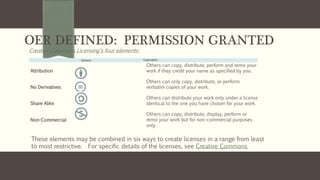
Creative Commons Licensing’s four elements:
Element Explanation
Attribution
Others can copy, distribute, perform and remix your
work if they credit your name as specified by you.
No Derivatives
Others can only copy, distribute, or perform
verbatim copies of your work.
Share Alike
Others can distribute your work only under a license
identical to the one you have chosen for your work.
Non-Commercial
Others can copy, distribute, display, perform or
remix your work but for non-commercial purposes
only
These elements may be combined in six ways to create licenses in a range from least
to most restrictive. For specific details of the licenses, see Creative Commons
USING OER: ADVANTAGES
FOR STUDENTS
 cost-free open license textbooks can replace costly printed textbooks
 OER provides immediate access to most recent versions of cost-free textbooks
 students can see published materials as recent, dynamic, updated sources
 students can connect with OER materials through variety of technologies—computers, tablets,
smartphones
 use of OER strengthens and enhances student compositions—written, oral, visual—as students can insert
 these into their compositions to illustrate and support their points.
 fo
USING OERS: ADVANTAGES
FOR EDUCATORS
 OERS provide alternatives to “choosing a textbook” and time spent evaluating cost/benefit for students
 OER offer access to recent publishing and opportunities to collaborate
 OER provide “permission granted” images, videos, and course materials, so that materials can be used
immediately.
 Use of OER can further illustrate textbook material, when traditional printed textbooks are preferred by instructor
 Instructors, librarians, and other educators can collaborate with other professional materials to develop and
update already-published materials. (No need to write for permission or wait until the next edition comes out.)
USING OER: CHALLENGES
FOR STUDENTS
 Some students may prefer a print textbook, such as a compact writing handbook, that is used by a
number of instructors of the same course, especially if a used/low-cost option is available.
 Ordering a used copy through an online source like Amazon.com may be more familiar and comfortable.
 Not all students have the same access or opportunities to own various technologies, or are less
comfortable with “moving between” a variety of source materials.
 Attraction of a “no-cost” text option may distract from noticing other course components and
responsibilities.
 Students must still understand and follow the practice of attribution—acknowledgement of authors,
artists, creators of source materials.
USING OER: CHALLENGES
FOR EDUCATORS
 Attentive planning and selectivity are needed when converting a course to OER.
 Ordering the most recent edition of a familiar, “proven” textbook may be the most effective option. Revising a
syllabus and already-effective course outline may not be feasible at the current time.
 Some open resources may need review and time to consider, if they have not been updated, or the usage rights
are not clear.
 Attraction of a “no-cost” text option may distract students from noticing other course components and
responsibilities, and faculty may need to spend more course time directing students’ attention.
 Instructor/faculty may wish to devote his or her time to creating OER materials and interacting with others who
do so, which may result in feeling like* having less time to devote to student work.
(*This is not truly a “disadvantage” as developing materials and working with others around the country can be energizing—but still, the newly engaged OER
creator may feel pulled in more than one direction!)
SOME CONCLUSIONS ABOUT USING OPEN EDUCATION RESOURCES
 For students, the avenues to current, quality materials about their subjects continues to increase.
For students, “textbook stress” and financial concerns can continue to decrease.
 For educators, the abundance of open resources allows for traditional textbooks to be selective options, rather than
default course components.
For educators, opportunities are available to publish one’s own work and work collaboratively with others in their field.
For all learners—educators AND students---you may develop and add-in elements of OER to your learning, a bit at a time.
For all learners (educators AND students) OER offers equal access to university course materials and full classes.
We all may “go to Yale” for free!
FOR THESE AND MANY OTHER REASONS, LEARN MORE ABOUT OER at Creative Commons and Open Washington .

OER Benefits and Challenges

  • 1.
    OPEN EDUCATION RESOURCES THEWHAT AND THE HOW Sarah E. (Sally) Nick OER 101, SBCTC May 2016
  • 2.
    OER—The “what” andthe “how”  Open Education Resources (OER) defined  OER Advantages  OER Challenges  Conclusions
  • 3.
    OER DEFINED: PERMISSIONGRANTED Open education resources—course materials, images, videos, and textbooks---are made available through OPEN LICENSING, which  grants usage rights through a standardized Creative Commons Licensing format  ensures that permission is already given by the author/creator to use and even adapt these materials  PROVIDED THAT the user attributes (names, identifies) the author/creator of the materials THEREFORE, unlike with traditional copyright, the user need not ask for permission from the author.
  • 4.
    OER DEFINED: PERMISSIONGRANTED Creative Commons Licensing’s four elements: Element Explanation Attribution Others can copy, distribute, perform and remix your work if they credit your name as specified by you. No Derivatives Others can only copy, distribute, or perform verbatim copies of your work. Share Alike Others can distribute your work only under a license identical to the one you have chosen for your work. Non-Commercial Others can copy, distribute, display, perform or remix your work but for non-commercial purposes only These elements may be combined in six ways to create licenses in a range from least to most restrictive. For specific details of the licenses, see Creative Commons
  • 5.
    USING OER: ADVANTAGES FORSTUDENTS  cost-free open license textbooks can replace costly printed textbooks  OER provides immediate access to most recent versions of cost-free textbooks  students can see published materials as recent, dynamic, updated sources  students can connect with OER materials through variety of technologies—computers, tablets, smartphones  use of OER strengthens and enhances student compositions—written, oral, visual—as students can insert  these into their compositions to illustrate and support their points.  fo
  • 6.
    USING OERS: ADVANTAGES FOREDUCATORS  OERS provide alternatives to “choosing a textbook” and time spent evaluating cost/benefit for students  OER offer access to recent publishing and opportunities to collaborate  OER provide “permission granted” images, videos, and course materials, so that materials can be used immediately.  Use of OER can further illustrate textbook material, when traditional printed textbooks are preferred by instructor  Instructors, librarians, and other educators can collaborate with other professional materials to develop and update already-published materials. (No need to write for permission or wait until the next edition comes out.)
  • 7.
    USING OER: CHALLENGES FORSTUDENTS  Some students may prefer a print textbook, such as a compact writing handbook, that is used by a number of instructors of the same course, especially if a used/low-cost option is available.  Ordering a used copy through an online source like Amazon.com may be more familiar and comfortable.  Not all students have the same access or opportunities to own various technologies, or are less comfortable with “moving between” a variety of source materials.  Attraction of a “no-cost” text option may distract from noticing other course components and responsibilities.  Students must still understand and follow the practice of attribution—acknowledgement of authors, artists, creators of source materials.
  • 8.
    USING OER: CHALLENGES FOREDUCATORS  Attentive planning and selectivity are needed when converting a course to OER.  Ordering the most recent edition of a familiar, “proven” textbook may be the most effective option. Revising a syllabus and already-effective course outline may not be feasible at the current time.  Some open resources may need review and time to consider, if they have not been updated, or the usage rights are not clear.  Attraction of a “no-cost” text option may distract students from noticing other course components and responsibilities, and faculty may need to spend more course time directing students’ attention.  Instructor/faculty may wish to devote his or her time to creating OER materials and interacting with others who do so, which may result in feeling like* having less time to devote to student work. (*This is not truly a “disadvantage” as developing materials and working with others around the country can be energizing—but still, the newly engaged OER creator may feel pulled in more than one direction!)
  • 9.
    SOME CONCLUSIONS ABOUTUSING OPEN EDUCATION RESOURCES  For students, the avenues to current, quality materials about their subjects continues to increase. For students, “textbook stress” and financial concerns can continue to decrease.  For educators, the abundance of open resources allows for traditional textbooks to be selective options, rather than default course components. For educators, opportunities are available to publish one’s own work and work collaboratively with others in their field. For all learners—educators AND students---you may develop and add-in elements of OER to your learning, a bit at a time. For all learners (educators AND students) OER offers equal access to university course materials and full classes. We all may “go to Yale” for free! FOR THESE AND MANY OTHER REASONS, LEARN MORE ABOUT OER at Creative Commons and Open Washington .