OEE(Overall Equipment Effectiveness) & Predictive Maintenance
Define OEE
Overall equipment effectiveness is a maintenance KPI (key performance
indicator) that measures an asset's level of productivity. OEE is a combination
of three factors that tell you how efficient an asset is during the manufacturing
process: asset availability, asset performance, and production quality.
Is there a normal OEE
world class overall OEE is 85.0% with availability at 90%, performance at
95% and quality at 99, 9%.
What is the purpose of OEE?
• OEE measure can identify which machine performance is ineffective and
required special attention
• It can pinpoint specific aspects of a process that can be ranked for
improvement
• Identifying any losses that restricts equipment from achieving it maximum
effectiveness
OEE(Overall Equipment Effectiveness) & Predictive Maintenance
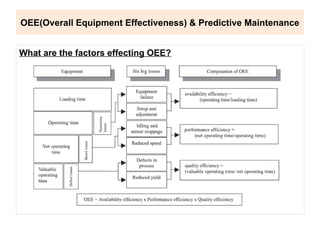
What are the factors effecting OEE?
Unplanned downtime losses as a function of Availability
1. Equipment failure: Breakdown losses are categorized as time and quantity losses
caused by failure, breakdown or by defective productive machines.
2. Set-up and Adjustment: These are losses that occur when production is changing
over from requirement of one item to another.
Speed losses as a function of Performance
1. Idling and minor stoppage: These losses occur when production is interrupted by
temporary malfunction or when a machine is idling.
2. Reduced speed: These losses refer to the difference between equipment design speed
and actual operating speed.
Quality losses as a function of Quality
1. Defect in process / rework: These are losses caused by malfunctioning of production
equipment.
2. Reduced yield: They are yield losses during start-up that occur from machine start-
up to stabilization.
What are the big losses of OEE?
OEE(Overall Equipment Effectiveness) & Predictive Maintenance
OEE is a program of zero breakdowns
and zero defects aimed at improving
or eliminating the losses. Equipment
breakdown is mainly depending on
the maintenance principles followed
by the industry.
Increasing effectiveness & efficiency
of equipment and
eliminating unplanned shutdowns &
production losses totally enhanced
by choosing the predictive
maintenance.
An Introduction to Predictive
Maintenance
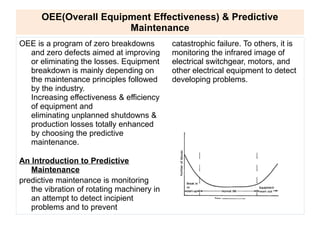
predictive maintenance is monitoring
the vibration of rotating machinery in
an attempt to detect incipient
problems and to prevent
catastrophic failure. To others, it is
monitoring the infrared image of
electrical switchgear, motors, and
other electrical equipment to detect
developing problems.
OEE(Overall Equipment Effectiveness) & Predictive
Maintenance
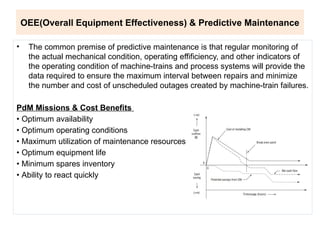
• The common premise of predictive maintenance is that regular monitoring of
the actual mechanical condition, operating effificiency, and other indicators of
the operating condition of machine-trains and process systems will provide the
data required to ensure the maximum interval between repairs and minimize
the number and cost of unscheduled outages created by machine-train failures.
PdM Missions & Cost Benefits
• Optimum availability
• Optimum operating conditions
• Maximum utilization of maintenance resources
• Optimum equipment life
• Minimum spares inventory
• Ability to react quickly
OEE(Overall Equipment Effectiveness) & Predictive Maintenance
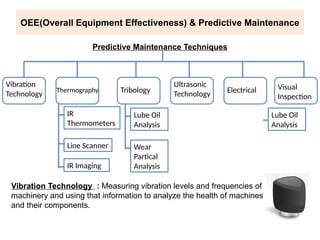
Predictive Maintenance Techniques
Vibration
Technology
Thermography Tribology
Ultrasonic
Technology Electrical Visual
Inspection
IR
Thermometers
Line Scanner
IR Imaging
Lube Oil
Analysis
Wear
Partical
Analysis
Lube Oil
Analysis
Vibration Technology : Measuring vibration levels and frequencies of
machinery and using that information to analyze the health of machines
and their components.
OEE(Overall Equipment Effectiveness) & Predictive Maintenance
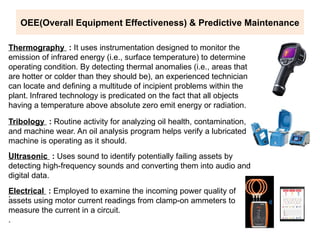
Thermography : It uses instrumentation designed to monitor the
emission of infrared energy (i.e., surface temperature) to determine
operating condition. By detecting thermal anomalies (i.e., areas that
are hotter or colder than they should be), an experienced technician
can locate and defining a multitude of incipient problems within the
plant. Infrared technology is predicated on the fact that all objects
having a temperature above absolute zero emit energy or radiation.
Tribology : Routine activity for analyzing oil health, contamination,
and machine wear. An oil analysis program helps verify a lubricated
machine is operating as it should.
.
Ultrasonic : Uses sound to identify potentially failing assets by
detecting high-frequency sounds and converting them into audio and
digital data.
.
Electrical : Employed to examine the incoming power quality of
assets using motor current readings from clamp-on ammeters to
measure the current in a circuit.
.
Visual Inspection : Visual inspection was the first method used for predictive
maintenance. Almost from the beginning of the Industrial Revolution, maintenance
technicians performed daily “walkdowns” of critical production and manufacturing
systems in an attempt to identify potential failures or maintenance-related problems
that could impact reliability, product quality, and production costs.
.
OEE(Overall Equipment Effectiveness) & Predictive Maintenance
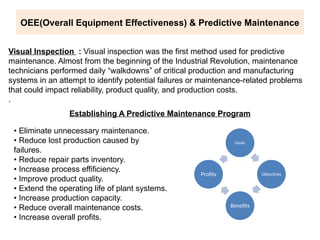
Establishing A Predictive Maintenance Program
Goals
Objectives
Benefits
Profits
• Eliminate unnecessary maintenance.
• Reduce lost production caused by
failures.
• Reduce repair parts inventory.
• Increase process effificiency.
• Improve product quality.
• Extend the operating life of plant systems.
• Increase production capacity.
• Reduce overall maintenance costs.
• Increase overall profits.
OEE(Overall Equipment Effectiveness) & Predictive Maintenance
Conclusion : World–Class Maintenance
Overall equipment effectiveness (OEE) is the benchmark used for world-class
maintenance programs. The OEE benchmark is established by measuring
equipment performance. Measuring equipment effectiveness must go beyond
just the availability or machine uptime. These all factors of OEE availability of
machine will be enhanced by using predictive maintenance tools. In PdM,
machine failures can easily predict and resolve. Mostly in PdM, vibration
analysis is the key factor to predict 60% of mechanical and electrical-related
failures.
Plant efficiency improvements can be scarce and may only be achieved
by streamlining maintenance processes

OEE(Overall Equipment Effectiveness) & Predictive Maintenance.pptx

  • 1.
    OEE(Overall Equipment Effectiveness)& Predictive Maintenance Define OEE Overall equipment effectiveness is a maintenance KPI (key performance indicator) that measures an asset's level of productivity. OEE is a combination of three factors that tell you how efficient an asset is during the manufacturing process: asset availability, asset performance, and production quality. Is there a normal OEE world class overall OEE is 85.0% with availability at 90%, performance at 95% and quality at 99, 9%. What is the purpose of OEE? • OEE measure can identify which machine performance is ineffective and required special attention • It can pinpoint specific aspects of a process that can be ranked for improvement • Identifying any losses that restricts equipment from achieving it maximum effectiveness
  • 2.
    OEE(Overall Equipment Effectiveness)& Predictive Maintenance What are the factors effecting OEE?
  • 3.
    Unplanned downtime lossesas a function of Availability 1. Equipment failure: Breakdown losses are categorized as time and quantity losses caused by failure, breakdown or by defective productive machines. 2. Set-up and Adjustment: These are losses that occur when production is changing over from requirement of one item to another. Speed losses as a function of Performance 1. Idling and minor stoppage: These losses occur when production is interrupted by temporary malfunction or when a machine is idling. 2. Reduced speed: These losses refer to the difference between equipment design speed and actual operating speed. Quality losses as a function of Quality 1. Defect in process / rework: These are losses caused by malfunctioning of production equipment. 2. Reduced yield: They are yield losses during start-up that occur from machine start- up to stabilization. What are the big losses of OEE? OEE(Overall Equipment Effectiveness) & Predictive Maintenance
  • 4.
    OEE is aprogram of zero breakdowns and zero defects aimed at improving or eliminating the losses. Equipment breakdown is mainly depending on the maintenance principles followed by the industry. Increasing effectiveness & efficiency of equipment and eliminating unplanned shutdowns & production losses totally enhanced by choosing the predictive maintenance. An Introduction to Predictive Maintenance predictive maintenance is monitoring the vibration of rotating machinery in an attempt to detect incipient problems and to prevent catastrophic failure. To others, it is monitoring the infrared image of electrical switchgear, motors, and other electrical equipment to detect developing problems. OEE(Overall Equipment Effectiveness) & Predictive Maintenance
  • 5.
    • The commonpremise of predictive maintenance is that regular monitoring of the actual mechanical condition, operating effificiency, and other indicators of the operating condition of machine-trains and process systems will provide the data required to ensure the maximum interval between repairs and minimize the number and cost of unscheduled outages created by machine-train failures. PdM Missions & Cost Benefits • Optimum availability • Optimum operating conditions • Maximum utilization of maintenance resources • Optimum equipment life • Minimum spares inventory • Ability to react quickly OEE(Overall Equipment Effectiveness) & Predictive Maintenance
  • 6.
    OEE(Overall Equipment Effectiveness)& Predictive Maintenance Predictive Maintenance Techniques Vibration Technology Thermography Tribology Ultrasonic Technology Electrical Visual Inspection IR Thermometers Line Scanner IR Imaging Lube Oil Analysis Wear Partical Analysis Lube Oil Analysis Vibration Technology : Measuring vibration levels and frequencies of machinery and using that information to analyze the health of machines and their components.
  • 7.
    OEE(Overall Equipment Effectiveness)& Predictive Maintenance Thermography : It uses instrumentation designed to monitor the emission of infrared energy (i.e., surface temperature) to determine operating condition. By detecting thermal anomalies (i.e., areas that are hotter or colder than they should be), an experienced technician can locate and defining a multitude of incipient problems within the plant. Infrared technology is predicated on the fact that all objects having a temperature above absolute zero emit energy or radiation. Tribology : Routine activity for analyzing oil health, contamination, and machine wear. An oil analysis program helps verify a lubricated machine is operating as it should. . Ultrasonic : Uses sound to identify potentially failing assets by detecting high-frequency sounds and converting them into audio and digital data. . Electrical : Employed to examine the incoming power quality of assets using motor current readings from clamp-on ammeters to measure the current in a circuit. .
  • 8.
    Visual Inspection :Visual inspection was the first method used for predictive maintenance. Almost from the beginning of the Industrial Revolution, maintenance technicians performed daily “walkdowns” of critical production and manufacturing systems in an attempt to identify potential failures or maintenance-related problems that could impact reliability, product quality, and production costs. . OEE(Overall Equipment Effectiveness) & Predictive Maintenance Establishing A Predictive Maintenance Program Goals Objectives Benefits Profits • Eliminate unnecessary maintenance. • Reduce lost production caused by failures. • Reduce repair parts inventory. • Increase process effificiency. • Improve product quality. • Extend the operating life of plant systems. • Increase production capacity. • Reduce overall maintenance costs. • Increase overall profits.
  • 9.
    OEE(Overall Equipment Effectiveness)& Predictive Maintenance Conclusion : World–Class Maintenance Overall equipment effectiveness (OEE) is the benchmark used for world-class maintenance programs. The OEE benchmark is established by measuring equipment performance. Measuring equipment effectiveness must go beyond just the availability or machine uptime. These all factors of OEE availability of machine will be enhanced by using predictive maintenance tools. In PdM, machine failures can easily predict and resolve. Mostly in PdM, vibration analysis is the key factor to predict 60% of mechanical and electrical-related failures. Plant efficiency improvements can be scarce and may only be achieved by streamlining maintenance processes