LIVE WEBCAST 
UPDATE ON BEPS PROJECT 
2 April 2014 
3:00pm – 4:00pm (CEST)
WELCOME 
2
Overview 
• The BEPS project is proceeding on track 
• 4 Discussion Drafts 
- Country by Country Reporting: 30 January 2014 
- Tax Treaty Abuse: 14 March 2014 
- Hybrid Mismatch Arrangements: 19 March 2014 
- Digital Economy: 24 March 2014 
• 3 other 2014 deliverables 
- Action 5: Harmful Tax Practices 
- Action 8: TP Aspects of Intangibles 
- Action 15: The Multilateral Instrument 
• Work on 2015 deliverables is also ongoing 
3
Engagement with 
Stakeholders 
• Planned Public Consultations: 
– Preventing Treaty Abuse: 14-15 April 2014 
– Digital Economy: 23 April 2014 
– Hybrid Mismatch Arrangements: 15May 2014 
– TP Documentation and CbC Reporting: 19 May 2014 
• Engagement with NOEs 
– Global Forum on Transfer Pricing (111 countries, 300 delegates) 
– 4 Regional Meetings (South Korea, Colombia, South Africa, France) 
• Australia G20 Symposium: 9-10 May 2014 
4
Review of Consultation 
with Developing Countries 
• Key Priorities: Interest deductibility, other base eroding 
payments, treaty abuse and transfer pricing actions 
• Other issues: tax incentives, capacity building and 
awareness raising 
• IMF contribution: indirect transfer of interest 
• Report to the G20 Development Working Group 
5
Update 
• Digital Economy 
• Hybrid Mismatch Arrangements 
• Tax Treaty Abuse 
• Transfer Pricing aspects of Intangibles 
• Transfer Pricing and Country by Country 
Reporting 
6
DIGITAL ECONOMY 
7
The Digital Economy 
• Overview of developments in ICT over time 
• Not possible nor useful to ring-fence the digital economy 
• Some key features of the digital economy warrant attention 
– Mobility 
– Reliance on data 
– Multi-sided businesses 
– Network effects 
– Tendency to mono/oligopoly and 
– Volatility 
8
The Digital Economy 
and BEPS 
• Focus on BEPS structures: 
– No unique BEPS issue related to the digital economy but 
– Some of the key features of the digital economy do exacerbate these 
issues 
– For both income and consumption tax purposes 
• BEPS Project expected to address these BEPS issues in a 
comprehensive manner 
• Draft identifies features of the digital economy that should be taken 
into account when doing the work on other actions 
9
The Digital Economy and 
broader tax challenges 
• Tax challenges that go beyond BEPS and that can be seen as more 
systemic: 
– possibility of doing business in a country without being physically 
present there 
– whether and how to attribute value to data 
– tax characterisation issues related to payments for cloud services 
– certain consumption tax aspects 
• Short description of the options that so far have been considered - 
more work to be done 
• Stakeholders input very important in this respect 
10
Digital Economy 
Next steps 
• Consultation: 
– Comments due by 14 April 2014 
– Public consultation on 23 April 2014 
• Next steps on report: 
– Add a chapter on fundamental tax principles 
– Further development of the options 
– Framework for analysing options 
– More detailed examples of BEPS structures in the digital 
economy 
11
HYBRID MISMATCHES 
12
Hybrids 
• What is a hybrid mismatch arrangement? 
– An arrangement that exploits the different tax treatment in two jurisdictions to produce 
a mismatch in tax outcomes 
– Mismatch is either two deductions for the same payment or a deductible payment that 
is not included in income by the recipient 
• Where are we on the Action Item (Action Item 2)? 
– Early release of Public Consultation Draft on 19 March 2014 
– Comments due by 2 May 2014 and Public Consultation on 15 May 2014 
• What are we trying to achieve? 
– Recommendations for domestic law changes and changes to OECD Model 
Convention to deal with hybrids. 
– Clear, automatic and comprehensive rules that neutralise the tax mismatch without 
disturbing the commercial or regulatory consequences. 
http://www.oecd.org/tax/discussion-drafts-action-2-hybrid-mismatch-arrangements.htm 13
What is in the report? 
• Domestic recommendations cover 3 areas: 
– Hybrid financial instruments (including transfers) 
– Payments made by a hybrid entity that give rise to duplicate deductions 
or deduction / no-inclusion outcomes 
– Imported mismatch structures. 
• Linking rules that base the tax treatment of hybrid on tax treatment 
in the other state. 
• Deny a deduction for payment or require for it to be included in 
income. 
• Primary / secondary rule ordering to determine which jurisdiction 
applies its rules first. 
14
Questions for consultation 
• Questions for public consultation set out in document 
• Interested in feedback on whether the rules proposed in the 
report will give rise to unanticipated difficulties for taxpayers or 
industries 
• Scope of the rules (particularly for hybrid financial 
instruments): 
– Applies to related parties, parties acting in concert and 
structured arrangements 
– Approach to definition of scope still under consideration 
– What is perceived impact of approach to scope on tax 
compliance and administration? 
15
PREVENTING TREATY 
ABUSE 
16
Treaty Abuse (1) 
Three elements: 
A. Prevent the granting of treaty benefits in inappropriate 
circumstances 
– Circumventing the limitations of the treaty itself 
– Circumventing application of domestic tax law by using 
treaties 
B. Clarify that Tax Treaties are not intended to generate double 
non-taxation 
C. Tax policy considerations to consider before entering into a 
treaty 
17
Treaty Abuse (2) 
• Discussion draft: 14 March 2014 
• Comments deadline: 9 April 2014 
• Public consultation meeting: 14-15 April 2014 
18
1. Specific treaty anti-abuse rules targeted at circumventing the 
limitations provided by the treaty itself: 
“Treaty shopping”: Limitation-on-benefits (LOB) 
- Question: inclusion of a “derivative benefits” clause in the LOB 
rule? 
Other specific anti abuse rules: 
– Minimum holding period dividend transfer transactions 
– Transactions that circumvent the application of Art. 13 (4) 
– Tie breaker rule dual residence entities: MAP 
– Anti-abuse rule for permanent establishments situated in third 
States 
19 
Prevent the granting of treaty benefits in 
inappropriate circumstances
Prevent the granting of treaty benefits in 
inappropriate circumstances 
2. Main purpose test rule 
– Incorporates in the Articles the guidance 
already found in the Commentary on Art. 1 
20
Prevent the granting of treaty benefits in 
inappropriate circumstances 
3. Abuse targeted at circumventing domestic 
tax law by using treaties (relationship 
treaties and domestic anti- abuse rules) 
– Refine the analysis in Commentary (clearer 
distinction between specific and general anti 
abuse rules) 
– Case-by-case analysis for specific rules 
– Saving clause 
21
TRANSFER PRICING 
ASPECTS OF INTANGIBLES 
22
Transfer Pricing Aspects 
of Intangibles 
• WP6 had productive meetings the previous weeks 
• Tentative agreements were reached on most 
aspects of the 30 July 2013 Revised Discussion 
Draft 
• Issue to be further discussed in May: Integration and 
correlation of Section B of Chapter VI with 2015 
BEPS work on risk, re-characterisation and capital 
(funding) 
23
TRANSFER PRICING 
DOCUMENTATION AND 
COUNTRY BY COUNTRY 
REPORTING 
24
TP Documentation and 
CbyC Reporting 
• BEPS Action 13 requires development of 
improved TP documentation standards 
including a country – by – country reporting 
template. 
• Discussion Draft 30 January 2014 
• 150+ comment letters / 1300 + pages 
• Two days of WP6 discussions last week 
25
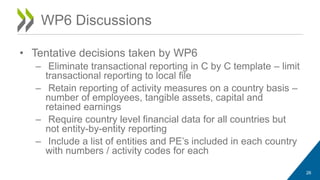
WP6 Discussions 
• Tentative decisions taken by WP6 
– Eliminate transactional reporting in C by C template – limit 
transactional reporting to local file 
– Retain reporting of activity measures on a country basis – 
number of employees, tangible assets, capital and 
retained earnings 
– Require country level financial data for all countries but 
not entity-by-entity reporting 
– Include a list of entities and PE’s included in each country 
with numbers / activity codes for each 
26
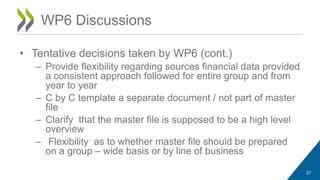
WP6 Discussions 
• Tentative decisions taken by WP6 (cont.) 
– Provide flexibility regarding sources financial data provided 
a consistent approach followed for entire group and from 
year to year 
– C by C template a separate document / not part of master 
file 
– Clarify that the master file is supposed to be a high level 
overview 
– Flexibility as to whether master file should be prepared 
on a group – wide basis or by line of business 
27
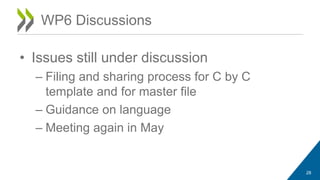
WP6 Discussions 
• Issues still under discussion 
– Filing and sharing process for C by C 
template and for master file 
– Guidance on language 
– Meeting again in May 
28
QUESTIONS AND ANSWERS 
29
Stay tuned! 
30 
Further Information 
http://www.oecd.org/tax/beps.htm 
Register to receive free e-mail alerts on the latest tax news from the OECD 
Centre for Tax Policy and Administration www.oecd.org/oecddirect

BEPS Webcast #2 - Update on project

  • 1.
    LIVE WEBCAST UPDATEON BEPS PROJECT 2 April 2014 3:00pm – 4:00pm (CEST)
  • 2.
  • 3.
    Overview • TheBEPS project is proceeding on track • 4 Discussion Drafts - Country by Country Reporting: 30 January 2014 - Tax Treaty Abuse: 14 March 2014 - Hybrid Mismatch Arrangements: 19 March 2014 - Digital Economy: 24 March 2014 • 3 other 2014 deliverables - Action 5: Harmful Tax Practices - Action 8: TP Aspects of Intangibles - Action 15: The Multilateral Instrument • Work on 2015 deliverables is also ongoing 3
  • 4.
    Engagement with Stakeholders • Planned Public Consultations: – Preventing Treaty Abuse: 14-15 April 2014 – Digital Economy: 23 April 2014 – Hybrid Mismatch Arrangements: 15May 2014 – TP Documentation and CbC Reporting: 19 May 2014 • Engagement with NOEs – Global Forum on Transfer Pricing (111 countries, 300 delegates) – 4 Regional Meetings (South Korea, Colombia, South Africa, France) • Australia G20 Symposium: 9-10 May 2014 4
  • 5.
    Review of Consultation with Developing Countries • Key Priorities: Interest deductibility, other base eroding payments, treaty abuse and transfer pricing actions • Other issues: tax incentives, capacity building and awareness raising • IMF contribution: indirect transfer of interest • Report to the G20 Development Working Group 5
  • 6.
    Update • DigitalEconomy • Hybrid Mismatch Arrangements • Tax Treaty Abuse • Transfer Pricing aspects of Intangibles • Transfer Pricing and Country by Country Reporting 6
  • 7.
  • 8.
    The Digital Economy • Overview of developments in ICT over time • Not possible nor useful to ring-fence the digital economy • Some key features of the digital economy warrant attention – Mobility – Reliance on data – Multi-sided businesses – Network effects – Tendency to mono/oligopoly and – Volatility 8
  • 9.
    The Digital Economy and BEPS • Focus on BEPS structures: – No unique BEPS issue related to the digital economy but – Some of the key features of the digital economy do exacerbate these issues – For both income and consumption tax purposes • BEPS Project expected to address these BEPS issues in a comprehensive manner • Draft identifies features of the digital economy that should be taken into account when doing the work on other actions 9
  • 10.
    The Digital Economyand broader tax challenges • Tax challenges that go beyond BEPS and that can be seen as more systemic: – possibility of doing business in a country without being physically present there – whether and how to attribute value to data – tax characterisation issues related to payments for cloud services – certain consumption tax aspects • Short description of the options that so far have been considered - more work to be done • Stakeholders input very important in this respect 10
  • 11.
    Digital Economy Nextsteps • Consultation: – Comments due by 14 April 2014 – Public consultation on 23 April 2014 • Next steps on report: – Add a chapter on fundamental tax principles – Further development of the options – Framework for analysing options – More detailed examples of BEPS structures in the digital economy 11
  • 12.
  • 13.
    Hybrids • Whatis a hybrid mismatch arrangement? – An arrangement that exploits the different tax treatment in two jurisdictions to produce a mismatch in tax outcomes – Mismatch is either two deductions for the same payment or a deductible payment that is not included in income by the recipient • Where are we on the Action Item (Action Item 2)? – Early release of Public Consultation Draft on 19 March 2014 – Comments due by 2 May 2014 and Public Consultation on 15 May 2014 • What are we trying to achieve? – Recommendations for domestic law changes and changes to OECD Model Convention to deal with hybrids. – Clear, automatic and comprehensive rules that neutralise the tax mismatch without disturbing the commercial or regulatory consequences. http://www.oecd.org/tax/discussion-drafts-action-2-hybrid-mismatch-arrangements.htm 13
  • 14.
    What is inthe report? • Domestic recommendations cover 3 areas: – Hybrid financial instruments (including transfers) – Payments made by a hybrid entity that give rise to duplicate deductions or deduction / no-inclusion outcomes – Imported mismatch structures. • Linking rules that base the tax treatment of hybrid on tax treatment in the other state. • Deny a deduction for payment or require for it to be included in income. • Primary / secondary rule ordering to determine which jurisdiction applies its rules first. 14
  • 15.
    Questions for consultation • Questions for public consultation set out in document • Interested in feedback on whether the rules proposed in the report will give rise to unanticipated difficulties for taxpayers or industries • Scope of the rules (particularly for hybrid financial instruments): – Applies to related parties, parties acting in concert and structured arrangements – Approach to definition of scope still under consideration – What is perceived impact of approach to scope on tax compliance and administration? 15
  • 16.
  • 17.
    Treaty Abuse (1) Three elements: A. Prevent the granting of treaty benefits in inappropriate circumstances – Circumventing the limitations of the treaty itself – Circumventing application of domestic tax law by using treaties B. Clarify that Tax Treaties are not intended to generate double non-taxation C. Tax policy considerations to consider before entering into a treaty 17
  • 18.
    Treaty Abuse (2) • Discussion draft: 14 March 2014 • Comments deadline: 9 April 2014 • Public consultation meeting: 14-15 April 2014 18
  • 19.
    1. Specific treatyanti-abuse rules targeted at circumventing the limitations provided by the treaty itself: “Treaty shopping”: Limitation-on-benefits (LOB) - Question: inclusion of a “derivative benefits” clause in the LOB rule? Other specific anti abuse rules: – Minimum holding period dividend transfer transactions – Transactions that circumvent the application of Art. 13 (4) – Tie breaker rule dual residence entities: MAP – Anti-abuse rule for permanent establishments situated in third States 19 Prevent the granting of treaty benefits in inappropriate circumstances
  • 20.
    Prevent the grantingof treaty benefits in inappropriate circumstances 2. Main purpose test rule – Incorporates in the Articles the guidance already found in the Commentary on Art. 1 20
  • 21.
    Prevent the grantingof treaty benefits in inappropriate circumstances 3. Abuse targeted at circumventing domestic tax law by using treaties (relationship treaties and domestic anti- abuse rules) – Refine the analysis in Commentary (clearer distinction between specific and general anti abuse rules) – Case-by-case analysis for specific rules – Saving clause 21
  • 22.
    TRANSFER PRICING ASPECTSOF INTANGIBLES 22
  • 23.
    Transfer Pricing Aspects of Intangibles • WP6 had productive meetings the previous weeks • Tentative agreements were reached on most aspects of the 30 July 2013 Revised Discussion Draft • Issue to be further discussed in May: Integration and correlation of Section B of Chapter VI with 2015 BEPS work on risk, re-characterisation and capital (funding) 23
  • 24.
    TRANSFER PRICING DOCUMENTATIONAND COUNTRY BY COUNTRY REPORTING 24
  • 25.
    TP Documentation and CbyC Reporting • BEPS Action 13 requires development of improved TP documentation standards including a country – by – country reporting template. • Discussion Draft 30 January 2014 • 150+ comment letters / 1300 + pages • Two days of WP6 discussions last week 25
  • 26.
    WP6 Discussions •Tentative decisions taken by WP6 – Eliminate transactional reporting in C by C template – limit transactional reporting to local file – Retain reporting of activity measures on a country basis – number of employees, tangible assets, capital and retained earnings – Require country level financial data for all countries but not entity-by-entity reporting – Include a list of entities and PE’s included in each country with numbers / activity codes for each 26
  • 27.
    WP6 Discussions •Tentative decisions taken by WP6 (cont.) – Provide flexibility regarding sources financial data provided a consistent approach followed for entire group and from year to year – C by C template a separate document / not part of master file – Clarify that the master file is supposed to be a high level overview – Flexibility as to whether master file should be prepared on a group – wide basis or by line of business 27
  • 28.
    WP6 Discussions •Issues still under discussion – Filing and sharing process for C by C template and for master file – Guidance on language – Meeting again in May 28
  • 29.
  • 30.
    Stay tuned! 30 Further Information http://www.oecd.org/tax/beps.htm Register to receive free e-mail alerts on the latest tax news from the OECD Centre for Tax Policy and Administration www.oecd.org/oecddirect