PUBLIC-PRIVATE ROUNDTABLE: SUSTAINABLE
INFRASTRUCTURE IN MONGOLIA – DEVELOPING GREEN
HYDROGEN PRODUCTION
Setting the scene presentation
21 March 2023
Peline Atamer
Head of SIPA – Central Asia
Global Relations and Co-operation Directorate
Peline.Atamer@OECD.org
❑ The Sustainable Infrastructure Programme in Asia (SIPA) in
Mongolia
❑ Key considerations for today’s discussion: green hydrogen
opportunities for sustainable infrastructure in Mongolia
Agenda
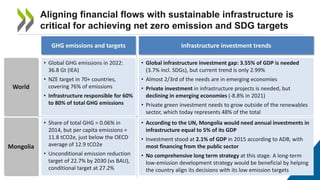
Aligning financial flows with sustainable infrastructure is
critical for achieving net zero emission and SDG targets
World
Mongolia
Infrastructure investment trends
GHG emissions and targets
• Global infrastructure investment gap: 3.55% of GDP is needed
(3.7% incl. SDGs), but current trend is only 2.99%
• Almost 2/3rd of the needs are in emerging economies
• Private investment in infrastructure projects is needed, but
declining in emerging economies (-8.8% in 2021)
• Private green investment needs to grow outside of the renewables
sector, which today represents 48% of the total
• Global GHG emissions in 2022:
36.8 Gt (IEA)
• NZE target in 70+ countries,
covering 76% of emissions
• Infrastructure responsible for 60%
to 80% of total GHG emissions
• According to the UN, Mongolia would need annual investments in
infrastructure equal to 5% of its GDP
• Investment stood at 2.1% of GDP in 2015 according to ADB, with
most financing from the public sector
• No comprehensive long term strategy at this stage. A long-term
low-emission development strategy would be beneficial by helping
the country align its decisions with its low emission targets
• Share of total GHG = 0.06% in
2014, but per capita emissions =
11.8 tCO2e, just below the OECD
average of 12.9 tCO2e
• Unconditional emission reduction
target of 22.7% by 2030 (vs BAU),
conditional target at 27.2%
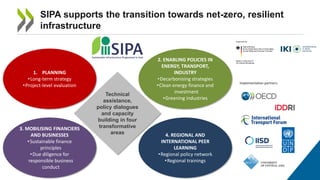
SIPA supports the transition towards net-zero, resilient
infrastructure
1. PLANNING
•Long-term strategy
•Project-level evaluation
2. ENABLING POLICIES IN
ENERGY, TRANSPORT,
INDUSTRY
•Decarbonising strategies
•Clean energy finance and
investment
•Greening industries
3. MOBILISING FINANCIERS
AND BUSINESSES
•Sustainable finance
principles
•Due diligence for
responsible business
conduct
4. REGIONAL AND
INTERNATIONAL PEER
LEARNING
•Regional policy network
•Regional trainings
Technical
assistance,
policy dialogues
and capacity
building in four
transformative
areas
Implementation partners:
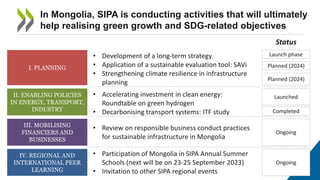
In Mongolia, SIPA is conducting activities that will ultimately
help realising green growth and SDG-related objectives
I. PLANNING
II. ENABLING POLICIES
IN ENERGY, TRANSPORT,
INDUSTRY
III. MOBILISING
FINANCIERS AND
BUSINESSES
IV. REGIONAL AND
INTERNATIONAL PEER
LEARNING
• Development of a long-term strategy
• Application of a sustainable evaluation tool: SAVi
• Strengthening climate resilience in infrastructure
planning
• Accelerating investment in clean energy:
Roundtable on green hydrogen
• Decarbonising transport systems: ITF study
Status
Launch phase
Launched
Completed
• Review on responsible business conduct practices
for sustainable infrastructure in Mongolia
• Participation of Mongolia in SIPA Annual Summer
Schools (next will be on 23-25 September 2023)
• Invitation to other SIPA regional events
Planned (2024)
Ongoing
Ongoing
Planned (2024)
❑ The Sustainable Infrastructure Programme in Asia (SIPA) in
Mongolia
❑ Key considerations for today’s discussion: green hydrogen
opportunities for sustainable infrastructure in Mongolia
Agenda
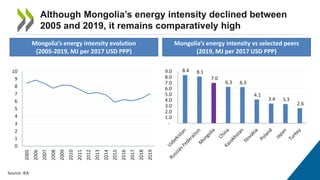
Although Mongolia’s energy intensity declined between
2005 and 2019, it remains comparatively high
8.4 8.1
7.0
6.3 6.3
4.1
3.4 3.3
2.6
-
1.0
2.0
3.0
4.0
5.0
6.0
7.0
8.0
9.0
Mongolia’s energy intensity vs selected peers
(2019, MJ per 2017 USD PPP)
Source: IEA
Mongolia’s energy intensity evolution
(2005-2019, MJ per 2017 USD PPP)
0
1
2
3
4
5
6
7
8
9
10
2005
2006
2007
2008
2009
2010
2011
2012
2013
2014
2015
2016
2017
2018
2019
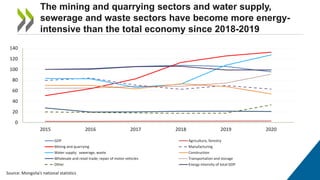
The mining and quarrying sectors and water supply,
sewerage and waste sectors have become more energy-
intensive than the total economy since 2018-2019
0
20
40
60
80
100
120
140
2015 2016 2017 2018 2019 2020
GDP Agriculture, forestry
Mining and quarrying Manufacturing
Water supply; sewerage, waste Construction
Wholesale and retail trade; repair of motor vehicles Transportation and storage
Other Energy intensity of total GDP
Source: Mongolia’s national statistics
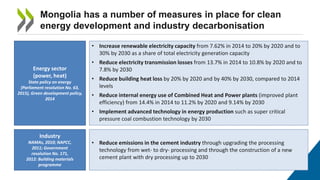
Mongolia has a number of measures in place for clean
energy development and industry decarbonisation
Energy sector
(power, heat)
State policy on energy
(Parliament resolution No. 63,
2015), Green development policy,
2014
Industry
NAMAs, 2010; NAPCC,
2011; Government
resolution No. 171,
2012: Building materials
programme
• Increase renewable electricity capacity from 7.62% in 2014 to 20% by 2020 and to
30% by 2030 as a share of total electricity generation capacity
• Reduce electricity transmission losses from 13.7% in 2014 to 10.8% by 2020 and to
7.8% by 2030
• Reduce building heat loss by 20% by 2020 and by 40% by 2030, compared to 2014
levels
• Reduce internal energy use of Combined Heat and Power plants (improved plant
efficiency) from 14.4% in 2014 to 11.2% by 2020 and 9.14% by 2030
• Implement advanced technology in energy production such as super critical
pressure coal combustion technology by 2030
• Reduce emissions in the cement industry through upgrading the processing
technology from wet- to dry- processing and through the construction of a new
cement plant with dry processing up to 2030
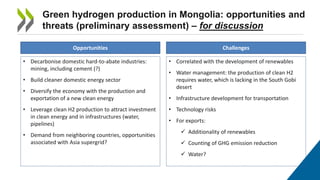
Green hydrogen production in Mongolia: opportunities and
threats (preliminary assessment) – for discussion
Opportunities Challenges
• Decarbonise domestic hard-to-abate industries:
mining, including cement (?)
• Build cleaner domestic energy sector
• Diversify the economy with the production and
exportation of a new clean energy
• Leverage clean H2 production to attract investment
in clean energy and in infrastructures (water,
pipelines)
• Demand from neighboring countries, opportunities
associated with Asia supergrid?
• Correlated with the development of renewables
• Water management: the production of clean H2
requires water, which is lacking in the South Gobi
desert
• Infrastructure development for transportation
• Technology risks
• For exports:
✓ Additionality of renewables
✓ Counting of GHG emission reduction
✓ Water?
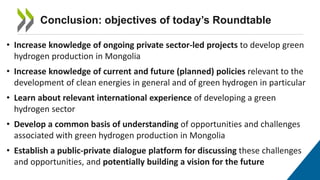
Conclusion: objectives of today’s Roundtable
• Increase knowledge of ongoing private sector-led projects to develop green
hydrogen production in Mongolia
• Increase knowledge of current and future (planned) policies relevant to the
development of clean energies in general and of green hydrogen in particular
• Learn about relevant international experience of developing a green
hydrogen sector
• Develop a common basis of understanding of opportunities and challenges
associated with green hydrogen production in Mongolia
• Establish a public-private dialogue platform for discussing these challenges
and opportunities, and potentially building a vision for the future
Thank you!
sipa@oecd.org

OECD SIPA Presentation_ENG.pdf

  • 1.
    PUBLIC-PRIVATE ROUNDTABLE: SUSTAINABLE INFRASTRUCTUREIN MONGOLIA – DEVELOPING GREEN HYDROGEN PRODUCTION Setting the scene presentation 21 March 2023 Peline Atamer Head of SIPA – Central Asia Global Relations and Co-operation Directorate Peline.Atamer@OECD.org
  • 2.
    ❑ The SustainableInfrastructure Programme in Asia (SIPA) in Mongolia ❑ Key considerations for today’s discussion: green hydrogen opportunities for sustainable infrastructure in Mongolia Agenda
  • 3.
    Aligning financial flowswith sustainable infrastructure is critical for achieving net zero emission and SDG targets World Mongolia Infrastructure investment trends GHG emissions and targets • Global infrastructure investment gap: 3.55% of GDP is needed (3.7% incl. SDGs), but current trend is only 2.99% • Almost 2/3rd of the needs are in emerging economies • Private investment in infrastructure projects is needed, but declining in emerging economies (-8.8% in 2021) • Private green investment needs to grow outside of the renewables sector, which today represents 48% of the total • Global GHG emissions in 2022: 36.8 Gt (IEA) • NZE target in 70+ countries, covering 76% of emissions • Infrastructure responsible for 60% to 80% of total GHG emissions • According to the UN, Mongolia would need annual investments in infrastructure equal to 5% of its GDP • Investment stood at 2.1% of GDP in 2015 according to ADB, with most financing from the public sector • No comprehensive long term strategy at this stage. A long-term low-emission development strategy would be beneficial by helping the country align its decisions with its low emission targets • Share of total GHG = 0.06% in 2014, but per capita emissions = 11.8 tCO2e, just below the OECD average of 12.9 tCO2e • Unconditional emission reduction target of 22.7% by 2030 (vs BAU), conditional target at 27.2%
  • 4.
    SIPA supports thetransition towards net-zero, resilient infrastructure 1. PLANNING •Long-term strategy •Project-level evaluation 2. ENABLING POLICIES IN ENERGY, TRANSPORT, INDUSTRY •Decarbonising strategies •Clean energy finance and investment •Greening industries 3. MOBILISING FINANCIERS AND BUSINESSES •Sustainable finance principles •Due diligence for responsible business conduct 4. REGIONAL AND INTERNATIONAL PEER LEARNING •Regional policy network •Regional trainings Technical assistance, policy dialogues and capacity building in four transformative areas Implementation partners:
  • 5.
    In Mongolia, SIPAis conducting activities that will ultimately help realising green growth and SDG-related objectives I. PLANNING II. ENABLING POLICIES IN ENERGY, TRANSPORT, INDUSTRY III. MOBILISING FINANCIERS AND BUSINESSES IV. REGIONAL AND INTERNATIONAL PEER LEARNING • Development of a long-term strategy • Application of a sustainable evaluation tool: SAVi • Strengthening climate resilience in infrastructure planning • Accelerating investment in clean energy: Roundtable on green hydrogen • Decarbonising transport systems: ITF study Status Launch phase Launched Completed • Review on responsible business conduct practices for sustainable infrastructure in Mongolia • Participation of Mongolia in SIPA Annual Summer Schools (next will be on 23-25 September 2023) • Invitation to other SIPA regional events Planned (2024) Ongoing Ongoing Planned (2024)
  • 6.
    ❑ The SustainableInfrastructure Programme in Asia (SIPA) in Mongolia ❑ Key considerations for today’s discussion: green hydrogen opportunities for sustainable infrastructure in Mongolia Agenda
  • 7.
    Although Mongolia’s energyintensity declined between 2005 and 2019, it remains comparatively high 8.4 8.1 7.0 6.3 6.3 4.1 3.4 3.3 2.6 - 1.0 2.0 3.0 4.0 5.0 6.0 7.0 8.0 9.0 Mongolia’s energy intensity vs selected peers (2019, MJ per 2017 USD PPP) Source: IEA Mongolia’s energy intensity evolution (2005-2019, MJ per 2017 USD PPP) 0 1 2 3 4 5 6 7 8 9 10 2005 2006 2007 2008 2009 2010 2011 2012 2013 2014 2015 2016 2017 2018 2019
  • 8.
    The mining andquarrying sectors and water supply, sewerage and waste sectors have become more energy- intensive than the total economy since 2018-2019 0 20 40 60 80 100 120 140 2015 2016 2017 2018 2019 2020 GDP Agriculture, forestry Mining and quarrying Manufacturing Water supply; sewerage, waste Construction Wholesale and retail trade; repair of motor vehicles Transportation and storage Other Energy intensity of total GDP Source: Mongolia’s national statistics
  • 9.
    Mongolia has anumber of measures in place for clean energy development and industry decarbonisation Energy sector (power, heat) State policy on energy (Parliament resolution No. 63, 2015), Green development policy, 2014 Industry NAMAs, 2010; NAPCC, 2011; Government resolution No. 171, 2012: Building materials programme • Increase renewable electricity capacity from 7.62% in 2014 to 20% by 2020 and to 30% by 2030 as a share of total electricity generation capacity • Reduce electricity transmission losses from 13.7% in 2014 to 10.8% by 2020 and to 7.8% by 2030 • Reduce building heat loss by 20% by 2020 and by 40% by 2030, compared to 2014 levels • Reduce internal energy use of Combined Heat and Power plants (improved plant efficiency) from 14.4% in 2014 to 11.2% by 2020 and 9.14% by 2030 • Implement advanced technology in energy production such as super critical pressure coal combustion technology by 2030 • Reduce emissions in the cement industry through upgrading the processing technology from wet- to dry- processing and through the construction of a new cement plant with dry processing up to 2030
  • 10.
    Green hydrogen productionin Mongolia: opportunities and threats (preliminary assessment) – for discussion Opportunities Challenges • Decarbonise domestic hard-to-abate industries: mining, including cement (?) • Build cleaner domestic energy sector • Diversify the economy with the production and exportation of a new clean energy • Leverage clean H2 production to attract investment in clean energy and in infrastructures (water, pipelines) • Demand from neighboring countries, opportunities associated with Asia supergrid? • Correlated with the development of renewables • Water management: the production of clean H2 requires water, which is lacking in the South Gobi desert • Infrastructure development for transportation • Technology risks • For exports: ✓ Additionality of renewables ✓ Counting of GHG emission reduction ✓ Water?
  • 11.
    Conclusion: objectives oftoday’s Roundtable • Increase knowledge of ongoing private sector-led projects to develop green hydrogen production in Mongolia • Increase knowledge of current and future (planned) policies relevant to the development of clean energies in general and of green hydrogen in particular • Learn about relevant international experience of developing a green hydrogen sector • Develop a common basis of understanding of opportunities and challenges associated with green hydrogen production in Mongolia • Establish a public-private dialogue platform for discussing these challenges and opportunities, and potentially building a vision for the future
  • 12.