Oculus Rift DK2 + Leap 
Motion Unity Tutorial 
Chris Zaharia @chrisjz
Content 
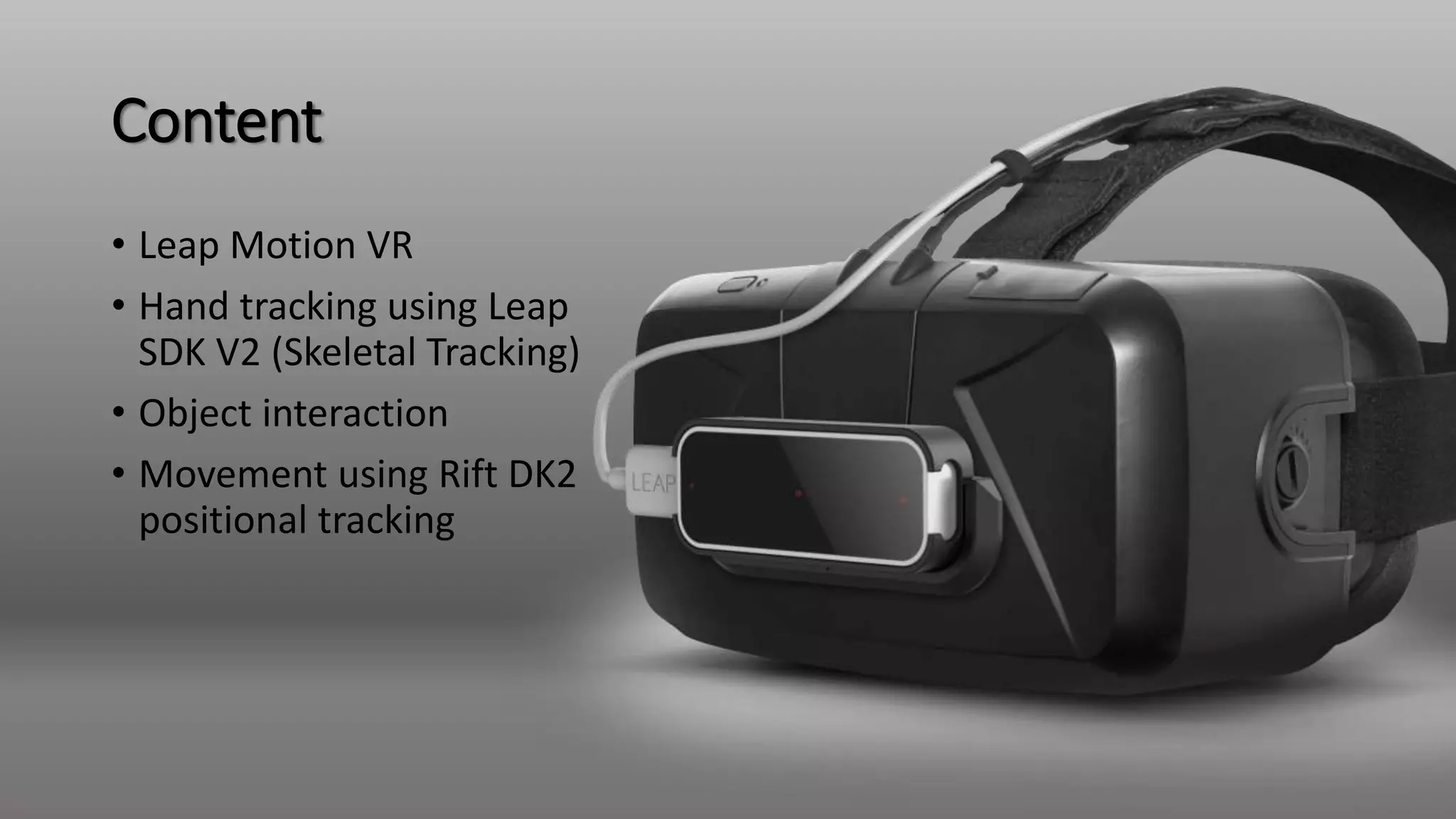
• Leap Motion VR 
• Hand tracking using Leap 
SDK V2 (Skeletal Tracking) 
• Object interaction 
• Movement using Rift DK2 
positional tracking
Leap Motion SDK V2 
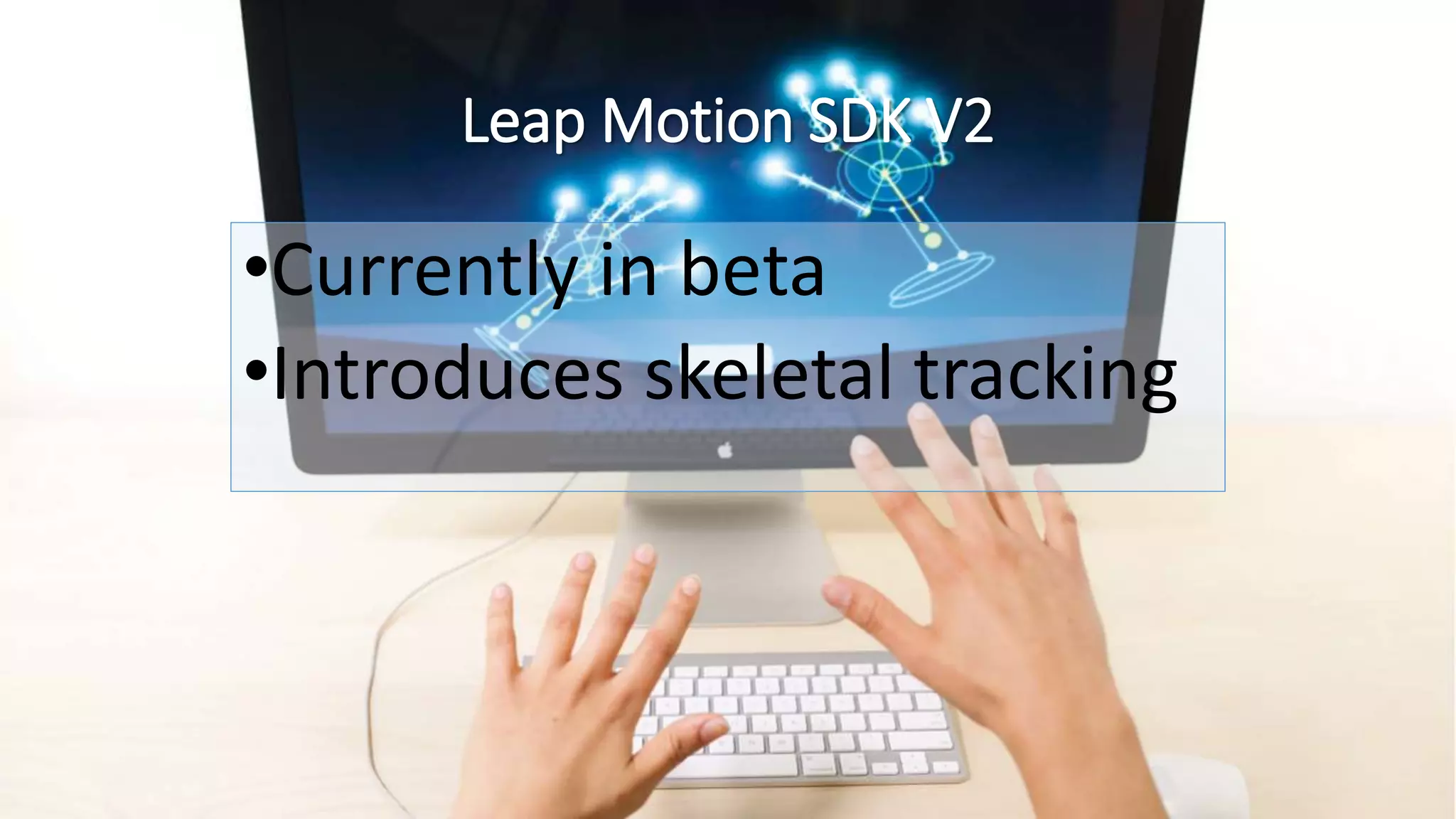
•Currently in beta 
•Introduces skeletal tracking
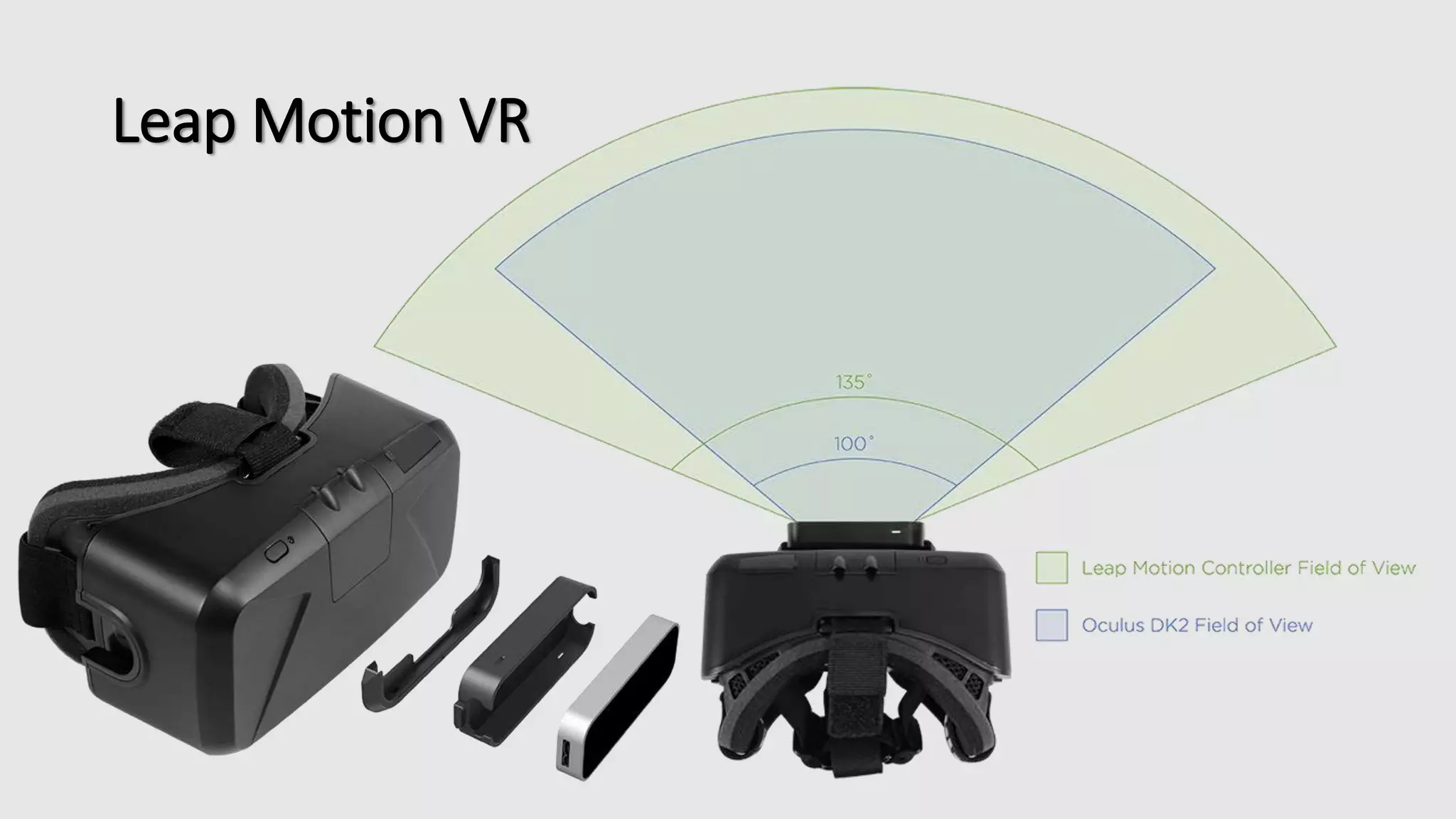
Leap Motion VR
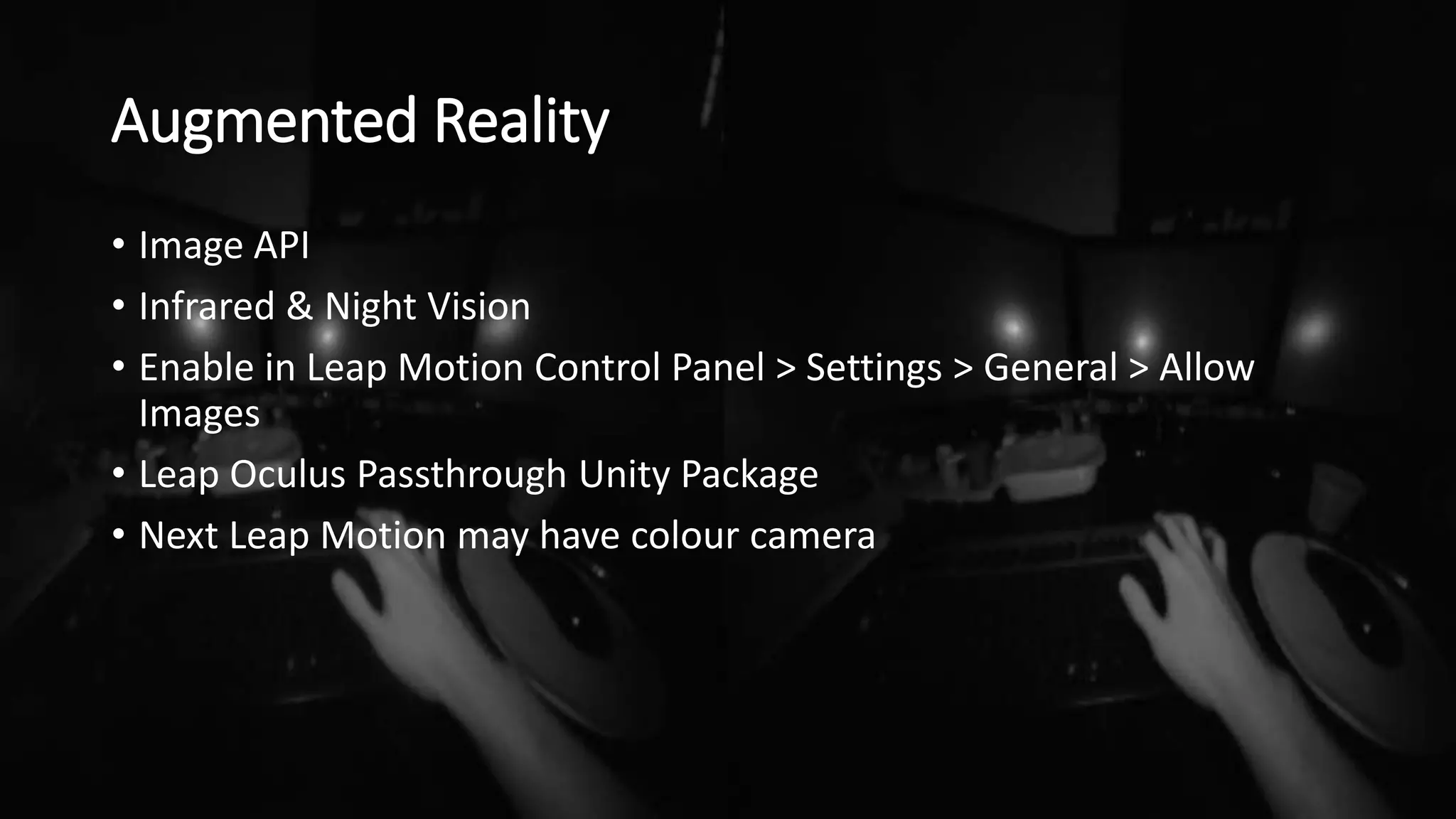
Augmented Reality 
• Image API 
• Infrared & Night Vision 
• Enable in Leap Motion Control Panel > Settings > General > Allow 
Images 
• Leap Oculus Passthrough Unity Package 
• Next Leap Motion may have colour camera
Requirements 
• IDE 
• Unity Pro 
• Leap 
• Leap Motion Driver 
• Leap Motion V2 Tracking Beta (v.2.1.1.21671+) 
• Leap Motion V2 Skeletal Assets (beta) 
• Rift DK2 
• Unity 4 Pro Integration
Scope 
•Map physical hand and finger movements to 3D hand 
model and physics 
• Grab physics objects (rigidbodies) by pinching 
• Movement and jump using DK2’s positional tracker
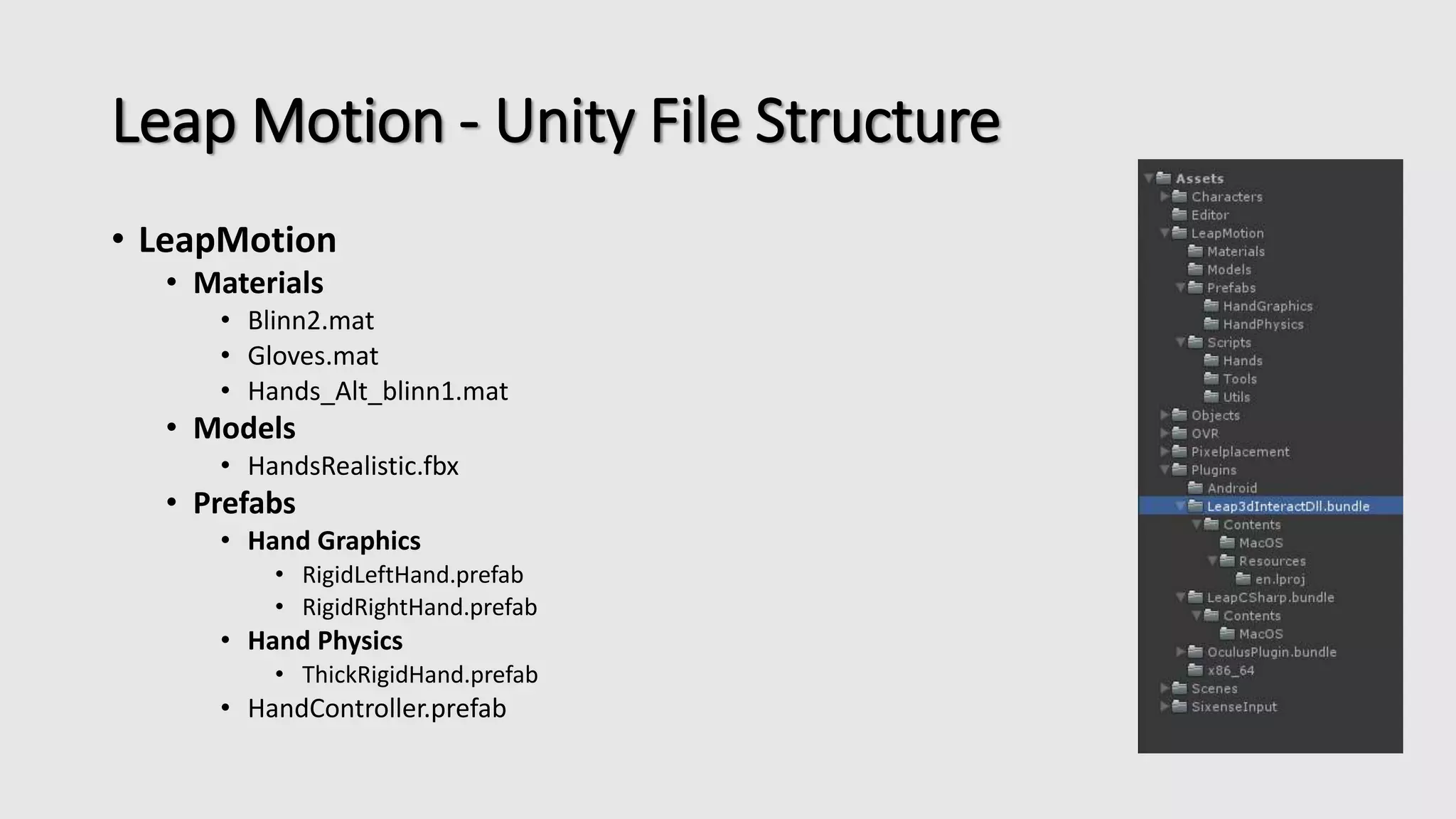
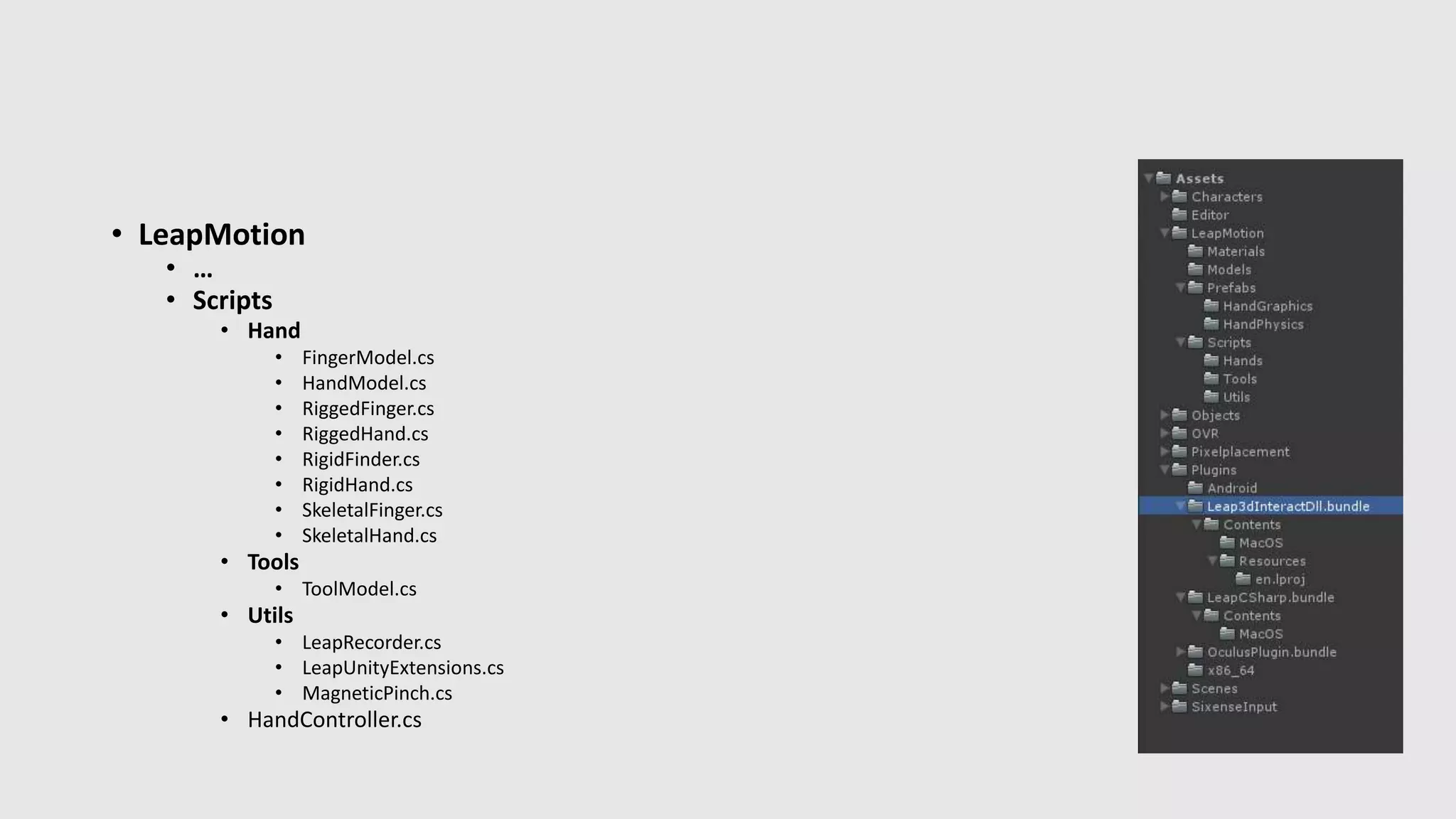
Leap Motion - Unity File Structure 
• LeapMotion 
• Materials 
• Blinn2.mat 
• Gloves.mat 
• Hands_Alt_blinn1.mat 
• Models 
• HandsRealistic.fbx 
• Prefabs 
• Hand Graphics 
• RigidLeftHand.prefab 
• RigidRightHand.prefab 
• Hand Physics 
• ThickRigidHand.prefab 
• HandController.prefab
• LeapMotion 
• … 
• Scripts 
• Hand 
• FingerModel.cs 
• HandModel.cs 
• RiggedFinger.cs 
• RiggedHand.cs 
• RigidFinder.cs 
• RigidHand.cs 
• SkeletalFinger.cs 
• SkeletalHand.cs 
• Tools 
• ToolModel.cs 
• Utils 
• LeapRecorder.cs 
• LeapUnityExtensions.cs 
• MagneticPinch.cs 
• HandController.cs
• Plugins 
• [Include all files]
Attach hands to player 
• Assumed that you’ve already integrated Rift with player 
• Is compatible with Sixense’s Razer Hydra integration via script (see 
LeapHandExtendController.cs in tutorial)
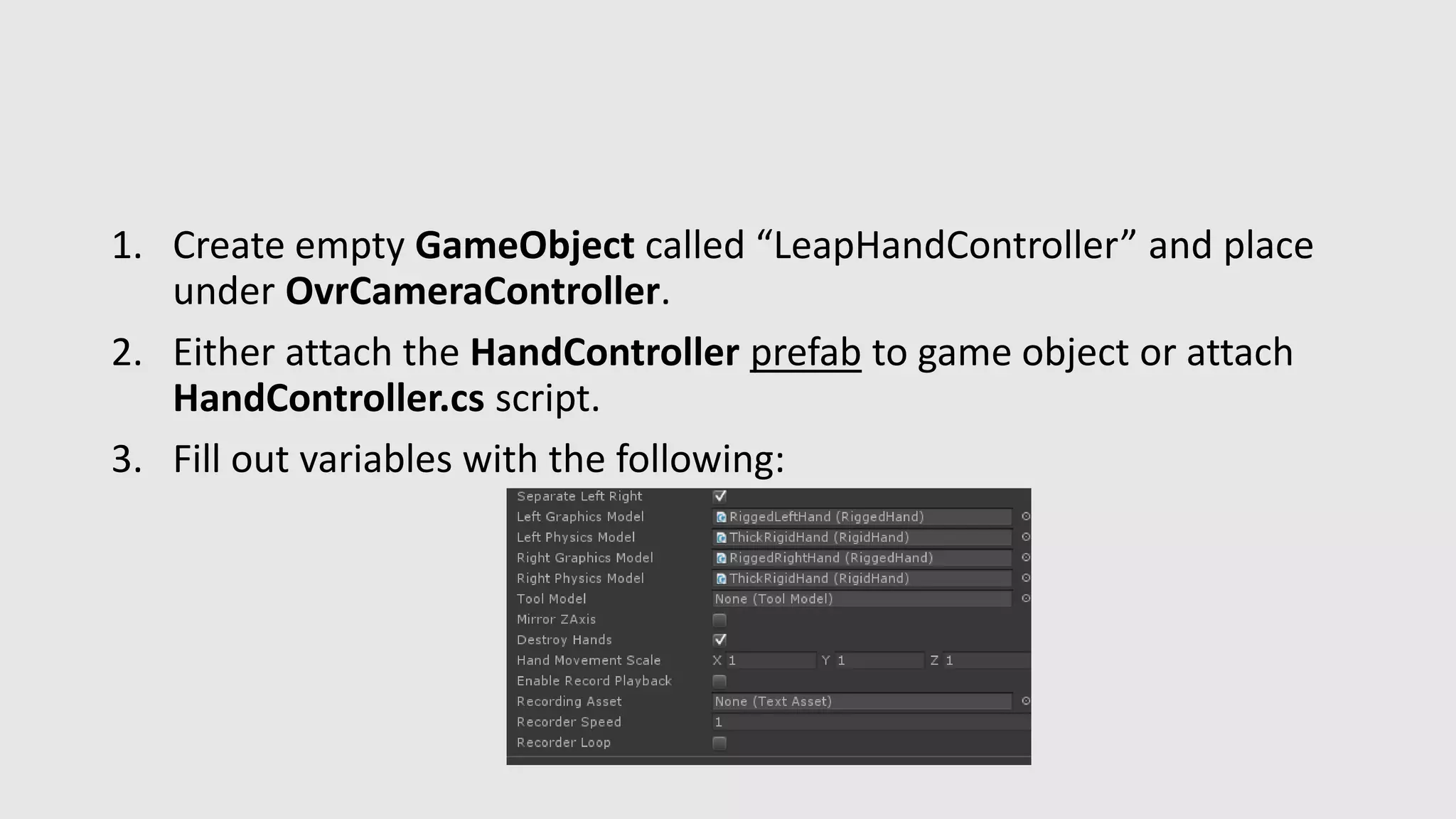
1. Create empty GameObject called “LeapHandController” and place 
under OvrCameraController. 
2. Either attach the HandController prefab to game object or attach 
HandController.cs script. 
3. Fill out variables with the following:
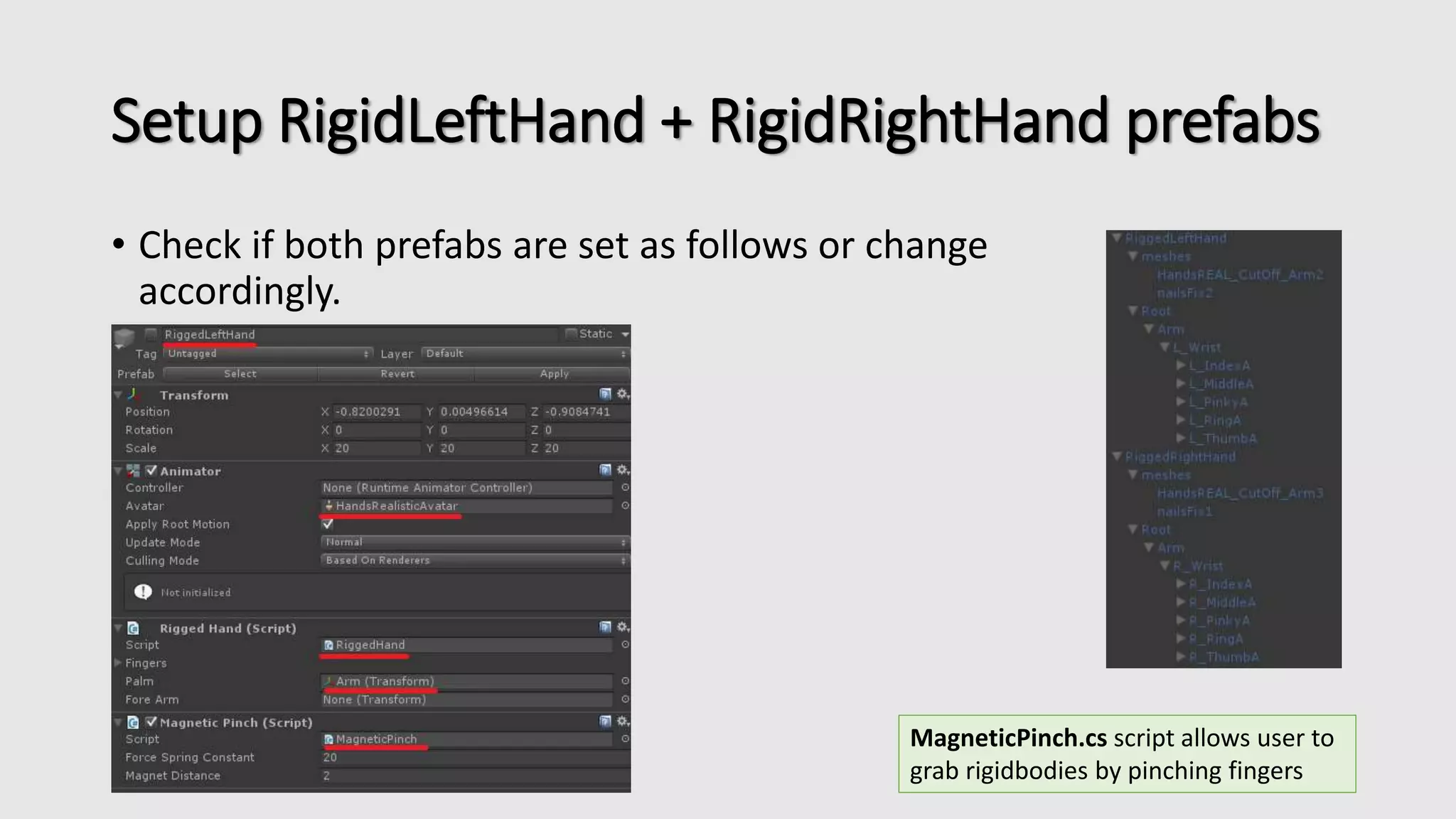
Setup RigidLeftHand + RigidRightHand prefabs 
• Check if both prefabs are set as follows or change 
accordingly. 
MagneticPinch.cs script allows user to 
grab rigidbodies by pinching fingers
For right hand, choose 
the [..]Arm3 mesh 
Each finger must have the following variables, 
based on type of finger (i.e. index, pinky) and if 
it’s left (starts with L) or right (starts with R):
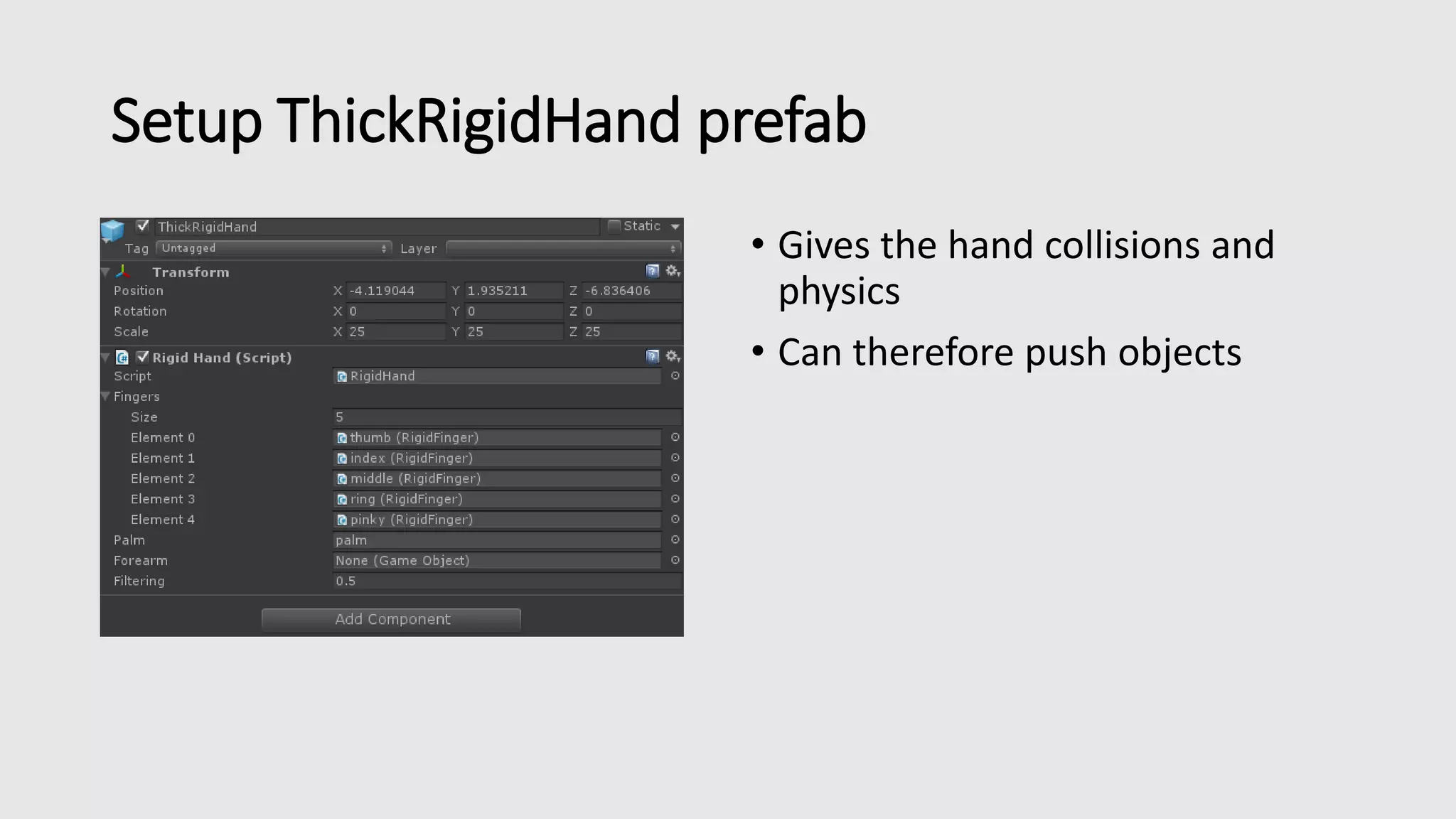
Setup ThickRigidHand prefab 
• Gives the hand collisions and 
physics 
• Can therefore push objects
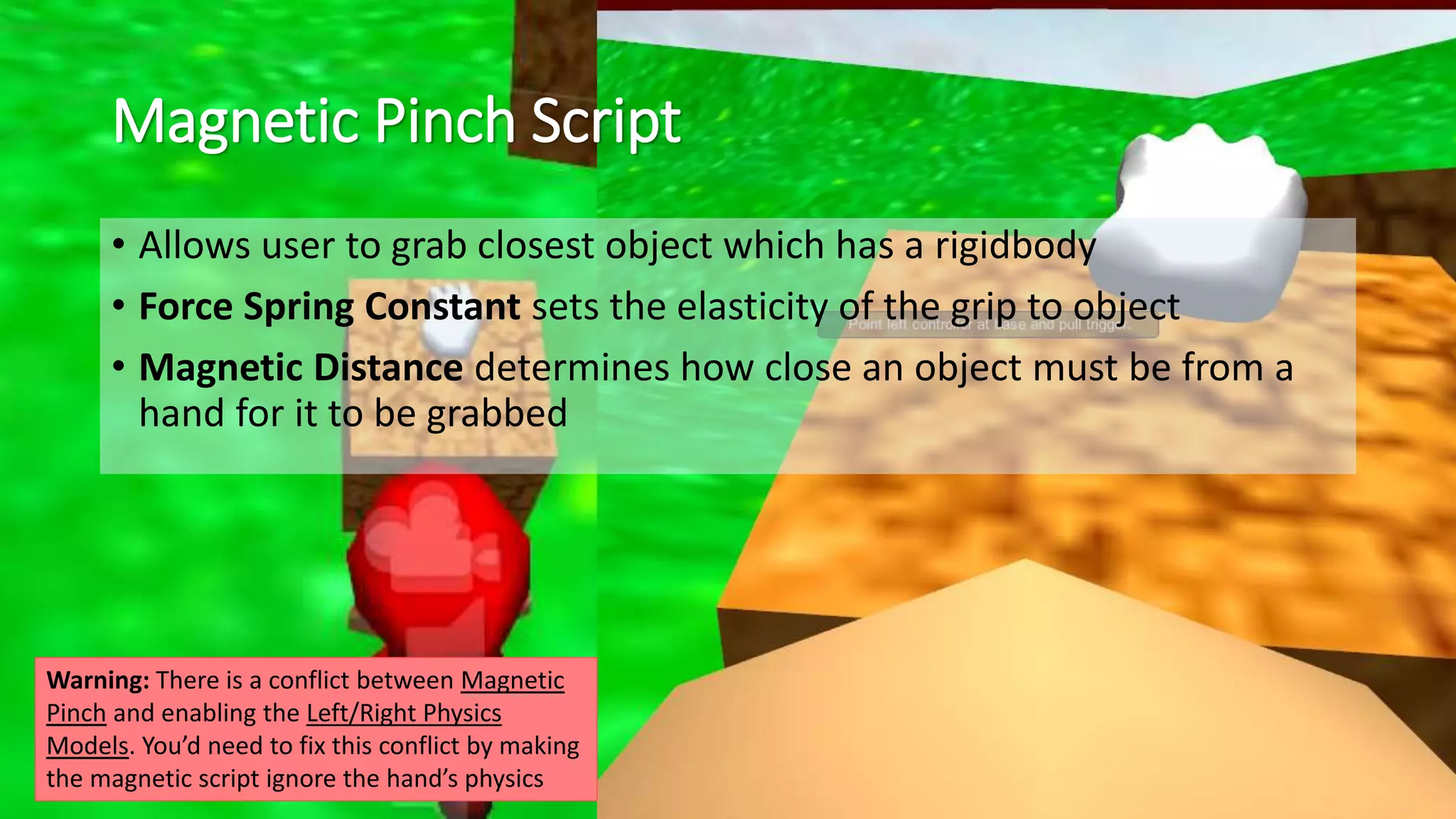
Magnetic Pinch Script 
• Allows user to grab closest object which has a rigidbody 
• Force Spring Constant sets the elasticity of the grip to object 
• Magnetic Distance determines how close an object must be from a 
hand for it to be grabbed 
Warning: There is a conflict between Magnetic 
Pinch and enabling the Left/Right Physics 
Models. You’d need to fix this conflict by making 
the magnetic script ignore the hand’s physics
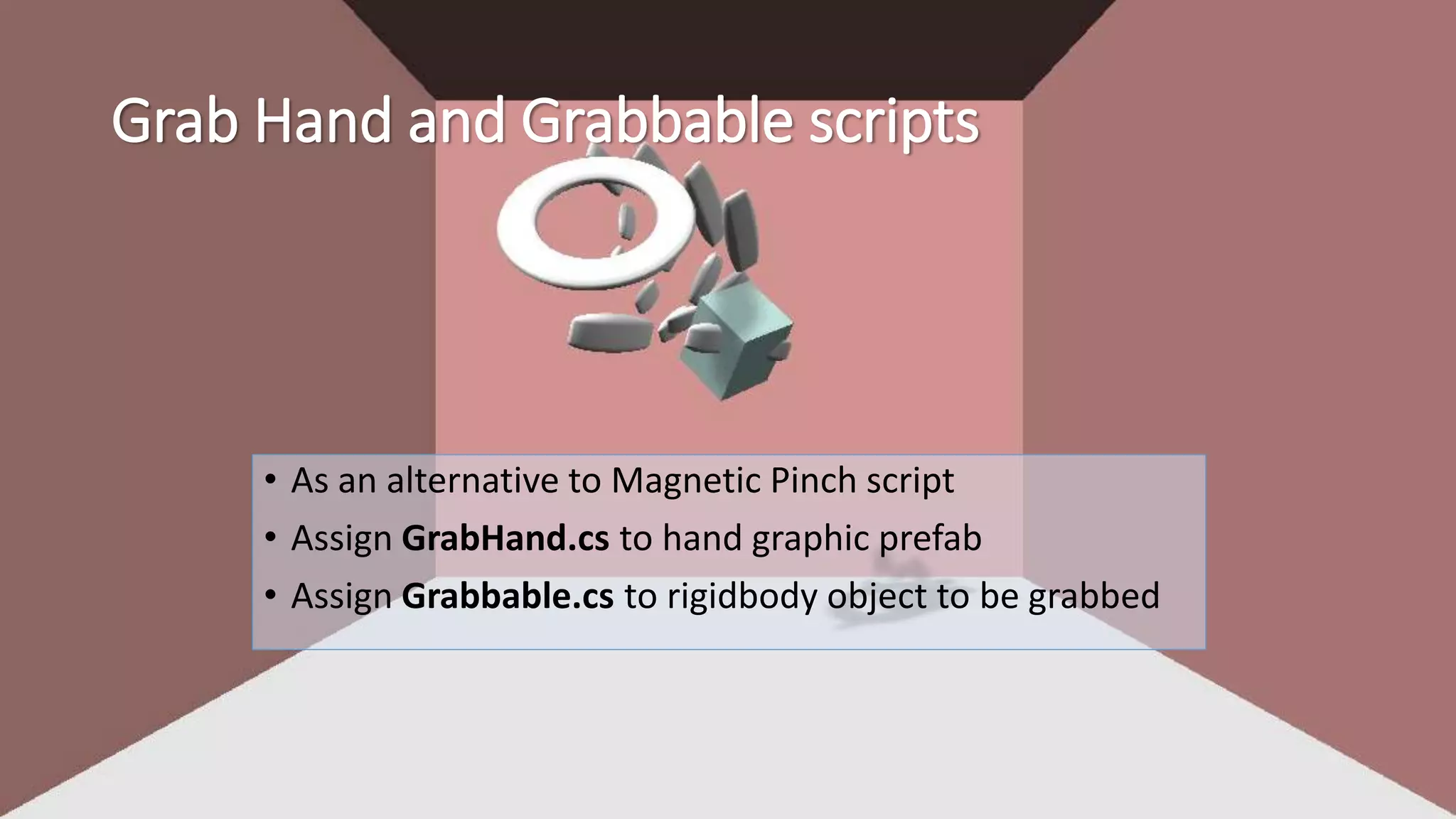
Grab Hand and Grabbable scripts 
• As an alternative to Magnetic Pinch script 
• Assign GrabHand.cs to hand graphic prefab 
• Assign Grabbable.cs to rigidbody object to be grabbed
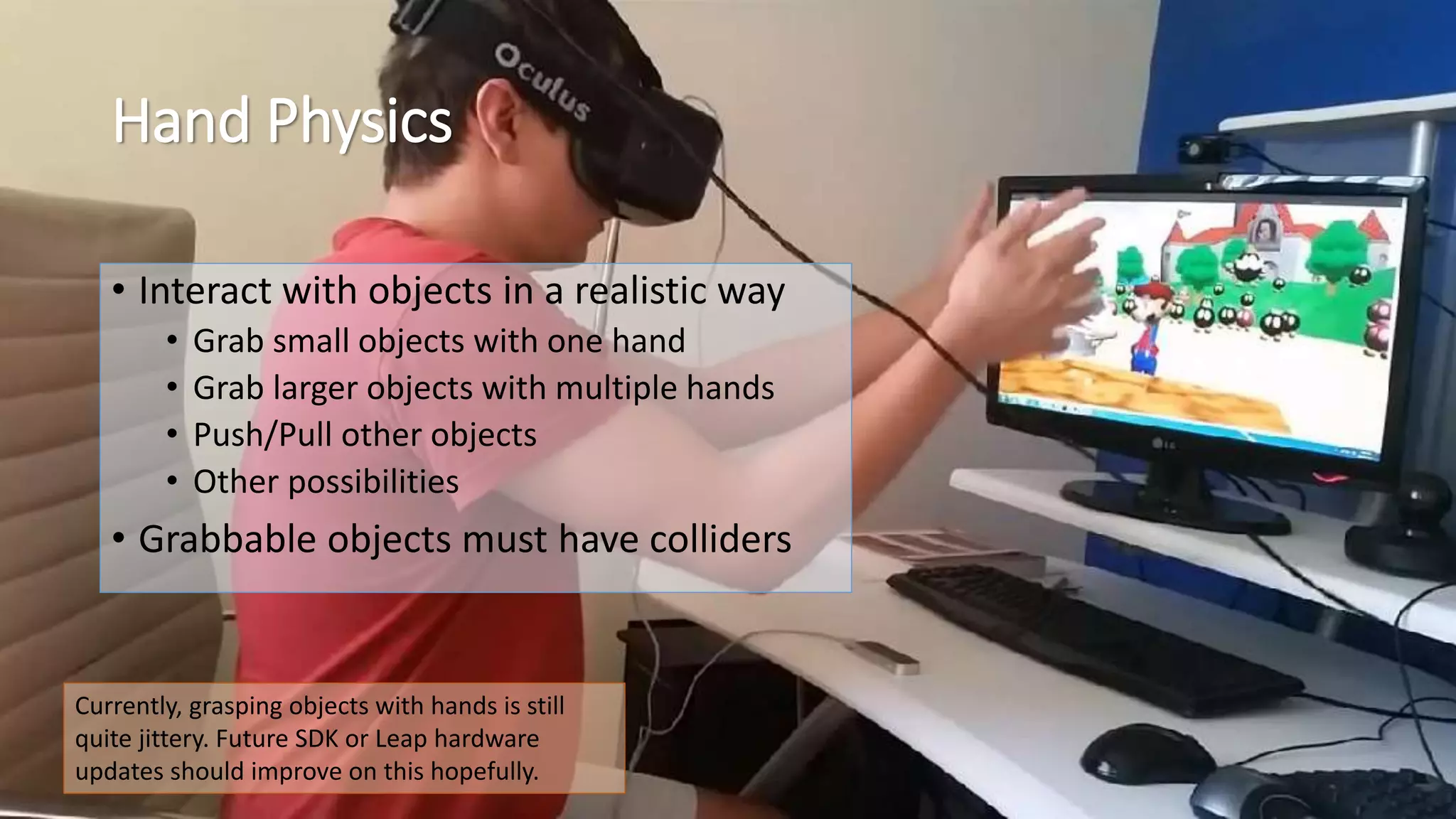
Hand Physics 
• Interact with objects in a realistic way 
• Grab small objects with one hand 
• Grab larger objects with multiple hands 
• Push/Pull other objects 
• Other possibilities 
• Grabbable objects must have colliders 
Currently, grasping objects with hands is still 
quite jittery. Future SDK or Leap hardware 
updates should improve on this hopefully.
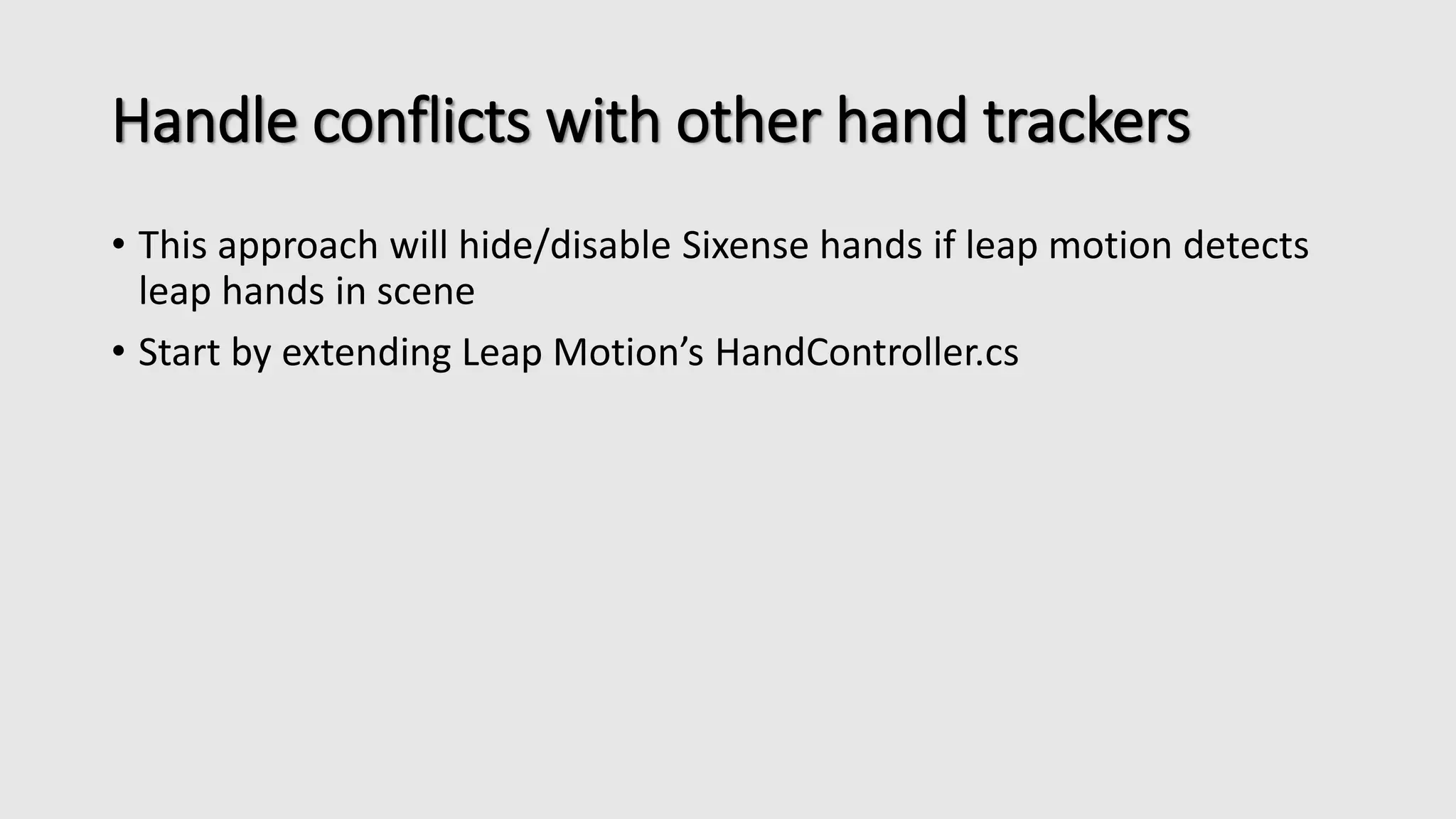
Handle conflicts with other hand trackers 
• This approach will hide/disable Sixense hands if leap motion detects 
leap hands in scene 
• Start by extending Leap Motion’s HandController.cs
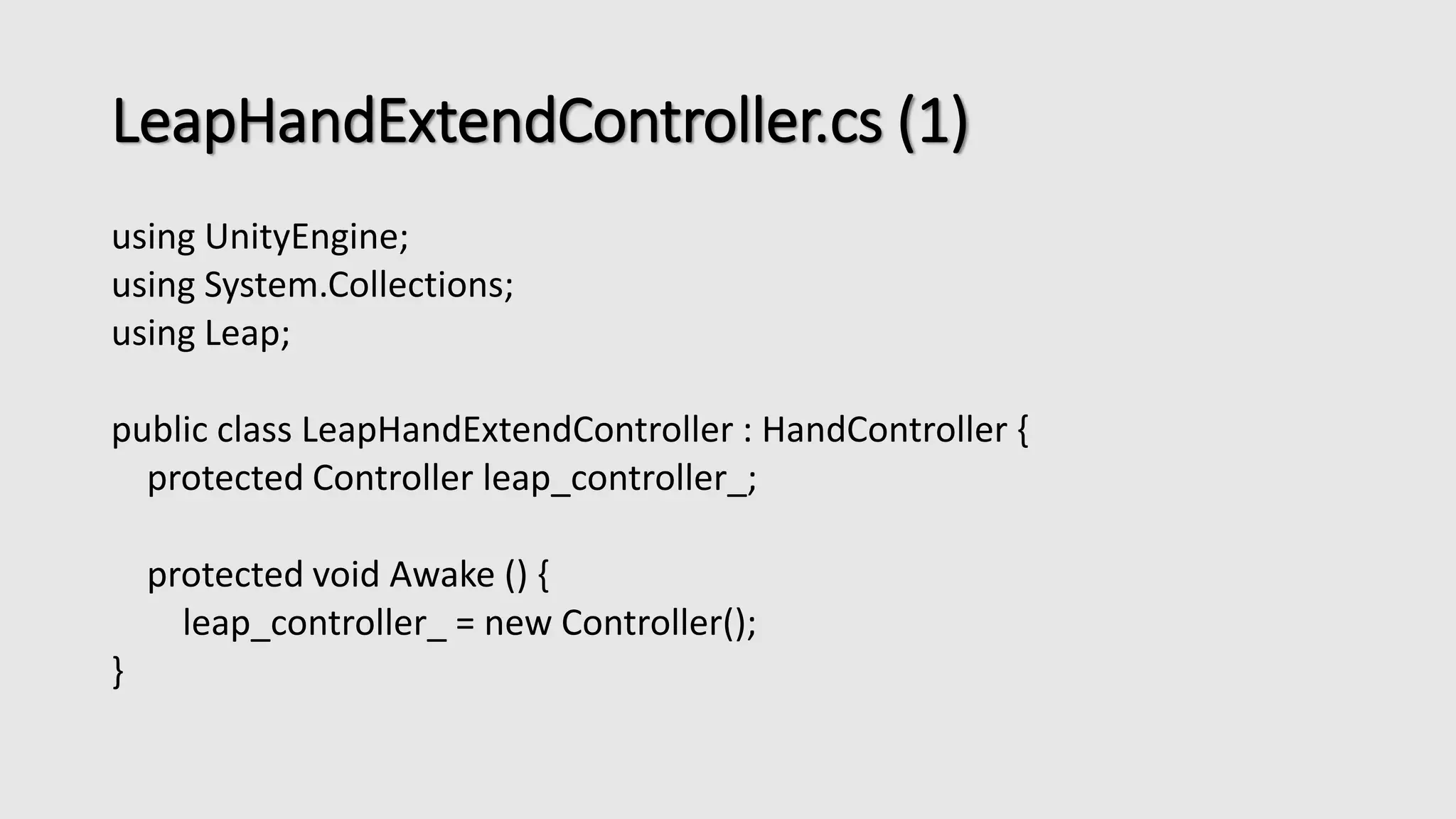
LeapHandExtendController.cs (1) 
using UnityEngine; 
using System.Collections; 
using Leap; 
public class LeapHandExtendController : HandController { 
protected Controller leap_controller_; 
protected void Awake () { 
leap_controller_ = new Controller(); 
}
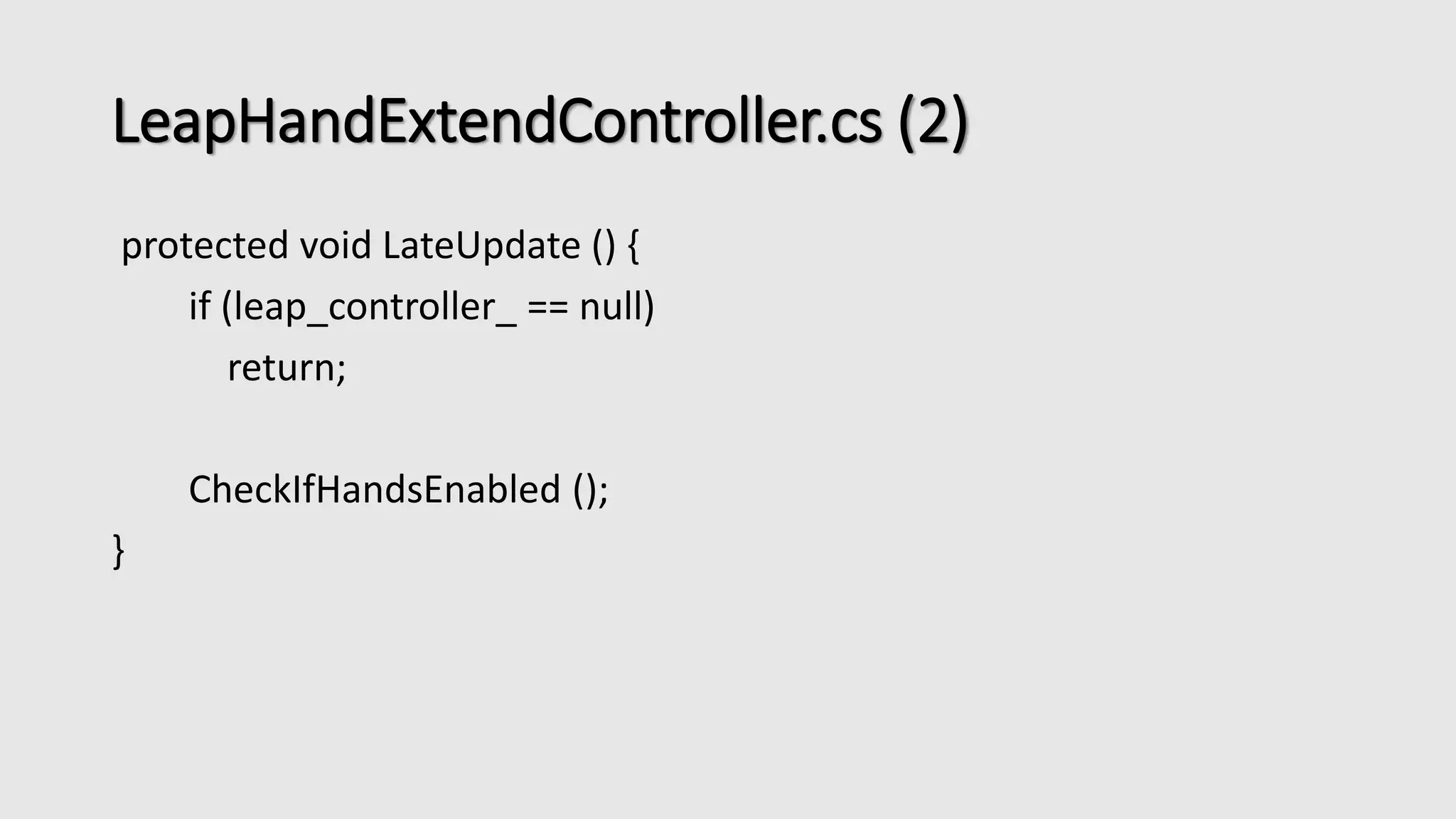
LeapHandExtendController.cs (2) 
protected void LateUpdate () { 
if (leap_controller_ == null) 
return; 
CheckIfHandsEnabled (); 
}
LeapHandExtendController.cs (3) 
protected void CheckIfHandsEnabled () { 
Frame frame = leap_controller_.Frame(); 
HandList hands = frame.Hands; 
int num_hands = hands.Count; 
if (num_hands > 0) { 
TriggerSixenseHands (false); 
} else { 
TriggerSixenseHands (true); 
} 
}
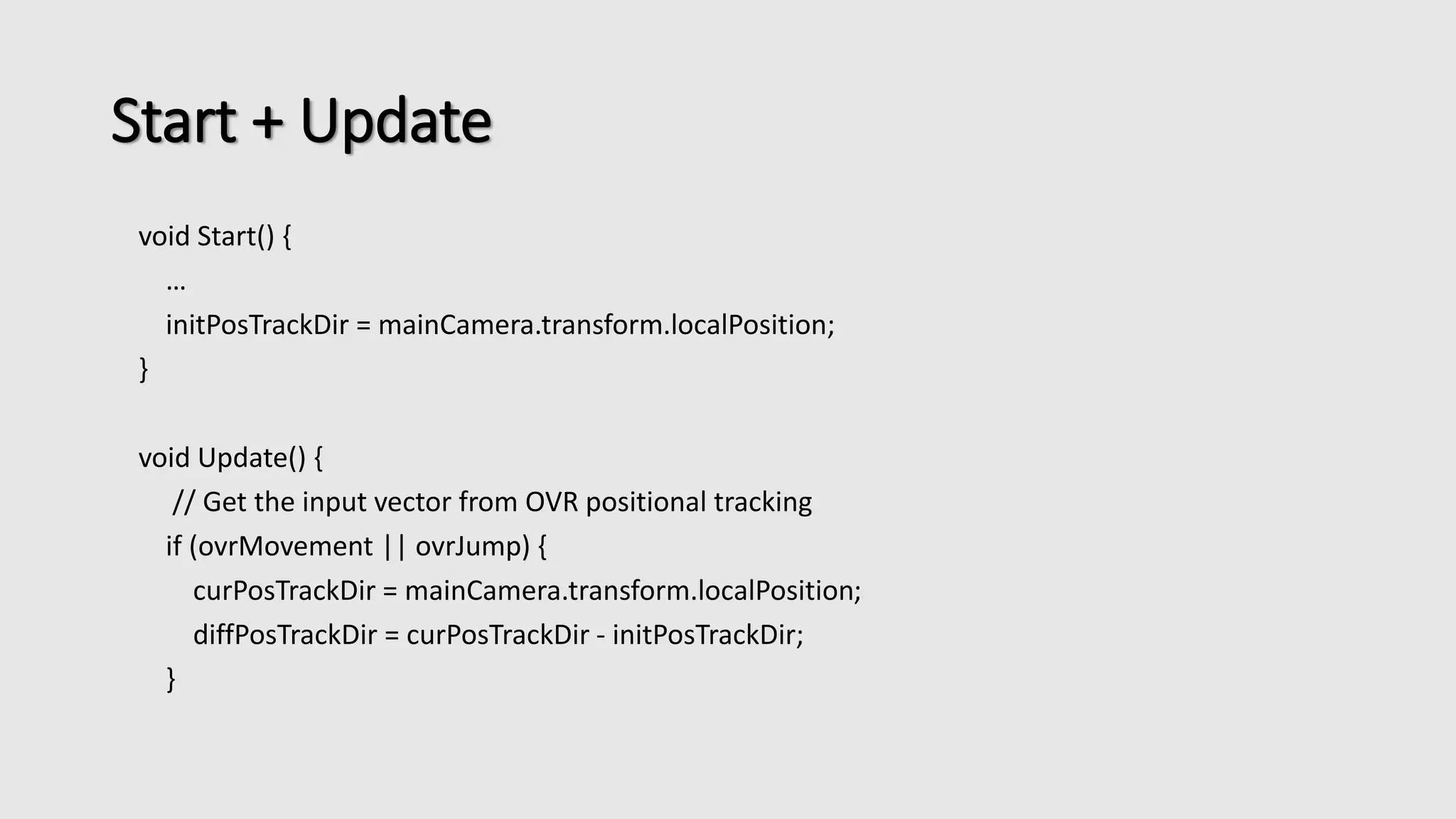
Movement - DK2 Positional Tracking 
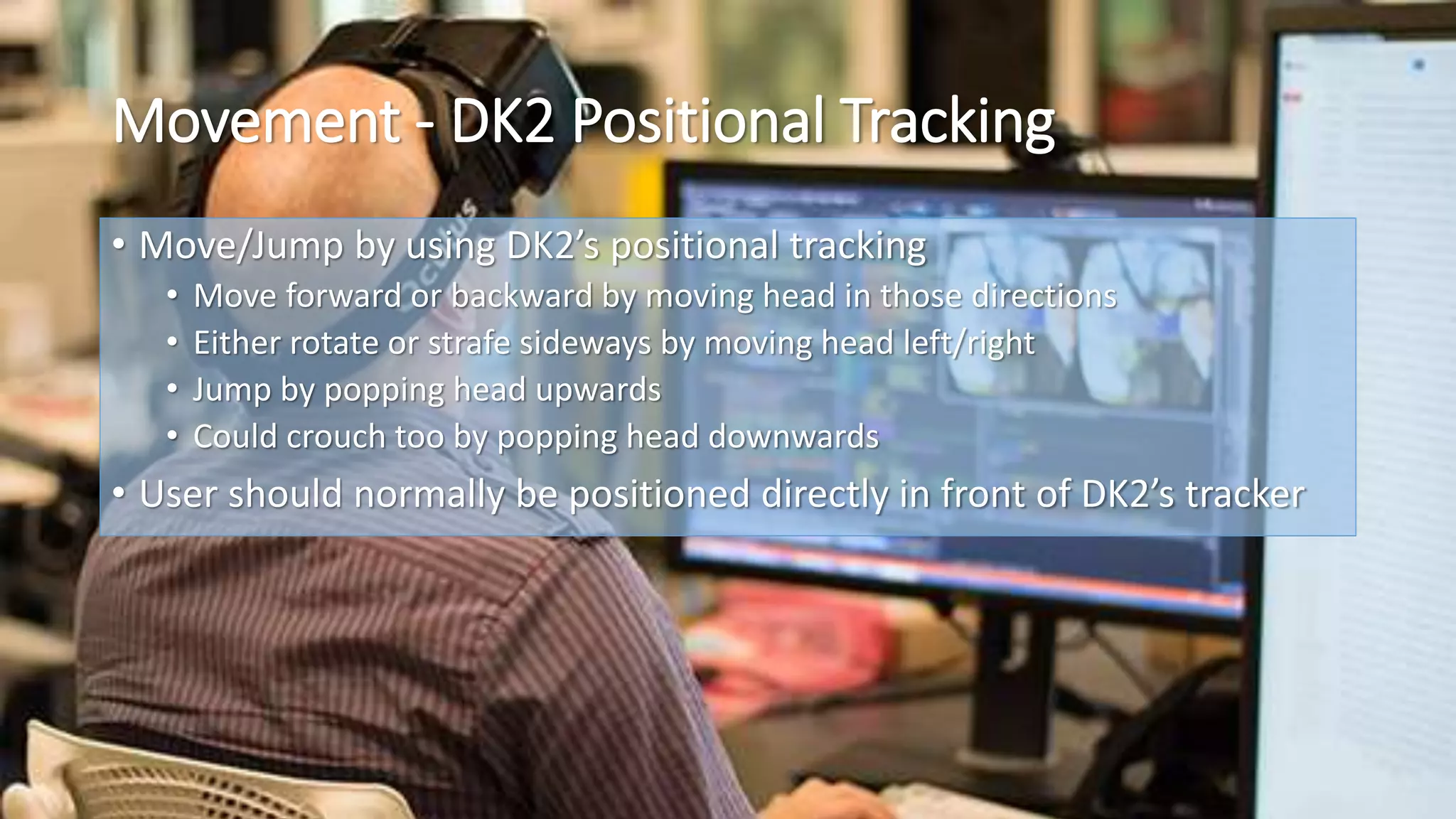
• Move/Jump by using DK2’s positional tracking 
• Move forward or backward by moving head in those directions 
• Either rotate or strafe sideways by moving head left/right 
• Jump by popping head upwards 
• Could crouch too by popping head downwards 
• User should normally be positioned directly in front of DK2’s tracker
Logic - Positional Tracking Movement 
• Create/modify your player input controller script, attached to player 
• Head position is calculated by subtracting the initial local position of the 
main camera, of when scene is loaded, from its current position 
• Create configurable Vector3 variables for: 
• Sensitivity – strength multiplier of movement or jump actions 
• Minimum – The minimum position that the Rift must be away from the centre 
position, for the action to actually be triggered 
• Movement will use the X (-left/+right) and Z axis (+forward/-backward) in 
the direction of the camera as a variable sent to the Character Motor’s 
inputMoveDirection variable 
• Jump will use the Y axis and will be mapped to the Character Motor’s 
inputJump variable
Code – Positional Track Movement 
[RequireComponent(typeof(CharacterMotor))] 
public class FPSInputController : MonoBehaviour { 
… 
public bool ovrMovement = false; // Enable move player by moving head on X and Z axis 
public bool ovrJump = false; // Enable player jumps by moving head on Y axis upwa rds 
public Vector3 ovrControlSensitivity = new Vector3(1, 1, 1); // Multiplier of positiona tracking move/jump actions 
public Vector3 ovrControlMinimum = new Vector3(0, 0, 0); // Min distance of head from centre to move/jump 
public enum OvrXAxisAction { Strafe = 0, Rotate = 1 } 
public OvrXAxisAction ovrXAxisAction = OvrXAxisAction.Rotate; // Whether x axis positional tracking performs strafing or rotation 
private GameObject mainCamera; // Camera where movement orientation is done and audio listener enabled 
private CharacterMotor motor; 
// OVR positional tracking, currently works via tilting head 
private Vector3 initPosTrackDir; 
private Vector3 curPosTrackDir; 
private Vector3 diffPosTrackDir;
Start + Update 
void Start() { 
… 
initPosTrackDir = mainCamera.transform.localPosition; 
} 
void Update() { 
// Get the input vector from OVR positional tracking 
if (ovrMovement || ovrJump) { 
curPosTrackDir = mainCamera.transform.localPosition; 
diffPosTrackDir = curPosTrackDir - initPosTrackDir; 
}
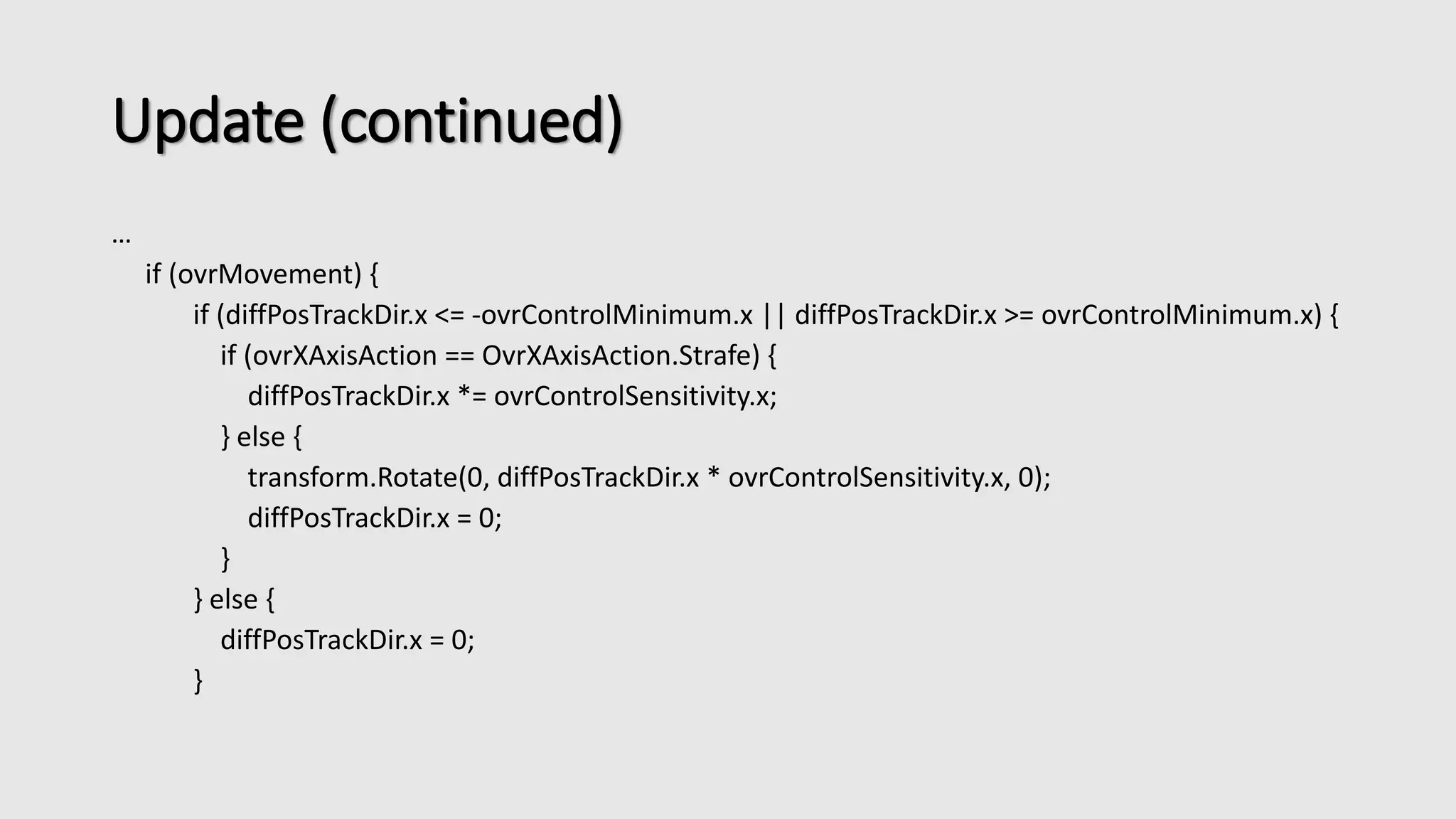
Update (continued) 
… 
if (ovrMovement) { 
if (diffPosTrackDir.x <= -ovrControlMinimum.x || diffPosTrackDir.x >= ovrControlMinimum.x) { 
if (ovrXAxisAction == OvrXAxisAction.Strafe) { 
diffPosTrackDir.x *= ovrControlSensitivity.x; 
} else { 
transform.Rotate(0, diffPosTrackDir.x * ovrControlSensitivity.x, 0); 
diffPosTrackDir.x = 0; 
} 
} else { 
diffPosTrackDir.x = 0; 
}
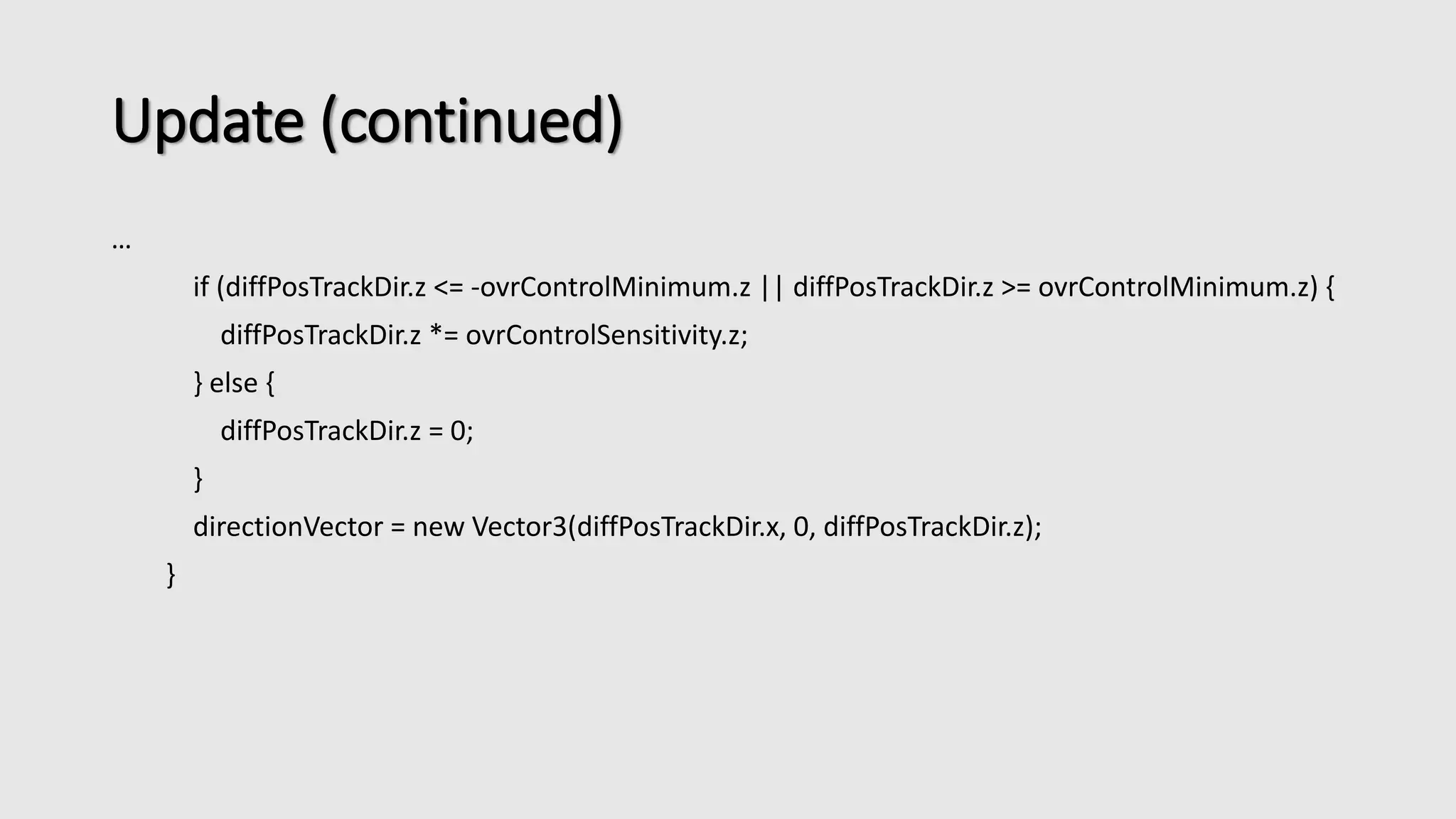
Update (continued) 
… 
if (diffPosTrackDir.z <= -ovrControlMinimum.z || diffPosTrackDir.z >= ovrControlMinimum.z) { 
diffPosTrackDir.z *= ovrControlSensitivity.z; 
} else { 
diffPosTrackDir.z = 0; 
} 
directionVector = new Vector3(diffPosTrackDir.x, 0, diffPosTrackDir.z); 
}
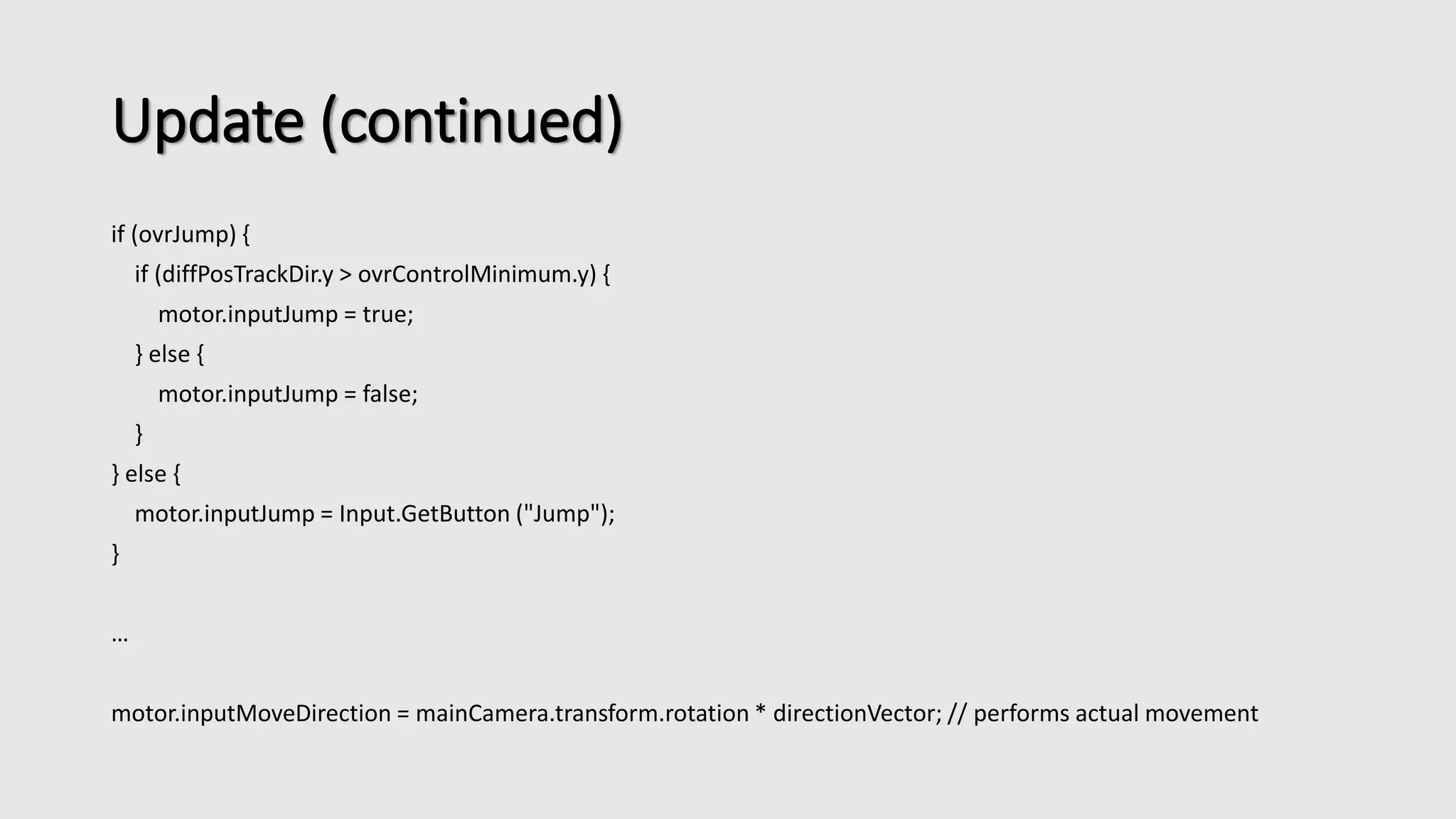
Update (continued) 
if (ovrJump) { 
if (diffPosTrackDir.y > ovrControlMinimum.y) { 
motor.inputJump = true; 
} else { 
motor.inputJump = false; 
} 
} else { 
motor.inputJump = Input.GetButton ("Jump"); 
} 
… 
motor.inputMoveDirection = mainCamera.transform.rotation * directionVector; // performs actual movement
}

Oculus Rift DK2 + Leap Motion Tutorial

  • 1.
    Oculus Rift DK2+ Leap Motion Unity Tutorial Chris Zaharia @chrisjz
  • 2.
    Content • LeapMotion VR • Hand tracking using Leap SDK V2 (Skeletal Tracking) • Object interaction • Movement using Rift DK2 positional tracking
  • 3.
    Leap Motion SDKV2 •Currently in beta •Introduces skeletal tracking
  • 4.
  • 5.
    Augmented Reality •Image API • Infrared & Night Vision • Enable in Leap Motion Control Panel > Settings > General > Allow Images • Leap Oculus Passthrough Unity Package • Next Leap Motion may have colour camera
  • 6.
    Requirements • IDE • Unity Pro • Leap • Leap Motion Driver • Leap Motion V2 Tracking Beta (v.2.1.1.21671+) • Leap Motion V2 Skeletal Assets (beta) • Rift DK2 • Unity 4 Pro Integration
  • 7.
    Scope •Map physicalhand and finger movements to 3D hand model and physics • Grab physics objects (rigidbodies) by pinching • Movement and jump using DK2’s positional tracker
  • 8.
    Leap Motion -Unity File Structure • LeapMotion • Materials • Blinn2.mat • Gloves.mat • Hands_Alt_blinn1.mat • Models • HandsRealistic.fbx • Prefabs • Hand Graphics • RigidLeftHand.prefab • RigidRightHand.prefab • Hand Physics • ThickRigidHand.prefab • HandController.prefab
  • 9.
    • LeapMotion •… • Scripts • Hand • FingerModel.cs • HandModel.cs • RiggedFinger.cs • RiggedHand.cs • RigidFinder.cs • RigidHand.cs • SkeletalFinger.cs • SkeletalHand.cs • Tools • ToolModel.cs • Utils • LeapRecorder.cs • LeapUnityExtensions.cs • MagneticPinch.cs • HandController.cs
  • 10.
    • Plugins •[Include all files]
  • 11.
    Attach hands toplayer • Assumed that you’ve already integrated Rift with player • Is compatible with Sixense’s Razer Hydra integration via script (see LeapHandExtendController.cs in tutorial)
  • 12.
    1. Create emptyGameObject called “LeapHandController” and place under OvrCameraController. 2. Either attach the HandController prefab to game object or attach HandController.cs script. 3. Fill out variables with the following:
  • 13.
    Setup RigidLeftHand +RigidRightHand prefabs • Check if both prefabs are set as follows or change accordingly. MagneticPinch.cs script allows user to grab rigidbodies by pinching fingers
  • 14.
    For right hand,choose the [..]Arm3 mesh Each finger must have the following variables, based on type of finger (i.e. index, pinky) and if it’s left (starts with L) or right (starts with R):
  • 15.
    Setup ThickRigidHand prefab • Gives the hand collisions and physics • Can therefore push objects
  • 16.
    Magnetic Pinch Script • Allows user to grab closest object which has a rigidbody • Force Spring Constant sets the elasticity of the grip to object • Magnetic Distance determines how close an object must be from a hand for it to be grabbed Warning: There is a conflict between Magnetic Pinch and enabling the Left/Right Physics Models. You’d need to fix this conflict by making the magnetic script ignore the hand’s physics
  • 17.
    Grab Hand andGrabbable scripts • As an alternative to Magnetic Pinch script • Assign GrabHand.cs to hand graphic prefab • Assign Grabbable.cs to rigidbody object to be grabbed
  • 18.
    Hand Physics •Interact with objects in a realistic way • Grab small objects with one hand • Grab larger objects with multiple hands • Push/Pull other objects • Other possibilities • Grabbable objects must have colliders Currently, grasping objects with hands is still quite jittery. Future SDK or Leap hardware updates should improve on this hopefully.
  • 20.
    Handle conflicts withother hand trackers • This approach will hide/disable Sixense hands if leap motion detects leap hands in scene • Start by extending Leap Motion’s HandController.cs
  • 21.
    LeapHandExtendController.cs (1) usingUnityEngine; using System.Collections; using Leap; public class LeapHandExtendController : HandController { protected Controller leap_controller_; protected void Awake () { leap_controller_ = new Controller(); }
  • 22.
    LeapHandExtendController.cs (2) protectedvoid LateUpdate () { if (leap_controller_ == null) return; CheckIfHandsEnabled (); }
  • 23.
    LeapHandExtendController.cs (3) protectedvoid CheckIfHandsEnabled () { Frame frame = leap_controller_.Frame(); HandList hands = frame.Hands; int num_hands = hands.Count; if (num_hands > 0) { TriggerSixenseHands (false); } else { TriggerSixenseHands (true); } }
  • 24.
    Movement - DK2Positional Tracking • Move/Jump by using DK2’s positional tracking • Move forward or backward by moving head in those directions • Either rotate or strafe sideways by moving head left/right • Jump by popping head upwards • Could crouch too by popping head downwards • User should normally be positioned directly in front of DK2’s tracker
  • 25.
    Logic - PositionalTracking Movement • Create/modify your player input controller script, attached to player • Head position is calculated by subtracting the initial local position of the main camera, of when scene is loaded, from its current position • Create configurable Vector3 variables for: • Sensitivity – strength multiplier of movement or jump actions • Minimum – The minimum position that the Rift must be away from the centre position, for the action to actually be triggered • Movement will use the X (-left/+right) and Z axis (+forward/-backward) in the direction of the camera as a variable sent to the Character Motor’s inputMoveDirection variable • Jump will use the Y axis and will be mapped to the Character Motor’s inputJump variable
  • 27.
    Code – PositionalTrack Movement [RequireComponent(typeof(CharacterMotor))] public class FPSInputController : MonoBehaviour { … public bool ovrMovement = false; // Enable move player by moving head on X and Z axis public bool ovrJump = false; // Enable player jumps by moving head on Y axis upwa rds public Vector3 ovrControlSensitivity = new Vector3(1, 1, 1); // Multiplier of positiona tracking move/jump actions public Vector3 ovrControlMinimum = new Vector3(0, 0, 0); // Min distance of head from centre to move/jump public enum OvrXAxisAction { Strafe = 0, Rotate = 1 } public OvrXAxisAction ovrXAxisAction = OvrXAxisAction.Rotate; // Whether x axis positional tracking performs strafing or rotation private GameObject mainCamera; // Camera where movement orientation is done and audio listener enabled private CharacterMotor motor; // OVR positional tracking, currently works via tilting head private Vector3 initPosTrackDir; private Vector3 curPosTrackDir; private Vector3 diffPosTrackDir;
  • 28.
    Start + Update void Start() { … initPosTrackDir = mainCamera.transform.localPosition; } void Update() { // Get the input vector from OVR positional tracking if (ovrMovement || ovrJump) { curPosTrackDir = mainCamera.transform.localPosition; diffPosTrackDir = curPosTrackDir - initPosTrackDir; }
  • 29.
    Update (continued) … if (ovrMovement) { if (diffPosTrackDir.x <= -ovrControlMinimum.x || diffPosTrackDir.x >= ovrControlMinimum.x) { if (ovrXAxisAction == OvrXAxisAction.Strafe) { diffPosTrackDir.x *= ovrControlSensitivity.x; } else { transform.Rotate(0, diffPosTrackDir.x * ovrControlSensitivity.x, 0); diffPosTrackDir.x = 0; } } else { diffPosTrackDir.x = 0; }
  • 30.
    Update (continued) … if (diffPosTrackDir.z <= -ovrControlMinimum.z || diffPosTrackDir.z >= ovrControlMinimum.z) { diffPosTrackDir.z *= ovrControlSensitivity.z; } else { diffPosTrackDir.z = 0; } directionVector = new Vector3(diffPosTrackDir.x, 0, diffPosTrackDir.z); }
  • 31.
    Update (continued) if(ovrJump) { if (diffPosTrackDir.y > ovrControlMinimum.y) { motor.inputJump = true; } else { motor.inputJump = false; } } else { motor.inputJump = Input.GetButton ("Jump"); } … motor.inputMoveDirection = mainCamera.transform.rotation * directionVector; // performs actual movement
  • 32.

Editor's Notes

  • #5 Normally, need Leap mount to mount Leap to DK1/DK2. Can also use blue tac or other methods.
  • #6 Leap Oculus Passhthrough Unity package allows integration of the infrared image passthrough in Unity. Can use to blend or show real world in VR.
  • #7 Need to use Unity Pro instead of free due to Leap integration using external plugins. Leap Motion V2 Skeletal Assets (beta) – found on Unity Assets store.
  • #9 Pick these files from the Leap Unity Assets package. Folders are bolded. Even some files included here you may not need.
  • #14 Red underline are suggested variables where the prefab’s may have different values than we want. Green underline is a suggestion.
  • #17 The magnetic pinch and hand physics conflict is due to the magnetic pinch script programmed to find the closest rigidbody which isn’t the hand’s graphics model which happens to be the physics hand model in this case.
  • #18 Haven’t yet experimented much with this one so I can’t add much detail yet.
  • #23 Currently we can’t override HandController’s Update() function, so we’ll use the LateUpdate() function instead.
  • #24 Check the amount of leap hands visible, and if there are more than zero then disable Sixense (or any other) hand trackers.
  • #26 Vector3 mapping to movements: Left = negative X Right = positive X Forward = positive Z Backward = negative Z Jump = positive Y (Additionally) Crouch = negative Y
  • #28 Note – entire code for class is not here, only relevant code. If you’d like some help on this, feel free to contact me @chrisjz. mainCamera needs to be declared as either the only camera following the player, or one of the 2 Oculus Rift cameras.
  • #29 Set current tracking position as the camera’s local positon, then calculate the difference position by subtracting the initial camera position from the current.
  • #30 If head position is further than the minimum from the centre, then set the direction to move multiplied by sensitivity, otherwise do not move in that direction.
  • #31 directionVector is used afterwards to set the movement directions and strength.
  • #32 If jump via positional tracking : Enabled, then trigger jump action if camera’s difference position is above the set minimum Y axis position Disabled, then map jump keyboard key to jump action