History
4
First observed inrodents by Nicolle and Manceaux
Named Toxoplasma gondii from Greek word toxon meaning arc
and gondii is name of North African desert rodent
Janku demonstrated parasitic cyst in retina of a child who died of
hydrocephalus, microphthalmia and coloboma in macular region
Toxoplasmosis was identified as most common cause of posterior
uveitis worldwide
1908
1960
1923
5.
5
Genotypes
• 3 genotypes:Type I, II and III
Type I Type II Type III
• Very virulent
• Post natal acquired
infection
• Associated with strong pro-
inflammatory response and
severe tissue damage
• Least virulent
• Encyst in tissue under
immune response
• Responsible for chronic
infection
• Congenital infection and
encephalitis
• Less virulent
8
Epidemiology In Nepal
•Toxoplasma infection in selected patients in Kathmandu, Nepal
• 272 patients with:
• Ocular diseases(uveitis, retinochoroiditis)
• Malignancy(including leukemia)
• Women with bad obstetric history(BOH) and
• Others( patients with fever, lymphadenitis and encephalitis)
Rai SK, Upadhyay MP, Shrestha HG. Toxoplasma infection in selected patients in Kathmandu, Nepal.
Nepal Medical College journal: NMCJ. 2003 Dec;5(2):89-91
9.
9
Contd…
• Toxoplasma antibodieswere detected by microlatex agglutination and
IgM ELISA techniques
• Overall, 50.7%(132) had Toxoplasma antibodies, out of which 5.7%(8)
had IgM antibodies
• Patient with malignancy had highest positive rate(68%)
• Women with BOH had highest Toxoplasma IgM positive rate(25%)
Rai SK, Upadhyay MP, Shrestha HG. Toxoplasma infection in selected patients in Kathmandu, Nepal.
Nepal Medical College journal: NMCJ. 2003 Dec;5(2):89-91
10.
Patterns of Uveitisamong Nepalese
Population Presenting at a Tertiary Referral
Eye Care Centre in Nepal
• Study period: 2012-2017
• Total patient attending BPKLCOS: 5,34,292
• Total patient diagnosed with uveitis: 4359 [0.82%]
• Patients diagnosed with toxoplasmosis : 272 [6.24%]
Kharel R, Khatri A, et al. Patterns of uveitis among Nepalese population presenting at a tertiary
referral eye care centre in Nepal. DOI: 10.15761/NFO.1000238
Risk factors
• Exposureto environments where the infectious organism is
found, especially those frequented by felines.
• Increased risk of infection in males, if you own more than 3
kittens, and eating raw or undercooked meat (lamb, ground
beef, shell fish, game).
13.
13
Pathogenesis
• Depends ona delicate balance between host immunity and parasite
virulence
Adaptive immune response is medicated by CD4+ T lymphocytes and
macrophages
synthesis of various proinflammatory cytokinesIL-12,IFN γ and TNF α
act synergistically to contain parasite replication
• Th 2 response counterbalances proinflammatory Th 1 pathway
16
Immunocompetent Patients
• Generallyasymptomatic
• 10-20% will develop cervical lymphadenopathy and or flu like illness
• Benign clinical course
• Early retinitis may occur in about 20%
• Symptoms usually resolve without treatment within weeks to months,
although some cases may take upto year
17.
17
Immunocompromised Patients
• Maybe acquired or result from reactivation of pre-existing disease
• Often severe
• Neurologic disease is most common sign, particularly in reactivated
infection
• May develop encephalitis, chorioretinitis, myocarditis and
pneumonitis
• Can cause multiple abscesses in nervous tissue with symptoms of
mass lesion
18.
18
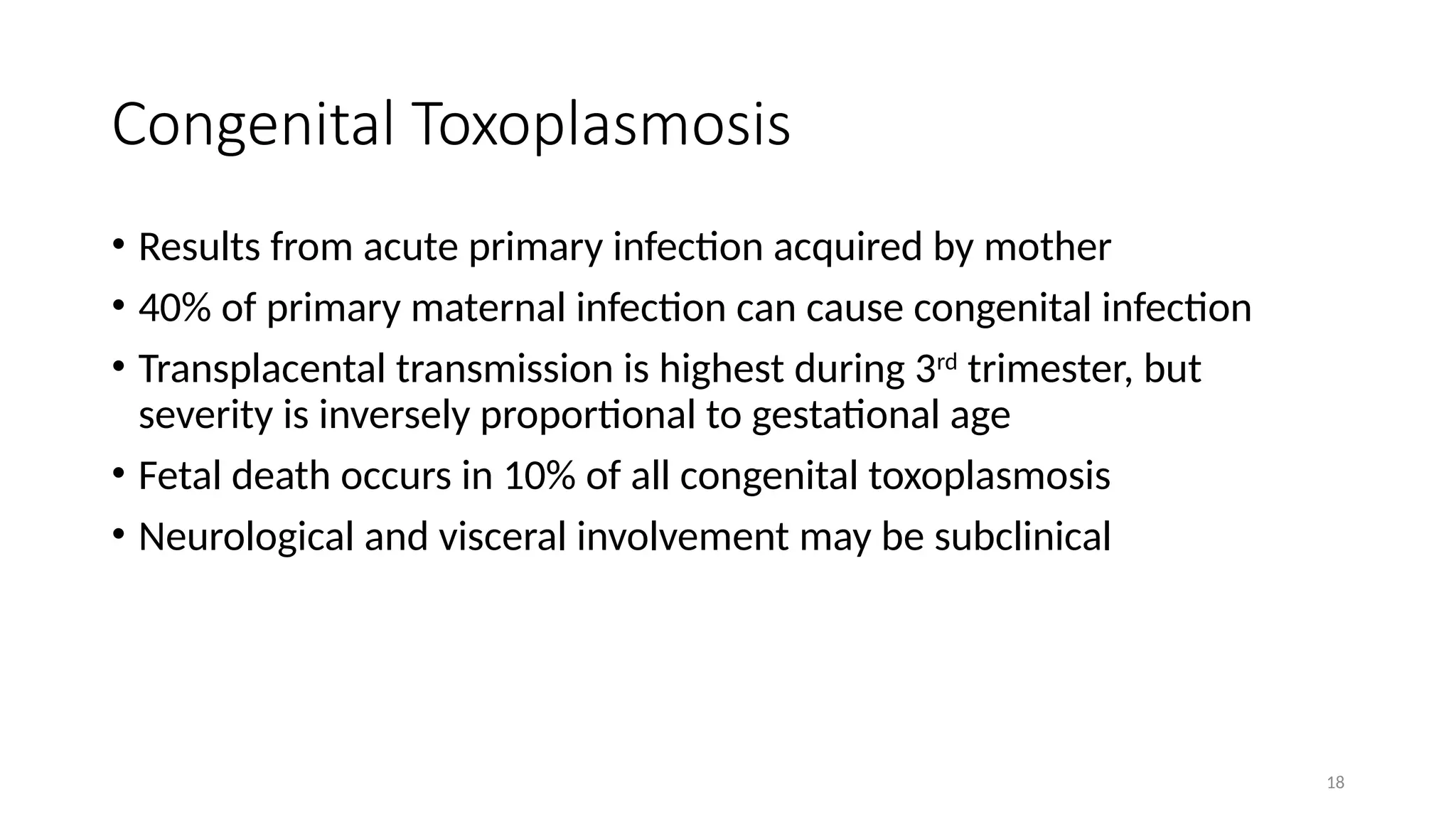
Congenital Toxoplasmosis
• Resultsfrom acute primary infection acquired by mother
• 40% of primary maternal infection can cause congenital infection
• Transplacental transmission is highest during 3rd
trimester, but
severity is inversely proportional to gestational age
• Fetal death occurs in 10% of all congenital toxoplasmosis
• Neurological and visceral involvement may be subclinical
19.
19
Congenital Toxoplasmosis
• Resultsfrom acute primary infection acquired by mother
• 40% of primary maternal infection can cause congenital infection
• Transplacental transmission is highest during 3rd
trimester, but
severity is inversely proportional to gestational age
• Fetal death occurs in 10% of all congenital toxoplasmosis
• Neurological and visceral involvement may be subclinical
21
Contd…
• Retinochoroiditis occurin over 75% leaving scars that are commonly a
later incidental finding
• Early infection: spontaneous abortion, still birth, severe congenital
disease
• Late infection: asymptomatic, normal appearing infant with latent
infection
24
Contd…
• Ocular sequalae
•25% of these become blind in one or both eyes
• Retinochoroidal scars
• Cataracts
• Microphthalmia
• Phthisis bulbi
• Strabismus
• Nystagmus
• Optic atrophy
• Macular membrane
25.
25
Postnatal Childhood Acquisition
•Accounts for 50% cases of childhood toxoplasmosis
• Ocular lesions are common but may not develop for years after initial
infection
26.
26
Ocular Toxoplasmosis
• 20-60%of all posterior uveitis
• 80-90% congenital
• Classic lesion:
• Focal necrotizing retinochoroiditis with vitreous inflammation can be
accompanied by granulomatous anterior uveitis
• Retina: primary site of parasite multiplication
• Choroid and sclera: site of contiguous inflammation
27.
27
Cont…
• Lesions inmacular area:
• 76% macular involvement
• Established as result of entrapment of freely swimming organisms or parasite
containing macrophages in terminal capillaries of perifoveal retina
29
Signs
• Anterior uveitis
•Elevated IOP - 20% cases
• May develop
• Mutton fat KPs
• Posterior synechiae
• Fibrin deposition
• Koeppe and Bussaca nodules
Prompt therapy to avoid complication like
pupillary seclusions, rubeosis iridis, secondary
glaucoma
30.
30
Signs
• Vitritis severe
•Retino-choroiditis with vitritis
Headlight in fog appearance
Complication: PVD, Vitreous
Contraction, RD
31.
31
Single fluffy whitelesion
associated with pigmented
scar(satellite lesion adjacent to
old scar)
De novo foci: not associated
with old scar/multiple lesions
Inflammatory focus
32.
32
Vascular Involvement
• Eitherin vicinity of active lesion or in distance retina
• Diffuse or segmental vasculitis
• Ag-Ab complex deposition in vessel wall
• Primarily involves vein
Complications: Retinal
hemorrhage, vascular
obstruction, shunting,
neovascularization
35
Optic Nerve Involvement
•Optic neuritis or papillitis associated with edema
• Direct extension of cerebral infection through sheath of optic nerve
• Patient with toxoplasma papillitis may present without evidence of
focus of retinitis
36.
36
Atypical Toxoplasmosis
• Multifocalretinochoroiditis
• Low-grade or absent vitreal infiltration
• Absence of retinochoroidal scar
• Bilaterality
• Optic disc involvement
• Choroiditis without retinitis
37.
37
Forms of atypicalretinitis:
Punctate outer retinal toxoplasmosis
Neuroretinitis (aggressively involving ON)
Neuritis
Multiple pseudoretinitis
Punctate outer retinal toxoplamosis(PORT) Small, multifocal
gray white lesion
Minimal vitreous involvement and punctate infiltrates in outer
retina with serous RD
38.
38
Neuroretinitis
• Active lesionslocalized to
juxtrapapillary region,
aggressively involving retina and
optic nerve
• Initially presents as severe
papillitis with disc hemorrhages,
venous engorgement and
overlying vitritis
39.
Multiple pseudoretinitis
• Simultaneouspresence of retinal lesions, which appears to be active
• However, close observation reveals just a single active lesion
accompanied by noncontiguous areas of retinal edema
• Once true active lesion heals, pseudo lesions completely disappear
without scarring
39
40.
40
Healing
• Spontaneously 6-8weeks
•Associated with decrease in retinal edema and flattening of lesion
with evidence of scar formation surrounded by variable amounts
of pigment
42
New or Acutelesion
• Intensely white
• Focal lesion overlying
vitreous inflammatory haze
• Acute anterior uveitis
Healed lesion
• Border become more
defined
• Hyperpigmented after
several months
• Large scar will have
atrophic center
43.
43
Recurrent Toxoplasmic Retinitis
•Retinochoroiditis scar may harbor
toxoplasmic cyst
• Immunological suppression recurrence
• Frequently appears as satellite or occurs
adjacent to previous scar
• Lesion tends to involve posterior pole
44.
44
Toxoplasmosis
Immunocompetent Immunocompromised
Isolated oftenunilateral lesion Multifocal and bilateral
White fluffy focus of necrotizing retinitis
with associated retinal edema, retinal
vasculitis and vitritis
Less vitritis and lesions may simulate
appearance of viral retinitis such as ARN or
CMV retinitis
Secondary non granulomatous
inflammation of adjacent choroid and
sclera
45.
45
Variants
• 1st
variant: Lesionslarger than 1DD dense and elevated
• Largely destructive lesion with significant vitritis and AC reaction
• Prompt therapy is necessary
• 2nd
variant: Punctate lesions of inner retina
• Inflammation is mild
• No therapy necessary unless lesion is close to macula and vision threatening
• 3rd
variant: Punctate lesions in outer retina and mild vitritis
• Lesion slowly resolves spontaneously
46.
46
Complications
Permanent
vision loss
• Macularinflammatory lesion and edema
• Optic nerve involvement
• Vascular occlusion
• Serous, rhegmatogenous and tractional RD
• Late secondary choroidal neovascularization
48
Diagnosis
• Serological tests:IgG, IgM, Sabin-Feldman dye test
• Polymerase chain reaction (PCR) for intraocular fluid
• Diagnostic pars plana vitrectomy with or without choroidal biopsy
• Imaging modalities
• B-scan: to exclude RD if severe vitritis present
• OCT
• Fluorescein angiography
49.
49
Serology
• IgG antibody
•Usually appears within 1-2 weeks of infection, peak within 1-2 months, fall at
variable rates and usually persist for life
• Titer doesn’t correlate with severity of illness
• Crosses placenta
• IgM antibody
• Determine acute phase of infection or in distant past
• Persist for month to more than year
• Do not cross placenta
• Presence of IgM in newborns confirm congenital infection
50.
50
Ocular Fluid AntibodyAssessment
• Goldman-Witmer coefficient
• Ratio of specific IgG in aqueous humor to that in serum as measured by ELISA
or radioimmunoassay
• GW ratio:
• <2 in immunocompetent patient- no active ocular toxoplasmosis
• Between 2 and 4- active ocular disease
• >4 is diagnostic of active ocular toxoplasmosis
51.
51
Polymerase Chain Reaction
•Used to detect T.gondii DNA in body fluids and tissues
• Used to diagnose congenital, ocular, cerebral and disseminated
toxoplasmosis
• PCR performed on amniotic fluiddiagnosis of fetal T.gondii infection
55
Toxoplasma ARN ofViral
etiology
CMV Retinitis Chorioretinitis of
Tubercular etiology
Endogenous
Endohthalmitis
History Prior relapses +-/Acute
onset, Contact with
cats/dogs,
contaminated food
Generally, no prior
relapses e Acute
onset
Acute onset
Prior relapses
Insidious onset History of fever,
systemic
infections, acute
onset
Complaint Blur vision, pain or
watering
Blur vision /pain +/- Blur vision,
No pain
Blur vision, mild
pain/ redness+/
Blur vison, with
Pain and redness
Anterior
Segment
Granulomatous >
Nongranulomatous
KPs +/-, No hypopyon
Decrease in
corneal sensation
+/-, Diffuse
pigmented KPs, iris
atrophy+/
Diffuse
KPs+/-, No
hypopyon
Iris nodules/
granuloma +/-
granulomatous KPs,
Broad based
synechia
Hypopyon+/-,
Fibrinous
reaction+/-,
generally
nongranulomatou
s KPs +/
56.
56
Toxoplasmosis ARN ofviral
etiology
CMV retinitis Chorioretinitis of
tubercular
etiology
Endogenous
ophthalmitis
Posterior
segment
Moderate – severe
vitritis, generally single
retinitis lesion,
occasionally associated
chorio-retinal scars,
frequently associated
exudative vasculitis
Circumferential
progression,
arteriorlar
vasculitis,
Hemorrhages +/-,
No dense
scarring after
resolution
Larger lesions,
few
hemorrhages,
pizza pie
appearance, no
scarring after
resolution
choroidal or
outer retinal
lesions,
Occlusive
vasculitis +/
Generally larger
lesions arising
from choroid and
involving outer
retina first,
vasculitis
component is not
clear
OCT Thick ERM, Full thickness
retinal involvement,
choroidal elevation +/-
Full thickness
involvement, No
choroidal
elevation
Ellipsoid zone
disruption,
choroidal
involvement
Choroidal
elevation, outer
retinal
involvement first
57.
57
Treatment
• Aim:
• Toreduce risk of permanent visual loss
• To reduce recurrent retinochoroiditis
• To reduce severity and duration of acute symptoms
58.
58
Indications
• Lesions threateningoptic nerve or fovea
• Decreased visual acuity
• Lesions associated with moderate to severe vitreous inflammation
• Lesions greater than 1 disc diameter in size
• Persistence of disease for more than 1 month
• Presence of multiple active lesions
61
Pyrimethamine
• Folic acidantagonist
• Mechanism of action
Inhibits dihydrofolate reductase enzyme
Preventing conversion of folic acid to folinic
• Adverse effects
• Leukopenia
• Thrombocytopenia
• Megaloblastic anemia
62.
62
• Complete bloodcount- 2weekly
• Contraindicated in 1st
trimester of pregnancy
63.
Sulfonamides
• Mechanism ofaction:
• Structural analogues and competitive antagonists of paraaminobenzoic acid
(PABA)
• Prevent normal utilization of PABA for synthesis of folic acid by parasites
• Adverse effects
• Crystalluria , hematuria, and renal damage
• Acute hemolytic anemia
• Agranulocytosis
• Hypersensitivity reactions
63
64.
64
• Contraindications
• Glucose6-phosphate dehydrogenase deficiency
• Third trimester of gestation
• Doses:
• Adults: 2gm loading dose followed by 1gm every 6hourly for 30-60days
• Children: 100mg/kg/day divided every 6hourly
• Newborns: 100mg/kg/day divided into 2 doses
65.
65
Clindamycin
• Mechanism ofaction:
• Inhibits ribosomal protein synthesis
• Adverse effects :
• Pseudomembranous colitis
• Skin rashes
• Diarrhea
• Dose:
• Adult: 300mg every 6hours for 30-40 days
• Children: 16-20mg/kg/day divided every 6hourly
66.
66
Intravitreal Therapy
• Advantages:
•Increased patient convenience
• Improved systemic side effect profile
• Greater drug availability
1mg of Clindamycin 0.4mg of Dexamethasone
67.
67
Co-trimoxazole
• Mechanism ofaction:
• Trimethoprim prevents reduction from dihydrofolate to tetrahydrofolate
• Sulfamethoxazole inhibits incorporation of PABA in synthesis of folic acid
• Dose:
• 160/800mg(one tablet) every 12 hours for 30-40days
• Combination with prednisolone(1mg/kg)
70.
70
Azithromycin
• Mechanism ofaction :
• Inhibits ribosomal protein synthesis
• Effective against encysted forms of parasite (bradyzoites) in vitro
• Dose:
• 500- 1000mg/ day for 3 weeks
• Reduce rate of recurrence of retinochoroiditis
71.
71
Atovaquone
• Mechanism ofaction
• Interferes mitochondrial electrical transport chain
• Potent action against tachyzoites
• Theoretically attacks encysted bradyzoites but does not seem to
prevent recurrence in vivo
• Dose
• 750mg every 6hourly for 4-6weeks
• No serous adverse effects
72.
72
Spiramycin
• Macrolide antibioticand antiparasitic
• Protein synthesis inhibitor
• Reduces rate of tachyzoite transmission to fetus
• Drug of choice in pregnancy
• Dose:
• 500mg every 6hourly for 3 weeks, regimen may be repeated after 21 days
• Adults: 500-750 mg every 6hourly for 30-40 days
• Children: 100 mg/kg/day divided every 6hour
74
Laser Photocoagulation
• Forextramacular chronically exudative lesion in individuals
nonresponsive to or not tolerating systemic therapy
75.
75
Pars Plana Vitrectomy
•For removal of persistent vitreous opacity or to relieve vitreoretinal
traction that may lead to retinal detachment
• Also removes antigenic proteins with inflammatory cells from vitreous
76.
76
Course And Prognosis
•Recurrent disease
• Around 2/3rd
of patients develop reactivations later in life
• More common in congenital>postnatally acquired toxoplasmosis
• Occur especially in first year after previous episode
• Some patients, however, sustain long-lasting disease remission
77.
Prevention
• Meat shouldbe cooked to 600C for at least 15minutes or frozen to
temperature below -200C for at least 24hours to destroy cysts
• Any contact with cat feces should be avoided
• Hands should be washed after touching uncooked meat and after contact
with cats or soil that could be contaminated with cat feces
• Consumption of raw eggs and unpasteurized milk, particularly goat’s milk
should be avoided
77
78.
78
Bibliography
• Uvea, AmericanAcademy of Ophthalmology, 2022-2023
• Kanski’s Clinical Ophthalmology, 9th
Edition
• Myron Yanoff and Jay S. Duker, Ophthalmology, 5th
Edition
• Uveitis, A Practical Guide to the Diagnosis and Treatment of
Intraocular Inflammation
Editor's Notes
#4 Arc-to describe small crescentic shape of tachyzoites , desert rodent which is related to organism that T.gondii was originally found in
By 1960
#5 Type II mainly found in USA
Type I mostly found in Brazil where 80% of people are affected and 18% manifest retinochoroiditis
#7 sexual cycle takes place exclusively in feline intestine.- initially become infected by eating contaminated meat containing tissue cysts or by ingesting sporulated oocysts. In cat's intestine, tachyzoites invade epithelial cells n start to multiply by schizogony. During this process, gametocytes are formed n fertilized to produce oocysts. Ocyst r shed in env. It takes 1-5days to sporulate in env n become infective.
Intermediate host rodents birds become infected by ingesting soil water or plant contaminated wid oocyst.oocyst transform into tachyzoites shortly after ingestion. These tachyzoites localize into neural n muscle tissue n develop into tissue cyst bradyzoites. Cats become infected by consuming intermediate host harbouring bradyzoites or ingestion of sporulated oocyst
#10 Bp Koirala lions center for ophthalmic studies , 2nd most common infectious disease 3 most commn infectious dz wre herpetic anterior uvieits ,13.95%, and tuberculosis , RA sarcoidosis
#11 Eating undercooked meat of animals harboring tissue cysts .
Consuming food or water contaminated with cat feces or by contaminated environmental samples (such as fecal-contaminated soil or changing the litter box of a pet cat) .
Blood transfusion or organ transplantation .
Transplacentally from mother to fetus
In the human host, the parasites form tissue cysts, most commonly in skeletal muscle, myocardium, brain, and eyes; these cysts may remain throughout the life of the host
#13 cytokines, particularly ,, Th 2 response counterbalances proinflammatory Th 1 pathway
Down-regulating protective immunity to T.gondii ..parasite virulence is also an imp determinant of pathogenesis d, 3 genogytpes, type 1 is highly virulent
#15 The clinical manifestation of toxoplasmosis depend upon the modality of infection: weather acquired, congenital or ocular
Also depends if the host is immunecompetent or immunocompromised.
#16 Lymphanedopathy may be only presenting symptoms, however ocular toxoplasmosis may be seen even in immunocompetent hosts n is caused by reactivation of parasite after n initial self resolving infection of retina .. Severe symptoms: myositis, myocarditis, pneumonitis and neurologic signs including facial paralysis, severe reflex alterations, hemiplegia and coma
#17 Wen host is immunocompromised, reactivation of latent parasite or acute infectin is more systemi n severe
#18 Occurs wen mother becomes infected wid parasite during pregnancy n if is passed to fetus via placenta
#19 Occurs wen mother becomes infected wid parasite during pregnancy n if is passed to fetus via placenta
#22 <10% of infected child, retinal choroidal lesion r seen in 80% of infected child
Classic presentationand
#24 Entire thickness of retina and choroid is
destroyed in necrotizing inflammation so
punched-out heavily pigmented scar remains
Ocular lesions are usually associated with
encephalitis and there is history of convulsions
#27 TThe acute lesion typically arises from the border of a chorioretinal scar
These lesions often remain active for up to 16 weeks and then resolve,leaving a hyperpigmented scar
#29 Anterior uveitis (spill over granulomatous).. Due to hypersensitivity to T. antigen
#30 Vitreous involvmnt may occur as localized or diffuse exudate, inflammatory cells, pigmnts or hemorrhage…retinochoroiditis wid vitritis usually intensely yellowish white or grey focal lesions overying vitreos inflammatory haze->may give headlight in fog appearance..wen there is severe n prolongd vitreous involvement vitreus contration post vitreous detachment or evn retinal detachment may occur
#31 De novo foci (usually seen in immunocompromised patients)
#33 Presence of periarterial lipid exudates,appears as multiple segmental yellowh white lesion in beaded pattern. Etiology is nt knwn bt they alwz reflect severe intraocular inflammation. Toxo is mst frequently reported cause.other- syphilis , tb viral
#34 The neovascularization regresses with resolution of the inflammation
#36 Ocuur in immunocomprsmed pt , HIV pt with CD4 <100,pt on chronic immunosuppression or corticosteroids n elderly pt. they can hav mor sever presentation
#37 Acute lesions resolve leaving behind fine granular white scars but they frequently recur
#40 In immunocompetent…Inflammatory focus replaced by well defined border with central retinochoroidal atrophy n peripheral retinal pigmnt epithelial hyperplasia
#41 A healed Toxoplasma scar typically has well-defined borders with central retinochoroidal atrophy In atrophic central area, either choroidal vessels or bare sclera may be observed.
Healing Toxoplasma .lesions may be complicated by proliferative vitreoretinopathy, retinal gliosis, vascular shunts, and choroidal neovascular membranes
Traction bands are also frequent, and they usually link an old scar to the optic disc (Franceschetti's syndrome) or to a neighboring scar
#42 Focal lesion overlying vitreous inflammatory haze (head light in the fog)
Large scar will have atrophic center (devoid of all choroidal retinal elements)
#43 satellite(single inflammatory focus or fluffy white retinitis or retinochoroiditis)
#47 glaucoma -mechanical obstruction of TM with fibrin, inflammatory cells, or debris
Cataracts - severe vitreous inflammation or use of local and systemic corticosteroids. PSC is typical
Vitreous hemorrhage and tractional or rhegmatogenous retinal detachment - proliferative vitreoretinopathy and contraction ofvitreous bands. Proliferative vitreoretinopathy and tractional bands - macular dragging.
epiretinal membranes - macular pucker and cystoid macular edema.
Cystoid macular edema -chronic inflammation.
macular cyst - macular hole.
Retinal occlusion -retinal vein occlusion around or within active lesions venous occlusions are more common. Arteriovenous shunts in the retina and chorioretinal vascular anastomosis - complications of vascular obstruction
. Disruption ofBruch's membrane - necrotizing retinochoroiditis - choroidal neovascular membranes, - adjacent to the retinal scar or at a distant location with feeder vessels originating from the scar. Optic nerve atrophy -primary involveof the optic nerve, peripapillary'lesions, or lesions localized in the papillomacular bundle. punctate outer retinal toxoplasmosis - frequent optic nerve atrophy..
#48 Diagnosis of ocular toxo is mst oftn made by clinical findings,serology can b supportive in making diagnosis. PCR analysis can aid in diagnosis particularly in immunosupresd pt where serology may b less sensitive. PPV-if diagnosis remain uncertain.. to obtain tissue for analysis.. Oct-aid in further characterizing retinal lesions n accompanying findings vascular leakage, oclusin macular edema or choroidal neovascularization.. To look for progressin.
#49 Using indirect fluorescence ab and ELISA to detect specific anti T.gondii ab
#50 Intraocular production of specific anti-Toxoplasma antibodies may be computed using this coefficient
#51 PCR has allowed detection of T.gondii DNA in brain tissue, cerebrospinal fluid, vitreous and aqueous fluid, bronchoalveolar lavage fluid, urine, amniotic and peripheral blood
Its principle is based on the use of DNA polymerase which is an in vitro replication of specific DNA sequences.. he DNA polymerase is the key enzyme that links individual nucleotides together to form the PCR product.
#52 Red arrows: indicate disorganization of inner/middle highly refective layers adjacent active lesion, yellow: disorganization of retinal layer(smudge effect), green : hyperreflective signals in overlying vitreos
#53 Toxocariasis-chronic endopth, post pole or peripheral granuloma without inflammation
#57 Ocular toxo Is progressive n recurrent dz,..In immunocompetent pt,dz can have self limiting course, in immunocompromizd dz is ofn severe n progressive. It has no cure as no drug are found to be effective against tissue cyst. Bt parasite activity n multiplication can be reduced n decrease size of retinochoroidal scar
#58 2 line drop in VA before infection. d/t vitritis
#59 those with AIDS with neoplastic disease or undergoing IMT
#60 Myelosuppresion which may reslt from pyrimethamine therapy
#61 folinic acid which is essential in both DNA and RNA synthesis. Dose related bone marrow suppression
#62 Stopped if platelet count falls below 100,000/ml or leukocyte count falls below 4000 cells, folinic acid retard thrombocytopenia, leukopenia and folate deficiency …teratogenic effect. Used in caution in hepatic or renal failure
#63 Sulfadiazine, sulfamerazine and sulfamethazine
#64 G6PD- cause hemolysis Newborns given daily for 1st year of life
#65 Clindamycin maybe added to regimen or substituted for sulfadiazine in case of sulfa allergy. Clindamycin either alone or in combination wid other drugs has been efectiv in managing acute lesion
#66 Advantages of intravitreal treatment include increased pt convenience,improved systemic side effect profile, greater drug availability and fewer follow-up visits and hematological evaluations
#67 Other treatment regimn include..prednisolone is started from 3rd day after anti-toxoplasmosis therapy
#72 Spiramycin- drug of choice during pregnancy. It achieves a high concentration in the placenta and has no reported teratogenic effects. Spiramycin may reduce the incidence of congenital transmission
#73 Prednisolone is started 24-48hrs after initiation of anti toxo therapy..Greater reduction in size of retinal lesion. When antimicrobial therapy is given it kills parasite leading to release of toxins leading to inflammation, so prednisolone 1mg/kg is given ,reduces risk of complications like CME persistent vitritis and perivascular inflammation
#76 Prognosis depends on immune status n age of pt, size n location of lesion


![Patterns of Uveitis among Nepalese
Population Presenting at a Tertiary Referral
Eye Care Centre in Nepal
• Study period: 2012-2017
• Total patient attending BPKLCOS: 5,34,292
• Total patient diagnosed with uveitis: 4359 [0.82%]
• Patients diagnosed with toxoplasmosis : 272 [6.24%]
Kharel R, Khatri A, et al. Patterns of uveitis among Nepalese population presenting at a tertiary
referral eye care centre in Nepal. DOI: 10.15761/NFO.1000238](https://image.slidesharecdn.com/oculartoxoplasmosisdr-250308120844-1cea37a2/75/Ocular-Toxoplasmosis-Dr-Prabhat-Devkota-pptx-10-2048.jpg)