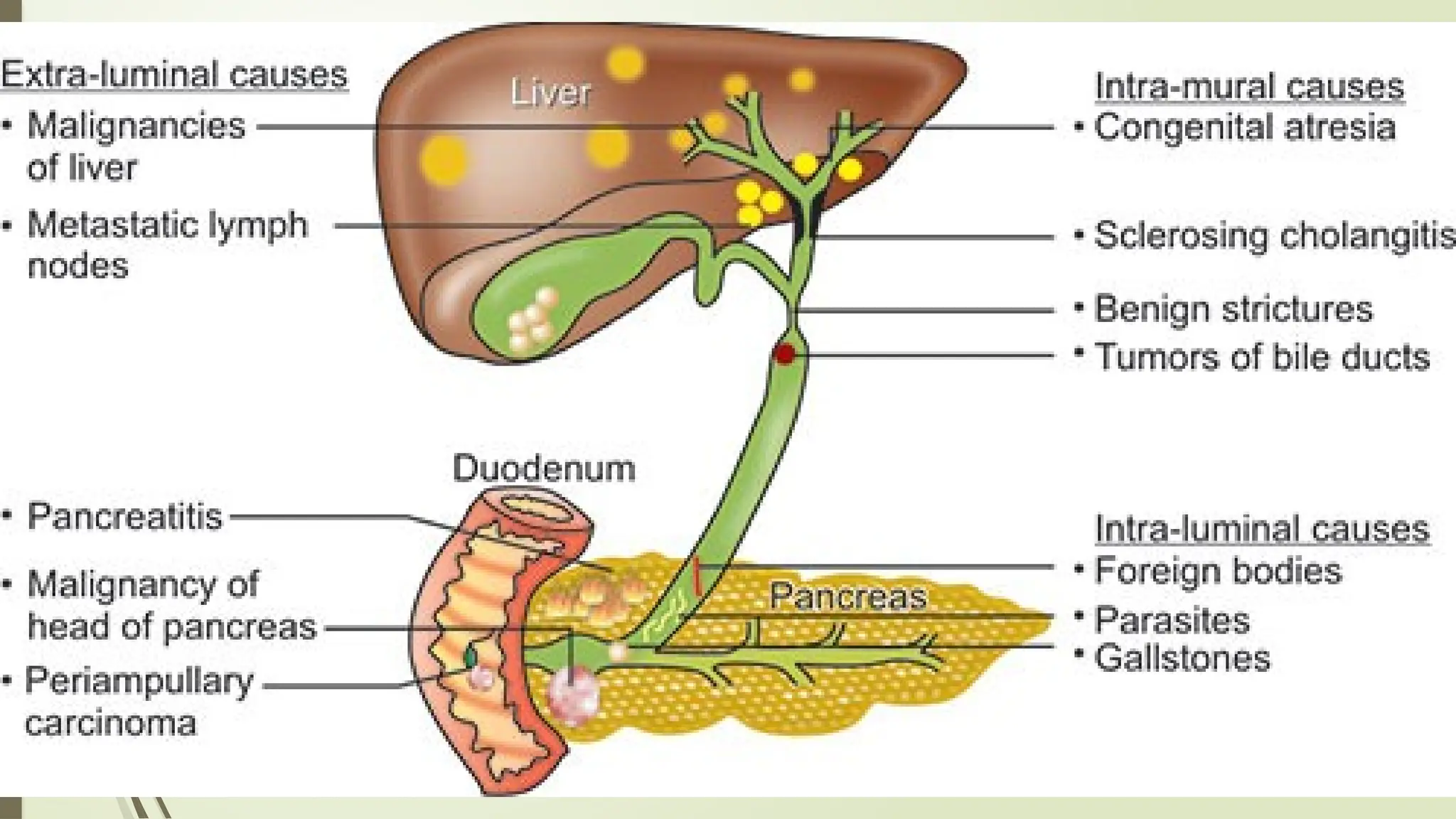
Obstructive Biliopathy.pptx .ppt on obstructive biliopathy
1.
Jaundice
• Jaundice isthe yellowish discoloration of skin , mucous membranes and the
whites of eyes caused by elevated levels of bilirubin in the blood
(hyperbilirubinemia).
• Jaundice is not a disease per se, but rather a visible sign of underlying disease
process.
• Jaundice is typically seen when levels of bilirubin in blood exceed 2.5-3 mg/dL.
• Types:
Non obstructive - Pre-hepatic and hepatic causes
Obstructive – Post-hepatic causes
• Imaging has a major role in detecting obstructive causes.
Jaundice
• Post hepatic(Obstructive) causes -
o Benign Causes – Choledocholithiasis
- Strictures (E.g. – Primary Sclerosis Cholangitis, Post
inflammatory/ Infectious)
- External Biliary Tree compression (E.g. – Pancreatic
Pseudocyst, Mirizzi Syndrome)
- Parasitic Infestation
o Malignant Causes – Cholangiocarcinoma
- Carcinoma Head of Pancreas
- Hepatocellular Carcinoma
- Gallbladder Carcinoma
- Portal lymphadenopathy
5.
Biliary Anatomy
• Theintrahepatic pattern of bile branching is best described according to the
system of Healey and Schroy, to which can be applied the Couinaud system for
numbering segments.
Biliary Anatomy
• Thecystic duct typically joins the common hepatic duct in the middle third of the
extrahepatic bile duct (often referred to as the 'common duct' on USG for
convenience), which then continues as the common bile duct.
• The cystic duct usually joins the right side of the common duct but can pass
behind or in front of the common duct to join it from the left. The cystic duct can
join the common duct at a very low level in which case it may be mistaken for
the common duct on imaging.
• Uncommonly it may join a right-sided duct, which is usually a low, aberrant right
sectoral or segmental duct.
• Some of these variations predispose patients to duct injury at cholecystectomy.
8.
Biliary Anatomy
Other variationsinclude –
• Ducts of Luschka or subvesical ducts (an intrahepatic duct running adjacent to
the gallbladder fossa, unaccompanied by a portal vein branch, and emptying into
either the right hepatic or common hepatic duct)
• Cystohepatic ducts (small ducts that drain directly into the gallbladder or cystic
duct)
• It is important to remember that the anterior position of the left intrahepatic
ducts affects the pattern of filling at direct cholangiography. During PTC or T-
tube cholangiography it may be necessary to roll the patient to the left to good
left-duct filling. Conversely the left ducts fill first at ERCP with the patient in the
prone position. Furthermore, as the patient is usually oblique during ERCP, the
left-sided ducts are often projected to the right and may be misinterpreted as
being right-sided ducts if there is incomplete filling of intrahepatic ducts.
Oral Cholecystography
• OCGrelies on the overnight absorption of an oral contrast agent, such as Sodium
Ipodate, which is absorbed from the bowel, excreted into the bile and then
concentrated in the gall bladder.
• Gallstones appear as filling defects in the gall bladder and may layer on a
horizontal beam film.
• Non opacification of the gallbladder signifies either absence or pathology of gall
bladder provided that the CBD is opacified.
• USG had replaced OCG for the diagnosis of gallstones.
• More recently, oral contrast agents have been used for CT cholangiography,
although most centres use intravenous biliary contrast agents.
12.
CT Cholangiography
• CTcholangiography has been used to describe two techniques using negative
and positive contrast methods, respectively.
• The negative contrast makes use of bile as a negative contrast agent to display
the biliary tree using various reformatting techniques. The reformats improve the
CT evaluation of bile duct obstruction, though they do not improve the detection
of duct stone.
• Positive contrast agents are either IV or oral contrast agents that are excreted
preferentially by the liver to opacify the bile ducts. The oral agents, such as
iopanoic acid and sodium ipodate, were commonly used for OCG in the past, and
IV agents, such as sodium iotroxate, were used for conventional IV
cholangiography using planar tomography. IV agents achieve diagnostic duct
opacification more reliably than oral agents but are not universally available.
Adequate contrast excretion relies on near- normal hepatocyte function, so the
technique is of no value in the investigation of jaundice, and usually fails if
bilirubin levels are more than two to three times normal.
13.
CT Cholangiography
• Mostcentres now use IV contrast agents for CT cholangiography, so-called CT-
intravenous cholangiography (CT-IVC).
• This technique involves the IV infusion of an agent such as sodium ipodate with
helical CT performed about 30 min later. Multislice helical CT allows high
resolution scanning and multiplanar reformatting.
• Since CT-IVC relies on the excretion and subsequent passage of a contrast agent,
it provides a functional dimension not obtained with conventional MR
cholangiography, allowing the direct demonstration of bile leaks, biliary
communication with cysts and segmental obstruction.
• CT-IVC can be made difficult by the presence of intraductal gas. This is more
easily recognized than with MRCP and repeating the examination with the
patient prone can overcome the problem.
15.
Percutaneous Transhepatic
Cholangiography
• PTChas been substantially replaced by ERCP and MRCP. Its role now is mostly as
part of transhepatic biliary intervention, although occasionally it is used
diagnostically.
• A 22 g Chiba needle is used to puncture the right or left intrahepatic ducts from
the right flank or, for left ducts, from an epigastric approach. The epigastric
approach is used if the left ducts cannot be opacified from the right or as part of
a left-lobe approach to biliary drainage.
• Any coagulation disorder should be reversed with vitamin K prior to the
procedure, which is performed with broad-spectrum IV antibiotic cover and
conscious sedation.
16.
Percutaneous Transhepatic
Cholangiography
• Ifthe ducts are dilated, the needle is withdrawn gradually with suction applied
and when bile is aspirated (reduces the risk of bile leak and endotoxaemia by
reducing intraductal pressure), contrast medium is injected to opacify the biliary
tree.
• Samples should be taken for microbiology and, if malignant obstruction is
suspected, cytological examination.
• Care should be taken to opacify the entire biliary tree, especially in cases of lobar
or segmental biliary obstruction. One common pitfall is the failure to fill the left
hepatic ducts from a right-sided approach and this should be suspected if there
are no ducts opacified in the midline.
19.
Intraoperative
Cholangiography
• Intraoperative cholangiography(IOC) is performed either routinely or selectively
during cholecystectomy to detect choledocholithiasis, confirm duct stone
clearance and provide a roadmap in an attempt to reduce the risk of bile duct
injury.
20.
T Tube Cholangiography
•If the common bile duct has been explored at cholecystectomy, a T-tube is
usually left in place and cholangiography performed via this tube after about 7 d,
prior to its removal.
• Cholangiography should confirm stone clearance and the free
passage of contrast medium into the duodenum. Care must be taken to avoid
the injection of air bubbles.
22.
Endoscopic Ultrasound
• Biliaryendoscopic ultrasound (EUS) provides high-frequency grey- scale imaging
(and in some systems colour Doppler imaging) for evaluation of the extrahepatic
biliary tree and pancreas.
• It allows direct visualization of the duodenum and fine-needle aspiration
cytology.
• More sophisticated and expensive systems of 'mother-daughter' probes allow
intraductal examination of the common bile duct, but are not in routine use.
24.
Role of imagingin Obstructive
Jaundice
• The principal role of imaging in the jaundiced patient is the
identification and detailed assessment of major bile duct obstruction.
• US is the preferred initial imaging investigation, but will usually be supplemented
with a combination of CT, MRCP, direct cholangiography and, in some centres,
endoscopic and/or intraoperative US.
• The questions that need to be addressed are:
1) Is bile duct obstruction present?
2) What is the anatomical level of obstruction?
3) What is the cause of the obstruction?
4) If the obstruction appears to be malignant
25.
Role of imagingin Obstructive
Jaundice
• The first task is to determine if there is intrahepatic and/or extrahepatic duct
dilatation as a marker of duct obstruction.
• The intrahepatic ducts should measure no more than 2-3 mm centrally; more
peripherally they are usually only just visible on USG and should be clearly
smaller than the adjacent portal vein branches.
• Mild dilatation of the intrahepatic ducts may occur without duct obstruction in
the elderly.
• The maximum diameter of the normal common duct (includes the common
hepatic and common bile duct) is influenced by age and where the duct is
measured. A diameter of >7 mm is commonly used as a predictor of bile duct
obstruction in the jaundiced patient but this is only a guide
• In the normal older population values of 8 mm or more are not unusual. If there
has been a cholecystectomy the upper limit of 'normal' is less well defined and
the duct tends to be larger, commonly up to 10 mm.
26.
Role of imagingin Obstructive
Jaundice
• If only the very upper end of the common duct is seen and is not dilated this does
exclude pathological dilatation of the more inferior portion. Conversely, if there is mild
dilatation of the suprapancreatic portion but the duct tapers to a normal size in its
pancreatic portion, further imaging is not mandatory and should be guided by the
clinical likelihood of duct obstruction.
• Hilar biliary obstruction will produce only intrahepatic duct dilatation, whilst more
distal obstruction will result in extrahepatic dilatation followed by intrahepatic
dilatation.
• Approximately 95 per cent of patients with bile duct obstruction have biliary dilatation,
the degree of which is related to the duration and completeness of the obstruction. In
the remaining 5 per cent there are usually sufficient clinical/biochemical indicators of
duct obstruction to suggest that cholangiography of some form (MRCP or ERCP) is
warranted. Most cases of biliary obstruction without duct dilatation are due to
choledocholithiasis, primary sclerosing cholangitis or postoperative stricturing.
27.
Role of imagingin Obstructive
Jaundice
• The next question is to determine the anatomical level, namely whether it is hilar (at or
close to the confluence of the right and left hepatic ducts), or low/mid common duct.
This helps with the differential diagnosis as well as in the selection of further imaging tests.
Anatomical Location Malignant Benign
Hilar Ca Gall Bladder
HCC
Low/ Mid Duct Pancreatic Ca
Ampullary Ca
Pancreatitis (Acute or Chronic)
Either Cholangiocarcinoma
Metastases
Lymphoma
Benign biliary tumours
Stones, Mrizzi Syndrome,
Post op Strictures, PSC,
Hemobilia, Parasites
28.
Role of imagingin Obstructive
Jaundice
• The next questions relate to the detailed evaluation of malignant obstruction in
regard to tumour resectability and biliary decompression options.
• In malignant hilar obstruction any evaluation should assess the proximal extent
of involvement into the right and left hepatic ducts, the presence of lobar
atrophy, the patency of the portal veins (main, right and left branches) and the
presence of any intrahepatic or local extrahepatic metastases.
• The proximal extent of involvement is classified according to the Bismuth-
Corlette classification.
• In malignant low obstruction, usually due to pancreatic carcinoma, the main
factors to assess are tumour size, vascular involvement (portal vein, superior
mesenteric vein and superior mesenteric artery), lymph node metastases and
hepatic metastases.
30.
Choledocholithiasis
• At least90 per cent of bile duct stones are stones that have passed from the
gallbladder, so-called secondary stones.
• Primary stones are those that arise in the bile duct and these are pigment
stones.
• For patients younger than 60 years undergoing cholecystectomy, 8-15 per cent
have duct stones, the figure increases substantially in older patients.
31.
Choledocholithiasis
Ultrasound –
•This is the most commonly used initial imaging modality.
• Sensitivity varies greatly with the upper range being 50-80 per cent.
• The sensitivity in jaundiced patients tends to be better.
• Positive stone diagnosis depends on the demonstration of an echogenic focus in
both the longitudinal and transverse planes.
• US measurement of bile duct diameter has value as a predictor of the presence of
bile duct stones, apart from the direct detection of stones.
• If the bile duct diameter is <4 mm in patients undergoing cholecystectomy the
likelihood of duct stones is very low. As the diameter increases, the likelihood of
duct stones also increases
• Duct dilatation and acoustic shadowing are each absent in about 30 per cent of
cases.
34.
Choledocholithiasis
• Diameter of<4 mm carries a high negative predictive value
for choledocholithiasis regardless of the presence of the gallbladder. It is
useful, therefore, to report bile duct diameter in suspected gallstone disease.
• Endoscopic US is more accurate than transcutaneous US, with a sensitivity of
>90 per cent and an even higher specificity. It is relatively expensive and
invasive and its use depends on local expertise.
• Condition that may mimic stones on USG are:
1. Intraductal gas - usually recognizable by its linear nature and its
movement.
2. Haemobilia and sludge - they produce more diffuse echoes than stones.
3. Surgical clips, hepatic artery calcification and duodenal diverticula -
these do not lie within the lumen of the duct
4. Parasites.
35.
Choledocholithiasis
CT –
•Similar to gallstones, bile duct calculi depending on their composition, may
appear calcified, of soft tissue density, isodense or hypodense with respect to
bile.
• Unenhanced CT is better for their detection as most calculi are slightly
hyperdense.
• High attenuation calculi can easily be seen on CT; contrasted against the lower
attenuation of bile or that of ampullary soft tissue.
• Bile duct calculi may reveal a faint hyperdense rim with a central low density
area (rim sign).
• Even impacted stone with no surrounding bile can be detected by noting that the
visualized calcific nodule (stone) lies in the course of the CBD.
36.
Choledocholithiasis
• Approximately 50%of the bile duct calculi are of faint attenuation only slightly
greater than the surrounding bile or are isoattenuating of adjacent pancreas.
• Detection of these stones is facilitated by looking for a rim or crescent of bile
that outlines these subtle intraluminal densities.
• Abrupt termination of dilated CBD in absence of any direct evidence of calculus
is an indirect sign of choledocholithiasis. This finding is however nonspecific and
is more often due to a malignant etiology.
• When a strong suspicion of CBD stone exists, water should be used to opacify
bowel. Positive oral contrast should be withheld as it may obscure stones
impacted at the ampulla of Vater.
• CT visualisation of bile duct calculi is optimized with the thin collimation isotropic
MDCT scanners.
37.
Choledocholithiasis
• MDCT hasrevived interest in CT cholangiography.
• CT cholangiography has shown to provide excellent visualization of the biliary
anatomy with 95% sensitivity for choledocholithiasis.
• On cholangiography, calculi within the bile ducts are seen as round or faceted
filling defects within the contrast column.
• These defects are usually mobile. When impacted, a typical convex border of the
contrast column in the distal CBD is seen outlining the proximal stone margin
and obstruction to flow of contrast is noted.
• Air-bubbles are a common problem at cholangiography, but can usually be
differentiated by their smooth, round appearance and their tendency to group
together and rise to the non-dependent surface as compared to stones which
are usually faceted or elliptical and tend to fall at the dependent portion of the
biliary tree.
42.
Benign Biliary Strictures
•Benign strictures of the biliary tree can be due to surgical and other trauma,
chronic pancreatitis, gallstones and duodenal ulcer.
POST OPERATIVE BILIARY STRICTURES –
• Benign strictures are most often a sequelae of direct injury or ischemic injury to
bile ducts during biliary tract surgery.
• In patients suspected of postoperative CBD strictures, USG should be carried out
as a screening procedure.
• In the presence of proximal dilatation of CBD with smooth tapering stenosis or
sudden cut off of CBD, no further investigation is required.
• If USG findings are equivocal or normal despite strong clinical suspicion of CBD
stricture, MRCP and if required ERCP/PTC should be performed.
44.
Benign Biliary Strictures
POST INFLAMMATORY STRICTURES –
• Post inflammatory strictures can be caused by cholangitis, chronic pancreatitis,
gallstones and penetrating or perforating duodenal ulcer.
• In chronic pancreatitis, strictures occur in less than half of the patients. The most
frequent configuration on cholangiography is about 3 to 5 cm, smooth, concentric,
often tapered narrowing of the intrapancreatic portion of the CBD.
• An hourglass configuration or deviation by a pseudocyst may also be seen. Strictures
associated with gallstones are often short and sometimes web-like.
• These may be single or multiple and may involve any portion of the biliary tree.
• Common duct strictures may result from fibrosis secondary to an adjacent inflamed
gall bladder.
• US, CT and MRI primary demonstrate biliary dilatation, but may also reflect the
primary pathology leading to strictures. E.g. – Pancreatitis, gall stones or CBD stones.
45.
• Cholangiographic appearanceof bile duct strictures (as identified by Caroli
& Nora).
• Type I: Long retro pancreatic stenosis.
Type II: Dilatation of the main bile duct, stricture of the sphincter of oddi.
Type III: Hourglass stricture.
Type IV: Symptomatic of either a cyst (a), or a cancer (b and c).
Type V: Cancer of the pancreas.
47.
Primary Sclerosing
Cholangitis
• Primarysclerosing cholangitis (PSC) is a chronic progressive cholestatic disease of
unknown etiology that occurs more commonly (70%) in males and has a median
age of onset of 40 years.
• Radiology plays a crucial role in the diagnosis of PSC as clinical features are
nonspecific, there is no specific serological marker and histology alone is not
diagnostic.
• Cholangiography is the most definitive imaging modality for the diagnosis of PSC.
In most cases ERCP is sufficient and PTC is performed only if certain segments of
the biliary tract are not opacified at ERCP.
48.
Primary Sclerosing
Cholangitis
• Diffuse,multifocal, short (1-2 cm in length) strictures in both intrahepatic and
extrahepatic bile ducts are the hallmark of PSC. Strictures alternate with normal
or mildly dilated intervening duct resulting in a beaded duct appearance.
• Other manifestations of PSC are shorter (1-2 mm) band-like strictures and small
diverticulum- like outpouchings (1mm to 1 cm), seen most frequently in the
extrahepatic bile ducts and also intraluminal webs.
• Fibrous obliteration of peripheral bile ducts can result in "pruned-tree"
appearance. In approximately 50% patients with PSC bile duct irregularity is seen
as subtle brush-border like appearance to coarse, shaggy or frankly nodular
appearance.
49.
Primary Sclerosing
Cholangitis
• Crosssectional imaging in PSC reveals thickening and dilatation of bile ducts.
• Duct wall thickening often with marked contrast enhancement, skip dilatations
and stenosis and mural webs have also been demonstrated on CT as well.
• Upper abdominal lymphadenopathy is frequently seen in patients with PSC
and does not necessarily indicate development of
cholangiocarcinoma.
• PSC induced cirrhosis induces unique morphological changes in the liver.
• There occurs atrophy of the lateral segments of the left lobe of liver in
addition to atrophy of posterior segments of the right hepatic lobe and
marked hypertrophy of the caudate lobe.
• The liver appears rounded with a lobulated contour.
50.
Primary Sclerosing
Cholangitis
• Cholangiocarcinomaoccurs in about 10 per cent of affected patients and is
notoriously difficult to diagnose early. It should be suspected if there is
progressive duct dilatation proximal to a stricture, or if a nodule >1 cm in
diameter is identified.
• Dual-phase, contrast-enhanced CT, especially when correlated with
cholangiography, can improve cholangiocarcinoma detection.
54.
Mirizzi Syndrome
• Mirizzisyndrome is an uncommon complication of long standing cholelithiasis
characterized by common hepatic duct or CBD obstruction due to extrinsic
compression from an impacted gallstone in the cystic duct or gallbladder neck or
from associated inflammatory changes.
• It may be complicated by fistula formation between the gallbladder and common
hepatic duct/common bile duct secondary to an eroding stone.
• The hallmark imaging features include cholelithiasis with intrahepatic biliary
dilatation and dilated common duct till the porta hepatis beyond which the CBD
is normal in calibre.
• Multiplanar reformatted images are particularly useful in depicting the extrinsic
nature of the obstruction.
• Definite diagnosis of internal biliary fistula can be established by ERCP/PTC.
56.
Choledochal Cysts
• Choledochalcyst is an uncommon congenital cystic dilatation of the bile duct.
• Most patients present in childhood although no age is exempt.
• The triad of jaundice, right upper quadrant pain and a palpable subcostal mass is
diagnostic but is not seen in all cases.
• Reported complications of choledochal cysts include secondary calculus
formation, pancreatitis, biliary cirrhosis, cyst rupture with bile peritonitis,
cholangitis, intrahepatic abscess, portal vein thrombosis and malignant
transformation into cholangiocarcinoma.
57.
Choledochal Cysts
• Todaniet al 24 have classified choledochal cysts into five types:
Type I: Fusiform cystic dilatation of extrahepatic CBD.
Type II: Eccentric fluid-filled cyst (diverticulum)
Type III: Localised cystic dilatation of distal intramural segment of CBD
Type IVA: Multiple intrahepatic and extrahepatic bile duct cysts.
Type IVB: Multiple extrahepatic bile duct cysts.
Type V: Multifocal saccular dilatation of IHBR (Caroli's disease).
• Ultrasonography is preferred for initial evaluation. It reveals an anechoic cystic
structure separate from the gall bladder that communicates with the hepatic
ducts.
• CT, MRI and cholangiography can accurately diagnose and classify choledochal
cyst. MRCP is equivalent to ERCP in detecting and defining the morphology of
choledochal cysts and in detecting the presence of anomalous union of the
pancreatic and bile ducts.
Type IV Choledochalcyst on PTC with
extrahepatic as well as intrahepatic
dilatation of bile ducts and a
characteristic long channel shared by
the CBD and pancreatic duct (arrow)
61.
Type V Choledochalcyst – (A) Ulteasound and (B) Axial T2W MR image show saccular
dilatation of intra hepatic biliary ducts.
62.
Parasitic Diseases
• Althoughmany parasites of the gastrointestinal tract may traverse the biliary
tract, clinically significant infestation is seen most commonly with Ascaris
lumbricoides, Clonorchis sinensis and Echinococcus granulosus.
Ascaris lumbricoides:
• Ultrasound is the most valuable diagnostic tool that reveals the worms as
tubular, non-shadowing, echogenic structures in the dilated biliary ducts. When
alive the worms can be seen to move.
• On unenhanced CT, they appear as hyperattenuating tubular structures
surrounded by less attenuated bile. In transverse sections on both US and CT, a
"bull's eye" image may be seen caused by the worm inside a dilated bile duct.
• On cholangiography, the worms may be seen as smooth cylindrical filling defects.
63.
Biliary Ascariasis. (A)USG shows linear echogenic lesion in dilated CBD.
(B) ERCP confirms the findings.
64.
Parasitic Diseases
Clonorchissinensis:
• Clonorchis sinensis is the most important among liver flukes.
• Adult worm resides in the intrahepatic bile ducts where it causes biliary obstruction,
incites an inflammatory response with recurrent pyogenic cholangitis and in later stages
causes periductal fibrosis.
• These worms appear as small short and curvilinear leaf like filling (2 to 10 mm in length)
on cholangiograms.
• The flukes tend to concentrate in the peripheral bile ducts. Cross sectional imaging is
therefore characterized by the presence of dilatation of small (peripheral) intrahepatic
bile ducts with concomitant thickening of the duct wall and periductal tissues.
• CT reveals branching low attenuation structures in the liver due to bile duct dilatation and
associated periductal fibrosis.
• Complications of clonorchiasis include: development of
cholangiocarcinoma which also tend to be peripheral in this setting, intraductal calculi
formation, cholangiohepatitis and liver abscess formation.
65.
Parasitic Diseases
Hydatidcyst:
• The cyst may rupture into the biliary system. In patients with rupture into the
biliary system, daughter cysts and membranes pass into the common bile duct
producing surgical obstructive jaundice.
• Accurate preoperative diagnosis of biliary communication of hydatid disease is
possible on US, CT, MRI and cholangiography.
66.
Ampullary Stenosis
• Biliaryobstruction may be caused by morphologic stenosis of the ampulla of
Vater or sphincter of Oddi.
• Although unclear, probable causes include passage of gallstones and
pancreatitis. Imaging studies are frequently abnormal but not always conclusive.
• On US, CT and cholangiography (ERCP/MRCP) bile duct and sometimes
pancreatic duct dilatation may be seen.
• Ultrasound may show partial obstruction by demonstrating an increase in CBD
diameter following a fatty meal.
67.
Ampullary Stenosis
• ERCPis the most valuable study for assessing the diagnosis of
papillary stenosis, where direct endoscopic inspection of the papilla is possible.
• Tumors of the papilla or surrounding duodenum may be identified, if present.
• Cholangiographic findings of common bile duct dilatation, an elongated or rigid
ampullary segment and failure of the CBD to empty contrast material in 45
minutes are suggestive of ampullary stenosis.
68.
Hemobilia
• Hemobilia orbleeding into the biliary tree has many causes, most frequent being
trauma. Other causes include cholangitis, gallstones, tumors, hepatic artery
aneurysms, coagulopathy and interventional procedures.
• Definite diagnosis rests with either direct endoscopic observation of blood
entering the duodenum from the ampulla of Vater or angiographic
demonstration of the bleeding site in the liver, gallbladder or biliary tract.
• Cholangiography may show clotted blood as a cast-like filling defect in the bile
ducts and may reveal a bile duct leak or a biliary vascular communication.
• Blood may be seen as echogenic material in gallbladder or CBD on US. On CT,
blood is seen as high attenuating area (> 50 HU) in the gallbladder or bile ducts.
69.
Benign Tumours ofthe Bile
Duct
• Benign bile duct tumours are very rare. Adenomas are the
most common type. Other benign tumors include fibroma, granular cell tumor,
myeloblastoma, neurofibroma, hamartoma, lipoma and leiomyoma. Benign tumors
are most frequently found in the periampullary region or in the common bile duct and
are quite uncommon in the common hepatic or intrahepatic ducts
• Most adenomas are asymptomatic and detected incidentally.
• Sonographically, they are moderately echogenic nonshadowing filling defects. The lack
of shadowing and relatively low echogenicity suggests a tumor rather than a stone.
• On CT, these are seen as soft tissue masses indistinguishable from noncalcified stones.
• Cholangiographically, the tumors usually present as round or oval filling defect with
smooth borders which do not change their position. Papillary adenomas can be
multiple.
70.
Cholangiocarcinoma
• Cholangiocarcinoma isan uncommon tumour that arises from the bile duct
epithelium and that tends to spread by local infiltration.
• Incidence peaks in sixth or seventh decade and is slightly more common in
males.
• Anatomically, cholangiocarcinoma are classified as:
Intrahepatic peripheral cholangiocarcinoma (10%): Arises peripheral to
secondary biliary confluence.
Hilar cholangiocarcinoma (25%): Arises from right or left hepatic ducts or from
primary biliary confluence.
Extrahepatic cholangiocarcinoma (65%)
71.
Cholangiocarcinoma
• Morphologically, thesetumors are classified as:
Mass forming cholangiocarcinoma.
Periductal infiltrating cholangiocarcinoma.
Intraductal cholangiocarcinoma.
• Patients with hilar or extrahepatic cholangiocarcinoma usually present early with
painless jaundice while intrahepaic cholangiocarcinoma remains asymptomatic
till late.
• Cholangiocarcinoma is slow growing and metastasizes late so that survival is long
if jaundice can be relieved.
• Local and distant metastases are uncommon even at autopsy.
• Ultrasonography is used for initial evaluation and can quickly the presence and
level of biliary obstruction. CT, MRI and MRCP are required for staging and
treatment planning. Cholangiography (ERCP/PTC) is often used to assess the
extent of biliary involvement and for palliation.
72.
Cholangiocarcinoma
Intrahepatic (Peripheral)Cholangiocarcinoma
• Ultrasonography reveals a hypoechoic, isoechoic or hyperechoic mass, which may be
homogenous or heterogeneous.
• Unenhanced CT reveals a hypodense solitary mass that may have satellite lesions.
• On enhanced CT/MRI, the tumor shows thin rim or thick band of
peripheral and patchy enhancement. The central area of the tumor, which contains
fibrous tissue, does not enhance during early phase but hyperdense during the
delayed phase, 4-20 minutes after injection, a feature which may help to differentiate
it from HCC.
• Focal intrahepatic biliary ductal dilatation and atrophy of the segment of the liver
drained by these ducts with retraction of overlying liver capsule may also be seen.
• Peripheral cholangiocarcinoma can also be of periductal infiltrating type intraductal
polypoidal type and these may cause segmental bile duct dilatation and lobar
atrophy.
73.
Cholangiocarcinoma
Hilar Cholangiocarcinoma(Klatskin Tumor)
• Hilar cholangiocarcinoma are usually periductal infiltrating type and most often
arise at the primary confluence or in the proximal common hepatic duct.
• Sonographic findings include intrahepatic bile ductal dilatation with or without
isolation of right and left sided ducts and lobar atrophy. Definite mass is rarely
seen on US and demonstration of dilated intrahepatic ducts without any
evidence of extrahepatic dilatation alone should raise the suspicion of hilar
cholangiocarcinoma.
• Uncommonly the tumor may be seen on US as bile duct wall thickening and less
commonly as a polypoidal lesion.
• The tumors are moderately echogenic, reflecting the fibrous nature of the
tumor.
74.
Cholangiocarcinoma
• CT (particularlyMDCT) are superior to US in identification of these small
tumors.
• Although the tumor appears hypodense to liver in both unenhanced enhanced CT
scans, the focally thickened bile duct wall due to infiltrating tumor may appear
hyperdense to the liver in the arterial and portal venous phase.
• In keeping with their fibrous rich stroma, delayed enhancement can be seen 8-15
minutes after contrast injection.
• Lobar hepatic atrophy is seen in one fourth of patients with cholangiocarcinoma and
this finding coupled with biliary dilatation is strongly suggestive of cholangiocarcinoma.
Atrophy results from long standing biliary obstruction or portal venous involvement
and results in crowding of dilated bile ducts and volume loss most often affecting the
left lobe of liver.
• Lymph nodal metastases can be seen in periportal and peripancreatic regions.
Retroperitoneal adenopathy, proximal intestinal obstruction and peritoneal
dissemination occur in advanced stages.
76.
Cholangiocarcinoma
• Hilar Cholangiocarcinomaare Graded according to Bismuth Classification.
Type I: Involves common hepatic duct only, confluence Patent.
Type II: Involves primary confluence.
Type III: Involves primary and either right/left side secondary confluence.
Type IV: Involves bilateral secondary confluence
77.
Small hilar cholangiocarcinoma(arrowhead) producing obstruction of the right posterior sectoral
duct (short arrow), right anterior sectoral duct (long arrow) and left hepatic duct. (A) Thick section
oblique coronal MRCP. (B) Axial portal phase CT. (C) Longitudinal US. (D) Transverse colour Doppler
US (open arrow: normal left portal vein).
78.
Cholangiocarcinoma
• Extrahepatic Cholangiocarcinoma
•Extrahepatic cholangiocarcinoma are usually small and have better prognosis
than Klatskin tumors.
• Ultrasound demonstrates biliary dilatation proximal to an abrupt obstruction.
• Demonstration of mass is rare, so that differentiation from benign strictures may
be difficult. In the absence of history of previous surgery, cholangiocarcinoma
should be suspected when abrupt obstruction of distal duct is seen without
visualisation of a mass or calculus and the pancreas is normal.
• The bile duct at the level of obstruction in cholangiocarcinoma is narrowed if the
process is primarily desmoplastic and widened if there an obstructing
intraluminal mass.
79.
Cholangiocarcinoma
• CT manifestationsof cholangiocarcinoma include biliary demonstration of a mass.
• The diagnosis is suggested by abrupt cut-off without a mass or calculus. Diffuse,
enhancing wall thickening may be seen. If a mass is seen, it is hypodense in
nonenhanced scans and shows delayed enhancement. a peripheral ring
enhancement pattern is seen.
• Cholangiography reveals a short stricture which appears as U or V shaped
occlusion having nipple, rat tail, smooth or irregular termination with prestenotic
dilatation.
• Periampullary carcinoma is the term used to describe tumours that arise from or
within 1 cm of the papilla of Vater. These include pancreatic, bile duct, ampullary
and duodenal cancers.
• On imaging, the biliary obstruction is seen till the level of ampulla, with or without
dilatation of pancreatic duct is seen.
80.
Periampullary Carcinoma. (A)Contrast enhanced axial CT and (B) Coronal
reformatted image shows an enhancing polypoidal mass at the lower end
of CBD causing biliary obstruction
81.
Metastatic adenocarcinoma. PTC
showsa long stricture of the common
duct involving the hilar confluence.
The stricture has a characteristic
scalloped appearance.
82.
Carcinoma Head ofPancreas
• The commonest tumor of the pancreas is an adenocarcinoma of ductal origin.
It is usually seen in the middle aged and elderly and is twice as common in males
as in females.
• Jaundice is the main complaint of the tumor of pancreatic head. Body and tail
tumors may initially present with pain and weight loss. The typical pancreatic
cancer is a solid scirrhous tumor which has a decreased vascular perfusion as
compared to the normal pancreatic tissue. The mass has definable margins
although they are not encapsulated.
• Most carcinomas have grown large enough to alter the contours of the gland by
the time they are detected.
83.
Carcinoma Head ofPancreas
• There is a strong tendency to constrict or obstruct the ducts that lie within their
paths of growth and the main pancreatic duct thus causing the dilataion and
rupture of ducts upstream which hence leads to the escape of fluid into the
substance of pancreas leading to acute pancreatitis, extra pancreatic effusion or
pancreatic pseudocyst formation.
• Most pancreatic adenocarcinomas arise in the head and hence, obstruction of
the CBD and concurrent neighboring pancreatic duct is frequently affected in this
disease. Metastatic lymphadenopathy adjacent to suprapancreatic part of the
bile duct can also cause ductal obstruction.
• The portal, splenic and superior mesenteric vein (SMV) lying adjacent to the
pancreas are particularly susceptible to involvement.
• Duodenum is most commonly invaded in the CA head of pancreas.
84.
Carcinoma Head ofPancreas
• Metastatic dissemination of pancreatic carcinoma occurs to regional lymph
nodes, i.e. coeliac, common hepatic, superior mesenteric and para-aortic;
hepatic via portal venous drainage, omental and peritoneal via intraperitoneal
shedding of tumor cells.
• The hallmark of pancreatic metastasis is the small size of individual lesions, so
the regional lymph nodes with deposits may not be significantly enlarged and
peritoneal seedlings are rarely more than a few millimetres in size.
• Imaging of pancreatic cancer involves both diagnosis and staging of the tumor.
85.
Carcinoma Head ofPancreas
Ultrasonography (US)
• Pancreatic carcinomas are usually hypoechoic as compared to normal
parenchyma. Necrotic tumors may show heterogenous echo pattern, obstruction
and dilatation may also be visualized.
• Vascular involvement is seen on US as thickening of periarterial tissues in which,
normally echogenic fat immediately adjacent to the artery is by tissue of lower
echogenicity.
• Color Doppler is now being extensively used for detection of vascular invasion of
pancreatic tumors and relationship between tumor and neighbouring vessels,
namely the superior mesenteric, common hepatic, coeliac, splenic and
gastroduodenal vessels.
86.
Carcinoma Head ofPancreas
• EUS uses a 7-12 MHz 3600 radial scanner, the tip of which is placed in the second
part of duodenum for the pancreatic head, portal vein and papilla, in the
duodenal bulb for the head, neck and distal CBD and through the stomach for
imaging of body, tail and the pancreatic duct. EUS is especially sensitive for small
(< 2 cm) solid tumors.
Computed Tomography (CT)
• CT is now considered to be the imaging modality of choice for the detection and
presurgical staging of pancreatic cancer.
• The normal pancreas enhances to a greater extent than pancreatic
adenocarcinoma, hence, tumors will be easier to detect when the normal
pancreas is optimally enhanced,this is achieved by bolus infusion of 150 ml of 60
% iodinated contrast material at rates of 2-3 ml/sec.
87.
Carcinoma Head ofPancreas
• Spiral scans are obtained during the pancreatic arterial and portal venous phases. The
arterial phase images are acquired 25 seconds after the start of injection of IV contrast
material at 3 ml/sec. Venous phase images are obtained 70 seconds after the start of
contrast infusion. This allows for optimal visualization of both the mesenteric arteries and
veins and is essential for detecting vascular invasion.
• When performing CT evaluation of pancreatic tumors, high density oral contrast should
be avoided and water should be used as oral contrast.
• With multidetector CT multiple discrete phases of vascular and parenchymal
enhancement can easily be achieved.
• The triple phase acquisition includes a nonenhanced phase, a late arterial phase, i.e. 10
second delay from the time of peak aortic enhancement and a portal venous phase with
a 35 second delay.
• The portal venous phase is best for detection of liver metastasis and for visualization of
venous structures.
91.
Patient with painlessjaundice. (a) USG shows the typical focal hypoechoic solid mass in the head of the pancreas
with abrupt cut off the common bile duct (CBD) and pancreatic duct (PDUCT) referred to as the double-duct sign. (b)
Axial CT (white arrows) showing the margins of this locally advanced pancreatic cancer invading the duodenum.
92.
Coronal CT imagethrough
the upper abdomen in a 45-year-old male
patient with painless jaundice showing a
"mushroom"-shaped
lesion consistent with an
ampullary tumour (white arrows).
Note double-duct sign (black arrows)
point to abrupt cut off and dilatation of
the common bile duct and pancreatic
duct.
93.
Metastases and Lymphoma
•Metastases and lymphoma may result in hilar or mid/low biliary obstruction.
• Cholangiographically, they mimic other malignant causes of obstruction.
• The strictures can be long and may have a characteristic scalloped appearance
on cholangiography, and on sectional imaging abnormal soft tissue is usually
evident.
• Intraductal metastases are rare but may be seen with a variety of tumours, most
notably melanoma.
#11 Oral cystography images showing normal GB on the left and cholelithiasis on the right.
#18 The white arrow points towards a filling defect, consistent with a stone in the lower CBD.
#21 The image on the left shows a normal post cholecystectomy T Tube cholangiography.
The image on the right shows a T Tube cholangiography with filling defect in lower CBD which is consistent with choledocholithiasis and also narrowing of the distal CBD, consistent with a stricture.
#23 The image on the right shows Endoscopic ultrasound image with polypoidal lesion in the ampulla, consistent with biopsy proven adenoma.
The image on the left shows Endoscopic ultrasound image with Small distal CBD stone.
#29 type I - limited to the common hepatic duct, below the level of the confluence of the right and left hepatic ducts
type II - Involves the confluence of the right and left hepatic ducts
type IIIa - type II and extends to involve the origin of the right hepatic duct (confluence of the right posterior and anterior sectoral ducts)
type IIIb - type II and extends to involve the origin of the left hepatic duct (confluence of the 2nd, 3rd and 4th segmental ducts)
type IV - extending to and involving the origins of both right and left hepatic ducts or multifocal involvement
#32 Small stone with posterior shadowing within a dilated duct on USG.
#33 A dilated duct with calculus seen in longitudinal USG scan.
#38 A distal CBD Stone (Arrow) is slightly more dense compared to surrounding bile.
#39 CT – IV Cholangiogram shows a small stone visible as a filling defect in opacified distal CBD.
#40 CT shows a rounded hyperdense calculus in distal CBD surrounded by a crescent of bile.
#41 75 year old male patient with h/o abdominal pain and jaundice. Axial image shows dilated intrahepatic ducts with a black arrow. Coronal image shows a large calcified stone in the suprapancreatic portion of CBD. Previous endovascular repair of abdominal aortic aneurysm is also noted.
#43 USG showing dilated proximal CBD with sudden cut off – Post operative stricture.
#46 CT scan showing pancreatic calcifications and dilated CBD (shown by arrow).
#51 CT – IV Cholangiogram (maximum intensity, oblique coronal reformat) shows multiple intra and extra hepatic segments of stricturing – Primary Sclerosing Cholangitis.
#52 Intraoperative cholangiogram shows strictures and characteristic diverticula – like outpouchings affecting the common duct – Primary Sclerosing Cholangitis.
#53 USG shows typical bile duct wall thickening in Primary Sclerosing Cholangitis.
#55 On the left, MRCP image shows stricture of lower common duct. On the right, ERCP image shows stone
(arrow) lying in an expanded cystic duct. Multiple gall stones are also seen.