Observation Report based on Site Visit
Page 3 of 42
Site Visit K
R
R
I
S
H
S
Q
U
A
R
E
Observation Report based on Site Visit
Page 4 of 42
ACKNOWLEDGEMENT
I take the opportunity to offer sincere heart felt, everlasting gratitude to my
Guide Mr. Sathushka Heshan lecture in Civil Engineering Construction Technology for her
valuable suggestions & kind support in completion of this Report in very successful manner.
And also, I would like to thank the chief engineer in “The One” site & all other
people who helped to make this work possible.
And also, I would like to thank you for the authors who wrote the references for writing
this report and everyone who published the information.
Finally, I wish to special thank my parents & friends of Sachith & Kavinda for
their kind support & encouragement throughout completion of this report.
Observation Report based on Site Visit
Page 5 of 42
Table of Contents
Summary..............................................................................................................................09
1.0 Introduction......................................................................................................................... 10
2.0 Site Description ................................................................................................................... 13
2.1. Location............................................................................................................................ 13
2.2. Purpose............................................................................................................................. 15
2.3. Site Details........................................................................................................................ 14
3.0 Geotechnical Investigations................................................................................................ 16
3.1. Soil Investigation ............................................................................................................. 16
3.1.1 Method of Soil Investigation ...................................................................................16
3.1.2 The One-Krrish Square Soil Investigation............................................................20
3.2. Other Investigations........................................................................................................ 22
4.0 Technologies & Methods of Earthwork Activities........................................................... 23
4.1. Excavation........................................................................................................................ 23
4.2. Foundation Methods ....................................................................................................... 27
Discussions about Krrish Square Site Foundation .........................................................27
4.3. Pilling................................................................................................................................ 28
4.4. Water Proofing................................................................................................................ 30
4.5. Special Methods they used when they are constructing .............................................. 32
5.0 Machines.............................................................................................................................. 34
5.1 Face Shovel Excavators ....................................................................................................... 34
5.2 Power Shovel-Drill ..................................................................Error! Bookmark not defined.5
5.3 Concrete Batching Plant.........................................................Error! Bookmark not defined.6
5.4 Crane ..................................................................................................................................... 37
Observation Report based on Site Visit
Page 6 of 42
5.5 Concrete Pumping Machine...................................................Error! Bookmark not defined.8
5.10 Pile Driver Hammer............................................................................................................ 8
Conclusion ..........................................................................................................................39
References...........................................................................................................................41
Observation Report based on Site Visit
Page 7 of 42
Table of Figures
Figure 1-Krrish Square Location................................................................................................. 10
Figure 2-The Quantity Surveying Engineers who are leaded us in the site ............................. 11
Figure 3-This is what it looks like after completing Krrish Square.......................................... 12
Figure 4-Krrish Square Location Map........................................................................................ 13
Figure 5-Shougang Construction Group Co. Ltd....................................................................... 14
Figure 6-Typical Residential Floor Plan...................................................................................... 15
Figure 7-Test Pit Wall with measurements ................................................................................. 17
Figure 8-Test Pit Wall ................................................................................................................... 17
Figure 9-Hand Operated Auger ................................................................................................... 18
Figure 10-Power Driven Auger..................................................................................................... 18
Figure 11-Wash Boring Machine ................................................................................................. 19
Figure 12-Pressure Drilling Machine........................................................................................... 19
Figure 13-Krrish Square soil investigation using the Power Driven Auger............................. 20
Figure 14-Krrish Square soil investigation using the Wash Boring machine ......................... 21
Figure 15-Krrish Square soil investigation using the Pressure Drilling machine ................... 21
Figure 16-Temperature, Weather and Frequency Testing Machine ........................................ 22
Figure 17-First excavation part of Krrish Square...................................................................... 23
Figure 18-Excavation area of Tower B on 05th June 2019 ......................................................... 24
Figure 19-Tower B excavation on 05th June 2019....................................................................... 24
Figure 20-Drilling Bedrock ........................................................................................................... 25
Figure 21-The area where Tower C is to be built ....................................................................... 25
Figure 22-Sump Pump used in Krrish Square............................................................................ 26
Figure 23-Sump Pumping method used in Krrish Square......................................................... 26
Figure 24-Tower A......................................................................................................................... 27
Figure 25-Format of Secant Pile................................................................................................... 29
Figure 26-Pile Driver Hammer..................................................................................................... 29
Figure 27-Secant Piles use in Krrish Square............................................................................... 30
Figure 28-Bituminous Membrane Water Proofing method....................................................... 31
Figure 29-Water Proofing Mat use in Krrish Square. It show the black color ....................... 31
Observation Report based on Site Visit
Page 8 of 42
Figure 30-Shotcrete System in Krrish Square ............................................................................ 32
Figure 31-Structure of H-iron....................................................................................................... 33
Figure 32-H-iron used in Tower A ............................................................................................... 33
Figure 33-Face Shovel Excavators ............................................................................................... 34
Figure 34-Power Shovel-Drill ....................................................................................................... 35
Figure 35-Face Shovel Excavator and Power Shovel-Drill used to excavate Tower B area in
Krrish Square................................................................................................................................. 35
Figure 36-The Concrete Batching Plant ...................................................................................... 36
Figure 37-The Concrete Batching Plant in Krrish Square ........................................................ 36
Figure 38-Crane ............................................................................................................................. 37
Figure 39-The Crane and Concrete Pumping machine used in Krrish Square....................... 37
Figure 40-Concrete Pumping Machine used in Krrish Square................................................. 38
Figure 41-Pile Driver Hammer..................................................................................................... 38
Figure 42-Visitor Pass in Krrish Square Site.............................................................................. 39
Figure 43-Our Team of Site Visit with our Guides..................................................................... 40
Observation Report based on Site Visit
Page 9 of 42
Summary
According to this ongoing site observation on Krrish Square in Colombo 01, it is a
trio tower project. The 3 towers introduce as the Tower A, B and C. The Tower A & B used the
raft foundation and the Tower C use the pile foundation because nature of soil is poor and the
bedrock is much below at ground level in area of tower C according to the soil investigation. The
ground water level appear the 2nd
basement in Tower A and Tower B. Excavate between 10m to
12m the bedrock can be fined in Krrish Square. Nowadays, the excavation part is doing for Tower
B.
In Krrish Square used the water proofing mat between the pilling wall and
retaining wall. The technologies used as H irons, Secant piles walls, used the method of well-point
system and deep-bored wells, nailing system, injection anchors and etc.
And also, the machines used as concrete pumping machine, backhoe, bulldozers,
pile driver hammers, cranes, power driven auger, wash boring machine, pressure drilling machines
and etc.
Observation Report based on Site Visit
Page 10 of 42
1.0 Introduction
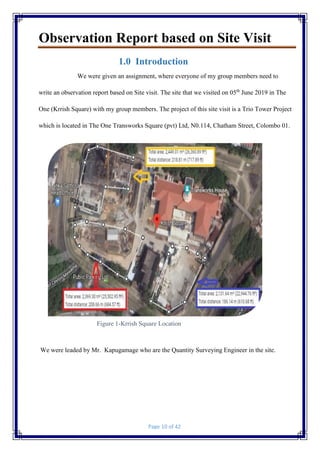
We were given an assignment, where everyone of my group members need to
write an observation report based on Site visit. The site that we visited on 05th
June 2019 in The
One (Krrish Square) with my group members. The project of this site visit is a Trio Tower Project
which is located in The One Transworks Square (pvt) Ltd, N0.114, Chatham Street, Colombo 01.
Figure 1-Krrish Square Location
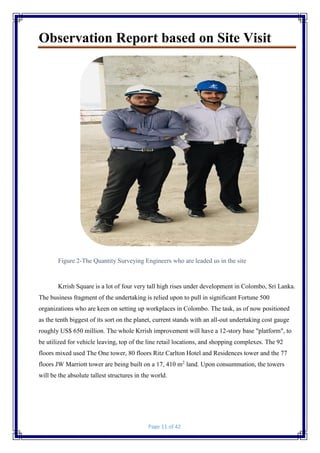
We were leaded by Mr. Kapugamage who are the Quantity Surveying Engineer in the site.
Observation Report based on Site Visit
Page 11 of 42
Figure 2-The Quantity Surveying Engineers who are leaded us in the site
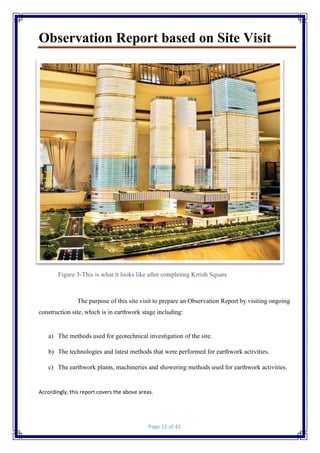
Krrish Square is a lot of four very tall high rises under development in Colombo, Sri Lanka.
The business fragment of the undertaking is relied upon to pull in significant Fortune 500
organizations who are keen on setting up workplaces in Colombo. The task, as of now positioned
as the tenth biggest of its sort on the planet, current stands with an all-out undertaking cost gauge
roughly US$ 650 million. The whole Krrish improvement will have a 12-story base "platform", to
be utilized for vehicle leaving, top of the line retail locations, and shopping complexes. The 92
floors mixed used The One tower, 80 floors Ritz Carlton Hotel and Residences tower and the 77
floors JW Marriott tower are being built on a 17, 410 m2
land. Upon consummation, the towers
will be the absolute tallest structures in the world.
Observation Report based on Site Visit
Page 12 of 42
Figure 3-This is what it looks like after completing Krrish Square
The purpose of this site visit to prepare an Observation Report by visiting ongoing
construction site, which is in earthwork stage including:
a) The methods used for geotechnical investigation of the site.
b) The technologies and latest methods that were performed for earthwork activities.
c) The earthwork plants, machineries and showering methods used for earthwork activities.
Accordingly, this report covers the above areas.
Observation Report based on Site Visit
Page 13 of 42
2.0 Site Description
The One – Krrish Square
2.1.Location
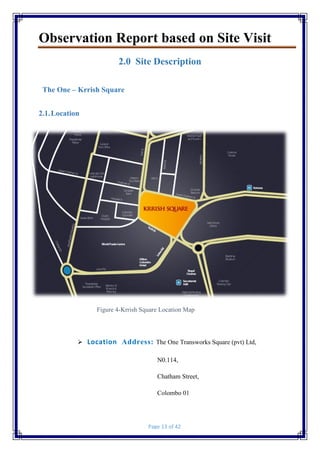
Figure 4-Krrish Square Location Map
 Location Address: The One Transworks Square (pvt) Ltd,
N0.114,
Chatham Street,
Colombo 01
Observation Report based on Site Visit
Page 14 of 42
2.2.Site Details
 Former Name: The One Trans works Square (pvt) Ltd
 Alternative Name: Krrish Square
 Type of Building: a Trio Tower project of three skyscrapers
 Location Address: The One Transworks Square (pvt) Ltd, N0.114, Chatham Street, Colombo
01
 Town or City: Colombo Fort
 Country: Sri Lanka
 Contract Estimate Cost: US$ 650 million
 Contract Period: 48 months
 Commencement Date: January 2017
 Completion Date:
 Tower A – 2021
 Tower B – 2022
 Tower C – 2023
 Completion Date: all towers end of 2025
 Client: Krrish Group
 Architect: China Construction Design International(CCDI)
 Contractor: Shougang Construction Group Co. Ltd
 Floor Count: 92, 80, 77
 Floor Area: 4, 500, 000 sqft
Figure 5-Shougang
Construction Group Co.
Ltd
Observation Report based on Site Visit
Page 15 of 42
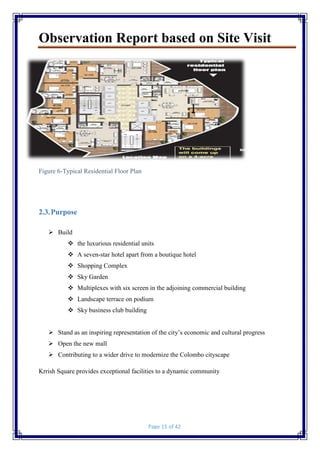
Figure 6-Typical Residential Floor Plan
2.3.Purpose
 Build
 the luxurious residential units
 A seven-star hotel apart from a boutique hotel
 Shopping Complex
 Sky Garden
 Multiplexes with six screen in the adjoining commercial building
 Landscape terrace on podium
 Sky business club building
 Stand as an inspiring representation of the city’s economic and cultural progress
 Open the new mall
 Contributing to a wider drive to modernize the Colombo cityscape
Krrish Square provides exceptional facilities to a dynamic community
Observation Report based on Site Visit
Page 16 of 42
3.0 Geotechnical Investigations
 The main purpose of Geotechnical investigation is to determine the type of foundation required
for the proposed task at the site. The foundation types are Shallow foundation and Deep
foundation. To make suggestions in regards to the safe bearing capacity or pile load capacity.
At last, the subsoil gives a definitive support to the structures (KM, 2014).
 Geotechnical investigation have the three main component.
 Planning
 Execution
 Report Writing
 The Geotechnical report include the following points.
 Description of Site conditions (Topographic features, hydraulic
conditions, existing structure etc.)
 Description of proposed construction (nature, type, loading
arrangement etc.)
 Field Activities description
 Lab Activities description
 Analysis and discussion of data collected
 Preparation of charts, tables, graphs etc.
 Calculation performed
 Conclusions and Recommendations
(Irfan, 2018)
3.1.Soil Investigation
 Soil investigation, also called geotechnical investigation.
 It represents to a technique for deciding physical properties of soil at a building site.
 This method is finished with the point of building up whether soil is safe and strong for
construction.
 Not until the soil samples are investigated can a construction project start.
Observation Report based on Site Visit
Page 17 of 42
 Accordingly, the result of site investigation report after engineers know the type of foundation,
nature of soil and the ground water level.
 Then the engineers decide the type of foundation, technologies and possible problems and
solutions for the building.
(Nieves, 2017)
3.1.1 Methods of Soil Investigation
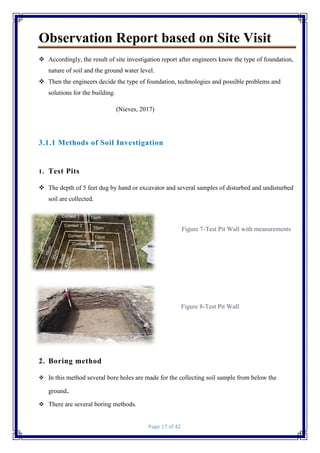
1. Test Pits
 The depth of 5 feet dug by hand or excavator and several samples of disturbed and undisturbed
soil are collected.
Figure 7-Test Pit Wall with measurements
Figure 8-Test Pit Wall
2. Boring method
 In this method several bore holes are made for the collecting soil sample from below the
ground.
 There are several boring methods.
Observation Report based on Site Visit
Page 18 of 42
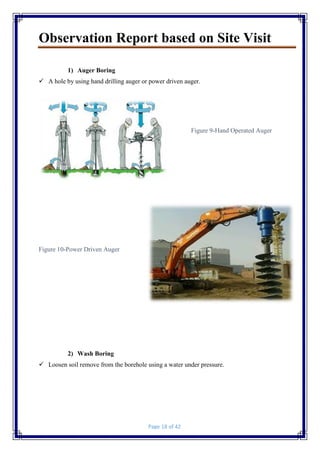
1) Auger Boring
 A hole by using hand drilling auger or power driven auger.
Figure 9-Hand Operated Auger
Figure 10-Power Driven Auger
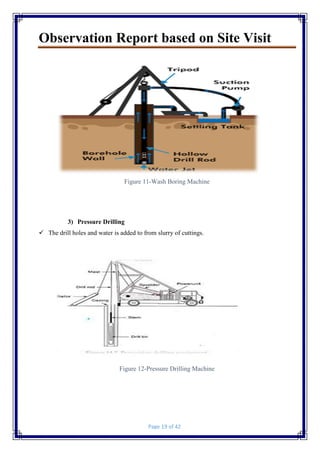
2) Wash Boring
 Loosen soil remove from the borehole using a water under pressure.
Observation Report based on Site Visit
Page 19 of 42
Figure 11-Wash Boring Machine
3) Pressure Drilling
 The drill holes and water is added to from slurry of cuttings.
Figure 12-Pressure Drilling Machine
Observation Report based on Site Visit
Page 20 of 42
3. Probing
 A 25mm or 40mm steel bar is driven into the ground using the hammer.
4. Inspection
 The enough data about neighbor building to design the foundation of the building by inspecting
the plot.
(Biswas, 2018)
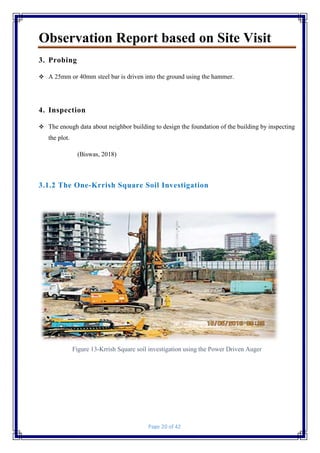
3.1.2 The One-Krrish Square Soil Investigation
Figure 13-Krrish Square soil investigation using the Power Driven Auger
Observation Report based on Site Visit
Page 21 of 42
Figure 14-Krrish Square soil investigation using the Wash Boring machine
Figure 15-Krrish Square soil investigation using the Pressure Drilling machine
Observation Report based on Site Visit
Page 22 of 42
 Accordingly, this soil investigation results, the engineers found the following facts.
 Where to build the Tower C, the Bedrock is more underneath than Tower A and B
 Choose the foundation types according this soil investigation as:
 Tower A –Raft Foundation
 Tower B – Raft Foundation
 Tower C – Pile Foundation
These foundation types selected because nature of soil.
 The ground water level appear the 2nd
basement in Tower A and Tower B.
 Where to build the Tower C, that place has poor soil.
(QS Engineers discussions)
3.2. Other Investigations
 The One-Krrish Square engineers do the following investigations.
 Always check for damage to the road
 Check the temperature
Figure 16-Temperature, Weather
and Frequency Testing Machine
 Constantly investigate and considering the quality of piles
 Compute the temperature and vibration in the site
Observation Report based on Site Visit
Page 23 of 42
4.0 Technologies & Methods of Earthwork Activities
4.1. Excavation
 Excavation is a part of earth work activities.
 Earth activities mean excavation and backfilling. And also, levelling, compacting and etc.
 Excavation is an early stage in building construction.
 Excavation means to loosen and takeout soil leaving space above or below ground.
 The 2 types of excavation.
1. Deep Excavation
2. Shallow Excavation
 There are several facts important for the excavation. Such as:
1. Nature of subsoil
2. Size of excavation
3. Ground Water Condition…..
 In Krrish Square site is excavated the 10m-12m from the top ground level.
Figure 17-First excavation part of Krrish Square
 Excavate between 10m to 12m the bedrock can be fined in Krrish Square.
Observation Report based on Site Visit
Page 24 of 42
 In the excavation a powered rock over bedrock. Then they first drilling rock and put chemical
and blast it chemically. That the using method is called the chemical method.
 Tower A and B used the raft foundation, so their excavation is large.
 Nowadays (05 June 2019) excavation part is doing for the Tower B.
Figure 18-Excavation area of
Tower B on 05th
June 2019
Figure 19-Tower B excavation on 05th
June 2019
Observation Report based on Site Visit
Page 25 of 42
 Where the tower B built, that place bedrock was drilling because the Tower B used the raft
foundation.
Figure 20-Drilling Bedrock
 Tower C excavation part not start until on 05th
June 2019. Then the existing Concrete Batching
Plant should be moved to another location in the place.
Figure 21-The area where Tower C is to be built
Observation Report based on Site Visit
Page 26 of 42
 But the site of Krrish Square used both methods of Sump Pumping method and well-point
method. The sump pumping method is used to draw water above water level. If you dug a well
and drew water, you would use a well point method. But both methods use the same
equipment. It's called sump pump. QS Engineers said the ground water level increased in the
early days. Then they are used the well-point system to remove water in the basement.
Figure 22-Sump Pump used in Krrish
Square
Figure 23-Sump Pumping
method used in Krrish Square
Observation Report based on Site Visit
Page 27 of 42
4.2. Foundation Methods
 Foundations provide help for structures, moving their heap to layers of soil or rock that have
adequate bearing limit and appropriate settlement attributes to help them.
 Foundation types depend on some facts. Such as:
 The nature of the load requiring support
 Ground Conditions
 Space availability
 Accessibility
 Sensitivity to noise and vibration
(Anon., 2019)
 There are 2 types of foundation.
1. Deep Foundation
 The deep foundation depth more than width.
 The 2 type of deep foundation.
1) End Bearing
2) Friction
2. Shallow Foundation
 The shallow foundation depth less than width.
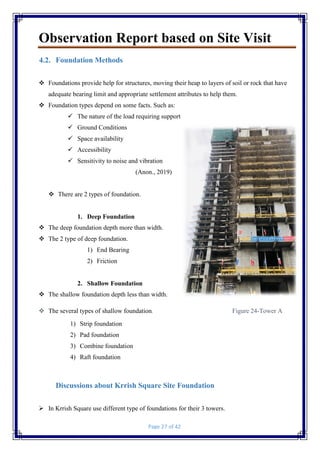
 The several types of shallow foundation. Figure 24-Tower A
1) Strip foundation
2) Pad foundation
3) Combine foundation
4) Raft foundation
Discussions about Krrish Square Site Foundation
 In Krrish Square use different type of foundations for their 3 towers.
Observation Report based on Site Visit
Page 28 of 42
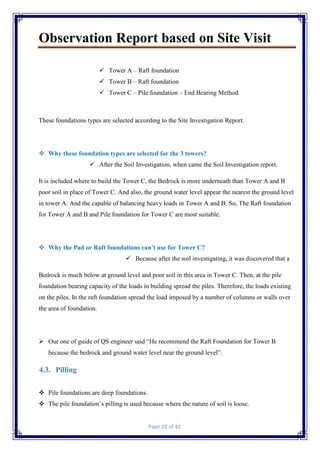
 Tower A – Raft foundation
 Tower B – Raft foundation
 Tower C – Pile foundation – End Bearing Method
These foundations types are selected according to the Site Investigation Report.
 Why these foundation types are selected for the 3 towers?
 After the Soil Investigation, when came the Soil Investigation report.
It is included where to build the Tower C, the Bedrock is more underneath than Tower A and B
poor soil in place of Tower C. And also, the ground water level appear the nearest the ground level
in tower A. And the capable of balancing heavy loads in Tower A and B. So, The Raft foundation
for Tower A and B and Pile foundation for Tower C are most suitable.
 Why the Pad or Raft foundations can’t use for Tower C?
 Because after the soil investigating, it was discovered that a
Bedrock is much below at ground level and poor soil in this area in Tower C. Then, at the pile
foundation bearing capacity of the loads in building spread the piles. Therefore, the loads existing
on the piles. In the raft foundation spread the load imposed by a number of columns or walls over
the area of foundation.
 Our one of guide of QS engineer said “He recommend the Raft Foundation for Tower B
because the bedrock and ground water level near the ground level”.
4.3. Pilling
 Pile foundations are deep foundations.
 The pile foundation’s pilling is used because where the nature of soil is loose.
Observation Report based on Site Visit
Page 29 of 42
 Secant pile walls are constructed by reinforced concrete piles.
 There are 2 types of secant piles.
1. Male Piles
2. Female Piles
 Male piles used the reinforcements but the female piles not used the reinforcements.
Figure 25-Format of Secant Pile
Figure 26-Pile Driver Hammer
Observation Report based on Site Visit
Page 30 of 42
 In the Krrish Square used these secant piles.
Figure 27-Secant Piles use in Krrish Square
 In these, male pile is between the 2 female piles.
 Firstly, female piles are installed.
 The male pile used the concrete with reinforcements. But the female pile used only concrete
and no reinforcements.
 They used the soil nailing system to safe the pile. Then this will protect the pilling wall from
collapsing. The pilling wall built the combination of male & female piles. The nail is anchor to
the female pile.
 Make a retaining wall after the pilling wall.
4.4. Water Proofing
 The water proofing’s protect the structure from possibility of water leaking, rain and moisture.
 Waterproofing is the process of making an item or structure waterproof or water-resistant.
Observation Report based on Site Visit
Page 31 of 42
 The water proofing use the surface of foundation, roof, walls and etc.
 Commonly used materials of water proofing is cementitious, bituminous, liquid water proofing
membrane and polyurethane water proofing membrane.
 The water proofing materials such as: rubber, PVC, polyurethane, silicone elastomer etc.
Figure 28-Bituminous Membrane Water Proofing method
 In Krrish Square used the water proofing drain mat between the pilling wall and retaining wall.
Figure 29-Water Proofing Mat use in Krrish Square. It show the black color
Observation Report based on Site Visit
Page 32 of 42
4.5. Special Methods they used when they are constructing
Injection Anchor System
 Soil Investigation shows the soil condition is different. The Ground Anchor system is used for
the Injection Anchor System. There is no point in having anchors because there is a loose
soil. That’s why the Injection Anchors System used. The materials of the injection anchor
system, cement and water are inject with high pressure. These materials are called high
strength grout because they mix with cement, water and a mesh and inject a high pressure. In
Krrish Square used cables in soil nailing system to protect the pilling wall. Because of the
strength of the soil is high on either side of the entrance, the Shot Crete system is used.
Figure 30-Shotcrete
System in Krrish Square
H-iron (H-Bars)
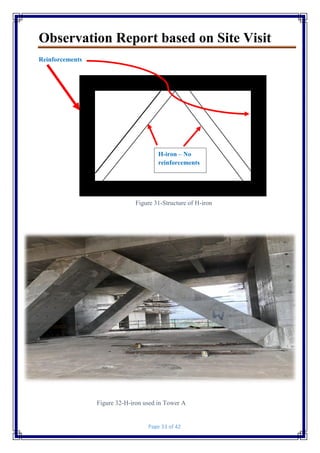
 Krrish Square Tower A used a special technique method called H-iron (H-Bars). H-iron is
used to balance heavy loads. The loads on the top floors are so heavy that the slab can't
handle the weight. H-iron has been used to reduce the chance of collapse. The weight of the
H-iron extends along the angle. H-iron is only in one place of the structure. The H-iron of
the reinforcements are the most powerful. H-irons used the 250 strength concrete.
Observation Report based on Site Visit
Page 33 of 42
Reinforcements
Figure 31-Structure of H-iron
Figure 32-H-iron used in Tower A
H-iron – No
reinforcements
Observation Report based on Site Visit
Page 34 of 42
5.0 Machines
 Earth-moving plant is usually utilized on building destinations to move and place excavated
soil. Before starting earth-moving works, there must be an arrangement for the measure of
material that should be moved just as where it will be moved to.
 The earthwork plant will depend on:
 The quantity of materials to be moved
 The type and condition of the soil and the site
 The distance to be moved
 The speed and turn-around time required
 The size of the excavating bucket
 There are several types of earthwork plants. Such as:
 Face Shovel Excavators
 Backactors
 Bulldozers
 Loading Shovel
 Clamshell Excavators
 Power Shovel Drill
 Concrete mixtures
 Cranes etc.
 In Krrish Square used the following machines in these days(05 June 2019).
5.1 Face Shovel Excavators
This machine is fitted U bucket shape.
This is used for loosing, excavating vertical
Soil above the machine base level and not
suitable for below ground excavation.
Figure 33-Face Shovel Excavators
Observation Report based on Site Visit
Page 35 of 42
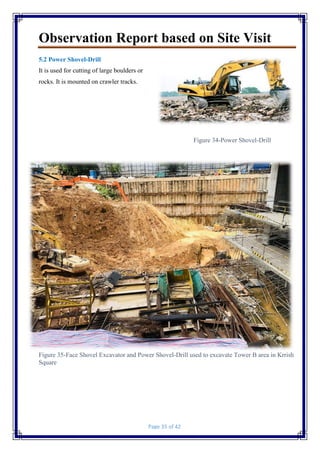
5.2 Power Shovel-Drill
It is used for cutting of large boulders or
rocks. It is mounted on crawler tracks.
Figure 34-Power Shovel-Drill
Figure 35-Face Shovel Excavator and Power Shovel-Drill used to excavate Tower B area in Krrish
Square
Observation Report based on Site Visit
Page 36 of 42
5.3 Concrete Batching Plant
The Concrete Batching Plant is used to manufacture concrete. Its ingredients are cement, sand,
aggregates, water and admixtures. The One has one of the largest batching plant in Sri Lanka. It
work speed is 180m3
/hr.
Figure 36-The Concrete Batching Plant
Figure 37-The Concrete Batching Plant in Krrish Square
Observation Report based on Site Visit
Page 37 of 42
5.4 Crane
Figure 38-Crane
The crane machines is used for lifting heavy goods and transporting them to other place.
Figure 39-The Crane and Concrete Pumping machine used in Krrish Square
5.5 Concrete Pumping Machine
When you put the concrete into the Concrete Pumping machine, it works by applying air
compressure. When a concrete is pumped up, a bucket underneath it will save 0.5mcub
Observation Report based on Site Visit
Page 38 of 42
Concrete. When the concrete pumping machine stops working, the concrete in the pump pipe
falls into the bucket. The concrete is then used for another concrete work.
Figure 40-Concrete Pumping Machine used in Krrish Square
5.6 Pile Driver Hammer
The Pile Driver Hammer is used to drive
piles into soil. These piles provide
foundation support for the structure.
Figure 41-Pile Driver Hammer
Observation Report based on Site Visit
Page 39 of 42
Conclusion
Site visit is real great opportunity for a student like me who to understand, get
experiences and gain the knowledge in the construction industry. This site visit gave me a chance
to experience and learn what can’t gained lectures or tutorials. Firstly, I learnt about the safety is
most important point in the site. Entrance gave us a visitors pass when we entered the site.
Figure 42-Visitor Pass in Krrish Square Site
Through this site visit I understood about the construction process, the construction
equipment and the work they do, Construction technologies, latest methods and the methods using
when they are constructing, foundation types, different type of building materials used in
construction, how we safe in the construction site and the communication of team work between
members.
Finally, I would like to thank our lecturer of Mr. Sathushka Heshan, our guide of Mr.
Kapugamage in site visit and to everyone who found this site for giving us this great opportunity to visit an
ongoing construction site. And also, I think this site visit benefits a lot on my subject and for my future as it
prepare me to overcome many upcoming problems. In overall, it was a great experience for me.
Observation Report based on Site Visit
Page 40 of 42
Figure 43-Our Team of Site Visit with our Guides
Group Members: Sachith Wicramasingha-Group Leader
Kavinda Udesh
Janith Dilshan
Subash Wimukthi
Yasisuru Adikari
Sanduli Devini
Sachini Nimesha
Observation Report based on Site Visit
Page 41 of 42
References
 Anon., 2019. Designing Buildings Wiki. [Online]
Available at: https://www.designingbuildings.co.uk/wiki/Building_foundations
[Accessed 02 05 2019].
 Biswas, L., 2018. A CIVIL ENGINEER. [Online]
Available at: https://www.acivilengineer.com/soil-investigation-basic/
[Accessed 06 03 2018].
 Irfan, D. M., 2018. SlideShare. [Online]
Available at: https://www.slideshare.net/1mirfan/geotechnical-engineeringi-lec-28-soil-
exploration?qid=20e795ba-e015-45a1-b8c5-9ddea7e39062&v=&b=&from_search=6
[Accessed 24 09 2018].
 KM, S., 2014. SlideShare. [Online]
Available at: https://www.slideshare.net/shamjithkeyem/site-inveswtigation-vandana-
miss?qid=20e795ba-e015-45a1-b8c5-9ddea7e39062&v=&b=&from_search=15
[Accessed 06 08 2014].
 Nieves, M., 2017. WorldBuild. [Online]
Available at: https://www.worldbuild365.com/blog/soil-investigation-what-is-it-and-why-is-it-
important-for-your-building-project-Bi1R4q
[Accessed 08 08 2017].
Observation Report based on Site Visit
Page 42 of 42

Observation site report

  • 1.
    Observation Report basedon Site Visit Page 3 of 42 Site Visit K R R I S H S Q U A R E
  • 2.
    Observation Report basedon Site Visit Page 4 of 42 ACKNOWLEDGEMENT I take the opportunity to offer sincere heart felt, everlasting gratitude to my Guide Mr. Sathushka Heshan lecture in Civil Engineering Construction Technology for her valuable suggestions & kind support in completion of this Report in very successful manner. And also, I would like to thank the chief engineer in “The One” site & all other people who helped to make this work possible. And also, I would like to thank you for the authors who wrote the references for writing this report and everyone who published the information. Finally, I wish to special thank my parents & friends of Sachith & Kavinda for their kind support & encouragement throughout completion of this report.
  • 3.
    Observation Report basedon Site Visit Page 5 of 42 Table of Contents Summary..............................................................................................................................09 1.0 Introduction......................................................................................................................... 10 2.0 Site Description ................................................................................................................... 13 2.1. Location............................................................................................................................ 13 2.2. Purpose............................................................................................................................. 15 2.3. Site Details........................................................................................................................ 14 3.0 Geotechnical Investigations................................................................................................ 16 3.1. Soil Investigation ............................................................................................................. 16 3.1.1 Method of Soil Investigation ...................................................................................16 3.1.2 The One-Krrish Square Soil Investigation............................................................20 3.2. Other Investigations........................................................................................................ 22 4.0 Technologies & Methods of Earthwork Activities........................................................... 23 4.1. Excavation........................................................................................................................ 23 4.2. Foundation Methods ....................................................................................................... 27 Discussions about Krrish Square Site Foundation .........................................................27 4.3. Pilling................................................................................................................................ 28 4.4. Water Proofing................................................................................................................ 30 4.5. Special Methods they used when they are constructing .............................................. 32 5.0 Machines.............................................................................................................................. 34 5.1 Face Shovel Excavators ....................................................................................................... 34 5.2 Power Shovel-Drill ..................................................................Error! Bookmark not defined.5 5.3 Concrete Batching Plant.........................................................Error! Bookmark not defined.6 5.4 Crane ..................................................................................................................................... 37
  • 4.
    Observation Report basedon Site Visit Page 6 of 42 5.5 Concrete Pumping Machine...................................................Error! Bookmark not defined.8 5.10 Pile Driver Hammer............................................................................................................ 8 Conclusion ..........................................................................................................................39 References...........................................................................................................................41
  • 5.
    Observation Report basedon Site Visit Page 7 of 42 Table of Figures Figure 1-Krrish Square Location................................................................................................. 10 Figure 2-The Quantity Surveying Engineers who are leaded us in the site ............................. 11 Figure 3-This is what it looks like after completing Krrish Square.......................................... 12 Figure 4-Krrish Square Location Map........................................................................................ 13 Figure 5-Shougang Construction Group Co. Ltd....................................................................... 14 Figure 6-Typical Residential Floor Plan...................................................................................... 15 Figure 7-Test Pit Wall with measurements ................................................................................. 17 Figure 8-Test Pit Wall ................................................................................................................... 17 Figure 9-Hand Operated Auger ................................................................................................... 18 Figure 10-Power Driven Auger..................................................................................................... 18 Figure 11-Wash Boring Machine ................................................................................................. 19 Figure 12-Pressure Drilling Machine........................................................................................... 19 Figure 13-Krrish Square soil investigation using the Power Driven Auger............................. 20 Figure 14-Krrish Square soil investigation using the Wash Boring machine ......................... 21 Figure 15-Krrish Square soil investigation using the Pressure Drilling machine ................... 21 Figure 16-Temperature, Weather and Frequency Testing Machine ........................................ 22 Figure 17-First excavation part of Krrish Square...................................................................... 23 Figure 18-Excavation area of Tower B on 05th June 2019 ......................................................... 24 Figure 19-Tower B excavation on 05th June 2019....................................................................... 24 Figure 20-Drilling Bedrock ........................................................................................................... 25 Figure 21-The area where Tower C is to be built ....................................................................... 25 Figure 22-Sump Pump used in Krrish Square............................................................................ 26 Figure 23-Sump Pumping method used in Krrish Square......................................................... 26 Figure 24-Tower A......................................................................................................................... 27 Figure 25-Format of Secant Pile................................................................................................... 29 Figure 26-Pile Driver Hammer..................................................................................................... 29 Figure 27-Secant Piles use in Krrish Square............................................................................... 30 Figure 28-Bituminous Membrane Water Proofing method....................................................... 31 Figure 29-Water Proofing Mat use in Krrish Square. It show the black color ....................... 31
  • 6.
    Observation Report basedon Site Visit Page 8 of 42 Figure 30-Shotcrete System in Krrish Square ............................................................................ 32 Figure 31-Structure of H-iron....................................................................................................... 33 Figure 32-H-iron used in Tower A ............................................................................................... 33 Figure 33-Face Shovel Excavators ............................................................................................... 34 Figure 34-Power Shovel-Drill ....................................................................................................... 35 Figure 35-Face Shovel Excavator and Power Shovel-Drill used to excavate Tower B area in Krrish Square................................................................................................................................. 35 Figure 36-The Concrete Batching Plant ...................................................................................... 36 Figure 37-The Concrete Batching Plant in Krrish Square ........................................................ 36 Figure 38-Crane ............................................................................................................................. 37 Figure 39-The Crane and Concrete Pumping machine used in Krrish Square....................... 37 Figure 40-Concrete Pumping Machine used in Krrish Square................................................. 38 Figure 41-Pile Driver Hammer..................................................................................................... 38 Figure 42-Visitor Pass in Krrish Square Site.............................................................................. 39 Figure 43-Our Team of Site Visit with our Guides..................................................................... 40
  • 7.
    Observation Report basedon Site Visit Page 9 of 42 Summary According to this ongoing site observation on Krrish Square in Colombo 01, it is a trio tower project. The 3 towers introduce as the Tower A, B and C. The Tower A & B used the raft foundation and the Tower C use the pile foundation because nature of soil is poor and the bedrock is much below at ground level in area of tower C according to the soil investigation. The ground water level appear the 2nd basement in Tower A and Tower B. Excavate between 10m to 12m the bedrock can be fined in Krrish Square. Nowadays, the excavation part is doing for Tower B. In Krrish Square used the water proofing mat between the pilling wall and retaining wall. The technologies used as H irons, Secant piles walls, used the method of well-point system and deep-bored wells, nailing system, injection anchors and etc. And also, the machines used as concrete pumping machine, backhoe, bulldozers, pile driver hammers, cranes, power driven auger, wash boring machine, pressure drilling machines and etc.
  • 8.
    Observation Report basedon Site Visit Page 10 of 42 1.0 Introduction We were given an assignment, where everyone of my group members need to write an observation report based on Site visit. The site that we visited on 05th June 2019 in The One (Krrish Square) with my group members. The project of this site visit is a Trio Tower Project which is located in The One Transworks Square (pvt) Ltd, N0.114, Chatham Street, Colombo 01. Figure 1-Krrish Square Location We were leaded by Mr. Kapugamage who are the Quantity Surveying Engineer in the site.
  • 9.
    Observation Report basedon Site Visit Page 11 of 42 Figure 2-The Quantity Surveying Engineers who are leaded us in the site Krrish Square is a lot of four very tall high rises under development in Colombo, Sri Lanka. The business fragment of the undertaking is relied upon to pull in significant Fortune 500 organizations who are keen on setting up workplaces in Colombo. The task, as of now positioned as the tenth biggest of its sort on the planet, current stands with an all-out undertaking cost gauge roughly US$ 650 million. The whole Krrish improvement will have a 12-story base "platform", to be utilized for vehicle leaving, top of the line retail locations, and shopping complexes. The 92 floors mixed used The One tower, 80 floors Ritz Carlton Hotel and Residences tower and the 77 floors JW Marriott tower are being built on a 17, 410 m2 land. Upon consummation, the towers will be the absolute tallest structures in the world.
  • 10.
    Observation Report basedon Site Visit Page 12 of 42 Figure 3-This is what it looks like after completing Krrish Square The purpose of this site visit to prepare an Observation Report by visiting ongoing construction site, which is in earthwork stage including: a) The methods used for geotechnical investigation of the site. b) The technologies and latest methods that were performed for earthwork activities. c) The earthwork plants, machineries and showering methods used for earthwork activities. Accordingly, this report covers the above areas.
  • 11.
    Observation Report basedon Site Visit Page 13 of 42 2.0 Site Description The One – Krrish Square 2.1.Location Figure 4-Krrish Square Location Map  Location Address: The One Transworks Square (pvt) Ltd, N0.114, Chatham Street, Colombo 01
  • 12.
    Observation Report basedon Site Visit Page 14 of 42 2.2.Site Details  Former Name: The One Trans works Square (pvt) Ltd  Alternative Name: Krrish Square  Type of Building: a Trio Tower project of three skyscrapers  Location Address: The One Transworks Square (pvt) Ltd, N0.114, Chatham Street, Colombo 01  Town or City: Colombo Fort  Country: Sri Lanka  Contract Estimate Cost: US$ 650 million  Contract Period: 48 months  Commencement Date: January 2017  Completion Date:  Tower A – 2021  Tower B – 2022  Tower C – 2023  Completion Date: all towers end of 2025  Client: Krrish Group  Architect: China Construction Design International(CCDI)  Contractor: Shougang Construction Group Co. Ltd  Floor Count: 92, 80, 77  Floor Area: 4, 500, 000 sqft Figure 5-Shougang Construction Group Co. Ltd
  • 13.
    Observation Report basedon Site Visit Page 15 of 42 Figure 6-Typical Residential Floor Plan 2.3.Purpose  Build  the luxurious residential units  A seven-star hotel apart from a boutique hotel  Shopping Complex  Sky Garden  Multiplexes with six screen in the adjoining commercial building  Landscape terrace on podium  Sky business club building  Stand as an inspiring representation of the city’s economic and cultural progress  Open the new mall  Contributing to a wider drive to modernize the Colombo cityscape Krrish Square provides exceptional facilities to a dynamic community
  • 14.
    Observation Report basedon Site Visit Page 16 of 42 3.0 Geotechnical Investigations  The main purpose of Geotechnical investigation is to determine the type of foundation required for the proposed task at the site. The foundation types are Shallow foundation and Deep foundation. To make suggestions in regards to the safe bearing capacity or pile load capacity. At last, the subsoil gives a definitive support to the structures (KM, 2014).  Geotechnical investigation have the three main component.  Planning  Execution  Report Writing  The Geotechnical report include the following points.  Description of Site conditions (Topographic features, hydraulic conditions, existing structure etc.)  Description of proposed construction (nature, type, loading arrangement etc.)  Field Activities description  Lab Activities description  Analysis and discussion of data collected  Preparation of charts, tables, graphs etc.  Calculation performed  Conclusions and Recommendations (Irfan, 2018) 3.1.Soil Investigation  Soil investigation, also called geotechnical investigation.  It represents to a technique for deciding physical properties of soil at a building site.  This method is finished with the point of building up whether soil is safe and strong for construction.  Not until the soil samples are investigated can a construction project start.
  • 15.
    Observation Report basedon Site Visit Page 17 of 42  Accordingly, the result of site investigation report after engineers know the type of foundation, nature of soil and the ground water level.  Then the engineers decide the type of foundation, technologies and possible problems and solutions for the building. (Nieves, 2017) 3.1.1 Methods of Soil Investigation 1. Test Pits  The depth of 5 feet dug by hand or excavator and several samples of disturbed and undisturbed soil are collected. Figure 7-Test Pit Wall with measurements Figure 8-Test Pit Wall 2. Boring method  In this method several bore holes are made for the collecting soil sample from below the ground.  There are several boring methods.
  • 16.
    Observation Report basedon Site Visit Page 18 of 42 1) Auger Boring  A hole by using hand drilling auger or power driven auger. Figure 9-Hand Operated Auger Figure 10-Power Driven Auger 2) Wash Boring  Loosen soil remove from the borehole using a water under pressure.
  • 17.
    Observation Report basedon Site Visit Page 19 of 42 Figure 11-Wash Boring Machine 3) Pressure Drilling  The drill holes and water is added to from slurry of cuttings. Figure 12-Pressure Drilling Machine
  • 18.
    Observation Report basedon Site Visit Page 20 of 42 3. Probing  A 25mm or 40mm steel bar is driven into the ground using the hammer. 4. Inspection  The enough data about neighbor building to design the foundation of the building by inspecting the plot. (Biswas, 2018) 3.1.2 The One-Krrish Square Soil Investigation Figure 13-Krrish Square soil investigation using the Power Driven Auger
  • 19.
    Observation Report basedon Site Visit Page 21 of 42 Figure 14-Krrish Square soil investigation using the Wash Boring machine Figure 15-Krrish Square soil investigation using the Pressure Drilling machine
  • 20.
    Observation Report basedon Site Visit Page 22 of 42  Accordingly, this soil investigation results, the engineers found the following facts.  Where to build the Tower C, the Bedrock is more underneath than Tower A and B  Choose the foundation types according this soil investigation as:  Tower A –Raft Foundation  Tower B – Raft Foundation  Tower C – Pile Foundation These foundation types selected because nature of soil.  The ground water level appear the 2nd basement in Tower A and Tower B.  Where to build the Tower C, that place has poor soil. (QS Engineers discussions) 3.2. Other Investigations  The One-Krrish Square engineers do the following investigations.  Always check for damage to the road  Check the temperature Figure 16-Temperature, Weather and Frequency Testing Machine  Constantly investigate and considering the quality of piles  Compute the temperature and vibration in the site
  • 21.
    Observation Report basedon Site Visit Page 23 of 42 4.0 Technologies & Methods of Earthwork Activities 4.1. Excavation  Excavation is a part of earth work activities.  Earth activities mean excavation and backfilling. And also, levelling, compacting and etc.  Excavation is an early stage in building construction.  Excavation means to loosen and takeout soil leaving space above or below ground.  The 2 types of excavation. 1. Deep Excavation 2. Shallow Excavation  There are several facts important for the excavation. Such as: 1. Nature of subsoil 2. Size of excavation 3. Ground Water Condition…..  In Krrish Square site is excavated the 10m-12m from the top ground level. Figure 17-First excavation part of Krrish Square  Excavate between 10m to 12m the bedrock can be fined in Krrish Square.
  • 22.
    Observation Report basedon Site Visit Page 24 of 42  In the excavation a powered rock over bedrock. Then they first drilling rock and put chemical and blast it chemically. That the using method is called the chemical method.  Tower A and B used the raft foundation, so their excavation is large.  Nowadays (05 June 2019) excavation part is doing for the Tower B. Figure 18-Excavation area of Tower B on 05th June 2019 Figure 19-Tower B excavation on 05th June 2019
  • 23.
    Observation Report basedon Site Visit Page 25 of 42  Where the tower B built, that place bedrock was drilling because the Tower B used the raft foundation. Figure 20-Drilling Bedrock  Tower C excavation part not start until on 05th June 2019. Then the existing Concrete Batching Plant should be moved to another location in the place. Figure 21-The area where Tower C is to be built
  • 24.
    Observation Report basedon Site Visit Page 26 of 42  But the site of Krrish Square used both methods of Sump Pumping method and well-point method. The sump pumping method is used to draw water above water level. If you dug a well and drew water, you would use a well point method. But both methods use the same equipment. It's called sump pump. QS Engineers said the ground water level increased in the early days. Then they are used the well-point system to remove water in the basement. Figure 22-Sump Pump used in Krrish Square Figure 23-Sump Pumping method used in Krrish Square
  • 25.
    Observation Report basedon Site Visit Page 27 of 42 4.2. Foundation Methods  Foundations provide help for structures, moving their heap to layers of soil or rock that have adequate bearing limit and appropriate settlement attributes to help them.  Foundation types depend on some facts. Such as:  The nature of the load requiring support  Ground Conditions  Space availability  Accessibility  Sensitivity to noise and vibration (Anon., 2019)  There are 2 types of foundation. 1. Deep Foundation  The deep foundation depth more than width.  The 2 type of deep foundation. 1) End Bearing 2) Friction 2. Shallow Foundation  The shallow foundation depth less than width.  The several types of shallow foundation. Figure 24-Tower A 1) Strip foundation 2) Pad foundation 3) Combine foundation 4) Raft foundation Discussions about Krrish Square Site Foundation  In Krrish Square use different type of foundations for their 3 towers.
  • 26.
    Observation Report basedon Site Visit Page 28 of 42  Tower A – Raft foundation  Tower B – Raft foundation  Tower C – Pile foundation – End Bearing Method These foundations types are selected according to the Site Investigation Report.  Why these foundation types are selected for the 3 towers?  After the Soil Investigation, when came the Soil Investigation report. It is included where to build the Tower C, the Bedrock is more underneath than Tower A and B poor soil in place of Tower C. And also, the ground water level appear the nearest the ground level in tower A. And the capable of balancing heavy loads in Tower A and B. So, The Raft foundation for Tower A and B and Pile foundation for Tower C are most suitable.  Why the Pad or Raft foundations can’t use for Tower C?  Because after the soil investigating, it was discovered that a Bedrock is much below at ground level and poor soil in this area in Tower C. Then, at the pile foundation bearing capacity of the loads in building spread the piles. Therefore, the loads existing on the piles. In the raft foundation spread the load imposed by a number of columns or walls over the area of foundation.  Our one of guide of QS engineer said “He recommend the Raft Foundation for Tower B because the bedrock and ground water level near the ground level”. 4.3. Pilling  Pile foundations are deep foundations.  The pile foundation’s pilling is used because where the nature of soil is loose.
  • 27.
    Observation Report basedon Site Visit Page 29 of 42  Secant pile walls are constructed by reinforced concrete piles.  There are 2 types of secant piles. 1. Male Piles 2. Female Piles  Male piles used the reinforcements but the female piles not used the reinforcements. Figure 25-Format of Secant Pile Figure 26-Pile Driver Hammer
  • 28.
    Observation Report basedon Site Visit Page 30 of 42  In the Krrish Square used these secant piles. Figure 27-Secant Piles use in Krrish Square  In these, male pile is between the 2 female piles.  Firstly, female piles are installed.  The male pile used the concrete with reinforcements. But the female pile used only concrete and no reinforcements.  They used the soil nailing system to safe the pile. Then this will protect the pilling wall from collapsing. The pilling wall built the combination of male & female piles. The nail is anchor to the female pile.  Make a retaining wall after the pilling wall. 4.4. Water Proofing  The water proofing’s protect the structure from possibility of water leaking, rain and moisture.  Waterproofing is the process of making an item or structure waterproof or water-resistant.
  • 29.
    Observation Report basedon Site Visit Page 31 of 42  The water proofing use the surface of foundation, roof, walls and etc.  Commonly used materials of water proofing is cementitious, bituminous, liquid water proofing membrane and polyurethane water proofing membrane.  The water proofing materials such as: rubber, PVC, polyurethane, silicone elastomer etc. Figure 28-Bituminous Membrane Water Proofing method  In Krrish Square used the water proofing drain mat between the pilling wall and retaining wall. Figure 29-Water Proofing Mat use in Krrish Square. It show the black color
  • 30.
    Observation Report basedon Site Visit Page 32 of 42 4.5. Special Methods they used when they are constructing Injection Anchor System  Soil Investigation shows the soil condition is different. The Ground Anchor system is used for the Injection Anchor System. There is no point in having anchors because there is a loose soil. That’s why the Injection Anchors System used. The materials of the injection anchor system, cement and water are inject with high pressure. These materials are called high strength grout because they mix with cement, water and a mesh and inject a high pressure. In Krrish Square used cables in soil nailing system to protect the pilling wall. Because of the strength of the soil is high on either side of the entrance, the Shot Crete system is used. Figure 30-Shotcrete System in Krrish Square H-iron (H-Bars)  Krrish Square Tower A used a special technique method called H-iron (H-Bars). H-iron is used to balance heavy loads. The loads on the top floors are so heavy that the slab can't handle the weight. H-iron has been used to reduce the chance of collapse. The weight of the H-iron extends along the angle. H-iron is only in one place of the structure. The H-iron of the reinforcements are the most powerful. H-irons used the 250 strength concrete.
  • 31.
    Observation Report basedon Site Visit Page 33 of 42 Reinforcements Figure 31-Structure of H-iron Figure 32-H-iron used in Tower A H-iron – No reinforcements
  • 32.
    Observation Report basedon Site Visit Page 34 of 42 5.0 Machines  Earth-moving plant is usually utilized on building destinations to move and place excavated soil. Before starting earth-moving works, there must be an arrangement for the measure of material that should be moved just as where it will be moved to.  The earthwork plant will depend on:  The quantity of materials to be moved  The type and condition of the soil and the site  The distance to be moved  The speed and turn-around time required  The size of the excavating bucket  There are several types of earthwork plants. Such as:  Face Shovel Excavators  Backactors  Bulldozers  Loading Shovel  Clamshell Excavators  Power Shovel Drill  Concrete mixtures  Cranes etc.  In Krrish Square used the following machines in these days(05 June 2019). 5.1 Face Shovel Excavators This machine is fitted U bucket shape. This is used for loosing, excavating vertical Soil above the machine base level and not suitable for below ground excavation. Figure 33-Face Shovel Excavators
  • 33.
    Observation Report basedon Site Visit Page 35 of 42 5.2 Power Shovel-Drill It is used for cutting of large boulders or rocks. It is mounted on crawler tracks. Figure 34-Power Shovel-Drill Figure 35-Face Shovel Excavator and Power Shovel-Drill used to excavate Tower B area in Krrish Square
  • 34.
    Observation Report basedon Site Visit Page 36 of 42 5.3 Concrete Batching Plant The Concrete Batching Plant is used to manufacture concrete. Its ingredients are cement, sand, aggregates, water and admixtures. The One has one of the largest batching plant in Sri Lanka. It work speed is 180m3 /hr. Figure 36-The Concrete Batching Plant Figure 37-The Concrete Batching Plant in Krrish Square
  • 35.
    Observation Report basedon Site Visit Page 37 of 42 5.4 Crane Figure 38-Crane The crane machines is used for lifting heavy goods and transporting them to other place. Figure 39-The Crane and Concrete Pumping machine used in Krrish Square 5.5 Concrete Pumping Machine When you put the concrete into the Concrete Pumping machine, it works by applying air compressure. When a concrete is pumped up, a bucket underneath it will save 0.5mcub
  • 36.
    Observation Report basedon Site Visit Page 38 of 42 Concrete. When the concrete pumping machine stops working, the concrete in the pump pipe falls into the bucket. The concrete is then used for another concrete work. Figure 40-Concrete Pumping Machine used in Krrish Square 5.6 Pile Driver Hammer The Pile Driver Hammer is used to drive piles into soil. These piles provide foundation support for the structure. Figure 41-Pile Driver Hammer
  • 37.
    Observation Report basedon Site Visit Page 39 of 42 Conclusion Site visit is real great opportunity for a student like me who to understand, get experiences and gain the knowledge in the construction industry. This site visit gave me a chance to experience and learn what can’t gained lectures or tutorials. Firstly, I learnt about the safety is most important point in the site. Entrance gave us a visitors pass when we entered the site. Figure 42-Visitor Pass in Krrish Square Site Through this site visit I understood about the construction process, the construction equipment and the work they do, Construction technologies, latest methods and the methods using when they are constructing, foundation types, different type of building materials used in construction, how we safe in the construction site and the communication of team work between members. Finally, I would like to thank our lecturer of Mr. Sathushka Heshan, our guide of Mr. Kapugamage in site visit and to everyone who found this site for giving us this great opportunity to visit an ongoing construction site. And also, I think this site visit benefits a lot on my subject and for my future as it prepare me to overcome many upcoming problems. In overall, it was a great experience for me.
  • 38.
    Observation Report basedon Site Visit Page 40 of 42 Figure 43-Our Team of Site Visit with our Guides Group Members: Sachith Wicramasingha-Group Leader Kavinda Udesh Janith Dilshan Subash Wimukthi Yasisuru Adikari Sanduli Devini Sachini Nimesha
  • 39.
    Observation Report basedon Site Visit Page 41 of 42 References  Anon., 2019. Designing Buildings Wiki. [Online] Available at: https://www.designingbuildings.co.uk/wiki/Building_foundations [Accessed 02 05 2019].  Biswas, L., 2018. A CIVIL ENGINEER. [Online] Available at: https://www.acivilengineer.com/soil-investigation-basic/ [Accessed 06 03 2018].  Irfan, D. M., 2018. SlideShare. [Online] Available at: https://www.slideshare.net/1mirfan/geotechnical-engineeringi-lec-28-soil- exploration?qid=20e795ba-e015-45a1-b8c5-9ddea7e39062&v=&b=&from_search=6 [Accessed 24 09 2018].  KM, S., 2014. SlideShare. [Online] Available at: https://www.slideshare.net/shamjithkeyem/site-inveswtigation-vandana- miss?qid=20e795ba-e015-45a1-b8c5-9ddea7e39062&v=&b=&from_search=15 [Accessed 06 08 2014].  Nieves, M., 2017. WorldBuild. [Online] Available at: https://www.worldbuild365.com/blog/soil-investigation-what-is-it-and-why-is-it- important-for-your-building-project-Bi1R4q [Accessed 08 08 2017].
  • 40.
    Observation Report basedon Site Visit Page 42 of 42