Object Oriented Programming: 17
Control Structure - Repetition
Prof Neeraj Bhargava
Vaibhav Khanna
Department of Computer Science
School of Engineering and Systems Sciences
Maharshi Dayanand Saraswati University Ajmer
2
Why Is Repetition Needed?
• Repetition allows you to efficiently use
variables
• Can input, add, and average multiple numbers
using a limited number of variables
• For example, to add five numbers:
– Declare a variable for each number, input the numbers and
add the variables together
– Create a loop that reads a number into a variable and adds
it to a variable that contains the sum of the numbers
3
while Looping (Repetition) Structure
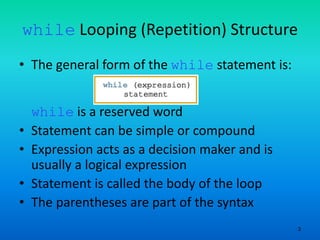
• The general form of the while statement is:
while is a reserved word
• Statement can be simple or compound
• Expression acts as a decision maker and is
usually a logical expression
• Statement is called the body of the loop
• The parentheses are part of the syntax
4
while Looping (Repetition) Structure
(continued)
• Infinite loop: continues to execute endlessly
– Avoided by including statements in loop body that
assure exit condition is eventually false
5
while Looping (Repetition) Structure
(continued)
6
Designing while Loops
7
Case 1: Counter-Controlled while
Loops
• If you know exactly how many pieces of
data need to be read, the while loop
becomes a counter-controlled loop
8
Case 2: Sentinel-Controlled while
Loops
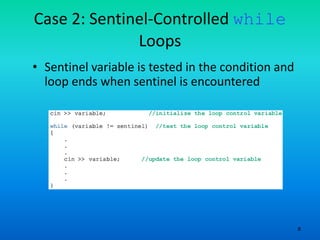
• Sentinel variable is tested in the condition and
loop ends when sentinel is encountered
9
Case 3: Flag-Controlled while Loops
• A flag-controlled while loop uses a bool
variable to control the loop
• The flag-controlled while loop takes the
form:
10
Case 4: EOF-Controlled while Loops
• Use an EOF (End Of File)-controlled while
loop
• The logical value returned by cin can
determine if the program has ended input
11
eof Function
• The function eof can determine the end
of file status
• Like other I/O functions (get, ignore,
peek), eof is a member of data type
istream
• The syntax for the function eof is:
where istreamVar is an input stream
variable, such as cin
12
More on Expressions in while
Statements
• The expression in a while statement can be
complex
– For example:
while ((noOfGuesses < 5) && (!isGuessed))
{
…
}
Assignment
• Explain the usage of while loop in C++

Object oriented programming17 control structures repetition statements

  • 1.
    Object Oriented Programming:17 Control Structure - Repetition Prof Neeraj Bhargava Vaibhav Khanna Department of Computer Science School of Engineering and Systems Sciences Maharshi Dayanand Saraswati University Ajmer
  • 2.
    2 Why Is RepetitionNeeded? • Repetition allows you to efficiently use variables • Can input, add, and average multiple numbers using a limited number of variables • For example, to add five numbers: – Declare a variable for each number, input the numbers and add the variables together – Create a loop that reads a number into a variable and adds it to a variable that contains the sum of the numbers
  • 3.
    3 while Looping (Repetition)Structure • The general form of the while statement is: while is a reserved word • Statement can be simple or compound • Expression acts as a decision maker and is usually a logical expression • Statement is called the body of the loop • The parentheses are part of the syntax
  • 4.
    4 while Looping (Repetition)Structure (continued) • Infinite loop: continues to execute endlessly – Avoided by including statements in loop body that assure exit condition is eventually false
  • 5.
    5 while Looping (Repetition)Structure (continued)
  • 6.
  • 7.
    7 Case 1: Counter-Controlledwhile Loops • If you know exactly how many pieces of data need to be read, the while loop becomes a counter-controlled loop
  • 8.
    8 Case 2: Sentinel-Controlledwhile Loops • Sentinel variable is tested in the condition and loop ends when sentinel is encountered
  • 9.
    9 Case 3: Flag-Controlledwhile Loops • A flag-controlled while loop uses a bool variable to control the loop • The flag-controlled while loop takes the form:
  • 10.
    10 Case 4: EOF-Controlledwhile Loops • Use an EOF (End Of File)-controlled while loop • The logical value returned by cin can determine if the program has ended input
  • 11.
    11 eof Function • Thefunction eof can determine the end of file status • Like other I/O functions (get, ignore, peek), eof is a member of data type istream • The syntax for the function eof is: where istreamVar is an input stream variable, such as cin
  • 12.
    12 More on Expressionsin while Statements • The expression in a while statement can be complex – For example: while ((noOfGuesses < 5) && (!isGuessed)) { … }
  • 13.
    Assignment • Explain theusage of while loop in C++