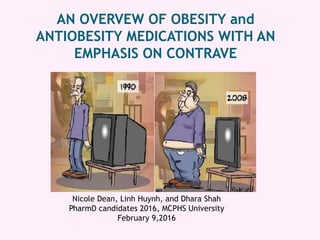
AN OVERVEW OF OBESITY and
ANTIOBESITY MEDICATIONS WITH AN
EMPHASIS ON CONTRAVE
Nicole Dean, Linh Huynh, and Dhara Shah
PharmD candidates 2016, MCPHS University
February 9,2016
OBJECTIVES
Identify risk factors and etiology of
obesity
Analyze different pharmacological
therapies for weight management
Compare CONTRAVE with other FDA-
approved anti-obesity drugs
INTRODUCTION
⦿ Obesity is a chronic disease associated with excess body
fat.
⦿ Obesity is the leading cause of mortality, morbidity,
disability, healthcare utilization, and healthcare costs in
the United States.
⦿ Obesity is a major risk factor for the top five diseases:
cardiovascular disease, cancer, stroke, and type 2
diabetes.
⦿ In total about 68.8% of Americans are obese or
overweight.
Please reference at bottom of
slide….each bullet should be
referenced unless these bullets were
derived from 1 source
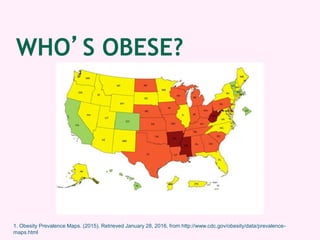
WHO’S OBESE?
1. Obesity Prevalence Maps. (2015). Retrieved January 28, 2016, from http://www.cdc.gov/obesity/data/prevalence-
maps.html
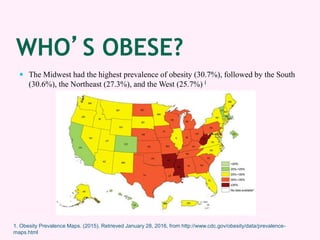
WHO’S OBESE?
 The Midwest had the highest prevalence of obesity (30.7%), followed by the South
(30.6%), the Northeast (27.3%), and the West (25.7%) 1
1. Obesity Prevalence Maps. (2015). Retrieved January 28, 2016, from http://www.cdc.gov/obesity/data/prevalence-
maps.html
DOLLARS AND CENTS
⦿In 1998 cost of obesity was 78.5 billion
⦿Medicare and Medicaid paying for half of this cost who
pays the other half? Would be prepared to respond
⦿Due to current trends, the cost of obesity costs 40 billion
dollars more every four years. Indent after the last bullet
⦿ In 2008 the total cost of obesity increased to 147 billion.
Would make this bullet #2
⦿Annually 7 Billion dollars is spent on medications for
complications associated with obesity. Bullet #3
Disability and Obesity. (2015). Retrieved February 05, 2016, from
http://www.cdc.gov/ncbddd/disabilityandhealth/obesity.html
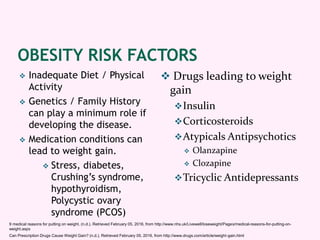
OBESITY RISK FACTORS
 Inadequate Diet / Physical
Activity
 Genetics / Family History
can play a minimum role if
developing the disease.
 Medication conditions can
lead to weight gain.
 Stress, diabetes,
Crushing’s syndrome,
hypothyroidism,
Polycystic ovary
syndrome (PCOS)
 Drugs leading to weight
gain
Insulin
Corticosteroids
Atypicals Antipsychotics
 Olanzapine
 Clozapine
Tricyclic Antidepressants
Can Prescription Drugs Cause Weight Gain? (n.d.). Retrieved February 05, 2016, from http://www.drugs.com/article/weight-gain.html
9 medical reasons for putting on weight. (n.d.). Retrieved February 05, 2016, from http://www.nhs.uk/Livewell/loseweight/Pages/medical-reasons-for-putting-on-
weight.aspx
PHARMACOLOGY OF
CONTRAVE AND OTHER
AVAILABLE ANTIOBESITY
DRUGS
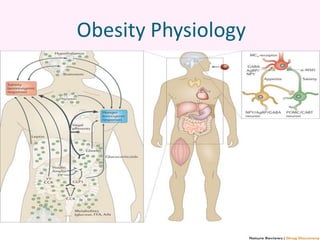
Obesity Physiology
Pharmacological Weight Loss
Options
Tenuate® Xenical®
Alli®
(OTC)
Belviq® Qsymia® Saxenda® Contrave
®
Generic Diethyl-
propion
Orlistat Locaserin Phentermine
&
Topiramate
Liraglutide Naltrexone
&
Bupropion
Class Central
Nervous
Stimulant
Lipase
inhibitor
Serotonin
(5HT2c)
Receptor
Agonist
Sympatho-
mimetic &
Anti-
convulsant
Glucagon-
Like Peptide
(GPL-1)
Receptor
Agonist
Dopamine/
Norepi-
nephrine
Reuptake
Inhibitor &
Opioid
Antagonist
Lexi-drugs Online. Hudson (OH): Lexi-Comp, Inc.;[updated 01/27/16; accessed 01/27/16]
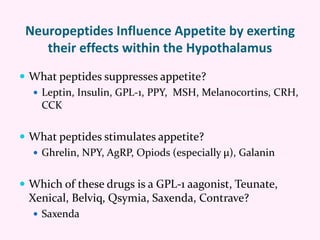
Neuropeptides Influence Appetite by exerting
their effects within the Hypothalamus
 What peptides suppresses appetite?
 Leptin, Insulin, GPL-1, PPY, MSH, Melanocortins, CRH,
CCK
 What peptides stimulates appetite?
 Ghrelin, NPY, AgRP, Opiods (especially μ), Galanin
 Which of these drugs is a GPL-1 aagonist, Teunate,
Xenical, Belviq, Qsymia, Saxenda, Contrave?
 Saxenda
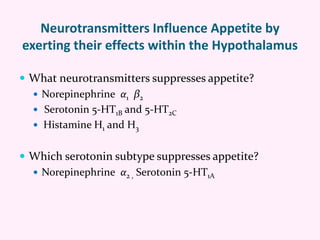
Neurotransmitters Influence Appetite by
exerting their effects within the Hypothalamus
 What neurotransmitters suppresses appetite?
 Norepinephrine α1 β2
 Serotonin 5-HT1B and 5-HT2C
 Histamine H1 and H3
 Which serotonin subtype suppresses appetite?
 Norepinephrine α2 , Serotonin 5-HT1A
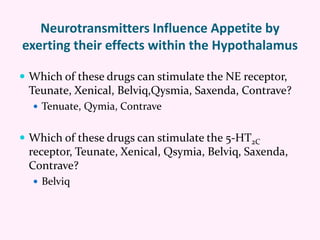
Neurotransmitters Influence Appetite by
exerting their effects within the Hypothalamus
 Which of these drugs can stimulate the NE receptor,
Teunate, Xenical, Belviq,Qysmia, Saxenda, Contrave?
 Tenuate, Qymia, Contrave
 Which of these drugs can stimulate the 5-HT2C
receptor, Teunate, Xenical, Qsymia, Belviq, Saxenda,
Contrave?
 Belviq
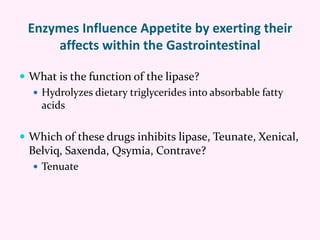
Enzymes Influence Appetite by exerting their
affects within the Gastrointestinal
 What is the function of the lipase?
 Hydrolyzes dietary triglycerides into absorbable fatty
acids
 Which of these drugs inhibits lipase, Teunate, Xenical,
Belviq, Saxenda, Qsymia, Contrave?
 Tenuate
Mechanism Of Action
Belviq, Qsymia,Saxenda,Xenical, and Contrave
Amazonaws.com. 2016. Available at: https://s3.amazonaws.com/classconnection/984/flashcards/5918984/png/screen_shot_2015-04-11_at_10447_pm-
14CA9DF33612FB6208F.png. Accessed January 29, 2016.
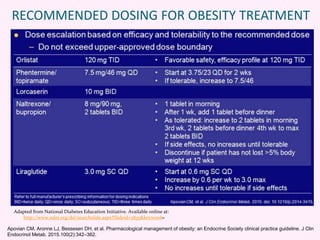
RECOMMENDED DOSING FOR OBESITY TREATMENT
Adapted from National Diabetes Education Initiative. Available online at:
http://www.ndei.org/dsl/searchslide.aspx?Slideid=3835&keyword=
Apovian CM, Aronne LJ, Bessesen DH, et al. Pharmacological management of obesity: an Endocrine Society clinical practice guideline. J Clin
Endocrinol Metab. 2015.100(2):342–362.
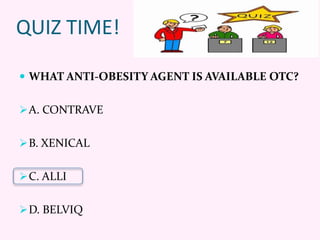
QUIZ TIME!
 WHAT ANTI-OBESITY AGENT IS AVAILABLE OTC?
A. CONTRAVE
B. XENICAL
C. ALLI
D. BELVIQ
A LITTLE MORE ABOUT CONTRAVE…
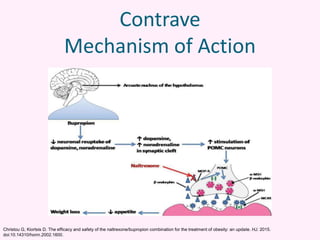
Contrave
Mechanism of Action
Christou G, Kiortsis D. The efficacy and safety of the naltrexone/bupropion combination for the treatment of obesity: an update. HJ. 2015.
doi:10.14310/horm.2002.1600.
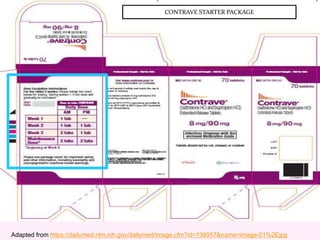
Adapted from https://dailymed.nlm.nih.gov/dailymed/image.cfm?id=138957&name=image-01%2Ejpg
CONTRAVE STARTER PACKAGE
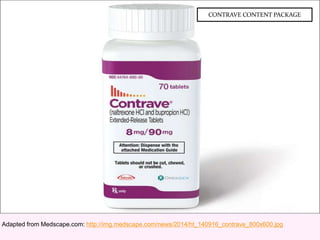
Adapted from Medscape.com: http://img.medscape.com/news/2014/ht_140916_contrave_800x600.jpg
CONTRAVE CONTENT PACKAGE
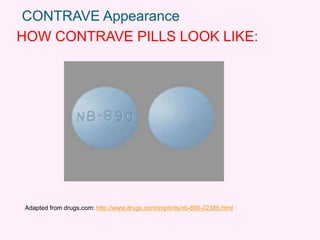
Adapted from drugs.com: http://www.drugs.com/imprints/nb-890-22385.html
HOW CONTRAVE PILLS LOOK LIKE:
CONTRAVE Appearance
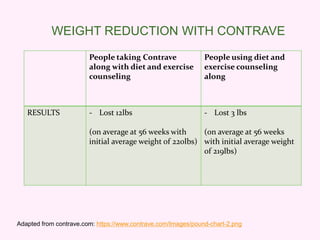
Adapted from contrave.com: https://www.contrave.com/Images/pound-chart-2.png
WEIGHT REDUCTION WITH CONTRAVE
People taking Contrave
along with diet and exercise
counseling
People using diet and
exercise counseling
along
RESULTS - Lost 12lbs
(on average at 56 weeks with
initial average weight of 220lbs)
- Lost 3 lbs
(on average at 56 weeks
with initial average weight
of 219lbs)
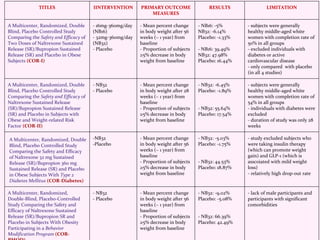
CONTRAVE TRIALS
TITLES IINTERVENTION PRIMARY OUTCOME
MEASURES
RESULTS LIMITATION
A Multicenter, Randomized, Double
Blind, Placebo Controlled Study
Comparing the Safety and Efficacy of
Two Doses of Naltrexone Sustained
Release (SR)/Bupropion Sustained
Release (SR) and Placebo in Obese
Subjects (COR-I)
- 16mg-360mg/day
(NB16)
- 32mg-360mg/day
(NB32)
- Placebo
- Mean percent change
in body weight after 56
weeks (~ 1 year) from
baseline
- Proportion of subjects
≥5% decrease in body
weight from baseline
- NB16: -5%
NB32: -6.14%
Placebo: -1.33%
- NB16: 39.49%
NB32: 47.98%
Placebo: 16.44%
- subjects were generally
healthy middle-aged white
women with completion rate of
50% in all groups
- excluded individuals with
diabetes or active
cardiovascular disease
- only compared with placebo
(in all 4 studies)
A Multicenter, Randomized, Double
Blind, Placebo Controlled Study
Comparing the Safety and Efficacy of
Naltrexone Sustained Release
(SR)/Bupropion Sustained Release
(SR) and Placebo in Subjects with
Obese and Weight-related Risk
Factor (COR-II)
- NB32
- Placebo
- Mean percent change
in body weight after 28
weeks (~ 1 year) from
baseline
- Proportion of subjects
≥5% decrease in body
weight from baseline
- NB32: -6.45%
Placebo: -1.89%
- NB32: 55.64%
Placebo: 17.54%
- subjects were generally
healthy middle-aged white
women with completion rate of
54% in all groups
- individuals with diabetes were
excluded
- duration of study was only 28
weeks
A Multicenter, Randomized, Double
Blind, Placebo Controlled Study
Comparing the Safety and Efficacy
of Naltrexone 32 mg Sustained
Release (SR)/Bupropion 360 mg
Sustained Release (SR) and Placebo
in Obese Subjects With Type 2
Diabetes Mellitus (COR-Diabetes)
-NB32
-Placebo
- Mean percent change
in body weight after 56
weeks (~ 1 year) from
baseline
- Proportion of subjects
≥5% decrease in body
weight from baseline
- NB32: -5.03%
Placebo: -1.75%
- NB32: 44.53%
Placebo: 18.87%
- study excluded subjects who
were taking insulin therapy
(which can promote weight
gain) and GLP-1 (which is
asscoiated with mild weight
loss)
- relatively high drop-out rate
A Multicenter, Randomized,
Double-Blind, Placebo-Controlled
Study Comparing the Safety and
Efficacy of Naltrexone Sustained
Release (SR)/Bupropion SR and
Placebo in Subjects With Obesity
Participating in a Behavior
Modification Program (COR-
- NB32
- Placebo
- Mean percent change
in body weight after 56
weeks (~ 1 year) from
baseline
- Proportion of subjects
≥5% decrease in body
weight from baseline
- NB32: -9.02%
Placebo: -5.08%
- NB32: 66.39%
Placebo: 42.49%
- lack of male participants and
participants with significant
comorbidities
RECOMMENDATIONS and
COMPARISON
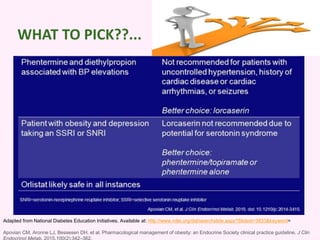
Adapted from National Diabetes Education Initiatives. Available at: http://www.ndei.org/dsl/searchslide.aspx?Slideid=3833&keyword=
Apovian CM, Aronne LJ, Bessesen DH, et al. Pharmacological management of obesity: an Endocrine Society clinical practice guideline. J Clin
Endocrinol Metab. 2015.100(2):342–362.
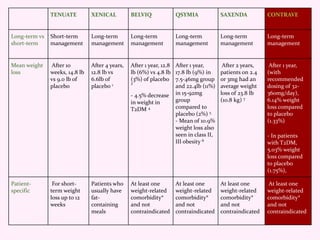
WHAT TO PICK??...
TENUATE XENICAL BELVIQ QSYMIA SAXENDA CONTRAVE
Long-term vs
short-term
Short-term
management
Long-term
management
Long-term
management
Long-term
management
Long-term
management
Long-term
management
Mean weight
loss
After 10
weeks, 14.8 lb
vs 9.0 lb of
placebo
After 4 years,
12.8 lb vs
6.6lb of
placebo 1
After 1 year, 12.8
lb (6%) vs 4.8 lb
(3%) of placebo
3
- 4.5% decrease
in weight in
T2DM 4
After 1 year,
17.8 lb (9%) in
7.5-46mg group
and 22.4lb (11%)
in 15-92mg
group
compared to
placebo (2%) 5
- Mean of 10.9%
weight loss also
seen in class II,
III obesity 6
After 2 years,
patients on 2.4
or 3mg had an
average weight
loss of 23.8 lb
(10.8 kg) 7
After 1 year,
(with
recommended
dosing of 32-
360mg/day),
6.14% weight
loss compared
to placebo
(1.33%)
- In patients
with T2DM,
5.03% weight
loss compared
to placebo
(1.75%),
Patient-
specific
For short-
term weight
loss up to 12
weeks
Patients who
usually have
fat-
containing
meals
At least one
weight-related
comorbidity*
and not
contraindicated
At least one
weight-related
comorbidity*
and not
contraindicated
At least one
weight-related
comorbidity*
and not
contraindicated
At least one
weight-related
comorbidity*
and not
contraindicated
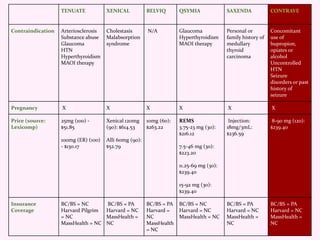
TENUATE XENICAL BELVIQ QSYMIA SAXENDA CONTRAVE
Contraindication Arteriosclerosis
Substance abuse
Glaucoma
HTN
Hyperthyroidism
MAOI therapy
Cholestasis
Malabsorption
syndrome
N/A Glaucoma
Hyperthyroidism
MAOI therapy
Personal or
family history of
medullary
thyroid
carcinoma
Concomitant
use of
bupropion,
opiates or
alcohol
Uncontrolled
HTN
Seizure
disorders or past
history of
seizure
Pregnancy X X X X X X
Price (source:
Lexicomp)
25mg (100) -
$51.85
100mg (ER) (100)
- $130.17
Xenical 120mg
(90): $614.53
Alli 60mg (90):
$52.79
10mg (60):
$263.22
REMS
3.75-23 mg (30):
$216.12
7.5-46 mg (30):
$223.20
11.25-69 mg (30):
$239.40
15-92 mg (30):
$239.40
Injection:
18mg/3mL:
$236.59
8-90 mg (120):
$239.40
Insurance
Coverage
BC/BS = NC
Harvard Pilgrim
= NC
MassHealth = NC
BC/BS = PA
Harvard = NC
MassHealth =
NC
BC/BS = PA
Harvard =
NC
MassHealth
= NC
BC/BS = NC
Harvard = NC
MassHealth = NC
BC/BS = PA
Harvard = NC
MassHealth =
NC
BC/BS = PA
Harvard = NC
MassHealth =
NC
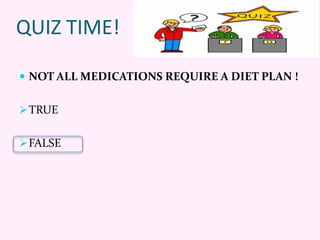
QUIZ TIME!
 NOT ALL MEDICATIONS REQUIRE A DIET PLAN !
TRUE
FALSE
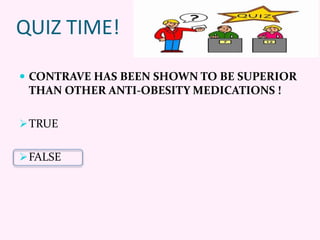
QUIZ TIME!
 CONTRAVE HAS BEEN SHOWN TO BE SUPERIOR
THAN OTHER ANTI-OBESITY MEDICATIONS !
TRUE
FALSE
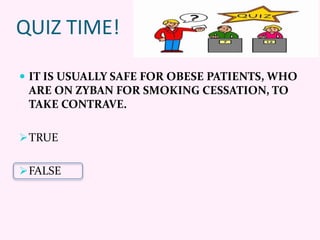
QUIZ TIME!
 IT IS USUALLY SAFE FOR OBESE PATIENTS, WHO
ARE ON ZYBAN FOR SMOKING CESSATION, TO
TAKE CONTRAVE.
TRUE
FALSE
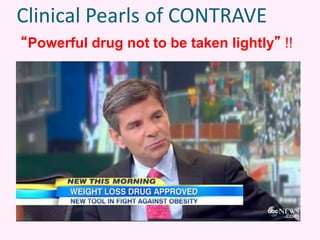
Clinical Pearls of CONTRAVE
“Powerful drug not to be taken lightly” !!
REFERENCES
 Contrave. In: Lexi-drugs Online. Hudson (OH): Lexi-Comp, Inc.;[updated 01/27/16; accessed 01/27/16].
http://online.lexi.com.ezproxymcp.flo.org/lco/action/doc/retrieve/docid/patch_f/5338462
 Tenuate. In: Lexi-drugs Online. Hudson (OH): Lexi-Comp, Inc.;[updated 01/19/16; accessed 01/27/16].
http://online.lexi.com.ezproxymcp.flo.org/lco/action/doc/retrieve/docid/patch_f/6740
 Xenical. In: Lexi-drugs Online. Hudson (OH): Lexi-Comp, Inc.;[updated 01/27/16; accessed 01/27/16].
http://online.lexi.com.ezproxymcp.flo.org/lco/action/doc/retrieve/docid/patch_f/7402
 Belviq. In: Lexi-drugs Online. Hudson (OH): Lexi-Comp, Inc.;[updated 01/27/16; accessed 01/27/16].
http://online.lexi.com.ezproxymcp.flo.org/lco/action/doc/retrieve/docid/patch_f/3808862
 Qsymia. In: Lexi-drugs Online. Hudson (OH): Lexi-Comp, Inc.;[updated 01/19/16; accessed 01/27/16].
http://online.lexi.com.ezproxymcp.flo.org/lco/action/doc/retrieve/docid/patch_f/3832942
 Saxenda. In: Lexi-drugs Online. Hudson (OH): Lexi-Comp, Inc.;[updated 01/27/16; accessed 01/27/16].
http://online.lexi.com.ezproxymcp.flo.org/lco/action/doc/retrieve/docid/patch_f/2144379
 Torgerson JS, Hauptman J, Boldrin MN, Sjostrom L. XENical in the prevention of diabetes in obese subjects
(XENDOS) study: A randomized study of orlistat as an adjunct to lifestyle changes for the prevention of type 2
diabetes in obese patients. Diabetes Care 2004;27(1):155–161.
 Fidler MC, Sanchez M, Raether B, Weissman NJ, et al. A one-year randomized trial of lorcaserin for weight loss in
obese and overweight adults: The BLOSSOM trial. J Clin Endocrinol Metab 2011;96(10):3067–3077.
 O’Neil PM, Smith SR, Weissman NJ, et al. Randomized placebo-controlled clinical trial of lorcaserin for weight loss
in type 2 diabetes mellitus: The BLOOM-DM study. Obesity 2012;20(7):1426–1436.
 Gadde KM, Allison DB, Ryan DH, Peterson CA, et al. Effects of low-dose, controlled-release, phentermine plus
topiramate combination on weight and associated comorbidities in overweight and obese adults (CONQUER): A
randomized, placebo-controlled, phase 3 trial. Lancet 2011;377:1341–1352.
 Allison DB, Gadde KM, Garvey WT, et al. Controlled-release phentermine/topiramate in severely obese adults: A
randomized controlled trial (EQUIP). Obesity 2012;20(2)330–342.
 Clements, J. N., & Shealy, K. M. (2015). Liraglutide An Injectable Option for the Management of Obesity. Annals of
Pharmacotherapy, 1060028015586806.
REFERENCES (cont)
 Greenway FL, Fujioka K, Plodkowski RA, et al. Effect of naltrexone plus bupropion on weight loss in
overweight and obese adults (COR-I): a multicentre, randomised, double-blind, placebo-controlled, phase 3
trial. The Lancet. 2010;376(9741):595–605.
 Apovian CM, Aronne L, Rubino D, et al. A randomized, phase 3 trial of naltrexone SR/bupropion SR on weight
and obesity-related risk factors (COR-II). Obesity. 2013;21(5):935–943.
 Hollander P, Gupta AK, Plodkowski R, et al. Effects of Naltrexone Sustained-Release/Bupropion Sustained-
Release Combination Therapy on Body Weight and Glycemic Parameters in Overweight and Obese Patients
With Type 2 Diabetes. Diabetes Care 2013;36:4022-4029. Diabetes Care. 2014;37(2):587–587.
 Wadden TA, Foreyt JP, Foster GD, et al. Weight Loss With Naltrexone SR/Bupropion SR Combination Therapy
as an Adjunct to Behavior Modification: The COR-BMOD Trial. Obesity. 2010;19(1):110–120.
 Apovian CM, Aronne LJ, Bessesen DH, et al. Pharmacological management of obesity: an Endocrine Society
clinical practice guideline. J Clin Endocrinol Metab. 2015.100(2):342–362.
 Obesity Prevalence Maps. (2015). Retrieved January 28, 2016, from
http://www.cdc.gov/obesity/data/prevalence-maps.html
 Christou G, Kiortsis D. The efficacy and safety of the naltrexone/bupropion combination for the
treatment of obesity: an update. HJ. 2015. doi:10.14310/horm.2002.1600.
 Sumnerdietrx.com. 2016. Available at: http://www.sumnerdietrx.com/files/2014/12/Contrave-
Ad_Portfolio-2014.png. Accessed January 29, 2016.
 Amazonaws.com. 2016. Available at:
https://s3.amazonaws.com/classconnection/984/flashcards/5918984/png/screen_shot_2015-04-
11_at_10447_pm-14CA9DF33612FB6208F.png. Accessed January 29, 2016.
 Google.com. bupropion pomc - Google Search. 2016. Available at:
https://www.google.com/search?q=bupropion+pomc&biw=1188&bih=563&source=lnms&tbm=isch&sa=
X&ved=0ahUKEwjMmMGY18_KAhUCPT4KHfuNBwcQ_AUIBigB#imgrc=H_juLQCeCoX6zM%3A.
Accessed January 29, 2016.


Obesity

  • 1.
    AN OVERVEW OFOBESITY and ANTIOBESITY MEDICATIONS WITH AN EMPHASIS ON CONTRAVE Nicole Dean, Linh Huynh, and Dhara Shah PharmD candidates 2016, MCPHS University February 9,2016
  • 2.
    OBJECTIVES Identify risk factorsand etiology of obesity Analyze different pharmacological therapies for weight management Compare CONTRAVE with other FDA- approved anti-obesity drugs
  • 3.
    INTRODUCTION ⦿ Obesity isa chronic disease associated with excess body fat. ⦿ Obesity is the leading cause of mortality, morbidity, disability, healthcare utilization, and healthcare costs in the United States. ⦿ Obesity is a major risk factor for the top five diseases: cardiovascular disease, cancer, stroke, and type 2 diabetes. ⦿ In total about 68.8% of Americans are obese or overweight. Please reference at bottom of slide….each bullet should be referenced unless these bullets were derived from 1 source
  • 4.
    WHO’S OBESE? 1. ObesityPrevalence Maps. (2015). Retrieved January 28, 2016, from http://www.cdc.gov/obesity/data/prevalence- maps.html
  • 5.
    WHO’S OBESE?  TheMidwest had the highest prevalence of obesity (30.7%), followed by the South (30.6%), the Northeast (27.3%), and the West (25.7%) 1 1. Obesity Prevalence Maps. (2015). Retrieved January 28, 2016, from http://www.cdc.gov/obesity/data/prevalence- maps.html
  • 6.
    DOLLARS AND CENTS ⦿In1998 cost of obesity was 78.5 billion ⦿Medicare and Medicaid paying for half of this cost who pays the other half? Would be prepared to respond ⦿Due to current trends, the cost of obesity costs 40 billion dollars more every four years. Indent after the last bullet ⦿ In 2008 the total cost of obesity increased to 147 billion. Would make this bullet #2 ⦿Annually 7 Billion dollars is spent on medications for complications associated with obesity. Bullet #3 Disability and Obesity. (2015). Retrieved February 05, 2016, from http://www.cdc.gov/ncbddd/disabilityandhealth/obesity.html
  • 7.
    OBESITY RISK FACTORS Inadequate Diet / Physical Activity  Genetics / Family History can play a minimum role if developing the disease.  Medication conditions can lead to weight gain.  Stress, diabetes, Crushing’s syndrome, hypothyroidism, Polycystic ovary syndrome (PCOS)  Drugs leading to weight gain Insulin Corticosteroids Atypicals Antipsychotics  Olanzapine  Clozapine Tricyclic Antidepressants Can Prescription Drugs Cause Weight Gain? (n.d.). Retrieved February 05, 2016, from http://www.drugs.com/article/weight-gain.html 9 medical reasons for putting on weight. (n.d.). Retrieved February 05, 2016, from http://www.nhs.uk/Livewell/loseweight/Pages/medical-reasons-for-putting-on- weight.aspx
  • 8.
    PHARMACOLOGY OF CONTRAVE ANDOTHER AVAILABLE ANTIOBESITY DRUGS
  • 9.
  • 10.
    Pharmacological Weight Loss Options Tenuate®Xenical® Alli® (OTC) Belviq® Qsymia® Saxenda® Contrave ® Generic Diethyl- propion Orlistat Locaserin Phentermine & Topiramate Liraglutide Naltrexone & Bupropion Class Central Nervous Stimulant Lipase inhibitor Serotonin (5HT2c) Receptor Agonist Sympatho- mimetic & Anti- convulsant Glucagon- Like Peptide (GPL-1) Receptor Agonist Dopamine/ Norepi- nephrine Reuptake Inhibitor & Opioid Antagonist Lexi-drugs Online. Hudson (OH): Lexi-Comp, Inc.;[updated 01/27/16; accessed 01/27/16]
  • 11.
    Neuropeptides Influence Appetiteby exerting their effects within the Hypothalamus  What peptides suppresses appetite?  Leptin, Insulin, GPL-1, PPY, MSH, Melanocortins, CRH, CCK  What peptides stimulates appetite?  Ghrelin, NPY, AgRP, Opiods (especially μ), Galanin  Which of these drugs is a GPL-1 aagonist, Teunate, Xenical, Belviq, Qsymia, Saxenda, Contrave?  Saxenda
  • 12.
    Neurotransmitters Influence Appetiteby exerting their effects within the Hypothalamus  What neurotransmitters suppresses appetite?  Norepinephrine α1 β2  Serotonin 5-HT1B and 5-HT2C  Histamine H1 and H3  Which serotonin subtype suppresses appetite?  Norepinephrine α2 , Serotonin 5-HT1A
  • 13.
    Neurotransmitters Influence Appetiteby exerting their effects within the Hypothalamus  Which of these drugs can stimulate the NE receptor, Teunate, Xenical, Belviq,Qysmia, Saxenda, Contrave?  Tenuate, Qymia, Contrave  Which of these drugs can stimulate the 5-HT2C receptor, Teunate, Xenical, Qsymia, Belviq, Saxenda, Contrave?  Belviq
  • 14.
    Enzymes Influence Appetiteby exerting their affects within the Gastrointestinal  What is the function of the lipase?  Hydrolyzes dietary triglycerides into absorbable fatty acids  Which of these drugs inhibits lipase, Teunate, Xenical, Belviq, Saxenda, Qsymia, Contrave?  Tenuate
  • 15.
    Mechanism Of Action Belviq,Qsymia,Saxenda,Xenical, and Contrave Amazonaws.com. 2016. Available at: https://s3.amazonaws.com/classconnection/984/flashcards/5918984/png/screen_shot_2015-04-11_at_10447_pm- 14CA9DF33612FB6208F.png. Accessed January 29, 2016.
  • 16.
    RECOMMENDED DOSING FOROBESITY TREATMENT Adapted from National Diabetes Education Initiative. Available online at: http://www.ndei.org/dsl/searchslide.aspx?Slideid=3835&keyword= Apovian CM, Aronne LJ, Bessesen DH, et al. Pharmacological management of obesity: an Endocrine Society clinical practice guideline. J Clin Endocrinol Metab. 2015.100(2):342–362.
  • 17.
    QUIZ TIME!  WHATANTI-OBESITY AGENT IS AVAILABLE OTC? A. CONTRAVE B. XENICAL C. ALLI D. BELVIQ
  • 18.
    A LITTLE MOREABOUT CONTRAVE…
  • 19.
    Contrave Mechanism of Action ChristouG, Kiortsis D. The efficacy and safety of the naltrexone/bupropion combination for the treatment of obesity: an update. HJ. 2015. doi:10.14310/horm.2002.1600.
  • 20.
  • 21.
    Adapted from Medscape.com:http://img.medscape.com/news/2014/ht_140916_contrave_800x600.jpg CONTRAVE CONTENT PACKAGE
  • 22.
    Adapted from drugs.com:http://www.drugs.com/imprints/nb-890-22385.html HOW CONTRAVE PILLS LOOK LIKE: CONTRAVE Appearance
  • 23.
    Adapted from contrave.com:https://www.contrave.com/Images/pound-chart-2.png WEIGHT REDUCTION WITH CONTRAVE People taking Contrave along with diet and exercise counseling People using diet and exercise counseling along RESULTS - Lost 12lbs (on average at 56 weeks with initial average weight of 220lbs) - Lost 3 lbs (on average at 56 weeks with initial average weight of 219lbs)
  • 24.
  • 25.
    TITLES IINTERVENTION PRIMARYOUTCOME MEASURES RESULTS LIMITATION A Multicenter, Randomized, Double Blind, Placebo Controlled Study Comparing the Safety and Efficacy of Two Doses of Naltrexone Sustained Release (SR)/Bupropion Sustained Release (SR) and Placebo in Obese Subjects (COR-I) - 16mg-360mg/day (NB16) - 32mg-360mg/day (NB32) - Placebo - Mean percent change in body weight after 56 weeks (~ 1 year) from baseline - Proportion of subjects ≥5% decrease in body weight from baseline - NB16: -5% NB32: -6.14% Placebo: -1.33% - NB16: 39.49% NB32: 47.98% Placebo: 16.44% - subjects were generally healthy middle-aged white women with completion rate of 50% in all groups - excluded individuals with diabetes or active cardiovascular disease - only compared with placebo (in all 4 studies) A Multicenter, Randomized, Double Blind, Placebo Controlled Study Comparing the Safety and Efficacy of Naltrexone Sustained Release (SR)/Bupropion Sustained Release (SR) and Placebo in Subjects with Obese and Weight-related Risk Factor (COR-II) - NB32 - Placebo - Mean percent change in body weight after 28 weeks (~ 1 year) from baseline - Proportion of subjects ≥5% decrease in body weight from baseline - NB32: -6.45% Placebo: -1.89% - NB32: 55.64% Placebo: 17.54% - subjects were generally healthy middle-aged white women with completion rate of 54% in all groups - individuals with diabetes were excluded - duration of study was only 28 weeks A Multicenter, Randomized, Double Blind, Placebo Controlled Study Comparing the Safety and Efficacy of Naltrexone 32 mg Sustained Release (SR)/Bupropion 360 mg Sustained Release (SR) and Placebo in Obese Subjects With Type 2 Diabetes Mellitus (COR-Diabetes) -NB32 -Placebo - Mean percent change in body weight after 56 weeks (~ 1 year) from baseline - Proportion of subjects ≥5% decrease in body weight from baseline - NB32: -5.03% Placebo: -1.75% - NB32: 44.53% Placebo: 18.87% - study excluded subjects who were taking insulin therapy (which can promote weight gain) and GLP-1 (which is asscoiated with mild weight loss) - relatively high drop-out rate A Multicenter, Randomized, Double-Blind, Placebo-Controlled Study Comparing the Safety and Efficacy of Naltrexone Sustained Release (SR)/Bupropion SR and Placebo in Subjects With Obesity Participating in a Behavior Modification Program (COR- - NB32 - Placebo - Mean percent change in body weight after 56 weeks (~ 1 year) from baseline - Proportion of subjects ≥5% decrease in body weight from baseline - NB32: -9.02% Placebo: -5.08% - NB32: 66.39% Placebo: 42.49% - lack of male participants and participants with significant comorbidities
  • 26.
  • 27.
    Adapted from NationalDiabetes Education Initiatives. Available at: http://www.ndei.org/dsl/searchslide.aspx?Slideid=3833&keyword= Apovian CM, Aronne LJ, Bessesen DH, et al. Pharmacological management of obesity: an Endocrine Society clinical practice guideline. J Clin Endocrinol Metab. 2015.100(2):342–362. WHAT TO PICK??...
  • 28.
    TENUATE XENICAL BELVIQQSYMIA SAXENDA CONTRAVE Long-term vs short-term Short-term management Long-term management Long-term management Long-term management Long-term management Long-term management Mean weight loss After 10 weeks, 14.8 lb vs 9.0 lb of placebo After 4 years, 12.8 lb vs 6.6lb of placebo 1 After 1 year, 12.8 lb (6%) vs 4.8 lb (3%) of placebo 3 - 4.5% decrease in weight in T2DM 4 After 1 year, 17.8 lb (9%) in 7.5-46mg group and 22.4lb (11%) in 15-92mg group compared to placebo (2%) 5 - Mean of 10.9% weight loss also seen in class II, III obesity 6 After 2 years, patients on 2.4 or 3mg had an average weight loss of 23.8 lb (10.8 kg) 7 After 1 year, (with recommended dosing of 32- 360mg/day), 6.14% weight loss compared to placebo (1.33%) - In patients with T2DM, 5.03% weight loss compared to placebo (1.75%), Patient- specific For short- term weight loss up to 12 weeks Patients who usually have fat- containing meals At least one weight-related comorbidity* and not contraindicated At least one weight-related comorbidity* and not contraindicated At least one weight-related comorbidity* and not contraindicated At least one weight-related comorbidity* and not contraindicated
  • 29.
    TENUATE XENICAL BELVIQQSYMIA SAXENDA CONTRAVE Contraindication Arteriosclerosis Substance abuse Glaucoma HTN Hyperthyroidism MAOI therapy Cholestasis Malabsorption syndrome N/A Glaucoma Hyperthyroidism MAOI therapy Personal or family history of medullary thyroid carcinoma Concomitant use of bupropion, opiates or alcohol Uncontrolled HTN Seizure disorders or past history of seizure Pregnancy X X X X X X Price (source: Lexicomp) 25mg (100) - $51.85 100mg (ER) (100) - $130.17 Xenical 120mg (90): $614.53 Alli 60mg (90): $52.79 10mg (60): $263.22 REMS 3.75-23 mg (30): $216.12 7.5-46 mg (30): $223.20 11.25-69 mg (30): $239.40 15-92 mg (30): $239.40 Injection: 18mg/3mL: $236.59 8-90 mg (120): $239.40 Insurance Coverage BC/BS = NC Harvard Pilgrim = NC MassHealth = NC BC/BS = PA Harvard = NC MassHealth = NC BC/BS = PA Harvard = NC MassHealth = NC BC/BS = NC Harvard = NC MassHealth = NC BC/BS = PA Harvard = NC MassHealth = NC BC/BS = PA Harvard = NC MassHealth = NC
  • 30.
    QUIZ TIME!  NOTALL MEDICATIONS REQUIRE A DIET PLAN ! TRUE FALSE
  • 31.
    QUIZ TIME!  CONTRAVEHAS BEEN SHOWN TO BE SUPERIOR THAN OTHER ANTI-OBESITY MEDICATIONS ! TRUE FALSE
  • 32.
    QUIZ TIME!  ITIS USUALLY SAFE FOR OBESE PATIENTS, WHO ARE ON ZYBAN FOR SMOKING CESSATION, TO TAKE CONTRAVE. TRUE FALSE
  • 33.
    Clinical Pearls ofCONTRAVE “Powerful drug not to be taken lightly” !!
  • 35.
    REFERENCES  Contrave. In:Lexi-drugs Online. Hudson (OH): Lexi-Comp, Inc.;[updated 01/27/16; accessed 01/27/16]. http://online.lexi.com.ezproxymcp.flo.org/lco/action/doc/retrieve/docid/patch_f/5338462  Tenuate. In: Lexi-drugs Online. Hudson (OH): Lexi-Comp, Inc.;[updated 01/19/16; accessed 01/27/16]. http://online.lexi.com.ezproxymcp.flo.org/lco/action/doc/retrieve/docid/patch_f/6740  Xenical. In: Lexi-drugs Online. Hudson (OH): Lexi-Comp, Inc.;[updated 01/27/16; accessed 01/27/16]. http://online.lexi.com.ezproxymcp.flo.org/lco/action/doc/retrieve/docid/patch_f/7402  Belviq. In: Lexi-drugs Online. Hudson (OH): Lexi-Comp, Inc.;[updated 01/27/16; accessed 01/27/16]. http://online.lexi.com.ezproxymcp.flo.org/lco/action/doc/retrieve/docid/patch_f/3808862  Qsymia. In: Lexi-drugs Online. Hudson (OH): Lexi-Comp, Inc.;[updated 01/19/16; accessed 01/27/16]. http://online.lexi.com.ezproxymcp.flo.org/lco/action/doc/retrieve/docid/patch_f/3832942  Saxenda. In: Lexi-drugs Online. Hudson (OH): Lexi-Comp, Inc.;[updated 01/27/16; accessed 01/27/16]. http://online.lexi.com.ezproxymcp.flo.org/lco/action/doc/retrieve/docid/patch_f/2144379  Torgerson JS, Hauptman J, Boldrin MN, Sjostrom L. XENical in the prevention of diabetes in obese subjects (XENDOS) study: A randomized study of orlistat as an adjunct to lifestyle changes for the prevention of type 2 diabetes in obese patients. Diabetes Care 2004;27(1):155–161.  Fidler MC, Sanchez M, Raether B, Weissman NJ, et al. A one-year randomized trial of lorcaserin for weight loss in obese and overweight adults: The BLOSSOM trial. J Clin Endocrinol Metab 2011;96(10):3067–3077.  O’Neil PM, Smith SR, Weissman NJ, et al. Randomized placebo-controlled clinical trial of lorcaserin for weight loss in type 2 diabetes mellitus: The BLOOM-DM study. Obesity 2012;20(7):1426–1436.  Gadde KM, Allison DB, Ryan DH, Peterson CA, et al. Effects of low-dose, controlled-release, phentermine plus topiramate combination on weight and associated comorbidities in overweight and obese adults (CONQUER): A randomized, placebo-controlled, phase 3 trial. Lancet 2011;377:1341–1352.  Allison DB, Gadde KM, Garvey WT, et al. Controlled-release phentermine/topiramate in severely obese adults: A randomized controlled trial (EQUIP). Obesity 2012;20(2)330–342.  Clements, J. N., & Shealy, K. M. (2015). Liraglutide An Injectable Option for the Management of Obesity. Annals of Pharmacotherapy, 1060028015586806.
  • 36.
    REFERENCES (cont)  GreenwayFL, Fujioka K, Plodkowski RA, et al. Effect of naltrexone plus bupropion on weight loss in overweight and obese adults (COR-I): a multicentre, randomised, double-blind, placebo-controlled, phase 3 trial. The Lancet. 2010;376(9741):595–605.  Apovian CM, Aronne L, Rubino D, et al. A randomized, phase 3 trial of naltrexone SR/bupropion SR on weight and obesity-related risk factors (COR-II). Obesity. 2013;21(5):935–943.  Hollander P, Gupta AK, Plodkowski R, et al. Effects of Naltrexone Sustained-Release/Bupropion Sustained- Release Combination Therapy on Body Weight and Glycemic Parameters in Overweight and Obese Patients With Type 2 Diabetes. Diabetes Care 2013;36:4022-4029. Diabetes Care. 2014;37(2):587–587.  Wadden TA, Foreyt JP, Foster GD, et al. Weight Loss With Naltrexone SR/Bupropion SR Combination Therapy as an Adjunct to Behavior Modification: The COR-BMOD Trial. Obesity. 2010;19(1):110–120.  Apovian CM, Aronne LJ, Bessesen DH, et al. Pharmacological management of obesity: an Endocrine Society clinical practice guideline. J Clin Endocrinol Metab. 2015.100(2):342–362.  Obesity Prevalence Maps. (2015). Retrieved January 28, 2016, from http://www.cdc.gov/obesity/data/prevalence-maps.html  Christou G, Kiortsis D. The efficacy and safety of the naltrexone/bupropion combination for the treatment of obesity: an update. HJ. 2015. doi:10.14310/horm.2002.1600.  Sumnerdietrx.com. 2016. Available at: http://www.sumnerdietrx.com/files/2014/12/Contrave- Ad_Portfolio-2014.png. Accessed January 29, 2016.  Amazonaws.com. 2016. Available at: https://s3.amazonaws.com/classconnection/984/flashcards/5918984/png/screen_shot_2015-04- 11_at_10447_pm-14CA9DF33612FB6208F.png. Accessed January 29, 2016.  Google.com. bupropion pomc - Google Search. 2016. Available at: https://www.google.com/search?q=bupropion+pomc&biw=1188&bih=563&source=lnms&tbm=isch&sa= X&ved=0ahUKEwjMmMGY18_KAhUCPT4KHfuNBwcQ_AUIBigB#imgrc=H_juLQCeCoX6zM%3A. Accessed January 29, 2016. 