Obesity
R D Cagampan
What is Obesity?
• Obesity is when you have a high amount of fat
in your body.
• Obesity is not about more weight, it's about
more fat .
• You may weigh more because you are tall.
And this is normal.
• All of us love to have a well-built bodies
• Obesity is not just a cosmetic concern, it's also
a risk for some health problems, such as:
• heart disease, diabetes and the high blood
pressure and others.
Obesity
The good news is you can prevent your health
problems easily, and you can lose weight through
change in life and dietary style, increase physical
activity and others.
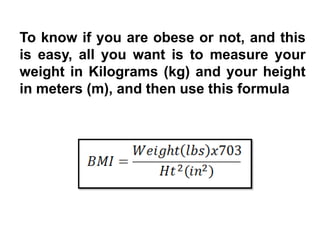
To know if you are obese or not, and this
is easy, all you want is to measure your
weight in Kilograms (kg) and your height
in meters (m), and then use this formula
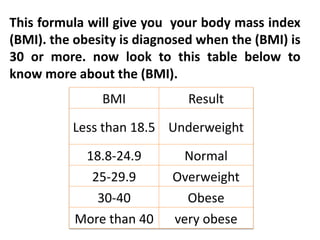
This formula will give you your body mass index
(BMI). the obesity is diagnosed when the (BMI) is
30 or more. now look to this table below to
know more about the (BMI).
BMI Result
Less than 18.5 Underweight
18.8-24.9 Normal
25-29.9 Overweight
30-40 Obese
More than 40 very obese
• Now with the (BMI) you
can diagnose yourself as
an obese or not, but still
one problem.
• Some people like the
muscular athletes find
their (BMI) higher than
normal
• They have a normal
amounts of fat in their
bodies but they weigh
more because of muscles.
Some facts:
• Our daily body activities need energy from
food we eat.
• Many metabolic reactions in the body need the
energy from food, such as to warm up in cold
weather and to sweat in the hot days.
But when our food calories amounts exceed the
body need, they will be stored in the body as fat.
• Inactivity:
without activity we don’t
burn as much calories. and
we need to have more
exercise to burn the
excessive calories.
The causes of obesity is a combination of states and risk
factors that work together to store more fat in our bodies,
These factors include:
• Diets: some bad eating habits
like high calories diets especially
at night, or skipping a healthy
breakfast, and replace it by junk
fast food - all of that increase the
body fat .
• Pregnancy: some women after
the baby is born have an
increasing in their weight, and if
they don’t lose that weight, with
many pregnancies after that,
they may become obese.
• Lack of sleep: this cause
disturbances in the body hormones, and
increase the appetite. you also may crave
to high calorie food.
• Drugs: some medications lead the
body to gain more weight, these drugs
include, diabetes medications, steroids
and beta blockers, anti-seizure
medications, antipsychotic medications
and antidepressants drugs.
• Medical conditions: some diseases and syndromes lead the
body to store more fat and gain weight like Cushing syndrome.
some disease low the metabolic rate in the body and low the
amount of burned calories every day such as the
hypothyroidism. And some diseases lead the patient to low his
activity, such as the arthritis or maybe the patients with
paraplegia
• Genetics: genes affect the amount of body fat we store and
where to store,
• Family lifestyle: not because of the genes we find the
obesity runs in the families, it also because of their life style and
the food they eat. We can notice that some countries such as
USA, have more obese people than others countries like Japan
and this is because the culture and the life style.
• Age: obesity could occur at any age, but as age, we lose
more amount of muscles built. more amount of muscles give
higher rate of metabolism and calories burning. When we lose
them we reduce the calories burning and tend to fill the body
with fat.
What are the complications of obesity?
• Type 2 diabetes.
• High blood pressure.
• Stroke.
• Heart disease.
• Gallbladder disease.
• Osteoarthritis.
• Sleep apnea,( dangerous sleep disorder in which
breathing repeatedly stops and starts).
• High cholesterol and triglycerides.
• Metabolic syndrome.
• Cancer.
• Depression.
Moreover the quality of life may be lower, and maybe
we can't do everything we want and like as easily as
we would like, we can't join some family activities or
we may feel some ashamed or depressed.
List of some weight-related states:
• Depression.
• Sexual problems.
• Social isolation.
• Physical disability.
• Discomfort.
Yes, you must go to the doctor asking for help. It's
important to talk to your doctor honestly about yourself,
your health, your diets and your life style, because that
is very helpful to improve your health. So when you go
to a doctor write down some questions to ask.
Do you need to
go to the doctor?
The doctor will start his management with the following
tips:
Taking your obesity history: the doctor ask about
life style, your weight, how long you have been obese,
what factors make you obese, what diet you eat
typically, how your daily activities are, do you smoke or
drink, stress effect on your weight, what medication do
you take, family - if there is any one have the same
condition.
Physical examinations for your expected health
problem: the doctor first will start to examine your
general physical conditions and your vital signs including,
the blood pressure, the temperature, the heart rate and
heart sound, the lungs and the breathing sounds, and
examination for your abdomen. After that we will ask you
to have some blood test to look for the complications of
the obesity.
(BMI): of course the doctor will calculate your body
mass index.
Blood tests: the blood test he will ask to have include
the cholesterol test, fasting glucose, liver function test
,and thyroid tests.
the healthy weight is the main goal for obesity treatment.
and you can reach that by making a good treatment plan
with your doctor and may be a big team of nutritionist,
dietitian, obesity specialist and nurse.
This plan include:
Dietary changes.
Exercise and activity.
Behavior change.
Prescription medication.
Weight-loss surgery.
Treatment
Prevention is always better than the treatment, and
if you feel currently overweight or your body mass
index exceed 30, you need to start your
prevention program.
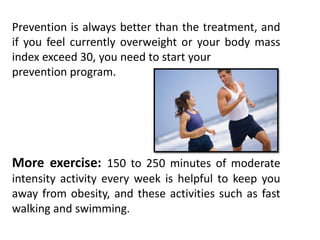
More exercise: 150 to 250 minutes of moderate
intensity activity every week is helpful to keep you
away from obesity, and these activities such as fast
walking and swimming.
Eat healthy: low calorie and fibers
rich food such as fruits, vegetables are
good food to have every day, but
saturated fats and sweets and alcohol
are extremely bad , they increase your
body weight, and threaten your health.
Monitor your weight:
monitoring your weigh and
calculating your body mass index
will be very helpful to know how
your prevention plan work.
Obesity

Obesity

  • 1.
  • 2.
    What is Obesity? •Obesity is when you have a high amount of fat in your body. • Obesity is not about more weight, it's about more fat . • You may weigh more because you are tall. And this is normal.
  • 3.
    • All ofus love to have a well-built bodies • Obesity is not just a cosmetic concern, it's also a risk for some health problems, such as: • heart disease, diabetes and the high blood pressure and others. Obesity
  • 4.
    The good newsis you can prevent your health problems easily, and you can lose weight through change in life and dietary style, increase physical activity and others.
  • 5.
    To know ifyou are obese or not, and this is easy, all you want is to measure your weight in Kilograms (kg) and your height in meters (m), and then use this formula
  • 6.
    This formula willgive you your body mass index (BMI). the obesity is diagnosed when the (BMI) is 30 or more. now look to this table below to know more about the (BMI). BMI Result Less than 18.5 Underweight 18.8-24.9 Normal 25-29.9 Overweight 30-40 Obese More than 40 very obese
  • 7.
    • Now withthe (BMI) you can diagnose yourself as an obese or not, but still one problem. • Some people like the muscular athletes find their (BMI) higher than normal • They have a normal amounts of fat in their bodies but they weigh more because of muscles.
  • 8.
    Some facts: • Ourdaily body activities need energy from food we eat. • Many metabolic reactions in the body need the energy from food, such as to warm up in cold weather and to sweat in the hot days. But when our food calories amounts exceed the body need, they will be stored in the body as fat.
  • 9.
    • Inactivity: without activitywe don’t burn as much calories. and we need to have more exercise to burn the excessive calories. The causes of obesity is a combination of states and risk factors that work together to store more fat in our bodies, These factors include:
  • 10.
    • Diets: somebad eating habits like high calories diets especially at night, or skipping a healthy breakfast, and replace it by junk fast food - all of that increase the body fat . • Pregnancy: some women after the baby is born have an increasing in their weight, and if they don’t lose that weight, with many pregnancies after that, they may become obese.
  • 11.
    • Lack ofsleep: this cause disturbances in the body hormones, and increase the appetite. you also may crave to high calorie food. • Drugs: some medications lead the body to gain more weight, these drugs include, diabetes medications, steroids and beta blockers, anti-seizure medications, antipsychotic medications and antidepressants drugs.
  • 12.
    • Medical conditions:some diseases and syndromes lead the body to store more fat and gain weight like Cushing syndrome. some disease low the metabolic rate in the body and low the amount of burned calories every day such as the hypothyroidism. And some diseases lead the patient to low his activity, such as the arthritis or maybe the patients with paraplegia • Genetics: genes affect the amount of body fat we store and where to store, • Family lifestyle: not because of the genes we find the obesity runs in the families, it also because of their life style and the food they eat. We can notice that some countries such as USA, have more obese people than others countries like Japan and this is because the culture and the life style.
  • 13.
    • Age: obesitycould occur at any age, but as age, we lose more amount of muscles built. more amount of muscles give higher rate of metabolism and calories burning. When we lose them we reduce the calories burning and tend to fill the body with fat.
  • 14.
    What are thecomplications of obesity? • Type 2 diabetes. • High blood pressure. • Stroke. • Heart disease. • Gallbladder disease. • Osteoarthritis. • Sleep apnea,( dangerous sleep disorder in which breathing repeatedly stops and starts). • High cholesterol and triglycerides. • Metabolic syndrome. • Cancer. • Depression.
  • 15.
    Moreover the qualityof life may be lower, and maybe we can't do everything we want and like as easily as we would like, we can't join some family activities or we may feel some ashamed or depressed. List of some weight-related states: • Depression. • Sexual problems. • Social isolation. • Physical disability. • Discomfort.
  • 16.
    Yes, you mustgo to the doctor asking for help. It's important to talk to your doctor honestly about yourself, your health, your diets and your life style, because that is very helpful to improve your health. So when you go to a doctor write down some questions to ask. Do you need to go to the doctor?
  • 17.
    The doctor willstart his management with the following tips: Taking your obesity history: the doctor ask about life style, your weight, how long you have been obese, what factors make you obese, what diet you eat typically, how your daily activities are, do you smoke or drink, stress effect on your weight, what medication do you take, family - if there is any one have the same condition.
  • 18.
    Physical examinations foryour expected health problem: the doctor first will start to examine your general physical conditions and your vital signs including, the blood pressure, the temperature, the heart rate and heart sound, the lungs and the breathing sounds, and examination for your abdomen. After that we will ask you to have some blood test to look for the complications of the obesity. (BMI): of course the doctor will calculate your body mass index. Blood tests: the blood test he will ask to have include the cholesterol test, fasting glucose, liver function test ,and thyroid tests.
  • 20.
    the healthy weightis the main goal for obesity treatment. and you can reach that by making a good treatment plan with your doctor and may be a big team of nutritionist, dietitian, obesity specialist and nurse. This plan include: Dietary changes. Exercise and activity. Behavior change. Prescription medication. Weight-loss surgery. Treatment
  • 22.
    Prevention is alwaysbetter than the treatment, and if you feel currently overweight or your body mass index exceed 30, you need to start your prevention program. More exercise: 150 to 250 minutes of moderate intensity activity every week is helpful to keep you away from obesity, and these activities such as fast walking and swimming.
  • 23.
    Eat healthy: lowcalorie and fibers rich food such as fruits, vegetables are good food to have every day, but saturated fats and sweets and alcohol are extremely bad , they increase your body weight, and threaten your health. Monitor your weight: monitoring your weigh and calculating your body mass index will be very helpful to know how your prevention plan work.