Misconceptions of
OAuth 2.0
Cory Forsyth
@bantic
201 Created
Consultants in NewYork City
Logan, UT
“A set of clean abstractions for authentication in Ember.js”
OAuth
a short intro
OAuth 1.0 & 2.0
• A delegated authorization protocol/framework
• Canonical example:
• User wants to print photos
• Photos are stored at my-pix.com
• User grants authorization to print-me.com to access
photos at my-pix.com
• Solves the “share my password” anti-pattern
OAuth
• 1.0:
• Uses cryptographic signatures, server-to-server communication
• 2.0:
• Includes “implicit grant” (front-end only) flow
• Includes “authorization code grant” flow
• No signatures (encrypted https communication only)
• Both:
• browser-centric redirection-based flows
OAuth
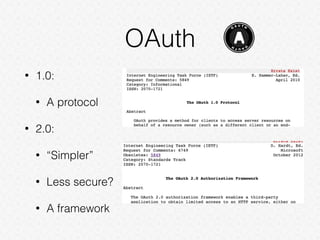
• 1.0:
• A protocol
• 2.0:
• “Simpler”
• Less secure?
• A framework
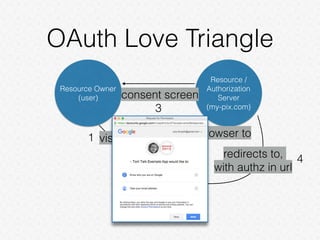
OAuth Love Triangle
Resource Owner
(user)
Resource /
Authorization
Server
(my-pix.com)
Client
(print-me.com)
visits1 directs browser to2
consent screen
3
redirects to,
with authz in url
4
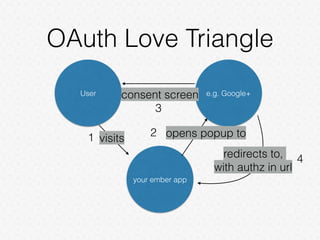
OAuth Love Triangle
User e.g. Google+
your ember app
visits1 opens popup to2
consent screen
3
redirects to,
with authz in url
4
OAuth 1 & 2 Terminology
• Resource Owner / User
• Human, likes taking and printing pictures
• Client / Consumer
• E.g., print-me.com
• For most people in this room: You code OAuth clients
• Server / Service Provider
• E.g., my-pix.com (and Google+, Facebook, Github, etc.)
OAuth Clients
• Can be confidential or public
• Public clients include:
• JavaScript that runs in the browser
• Native Apps (could be decompiled)
• Must be registered with a provider — provider
issues client_id, client_secret
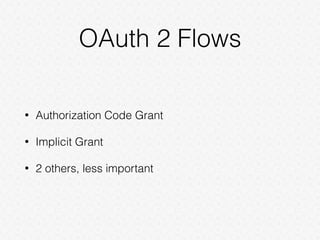
OAuth 2 Flows
• Authorization Code Grant
• Implicit Grant
• 2 others, less important
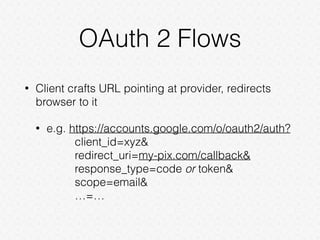
OAuth 2 Flows
• Client crafts URL pointing at provider, redirects
browser to it
• e.g. https://accounts.google.com/o/oauth2/auth?

client_id=xyz&

redirect_uri=my-pix.com/callback&

response_type=code or token&

scope=email&

…=…
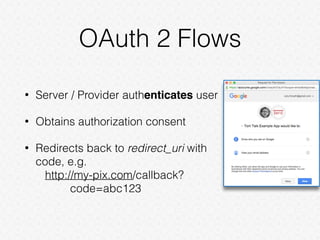
OAuth 2 Flows
• Server / Provider authenticates user
• Obtains authorization consent
• Redirects back to redirect_uri with
code, e.g.

http://my-pix.com/callback?

code=abc123
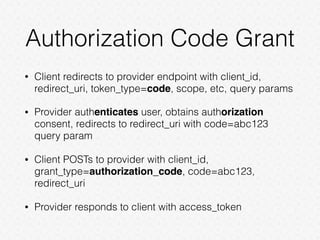
Authorization Code Grant
• Client redirects to provider endpoint with client_id,
redirect_uri, token_type=code, scope, etc, query params
• Provider authenticates user, obtains authorization
consent, redirects to redirect_uri with code=abc123
query param
• Client POSTs to provider with client_id,
grant_type=authorization_code, code=abc123,
redirect_uri
• Provider responds to client with access_token
Implicit Grant
• Client redirects to provider endpoint with client_id,
redirect_uri, token_type=token, scope, etc, query
params
• Provider authenticates user, obtains authorization
consent, redirects to redirect_uri with
access_token=abc123 hash fragment
• e.g. print-me.com/callback#access_token=abc123
Misunderstanding #1
Access vs Bearer Tokens
• Clients use access tokens to make requests of
providers for protected resources (on behalf of
users)
• Clients present “bearer” access tokens as query
parameters, headers (“Authorization: Bearer xyz”),
or form parameters
Access vs Bearer Tokens
• Access Tokens are almost always Bearer Tokens
• Providers include “token_type” when issuing tokens
• “bearer” is a token_type (there is also “mac”)
• Called “Bearer” because the Provider will allow any
request with the token present (whoever
holds/“bears” the token has access)
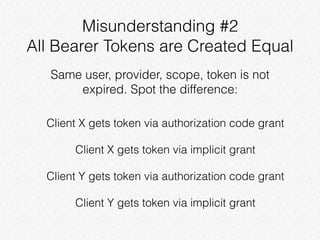
Misunderstanding #2
All Bearer Tokens are Created Equal
Client X gets token via authorization code grant
Client X gets token via implicit grant
Client Y gets token via authorization code grant
Client Y gets token via implicit grant
Same user, provider, scope, token is not
expired. Spot the difference:
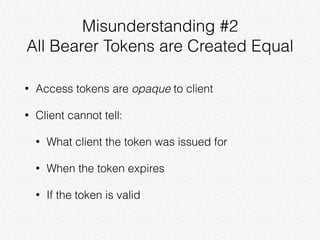
Misunderstanding #2
All Bearer Tokens are Created Equal
• Access tokens are opaque to client
• Client cannot tell:
• What client the token was issued for
• When the token expires
• If the token is valid
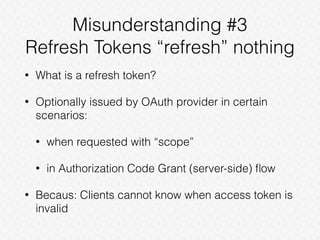
Misunderstanding #3
Refresh Tokens “refresh” nothing
• What is a refresh token?
• Optionally issued by OAuth provider in certain
scenarios:
• when requested with “scope”
• in Authorization Code Grant (server-side) flow
• Becaus: Clients cannot know when access token is
invalid
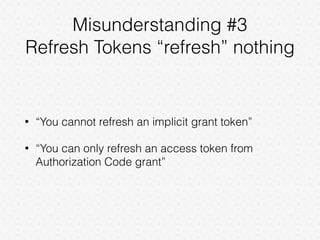
Misunderstanding #3
Refresh Tokens “refresh” nothing
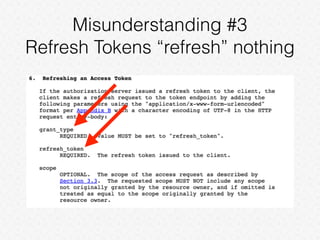
• “You cannot refresh an implicit grant token”
• “You can only refresh an access token from
Authorization Code grant”
Misunderstanding #3
Refresh Tokens “refresh” nothing
• “You cannot refresh an implicit grant token”
• “You can only refresh an access token from
Authorization Code grant”
Misunderstanding #3
Refresh Tokens “refresh” nothing
Misunderstanding #4
OAuth does not do authentication
• authentication: Who are you?
• authorization: What are you allowed to do?
• OAuth 2.0: An Authorization Framework
Misunderstanding #4
OAuth does not do authentication
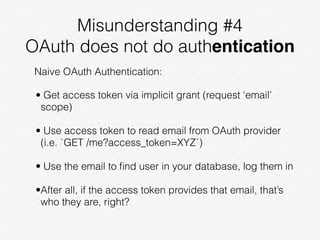
Naive OAuth Authentication:
• Get access token via implicit grant (request ‘email’
scope)
• Use access token to read email from OAuth provider
(i.e. `GET /me?access_token=XYZ`)
• Use the email to find user in your database, log them in
•After all, if the access token provides that email, that’s
who they are, right?
Misunderstanding #4
OAuth does not do authentication
• Remember, access token is opaque to client
• Client cannot tell:
• who that token was issued for
• when that token was issued
• Simple to intercept redirect, inject another access
token
Misunderstanding #4
OAuth does not do authentication
• What does work?
• authorization code flow (server-side) with ‘state’ param:
• ensures access token is “fresh”, for this client
• OpenID Connect
• Builds upon OAuth, uses JWT
• Allow in-browser verification of token integrity,
audience, identity
Misunderstanding #4
OAuth does not do authentication
Thanks
Cory Forsyth
@bantic
Links
• Torii: https://github.com/vestorly/torii
• OAuth 2 explanation
• More curated links
Image Credits
• https://twitter.com/old_sound/status/670412302135500803/photo/1

OAuth 2.0 Misconceptions

  • 1.
  • 2.
  • 3.
  • 4.
  • 5.
    “A set ofclean abstractions for authentication in Ember.js”
  • 6.
  • 7.
    OAuth 1.0 &2.0 • A delegated authorization protocol/framework • Canonical example: • User wants to print photos • Photos are stored at my-pix.com • User grants authorization to print-me.com to access photos at my-pix.com • Solves the “share my password” anti-pattern
  • 8.
    OAuth • 1.0: • Usescryptographic signatures, server-to-server communication • 2.0: • Includes “implicit grant” (front-end only) flow • Includes “authorization code grant” flow • No signatures (encrypted https communication only) • Both: • browser-centric redirection-based flows
  • 9.
    OAuth • 1.0: • Aprotocol • 2.0: • “Simpler” • Less secure? • A framework
  • 10.
    OAuth Love Triangle ResourceOwner (user) Resource / Authorization Server (my-pix.com) Client (print-me.com) visits1 directs browser to2 consent screen 3 redirects to, with authz in url 4
  • 11.
    OAuth Love Triangle Usere.g. Google+ your ember app visits1 opens popup to2 consent screen 3 redirects to, with authz in url 4
  • 12.
    OAuth 1 &2 Terminology • Resource Owner / User • Human, likes taking and printing pictures • Client / Consumer • E.g., print-me.com • For most people in this room: You code OAuth clients • Server / Service Provider • E.g., my-pix.com (and Google+, Facebook, Github, etc.)
  • 13.
    OAuth Clients • Canbe confidential or public • Public clients include: • JavaScript that runs in the browser • Native Apps (could be decompiled) • Must be registered with a provider — provider issues client_id, client_secret
  • 14.
    OAuth 2 Flows •Authorization Code Grant • Implicit Grant • 2 others, less important
  • 15.
    OAuth 2 Flows •Client crafts URL pointing at provider, redirects browser to it • e.g. https://accounts.google.com/o/oauth2/auth?
 client_id=xyz&
 redirect_uri=my-pix.com/callback&
 response_type=code or token&
 scope=email&
 …=…
  • 16.
    OAuth 2 Flows •Server / Provider authenticates user • Obtains authorization consent • Redirects back to redirect_uri with code, e.g.
 http://my-pix.com/callback?
 code=abc123
  • 17.
    Authorization Code Grant •Client redirects to provider endpoint with client_id, redirect_uri, token_type=code, scope, etc, query params • Provider authenticates user, obtains authorization consent, redirects to redirect_uri with code=abc123 query param • Client POSTs to provider with client_id, grant_type=authorization_code, code=abc123, redirect_uri • Provider responds to client with access_token
  • 18.
    Implicit Grant • Clientredirects to provider endpoint with client_id, redirect_uri, token_type=token, scope, etc, query params • Provider authenticates user, obtains authorization consent, redirects to redirect_uri with access_token=abc123 hash fragment • e.g. print-me.com/callback#access_token=abc123
  • 19.
  • 20.
    • Clients useaccess tokens to make requests of providers for protected resources (on behalf of users) • Clients present “bearer” access tokens as query parameters, headers (“Authorization: Bearer xyz”), or form parameters Access vs Bearer Tokens
  • 21.
    Access vs BearerTokens • Access Tokens are almost always Bearer Tokens • Providers include “token_type” when issuing tokens • “bearer” is a token_type (there is also “mac”) • Called “Bearer” because the Provider will allow any request with the token present (whoever holds/“bears” the token has access)
  • 22.
    Misunderstanding #2 All BearerTokens are Created Equal Client X gets token via authorization code grant Client X gets token via implicit grant Client Y gets token via authorization code grant Client Y gets token via implicit grant Same user, provider, scope, token is not expired. Spot the difference:
  • 23.
    Misunderstanding #2 All BearerTokens are Created Equal • Access tokens are opaque to client • Client cannot tell: • What client the token was issued for • When the token expires • If the token is valid
  • 24.
    Misunderstanding #3 Refresh Tokens“refresh” nothing • What is a refresh token? • Optionally issued by OAuth provider in certain scenarios: • when requested with “scope” • in Authorization Code Grant (server-side) flow • Becaus: Clients cannot know when access token is invalid
  • 25.
    Misunderstanding #3 Refresh Tokens“refresh” nothing • “You cannot refresh an implicit grant token” • “You can only refresh an access token from Authorization Code grant”
  • 26.
    Misunderstanding #3 Refresh Tokens“refresh” nothing • “You cannot refresh an implicit grant token” • “You can only refresh an access token from Authorization Code grant”
  • 27.
  • 28.
    Misunderstanding #4 OAuth doesnot do authentication • authentication: Who are you? • authorization: What are you allowed to do? • OAuth 2.0: An Authorization Framework
  • 29.
    Misunderstanding #4 OAuth doesnot do authentication Naive OAuth Authentication: • Get access token via implicit grant (request ‘email’ scope) • Use access token to read email from OAuth provider (i.e. `GET /me?access_token=XYZ`) • Use the email to find user in your database, log them in •After all, if the access token provides that email, that’s who they are, right?
  • 30.
    Misunderstanding #4 OAuth doesnot do authentication • Remember, access token is opaque to client • Client cannot tell: • who that token was issued for • when that token was issued • Simple to intercept redirect, inject another access token
  • 31.
    Misunderstanding #4 OAuth doesnot do authentication • What does work? • authorization code flow (server-side) with ‘state’ param: • ensures access token is “fresh”, for this client • OpenID Connect • Builds upon OAuth, uses JWT • Allow in-browser verification of token integrity, audience, identity
  • 32.
    Misunderstanding #4 OAuth doesnot do authentication
  • 33.
    Thanks Cory Forsyth @bantic Links • Torii:https://github.com/vestorly/torii • OAuth 2 explanation • More curated links Image Credits • https://twitter.com/old_sound/status/670412302135500803/photo/1