
twitter: @MithunShanbhag
blog: mithunshanbhag.github.io
twitter: @MithunShanbhagblog: mithunshanbhag.github.io
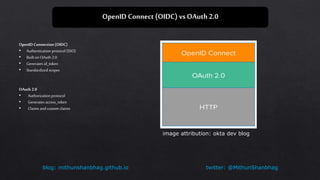
OpenID Connect (OIDC) vs OAuth 2.0
OpenID Connection (OIDC)
• Authentication protocol (SSO)
• Built on OAuth 2.0
• Generates id_token
• Standardizedscopes
OAuth 2.0
• Authorization protocol
• Generates access_token
• Claimsandcustom claims
image attribution: okta dev blog
twitter: @MithunShanbhagblog: mithunshanbhag.github.io
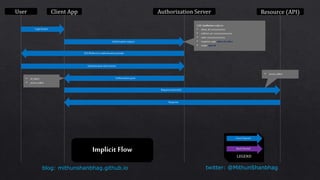
User Client App Authorization Server Resource (API)
Authorization request
Login button
302/Redirectto authentication prompt
Authentication and consent
Calls /authorize endpoint
• client_id: xxxxxxxxxxxx
• redirect_uri: xxxxxxxxxxxxxxx
• state:xxxxxxxxxxxxxxx
• response_type:tokenid_token
• scope: openid
Authorization grant
Requestresource(s)
• access_token
• id_token
• access_token
Response
Implicit Flow
LEGEND
FrontChannel
Back Channel
twitter: @MithunShanbhagblog: mithunshanbhag.github.io
DEMO
twitter: @MithunShanbhagblog: mithunshanbhag.github.io
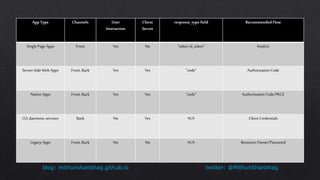
AppType Channels User
Interaction
Client
Secret
response_type field Recommended Flow
Single Page Apps Front Yes No “token id_token” Implicit
Server-Side Web Apps Front, Back Yes Yes “code” Authorization Code
Native Apps Front, Back Yes Yes “code” Authorization Code/PKCE
CLI,daemons, services Back No Yes N/A Client Credentials
Legacy Apps Front, Back No No N/A Resource Owner/Password
twitter: @MithunShanbhagblog: mithunshanbhag.github.io
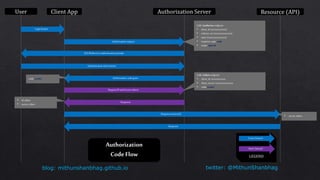
User Client App Authorization Server Resource (API)
Authorization request
Login button
302/Redirectto authentication prompt
Authentication and consent
Calls /authorize endpoint
• client_id: {xxxxxxxxxxxx}
• redirect_uri: {xxxxxxxxxxxxxx}
• state:{xxxxxxxxxxxxxxx}
• response_type:code
• scope: openid
Authorization code grant
RequestID and Access tokens
code: {code}
Response
Authorization
Code Flow LEGEND
FrontChannel
Back Channel
Calls /token endpoint
• client_id: xxxxxxxxxxxx
• client_secret: xxxxxxxxxxxxxxx
• code: {code}
• id_token
• access_token
Requestresource(s)
Response
• access_token
twitter: @MithunShanbhagblog: mithunshanbhag.github.io
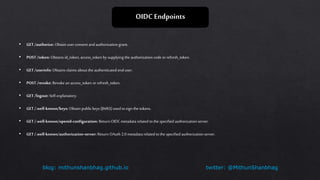
OIDC Endpoints
• GET/authorize: Obtain user consent andauthorization grant.
• POST/token: Obtains id_token, access_token by supplying the authorization code or refresh_token.
• GET/userinfo: Obtains claims about the authenticated end user.
• POST/revoke: Revoke an access_token or refresh_token.
• GET/logout: Self-explanatory.
• GET/.well-known/keys: Obtain public keys (JWKS) used tosign the tokens.
• GET/.well-known/openid-configuration: Return OIDCmetadata related tothe specified authorization server.
• GET/.well-known/authorization-server: Return OAuth 2.0 metadata related tothe specified authorization server.
twitter: @MithunShanbhagblog: mithunshanbhag.github.io
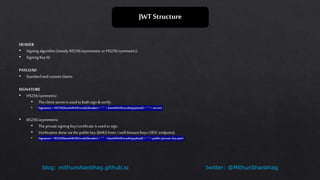
JWT Structure
HEADER
• Signing algorithm (mostly RS256/asymmetric orHS256/symmetric).
• Signing Key Id.
PAYLOAD
• Standardandcustom claims.
SIGNATURE
• HS256/symmetric:
• The client secret is used toboth sign & verify.
• Signature = HS256(base64UrlEncode(header)+ "." + base64UrlEncode(payload) + “.”+ secret)
• RS256/asymmetric:
• The private signing key/certificate is used tosign.
• Verification done via the public key (JWKS from/.well-known/keys OIDCendpoint).
• Signature = RS256(base64UrlEncode(header)+ "." + base64UrlEncode(payload) + “.”+ public/private key pair)
twitter: @MithunShanbhagblog: mithunshanbhag.github.io
Q&A

Identity, authentication and authorization

  • 1.
  • 2.
    twitter: @MithunShanbhagblog: mithunshanbhag.github.io OpenIDConnect (OIDC) vs OAuth 2.0 OpenID Connection (OIDC) • Authentication protocol (SSO) • Built on OAuth 2.0 • Generates id_token • Standardizedscopes OAuth 2.0 • Authorization protocol • Generates access_token • Claimsandcustom claims image attribution: okta dev blog
  • 3.
    twitter: @MithunShanbhagblog: mithunshanbhag.github.io UserClient App Authorization Server Resource (API) Authorization request Login button 302/Redirectto authentication prompt Authentication and consent Calls /authorize endpoint • client_id: xxxxxxxxxxxx • redirect_uri: xxxxxxxxxxxxxxx • state:xxxxxxxxxxxxxxx • response_type:tokenid_token • scope: openid Authorization grant Requestresource(s) • access_token • id_token • access_token Response Implicit Flow LEGEND FrontChannel Back Channel
  • 4.
  • 5.
    twitter: @MithunShanbhagblog: mithunshanbhag.github.io AppTypeChannels User Interaction Client Secret response_type field Recommended Flow Single Page Apps Front Yes No “token id_token” Implicit Server-Side Web Apps Front, Back Yes Yes “code” Authorization Code Native Apps Front, Back Yes Yes “code” Authorization Code/PKCE CLI,daemons, services Back No Yes N/A Client Credentials Legacy Apps Front, Back No No N/A Resource Owner/Password
  • 6.
    twitter: @MithunShanbhagblog: mithunshanbhag.github.io UserClient App Authorization Server Resource (API) Authorization request Login button 302/Redirectto authentication prompt Authentication and consent Calls /authorize endpoint • client_id: {xxxxxxxxxxxx} • redirect_uri: {xxxxxxxxxxxxxx} • state:{xxxxxxxxxxxxxxx} • response_type:code • scope: openid Authorization code grant RequestID and Access tokens code: {code} Response Authorization Code Flow LEGEND FrontChannel Back Channel Calls /token endpoint • client_id: xxxxxxxxxxxx • client_secret: xxxxxxxxxxxxxxx • code: {code} • id_token • access_token Requestresource(s) Response • access_token
  • 7.
    twitter: @MithunShanbhagblog: mithunshanbhag.github.io OIDCEndpoints • GET/authorize: Obtain user consent andauthorization grant. • POST/token: Obtains id_token, access_token by supplying the authorization code or refresh_token. • GET/userinfo: Obtains claims about the authenticated end user. • POST/revoke: Revoke an access_token or refresh_token. • GET/logout: Self-explanatory. • GET/.well-known/keys: Obtain public keys (JWKS) used tosign the tokens. • GET/.well-known/openid-configuration: Return OIDCmetadata related tothe specified authorization server. • GET/.well-known/authorization-server: Return OAuth 2.0 metadata related tothe specified authorization server.
  • 8.
    twitter: @MithunShanbhagblog: mithunshanbhag.github.io JWTStructure HEADER • Signing algorithm (mostly RS256/asymmetric orHS256/symmetric). • Signing Key Id. PAYLOAD • Standardandcustom claims. SIGNATURE • HS256/symmetric: • The client secret is used toboth sign & verify. • Signature = HS256(base64UrlEncode(header)+ "." + base64UrlEncode(payload) + “.”+ secret) • RS256/asymmetric: • The private signing key/certificate is used tosign. • Verification done via the public key (JWKS from/.well-known/keys OIDCendpoint). • Signature = RS256(base64UrlEncode(header)+ "." + base64UrlEncode(payload) + “.”+ public/private key pair)
  • 9.

Editor's Notes

  • #5 angular app (angular app) Fiddler jwt.io
  • #6 PKCE: Proof key for code exchange Code verifier, code challenge Client Credentials: Directly call the /token endpoint with client id + client secret, get access_token back Resource Owner Password: Directly call the /token endpoint with usernam + password, get access_token back