ECOBANK GROUP
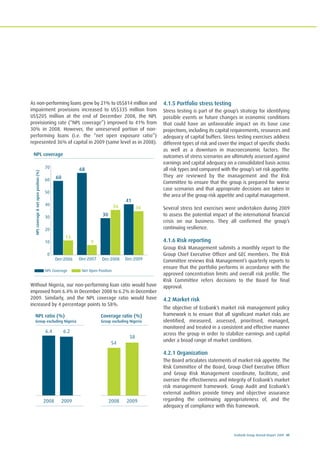
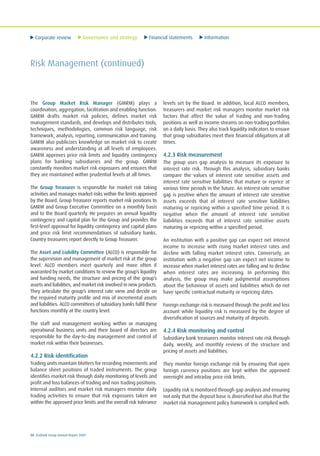
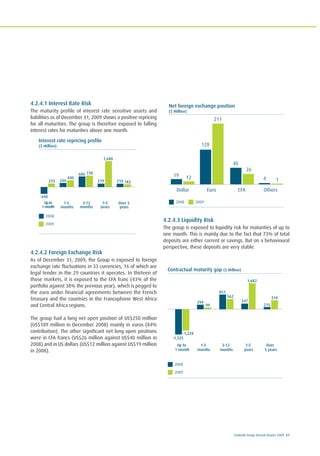
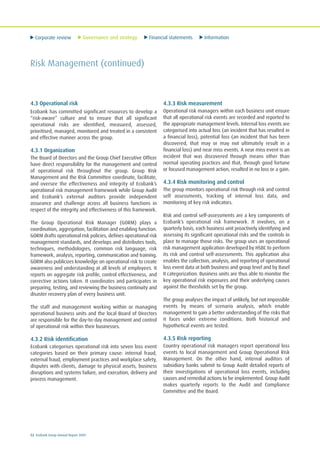
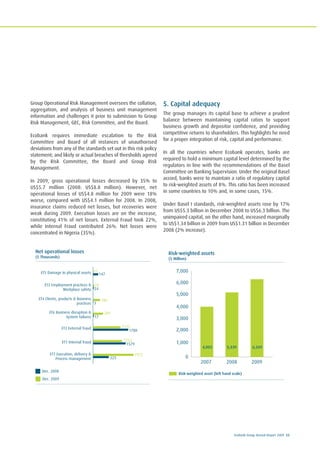
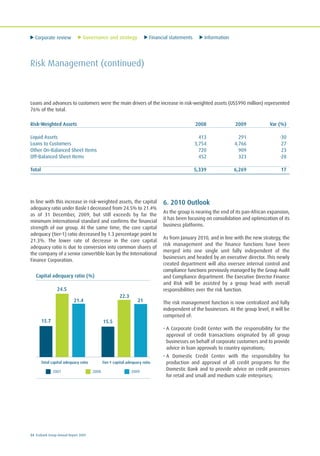
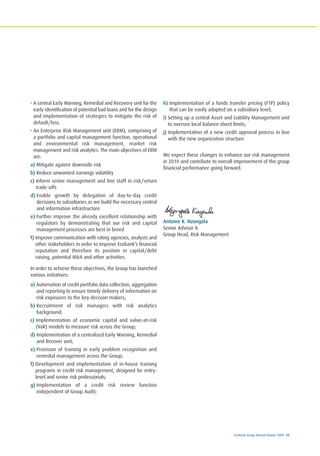
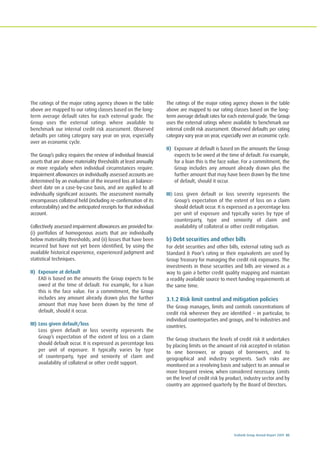
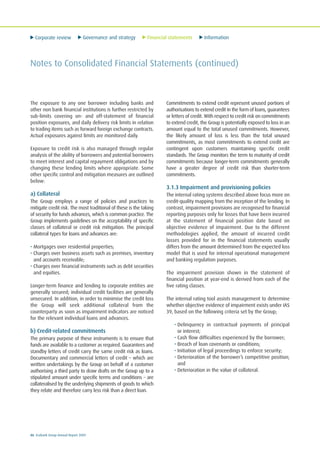
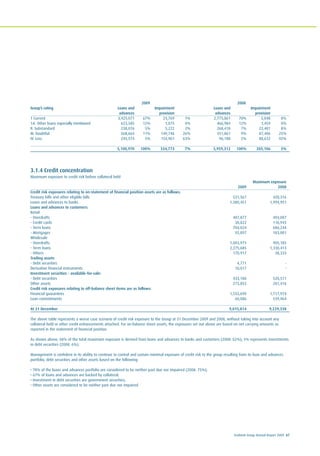
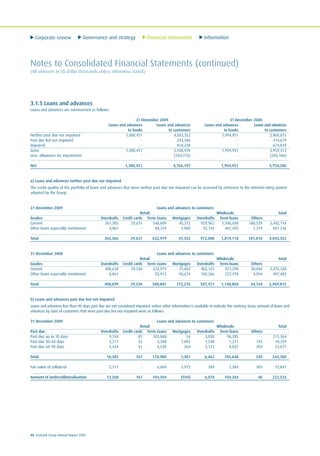
ANNUAL REPORT 2009
Corporate review Governance and strategy Financial statements Information
2 Ecobank Group Annual Report 2009
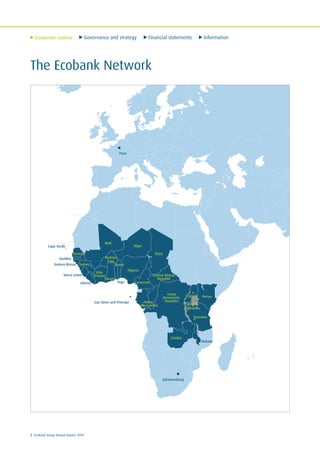
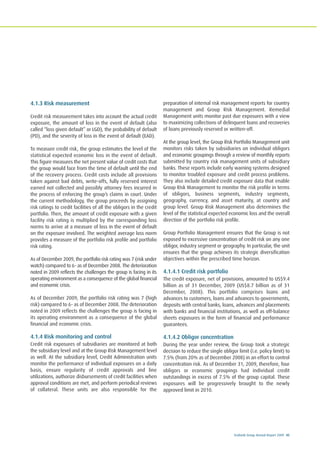
The Ecobank Network
Ecobank presence in 2010
Ecobank representative office and Paris affiliate
Niger
Nigeria
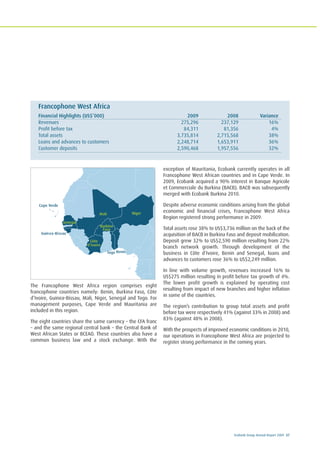
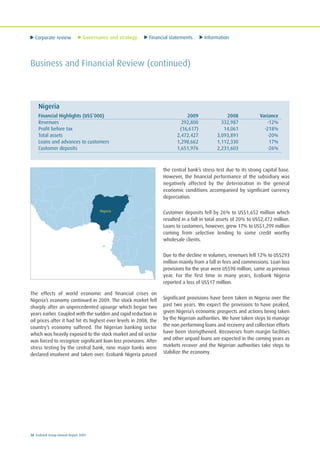
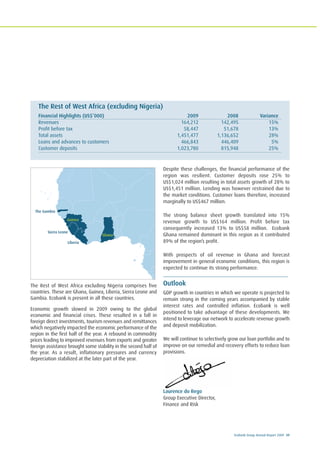
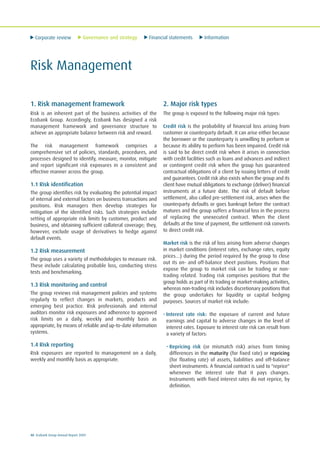
Chad
Mali
Ghana
Togo
Benin
Rwanda
Burundi
Malawi
Kenya
Tanzania
Uganda
Zambia
Johannesburg
Guinea
Sao Tome and Principe
Senegal
Cape Verde
Gambia
Guinea-Bissau
Sierra Leone
Liberia Cameroon
Central African
Republic
Burkina
Faso
Côte
d’Ivoire
Congo
(Brazzaville)
Congo
(Democratic
Republic)
Paris
Ecobank Group Annual Report 2009 3
Corporate Statement
Building a world class Pan-African bank
Ecobank is a full-service bank providing a broad range of products and services to governments,
financial institutions, multinationals, international organisations, medium, small and micro
businesses and individuals.
Listed on the Nigerian Stock Exchange, the Ghana Stock Exchange and the BRVM in Abidjan,
Ecobank is also the leading pan-African bank with operations in 30 countries across the
continent, more than any other bank in the world.
Leading geographical network in Africa
Ecobank currently operates in 30 countries in west, central,
eastern and southern Africa, namely: Benin, Burkina Faso,
Burundi, Cameroon, Cape Verde, Central African Republic,
Chad, Congo (Brazzaville), Congo (Democratic Republic), Côte
d’Ivoire, Gabon, Gambia, Ghana, Guinea, Guinea-Bissau,
Kenya, Liberia, Malawi, Mali, Niger, Nigeria, Rwanda, Sao
Tome and Principe, Senegal, Sierra Leone, Tanzania, Togo,
Uganda and Zambia. Ecobank has also a representative office
in Johannesburg, South Africa and a subsidiary in Paris,
France.
One bank everywhere
Ecobank operates as “One Bank” with a common brand,
common standards, policies and processes. This applies to all
the business units of the group, so customers get consistent
service across its branches and offices.
Balanced business mix
Ecobank is developing a balanced mix of retail, wholesale
and investment banking businesses.
Corporate social responsability and
sustainability
Through the Ecobank Foundation, Ecobank supports
charitable projects relating to women, children, health and
culture. Ecobank invests substantially in developing African
talent and management capacity. Through a partnership with
Accion, microfinance units are being promoted in countries
where Ecobank operates.
Technology
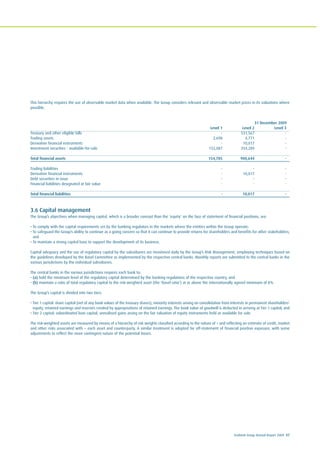
Ecobank has data centers in Accra, Lagos, Lome and Abidjan
that provide a common technology platform. These include
a regional switch connecting all affiliates and supporting the
group’s “One Bank” brand. The group also operates its own
fully integrated telecommunications network.
Corporate review Governance and strategy Financial statements Information
4 Ecobank Group Annual Report 2009
Contents
Corporate review
2 The Ecobank network
3 Corporate statement
5 Financial highlights
Governance and strategy
6 Chairman’s address
8 Directors’ report
10 Board of Directors
15 Chief Executive Officer’s review
18 Corporate governance
23 Corporate social responsibility and sustainability
26 Business and financial review
40 Risk management
56 Statement of Directors’ responsibilities
57 Report of the independent auditors
Financial statements
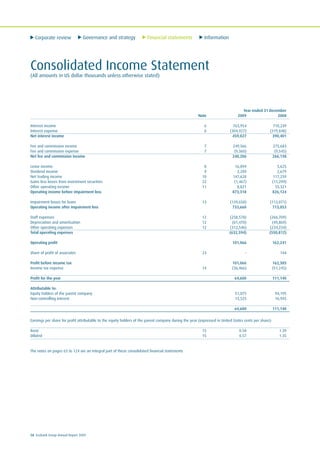
58 Consolidated income statement
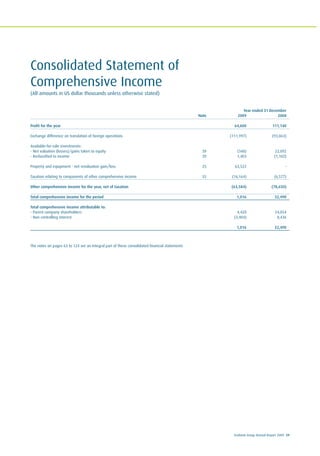
59 Consolidated statement of comprehensive income
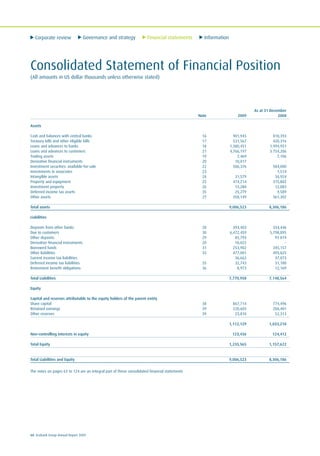
60 Consolidated statement of financial position
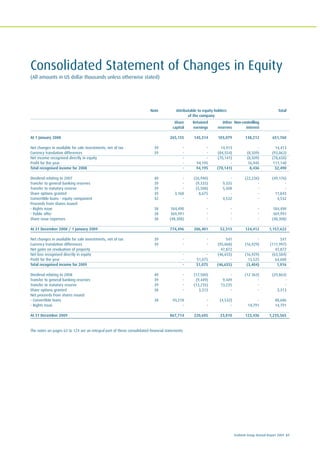
61 Consolidated statement of changes in equity
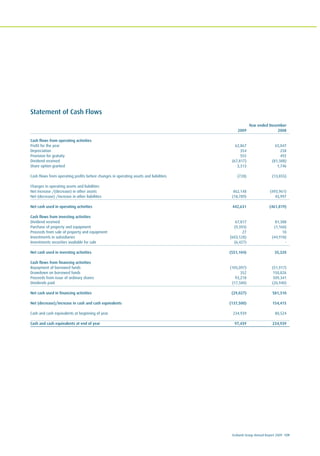
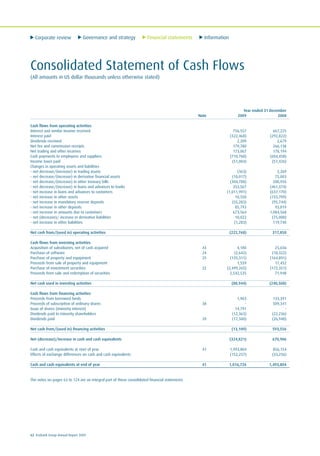
62 Consolidated statement of cash flows
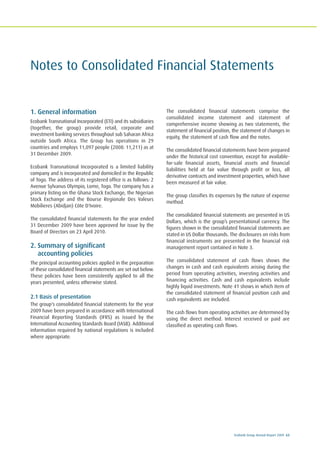
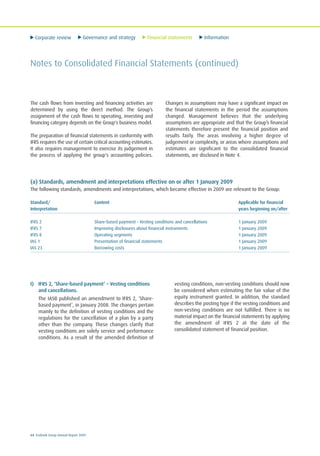
63 Notes to Consolidated Financial Statements
125 Five year summary of financial
126 Parent Company’s financial statement
Information
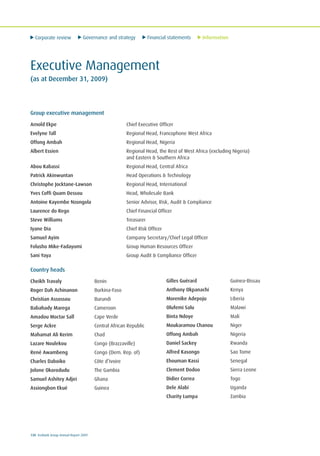
130 Executive Management
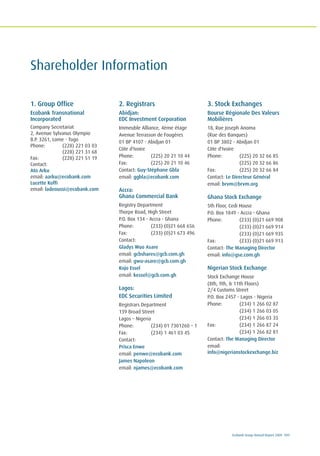
131 Shareholder information
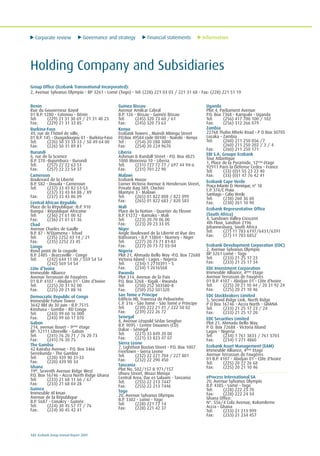
132 Holding company and subsidiaries
Ecobank Group Annual Report 2009 5
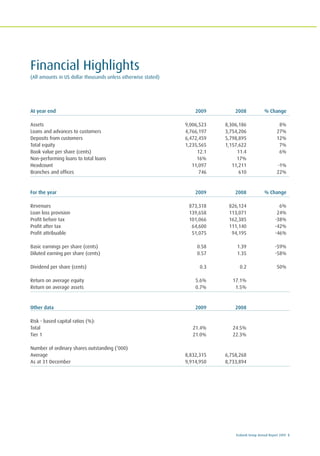
Financial Highlights
(All amounts in US dollar thousands unless otherwise stated)
At year end 2009 2008 % Change
Assets 9,006,523 8,306,186 8%
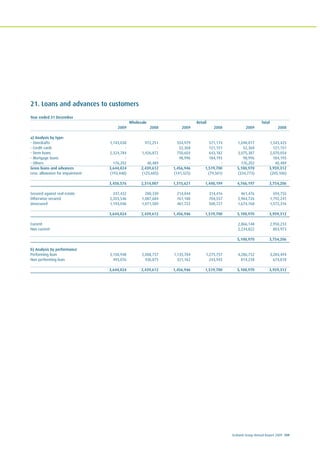
Loans and advances to customers 4,766,197 3,754,206 27%
Deposits from customers 6,472,459 5,798,895 12%
Total equity 1,235,565 1,157,622 7%
Book value per share (cents) 12.1 11.4 6%
Non-performing loans to total loans 16% 17%
Headcount 11,097 11,211 -1%
Branches and offices 746 610 22%
For the year 2009 2008 % Change
Revenues 873,318 826,124 6%
Loan loss provision 139,658 113,071 24%
Profit before tax 101,066 162,385 -38%
Profit after tax 64,600 111,140 -42%
Profit attribuable 51,075 94,195 -46%
Basic earnings per share (cents) 0.58 1.39 -59%
Diluted earning per share (cents) 0.57 1.35 -58%
Dividend per share (cents) 0.3 0.2 50%
Return on average equity 5.6% 17.1%
Return on average assets 0.7% 1.5%
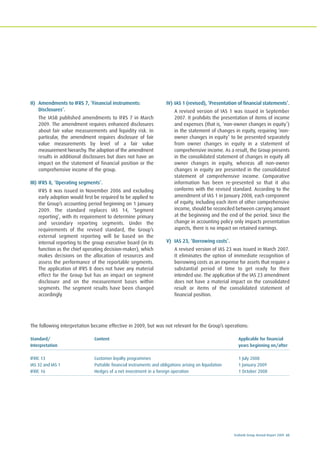
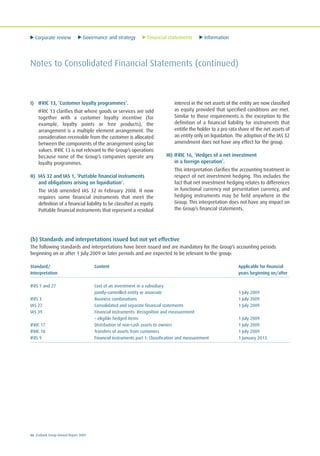
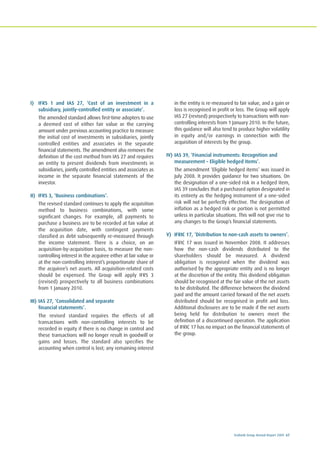
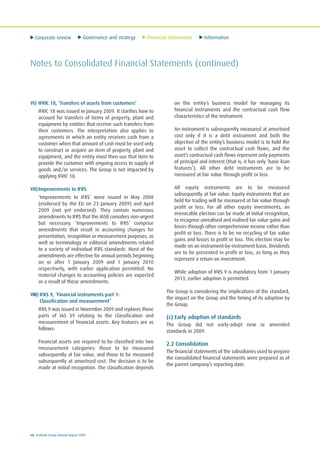
Other data 2009 2008
Risk - based capital ratios (%):
Total 21.4% 24.5%
Tier 1 21.0% 22.3%
Number of ordinary shares outstanding (‘000)
Average 8,832,315 6,758,268
As at 31 December 9,914,950 8,733,894
Corporate review Governance and strategy Financial statements Information
6 Ecobank Group Annual Report 2009
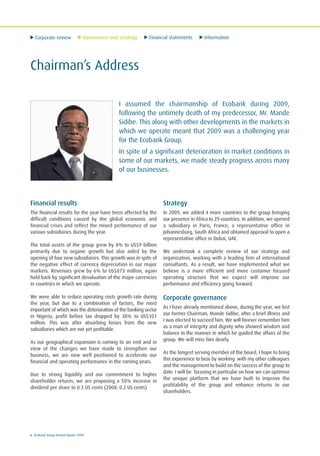
Chairman’s Address
I assumed the chairmanship of Ecobank during 2009,
following the untimely death of my predecessor, Mr. Mande
Sidibe. This along with other developments in the markets in
which we operate meant that 2009 was a challenging year
for the Ecobank Group.
In spite of a significant deterioration in market conditions in
some of our markets, we made steady progress across many
of our businesses.
Financial results
The financial results for the year have been affected by the
difficult conditions caused by the global economic and
financial crises and reflect the mixed performance of our
various subsidiaries during the year.
The total assets of the group grew by 8% to US$9 billion
primarily due to organic growth but also aided by the
opening of four new subsidiaries. This growth was in spite of
the negative effect of currency depreciation in our major
markets. Revenues grew by 6% to US$873 million, again
held back by significant devaluation of the major currencies
in countries in which we operate.
We were able to reduce operating costs growth rate during
the year, but due to a combination of factors, the most
important of which was the deterioration of the banking sector
in Nigeria, profit before tax dropped by 38% to US$101
million. This was after absorbing losses from the new
subsidiaries which are not yet profitable.
As our geographical expansion is coming to an end and in
view of the changes we have made to strengthen our
business, we are now well positioned to accelerate our
financial and operating performance in the coming years.
Due to strong liquidity and our commitment to higher
shareholder returns, we are proposing a 50% increase in
dividend per share to 0.3 US cents (2008: 0.2 US cents)
Strategy
In 2009, we added 4 more countries to the group bringing
our presence in Africa to 29 countries. In addition, we opened
a subsidiary in Paris, France, a representative office in
Johannesburg, South Africa and obtained approval to open a
representative office in Dubai, UAE.
We undertook a complete review of our strategy and
organization, working with a leading firm of international
consultants. As a result, we have implemented what we
believe is a more efficient and more customer focused
operating structure that we expect will improve our
performance and efficiency going forward.
Corporate governance
As I have already mentioned above, during the year, we lost
our former Chairman, Mande Sidibe, after a brief illness and
I was elected to succeed him. We will forever remember him
as a man of integrity and dignity who showed wisdom and
balance in the manner in which he guided the affairs of the
group. We will miss him dearly.
As the longest serving member of the board, I hope to bring
this experience to bear by working with my other colleagues
and the management to build on the success of the group to
date. I will be focusing in particular on how we can optimise
the unique platform that we have built to improve the
profitability of the group and enhance returns to our
shareholders.
Ecobank Group Annual Report 2009 7
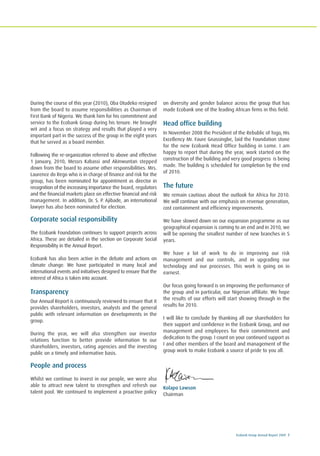
During the course of this year (2010), Oba Otudeko resigned
from the board to assume responsibilities as Chairman of
First Bank of Nigeria. We thank him for his commitment and
service to the Ecobank Group during his tenure. He brought
wit and a focus on strategy and results that played a very
important part in the success of the group in the eight years
that he served as a board member.
Following the re-organization referred to above and effective
1 January, 2010, Messrs Kabassi and Akinwuntan stepped
down from the board to assume other responsibilities. Mrs.
Laurence do Rego who is in charge of finance and risk for the
group, has been nominated for appointment as director in
recognition of the increasing importance the board, regulators
and the financial markets place on effective financial and risk
management. In addition, Dr. S. P. Ajibade, an international
lawyer has also been nominated for election.
Corporate social responsibility
The Ecobank Foundation continues to support projects across
Africa. These are detailed in the section on Corporate Social
Responsibility in the Annual Report.
Ecobank has also been active in the debate and actions on
climate change. We have participated in many local and
international events and initiatives designed to ensure that the
interest of Africa is taken into account.
Transparency
Our Annual Report is continuously reviewed to ensure that it
provides shareholders, investors, analysts and the general
public with relevant information on developments in the
group.
During the year, we will also strengthen our investor
relations function to better provide information to our
shareholders, investors, rating agencies and the investing
public on a timely and informative basis.
People and process
Whilst we continue to invest in our people, we were also
able to attract new talent to strengthen and refresh our
talent pool. We continued to implement a proactive policy
on diversity and gender balance across the group that has
made Ecobank one of the leading African firms in this field.
Head office building
In November 2008 the President of the Rebublic of Togo, His
Excellency Mr. Faure Gnassingbe, laid the Foundation stone
for the new Ecobank Head Office building in Lome. I am
happy to report that during the year, work started on the
construction of the building and very good progress is being
made. The building is scheduled for completion by the end
of 2010.
The future
We remain cautious about the outlook for Africa for 2010.
We will continue with our emphasis on revenue generation,
cost containment and efficiency improvements.
We have slowed down on our expansion programme as our
geographical expansion is coming to an end and in 2010, we
will be opening the smallest number of new branches in 5
years.
We have a lot of work to do in improving our risk
management and our controls, and in upgrading our
technology and our processes. This work is going on in
earnest.
Our focus going forward is on improving the performance of
the group and in particular, our Nigerian affiliate. We hope
the results of our efforts will start showing through in the
results for 2010.
I will like to conclude by thanking all our shareholders for
their support and confidence in the Ecobank Group, and our
management and employees for their commitment and
dedication to the group. I count on your continued support as
I and other members of the board and management of the
group work to make Ecobank a source of pride to you all.
Kolapo Lawson
Chairman
Corporate review Governance and strategy Financial statements Information
8 Ecobank Group Annual Report 2009
Directors’ Report
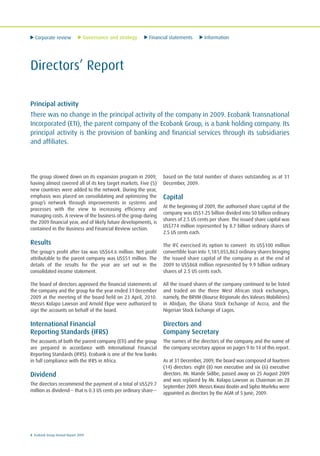
Principal activity
There was no change in the principal activity of the company in 2009. Ecobank Transnational
Incorporated (ETI), the parent company of the Ecobank Group, is a bank holding company. Its
principal activity is the provision of banking and financial services through its subsidiaries
and affiliates.
The group slowed down on its expansion program in 2009,
having almost covered all of its key target markets. Five (5)
new countries were added to the network. During the year,
emphasis was placed on consolidating and optimizing the
group’s network through improvements in systems and
processes with the view to increasing efficiency and
managing costs. A review of the business of the group during
the 2009 financial year, and of likely future developments, is
contained in the Business and Financial Review section.
Results
The group's profit after tax was US$64.6 million. Net profit
attributable to the parent company was US$51 million. The
details of the results for the year are set out in the
consolidated income statement.
The board of directors approved the financial statements of
the company and the group for the year ended 31 December
2009 at the meeting of the board held on 23 April, 2010.
Messrs Kolapo Lawson and Arnold Ekpe were authorized to
sign the accounts on behalf of the board.
International Financial
Reporting Standards (IFRS)
The accounts of both the parent company (ETI) and the group
are prepared in accordance with International Financial
Reporting Standards (IFRS). Ecobank is one of the few banks
in full compliance with the IFRS in Africa.
Dividend
The directors recommend the payment of a total of US$29.7
million as dividend— that is 0.3 US cents per ordinary share—
based on the total number of shares outstanding as at 31
December, 2009.
Capital
At the beginning of 2009, the authorised share capital of the
company was US$1.25 billion divided into 50 billion ordinary
shares of 2.5 US cents per share. The issued share capital was
US$774 million represented by 8.7 billion ordinary shares of
2.5 US cents each.
The IFC exercised its option to convert its US$100 million
convertible loan into 1,181,055,863 ordinary shares bringing
the issued share capital of the company as at the end of
2009 to US$868 million represented by 9.9 billion ordinary
shares of 2.5 US cents each.
All the issued shares of the company continued to be listed
and traded on the three West African stock exchanges,
namely, the BRVM (Bourse Régionale des Valeurs Mobilières)
in Abidjan, the Ghana Stock Exchange of Accra, and the
Nigerian Stock Exchange of Lagos.
Directors and
Company Secretary
The names of the directors of the company and the name of
the company secretary appear on pages 9 to 14 of this report.
As at 31 December, 2009, the board was composed of fourteen
(14) directors: eight (8) non executive and six (6) executive
directors. Mr. Mande Sidibe, passed away on 25 August 2009
and was replaced by Mr. Kolapo Lawson as Chairman on 28
September 2009. Messrs Kwasi Boatin and Sipho Mseleku were
appointed as directors by the AGM of 5 June, 2009.
Ecobank Group Annual Report 2009 9
The board of directors met six (6) times during the year. The
Governance Committee met four (4) times, the Audit and
Compliance Committee, three (3) times and the Risk
Committee once during the year to deliberate on issues
under their respective responsibilities.
Corporate governance
and compliance
The company maintains corporate policies and standards
designed to encourage good and transparent corporate
governance, avoid potential conflicts of interest and promote
ethical business practices. See pages 18 to 22 of this report.
Subsidiaries
In 2009, operations started in four more countries, namely,
Uganda, Gabon and Zambia (bringing the total number of
African countries in which Ecobank has banking operations
to 28) and an international financial and capital markets
operations in Paris, France. We also opened a representative
office in Johannesburg, South Africa. At the beginning of
2010, Ecobank Tanzania started operations bringing the total
number of countries in which the group is present to 31 as
at the date of this annual report. During the first half of this
year, we obtained a license for a representative office in
Dubai while efforts were underway to secure a similar
license in China.
Our investment banking subsidiary, Ecobank Development
Corporation (EDC), as well as its stockbrokerage units in
Central Africa Region, Ghana, Nigeria, Francophone West
Africa Region continued to develop their businesses. eProcess
International SA, our shared services and technology
subsidiary, continued its activities as the technology
infrastructure and platform for the group.
Ecobank Transnational Incorporated has a majority equity
interest in all its subsidiaries, and provides them with
management, operational, technical, training, business
development and advisory services.
Post balance sheet events
There were no post balance sheet events that could
materially affect either the reported state of affairs of the
company and the group as at 31 December, 2009 or the
profit for the year ended on the same date which have not
been adequately provided for or disclosed.
Responsibilities of Directors
The board of directors is responsible for the preparation of
the financial statements, which give a true and fair view of
the state of affairs of the company at the end of the financial
period and of the results for that period. These
responsibilities include ensuring that:
• adequate internal control procedures are instituted to
safeguard assets, prevent and detect fraud and other
irregularities
• proper accounting records are maintained
• applicable accounting standards are followed
• suitable accounting policies are used and consistently
applied
• the financial statements are prepared on the going concern
basis unless it is inappropriate to presume that the company
will continue in business.
Independent
External Auditors
The joint auditors, Pricewaterhouse-Coopers, Lagos, Nigeria
and Price- waterhouseCoopers S.A., Abidjan, Côte d'Ivoire
have indicated their willingness to continue in office. A
resolution will be presented at the 2010 AGM to authorize
the directors to determine their remuneration.
14 May, 2010
By Order of the Board,
Samuel K Ayim
Company Secretary
Corporate review Governance and strategy Financial statements Information
10 Ecobank Group Annual Report 2009
Board of Directors
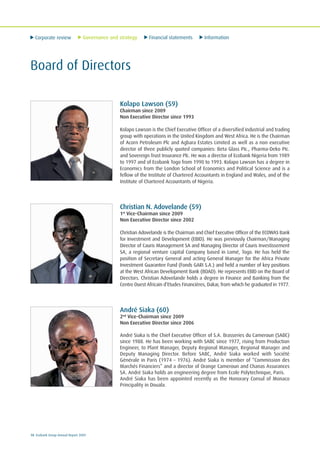
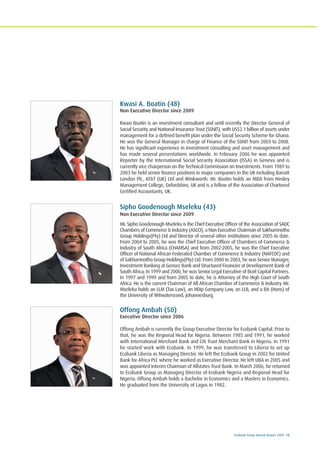
Kolapo Lawson (59)
Chairman since 2009
Non Executive Director since 1993
Kolapo Lawson is the Chief Executive Officer of a diversified industrial and trading
group with operations in the United Kingdom and West Africa. He is the Chairman
of Acorn Petroleum Plc and Agbara Estates Limited as well as a non executive
director of three publicly quoted companies: Beta Glass PIc., Pharma-Deko PIc.
and Sovereign Trust Insurance Plc. He was a director of Ecobank Nigeria from 1989
to 1997 and of Ecobank Togo from 1990 to 1993. Kolapo Lawson has a degree in
Economics from the London School of Economics and Political Science and is a
fellow of the Institute of Chartered Accountants in England and Wales, and of the
Institute of Chartered Accountants of Nigeria.
Christian N. Adovelande (59)
1st
Vice-Chairman since 2009
Non Executive Director since 2002
Christian Adovelande is the Chairman and Chief Executive Officer of the ECOWAS Bank
for Investment and Development (EBID). He was previously Chairman/Managing
Director of Cauris Management SA and Managing Director of Cauris Investissement
SA, a regional venture capital Company based in Lomé, Togo. He has held the
position of Secretary General and acting General Manager for the Africa Private
Investment Guarantee Fund (Fonds GARI S.A.) and held a number of key positions
at the West African Development Bank (BOAD). He represents EBID on the Board of
Directors. Christian Adovelande holds a degree in Finance and Banking from the
Centre Ouest Africain d’Etudes Financières, Dakar, from which he graduated in 1977.
André Siaka (60)
2nd
Vice-Chairman since 2009
Non Executive Director since 2006
André Siaka is the Chief Executive Officer of S.A. Brasseries du Cameroun (SABC)
since 1988. He has been working with SABC since 1977, rising from Production
Engineer, to Plant Manager, Deputy Regional Manager, Regional Manager and
Deputy Managing Director. Before SABC, André Siaka worked with Société
Générale in Paris (1974 – 1976). André Siaka is member of “Commission des
Marchés Financiers” and a director of Orange Cameroun and Chanas Assurances
SA. André Siaka holds an engineering degree from Ecole Polytechnique, Paris.
André Siaka has been appointed recently as the Honorary Consul of Monaco
Principality in Douala.
Ecobank Group Annual Report 2009 11
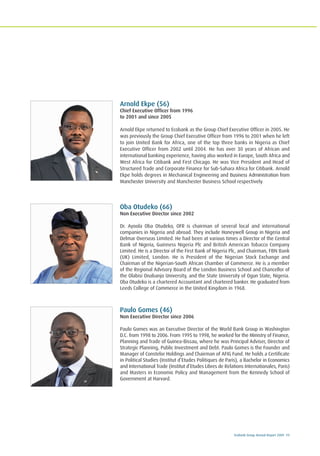
Arnold Ekpe (56)
Chief Executive Officer from 1996
to 2001 and since 2005
Arnold Ekpe returned to Ecobank as the Group Chief Executive Officer in 2005. He
was previously the Group Chief Executive Officer from 1996 to 2001 when he left
to join United Bank for Africa, one of the top three banks in Nigeria as Chief
Executive Officer from 2002 until 2004. He has over 30 years of African and
international banking experience, having also worked in Europe, South Africa and
West Africa for Citibank and First Chicago. He was Vice President and Head of
Structured Trade and Corporate Finance for Sub-Sahara Africa for Citibank. Arnold
Ekpe holds degrees in Mechanical Engineering and Business Administration from
Manchester University and Manchester Business School respectively.
Oba Otudeko (66)
Non Executive Director since 2002
Dr. Ayoola Oba Otudeko, OFR is chairman of several local and international
companies in Nigeria and abroad. They include Honeywell Group in Nigeria and
Delmar Overseas Limited. He had been at various times a Director of the Central
Bank of Nigeria, Guinness Nigeria Plc and British American Tobacco Company
Limited. He is a Director of the First Bank of Nigeria Plc, and Chairman, FBN Bank
(UK) Limited, London. He is President of the Nigerian Stock Exchange and
Chairman of the Nigerian-South African Chamber of Commerce. He is a member
of the Regional Advisory Board of the London Business School and Chancellor of
the Olabisi Onabanjo University, and the State University of Ogun State, Nigeria.
Oba Otudeko is a chartered Accountant and chartered banker. He graduated from
Leeds College of Commerce in the United Kingdom in 1968.
Paulo Gomes (46)
Non Executive Director since 2006
Paulo Gomes was an Executive Director of the World Bank Group in Washington
D.C. from 1998 to 2006. From 1995 to 1998, he worked for the Ministry of Finance,
Planning and Trade of Guinea-Bissau, where he was Principal Adviser, Director of
Strategic Planning, Public Investment and Debt. Paulo Gomes is the Founder and
Manager of Constelor Holdings and Chairman of AFIG Fund. He holds a Certificate
in Political Studies (Institut d’Etudes Politiques de Paris), a Bachelor in Economics
and International Trade (Institut d’Etudes Libres de Relations Internationales, Paris)
and Masters in Economic Policy and Management from the Kennedy School of
Government at Harvard.
Corporate review Governance and strategy Financial statements Information
12 Ecobank Group Annual Report 2009
Isyaku Umar (62)
Non Executive Director since 2006
Isyaku Umar started his career with UAC of Nigeria. From 1972 to 1976, he was
employed in Kano State Government and was at various times Secretary of the
Draught Relief Committee and Principal Private Secretary to the Military Governor.
Following that, he became the General Manager of Mai-Nasara and Sons Limited
from 1977 to 1979, and Managing Director of Tofa General Enterprises Ltd from
1979 to date. Isyaku Umar holds a Bachelor’s degree in Economics from Ahmadu
Bello University Zaria and a Master of Public Administration degree from
Pittsburgh University and an Hononary Doctorate Degree by Nnamdi Azikiwe
University Awka Anambra State Nigeria.
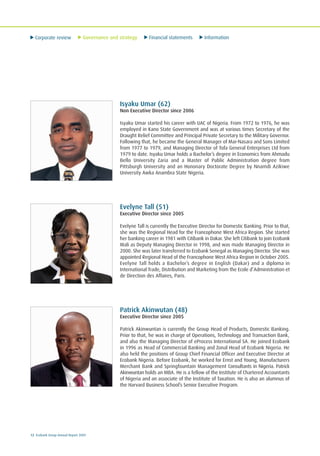
Evelyne Tall (51)
Executive Director since 2005
Evelyne Tall is currently the Executive Director for Domestic Banking. Prior to that,
she was the Regional Head for the Francophone West Africa Region. She started
her banking career in 1981 with Citibank in Dakar. She left Citibank to join Ecobank
Mali as Deputy Managing Director in 1998, and was made Managing Director in
2000. She was later transferred to Ecobank Senegal as Managing Director. She was
appointed Regional Head of the Francophone West Africa Region in October 2005.
Evelyne Tall holds a Bachelor’s degree in English (Dakar) and a diploma in
International Trade, Distribution and Marketing from the Ecole d’Administration et
de Direction des Affaires, Paris.
Patrick Akinwutan (48)
Executive Director since 2005
Patrick Akinwuntan is currently the Group Head of Products, Domestic Banking.
Prior to that, he was in charge of Operations, Technology and Transaction Bank,
and also the Managing Director of eProcess International SA. He joined Ecobank
in 1996 as Head of Commercial Banking and Zonal Head of Ecobank Nigeria. He
also held the positions of Group Chief Financial Officer and Executive Director at
Ecobank Nigeria. Before Ecobank, he worked for Ernst and Young, Manufacturers
Merchant Bank and Springfountain Management Consultants in Nigeria. Patrick
Akinwuntan holds an MBA. He is a fellow of the Institute of Chartered Accountants
of Nigeria and an associate of the Institute of Taxation. He is also an alumnus of
the Harvard Business School’s Senior Executive Program.
Ecobank Group Annual Report 2009 13
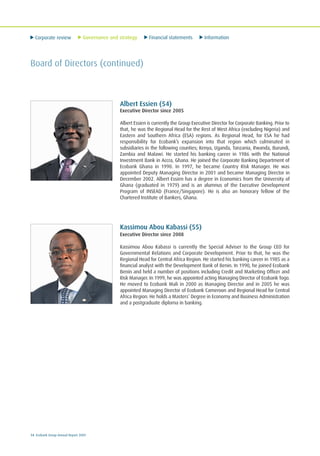
Kwasi A. Boatin (48)
Non Executive Director since 2009
Kwasi Boatin is an investment consultant and until recently the Director General of
Social Security and National Insurance Trust (SSNIT), with US$2.1 billion of assets under
management for a defined benefit plan under the Social Security Scheme for Ghana.
He was the General Manager in charge of Finance of the SSNIT from 2003 to 2008.
He has significant experience in investment consulting and asset management and
has made several presentations worldwide. In February 2006 he was appointed
Reporter by the International Social Security Association (ISSA) in Geneva and is
currently vice chairperson on the Technical Commission on Investments. From 1989 to
2003 he held senior finance positions in major companies in the UK including Barratt
London Plc, AT&T (UK) Ltd and Winkworth. Mr. Boatin holds an MBA from Henley
Management College, Oxfordshire, UK and is a fellow of the Association of Chartered
Certified Accountants, UK.
Sipho Goodenough Mseleku (43)
Non Executive Director since 2009
Mr. Sipho Goodenough Mseleku is the Chief Executive Officer of the Association of SADC
Chambers of Commerce & Industry (ASCCI), a Non Executive Chairman of Sakhumnotho
Group Holdings(Pty) Ltd and Director of several other institutions since 2005 to date.
From 2004 to 2005, he was the Chief Executive Officer of Chambers of Commerce &
Industry of South Africa (CHAMSA) and from 2002-2005, he was the Chief Executive
Officer of National African Federated Chamber of Commerce & Industry (NAFCOC) and
of Sakhumnotho Group Holdings(Pty) Ltd. From 2000 to 2003, he was Senior Manager,
Investment Banking at Gensec Bank and Structured Financier at Development Bank of
South Africa; In 1999 and 2000, he was Senior Legal Executive of Brait Capital Partners.
In 1997 and 1999 and from 2005 to date, he is Attorney of the High Court of South
Africa. He is the current Chairman of All African Chamber of Commerce & Industry. Mr.
Mseleku holds an LLM (Tax Law), an HDip Company Law, an LLB, and a BA (Hons) of
the University of Witwatersrand, Johannesburg.
Offong Ambah (50)
Executive Director since 2006
Offong Ambah is currently the Group Executive Director for Ecobank Capital. Prior to
that, he was the Regional Head for Nigeria. Between 1985 and 1991, he worked
with International Merchant Bank and Citi Trust Merchant Bank in Nigeria. In 1991
he started work with Ecobank. In 1999, he was transferred to Liberia to set up
Ecobank Liberia as Managing Director. He left the Ecobank Group in 2002 for United
Bank for Africa PLC where he worked as Executive Director. He left UBA in 2005 and
was appointed Interim Chairman of Allstates Trust Bank. In March 2006, he returned
to Ecobank Group as Managing Director of Ecobank Nigeria and Regional Head for
Nigeria. Offong Ambah holds a Bachelor in Economics and a Masters in Economics.
He graduated from the University of Lagos in 1982.
Corporate review Governance and strategy Financial statements Information
14 Ecobank Group Annual Report 2009
Board of Directors (continued)
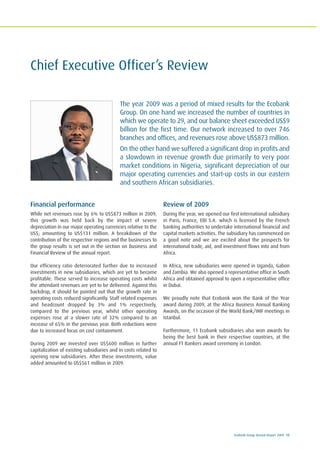
Albert Essien (54)
Executive Director since 2005
Albert Essien is currently the Group Executive Director for Corporate Banking. Prior to
that, he was the Regional Head for the Rest of West Africa (excluding Nigeria) and
Eastern and Southern Africa (ESA) regions. As Regional Head, for ESA he had
responsibility for Ecobank’s expansion into that region which culminated in
subsidiaries in the following counties; Kenya, Uganda, Tanzania, Rwanda, Burundi,
Zambia and Malawi. He started his banking career in 1986 with the National
Investment Bank in Accra, Ghana. He joined the Corporate Banking Department of
Ecobank Ghana in 1990. In 1997, he became Country Risk Manager. He was
appointed Deputy Managing Director in 2001 and became Managing Director in
December 2002. Albert Essien has a degree in Economics from the University of
Ghana (graduated in 1979) and is an alumnus of the Executive Development
Program of INSEAD (France/Singapore). He is also an honorary fellow of the
Chartered Institute of Bankers, Ghana.
Kassimou Abou Kabassi (55)
Executive Director since 2008
Kassimou Abou Kabassi is currently the Special Adviser to the Group CEO for
Governmental Relations and Corporate Development. Prior to that, he was the
Regional Head for Central Africa Region. He started his banking career in 1985 as a
financial analyst with the Development Bank of Benin. In 1990, he joined Ecobank
Benin and held a number of positions including Credit and Marketing Officer and
Risk Manager. In 1999, he was appointed acting Managing Director of Ecobank Togo.
He moved to Ecobank Mali in 2000 as Managing Director and in 2005 he was
appointed Managing Director of Ecobank Cameroon and Regional Head for Central
Africa Region. He holds a Masters’ Degree in Economy and Business Administration
and a postgraduate diploma in banking.
Ecobank Group Annual Report 2009 15
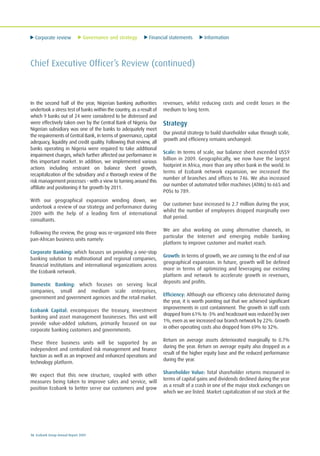
Chief Executive Officer’s Review
The year 2009 was a period of mixed results for the Ecobank
Group. On one hand we increased the number of countries in
which we operate to 29, and our balance sheet exceeded US$9
billion for the first time. Our network increased to over 746
branches and offices, and revenues rose above US$873 million.
On the other hand we suffered a significant drop in profits and
a slowdown in revenue growth due primarily to very poor
market conditions in Nigeria, significant depreciation of our
major operating currencies and start-up costs in our eastern
and southern African subsidiaries.
Financial performance
While net revenues rose by 6% to US$873 million in 2009,
this growth was held back by the impact of severe
depreciation in our major operating currencies relative to the
US$; amounting to US$131 million. A breakdown of the
contribution of the respective regions and the businesses to
the group results is set out in the section on Business and
Financial Review of the annual report.
Our efficiency ratio deteriorated further due to increased
investments in new subsidiaries, which are yet to become
profitable. These served to increase operating costs whilst
the attendant revenues are yet to be delivered. Against this
backdrop, it should be pointed out that the growth rate in
operating costs reduced significantly. Staff related expenses
and headcount dropped by 3% and 1% respectively,
compared to the previous year, whilst other operating
expenses rose at a slower rate of 32% compared to an
increase of 65% in the previous year. Both reductions were
due to increased focus on cost containment.
During 2009 we invested over US$600 million in further
capitalization of existing subsidiaries and in costs related to
opening new subsidiaries. After these investments, value
added amounted to US$561 million in 2009.
Review of 2009
During the year, we opened our first international subsidiary
in Paris, France, EBI S.A. which is licensed by the French
banking authorities to undertake international financial and
capital markets activities. The subsidiary has commenced on
a good note and we are excited about the prospects for
international trade, aid, and investment flows into and from
Africa.
In Africa, new subsidiaries were opened in Uganda, Gabon
and Zambia. We also opened a representative office in South
Africa and obtained approval to open a representative office
in Dubai.
We proudly note that Ecobank won the Bank of the Year
award during 2009, at the Africa Business Annual Banking
Awards, on the occasion of the World Bank/IMF meetings in
Istanbul.
Furthermore, 11 Ecobank subsidiaries also won awards for
being the best bank in their respective countries, at the
annual FT Bankers award ceremony in London.
Corporate review Governance and strategy Financial statements Information
16 Ecobank Group Annual Report 2009
Chief Executive Officer’s Review (continued)
In the second half of the year, Nigerian banking authorities
undertook a stress test of banks within the country, as a result of
which 9 banks out of 24 were considered to be distressed and
were effectively taken over by the Central Bank of Nigeria. Our
Nigerian subsidiary was one of the banks to adequately meet
the requirements of Central Bank, in terms of governance, capital
adequacy, liquidity and credit quality. Following that review, all
banks operating in Nigeria were required to take additional
impairment charges, which further affected our performance in
this important market. In addition, we implemented various
actions including restraint on balance sheet growth,
recapitalization of the subsidiary and a thorough review of the
risk management processes - with a view to turning around this
affiliate and positioning it for growth by 2011.
With our geographical expansion winding down, we
undertook a review of our strategy and performance during
2009 with the help of a leading firm of international
consultants.
Following the review, the group was re-organized into three
pan-African business units namely:
Corporate Banking: which focuses on providing a one-stop
banking solution to multinational and regional companies,
financial institutions and international organizations across
the Ecobank network.
Domestic Banking: which focuses on serving local
companies, small and medium scale enterprises,
government and government agencies and the retail market.
Ecobank Capital: encompasses the treasury, investment
banking and asset management businesses. This unit will
provide value-added solutions, primarily focused on our
corporate banking customers and governments.
These three business units will be supported by an
independent and centralized risk management and finance
function as well as an improved and enhanced operations and
technology platform.
We expect that this new structure, coupled with other
measures being taken to improve sales and service, will
position Ecobank to better serve our customers and grow
revenues, whilst reducing costs and credit losses in the
medium to long term.
Strategy
Our pivotal strategy to build shareholder value through scale,
growth and efficiency remains unchanged:
Scale: In terms of scale, our balance sheet exceeded US$9
billion in 2009. Geographically, we now have the largest
footprint in Africa, more than any other bank in the world. In
terms of Ecobank network expansion, we increased the
number of branches and offices to 746. We also increased
our number of automated teller machines (ATMs) to 665 and
POSs to 789.
Our customer base increased to 2.7 million during the year,
whilst the number of employees dropped marginally over
that period.
We are also working on using alternative channels, in
particular the Internet and emerging mobile banking
platform to improve customer and market reach.
Growth: In terms of growth, we are coming to the end of our
geographical expansion. In future, growth will be defined
more in terms of optimizing and leveraging our existing
platform and network to accelerate growth in revenues,
deposits and profits.
Efficiency: Although our efficiency ratio deteriorated during
the year, it is worth pointing out that we achieved significant
improvements in cost containment. The growth in staff costs
dropped from 61% to -3% and headcount was reduced by over
1%, even as we increased our branch network by 22%. Growth
in other operating costs also dropped from 69% to 32%.
Return on average assets deteriorated marginally to 0.7%
during the year. Return on average equity also dropped as a
result of the higher equity base and the reduced performance
during the year.
Shareholder Value: Total shareholder returns measured in
terms of capital gains and dividends declined during the year
as a result of a crash in one of the major stock exchanges on
which we are listed. Market capitalization of our stock at the
Ecobank Group Annual Report 2009 17
end of 2009 was US$961 million, compared to US$2,516
million at the end of 2008. However, market capital has
increased by over 50% since the end of 2009.
Return on average equity dropped to 5.6% as a result of the
reduced profit during the year and the increased capital base.
Earning per share amounted to 0.58 US cents.
Conclusion
Competition in the banking industry continues to gather
strength. We see several banking groups looking to
implement regional strategies similar to Ecobank’s. We
believe that our first mover advantage has positioned us to
better withstand the unfolding competition. To fortify the
group, we would be looking to strengthen our balance sheet
through raising additional capital and bringing new talent to
strengthen the management pool. We also aim to invest in
training and staff development and in modernizing and
improving our risk management and operating processes,
systems and controls.
While 2009 was a challenging year for the group, our priority
in 2010 is to improve the financial and operating
performance of the group. We will re-energize the group for
improved performance and results. Barring any unforeseen
circumstances, these measures should start bearing fruit over
the course of 2010.
Arnold Ekpe
Group Chief Executive Officer
Corporate review Governance and strategy Financial statements Information
18 Ecobank Group Annual Report 2009
Corporate Governance
Commitment to corporate governance
The Ecobank Group is committed to ensuring good corporate
governance. The group believes that good corporate
governance enhances shareholder value. Ecobank has been
a pioneer in West African banking in institutionalizing
corporate governance principles as part of the group’s
corporate culture. To this end, Ecobank aims at complying
with best international practices on corporate governance.
Adherence to corporate governance principles is articulated
in a number of corporate documents. The Articles of
Association of the company and those of its subsidiaries
define the respective roles of management, the board of
directors and shareholders (including the protection of
minority rights) in the administration of the group. The group
has standard written rules for the internal operation of the
boards of directors, a corporate governance charter, a code of
conduct for directors and rules on business ethics for staff,
all of which aim at ensuring transparency and accountability.
The board of directors has adopted the IFC principles and
methodology on corporate governance to guide its corporate
governance framework. The group’s governance practices are
also guided by the Basel Committee standards on corporate
governance.
The composition of the board includes executive, non-
executive and independent directors. Non-executive directors
always constitute a majority of the board.
Guided by the IFC’s suggested definition of an independent
director, the board has formally adopted the following
definition of independent director for application throughout
the group.
"Independent Director" means a Director who:
• has not been employed by ETI or any of its subsidiaries and
affiliates in the past five years;
• is not affiliated with a company that is, an advisor or
consultant to ETI or any of its subsidiaries and affiliates;
• is not affiliated with a significant customer or supplier of
the group or any of its subsidiaries and affiliates;
• has no personal service contracts with the group, any of its
subsidiaries and affiliates, or its senior management;
• is not affiliated with a non-profit organization that receives
significant funding from the group or any of its subsidiaries
and affiliates;
• is not employed as an executive of another company where
any of the group's executives serve on that company's
board of directors;
• is not a member of the immediate family of an individual
who is, or has been during the past five years, employed by
the group or any of its subsidiaries and affiliates as an
executive officer;
• is not, nor in the past five years has been, affiliated with or
employed by a present or former auditor of the group or of
its subsidiaries and affiliate; or
• is not a controlling person of the group (or member of a
group of individuals and/or entities that collectively
exercise effective control over the group) or such person’s
brother, sister, parent, grandparent, child, cousin, aunt,
uncle, nephew or niece or a spouse, widow, in-law, heir,
legatee and successor of any of the foregoing (or any trust
or similar arrangement of which any such persons or a
combination thereof are the sole beneficiaries) or the
executor, administrator or personal representative of any
person described in this sub-paragraph who is deceased or
legally incompetent.
For the purposes of this definition, a person shall be deemed
to be "affiliated" with a party if such person (i) has a direct
or indirect ownership interest in; or (ii) is employed by such
party.
By this definition, most of the company’s non-executive
directors are independent directors.
The board also applies the following criteria for the
appointment of non-executive directors:
• Independence – Although not all non-executive directors
need to meet the independent director definition above,
all directors should be capable of exercising independent
judgment and decision-taking.
• Demonstrated business acumen – Strong business
experience and a proven understanding of corporate and
business processes through a successful track record and a
strong reputation in the business community.
Ecobank Group Annual Report 2009 19
• Leadership and board experience – A recognized ability to
add value and display leadership at board level and an
ability to assert balanced and constructive views at board
level.
• Special technical skills or expertise – Experience in banking
(particularly retail banking but also commercial and/or
investment banking), accounting, and/or law and expertise
not readily available to the executive team would be
valuable especially if this professional experience is in
emerging markets.
• Integrity – High level of integrity and professional and
personal ethics and values consistent with those of the
Ecobank Group.
• Character – Strength of character and ability and willingness
to challenge and probe; sound business judgment; strong
interpersonal skills; and the ability to listen carefully and
communicate with clarity, objectivity and brevity.
• Time commitment – Sufficient time to effectively carry out
duties of a non-executive director.
• Additional considerations – Importance of bringing more
diversity to the board in terms of age, gender,
demographics, etc.
The board has also adopted standard evaluation tools to help
assess the performance of the board as a whole as well as that
of individual directors. In 2009, evaluation was administered to
all directors of ETI and subsidiaries across the group. Analysis of
the reports of the evaluation indicate very high performance of
the board of the group.
Governance structures within
the Ecobank Group
The Ecobank Group corporate governance documents outline
corporate governance policies and clarify governance
structures throughout the group. It covers essentially the
following areas :
• Role of the parent company
• Relationships and interface between the parent company
and subsidiaries
• Standards of conducts and procedure for directors.
The key principles underlying the group's governance
structures are as follows:
• The parent company acts as a "strategic architect" with
appropriate involvement in operational management and
decision making at subsidiaries level. It sets the overall
strategy and direction of the group, develops policies and
procedures and monitors them through reviews and audits
to ensure compliance not only with group strategy, policies
and procedures but also with local laws and regulations.
• Operational decision-making is individualized and
maintained at an appropriate level, as close as possible to
required action and customers.
• Individual accountability and responsibility are
institutionalized and embedded through empowerment
and the granting of relevant levels of authority.
• Coordination at the corporate centre and group level is
achieved through high levels of interaction between parent
company and its subsidiaries as well as amongst
subsidiaries at board and executive management levels.
• Clear terms of reference and accountability are laid out for
committees at board and executive levels. There is effective
communication and information sharing outside of
meetings. The group operates an “open-door” policy.
• Application of group decisions and policies by all Ecobank
Group member companies is subject to applicable local law
and regulation. Where there is a conflict between Group
Policy and local laws and regulations, local law and
regulations shall prevail.
The following are the governance units within the group:
• The parent company board of directors
• Country board of directors
• Group executive management committee
• Country executive management committee
• Business leaders conference.
Appropriate sub-committees are also set up, either on a
permanent or ad hoc basis to handle issues as they arise. A
brief overview of the roles and responsibilities of each of the
governance units is provided below.
Corporate review Governance and strategy Financial statements Information
20 Ecobank Group Annual Report 2009
Corporate Governance (continued)
Parent Company Board of Directors
The board of directors of ETI is elected by, and accountable to,
the company's shareholders for the proper and effective
administration of the Ecobank Group. Their primary
responsibility is to foster the long-term success of the
company, consistent with its fiduciary responsibility to the
shareholders. The group’s governance charter requires the
board of directors to be guided by the following principles:
• Clear delineation and segregation of responsibilities
between executive management and board to ensure non-
interference of the board in the operational management
of the group;
• Objective judgment on corporate affairs independent of
executive management;
• Actions on a fully informed basis, in good faith, with due
diligence and care and in the best interest of the group and
its shareholders;
• Compliance with applicable laws and regulations in line
with group strategy and direction;
• Local legislation to prevail in the event of any conflict
between group policies and local laws;
• Transparency and avoidance of conflict of interest between
directors and the business of the Ecobank Group;
• Full disclosure of accurate, adequate and timely information
regarding personal interests of directors.
As at the end of 2009, the membership of the board was
fourteen, comprising six executive and eight non-executive
directors (refer to pages 10 to 14). The Group Corporate
Governance Charter requires that there are more non-executive
directors than executives on the board.
The board has three committees, namely, the Governance
Committee, the Audit and Compliance Committee and the Risk
Committee.
The board of directors met six (6) times during the year. The
Governance Committee met four (4) times, the Audit and
Compliance Committee, three (3) times and the Risk
Committee one (1) time during the year to deliberate on issues
under their respective responsibilities.
The membership of the committees was reconstituted during
the year following changes on the board. The current
composition and terms of reference of the committees are
summarized below:
Governance committee
Composition
At the end of 2009, the Committee comprised of five
members:the board Chairman, the two vice –Chairmen
(Messrs Christian Adovelande and Andre Siaka), the Chief
Executive Officer and one non executive director (Mr. Oba
Otudeko). Mr. Siaka joined the committee on its
reconstitution on December 4, 2009.
The Company Secretary is the secretary to the Committee.
Responsibilities
• Formulates, reviews and generally ensures implementation
of policies applicable to all units of the group and ensure
good governance throughout the group;
• Manages the relationship between the company and its
shareholders and subsidiaries, including relationships with
the boards of subsidiaries;
• Formulates new and reviews existing group-wide policies
including organizational structure;
• Handles relationship with regulators and third parties;
• Manages board affairs in between the meetings of the
board or when the board is not sitting;
• Recommends the appointment of executive and non-
executive directors;
• Reviews the human resources strategy and policies of the
group and the remuneration of senior executives.
Audit and compliance committee
Composition
Membership as the end of 2009 was composed of two non-
executive directors (Messrs . Kwasi Boatin as Chairman and
Paulo Gomes) and one shareholder (Mr. Ayi A. Amavi) with
the Chief Executive Officer in attendance where appropriate.
Ecobank Group Annual Report 2009 21
Mr. Lawson ceased to be the Chairman of this committee
upon his appointment as chairman of the board and of the
Governance Committee. Mr. Boatin was appointed as director
in his own right, ceased to be a representative of SSNIT on
the committee,
All members have business knowledge and skills and
familiarity with accounting practices and concepts.
The Chief Audit and Compliance Officer and the Chief
Financial Officer serve as the secretaries to the committee.
Responsibilities
• Reviews internal controls including financial and business
controls;
• Reviews internal audit function and audit activities;
• Facilitates dialogue between auditors and management
regarding outcomes of audit reviews;
• Makes proposals with regard to external auditors and their
remuneration;
• Works with external auditors to review annual financial
statements before full board approval;
• Ensure compliance with all applicable laws, regulations and
operating standards.
Risk committee
Composition
At the end of 2009, the Committee was composed of two
non-executive directors (Messrs Andre Siaka as Chairman and
Isyaku Umar) and the Chief Executive Officer. Members have
good knowledge of business, finance, banking, general
management and credit. The Chief Risk Officer serves as
Secretary to the Committee. Mr. Siaka was appointed
chairman following his appointment as second vice chairman
of the board.
Responsibilities
• Initiates the determination and definition of policies and
guidelines for the approval of credit, operational,
market/price and other risks within the group; defining
acceptable risks and risk acceptance criteria;
• Sets and reviews credit approval limits for management;
• Reviews and ratifies operational and credit policy changes
initiated by management;
• Ensures compliance with the bank's credit policies and
statutory requirements prescribed by the regulatory or
supervisory authorities;
• Reviews periodic credit portfolio reports and assesses
portfolio performance;
• Reviews all other risks i.e. technology, market, insurance,
reputation, regulations, etc.
Country Boards of Directors
Ecobank subsidiaries operate as separate legal entities in
their respective countries. ETI is the majority shareholder in
all the subsidiaries but host country citizens and institutions
are typically investors in the local subsidiaries. Each
subsidiary has a board of directors, the majority of whom are
non-executive directors.
The Group Governance Charter requires that country boards
be guided by the same governance principles as the parent
company. As a rule, but subject to local regulations and the
size of the board, the boards of directors of subsidiaries have
the same number of committees as the parent company.
The boards of directors of the subsidiaries are accountable to
the subsidiaries' shareholders for the proper and effective
administration of the subsidiary in line with the overall group
direction and strategy. These boards also have statutory
obligations based on company and banking laws in the
respective countries. In the event of any conflict between
the group policies and local laws, the local laws prevail.
Group Executive Management committee
In 2009, the Group Executive Management Committee
(GEMC) was comprised of the Chief Executive Officer, the
regional and group business heads and group functional
heads, a total of seventeen members. They are responsible
for the operational management of the group and its
subsidiaries.
Corporate review Governance and strategy Financial statements Information
22 Ecobank Group Annual Report 2009
Corporate Governance (continued)
The Committee is responsible to the board and plays an
important role in the group’s corporate governance structure.
The Committee manages the broad strategic and policy
direction of the group, submits them to the board for
approval where necessary, and oversees their
implementation. The Committee had decision- making
powers in specific areas of group management. In particular,
the Committee works with and assists the Chief Executive
Officer to:
• Define and develop group strategy;
• Confirm alignment of individual subsidiaries' plans with
overall group strategy;
• Track and manage strategic and business performance
against plan;
• Implement group policy and decisions;
• Make recommendations on various issues relating to staff;
• Track and monitor progress and accomplishments on major
group initiatives and projects at affiliate level;
• Recommend opening or closing of subsidiaries;
• Articulate appropriate response to environmental factors,
regulations, government policies competition and other
such issues across the group;
• Articulate policies for advancing group objectives;
• Make important decisions in areas where delegation of
authority is granted to the Committee.
Country Executive Management committee
The Country Executive Management Committee consists of
the country head, and other senior executive members of
each subsidiary. In addition to the day-to-day management
of the subsidiary’s operations, the role of a Country Executive
Management Committee includes the following:
• Managing the strategic objectives of the country's operation
in line with group strategy;
• Defining overall business goals and objectives for the
country’s operation;
• Ensuring alignment of operating plans with overall group
strategy;
• Approving business unit direction and strategies;
• Making decisions on operating plans and budgets;
• Reviewing the financial reporting and control framework;
• Tracking and managing country strategic and business
performance against plan;
• Tracking and monitoring progress and accomplishments on
major initiatives and projects at country level;
• Articulating appropriate response to environmental factors,
regulation, government policies, competition and other
such issues in the country;
• Articulating policies for advancing business objectives in the
country;
• Advising the parent company on adaptation of overall
strategy to the specificities of the local environment;
• Advising on local laws and regulation impacting on group
policies.
Business leaders conference
The Business Leaders Conference is a collegial meeting of all
subsidiaries’ Managing directors and group functional heads
for reviewing and embedding group strategy and policies.
The Business Leaders Conference is the primary co-ordinating
body for group cohesion and integration and the
actualization of group strategy.
The Conference is a consultative body – not a decision-
making body.
The Conference plays a key role in facilitating the
harmonization and integration of the group strategy. Its role
includes:
• Sharing and disseminating information, experiences and best
practices across the group;
• Initiating policies that encourage integration and promote
the “One-bank” concept;
• Promotingintegrationandstandardization of group policies and
procedures;
• Promoting and monitoring compliance with group
operational standards;
• Contributing to the formulation of group policies.
Ecobank Group Annual Report 2009 23
Ecobank foundation
The Ecobank Group, through its Foundation provides
assistance to African communities in the areas of education,
health, environment, entrepreneurship, culture and research.
From 2005 to 2008, the Ecobank Foundation funded 28
projects for approximately nine hundred thousand US$.
These included projects in Benin, Burkina Faso, Chad, Côte
d'Ivoire, Mali, Nigeria, Sao Tome and Principe, Senegal and
Togo and projects of a Pan-African, nature such as FESPACO,
The Pathfinder Excellence camps and the West and Central
African Education Research Network.
In 2009, ten programs were approved for a total of eight
hundred thousand US$ including a project to provide access
to technology in village schools in 5 countries (Cameroon,
Côte d'Ivoire, Ghana, Liberia, Sierra Leone) in partnership
with the Western Union Foundation.
The Ecobank Foundation focuses on projects in countries in
which the Ecobank Group is present.
Microfinance
Ecobank is committed to extending banking services to the
poor and low income population and in empowering the
micro and small entrepreneurs in Africa
During the year, we obtained a licence to establish a
microfinance bank in Cameroon and acquired a controlling
interest in a microfinance bank in Burkina Faso. Including Nigeria
and Ghana, this bring to 4 the number of countries in which we
have microfinance operations. Ecobank also banks and assists
over 200 microfinance institutions across various countries, in
supporting their micro-clients numbering over 2 million.
In recognition of the bank’s commitment to serving the grass
root population, The Bill and Melinda Gates Foundation
awarded a landmark grant of US$ 6 million to Ecobank to assist
in bringing quality, affordable savings accounts and other
financial services to the doorsteps of the poor in Africa through
mobile banking. Pilot projects have been launched in Ghana
and Liberia with the objective of reaching 10 million low-
income savers in the long-term. This innovative and pioneering
initiative, which leverages electronic banking technology and
retail agents network, has as its objective the promotion of a
savings culture among Africa’s unbanked population.
Corporate Social Responsibility
and Sustainability
The Ecobank Group takes a stakeholder’s approach to sustainable development. We balance
the need for above-market growth in profitability with the fight against poverty and under-
development in African communities. Our commitment goes beyond delivering superior
returns for shareholders or excellent performance with our numbers. We also take seriously
the welfare and development of the communities in which we operate.
We seek to factor social and environmental concerns into our business operations, and are
especially sensitive to the challenges of our environment, to the challenges of poverty,
disease, corruption and to developing human capacity.
The Ecobank Group is not only committed to contributing to operating as a responsible
corporate citizen contributing to the economic and social development of communities in
which we operate.
Corporate review Governance and strategy Financial statements Information
24 Ecobank Group Annual Report 2009
Corporate Social Responsibility and Sustainability
(continued)
Human capital
Ecobank is an equal opportunity employer. We believe our
people are our greatest resource and we invest in attracting,
retaining and developing our people. More than 11,000
people from 32 African nationalities work in Ecobank in local
and virtual teams to deliver value to our customers.
We estimate that we directly support up to 5 times our
number of employees or over 50,000 people. Through our
contractors, suppliers and distributors, we believe we directly
and indirectly provide employment to a much larger number
of people across Africa.
The bank has also strengthened its team of human resource
professionals and specialists and has launched a
transformation project with the objective of significantly
upgrading the overall quality of its personnel. Tools such as
Gallup talent measurement process, assessment and
development centres and psychometrics are being
embedded in our personnel development and assessment.
We appreciate and recognize our people for outstanding
performance and we work to expand their career options for
growth.
Learning and development
Learning and Development for Ecobank is aimed at
implementing a creative and effective approach to learning,
based on feedback from all key stakeholders. Our focus is on
designing training and developmental initiatives to meet the
evolving needs of the bank and employees in the ever fast-
changing global financial markets.
We devote up to 5% of payroll cost to training and
development opportunities. A key strategic intent and indicator
for training and development is that all staff must have at least
an average of 40 hours of training and coaching every year.
Over 90% of our senior managers and country heads were
developed internally through a structured process that
identifies, develops, advances, and retains current and future
leaders. Our leadership programs offer project and secondment
assignments, job shadowing, coaching and seminars.
We seek to offer our people appropriate training and
development opportunities and to provide an environment
for our people to be empowered and motivated. We seek to
provide them with the tools and resources including the
appropriate technological platform.
Leadership building
Our leadership programs offer project and secondment
assignments, coaching and virtual and classroom seminars.
We support human capital development in Africa through
graduate and internship opportunities.
We continue to upgrade and update the skills and
competence of senior management and our executives, with
modern trends in management and business development.
At the senior management and executive levels, all country
heads and other senior managers underwent external
training programs in 2008 to hone their leadership skills and
prepare them to face the challenges posed by the changing
global and African economic and financial landscape.
Diversity and inclusion
Diversity and inclusion are an integral part of our culture and
strategy. Ecobank, by virtue of its geographical spread, is one
of the most diversified groups in Africa in terms of its people.
Ecobank also has a policy of ensuring diversity in its
employee talent pool, without compromising the quality of
its staff. Our employees come from 32 different nationalities
across Africa and we communicate in English, French and
Portuguese.
In terms of gender balance, 41% of the workforce is female
and 59% male. Women also make up 33% of the
management and executive team.
We believe this diversified workforce provides a competitive
advantage in responding to the varied needs of our
customers and makes the group a more interesting place to
work, pursue a career and respond to local sustainable
development needs.
Ecobank Group Annual Report 2009 25
Health and work Life balance
We recognize the health and work life balance needs of our
employees and seek to harness the power of our human
capital in our mission of building a world class bank and
contributing to the development of Africa. We support the
need for attractive working conditions and accommodate
gender and cultural specific needs. We support employees’
dependants and the well being of their immediate family.
We have a comprehensive and progressive medical and
health care plan for our employees.
The environment
In line with emerging concerns about global warming, Ecobank
has taken steps to reduce its carbon footprint. The group
adopted a general policy in 1999, which outlined the Board’s
commitment to a clean and green environment, and requires
all Ecobank subsidiaries to be environmentally responsible.
In furtherance of the Policy, Ecobank has adopted a Social and
Environmental Management System (SEMS) and policy that
governs project financing across the entire group. The Group
Environmental Risk Manager actively engages subsidiaries to
ensure that they abide by IFC performance standards on social
and environmental sustainability. Each subsidiary has an
environmental coordinator responsible for all social and
environmental issues in that particular country. Ecobank also
works with other international financial institutions to enhance
performance standards related to the environment.
Lending units of the group are required to conduct social and
environmental due diligence for projects with potential adverse
social or environmental impacts, be they site-specific or
general, and irrespective of whether they are reversible or
irreversible. Client companies and projects are monitored
where appropriate to ensure that they demonstrate compliance
with environmental standards, or sign up to a corrective action
plan that will ensure compliance.
The group is currently reviewing its credit processes to ensure
all lending activities are consistent with the SEMS and Policy. All
stages of the credit process cycle (initiation, review, approval,
disbursement, and monitoring) are being aligned with social
and environmental standard steps. The centralized and
independent risk management ensures all credit decisions are
consistent with the group commitment.
Paper usage
The Straight Through Processing (STP) initiatives that are
currently being implemented in Operations help to eliminate
manual intervention and improve paper management.
A workflow platform is also being implemented also across
the group which will help to further reduce paper usage.
We have included in all emails sent within the group a
question seeking to discourage unnecessary printing of
documents.
Ecobank has chosen to use recycled wood free paper (about
20 tons) for the production of its annual report, thus
preserving equivalent forest areas.
Energy
Our electronic communications platforms (such as video and
audio conferencing) promote reduced energy usage by
reducing the need for air and road travel. We are also
working on an energy audit of the group to migrate the
group to more environmentally friendly appliances such as
energy efficient light bulbs and air conditioners.
Our new head office building currently under construction is
designed to be an energy intelligent building designed to
minimize energy usage.
Corporate review Governance and strategy Financial statements Information
26 Ecobank Group Annual Report 2009
Business and Financial Review
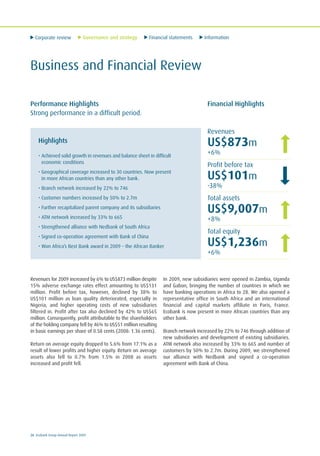
Performance Highlights
Strong performance in a difficult period.
Financial Highlights
Highlights
• Achieved solid growth in revenues and balance sheet in difficult
economic conditions
• Geographical coverage increased to 30 countries. Now present
in more African countries than any other bank.
• Branch network increased by 22% to 746
• Customer numbers increased by 50% to 2.7m
• Further recapitalized parent company and its subsidiaries
• ATM network increased by 33% to 665
• Strengthened alliance with Nedbank of South Africa
• Signed co-operation agreement with Bank of China
• Won Africa’s Best Bank award in 2009 – the African Banker
Revenues for 2009 increased by 6% to US$873 million despite
15% adverse exchange rates effect amounting to US$131
million. Profit before tax, however, declined by 38% to
US$101 million as loan quality deteriorated, especially in
Nigeria, and higher operating costs of new subsidiaries
filtered in. Profit after tax also declined by 42% to US$65
million. Consequently, profit attributable to the shareholders
of the holding company fell by 46% to US$51 million resulting
in basic earnings per share of 0.58 cents (2008: 1.36 cents).
Return on average equity dropped to 5.6% from 17.1% as a
result of lower profits and higher equity. Return on average
assets also fell to 0.7% from 1.5% in 2008 as assets
increased and profit fell.
In 2009, new subsidiaries were opened in Zambia, Uganda
and Gabon, bringing the number of countries in which we
have banking operations in Africa to 28. We also opened a
representative office in South Africa and an international
financial and capital markets affiliate in Paris, France.
Ecobank is now present in more African countries than any
other bank.
Branch network increased by 22% to 746 through addition of
new subsidiaries and development of existing subsidiaries.
ATM network also increased by 33% to 665 and number of
customers by 50% to 2.7m. During 2009, we strengthened
our alliance with Nedbank and signed a co-operation
agreement with Bank of China.
Revenues
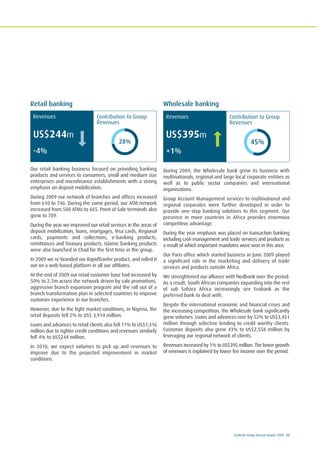
US$873m
+6%
Profit before tax
US$101m
-38%
Total assets
US$9,007m
+8%
Total equity
US$1,236m
+6%
Ecobank Group Annual Report 2009 27
General Economic Environment
Slow down in African economies due to the negative impact of the global economic and
financial crises on the African banking sector.
Highlights
• Decline in trade and commodity prices
• Significant currency depreciation in our markets, especially in Ghana and Nigeria
• Sharp decline in stock markets resulting from global financial crises, but some recovery in the second half of the year
• Slowdown in economic growth as 2008 economic crisis continued
• Major challenges in Nigerian banking sector after central bank intervention
The 2008 global economic and financial crises continued
in 2009. The crisis negatively affected Africa in many
ways. Trade fell sharply, capital flows dried up,
remittances slowed down, currencies depreciated and
liquidity shrank.
Particularly in Nigeria, the stock market fell sharply after an
unprecedented upsurge which began two years earlier.
Coupled with the sudden and rapid reduction in oil prices
after it had hit its highest ever levels in 2008, the country’s
economy suffered the effects. The Nigerian banking sector
which was heavily exposed to the stock market and oil sector
was forced to recognize significant loan loss provisions. After
stress testing by the central bank, nine banks were declared
insolvent and effectively taken over.
The overall result was a disappointing year for the African
economy, bringing to an end, the longest and broadest
expansion in modern history. In 2009, growth in sub-Saharan
Africa reduced to nearly 2%, from 5% to 7% beforehand.
Average per capita incomes fell marginally in 2009, the first
decline in nearly two decades.
In line with the rest of the world, the African recovery began
in the latter half of 2009. There were signs of a rebound in
trade, bank credit extension and commercial activity. Stock
markets stabilized and started showing signs of recovery. For
2010, the IMF projects a growth of around 4.5% for Africa,
signaling potential improvement in corporate performance.
Ecobank is well positioned to take advantage of the
emerging opportunities in the post crises African economy
due to our unmatched network across Africa.
Corporate review Governance and strategy Financial statements Information
28 Ecobank Group Annual Report 2009
Business and Financial Review (continued)
Operating income and profit
US$’000 2009 2008 Variance
Net interest income 459,027 390,401 18%
Net fees and commissions 240,206 266,138 -10%
Trading income 147,628 117,259 26%
Other operating income 26,457 52,326 -49%
Non-interest income 414,291 435,723 -5%
Operating income 873,318 826,124 6%
Impairment losses (139,658) (113,071) 24%
Operating expenses (632,594) (550,812) 15%
Profit before tax 101,066 162,241 -38%
Income statement analysis
Revenue grew but profit was affected by higher provisions and higher operating expenses
from network expansion.
Net interest income
Net interest income was up 18% to US$459m underscored by
strong loan growth and lower interest expense. Gross interest
income increased by 8% to US$764 million largely accounted
for by 11% growth in interest on customer loans, especially
from the wholesale business. Interest on investment
securities and interbank transactions declined marginally due
to lower volumes.
Interest expense reduced 5% to US$305 million due to
capital injection into many of our subsidiaries and increased
customer deposit mobilization.
Non-interest income
Non-interest income fell 5% to US$414 million resulting from
a fall in fees and commissions as business activities slowed
down and our investment banking business suffered from
lower investor activity on the stock markets.
a) Fees and commissions
Net Fees and commissions were down 10% to US$240
million, due primarily to lower fee income in our investment
banking activities. Cash management fees were up 5% to
US$137 million as customer transaction volumes rose across
the group. All other fees and commissions fell with particular
emphasis on portfolio management fees due to low volumes
of trading on the stock markets.
b) Trading income
Trading income increased 26% to US$148 million arising from
strong foreign exchange transaction volumes particularly in
Ecobank Nigeria where trading income rose by over 200%.
c) Other operating income
Lease income increased 200% to US$17 million largely
coming from Nigeria as the subsidiary grew its finance lease
business. Losses on investment securities reduced
substantially due to relatively stable stock markets. All other
revenues registered a reduction due a to decline in volumes.
Ecobank Group Annual Report 2009 29
The chart below shows the income structure of the group.
Impairment losses
Impairment losses rose 24% to US$140 million. US$98
million represented provisions from our subsidiary in Nigeria
accounting for 70% of the incremental provisions, reflecting
the economic and systemic conditions in Nigeria, a situation
which affected the entire Nigerian banking sector. We also
recorded US$10 million in provisions from Kenya arising from
an acceleration of provisions on legacy.
Operating expenses
Total operating expenses went up 15% to US$633 million
compared to a 65% increase in 2008 as our efficiency
measures started to bear fruit.
Staff expenses which accounted for 41% of the total
operating expenses fell 3% to US$259 million due to a
reduction of 1% in headcount. As a result, average number
of staff per branch fell from 18 to 15.
Other operating expenses relating to branch operations,
technology, marketing and administration increased by 32%
to US$374 million (2008: 69%) due mainly to branch
network expansion and higher costs reflecting higher
inflation in many of our markets. Branch network increased
22% to 746 and ATMs went up 33% to 665 as we sought to
increase our distribution network across our various markets.
The chart below shows the cost structure of the group.
Cost-to-income ratio
Cost-to-income ratio increased from 67% to 72%. The
deterioration in cost-to-income ratio is explained by the rapid
expansion of the group over the past 5 years. As a result,
about 40% of our branches are less than 2 years old. In
addition, we added 10 new subsidiaries to our network in
the past two years. These new branches and subsidiaries are
yet to mature and fully contribute to revenues and profits.
Our geographical expansion is now coming to an end and
the focus is on consolidating and optimizing the operations
of the group. We are therefore expecting to see substantial
improvement in the cost-to-income ratio in the coming years.
Income structure (US$m)
Net interest income 459
( ) 2008
Fees & commissions 240
Trading 148
Others 26
26
3%
(6%)148
17%
(14%)
240
27%
(32%)
459
53%
(48%)
Operating expense structure (US$m)
Staff 259
( ) 2008
Dep & Amort. 61
Others 313
259
41%
(43%)
313
49%
(48%)
61
10%
(9%)
Corporate review Governance and strategy Financial statements Information
30 Ecobank Group Annual Report 2009
Business and Financial Review (continued)
Profit before tax
Profit before tax fell 38% to US$101 million, largely due to
higher provisions and high start-up costs of our new
subsidiaries. Four new start-ups contributed a loss of US$20
million. In addition, start-ups and acquisitions over the past
two years together contributed a loss of US$41 million.
Outlook
We expect the group’s profit performance to improve in the
coming years for a number of reasons.
a) General economic environment
African economies are projected to grow at around 4.5% in
2010 in response to the global economic recovery.
The prospects of higher economic recovery will impact
positively on consumer and business volumes. Ecobank is well
positioned to take advantage of this upturn.
b) Nigeria
Significant provisions have been taken in Nigeria over the
past two years. We expect the provisions to have peaked,
giving Nigeria’s economic prospects and expectation for
reduced policy volatility in Nigeria. We have taken steps to
manage the non performing loans and recovery and
collection efforts have been strengthened. Recoveries from
margin facilities and other unpaid loans are expected in the
coming years as markets recover and the Nigerian authorities
take steps to stabilize the economy.
c) New affiliates and new branches
10 of our banking affiliates are less than two years old and
are currently making losses. In addition, 40% of the group’s
branches are less than two years old. As these new
subsidiaries and branches become more efficient and
profitable, they will contribute strongly to revenues and profits.
d) Restructuring of the group
The group has restructured its operations in 2010, putting more
emphasis on customers and less on geographical expansion.
This is expected to improve customer service, accelerate
revenue growth and enhance efficiency. In addition, branch
network and geographical expansion are being curtailed and
emphasis placed on existing branches.
Profit before tax by region (US$m)
Francophone
West Africa 84
(2008)
Nigeria (17)
Rest of West
Africa (ex. Nigeria) 58
Central Africa 12
East & Southern
Africa (25)
Others (13)
84
83%
(50%)
(9%)
(17)
-16%
(32%)
(12%)
58
12
58%
(1%)
(25)
-24%
(-4%)
(13)
-13%
12%
Ecobank Group Annual Report 2009 31
Balance sheet highlights
US$’000 2009 2008 Variance
Total Assets 9,006,523 8,306,186 8%
Loans and advances to banks 1,380,451 1,994,951 -31%
Loans and advances to customers 4,766,197 3,754,206 27%
Investment securities 1,045,412 1,011,422 3%
Property and equipment 474,214 315,802 50%
Customer deposits 6,472,459 5,798,895 12%
Borrowed funds 253,902 345,157 -26%
Total equity 1,235,565 1,157,622 7%
Balance Sheet Analysis
Balance sheet crossed US$9 billion fuelled by accelerated deposit mobilization as we
leveraged our unmatched network across Africa.
Balance sheet size increased 8% to US$9,007 million as we
increased customer deposits through our branch network.
The acquisition of BACB in Burkina Faso also contributed
US$228 million or 33% of the total increase in assets.
Loans and advances to banks
Loans and advances to banks, comprising operating account
balances and inter-bank placements declined 31% to
US$1,380 million largely accounted for by a switch to loans
and restrained market conditions in Nigeria.
Loans and advances to customers
Net customer loans rose 27% to US$4,766 million. Gross
Customer loans increased 29% to US$5,101 million, through
selective lending to credit worthy clients. Francophone West
Africa Region contributed 53% or US$600 million to the
growth, partly accounted for by acquisition in Burkina Faso
and growing our business in Côte d’Ivoire, Benin and Senegal.
The non performing component of the gross loans (NPLs)
increased 21% to US$814 million compared to the gross loan
growth of 29%, resulting in a slightly improved NPL ratio to
16% (2008: 17%). Ecobank Nigeria contributed 65% or
US$90 million of the total increase in NPLs.
Accumulated provisions increased by 63% to US$335 million.
Out of the total increase of US$130 million, Nigeria contributed
US$93 million or 72% arising from the deterioration of its
credit portfolio as a result of market conditions.
The chart below shows the contribution of the net loans by
regions.
Net loans by region (US$m)
Francophone
West Africa 2,249
( ) 2008
Nigeria 1,299
Rest of West
Africa ex. Nigeria 467
Central Africa 508
East & Southern
Africa 185
Others 59
59
1%
(0%)
185
4%
(3%)508
11%
(11%)
467
10%
(12%)
1,299
27%
(30%)
2,249
47%
(44%)
Corporate review Governance and strategy Financial statements Information
32 Ecobank Group Annual Report 2009
Business and Financial Review (continued)
Investment securities
Investment securities comprising treasury bills, trading
securities and available-for-sale investment securities rose
3% to US$1,045 million. Treasury bills component increased
26% to US$532 million.
Trading assets were up 5% to US$7 million. The lower growth
rate was accounted for by low activities on the stock markets.
Available-for-sale investment securities declined 13% to
US$506 million. Out of the total decline of US$78 million,
Nigeria accounted for US$61 million or 78% largely due to
lower liquidity in the Nigerian stock market.
Property and equipment
In line with branch network expansion, property and
equipment increased 50% to US$474 million, representing
investment in branch expansion, technology and the on-
going head office projects of the parent company and some
subsidiaries. In addition, the group undertook revaluation of
its properties. Revaluation gain accounted for in this regard
amounted to US$63 million.
Customer deposits
In 2009, the group continued to focus on enhancing
liquidity and building a strong and competitive balance
sheet. In this respect, we leveraged our wide network
coverage to mobilize deposits. As a result, customer
deposits grew by 12% to US$6,472 million except in Nigeria
where customer deposits fell due to tight liquidity in the
market. The chart below shows the contribution of deposits
by regions.
Deposits from retail clients fell marginally to US$3,914
million reflecting the market conditions in Nigeria.
Wholesale deposits, however, rose by 43% to US$2,558
million largely accounted for by leveraging our branch
network across Africa.
Borrowed funds
In November 2009 the International Finance Corporation (IFC)
converted its US$100 million convertible loan into shares. As
a result, borrowed funds decreased by 26% to US$254 million.
Total equity
Total equity rose 7% to US$1,236 million on the strength of
the conversion of US$100 million IFC loan into equity. Total
equity was negatively affected by US$112 million in
translation losses largely attributed to depreciation of the
Nigerian Naira and Ghana cedi which was partly offset by net
revaluation gain on our buildings of US$48 million.
Deposit by region (US$m)
Francophone
West Africa 2,590
( ) 2008
Nigeria 1,657
Rest of West Africa
(ex. Nigeria) 1,024
Central Africa 899
East &
Southern Africa 308
2,590
40%
(34%)
1,657
25%
(38%)
1,024
16%
(14%)
899
14%
(10%)
308
5%
(4%)
Ecobank Group Annual Report 2009 33
Retail banking
Our retail banking business focused on providing banking
products and services to consumers, small and medium size
enterprises and microfinance establishments with a strong
emphasis on deposit mobilization.
During 2009 our network of branches and offices increased
from 610 to 746. During the same period, our ATM network
increased from 500 ATMs to 665. Point of Sale terminals also
grew to 789.
During the year we improved our retail services in the areas of
deposit mobilization, loans, mortgages, Visa cards, Regional
cards, payments and collections, e-banking products,
remittances and Treasury products. Islamic banking products
were also launched in Chad for the first time in the group.
In 2009 we re-branded our RapidTranfer product, and rolled it
out on a web-based platform in all our affiliates.
At the end of 2009 our retail customer base had increased by
50% to 2.7m across the network driven by sale promotions,
aggressive branch expansion program and the roll out of a
branch transformation plan in selected countries to improve
customer experience in our branches.
However, due to the tight market conditions, in Nigeria, the
retail deposits fell 2% to US$ 3,914 million.
Loans and advances to retail clients also fell 11% to US$1,316
million due to tighter credit conditions and revenues similarly
fell 4% to US$244 million.
In 2010, we expect volumes to pick up and revenues to
improve due to the projected improvement in market
conditions.
Wholesale banking
During 2009, the Wholesale bank grew its business with
multinationals, regional and large local corporate entities as
well as to public sector companies and international
organisations.
Group Account Management services to multinational and
regional corporates were further developed in order to
provide one-stop banking solutions to this segment. Our
presence in more countries in Africa provides enormous
competitive advantage.
During the year emphasis was placed on transaction banking
including cash management and trade services and products as
a result of which important mandates were won in this area.
Our Paris office which started business in June 2009 played
a significant role in the marketing and delivery of trade
services and products outside Africa.
We strenghtened our alliance with Nedbank over the period.
As a result, South African companies expanding into the rest
of sub Sahara Africa increasingly see Ecobank as the
preferred bank to deal with.
Despite the international economic and financial crises and
the increasing competition, the Wholesale bank significantly
grew volumes. Loans and advances rose by 52% to US$3,451
million through selective lending to credit worthy clients.
Customer deposits also grew 43% to US$2,558 million by
leveraging our regional network of clients.
Revenues increased by 1% to US$395 million. The lower growth
of revenues is explained by lower fee income over the period.
84
83%
(50%)
(9%)
(17)
-16%
(32%)
(12%)
58
12
58%
(1%)
(25)
-24%
(-4%)
(13)
-13%
12%
45%
Contribution to Group
Revenues
Revenues
US$395m
+1%
Contribution to Group
Revenues
28%
Revenues
US$244m
-4%
Corporate review Governance and strategy Financial statements Information
34 Ecobank Group Annual Report 2009
Treasury
Our Treasury business continued to be a leading player in all
the markets in which we operate, particularly in the foreign
currency markets. The re-organization of the Treasury in 2008
laid the foundation for a deeper penetration across our
markets. Emphasis was placed on focused sales and marketing
of products to corporate clients and financial institutions; our
position as an active market maker in sub-Sahara African
currencies, coupled with our ability to offer niche Treasury
solutions to our clients contributed immensely to the financial
performance of the segment in 2009.
In 2009, we started building a research capability to increase
the depth of our product offering in fixed income to clients
in both middle Africa and offshore.
Treasury revenue therefore, increased by US$37 million to
US$215 million in 2009, representing a growth of 21%.
Transaction banking
Our Transaction Banking business focused on providing cash
management and trade products to our retail and wholesale
customers.
The unit was active in marketing and deploying various
products and services to enhance cash management and
trade. These included collections solutions, domestic and
regional liquidity management, internet banking, and supply
chain finance.
In card services, Ecobank cards is now distributed in 28
Ecobank affiliates, and are used in over 665 automated teller
machines (ATMs) and 800 Point of Sale (POS) terminals
group-wide.
Currently a total of 13 affiliates are enabled with Visa-
acquiring functionality on their ATMs. The Ecobank switch is
also presently being connected to the Nedbank switch in
South Africa and to other switches in Africa.
As a result, the Ecobank switch has the largest coverage of any
switch within Africa and provides convenience for our
cardholders.
Technology and operations
During 2009, we fully stabilized our technology services at
our data centre in Accra, Ghana. The centre hosts an
integrated international telecommunications platform that
connects all Ecobank affiliates, their payment systems and
ATM platforms.
Leveraging on the technology centre, we re-launched our
Rapidtransfer product on a web-based platform across 29
countries in Africa, providing fast, secure and efficient way to
make cross-border payments and facilitate regional trade.
In addition, eAlert, eStatement and SMS alert messages were
deployed across the Group to ensure that our customers
receive up-to-date information of their transactions on a
24/7 basis.
The technology group is also working with selected providers
to introduce mobile banking platforms to enable mobile
payments and savings.
Business and Financial Review (continued)
84
83%
(50%)
(9%)
(17)
-16%
(32%)
(12%)
58
12
58%
(1%)
(25)
-24%
(-4%)
(13)
-13%
12%
25%
Contribution to Group
Revenues
Revenues
US$215m
+21%
Ecobank Group Annual Report 2009 35
The Central Africa Region comprises nine countries, Angola,
Cameroon, Central African Republic, Chad, Congo, Democratic
Republic of Congo, Equatorial Guinea, Gabon and Sao Tome &
Principe
Six countries in this region - Cameroon, Central African
Republic, Chad, Congo, Equatorial Guinea and Gabon- are
members of the Economic and Monetary Community of
Central Africa (CEMAC). These countries share the same
currency and the same central bank (the BEAC); they also
have a common Business Law.
Ecobank commenced start-up banking operations in Gabon in
April 2009, bringing our presence in this region to seven
countries. Plans are to open banking operations in Equatorial
Guinea and in Angola.
The world economic and financial crises negatively affected
growth in the region due to the decline in commodity prices.
As a result, national budgets were considerably revised
downwards and state infrastructural projects suspended,
impacting negatively on the level of economic activities
across the region.
In spite of this unfavourable economic conditions, the region
registered a strong performance in most areas.
Balance sheet size increased 43% to US$1,089 million coming
from strong growth in deposits through an enlarged branch
network. The branch network was up 49% to 76 and this
fuelled a 54% increase in customer deposits to US$898
million. Through selective lending, customer loans were up
25% to US$508 million.
Due to increased volumes, revenues rose 16% to US$88
million. Profit before tax, however, fell 37% to US$12 million
mainly due to losses contributed by new subsidiaries which
are less than two years old.
Branch network expansion has been restrained and attention
redirected on ensuring that the existing branches are efficient
and profitable. We therefore expect the profit performance of
this region to improve significantly in the coming years.
Central Africa
Financial Highlights (US$’000) 2009 2008 Variance
Revenues 87,793 75,804 16%
Profit before tax 12,176 19,306 -37%
Total assets 1,088,615 763,858 43%
Loans and advances to customers 508,429 405,178 25%
Customer deposits 898,174 581,785 54%
La communauté Economique
des Etats de l’Afrique Centrale
(CEEAC)
Chad
Gabon
Democratic
Republic
of Congo
São Tomé and Príncipe
Cameroon
Central African
Republic
Congo
Corporate review Governance and strategy Financial statements Information
36 Ecobank Group Annual Report 2009
Eastern and Southern Africa Region comprise Kenya, Tanzania,
Uganda, Rwanda, Burundi, Malawi, Zambia and Zimbabwe.
Ecobank is present in all these countries with the exception of
Zimbabwe. Ecobank is relatively new in this region as it only
started operations in 2007. Operations in Uganda and Zambia
began in 2009 and Tanzania in January 2010.
Like the rest of Africa, the economies of the countries in
these regions came under pressure from the global economic
and financial crises in 2009. Despite this, financial
performance of the region was strong especially with respect
to the balance sheet.
Customer deposits rose 45% to US$308 million resulting in
total assets growth of 50% to US$425 million. Deposit
mobilization was underpinned by branch network expansion
which grew by 86% to 54.
Growth in business volumes translated into an 83% growth
in revenues. The region however reported a loss of US$25
million as most of the subsidiaries are less than two years old
and are yet to make a profit; and the acceleration of
provisions on legacy loans from the acquisition in Kenya.
Measures have been taken to significantly improve the
quality of legacy loans. Emphasis has also been placed on
revenue growth and branch efficiency. We therefore expect
significant improvement in the performance of this region in
the coming years.
Business and Financial Review (continued)
Rwanda
Ouganda
Zambia
Malawi
Kenya
Tanzania
Burundi
Eastern and Southern Africa
Financial Highlights (US$’000) 2009 2008 Variance
Revenues 36,003 19,681 83%
Profit before tax (24,506) 1,568 -1663%
Total assets 424,781 282,655 50%
Loans and advances to customers 184,549 121,724 52%
Customer deposits 308,063 212,003 45%
Ecobank Group Annual Report 2009 37
The Francophone West Africa region comprises eight
francophone countries namely: Benin, Burkina Faso, Côte
d’Ivoire, Guinea-Bissau, Mali, Niger, Senegal and Togo. For
management purposes, Cape Verde and Mauritania are
included in this region.
The eight countries share the same currency – the CFA franc
– and the same regional central bank – the Central Bank of
West African States or BCEAO. These countries also have a
common business law and a stock exchange. With the
exception of Mauritania, Ecobank currently operates in all
Francophone West African countries and in Cape Verde. In
2009, Ecobank acquired a 90% interest in Banque Agricole
et Commerciale du Burkina (BACB). BACB was subsequently
merged with Ecobank Burkina 2010.
Despite adverse economic conditions arising from the global
economic and financial crises, Francophone West Africa
Region registered strong performance in 2009.
Total assets rose 38% to US$3,736 million on the back of the
acquisition of BACB in Burkina Faso and deposit mobilization.
Deposit grew 32% to US$2,590 million resulting from 22%
branch network growth. Through development of the
business in Côte d’Ivoire, Benin and Senegal, loans and
advances to customers rose 36% to US$2,249 million.
In line with volume growth, revenues increased 16% to
US$275 million resulting in profit before tax growth of 4%.
The lower profit growth is explained by operating cost
resulting from impact of new branches and higher inflation
in some of the countries.
The region’s contribution to group total assets and profit
before tax were respectively 41% (against 33% in 2008) and
83% (against 48% in 2008).
With the prospects of improved economic conditions in 2010,
our operations in Francophone West Africa are projected to
register strong performance in the coming years.
Francophone West Africa
Financial Highlights (US$’000) 2009 2008 Variance
Revenues 275,296 237,129 16%
Profit before tax 84,311 81,356 4%
Total assets 3,735,814 2,715,568 38%
Loans and advances to customers 2,248,714 1,653,911 36%
Customer deposits 2,590,468 1,957,556 32%
NigerMali
Togo
Burkina
Faso
Côte
d’Ivoire
Guinea-Bissau
Benin
Senegal
Cape Verde
Corporate review Governance and strategy Financial statements Information
38 Ecobank Group Annual Report 2009
Business and Financial Review (continued)
The effects of world economic and financial crises on
Nigeria’s economy continued in 2009. The stock market fell
sharply after an unprecedented upsurge which began two
years earlier. Coupled with the sudden and rapid reduction in
oil prices after it had hit its highest ever levels in 2008, the
country’s economy suffered. The Nigerian banking sector
which was heavily exposed to the stock market and oil sector
was forced to recognize significant loan loss provisions. After
stress testing by the central bank, nine major banks were
declared insolvent and taken over. Ecobank Nigeria passed
the central bank’s stress test due to its strong capital base.
However, the financial performance of the subsidiary was
negatively affected by the deterioration in the general
economic conditions accompanied by significant currency
depreciation.
Customer deposits fell by 26% to US$1,652 million which
resulted in a fall in total assets of 20% to US$2,472 million.
Loans to customers, however, grew 17% to US$1,299 million
coming from selective lending to some credit worthy
wholesale clients.
Due to the decline in volumes, revenues fell 12% to US$293
million mainly from a fall in fees and commissions. Loan loss
provisions for the year were US$98 million, same as previous
year. For the first time in many years, Ecobank Nigeria
reported a loss of US$17 million.
Significant provisions have been taken in Nigeria over the
past two years. We expect the provisions to have peaked,
given Nigeria’s economic prospects and actions being taken
by the Nigerian authorities. We have taken steps to manage
the non performing loans and recovery and collection efforts
have been strengthened. Recoveries from margin facilities
and other unpaid loans are expected in the coming years as
markets recover and the Nigerian authorities take steps to
stabilize the economy.
Nigeria
Financial Highlights (US$’000) 2009 2008 Variance
Revenues 292,800 332,987 -12%
Profit before tax (16,617) 14,061 -218%
Total assets 2,472,427 3,093,891 -20%
Loans and advances to customers 1,298,662 1,112,330 17%
Customer deposits 1,651,976 2,231,603 -26%
Nigeria
Ecobank Group Annual Report 2009 39
The Rest of West Africa excluding Nigeria comprises five
countries. These are Ghana, Guinea, Liberia, Sierra Leone and
Gambia. Ecobank is present in all these countries.
Economic growth slowed in 2009 owing to the global
economic and financial crises. These resulted in a fall in
foreign direct investments, tourism revenues and remittances
which negatively impacted the economic performance of the
region in the first half of the year. A rebound in commodity
prices leading to improved revenues from exports and greater
foreign assistance brought some stability in the second half of
the year. As a result, inflationary pressures and currency
depreciation stabilized at the later part of the year.
Despite these challenges, the financial performance of the
region was resilient. Customer deposits rose 25% to
US$1,024 million resulting in total assets growth of 28% to
US$1,451 million. Lending was however restrained due to
the market conditions. Customer loans therefore, increased
marginally to US$467 million.
The strong balance sheet growth translated into 15%
revenue growth to US$164 million. Profit before tax
consequently increased 13% to US$58 million. Ecobank
Ghana remained dominant in this region as it contributed
89% of the region’s profit.
With prospects of oil revenue in Ghana and forecast
improvement in general economic conditions, this region is
expected to continue its strong performance.
Outlook
GDP growth in countries in which we operate is projected to
remain strong in the coming years accompanied by stable
interest rates and controlled inflation. Ecobank is well
positioned to take advantage of these developments. We
intend to leverage our network to accelerate revenue growth
and deposit mobilization.
We will continue to selectively grow our loan portfolio and to
improve on our remedial and recovery efforts to reduce loan
provisions.
Laurence do Rego
Group Executive Director,
Finance and Risk
The Rest of West Africa (excluding Nigeria)
Financial Highlights (US$’000) 2009 2008 Variance
Revenues 164,212 142,495 15%
Profit before tax 58,447 51,678 13%
Total assets 1,451,477 1,136,652 28%
Loans and advances to customers 466,843 446,409 5%
Customer deposits 1,023,780 815,948 25%
Guinea
Sierra Leone
Ghana
The Gambia
Liberia
West Africa Monetary Zone
(WAMZ)
Corporate review Governance and strategy Financial statements Information
40 Ecobank Group Annual Report 2009
Risk Management
1. Risk management framework
Risk is an inherent part of the business activities of the
Ecobank Group. Accordingly, Ecobank has designed a risk
management framework and governance structure to
achieve an appropriate balance between risk and reward.
The risk management framework comprises a
comprehensive set of policies, standards, procedures, and
processes designed to identify, measure, monitor, mitigate
and report significant risk exposures in a consistent and
effective manner across the group.
1.1 Risk identification
The group identifies risk by evaluating the potential impact
of internal and external factors on business transactions and
positions. Risk managers then develop strategies for
mitigation of the identified risks. Such strategies include
setting of appropriate risk limits by customer, product and
business, and obtaining sufficient collateral coverage; they,
however, exclude usage of derivatives to hedge against
default events.
1.2 Risk measurement
The group uses a variety of methodologies to measure risk.
These include calculating probable loss, conducting stress
tests and benchmarking.
1.3 Risk monitoring and control
The group reviews risk management policies and systems
regularly to reflect changes in markets, products and
emerging best practice. Risk professionals and internal
auditors monitor risk exposures and adherence to approved
risk limits on a daily, weekly and monthly basis as
appropriate, by means of reliable and up-to-date information
systems.
1.4 Risk reporting
Risk exposures are reported to management on a daily,
weekly and monthly basis as appropriate.
2. Major risk types
The group is exposed to the following major risk types:
Credit risk is the probability of financial loss arising from
customer or counterparty default. It can arise either because
the borrower or the counterparty is unwilling to perform or
because its ability to perform has been impaired. Credit risk
is said to be direct credit risk when it arises in connection
with credit facilities such as loans and advances and indirect
or contingent credit risk when the group has guaranteed
contractual obligations of a client by issuing letters of credit
and guarantees. Credit risk also exists when the group and its
client have mutual obligations to exchange (deliver) financial
instruments at a future date. The risk of default before
settlement, also called pre-settlement risk, arises when the
counterparty defaults or goes bankrupt before the contract
matures and the group suffers a financial loss in the process
of replacing the unexecuted contract. When the client
defaults at the time of payment, the settlement risk converts
to direct credit risk.
Market risk is the risk of loss arising from adverse changes
in market conditions (interest rates, exchange rates, equity
prices…) during the period required by the group to close
out its on- and off-balance sheet positions. Positions that
expose the group to market risk can be trading or non-
trading related. Trading risk comprises positions that the
group holds as part of its trading or market-making activities,
whereas non-trading risk includes discretionary positions that
the group undertakes for liquidity or capital hedging
purposes. Sources of market risk include:
• Interest rate risk: the exposure of current and future
earnings and capital to adverse changes in the level of
interest rates. Exposure to interest rate risk can result from
a variety of factors:
• Repricing risk (or mismatch risk) arises from timing
differences in the maturity (for fixed rate) or repricing
(for floating rate) of assets, liabilities and off-balance
sheet instruments. A financial contract is said to "reprice"
whenever the interest rate that it pays changes.
Instruments with fixed interest rates do not reprice, by
definition.
Ecobank Group Annual Report 2009 41
• Yield curve risk is the risk that changes in market
interest rates may have different effects on yields or
prices on similar instruments with different maturities.
• Basis risk risk is the risk that changes in market interest
rates may have different effects on rates received or paid
on instruments with similar repricing characteristics (e.g.
a floating-rate loan whose rate is based on the three-
month Treasury bill rate that is funded with three-month
LIBOR deposits). Interest rates for various assets and
liabilities change at the same time but not necessarily in
the same amount.
• Options risk is inherent in interest-rate related options
embedded in assets and liabilities, such as provisions in
agreements that give borrowers the right (and not the
obligation) to prepay their loans or give depositors the
right (and not the obligation) to withdraw funds at any
time, often with little or no penalty. These options, if
exercised, can affect net interest income and underlying
economic value.
• Liquidity risk arises from the general funding needs of the
activities of the group and in the management of its assets
and liabilities. The group is exposed to the risk that
depositors’ demands for withdrawals outstrip its ability to
realize longer-term assets in cash. The group, therefore,
seeks to maximize liquidity access and minimise funding
costs by capturing stable, reliable and cost-effective sources
of funding in all of its markets. There are two types of
liquidity risk:
• Funding liquidity risk is the risk that funds will not be
available when needed to meet our financial
commitments.
• Trading liquidity risk is the risk that assets cannot be
liquidated quickly enough. This can happen when the
liquidity of a market disappears making it difficult or costly
to close or modify positions.
Interest rate risk and liquidity risk are interconnected given
that management of either side of the balance sheet has an
impact on interest rate risk exposure.
• Foreign exchange risk: the risk to earnings and capital
arising from sudden changes in the relative prices of
different currencies. It can arise directly through trading in
foreign currencies, making loans in a currency other than
the local currency of the obligor, buying foreign-issued
securities, or issuing foreign-currency denominated debt as
a source of funds. It can also arise when assets and
liabilities are denominated in foreign (as well as domestic)
currencies. The group is also exposed to foreign exchange
risk arising from adverse changes in currency exchange
rates used to translate carrying values and income streams
in foreign currencies to the US dollar, Ecobank’s reporting
currency.
• Equity price risk: the risk of loss from adverse changes in
the value of equity portfolios due to changes in the level of
equity prices.
Operational risk is the risk of loss resulting from inadequate
or failed internal processes, people and systems or external
events. It is inherent in every product and service that
Ecobank provides. It manifests itself in a variety of ways,
including internal fraud, external fraud, transaction
processing errors, business interruption, and disputes with
employees, clients and vendors. Operational risk also
includes legal risk, the risk of loss resulting from the failure
to comply with laws, prudent ethical standards and
contractual obligations. These events can potentially result
in reputational harm to the group (reputational risk).
Sovereign risk includes political, convertibility and cross-
border risks. Such risks can arise from actions of a sovereign
state or to unforeseen circumstances such as wars and
uprisings. They affect the ability of residents to meet their
obligations to a lender who is domiciled in another country.
In as much as the West African Economic and Monetary
Union (UEMOA) and the Central African Economic and
Monetary Union (CEMAC) share a “common” currency with
the support of the Banque de France, risk exposures taken by
the group’s subsidiaries registered within either economic
union on residents of any country within either economic
union are not considered cross-border risk.
Corporate review Governance and strategy Financial statements Information
42 Ecobank Group Annual Report 2009
Risk Management (continued)
Strategic and franchise risks arise whenever the group
launches a new product or a new service or when it
implements a strategy. The risk is that the strategy may fail,
causing damage to the group’s image, which may impair the
group’s ability to generate or retain business. However, the
group always carefully assesses both the impact of external
factors on its strategic choices (strategic risk) and the feed-
back from clients, shareholders and regulators on its results
and capital (franchise risk).
Compliance risk is related to violations of rules and
regulations in force in countries where the group operates.
The compliance risk also arises when the rules or regulations
applicable to the products and activities of subsidiary banks
are ambiguous. Such a risk could result in sanctions, penalties,
damages and even the voiding of existing contracts. Legal
and regulatory risks are part of compliance risk.
Disclosure risk is the risk of loss due to the presentation of
incomplete or false information to the general public, or
shareholders or regulatory bodies. Non-compliance with
accounting rules and requirements for rendition of reports to
regulatory and supervisory or fiscal authorities could also
give rise to strategic and franchise risks.
3. Governance structure
The Board of Directors exercises its oversight of risk
management as a whole and through the Board’s Risk
Committee and Audit and Compliance Committee. The
Board articulates the amount of risk that Ecobank is willing
to accept in the normal course of business (risk appetite) and
sets the overall risk profile for the group. The Risk Committee
proposes risk policies and the overall approach to risk
management and monitors the adequacy of controls,
compliance with risk policies and the group’s risk profile. The
Audit and Compliance Committee ensures that the financial
activities of the business are subject to independent review
and external audit.
Group Risk Management, under oversight of the Risk
Committee and the supervision of the Group Head Risk
Management, develops the risk management strategy,
principles, framework and policies, and implements
appropriate risk management processes, methodologies and
tools for managing risk. The Group Head Risk Management
advises and coaches management and business units on risk
management; monitors the application and effectiveness of
risk management processes; and co-ordinates appropriate
and timely delivery of risk management information to the
Group Chief Executive Officer, the Group Executive Committee
(GEC), the Risk Committee and the Board. The Group Head
Risk Management is assisted by a group portfolio manager,
a group operational and environmental risk manager, a
group market risk manager, and a risk analytics manager.
Within each subsidiary bank, Group Risk Management is
represented by a risk management department which is
completely independent from all the operating and risk-
taking units. The risk management department is managed
by a country risk manager who, until the end of December
2009, reported administratively to the Managing Director of
the subsidiary and functionally to the Group Head Risk
Management. Under the new organization structure (Section
6), however, the risk management function reports
administratively to Group Head Risk Management.
Within each business region, Group Risk Management was,
until the end of December 2009, represented by a regional
risk manager who reported administratively to a regional
director who was a member of the GEC, and functionally to
the Group Head Risk Management. Regional Risk Managers
assisted Regional Directors in approving and managing risk in
all the countries under their supervision. Under the new
organization structure (Section 6), the regional risk
management function has been replaced by the positions of
corporate credit risk managers and Domestic credit risk
managers at the group level.
The Asset and Liability Committee (ALCO), a sub-committee
of GEMC, is responsible for the supervision and management
of market risk, mainly interest rate and liquidity risks. Its
members are: Group Head Risk Management, Chief Financial
Officer, Group Market Risk Manager, Group Treasurer and
business heads in the Corporate Bank and Domestic Bank.
ALCO members meet quarterly to review the structure and
pricing of the group’s assets and liabilities, to decide on the
required maturity profile and mix of incremental assets and
liabilities, to evaluate market risk involved in new products,
and to articulate the group’s interest rate view.
Ecobank Group Annual Report 2009 43
At the subsidiary bank level, the responsibility of asset and
liability management lies with the Treasury Department.
Specifically, the Asset and Liability Management (ALM) desk
of the Treasury & Financial Institutions Unit manages the
balance sheet. The results of balance sheet analysis along
with appropriate recommendations are reviewed in monthly
ALCO meetings where important decisions are made to
minimise risk and maximize returns. Local ALCO membership
includes the country head, the country treasurer, the country
risk manager, the internal auditor, the financial controller,
and legal officer.
On an ongoing basis, Group Audit provides to the Audit and
Compliance Committee and the Board, timely independent
assurance of the integrity and effectiveness of the risk
management framework.
All business units are responsible for identification,
measurement, assessment, and monitoring of risk within
their units.
4. Risk management approach
4.1 Credit risk
4.1.1 Organization
The group manages credit risk by means of a governance
structure with clearly defined responsibilities and credit
approval authority.
The Board of Directors of ETI is the highest credit approval
authority at Ecobank. It sets credit policies and ensures that
all officers involved in the extension of credit across the
group scrupulously adhere to these policies.
From time to time, the Board delegates its credit approval
authority to individual Credit Officers based on their credit
skills, experience and independence of judgment. While
credit approval limits are delegated to individual credit
officers, no credit officer approves credits singly. All
extensions of credit are approved by at least three credit
officers, one of whom must have an individual credit limit
equal to or greater than the amount of credit extension
under consideration. Also, because of the separation of duties
between origination and risk management, at least one of
the three credit officers must come from Risk Management.
Under the new organization structure (Section 6), all credits
require the additional sign-off of corporate credit risk
managers at the group level.
The Board reviews and approves all credits in excess of the
policy limit, defined as maximum credit exposure to any
borrower or group of related borrowers. It has, however,
delegated this function to the Risk Committee, which has the
authority to approve all such credits when the Board is not
sitting. The Risk Committee comprises the Group Chief
Executive Officer, two executive directors and two non-
executive directors. The policy limit, originally set at 20% of
the consolidated shareholders’ funds of the group, was
dropped during the year to 7.5% in order to further reduce
concentration risk.
The primary responsibility for managing credit risk, however,
lies with the Group Head Risk Management. He ensures that
Ecobank has resources, expertise, and controls in place for
efficient and effective management of credit risk across the
group. The Group Head Risk Management approves all
unusual risks as well as extensions of credit which exceed
the credit authority granted to regional heads and regional
risk managers, and to corporate credit risk managers under
the new organizational structure. At the subsidiary bank
level, the above functions are fulfilled by a specially
designated country risk manager.
Ecobank subsidiaries receive delegations of credit approval
authority from their respective boards of directors, in line
with the general framework set up by the Group Chief
Executive Officer and Group Head Risk Management.
4.1.2 Risk identification
Ecobank is exposed to credit risk through direct lending,
issuance of financial and performance guarantees, and capital
market activities. Credit risk analysts work in partnership with
the sales function in identifying risk exposures within each
subsidiary bank.
Credit decisions are based on an in-depth review of the
obligor’s creditworthiness. The group utilizes an internal risk
rating system based on a scale of 1 to 10 to rate commercial
and industrial obligors, financial institutions, sovereign
governments, as well as small- and medium-scale enterprises.
Corporate review Governance and strategy Financial statements Information
44 Ecobank Group Annual Report 2009
Risk Management (continued)
A rating of “1” identifies obligors of the highest quality,
comparable to AAA on the scale of Standard and Poor’s. A risk
rating of “10” is assigned to obligors of lowest quality or
highest risk, identical to D on the scale of Standard and Poor’s.
Obligors risk rated 1 to 6 are considered as “normal
borrowers”; those risk rated 7 and 8 are considered as
“borrowers requiring caution” while those risk rated 9 are
“substandard borrowers”, and those risk rated 10, “borrowers
at risk of permanent default”.
Risk ratings provide an objective means to compare obligors
and facilities within a given portfolio, and to measure and
manage credit risk across different geographies, industry
segments, and business segments, and other relevant risk
factors using the same standards. Accordingly, the level of
credit authority required to approve any credit transaction is
also based on the risk rating of obligors and facilities involved.
An obligor risk rating is defined as the risk of default on long
term unsecured debt in local currency over a twelve month
period. It is assigned and approved when a credit facility is
first extended and is reviewed annually and upon the
occurrence of a significant adverse event. The risk of default
is derived from an analysis of the obligor’s historical and
projected financial statements and such qualitative criteria
as industry issues, the obligor position in the market, the
quality of the board and management and access to
financing. The process for determining the obligor risk rating
is carried out through decision-making tools developed by a
subsidiary of Moody’s Corporation.
With regard to consumer lending, the group utilizes a credit
program approach whereby credit is extended on the basis
of product-specific risk parameters, using manual scoring
systems. The products involved are ordinarily secured and of
a self-liquidating nature.
A facility risk rating describes the risk associated with a
particular facility of a given obligor. It is usually equivalent to
the obligor risk rating; however, a different facility risk rating
may be assigned by adjusting the obligor risk rating to take
into account such factors as the facility structure or collateral.
The following graphs show our credit portfolio as of 31
December, 2009, broken down by facility risk ratings.
Sixty-eight percent of our credit exposures were categorized
as being of normal credit risk quality.
0
5
10
15
20
25
30
35
40
1 2 3 4 5 6 7 8 9 10
12
11
9
6
2
12
28
16
5 5
6
2
4
7
9
39
15
6
5
1
Portfolio distribution by facility risk rating
Percent of total portfolio
Dec. 2008 Dec.2009
Facility risk rating
0
10
20
30
40
50
60
70
80
Portfolio breakdown by risk category
Percent of total portfolio
Dec. 2008 Dec. 2009
73
48
5
68
40
5
Normal risk
(1-6)
Risk under
watch (7-8)
Substandard
risk (9)
Risk of permanent
default (10)
1
6
Ecobank Group Annual Report 2009 45
4.1.3 Risk measurement
Credit risk measurement takes into account the actual credit
exposure, the amount of loss in the event of default (also
called “loss given default” or LGD), the probability of default
(PD), and the severity of loss in the event of default (EAD).
To measure credit risk, the group estimates the level of the
statistical expected economic loss in the event of default.
This figure measures the net present value of credit costs that
the group would face from the time of default until the end
of the recovery process. Credit costs include all provisions
taken against bad debts, write-offs, fully reserved interest
earned not collected and possibly attorney fees incurred in
the process of enforcing the group’s claims in court. Under
the current methodology, the group proceeds by assigning
risk ratings to credit facilities of all the obligors in the credit
portfolio. Then, the amount of credit exposure with a given
facility risk rating is multiplied by the corresponding loss
norms to arrive at a measure of loss in the event of default
on the exposure involved. The weighted average loss norm
provides a measure of the portfolio risk profile and portfolio
risk rating.
As of December 2009, the portfolio risk rating was 7 (risk under
watch) compared to 6- as of December 2008. The deterioration
noted in 2009 reflects the challenges the group is facing in its
operating environment as a consequence of the global financial
and economic crisis.
As of December 2009, the portfolio risk rating was 7 (high
risk) compared to 6- as of December 2008. The deterioration
noted in 2009 reflects the challenges the group is facing in
its operating environment as a consequence of the global
financial and economic crisis.
4.1.4 Risk monitoring and control
Credit risk exposures of subsidiaries are monitored at both
the subsidiary level and at the Group Risk Management level
as well. At the subsidiary level, Credit Administration units
monitor the performance of individual exposures on a daily
basis, ensure regularity of credit approvals and line
utilizations, authorize disbursements of credit facilities when
approval conditions are met, and perform periodical reviews
of collateral. These units are also responsible for the
preparation of internal risk management reports for country
management and Group Risk Management. Remedial
Management units monitor past due exposures with a view
to maximizing collections of delinquent loans and recoveries
of loans previously reserved or written-off.
At the group level, the Group Risk Portfolio Management unit
monitors risks taken by subsidiaries on individual obligors
and economic groupings through a review of monthly reports
submitted by country risk management units of subsidiary
banks. These reports include early warning systems designed
to monitor troubled exposure and credit process problems.
They also include detailed credit exposure data that enable
Group Risk Management to monitor the risk profile in terms
of obligors, business segments, industry segments,
geography, currency, and asset maturity, at country and
group level. Group Risk Management also determines the
level of the statistical expected economic loss and the overall
direction of the portfolio risk profile.
Group Portfolio Management ensures that the Group is not
exposed to excessive concentration of credit risk on any one
obligor, industry segment or geography. In particular, the unit
ensures that the group achieves its strategic diversification
objectives within the prescribed time horizon.
4.1.4.1 Credit risk portfolio
The credit exposure, net of provisions, amounted to US$9.4
billion as of 31 December, 2009 (US$8.7 billion as of 31
December, 2008). This portfolio comprises loans and
advances to customers, loans and advances to governments,
deposits with central banks, loans, advances and placements
with banks and financial institutions, as well as off-balance
sheets exposures in the form of financial and performance
guarantees.
4.1.4.2 Obligor concentration
During the year under review, the Group took a strategic
decision to reduce the single obligor limit (i.e. policy limit) to
7.5% (from 20% as of December 2008) in an effort to control
concentration risk. As of December 31, 2009, therefore, four
obligors or economic groupings had individual credit
outstandings in excess of 7.5% of the group capital. These
exposures will be progressively brought to the newly
approved limit in 2010.
Corporate review Governance and strategy Financial statements Information
46 Ecobank Group Annual Report 2009
Risk Management (continued)
However, the twenty largest non-bank exposures in
aggregate amounted to 116% of the capital (December
2008: 96%) and 21% of the total non-bank credit exposures
(December 2008: 15%), indicating a more concentrated
credit risk portfolio. These exposures were nonetheless
diversified across various industry sectors and 65% of them
were of normal credit risk quality.
4.1.4.3 Industry diversification
The portfolio breakdown by industry shows a relatively stable
diversification of credit exposure, with concentrations in the
banking sector (mainly comprised of ordinary short term
banking transactions with local banks and OECD-based
correspondent banks domiciled in OECD countries), in the
Wholesale and Retail trade sector and in the government
sector (mainly treasury bills held for liquidity management
purpose). These four industry sectors accounted for 64% of
the total group exposures (December 2008: 59%). The Board
revised the group concentration limits during the year to
align our risk appetite to the prevailing difficult environment.
4.1.4.4 Geographic diversification
The group has banking operations in 30 countries and
accordingly benefits substantially from geographic
diversification of its credit exposure. The group exposure by
country of obligor domicile highlights the decline of its
Nigerian operations (27% from 35% in 2008). No other
country represents more than 9% of the total exposure. At the
regional level, Francophone West Africa Region became this year
the largest concentration (ahead of Nigeria) as exposures on
residents of that region represented 37% of the portfolio. The
drop in the exposure to residents of Nigeria was more than offset
by the growth in the exposure to residents of the Rest of West
Africa (excluding Nigeria), Central Africa and Eastern and
Southern Africa regions.
Top 20 exposures per industry sector
Telecommunications 16%
Wholesale Trade 10%
Construction 10%
Government 15%
Manufacturing 22%
Mining 5%
Oil Distribution 5%
Services 5%
Stock Brokers 12%
16% 10%
10%
15%
22%
5%
5%
5%
12%
Top 20 exposures per internal risk rating
Substandard risk
(9) 12%
Risk under watch
(7-8) 22%
Normal risk
(1-6) 65%
35%
22%
43%
65%
22%
12%
1%
Risk of permanent
default (10) 1%
Diversification industry segment
Percent of total portfolio
Dec. 2008
Financials inst. central banks
Services
Wholesale & Retail trade
Government
Manufacturing
Telecommunications
Construction
Central banks
Oil & Gas exploration and production
utilities
Oil distribution
All others
Coffee
Cotton
19
20
19
13
13
8
6
6
5
4
3
2
2
2
1
17
11
13
7
6
6
6
6
3
2
3
2
1
Dec. 2009
Ecobank Group Annual Report 2009 47
4.1.4.5 Asset quality
4.1.4.5.1 Gross loans and advances to customers
Gross loans and advances to customers rose 29% in 2009 to
US$5.1 billion. This growth was mainly driven by wholesale
customers (+50%) while the retail business contracted by 4%.
Subsidiaries in the Francophone West Africa Region
contributed 52% of the wholesale asset growth. Nigeria’s
share, at 14%, reflects the subsidiary’s shift in focus from
business development to improving asset quality.
0
1,000
2,000
3,000
4,000
5,000
Contribution to growth in loans to customers
($Million)
5,101
31
63 103
186
192
595
Dec.
2008
Rest of
West
Africa
(ex.
Nigeria)
Eastern
&
Southern
Africa
Central
Africa
Nigeria Other Franco-
phone
West
Africa
Dec.
2009
3,959
Gross loans by business
1,000
2007 2008 2009
0
2,000
3,000
$Million
4,000
5,000
2,000
1,243
2,440
1,520
3,650
1,407
Retail
Wholesale
2009 Exposures by region of residence
Percent of total
37%
11%
4%
10% 11%
27%
Other 10%
Central Africa 11%
Nigeria 27%
Francophone
West Africa 37%
Rest of West Africa
(ex. Nigeria) 11%
Eastern &
Southern Africa 4%
27%
Other 2%
Central Africa 8%
Nigeria 38%
Francophone
West Africa 36%
Rest of West Africa
(ex. Nigeria) 12%
Eastern &
Southern Africa 4%
37%
2008 Exposures by region of residence
Percent of total
38%
36%
12%
4%
2%
8%
Corporate review Governance and strategy Financial statements Information
48 Ecobank Group Annual Report 2009
Risk Management (continued)
At the product level, loan growth was driven mainly by term
loans which contributed 60% of the assets (52% in 2008).
Overdrafts grew by only 10% and now accounts for 33% of
the portfolio compared to 39% in 2008.
4.1.4.5.2 Non-performing loans
Non-performing loans (NPL) rose 21% to US$814 million in
December 2009, mainly driven by Nigeria, which accounted
for 74% of the non-performing loans of the group and
where the combined effect of the international financial
crisis and economic downturn negatively impacted the local
banking system.
The classification of additional assets following stress tests
carried out on Nigerian banks by Central Bank of Nigeria and
Nigeria Deposit Insurance Corporation is the main reason for
the build-up of non-performing loans. While our Nigerian
subsidiary emerged among the banks that successfully passed
the stress tests, it had, like all other Nigerian banks, to establish
a significant amount of provisions for loan impairments during
the third quarter. Nevertheless, asset quality improved
marginally, as the ratio of non-performing loans to gross loans
and advances (“NPL ratio”) decreased by one percentage point
to 16%. Management has taken appropriate remedial
measures to ensure a turnaround in 2010.
The breakdown of non-performing loans by business
segments highlights a higher concentration of non-
performing loans with Wholesale banking customers (61%)
than with Retail Bank customers (39%). However, Retail
Bank customers appear to have been more vulnerable to the
weak economic environment. They contributed 55% of the
growth in the group’s non-performing loans.
Loans to customers dec. 2008
Mortgage 5%
Others 1%
Overdrafts 39%
Credit cards 3%
Term loans 52%
52%
5% 1%
39%
3%
Gross loans to customers dec. 2009
Mortgage 2%
Others 4%
Overdrafts 33%
Credit cards 1%
Term loans 60%
60%
2% 4%
33%
1%
2009 Non-performing loans
Rest of West Africa
(ex. Nigeria) 3%
Central Africa 3%
Eastern &
Southern Africa 3%
Nigeria 74%
Francophone
West Africa 17%74%
17%
3%
3% 3%
Non-performing per business segment
($ Million)
2008 2009
431
244
493
321
Retail
Wholesale
Ecobank Group Annual Report 2009 49
NPL ratio (%)
Group excluding Nigeria
Coverage ratio (%)
Group excluding Nigeria
2008 2009
6.4 6.2
2008 2009
54
58
As non-performing loans grew by 21% to US$814 million and
impairment provisions increased to US$335 million from
US$205 million at the end of December 2008, the NPL
provisioning rate (“NPL coverage”) improved to 41% from
30% in 2008. However, the unreserved portion of non-
performing loans (i.e. the “net open exposure ratio”)
represented 36% of capital in 2009 (same level as in 2008).
Without Nigeria, our non-performing loan ratio would have
improved from 6.4% in December 2008 to 6.2% in December
2009. Similarly, and the NPL coverage ratio would have
increased by 4 percentage points to 58%.
4.1.5 Portfolio stress testing
Stress testing is part of the group’s strategy for identifying
possible events or future changes in economic conditions
that could have an unfavorable impact on its base case
projections, including its capital requirements, resources and
adequacy of capital buffers. Stress testing exercises address
different types of risk and cover the impact of specific shocks
as well as a downturn in macroeconomic factors. The
outcomes of stress scenarios are ultimately assessed against
earnings and capital adequacy on a consolidated basis across
all risk types and compared with the group’s set risk appetite.
They are reviewed by the management and the Risk
Committee to ensure that the group is prepared for worse
case scenarios and that appropriate decisions are taken in
the area of the group risk appetite and capital management.
Several stress test exercises were undertaken during 2009
to assess the potential impact of the international financial
crisis on our business. They all confirmed the group’s
continuing resilience.
4.1.6 Risk reporting
Group Risk Management submits a monthly report to the
Group Chief Executive Officer and GEC members. The Risk
Committee reviews Risk Management’s quarterly reports to
ensure that the portfolio performs in accordance with the
approved concentration limits and overall risk profile. The
Risk Committee refers decisions to the Board for final
approval.
4.2 Market risk
The objective of Ecobank’s market risk management policy
framework is to ensure that all significant market risks are
identified, measured, assessed, prioritised, managed,
monitored and treated in a consistent and effective manner
across the group in order to stabilize earnings and capital
under a broad range of market conditions.
4.2.1 Organization
The Board articulates statements of market risk appetite. The
Risk Committee of the Board, Group Chief Executive Officer
and Group Risk Management coordinate, facilitate, and
oversee the effectiveness and integrity of Ecobank’s market
risk management framework. Group Audit and Ecobank’s
external auditors provide timey and objective assurance
regarding the continuing appropriateness of, and the
adequacy of compliance with this framework.
Dec-2006
NPLcoverage&netopenposition(%)
70
60
50
40
30
20
10
0
41
60
NPL Coverage Net Open Position
13
68
36
9
30
36
Dec-2007 Dec-2008 Dec-2009
NPL coverage
Corporate review Governance and strategy Financial statements Information
50 Ecobank Group Annual Report 2009
Risk Management (continued)
The Group Market Risk Manager (GMRM) plays a
coordination, aggregation, facilitation and enabling function.
GMRM drafts market risk policies, defines market risk
management standards, and develops and distributes tools,
techniques, methodologies, common risk language, risk
framework, analysis, reporting, communication and training.
GMRM also publicizes knowledge on market risk to create
awareness and understanding at all levels of employees.
GMRM approves price risk limits and liquidity contingency
plans for banking subsidiaries and the group. GMRM
constantly monitors market risk exposures and ensures that
they are maintained within prudential levels at all times.
The Group Treasurer is responsible for market risk taking
activities and manages market risks within the limits approved
by the Board. Group Treasurer reports market risk positions to
GMRM and Group Executive Committee on a monthly basis
and to the Board quarterly. He prepares an annual liquidity
contingency and capital plan for the Group and provides the
first-level approval for liquidity contingency and capital plans
and price risk limit recommendations of subsidiary banks.
Country treasurers report directly to Group Treasurer.
The Asset and Liability Committee (ALCO) is responsible for
the supervision and management of market risk at the group
level. ALCO members meet quarterly and more often if
warranted by market conditions to review the group’s liquidity
and funding needs, the structure and pricing of the group’s
assets and liabilities, and market risk involved in new products.
They articulate the group’s interest rate view and decide on
the required maturity profile and mix of incremental assets
and liabilities. ALCO committees of subsidiary banks fulfil these
functions monthly at the country level.
The staff and management working within or managing
operational business units and their board of directors are
responsible for the day-to-day management and control of
market risk within their businesses.
4.2.2 Risk identification
Trading units maintain blotters for recording movements and
balance sheet positions of traded instruments. The group
identifies market risk through daily monitoring of levels and
profit and loss balances of trading and non trading positions.
Internal auditors and market risk managers monitor daily
trading activities to ensure that risk exposures taken are
within the approved price limits and the overall risk tolerance
levels set by the Board. In addition, local ALCO members,
treasurers and market risk managers monitor market risk
factors that affect the value of trading and non-trading
positions as well as income streams on non-trading portfolios
on a daily basis. They also track liquidity indicators to ensure
that group subsidiaries meet their financial obligations at all
times.
4.2.3 Risk measurement
The group uses gap analysis to measure its exposure to
interest rate risk. Through this analysis, subsidiary banks
compare the values of interest rate sensitive assets and
interest rate sensitive liabilities that mature or reprice at
various time periods in the future. An interest rate sensitive
gap is positive when the amount of interest rate sensitive
assets exceeds that of interest rate sensitive liabilities
maturing or repricing within a specified time period. It is
negative when the amount of interest rate sensitive
liabilities exceeds that of interest rate sensitive assets
maturing or repricing within a specified period.
An institution with a positive gap can expect net interest
income to increase with rising market interest rates and
decline with falling market interest rates. Conversely, an
institution with a negative gap can expect net income to
increase when market interest rates are falling and to decline
when interest rates are increasing. In performing this
analysis, the group may make judgmental assumptions
about the behaviour of assets and liabilities which do not
have specific contractual maturity or repricing dates.
Foreign exchange risk is measured through the profit and loss
account while liquidity risk is measured by the degree of
diversification of sources and maturity of deposits.
4.2.4 Risk monitoring and control
Subsidiary bank treasurers monitor interest rate risk through
daily, weekly, and monthly reviews of the structure and
pricing of assets and liabilities.
They monitor foreign exchange risk by ensuring that open
foreign currency positions are kept within the approved
overnight and intraday price risk limits.
Liquidity risk is monitored through gap analysis and ensuring
not only that the deposit base is diversified but also that the
market risk management policy framework is complied with.
4.2.4.1 Interest Rate Risk
The maturity profile of interest rate sensitive assets and
liabilities as of December 31, 2009 shows a positive repricing
for all maturities. The group is therefore exposed to falling
interest rates for maturities above one month.
4.2.4.2 Foreign Exchange Risk
As of December 31, 2009, the Group is exposed to foreign
exchange rate fluctuations in 33 currencies, 16 of which are
legal tender in the 29 countries it operates. In thirteen of
those markets, it is exposed to the CFA franc (43% of the
portfolio against 38% the previous year), which is pegged to
the euro under financial agreements between the French
Treasury and the countries in the Francophone West Africa
and Central Africa regions.
The group had a long net open position of US$250 million
(US$189 million in December 2008) mainly in euros (84%
contribution). The other significant net long open positions
were in CFA francs (US$26 million against US$40 million in
2008) and in US dollars (US$12 million against US$19 million
in 2008).
4.2.4.3 Liquidity Risk
The group is exposed to liquidity risk for maturities of up to
one month. This is mainly due to the fact that 73% of total
deposits are either current or savings. But on a behavioural
perspective, these deposits are very stable.
Ecobank Group Annual Report 2009 51
Interest rate repricing profile
($ Million)
-440
233 260
440
686 738
219
1,686
216 182
Upto
1month
1-3
months
3-12
months
1-5
years
Over 5
years
2008
2009
Net foreign exchange position
($ Million)
Dollar Euro CFA Others
19 12
128
211
40
26
4 1
2008 2009
Contractual maturity gap ($ Million)
-1,325
-1,228
294
99
851
562
1,682
215
347
516
Up to
1 month
1-3
months
3-12
months
1-5
years
Over
5 years
2008
2009
Corporate review Governance and strategy Financial statements Information
52 Ecobank Group Annual Report 2009
Risk Management (continued)
4.3 Operational risk
Ecobank has committed significant resources to develop a
“risk-aware” culture and to ensure that all significant
operational risks are identified, measured, assessed,
prioritised, managed, monitored and treated in a consistent
and effective manner across the group.
4.3.1 Organization
The Board of Directors and the Group Chief Executive Officer
have direct responsibility for the management and control
of operational risk throughout the group. Group Risk
Management and the Risk Committee coordinate, facilitate,
and oversee the effectiveness and integrity of Ecobank’s
operational risk management framework while Group Audit
and Ecobank’s external auditors provide independent
assurance and challenge across all business functions in
respect of the integrity and effectiveness of this framework.
The Group Operational Risk Manager (GORM) plays a
coordination, aggregation, facilitation and enabling function.
GORM drafts operational risk policies, defines operational risk
management standards, and develops and distributes tools,
techniques, methodologies, common risk language, risk
framework, analysis, reporting, communication and training.
GORM also publicizes knowledge on operational risk to create
awareness and understanding at all levels of employees. It
reports on aggregate risk profile, control effectiveness, and
corrective actions taken. It coordinates and participates in
preparing, testing, and reviewing the business continuity and
disaster recovery plan of every business unit.
The staff and management working within or managing
operational business units and the local Board of Directors
are responsible for the day-to-day management and control
of operational risk within their businesses.
4.3.2 Risk identification
Ecobank categorises operational risk into seven loss event
categories based on their primary cause: internal fraud,
external fraud, employment practices and workplace safety,
disputes with clients, damage to physical assets, business
disruptions and systems failure, and execution, delivery and
process management.
4.3.3 Risk measurement
Operational risk managers within each business unit ensure
that all operational risk events are recorded and reported to
the appropriate management levels. Internal loss events are
categorised into actual loss (an incident that has resulted in
a financial loss), potential loss (an incident that has been
discovered, that may or may not ultimately result in a
financial loss) and near miss events. A near miss event is an
incident that was discovered through means other than
normal operating practices and that, through good fortune
or focused management action, resulted in no loss or a gain.
4.3.4 Risk monitoring and control
The group monitors operational risk through risk and control
self assessments, tracking of internal loss data, and
monitoring of key risk indicators.
Risk and control self-assessments are a key components of
Ecobank’s operational risk framework. It involves, on a
quarterly basis, each business unit proactively identifying and
assessing its significant operational risks and the controls in
place to manage those risks. The group uses an operational
risk management application developed by HSBC to perform
its risk and control self-assessments. This application also
enables the collection, analysis, and reporting of operational
loss event data at both business and group level and by Basel
II categorization. Business units are thus able to monitor the
key operational risk exposures and their underlying causes
against the thresholds set by the group.
The group analyses the impact of unlikely, but not impossible
events by means of scenario analysis, which enable
management to gain a better understanding of the risks that
it faces under extreme conditions. Both historical and
hypothetical events are tested.
4.3.5 Risk reporting
Country operational risk managers report operational loss
events to local management and Group Operational Risk
Management. On the other hand, internal auditors of
subsidiary banks submit to Group Audit detailed reports of
their investigations of operational loss events, including
causes and remedial actions to be implemented. Group Audit
makes quarterly reports to the Audit and Compliance
Committee and the Board.
Ecobank Group Annual Report 2009 53
Risk-weighted assets
($ Million)
Risk-weighted asset (left hand scale)
6,000
7,000
5,000
4,000
3,000
2,000
1,000
0
2007 2008 2009
4,003 5,339 6,269
Group Operational Risk Management oversees the collation,
aggregation, and analysis of business unit management
information and challenges it prior to submission to Group
Risk Management, GEC, Risk Committee, and the Board.
Ecobank requires immediate escalation to the Risk
Committee and Board of all instances of unauthorised
deviations from any of the standards set out in this risk policy
statement; and likely or actual breaches of thresholds agreed
by the Risk Committee, the Board and Group Risk
Management.
In 2009, gross operational losses decreased by 35% to
US$5.7 million (2008: US$8.8 million). However, net
operational losses of US$4.8 million for 2009 were 18%
worse, compared with US$4.1 million for 2008. In 2008,
insurance claims reduced net losses, but recoveries were
weak during 2009. Execution losses are on the increase,
constituting 41% of net losses. External Fraud took 22%,
while Internal Fraud contributed 26%. Net losses were
concentrated in Nigeria (35%).
5. Capital adequacy
The group manages its capital base to achieve a prudent
balance between maintaining capital ratios to support
business growth and depositor confidence, and providing
competitive returns to shareholders. This highlights he need
for a proper integration of risk, capital and performance.
In all the countries where Ecobank operates, banks are
required to hold a minimum capital level determined by the
regulators in line with the recommendations of the Basel
Committee on Banking Supervision. Under the original Basel
accord, banks were to maintain a ratio of regulatory capital
to risk-weighted assets of 8%. This ratio has been increased
in some countries to 10% and, in some cases, 15%.
Under Basel I standards, risk-weighted assets rose by 17%
from US$5.3 billion in December 2008 to US$6.3 billion. The
unimpaired capital, on the other hand, increased marginally
to US$1.34 billion in 2009 from US$1.31 billion in December
2008 (2% increase).
Net operational losses
($ Thousands)
Dec. 2008
ET5 Damage to physical assets
ET3 Employment practices &
Workplace safety
ET4 Clients, products & Business
practices
ET6 Business disruption &
System failures
ET2 External fraud
ET1 Internal fraud
ET7 Execution, delivery &
Process management
17
147
24
3
17
1788
1579
525
26
180
289
1115
1232
1972
Dec. 2009
Corporate review Governance and strategy Financial statements Information
54 Ecobank Group Annual Report 2009
Risk Management (continued)
In line with this increase in risk-weighted assets, the capital
adequacy ratio under Basle I decreased from 24.5% to 21.4%
as of 31 December, 2009, but still exceeds by far the
minimum international standard and confirms the financial
strength of our group. At the same time, the core capital
adequacy (tier-1) ratio decreased by 1.3 percentage point to
21.3%. The lower rate of decrease in the core capital
adequacy ratio is due to conversion into common shares of
the company of a senior convertible loan by the International
Finance Corporation.
6. 2010 Outlook
As the group is nearing the end of its pan-African expansion,
it has been focusing on consolidation and optimization of its
business platforms.
As from January 2010, and in line with the new strategy, the
risk management and the finance functions have been
merged into one single unit fully independent of the
businesses and headed by an executive director. This newly
created department will also oversee internal control and
compliance functions previously managed by the Group Audit
and Compliance department. The Executive Director Finance
and Risk will be assisted by a group head with overall
responsibilities over the risk function.
The risk management function is now centralized and fully
independent of the businesses. At the group level, it will be
comprised of:
• A Corporate Credit Center with the responsibility for the
approval of credit transactions originated by all group
businesses on behalf of corporate customers and to provide
advice in loan approvals to country operations;
• A Domestic Credit Center with the responsibility for
production and approval of all credit programs for the
Domestic Bank and to provide advice on credit processes
for retail and small and medium scale enterprises;
Loans and advances to customers were the main drivers of the increase in risk-weighted assets (US$990 million) represented
76% of the total.
Risk-Weighted Assets 2008 2009 Var (%)
Liquid Assets 413 291 -30
Loans to Customers 3,754 4,766 27
Other On-Balanced Sheet Items 720 909 23
Off-Balanced Sheet Items 452 323 -28
Total 5,339 6,269 17
Capital adequacy ratio (%)
Total capital adequacy ratio Tier-1 capital adequacy ratio
15.7 15.5
22.3
24.5
21.4 21
2007 2008 2009
Ecobank Group Annual Report 2009 55
• A central Early Warning, Remedial and Recovery unit for the
early identification of potential bad loans and for the design
and implementation of strategies to mitigate the risk of
default/loss.
• An Enterprise Risk Management unit (ERM), comprising of
a portfolio and capital management function, operational
and environmental risk management, market risk
management and risk analytics. The main objectives of ERM
are:
a) Mitigate against downside risk
b) Reduce unwanted earnings volatility
c) Inform senior management and line staff in risk/return
trade-offs
d) Enable growth by delegation of day-to-day credit
decisions to subsidiaries as we build the necessary control
and information infrastructure
e) Further improve the already excellent relationship with
regulators by demonstrating that our risk and capital
management processes are best in breed
f) Improve communication with rating agencies, analysts and
other stakeholders in order to improve Ecobank’s financial
reputation and therefore its position in capital/debt
raising, potential M&A and other activities.
In order to achieve these objectives, the Group has launched
various initiatives:
a) Automation of credit portfolio data collection, aggregation
and reporting to ensure timely delivery of information on
risk exposures to the key decision makers;
b) Recruitment of risk managers with risk analytics
background;
c) Implementation of economic capital and value-at-risk
(VaR) models to measure risk across the Group;
d) Implementation of a centralized Early Warning, Remedial
and Recover unit;
e) Provision of training in early problem recognition and
remedial management across the Group;
f) Development and implementation of in-house training
programs in credit risk management, designed for entry-
level and senior risk professionals;
g) Implementation of a credit risk review function
independent of Group Audit;
h) Implementation of a funds transfer pricing (FTP) policy
that can be easily adopted on a subsidiary level;
i) Setting up a central Asset and Liability Management unit
to oversee local balance sheet limits;
j) Implementation of a new credit approval process in line
with the new organization structure.
We expect these changes to enhance our risk management
in 2010 and contribute to overall improvement of the group
financial performance going forward.
Antoine K. Nzongola
Senior Advisor &
Group Head, Risk Management
Corporate review Governance and strategy Financial statements Information
56 Ecobank Group Annual Report 2009
Statement of Directors’ Responsibilities
Kolapo Lawson
Chairman
Arnold Ekpe
Group Chief Executive Officer
Responsibility for annual consolidated
financial statements
The directors are responsible for the preparation of the
consolidated financial statements for each financial year that
give a true and fair view of the state of financial affairs of the
group at the end of the year and of its profit or loss. This
responsibility include ensuring that the group:
(a) keeps proper accounting records that disclose, with
reasonable accuracy, the financial position of the
company and its subsidiaries;
(b) establishes adequate internal controls to safeguard its
assets and to prevent and detect fraud and other
irregularities; and
(c) prepares it’s consolidated financial statements using
suitable accounting policies supported by reasonable and
prudent judgements and estimates, that are consistently
applied.
The directors accept responsibility for the annual consolidated
financial statements, which have been prepared using
appropriate accounting policies supported by reasonable and
prudent judgements and estimates, in conformity with
International Financial Reporting Standards.
The directors are of the opinion that the consolidated
financial statements give a true and fair view of the state of
the financial affairs of the company and its subsidiaries and
of its profit or loss. The directors further accept responsibility
for the maintenance of accounting records that may be relied
upon in the preparation of financial statements, as well as
adequate systems of internal financial control.
Nothing has come to the attention of the directors to indicate
that the company and its subsidiaries will not remain a going
concern for at least twelve months from the date of this
statement.
Approval of annual consolidated financial
statements
The annual consolidated financial statements, presented on
pages 58 to 124 were approved by the board of directors on
23 April 2010 and signed on its behalf by:
Ecobank Group Annual Report 2009 57
Report of the Independent Auditors to the
Members of Ecobank Transnational Incorporated
Report on the consolidated financial
statements
We have audited the accompanying consolidated financial
statements of Ecobank Transnational Incorporated and its
subsidiaries (the ‘Group’) which comprise the consolidated
statement of financial position as of 31 December 2009 and
the consolidated income statement and statement of
comprehensive income, consolidated statement of changes
in equity and consolidated statement of cash flows for the
year then ended and a summary of significant accounting
policies and other explanatory notes.
Directors’ responsibility for the financial statements
The directors are responsible for the preparation and fair
presentation of these consolidated financial statements in
accordance with International Financial Reporting Standards.
This responsibility includes: designing, implementing and
maintaining internal control relevant to the preparation and
fair presentation of financial statements that are free from
material misstatement, whether due to fraud or error;
selecting and applying appropriate accounting policies; and
making accounting estimates that are reasonable in the
circumstances.
Auditors’ responsibility
Our responsibility is to express an opinion on these
consolidated financial statements based on our audit. We
conducted our audit in accordance with International
Standards on Auditing. Those Standards require that we
comply with ethical requirements and plan and perform the
audit to obtain reasonable assurance whether the financial
statements are free from material misstatement.
An audit involves performing procedures to obtain audit
evidence about the amounts and disclosures in the financial
statements. The procedures selected depend on the auditor’s
judgment, including the assessment of the risks of material
misstatement of the financial statements, whether due to
fraud or error. In making those risk assessments, the auditor
considers internal control relevant to the entity’s preparation
and fair presentation of the financial statements in order to
design audit procedures that are appropriate in the
circumstances, but not for the purpose of expressing an
opinion on the effectiveness of the entity’s internal control. An
audit also includes evaluating the appropriateness of
accounting policies used and the reasonableness of accounting
estimates made by management, as well as evaluating the
overall presentation of the financial statements.
We believe that the audit evidence we have obtained is
sufficient and appropriate to provide a basis for our audit
opinion.
Opinion
In our opinion, the accompanying consolidated financial
statements give a true and fair view of the financial position
of the Group as of 31 December 2009, and of its financial
performance and its cash flows for the year then ended in
accordance with International Financial Reporting Standards.
PricewaterhouseCoopers
Chartered Accountants
Lagos, Nigeria
28 April 2010
PricewaterhouseCoopers, SA
Chartered Accountants
Abidjan, Côte d’Ivoire
Corporate review Governance and strategy Financial statements Information
58 Ecobank Group Annual Report 2009
Consolidated Income Statement
(All amounts in US dollar thousands unless otherwise stated)
Year ended 31 December
Note 2009 2008
Interest income 6 763,954 710,249
Interest expense 6 (304,927) (319,848)
Net interest income 459,027 390,401
Fee and commission income 7 249,566 275,683
Fee and commission expense 7 (9,360) (9,545)
Net fee and commission income 240,206 266,138
Lease income 8 16,894 5,625
Dividend income 9 2,209 2,679
Net trading income 10 147,628 117,259
Gains less losses from investment securities 22 (1,467) (11,299)
Other operating income 11 8,821 55,321
Operating income before impairment loss 873,318 826,124
Impairment losses for loans 13 (139,658) (113,071)
Operating income after impairment loss 733,660 713,053
Staff expenses 12 (258,578) (266,709)
Depreciation and amortisation 12 (61,470) (49,869)
Other operating expenses 12 (312,546) (234,234)
Total operating expenses (632,594) (550,812)
Operating profit 101,066 162,241
Share of profit of associates 23 - 144
Profit before income tax 101,066 162,385
Income tax expense 14 (36,466) (51,245)
Profit for the year 64,600 111,140
Attributable to:
Equity holders of the parent company 51,075 94,195
Non-controlling interest 13,525 16,945
64,600 111,140
Earnings per share for profit attributable to the equity holders of the parent company during the year (expressed in United States cents per share):
Basic 15 0.58 1.39
Diluted 15 0.57 1.35
The notes on pages 63 to 124 are an integral part of these consolidated financial statements
Ecobank Group Annual Report 2009 59
Consolidated Statement of
Comprehensive Income
(All amounts in US dollar thousands unless otherwise stated)
Year ended 31 December
Note 2009 2008
Profit for the year 64,600 111,140
Exchange difference on translation of foreign operations (111,997) (93,063)
Available-for-sale investments:
- Net valuation (losses)/gains taken to equity 39 (348) 22,092
- Reclassified to income 39 1,403 (1,102)
Property and equipment - net revaluation gain/loss 25 63,522 -
Taxation relating to components of other comprehensive income 35 (16,164) (6,577)
Other comprehensive income for the year, net of taxation (63,584) (78,650)
Total comprehensive income for the period 1,016 32,490
Total comprehensive income attributable to:
- Parent company shareholders 4,420 24,054
- Non controlling interest (3,404) 8,436
1,016 32,490
The notes on pages 63 to 124 are an integral part of these consolidated financial statements
Corporate review Governance and strategy Financial statements Information
60 Ecobank Group Annual Report 2009
Consolidated Statement of Financial Position
(All amounts in US dollar thousands unless otherwise stated)
As at 31 December
Note 2009 2008
Assets
Cash and balances with central banks 16 901,945 810,393
Treasury bills and other eligible bills 17 531,567 420,316
Loans and advances to banks 18 1,380,451 1,994,951
Loans and advances to customers 21 4,766,197 3 754,206
Trading assets 19 7,469 7,106
Derivative financial instruments 20 10,017 -
Investment securities: available-for-sale 22 506,376 584,000
Investments in associates 23 - 1,514
Intangible assets 24 31,579 34,924
Property and equipment 25 474,214 315,802
Investment property 26 13,280 12,083
Deferred income tax assets 35 25,279 9,589
Other assets 27 358,149 361,302
Total assets 9,006,523 8,306,186
Liabilities
Deposits from other banks 28 393,403 334,446
Due to customers 30 6,472,459 5,798,895
Other deposits 29 85,793 93 819
Derivative financial instruments 20 10,022 -
Borrowed funds 31 253,902 345,157
Other liabilities 33 477,001 495,825
Current income tax liabilities 36,662 37,073
Deferred income tax liabilities 35 32,743 31,180
Retirement benefit obligations 36 8,973 12,169
Total Liabilities 7,770,958 7,148,564
Equity
Capital and reserves attributable to the equity holders of the parent entity
Share capital 38 867,714 774,496
Retained earnings 39 220,605 206,401
Other reserves 39 23,810 52,313
1,112,129 1,033,210
Non-controlling interests in equity 123,436 124,412
Total Equity 1,235,565 1,157,622
Total Liabilities and Equity 9,006,523 8,306,186
The notes on pages 63 to 124 are an integral part of these consolidated financial statements
Ecobank Group Annual Report 2009 61
Note Attributable to equity holders Total
of the company
Share Retained Other Non-controlling
capital earnings reserves interest
At 1 January 2008 265,155 145,314 103,079 138,212 651,760
Net changes in available for sale investments, net of tax 39 - - 14,413 - 14,413
Currency translation differences 39 - - (84,554) (8,509) (93,063)
Net income recognised directly in equity - - (70,141) (8,509) (78,650)
Profit for the year - 94,195 - 16,945 111,140
Total recognised income for 2008 - 94,195 (70,141) 8,436 32,490
Dividend relating to 2007 40 - (26,940) - (22,236) (49,176)
Transfer to general banking reserves 39 - (9,335) 9,335 - -
Transfer to statutory reserve 39 - (5,508) 5,508 - -
Share options granted 39 3,168 8,675 - - 11,843
Convertible loans - equity component 32 - - 4,532 - 4,532
Proceeds from shares issued:
- Rights issue 38 184,490 - - - 184,490
- Public offer 38 369,991 - - - 369,991
Share issue expenses 38 (48,308) - - - (48,308)
At 31 December 2008 / 1 January 2009 774,496 206,401 52,313 124,412 1,157,622
Net changes in available for sale investments, net of tax 39 - - 541 - 541
Currency translation differences 39 - - (95,068) (16,929) (111,997)
Net gains on revaluation of property 47,872 47,872
Net loss recognised directly in equity - - (46,655) (16,929) (63,584)
Profit for the year - 51,075 - 13,525 64,600
Total recognised income for 2009 - 51,075 (46,655) (3,404) 1,016
Dividend relating to 2008 40 - (17,500) - (12 363) (29,863)
Transfer to general banking reserves 39 - (9,449) 9,449 - -
Transfer to statutory reserve 39 - (13,235) 13,235 - -
Share options granted 38 - 3,313 - - 3,313
Net proceeds from shares issued:
- Convertible loans 38 93,218 - (4,532) - 88,686
- Rights issue - - - 14,791 14,791
At 31 December 2009 867,714 220,605 23,810 123,436 1,235,565
The notes on pages 63 to 124 are an integral part of these consolidated financial statements
Consolidated Statement of Changes in Equity
(All amounts in US dollar thousands unless otherwise stated)
Corporate review Governance and strategy Financial statements Information
62 Ecobank Group Annual Report 2009
Consolidated Statement of Cash Flows
(All amounts in US dollar thousands unless otherwise stated)
Year ended 31 December
Note 2009 2008
Cash flows from operating activities
Interest and similar income received 756,557 667,225
Interest paid (322,468) (292,822)
Dividends received 2,209 2,679
Net fee and commission receipts 179,780 266,138
Net trading and other incomes 173,067 178,194
Cash payments to employees and suppliers (710,760) (604,458)
Income taxes paid (51,004) (51,426)
Changes in operating assets and liabilities
- net decrease/(increase) in trading assets (363) 3,269
- net decrease/(increase) in derivative financial assets (10,017) 75,003
- net decrease/(increase) in other treasury bills (304,708) 200,926
- net decrease/(increase) in loans and advances to banks 353,567 (461,374)
- net increase in loans and advances to customers (1,011,991) (637,170)
- net increase in other assets 10,550 (155,709)
- net increase in mandatory reserve deposits (55,283) (95,744)
- net increase in other deposits 85,793 93,819
- net increase in amounts due to customers 673,564 1,084,568
- net (decrease)/ increase in derivative liabilities 10,022 (75,000)
- net increase in other liabilities (1,283) 119,740
Net cash from/(used in) operating activities (222,768) 317,858
Cash flows from investing activities
Acquisition of subsidiaries, net of cash acquired 43 4,180 25,656
Purchase of software 24 (2,642) (18,322)
Purchase of property and equipment 25 (135,311) (164,891)
Proceeds from sale of property and equipment 1,559 17,452
Purchase of investment securities 22 (2,499,265) (172,351)
Proceeds from sale and redemption of securities 2,542,535 71,948
Net cash used in investing activities (88,944) (240,508)
Cash flows from financing activities
Proceeds from borrowed funds 1,963 133,391
Proceeds of subscription of ordinary shares 38 - 509,341
Issue of shares (minority interest) 14,791 -
Dividends paid to minority shareholders (12,363) (22,236)
Dividends paid 39 (17,500) (26,940)
Net cash from/(used in) financing activities (13,109) 593,556
Net (decrease)/increase in cash and cash equivalents (324,821) 670,906
Cash and cash equivalents at start of year 41 1,493,804 856,154
Effects of exchange differences on cash and cash equivalents (152,257) (33,256)
Cash and cash equivalents at end of year 41 1,016,726 1,493,804
The notes on pages 63 to 124 are an integral part of these consolidated financial statements
Ecobank Group Annual Report 2009 63
Notes to Consolidated Financial Statements
1. General information
Ecobank Transnational Incorporated (ETI) and its subsidiaries
(together, the group) provide retail, corporate and
investment banking services throughout sub Saharan Africa
outside South Africa. The Group has operations in 29
countries and employs 11,097 people (2008: 11,211) as at
31 December 2009.
Ecobank Transnational Incorporated is a limited liability
company and is incorporated and domiciled in the Republic
of Togo. The address of its registered office is as follows: 2
Avenue Sylvanus Olympio, Lome, Togo. The company has a
primary listing on the Ghana Stock Exchange, the Nigerian
Stock Exchange and the Bourse Regionale Des Valeurs
Mobilieres (Abidjan) Côte D'Ivoire.
The consolidated financial statements for the year ended
31 December 2009 have been approved for issue by the
Board of Directors on 23 April 2010.
2. Summary of significant
accounting policies
The principal accounting policies applied in the preparation
of these consolidated financial statements are set out below.
These policies have been consistently applied to all the
years presented, unless otherwise stated.
2.1 Basis of presentation
The group's consolidated financial statements for the year
2009 have been prepared in accordance with International
Financial Reporting Standards (IFRS) as issued by the
International Accounting Standards Board (IASB). Additional
information required by national regulations is included
where appropriate.
The consolidated financial statements comprise the
consolidated income statement and statement of
comprehensive income showing as two statements, the
statement of financial position, the statement of changes in
equity, the statement of cash flow and the notes.
The consolidated financial statements have been prepared
under the historical cost convention, except for available-
for-sale financial assets, financial assets and financial
liabilities held at fair value through profit or loss, all
derivative contracts and investment properties, which have
been measured at fair value.
The group classifies its expenses by the nature of expense
method.
The consolidated financial statements are presented in US
Dollars, which is the group’s presentational currency. The
figures shown in the consolidated financial statements are
stated in US Dollar thousands. The disclosures on risks from
financial instruments are presented in the financial risk
management report contained in Note 3.
The consolidated statement of cash flows shows the
changes in cash and cash equivalents arising during the
period from operating activities, investing activities and
financing activities. Cash and cash equivalents include
highly liquid investments. Note 41 shows in which item of
the consolidated statement of financial position cash and
cash equivalents are included.
The cash flows from operating activities are determined by
using the direct method. Interest received or paid are
classified as operating cash flows.
Corporate review Governance and strategy Financial statements Information
64 Ecobank Group Annual Report 2009
I) IFRS 2, ‘Share-based payment’ – Vesting conditions
and cancellations.
The IASB published an amendment to IFRS 2, ‘Share-
based payment’, in January 2008. The changes pertain
mainly to the definition of vesting conditions and the
regulations for the cancellation of a plan by a party
other than the company. These changes clarify that
vesting conditions are solely service and performance
conditions. As a result of the amended definition of
vesting conditions, non-vesting conditions should now
be considered when estimating the fair value of the
equity instrument granted. In addition, the standard
describes the posting type if the vesting conditions and
non-vesting conditions are not fulfilled. There is no
material impact on the financial statements by applying
the amendment of IFRS 2 at the date of the
consolidated statement of financial position.
The cash flows from investing and financing activities are
determined by using the direct method. The Group’s
assignment of the cash flows to operating, investing and
financing category depends on the Group's business model.
The preparation of financial statements in conformity with
IFRS requires the use of certain critical accounting estimates.
It also requires management to exercise its judgement in
the process of applying the group's accounting policies.
Changes in assumptions may have a significant impact on
the financial statements in the period the assumptions
changed. Management believes that the underlying
assumptions are appropriate and that the Group’s financial
statements therefore present the financial position and
results fairly. The areas involving a higher degree of
judgement or complexity, or areas where assumptions and
estimates are significant to the consolidated financial
statements, are disclosed in Note 4.
Notes to Consolidated Financial Statements (continued)
(a) Standards, amendment and interpretations effective on or after 1 January 2009
The following standards, amendments and interpretations, which became effective in 2009 are relevant to the Group:
Standard/ Content Applicable for financial
Interpretation years beginning on/after
IFRS 2 Share-based payment - Vesting conditions and cancellations 1 January 2009
IFRS 7 Improving disclosures about financial instruments 1 January 2009
IFRS 8 Operating segments 1 January 2009
IAS 1 Presentation of financial statements 1 January 2009
IAS 23 Borrowing costs 1 January 2009
Ecobank Group Annual Report 2009 65
II) Amendments to IFRS 7, ‘Financial instruments:
Disclosures’.
The IASB published amendments to IFRS 7 in March
2009. The amendment requires enhanced disclosures
about fair value measurements and liquidity risk. In
particular, the amendment requires disclosure of fair
value measurements by level of a fair value
measurement hierarchy. The adoption of the amendment
results in additional disclosures but does not have an
impact on the statement of financial position or the
comprehensive income of the group.
III) IFRS 8, ‘Operating segments’.
IFRS 8 was issued in November 2006 and excluding
early adoption would first be required to be applied to
the Group’s accounting period beginning on 1 January
2009. The standard replaces IAS 14, ‘Segment
reporting’, with its requirement to determine primary
and secondary reporting segments. Under the
requirements of the revised standard, the Group’s
external segment reporting will be based on the
internal reporting to the group executive board (in its
function as the chief operating decision-maker), which
makes decisions on the allocation of resources and
assess the performance of the reportable segments.
The application of IFRS 8 does not have any material
effect for the Group but has an impact on segment
disclosure and on the measurement bases within
segments. The segment results have been changed
accordingly.
IV) IAS 1 (revised), ‘Presentation of financial statements’.
A revised version of IAS 1 was issued in September
2007. It prohibits the presentation of items of income
and expenses (that is, ‘non-owner changes in equity’)
in the statement of changes in equity, requiring ‘non-
owner changes in equity’ to be presented separately
from owner changes in equity in a statement of
comprehensive income. As a result, the Group presents
in the consolidated statement of changes in equity all
owner changes in equity, whereas all non-owner
changes in equity are presented in the consolidated
statement of comprehensive income. Comparative
information has been re-presented so that it also
conforms with the revised standard. According to the
amendment of IAS 1 in January 2008, each component
of equity, including each item of other comprehensive
income, should be reconciled between carrying amount
at the beginning and the end of the period. Since the
change in accounting policy only impacts presentation
aspects, there is no impact on retained earnings.
V) IAS 23, ‘Borrowing costs’.
A revised version of IAS 23 was issued in March 2007.
It eliminates the option of immediate recognition of
borrowing costs as an expense for assets that require a
substantial period of time to get ready for their
intended use. The application of the IAS 23 amendment
does not have a material impact on the consolidated
result or items of the consolidated statement of
financial position.
The following interpretation became effective in 2009, but was not relevant for the Group’s operations:
Standard/ Content Applicable for financial
Interpretation years beginning on/after
IFRIC 13 Customer loyalty programmes 1 July 2008
IAS 32 and IAS 1 Puttable financial instruments and obligations arising on liquidation 1 January 2009
IFRIC 16 Hedges of a net investment in a foreign operation 1 October 2008
Corporate review Governance and strategy Financial statements Information
66 Ecobank Group Annual Report 2009
Notes to Consolidated Financial Statements (continued)
I) IFRIC 13, ‘Customer loyalty programmes’.
IFRIC 13 clarifies that where goods or services are sold
together with a customer loyalty incentive (for
example, loyalty points or free products), the
arrangement is a multiple element arrangement. The
consideration receivable from the customer is allocated
between the components of the arrangement using fair
values. IFRIC 13 is not relevant to the Group’s operations
because none of the Group’s companies operate any
loyalty programmes.
II) IAS 32 and IAS 1, ‘Puttable financial instruments
and obligations arising on liquidiation’.
The IASB amended IAS 32 in February 2008. It now
requires some financial instruments that meet the
definition of a financial liability to be classified as equity.
Puttable financial instruments that represent a residual
interest in the net assets of the entity are now classified
as equity provided that specified conditions are met.
Similar to those requirements is the exception to the
definition of a financial liability for instruments that
entitle the holder to a pro rata share of the net assets of
an entity only on liquidation. The adoption of the IAS 32
amendment does not have any effect for the group.
III) IFRIC 16, ‘Hedges of a net investment
in a foreign operation’.
This interpretation clarifies the accounting treatment in
respect of net investment hedging. This includes the
fact that net investment hedging relates to differences
in functional currency not presentation currency, and
hedging instruments may be held anywhere in the
Group. This interpretation does not have any impact on
the Group’s financial statements.
(b) Standards and interpretations issued but not yet effective
The following standards and interpretations have been issued and are mandatory for the Group’s accounting periods
beginning on or after 1 July 2009 or later periods and are expected to be relevant to the group:
Standard/ Content Applicable for financial
Interpretation years beginning on/after
IFRS 1 and 27 Cost of an investment in a subsidiary
jointly-controlled entity or associate 1 July 2009
IFRS 3 Business combinations 1 July 2009
IAS 27 Consolidated and separate financial statements 1 July 2009
IAS 39 Financial instruments: Recognition and measurement
– eligible hedged items 1 July 2009
IFRIC 17 Distribution of non-cash assets to owners 1 July 2009
IFRIC 18 Transfers of assets from customers 1 July 2009
IFRS 9 Financial instruments part 1: Classification and measurement 1 January 2013
Ecobank Group Annual Report 2009 67
I) IFRS 1 and IAS 27, ‘Cost of an investment in a
subsidiary, jointly-controlled entity or associate’.
The amended standard allows first-time adopters to use
a deemed cost of either fair value or the carrying
amount under previous accounting practice to measure
the initial cost of investments in subsidiaries, jointly
controlled entities and associates in the separate
financial statements. The amendment also removes the
definition of the cost method from IAS 27 and requires
an entity to present dividends from investments in
subsidiaries, jointly controlled entities and associates as
income in the separate financial statements of the
investor.
II) IFRS 3, ‘Business combinations’.
The revised standard continues to apply the acquisition
method to business combinations, with some
significant changes. For example, all payments to
purchase a business are to be recorded at fair value at
the acquisition date, with contingent payments
classified as debt subsequently re-measured through
the income statement. There is a choice, on an
acquisition-by-acquisition basis, to measure the non-
controlling interest in the acquiree either at fair value or
at the non-controlling interest’s proportionate share of
the acquiree’s net assets. All acquisition-related costs
should be expensed. The Group will apply IFRS 3
(revised) prospectively to all business combinations
from 1 January 2010.
III) IAS 27, ‘Consolidated and separate
financial statements’.
The revised standard requires the effects of all
transactions with non-controlling interests to be
recorded in equity if there is no change in control and
these transactions will no longer result in goodwill or
gains and losses. The standard also specifies the
accounting when control is lost; any remaining interest
in the entity is re-measured to fair value, and a gain or
loss is recognised in profit or loss. The Group will apply
IAS 27 (revised) prospectively to transactions with non-
controlling interests from 1 January 2010. In the future,
this guidance will also tend to produce higher volatility
in equity and/or earnings in connection with the
acquisition of interests by the group.
IV) IAS 39, ‘Financial instruments: Recognition and
measurement – Eligible hedged items’.
The amendment ‘Eligible hedged items’ was issued in
July 2008. It provides guidance for two situations. On
the designation of a one-sided risk in a hedged item,
IAS 39 concludes that a purchased option designated in
its entirety as the hedging instrument of a one-sided
risk will not be perfectly effective. The designation of
inflation as a hedged risk or portion is not permitted
unless in particular situations. This will not give rise to
any changes to the Group’s financial statements.
V) IFRIC 17, ‘Distribution to non-cash assets to owners’.
IFRIC 17 was issued in November 2008. It addresses
how the non-cash dividends distributed to the
shareholders should be measured. A dividend
obligation is recognised when the dividend was
authorised by the appropriate entity and is no longer
at the discretion of the entity. This dividend obligation
should be recognised at the fair value of the net assets
to be distributed. The difference between the dividend
paid and the amount carried forward of the net assets
distributed should be recognised in profit and loss.
Additional disclosures are to be made if the net assets
being held for distribution to owners meet the
definition of a discontinued operation. The application
of IFRIC 17 has no impact on the financial statements of
the group.
Corporate review Governance and strategy Financial statements Information
68 Ecobank Group Annual Report 2009
Notes to Consolidated Financial Statements (continued)
VI) IFRIC 18, ‘Transfers of assets from customers’
IFRIC 18 was issued in January 2009. It clarifies how to
account for transfers of items of property, plant and
equipment by entities that receive such transfers from
their customers. The interpretation also applies to
agreements in which an entity receives cash from a
customer when that amount of cash must be used only
to construct or acquire an item of property, plant and
equipment, and the entity must then use that item to
provide the customer with ongoing access to supply of
goods and/or services. The Group is not impacted by
applying IFRIC 18.
VII)Improvements to IFRS
‘Improvements to IFRS’ were issued in May 2008
(endorsed by the EU on 23 January 2009) and April
2009 (not yet endorsed). They contain numerous
amendments to IFRS that the IASB considers non-urgent
but necessary. ‘Improvements to IFRS’ comprise
amendments that result in accounting changes for
presentation, recognition or measurement purposes, as
well as terminology or editorial amendments related
to a variety of individual IFRS standards. Most of the
amendments are effective for annual periods beginning
on or after 1 January 2009 and 1 January 2010
respectively, with earlier application permitted. No
material changes to accounting policies are expected
as a result of these amendments.
VIII) IFRS 9, ‘Financial instruments part 1:
Classification and measurement’
IFRS 9 was issued in November 2009 and replaces those
parts of IAS 39 relating to the classification and
measurement of financial assets. Key features are as
follows:
Financial assets are required to be classified into two
measurement categories: those to be measured
subsequently at fair value, and those to be measured
subsequently at amortised cost. The decision is to be
made at initial recognition. The classification depends
on the entity’s business model for managing its
financial instruments and the contractual cash flow
characteristics of the instrument.
An instrument is subsequently measured at amortised
cost only if it is a debt instrument and both the
objective of the entity’s business model is to hold the
asset to collect the contractual cash flows, and the
asset’s contractual cash flows represent only payments
of principal and interest (that is, it has only ‘basic loan
features’). All other debt instruments are to be
measured at fair value through profit or loss.
All equity instruments are to be measured
subsequently at fair value. Equity instruments that are
held for trading will be measured at fair value through
profit or loss. For all other equity investments, an
irrevocable election can be made at initial recognition,
to recognise unrealised and realised fair value gains and
losses through other comprehensive income rather than
profit or loss. There is to be no recycling of fair value
gains and losses to profit or loss. This election may be
made on an instrument-by-instrument basis. Dividends
are to be presented in profit or loss, as long as they
represent a return on investment.
While adoption of IFRS 9 is mandatory from 1 January
2013, earlier adoption is permitted.
The Group is considering the implications of the standard,
the impact on the Group and the timing of its adoption by
the Group.
(c) Early adoption of standards
The Group did not early-adopt new or amended
standards in 2009.
2.2 Consolidation
The financial statements of the subsidiaries used to prepare
the consolidated financial statements were prepared as of
the parent company’s reporting date.
Ecobank Group Annual Report 2009 69
a) Subsidiaries
The consolidated financial statements of the Group
comprise the financial statements of the parent entity and
all consolidated subsidiaries as of 31 December 2009.
Subsidiaries are companies in which the Group directly or
indirectly holds the majority of the voting rights and where
it determines their financial and business policies and is
able to exercise control over them in order to benefit from
their activities. The existence and effect of potential voting
rights that are currently exercisable or convertible are
considered when assessing whether the Group controls
another entity. Subsidiaries are fully consolidated from the
date on which control is transferred to the Group. They are
de-consolidated from the date on which control ceases.
The results of the subsidiaries acquired or disposed of
during the year are included in the consolidated income
statement from the effective acquisition date or up to the
effective date on which control ceases, as appropriate.
Inter-company transactions, balances and intragroup gains
on transactions between group companies are eliminated.
Intragroup losses are also eliminated unless the transaction
provides evidence of impairment of the asset transferred.
The integration of the subsidiaries into the consolidated
financial statements is based on consistent accounting and
valuation methods for similar transactions and other
occurrences under similar circumstances.
Accounting for business combinations under IFRS 3 only
applies if it is considered that a business has been acquired.
Under IFRS 3, ‘Business combinations’, a business is defined
as an integrated set of activities and assets conducted and
managed for the purpose of providing a return to investors
or lower costs or other economic benefits directly and
proportionately to policyholders or participants. A business
generally consists of inputs, processes applied to those
inputs, and resulting outputs that are, or will be, used to
generate revenues. If goodwill is present in a transferred
set of activities and assets, the transferred set is presumed
to be a business.
For acquisitions meeting the definition of a business, the
acquisition method of accounting is used. The cost of an
acquisition is measured as the fair value of the assets given,
equity instruments issued and liabilities incurred or
assumed at the date of exchange, plus costs directly
attributable to the acquisition. Identifiable assets acquired
and liabilities and contingent liabilities assumed in a
business combination are measured initially at their fair
values at the acquisition date, irrespective of the extent of
any non-controlling interest. The excess of the cost of
acquisition over the fair value of the Group’s share of the
identifiable net assets acquired is recorded as goodwill. Any
goodwill arising from initial consolidation is tested for
impairment at least once a year and whenever events or
changes in circumstances indicate the need for an
impairment. They are written down if required. If the cost
of acquisition is less than the fair value of the Group’s share
of the net assets acquired, the difference is recognised
directly in the consolidated income statement.
For acquisitions not meeting the definition of a business,
the Group allocates the cost between the individual
identifiable assets and liabilities. The cost of acquired assets
and liabilities is determined by:
I) accounting for financial assets and liabilities at their fair
value at the acquisition date as measured in accordance
with IAS 39, ‘Financial instruments: Recognition and
measurement’; and
II) allocating the remaining balance of the cost of
purchasing the assets and liabilities to the individual
assets and liabilities, other than financial instruments,
based on their relative fair values at the acquisition date.
Corporate review Governance and strategy Financial statements Information
70 Ecobank Group Annual Report 2009
Notes to Consolidated Financial Statements (continued)
b) Transactions and non-controlling interests
The Group applies a policy of treating transactions with
non-controlling interests as transactions with equity owners
of the Group.
For purchases from non-controlling interests, the difference
between any consideration paid and the relevant share
acquired of the carrying value of net assets of the
subsidiary is recorded in equity. Gains or losses on disposals
to noncontrolling interests are also recorded in equity.
Interests in the equity of subsidiaries not attributable to the
parent are reported in consolidated equity as non-
controlling interest. Profits or losses attributable to
non-controlling interests are reported in the consolidated
comprehensive income as profit or loss attributable to
noncontrolling interests.
c) Associates
Associates are all entities over which the Group has
significant influence but not control, generally
accompanying a shareholding of between 20% and 50% of
the voting rights. Investments in associates are accounted
for by the equity method of accounting and are initially
recognised at cost. The Group’s investment in associates
includes goodwill (net of any accumulated impairment loss)
identified on acquisition.
The Group’s share of its associates’ post-acquisition profits
or losses is recognised in the consolidated income
statement; its share of post-acquisition movements is
recognised in reserves. The cumulative post-acquisition
movements are adjusted against the carrying amount of the
investment. When the Group’s share of losses in an associate
equals or exceeds its interest in the associate, including any
other unsecured receivables, the Group does not recognise
further losses, unless it has incurred obligations or made
payments on behalf of the associate.
Intragroup gains on transactions between the Group and its
associates are eliminated to the extent of the Group’s
interest in the associates. Intragroup losses are also
eliminated unless the transaction provides evidence of an
impairment of the asset transferred. For preparation of
consolidated financial statements, equal accounting polices
for similar transactions and other events in similar
circumstances are used.
Dilution gains and losses in associates are recognised in the
consolidated income statement.
2.3 Foreign currency translation
a) Functional and presentation currency
Items included in the financial statements of each of the
Group’s entities are measured using the currency of the
primary economic environment in which the entity
operates (‘the functional currency’).
The consolidated financial statements are presented in
United States dollars, which is the Group’s presentation
currency.
b) Transactions and balances
Foreign currency transactions that are denominated, or that
require settlement, in a foreign currency are translated into
the functional currency using the exchange rates prevailing
at the dates of the transactions.
Monetary items denominated in foreign currency are
translated with the closing rate as at the reporting date. If
several exchange rates are available, the forward rate is
used at which the future cash flows represented by the
transaction or balance could have been settled if those cash
flows had occurred. Non-monetary items measured at
historical cost denominated in a foreign currency are
translated with the exchange rate as at the date of initial
recognition; nonmonetary items in a foreign currency that
are measured at fair value are translated using the exchange
rates at the date when the fair value was determined.
Foreign exchange gains and losses resulting from the
settlement of foreign currency transactions and from the
translation at year-end exchange rates of monetary assets
and liabilities denominated in foreign currencies are
recognised in the consolidated income statement, except
when deferred in equity as gains or losses from qualifying
cash flow hedging instruments or qualifying net investment
hedging instruments. All foreign exchange gains and losses
recognised in the income statement are presented net in
the consolidated income statement within the
corresponding item. Foreign exchange gains and losses on
other comprehensive income items are presented in other
comprehensive income within the corresponding item. In
the case of changes in the fair value of monetary assets
Ecobank Group Annual Report 2009 71
denominated in foreign currency classified as available for
sale, a distinction is made between translation differences
resulting from changes in amortised cost of the security and
other changes in the carrying amount of the security.
Translation differences related to changes in the amortised
cost are recognised in profit or loss, and other changes in
the carrying amount, except impairment, are recognised in
equity. Translation differences on non-monetary financial
instruments, such as equities held at fair value through profit
or loss, are reported as part of the fair value gain or loss.
Translation differences on non-monetary financial
instruments, such as equities classified as available-forsale
financial assets, are included in the fair value reserve in
equity.
c) Group companies
The results and financial position of all group entities (none
of which has the currency of a hyperinflationary economy)
that have a functional currency different from the
presentation currency are translated into the presentation
currency as follows:
I) Assets and liabilities for each statement of financial
position presented are translated at the closing rate at
the date of that statement of financial position;
II) income and expenses for each income statement are
translated at average exchange rates; (unless this
average is not a reasonable approximation of the
cumulative effect of the rates prevailing on the
transaction dates, in which case income and expenses
are translated at the dates of the transactions) and
III) all resulting exchange differences are recognised in
other comprehensive income.
Exchange differences arising from the above process are
reported in shareholders’ equity as ‘Foreign currency
translation differences’.
On consolidation, exchange differences arising from the
translation of the net investment in foreign entities, and of
borrowings, currency instruments designated as hedges of
such investments are taken to ‘Other comprehensive
income’. When a foreign operation is sold, such exchange
differences are recognised in the income statement as part
of the gain or loss on sale.
Goodwill and fair value adjustments arising on the
acquisition of a foreign entity are treated as assets and
liabilities of the foreign entity and translated at the closing
rate.
2.4 Sale and repurchase agreements
Securities sold subject to repurchase agreements (‘repos’)
are reclassified in the financial statements as pledged assets
when the transferee has the right by contract or custom to
sell or repledge the collateral; the counterparty liability is
included in deposits from banks or deposits from customers,
as appropriate. Securities purchased under agreements to
resell (‘reverse repos’) are recorded as loans and advances to
other banks or customers, as appropriate. The difference
between sale and repurchase price is treated as interest and
accrued over the life of the agreements using the effective
interest method. Securities lent to counterparties are also
retained in the financial statements.
2.5 Financial assets and liabilities
All financial assets and liabilities – which include derivative
financial instruments – have to be recognised in the
consolidated statement of financial position and measured in
accordance with their assigned category.
2.5.1 Financial assets
The Group allocates financial assets to the following IAS 39
categories: financial assets at fair value through profit or
loss; loans and receivables; held-to-maturity investments;
and available-for-sale financial assets. Management
determines the classification of its financial instruments at
initial recognition.
a) Financial assets at fair value through profit or loss
This category comprises two sub-categories: financial assets
classified as held for trading, and financial assets
designated by the Group as at fair value through profit or
loss upon initial recognition.
Corporate review Governance and strategy Financial statements Information
72 Ecobank Group Annual Report 2009
Notes to Consolidated Financial Statements (continued)
A financial asset is classified as held for trading if it is acquired
or incurred principally for the purpose of selling or repurchasing
it in the near term or if it is part of a portfolio of identified
financial instruments that are managed together and for which
there is evidence of a recent actual pattern of short-term profit-
taking. Derivatives are also categorised as held for trading
unless they are designated and effective as hedging
instruments. Financial assets held for trading consist of debt
instruments, including money-market paper, traded corporate
and bank loans, and equity instruments, as well as financial
assets with embedded derivatives. They are recognised in the
consolidated statement of financial position as ‘Financial assets
held for trading’.
Financial instruments included in this category are recognised
initially at fair value; transaction costs are taken directly to
the consolidated income statement. Gains and losses arising
from changes in fair value are included directly in the
consolidated income statement and are reported as ‘Net
gains/(losses) on financial instruments classified as held for
trading’. Interest income and expense and dividend income
and expenses on financial assets held for trading are included
in ‘Net interest income’ or ‘Dividend income’, respectively.
The instruments are derecognised when the rights to receive
cash flows have expired or the Group has transferred
substantially all the risks and rewards of ownership and the
transfer qualifies for derecognising.
Financial assets for which the fair value option is applied
are recognised in the consolidated statement of financial
position as ‘Financial assets designated at fair value’. Fair
value changes relating to financial assets designated at fair
value through profit or loss are recognised in ‘Net gains on
financial instrumetns designated at fair value through profit
or loss’.
b) Loans and receivables
Loans and receivables are non-derivative financial assets
with fixed or determinable payments that are not quoted
in an active market, other than:
(a) those that the Group intends to sell immediately or in
the short term, which are classified as held for trading,
and those that the entity upon initial recognition
designates as at fair value through profit or loss;
(b) those that the Group upon initial recognition designates
as available for sale; or
(c) those for which the holder may not recover
substantially all of its initial investment, other than
because of credit deterioration.
Loans and receivables are initially recognised at fair value –
which is the cash consideration to originate or purchase the
loan including any transaction costs – and measured
subsequently at amortised cost using the effective interest
rate method. Loans and receivables are reported in the
consolidated statement of financial position as loans and
advances to banks or customers or as investment securities.
Interest on loans is included in the consolidated income
statement and is reported as ‘Interest income’. In the case
of an impairment, the impairment loss is reported as a
deduction from the carrying value of the loan and
recognised in the consolidated income statement as
‘impairment losses for loans’.
c) Held-to maturity financial assets
Held-to-maturity investments are non-derivative financial
assets with fixed or determinable payments and fixed
maturities that the Group’s management has the positive
intention and ability to hold to maturity, other than:
(a) those that the Group upon initial recognition designates
as at fair value through profit or loss;
(b) those that the Group designates as available for sale; and
(c) those that meet the definition of loans
and receivables.
These are initially recognised at fair value including direct
and incremental transaction costs and measured
subsequently at amortised cost, using the effective interest
method. Interest on held-to-maturity investments is
included in the consolidated income statement and
reported as ‘Interest income’. In the case of an impairment,
the impairment loss is reported as a deduction from the
carrying value of the investment and recognised in the
consolidated income statement as ‘net gains/(losses) on
investment securities’.
Ecobank Group Annual Report 2009 73
d) Available-for-sale
Available-for-sale investments are financial assets that are
intended to be held for an indefinite period of time, which
may be sold in response to needs for liquidity or changes in
interest rates, exchange rates or equity prices or that are not
classified as loans and receivables, held-to-maturity
investments or financial assets at fair value through profit or
loss.
Available-for-sale financial assets are initial recognised at fair
value, which is the cash consideration including any
transaction costs, and measured subsequently at fair value
with gains and losses being recognised in the consolidated
statement of comprehensive income, except for impairment
losses and foreign exchange gains and losses, until the
financial asset is derecognised. If an available-for-sale
financial asset is determined to be impaired, the cumulative
gain or loss previously recognised in the consolidated
statement of comprehensive income is recognised in the
consolidated income statement. However, interest is
calculated using the effective interest method, and foreign
currency gains and losses on monetary assets classified as
available for sale are recognised in the consolidated income
statement. Dividends on available-for-sale equity instruments
are recognised in the consolidated income statement in
‘Dividend income’ when the Group’s right to receive payment
is established.
e) Recognition
The Group uses trade date accounting for regular way contracts
when recording financial asset transactions. Financial assets that
are transferred to a third party but do not qualify for
derecognition are presented in the consolidated statement of
financial position as ‘Assets pledged as collateral’, if the
transferee has the right to sell or repledge them.
2.5.2 Financial liabilities
The Group’s holding in financial liabilities is in financial
liabilities at fair value through profit or loss (including
financial liabilities held for trading and those that
designated at fair value), financial liabilities at amortised
cost and hedging derivatives. Financial liabilites are
derecognised when extinguished.
a) Financial liabilities at fair value through
profit or loss
This category comprises two sub-categories: financial
liabilities classified as held for trading, and financial
liabilities designated by the Group as at fair value through
profit or loss upon initial recognition.
A financial liability is classified as held for trading if it is
acquired or incurred principally for the purpose of selling
or repurchasing it in the near term or if it is part of a
portfolio of identified financial instruments that are
managed together and for which there is evidence of a
recent actual pattern of short-term profit-taking. Derivatives
are also categorised as held for trading unless they are
designated and effective as hedging instruments. Financial
liabilities held for trading also include obligations to deliver
financial assets borrowed by a short seller. Those financial
instruments are recognised in the consolidated statement
of financial position as ‘Financial liabilites held for trading’.
Gains and losses arising from changes in fair value of
financial liabilities classified held for trading are included
in the consolidated income statement and are reported as
‘Net gains/(losses) on financial instruments classified as
held for trading’. Interest expenses on financial liabilities
held for trading are included in ‘Net interest income’.
Financial liabilities for which the fair value option is applied
are recognised in the consolidated statement of financial
position as ‘Financial liabilities designated at fair value’. Fair
value changes relating to financial liabilities designated at
fair value through profit or loss are recognised in ‘Net gains
on financial instruments designated at fair value through
profit or loss'.
b) Other liabilities measured at amortised cost
Financial liabilities that are not classified as at fair value
through profit or loss fall into this category and are
measured at amortised cost. Financial liabilities measured at
amortised cost are deposits from banks or customers,
borrowed funds for which the fair value option is not
applied, convertible bonds and subordinated debts.
Corporate review Governance and strategy Financial statements Information
74 Ecobank Group Annual Report 2009
Notes to Consolidated Financial Statements (continued)
c) Determination of fair value
For financial instruments traded in active markets, the
determination of fair values of financial assets and financial
liabilities is based on quoted market prices or dealer price
quotations. This includes listed equity securities and quoted
debt instruments on major exchanges and broker quotes.
A financial instrument is regarded as quoted in an active
market if quoted prices are readily and regularly available
from an exchange, dealer, broker, industry group, pricing
service or regulatory agency, and those prices represent
actual and regularly occurring market transactions on an
arm’s length basis. If the above criteria are not met, the
market is regarded as being inactive. Indications that a
market is inactive are when there is a wide bid-offer spread
or significant increase in the bid-offer spread or there are
few recent transactions.
For all other financial instruments, fair value is determined
using valuation techniques. In these techniques, fair values
are estimated from observable data in respect of similar
financial instruments, using models to estimate the present
value of expected future cash flows or other valuation
techniques, using inputs existing at the dates of the
consolidated statement of financial position.
The output of a model is always an estimate or
approximation of a value that cannot be determined with
certainty, and valuation techniques employed may not fully
reflect all factors relevant to the positions the Group holds.
Valuations are therefore adjusted, where appropriate, to
allow for additional factors including model risks, liquidity
risk and counterparty credit risk. Based on the established
fair value model governance policies, and related controls
and procedures applied, management believes that these
valuation adjustments are necessary and appropriate to
fairly state the values of financial instruments carried at fair
value in the consolidated statement of financial position.
Price data and parameters used in the measurement
procedures applied are generally reviewed carefully and
adjusted, if necessary – particularly in view of the current
market developments.
In cases when the fair value of unlisted equity instruments
cannot be determined reliably, the instruments are carried
at cost less impairment. The fair value for loans and
advances as well as liabilities to banks and customers are
determined using a present value model on the basis of
contractually agreed cash flows, taking into account credit
quality, liquidity and costs.
The fair values of contingent liabilities and irrevocable loan
commitments correspond to their carrying amounts.
d) Recognition of deferred day-one profit and loss
The best evidence of fair value at initial recognition is the
transaction price (that is, the fair value of the consideration
given or received), unless the fair value of that instrument is
evidenced by comparison with other observable current
market transactions in the same instrument (that is, without
modification or repackaging) or based on a valuation
technique whose variables include only data from observable
markets.
The Group has entered into transactions, some of which will
mature after more than 10 years, where fair value is
determined using valuation models for which not all inputs
are market observable prices or rates. Such financial
instruments are initially recognised at the transaction price,
although the value obtained from the relevant valuation
model may differ. The difference between the transaction
price and the model value, commonly referred to as ‘day one
profit and loss’, is not recognised immediately in the
consolidated income statement.
The timing of recognition of deferred day one profit and loss
is determined individually. It is either amortised over the life
of the transaction, deferred until the instrument’s fair value
can be determined using market observable inputs, or
realised through settlement. The financial instrument is
subsequently measured at fair value, adjusted for the
deferred day one profit and loss. Subsequent changes in fair
value are recognised immediately in the consolidated income
statement without immediate reversal of deferred day one
profits and losses.
Ecobank Group Annual Report 2009 75
e) Derecognition
Financial assets are derecognised when the contractual
rights to receive the cash flows from these assets have
ceased to exist or the assets have been transferred and
substantially all the risks and rewards of ownership of
the assets are also transferred. Financial liabilities are
derecognised when they have been redeemed or
otherwise extinguished.
2.6 Reclassification of financial assets
The Group may choose to reclassify a non-derivative
financial asset held for trading out of the held-for-trading
category if the financial asset is no longer held for the
purpose of selling it in the near-term. Financial assets other
than loans and receivables are permitted to be reclassified
out of the held for trading category only in rare
circumstances arising from a single event that is unusual
and highly unlikely to recur in the near-term. In addition,
the Group may choose to reclassify financial assets that
would meet the definition of loans and receivables out of
the held-for-trading or available-for-sale categories if the
Group has the intention and ability to hold these financial
assets for the foreseeable future or until maturity at the
date of reclassification.
Reclassifications are made at fair value as of the
reclassification date. Fair value becomes the new cost or
amortised cost as applicable, and no reversals of fair value
gains or losses recorded before reclassification date are
subsequently made. Effective interest rates for financial
assets reclassified to loans and receivables and held-to-
maturity categories are determined at the reclassification
date. Further increases in estimates of cash flows adjust
effective interest rates prospectively.
On reclassification of a financial asset out of the ‘at fair
value through profit or loss’ category, all embedded
derivatives are re-assessed and, if necessary, separately
accounted for.
2.7 Classes of financial instrument
The Group classifies the financial instruments into classes that reflect the nature of information and take into account the
characteristics of those financial instruments. The classification made can be seen in the table below:
Financial assets
Category (as defined by IAS 39) Class (as determined by the group) Note
Financial assets at fair value through profit or loss None Not applicable
Loans and receivables Loans and advances to banks 21
Held-to-maturity Investments None Not applicable
Available-for-sale financial assets Investment securities – debt securities 22
Hedging derivatives None Not applicable
Financial liabilities
Category (as defined by IAS 39) Class (as determined by the group) Note
Financial liabilities at fair value through profit or loss None Not applicable
Financial liabilities at armortised cost Deposits from banks 28
Off balance sheet financial instruments
Category (as defined by IAS 39) Class (as determined by the group) Note
Loan commitments Loan commitments 37
Guarantees, acceptances and other financial facilities Guarantees, acceptances and other financial facilities 37
Corporate review Governance and strategy Financial statements Information
76 Ecobank Group Annual Report 2009
Notes to Consolidated Financial Statements (continued)
2.8 Offsetting financial instruments
Financial assets and liabilities are offset and the net amount
reported in the consolidated statement of financial position
when there is a legally enforceable right to offset the
recognised amounts and there is an intention to settle on
a net basis or realise the asset and settle the liability
simultaneously.
2.9 Interest income and expense
Interest income and expense for all interest-bearing
financial instruments are recognised within ‘interest
income’ and ‘interest expense’ in the consolidated income
statement using the effective interest method.
The effective interest method is a method of calculating the
amortised cost of a financial asset or a financial liability and
of allocating the interest income or interest expense over
the relevant period. The effective interest rate is the rate
that exactly discounts estimated future cash payments or
receipts through the expected life of the financial
instrument or, when appropriate, a shorter period to the
net carrying amount of the financial asset or financial
liability. When calculating the effective interest rate, the
Group estimates cash flows considering all contractual
terms of the financial instrument (for example, prepayment
options) but does not consider future credit losses. The
calculation includes all fees and points paid or received
between parties to the contract that are an integral part of
the effective interest rate, transaction costs and all other
premiums or discounts.
Once a financial asset or a group of similar financial assets
has been written down as a result of an impairment loss,
interest income is recognised using the rate of interest used
to discount the future cash flows for the purpose of
measuring the impairment loss.
2.10 Fee and commission income
Fees and commissions are generally recognised on an accrual
basis when the service has been provided. Loan
commitment fees for loans that are likely to be drawn down
are deferred (together with related direct costs) and
recognised as an adjustment to the effective interest rate on
the loan. Loan syndication fees are recognised as revenue
when the syndication has been completed and the Group
has retained no part of the loan package for itself or has
retained a part at the same effective interest rate as the
other participants. Commission and fees arising from
negotiating, or participating in the negotiation of, a
transaction for a third party – such as the arrangement of the
acquisition of shares or other securities, or the purchase or
sale of businesses – are recognised on completion of the
underlying transaction. Portfolio and other management
advisory and service fees are recognised based on the
applicable service contracts, usually on a time-apportionate
basis. Asset management fees related to investment funds
are recognised rateably over the period in which the service
is provided. The same principle is applied for wealth
management, financial planning and custody services that
are continuously provided over an extended period of time.
Performance-linked fees or fee components are recognised
when the performance criteria are fulfilled.
2.11 Dividend income
Dividends are recognised in the consolidated income
statement in ‘Dividend income’ when the entity’s right to
receive payment is established.
2.12 Impairment of financial assets
a) Assets carried at amortised cost
The Group assesses at each reporting date whether there is
objective evidence that a financial asset or group of
financial assets is impaired. A financial asset or a group of
financial assets is impaired and impairment losses are
incurred only if there is objective evidence of impairment
as a result of one or more events that occurred after the
initial recognition of the asset (a ‘loss event’) and that loss
event (or events) has an impact on the estimated future
cash flows of the financial asset or group of financial assets
that can be reliably estimated.
The criteria that the Group uses to determine that there is
objective evidence of an impairment loss include:
I) significant financial difficulty of the issuer or obligor;
II) a breach of contract, such as a default or delinquency in
interest or principal payments;
Ecobank Group Annual Report 2009 77
III) the lender, for economic or legal reasons relating to the
borrower’s financial difficulty, granting to the borrower
a concession that the lender would not otherwise
consider;
IV) it becomes probable that the borrower will enter
bankruptcy or other financial reorganisation;
V) the disappearance of an active market for that financial
asset because of financial difficulties; or
VI) observable data indicating that there is a measurable
decrease in the estimated future cash flows from a
portfolio of financial assets since the initial recognition
of those assets, although the decrease cannot yet be
identified with the individual financial assets in the
portfolio.
The estimated period between a loss occurring and its
identification is determined by local management for each
identified portfolio. In general, the periods used vary
between three months and 12 months; in exceptional
cases, longer periods are warranted.
The Group first assesses whether objective evidence of
impairment exists individually for financial assets that are
individually significant, and individually or collectively for
financial assets that are not individually significant. If the
Group determines that no objective evidence of
impairment exists for an individually assessed financial
asset, whether significant or not, it includes the asset in a
group of financial assets with similar credit risk
characteristics and collectively assesses them for
impairment. Assets that are individually assessed for
impairment and for which an impairment loss is or
continues to be recognised are not included in a collective
assessment of impairment.
The amount of the loss is measured as the difference between
the asset’s carrying amount and the present value of estimated
future cash flows (excluding future credit losses that have not
been incurred) discounted at the financial asset’s original
effective interest rate. The carrying amount of the asset is
reduced through the use of an allowance account and the
amount of the loss is recognised in the consolidated income
statement. If a loan or held-to-maturity investment has a
variable interest rate, the discount rate for measuring any
impairment loss is the current effective interest rate
determined under the contract. As a practical expedient, the
Group may measure impairment on the basis of an
instrument’s fair value using an observable market price.
The calculation of the present value of the estimated cash
flows of a collateralised financial asset reflects the cash
flows that may result from foreclosure less costs for
obtaining and selling the collateral, whether or not the
foreclosure is probable.
For the purposes of a collective evaluation of impairment,
financial assets are grouped on the basis of similar credit
risk characteristics (i.e., on the basis of the groups grading
process that considers industry, collateral type, past-due
status and other relevant factors). Those characteristics are
relevant to the estimation of future cash flows for groups of
such assets by being indicative of the debtors' ability to pay
all amounts due according to the contractual terms of the
assets being evaluated.
Future cash flows in a group of financial assets that are
collectively evaluated for impairment are estimated on the
basis of the contractual cash flows of the assets in the
Group and historical loss experience for assets with credit
risk characteristics similar to those in the Group. Historical
loss experience is adjusted on the basis of current observable
data to reflect the effects of current conditions that did not
affect the period on which the historical loss experience is
based and to remove the effects of conditions in the historical
period that do not currently exist.
Estimates of changes in future cash flows for groups of
assets should reflect and be directionally consistent with
changes in related observable data from period to period
(forexample, changes in unemployment rates, property
prices, payment status, or other factors indicative of
changes in the probability of losses in the Group and their
magnitude). The methodology and assumptions used for
estimating future cash flows are reviewed regularly by the
Group to reduce any differences between loss estimates
and actual loss experience.
Corporate review Governance and strategy Financial statements Information
78 Ecobank Group Annual Report 2009
Notes to Consolidated Financial Statements (continued)
When a loan is uncollectible, it is written off against the
related allowance for loan impairment. Such loans are
written off after all the necessary procedures have been
completed and the amount of the loss has been
determined. Impairment charges relating to loans and
advances to banks and customers are classified in loan
impairment charges whilst impairment charges relating to
investment securities (hold to maturity and loans and
receivables categories) are classified in ‘Net gains/(losses)
on investment securities’.
If, in a subsequent period, the amount of the impairment loss
decreases and the decrease can be related objectively to an
event occurring after the impairment was recognised (such as
an improvement in the debtor’s credit rating), the previously
recognised impairment loss is reversed by adjusting the
allowance account. The amount of the reversal is recognised
in the consolidated income statement.
b) Assets classified as available for sale
The Group assesses at each date of the consolidated
statement of financial position whether there is objective
evidence that a financial asset or a group of financial assets
is impaired. In the case of equity investments classified as
available for sale, a significant or prolonged decline in the
fair value of the security below its cost is objective evidence
of impairment resulting in the recognition of an impairment
loss. If any such evidence exists for available-for-sale
financial assets, the cumulative loss – measured as the
difference between the acquisition cost and the current fair
value, less any impairment loss on that financial asset
previously recognised in profit or loss – is removed from
equity and recognised in the consolidated income
statement. Impairment losses recognised in the
consolidated income statement on equity instruments are
not reversed through the consolidated income statement.
If, in a subsequent period, the fair value of a debt
instrument classified as available for sale increases and the
increase can be objectively related to an event occurring
after the impairment loss was recognised in profit or loss,
the impairment loss is reversed through the consolidated
income statement.
c) Renegotiated loans
Loans that are either subject to collective impairment
assessment or individually significant and whose terms
have been renegotiated are no longer considered to be past
due but are treated as new loans. In subsequent years, the
asset is considered to be past due and disclosed only if
renegotiated again.
2.13 Impairment of non-financial assets
Intangible assets that have an indefinite useful life are not
subject to amortisation and are tested annually for
impairment. Assets are reviewed for impairment whenever
events or changes in circumstances indicate that the
carrying amount may not be recoverable. An impairment
loss is recognised for the amount by which the asset’s
carrying amount exceeds its recoverable amount. The
recoverable amount is the higher of an asset’s fair value less
costs to sell and value in use. For the purposes of assessing
impairment, assets are grouped at the lowest levels for
which there are separately identifiable cash inflows (cash-
generating units). The impairment test also can be
performed on a single asset when the fair value less cost to
sell or the value in use can be determined reliably. Non-
financial assets other than goodwill that suffered
impairment are reviewed for possible reversal of the
impairment at each reporting date. No non-financial assets
were impaired in 2009.
2.14 Share-based payments
The Group engages in equity settled share-based payment
transactions in respect of services received from certain of its
employees. The fair value of the services received is measured
by reference to the fair value of the shares or share options
granted on the date of the grant. The cost of the employee
services received in respect of the shares or share options
granted is recognised in the consolidated income statement
over the period that the services are received, which is the
vesting period.
The fair value of the options granted is determined using
option pricing models, which take into account the exercise
price of the option, the current share price, the risk free interest
rate, the expected volatility of the share price over the life of
the option and other relevant factors. Except for those which
include terms related to market conditions, vesting conditions
Ecobank Group Annual Report 2009 79
included in the terms of the grant are not taken into account
in estimating fair value.
Non-market vesting conditions are taken into account by
adjusting the number of shares or share options included in
the measurement of the cost of employee services so that
ultimately, the amount recognised in the consolidated income
statement reflects the number of vested shares or share
options. Where vesting conditions are related to market
conditions, the charges for the services received are recognised
regardless of whether or not the market related vesting
condition is met, provided that the non-market vesting
conditions are met.
2.15 Cash and cash equivalents
Cash and cash equivalents comprise balances with less than
three months’ maturity from the date of acquisition,
including cash in hand, deposits held at call with banks and
other short-term highly liquid investments with original
maturities of three months or less.
2.16 Repossessed collateral
In certain circumstances, property is repossessed following
the foreclosure on loans that are in default. Repossessed
properties are measured at the lower of carrying amount
and fair value less costs to sell and reported within ‘Other
assets’.
2.17 Leases
Leases are accounted for in accordance with IAS 17 and
IFRIC 4. They are divided into finance leases and operating
leases.
a) A group company is the lessee
The leases entered into by the Group are primarily
operating leases. The total payments made under operating
leases are charged to other operating expenses in the
income statement on a straight-line basis over the period
of the lease.
When an operating lease is terminated before the lease
period has expired, any payment required to be made to
the lessor by way of penalty is recognised as an expense in
the period in which termination takes place.
b) A group company is the lessor
When assets are held subject to a finance lease, the present
value of the lease payments is recognised as a receivable.
The difference between the gross receivable and the present
value of the receivable is recognised as unearned finance
income. Lease income is recognised over the term of the
lease using the net investment method (before tax), which
reflects a constant periodic rate of return.
c) Fees paid in connection with arranging leases
The Group makes payments to agents for services in
connection with negotiating lease contracts with the Group’s
lessees. For operating leases, the letting fees are capitalised
within the carrying amount of the related investment property,
and depreciated over the life of the lease.
2.18 Investment properties
Properties that are held for long-term rental yields or for
capital appreciation or both, and that are not occupied by
the entities in the consolidated group, are classified as
investment properties. Investment properties comprise office
buildings and retail parks leased out under operating lease
agreements.
Some properties may be partially occupied by the Group,
with the remainder being held for rental income or capital
appreciation. If that part of the property occupied by the
Group can be sold separately, the Group accounts for the
portions separately. The portion that is owner-occupied is
accounted for under IAS 16, and the portion that is held for
rental income or capital appreciation or both is treated as
investment property under IAS 40. When the portions
cannot be sold separately, the whole property is treated as
investment property only if an insignificant portion is owner-
occupied. The Group considers the owner-occupied portion
as insignificant when the property is more than 5% held to
earn rental income or capital appreciation.
Recognition of investment properties takes place only
when it is probable that the future economic benefits that
are associated with the investment property will flow to
the entity and the cost can be measured reliably. This is
usually the day when all risks are transferred. Investment
properties are measured initially at cost, including
transaction costs.
Corporate review Governance and strategy Financial statements Information
80 Ecobank Group Annual Report 2009
Notes to Consolidated Financial Statements (continued)
The carrying amount includes the cost of replacing parts of
an existing investment property at the time the cost has
incurred if the recognition criteria are met; and excludes the
costs of day-to-day servicing of an investment property.
Subsequent to initial recognition, investment properties are
stated at fair value, which reflects market conditions at the
date of the consolidated statement of financial position.
Gains or losses arising from changes in the fair value of
investment properties are included in the consolidated
income statement in the year in which they arise.
Subsequent expenditure is included in the asset’s carrying
amount only when it is probable that future economic
benefits associated with the item will flow to the Group and
the cost of the item can be measured reliably. All other
repairs and maintenance costs are charged to the
consolidated income statement during the financial period
in which they are incurred.
The fair value of investment properties is based on the
nature, location and condition of the specific asset. The fair
value is calculated by discounting the expected net rentals
at a rate that reflects the current market conditions as of
the valuation date adjusted, if necessary, for any difference
in the nature, location or condition of the specific asset. The
fair value of investment property does not reflect future
capital expenditure that will improve or enhance the
property and does not reflect the related future benefits
from this future expenditure. These valuations are
performed annually by external appraisers.
2.19 Property, plant and equipment
Land and buildings comprise mainly branches and offices.
All property, plant and equipment used by the parent or its
subsidiaries is stated at historical cost less depreciation.
Historical cost includes expenditure that is directly
attributable to the acquisition of the items.
Subsequent expenditures are included in the asset’s carrying
amount or are recognised as a separate asset, as appropriate,
only when it is probable that future economic benefits
associated with the item will flow to the Group and the cost of
the item can be measured reliably. The carrying amount of the
replaced part is derecognised. All other repair and maintenance
costs are charged to other operating expenses during the
financial period in which they are incurred.
After recognition as an asset, an item of property and
equipment whose fair value can be measured reliably shall
be carried at a revalued amount, being its fair value at the
date of the revaluation less any subsequent accumulated
depreciation and subsequent accumulated impairment
losses. Revaluations shall be made with sufficient regularity
to ensure that the carrying amount does not differ
materially from that which would be determined using fair
value at the balance sheet date. If an item of property,
plant and equipment is revalued, the entire class of
property, plant and equipment to which that asset belongs
shall be revalued. The fair value of land and buildings is
usually determined from market-based evidence by
appraisal that is normally undertaken by professionally
qualified valuers. The fair value of items of plant and
equipment is usually their market value determined by
appraisal.
If an asset’s carrying amount is increased as a result of a
revaluation, the increase shall be credited directly to equity
under the heading of revaluation reserve.
However, the increase shall be recognised in profit or loss
to the extent that it reverses a revaluation decrease of the
same asset previously recognised in profit or loss. If an
asset’s carrying amount is decreased as a result of a
revaluation, the decrease shall be recognised in profit or
loss. However, the decrease shall be debited directly to
equity under the heading of revaluation reserve to the
extent of any credit balance existing in the revaluation
surplus in respect of that asset.
Land is not depreciated. Depreciation on other assets is
calculated using the straight-line method to allocate their
cost to their residual values over their estimated useful
lives, as follows:
• Buildings 25 - 40 years
• Leasehold improvements 25 years, or over the period
of the lease if less than 25
years
• Furniture and equipment 3 - 5 years
• Motor vehicles 3 - 8 years
Ecobank Group Annual Report 2009 81
The assets' residual values and useful lives are reviewed, and
adjusted if appropriate, at each date of the consolidated
statement of financial position. Assets are subject to review
for impairment whenever events or changes in
circumstances indicate that the carrying amount may not be
recoverable. An asset's carrying amount is written down
immediately to its recoverable amount if the asset's carrying
amount is greater than its estimated recoverable amount.
The recoverable amount is the higher of the asset's fair value
less costs to sell and value in use.
Gains and losses on disposals are determined by comparing
proceeds with carrying amount. These are included in other
operating expenses in the consolidated income statement.
2.20 Intangible assets
a) Goodwill
Goodwill represents the excess of the cost of acquisition over
the fair value of the Group's share of the net identifiable assets
of the acquired subsidiaries and associates at the date of
acquisition. Goodwill on acquisitions of subsidiaries is included
in intangible assets. Goodwill on acquisitions of associates is
included in investments in associates
Goodwill is tested annually for impairment and carried at
cost less accumulated impairment losses. Gains and losses
on the disposal of an entity include the carrying amount of
goodwill relating to the entity sold.
Goodwill is allocated to cash-generating units for the
purpose of impairment testing. Each of those cash-
generating units is represented by each primary reporting
segment.
Goodwill is tested annually as well as whenever a trigger
event has been observed for impairment by comparing the
present value of the expected future cash flows from a
cashgenerating unit with the carrying value of its net
assets, including attributable goodwill and carried at cost
less accumulated impairment losses. Impairment losses on
goodwill are not reversed.
b) Computer software licences
Acquired computer software licences are capitalised on the
basis of the costs incurred to acquire and bring to use the
specific software. These costs are amortised on the basis of
the expected useful lives.
Costs associated with developing or maintaining computer
software programs are recognised as an expense incurred.
Costs that are directly associated with the production of
identifiable and unique software products controlled by the
Group, and that will probably generate economic benefits
exceeding costs beyond one year, are recognised as
intangible assets. Direct costs include software
development employee costs and an appropriate portion
of relevant overheads.
Computer software development costs recognised as assets
are amortised using the straight-line method over their
useful lives (not exceeding three years).
2.21 Income tax
a) Current income tax
Income tax payable (receivable) is calculated on the basis of
the applicable tax law in the respective jurisdiction and is
recognised as an expense (income) for the period except to
the extent that current tax related to items that are charged
or credited in other comprehensive income or directly to
equity. In these circumstances, current tax is charged or credit
to other comprehensive income or to equity (for example,
current tax on of available-for-sale investment).
Where the Group has tax losses that can be relieved against a
tax liability for a previous year, it recognises those losses as an
asset, because the tax relief is recoverable by refund of tax
previously paid. This asset is offset against an existing current
tax balance. Where tax losses can be relieved only by carry-
forward against taxable profits of future periods, a deductible
temporary difference arises. Those losses carried forward are
set off against deferred tax liabilities carried in the consolidated
statement of financial position. The Group does not offset
income tax liabilies and current income tax assets.
Corporate review Governance and strategy Financial statements Information
82 Ecobank Group Annual Report 2009
Notes to Consolidated Financial Statements (continued)
b) Deferred income tax
Deferred income tax is provided in full, using the liability
method, on temporary differences arising between the tax
bases of assets and liabilities and their carrying amounts
in the consolidated financial statements. Deferred income
tax is determined using tax rates (and laws) that have been
enacted or substantially enacted by the date of the
consolidated statement of financial position and are
expected to apply when the related deferred income tax
asset is realised or the deferred income tax liability is
settled.
The principal temporary differences arise from depreciation
of property, plant and equipment, revaluation of certain
financial assets and liabilities, provisions for pensions and
other post-retirement benefits and carry-forwards; and, in
relation to acquisitions, on the difference between the fair
values of the net assets acquired and their tax base.
However, the deferred income tax is not accounted for if it
arises from initial recognition of an asset or liability in a
transaction other than a business combination that at the
time of the transaction affects neither accounting nor
taxable profit or loss. Deferred tax assets are recognised
when it is probable that future taxable profit will be
available against which these temporary differences can be
utilised. Deferred income tax is provided on temporary
differences arising from investments in subsidiaries and
associates, except where the timing of the reversal of the
temporary difference is controlled by the Group and it is
probable that the difference will not reverse in the
foreseeable future.
The tax effects of carry-forwards of unused losses or unused
tax credits are recognised as an asset when it is probable
that future taxable profits will be available against which
these losses can be utilised.
Deferred tax related to fair value re-measurement of
available-for-sale investments, which are recognised in
other comprehensive income, is also recognised in the
other comprehensive income and subsequently in the
consolidated income statement together with the deferred
gain or loss.
2.22 Provisions
Provisions for restructuring costs and legal claims are
recognised when the group has a present legal or
constructive obligation as a result of past events; it is more
likely than not that an outflow of resources will be required
to settle the obligation; and the amount has been reliably
estimated. The Group recognises no provisions for future
operating losses.
Where there are a number of similar obligations, the
likelihood that an outflow will be required in settlement is
determined by considering the class of obligations as a
whole. A provision is recognised even if the likelihood of an
outflow with respect to any one item included in the same
class of obligations may be small.
Provisions are measured at the present value of the
expenditures expected to be required to settle the
obligation using a pre-tax rate that reflects current market
assessments of the time value of money and the risks
specific to the obligation. The increase in the provision due
to passage of time is recognised as interest expense.
2.23 Employee benefits
a) Pension obligations
Group companies operate defined contribution plans. A
defined contribution plan is a pension plan under which the
Group pays fixed contributions into a separate entity. The
Group has no legal or constructive obligations to pay further
contributions if the fund does not hold sufficient assets to
pay all employees the benefits relating to employee service
in the current and prior periods. The contributions are
recognised as employee benefit expense when they are
due. Prepaid contributions are recognised as an asset to the
extent that a cash refund or a reduction in the future
payments is available.
b) Other post-retirement obligations
The group also provides gratuity benefits to its retirees. The
entitlement to these benefits is usually conditional on the
employee remaining in service up to retirement age and
the completion of a minimum service period. The expected
costs of these benefits are accrued over the period of
employment using the accounting methodology described
below.
Ecobank Group Annual Report 2009 83
The liability recognised in the statement of financial
position in respect of the gratuity payments is the present
value of the gratuity payment obligation at the statement
of financial position date less the fair value of plan assets
(if any), together with adjustments for unrecognised
actuarial gains or losses and past service costs. The gratuity
payment obligation is calculated annually by independent
actuaries using the projected unit credit method. The
present value of the gratuity payment obligation is
determined by discounting the estimated future cash
outflows using interest rates of high-quality corporate
bonds that are denominated in the currency in which the
benefits will be paid, and that have terms to maturity
approximating to the terms of the related gratuity payment
liability.
Actuarial gains and losses arising from experience
adjustments, and changes in actuarial assumptions, are
charged or credited to income over the expected average
remaining working lives of the related employees. These
obligations are valued annually by independent qualified
actuaries.
2.24 Borrowings
Borrowings are recognised initially at fair value net of
transaction costs incurred. Borrowings are subsequently
stated at amortised cost; any difference between proceeds
net of transaction costs and the redemption value is
recognised in the income statement over the period of the
borrowing using the effective interest method.
The fair value of the liability portion of a convertible bond
or convertible preference share is determined using a
market interest rate for an equivalent non-convertible bond
or coupon for an equivalent redeemable preference share.
This amount is recorded as a liability on an amortised cost
basis until extinguished on conversion or maturity. The
remainder of the proceeds is allocated to the conversion
option. This is recognised and included in shareholders'
equity, net of income tax effects.
Interest, losses and gains relating to the financial liability
component of the convertible bonds are recognised in profit
or loss.
2.25 Fiduciary activities
Group companies commonly act as trustees and in other
fiduciary capacities that result in the holding or placing of
assets on behalf of individuals, trusts, retirement benefit
plans and other institutions. These assets and income
arising thereon are excluded from these financial
statements, as they are not assets of the Group.
2.26 Share capital
a) Share issue costs
Ordinary shares are classified as equity. Incremental costs
directly attributable to the issue of new shares or to the
acquisition of a business are shown in equity as a
deduction, net of tax, from the proceeds.
b) Dividends on ordinary shares
Dividends on ordinary shares are recognised in equity in the
period in which they are approved by the Company’s
shareholders. Dividends for the year that are declared after
the date of the consolidated statement of financial position
position are dealt with in the subsequent events note.
c) Treasury shares
Where the company purchases its equity share capital, the
consideration paid is deducted from total shareholders'
equity as treasury shares until they are cancelled. Where
such shares are subsequently sold or reissued, any
consideration received is included in shareholders' equity.
Rental income from investment property is recognised in
the income statement on a straight-line basis over the term
of the lease.
2.27 Segment reporting
Operating segments are reported in a manner consistent with
the internal reporting provided to the chief operating decision-
maker. The chief operating decision-maker is the person or
group that allocates resources to and assesses the performance
of the operating segments of an entity. The Group has
determined the Group executive board as its chief operating
decisionmaker.
Corporate review Governance and strategy Financial statements Information
84 Ecobank Group Annual Report 2009
Notes to Consolidated Financial Statements (continued)
All transactions between business segments are conducted on
an arm´s length basis, with intra-segment revenue and costs
being eliminated in head office. Income and expenses directly
associated with each segment are included in determining
business segment performance.
3. Financial risk management
The group’s business involves taking on risks in a targeted
manner and managing them professionally. The core
functions of the group’s risk management are to identify all
key risks for the group, measure these risks, manage the risk
positions and determine capital allocations. The group
regularly reviews its risk management policies and systems
to reflect changes in markets, products and best market
practice. The group’s aim is to achieve an appropriate balance
between risk and return and minimise potential adverse
effects on the group’s financial performance. The group
defines risk as the possibility of losses or profits foregone,
which may be caused by internal or external factors.
Risk management is carried out by the Group Risk
Management under policies approved by the Board of
Directors. Group Risk Management identifies, evaluates and
hedges financial risks in close co-operation with the operating
units of the group. The Board provides written principles for
overall risk management, as well as written policies covering
specific areas, such as foreign exchange risk, interest rate risk,
credit risk, use of derivative financial instruments and non-
derivative financial instruments. In addition, the Group Audit
and Compliance is responsible for the independent review of
risk management and the control environment.
The most important types of risk are credit risk, liquidity
risk, market risk and other operational risk. Market risk
includes currency risk, interest rate and other price risk.
3.1 Credit risk
The Group takes on exposure to credit risk, which is the risk
that a counterparty will cause a financial loss to the Group
by failing to pay amounts in full when due. Credit risk is
the most important risk for the Group’s business:
management therefore carefully manages the exposure to
credit risk. Credit exposures arise principally in lending and
investment activities. There is also credit risk in off-
statement of financial position financial instruments, such
as loan commitments. Credit risk management and control
is centralised in the risk management team, which reports
regularly to the Board of Directors.
3.1.1 Credit risk measurement
I) Probability of default
The Group assesses the probability of default of individual
counterparties using internal rating tools tailored to the
various categories of counterparty. They have been
developed internally and combine statistical analysis with
credit officer judgment and are validated, where
appropriate, by comparison with externally available
data. Clients of the Group are segmented into four rating
classes. The Group’s rating scale, which is shown above,
reflects the range of default probabilities defined for each
rating class. This means that, in principle, exposures
migrate between classes as the assessment of their
probability of default changes. The rating tools are kept
under review and upgraded as necessary. The Group
regularly validates the performance of the rating and their
predictive power with regard to default events.
Group’s internal ratings scale and mapping of external ratings are as follows;
Mapping to external rating
Group’s rating Description of grade (Standards and Poors)
1 - 6 Normal assets AAA to B
7 - 8 Assets under watch CCC to C
9 Substardard assets C
10 Assets with risk of default D
Ecobank Group Annual Report 2009 85
The ratings of the major rating agency shown in the table
above are mapped to our rating classes based on the long-
term average default rates for each external grade. The
Group uses the external ratings where available to
benchmark our internal credit risk assessment. Observed
defaults per rating category vary year on year, especially
over an economic cycle.
The Group’s policy requires the review of individual financial
assets that are above materiality thresholds at least annually
or more regularly when individual circumstances require.
Impairment allowances on individually assessed accounts are
determined by an evaluation of the incurred loss at balance-
sheet date on a case-by-case basis, and are applied to all
individually significant accounts. The assessment normally
encompasses collateral held (including re-confirmation of its
enforceability) and the anticipated receipts for that individual
account.
Collectively assessed impairment allowances are provided for:
(i) portfolios of homogenous assets that are individually
below materiality thresholds; and (ii) losses that have been
incurred but have not yet been identified, by using the
available historical experience, experienced judgment and
statistical techniques.
II) Exposure at default
EAD is based on the amounts the Group expects to be
owed at the time of default. For example, for a loan
this is the face value. For a commitment, the Group
includes any amount already drawn plus the further
amount that may have been drawn by the time of
default, should it occur.
III) Loss given default/loss
Loss given default or loss severity represents the
Group’s expectation of the extent of loss on a claim
should default occur. It is expressed as percentage loss
per unit of exposure. It typically varies by type
of counterparty, type and seniority of claim and
availability of collateral or other credit support.
The ratings of the major rating agency shown in the table
above are mapped to our rating classes based on the long-
term average default rates for each external grade. The Group
uses the external ratings where available to benchmark our
internal credit risk assessment. Observed defaults per rating
category vary year on year, especially over an economic cycle.
II) Exposure at default is based on the amounts the Group
expects to be owed at the time of default. For example,
for a loan this is the face value. For a commitment, the
Group includes any amount already drawn plus the
further amount that may have been drawn by the time
of default, should it occur.
III) Loss given default or loss severity represents the
Group’s expectation of the extent of loss on a claim
should default occur. It is expressed as a percentage loss
per unit of exposure and typically varies by type of
counterparty, type and seniority of claim and
availability of collateral or other credit mitigation.
b) Debt securities and other bills
For debt securities and other bills, external rating such as
Standard & Poor’s rating or their equivalents are used by
Group Treasury for managing the credit risk exposures. The
investments in those securities and bills are viewed as a
way to gain a better credit quality mapping and maintain
a readily available source to meet funding requirements at
the same time.
3.1.2 Risk limit control and mitigation policies
The Group manages, limits and controls concentrations of
credit risk wherever they are identified − in particular, to
individual counterparties and groups, and to industries and
countries.
The Group structures the levels of credit risk it undertakes
by placing limits on the amount of risk accepted in relation
to one borrower, or groups of borrowers, and to
geographical and industry segments. Such risks are
monitored on a revolving basis and subject to an annual or
more frequent review, when considered necessary. Limits
on the level of credit risk by product, industry sector and by
country are approved quarterly by the Board of Directors.
Corporate review Governance and strategy Financial statements Information
86 Ecobank Group Annual Report 2009
Notes to Consolidated Financial Statements (continued)
The exposure to any one borrower including banks and
other non bank financial institutions is further restricted by
sub-limits covering on- and off-statement of financial
position exposures, and daily delivery risk limits in relation
to trading items such as forward foreign exchange contracts.
Actual exposures against limits are monitored daily.
Exposure to credit risk is also managed through regular
analysis of the ability of borrowers and potential borrowers
to meet interest and capital repayment obligations and by
changing these lending limits where appropriate. Some
other specific control and mitigation measures are outlined
below:
a) Collateral
The Group employs a range of policies and practices to
mitigate credit risk. The most traditional of these is the taking
of security for funds advances, which is common practice. The
Group implements guidelines on the acceptability of specific
classes of collateral or credit risk mitigation. The principal
collateral types for loans and advances are:
• Mortgages over residential properties;
• Charges over business assets such as premises, inventory
and accounts receivable;
• Charges over financial instruments such as debt securities
and equities.
Longer-term finance and lending to corporate entities are
generally secured; individual credit facilities are generally
unsecured. In addition, in order to minimise the credit loss
the Group will seek additional collateral from the
counterparty as soon as impairment indicators are noticed
for the relevant individual loans and advances.
b) Credit-related commitments
The primary purpose of these instruments is to ensure that
funds are available to a customer as required. Guarantees and
standby letters of credit carry the same credit risk as loans.
Documentary and commercial letters of credit – which are
written undertakings by the Group on behalf of a customer
authorising a third party to draw drafts on the Group up to a
stipulated amount under specific terms and conditions – are
collateralised by the underlying shipments of goods to which
they relate and therefore carry less risk than a direct loan.
Commitments to extend credit represent unused portions of
authorisations to extend credit in the form of loans, guarantees
or letters of credit. With respect to credit risk on commitments
to extend credit, the Group is potentially exposed to loss in an
amount equal to the total unused commitments. However,
the likely amount of loss is less than the total unused
commitments, as most commitments to extend credit are
contingent upon customers maintaining specific credit
standards. The Group monitors the term to maturity of credit
commitments because longer-term commitments generally
have a greater degree of credit risk than shorter-term
commitments.
3.1.3 Impairment and provisioning policies
The internal rating systems described above focus more on
credit-quality mapping from the inception of the lending. In
contrast, impairment provisions are recognised for financial
reporting purposes only for losses that have been incurred
at the statement of financial position date based on
objective evidence of impairment. Due to the different
methodologies applied, the amount of incurred credit
losses provided for in the financial statements usually
differs from the amount determined from the expected loss
model that is used for internal operational management
and banking regulation purposes.
The impairment provision shown in the statement of
financial position at year-end is derived from each of the
five rating classes.
The internal rating tool assists management to determine
whether objective evidence of impairment exists under IAS
39, based on the following criteria set by the Group;
• Delinquency in contractual payments of principal
or interest;
• Cash flow difficulties experienced by the borrower;
• Breach of loan covenants or conditions;
• Initiation of legal proceedings to enforce security;
• Deterioration of the borrower’s competitive position;
and
• Deterioration in the value of collateral.
Ecobank Group Annual Report 2009 87
2009 2008
Group’s rating Loans and Impairment Loans and Impairment
advances provision advances provision
1 Current 3,425,071 67% 23,769 1% 2,775,861 70% 5,048 0%
1A. Other loans especially mentioned 623,585 12% 1,075 0% 466,984 12% 1,459 0%
II. Substandard 238,076 5% 5,222 2% 268,418 7% 22,481 8%
III. Doubtful 568,664 11% 149,746 26% 351,861 9% 87,486 25%
IV. Loss 245,574 5% 154,961 63% 96,188 2% 88,632 92%
5,100,970 100% 334,773 7% 3,959,312 100% 205,106 5%
3.1.4 Credit concentration
Maximum exposure to credit risk before collateral held
Maximum exposure
2009 2008
Credit risk exposures relating to on-statement of financial position assets are as follows:
Treasury bills and other eligible bills 531,567 420,316
Loans and advances to banks 1,380,451 1,994,951
Loans and advances to customers:
Retail
- Overdrafts 487,877 494,087
- Credit cards 30,822 116,943
- Term loans 704,024 686,244
- Mortgages 92,897 183,001
Wholesale
- Overdrafts 1,003,975 905,185
- Term loans 2,275,685 1,330,413
- Others 170,917 38,333
Trading assets
- Debt securities 4,771 -
Derivative financial instruments 10,017 -
Investment securities - available-for-sale:
- Debt securities 433,180 520,511
Other assets 273,855 281,416
Credit risk exposures relating to off-balance sheet items are as follows:
Financial guarantees 1,555,690 1,717,974
Loan commitments 60,086 539,964
At 31 December 9,015,814 9,229,338
The above table represents a worse case scenario of credit risk exposure to the Group at 31 December 2009 and 2008, without taking into account any
collateral held or other credit enhancements attached. For on-balance sheet assets, the exposures set out above are based on net carrying amounts as
reported in the statement of financial position.
As shown above, 68% of the total maximum exposure is derived from loans and advances to banks and customers (2008: 62%); 5% represents investments
in debt securities (2008: 6%).
Management is confident in its ability to continue to control and sustain minimal exposure of credit risk to the group resulting from its loan and advances
portfolio, debt securities and other assets based on the following:
• 78% of the loans and advances portfolio are considered to be neither past due nor impaired (2008: 75%);
• 67% of loans and advances are backed by collateral;
• Investment in debt securities are government securities;
• Other assets are considered to be neither past due nor impaired
Corporate review Governance and strategy Financial statements Information
88 Ecobank Group Annual Report 2009
Notes to Consolidated Financial Statements (continued)
(All amounts in US dollar thousands unless otherwise stated)
3.1.5 Loans and advances
Loans and advances are summarised as follows:
31 December 2009 31 December 2008
Loans and advances Loans and advances Loans and advances Loans and advances
to banks to customers to banks to customers
Neither past due nor impaired 1,380,451 4,043,352 1,994,951 2,969,815
Past due but not impaired - 243,380 - 314,679
Impaired - 814,238 - 674,818
Gross 1,380,451 5,100,970 1,994,951 3,959,312
Less: allowance for impairment - (334,773) - (205,106)
Net 1,380,451 4,766,197 1,994,951 3,754,206
a) Loans and advances neither past due nor impaired
The credit quality of the portfolio of loans and advances that were neither past due nor impaired can be assessed by reference to the internal rating system
adopted by the Group.
31 December 2009 Loans and advances to customers
Retail Wholesale Total
Grades: Overdrafts Credit cards Term Loans Mortgages Overdrafts Term loans Others
Current 361,305 29,631 548,609 45,372 929,962 1,346,698 180,539 3,442,116
Other loans especially mentioned 4,061 - 84,370 1,980 42,126 467,420 1,279 601 236
Total 365,366 29,631 632,979 47,352 972,088 1,814,118 181,818 4,043,352
31 December 2008 Loans and advances to customers
Retail Wholesale Total
Grades: Overdrafts Credit cards Term Loans Mortgages Overdrafts Term loans Others
Current 400,638 29,530 532,975 75,602 482,155 921,390 30,040 2,472,330
Other loans especially mentioned 8,061 - 55,912 96,674 105,266 227,478 4,094 497,485
Total 408,699 29,530 588,887 172,276 587,421 1,148,868 34,134 2,969,815
b) Loans and advances past due but not impaired
Loans and advances less than 90 days past due are not considered impaired, unless other information is available to indicate the contrary. Gross amount of loans and
advances by class of customers that were past due but not impaired were as follows:
31 December 2009 Loans and advances to customers
Retail Wholesale Total
Past due Overdrafts Credit cards Term Loans Mortgages Overdrafts Term loans Others
Past due up to 30 days 9,744 81 102,060 34 3,050 96,395 - 211,364
Past due 30-60 days 3,217 35 3,398 1,083 1,240 1,221 145 10,339
Past due 60-90 days 5,424 51 5,530 264 2,172 8,032 204 21,677
Total 18,385 167 110,988 1,381 6,462 105,648 349 243,380
Fair value of collateral 5,117 - 6,684 1,975 384 1,384 303 15,847
Amount of undercollateralisation 13,268 167 104,304 (594) 6,078 104,264 46 227,533
Ecobank Group Annual Report 2009 89
31 December 2008 Loans and advances to customers
Retail Wholesale Total
Past due Overdrafts Credit cards Term Loans Mortgages Overdrafts Term loans Others
Past due up to 30 days 6,108 13,705 19,018 22 81,218 8,513 34 128,618
Past due 30-60 days 7,730 7,597 2,059 15 5,906 42,450 18 65,775
Past due 60-90 days 41,738 45,289 9,254 2,157 19,926 1,529 393 120,286
Total 55,576 66,591 30,331 2,194 107,050 52,492 445 314,679
Fair value of collateral 1,084 - 9,313 - 606 1,282 303 12,588
Amount of undercollateralisation 54,492 66,591 21,018 2,194 106,444 51,210 142 302,091
Upon initial recognition of loans and advances, the fair value of collateral is based on valuation techniques commonly used for the corresponding assets. In
subsequent periods, the fair value is updated by reference to market price.
c) Loans and advances individually impaired
I) Loans and advances to customers
The breakdown of the gross amount of individually impaired loans and advances by class, along with the fair value of related collateral held by the Group as
security, are as follows:
Retail Wholesale Total
Overdrafts Credit cards Term Loans Mortgages Overdrafts Term loans Others
31 December 2009
Gross 222,705 22,570 66,000 12,331 128,729 349,817 12,086 814,238
Impairment allowance 62,035 21,546 46,579 6,099 114,063 49,099 5,286 304,707
Fair value of collateral 54,577 287 30,284 6,948 204,838 265,791 - 562,725
31 December 2008
Gross 84,171 23,839 55,985 8,835 152,974 347,128 1,886 674,818
Impairment allowance 37,054 4,208 23,395 1,192 78,111 30,002 2,156 176,118
Fair value of collateral 63,605 1,133 19,186 11,120 9,757 18,767 - 123,568
II) Loans and advances to banks
The total gross amount of individually impaired loans and advances to banks as at 31 December 2009 was nil (2008: nil).
d) Loans and advances renegotiated
Restructuring activities include extended payment arrangements, modification and deferral of payments. Following restructuring, a previously overdue
customer account is reset from past due to a normal status and managed together with other similar accounts. Restructuring policies and practices are based
on indicators or criteria which, in the judgment of local management, indicate that payment will most likely continue. These policies are kept under
continuous review. Restructuring is most commonly applied to term loans and overdrafts. Renegotiated loans that would otherwise be past due or impaired
totalled US$852.0 million at 31 December 2009 (2008: US$150.1 million).
2009 2008
Loans and advances to customers
Continuing to be impaired after restructuring (included in non performing loans) 370,163 37,262
Non–impaired after restructuring – would otherwise have been impaired 163,068 104,936
Non–impaired after restructuring – would otherwise not have been impaired 318,725 7,859
Total 851,956 150,057
Corporate review Governance and strategy Financial statements Information
90 Ecobank Group Annual Report 2009
Notes to Consolidated Financial Statements (continued)
(All amounts in US dollar thousands unless otherwise stated)
3.1.6 Repossessed collateral
During 2008, the bank obtained possession of collateral held as security, as follows:
2009 2008
Nature of assets Carrying amount Carrying amount
Collateral Related loan Collateral Related loan
Residential property 2,146 3,570 238 1,075
Commercial property 212 265 178 273
Vehicle and equipment 13,127 13,131 24 24
15,485 16,966 440 1,372
Repossessed properties are sold as soon as practicable with the proceeds used to reduce the outstanding indebtedness.
3.1.7 Concentration of risks of financial assets with credit risk exposure
a) Geographical sectors
The following table breaks down the Group’s main credit exposure at their carrying amounts, as categorised by geographical region as of 31 December 2009.
For this table, the Group has allocated exposures to regions based on the country of domicile of our counterparties.
Francophone Nigeria Rest of West Central Eastern & Others Total
West Africa Africa Africa Southern
(ex. Nigeria) Africa
As at 31 December 2009
Treasury bills and other eligible bills 124,081 182,382 212,504 - 12,600 - 531,567
Loans and advances to banks 171,902 476,342 41,143 86,298 62,713 542,053 1,380,451
Loans and advances to customers:
Retail
Overdrafts 139,057 249,087 35,873 16,625 47,235 - 487,877
Credit cards - 28,788 2,034 - - - 30,822
Term loans 398,932 56,191 108,278 74,744 65,879 - 704,024
Mortgages 45,392 28,378 4,610 1,899 12,618 - 92,897
Wholesale
Overdrafts 374,088 382,690 102,449 133,607 11,111 30 1,003,975
Term loans 1,273,664 494,756 216,516 248,705 42,044 - 2,275,685
Others 38,724 92,266 4,691 4,098 5,661 25,477 170,917
Trading assets – debt securities - - - - 4,771 - 4,771
Derivative financial instruments - - - 10,000 17 - 10,017
Investment securities – debt securities 186,048 86,129 113,322 11,064 35,958 659 433,180
Other assets 86,694 91,515 61,101 15,796 12,074 6,675 273,855
Total 2,838,582 2,168,524 902,521 602,836 312,681 574,894 7,400,038
As at 31 December 2008
Treasury bills and other eligible bills 72,621 267,875 59,719 2,232 17,869 - 420,316
Loans and advances to banks 239,203 900,501 164,961 12,370 52,586 625,330 1,994,951
Loans and advances to customers:
Retail
Overdrafts 255,679 143,971 26,170 28,351 39,605 311 494,087
Credit cards - 115,478 1,465 - - - 116,943
Term loans 346,559 142,064 108,475 36,874 52,237 35 686,244
Mortgages 130,681 36,399 560 1,960 13,401 - 183,001
Wholesale
Overdrafts 279,618 316,559 172,544 128,555 7,855 54 905,185
Term loans 648,195 338,239 136,744 199,782 6,477 976 1,330,413
Others 1,667 34,185 464 867 1,150 - 38,333
Investment securities – debt securities 240,240 146,325 109,425 2,128 22,393 - 520,511
Other assets 64,992 96,798 77,035 4,473 9,612 28,506 281,416
Total 2,279,455 2,538,394 857,562 417,592 223,185 655,212 6,971,400
Ecobank Group Annual Report 2009 91
b) Industry sectors
The following table breaks down the Group’s main credit exposure at their carrying amounts, as categorised by the industry sectors of our counterparties.
Financial Wholesale & Manufacturing Government Mining & Services & Total
Institutions Retail Trading Construction Others
31 December 2009
Treasury bills and other eligible bills 24,513 - - 507,054 - - 531,567
Loans and advances to banks 1,271,939 - - 108,512 - - 1,380,451
Loans and advances to customers:
- Overdrafts 16,228 774,109 215,495 64,387 90,210 331,423 1,491,852
- Credit cards - 2,034 - - - 28,788 30,822
- Term loans 419,900 982,103 279,882 208,558 89,166 1,000,100 2,979,709
- Mortgages - 18,821 2,366 55 2,253 69,402 92,897
- Others 268 71,981 15,451 20 5,802 77,395 170,917
Trading assets – debt securities - - - 4,771 - - 4,771
Derivative financial instruments 17 - - 10,000 - - 10,017
Investment securities – debt securities 72,898 24,184 1,830 315,015 - 19,253 433,180
Other assets 69,216 9,384 - 16,185 - 179,070 273,855
Total 1,874,979 1,882,616 515,024 1,234,557 187,431 1,705,431 7,400,038
31 December 2008
Treasury bills and other eligible bills - - - 420,316 - - 420,316
Loans and advances to banks 1,994,951 - - - - - 1,994,951
Loans and advances to customers:
- Overdrafts 37,151 416,690 218,545 42,838 152,573 531,475 1,399,272
- Credit cards - - - - - 116,943 116,943
- Term loans 290,184 561,956 212,328 95,751 117,373 739,065 2,016,657
- Mortgages 1,121 28,695 8,520 2,798 3,424 138,443 183,001
- Others 417 10,070 1,841 418 8,534 17,053 38,333
Investment securities – debt securities - - - 520,511 - - 520,511
Other assets - - - - - 281,416 281,416
Total 2,323,824 1,017,411 441,234 1,082,632 281,904 1,824,395 6,971,400
3.2 Market risk
Market risk is the risk that changes in market prices, which include currency exchange rates, equity products and interest rates, will affect the fair value or future cash
flows of a financial instrument. Market risk arises from open positions in interest rates, equity prices and foreign currencies, both of which are exposed to general and
specific market movements and changes in the level of volatility. The objective of market risk management is to manage and control market risk exposures within
acceptable limits, while optimising the return on risk. Overall responsibility for managing market risk rests with the Group Risk Management and the Board's Risk
Committee. The Group Risk Management is responsible for the development of detailed risk management policies and procedures (subject to review and approval
Board's Risk Committee) and for the day to day implementation of those policies.
Corporate review Governance and strategy Financial statements Information
92 Ecobank Group Annual Report 2009
3.2.1 Foreign exchange risk
The Group takes on exposure to the effects of fluctuations in the prevailing foreign currency exchange rates on its financial position and cash flows. The Board
sets limits on the level of exposure by currency and in total for both overnight and intra-day positions, which are monitored daily. The table below summarises
the Group’s exposure to foreign currency exchange rate risk at 31 December. Included in the table are the Group’s financial instruments at carrying amounts,
categorised by currency.
31 December 2009 Dollar Euro CFA Naira Cedis Others Total
Assets
Cash and balances with central banks 62,959 44,864 548,399 58,372 64,254 123,097 901,945
Treasury bills and other eligible bills - - 124,081 182,382 143,156 81,948 531,567
Loans and advances to banks 589,363 286,463 149,173 252,880 9,020 93,552 1,380,451
Loans and advances to customers 505,455 35,746 2,742,649 1,081,587 179,490 221,270 4,766,197
Trading assets - - 965 - 1,733 4,771 7,469
Derivative financial instruments 10,000 - - - - 17 10,017
Investment securities - available-for-sale 28,953 - 259,379 120,440 57,713 39,891 506,376
Other assets 36,545 1,920 147,224 102,822 27,600 42,038 358,149
Total financial assets 1,233,275 368,993 3,971,870 1,798,483 482,966 606,584 8,462,171
Liabilities
Deposits from banks 37,515 24,201 226,465 45,281 41,991 17,950 393,403
Due to customers 734,862 135,911 3,429,417 1,272,301 403,866 496,102 6,472,459
Other deposits 973 - 84,806 - - 14 85,793
Derivative financial instruments - - - - - 10,022 10,022
Other borrowed funds 179,620 18,033 52,173 - - 4,076 253,902
Other liabilities 76,600 14,231 164,360 111,555 5,977 104,278 477,001
Total financial liabilities 1,029,570 192,376 3,957,221 1,429,137 451,834 632,442 7,692,580
Net on-statement of
financial position 203,705 176,617 14,649 369,346 31,132 (25,858) 769,591
Credit commitments 745,646 62,661 523,180 103,952 46,230 134,107 1,615,776
31 December 2008
Assets
Cash and balances with central banks 65,051 22,776 489,449 134,506 45,251 53,360 810,393
Treasury bills and other eligible bills - - 74,854 267,874 46,387 31,201 420,316
Loans and advances to banks 781,267 228,345 124,401 787,017 13,760 60,161 1,994,951
Loans and advances to customers 412,984 8,712 2,052,514 910,282 209,552 160,162 3,754,206
Trading assets - - 2,909 - 4,197 - 7,106
Investment securities - available-for-sale 720 - 249,313 193,775 63,981 76,211 584,000
Other assets 155,372 5,309 52,194 7,153 89,183 52,091 361,302
Total financial assets 1,415,394 265,142 3,045,634 2,300,607 472,311 433,186 7,932,274
Liabilities
Deposits from banks 40,391 31,028 98,398 141,991 1,465 21,173 334,446
Due to customers 411,254 47,385 2,508,452 2,231,336 313,338 287,130 5,798,895
Other deposits 6,725 7 77,848 9,207 - 32 93,819
Other borrowed funds 289,467 4,194 36,392 - 5,091 10,013 345,157
Other liabilities 73,228 2,023 236,294 98,913 61,525 23,842 495,825
Total financial liabilities 821,065 84,637 2,957,384 2,481,447 381,419 342,190 7,068,142
Net on-statement of
financial position 594,329 180,505 88,250 (180,840) 90,892 90,996 864,132
Credit commitments 523,764 163,507 445,291 996,125 24,975 104,276 2,257,938
Notes to Consolidated Financial Statements (continued)
(All amounts in US dollar thousands unless otherwise stated)
Ecobank Group Annual Report 2009 93
3.2.2 Interest rate risk
Cash flow interest rate risk is the risk that the future cash flows of a financial instrument will fluctuate because of changes in market interest rates. Fair value
interest rate risk is the risk that the value of a financial instrument will fluctuate because of changes in market interest rates. The Group takes on exposure to
the effects of fluctuations in the prevailing levels of market interest rates on both its fair value and cash flow risks. Interest margins may increase as a result
of such changes but may reduce losses in the event that unexpected movements arise. The Board of Directors sets limits on the level of mismatch of interest
rate repricing that may be undertaken, which is monitored daily by Group Treasury.
The table below summarises the Group’s exposure to interest rate risks. It includes the Group’s financial instruments at carrying amounts, categorised by the
earlier of contractual repricing or maturity dates.
As at 31 December 2009 Up to 1 1-3 3-12 1-5 Over 5 Non-interest Total
month months months years years bearing
Assets
Cash and balances with central banks 42,219 - - - - 859,726 901,945
Treasury bills and other eligible bills 72,840 98,810 359,302 615 - - 531,567
Loans and advances to banks 734,844 256,058 102,156 - - 287,393 1,380,451
Loans and advances to customers 1,321,748 568,410 618,474 1,981,842 252,980 22,743 4,766,197
Trading assets 2,584 - 115 - 4,770 - 7,469
Derivative financial instruments 17 - 10,000 - - - 10,017
Investment securities - available-for-sale - - - 352,192 80,988 73,196 506,376
Other assets - - - - - 358,149 358,149
Total financial assets 2,174,252 923,278 1,090,047 2,334,649 338,738 1,601,207 8,462,171
Liabilities
Deposits from banks 190,963 74,147 76,112 - - 52,181 393,403
Due to customers 3,446,153 430,994 301,191 424,203 77,926 1,791,992 6,472,459
Other deposits 84,553 - 1,240 - - - 85,793
Derivative financial instruments - - 10,022 - - - 10,022
Borrowed funds 3,500 1,088 22,770 168,693 57,851 - 253,902
Other liabilities - - - - - 477,001 477,001
Total financial liabilities 3,725,169 506,229 411,335 592,896 135,777 2,321,174 7,692,580
Total interest repricing gap (1,550,917) 417,049 678,712 1,741,753 202,961
At 31 December 2008
Assets
Cash and balances with central banks 450,513 9,141 - - - 350,739 810,393
Treasury bills and other eligible bills 145,130 219,977 40,124 15,085 - - 420,316
Loans and advances to banks 1,543,702 451,249 - - - - 1,994,951
Loans and advances to customers 1,190,339 792,141 967,753 663,395 140,578 - 3,754,206
Trading assets 7,106 - - - - - 7,106
Investment securities - available-for-sale 98,835 53,768 101,470 137,073 129,365 63,489 584,000
Other assets - - - - - 361,302 361,302
Total financial assets 3,435,625 1,526,276 1,109,347 815,553 269,943 775,530 7,932,274
Liabilities
Deposits from banks 120,668 157,586 56,192 - - - 334,446
Due to customers 3,628,971 1,108,183 333,952 331,655 40,647 355,487 5,798,895
Other deposits 84,573 - 9,246 - - - 93,819
Trading liabilities - - - - - - -
Borrowed funds 41,475 714 24,171 265,094 13,703 - 345,157
Other liabilities - - - - - 495,825 495,825
Total financial liabilities 3,875,687 1,266,483 423,561 596,749 54,350 851,312 7,068,142
Total interest repricing gap (440,062) 259,793 685,786 218,804 215,593
Corporate review Governance and strategy Financial statements Information
94 Ecobank Group Annual Report 2009
Notes to Consolidated Financial Statements (continued)
(All amounts in US dollar thousands unless otherwise stated)
3.3 Liquidity risk
Liquidity risk is the risk that the Group is unable to meet its payment obligations associated with its financial liabilities when they fall due and to replace funds when
they are withdrawn. The consequence may be the failure to meet obligations to repay depositors and fulfil commitments to lend.
3.3.1 Liquidity risk management process
The Group’s liquidity management process, as carried out within the Group and monitored by a separate team in Group Treasury, includes:
• Day-to-day funding, managed by monitoring future cash flows to ensure that requirements can be met. This includes replenishment of funds as they
mature or are borrowed by customers;
• Maintaining a portfolio of highly marketable assets that can easily be liquidated as protection against any unforeseen interruption to cash flow;
• Monitoring statement of financial position liquidity ratios against internal and regulatory requirements; and
• Managing the concentration and profile of debt maturities.
Monitoring and reporting take the form of cash flow measurement and projections for the next day, week and month respectively, as these are key periods
for liquidity management. The starting point for those projections is an analysis of the contractual maturity of the financial liabilities and the expected collection
date of the financial assets.
3.3.2 Non-derivative cash flows
The table below presents the cash flows payable by the Group under non-derivative financial liabilities by remaining contractual maturities at the balance
sheet date. The amounts disclosed in the table are the contractual undiscounted cash flows, whereas the Group manages the inherent liquidity risk based on
expected undiscounted cash inflows.
As at 31 December 2009 Up to 1 1-3 3-12 1-5 Over 5 Total
month months months years years
Liabilities
Deposits from banks 248,585 91,821 79,384 - - 419,790
Due to customers 5,122,136 493,465 395,858 542,326 83,831 6,637,616
Other deposits 84,725 - 1,248 - - 85,973
Other borrowed funds 3,692 1,138 23,711 185,483 60,161 272,185
Other liabilities 325,569 44,313 107,120 - - 477,002
Current income tax liabilities 22,394 8,374 5,888 - - 36,656
Deferred income tax liabilities 26,457 501 651 5,119 15 32,743
Retirement benefit obligations - - - 2,985 5,988 8,973
Total liabilities (contractual maturity dates) 5,833,558 639,612 613,860 733,913 144,995 7,970,938
Total assets (expected maturity dates) 4,625,890 834,189 1,081,170 2,485,169 684,446 9,710,864
As at 31 December 2008
Deposits from banks 249,844 12,189 75,768 - - 337,801
Due to customers 4,737,445 595,040 395,059 369,946 38,984 6,136,474
Other deposits 85,607 - 9,338 - - 94,945
Other borrowed funds 24,419 9,102 18,423 310,983 42,370 405,297
Other liabilities 8,139 25,439 139,256 - 322,991 495,825
Current income tax liabilities 23,453 13,620 - - - 37,073
Deferred income tax liabilities - - 10,053 21,127 - 31,180
Retirement benefit obligations - - - 1,217 10,952 12,169
Total liabilities (contractual maturity dates) 5,128,907 655,390 647,897 703,273 415,297 7,550,764
Total assets (expected maturity dates) 3,803,717 949,317 1,498,974 1,050,459 629,807 7,932,274
Assets available to meet all of the liabilities and to cover outstanding loan commitments include cash, central bank balances, items in the course of collection
and treasury and other eligible bills; loans and advances to banks; and loans and advances to customers. In the normal course of business, a proportion of
customer loans and advances contractually repayable within one year will be extended. The Group would also be able to meet unexpected net cash outflows
by selling investment securities.
Ecobank Group Annual Report 2009 95
3.3.3 Derivative cash flows
a) Derivatives settled on a gross basis
The Group’s derivatives that will be settled on a gross basis are interest rate derivatives.
The table below analyses the Group’s derivative financial instruments that will be settled on a gross basis into relevant maturity groupings based on the
remaining period at the statement of financial position to the contractual maturity date. The amounts disclosed in the table are the contractual undiscounted
cash flows.
As at 31 December 2009 Up to 1 1-3 3-12 1-5 Over 5 Total
month months months years years
Derivatives held for hedging:
- Foreign exchange derivatives:
- Outflow - - 10,000 - - 10,000
- Inflow - - (10,022) - - (10,022)
At 31 December 2008
Derivatives held for hedging:
- Interest rate derivatives:
- Outflow - - - - - -
- Inflow - - - - - -
3.4 Off-balance sheet items
The dates of the contractual amounts of the Group’s off-statement of financial position financial instruments that commit it to extend credit to customers and
other facilities, provide financial guarantees and capital commitments are summarised in the table below.
At 31 December 2009 No later than Over Total
1 year 1 year
Loan commitments 53,322 6,764 60,086
Guarantees, acceptances and other financial facilities 1,534,067 21,623 1,555,690
Capital commitments 45,676 - 45,676
Total 1,633,065 28,387 1,661,452
At 31 December 2008
Loan commitments 513,398 26,566 539,964
Guarantees, acceptances and other financial facilities 1,145,145 572,829 1,717,974
Capital commitments 17,781 - 17,781
Total 1,676,324 599,395 2,275,719
Corporate review Governance and strategy Financial statements Information
96 Ecobank Group Annual Report 2009
Notes to Consolidated Financial Statements (continued)
(All amounts in US dollar thousands unless otherwise stated)
3.5 Fair value of financial assets and liabilities
a) Financial instruments not measured at fair value
The table below summarises the carrying amounts and fair values of those financial assets and liabilities not presented on the group’s consolidated statement .
Carrying value Fair value
2009 2008 2009 2008
Financial assets:
Loans and advances to banks 1,380,451 1,994 951 1,791,752 2,088,920
Loans and advances to customers 4,766,197 3,754 206 4,824,314 3,766,171
Financial liabilities:
Deposits from banks 393,403 334,446 342,837 749,338
Due to customers 6,472,459 5,798,895 6,418,999 5,547,003
Other deposits 85,793 93,819 85,839 84,612
Borrowed funds 253,902 345,157 269,403 358,644
I) Loans and advances to banks
Loans and advances to banks include inter-bank placements and items in the course of collection. The carrying amount of floating rate placements and overnight
deposits is a reasonable approximation of fair value. The estimated fair value of fixed interest bearing deposits is based on discounted cash flows using prevailing
money-market interest rates for debts with similar credit risk and remaining maturity.
II) Loans and advances to customers
Loans and advances are net of charges for impairment. The estimated fair value of loans and advances represents the discounted amount of estimated future
cash flows expected to be received. Expected cash flows are discounted at current market rates to determine fair value.
III) Deposit from banks and due to customers
The estimated fair value of deposits with no stated maturity, which includes non-interest bearing deposits, is the amount repayable on demand.
The estimated fair value of fixed interest-bearing deposits not quoted in an active market is based on discounted cash flows using interest rates for new debts
with similar remaining maturity.
b) Financial instruments measured at fair value
See Note 2.5 ‘Determination of fair value’.
c) Fair value hierarchy
IFRS 7 specifies a hierarchy of valuation techniques based on whether the inputs to those valuation techniques are observable or unobservable. Observable
inputs reflect market data obtained from independent sources; unobservable inputs reflect the Group’s market assumptions. These two types of inputs have
created the following fair value hierarchy:
I) Level 1 – Quoted prices (unadjusted) in active markets for identical assets or liabilities. This level includes listed equity securities and debt instruments on
exchanges.
II) Level 2 – Inputs other than quoted prices included within Level 1 that are observable for the asset or liability, either directly (that is, as prices) or indirectly
(that is, derived from prices).
III) Level 3 – Inputs for the asset or liability that are not based on observable market data (unobservable inputs). This level includes equity investments and
debt instruments with significant unobservable components.
Ecobank Group Annual Report 2009 97
This hierarchy requires the use of observable market data when available. The Group considers relevant and observable market prices in its valuations where
possible.
31 December 2009
Level 1 Level 2 Level 3
Treasury and other eligible bills - 531,567 -
Trading assets 2,698 4,771 -
Derivative financial instruments - 10,017 -
Investment securities - available-for-sale 152,087 354,289 -
Total financial assets 154,785 900,644 -
Trading liabilities - - -
Derivative financial instruments - 10,017 -
Debt securities in issue - - -
Financial liabilities designated at fair value - - -
Total financial liabilities - 10,017 -
3.6 Capital management
The Group’s objectives when managing capital, which is a broader concept than the ‘equity’ on the face of statement of financial positions, are:
• To comply with the capital requirements set by the banking regulators in the markets where the entities within the Group operate;
• To safeguard the Group’s ability to continue as a going concern so that it can continue to provide returns for shareholders and benefits for other stakeholders;
and
• To maintain a strong capital base to support the development of its business.
Capital adequacy and the use of regulatory capital by the subsidiaries are monitored daily by the Group’s Risk Management, employing techniques based on
the guidelines developed by the Basel Committee as implemented by the respective central banks. Monthly reports are submitted to the central banks in the
various jurisdictions by the individual subsidiaries.
The central banks in the various jurisdictions requires each bank to:
• (a) hold the minimum level of the regulatory capital determined by the banking regulations of the respective country, and
• (b) maintain a ratio of total regulatory capital to the risk-weighted asset (the ‘Basel ratio’) at or above the internationally agreed minimum of 8%.
The Group’s capital is divided into two tiers:
• Tier 1 capital: share capital (net of any book values of the treasury shares), minority interests arising on consolidation from interests in permanent shareholders’
equity, retained earnings and reserves created by appropriations of retained earnings. The book value of goodwill is deducted in arriving at Tier 1 capital; and
• Tier 2 capital: subordinated loan capital, unrealised gains arsing on the fair valuation of equity instruments held as available for sale.
The risk-weighted assets are measured by means of a hierarchy of risk weights classified according to the nature of − and reflecting an estimate of credit, market
and other risks associated with − each asset and counterparty. A similar treatment is adopted for off-statement of financial position exposure, with some
adjustments to reflect the more contingent nature of the potential losses.
Corporate review Governance and strategy Financial statements Information
98 Ecobank Group Annual Report 2009
Notes to Consolidated Financial Statements (continued)
(All amounts in US dollar thousands unless otherwise stated)
3.6 Capital management (continued)
The table below summarises the composition of regulatory capital and the ratios of the Group for the years ended 31 December 2009 and 2008. During those
two years, the individual entities within the Group complied with all of the externally imposed capital requirements to which they are subject.
2009 2008
Tier 1 capital
Share capital 867,714 774,496
General bank reserves 33,737 24,288
Statutory reserve 86,452 73,217
Retained earnings 220,605 206,401
Minority interests 123,436 124,412
Less: goodwill (14,613) (14,044)
Total qualifying Tier 1 capital 1,317,331 1,188,770
Tier 2 capital
Convertible loans (including liability and equity portions) - 100,000
Revaluation reserve – available-for-sale investments 23,265 22,724
Total qualifying Tier 2 capital 23,265 122,724
Less investments in associates - 1,514
Total regulatory capital 1,340,596 1,309,980
Risk-weighted assets:
On-statement of financial position 5,945,354 4,887,274
Off-statement of financial position 323,155 451,588
Total risk-weighted assets 6,268,509 5,338,862
Basel ratio 21.4% 24.5%
Tier I 21.0% 22.3%
The increase of the capital in the year of 2009 is mainly due to proceeds from convertible loan which was converted during the year as well as the
contribution of the current-year profit.
Ecobank Group Annual Report 2009 99
4. Critical accounting estimates,
and judgements in applying
accounting policies
The Group makes estimates and assumptions that affect
the reported amounts of assets and liabilities within the
next financial year. Estimates and judgements are
continually evaluated and are based on historical
experience and other factors, including expectations of
future events that are believed to be reasonable under the
circumstances.
a) The group reviews its loan portfolios to assess
impairment at least on a monthly basis. In determining
whether an impairment loss should be recorded in the
income statement, the Group makes judgements as to
whether there is any observable data indicating that there
is a measurable decrease in the estimated future cash flows
from a portfolio of loans before the decrease can be
identified with an individual loan in that porfolio. This
evidence may include observable data indicating that there
has been an adverse change in the payment status of
borrowers in a group, or national or local economic
conditions that correlate with defaults on assets in the
group. Management uses estimates based on historical loss
experience for assets with credit risk characteristics and
objective evidence of impairment similar to those in the
portfolio when scheduling its future cash flows. The
methodology and assumptions used for estimating both
the amount and timing of future cash flows are reviewed
regularly to reduce any differences between loss estimates
and actual loss experience.
b) Fair value of financial instruments
The fair value of financial instruments that are not quoted in
active markets are determined by using valuation
techniques. Where valuation techniques (for example,
models) are used to determine fair values, they are
validated and periodically reviewed by qualified personnel
independent of the area that created them. To the extent
practical, models use only observable data; however, areas
such as credit risk (both own and counterparty), volatilities
and correlations require management to make estimates.
Changes in assumptions about these factors could affect
reported fair value of financial instruments.
c) Impairment of available for-sale
equity investments
The Group determines that available-for-sale equity
investments are impaired when there has been a significant
or prolonged decline in the fair value below its cost. This
determination of what is significant or prolonged requires
judgement. In making this judgement, the Group evaluates
among other factors, the normal volatility in share price. In
addition, impairment may be appropriate when there is
evidence of a deterioration in the financial health of the
investee, industry and sector performance, changes in
technology, and operational and financing
cash flows.
d) Income taxes
The Group is subject to income taxes in numerous
jurisdictions. Significant estimates are required in
determining the provision for income taxes. There are many
transactions and calculations for which the ultimate tax
determination is uncertain during the ordinary course of
business. The Group recognises liabilities for anticipated tax
issues based on estimates of whether additional taxes will
be due. Where the final tax outcome of these matters is
different from the amounts that were initially recorded,
such differences will impact the income tax and deferred
tax provisions in the period in which such determination is
made.
e) Share-based payment
The Group granted shares and share options to the
employees as a common feature of employee
remuneration. IFRS 2 requires recognition of an expense for
those shares and share options at the fair value on the
grant date (equity-settled plans). For shares granted to
employees, the fair value is measured directly at the
market price of the entity’s shares, adjusted to take into
account the terms and conditions upon which the shares
were granted. For share options granted to employees, in
many cases market prices are not available because the
options granted are subject to terms and conditions that do
not apply to traded options. If this is the case, the Group
estimates the fair value of the equity instruments granted
using a valuation technique, which is consistent with
generally accepted valuation methodologies.
Corporate review Governance and strategy Financial statements Information
100 Ecobank Group Annual Report 2009
Notes to Consolidated Financial Statements (continued)
(All amounts in US dollar thousands unless otherwise stated)
5. Segmental analysis
In the financial year 2009, segment reporting by the group
was prepared for the first time in accordance with IFRS 8,
‘Operating segments’. Segment information for 2008 that is
reported as comparative information for 2009 has been
restated to conform to the requirements of IFRS 8.
Following the management approach of IFRS 8, operating
segments are reported in accordance with the internal
reporting provided to the Group Executive Management
Committee (the chief operating decision-maker), which is
responsible for allocating resources to the reportable
segments and assesses its performance. All operating
segments used by the group meet the definition of a
reportable segment under IFRS 8.
The Group is organised into the following segments:
I) Francophone West Africa region comprises all
subsidiaries within the UEMOA monetary zone. Countries
in this zone share a common currency. This region
currently includes subsidiaries in Benin, Burkina Faso,
Cape Verde, Côte d'Ivoire, Mali, Niger, Senegal, Togo and
Guinea Bissau.
II) Nigeria region comprises all subsidiaries in Nigeria.
III) Rest of West Africa (excluding Nigeria) region comprises
all subsidiaries in West African countries not included in
the common monetary zone described as UEMOA. This
region currently includes subsidiaries in Ghana, Guinea,
Liberia, Sierra Leone, Gambia.
IV) Central Africa region comprises all subsidiaries within
the CEMAC monetary zone. Countries in this zone share
a common currency. Cameroon, Chad, Central Africa, DR
Congo , Congo Brazaville, Gabon and Sao Tome are the
only countries currently included in this segment.
V) Eastern and Southern Africa region comprises Burundi,
Kenya, Malawi, Rwanda , Uganda and Zambia.
Transactions between the business segments are carried
out at arm’s length. The revenue from external parties
reported to the Group Executive Management Committee is
measured in a manner consistent with that in the
consolidated income statement. Funds are ordinarily
allocated between segments, resulting in funding cost
transfers disclosed in inter-segment net interest income.
Interest charged for these funds is based on the Group’s
cost of capital. There are no other material items of income
or expense between the business segments.
Internal charges and transfer pricing adjustments have
been reflected in the performance of each business.
Revenue-sharing agreements are used to allocate external
customer revenues to a business segment on a reasonable
basis. The Group’s management reporting is based on a
measure of operating profit comprising net interest income,
loan impairment charges, net fee and commission income,
other income and non-interest expenses. This
measurement basis excludes the effects of non-recurring
expenditure from the operating segments such as
restructuring costs, legal expenses and goodwill
impairments when the impairment is the result of an
isolated, non-recurring event. As the Group Executive Board
reviews operating profit, the results of discontinued
operations are not included in the measure of operating
profit.
The information provided about each segment is based on
the internal reports about segment profit or loss, assets and
other information, which are regularly reviewed by the
Group Executive Management Committee. Segment assets
and liabilities comprise operating assets and liabilities,
being the majority of the consolidated statement of
financial position, but exclude items such as taxation.
Ecobank Group Annual Report 2009 101
Segment results of operations
The segment information provided to the Group Executive Management Committee for the reportable segments for the year ended 31 December 2009 is as
follows:
Francophone Nigeria Rest of West Central Eastern & Others Total
West Africa Africa Africa Southern
(ex. Nigeria) Africa
At 31 December 2009
Net interest income 149,255 170,804 79,780 42,430 15,955 803 459,027
Net fees and commission income 81,067 61,765 51,646 30,968 8,441 19,311 253,198
Other income 44,974 60,230 32,786 14,394 11,607 101,626 265,617
Operating income 275,296 292,799 164,212 87,792 36,003 121,740 977,842
Loan impairment charges (14,842) (97,661) (14,480) (1,665) (9,932) (1,078) (139,658)
Operating expenses (176,144) (211,756) (91,285) (73,952) (50,577) (62,823) (666,537)
Operating profit 84,310 (16,618) 58,447 12,175 (24,506) 57,839 171,647
Profit before tax 84,310 (16,618) 58,447 12,175 (24,506) 57,839 171,647
Taxation (19,768) 1,697 (17,145) (4,701) 4,538 (1,087) (36,466)
Profit after tax 64,542 (14,921) 41,302 7,474 (19,968) 56,752 135,181
Total assets 3,735,814 2,472,427 1 ,451,477 1,088,615 424,781 1,394,807 10,567,921
Total liabilities 3,427,916 1,942,736 1,277,222 1,020,497 354,807 367,827 8,391,005
At 31 December 2008
Net interest income 124,151 170,709 63,393 30,213 9,420 (7,485) 390,401
Net fees and commission income 66,649 107,533 37,312 29,375 3,920 30,875 275,664
Other income 46,328 54,745 41,789 16,216 6,341 103,841 269,260
Operating income 237,128 332,987 142,494 75,804 19,681 127,231 935,325
Loan impairment charges (negative) (6,154) (97,892) (9,345) (226) 546 - (113,071)
Operating expenses (negative) (149,619) (221,035) (81,471) (56,272) (18,659) (61,301) (588,357)
Operating profit 81,355 14,060 51,678 19,306 1,568 65,930 233,897
Share of profit of associates - - - - 144 - 144
Profit before tax 81,355 14,060 51,678 19,306 1,712 65,930 234,041
Taxation (21,441) 3,348 (14,676) (10,927) 1,014 (2,634) (45,316)
Profit after tax 59,914 17,408 37,002 8,379 2,726 63,296 188,725
Total assets 2,878,568 3,118,981 1,136,652 763,858 282,655 1,368,421 9,549,135
Total liabilities 2,676,040 2,892,411 1,036,392 708,470 249,601 496,412 8,059,326
Reconciliation of segment results of operations to consolidated results of operations
Total management Consolidation Total
At 31 December 2009 reporting and adjustments consolidation
Net interest income 459,027 - 459,027
Net fees and commission income 253,198 12,992 240,206
Other income 265,617 91,532 174,085
Operating income 977,842 104,524 873,318
Loan impairment charges (139,658) - (139,658)
Operating expenses (666,537) (33,943) (632,594)
Operating profit 171,647 70,581 101,066
Share of profit of associates - - -
Profit before tax 171,647 70,581 101,066
Taxation (negative) (36,466) - (36,466)
Profit after tax 135,181 70,581 64,600
Total assets 10,567,921 1,561,398 9,006,523
Total liabilities 8,391,005 620,047 7,770,958
Corporate review Governance and strategy Financial statements Information
102 Ecobank Group Annual Report 2009
Notes to Consolidated Financial Statements (continued)
(All amounts in US dollar thousands unless otherwise stated)
5. Segmental analysis (continued)
Total management Consolidation Total
At 31 December 2008 reporting and adjustments consolidation
Net interest income 390,401 - 390,401
Net fees and commission income 275,664 9,526 266,138
Other income 269,260 99,675 169,585
Operating income 935,325 109,201 826,124
Loan impairment charges (113,071) - (113,071)
Operating expenses (588,357) (37,545) (550,812)
Operating profit 233,897 71,656 162,241
Share of profit of associates and joint venture 144 - 144
Profit before tax 234,041 71,656 162,385
Taxation (negative) (45,316) 5,929 (51,245)
Profit after tax 188,725 77,585 111,140
Total assets 9,549,135 1,242,949 8,306,186
Total liabilities 8,059,326 910,762 7,148,564
5.1 Entity-wide disclosures
The group is also organised into three main business segments:
a) Retail banking comprises private banking services, private customer current accounts, savings, deposits, investment savings products, custody, credit and
debit cards, consumer loans and mortgages.
b) Wholesale banking specialises in serving the public sector, multinational institutions, financial institutions and other major players in the private sector.
c) Treasury comprises assets and liability management, money market operations, the treasury sales and trading unit, and is also responsible for compliance
with regulatory capital requirements.
Other Group operations comprise fund management and investment banking services, none of which constitutes a separately reportable segment. Internal
charges have been reflected in the performance of each business.
Funds are ordinarily allocated between segments, resulting in funding cost transfers disclosed in operating income. Interest charged for these funds is based
on the Group's cost of capital. There are no other material items of income or expense between the business segments.
Segment assets and liabilities comprise operating assets and liabilities, being the majority of the statement of financial position, but exclude items such as
taxation and borrowings.
The following table shows the Group's performance by business segments.
At 31 December 2009 Wholesale Retail Treasury Investment Others Elimination Group
banking banking banking
Net interest income 279,601 100,089 78,637 539 161 - 459,027
Net fees and commission income 97,276 132,378 2,997 4,102 16,446 (12,993) 240,206
Other income 18,170 11,958 132,969 8,117 94,015 (91,144) 174,085
Operating income 395,047 244,425 214,603 12,758 110,622 (104,137) 873,318
Loan impairment charges (69,219) (70,439) - - - - (139,658)
Net operating income 325,528 173,986 214,603 12,758 110,622 (104,137) 733,660
Share of profit of associates - - - - - - -
and joint venture
Total income 325,528 173,986 214,603 12,758 110,622 (104,137) 733,660
Total assets 3,450,576 1,315,621 1,702,689 145,839 3,965,796 (1,573,998) 9,006,523
Total liabilities 2,558,173 3,914,286 733,098 126,801 1,045,787 (607,187) 7,770,958
Ecobank Group Annual Report 2009 103
At 31 December 2008 Wholesale Retail Treasury Investment Others Elimination Group
banking banking banking
Net interest income 246,582 79,766 71,871 554 (8,372) - 390,401
Net fees and commission income 136,906 99,211 15,054 18,144 6,349 (9,526) 266,138
Other income 6,725 74,648 90,279 (5,039) 102,647 (99,675) 169,585
Operating income 390,213 253,625 177,204 13,659 100,624 (109,201) 826,124
Loan impairment charges (negative) (79,033) (34,038) - - - - (113,071)
Net operating income 311,180 219,587 177,204 13,659 100,624 (109,201) 713,053
Share of profit of associates
and joint venture - - - - 144 - 144
Total income 311,180 219,587 177,204 13,659 100,768 (109,201) 713,197
Total assets 2,273,931 1,480,275 1 487,566 234,438 4,072,925 (1,242,949) 8,306,186
Total liabilities 1,788,635 4,010,260 773,422 207,250 1,279,759 (910,762) 7,148,564
6. Net interest income
Year ended 31 December
2009 2008
Interest income
Loans and advances to banks 48,364 46,674
Loans and advances to customers:
- Wholesale 446,134 382,143
- Retail 179,783 179,314
Treasury bills and other eligible bills 51,438 62,038
Investment securities - available for sale 37,924 39,580
Trading securities 241 215
Others 70 285
763,954 710,249
Interest expense
Deposits from banks 32,452 71,115
Due to customers:
- Wholesale 166,533 135,561
- Retail 79,694 99,548
Other borrowed funds 25,387 13,624
Others 491 -
304,927 319,848
7. Net fee and commission income
Fee and commission income
Credit related fees and commissions 93,890 105,686
Corporate finance fees 12,975 21,098
Portfolio and other management fees 1,929 11,601
Cash management and related fees 137,278 130,507
Brokerage fees and commissions 1,969 5,421
Other fees 1,525 1,370
249,566 275,683
Corporate review Governance and strategy Financial statements Information
104 Ecobank Group Annual Report 2009
Notes to Consolidated Financial Statements (continued)
(All amounts in US dollar thousands unless otherwise stated)
7. Net fee and commission income (continued)
Year ended 31 December
2009 2008
Fee and commission expense
Brokerage fees paid 738 572
Other fees paid 8,622 8,973
9,360 9,545
The Group provides custody, trustee, investment management and advisory services to third parties, which involve the Group making allocation and purchase
and sale decisions in relation to a wide range of financial instruments. Those assets that are held in a fiduciary capacity are not included in these financial
statements.
8. Lease income
Equipments 9,240 -
Motor vehicles 6,818 5,038
Other leased assets 836 587
16,894 5,625
9. Dividend income
Trading securities 201 -
Available-for-sale securities 2,008 2,679
2,209 2,679
10. Net trading income
Foreign exchange:
- translation gains less losses of trading assets 15,062 1,032
- transaction gains less losses 125,334 109,366
Equities 7,232 6,861
147,628 117,259
Ecobank Group Annual Report 2009 105
11. Other operating income
Negative goodwill arising from business combination:
- acquisition by parent company (Note 43) - 7,429
- acquisition by subsidiary - 17,851
Profit on sale of loans - 20,322
Others 8,821 9,719
8,821 55,321
12. Operating expenses
Year ended 31 December
2009 2008
Staff cost:
Wages, salaries and allowances 244,660 250,648
Social security costs 10,905 10,657
Pension costs:
- defined contribution plans 973 759
Other post retirement benefits (Note 36) 2,040 4,645
258,578 266,709
Directors' emoluments 2,533 2,981
Profit on sale of property and equipment (276) (155)
Impairment charges:
- property and equipment (Note 25) - 264
Software costs (Note 24) 7,555 5,460
Restructuring costs 1,888 -
Social responsibility 1,229 1,923
Other administrative expenses 307,536 229,221
Depreciation (Note 25) 53,915 44,409
Total operating expenses 632,594 550,812
13. Impairment losses on loans and advances
Loans and advances to customers (Note 21) 139,658 113,071
14. Income tax expense
Current income tax 52,160 51,322
Deferred income tax (Note 35) (15,694) (77)
36,466 51,245
The income tax rate applicable to the majority of income of the subsidiaries ranged from 25% to 45%.
Corporate review Governance and strategy Financial statements Information
106 Ecobank Group Annual Report 2009
Notes to Consolidated Financial Statements (continued)
(All amounts in US dollar thousands unless otherwise stated)
14. Income tax expense (continued)
Further information about deferred income tax is presented in Note 35. The tax on the Group's profit before tax differs from the theoretical amount that would
arise using the basic tax rate of the parent as follows
Year ended 31 December
2009 2008
Profit before tax 101,066 162,385
Tax calculated at local tax rates applicable to profits in the respective countries 46,459 53,604
Tax impact on income not subject to tax (10,867) (15,097)
Tax impact on expenses not deductible for tax purposes: 9,357 13,266
Utilisation of previously unrecognised tax losses (6,886) (528)
Others (1,597) -
Income tax expense 36,466 51,245
Under the Headquarters Agreement between Ecobank Transnational Incorporated (ETI) and the Republic of Togo signed in October 1985, ETI is exempt from tax
on all its income arising from operations in Togo.
15. Earnings per share
Basic
Basic earnings per share is calculated by dividing the net profit attributable to equity holders of the company by the weighted average number of ordinary shares
in issue during the year.
Profit attributable to equity holders of the Company 51,075 94,195
Weighted average number of ordinary shares in issue (in thousands) 8,832,315 6,758,268
Basic earnings per share (expressed in US cents per share) 0.58 1.39
Diluted
Diluted earnings per share is calculated by adjusting the weighted average number of ordinary shares outstanding to assume conversion of all dilutive potential
ordinary shares. The company has only one category of dilutive potential ordinary shares at the end of 2009: share options granted to employees.
For the share options, a calculation has been done to determine the number of shares that could have been acquired at fair value.
Weighted average number of ordinary shares in issue (in thousands) 8,832,315 6,758,268
Adjustment for share option 136,609 208,551
Weighted average number of ordinary shares for diluted earnings per share (in thousands) 8,968,924 6,966,819
Dilutive earnings per share (expressed in US cents per share) 0.57 1.35
Ecobank Group Annual Report 2009 107
16. Cash and balances with central banks
Year ended 31 December
2009 2008
Cash in hand 324,584 282,650
Balances with central banks other than mandatory reserve deposits 239,084 244,749
Included in cash and cash equivalents (Note 41) 563,668 527,399
Mandatory reserve deposits with central banks 338,277 282,994
901,945 810,393
Mandatory reserve deposits are not available for use in the Group's day to day operations. Cash in hand and balances with central banks and mandatory reserve
deposits are non-interest-bearing.
17. Treasury bills and other eligible bills
Maturing within 3 months 171,650 365,107
Maturing after three months 359,917 55,209
531,567 420,316
Current 530,952 405,231
Non current 615 15,085
531,567 420,316
Treasury bills and other eligible bills are debt securities issued by the government of various countries in which the group operates. The movement of these debt
securities which are classified as available for sale is summarised in Note 22.
18. Loans and advances to banks
Items in course of collection from other banks 58,380 583,063
Deposits with other banks (Note 41) 674,811 935,744
Placements with other banks 647,260 476,144
1,380,451 1,994,951
All loans and advances to banks are current.
Corporate review Governance and strategy Financial statements Information
108 Ecobank Group Annual Report 2009
Notes to Consolidated Financial Statements (continued)
(All amounts in US dollar thousands unless otherwise stated)
19. Trading assets
Year ended 31 December
2009 2008
Debt securities:
- Government bonds 4,771 -
Equity securities:
- Listed 2,698 7,106
Total trading assets 7,469 7,106
Current 2,699 -
Non current 4,770 7,106
7,469 7,106
20. Derivative financial instruments and trading liabilities
The Group uses the following derivative instruments for non-hedging purposes.
Currency forwards represents commitments to purchase foreign and domestic currency, including undelivered spot transactions. Foreign currency and interest
rate futures are contractual obligations to receive or pay a net amount based on changes in currency rates or interest rates or buy or sell foreign currency or
financial institution on a future date at a specified price. The credit risk is negligible, as futures contracts are collateralised by cash or marketable securities, and
changes in the futures contract value are settled daily with the exchange.
Contract / Fair value
Derivatives notional amount Assets Liabilities
At 31 December 2009
Currency forwards - 17 -
Currency swaps 10,000 10,000 10,022
Currency futures - - -
Total derivatives assets - 10,017 10,022
At 31 December 2008
Interest rate swaps - - -
Currency swaps - - -
Total derivatives liabilities - - -
The Group has not designated at initial recognition any financial liability as at fair value through profit or loss.
All derivative financial instruments are current.
Ecobank Group Annual Report 2009 109
21. Loans and advances to customers
Year ended 31 December
Wholesale Retail Total
2009 2008 2009 2008 2009 2008
a) Analysis by type:
- Overdrafts 1,143,038 972,251 554,979 571,174 1,698,017 1,543,425
- Credit cards - - 52,368 121,151 52,368 121,151
- Term loans 2,324,784 1,426,872 750,603 643,182 3,075,387 2,070,054
- Mortgage loans - - 98,996 184,193 98,996 184,193
- Others 176,202 40,489 - - 176,202 40,489
Gross loans and advances 3,644,024 2,439,612 1,456,946 1,519,700 5,100,970 3,959,312
Less: allowance for impairment (193,448) (125,605) (141,325) (79,501) (334,773) (205,106)
3,450,576 2,314,007 1,315,621 1,440,199 4,766,197 3,754,206
Secured against real estate 247,432 280,339 214,044 314,416 461,476 594,755
Otherwise secured 2,203,546 1,087,684 761,180 704,557 2,964,726 1,792,241
Unsecured 1,193,046 1,071,589 481,722 500,727 1,674,768 1,572,316
3,644,024 2,439,612 1,456,946 1,519,700 5,100,970 3,959,312
Current 2,866,148 2,950,233
Non current 2,234,822 803,973
5,100,970 3,754,206
b) Analysis by performance
Performing loan 3,150,948 2,008,737 1,135,784 1,275,757 4,286,732 3,284,494
Non performing loan 493,076 430,875 321,162 243,943 814,238 674,818
3,644,024 2,439,612 1,456,946 1,519,700 5,100,970 3,959,312
Corporate review Governance and strategy Financial statements Information
110 Ecobank Group Annual Report 2009
Notes to Consolidated Financial Statements (continued)
(All amounts in US dollar thousands unless otherwise stated)
21. Loans and advances to customers (continued)
c) Allowance for impairment
Reconciliation of allowance account for losses on loans and advances by class is as follows:
At 31 December 2009 Wholesale Retail Total
Overdrafts Term loans Others Overdrafts Credit cards Term loans Mortgage
At 1 January 2008 103,111 30,002 2,156 41,042 4,208 23,395 1,192 205,106
Provision for loan impairment 59,824 31,310 4,568 32,571 18,297 32,477 4,998 184,045
Amounts recovered during the year (11,085) (13,463) (1,935) (7,720) (966) (8,636) (582) (44,387)
Loans written off during the year (10,541) (1,102) (66) (3,288) - (4,284) (172) (19,453)
Exchange difference (2,246) 2,352 563 4,497 7 3,627 663 9,463
At 31 December 2009 139,063 49,099 5,286 67,102 21,546 46,579 6,099 334,774
At 31 December 2008
At 1 January 2007 26,496 45,108 2,193 21,930 - 29,946 827 126,500
Provision for loan impairment 96,304 6,375 1,374 38,169 3,747 8,738 1,101 155,808
Amounts recovered during the year (14,300) (10,298) (422) (13,146) - (4,135) (437) (42,738)
Loans written off during the year (6,475) (4,804) (398) (3,187) - (4,467) (54) (19,385)
Exchange difference 1,086 (6,379) (591) (2,724) 461 (6,687) (245) (15,079)
At 31 December 2008 103,111 30,002 2,156 41,042 4,208 23,395 1,192 205,106
Year ended 31 December
2009 2008
Gross investment in finance leases, receivable
No later than 1 year 10,483 14,726
Later than 1 year and no later than 5 years 56,132 89,329
Later than 5 years 1,081 1,259
67,696 105,314
Unearned future finance income on finance leases (14,362) (20,723)
Net investment in finance leases 53,334 84,591
The net investment in finance lease may be analysed as follows:
No later than 1 year 9,615 14,104
Later than 1 year and no later than 5 years 42,816 69,467
Later than 5 years 903 1,020
53,334 84,591
Ecobank Group Annual Report 2009 111
22. Investment securities
Securities available-for-sale
Year ended 31 December
2009 2008
Debt securities - at fair value:
- listed 148,273 205,132
- unlisted 284,907 315,379
Total 433,180 520,511
Equity securities - at fair value:
- listed 3,814 22,508
- unlisted 69,382 40,981
Total 73,196 63,489
Total securities available-for-sale 506,376 584,000
- Current - 254,073
- Non current 506,376 329,927
506,376 584,000
The Group has not reclassified any financial asset measured at amortised cost rather than fair value during the year. (2008: nil)
The movement in securities classified available-for-sale may be summarised as follows:
Available- Treasury & other Total
for-sale eligible bills
At 1 January 2009 584,000 420,316 1,004,316
Additions 2,499,265 2,386,457 4,885,722
Disposals (sale and redemption) (2,544,002) (2,299,033) (4,843,035)
Losses from impairment of available-for-sale equity securities (93) - (93)
Gains/(loss) from changes in fair value (3,895) 3,547 (348)
Exchange differences (28,899) 20,280 (8,619)
At 31 December 2009 506,376 531,567 1,037,943
At 1 January 2008 553,013 547,401 1,100,414
Additions 172,351 167,472 339,823
Disposals (sale and redemption) (83,247) (223,439) (306,686)
Losses from impairment of available-for-sale equity securities (12,697) - (12,697)
Gains from changes in fair value 19,611 2 481 22,092
Exchange differences (65,031) (73,599) (138,630)
At 31 December 2008 584,000 420,316 1,004,316
Gains less losses from investment securities 2009 2008
Derecognition of available-for-sale financial assets 29 296
Net gains transferred to net profit on impairment (Note 39) (1,403) 1,102
Impairment of available-for-sale equity securities (93) (12,697)
(1,467) (11,299)
Corporate review Governance and strategy Financial statements Information
112 Ecobank Group Annual Report 2009
Notes to Consolidated Financial Statements (continued)
(All amounts in US dollar thousands unless otherwise stated)
23. Investment in associate
Year ended 31 December
2009 2008
At 1 January 1,514 -
Acquisition of subsidiary - 1,377
Disposal (1,546) -
Share of results - 203
Share of tax - (59)
Exchange differences 32 (7)
At 31 December - 1,514
At 31 December 2008
Name Country of Assets Liabilities Revenues Profit/ (loss) %Interest
incorporation
Mercantile Insurance Company Kenya 11,510 7,519 584 144 35%
24. Intangible assets
Goodwill
At 1 January 14,044 11,752
Acquisition of subsidiary 569 2,292
At 31 December 14,613 14,044
Goodwill is reviewed annually for impairment, or more frequently when there are indications that impairment may have occured. There was no impairment
identified in 2009 (2008: Nil).
Software costs
At 1 January 20,880 8,693
Purchase 2,642 18,322
Amortisation (Note 12) (7,555) (5,460)
Exchange differences 999 (675)
At 31 December 16,966 20,880
Total intangibles 31,579 34,924
25. Property and equipment
Motor Land & Furniture & Installations Construction Total
Vehicles Buildings Equipment in progress
At 1 January 2008
Cost 29,535 116,919 126,742 29,073 50,157 352,426
Accumulated depreciation 13,973 17,119 65,075 13,275 - 109,442
Net book amount 15,562 99,800 61,667 15,798 50,157 242,984
Year ended December 2008
Opening net book amount 15,562 99,800 61,667 15,798 50,157 242,984
Acquisition of subsidiaries 318 5,311 1,333 223 6 7,191
Additions 16,249 38,534 52,420 25,551 32,137 164,891
Disposals - cost (5,315) (750) (10,828) (9,506) - (26,399)
Disposals - accumulated depreciation 4,079 17 3,257 1,749 - 9,102
Reclassifications - cost 763 11,067 8,817 3,390 (24,037) -
Impairment charge - (264) - - - (264)
Depreciation charge (8,147) (5,250) (26,825) (4,187) - (44,409)
Exchange rate adjustments (2,406) (19,454) (9,294) 511 (6,651) (37,294)
Closing net book amount 21,103 129,011 80,547 33,529 51,612 315,802
Ecobank Group Annual Report 2009 113
Motor Land & Furniture & Installations Construction Total
Vehicles Buildings Equipment in progress
At 31 December 2008/1 January 2009
Cost 39,405 149,470 165,313 53,455 51,612 459,255
Accumulated depreciation 18,302 20,459 84,766 19,926 - 143,453
Net book amount 21,103 129,011 80,547 33,529 51,612 315,802
Year ended December 2009
Opening net book amount 21,103 129,011 80,547 33,529 51,612 315,802
Acquisition of subsidiaries 468 13,884 2,015 4,652 - 21,019
Additions 12,134 41,362 44,712 15,121 21,982 135,311
Reveluation - 63,522 - - - 63,522
Disposals - cost (4,101) (323) (1,782) (25) - (6,231)
Disposals - accumulated depreciation 3,400 107 1,416 25 - 4,948
Reclassifications - cost - 7,380 4,402 5,514 (17,296) -
Depreciation charge (9,237) (6,493) (31,185) (7,000) - (53,915)
Exchange rate adjustments (709) 14,428 (2,566) 1,067 (18,462) (6,242)
Closing net book amount 23,058 262,878 97,559 52,883 37,836 474,214
At 31 December 2009
Cost 48,315 294,851 210,971 81,860 37,836 673,833
Accumulated depreciation 25,257 31,973 113,412 28,977 - 199,619
Net book amount 23,058 262,878 97,559 52,883 37,836 474,214
The group revalued its buildings at 31 December 2009. The valuations were done by professionally qualified independent valuers, using market values as the
reference.
26. Investment property
Year ended 31 December
2009 2008
1 January 12,083 -
Additions - -
Acquisition of subsidiaries - 13,022
Fair value gains 1,588 1,140
Disposal (710) -
Exchange rate adjustments 319 (2,079)
At 31 December 13,280 12,083
The investment properties are valued annually on 31 December at fair value, comprising market value by an independent, professionally qualified valuer.
The following amounts have been recognised in the income statement:
Rental income 836 994
Direct operating expenses arising from investment properties that generate rental income (605) (613)
231 381
Corporate review Governance and strategy Financial statements Information
114 Ecobank Group Annual Report 2009
Notes to Consolidated Financial Statements (continued)
(All amounts in US dollar thousands unless otherwise stated)
27. Other assets
Year ended 31 December
2009 2008
Fees receivable 60,426 53,029
Accounts receivable 202,720 197,258
Prepayments 84,294 79,886
Sundry receivables 10,709 31,129
358,149 361,302
All other assets are current
28. Deposits from other banks
Items in course of collection 1,828 16,671
Deposits from other banks 391,575 317,775
393,403 334,446
All deposits from banks are current and have variable interest rates.
29. Other deposits
Other money-market deposits 85,793 93,819
All certificate of deposits are current and have variable interest rates.
30. Due to customers
Wholesale
Current accounts 1,758,116 1,268,316
Term deposits 800,057 520,319
2,558,173 1,788,635
Retail
Current accounts 2,007,271 2,416,332
Term deposits 924,465 882,535
Savings deposits 982,550 711,393
3,914,286 4,010,260
Total 6,472,459 5,798,895
Current 4,178,338 5,071,106
Non current 2,294,121 727,789
Customer deposits carry variable interest rates
Ecobank Group Annual Report 2009 115
31. Borrowed funds
Year ended 31 December
2009 2008
Nederlandse Financierings-Maatschappij voor Ontwikkelingslanden N.V (FMO) 50,464 50,112
European Investment Bank 94,722 93,902
International Finance Corporation 44,512 43,471
International Finance Corporation - Convertible loans - 96,241
Deutsche Bank 6,078 -
African Development Bank - 4,286
Social Security and National Insurance Trust 2,974 3,592
BHK Bank - 3,824
OIKOCREDIT Ecumenical Development 1,101 1,875
Export Development Investment Fund 467 1,245
Banque Ouest-Africaine de Dévelopment (BOAD) 9,883 19,154
Credit Foncier du Cameroon 8,565 8,300
Banque Centrale de la République de Guinée - 7,363
Societe Mamadou Dalaba 2,913 2,779
Ecobank Senegal bonds 7,321 -
Le Mans and Union Des Assurances Vie 2,416 3,405
Agence Française de Developpement 5,068 -
International Cooperation Development Fund, China 3,105 -
Legba Hounsou 2,196 -
Akanni A. Ibouraima 1,098 -
Balogoun EP Akanni Naimatou 1,098 -
Other loans 9,921 5,608
253,902 345,157
Current 27,358 66,360
Non current 226,544 278,797
Nderlandse Financierings (FMO) Loan is repayable over five (5) years in twenty (20) equal quarterly instalments from 2009-2015. Interest rate is based on 3
month LIBOR rate plus margin of 4% payable quarterly.
The loan from the European Investment Bank to Ecobank Transnational Incorporated is repayable in ten equal semi-annual instalments starting from 2009. This
attracts interest at 6 month LIBOR rate plus 2.564% payable semi-annually.
The European Investment Bank loan to Ecobank Ghana expires in 2014 with a rate of average of Ghanaian 6-month Treasury bill rate and 6-month corporate
bond rate in Ghana.
The International Finance Corporation (IFC) loan to Ecobank Nigeria and Ghana are repayable in 2013 and 2015 respectively. Interest rates to Ecobank Nigeria
and Ecobank Ghana are LIBOR plus 2.75% and LIBOR plus 3% respectively.
The Deutsche Bank loan to Ecobank Nigeria is a three-year facility maturing in 2012 with a rate of LIBOR +1.8%.
The Social Security and National Insurance Trust, Ghana loan is a 10-year facility expiring in 2015. It attracts interest at the Bank of Ghana prime rate applicable
at the date of drawdown.
OIKO Credit Ecumenical Development loan to Ecobank Ghana is a five year term loan. Interest is payable at a rate of 6 months LIBOR plus 2.5% per annum.
The Banque Ouest-Africaine de Dévelopment is a facility to Ecobank Senegal and attracts interest at 7% per annum. The facility is repayable in 2015.
The Credit Foncier du Cameroon loan to Ecobank Cameroon is a one year facility with an interest rate of 3.5%
The Societe Mamadou Dalaba loan to Ecobank Guinea is a five year facility with an interest rate of 16%.
The Union Des Assurance Vie loan to Ecobank Côte d'Ivoire is repayable in 2012 with interest rate ranging from 7.5% to 8%.
Agence Française de Developpement loan BACB has an interest rate of 2% and expires in 2012
International Cooperation Development Fund, China is a term to BACB expiring in 2023 with an interest rate of 4.5%
Five-year term loans from Legba Hounsou, Akanni A. Ibouraima and Balogoun EP Akanni Naimatou, all individuals, to Ecobank Benin attract a rate of 7.5%
Corporate review Governance and strategy Financial statements Information
116 Ecobank Group Annual Report 2009
Notes to Consolidated Financial Statements (continued)
(All amounts in US dollar thousands unless otherwise stated)
32. Convertible loans
On 1 August 2008, ETI secured a convertible loan of US$ 100 million from International Finance Corporation (IFC). The loan was converted into ordinary
shares on 13 November 2009.
The convertible loan is presented in the consolidated statement of financial position as follows:
Year ended 31 December
2009 2008
Liability component at 1 January 96,241 -
Initial recognition:
- Face value of convertible bond issued - 100,000
- Equity conversion component - (4,532)
96,241 95,468
Interest expense 6,419 2,209
Interest paid (2,660) (1,436)
100,000 96,241
Conversion to ordinary shares (100,000) -
Liability component at 31 December - 96,241
The carrying amount of the liability component of the convertible bond reflects its current fair value.
Interest on the loan is calculated on the effective yield basis by applying the effective interest rate (5.48%) for an equivalent non-convertible loan to the liability
component of the convertible loan and for the year ended 31 December 2009 amounted to US$6.4 million (2008: US$2.2 million). The actual interest paid in 2009
was US$ 2.7 million (2008: US$1.4 million).
33. Other liabilities
Accrued income 40,851 58,392
Unclaimed dividend 6,227 14,486
Accruals 303,689 259,534
Other provisions (Note 34) 10,870 12,784
Obligations under customers' letters of credit 42,263 79,007
Bankers draft 67,427 62,975
Others 5,674 8,647
477,001 495,825
Other liabilities are expected to the settled within no more than 12 months after the date of the consolidated statement of financial position.
34. Other provisions
At 1 January 12,784 6,661
Additional provisions charged to income statement 6,146 9,283
Recoveries during the year (2,476) -
Utilised during year (2,449) (1,980)
Exchange differences (3,135) (1,180)
At 31 December 10,870 12,784
Other provisions represent amounts provided for in respect of various litigations pending in court. Based on professional advice, the amounts for pending
litigations have been set aside to cover the expected losses to the Group on the determination of these litigations.
Ecobank Group Annual Report 2009 117
35. Deferred income taxes
Deferred income taxes are calculated using the enacted tax rate of each subsidiary.
The movement on the deferred income tax account is as follows:
Year ended 31 December
2009 2008
At 1 January 21,591 15,091
Income statement charge (15,694) (77)
Available-for-sale securities:
- fair value remeasurement 84 6,930
- transfer to net profit 430 (353)
Revaluation of property and equipment 15,650 -
Others (12,400) -
Exchange differences (2,196) -
At 31 December 7,465 21,591
Deferred income tax assets and liabilities are attributable to the following items:
Deferred income tax liabilities
Accelerated tax depreciation 10,296 16,125
Available-for-sale securities 4,483 6,577
Revaluation of property and equipment 15,650 -
Other temporary differences 2,314 8,478
32,743 31,180
Deferred income tax assets
Pensions and other post retirement benefits 62 2,734
Provisions for loan impairment 1,783 1,526
Other provisions 7,376 4,734
Tax loss carried forward 16,058 595
25,279 9,589
Deferred tax liabilities
To be recovered within 12 months 6,692 3,286
To be recovered after more than 12 months 26,051 27,894
32,743 31,180
Deferred tax assets
To be recovered within 12 months 6,161 5,224
To be recovered after more than 12 months 19,118 4,365
25,279 9,589
The deferred tax charge in the income statement comprises the following temporary differences:
Accelerated tax depreciation (5,829) 278
Pensions and other post retirement benefits 2,672 (600)
Allowances for loan losses (257) 1,396
Other provisions (2,642) (1,943)
Tax losses carry forward (15,463) 320
Other temporary differences 5,825 472
(15,694) (77)
Corporate review Governance and strategy Financial statements Information
118 Ecobank Group Annual Report 2009
Notes to Consolidated Financial Statements (continued)
(All amounts in US dollar thousands unless otherwise stated)
35. Deferred income taxes (continued)
Deferred income tax assets are recognised for tax losses carried forward only to the extent that realisation of the related tax benefit is probable.
Deferred income tax assets and liabilities are offset when there is a legally enforceable right to offset current tax assets against current tax liabilities and when
the deferred income taxes related to the same fiscal authority.
Income tax effects relating to components of other comprehensive income
2009 2008
Gross Tax Net Gross Tax Net
Fair value gains/loss on available for sale 1,055 (514) 541 20,990 (6,577) 14,413
Revaluation gains/loss on property and equipment 63,522 (15,650) 47,872 - - -
64,577 (16,164) 48,413 20,990 (6,577) 14,413
36. Retirement benefit obligations
Amounts recognised in the statement of financial position:
Other post retirement benefits 8,973 12,169
Other post-retirement benefits
Apart from the pension schemes, the Group operates a post employment gratuity payment scheme. The method of accounting and the frequency
of valuations are as described in Note 2.23.
The Group operates a post employment gratuity payment scheme. The amounts recognised in the balance sheet are as follows:
Year ended 31 December
2009 2008
Present value of funded obligations 9,405 8,464
Fair value of plan assets (5,692) (2,948)
3,713 5,516
Present value of unfunded obligations 5,141 6,517
Unrecognised actuarial losses 119 5,652
Liability in the statement of financial position 8,973 12,169
Ecobank Group Annual Report 2009 119
The amounts recognised in the income statement are as follows:
Year ended 31 December
2009 2008
Current service cost 3,138 4,749
Interest cost 947 1,244
Expected return on plan assets (483) (182)
Net actuarial losses recognised in year (1,562) (1,166)
Total included in staff costs 2,040 4,645
The movement in the liability recognised in the balance sheet is reconciled as follows:
At 1 January 12,169 13,508
Total expense - as above (Note 12) 2,040 4,645
Contributions paid (5,055) (3,873)
Exchange differences (181) (2,111)
At 31 December 8,973 12,169
The plan assets relate to funded post employment gratuity obligations for Ecobank Nigeria Plc. The movement in the fair value of the plan assets for the
year is as follows:
At 1 January 2,948 -
Expected return on plan assets 483 182
Contributions 2,682 2,766
Exchange differences (421) -
At 31 December 5,692 2,948
The expected return on plan assets is determined by considering the expected returns available on the assets underlying the current investment policy.
The principal assumptions used for the subsidiaries operating in the Francophone West Africa Region were as follows:
2009 2008
Discount rate 3% 3%
Expected return on plan assets 1.8% 1.8%
Future salary increases 2% 2%
The principal assumptions used for the employees of Ecobank Nigeria Plc were as follows:
Discount rate 12% 12%
Expected return on plan assets 12% 12%
Future salary increases 10% 10%
Corporate review Governance and strategy Financial statements Information
120 Ecobank Group Annual Report 2009
Notes to Consolidated Financial Statements (continued)
(All amounts in US dollar thousands unless otherwise stated)
37. Contingent liabilities and commitments
a) Legal proceedings
There were a number of legal proceedings outstanding against the Group at 31 December 2009 with contingent liabilities of US$80.6m (2008: US$47.4m). No
provision has been made as professional advice indicates that it is unlikely that any significant loss will arise.
b) Capital commitments
At 31 December 2009, the Group had capital commitments of US$45.6m (2008: US$17.8m) in respect of buildings and equipment purchases. The Group's
management is confident that future net revenues and funding will be sufficient to cover this commitment.
c) Loan commitments, guarantee and other financial facilities
At 31 December 2009 the group had contractual amounts of the off-balance sheet financial instruments that commit it to extend credit to customers guarantees
and other facilities are as follows:
2009 2008
Acceptances 34,563 86,919
Guaranteed commercial papers 427,168 167,493
Documentary and commercial letters of credit 513,011 947,346
Performance bond, guarantees and indemnities 580,948 516,216
Loan commitments 60,086 539,964
1,615,776 2,257,938
38. Share capital
No of shares ('000) Ordinary shares Share premium Total
At 1 January 2008 1,347,034 168,268 96,887 265,155
Employee share option 7,920 990 2,178 3,168
Additional shares from 5 for 1 share split 5,419,814 - - -
Proceeds from share subscription:
- Rights issue 683,295 17,082 167,408 184,490
- Public offer 1,275,831 31,896 338,095 369,991
Shares offer expenses - - (48,308) (48,308)
At 31 December 2008/ 1 January 2009 8,733,894 218,236 556,260 774,496
Proceeds from share subscription:
- Convertible debt converted 1,181,056 29,526 63,692 93,218
At 31 December 2009 9,914,950 247,762 619,952 867,714
The total authorised number of ordinary shares at year end was 50 billion (2008: 50 billion) with a par value of US$0.025 per share (2008: US$0.025 per share).
In November 2009, US$100 million convertible loan of IFC was converted into 1.2 million ordinary shares at a price of US$0.085 per share.
Share option
The Group offers share option to certain employees with more than three years' service. Options are conditional on the employee completing three year's service
(the vesting period). The options are exercisable starting three years from the grant date. The Group has no legal or constructive obligation to repurchase or
settle the options in cash. Following the 5 for 1 split issue made in 2008, the shares under the employee share option scheme were accordingly split into five
equal parts and reflected in the 2008 number of shares under the option scheme.
Ecobank Group Annual Report 2009 121
Movement in the number of share options outstanding are as follows:
Year ended 31 December
2009 2008
At 1 January 352,720 66,264
Granted - 50,000
Additional shares from share split - 265,056
Lapsed (6,600) (28,600)
At 31 December 346,120 352,720
Share options were granted on 1 January 2007 at a price of US$ 0.08 (restated for share splits) per share and expire on 31 December 2011. No option was
exercisable at 31 December 2009.
The number of shares outstanding at the end of the year was as follows:
2009 2008
Expiry date; 1 January '000 '000
2010 148,060 151,360
2011 139,166 140,816
2012 58,894 60,544
346,120 352,720
For the employees share option plan, options may be exercised prior to the tenth anniversary of the grant, no later than 31 December 2016.
39. Reserves and retained earnings
Year ended 31 December
2009 2008
General banking reserve 33,737 24,288
Statutory reserve 86,452 73,217
Revaluation reserve - Available-for-sale investments 23,265 22,724
Convertible bond - equity component - 4,532
Revaluation reserve - property and equipment 47,872 -
Translation reserve (167,516) (72,448)
23,810 52,313
Movements in the reserves were as follows:
General banking reserve
At 1 January 24,288 14,953
Transfer from retained profits 9,449 9,335
At 31 December 33,737 24,288
The general banking reserve represents transfers from retained earnings for unforeseeable risks and future losses. General banking reserves can only be
distributed following approval by the shareholders in general meeting.
Statutory reserve
At 1 January 73,217 67,709
Transfer from retained profits 13,235 5,508
At 31 December 86,452 73,217
Statutory reserves represents accumulated transfers from retained earnings in accordance with relevant local banking legislation. These reserves are not
distributable.
Corporate review Governance and strategy Financial statements Information
122 Ecobank Group Annual Report 2009
Notes to Consolidated Financial Statements (continued)
(All amounts in US dollar thousands unless otherwise stated)
39. Reserves and retained earnings (continued)
Year ended 31 December
Revaluation reserves - Available -for-sale 2009 2008
At 1 January 22,724 8,311
Net gains transferred to income statement on impairment (Note 22) 1,403 (1,102)
Less deferred tax (Note 35) (430) 353
Net gains from changes in fair value (Note 22) (348) 22,092
Deferred income taxes (Note 35) (84) (6,930)
At 31 December 23,265 22,724
The revaluation reserve shows the effects from the fair value measurement of available-for-sale investment securities after deduction of deferred taxes.
Convertible bond - equity component
Movement in equity component of convertibles were as follows:
At 1 January 4,532 -
Conversion of convertible loan (4,532) 4,532
At 31 December - 4,532
The equity component of the convertible loan is computed as a residual amount after determining the loan amount using the market rate of an equivalent loan.
Translation reserve
At 1 January (72,448) 12,106
Currency translation difference arising during the year (95,068) (84,554)
At 31 December (167,516) (72,448)
Reserves and retained earnings
Revaluation Reserve - property and equipment
Net gains/(losses) from changes in fair value 63,522 -
Deferred income taxes (15,650) -
At 31 December 47,872 -
Retained earnings
Movements in retained earnings were as follows:
At 1 January 206,401 145,314
Net profit for year 51,075 94,195
Dividend (17,500) (26,940)
Employee share option scheme 3,313 8,675
Transfer to general banking reserve (9,449) (9,335)
Transfer to statutory reserve (13,235) (5,508)
At 31 December 220,605 206,401
Ecobank Group Annual Report 2009 123
40. Dividends per share
Final dividends are not accounted for until they have been ratified at the Annual General Meeting. At the forthcoming annual general meeting, a dividend in respect
of 2009 of 0.3 cents per share (2008: 0.2 cents per share) is to be proposed. This amounts to a total of US$29.7 million (2007: US$17.5 million). The financial
statements for the year ended 31 December 2009 do not reflect these dividends, which will be accounted for in the shareholder's equity as an appropriation of
retained profits in the year ending 31 December 2010.
41. Cash and cash equivalents
For the purposes of the cash flow statement, cash and cash equivalents comprise the following balances with less than three months maturity from the date
of acquisition
Year ended 31 December
2009 2008
Cash and balances with central banks (Note 16) 563,668 527,399
Treasury Bills and other eligible bills (Note 17) 171,650 365,107
Deposits with other banks (Note 18) 674,811 935,744
Deposits from other banks (Note 28) (393,403) (334,446)
1,016,726 1,493,804
42. Related party transactions
A number of banking transaction are entered into with related parties in the normal course of business. These transactions include loans, deposits, and foreign
currency transactions. The volumes of related party transactions, outstanding balances at the year end, and relating expense and income for the year as follows:
Year ended 31 December
Directors and key Related
management personnel companies
Loans and advances to related parties 2009 2008 2009 2008
Loans outstanding at 1 January 5,065 1,077 31,782 25,046
Loans issued during the year 2,949 4,640 21,559 8,851
Loan repayments during the year (2,015) (159) (18,056) (2,096)
Exchange difference 368 (493) (1,296) (19)
Loans outstanding at 31 December 6,367 5,065 33,989 31,782
Interest income earned 262 218 5,509 3,432
No provisions have been recognised in respect of loans given to related parties (2008:nil).
The loans issued to executive directors during the year and related companies controlled by directors were given on commercial terms and market rates.
Year ended 31 December
Directors and key Related
management personnel companies
Deposit from related parties 2009 2008 2009 2008
Deposits at 1 January 2,194 408 113 525
Deposits received during the year 2,409 44,353 51,296 806
Deposits repaid during the year (2,318) (42,117) (50,865) (1,133)
Exchange difference (1,793) (450) 81 (85)
Deposits at 31 December 492 2,194 625 113
Interest expense on deposits 16 3 175 41
Corporate review Governance and strategy Financial statements Information
124 Ecobank Group Annual Report 2009
Notes to Consolidated Financial Statements (continued)
(All amounts in US dollar thousands unless otherwise stated)
42. Related party transactions (continued)
Year ended 31 December
Directors’ remuneration 2009 2008
Total remuneration of the directors 2,533 4,181
A listing of the members of directors of the Board of Directors is shown on [pages 10 to 14] of the Annual Report.
Key management compensation
Salaries and other short term benefits 1,008 2,981
43. Major business acquisitions
In January 2009, the Group completed the acquistion of 90% of the share capital of Banque Agricole, Commecial de Burkina (BACB). The acquired bank
contributed operating income and profit before tax of US$11.1m and US$2.1m respectively to the group for the period ending 31 December 2009.
The details of the fair value of the assets and liabilities acquired and goodwill arising are as follows:
BACB
Fair value on Acquiree's previous
date of Acquisition carrying value
01 January 2009 31 December 2009
Cash and cash equivalent 21,533 21,533
Loans and advances to customers 12,193 12,193
Investment securities 135,005 135,005
Property, plant and equipment 21,019 21,019
Other assets 6,325 6,325
Deposit from banks (23,833) (23,833)
Deposit from customers (132,223) (132,223)
Other borrowed funds (15,984) (15,984)
Other liabilities (5,386) (5,386)
Net assets value 18,649 18,649
Less minority interest (1,865)
Net assets acquired 16,784
Cost of acquisition (discharged by cash) 17,353
Net assets acquired 16,784
Goodwill (Note 24) 569
Cost of acquisition (discharged by cash) 17,353
Cash and cash equivalents in subsidiaries acquired 21,533
Net cash flow 4,180
The goodwill is attributable to the high profitability of the acquired business and the significant synergies expected to arise.
44. Events after the balance sheet date
A new subsidiary, Ecobank Tanzania commenced operations in January 2010. Ecobank Tanzania is a wholly owned subsidiary of the company.
In January 2010, the board of directors approved implementation of a new structure for the group. This new structure which is based on business is to replace
the existing geography based structure.
Ecobank Group Annual Report 2009 125
2009 2008 2007 2006 2005
At the year end
Total assets 9,006,523 8,306,186 6,550,224 3,503,739 2,199,230
Loans and advances to customers 4,766,197 3,754,206 3,117,036 1,919,366 1,022,140
Deposits from customers 6,472,459 5,798,895 4,714,327 2,500,178 1,532,478
Shareholders' equity 1,112,129 1,033,210 513,548 382,088 221,547
Total equity 1,235,565 1,157,622 651,760 482,315 303,879
Book value per share (cents) 12.1 11.4 6.5 4.8 4.2
For the year
Revenues 873,318 826,124 543,988 348,464 236,351
Loan loss provision 139,658 113,071 19,148 13,091 14,898
Profit before tax 101,066 162,385 190,570 129,299 73,729
Profit after tax 64,600 111,140 138,936 86,365 50,939
Profit attributable 51,075 94,195 107,373 69,350 41,502
Earnings per phare (cents) 0.58 1.39 1.56 1.11 1.01
Earnings per phare (cents) - diluted 0.57 1.35 1.51 1.11 1.01
Dividend per phare (cents) 0.3 0.2 0.4 0.3 0.3
Return on average equity 5.6% 17.1% 24.5% 23.0% 23.8%
Return on average assets 0.70% 1.5% 2.8% 3.0% 2.5%
Efficiency ratio 72% 67% 61% 59% 63%
Five Year Summary of Financial
(All amounts in US dollar thousands unless otherwise stated)
Corporate review Governance and strategy Financial statements Information
126 Ecobank Group Annual Report 2009
Parent Company’s Financial Statement
(All amounts in US dollar thousands unless otherwise stated)
Income Statement
Year ended 31 December
2009 2008
Interest income 8,604 2,825
Interest expense (7,831) (8,473)
Net interest income/(expense) 773 (5,648)
Fee and commission income 15,420 12,804
Fee and commission expense (681) (42)
Net interest, fee and commission income 15,512 7,114
Dividend income 67,817 81,388
Operating expenses (20,462) (23,455)
Profit for the year 62,867 65,047
Earnings per share for profit attributable to the equity holders of the Company during the year (expressed in US cents per share):
Basic 0.71 0.96
Diluted 0.70 0.93
Statement of Comprehensive Income
Year ended 31 December
2009 2008
Profit for the year 62,867 65,047
Other comprehensive income
Available-for-sale investments
Net valuation losses taken to equity (234) -
Other comprehensive income for the year (234) -
Total comprehensive income for the period 62,633 65,047
Ecobank Group Annual Report 2009 127
Statement of Financial Position
As at 31 December
2009 2008
Assets
Loans and advances to banks 97,439 234,939
Investment in subsidiaries 951,833 346,131
Investment securities - available- for-sale 6,193 -
Other assets 65,689 538,096
Property and equipment 18,054 1,357
Total Assets 1,139,208 1,120,523
Liabilities
Borrowed funds 123,947 224,160
Other liabilities 33,630 52,419
Retirement benefit obligations 2,807 2,252
Total Liabilities 160,384 278,831
Equity
Share capital 866,709 773,491
Retained earnings 78,209 38,959
Other reserves 33,906 29,242
Total Equity 978,824 841,692
Total Liabilities and Equity 1,139,208 1,120,523
Corporate review Governance and strategy Financial statements Information
128 Ecobank Group Annual Report 2009
Statement of Changes in Equity
Share capital Retained earnings Other reserves Total
At 1 January 2008 264,547 1,538 14,953 281,038
Net profit for the year - 65,047 - 65,047
Total recognised income for 2008 - 65,047 - 65,047
Dividend relating to 2007 - (26,940) - (26,940)
Share option granted - 9,071 - 9,071
Convertible bond- equity component - - 4,532 4,532
Transfer to general banking reserve - (9,757) 9,757 -
Proceeds from issue of shares 508,944 - - 508,944
At 31 December 2008/ 1 January 2009 773,491 38,959 29,242 841,692
Net profit for the year - 62,867 - 62,867
Total recognised income for 2009 - 62 867 - 62 867
Dividend relating to 2008 - (17,500) - (17,500)
Share option granted - 3,313 - 3,313
Net change in available for sale investments,net of tax - - (234) (234)
Transfer to general banking reserve - (9,430) 9,430 -
Proceeds from issue of shares 93,218 - (4,532) 88,686
At 31 December 2009 866,709 78,209 33,906 978,824
Parent Company’s Financial Statement (continued)
(All amounts in US dollar thousands unless otherwise stated)
Ecobank Group Annual Report 2009 129
Statement of Cash Flows
Year ended December
2009 2008
Cash flows from operating activities
Profit for the year 62,867 65,047
Depreciation 354 258
Provision for gratuity 555 492
Dividend received (67,817) (81,388)
Share option granted 3,313 1,746
Cash flows from operating profits before changes in operating assets and liabilities (728) (13,855)
Changes in operating assets and liabilities
Net increase /(decrease) in other assets 462,148 (493,961)
Net (decrease) /increase in other liabilities (18,789) 45,997
Net cash used in operating activities 442,631 (461,819)
Cash flows from investing activities
Dividend received 67,817 81,388
Purchase of property and equipment (9,393) (1,160)
Proceeds from sale of property and equipment 27 10
Investments in subsidiaries (603,128) (44,918)
Investments securities available for sale (6,427) -
Net cash used in investing activities (551,104) 35,320
Cash flows from financing activities
Repayment of borrowed funds (105,097) (51,917)
Drawdown on borrowed funds 352 150,826
Proceeds from issue of ordinary shares 93,218 509,341
Dividends paid (17,500) (26,940)
Net cash used in financing activities (29,027) 581,310
Net (decrease)/increase in cash and cash equivalents (137,500) 154,415
Cash and cash equivalents at beginning of year 234,939 80,524
Cash and cash equivalents at end of year 97,439 234,939
Corporate review Governance and strategy Financial statements Information
130 Ecobank Group Annual Report 2009
Executive Management
(as at December 31, 2009)
Group executive management
Arnold Ekpe Chief Executive Officer
Evelyne Tall Regional Head, Francophone West Africa
Offong Ambah Regional Head, Nigeria
Albert Essien Regional Head, the Rest of West Africa (excluding Nigeria)
and Eastern & Southern Africa
Abou Kabassi Regional Head, Central Africa
Patrick Akinwuntan Head Operations & Technology
Christophe Jocktane-Lawson Regional Head, International
Yves Coffi Quam Dessou Head, Wholesale Bank
Antoine Kayembe Nzongola Senior Advisor, Risk, Audit & Compliance
Laurence do Rego Chief Financial Officer
Steve Williams Treasurer
Iyane Dia Chief Risk Officer
Samuel Ayim Company Secretary/Chief Legal Officer
Folusho Mike-Fadayomi Group Human Resources Officer
Sani Yaya Group Audit & Compliance Officer
Country heads
Cheikh Travaly Benin
Roger Dah Achinanon Burkina-Faso
Christian Assossou Burundi
Babahady Marega Cameroon
Amadou Moctar Sall Cape Verde
Serge Ackre Central African Republic
Mahamat Ali Kerim Chad
Lazare Noulekou Congo (Brazzaville)
René Awambeng Congo (Dem. Rep. of)
Charles Daboiko Côte d’Ivoire
Jolone Okorodudu The Gambia
Samuel Ashitey Adjei Ghana
Assiongbon Ekué Guinea
Gilles Guérard Guinea-Bissau
Anthony Okpanachi Kenya
Morenike Adepoju Liberia
Olufemi Salu Malawi
Binta Ndoye Mali
Moukaramou Chanou Niger
Offong Ambah Nigeria
Daniel Sackey Rwanda
Alfred Kasongo Sao Tome
Ehouman Kassi Senegal
Clement Dodoo Sierra Leone
Didier Correa Togo
Dele Alabi Uganda
Charity Lumpa Zambia
Ecobank Group Annual Report 2009 131
Shareholder Information
1. Group Office
Ecobank Transnational
Incorporated
Company Secretariat
2, Avenue Sylvanus Olympio
B.P. 3261, Lome - Togo
Phone: (228) 221 03 03
(228) 221 31 68
Fax: (228) 221 51 19
Contact:
Ato Arku
email: aarku@ecobank.com
Lucette Koffi
email: ladeoussi@ecobank.com
2. Registrars
Abidjan:
EDC Investment Corporation
Immeuble Alliance, 4ème étage
Avenue Terrasson de Fougères
01 BP 4107 - Abidjan 01
Côte d'Ivoire
Phone: (225) 20 21 10 44
Fax: (225) 20 21 10 46
Contact: Guy-Stéphane Gbla
email: ggbla@ecobank.com
Accra:
Ghana Commercial Bank
Registry Department
Thorpe Road, High Street
P.O. Box 134 - Accra - Ghana
Phone: (233) (0)21 668 656
Fax: (233) (0)21 673 496
Contact:
Gladys Wuo Asare
email: gcbshares@gcb.com.gh
email: gwu-asare@gcb.com.gh
Kojo Essel
email: kessel@gcb.com.gh
Lagos:
EDC Securities Limited
Registrars Department
139 Broad Street
Lagos – Nigeria
Phone: (234) 01 7301260 – 1
Fax: (234) 1 461 03 45
Contact:
Prisca Enwe
email: penwe@ecobank.com
James Napoleon
email: njames@ecobank.com
3. Stock Exchanges
Bourse Régionale Des Valeurs
Mobilières
18, Rue Joseph Anoma
(Rue des Banques)
01 BP 3802 - Abidjan 01
Côte d'Ivoire
Phone: (225) 20 32 66 85
(225) 20 32 66 86
Fax: (225) 20 32 66 84
Contact: Le Directeur Général
email: brvm@brvm.org
Ghana Stock Exchange
5th Floor, Cedi House
P.O. Box 1849 - Accra - Ghana
Phone: (233) (0)21 669 908
(233) (0)21 669 914
(233) (0)21 669 935
Fax: (233) (0)21 669 913
Contact: The Managing Director
email: info@gse.com.gh
Nigerian Stock Exchange
Stock Exchange House
(8th, 9th, & 11th Floors)
2/4 Customs Street
P.O. Box 2457 - Lagos - Nigeria
Phone: (234) 1 266 02 87
(234) 1 266 03 05
(234) 1 266 03 35
Fax: (234) 1 266 87 24
(234) 1 266 82 81
Contact: The Managing Director
email:
info@nigerianstockexchange.biz
Corporate review Governance and strategy Financial statements Information
132 Ecobank Group Annual Report 2009
Holding Company and Subsidiaries
Group Office (Ecobank Transnational Incorporated):
2, Avenue Sylvanus Olympio - BP 3261 - Lomé (Togo) - Tel: (228) 221 03 03 / 221 31 68 - Fax: (228) 221 51 19
Benin
Rue du Gouverneur Bayol
01 B.P. 1280 - Cotonou - Bénin
Tel: (229) 21 31 30 69 / 21 31 40 23
Fax: (229) 21 31 33 85
Burkina-Faso
49, rue de l’hôtel de ville,
01 B.P. 145 - Ouagadougou 01 - Burkina-Faso
Tel: (226) 50 33 33 33 / 50 49 64 00
Fax: (226) 50 31 89 81
Burundi
6, rue de la Science
B.P. 270 -Bujumbura - Burundi
Tel: (257) 22 22 63 51
Fax: (257) 22 22 54 37
Cameroon
Boulevard de la Liberté
B.P. 582 - Douala - Cameroun
Tel: (237) 33 43 82 51-53
(237) 33 43 84 88 / 89
Fax: (237) 33 43 86 09
Central African Republic
Place de la République -B.P. 910
Bangui - République Africaine
Tel: (236) 21 61 00 42
Fax: (236) 21 61 61 36
Chad
Avenue Charles de Gaulle
B.P. 87 - N'Djamena - Tchad
Tel: (235) 2252 43 14 / 21
Fax: (235) 2252 23 45
Congo
Rond point de la coupole
B.P. 2485 - Brazzaville - Congo
Tel: (242) 644 11 00 / 559 54 54
(242) 569 54 54
Côte d’Ivoire
Immeuble Alliance
Avenue Terrasson de Fougères
01 B.P. 4107 - Abidjan 01 - Côte d’Ivoire
Tel: (225) 20 31 92 00
Fax: (225) 20 21 88 16
Democratic Republic of Congo
Immeuble Future Tower
3642 Bld du 30 juin - B.P. 7515
Kinshasa - Gombe - RD Congo
Tel: (243) 99 60 16 000
Fax: (243) 99 60 17 070
Gabon
214, avenue Bouet – 9ème
étage
BP: 12111 Libreville - Gabon
Tel: (241) 76 20 71 / 76 20 73
Fax: (241) 76 20 75
The Gambia
42 Kairaba Avenue - P.O. Box 3466
Serrekunda - The Gambia
Tel: (220) 439 90 31-33
Fax: (220) 439 90 34
Ghana
19th
, Seventh Avenue Ridge West
P.O. Box 16746 - Accra North Ridge Ghana
Tel: (233) 21 68 11 66 / 67
Fax: (233) 21 68 04 28
Guinea
Immeuble Al Iman
Avenue de la République
B.P. 5687 - Conakry - Guinée
Tel: (224) 30 45 57 77 / 76
Fax: (224) 30 45 42 41
Guinea Bissau
Avenue Amilcar Cabral
B.P. 126 - Bissau - Guinée Bissau
Tel: (245) 320 73 60 / 61
Fax: (245) 320 73 63
Kenya
Ecobank Towers , Muindi Mbingu Street
P.O.Box 49584 code 00100 - Nairobi - Kenya
Tel : (254) 20 288 3000
Fax: (254) 20 224 9670
Liberia
Ashmun & Randall Street - P.O. Box 4825
1000 Monrovia 10 - Liberia
Tel: (231) 727 72 77 / 697 44 94-6
Fax: (231) 701 22 90
Malawi
Ecobank House
Corner Victoria Avenue & Henderson Street,
Private Bag 389, Chichiri
Blantyre 3 - Malawi
Tel: (265) 01 822 808 / 822 099
Fax: (265) 01 822 683 / 820 583
Mali
Place de la Nation - Quartier du Fleuve
B.P. E1272 - Bamako - Mali
Tel: (223) 20 70 06 00
Fax: (223) 20 23 33 05
Niger
Angle Boulevard de la Liberté et Rue des
Bâtisseurs - B.P. 13804 - Niamey - Niger
Tel: (227) 20 73 71 81-83
Fax: (227) 20 73 72 03-04
Nigeria
Plot 21, Ahmadu Bello Way -P.O. Box 72688
Victoria Island - Lagos - Nigeria
Tel: (234) 1 2710391 – 5
Fax: (234) 1 2616568
Rwanda
Plot 314, Avenue de la Paix
P.O. Box 3268 - Kigali - Rwanda
Tel: (250) 252 503580-8
Fax: (250) 252 501320
Sao Tome e Principe
Edifício HB, Travessa do Pelourinho
C.P. 316 - São Tomé - São Tomé e Príncipe
Tel: (239) 222 21 41 / 222 50 02
Fax: (239) 222 26 72
Senegal
8, Avenue Léopold Sédar Senghor
B.P. 9095 - Centre Douanes (CD)
Dakar - Sénégal
Tel: (221) 33 849 20 00
Fax: (221) 33 823 47 07
Sierra Leone
7, Lightfoot Boston Street - P.O. Box 1007
Freetown - Sierra Leone
Tel: (232) 22 221 704 / 227 801
Fax: (232) 22 290 450
Tanzania
Plot No. 502/157 & 971/157
Uhuru Street, Mnazi Mmoja
Central Area, Dar es Salaam - Tanzania
Tel: (255) 22 213 7447
Fax: (255) 22 213 7446
Togo
20, Avenue Sylvanus Olympio
B.P. 3302 - Lomé - Togo
Tel: (228) 221 72 14
Fax: (228) 221 42 37
Uganda
Plot 4, Parliament Avenue
P.O. Box 7368 - Kampala - Uganda
Tel: (256) 417 700 100 / 102
Fax: (256) 312 266 079
Zambia
22768 Thabo Mbeki Road - P O Box 30705
Lusaka - Zambia
Tel: (260) 211 250 056 /7
(260) 211 250 202 / 3 / 4
Fax: (260) 211 250 171
EBI S.A. Groupe Ecobank
Tour Atlantique
1, Place de la Pyramide, 12ème
étage
92911 Paris la Défense Cedex - France
Tel: (33) (0)1 55 23 23 40
Fax: (33) (0)1 47 76 42 41
Ecobank Cape Verde
Praça Infante D. Henrique, n° 18
C.P. 374/C Praia
Santiago – Cabo Verde
Tel: (238) 260 36 60
Fax: (238) 261 10 90
Ecobank Representative Office
(South Africa)
4, Sandown Valley Crescent
4th Floor, Sandton 2196
Johannesburg, South Africa
Tel: (27) 11 783 6197/6431/6391
Fax: (27) 11 783 6852
Ecobank Development Corporation (EDC)
2, Avenue Sylvanus Olympio
BP 3261 Lomé - Togo
Tel: (233) 21 25 17 23
Fax: (233) 21 25 17 34
EDC Investment Corporation
Immeuble Alliance, 4ème
Etage
Avenue Terrasson de Fougères
01 B.P. 4107 - Abidjan 01 - Côte d'Ivoire
Tel: (225) 20 21 10 44 / 20 31 92 24
Fax: (225) 20 21 10 46
EDC Stockbrokers Limited
5, Second Ridge Link, North Ridge
P O Box 16746 - Accra North - GHANA
Tel: (233) 21 25 17 23 / 24
Fax: (233) 21 25 17 20
EDC Securities Limited
Plot 21, Ahmadu Bello Way
P. O. Box 72688 - Victoria Island
Lagos - Nigeria
Tel: (234) 1 761 3833 / 761 3703
Fax: (234) 1 271 4860
Ecobank Asset Management (EAM)
Immeuble Alliance, 4ème
Etage
Avenue Terrasson de Fougères
01 B.P. 4107 - Abidjan 01 - Côte d'Ivoire
Tel: (225) 20 22 26 68
Fax: (225) 20 21 10 46
eProcess International SA
20, Avenue Sylvanus Olympio
B.P. 4385 - Lomé - Togo
Tel: (228) 222 23 70
Fax: (228) 222 24 34
Ghana Office:
N°. 556/4 Cola Avenue, Kokomleme
Accra - Ghana
Tel: (233) 21 213 999
Fax: (233) 21 234 457
Ecobank Transnational Incorporated
2, Avenue Sylvanus Olympio
B.P. 3261, Lomé – Togo
www.ecobank.com

Ecobank annual report 2009

  • 1.
  • 2.
    Corporate review Governanceand strategy Financial statements Information 2 Ecobank Group Annual Report 2009 The Ecobank Network Ecobank presence in 2010 Ecobank representative office and Paris affiliate Niger Nigeria Chad Mali Ghana Togo Benin Rwanda Burundi Malawi Kenya Tanzania Uganda Zambia Johannesburg Guinea Sao Tome and Principe Senegal Cape Verde Gambia Guinea-Bissau Sierra Leone Liberia Cameroon Central African Republic Burkina Faso Côte d’Ivoire Congo (Brazzaville) Congo (Democratic Republic) Paris
  • 3.
    Ecobank Group AnnualReport 2009 3 Corporate Statement Building a world class Pan-African bank Ecobank is a full-service bank providing a broad range of products and services to governments, financial institutions, multinationals, international organisations, medium, small and micro businesses and individuals. Listed on the Nigerian Stock Exchange, the Ghana Stock Exchange and the BRVM in Abidjan, Ecobank is also the leading pan-African bank with operations in 30 countries across the continent, more than any other bank in the world. Leading geographical network in Africa Ecobank currently operates in 30 countries in west, central, eastern and southern Africa, namely: Benin, Burkina Faso, Burundi, Cameroon, Cape Verde, Central African Republic, Chad, Congo (Brazzaville), Congo (Democratic Republic), Côte d’Ivoire, Gabon, Gambia, Ghana, Guinea, Guinea-Bissau, Kenya, Liberia, Malawi, Mali, Niger, Nigeria, Rwanda, Sao Tome and Principe, Senegal, Sierra Leone, Tanzania, Togo, Uganda and Zambia. Ecobank has also a representative office in Johannesburg, South Africa and a subsidiary in Paris, France. One bank everywhere Ecobank operates as “One Bank” with a common brand, common standards, policies and processes. This applies to all the business units of the group, so customers get consistent service across its branches and offices. Balanced business mix Ecobank is developing a balanced mix of retail, wholesale and investment banking businesses. Corporate social responsability and sustainability Through the Ecobank Foundation, Ecobank supports charitable projects relating to women, children, health and culture. Ecobank invests substantially in developing African talent and management capacity. Through a partnership with Accion, microfinance units are being promoted in countries where Ecobank operates. Technology Ecobank has data centers in Accra, Lagos, Lome and Abidjan that provide a common technology platform. These include a regional switch connecting all affiliates and supporting the group’s “One Bank” brand. The group also operates its own fully integrated telecommunications network.
  • 4.
    Corporate review Governanceand strategy Financial statements Information 4 Ecobank Group Annual Report 2009 Contents Corporate review 2 The Ecobank network 3 Corporate statement 5 Financial highlights Governance and strategy 6 Chairman’s address 8 Directors’ report 10 Board of Directors 15 Chief Executive Officer’s review 18 Corporate governance 23 Corporate social responsibility and sustainability 26 Business and financial review 40 Risk management 56 Statement of Directors’ responsibilities 57 Report of the independent auditors Financial statements 58 Consolidated income statement 59 Consolidated statement of comprehensive income 60 Consolidated statement of financial position 61 Consolidated statement of changes in equity 62 Consolidated statement of cash flows 63 Notes to Consolidated Financial Statements 125 Five year summary of financial 126 Parent Company’s financial statement Information 130 Executive Management 131 Shareholder information 132 Holding company and subsidiaries
  • 5.
    Ecobank Group AnnualReport 2009 5 Financial Highlights (All amounts in US dollar thousands unless otherwise stated) At year end 2009 2008 % Change Assets 9,006,523 8,306,186 8% Loans and advances to customers 4,766,197 3,754,206 27% Deposits from customers 6,472,459 5,798,895 12% Total equity 1,235,565 1,157,622 7% Book value per share (cents) 12.1 11.4 6% Non-performing loans to total loans 16% 17% Headcount 11,097 11,211 -1% Branches and offices 746 610 22% For the year 2009 2008 % Change Revenues 873,318 826,124 6% Loan loss provision 139,658 113,071 24% Profit before tax 101,066 162,385 -38% Profit after tax 64,600 111,140 -42% Profit attribuable 51,075 94,195 -46% Basic earnings per share (cents) 0.58 1.39 -59% Diluted earning per share (cents) 0.57 1.35 -58% Dividend per share (cents) 0.3 0.2 50% Return on average equity 5.6% 17.1% Return on average assets 0.7% 1.5% Other data 2009 2008 Risk - based capital ratios (%): Total 21.4% 24.5% Tier 1 21.0% 22.3% Number of ordinary shares outstanding (‘000) Average 8,832,315 6,758,268 As at 31 December 9,914,950 8,733,894
  • 6.
    Corporate review Governanceand strategy Financial statements Information 6 Ecobank Group Annual Report 2009 Chairman’s Address I assumed the chairmanship of Ecobank during 2009, following the untimely death of my predecessor, Mr. Mande Sidibe. This along with other developments in the markets in which we operate meant that 2009 was a challenging year for the Ecobank Group. In spite of a significant deterioration in market conditions in some of our markets, we made steady progress across many of our businesses. Financial results The financial results for the year have been affected by the difficult conditions caused by the global economic and financial crises and reflect the mixed performance of our various subsidiaries during the year. The total assets of the group grew by 8% to US$9 billion primarily due to organic growth but also aided by the opening of four new subsidiaries. This growth was in spite of the negative effect of currency depreciation in our major markets. Revenues grew by 6% to US$873 million, again held back by significant devaluation of the major currencies in countries in which we operate. We were able to reduce operating costs growth rate during the year, but due to a combination of factors, the most important of which was the deterioration of the banking sector in Nigeria, profit before tax dropped by 38% to US$101 million. This was after absorbing losses from the new subsidiaries which are not yet profitable. As our geographical expansion is coming to an end and in view of the changes we have made to strengthen our business, we are now well positioned to accelerate our financial and operating performance in the coming years. Due to strong liquidity and our commitment to higher shareholder returns, we are proposing a 50% increase in dividend per share to 0.3 US cents (2008: 0.2 US cents) Strategy In 2009, we added 4 more countries to the group bringing our presence in Africa to 29 countries. In addition, we opened a subsidiary in Paris, France, a representative office in Johannesburg, South Africa and obtained approval to open a representative office in Dubai, UAE. We undertook a complete review of our strategy and organization, working with a leading firm of international consultants. As a result, we have implemented what we believe is a more efficient and more customer focused operating structure that we expect will improve our performance and efficiency going forward. Corporate governance As I have already mentioned above, during the year, we lost our former Chairman, Mande Sidibe, after a brief illness and I was elected to succeed him. We will forever remember him as a man of integrity and dignity who showed wisdom and balance in the manner in which he guided the affairs of the group. We will miss him dearly. As the longest serving member of the board, I hope to bring this experience to bear by working with my other colleagues and the management to build on the success of the group to date. I will be focusing in particular on how we can optimise the unique platform that we have built to improve the profitability of the group and enhance returns to our shareholders.
  • 7.
    Ecobank Group AnnualReport 2009 7 During the course of this year (2010), Oba Otudeko resigned from the board to assume responsibilities as Chairman of First Bank of Nigeria. We thank him for his commitment and service to the Ecobank Group during his tenure. He brought wit and a focus on strategy and results that played a very important part in the success of the group in the eight years that he served as a board member. Following the re-organization referred to above and effective 1 January, 2010, Messrs Kabassi and Akinwuntan stepped down from the board to assume other responsibilities. Mrs. Laurence do Rego who is in charge of finance and risk for the group, has been nominated for appointment as director in recognition of the increasing importance the board, regulators and the financial markets place on effective financial and risk management. In addition, Dr. S. P. Ajibade, an international lawyer has also been nominated for election. Corporate social responsibility The Ecobank Foundation continues to support projects across Africa. These are detailed in the section on Corporate Social Responsibility in the Annual Report. Ecobank has also been active in the debate and actions on climate change. We have participated in many local and international events and initiatives designed to ensure that the interest of Africa is taken into account. Transparency Our Annual Report is continuously reviewed to ensure that it provides shareholders, investors, analysts and the general public with relevant information on developments in the group. During the year, we will also strengthen our investor relations function to better provide information to our shareholders, investors, rating agencies and the investing public on a timely and informative basis. People and process Whilst we continue to invest in our people, we were also able to attract new talent to strengthen and refresh our talent pool. We continued to implement a proactive policy on diversity and gender balance across the group that has made Ecobank one of the leading African firms in this field. Head office building In November 2008 the President of the Rebublic of Togo, His Excellency Mr. Faure Gnassingbe, laid the Foundation stone for the new Ecobank Head Office building in Lome. I am happy to report that during the year, work started on the construction of the building and very good progress is being made. The building is scheduled for completion by the end of 2010. The future We remain cautious about the outlook for Africa for 2010. We will continue with our emphasis on revenue generation, cost containment and efficiency improvements. We have slowed down on our expansion programme as our geographical expansion is coming to an end and in 2010, we will be opening the smallest number of new branches in 5 years. We have a lot of work to do in improving our risk management and our controls, and in upgrading our technology and our processes. This work is going on in earnest. Our focus going forward is on improving the performance of the group and in particular, our Nigerian affiliate. We hope the results of our efforts will start showing through in the results for 2010. I will like to conclude by thanking all our shareholders for their support and confidence in the Ecobank Group, and our management and employees for their commitment and dedication to the group. I count on your continued support as I and other members of the board and management of the group work to make Ecobank a source of pride to you all. Kolapo Lawson Chairman
  • 8.
    Corporate review Governanceand strategy Financial statements Information 8 Ecobank Group Annual Report 2009 Directors’ Report Principal activity There was no change in the principal activity of the company in 2009. Ecobank Transnational Incorporated (ETI), the parent company of the Ecobank Group, is a bank holding company. Its principal activity is the provision of banking and financial services through its subsidiaries and affiliates. The group slowed down on its expansion program in 2009, having almost covered all of its key target markets. Five (5) new countries were added to the network. During the year, emphasis was placed on consolidating and optimizing the group’s network through improvements in systems and processes with the view to increasing efficiency and managing costs. A review of the business of the group during the 2009 financial year, and of likely future developments, is contained in the Business and Financial Review section. Results The group's profit after tax was US$64.6 million. Net profit attributable to the parent company was US$51 million. The details of the results for the year are set out in the consolidated income statement. The board of directors approved the financial statements of the company and the group for the year ended 31 December 2009 at the meeting of the board held on 23 April, 2010. Messrs Kolapo Lawson and Arnold Ekpe were authorized to sign the accounts on behalf of the board. International Financial Reporting Standards (IFRS) The accounts of both the parent company (ETI) and the group are prepared in accordance with International Financial Reporting Standards (IFRS). Ecobank is one of the few banks in full compliance with the IFRS in Africa. Dividend The directors recommend the payment of a total of US$29.7 million as dividend— that is 0.3 US cents per ordinary share— based on the total number of shares outstanding as at 31 December, 2009. Capital At the beginning of 2009, the authorised share capital of the company was US$1.25 billion divided into 50 billion ordinary shares of 2.5 US cents per share. The issued share capital was US$774 million represented by 8.7 billion ordinary shares of 2.5 US cents each. The IFC exercised its option to convert its US$100 million convertible loan into 1,181,055,863 ordinary shares bringing the issued share capital of the company as at the end of 2009 to US$868 million represented by 9.9 billion ordinary shares of 2.5 US cents each. All the issued shares of the company continued to be listed and traded on the three West African stock exchanges, namely, the BRVM (Bourse Régionale des Valeurs Mobilières) in Abidjan, the Ghana Stock Exchange of Accra, and the Nigerian Stock Exchange of Lagos. Directors and Company Secretary The names of the directors of the company and the name of the company secretary appear on pages 9 to 14 of this report. As at 31 December, 2009, the board was composed of fourteen (14) directors: eight (8) non executive and six (6) executive directors. Mr. Mande Sidibe, passed away on 25 August 2009 and was replaced by Mr. Kolapo Lawson as Chairman on 28 September 2009. Messrs Kwasi Boatin and Sipho Mseleku were appointed as directors by the AGM of 5 June, 2009.
  • 9.
    Ecobank Group AnnualReport 2009 9 The board of directors met six (6) times during the year. The Governance Committee met four (4) times, the Audit and Compliance Committee, three (3) times and the Risk Committee once during the year to deliberate on issues under their respective responsibilities. Corporate governance and compliance The company maintains corporate policies and standards designed to encourage good and transparent corporate governance, avoid potential conflicts of interest and promote ethical business practices. See pages 18 to 22 of this report. Subsidiaries In 2009, operations started in four more countries, namely, Uganda, Gabon and Zambia (bringing the total number of African countries in which Ecobank has banking operations to 28) and an international financial and capital markets operations in Paris, France. We also opened a representative office in Johannesburg, South Africa. At the beginning of 2010, Ecobank Tanzania started operations bringing the total number of countries in which the group is present to 31 as at the date of this annual report. During the first half of this year, we obtained a license for a representative office in Dubai while efforts were underway to secure a similar license in China. Our investment banking subsidiary, Ecobank Development Corporation (EDC), as well as its stockbrokerage units in Central Africa Region, Ghana, Nigeria, Francophone West Africa Region continued to develop their businesses. eProcess International SA, our shared services and technology subsidiary, continued its activities as the technology infrastructure and platform for the group. Ecobank Transnational Incorporated has a majority equity interest in all its subsidiaries, and provides them with management, operational, technical, training, business development and advisory services. Post balance sheet events There were no post balance sheet events that could materially affect either the reported state of affairs of the company and the group as at 31 December, 2009 or the profit for the year ended on the same date which have not been adequately provided for or disclosed. Responsibilities of Directors The board of directors is responsible for the preparation of the financial statements, which give a true and fair view of the state of affairs of the company at the end of the financial period and of the results for that period. These responsibilities include ensuring that: • adequate internal control procedures are instituted to safeguard assets, prevent and detect fraud and other irregularities • proper accounting records are maintained • applicable accounting standards are followed • suitable accounting policies are used and consistently applied • the financial statements are prepared on the going concern basis unless it is inappropriate to presume that the company will continue in business. Independent External Auditors The joint auditors, Pricewaterhouse-Coopers, Lagos, Nigeria and Price- waterhouseCoopers S.A., Abidjan, Côte d'Ivoire have indicated their willingness to continue in office. A resolution will be presented at the 2010 AGM to authorize the directors to determine their remuneration. 14 May, 2010 By Order of the Board, Samuel K Ayim Company Secretary
  • 10.
    Corporate review Governanceand strategy Financial statements Information 10 Ecobank Group Annual Report 2009 Board of Directors Kolapo Lawson (59) Chairman since 2009 Non Executive Director since 1993 Kolapo Lawson is the Chief Executive Officer of a diversified industrial and trading group with operations in the United Kingdom and West Africa. He is the Chairman of Acorn Petroleum Plc and Agbara Estates Limited as well as a non executive director of three publicly quoted companies: Beta Glass PIc., Pharma-Deko PIc. and Sovereign Trust Insurance Plc. He was a director of Ecobank Nigeria from 1989 to 1997 and of Ecobank Togo from 1990 to 1993. Kolapo Lawson has a degree in Economics from the London School of Economics and Political Science and is a fellow of the Institute of Chartered Accountants in England and Wales, and of the Institute of Chartered Accountants of Nigeria. Christian N. Adovelande (59) 1st Vice-Chairman since 2009 Non Executive Director since 2002 Christian Adovelande is the Chairman and Chief Executive Officer of the ECOWAS Bank for Investment and Development (EBID). He was previously Chairman/Managing Director of Cauris Management SA and Managing Director of Cauris Investissement SA, a regional venture capital Company based in Lomé, Togo. He has held the position of Secretary General and acting General Manager for the Africa Private Investment Guarantee Fund (Fonds GARI S.A.) and held a number of key positions at the West African Development Bank (BOAD). He represents EBID on the Board of Directors. Christian Adovelande holds a degree in Finance and Banking from the Centre Ouest Africain d’Etudes Financières, Dakar, from which he graduated in 1977. André Siaka (60) 2nd Vice-Chairman since 2009 Non Executive Director since 2006 André Siaka is the Chief Executive Officer of S.A. Brasseries du Cameroun (SABC) since 1988. He has been working with SABC since 1977, rising from Production Engineer, to Plant Manager, Deputy Regional Manager, Regional Manager and Deputy Managing Director. Before SABC, André Siaka worked with Société Générale in Paris (1974 – 1976). André Siaka is member of “Commission des Marchés Financiers” and a director of Orange Cameroun and Chanas Assurances SA. André Siaka holds an engineering degree from Ecole Polytechnique, Paris. André Siaka has been appointed recently as the Honorary Consul of Monaco Principality in Douala.
  • 11.
    Ecobank Group AnnualReport 2009 11 Arnold Ekpe (56) Chief Executive Officer from 1996 to 2001 and since 2005 Arnold Ekpe returned to Ecobank as the Group Chief Executive Officer in 2005. He was previously the Group Chief Executive Officer from 1996 to 2001 when he left to join United Bank for Africa, one of the top three banks in Nigeria as Chief Executive Officer from 2002 until 2004. He has over 30 years of African and international banking experience, having also worked in Europe, South Africa and West Africa for Citibank and First Chicago. He was Vice President and Head of Structured Trade and Corporate Finance for Sub-Sahara Africa for Citibank. Arnold Ekpe holds degrees in Mechanical Engineering and Business Administration from Manchester University and Manchester Business School respectively. Oba Otudeko (66) Non Executive Director since 2002 Dr. Ayoola Oba Otudeko, OFR is chairman of several local and international companies in Nigeria and abroad. They include Honeywell Group in Nigeria and Delmar Overseas Limited. He had been at various times a Director of the Central Bank of Nigeria, Guinness Nigeria Plc and British American Tobacco Company Limited. He is a Director of the First Bank of Nigeria Plc, and Chairman, FBN Bank (UK) Limited, London. He is President of the Nigerian Stock Exchange and Chairman of the Nigerian-South African Chamber of Commerce. He is a member of the Regional Advisory Board of the London Business School and Chancellor of the Olabisi Onabanjo University, and the State University of Ogun State, Nigeria. Oba Otudeko is a chartered Accountant and chartered banker. He graduated from Leeds College of Commerce in the United Kingdom in 1968. Paulo Gomes (46) Non Executive Director since 2006 Paulo Gomes was an Executive Director of the World Bank Group in Washington D.C. from 1998 to 2006. From 1995 to 1998, he worked for the Ministry of Finance, Planning and Trade of Guinea-Bissau, where he was Principal Adviser, Director of Strategic Planning, Public Investment and Debt. Paulo Gomes is the Founder and Manager of Constelor Holdings and Chairman of AFIG Fund. He holds a Certificate in Political Studies (Institut d’Etudes Politiques de Paris), a Bachelor in Economics and International Trade (Institut d’Etudes Libres de Relations Internationales, Paris) and Masters in Economic Policy and Management from the Kennedy School of Government at Harvard.
  • 12.
    Corporate review Governanceand strategy Financial statements Information 12 Ecobank Group Annual Report 2009 Isyaku Umar (62) Non Executive Director since 2006 Isyaku Umar started his career with UAC of Nigeria. From 1972 to 1976, he was employed in Kano State Government and was at various times Secretary of the Draught Relief Committee and Principal Private Secretary to the Military Governor. Following that, he became the General Manager of Mai-Nasara and Sons Limited from 1977 to 1979, and Managing Director of Tofa General Enterprises Ltd from 1979 to date. Isyaku Umar holds a Bachelor’s degree in Economics from Ahmadu Bello University Zaria and a Master of Public Administration degree from Pittsburgh University and an Hononary Doctorate Degree by Nnamdi Azikiwe University Awka Anambra State Nigeria. Evelyne Tall (51) Executive Director since 2005 Evelyne Tall is currently the Executive Director for Domestic Banking. Prior to that, she was the Regional Head for the Francophone West Africa Region. She started her banking career in 1981 with Citibank in Dakar. She left Citibank to join Ecobank Mali as Deputy Managing Director in 1998, and was made Managing Director in 2000. She was later transferred to Ecobank Senegal as Managing Director. She was appointed Regional Head of the Francophone West Africa Region in October 2005. Evelyne Tall holds a Bachelor’s degree in English (Dakar) and a diploma in International Trade, Distribution and Marketing from the Ecole d’Administration et de Direction des Affaires, Paris. Patrick Akinwutan (48) Executive Director since 2005 Patrick Akinwuntan is currently the Group Head of Products, Domestic Banking. Prior to that, he was in charge of Operations, Technology and Transaction Bank, and also the Managing Director of eProcess International SA. He joined Ecobank in 1996 as Head of Commercial Banking and Zonal Head of Ecobank Nigeria. He also held the positions of Group Chief Financial Officer and Executive Director at Ecobank Nigeria. Before Ecobank, he worked for Ernst and Young, Manufacturers Merchant Bank and Springfountain Management Consultants in Nigeria. Patrick Akinwuntan holds an MBA. He is a fellow of the Institute of Chartered Accountants of Nigeria and an associate of the Institute of Taxation. He is also an alumnus of the Harvard Business School’s Senior Executive Program.
  • 13.
    Ecobank Group AnnualReport 2009 13 Kwasi A. Boatin (48) Non Executive Director since 2009 Kwasi Boatin is an investment consultant and until recently the Director General of Social Security and National Insurance Trust (SSNIT), with US$2.1 billion of assets under management for a defined benefit plan under the Social Security Scheme for Ghana. He was the General Manager in charge of Finance of the SSNIT from 2003 to 2008. He has significant experience in investment consulting and asset management and has made several presentations worldwide. In February 2006 he was appointed Reporter by the International Social Security Association (ISSA) in Geneva and is currently vice chairperson on the Technical Commission on Investments. From 1989 to 2003 he held senior finance positions in major companies in the UK including Barratt London Plc, AT&T (UK) Ltd and Winkworth. Mr. Boatin holds an MBA from Henley Management College, Oxfordshire, UK and is a fellow of the Association of Chartered Certified Accountants, UK. Sipho Goodenough Mseleku (43) Non Executive Director since 2009 Mr. Sipho Goodenough Mseleku is the Chief Executive Officer of the Association of SADC Chambers of Commerce & Industry (ASCCI), a Non Executive Chairman of Sakhumnotho Group Holdings(Pty) Ltd and Director of several other institutions since 2005 to date. From 2004 to 2005, he was the Chief Executive Officer of Chambers of Commerce & Industry of South Africa (CHAMSA) and from 2002-2005, he was the Chief Executive Officer of National African Federated Chamber of Commerce & Industry (NAFCOC) and of Sakhumnotho Group Holdings(Pty) Ltd. From 2000 to 2003, he was Senior Manager, Investment Banking at Gensec Bank and Structured Financier at Development Bank of South Africa; In 1999 and 2000, he was Senior Legal Executive of Brait Capital Partners. In 1997 and 1999 and from 2005 to date, he is Attorney of the High Court of South Africa. He is the current Chairman of All African Chamber of Commerce & Industry. Mr. Mseleku holds an LLM (Tax Law), an HDip Company Law, an LLB, and a BA (Hons) of the University of Witwatersrand, Johannesburg. Offong Ambah (50) Executive Director since 2006 Offong Ambah is currently the Group Executive Director for Ecobank Capital. Prior to that, he was the Regional Head for Nigeria. Between 1985 and 1991, he worked with International Merchant Bank and Citi Trust Merchant Bank in Nigeria. In 1991 he started work with Ecobank. In 1999, he was transferred to Liberia to set up Ecobank Liberia as Managing Director. He left the Ecobank Group in 2002 for United Bank for Africa PLC where he worked as Executive Director. He left UBA in 2005 and was appointed Interim Chairman of Allstates Trust Bank. In March 2006, he returned to Ecobank Group as Managing Director of Ecobank Nigeria and Regional Head for Nigeria. Offong Ambah holds a Bachelor in Economics and a Masters in Economics. He graduated from the University of Lagos in 1982.
  • 14.
    Corporate review Governanceand strategy Financial statements Information 14 Ecobank Group Annual Report 2009 Board of Directors (continued) Albert Essien (54) Executive Director since 2005 Albert Essien is currently the Group Executive Director for Corporate Banking. Prior to that, he was the Regional Head for the Rest of West Africa (excluding Nigeria) and Eastern and Southern Africa (ESA) regions. As Regional Head, for ESA he had responsibility for Ecobank’s expansion into that region which culminated in subsidiaries in the following counties; Kenya, Uganda, Tanzania, Rwanda, Burundi, Zambia and Malawi. He started his banking career in 1986 with the National Investment Bank in Accra, Ghana. He joined the Corporate Banking Department of Ecobank Ghana in 1990. In 1997, he became Country Risk Manager. He was appointed Deputy Managing Director in 2001 and became Managing Director in December 2002. Albert Essien has a degree in Economics from the University of Ghana (graduated in 1979) and is an alumnus of the Executive Development Program of INSEAD (France/Singapore). He is also an honorary fellow of the Chartered Institute of Bankers, Ghana. Kassimou Abou Kabassi (55) Executive Director since 2008 Kassimou Abou Kabassi is currently the Special Adviser to the Group CEO for Governmental Relations and Corporate Development. Prior to that, he was the Regional Head for Central Africa Region. He started his banking career in 1985 as a financial analyst with the Development Bank of Benin. In 1990, he joined Ecobank Benin and held a number of positions including Credit and Marketing Officer and Risk Manager. In 1999, he was appointed acting Managing Director of Ecobank Togo. He moved to Ecobank Mali in 2000 as Managing Director and in 2005 he was appointed Managing Director of Ecobank Cameroon and Regional Head for Central Africa Region. He holds a Masters’ Degree in Economy and Business Administration and a postgraduate diploma in banking.
  • 15.
    Ecobank Group AnnualReport 2009 15 Chief Executive Officer’s Review The year 2009 was a period of mixed results for the Ecobank Group. On one hand we increased the number of countries in which we operate to 29, and our balance sheet exceeded US$9 billion for the first time. Our network increased to over 746 branches and offices, and revenues rose above US$873 million. On the other hand we suffered a significant drop in profits and a slowdown in revenue growth due primarily to very poor market conditions in Nigeria, significant depreciation of our major operating currencies and start-up costs in our eastern and southern African subsidiaries. Financial performance While net revenues rose by 6% to US$873 million in 2009, this growth was held back by the impact of severe depreciation in our major operating currencies relative to the US$; amounting to US$131 million. A breakdown of the contribution of the respective regions and the businesses to the group results is set out in the section on Business and Financial Review of the annual report. Our efficiency ratio deteriorated further due to increased investments in new subsidiaries, which are yet to become profitable. These served to increase operating costs whilst the attendant revenues are yet to be delivered. Against this backdrop, it should be pointed out that the growth rate in operating costs reduced significantly. Staff related expenses and headcount dropped by 3% and 1% respectively, compared to the previous year, whilst other operating expenses rose at a slower rate of 32% compared to an increase of 65% in the previous year. Both reductions were due to increased focus on cost containment. During 2009 we invested over US$600 million in further capitalization of existing subsidiaries and in costs related to opening new subsidiaries. After these investments, value added amounted to US$561 million in 2009. Review of 2009 During the year, we opened our first international subsidiary in Paris, France, EBI S.A. which is licensed by the French banking authorities to undertake international financial and capital markets activities. The subsidiary has commenced on a good note and we are excited about the prospects for international trade, aid, and investment flows into and from Africa. In Africa, new subsidiaries were opened in Uganda, Gabon and Zambia. We also opened a representative office in South Africa and obtained approval to open a representative office in Dubai. We proudly note that Ecobank won the Bank of the Year award during 2009, at the Africa Business Annual Banking Awards, on the occasion of the World Bank/IMF meetings in Istanbul. Furthermore, 11 Ecobank subsidiaries also won awards for being the best bank in their respective countries, at the annual FT Bankers award ceremony in London.
  • 16.
    Corporate review Governanceand strategy Financial statements Information 16 Ecobank Group Annual Report 2009 Chief Executive Officer’s Review (continued) In the second half of the year, Nigerian banking authorities undertook a stress test of banks within the country, as a result of which 9 banks out of 24 were considered to be distressed and were effectively taken over by the Central Bank of Nigeria. Our Nigerian subsidiary was one of the banks to adequately meet the requirements of Central Bank, in terms of governance, capital adequacy, liquidity and credit quality. Following that review, all banks operating in Nigeria were required to take additional impairment charges, which further affected our performance in this important market. In addition, we implemented various actions including restraint on balance sheet growth, recapitalization of the subsidiary and a thorough review of the risk management processes - with a view to turning around this affiliate and positioning it for growth by 2011. With our geographical expansion winding down, we undertook a review of our strategy and performance during 2009 with the help of a leading firm of international consultants. Following the review, the group was re-organized into three pan-African business units namely: Corporate Banking: which focuses on providing a one-stop banking solution to multinational and regional companies, financial institutions and international organizations across the Ecobank network. Domestic Banking: which focuses on serving local companies, small and medium scale enterprises, government and government agencies and the retail market. Ecobank Capital: encompasses the treasury, investment banking and asset management businesses. This unit will provide value-added solutions, primarily focused on our corporate banking customers and governments. These three business units will be supported by an independent and centralized risk management and finance function as well as an improved and enhanced operations and technology platform. We expect that this new structure, coupled with other measures being taken to improve sales and service, will position Ecobank to better serve our customers and grow revenues, whilst reducing costs and credit losses in the medium to long term. Strategy Our pivotal strategy to build shareholder value through scale, growth and efficiency remains unchanged: Scale: In terms of scale, our balance sheet exceeded US$9 billion in 2009. Geographically, we now have the largest footprint in Africa, more than any other bank in the world. In terms of Ecobank network expansion, we increased the number of branches and offices to 746. We also increased our number of automated teller machines (ATMs) to 665 and POSs to 789. Our customer base increased to 2.7 million during the year, whilst the number of employees dropped marginally over that period. We are also working on using alternative channels, in particular the Internet and emerging mobile banking platform to improve customer and market reach. Growth: In terms of growth, we are coming to the end of our geographical expansion. In future, growth will be defined more in terms of optimizing and leveraging our existing platform and network to accelerate growth in revenues, deposits and profits. Efficiency: Although our efficiency ratio deteriorated during the year, it is worth pointing out that we achieved significant improvements in cost containment. The growth in staff costs dropped from 61% to -3% and headcount was reduced by over 1%, even as we increased our branch network by 22%. Growth in other operating costs also dropped from 69% to 32%. Return on average assets deteriorated marginally to 0.7% during the year. Return on average equity also dropped as a result of the higher equity base and the reduced performance during the year. Shareholder Value: Total shareholder returns measured in terms of capital gains and dividends declined during the year as a result of a crash in one of the major stock exchanges on which we are listed. Market capitalization of our stock at the
  • 17.
    Ecobank Group AnnualReport 2009 17 end of 2009 was US$961 million, compared to US$2,516 million at the end of 2008. However, market capital has increased by over 50% since the end of 2009. Return on average equity dropped to 5.6% as a result of the reduced profit during the year and the increased capital base. Earning per share amounted to 0.58 US cents. Conclusion Competition in the banking industry continues to gather strength. We see several banking groups looking to implement regional strategies similar to Ecobank’s. We believe that our first mover advantage has positioned us to better withstand the unfolding competition. To fortify the group, we would be looking to strengthen our balance sheet through raising additional capital and bringing new talent to strengthen the management pool. We also aim to invest in training and staff development and in modernizing and improving our risk management and operating processes, systems and controls. While 2009 was a challenging year for the group, our priority in 2010 is to improve the financial and operating performance of the group. We will re-energize the group for improved performance and results. Barring any unforeseen circumstances, these measures should start bearing fruit over the course of 2010. Arnold Ekpe Group Chief Executive Officer
  • 18.
    Corporate review Governanceand strategy Financial statements Information 18 Ecobank Group Annual Report 2009 Corporate Governance Commitment to corporate governance The Ecobank Group is committed to ensuring good corporate governance. The group believes that good corporate governance enhances shareholder value. Ecobank has been a pioneer in West African banking in institutionalizing corporate governance principles as part of the group’s corporate culture. To this end, Ecobank aims at complying with best international practices on corporate governance. Adherence to corporate governance principles is articulated in a number of corporate documents. The Articles of Association of the company and those of its subsidiaries define the respective roles of management, the board of directors and shareholders (including the protection of minority rights) in the administration of the group. The group has standard written rules for the internal operation of the boards of directors, a corporate governance charter, a code of conduct for directors and rules on business ethics for staff, all of which aim at ensuring transparency and accountability. The board of directors has adopted the IFC principles and methodology on corporate governance to guide its corporate governance framework. The group’s governance practices are also guided by the Basel Committee standards on corporate governance. The composition of the board includes executive, non- executive and independent directors. Non-executive directors always constitute a majority of the board. Guided by the IFC’s suggested definition of an independent director, the board has formally adopted the following definition of independent director for application throughout the group. "Independent Director" means a Director who: • has not been employed by ETI or any of its subsidiaries and affiliates in the past five years; • is not affiliated with a company that is, an advisor or consultant to ETI or any of its subsidiaries and affiliates; • is not affiliated with a significant customer or supplier of the group or any of its subsidiaries and affiliates; • has no personal service contracts with the group, any of its subsidiaries and affiliates, or its senior management; • is not affiliated with a non-profit organization that receives significant funding from the group or any of its subsidiaries and affiliates; • is not employed as an executive of another company where any of the group's executives serve on that company's board of directors; • is not a member of the immediate family of an individual who is, or has been during the past five years, employed by the group or any of its subsidiaries and affiliates as an executive officer; • is not, nor in the past five years has been, affiliated with or employed by a present or former auditor of the group or of its subsidiaries and affiliate; or • is not a controlling person of the group (or member of a group of individuals and/or entities that collectively exercise effective control over the group) or such person’s brother, sister, parent, grandparent, child, cousin, aunt, uncle, nephew or niece or a spouse, widow, in-law, heir, legatee and successor of any of the foregoing (or any trust or similar arrangement of which any such persons or a combination thereof are the sole beneficiaries) or the executor, administrator or personal representative of any person described in this sub-paragraph who is deceased or legally incompetent. For the purposes of this definition, a person shall be deemed to be "affiliated" with a party if such person (i) has a direct or indirect ownership interest in; or (ii) is employed by such party. By this definition, most of the company’s non-executive directors are independent directors. The board also applies the following criteria for the appointment of non-executive directors: • Independence – Although not all non-executive directors need to meet the independent director definition above, all directors should be capable of exercising independent judgment and decision-taking. • Demonstrated business acumen – Strong business experience and a proven understanding of corporate and business processes through a successful track record and a strong reputation in the business community.
  • 19.
    Ecobank Group AnnualReport 2009 19 • Leadership and board experience – A recognized ability to add value and display leadership at board level and an ability to assert balanced and constructive views at board level. • Special technical skills or expertise – Experience in banking (particularly retail banking but also commercial and/or investment banking), accounting, and/or law and expertise not readily available to the executive team would be valuable especially if this professional experience is in emerging markets. • Integrity – High level of integrity and professional and personal ethics and values consistent with those of the Ecobank Group. • Character – Strength of character and ability and willingness to challenge and probe; sound business judgment; strong interpersonal skills; and the ability to listen carefully and communicate with clarity, objectivity and brevity. • Time commitment – Sufficient time to effectively carry out duties of a non-executive director. • Additional considerations – Importance of bringing more diversity to the board in terms of age, gender, demographics, etc. The board has also adopted standard evaluation tools to help assess the performance of the board as a whole as well as that of individual directors. In 2009, evaluation was administered to all directors of ETI and subsidiaries across the group. Analysis of the reports of the evaluation indicate very high performance of the board of the group. Governance structures within the Ecobank Group The Ecobank Group corporate governance documents outline corporate governance policies and clarify governance structures throughout the group. It covers essentially the following areas : • Role of the parent company • Relationships and interface between the parent company and subsidiaries • Standards of conducts and procedure for directors. The key principles underlying the group's governance structures are as follows: • The parent company acts as a "strategic architect" with appropriate involvement in operational management and decision making at subsidiaries level. It sets the overall strategy and direction of the group, develops policies and procedures and monitors them through reviews and audits to ensure compliance not only with group strategy, policies and procedures but also with local laws and regulations. • Operational decision-making is individualized and maintained at an appropriate level, as close as possible to required action and customers. • Individual accountability and responsibility are institutionalized and embedded through empowerment and the granting of relevant levels of authority. • Coordination at the corporate centre and group level is achieved through high levels of interaction between parent company and its subsidiaries as well as amongst subsidiaries at board and executive management levels. • Clear terms of reference and accountability are laid out for committees at board and executive levels. There is effective communication and information sharing outside of meetings. The group operates an “open-door” policy. • Application of group decisions and policies by all Ecobank Group member companies is subject to applicable local law and regulation. Where there is a conflict between Group Policy and local laws and regulations, local law and regulations shall prevail. The following are the governance units within the group: • The parent company board of directors • Country board of directors • Group executive management committee • Country executive management committee • Business leaders conference. Appropriate sub-committees are also set up, either on a permanent or ad hoc basis to handle issues as they arise. A brief overview of the roles and responsibilities of each of the governance units is provided below.
  • 20.
    Corporate review Governanceand strategy Financial statements Information 20 Ecobank Group Annual Report 2009 Corporate Governance (continued) Parent Company Board of Directors The board of directors of ETI is elected by, and accountable to, the company's shareholders for the proper and effective administration of the Ecobank Group. Their primary responsibility is to foster the long-term success of the company, consistent with its fiduciary responsibility to the shareholders. The group’s governance charter requires the board of directors to be guided by the following principles: • Clear delineation and segregation of responsibilities between executive management and board to ensure non- interference of the board in the operational management of the group; • Objective judgment on corporate affairs independent of executive management; • Actions on a fully informed basis, in good faith, with due diligence and care and in the best interest of the group and its shareholders; • Compliance with applicable laws and regulations in line with group strategy and direction; • Local legislation to prevail in the event of any conflict between group policies and local laws; • Transparency and avoidance of conflict of interest between directors and the business of the Ecobank Group; • Full disclosure of accurate, adequate and timely information regarding personal interests of directors. As at the end of 2009, the membership of the board was fourteen, comprising six executive and eight non-executive directors (refer to pages 10 to 14). The Group Corporate Governance Charter requires that there are more non-executive directors than executives on the board. The board has three committees, namely, the Governance Committee, the Audit and Compliance Committee and the Risk Committee. The board of directors met six (6) times during the year. The Governance Committee met four (4) times, the Audit and Compliance Committee, three (3) times and the Risk Committee one (1) time during the year to deliberate on issues under their respective responsibilities. The membership of the committees was reconstituted during the year following changes on the board. The current composition and terms of reference of the committees are summarized below: Governance committee Composition At the end of 2009, the Committee comprised of five members:the board Chairman, the two vice –Chairmen (Messrs Christian Adovelande and Andre Siaka), the Chief Executive Officer and one non executive director (Mr. Oba Otudeko). Mr. Siaka joined the committee on its reconstitution on December 4, 2009. The Company Secretary is the secretary to the Committee. Responsibilities • Formulates, reviews and generally ensures implementation of policies applicable to all units of the group and ensure good governance throughout the group; • Manages the relationship between the company and its shareholders and subsidiaries, including relationships with the boards of subsidiaries; • Formulates new and reviews existing group-wide policies including organizational structure; • Handles relationship with regulators and third parties; • Manages board affairs in between the meetings of the board or when the board is not sitting; • Recommends the appointment of executive and non- executive directors; • Reviews the human resources strategy and policies of the group and the remuneration of senior executives. Audit and compliance committee Composition Membership as the end of 2009 was composed of two non- executive directors (Messrs . Kwasi Boatin as Chairman and Paulo Gomes) and one shareholder (Mr. Ayi A. Amavi) with the Chief Executive Officer in attendance where appropriate.
  • 21.
    Ecobank Group AnnualReport 2009 21 Mr. Lawson ceased to be the Chairman of this committee upon his appointment as chairman of the board and of the Governance Committee. Mr. Boatin was appointed as director in his own right, ceased to be a representative of SSNIT on the committee, All members have business knowledge and skills and familiarity with accounting practices and concepts. The Chief Audit and Compliance Officer and the Chief Financial Officer serve as the secretaries to the committee. Responsibilities • Reviews internal controls including financial and business controls; • Reviews internal audit function and audit activities; • Facilitates dialogue between auditors and management regarding outcomes of audit reviews; • Makes proposals with regard to external auditors and their remuneration; • Works with external auditors to review annual financial statements before full board approval; • Ensure compliance with all applicable laws, regulations and operating standards. Risk committee Composition At the end of 2009, the Committee was composed of two non-executive directors (Messrs Andre Siaka as Chairman and Isyaku Umar) and the Chief Executive Officer. Members have good knowledge of business, finance, banking, general management and credit. The Chief Risk Officer serves as Secretary to the Committee. Mr. Siaka was appointed chairman following his appointment as second vice chairman of the board. Responsibilities • Initiates the determination and definition of policies and guidelines for the approval of credit, operational, market/price and other risks within the group; defining acceptable risks and risk acceptance criteria; • Sets and reviews credit approval limits for management; • Reviews and ratifies operational and credit policy changes initiated by management; • Ensures compliance with the bank's credit policies and statutory requirements prescribed by the regulatory or supervisory authorities; • Reviews periodic credit portfolio reports and assesses portfolio performance; • Reviews all other risks i.e. technology, market, insurance, reputation, regulations, etc. Country Boards of Directors Ecobank subsidiaries operate as separate legal entities in their respective countries. ETI is the majority shareholder in all the subsidiaries but host country citizens and institutions are typically investors in the local subsidiaries. Each subsidiary has a board of directors, the majority of whom are non-executive directors. The Group Governance Charter requires that country boards be guided by the same governance principles as the parent company. As a rule, but subject to local regulations and the size of the board, the boards of directors of subsidiaries have the same number of committees as the parent company. The boards of directors of the subsidiaries are accountable to the subsidiaries' shareholders for the proper and effective administration of the subsidiary in line with the overall group direction and strategy. These boards also have statutory obligations based on company and banking laws in the respective countries. In the event of any conflict between the group policies and local laws, the local laws prevail. Group Executive Management committee In 2009, the Group Executive Management Committee (GEMC) was comprised of the Chief Executive Officer, the regional and group business heads and group functional heads, a total of seventeen members. They are responsible for the operational management of the group and its subsidiaries.
  • 22.
    Corporate review Governanceand strategy Financial statements Information 22 Ecobank Group Annual Report 2009 Corporate Governance (continued) The Committee is responsible to the board and plays an important role in the group’s corporate governance structure. The Committee manages the broad strategic and policy direction of the group, submits them to the board for approval where necessary, and oversees their implementation. The Committee had decision- making powers in specific areas of group management. In particular, the Committee works with and assists the Chief Executive Officer to: • Define and develop group strategy; • Confirm alignment of individual subsidiaries' plans with overall group strategy; • Track and manage strategic and business performance against plan; • Implement group policy and decisions; • Make recommendations on various issues relating to staff; • Track and monitor progress and accomplishments on major group initiatives and projects at affiliate level; • Recommend opening or closing of subsidiaries; • Articulate appropriate response to environmental factors, regulations, government policies competition and other such issues across the group; • Articulate policies for advancing group objectives; • Make important decisions in areas where delegation of authority is granted to the Committee. Country Executive Management committee The Country Executive Management Committee consists of the country head, and other senior executive members of each subsidiary. In addition to the day-to-day management of the subsidiary’s operations, the role of a Country Executive Management Committee includes the following: • Managing the strategic objectives of the country's operation in line with group strategy; • Defining overall business goals and objectives for the country’s operation; • Ensuring alignment of operating plans with overall group strategy; • Approving business unit direction and strategies; • Making decisions on operating plans and budgets; • Reviewing the financial reporting and control framework; • Tracking and managing country strategic and business performance against plan; • Tracking and monitoring progress and accomplishments on major initiatives and projects at country level; • Articulating appropriate response to environmental factors, regulation, government policies, competition and other such issues in the country; • Articulating policies for advancing business objectives in the country; • Advising the parent company on adaptation of overall strategy to the specificities of the local environment; • Advising on local laws and regulation impacting on group policies. Business leaders conference The Business Leaders Conference is a collegial meeting of all subsidiaries’ Managing directors and group functional heads for reviewing and embedding group strategy and policies. The Business Leaders Conference is the primary co-ordinating body for group cohesion and integration and the actualization of group strategy. The Conference is a consultative body – not a decision- making body. The Conference plays a key role in facilitating the harmonization and integration of the group strategy. Its role includes: • Sharing and disseminating information, experiences and best practices across the group; • Initiating policies that encourage integration and promote the “One-bank” concept; • Promotingintegrationandstandardization of group policies and procedures; • Promoting and monitoring compliance with group operational standards; • Contributing to the formulation of group policies.
  • 23.
    Ecobank Group AnnualReport 2009 23 Ecobank foundation The Ecobank Group, through its Foundation provides assistance to African communities in the areas of education, health, environment, entrepreneurship, culture and research. From 2005 to 2008, the Ecobank Foundation funded 28 projects for approximately nine hundred thousand US$. These included projects in Benin, Burkina Faso, Chad, Côte d'Ivoire, Mali, Nigeria, Sao Tome and Principe, Senegal and Togo and projects of a Pan-African, nature such as FESPACO, The Pathfinder Excellence camps and the West and Central African Education Research Network. In 2009, ten programs were approved for a total of eight hundred thousand US$ including a project to provide access to technology in village schools in 5 countries (Cameroon, Côte d'Ivoire, Ghana, Liberia, Sierra Leone) in partnership with the Western Union Foundation. The Ecobank Foundation focuses on projects in countries in which the Ecobank Group is present. Microfinance Ecobank is committed to extending banking services to the poor and low income population and in empowering the micro and small entrepreneurs in Africa During the year, we obtained a licence to establish a microfinance bank in Cameroon and acquired a controlling interest in a microfinance bank in Burkina Faso. Including Nigeria and Ghana, this bring to 4 the number of countries in which we have microfinance operations. Ecobank also banks and assists over 200 microfinance institutions across various countries, in supporting their micro-clients numbering over 2 million. In recognition of the bank’s commitment to serving the grass root population, The Bill and Melinda Gates Foundation awarded a landmark grant of US$ 6 million to Ecobank to assist in bringing quality, affordable savings accounts and other financial services to the doorsteps of the poor in Africa through mobile banking. Pilot projects have been launched in Ghana and Liberia with the objective of reaching 10 million low- income savers in the long-term. This innovative and pioneering initiative, which leverages electronic banking technology and retail agents network, has as its objective the promotion of a savings culture among Africa’s unbanked population. Corporate Social Responsibility and Sustainability The Ecobank Group takes a stakeholder’s approach to sustainable development. We balance the need for above-market growth in profitability with the fight against poverty and under- development in African communities. Our commitment goes beyond delivering superior returns for shareholders or excellent performance with our numbers. We also take seriously the welfare and development of the communities in which we operate. We seek to factor social and environmental concerns into our business operations, and are especially sensitive to the challenges of our environment, to the challenges of poverty, disease, corruption and to developing human capacity. The Ecobank Group is not only committed to contributing to operating as a responsible corporate citizen contributing to the economic and social development of communities in which we operate.
  • 24.
    Corporate review Governanceand strategy Financial statements Information 24 Ecobank Group Annual Report 2009 Corporate Social Responsibility and Sustainability (continued) Human capital Ecobank is an equal opportunity employer. We believe our people are our greatest resource and we invest in attracting, retaining and developing our people. More than 11,000 people from 32 African nationalities work in Ecobank in local and virtual teams to deliver value to our customers. We estimate that we directly support up to 5 times our number of employees or over 50,000 people. Through our contractors, suppliers and distributors, we believe we directly and indirectly provide employment to a much larger number of people across Africa. The bank has also strengthened its team of human resource professionals and specialists and has launched a transformation project with the objective of significantly upgrading the overall quality of its personnel. Tools such as Gallup talent measurement process, assessment and development centres and psychometrics are being embedded in our personnel development and assessment. We appreciate and recognize our people for outstanding performance and we work to expand their career options for growth. Learning and development Learning and Development for Ecobank is aimed at implementing a creative and effective approach to learning, based on feedback from all key stakeholders. Our focus is on designing training and developmental initiatives to meet the evolving needs of the bank and employees in the ever fast- changing global financial markets. We devote up to 5% of payroll cost to training and development opportunities. A key strategic intent and indicator for training and development is that all staff must have at least an average of 40 hours of training and coaching every year. Over 90% of our senior managers and country heads were developed internally through a structured process that identifies, develops, advances, and retains current and future leaders. Our leadership programs offer project and secondment assignments, job shadowing, coaching and seminars. We seek to offer our people appropriate training and development opportunities and to provide an environment for our people to be empowered and motivated. We seek to provide them with the tools and resources including the appropriate technological platform. Leadership building Our leadership programs offer project and secondment assignments, coaching and virtual and classroom seminars. We support human capital development in Africa through graduate and internship opportunities. We continue to upgrade and update the skills and competence of senior management and our executives, with modern trends in management and business development. At the senior management and executive levels, all country heads and other senior managers underwent external training programs in 2008 to hone their leadership skills and prepare them to face the challenges posed by the changing global and African economic and financial landscape. Diversity and inclusion Diversity and inclusion are an integral part of our culture and strategy. Ecobank, by virtue of its geographical spread, is one of the most diversified groups in Africa in terms of its people. Ecobank also has a policy of ensuring diversity in its employee talent pool, without compromising the quality of its staff. Our employees come from 32 different nationalities across Africa and we communicate in English, French and Portuguese. In terms of gender balance, 41% of the workforce is female and 59% male. Women also make up 33% of the management and executive team. We believe this diversified workforce provides a competitive advantage in responding to the varied needs of our customers and makes the group a more interesting place to work, pursue a career and respond to local sustainable development needs.
  • 25.
    Ecobank Group AnnualReport 2009 25 Health and work Life balance We recognize the health and work life balance needs of our employees and seek to harness the power of our human capital in our mission of building a world class bank and contributing to the development of Africa. We support the need for attractive working conditions and accommodate gender and cultural specific needs. We support employees’ dependants and the well being of their immediate family. We have a comprehensive and progressive medical and health care plan for our employees. The environment In line with emerging concerns about global warming, Ecobank has taken steps to reduce its carbon footprint. The group adopted a general policy in 1999, which outlined the Board’s commitment to a clean and green environment, and requires all Ecobank subsidiaries to be environmentally responsible. In furtherance of the Policy, Ecobank has adopted a Social and Environmental Management System (SEMS) and policy that governs project financing across the entire group. The Group Environmental Risk Manager actively engages subsidiaries to ensure that they abide by IFC performance standards on social and environmental sustainability. Each subsidiary has an environmental coordinator responsible for all social and environmental issues in that particular country. Ecobank also works with other international financial institutions to enhance performance standards related to the environment. Lending units of the group are required to conduct social and environmental due diligence for projects with potential adverse social or environmental impacts, be they site-specific or general, and irrespective of whether they are reversible or irreversible. Client companies and projects are monitored where appropriate to ensure that they demonstrate compliance with environmental standards, or sign up to a corrective action plan that will ensure compliance. The group is currently reviewing its credit processes to ensure all lending activities are consistent with the SEMS and Policy. All stages of the credit process cycle (initiation, review, approval, disbursement, and monitoring) are being aligned with social and environmental standard steps. The centralized and independent risk management ensures all credit decisions are consistent with the group commitment. Paper usage The Straight Through Processing (STP) initiatives that are currently being implemented in Operations help to eliminate manual intervention and improve paper management. A workflow platform is also being implemented also across the group which will help to further reduce paper usage. We have included in all emails sent within the group a question seeking to discourage unnecessary printing of documents. Ecobank has chosen to use recycled wood free paper (about 20 tons) for the production of its annual report, thus preserving equivalent forest areas. Energy Our electronic communications platforms (such as video and audio conferencing) promote reduced energy usage by reducing the need for air and road travel. We are also working on an energy audit of the group to migrate the group to more environmentally friendly appliances such as energy efficient light bulbs and air conditioners. Our new head office building currently under construction is designed to be an energy intelligent building designed to minimize energy usage.
  • 26.
    Corporate review Governanceand strategy Financial statements Information 26 Ecobank Group Annual Report 2009 Business and Financial Review Performance Highlights Strong performance in a difficult period. Financial Highlights Highlights • Achieved solid growth in revenues and balance sheet in difficult economic conditions • Geographical coverage increased to 30 countries. Now present in more African countries than any other bank. • Branch network increased by 22% to 746 • Customer numbers increased by 50% to 2.7m • Further recapitalized parent company and its subsidiaries • ATM network increased by 33% to 665 • Strengthened alliance with Nedbank of South Africa • Signed co-operation agreement with Bank of China • Won Africa’s Best Bank award in 2009 – the African Banker Revenues for 2009 increased by 6% to US$873 million despite 15% adverse exchange rates effect amounting to US$131 million. Profit before tax, however, declined by 38% to US$101 million as loan quality deteriorated, especially in Nigeria, and higher operating costs of new subsidiaries filtered in. Profit after tax also declined by 42% to US$65 million. Consequently, profit attributable to the shareholders of the holding company fell by 46% to US$51 million resulting in basic earnings per share of 0.58 cents (2008: 1.36 cents). Return on average equity dropped to 5.6% from 17.1% as a result of lower profits and higher equity. Return on average assets also fell to 0.7% from 1.5% in 2008 as assets increased and profit fell. In 2009, new subsidiaries were opened in Zambia, Uganda and Gabon, bringing the number of countries in which we have banking operations in Africa to 28. We also opened a representative office in South Africa and an international financial and capital markets affiliate in Paris, France. Ecobank is now present in more African countries than any other bank. Branch network increased by 22% to 746 through addition of new subsidiaries and development of existing subsidiaries. ATM network also increased by 33% to 665 and number of customers by 50% to 2.7m. During 2009, we strengthened our alliance with Nedbank and signed a co-operation agreement with Bank of China. Revenues US$873m +6% Profit before tax US$101m -38% Total assets US$9,007m +8% Total equity US$1,236m +6%
  • 27.
    Ecobank Group AnnualReport 2009 27 General Economic Environment Slow down in African economies due to the negative impact of the global economic and financial crises on the African banking sector. Highlights • Decline in trade and commodity prices • Significant currency depreciation in our markets, especially in Ghana and Nigeria • Sharp decline in stock markets resulting from global financial crises, but some recovery in the second half of the year • Slowdown in economic growth as 2008 economic crisis continued • Major challenges in Nigerian banking sector after central bank intervention The 2008 global economic and financial crises continued in 2009. The crisis negatively affected Africa in many ways. Trade fell sharply, capital flows dried up, remittances slowed down, currencies depreciated and liquidity shrank. Particularly in Nigeria, the stock market fell sharply after an unprecedented upsurge which began two years earlier. Coupled with the sudden and rapid reduction in oil prices after it had hit its highest ever levels in 2008, the country’s economy suffered the effects. The Nigerian banking sector which was heavily exposed to the stock market and oil sector was forced to recognize significant loan loss provisions. After stress testing by the central bank, nine banks were declared insolvent and effectively taken over. The overall result was a disappointing year for the African economy, bringing to an end, the longest and broadest expansion in modern history. In 2009, growth in sub-Saharan Africa reduced to nearly 2%, from 5% to 7% beforehand. Average per capita incomes fell marginally in 2009, the first decline in nearly two decades. In line with the rest of the world, the African recovery began in the latter half of 2009. There were signs of a rebound in trade, bank credit extension and commercial activity. Stock markets stabilized and started showing signs of recovery. For 2010, the IMF projects a growth of around 4.5% for Africa, signaling potential improvement in corporate performance. Ecobank is well positioned to take advantage of the emerging opportunities in the post crises African economy due to our unmatched network across Africa.
  • 28.
    Corporate review Governanceand strategy Financial statements Information 28 Ecobank Group Annual Report 2009 Business and Financial Review (continued) Operating income and profit US$’000 2009 2008 Variance Net interest income 459,027 390,401 18% Net fees and commissions 240,206 266,138 -10% Trading income 147,628 117,259 26% Other operating income 26,457 52,326 -49% Non-interest income 414,291 435,723 -5% Operating income 873,318 826,124 6% Impairment losses (139,658) (113,071) 24% Operating expenses (632,594) (550,812) 15% Profit before tax 101,066 162,241 -38% Income statement analysis Revenue grew but profit was affected by higher provisions and higher operating expenses from network expansion. Net interest income Net interest income was up 18% to US$459m underscored by strong loan growth and lower interest expense. Gross interest income increased by 8% to US$764 million largely accounted for by 11% growth in interest on customer loans, especially from the wholesale business. Interest on investment securities and interbank transactions declined marginally due to lower volumes. Interest expense reduced 5% to US$305 million due to capital injection into many of our subsidiaries and increased customer deposit mobilization. Non-interest income Non-interest income fell 5% to US$414 million resulting from a fall in fees and commissions as business activities slowed down and our investment banking business suffered from lower investor activity on the stock markets. a) Fees and commissions Net Fees and commissions were down 10% to US$240 million, due primarily to lower fee income in our investment banking activities. Cash management fees were up 5% to US$137 million as customer transaction volumes rose across the group. All other fees and commissions fell with particular emphasis on portfolio management fees due to low volumes of trading on the stock markets. b) Trading income Trading income increased 26% to US$148 million arising from strong foreign exchange transaction volumes particularly in Ecobank Nigeria where trading income rose by over 200%. c) Other operating income Lease income increased 200% to US$17 million largely coming from Nigeria as the subsidiary grew its finance lease business. Losses on investment securities reduced substantially due to relatively stable stock markets. All other revenues registered a reduction due a to decline in volumes.
  • 29.
    Ecobank Group AnnualReport 2009 29 The chart below shows the income structure of the group. Impairment losses Impairment losses rose 24% to US$140 million. US$98 million represented provisions from our subsidiary in Nigeria accounting for 70% of the incremental provisions, reflecting the economic and systemic conditions in Nigeria, a situation which affected the entire Nigerian banking sector. We also recorded US$10 million in provisions from Kenya arising from an acceleration of provisions on legacy. Operating expenses Total operating expenses went up 15% to US$633 million compared to a 65% increase in 2008 as our efficiency measures started to bear fruit. Staff expenses which accounted for 41% of the total operating expenses fell 3% to US$259 million due to a reduction of 1% in headcount. As a result, average number of staff per branch fell from 18 to 15. Other operating expenses relating to branch operations, technology, marketing and administration increased by 32% to US$374 million (2008: 69%) due mainly to branch network expansion and higher costs reflecting higher inflation in many of our markets. Branch network increased 22% to 746 and ATMs went up 33% to 665 as we sought to increase our distribution network across our various markets. The chart below shows the cost structure of the group. Cost-to-income ratio Cost-to-income ratio increased from 67% to 72%. The deterioration in cost-to-income ratio is explained by the rapid expansion of the group over the past 5 years. As a result, about 40% of our branches are less than 2 years old. In addition, we added 10 new subsidiaries to our network in the past two years. These new branches and subsidiaries are yet to mature and fully contribute to revenues and profits. Our geographical expansion is now coming to an end and the focus is on consolidating and optimizing the operations of the group. We are therefore expecting to see substantial improvement in the cost-to-income ratio in the coming years. Income structure (US$m) Net interest income 459 ( ) 2008 Fees & commissions 240 Trading 148 Others 26 26 3% (6%)148 17% (14%) 240 27% (32%) 459 53% (48%) Operating expense structure (US$m) Staff 259 ( ) 2008 Dep & Amort. 61 Others 313 259 41% (43%) 313 49% (48%) 61 10% (9%)
  • 30.
    Corporate review Governanceand strategy Financial statements Information 30 Ecobank Group Annual Report 2009 Business and Financial Review (continued) Profit before tax Profit before tax fell 38% to US$101 million, largely due to higher provisions and high start-up costs of our new subsidiaries. Four new start-ups contributed a loss of US$20 million. In addition, start-ups and acquisitions over the past two years together contributed a loss of US$41 million. Outlook We expect the group’s profit performance to improve in the coming years for a number of reasons. a) General economic environment African economies are projected to grow at around 4.5% in 2010 in response to the global economic recovery. The prospects of higher economic recovery will impact positively on consumer and business volumes. Ecobank is well positioned to take advantage of this upturn. b) Nigeria Significant provisions have been taken in Nigeria over the past two years. We expect the provisions to have peaked, giving Nigeria’s economic prospects and expectation for reduced policy volatility in Nigeria. We have taken steps to manage the non performing loans and recovery and collection efforts have been strengthened. Recoveries from margin facilities and other unpaid loans are expected in the coming years as markets recover and the Nigerian authorities take steps to stabilize the economy. c) New affiliates and new branches 10 of our banking affiliates are less than two years old and are currently making losses. In addition, 40% of the group’s branches are less than two years old. As these new subsidiaries and branches become more efficient and profitable, they will contribute strongly to revenues and profits. d) Restructuring of the group The group has restructured its operations in 2010, putting more emphasis on customers and less on geographical expansion. This is expected to improve customer service, accelerate revenue growth and enhance efficiency. In addition, branch network and geographical expansion are being curtailed and emphasis placed on existing branches. Profit before tax by region (US$m) Francophone West Africa 84 (2008) Nigeria (17) Rest of West Africa (ex. Nigeria) 58 Central Africa 12 East & Southern Africa (25) Others (13) 84 83% (50%) (9%) (17) -16% (32%) (12%) 58 12 58% (1%) (25) -24% (-4%) (13) -13% 12%
  • 31.
    Ecobank Group AnnualReport 2009 31 Balance sheet highlights US$’000 2009 2008 Variance Total Assets 9,006,523 8,306,186 8% Loans and advances to banks 1,380,451 1,994,951 -31% Loans and advances to customers 4,766,197 3,754,206 27% Investment securities 1,045,412 1,011,422 3% Property and equipment 474,214 315,802 50% Customer deposits 6,472,459 5,798,895 12% Borrowed funds 253,902 345,157 -26% Total equity 1,235,565 1,157,622 7% Balance Sheet Analysis Balance sheet crossed US$9 billion fuelled by accelerated deposit mobilization as we leveraged our unmatched network across Africa. Balance sheet size increased 8% to US$9,007 million as we increased customer deposits through our branch network. The acquisition of BACB in Burkina Faso also contributed US$228 million or 33% of the total increase in assets. Loans and advances to banks Loans and advances to banks, comprising operating account balances and inter-bank placements declined 31% to US$1,380 million largely accounted for by a switch to loans and restrained market conditions in Nigeria. Loans and advances to customers Net customer loans rose 27% to US$4,766 million. Gross Customer loans increased 29% to US$5,101 million, through selective lending to credit worthy clients. Francophone West Africa Region contributed 53% or US$600 million to the growth, partly accounted for by acquisition in Burkina Faso and growing our business in Côte d’Ivoire, Benin and Senegal. The non performing component of the gross loans (NPLs) increased 21% to US$814 million compared to the gross loan growth of 29%, resulting in a slightly improved NPL ratio to 16% (2008: 17%). Ecobank Nigeria contributed 65% or US$90 million of the total increase in NPLs. Accumulated provisions increased by 63% to US$335 million. Out of the total increase of US$130 million, Nigeria contributed US$93 million or 72% arising from the deterioration of its credit portfolio as a result of market conditions. The chart below shows the contribution of the net loans by regions. Net loans by region (US$m) Francophone West Africa 2,249 ( ) 2008 Nigeria 1,299 Rest of West Africa ex. Nigeria 467 Central Africa 508 East & Southern Africa 185 Others 59 59 1% (0%) 185 4% (3%)508 11% (11%) 467 10% (12%) 1,299 27% (30%) 2,249 47% (44%)
  • 32.
    Corporate review Governanceand strategy Financial statements Information 32 Ecobank Group Annual Report 2009 Business and Financial Review (continued) Investment securities Investment securities comprising treasury bills, trading securities and available-for-sale investment securities rose 3% to US$1,045 million. Treasury bills component increased 26% to US$532 million. Trading assets were up 5% to US$7 million. The lower growth rate was accounted for by low activities on the stock markets. Available-for-sale investment securities declined 13% to US$506 million. Out of the total decline of US$78 million, Nigeria accounted for US$61 million or 78% largely due to lower liquidity in the Nigerian stock market. Property and equipment In line with branch network expansion, property and equipment increased 50% to US$474 million, representing investment in branch expansion, technology and the on- going head office projects of the parent company and some subsidiaries. In addition, the group undertook revaluation of its properties. Revaluation gain accounted for in this regard amounted to US$63 million. Customer deposits In 2009, the group continued to focus on enhancing liquidity and building a strong and competitive balance sheet. In this respect, we leveraged our wide network coverage to mobilize deposits. As a result, customer deposits grew by 12% to US$6,472 million except in Nigeria where customer deposits fell due to tight liquidity in the market. The chart below shows the contribution of deposits by regions. Deposits from retail clients fell marginally to US$3,914 million reflecting the market conditions in Nigeria. Wholesale deposits, however, rose by 43% to US$2,558 million largely accounted for by leveraging our branch network across Africa. Borrowed funds In November 2009 the International Finance Corporation (IFC) converted its US$100 million convertible loan into shares. As a result, borrowed funds decreased by 26% to US$254 million. Total equity Total equity rose 7% to US$1,236 million on the strength of the conversion of US$100 million IFC loan into equity. Total equity was negatively affected by US$112 million in translation losses largely attributed to depreciation of the Nigerian Naira and Ghana cedi which was partly offset by net revaluation gain on our buildings of US$48 million. Deposit by region (US$m) Francophone West Africa 2,590 ( ) 2008 Nigeria 1,657 Rest of West Africa (ex. Nigeria) 1,024 Central Africa 899 East & Southern Africa 308 2,590 40% (34%) 1,657 25% (38%) 1,024 16% (14%) 899 14% (10%) 308 5% (4%)
  • 33.
    Ecobank Group AnnualReport 2009 33 Retail banking Our retail banking business focused on providing banking products and services to consumers, small and medium size enterprises and microfinance establishments with a strong emphasis on deposit mobilization. During 2009 our network of branches and offices increased from 610 to 746. During the same period, our ATM network increased from 500 ATMs to 665. Point of Sale terminals also grew to 789. During the year we improved our retail services in the areas of deposit mobilization, loans, mortgages, Visa cards, Regional cards, payments and collections, e-banking products, remittances and Treasury products. Islamic banking products were also launched in Chad for the first time in the group. In 2009 we re-branded our RapidTranfer product, and rolled it out on a web-based platform in all our affiliates. At the end of 2009 our retail customer base had increased by 50% to 2.7m across the network driven by sale promotions, aggressive branch expansion program and the roll out of a branch transformation plan in selected countries to improve customer experience in our branches. However, due to the tight market conditions, in Nigeria, the retail deposits fell 2% to US$ 3,914 million. Loans and advances to retail clients also fell 11% to US$1,316 million due to tighter credit conditions and revenues similarly fell 4% to US$244 million. In 2010, we expect volumes to pick up and revenues to improve due to the projected improvement in market conditions. Wholesale banking During 2009, the Wholesale bank grew its business with multinationals, regional and large local corporate entities as well as to public sector companies and international organisations. Group Account Management services to multinational and regional corporates were further developed in order to provide one-stop banking solutions to this segment. Our presence in more countries in Africa provides enormous competitive advantage. During the year emphasis was placed on transaction banking including cash management and trade services and products as a result of which important mandates were won in this area. Our Paris office which started business in June 2009 played a significant role in the marketing and delivery of trade services and products outside Africa. We strenghtened our alliance with Nedbank over the period. As a result, South African companies expanding into the rest of sub Sahara Africa increasingly see Ecobank as the preferred bank to deal with. Despite the international economic and financial crises and the increasing competition, the Wholesale bank significantly grew volumes. Loans and advances rose by 52% to US$3,451 million through selective lending to credit worthy clients. Customer deposits also grew 43% to US$2,558 million by leveraging our regional network of clients. Revenues increased by 1% to US$395 million. The lower growth of revenues is explained by lower fee income over the period. 84 83% (50%) (9%) (17) -16% (32%) (12%) 58 12 58% (1%) (25) -24% (-4%) (13) -13% 12% 45% Contribution to Group Revenues Revenues US$395m +1% Contribution to Group Revenues 28% Revenues US$244m -4%
  • 34.
    Corporate review Governanceand strategy Financial statements Information 34 Ecobank Group Annual Report 2009 Treasury Our Treasury business continued to be a leading player in all the markets in which we operate, particularly in the foreign currency markets. The re-organization of the Treasury in 2008 laid the foundation for a deeper penetration across our markets. Emphasis was placed on focused sales and marketing of products to corporate clients and financial institutions; our position as an active market maker in sub-Sahara African currencies, coupled with our ability to offer niche Treasury solutions to our clients contributed immensely to the financial performance of the segment in 2009. In 2009, we started building a research capability to increase the depth of our product offering in fixed income to clients in both middle Africa and offshore. Treasury revenue therefore, increased by US$37 million to US$215 million in 2009, representing a growth of 21%. Transaction banking Our Transaction Banking business focused on providing cash management and trade products to our retail and wholesale customers. The unit was active in marketing and deploying various products and services to enhance cash management and trade. These included collections solutions, domestic and regional liquidity management, internet banking, and supply chain finance. In card services, Ecobank cards is now distributed in 28 Ecobank affiliates, and are used in over 665 automated teller machines (ATMs) and 800 Point of Sale (POS) terminals group-wide. Currently a total of 13 affiliates are enabled with Visa- acquiring functionality on their ATMs. The Ecobank switch is also presently being connected to the Nedbank switch in South Africa and to other switches in Africa. As a result, the Ecobank switch has the largest coverage of any switch within Africa and provides convenience for our cardholders. Technology and operations During 2009, we fully stabilized our technology services at our data centre in Accra, Ghana. The centre hosts an integrated international telecommunications platform that connects all Ecobank affiliates, their payment systems and ATM platforms. Leveraging on the technology centre, we re-launched our Rapidtransfer product on a web-based platform across 29 countries in Africa, providing fast, secure and efficient way to make cross-border payments and facilitate regional trade. In addition, eAlert, eStatement and SMS alert messages were deployed across the Group to ensure that our customers receive up-to-date information of their transactions on a 24/7 basis. The technology group is also working with selected providers to introduce mobile banking platforms to enable mobile payments and savings. Business and Financial Review (continued) 84 83% (50%) (9%) (17) -16% (32%) (12%) 58 12 58% (1%) (25) -24% (-4%) (13) -13% 12% 25% Contribution to Group Revenues Revenues US$215m +21%
  • 35.
    Ecobank Group AnnualReport 2009 35 The Central Africa Region comprises nine countries, Angola, Cameroon, Central African Republic, Chad, Congo, Democratic Republic of Congo, Equatorial Guinea, Gabon and Sao Tome & Principe Six countries in this region - Cameroon, Central African Republic, Chad, Congo, Equatorial Guinea and Gabon- are members of the Economic and Monetary Community of Central Africa (CEMAC). These countries share the same currency and the same central bank (the BEAC); they also have a common Business Law. Ecobank commenced start-up banking operations in Gabon in April 2009, bringing our presence in this region to seven countries. Plans are to open banking operations in Equatorial Guinea and in Angola. The world economic and financial crises negatively affected growth in the region due to the decline in commodity prices. As a result, national budgets were considerably revised downwards and state infrastructural projects suspended, impacting negatively on the level of economic activities across the region. In spite of this unfavourable economic conditions, the region registered a strong performance in most areas. Balance sheet size increased 43% to US$1,089 million coming from strong growth in deposits through an enlarged branch network. The branch network was up 49% to 76 and this fuelled a 54% increase in customer deposits to US$898 million. Through selective lending, customer loans were up 25% to US$508 million. Due to increased volumes, revenues rose 16% to US$88 million. Profit before tax, however, fell 37% to US$12 million mainly due to losses contributed by new subsidiaries which are less than two years old. Branch network expansion has been restrained and attention redirected on ensuring that the existing branches are efficient and profitable. We therefore expect the profit performance of this region to improve significantly in the coming years. Central Africa Financial Highlights (US$’000) 2009 2008 Variance Revenues 87,793 75,804 16% Profit before tax 12,176 19,306 -37% Total assets 1,088,615 763,858 43% Loans and advances to customers 508,429 405,178 25% Customer deposits 898,174 581,785 54% La communauté Economique des Etats de l’Afrique Centrale (CEEAC) Chad Gabon Democratic Republic of Congo São Tomé and Príncipe Cameroon Central African Republic Congo
  • 36.
    Corporate review Governanceand strategy Financial statements Information 36 Ecobank Group Annual Report 2009 Eastern and Southern Africa Region comprise Kenya, Tanzania, Uganda, Rwanda, Burundi, Malawi, Zambia and Zimbabwe. Ecobank is present in all these countries with the exception of Zimbabwe. Ecobank is relatively new in this region as it only started operations in 2007. Operations in Uganda and Zambia began in 2009 and Tanzania in January 2010. Like the rest of Africa, the economies of the countries in these regions came under pressure from the global economic and financial crises in 2009. Despite this, financial performance of the region was strong especially with respect to the balance sheet. Customer deposits rose 45% to US$308 million resulting in total assets growth of 50% to US$425 million. Deposit mobilization was underpinned by branch network expansion which grew by 86% to 54. Growth in business volumes translated into an 83% growth in revenues. The region however reported a loss of US$25 million as most of the subsidiaries are less than two years old and are yet to make a profit; and the acceleration of provisions on legacy loans from the acquisition in Kenya. Measures have been taken to significantly improve the quality of legacy loans. Emphasis has also been placed on revenue growth and branch efficiency. We therefore expect significant improvement in the performance of this region in the coming years. Business and Financial Review (continued) Rwanda Ouganda Zambia Malawi Kenya Tanzania Burundi Eastern and Southern Africa Financial Highlights (US$’000) 2009 2008 Variance Revenues 36,003 19,681 83% Profit before tax (24,506) 1,568 -1663% Total assets 424,781 282,655 50% Loans and advances to customers 184,549 121,724 52% Customer deposits 308,063 212,003 45%
  • 37.
    Ecobank Group AnnualReport 2009 37 The Francophone West Africa region comprises eight francophone countries namely: Benin, Burkina Faso, Côte d’Ivoire, Guinea-Bissau, Mali, Niger, Senegal and Togo. For management purposes, Cape Verde and Mauritania are included in this region. The eight countries share the same currency – the CFA franc – and the same regional central bank – the Central Bank of West African States or BCEAO. These countries also have a common business law and a stock exchange. With the exception of Mauritania, Ecobank currently operates in all Francophone West African countries and in Cape Verde. In 2009, Ecobank acquired a 90% interest in Banque Agricole et Commerciale du Burkina (BACB). BACB was subsequently merged with Ecobank Burkina 2010. Despite adverse economic conditions arising from the global economic and financial crises, Francophone West Africa Region registered strong performance in 2009. Total assets rose 38% to US$3,736 million on the back of the acquisition of BACB in Burkina Faso and deposit mobilization. Deposit grew 32% to US$2,590 million resulting from 22% branch network growth. Through development of the business in Côte d’Ivoire, Benin and Senegal, loans and advances to customers rose 36% to US$2,249 million. In line with volume growth, revenues increased 16% to US$275 million resulting in profit before tax growth of 4%. The lower profit growth is explained by operating cost resulting from impact of new branches and higher inflation in some of the countries. The region’s contribution to group total assets and profit before tax were respectively 41% (against 33% in 2008) and 83% (against 48% in 2008). With the prospects of improved economic conditions in 2010, our operations in Francophone West Africa are projected to register strong performance in the coming years. Francophone West Africa Financial Highlights (US$’000) 2009 2008 Variance Revenues 275,296 237,129 16% Profit before tax 84,311 81,356 4% Total assets 3,735,814 2,715,568 38% Loans and advances to customers 2,248,714 1,653,911 36% Customer deposits 2,590,468 1,957,556 32% NigerMali Togo Burkina Faso Côte d’Ivoire Guinea-Bissau Benin Senegal Cape Verde
  • 38.
    Corporate review Governanceand strategy Financial statements Information 38 Ecobank Group Annual Report 2009 Business and Financial Review (continued) The effects of world economic and financial crises on Nigeria’s economy continued in 2009. The stock market fell sharply after an unprecedented upsurge which began two years earlier. Coupled with the sudden and rapid reduction in oil prices after it had hit its highest ever levels in 2008, the country’s economy suffered. The Nigerian banking sector which was heavily exposed to the stock market and oil sector was forced to recognize significant loan loss provisions. After stress testing by the central bank, nine major banks were declared insolvent and taken over. Ecobank Nigeria passed the central bank’s stress test due to its strong capital base. However, the financial performance of the subsidiary was negatively affected by the deterioration in the general economic conditions accompanied by significant currency depreciation. Customer deposits fell by 26% to US$1,652 million which resulted in a fall in total assets of 20% to US$2,472 million. Loans to customers, however, grew 17% to US$1,299 million coming from selective lending to some credit worthy wholesale clients. Due to the decline in volumes, revenues fell 12% to US$293 million mainly from a fall in fees and commissions. Loan loss provisions for the year were US$98 million, same as previous year. For the first time in many years, Ecobank Nigeria reported a loss of US$17 million. Significant provisions have been taken in Nigeria over the past two years. We expect the provisions to have peaked, given Nigeria’s economic prospects and actions being taken by the Nigerian authorities. We have taken steps to manage the non performing loans and recovery and collection efforts have been strengthened. Recoveries from margin facilities and other unpaid loans are expected in the coming years as markets recover and the Nigerian authorities take steps to stabilize the economy. Nigeria Financial Highlights (US$’000) 2009 2008 Variance Revenues 292,800 332,987 -12% Profit before tax (16,617) 14,061 -218% Total assets 2,472,427 3,093,891 -20% Loans and advances to customers 1,298,662 1,112,330 17% Customer deposits 1,651,976 2,231,603 -26% Nigeria
  • 39.
    Ecobank Group AnnualReport 2009 39 The Rest of West Africa excluding Nigeria comprises five countries. These are Ghana, Guinea, Liberia, Sierra Leone and Gambia. Ecobank is present in all these countries. Economic growth slowed in 2009 owing to the global economic and financial crises. These resulted in a fall in foreign direct investments, tourism revenues and remittances which negatively impacted the economic performance of the region in the first half of the year. A rebound in commodity prices leading to improved revenues from exports and greater foreign assistance brought some stability in the second half of the year. As a result, inflationary pressures and currency depreciation stabilized at the later part of the year. Despite these challenges, the financial performance of the region was resilient. Customer deposits rose 25% to US$1,024 million resulting in total assets growth of 28% to US$1,451 million. Lending was however restrained due to the market conditions. Customer loans therefore, increased marginally to US$467 million. The strong balance sheet growth translated into 15% revenue growth to US$164 million. Profit before tax consequently increased 13% to US$58 million. Ecobank Ghana remained dominant in this region as it contributed 89% of the region’s profit. With prospects of oil revenue in Ghana and forecast improvement in general economic conditions, this region is expected to continue its strong performance. Outlook GDP growth in countries in which we operate is projected to remain strong in the coming years accompanied by stable interest rates and controlled inflation. Ecobank is well positioned to take advantage of these developments. We intend to leverage our network to accelerate revenue growth and deposit mobilization. We will continue to selectively grow our loan portfolio and to improve on our remedial and recovery efforts to reduce loan provisions. Laurence do Rego Group Executive Director, Finance and Risk The Rest of West Africa (excluding Nigeria) Financial Highlights (US$’000) 2009 2008 Variance Revenues 164,212 142,495 15% Profit before tax 58,447 51,678 13% Total assets 1,451,477 1,136,652 28% Loans and advances to customers 466,843 446,409 5% Customer deposits 1,023,780 815,948 25% Guinea Sierra Leone Ghana The Gambia Liberia West Africa Monetary Zone (WAMZ)
  • 40.
    Corporate review Governanceand strategy Financial statements Information 40 Ecobank Group Annual Report 2009 Risk Management 1. Risk management framework Risk is an inherent part of the business activities of the Ecobank Group. Accordingly, Ecobank has designed a risk management framework and governance structure to achieve an appropriate balance between risk and reward. The risk management framework comprises a comprehensive set of policies, standards, procedures, and processes designed to identify, measure, monitor, mitigate and report significant risk exposures in a consistent and effective manner across the group. 1.1 Risk identification The group identifies risk by evaluating the potential impact of internal and external factors on business transactions and positions. Risk managers then develop strategies for mitigation of the identified risks. Such strategies include setting of appropriate risk limits by customer, product and business, and obtaining sufficient collateral coverage; they, however, exclude usage of derivatives to hedge against default events. 1.2 Risk measurement The group uses a variety of methodologies to measure risk. These include calculating probable loss, conducting stress tests and benchmarking. 1.3 Risk monitoring and control The group reviews risk management policies and systems regularly to reflect changes in markets, products and emerging best practice. Risk professionals and internal auditors monitor risk exposures and adherence to approved risk limits on a daily, weekly and monthly basis as appropriate, by means of reliable and up-to-date information systems. 1.4 Risk reporting Risk exposures are reported to management on a daily, weekly and monthly basis as appropriate. 2. Major risk types The group is exposed to the following major risk types: Credit risk is the probability of financial loss arising from customer or counterparty default. It can arise either because the borrower or the counterparty is unwilling to perform or because its ability to perform has been impaired. Credit risk is said to be direct credit risk when it arises in connection with credit facilities such as loans and advances and indirect or contingent credit risk when the group has guaranteed contractual obligations of a client by issuing letters of credit and guarantees. Credit risk also exists when the group and its client have mutual obligations to exchange (deliver) financial instruments at a future date. The risk of default before settlement, also called pre-settlement risk, arises when the counterparty defaults or goes bankrupt before the contract matures and the group suffers a financial loss in the process of replacing the unexecuted contract. When the client defaults at the time of payment, the settlement risk converts to direct credit risk. Market risk is the risk of loss arising from adverse changes in market conditions (interest rates, exchange rates, equity prices…) during the period required by the group to close out its on- and off-balance sheet positions. Positions that expose the group to market risk can be trading or non- trading related. Trading risk comprises positions that the group holds as part of its trading or market-making activities, whereas non-trading risk includes discretionary positions that the group undertakes for liquidity or capital hedging purposes. Sources of market risk include: • Interest rate risk: the exposure of current and future earnings and capital to adverse changes in the level of interest rates. Exposure to interest rate risk can result from a variety of factors: • Repricing risk (or mismatch risk) arises from timing differences in the maturity (for fixed rate) or repricing (for floating rate) of assets, liabilities and off-balance sheet instruments. A financial contract is said to "reprice" whenever the interest rate that it pays changes. Instruments with fixed interest rates do not reprice, by definition.
  • 41.
    Ecobank Group AnnualReport 2009 41 • Yield curve risk is the risk that changes in market interest rates may have different effects on yields or prices on similar instruments with different maturities. • Basis risk risk is the risk that changes in market interest rates may have different effects on rates received or paid on instruments with similar repricing characteristics (e.g. a floating-rate loan whose rate is based on the three- month Treasury bill rate that is funded with three-month LIBOR deposits). Interest rates for various assets and liabilities change at the same time but not necessarily in the same amount. • Options risk is inherent in interest-rate related options embedded in assets and liabilities, such as provisions in agreements that give borrowers the right (and not the obligation) to prepay their loans or give depositors the right (and not the obligation) to withdraw funds at any time, often with little or no penalty. These options, if exercised, can affect net interest income and underlying economic value. • Liquidity risk arises from the general funding needs of the activities of the group and in the management of its assets and liabilities. The group is exposed to the risk that depositors’ demands for withdrawals outstrip its ability to realize longer-term assets in cash. The group, therefore, seeks to maximize liquidity access and minimise funding costs by capturing stable, reliable and cost-effective sources of funding in all of its markets. There are two types of liquidity risk: • Funding liquidity risk is the risk that funds will not be available when needed to meet our financial commitments. • Trading liquidity risk is the risk that assets cannot be liquidated quickly enough. This can happen when the liquidity of a market disappears making it difficult or costly to close or modify positions. Interest rate risk and liquidity risk are interconnected given that management of either side of the balance sheet has an impact on interest rate risk exposure. • Foreign exchange risk: the risk to earnings and capital arising from sudden changes in the relative prices of different currencies. It can arise directly through trading in foreign currencies, making loans in a currency other than the local currency of the obligor, buying foreign-issued securities, or issuing foreign-currency denominated debt as a source of funds. It can also arise when assets and liabilities are denominated in foreign (as well as domestic) currencies. The group is also exposed to foreign exchange risk arising from adverse changes in currency exchange rates used to translate carrying values and income streams in foreign currencies to the US dollar, Ecobank’s reporting currency. • Equity price risk: the risk of loss from adverse changes in the value of equity portfolios due to changes in the level of equity prices. Operational risk is the risk of loss resulting from inadequate or failed internal processes, people and systems or external events. It is inherent in every product and service that Ecobank provides. It manifests itself in a variety of ways, including internal fraud, external fraud, transaction processing errors, business interruption, and disputes with employees, clients and vendors. Operational risk also includes legal risk, the risk of loss resulting from the failure to comply with laws, prudent ethical standards and contractual obligations. These events can potentially result in reputational harm to the group (reputational risk). Sovereign risk includes political, convertibility and cross- border risks. Such risks can arise from actions of a sovereign state or to unforeseen circumstances such as wars and uprisings. They affect the ability of residents to meet their obligations to a lender who is domiciled in another country. In as much as the West African Economic and Monetary Union (UEMOA) and the Central African Economic and Monetary Union (CEMAC) share a “common” currency with the support of the Banque de France, risk exposures taken by the group’s subsidiaries registered within either economic union on residents of any country within either economic union are not considered cross-border risk.
  • 42.
    Corporate review Governanceand strategy Financial statements Information 42 Ecobank Group Annual Report 2009 Risk Management (continued) Strategic and franchise risks arise whenever the group launches a new product or a new service or when it implements a strategy. The risk is that the strategy may fail, causing damage to the group’s image, which may impair the group’s ability to generate or retain business. However, the group always carefully assesses both the impact of external factors on its strategic choices (strategic risk) and the feed- back from clients, shareholders and regulators on its results and capital (franchise risk). Compliance risk is related to violations of rules and regulations in force in countries where the group operates. The compliance risk also arises when the rules or regulations applicable to the products and activities of subsidiary banks are ambiguous. Such a risk could result in sanctions, penalties, damages and even the voiding of existing contracts. Legal and regulatory risks are part of compliance risk. Disclosure risk is the risk of loss due to the presentation of incomplete or false information to the general public, or shareholders or regulatory bodies. Non-compliance with accounting rules and requirements for rendition of reports to regulatory and supervisory or fiscal authorities could also give rise to strategic and franchise risks. 3. Governance structure The Board of Directors exercises its oversight of risk management as a whole and through the Board’s Risk Committee and Audit and Compliance Committee. The Board articulates the amount of risk that Ecobank is willing to accept in the normal course of business (risk appetite) and sets the overall risk profile for the group. The Risk Committee proposes risk policies and the overall approach to risk management and monitors the adequacy of controls, compliance with risk policies and the group’s risk profile. The Audit and Compliance Committee ensures that the financial activities of the business are subject to independent review and external audit. Group Risk Management, under oversight of the Risk Committee and the supervision of the Group Head Risk Management, develops the risk management strategy, principles, framework and policies, and implements appropriate risk management processes, methodologies and tools for managing risk. The Group Head Risk Management advises and coaches management and business units on risk management; monitors the application and effectiveness of risk management processes; and co-ordinates appropriate and timely delivery of risk management information to the Group Chief Executive Officer, the Group Executive Committee (GEC), the Risk Committee and the Board. The Group Head Risk Management is assisted by a group portfolio manager, a group operational and environmental risk manager, a group market risk manager, and a risk analytics manager. Within each subsidiary bank, Group Risk Management is represented by a risk management department which is completely independent from all the operating and risk- taking units. The risk management department is managed by a country risk manager who, until the end of December 2009, reported administratively to the Managing Director of the subsidiary and functionally to the Group Head Risk Management. Under the new organization structure (Section 6), however, the risk management function reports administratively to Group Head Risk Management. Within each business region, Group Risk Management was, until the end of December 2009, represented by a regional risk manager who reported administratively to a regional director who was a member of the GEC, and functionally to the Group Head Risk Management. Regional Risk Managers assisted Regional Directors in approving and managing risk in all the countries under their supervision. Under the new organization structure (Section 6), the regional risk management function has been replaced by the positions of corporate credit risk managers and Domestic credit risk managers at the group level. The Asset and Liability Committee (ALCO), a sub-committee of GEMC, is responsible for the supervision and management of market risk, mainly interest rate and liquidity risks. Its members are: Group Head Risk Management, Chief Financial Officer, Group Market Risk Manager, Group Treasurer and business heads in the Corporate Bank and Domestic Bank. ALCO members meet quarterly to review the structure and pricing of the group’s assets and liabilities, to decide on the required maturity profile and mix of incremental assets and liabilities, to evaluate market risk involved in new products, and to articulate the group’s interest rate view.
  • 43.
    Ecobank Group AnnualReport 2009 43 At the subsidiary bank level, the responsibility of asset and liability management lies with the Treasury Department. Specifically, the Asset and Liability Management (ALM) desk of the Treasury & Financial Institutions Unit manages the balance sheet. The results of balance sheet analysis along with appropriate recommendations are reviewed in monthly ALCO meetings where important decisions are made to minimise risk and maximize returns. Local ALCO membership includes the country head, the country treasurer, the country risk manager, the internal auditor, the financial controller, and legal officer. On an ongoing basis, Group Audit provides to the Audit and Compliance Committee and the Board, timely independent assurance of the integrity and effectiveness of the risk management framework. All business units are responsible for identification, measurement, assessment, and monitoring of risk within their units. 4. Risk management approach 4.1 Credit risk 4.1.1 Organization The group manages credit risk by means of a governance structure with clearly defined responsibilities and credit approval authority. The Board of Directors of ETI is the highest credit approval authority at Ecobank. It sets credit policies and ensures that all officers involved in the extension of credit across the group scrupulously adhere to these policies. From time to time, the Board delegates its credit approval authority to individual Credit Officers based on their credit skills, experience and independence of judgment. While credit approval limits are delegated to individual credit officers, no credit officer approves credits singly. All extensions of credit are approved by at least three credit officers, one of whom must have an individual credit limit equal to or greater than the amount of credit extension under consideration. Also, because of the separation of duties between origination and risk management, at least one of the three credit officers must come from Risk Management. Under the new organization structure (Section 6), all credits require the additional sign-off of corporate credit risk managers at the group level. The Board reviews and approves all credits in excess of the policy limit, defined as maximum credit exposure to any borrower or group of related borrowers. It has, however, delegated this function to the Risk Committee, which has the authority to approve all such credits when the Board is not sitting. The Risk Committee comprises the Group Chief Executive Officer, two executive directors and two non- executive directors. The policy limit, originally set at 20% of the consolidated shareholders’ funds of the group, was dropped during the year to 7.5% in order to further reduce concentration risk. The primary responsibility for managing credit risk, however, lies with the Group Head Risk Management. He ensures that Ecobank has resources, expertise, and controls in place for efficient and effective management of credit risk across the group. The Group Head Risk Management approves all unusual risks as well as extensions of credit which exceed the credit authority granted to regional heads and regional risk managers, and to corporate credit risk managers under the new organizational structure. At the subsidiary bank level, the above functions are fulfilled by a specially designated country risk manager. Ecobank subsidiaries receive delegations of credit approval authority from their respective boards of directors, in line with the general framework set up by the Group Chief Executive Officer and Group Head Risk Management. 4.1.2 Risk identification Ecobank is exposed to credit risk through direct lending, issuance of financial and performance guarantees, and capital market activities. Credit risk analysts work in partnership with the sales function in identifying risk exposures within each subsidiary bank. Credit decisions are based on an in-depth review of the obligor’s creditworthiness. The group utilizes an internal risk rating system based on a scale of 1 to 10 to rate commercial and industrial obligors, financial institutions, sovereign governments, as well as small- and medium-scale enterprises.
  • 44.
    Corporate review Governanceand strategy Financial statements Information 44 Ecobank Group Annual Report 2009 Risk Management (continued) A rating of “1” identifies obligors of the highest quality, comparable to AAA on the scale of Standard and Poor’s. A risk rating of “10” is assigned to obligors of lowest quality or highest risk, identical to D on the scale of Standard and Poor’s. Obligors risk rated 1 to 6 are considered as “normal borrowers”; those risk rated 7 and 8 are considered as “borrowers requiring caution” while those risk rated 9 are “substandard borrowers”, and those risk rated 10, “borrowers at risk of permanent default”. Risk ratings provide an objective means to compare obligors and facilities within a given portfolio, and to measure and manage credit risk across different geographies, industry segments, and business segments, and other relevant risk factors using the same standards. Accordingly, the level of credit authority required to approve any credit transaction is also based on the risk rating of obligors and facilities involved. An obligor risk rating is defined as the risk of default on long term unsecured debt in local currency over a twelve month period. It is assigned and approved when a credit facility is first extended and is reviewed annually and upon the occurrence of a significant adverse event. The risk of default is derived from an analysis of the obligor’s historical and projected financial statements and such qualitative criteria as industry issues, the obligor position in the market, the quality of the board and management and access to financing. The process for determining the obligor risk rating is carried out through decision-making tools developed by a subsidiary of Moody’s Corporation. With regard to consumer lending, the group utilizes a credit program approach whereby credit is extended on the basis of product-specific risk parameters, using manual scoring systems. The products involved are ordinarily secured and of a self-liquidating nature. A facility risk rating describes the risk associated with a particular facility of a given obligor. It is usually equivalent to the obligor risk rating; however, a different facility risk rating may be assigned by adjusting the obligor risk rating to take into account such factors as the facility structure or collateral. The following graphs show our credit portfolio as of 31 December, 2009, broken down by facility risk ratings. Sixty-eight percent of our credit exposures were categorized as being of normal credit risk quality. 0 5 10 15 20 25 30 35 40 1 2 3 4 5 6 7 8 9 10 12 11 9 6 2 12 28 16 5 5 6 2 4 7 9 39 15 6 5 1 Portfolio distribution by facility risk rating Percent of total portfolio Dec. 2008 Dec.2009 Facility risk rating 0 10 20 30 40 50 60 70 80 Portfolio breakdown by risk category Percent of total portfolio Dec. 2008 Dec. 2009 73 48 5 68 40 5 Normal risk (1-6) Risk under watch (7-8) Substandard risk (9) Risk of permanent default (10) 1 6
  • 45.
    Ecobank Group AnnualReport 2009 45 4.1.3 Risk measurement Credit risk measurement takes into account the actual credit exposure, the amount of loss in the event of default (also called “loss given default” or LGD), the probability of default (PD), and the severity of loss in the event of default (EAD). To measure credit risk, the group estimates the level of the statistical expected economic loss in the event of default. This figure measures the net present value of credit costs that the group would face from the time of default until the end of the recovery process. Credit costs include all provisions taken against bad debts, write-offs, fully reserved interest earned not collected and possibly attorney fees incurred in the process of enforcing the group’s claims in court. Under the current methodology, the group proceeds by assigning risk ratings to credit facilities of all the obligors in the credit portfolio. Then, the amount of credit exposure with a given facility risk rating is multiplied by the corresponding loss norms to arrive at a measure of loss in the event of default on the exposure involved. The weighted average loss norm provides a measure of the portfolio risk profile and portfolio risk rating. As of December 2009, the portfolio risk rating was 7 (risk under watch) compared to 6- as of December 2008. The deterioration noted in 2009 reflects the challenges the group is facing in its operating environment as a consequence of the global financial and economic crisis. As of December 2009, the portfolio risk rating was 7 (high risk) compared to 6- as of December 2008. The deterioration noted in 2009 reflects the challenges the group is facing in its operating environment as a consequence of the global financial and economic crisis. 4.1.4 Risk monitoring and control Credit risk exposures of subsidiaries are monitored at both the subsidiary level and at the Group Risk Management level as well. At the subsidiary level, Credit Administration units monitor the performance of individual exposures on a daily basis, ensure regularity of credit approvals and line utilizations, authorize disbursements of credit facilities when approval conditions are met, and perform periodical reviews of collateral. These units are also responsible for the preparation of internal risk management reports for country management and Group Risk Management. Remedial Management units monitor past due exposures with a view to maximizing collections of delinquent loans and recoveries of loans previously reserved or written-off. At the group level, the Group Risk Portfolio Management unit monitors risks taken by subsidiaries on individual obligors and economic groupings through a review of monthly reports submitted by country risk management units of subsidiary banks. These reports include early warning systems designed to monitor troubled exposure and credit process problems. They also include detailed credit exposure data that enable Group Risk Management to monitor the risk profile in terms of obligors, business segments, industry segments, geography, currency, and asset maturity, at country and group level. Group Risk Management also determines the level of the statistical expected economic loss and the overall direction of the portfolio risk profile. Group Portfolio Management ensures that the Group is not exposed to excessive concentration of credit risk on any one obligor, industry segment or geography. In particular, the unit ensures that the group achieves its strategic diversification objectives within the prescribed time horizon. 4.1.4.1 Credit risk portfolio The credit exposure, net of provisions, amounted to US$9.4 billion as of 31 December, 2009 (US$8.7 billion as of 31 December, 2008). This portfolio comprises loans and advances to customers, loans and advances to governments, deposits with central banks, loans, advances and placements with banks and financial institutions, as well as off-balance sheets exposures in the form of financial and performance guarantees. 4.1.4.2 Obligor concentration During the year under review, the Group took a strategic decision to reduce the single obligor limit (i.e. policy limit) to 7.5% (from 20% as of December 2008) in an effort to control concentration risk. As of December 31, 2009, therefore, four obligors or economic groupings had individual credit outstandings in excess of 7.5% of the group capital. These exposures will be progressively brought to the newly approved limit in 2010.
  • 46.
    Corporate review Governanceand strategy Financial statements Information 46 Ecobank Group Annual Report 2009 Risk Management (continued) However, the twenty largest non-bank exposures in aggregate amounted to 116% of the capital (December 2008: 96%) and 21% of the total non-bank credit exposures (December 2008: 15%), indicating a more concentrated credit risk portfolio. These exposures were nonetheless diversified across various industry sectors and 65% of them were of normal credit risk quality. 4.1.4.3 Industry diversification The portfolio breakdown by industry shows a relatively stable diversification of credit exposure, with concentrations in the banking sector (mainly comprised of ordinary short term banking transactions with local banks and OECD-based correspondent banks domiciled in OECD countries), in the Wholesale and Retail trade sector and in the government sector (mainly treasury bills held for liquidity management purpose). These four industry sectors accounted for 64% of the total group exposures (December 2008: 59%). The Board revised the group concentration limits during the year to align our risk appetite to the prevailing difficult environment. 4.1.4.4 Geographic diversification The group has banking operations in 30 countries and accordingly benefits substantially from geographic diversification of its credit exposure. The group exposure by country of obligor domicile highlights the decline of its Nigerian operations (27% from 35% in 2008). No other country represents more than 9% of the total exposure. At the regional level, Francophone West Africa Region became this year the largest concentration (ahead of Nigeria) as exposures on residents of that region represented 37% of the portfolio. The drop in the exposure to residents of Nigeria was more than offset by the growth in the exposure to residents of the Rest of West Africa (excluding Nigeria), Central Africa and Eastern and Southern Africa regions. Top 20 exposures per industry sector Telecommunications 16% Wholesale Trade 10% Construction 10% Government 15% Manufacturing 22% Mining 5% Oil Distribution 5% Services 5% Stock Brokers 12% 16% 10% 10% 15% 22% 5% 5% 5% 12% Top 20 exposures per internal risk rating Substandard risk (9) 12% Risk under watch (7-8) 22% Normal risk (1-6) 65% 35% 22% 43% 65% 22% 12% 1% Risk of permanent default (10) 1% Diversification industry segment Percent of total portfolio Dec. 2008 Financials inst. central banks Services Wholesale & Retail trade Government Manufacturing Telecommunications Construction Central banks Oil & Gas exploration and production utilities Oil distribution All others Coffee Cotton 19 20 19 13 13 8 6 6 5 4 3 2 2 2 1 17 11 13 7 6 6 6 6 3 2 3 2 1 Dec. 2009
  • 47.
    Ecobank Group AnnualReport 2009 47 4.1.4.5 Asset quality 4.1.4.5.1 Gross loans and advances to customers Gross loans and advances to customers rose 29% in 2009 to US$5.1 billion. This growth was mainly driven by wholesale customers (+50%) while the retail business contracted by 4%. Subsidiaries in the Francophone West Africa Region contributed 52% of the wholesale asset growth. Nigeria’s share, at 14%, reflects the subsidiary’s shift in focus from business development to improving asset quality. 0 1,000 2,000 3,000 4,000 5,000 Contribution to growth in loans to customers ($Million) 5,101 31 63 103 186 192 595 Dec. 2008 Rest of West Africa (ex. Nigeria) Eastern & Southern Africa Central Africa Nigeria Other Franco- phone West Africa Dec. 2009 3,959 Gross loans by business 1,000 2007 2008 2009 0 2,000 3,000 $Million 4,000 5,000 2,000 1,243 2,440 1,520 3,650 1,407 Retail Wholesale 2009 Exposures by region of residence Percent of total 37% 11% 4% 10% 11% 27% Other 10% Central Africa 11% Nigeria 27% Francophone West Africa 37% Rest of West Africa (ex. Nigeria) 11% Eastern & Southern Africa 4% 27% Other 2% Central Africa 8% Nigeria 38% Francophone West Africa 36% Rest of West Africa (ex. Nigeria) 12% Eastern & Southern Africa 4% 37% 2008 Exposures by region of residence Percent of total 38% 36% 12% 4% 2% 8%
  • 48.
    Corporate review Governanceand strategy Financial statements Information 48 Ecobank Group Annual Report 2009 Risk Management (continued) At the product level, loan growth was driven mainly by term loans which contributed 60% of the assets (52% in 2008). Overdrafts grew by only 10% and now accounts for 33% of the portfolio compared to 39% in 2008. 4.1.4.5.2 Non-performing loans Non-performing loans (NPL) rose 21% to US$814 million in December 2009, mainly driven by Nigeria, which accounted for 74% of the non-performing loans of the group and where the combined effect of the international financial crisis and economic downturn negatively impacted the local banking system. The classification of additional assets following stress tests carried out on Nigerian banks by Central Bank of Nigeria and Nigeria Deposit Insurance Corporation is the main reason for the build-up of non-performing loans. While our Nigerian subsidiary emerged among the banks that successfully passed the stress tests, it had, like all other Nigerian banks, to establish a significant amount of provisions for loan impairments during the third quarter. Nevertheless, asset quality improved marginally, as the ratio of non-performing loans to gross loans and advances (“NPL ratio”) decreased by one percentage point to 16%. Management has taken appropriate remedial measures to ensure a turnaround in 2010. The breakdown of non-performing loans by business segments highlights a higher concentration of non- performing loans with Wholesale banking customers (61%) than with Retail Bank customers (39%). However, Retail Bank customers appear to have been more vulnerable to the weak economic environment. They contributed 55% of the growth in the group’s non-performing loans. Loans to customers dec. 2008 Mortgage 5% Others 1% Overdrafts 39% Credit cards 3% Term loans 52% 52% 5% 1% 39% 3% Gross loans to customers dec. 2009 Mortgage 2% Others 4% Overdrafts 33% Credit cards 1% Term loans 60% 60% 2% 4% 33% 1% 2009 Non-performing loans Rest of West Africa (ex. Nigeria) 3% Central Africa 3% Eastern & Southern Africa 3% Nigeria 74% Francophone West Africa 17%74% 17% 3% 3% 3% Non-performing per business segment ($ Million) 2008 2009 431 244 493 321 Retail Wholesale
  • 49.
    Ecobank Group AnnualReport 2009 49 NPL ratio (%) Group excluding Nigeria Coverage ratio (%) Group excluding Nigeria 2008 2009 6.4 6.2 2008 2009 54 58 As non-performing loans grew by 21% to US$814 million and impairment provisions increased to US$335 million from US$205 million at the end of December 2008, the NPL provisioning rate (“NPL coverage”) improved to 41% from 30% in 2008. However, the unreserved portion of non- performing loans (i.e. the “net open exposure ratio”) represented 36% of capital in 2009 (same level as in 2008). Without Nigeria, our non-performing loan ratio would have improved from 6.4% in December 2008 to 6.2% in December 2009. Similarly, and the NPL coverage ratio would have increased by 4 percentage points to 58%. 4.1.5 Portfolio stress testing Stress testing is part of the group’s strategy for identifying possible events or future changes in economic conditions that could have an unfavorable impact on its base case projections, including its capital requirements, resources and adequacy of capital buffers. Stress testing exercises address different types of risk and cover the impact of specific shocks as well as a downturn in macroeconomic factors. The outcomes of stress scenarios are ultimately assessed against earnings and capital adequacy on a consolidated basis across all risk types and compared with the group’s set risk appetite. They are reviewed by the management and the Risk Committee to ensure that the group is prepared for worse case scenarios and that appropriate decisions are taken in the area of the group risk appetite and capital management. Several stress test exercises were undertaken during 2009 to assess the potential impact of the international financial crisis on our business. They all confirmed the group’s continuing resilience. 4.1.6 Risk reporting Group Risk Management submits a monthly report to the Group Chief Executive Officer and GEC members. The Risk Committee reviews Risk Management’s quarterly reports to ensure that the portfolio performs in accordance with the approved concentration limits and overall risk profile. The Risk Committee refers decisions to the Board for final approval. 4.2 Market risk The objective of Ecobank’s market risk management policy framework is to ensure that all significant market risks are identified, measured, assessed, prioritised, managed, monitored and treated in a consistent and effective manner across the group in order to stabilize earnings and capital under a broad range of market conditions. 4.2.1 Organization The Board articulates statements of market risk appetite. The Risk Committee of the Board, Group Chief Executive Officer and Group Risk Management coordinate, facilitate, and oversee the effectiveness and integrity of Ecobank’s market risk management framework. Group Audit and Ecobank’s external auditors provide timey and objective assurance regarding the continuing appropriateness of, and the adequacy of compliance with this framework. Dec-2006 NPLcoverage&netopenposition(%) 70 60 50 40 30 20 10 0 41 60 NPL Coverage Net Open Position 13 68 36 9 30 36 Dec-2007 Dec-2008 Dec-2009 NPL coverage
  • 50.
    Corporate review Governanceand strategy Financial statements Information 50 Ecobank Group Annual Report 2009 Risk Management (continued) The Group Market Risk Manager (GMRM) plays a coordination, aggregation, facilitation and enabling function. GMRM drafts market risk policies, defines market risk management standards, and develops and distributes tools, techniques, methodologies, common risk language, risk framework, analysis, reporting, communication and training. GMRM also publicizes knowledge on market risk to create awareness and understanding at all levels of employees. GMRM approves price risk limits and liquidity contingency plans for banking subsidiaries and the group. GMRM constantly monitors market risk exposures and ensures that they are maintained within prudential levels at all times. The Group Treasurer is responsible for market risk taking activities and manages market risks within the limits approved by the Board. Group Treasurer reports market risk positions to GMRM and Group Executive Committee on a monthly basis and to the Board quarterly. He prepares an annual liquidity contingency and capital plan for the Group and provides the first-level approval for liquidity contingency and capital plans and price risk limit recommendations of subsidiary banks. Country treasurers report directly to Group Treasurer. The Asset and Liability Committee (ALCO) is responsible for the supervision and management of market risk at the group level. ALCO members meet quarterly and more often if warranted by market conditions to review the group’s liquidity and funding needs, the structure and pricing of the group’s assets and liabilities, and market risk involved in new products. They articulate the group’s interest rate view and decide on the required maturity profile and mix of incremental assets and liabilities. ALCO committees of subsidiary banks fulfil these functions monthly at the country level. The staff and management working within or managing operational business units and their board of directors are responsible for the day-to-day management and control of market risk within their businesses. 4.2.2 Risk identification Trading units maintain blotters for recording movements and balance sheet positions of traded instruments. The group identifies market risk through daily monitoring of levels and profit and loss balances of trading and non trading positions. Internal auditors and market risk managers monitor daily trading activities to ensure that risk exposures taken are within the approved price limits and the overall risk tolerance levels set by the Board. In addition, local ALCO members, treasurers and market risk managers monitor market risk factors that affect the value of trading and non-trading positions as well as income streams on non-trading portfolios on a daily basis. They also track liquidity indicators to ensure that group subsidiaries meet their financial obligations at all times. 4.2.3 Risk measurement The group uses gap analysis to measure its exposure to interest rate risk. Through this analysis, subsidiary banks compare the values of interest rate sensitive assets and interest rate sensitive liabilities that mature or reprice at various time periods in the future. An interest rate sensitive gap is positive when the amount of interest rate sensitive assets exceeds that of interest rate sensitive liabilities maturing or repricing within a specified time period. It is negative when the amount of interest rate sensitive liabilities exceeds that of interest rate sensitive assets maturing or repricing within a specified period. An institution with a positive gap can expect net interest income to increase with rising market interest rates and decline with falling market interest rates. Conversely, an institution with a negative gap can expect net income to increase when market interest rates are falling and to decline when interest rates are increasing. In performing this analysis, the group may make judgmental assumptions about the behaviour of assets and liabilities which do not have specific contractual maturity or repricing dates. Foreign exchange risk is measured through the profit and loss account while liquidity risk is measured by the degree of diversification of sources and maturity of deposits. 4.2.4 Risk monitoring and control Subsidiary bank treasurers monitor interest rate risk through daily, weekly, and monthly reviews of the structure and pricing of assets and liabilities. They monitor foreign exchange risk by ensuring that open foreign currency positions are kept within the approved overnight and intraday price risk limits. Liquidity risk is monitored through gap analysis and ensuring not only that the deposit base is diversified but also that the market risk management policy framework is complied with.
  • 51.
    4.2.4.1 Interest RateRisk The maturity profile of interest rate sensitive assets and liabilities as of December 31, 2009 shows a positive repricing for all maturities. The group is therefore exposed to falling interest rates for maturities above one month. 4.2.4.2 Foreign Exchange Risk As of December 31, 2009, the Group is exposed to foreign exchange rate fluctuations in 33 currencies, 16 of which are legal tender in the 29 countries it operates. In thirteen of those markets, it is exposed to the CFA franc (43% of the portfolio against 38% the previous year), which is pegged to the euro under financial agreements between the French Treasury and the countries in the Francophone West Africa and Central Africa regions. The group had a long net open position of US$250 million (US$189 million in December 2008) mainly in euros (84% contribution). The other significant net long open positions were in CFA francs (US$26 million against US$40 million in 2008) and in US dollars (US$12 million against US$19 million in 2008). 4.2.4.3 Liquidity Risk The group is exposed to liquidity risk for maturities of up to one month. This is mainly due to the fact that 73% of total deposits are either current or savings. But on a behavioural perspective, these deposits are very stable. Ecobank Group Annual Report 2009 51 Interest rate repricing profile ($ Million) -440 233 260 440 686 738 219 1,686 216 182 Upto 1month 1-3 months 3-12 months 1-5 years Over 5 years 2008 2009 Net foreign exchange position ($ Million) Dollar Euro CFA Others 19 12 128 211 40 26 4 1 2008 2009 Contractual maturity gap ($ Million) -1,325 -1,228 294 99 851 562 1,682 215 347 516 Up to 1 month 1-3 months 3-12 months 1-5 years Over 5 years 2008 2009
  • 52.
    Corporate review Governanceand strategy Financial statements Information 52 Ecobank Group Annual Report 2009 Risk Management (continued) 4.3 Operational risk Ecobank has committed significant resources to develop a “risk-aware” culture and to ensure that all significant operational risks are identified, measured, assessed, prioritised, managed, monitored and treated in a consistent and effective manner across the group. 4.3.1 Organization The Board of Directors and the Group Chief Executive Officer have direct responsibility for the management and control of operational risk throughout the group. Group Risk Management and the Risk Committee coordinate, facilitate, and oversee the effectiveness and integrity of Ecobank’s operational risk management framework while Group Audit and Ecobank’s external auditors provide independent assurance and challenge across all business functions in respect of the integrity and effectiveness of this framework. The Group Operational Risk Manager (GORM) plays a coordination, aggregation, facilitation and enabling function. GORM drafts operational risk policies, defines operational risk management standards, and develops and distributes tools, techniques, methodologies, common risk language, risk framework, analysis, reporting, communication and training. GORM also publicizes knowledge on operational risk to create awareness and understanding at all levels of employees. It reports on aggregate risk profile, control effectiveness, and corrective actions taken. It coordinates and participates in preparing, testing, and reviewing the business continuity and disaster recovery plan of every business unit. The staff and management working within or managing operational business units and the local Board of Directors are responsible for the day-to-day management and control of operational risk within their businesses. 4.3.2 Risk identification Ecobank categorises operational risk into seven loss event categories based on their primary cause: internal fraud, external fraud, employment practices and workplace safety, disputes with clients, damage to physical assets, business disruptions and systems failure, and execution, delivery and process management. 4.3.3 Risk measurement Operational risk managers within each business unit ensure that all operational risk events are recorded and reported to the appropriate management levels. Internal loss events are categorised into actual loss (an incident that has resulted in a financial loss), potential loss (an incident that has been discovered, that may or may not ultimately result in a financial loss) and near miss events. A near miss event is an incident that was discovered through means other than normal operating practices and that, through good fortune or focused management action, resulted in no loss or a gain. 4.3.4 Risk monitoring and control The group monitors operational risk through risk and control self assessments, tracking of internal loss data, and monitoring of key risk indicators. Risk and control self-assessments are a key components of Ecobank’s operational risk framework. It involves, on a quarterly basis, each business unit proactively identifying and assessing its significant operational risks and the controls in place to manage those risks. The group uses an operational risk management application developed by HSBC to perform its risk and control self-assessments. This application also enables the collection, analysis, and reporting of operational loss event data at both business and group level and by Basel II categorization. Business units are thus able to monitor the key operational risk exposures and their underlying causes against the thresholds set by the group. The group analyses the impact of unlikely, but not impossible events by means of scenario analysis, which enable management to gain a better understanding of the risks that it faces under extreme conditions. Both historical and hypothetical events are tested. 4.3.5 Risk reporting Country operational risk managers report operational loss events to local management and Group Operational Risk Management. On the other hand, internal auditors of subsidiary banks submit to Group Audit detailed reports of their investigations of operational loss events, including causes and remedial actions to be implemented. Group Audit makes quarterly reports to the Audit and Compliance Committee and the Board.
  • 53.
    Ecobank Group AnnualReport 2009 53 Risk-weighted assets ($ Million) Risk-weighted asset (left hand scale) 6,000 7,000 5,000 4,000 3,000 2,000 1,000 0 2007 2008 2009 4,003 5,339 6,269 Group Operational Risk Management oversees the collation, aggregation, and analysis of business unit management information and challenges it prior to submission to Group Risk Management, GEC, Risk Committee, and the Board. Ecobank requires immediate escalation to the Risk Committee and Board of all instances of unauthorised deviations from any of the standards set out in this risk policy statement; and likely or actual breaches of thresholds agreed by the Risk Committee, the Board and Group Risk Management. In 2009, gross operational losses decreased by 35% to US$5.7 million (2008: US$8.8 million). However, net operational losses of US$4.8 million for 2009 were 18% worse, compared with US$4.1 million for 2008. In 2008, insurance claims reduced net losses, but recoveries were weak during 2009. Execution losses are on the increase, constituting 41% of net losses. External Fraud took 22%, while Internal Fraud contributed 26%. Net losses were concentrated in Nigeria (35%). 5. Capital adequacy The group manages its capital base to achieve a prudent balance between maintaining capital ratios to support business growth and depositor confidence, and providing competitive returns to shareholders. This highlights he need for a proper integration of risk, capital and performance. In all the countries where Ecobank operates, banks are required to hold a minimum capital level determined by the regulators in line with the recommendations of the Basel Committee on Banking Supervision. Under the original Basel accord, banks were to maintain a ratio of regulatory capital to risk-weighted assets of 8%. This ratio has been increased in some countries to 10% and, in some cases, 15%. Under Basel I standards, risk-weighted assets rose by 17% from US$5.3 billion in December 2008 to US$6.3 billion. The unimpaired capital, on the other hand, increased marginally to US$1.34 billion in 2009 from US$1.31 billion in December 2008 (2% increase). Net operational losses ($ Thousands) Dec. 2008 ET5 Damage to physical assets ET3 Employment practices & Workplace safety ET4 Clients, products & Business practices ET6 Business disruption & System failures ET2 External fraud ET1 Internal fraud ET7 Execution, delivery & Process management 17 147 24 3 17 1788 1579 525 26 180 289 1115 1232 1972 Dec. 2009
  • 54.
    Corporate review Governanceand strategy Financial statements Information 54 Ecobank Group Annual Report 2009 Risk Management (continued) In line with this increase in risk-weighted assets, the capital adequacy ratio under Basle I decreased from 24.5% to 21.4% as of 31 December, 2009, but still exceeds by far the minimum international standard and confirms the financial strength of our group. At the same time, the core capital adequacy (tier-1) ratio decreased by 1.3 percentage point to 21.3%. The lower rate of decrease in the core capital adequacy ratio is due to conversion into common shares of the company of a senior convertible loan by the International Finance Corporation. 6. 2010 Outlook As the group is nearing the end of its pan-African expansion, it has been focusing on consolidation and optimization of its business platforms. As from January 2010, and in line with the new strategy, the risk management and the finance functions have been merged into one single unit fully independent of the businesses and headed by an executive director. This newly created department will also oversee internal control and compliance functions previously managed by the Group Audit and Compliance department. The Executive Director Finance and Risk will be assisted by a group head with overall responsibilities over the risk function. The risk management function is now centralized and fully independent of the businesses. At the group level, it will be comprised of: • A Corporate Credit Center with the responsibility for the approval of credit transactions originated by all group businesses on behalf of corporate customers and to provide advice in loan approvals to country operations; • A Domestic Credit Center with the responsibility for production and approval of all credit programs for the Domestic Bank and to provide advice on credit processes for retail and small and medium scale enterprises; Loans and advances to customers were the main drivers of the increase in risk-weighted assets (US$990 million) represented 76% of the total. Risk-Weighted Assets 2008 2009 Var (%) Liquid Assets 413 291 -30 Loans to Customers 3,754 4,766 27 Other On-Balanced Sheet Items 720 909 23 Off-Balanced Sheet Items 452 323 -28 Total 5,339 6,269 17 Capital adequacy ratio (%) Total capital adequacy ratio Tier-1 capital adequacy ratio 15.7 15.5 22.3 24.5 21.4 21 2007 2008 2009
  • 55.
    Ecobank Group AnnualReport 2009 55 • A central Early Warning, Remedial and Recovery unit for the early identification of potential bad loans and for the design and implementation of strategies to mitigate the risk of default/loss. • An Enterprise Risk Management unit (ERM), comprising of a portfolio and capital management function, operational and environmental risk management, market risk management and risk analytics. The main objectives of ERM are: a) Mitigate against downside risk b) Reduce unwanted earnings volatility c) Inform senior management and line staff in risk/return trade-offs d) Enable growth by delegation of day-to-day credit decisions to subsidiaries as we build the necessary control and information infrastructure e) Further improve the already excellent relationship with regulators by demonstrating that our risk and capital management processes are best in breed f) Improve communication with rating agencies, analysts and other stakeholders in order to improve Ecobank’s financial reputation and therefore its position in capital/debt raising, potential M&A and other activities. In order to achieve these objectives, the Group has launched various initiatives: a) Automation of credit portfolio data collection, aggregation and reporting to ensure timely delivery of information on risk exposures to the key decision makers; b) Recruitment of risk managers with risk analytics background; c) Implementation of economic capital and value-at-risk (VaR) models to measure risk across the Group; d) Implementation of a centralized Early Warning, Remedial and Recover unit; e) Provision of training in early problem recognition and remedial management across the Group; f) Development and implementation of in-house training programs in credit risk management, designed for entry- level and senior risk professionals; g) Implementation of a credit risk review function independent of Group Audit; h) Implementation of a funds transfer pricing (FTP) policy that can be easily adopted on a subsidiary level; i) Setting up a central Asset and Liability Management unit to oversee local balance sheet limits; j) Implementation of a new credit approval process in line with the new organization structure. We expect these changes to enhance our risk management in 2010 and contribute to overall improvement of the group financial performance going forward. Antoine K. Nzongola Senior Advisor & Group Head, Risk Management
  • 56.
    Corporate review Governanceand strategy Financial statements Information 56 Ecobank Group Annual Report 2009 Statement of Directors’ Responsibilities Kolapo Lawson Chairman Arnold Ekpe Group Chief Executive Officer Responsibility for annual consolidated financial statements The directors are responsible for the preparation of the consolidated financial statements for each financial year that give a true and fair view of the state of financial affairs of the group at the end of the year and of its profit or loss. This responsibility include ensuring that the group: (a) keeps proper accounting records that disclose, with reasonable accuracy, the financial position of the company and its subsidiaries; (b) establishes adequate internal controls to safeguard its assets and to prevent and detect fraud and other irregularities; and (c) prepares it’s consolidated financial statements using suitable accounting policies supported by reasonable and prudent judgements and estimates, that are consistently applied. The directors accept responsibility for the annual consolidated financial statements, which have been prepared using appropriate accounting policies supported by reasonable and prudent judgements and estimates, in conformity with International Financial Reporting Standards. The directors are of the opinion that the consolidated financial statements give a true and fair view of the state of the financial affairs of the company and its subsidiaries and of its profit or loss. The directors further accept responsibility for the maintenance of accounting records that may be relied upon in the preparation of financial statements, as well as adequate systems of internal financial control. Nothing has come to the attention of the directors to indicate that the company and its subsidiaries will not remain a going concern for at least twelve months from the date of this statement. Approval of annual consolidated financial statements The annual consolidated financial statements, presented on pages 58 to 124 were approved by the board of directors on 23 April 2010 and signed on its behalf by:
  • 57.
    Ecobank Group AnnualReport 2009 57 Report of the Independent Auditors to the Members of Ecobank Transnational Incorporated Report on the consolidated financial statements We have audited the accompanying consolidated financial statements of Ecobank Transnational Incorporated and its subsidiaries (the ‘Group’) which comprise the consolidated statement of financial position as of 31 December 2009 and the consolidated income statement and statement of comprehensive income, consolidated statement of changes in equity and consolidated statement of cash flows for the year then ended and a summary of significant accounting policies and other explanatory notes. Directors’ responsibility for the financial statements The directors are responsible for the preparation and fair presentation of these consolidated financial statements in accordance with International Financial Reporting Standards. This responsibility includes: designing, implementing and maintaining internal control relevant to the preparation and fair presentation of financial statements that are free from material misstatement, whether due to fraud or error; selecting and applying appropriate accounting policies; and making accounting estimates that are reasonable in the circumstances. Auditors’ responsibility Our responsibility is to express an opinion on these consolidated financial statements based on our audit. We conducted our audit in accordance with International Standards on Auditing. Those Standards require that we comply with ethical requirements and plan and perform the audit to obtain reasonable assurance whether the financial statements are free from material misstatement. An audit involves performing procedures to obtain audit evidence about the amounts and disclosures in the financial statements. The procedures selected depend on the auditor’s judgment, including the assessment of the risks of material misstatement of the financial statements, whether due to fraud or error. In making those risk assessments, the auditor considers internal control relevant to the entity’s preparation and fair presentation of the financial statements in order to design audit procedures that are appropriate in the circumstances, but not for the purpose of expressing an opinion on the effectiveness of the entity’s internal control. An audit also includes evaluating the appropriateness of accounting policies used and the reasonableness of accounting estimates made by management, as well as evaluating the overall presentation of the financial statements. We believe that the audit evidence we have obtained is sufficient and appropriate to provide a basis for our audit opinion. Opinion In our opinion, the accompanying consolidated financial statements give a true and fair view of the financial position of the Group as of 31 December 2009, and of its financial performance and its cash flows for the year then ended in accordance with International Financial Reporting Standards. PricewaterhouseCoopers Chartered Accountants Lagos, Nigeria 28 April 2010 PricewaterhouseCoopers, SA Chartered Accountants Abidjan, Côte d’Ivoire
  • 58.
    Corporate review Governanceand strategy Financial statements Information 58 Ecobank Group Annual Report 2009 Consolidated Income Statement (All amounts in US dollar thousands unless otherwise stated) Year ended 31 December Note 2009 2008 Interest income 6 763,954 710,249 Interest expense 6 (304,927) (319,848) Net interest income 459,027 390,401 Fee and commission income 7 249,566 275,683 Fee and commission expense 7 (9,360) (9,545) Net fee and commission income 240,206 266,138 Lease income 8 16,894 5,625 Dividend income 9 2,209 2,679 Net trading income 10 147,628 117,259 Gains less losses from investment securities 22 (1,467) (11,299) Other operating income 11 8,821 55,321 Operating income before impairment loss 873,318 826,124 Impairment losses for loans 13 (139,658) (113,071) Operating income after impairment loss 733,660 713,053 Staff expenses 12 (258,578) (266,709) Depreciation and amortisation 12 (61,470) (49,869) Other operating expenses 12 (312,546) (234,234) Total operating expenses (632,594) (550,812) Operating profit 101,066 162,241 Share of profit of associates 23 - 144 Profit before income tax 101,066 162,385 Income tax expense 14 (36,466) (51,245) Profit for the year 64,600 111,140 Attributable to: Equity holders of the parent company 51,075 94,195 Non-controlling interest 13,525 16,945 64,600 111,140 Earnings per share for profit attributable to the equity holders of the parent company during the year (expressed in United States cents per share): Basic 15 0.58 1.39 Diluted 15 0.57 1.35 The notes on pages 63 to 124 are an integral part of these consolidated financial statements
  • 59.
    Ecobank Group AnnualReport 2009 59 Consolidated Statement of Comprehensive Income (All amounts in US dollar thousands unless otherwise stated) Year ended 31 December Note 2009 2008 Profit for the year 64,600 111,140 Exchange difference on translation of foreign operations (111,997) (93,063) Available-for-sale investments: - Net valuation (losses)/gains taken to equity 39 (348) 22,092 - Reclassified to income 39 1,403 (1,102) Property and equipment - net revaluation gain/loss 25 63,522 - Taxation relating to components of other comprehensive income 35 (16,164) (6,577) Other comprehensive income for the year, net of taxation (63,584) (78,650) Total comprehensive income for the period 1,016 32,490 Total comprehensive income attributable to: - Parent company shareholders 4,420 24,054 - Non controlling interest (3,404) 8,436 1,016 32,490 The notes on pages 63 to 124 are an integral part of these consolidated financial statements
  • 60.
    Corporate review Governanceand strategy Financial statements Information 60 Ecobank Group Annual Report 2009 Consolidated Statement of Financial Position (All amounts in US dollar thousands unless otherwise stated) As at 31 December Note 2009 2008 Assets Cash and balances with central banks 16 901,945 810,393 Treasury bills and other eligible bills 17 531,567 420,316 Loans and advances to banks 18 1,380,451 1,994,951 Loans and advances to customers 21 4,766,197 3 754,206 Trading assets 19 7,469 7,106 Derivative financial instruments 20 10,017 - Investment securities: available-for-sale 22 506,376 584,000 Investments in associates 23 - 1,514 Intangible assets 24 31,579 34,924 Property and equipment 25 474,214 315,802 Investment property 26 13,280 12,083 Deferred income tax assets 35 25,279 9,589 Other assets 27 358,149 361,302 Total assets 9,006,523 8,306,186 Liabilities Deposits from other banks 28 393,403 334,446 Due to customers 30 6,472,459 5,798,895 Other deposits 29 85,793 93 819 Derivative financial instruments 20 10,022 - Borrowed funds 31 253,902 345,157 Other liabilities 33 477,001 495,825 Current income tax liabilities 36,662 37,073 Deferred income tax liabilities 35 32,743 31,180 Retirement benefit obligations 36 8,973 12,169 Total Liabilities 7,770,958 7,148,564 Equity Capital and reserves attributable to the equity holders of the parent entity Share capital 38 867,714 774,496 Retained earnings 39 220,605 206,401 Other reserves 39 23,810 52,313 1,112,129 1,033,210 Non-controlling interests in equity 123,436 124,412 Total Equity 1,235,565 1,157,622 Total Liabilities and Equity 9,006,523 8,306,186 The notes on pages 63 to 124 are an integral part of these consolidated financial statements
  • 61.
    Ecobank Group AnnualReport 2009 61 Note Attributable to equity holders Total of the company Share Retained Other Non-controlling capital earnings reserves interest At 1 January 2008 265,155 145,314 103,079 138,212 651,760 Net changes in available for sale investments, net of tax 39 - - 14,413 - 14,413 Currency translation differences 39 - - (84,554) (8,509) (93,063) Net income recognised directly in equity - - (70,141) (8,509) (78,650) Profit for the year - 94,195 - 16,945 111,140 Total recognised income for 2008 - 94,195 (70,141) 8,436 32,490 Dividend relating to 2007 40 - (26,940) - (22,236) (49,176) Transfer to general banking reserves 39 - (9,335) 9,335 - - Transfer to statutory reserve 39 - (5,508) 5,508 - - Share options granted 39 3,168 8,675 - - 11,843 Convertible loans - equity component 32 - - 4,532 - 4,532 Proceeds from shares issued: - Rights issue 38 184,490 - - - 184,490 - Public offer 38 369,991 - - - 369,991 Share issue expenses 38 (48,308) - - - (48,308) At 31 December 2008 / 1 January 2009 774,496 206,401 52,313 124,412 1,157,622 Net changes in available for sale investments, net of tax 39 - - 541 - 541 Currency translation differences 39 - - (95,068) (16,929) (111,997) Net gains on revaluation of property 47,872 47,872 Net loss recognised directly in equity - - (46,655) (16,929) (63,584) Profit for the year - 51,075 - 13,525 64,600 Total recognised income for 2009 - 51,075 (46,655) (3,404) 1,016 Dividend relating to 2008 40 - (17,500) - (12 363) (29,863) Transfer to general banking reserves 39 - (9,449) 9,449 - - Transfer to statutory reserve 39 - (13,235) 13,235 - - Share options granted 38 - 3,313 - - 3,313 Net proceeds from shares issued: - Convertible loans 38 93,218 - (4,532) - 88,686 - Rights issue - - - 14,791 14,791 At 31 December 2009 867,714 220,605 23,810 123,436 1,235,565 The notes on pages 63 to 124 are an integral part of these consolidated financial statements Consolidated Statement of Changes in Equity (All amounts in US dollar thousands unless otherwise stated)
  • 62.
    Corporate review Governanceand strategy Financial statements Information 62 Ecobank Group Annual Report 2009 Consolidated Statement of Cash Flows (All amounts in US dollar thousands unless otherwise stated) Year ended 31 December Note 2009 2008 Cash flows from operating activities Interest and similar income received 756,557 667,225 Interest paid (322,468) (292,822) Dividends received 2,209 2,679 Net fee and commission receipts 179,780 266,138 Net trading and other incomes 173,067 178,194 Cash payments to employees and suppliers (710,760) (604,458) Income taxes paid (51,004) (51,426) Changes in operating assets and liabilities - net decrease/(increase) in trading assets (363) 3,269 - net decrease/(increase) in derivative financial assets (10,017) 75,003 - net decrease/(increase) in other treasury bills (304,708) 200,926 - net decrease/(increase) in loans and advances to banks 353,567 (461,374) - net increase in loans and advances to customers (1,011,991) (637,170) - net increase in other assets 10,550 (155,709) - net increase in mandatory reserve deposits (55,283) (95,744) - net increase in other deposits 85,793 93,819 - net increase in amounts due to customers 673,564 1,084,568 - net (decrease)/ increase in derivative liabilities 10,022 (75,000) - net increase in other liabilities (1,283) 119,740 Net cash from/(used in) operating activities (222,768) 317,858 Cash flows from investing activities Acquisition of subsidiaries, net of cash acquired 43 4,180 25,656 Purchase of software 24 (2,642) (18,322) Purchase of property and equipment 25 (135,311) (164,891) Proceeds from sale of property and equipment 1,559 17,452 Purchase of investment securities 22 (2,499,265) (172,351) Proceeds from sale and redemption of securities 2,542,535 71,948 Net cash used in investing activities (88,944) (240,508) Cash flows from financing activities Proceeds from borrowed funds 1,963 133,391 Proceeds of subscription of ordinary shares 38 - 509,341 Issue of shares (minority interest) 14,791 - Dividends paid to minority shareholders (12,363) (22,236) Dividends paid 39 (17,500) (26,940) Net cash from/(used in) financing activities (13,109) 593,556 Net (decrease)/increase in cash and cash equivalents (324,821) 670,906 Cash and cash equivalents at start of year 41 1,493,804 856,154 Effects of exchange differences on cash and cash equivalents (152,257) (33,256) Cash and cash equivalents at end of year 41 1,016,726 1,493,804 The notes on pages 63 to 124 are an integral part of these consolidated financial statements
  • 63.
    Ecobank Group AnnualReport 2009 63 Notes to Consolidated Financial Statements 1. General information Ecobank Transnational Incorporated (ETI) and its subsidiaries (together, the group) provide retail, corporate and investment banking services throughout sub Saharan Africa outside South Africa. The Group has operations in 29 countries and employs 11,097 people (2008: 11,211) as at 31 December 2009. Ecobank Transnational Incorporated is a limited liability company and is incorporated and domiciled in the Republic of Togo. The address of its registered office is as follows: 2 Avenue Sylvanus Olympio, Lome, Togo. The company has a primary listing on the Ghana Stock Exchange, the Nigerian Stock Exchange and the Bourse Regionale Des Valeurs Mobilieres (Abidjan) Côte D'Ivoire. The consolidated financial statements for the year ended 31 December 2009 have been approved for issue by the Board of Directors on 23 April 2010. 2. Summary of significant accounting policies The principal accounting policies applied in the preparation of these consolidated financial statements are set out below. These policies have been consistently applied to all the years presented, unless otherwise stated. 2.1 Basis of presentation The group's consolidated financial statements for the year 2009 have been prepared in accordance with International Financial Reporting Standards (IFRS) as issued by the International Accounting Standards Board (IASB). Additional information required by national regulations is included where appropriate. The consolidated financial statements comprise the consolidated income statement and statement of comprehensive income showing as two statements, the statement of financial position, the statement of changes in equity, the statement of cash flow and the notes. The consolidated financial statements have been prepared under the historical cost convention, except for available- for-sale financial assets, financial assets and financial liabilities held at fair value through profit or loss, all derivative contracts and investment properties, which have been measured at fair value. The group classifies its expenses by the nature of expense method. The consolidated financial statements are presented in US Dollars, which is the group’s presentational currency. The figures shown in the consolidated financial statements are stated in US Dollar thousands. The disclosures on risks from financial instruments are presented in the financial risk management report contained in Note 3. The consolidated statement of cash flows shows the changes in cash and cash equivalents arising during the period from operating activities, investing activities and financing activities. Cash and cash equivalents include highly liquid investments. Note 41 shows in which item of the consolidated statement of financial position cash and cash equivalents are included. The cash flows from operating activities are determined by using the direct method. Interest received or paid are classified as operating cash flows.
  • 64.
    Corporate review Governanceand strategy Financial statements Information 64 Ecobank Group Annual Report 2009 I) IFRS 2, ‘Share-based payment’ – Vesting conditions and cancellations. The IASB published an amendment to IFRS 2, ‘Share- based payment’, in January 2008. The changes pertain mainly to the definition of vesting conditions and the regulations for the cancellation of a plan by a party other than the company. These changes clarify that vesting conditions are solely service and performance conditions. As a result of the amended definition of vesting conditions, non-vesting conditions should now be considered when estimating the fair value of the equity instrument granted. In addition, the standard describes the posting type if the vesting conditions and non-vesting conditions are not fulfilled. There is no material impact on the financial statements by applying the amendment of IFRS 2 at the date of the consolidated statement of financial position. The cash flows from investing and financing activities are determined by using the direct method. The Group’s assignment of the cash flows to operating, investing and financing category depends on the Group's business model. The preparation of financial statements in conformity with IFRS requires the use of certain critical accounting estimates. It also requires management to exercise its judgement in the process of applying the group's accounting policies. Changes in assumptions may have a significant impact on the financial statements in the period the assumptions changed. Management believes that the underlying assumptions are appropriate and that the Group’s financial statements therefore present the financial position and results fairly. The areas involving a higher degree of judgement or complexity, or areas where assumptions and estimates are significant to the consolidated financial statements, are disclosed in Note 4. Notes to Consolidated Financial Statements (continued) (a) Standards, amendment and interpretations effective on or after 1 January 2009 The following standards, amendments and interpretations, which became effective in 2009 are relevant to the Group: Standard/ Content Applicable for financial Interpretation years beginning on/after IFRS 2 Share-based payment - Vesting conditions and cancellations 1 January 2009 IFRS 7 Improving disclosures about financial instruments 1 January 2009 IFRS 8 Operating segments 1 January 2009 IAS 1 Presentation of financial statements 1 January 2009 IAS 23 Borrowing costs 1 January 2009
  • 65.
    Ecobank Group AnnualReport 2009 65 II) Amendments to IFRS 7, ‘Financial instruments: Disclosures’. The IASB published amendments to IFRS 7 in March 2009. The amendment requires enhanced disclosures about fair value measurements and liquidity risk. In particular, the amendment requires disclosure of fair value measurements by level of a fair value measurement hierarchy. The adoption of the amendment results in additional disclosures but does not have an impact on the statement of financial position or the comprehensive income of the group. III) IFRS 8, ‘Operating segments’. IFRS 8 was issued in November 2006 and excluding early adoption would first be required to be applied to the Group’s accounting period beginning on 1 January 2009. The standard replaces IAS 14, ‘Segment reporting’, with its requirement to determine primary and secondary reporting segments. Under the requirements of the revised standard, the Group’s external segment reporting will be based on the internal reporting to the group executive board (in its function as the chief operating decision-maker), which makes decisions on the allocation of resources and assess the performance of the reportable segments. The application of IFRS 8 does not have any material effect for the Group but has an impact on segment disclosure and on the measurement bases within segments. The segment results have been changed accordingly. IV) IAS 1 (revised), ‘Presentation of financial statements’. A revised version of IAS 1 was issued in September 2007. It prohibits the presentation of items of income and expenses (that is, ‘non-owner changes in equity’) in the statement of changes in equity, requiring ‘non- owner changes in equity’ to be presented separately from owner changes in equity in a statement of comprehensive income. As a result, the Group presents in the consolidated statement of changes in equity all owner changes in equity, whereas all non-owner changes in equity are presented in the consolidated statement of comprehensive income. Comparative information has been re-presented so that it also conforms with the revised standard. According to the amendment of IAS 1 in January 2008, each component of equity, including each item of other comprehensive income, should be reconciled between carrying amount at the beginning and the end of the period. Since the change in accounting policy only impacts presentation aspects, there is no impact on retained earnings. V) IAS 23, ‘Borrowing costs’. A revised version of IAS 23 was issued in March 2007. It eliminates the option of immediate recognition of borrowing costs as an expense for assets that require a substantial period of time to get ready for their intended use. The application of the IAS 23 amendment does not have a material impact on the consolidated result or items of the consolidated statement of financial position. The following interpretation became effective in 2009, but was not relevant for the Group’s operations: Standard/ Content Applicable for financial Interpretation years beginning on/after IFRIC 13 Customer loyalty programmes 1 July 2008 IAS 32 and IAS 1 Puttable financial instruments and obligations arising on liquidation 1 January 2009 IFRIC 16 Hedges of a net investment in a foreign operation 1 October 2008
  • 66.
    Corporate review Governanceand strategy Financial statements Information 66 Ecobank Group Annual Report 2009 Notes to Consolidated Financial Statements (continued) I) IFRIC 13, ‘Customer loyalty programmes’. IFRIC 13 clarifies that where goods or services are sold together with a customer loyalty incentive (for example, loyalty points or free products), the arrangement is a multiple element arrangement. The consideration receivable from the customer is allocated between the components of the arrangement using fair values. IFRIC 13 is not relevant to the Group’s operations because none of the Group’s companies operate any loyalty programmes. II) IAS 32 and IAS 1, ‘Puttable financial instruments and obligations arising on liquidiation’. The IASB amended IAS 32 in February 2008. It now requires some financial instruments that meet the definition of a financial liability to be classified as equity. Puttable financial instruments that represent a residual interest in the net assets of the entity are now classified as equity provided that specified conditions are met. Similar to those requirements is the exception to the definition of a financial liability for instruments that entitle the holder to a pro rata share of the net assets of an entity only on liquidation. The adoption of the IAS 32 amendment does not have any effect for the group. III) IFRIC 16, ‘Hedges of a net investment in a foreign operation’. This interpretation clarifies the accounting treatment in respect of net investment hedging. This includes the fact that net investment hedging relates to differences in functional currency not presentation currency, and hedging instruments may be held anywhere in the Group. This interpretation does not have any impact on the Group’s financial statements. (b) Standards and interpretations issued but not yet effective The following standards and interpretations have been issued and are mandatory for the Group’s accounting periods beginning on or after 1 July 2009 or later periods and are expected to be relevant to the group: Standard/ Content Applicable for financial Interpretation years beginning on/after IFRS 1 and 27 Cost of an investment in a subsidiary jointly-controlled entity or associate 1 July 2009 IFRS 3 Business combinations 1 July 2009 IAS 27 Consolidated and separate financial statements 1 July 2009 IAS 39 Financial instruments: Recognition and measurement – eligible hedged items 1 July 2009 IFRIC 17 Distribution of non-cash assets to owners 1 July 2009 IFRIC 18 Transfers of assets from customers 1 July 2009 IFRS 9 Financial instruments part 1: Classification and measurement 1 January 2013
  • 67.
    Ecobank Group AnnualReport 2009 67 I) IFRS 1 and IAS 27, ‘Cost of an investment in a subsidiary, jointly-controlled entity or associate’. The amended standard allows first-time adopters to use a deemed cost of either fair value or the carrying amount under previous accounting practice to measure the initial cost of investments in subsidiaries, jointly controlled entities and associates in the separate financial statements. The amendment also removes the definition of the cost method from IAS 27 and requires an entity to present dividends from investments in subsidiaries, jointly controlled entities and associates as income in the separate financial statements of the investor. II) IFRS 3, ‘Business combinations’. The revised standard continues to apply the acquisition method to business combinations, with some significant changes. For example, all payments to purchase a business are to be recorded at fair value at the acquisition date, with contingent payments classified as debt subsequently re-measured through the income statement. There is a choice, on an acquisition-by-acquisition basis, to measure the non- controlling interest in the acquiree either at fair value or at the non-controlling interest’s proportionate share of the acquiree’s net assets. All acquisition-related costs should be expensed. The Group will apply IFRS 3 (revised) prospectively to all business combinations from 1 January 2010. III) IAS 27, ‘Consolidated and separate financial statements’. The revised standard requires the effects of all transactions with non-controlling interests to be recorded in equity if there is no change in control and these transactions will no longer result in goodwill or gains and losses. The standard also specifies the accounting when control is lost; any remaining interest in the entity is re-measured to fair value, and a gain or loss is recognised in profit or loss. The Group will apply IAS 27 (revised) prospectively to transactions with non- controlling interests from 1 January 2010. In the future, this guidance will also tend to produce higher volatility in equity and/or earnings in connection with the acquisition of interests by the group. IV) IAS 39, ‘Financial instruments: Recognition and measurement – Eligible hedged items’. The amendment ‘Eligible hedged items’ was issued in July 2008. It provides guidance for two situations. On the designation of a one-sided risk in a hedged item, IAS 39 concludes that a purchased option designated in its entirety as the hedging instrument of a one-sided risk will not be perfectly effective. The designation of inflation as a hedged risk or portion is not permitted unless in particular situations. This will not give rise to any changes to the Group’s financial statements. V) IFRIC 17, ‘Distribution to non-cash assets to owners’. IFRIC 17 was issued in November 2008. It addresses how the non-cash dividends distributed to the shareholders should be measured. A dividend obligation is recognised when the dividend was authorised by the appropriate entity and is no longer at the discretion of the entity. This dividend obligation should be recognised at the fair value of the net assets to be distributed. The difference between the dividend paid and the amount carried forward of the net assets distributed should be recognised in profit and loss. Additional disclosures are to be made if the net assets being held for distribution to owners meet the definition of a discontinued operation. The application of IFRIC 17 has no impact on the financial statements of the group.
  • 68.
    Corporate review Governanceand strategy Financial statements Information 68 Ecobank Group Annual Report 2009 Notes to Consolidated Financial Statements (continued) VI) IFRIC 18, ‘Transfers of assets from customers’ IFRIC 18 was issued in January 2009. It clarifies how to account for transfers of items of property, plant and equipment by entities that receive such transfers from their customers. The interpretation also applies to agreements in which an entity receives cash from a customer when that amount of cash must be used only to construct or acquire an item of property, plant and equipment, and the entity must then use that item to provide the customer with ongoing access to supply of goods and/or services. The Group is not impacted by applying IFRIC 18. VII)Improvements to IFRS ‘Improvements to IFRS’ were issued in May 2008 (endorsed by the EU on 23 January 2009) and April 2009 (not yet endorsed). They contain numerous amendments to IFRS that the IASB considers non-urgent but necessary. ‘Improvements to IFRS’ comprise amendments that result in accounting changes for presentation, recognition or measurement purposes, as well as terminology or editorial amendments related to a variety of individual IFRS standards. Most of the amendments are effective for annual periods beginning on or after 1 January 2009 and 1 January 2010 respectively, with earlier application permitted. No material changes to accounting policies are expected as a result of these amendments. VIII) IFRS 9, ‘Financial instruments part 1: Classification and measurement’ IFRS 9 was issued in November 2009 and replaces those parts of IAS 39 relating to the classification and measurement of financial assets. Key features are as follows: Financial assets are required to be classified into two measurement categories: those to be measured subsequently at fair value, and those to be measured subsequently at amortised cost. The decision is to be made at initial recognition. The classification depends on the entity’s business model for managing its financial instruments and the contractual cash flow characteristics of the instrument. An instrument is subsequently measured at amortised cost only if it is a debt instrument and both the objective of the entity’s business model is to hold the asset to collect the contractual cash flows, and the asset’s contractual cash flows represent only payments of principal and interest (that is, it has only ‘basic loan features’). All other debt instruments are to be measured at fair value through profit or loss. All equity instruments are to be measured subsequently at fair value. Equity instruments that are held for trading will be measured at fair value through profit or loss. For all other equity investments, an irrevocable election can be made at initial recognition, to recognise unrealised and realised fair value gains and losses through other comprehensive income rather than profit or loss. There is to be no recycling of fair value gains and losses to profit or loss. This election may be made on an instrument-by-instrument basis. Dividends are to be presented in profit or loss, as long as they represent a return on investment. While adoption of IFRS 9 is mandatory from 1 January 2013, earlier adoption is permitted. The Group is considering the implications of the standard, the impact on the Group and the timing of its adoption by the Group. (c) Early adoption of standards The Group did not early-adopt new or amended standards in 2009. 2.2 Consolidation The financial statements of the subsidiaries used to prepare the consolidated financial statements were prepared as of the parent company’s reporting date.
  • 69.
    Ecobank Group AnnualReport 2009 69 a) Subsidiaries The consolidated financial statements of the Group comprise the financial statements of the parent entity and all consolidated subsidiaries as of 31 December 2009. Subsidiaries are companies in which the Group directly or indirectly holds the majority of the voting rights and where it determines their financial and business policies and is able to exercise control over them in order to benefit from their activities. The existence and effect of potential voting rights that are currently exercisable or convertible are considered when assessing whether the Group controls another entity. Subsidiaries are fully consolidated from the date on which control is transferred to the Group. They are de-consolidated from the date on which control ceases. The results of the subsidiaries acquired or disposed of during the year are included in the consolidated income statement from the effective acquisition date or up to the effective date on which control ceases, as appropriate. Inter-company transactions, balances and intragroup gains on transactions between group companies are eliminated. Intragroup losses are also eliminated unless the transaction provides evidence of impairment of the asset transferred. The integration of the subsidiaries into the consolidated financial statements is based on consistent accounting and valuation methods for similar transactions and other occurrences under similar circumstances. Accounting for business combinations under IFRS 3 only applies if it is considered that a business has been acquired. Under IFRS 3, ‘Business combinations’, a business is defined as an integrated set of activities and assets conducted and managed for the purpose of providing a return to investors or lower costs or other economic benefits directly and proportionately to policyholders or participants. A business generally consists of inputs, processes applied to those inputs, and resulting outputs that are, or will be, used to generate revenues. If goodwill is present in a transferred set of activities and assets, the transferred set is presumed to be a business. For acquisitions meeting the definition of a business, the acquisition method of accounting is used. The cost of an acquisition is measured as the fair value of the assets given, equity instruments issued and liabilities incurred or assumed at the date of exchange, plus costs directly attributable to the acquisition. Identifiable assets acquired and liabilities and contingent liabilities assumed in a business combination are measured initially at their fair values at the acquisition date, irrespective of the extent of any non-controlling interest. The excess of the cost of acquisition over the fair value of the Group’s share of the identifiable net assets acquired is recorded as goodwill. Any goodwill arising from initial consolidation is tested for impairment at least once a year and whenever events or changes in circumstances indicate the need for an impairment. They are written down if required. If the cost of acquisition is less than the fair value of the Group’s share of the net assets acquired, the difference is recognised directly in the consolidated income statement. For acquisitions not meeting the definition of a business, the Group allocates the cost between the individual identifiable assets and liabilities. The cost of acquired assets and liabilities is determined by: I) accounting for financial assets and liabilities at their fair value at the acquisition date as measured in accordance with IAS 39, ‘Financial instruments: Recognition and measurement’; and II) allocating the remaining balance of the cost of purchasing the assets and liabilities to the individual assets and liabilities, other than financial instruments, based on their relative fair values at the acquisition date.
  • 70.
    Corporate review Governanceand strategy Financial statements Information 70 Ecobank Group Annual Report 2009 Notes to Consolidated Financial Statements (continued) b) Transactions and non-controlling interests The Group applies a policy of treating transactions with non-controlling interests as transactions with equity owners of the Group. For purchases from non-controlling interests, the difference between any consideration paid and the relevant share acquired of the carrying value of net assets of the subsidiary is recorded in equity. Gains or losses on disposals to noncontrolling interests are also recorded in equity. Interests in the equity of subsidiaries not attributable to the parent are reported in consolidated equity as non- controlling interest. Profits or losses attributable to non-controlling interests are reported in the consolidated comprehensive income as profit or loss attributable to noncontrolling interests. c) Associates Associates are all entities over which the Group has significant influence but not control, generally accompanying a shareholding of between 20% and 50% of the voting rights. Investments in associates are accounted for by the equity method of accounting and are initially recognised at cost. The Group’s investment in associates includes goodwill (net of any accumulated impairment loss) identified on acquisition. The Group’s share of its associates’ post-acquisition profits or losses is recognised in the consolidated income statement; its share of post-acquisition movements is recognised in reserves. The cumulative post-acquisition movements are adjusted against the carrying amount of the investment. When the Group’s share of losses in an associate equals or exceeds its interest in the associate, including any other unsecured receivables, the Group does not recognise further losses, unless it has incurred obligations or made payments on behalf of the associate. Intragroup gains on transactions between the Group and its associates are eliminated to the extent of the Group’s interest in the associates. Intragroup losses are also eliminated unless the transaction provides evidence of an impairment of the asset transferred. For preparation of consolidated financial statements, equal accounting polices for similar transactions and other events in similar circumstances are used. Dilution gains and losses in associates are recognised in the consolidated income statement. 2.3 Foreign currency translation a) Functional and presentation currency Items included in the financial statements of each of the Group’s entities are measured using the currency of the primary economic environment in which the entity operates (‘the functional currency’). The consolidated financial statements are presented in United States dollars, which is the Group’s presentation currency. b) Transactions and balances Foreign currency transactions that are denominated, or that require settlement, in a foreign currency are translated into the functional currency using the exchange rates prevailing at the dates of the transactions. Monetary items denominated in foreign currency are translated with the closing rate as at the reporting date. If several exchange rates are available, the forward rate is used at which the future cash flows represented by the transaction or balance could have been settled if those cash flows had occurred. Non-monetary items measured at historical cost denominated in a foreign currency are translated with the exchange rate as at the date of initial recognition; nonmonetary items in a foreign currency that are measured at fair value are translated using the exchange rates at the date when the fair value was determined. Foreign exchange gains and losses resulting from the settlement of foreign currency transactions and from the translation at year-end exchange rates of monetary assets and liabilities denominated in foreign currencies are recognised in the consolidated income statement, except when deferred in equity as gains or losses from qualifying cash flow hedging instruments or qualifying net investment hedging instruments. All foreign exchange gains and losses recognised in the income statement are presented net in the consolidated income statement within the corresponding item. Foreign exchange gains and losses on other comprehensive income items are presented in other comprehensive income within the corresponding item. In the case of changes in the fair value of monetary assets
  • 71.
    Ecobank Group AnnualReport 2009 71 denominated in foreign currency classified as available for sale, a distinction is made between translation differences resulting from changes in amortised cost of the security and other changes in the carrying amount of the security. Translation differences related to changes in the amortised cost are recognised in profit or loss, and other changes in the carrying amount, except impairment, are recognised in equity. Translation differences on non-monetary financial instruments, such as equities held at fair value through profit or loss, are reported as part of the fair value gain or loss. Translation differences on non-monetary financial instruments, such as equities classified as available-forsale financial assets, are included in the fair value reserve in equity. c) Group companies The results and financial position of all group entities (none of which has the currency of a hyperinflationary economy) that have a functional currency different from the presentation currency are translated into the presentation currency as follows: I) Assets and liabilities for each statement of financial position presented are translated at the closing rate at the date of that statement of financial position; II) income and expenses for each income statement are translated at average exchange rates; (unless this average is not a reasonable approximation of the cumulative effect of the rates prevailing on the transaction dates, in which case income and expenses are translated at the dates of the transactions) and III) all resulting exchange differences are recognised in other comprehensive income. Exchange differences arising from the above process are reported in shareholders’ equity as ‘Foreign currency translation differences’. On consolidation, exchange differences arising from the translation of the net investment in foreign entities, and of borrowings, currency instruments designated as hedges of such investments are taken to ‘Other comprehensive income’. When a foreign operation is sold, such exchange differences are recognised in the income statement as part of the gain or loss on sale. Goodwill and fair value adjustments arising on the acquisition of a foreign entity are treated as assets and liabilities of the foreign entity and translated at the closing rate. 2.4 Sale and repurchase agreements Securities sold subject to repurchase agreements (‘repos’) are reclassified in the financial statements as pledged assets when the transferee has the right by contract or custom to sell or repledge the collateral; the counterparty liability is included in deposits from banks or deposits from customers, as appropriate. Securities purchased under agreements to resell (‘reverse repos’) are recorded as loans and advances to other banks or customers, as appropriate. The difference between sale and repurchase price is treated as interest and accrued over the life of the agreements using the effective interest method. Securities lent to counterparties are also retained in the financial statements. 2.5 Financial assets and liabilities All financial assets and liabilities – which include derivative financial instruments – have to be recognised in the consolidated statement of financial position and measured in accordance with their assigned category. 2.5.1 Financial assets The Group allocates financial assets to the following IAS 39 categories: financial assets at fair value through profit or loss; loans and receivables; held-to-maturity investments; and available-for-sale financial assets. Management determines the classification of its financial instruments at initial recognition. a) Financial assets at fair value through profit or loss This category comprises two sub-categories: financial assets classified as held for trading, and financial assets designated by the Group as at fair value through profit or loss upon initial recognition.
  • 72.
    Corporate review Governanceand strategy Financial statements Information 72 Ecobank Group Annual Report 2009 Notes to Consolidated Financial Statements (continued) A financial asset is classified as held for trading if it is acquired or incurred principally for the purpose of selling or repurchasing it in the near term or if it is part of a portfolio of identified financial instruments that are managed together and for which there is evidence of a recent actual pattern of short-term profit- taking. Derivatives are also categorised as held for trading unless they are designated and effective as hedging instruments. Financial assets held for trading consist of debt instruments, including money-market paper, traded corporate and bank loans, and equity instruments, as well as financial assets with embedded derivatives. They are recognised in the consolidated statement of financial position as ‘Financial assets held for trading’. Financial instruments included in this category are recognised initially at fair value; transaction costs are taken directly to the consolidated income statement. Gains and losses arising from changes in fair value are included directly in the consolidated income statement and are reported as ‘Net gains/(losses) on financial instruments classified as held for trading’. Interest income and expense and dividend income and expenses on financial assets held for trading are included in ‘Net interest income’ or ‘Dividend income’, respectively. The instruments are derecognised when the rights to receive cash flows have expired or the Group has transferred substantially all the risks and rewards of ownership and the transfer qualifies for derecognising. Financial assets for which the fair value option is applied are recognised in the consolidated statement of financial position as ‘Financial assets designated at fair value’. Fair value changes relating to financial assets designated at fair value through profit or loss are recognised in ‘Net gains on financial instrumetns designated at fair value through profit or loss’. b) Loans and receivables Loans and receivables are non-derivative financial assets with fixed or determinable payments that are not quoted in an active market, other than: (a) those that the Group intends to sell immediately or in the short term, which are classified as held for trading, and those that the entity upon initial recognition designates as at fair value through profit or loss; (b) those that the Group upon initial recognition designates as available for sale; or (c) those for which the holder may not recover substantially all of its initial investment, other than because of credit deterioration. Loans and receivables are initially recognised at fair value – which is the cash consideration to originate or purchase the loan including any transaction costs – and measured subsequently at amortised cost using the effective interest rate method. Loans and receivables are reported in the consolidated statement of financial position as loans and advances to banks or customers or as investment securities. Interest on loans is included in the consolidated income statement and is reported as ‘Interest income’. In the case of an impairment, the impairment loss is reported as a deduction from the carrying value of the loan and recognised in the consolidated income statement as ‘impairment losses for loans’. c) Held-to maturity financial assets Held-to-maturity investments are non-derivative financial assets with fixed or determinable payments and fixed maturities that the Group’s management has the positive intention and ability to hold to maturity, other than: (a) those that the Group upon initial recognition designates as at fair value through profit or loss; (b) those that the Group designates as available for sale; and (c) those that meet the definition of loans and receivables. These are initially recognised at fair value including direct and incremental transaction costs and measured subsequently at amortised cost, using the effective interest method. Interest on held-to-maturity investments is included in the consolidated income statement and reported as ‘Interest income’. In the case of an impairment, the impairment loss is reported as a deduction from the carrying value of the investment and recognised in the consolidated income statement as ‘net gains/(losses) on investment securities’.
  • 73.
    Ecobank Group AnnualReport 2009 73 d) Available-for-sale Available-for-sale investments are financial assets that are intended to be held for an indefinite period of time, which may be sold in response to needs for liquidity or changes in interest rates, exchange rates or equity prices or that are not classified as loans and receivables, held-to-maturity investments or financial assets at fair value through profit or loss. Available-for-sale financial assets are initial recognised at fair value, which is the cash consideration including any transaction costs, and measured subsequently at fair value with gains and losses being recognised in the consolidated statement of comprehensive income, except for impairment losses and foreign exchange gains and losses, until the financial asset is derecognised. If an available-for-sale financial asset is determined to be impaired, the cumulative gain or loss previously recognised in the consolidated statement of comprehensive income is recognised in the consolidated income statement. However, interest is calculated using the effective interest method, and foreign currency gains and losses on monetary assets classified as available for sale are recognised in the consolidated income statement. Dividends on available-for-sale equity instruments are recognised in the consolidated income statement in ‘Dividend income’ when the Group’s right to receive payment is established. e) Recognition The Group uses trade date accounting for regular way contracts when recording financial asset transactions. Financial assets that are transferred to a third party but do not qualify for derecognition are presented in the consolidated statement of financial position as ‘Assets pledged as collateral’, if the transferee has the right to sell or repledge them. 2.5.2 Financial liabilities The Group’s holding in financial liabilities is in financial liabilities at fair value through profit or loss (including financial liabilities held for trading and those that designated at fair value), financial liabilities at amortised cost and hedging derivatives. Financial liabilites are derecognised when extinguished. a) Financial liabilities at fair value through profit or loss This category comprises two sub-categories: financial liabilities classified as held for trading, and financial liabilities designated by the Group as at fair value through profit or loss upon initial recognition. A financial liability is classified as held for trading if it is acquired or incurred principally for the purpose of selling or repurchasing it in the near term or if it is part of a portfolio of identified financial instruments that are managed together and for which there is evidence of a recent actual pattern of short-term profit-taking. Derivatives are also categorised as held for trading unless they are designated and effective as hedging instruments. Financial liabilities held for trading also include obligations to deliver financial assets borrowed by a short seller. Those financial instruments are recognised in the consolidated statement of financial position as ‘Financial liabilites held for trading’. Gains and losses arising from changes in fair value of financial liabilities classified held for trading are included in the consolidated income statement and are reported as ‘Net gains/(losses) on financial instruments classified as held for trading’. Interest expenses on financial liabilities held for trading are included in ‘Net interest income’. Financial liabilities for which the fair value option is applied are recognised in the consolidated statement of financial position as ‘Financial liabilities designated at fair value’. Fair value changes relating to financial liabilities designated at fair value through profit or loss are recognised in ‘Net gains on financial instruments designated at fair value through profit or loss'. b) Other liabilities measured at amortised cost Financial liabilities that are not classified as at fair value through profit or loss fall into this category and are measured at amortised cost. Financial liabilities measured at amortised cost are deposits from banks or customers, borrowed funds for which the fair value option is not applied, convertible bonds and subordinated debts.
  • 74.
    Corporate review Governanceand strategy Financial statements Information 74 Ecobank Group Annual Report 2009 Notes to Consolidated Financial Statements (continued) c) Determination of fair value For financial instruments traded in active markets, the determination of fair values of financial assets and financial liabilities is based on quoted market prices or dealer price quotations. This includes listed equity securities and quoted debt instruments on major exchanges and broker quotes. A financial instrument is regarded as quoted in an active market if quoted prices are readily and regularly available from an exchange, dealer, broker, industry group, pricing service or regulatory agency, and those prices represent actual and regularly occurring market transactions on an arm’s length basis. If the above criteria are not met, the market is regarded as being inactive. Indications that a market is inactive are when there is a wide bid-offer spread or significant increase in the bid-offer spread or there are few recent transactions. For all other financial instruments, fair value is determined using valuation techniques. In these techniques, fair values are estimated from observable data in respect of similar financial instruments, using models to estimate the present value of expected future cash flows or other valuation techniques, using inputs existing at the dates of the consolidated statement of financial position. The output of a model is always an estimate or approximation of a value that cannot be determined with certainty, and valuation techniques employed may not fully reflect all factors relevant to the positions the Group holds. Valuations are therefore adjusted, where appropriate, to allow for additional factors including model risks, liquidity risk and counterparty credit risk. Based on the established fair value model governance policies, and related controls and procedures applied, management believes that these valuation adjustments are necessary and appropriate to fairly state the values of financial instruments carried at fair value in the consolidated statement of financial position. Price data and parameters used in the measurement procedures applied are generally reviewed carefully and adjusted, if necessary – particularly in view of the current market developments. In cases when the fair value of unlisted equity instruments cannot be determined reliably, the instruments are carried at cost less impairment. The fair value for loans and advances as well as liabilities to banks and customers are determined using a present value model on the basis of contractually agreed cash flows, taking into account credit quality, liquidity and costs. The fair values of contingent liabilities and irrevocable loan commitments correspond to their carrying amounts. d) Recognition of deferred day-one profit and loss The best evidence of fair value at initial recognition is the transaction price (that is, the fair value of the consideration given or received), unless the fair value of that instrument is evidenced by comparison with other observable current market transactions in the same instrument (that is, without modification or repackaging) or based on a valuation technique whose variables include only data from observable markets. The Group has entered into transactions, some of which will mature after more than 10 years, where fair value is determined using valuation models for which not all inputs are market observable prices or rates. Such financial instruments are initially recognised at the transaction price, although the value obtained from the relevant valuation model may differ. The difference between the transaction price and the model value, commonly referred to as ‘day one profit and loss’, is not recognised immediately in the consolidated income statement. The timing of recognition of deferred day one profit and loss is determined individually. It is either amortised over the life of the transaction, deferred until the instrument’s fair value can be determined using market observable inputs, or realised through settlement. The financial instrument is subsequently measured at fair value, adjusted for the deferred day one profit and loss. Subsequent changes in fair value are recognised immediately in the consolidated income statement without immediate reversal of deferred day one profits and losses.
  • 75.
    Ecobank Group AnnualReport 2009 75 e) Derecognition Financial assets are derecognised when the contractual rights to receive the cash flows from these assets have ceased to exist or the assets have been transferred and substantially all the risks and rewards of ownership of the assets are also transferred. Financial liabilities are derecognised when they have been redeemed or otherwise extinguished. 2.6 Reclassification of financial assets The Group may choose to reclassify a non-derivative financial asset held for trading out of the held-for-trading category if the financial asset is no longer held for the purpose of selling it in the near-term. Financial assets other than loans and receivables are permitted to be reclassified out of the held for trading category only in rare circumstances arising from a single event that is unusual and highly unlikely to recur in the near-term. In addition, the Group may choose to reclassify financial assets that would meet the definition of loans and receivables out of the held-for-trading or available-for-sale categories if the Group has the intention and ability to hold these financial assets for the foreseeable future or until maturity at the date of reclassification. Reclassifications are made at fair value as of the reclassification date. Fair value becomes the new cost or amortised cost as applicable, and no reversals of fair value gains or losses recorded before reclassification date are subsequently made. Effective interest rates for financial assets reclassified to loans and receivables and held-to- maturity categories are determined at the reclassification date. Further increases in estimates of cash flows adjust effective interest rates prospectively. On reclassification of a financial asset out of the ‘at fair value through profit or loss’ category, all embedded derivatives are re-assessed and, if necessary, separately accounted for. 2.7 Classes of financial instrument The Group classifies the financial instruments into classes that reflect the nature of information and take into account the characteristics of those financial instruments. The classification made can be seen in the table below: Financial assets Category (as defined by IAS 39) Class (as determined by the group) Note Financial assets at fair value through profit or loss None Not applicable Loans and receivables Loans and advances to banks 21 Held-to-maturity Investments None Not applicable Available-for-sale financial assets Investment securities – debt securities 22 Hedging derivatives None Not applicable Financial liabilities Category (as defined by IAS 39) Class (as determined by the group) Note Financial liabilities at fair value through profit or loss None Not applicable Financial liabilities at armortised cost Deposits from banks 28 Off balance sheet financial instruments Category (as defined by IAS 39) Class (as determined by the group) Note Loan commitments Loan commitments 37 Guarantees, acceptances and other financial facilities Guarantees, acceptances and other financial facilities 37
  • 76.
    Corporate review Governanceand strategy Financial statements Information 76 Ecobank Group Annual Report 2009 Notes to Consolidated Financial Statements (continued) 2.8 Offsetting financial instruments Financial assets and liabilities are offset and the net amount reported in the consolidated statement of financial position when there is a legally enforceable right to offset the recognised amounts and there is an intention to settle on a net basis or realise the asset and settle the liability simultaneously. 2.9 Interest income and expense Interest income and expense for all interest-bearing financial instruments are recognised within ‘interest income’ and ‘interest expense’ in the consolidated income statement using the effective interest method. The effective interest method is a method of calculating the amortised cost of a financial asset or a financial liability and of allocating the interest income or interest expense over the relevant period. The effective interest rate is the rate that exactly discounts estimated future cash payments or receipts through the expected life of the financial instrument or, when appropriate, a shorter period to the net carrying amount of the financial asset or financial liability. When calculating the effective interest rate, the Group estimates cash flows considering all contractual terms of the financial instrument (for example, prepayment options) but does not consider future credit losses. The calculation includes all fees and points paid or received between parties to the contract that are an integral part of the effective interest rate, transaction costs and all other premiums or discounts. Once a financial asset or a group of similar financial assets has been written down as a result of an impairment loss, interest income is recognised using the rate of interest used to discount the future cash flows for the purpose of measuring the impairment loss. 2.10 Fee and commission income Fees and commissions are generally recognised on an accrual basis when the service has been provided. Loan commitment fees for loans that are likely to be drawn down are deferred (together with related direct costs) and recognised as an adjustment to the effective interest rate on the loan. Loan syndication fees are recognised as revenue when the syndication has been completed and the Group has retained no part of the loan package for itself or has retained a part at the same effective interest rate as the other participants. Commission and fees arising from negotiating, or participating in the negotiation of, a transaction for a third party – such as the arrangement of the acquisition of shares or other securities, or the purchase or sale of businesses – are recognised on completion of the underlying transaction. Portfolio and other management advisory and service fees are recognised based on the applicable service contracts, usually on a time-apportionate basis. Asset management fees related to investment funds are recognised rateably over the period in which the service is provided. The same principle is applied for wealth management, financial planning and custody services that are continuously provided over an extended period of time. Performance-linked fees or fee components are recognised when the performance criteria are fulfilled. 2.11 Dividend income Dividends are recognised in the consolidated income statement in ‘Dividend income’ when the entity’s right to receive payment is established. 2.12 Impairment of financial assets a) Assets carried at amortised cost The Group assesses at each reporting date whether there is objective evidence that a financial asset or group of financial assets is impaired. A financial asset or a group of financial assets is impaired and impairment losses are incurred only if there is objective evidence of impairment as a result of one or more events that occurred after the initial recognition of the asset (a ‘loss event’) and that loss event (or events) has an impact on the estimated future cash flows of the financial asset or group of financial assets that can be reliably estimated. The criteria that the Group uses to determine that there is objective evidence of an impairment loss include: I) significant financial difficulty of the issuer or obligor; II) a breach of contract, such as a default or delinquency in interest or principal payments;
  • 77.
    Ecobank Group AnnualReport 2009 77 III) the lender, for economic or legal reasons relating to the borrower’s financial difficulty, granting to the borrower a concession that the lender would not otherwise consider; IV) it becomes probable that the borrower will enter bankruptcy or other financial reorganisation; V) the disappearance of an active market for that financial asset because of financial difficulties; or VI) observable data indicating that there is a measurable decrease in the estimated future cash flows from a portfolio of financial assets since the initial recognition of those assets, although the decrease cannot yet be identified with the individual financial assets in the portfolio. The estimated period between a loss occurring and its identification is determined by local management for each identified portfolio. In general, the periods used vary between three months and 12 months; in exceptional cases, longer periods are warranted. The Group first assesses whether objective evidence of impairment exists individually for financial assets that are individually significant, and individually or collectively for financial assets that are not individually significant. If the Group determines that no objective evidence of impairment exists for an individually assessed financial asset, whether significant or not, it includes the asset in a group of financial assets with similar credit risk characteristics and collectively assesses them for impairment. Assets that are individually assessed for impairment and for which an impairment loss is or continues to be recognised are not included in a collective assessment of impairment. The amount of the loss is measured as the difference between the asset’s carrying amount and the present value of estimated future cash flows (excluding future credit losses that have not been incurred) discounted at the financial asset’s original effective interest rate. The carrying amount of the asset is reduced through the use of an allowance account and the amount of the loss is recognised in the consolidated income statement. If a loan or held-to-maturity investment has a variable interest rate, the discount rate for measuring any impairment loss is the current effective interest rate determined under the contract. As a practical expedient, the Group may measure impairment on the basis of an instrument’s fair value using an observable market price. The calculation of the present value of the estimated cash flows of a collateralised financial asset reflects the cash flows that may result from foreclosure less costs for obtaining and selling the collateral, whether or not the foreclosure is probable. For the purposes of a collective evaluation of impairment, financial assets are grouped on the basis of similar credit risk characteristics (i.e., on the basis of the groups grading process that considers industry, collateral type, past-due status and other relevant factors). Those characteristics are relevant to the estimation of future cash flows for groups of such assets by being indicative of the debtors' ability to pay all amounts due according to the contractual terms of the assets being evaluated. Future cash flows in a group of financial assets that are collectively evaluated for impairment are estimated on the basis of the contractual cash flows of the assets in the Group and historical loss experience for assets with credit risk characteristics similar to those in the Group. Historical loss experience is adjusted on the basis of current observable data to reflect the effects of current conditions that did not affect the period on which the historical loss experience is based and to remove the effects of conditions in the historical period that do not currently exist. Estimates of changes in future cash flows for groups of assets should reflect and be directionally consistent with changes in related observable data from period to period (forexample, changes in unemployment rates, property prices, payment status, or other factors indicative of changes in the probability of losses in the Group and their magnitude). The methodology and assumptions used for estimating future cash flows are reviewed regularly by the Group to reduce any differences between loss estimates and actual loss experience.
  • 78.
    Corporate review Governanceand strategy Financial statements Information 78 Ecobank Group Annual Report 2009 Notes to Consolidated Financial Statements (continued) When a loan is uncollectible, it is written off against the related allowance for loan impairment. Such loans are written off after all the necessary procedures have been completed and the amount of the loss has been determined. Impairment charges relating to loans and advances to banks and customers are classified in loan impairment charges whilst impairment charges relating to investment securities (hold to maturity and loans and receivables categories) are classified in ‘Net gains/(losses) on investment securities’. If, in a subsequent period, the amount of the impairment loss decreases and the decrease can be related objectively to an event occurring after the impairment was recognised (such as an improvement in the debtor’s credit rating), the previously recognised impairment loss is reversed by adjusting the allowance account. The amount of the reversal is recognised in the consolidated income statement. b) Assets classified as available for sale The Group assesses at each date of the consolidated statement of financial position whether there is objective evidence that a financial asset or a group of financial assets is impaired. In the case of equity investments classified as available for sale, a significant or prolonged decline in the fair value of the security below its cost is objective evidence of impairment resulting in the recognition of an impairment loss. If any such evidence exists for available-for-sale financial assets, the cumulative loss – measured as the difference between the acquisition cost and the current fair value, less any impairment loss on that financial asset previously recognised in profit or loss – is removed from equity and recognised in the consolidated income statement. Impairment losses recognised in the consolidated income statement on equity instruments are not reversed through the consolidated income statement. If, in a subsequent period, the fair value of a debt instrument classified as available for sale increases and the increase can be objectively related to an event occurring after the impairment loss was recognised in profit or loss, the impairment loss is reversed through the consolidated income statement. c) Renegotiated loans Loans that are either subject to collective impairment assessment or individually significant and whose terms have been renegotiated are no longer considered to be past due but are treated as new loans. In subsequent years, the asset is considered to be past due and disclosed only if renegotiated again. 2.13 Impairment of non-financial assets Intangible assets that have an indefinite useful life are not subject to amortisation and are tested annually for impairment. Assets are reviewed for impairment whenever events or changes in circumstances indicate that the carrying amount may not be recoverable. An impairment loss is recognised for the amount by which the asset’s carrying amount exceeds its recoverable amount. The recoverable amount is the higher of an asset’s fair value less costs to sell and value in use. For the purposes of assessing impairment, assets are grouped at the lowest levels for which there are separately identifiable cash inflows (cash- generating units). The impairment test also can be performed on a single asset when the fair value less cost to sell or the value in use can be determined reliably. Non- financial assets other than goodwill that suffered impairment are reviewed for possible reversal of the impairment at each reporting date. No non-financial assets were impaired in 2009. 2.14 Share-based payments The Group engages in equity settled share-based payment transactions in respect of services received from certain of its employees. The fair value of the services received is measured by reference to the fair value of the shares or share options granted on the date of the grant. The cost of the employee services received in respect of the shares or share options granted is recognised in the consolidated income statement over the period that the services are received, which is the vesting period. The fair value of the options granted is determined using option pricing models, which take into account the exercise price of the option, the current share price, the risk free interest rate, the expected volatility of the share price over the life of the option and other relevant factors. Except for those which include terms related to market conditions, vesting conditions
  • 79.
    Ecobank Group AnnualReport 2009 79 included in the terms of the grant are not taken into account in estimating fair value. Non-market vesting conditions are taken into account by adjusting the number of shares or share options included in the measurement of the cost of employee services so that ultimately, the amount recognised in the consolidated income statement reflects the number of vested shares or share options. Where vesting conditions are related to market conditions, the charges for the services received are recognised regardless of whether or not the market related vesting condition is met, provided that the non-market vesting conditions are met. 2.15 Cash and cash equivalents Cash and cash equivalents comprise balances with less than three months’ maturity from the date of acquisition, including cash in hand, deposits held at call with banks and other short-term highly liquid investments with original maturities of three months or less. 2.16 Repossessed collateral In certain circumstances, property is repossessed following the foreclosure on loans that are in default. Repossessed properties are measured at the lower of carrying amount and fair value less costs to sell and reported within ‘Other assets’. 2.17 Leases Leases are accounted for in accordance with IAS 17 and IFRIC 4. They are divided into finance leases and operating leases. a) A group company is the lessee The leases entered into by the Group are primarily operating leases. The total payments made under operating leases are charged to other operating expenses in the income statement on a straight-line basis over the period of the lease. When an operating lease is terminated before the lease period has expired, any payment required to be made to the lessor by way of penalty is recognised as an expense in the period in which termination takes place. b) A group company is the lessor When assets are held subject to a finance lease, the present value of the lease payments is recognised as a receivable. The difference between the gross receivable and the present value of the receivable is recognised as unearned finance income. Lease income is recognised over the term of the lease using the net investment method (before tax), which reflects a constant periodic rate of return. c) Fees paid in connection with arranging leases The Group makes payments to agents for services in connection with negotiating lease contracts with the Group’s lessees. For operating leases, the letting fees are capitalised within the carrying amount of the related investment property, and depreciated over the life of the lease. 2.18 Investment properties Properties that are held for long-term rental yields or for capital appreciation or both, and that are not occupied by the entities in the consolidated group, are classified as investment properties. Investment properties comprise office buildings and retail parks leased out under operating lease agreements. Some properties may be partially occupied by the Group, with the remainder being held for rental income or capital appreciation. If that part of the property occupied by the Group can be sold separately, the Group accounts for the portions separately. The portion that is owner-occupied is accounted for under IAS 16, and the portion that is held for rental income or capital appreciation or both is treated as investment property under IAS 40. When the portions cannot be sold separately, the whole property is treated as investment property only if an insignificant portion is owner- occupied. The Group considers the owner-occupied portion as insignificant when the property is more than 5% held to earn rental income or capital appreciation. Recognition of investment properties takes place only when it is probable that the future economic benefits that are associated with the investment property will flow to the entity and the cost can be measured reliably. This is usually the day when all risks are transferred. Investment properties are measured initially at cost, including transaction costs.
  • 80.
    Corporate review Governanceand strategy Financial statements Information 80 Ecobank Group Annual Report 2009 Notes to Consolidated Financial Statements (continued) The carrying amount includes the cost of replacing parts of an existing investment property at the time the cost has incurred if the recognition criteria are met; and excludes the costs of day-to-day servicing of an investment property. Subsequent to initial recognition, investment properties are stated at fair value, which reflects market conditions at the date of the consolidated statement of financial position. Gains or losses arising from changes in the fair value of investment properties are included in the consolidated income statement in the year in which they arise. Subsequent expenditure is included in the asset’s carrying amount only when it is probable that future economic benefits associated with the item will flow to the Group and the cost of the item can be measured reliably. All other repairs and maintenance costs are charged to the consolidated income statement during the financial period in which they are incurred. The fair value of investment properties is based on the nature, location and condition of the specific asset. The fair value is calculated by discounting the expected net rentals at a rate that reflects the current market conditions as of the valuation date adjusted, if necessary, for any difference in the nature, location or condition of the specific asset. The fair value of investment property does not reflect future capital expenditure that will improve or enhance the property and does not reflect the related future benefits from this future expenditure. These valuations are performed annually by external appraisers. 2.19 Property, plant and equipment Land and buildings comprise mainly branches and offices. All property, plant and equipment used by the parent or its subsidiaries is stated at historical cost less depreciation. Historical cost includes expenditure that is directly attributable to the acquisition of the items. Subsequent expenditures are included in the asset’s carrying amount or are recognised as a separate asset, as appropriate, only when it is probable that future economic benefits associated with the item will flow to the Group and the cost of the item can be measured reliably. The carrying amount of the replaced part is derecognised. All other repair and maintenance costs are charged to other operating expenses during the financial period in which they are incurred. After recognition as an asset, an item of property and equipment whose fair value can be measured reliably shall be carried at a revalued amount, being its fair value at the date of the revaluation less any subsequent accumulated depreciation and subsequent accumulated impairment losses. Revaluations shall be made with sufficient regularity to ensure that the carrying amount does not differ materially from that which would be determined using fair value at the balance sheet date. If an item of property, plant and equipment is revalued, the entire class of property, plant and equipment to which that asset belongs shall be revalued. The fair value of land and buildings is usually determined from market-based evidence by appraisal that is normally undertaken by professionally qualified valuers. The fair value of items of plant and equipment is usually their market value determined by appraisal. If an asset’s carrying amount is increased as a result of a revaluation, the increase shall be credited directly to equity under the heading of revaluation reserve. However, the increase shall be recognised in profit or loss to the extent that it reverses a revaluation decrease of the same asset previously recognised in profit or loss. If an asset’s carrying amount is decreased as a result of a revaluation, the decrease shall be recognised in profit or loss. However, the decrease shall be debited directly to equity under the heading of revaluation reserve to the extent of any credit balance existing in the revaluation surplus in respect of that asset. Land is not depreciated. Depreciation on other assets is calculated using the straight-line method to allocate their cost to their residual values over their estimated useful lives, as follows: • Buildings 25 - 40 years • Leasehold improvements 25 years, or over the period of the lease if less than 25 years • Furniture and equipment 3 - 5 years • Motor vehicles 3 - 8 years
  • 81.
    Ecobank Group AnnualReport 2009 81 The assets' residual values and useful lives are reviewed, and adjusted if appropriate, at each date of the consolidated statement of financial position. Assets are subject to review for impairment whenever events or changes in circumstances indicate that the carrying amount may not be recoverable. An asset's carrying amount is written down immediately to its recoverable amount if the asset's carrying amount is greater than its estimated recoverable amount. The recoverable amount is the higher of the asset's fair value less costs to sell and value in use. Gains and losses on disposals are determined by comparing proceeds with carrying amount. These are included in other operating expenses in the consolidated income statement. 2.20 Intangible assets a) Goodwill Goodwill represents the excess of the cost of acquisition over the fair value of the Group's share of the net identifiable assets of the acquired subsidiaries and associates at the date of acquisition. Goodwill on acquisitions of subsidiaries is included in intangible assets. Goodwill on acquisitions of associates is included in investments in associates Goodwill is tested annually for impairment and carried at cost less accumulated impairment losses. Gains and losses on the disposal of an entity include the carrying amount of goodwill relating to the entity sold. Goodwill is allocated to cash-generating units for the purpose of impairment testing. Each of those cash- generating units is represented by each primary reporting segment. Goodwill is tested annually as well as whenever a trigger event has been observed for impairment by comparing the present value of the expected future cash flows from a cashgenerating unit with the carrying value of its net assets, including attributable goodwill and carried at cost less accumulated impairment losses. Impairment losses on goodwill are not reversed. b) Computer software licences Acquired computer software licences are capitalised on the basis of the costs incurred to acquire and bring to use the specific software. These costs are amortised on the basis of the expected useful lives. Costs associated with developing or maintaining computer software programs are recognised as an expense incurred. Costs that are directly associated with the production of identifiable and unique software products controlled by the Group, and that will probably generate economic benefits exceeding costs beyond one year, are recognised as intangible assets. Direct costs include software development employee costs and an appropriate portion of relevant overheads. Computer software development costs recognised as assets are amortised using the straight-line method over their useful lives (not exceeding three years). 2.21 Income tax a) Current income tax Income tax payable (receivable) is calculated on the basis of the applicable tax law in the respective jurisdiction and is recognised as an expense (income) for the period except to the extent that current tax related to items that are charged or credited in other comprehensive income or directly to equity. In these circumstances, current tax is charged or credit to other comprehensive income or to equity (for example, current tax on of available-for-sale investment). Where the Group has tax losses that can be relieved against a tax liability for a previous year, it recognises those losses as an asset, because the tax relief is recoverable by refund of tax previously paid. This asset is offset against an existing current tax balance. Where tax losses can be relieved only by carry- forward against taxable profits of future periods, a deductible temporary difference arises. Those losses carried forward are set off against deferred tax liabilities carried in the consolidated statement of financial position. The Group does not offset income tax liabilies and current income tax assets.
  • 82.
    Corporate review Governanceand strategy Financial statements Information 82 Ecobank Group Annual Report 2009 Notes to Consolidated Financial Statements (continued) b) Deferred income tax Deferred income tax is provided in full, using the liability method, on temporary differences arising between the tax bases of assets and liabilities and their carrying amounts in the consolidated financial statements. Deferred income tax is determined using tax rates (and laws) that have been enacted or substantially enacted by the date of the consolidated statement of financial position and are expected to apply when the related deferred income tax asset is realised or the deferred income tax liability is settled. The principal temporary differences arise from depreciation of property, plant and equipment, revaluation of certain financial assets and liabilities, provisions for pensions and other post-retirement benefits and carry-forwards; and, in relation to acquisitions, on the difference between the fair values of the net assets acquired and their tax base. However, the deferred income tax is not accounted for if it arises from initial recognition of an asset or liability in a transaction other than a business combination that at the time of the transaction affects neither accounting nor taxable profit or loss. Deferred tax assets are recognised when it is probable that future taxable profit will be available against which these temporary differences can be utilised. Deferred income tax is provided on temporary differences arising from investments in subsidiaries and associates, except where the timing of the reversal of the temporary difference is controlled by the Group and it is probable that the difference will not reverse in the foreseeable future. The tax effects of carry-forwards of unused losses or unused tax credits are recognised as an asset when it is probable that future taxable profits will be available against which these losses can be utilised. Deferred tax related to fair value re-measurement of available-for-sale investments, which are recognised in other comprehensive income, is also recognised in the other comprehensive income and subsequently in the consolidated income statement together with the deferred gain or loss. 2.22 Provisions Provisions for restructuring costs and legal claims are recognised when the group has a present legal or constructive obligation as a result of past events; it is more likely than not that an outflow of resources will be required to settle the obligation; and the amount has been reliably estimated. The Group recognises no provisions for future operating losses. Where there are a number of similar obligations, the likelihood that an outflow will be required in settlement is determined by considering the class of obligations as a whole. A provision is recognised even if the likelihood of an outflow with respect to any one item included in the same class of obligations may be small. Provisions are measured at the present value of the expenditures expected to be required to settle the obligation using a pre-tax rate that reflects current market assessments of the time value of money and the risks specific to the obligation. The increase in the provision due to passage of time is recognised as interest expense. 2.23 Employee benefits a) Pension obligations Group companies operate defined contribution plans. A defined contribution plan is a pension plan under which the Group pays fixed contributions into a separate entity. The Group has no legal or constructive obligations to pay further contributions if the fund does not hold sufficient assets to pay all employees the benefits relating to employee service in the current and prior periods. The contributions are recognised as employee benefit expense when they are due. Prepaid contributions are recognised as an asset to the extent that a cash refund or a reduction in the future payments is available. b) Other post-retirement obligations The group also provides gratuity benefits to its retirees. The entitlement to these benefits is usually conditional on the employee remaining in service up to retirement age and the completion of a minimum service period. The expected costs of these benefits are accrued over the period of employment using the accounting methodology described below.
  • 83.
    Ecobank Group AnnualReport 2009 83 The liability recognised in the statement of financial position in respect of the gratuity payments is the present value of the gratuity payment obligation at the statement of financial position date less the fair value of plan assets (if any), together with adjustments for unrecognised actuarial gains or losses and past service costs. The gratuity payment obligation is calculated annually by independent actuaries using the projected unit credit method. The present value of the gratuity payment obligation is determined by discounting the estimated future cash outflows using interest rates of high-quality corporate bonds that are denominated in the currency in which the benefits will be paid, and that have terms to maturity approximating to the terms of the related gratuity payment liability. Actuarial gains and losses arising from experience adjustments, and changes in actuarial assumptions, are charged or credited to income over the expected average remaining working lives of the related employees. These obligations are valued annually by independent qualified actuaries. 2.24 Borrowings Borrowings are recognised initially at fair value net of transaction costs incurred. Borrowings are subsequently stated at amortised cost; any difference between proceeds net of transaction costs and the redemption value is recognised in the income statement over the period of the borrowing using the effective interest method. The fair value of the liability portion of a convertible bond or convertible preference share is determined using a market interest rate for an equivalent non-convertible bond or coupon for an equivalent redeemable preference share. This amount is recorded as a liability on an amortised cost basis until extinguished on conversion or maturity. The remainder of the proceeds is allocated to the conversion option. This is recognised and included in shareholders' equity, net of income tax effects. Interest, losses and gains relating to the financial liability component of the convertible bonds are recognised in profit or loss. 2.25 Fiduciary activities Group companies commonly act as trustees and in other fiduciary capacities that result in the holding or placing of assets on behalf of individuals, trusts, retirement benefit plans and other institutions. These assets and income arising thereon are excluded from these financial statements, as they are not assets of the Group. 2.26 Share capital a) Share issue costs Ordinary shares are classified as equity. Incremental costs directly attributable to the issue of new shares or to the acquisition of a business are shown in equity as a deduction, net of tax, from the proceeds. b) Dividends on ordinary shares Dividends on ordinary shares are recognised in equity in the period in which they are approved by the Company’s shareholders. Dividends for the year that are declared after the date of the consolidated statement of financial position position are dealt with in the subsequent events note. c) Treasury shares Where the company purchases its equity share capital, the consideration paid is deducted from total shareholders' equity as treasury shares until they are cancelled. Where such shares are subsequently sold or reissued, any consideration received is included in shareholders' equity. Rental income from investment property is recognised in the income statement on a straight-line basis over the term of the lease. 2.27 Segment reporting Operating segments are reported in a manner consistent with the internal reporting provided to the chief operating decision- maker. The chief operating decision-maker is the person or group that allocates resources to and assesses the performance of the operating segments of an entity. The Group has determined the Group executive board as its chief operating decisionmaker.
  • 84.
    Corporate review Governanceand strategy Financial statements Information 84 Ecobank Group Annual Report 2009 Notes to Consolidated Financial Statements (continued) All transactions between business segments are conducted on an arm´s length basis, with intra-segment revenue and costs being eliminated in head office. Income and expenses directly associated with each segment are included in determining business segment performance. 3. Financial risk management The group’s business involves taking on risks in a targeted manner and managing them professionally. The core functions of the group’s risk management are to identify all key risks for the group, measure these risks, manage the risk positions and determine capital allocations. The group regularly reviews its risk management policies and systems to reflect changes in markets, products and best market practice. The group’s aim is to achieve an appropriate balance between risk and return and minimise potential adverse effects on the group’s financial performance. The group defines risk as the possibility of losses or profits foregone, which may be caused by internal or external factors. Risk management is carried out by the Group Risk Management under policies approved by the Board of Directors. Group Risk Management identifies, evaluates and hedges financial risks in close co-operation with the operating units of the group. The Board provides written principles for overall risk management, as well as written policies covering specific areas, such as foreign exchange risk, interest rate risk, credit risk, use of derivative financial instruments and non- derivative financial instruments. In addition, the Group Audit and Compliance is responsible for the independent review of risk management and the control environment. The most important types of risk are credit risk, liquidity risk, market risk and other operational risk. Market risk includes currency risk, interest rate and other price risk. 3.1 Credit risk The Group takes on exposure to credit risk, which is the risk that a counterparty will cause a financial loss to the Group by failing to pay amounts in full when due. Credit risk is the most important risk for the Group’s business: management therefore carefully manages the exposure to credit risk. Credit exposures arise principally in lending and investment activities. There is also credit risk in off- statement of financial position financial instruments, such as loan commitments. Credit risk management and control is centralised in the risk management team, which reports regularly to the Board of Directors. 3.1.1 Credit risk measurement I) Probability of default The Group assesses the probability of default of individual counterparties using internal rating tools tailored to the various categories of counterparty. They have been developed internally and combine statistical analysis with credit officer judgment and are validated, where appropriate, by comparison with externally available data. Clients of the Group are segmented into four rating classes. The Group’s rating scale, which is shown above, reflects the range of default probabilities defined for each rating class. This means that, in principle, exposures migrate between classes as the assessment of their probability of default changes. The rating tools are kept under review and upgraded as necessary. The Group regularly validates the performance of the rating and their predictive power with regard to default events. Group’s internal ratings scale and mapping of external ratings are as follows; Mapping to external rating Group’s rating Description of grade (Standards and Poors) 1 - 6 Normal assets AAA to B 7 - 8 Assets under watch CCC to C 9 Substardard assets C 10 Assets with risk of default D
  • 85.
    Ecobank Group AnnualReport 2009 85 The ratings of the major rating agency shown in the table above are mapped to our rating classes based on the long- term average default rates for each external grade. The Group uses the external ratings where available to benchmark our internal credit risk assessment. Observed defaults per rating category vary year on year, especially over an economic cycle. The Group’s policy requires the review of individual financial assets that are above materiality thresholds at least annually or more regularly when individual circumstances require. Impairment allowances on individually assessed accounts are determined by an evaluation of the incurred loss at balance- sheet date on a case-by-case basis, and are applied to all individually significant accounts. The assessment normally encompasses collateral held (including re-confirmation of its enforceability) and the anticipated receipts for that individual account. Collectively assessed impairment allowances are provided for: (i) portfolios of homogenous assets that are individually below materiality thresholds; and (ii) losses that have been incurred but have not yet been identified, by using the available historical experience, experienced judgment and statistical techniques. II) Exposure at default EAD is based on the amounts the Group expects to be owed at the time of default. For example, for a loan this is the face value. For a commitment, the Group includes any amount already drawn plus the further amount that may have been drawn by the time of default, should it occur. III) Loss given default/loss Loss given default or loss severity represents the Group’s expectation of the extent of loss on a claim should default occur. It is expressed as percentage loss per unit of exposure. It typically varies by type of counterparty, type and seniority of claim and availability of collateral or other credit support. The ratings of the major rating agency shown in the table above are mapped to our rating classes based on the long- term average default rates for each external grade. The Group uses the external ratings where available to benchmark our internal credit risk assessment. Observed defaults per rating category vary year on year, especially over an economic cycle. II) Exposure at default is based on the amounts the Group expects to be owed at the time of default. For example, for a loan this is the face value. For a commitment, the Group includes any amount already drawn plus the further amount that may have been drawn by the time of default, should it occur. III) Loss given default or loss severity represents the Group’s expectation of the extent of loss on a claim should default occur. It is expressed as a percentage loss per unit of exposure and typically varies by type of counterparty, type and seniority of claim and availability of collateral or other credit mitigation. b) Debt securities and other bills For debt securities and other bills, external rating such as Standard & Poor’s rating or their equivalents are used by Group Treasury for managing the credit risk exposures. The investments in those securities and bills are viewed as a way to gain a better credit quality mapping and maintain a readily available source to meet funding requirements at the same time. 3.1.2 Risk limit control and mitigation policies The Group manages, limits and controls concentrations of credit risk wherever they are identified − in particular, to individual counterparties and groups, and to industries and countries. The Group structures the levels of credit risk it undertakes by placing limits on the amount of risk accepted in relation to one borrower, or groups of borrowers, and to geographical and industry segments. Such risks are monitored on a revolving basis and subject to an annual or more frequent review, when considered necessary. Limits on the level of credit risk by product, industry sector and by country are approved quarterly by the Board of Directors.
  • 86.
    Corporate review Governanceand strategy Financial statements Information 86 Ecobank Group Annual Report 2009 Notes to Consolidated Financial Statements (continued) The exposure to any one borrower including banks and other non bank financial institutions is further restricted by sub-limits covering on- and off-statement of financial position exposures, and daily delivery risk limits in relation to trading items such as forward foreign exchange contracts. Actual exposures against limits are monitored daily. Exposure to credit risk is also managed through regular analysis of the ability of borrowers and potential borrowers to meet interest and capital repayment obligations and by changing these lending limits where appropriate. Some other specific control and mitigation measures are outlined below: a) Collateral The Group employs a range of policies and practices to mitigate credit risk. The most traditional of these is the taking of security for funds advances, which is common practice. The Group implements guidelines on the acceptability of specific classes of collateral or credit risk mitigation. The principal collateral types for loans and advances are: • Mortgages over residential properties; • Charges over business assets such as premises, inventory and accounts receivable; • Charges over financial instruments such as debt securities and equities. Longer-term finance and lending to corporate entities are generally secured; individual credit facilities are generally unsecured. In addition, in order to minimise the credit loss the Group will seek additional collateral from the counterparty as soon as impairment indicators are noticed for the relevant individual loans and advances. b) Credit-related commitments The primary purpose of these instruments is to ensure that funds are available to a customer as required. Guarantees and standby letters of credit carry the same credit risk as loans. Documentary and commercial letters of credit – which are written undertakings by the Group on behalf of a customer authorising a third party to draw drafts on the Group up to a stipulated amount under specific terms and conditions – are collateralised by the underlying shipments of goods to which they relate and therefore carry less risk than a direct loan. Commitments to extend credit represent unused portions of authorisations to extend credit in the form of loans, guarantees or letters of credit. With respect to credit risk on commitments to extend credit, the Group is potentially exposed to loss in an amount equal to the total unused commitments. However, the likely amount of loss is less than the total unused commitments, as most commitments to extend credit are contingent upon customers maintaining specific credit standards. The Group monitors the term to maturity of credit commitments because longer-term commitments generally have a greater degree of credit risk than shorter-term commitments. 3.1.3 Impairment and provisioning policies The internal rating systems described above focus more on credit-quality mapping from the inception of the lending. In contrast, impairment provisions are recognised for financial reporting purposes only for losses that have been incurred at the statement of financial position date based on objective evidence of impairment. Due to the different methodologies applied, the amount of incurred credit losses provided for in the financial statements usually differs from the amount determined from the expected loss model that is used for internal operational management and banking regulation purposes. The impairment provision shown in the statement of financial position at year-end is derived from each of the five rating classes. The internal rating tool assists management to determine whether objective evidence of impairment exists under IAS 39, based on the following criteria set by the Group; • Delinquency in contractual payments of principal or interest; • Cash flow difficulties experienced by the borrower; • Breach of loan covenants or conditions; • Initiation of legal proceedings to enforce security; • Deterioration of the borrower’s competitive position; and • Deterioration in the value of collateral.
  • 87.
    Ecobank Group AnnualReport 2009 87 2009 2008 Group’s rating Loans and Impairment Loans and Impairment advances provision advances provision 1 Current 3,425,071 67% 23,769 1% 2,775,861 70% 5,048 0% 1A. Other loans especially mentioned 623,585 12% 1,075 0% 466,984 12% 1,459 0% II. Substandard 238,076 5% 5,222 2% 268,418 7% 22,481 8% III. Doubtful 568,664 11% 149,746 26% 351,861 9% 87,486 25% IV. Loss 245,574 5% 154,961 63% 96,188 2% 88,632 92% 5,100,970 100% 334,773 7% 3,959,312 100% 205,106 5% 3.1.4 Credit concentration Maximum exposure to credit risk before collateral held Maximum exposure 2009 2008 Credit risk exposures relating to on-statement of financial position assets are as follows: Treasury bills and other eligible bills 531,567 420,316 Loans and advances to banks 1,380,451 1,994,951 Loans and advances to customers: Retail - Overdrafts 487,877 494,087 - Credit cards 30,822 116,943 - Term loans 704,024 686,244 - Mortgages 92,897 183,001 Wholesale - Overdrafts 1,003,975 905,185 - Term loans 2,275,685 1,330,413 - Others 170,917 38,333 Trading assets - Debt securities 4,771 - Derivative financial instruments 10,017 - Investment securities - available-for-sale: - Debt securities 433,180 520,511 Other assets 273,855 281,416 Credit risk exposures relating to off-balance sheet items are as follows: Financial guarantees 1,555,690 1,717,974 Loan commitments 60,086 539,964 At 31 December 9,015,814 9,229,338 The above table represents a worse case scenario of credit risk exposure to the Group at 31 December 2009 and 2008, without taking into account any collateral held or other credit enhancements attached. For on-balance sheet assets, the exposures set out above are based on net carrying amounts as reported in the statement of financial position. As shown above, 68% of the total maximum exposure is derived from loans and advances to banks and customers (2008: 62%); 5% represents investments in debt securities (2008: 6%). Management is confident in its ability to continue to control and sustain minimal exposure of credit risk to the group resulting from its loan and advances portfolio, debt securities and other assets based on the following: • 78% of the loans and advances portfolio are considered to be neither past due nor impaired (2008: 75%); • 67% of loans and advances are backed by collateral; • Investment in debt securities are government securities; • Other assets are considered to be neither past due nor impaired
  • 88.
    Corporate review Governanceand strategy Financial statements Information 88 Ecobank Group Annual Report 2009 Notes to Consolidated Financial Statements (continued) (All amounts in US dollar thousands unless otherwise stated) 3.1.5 Loans and advances Loans and advances are summarised as follows: 31 December 2009 31 December 2008 Loans and advances Loans and advances Loans and advances Loans and advances to banks to customers to banks to customers Neither past due nor impaired 1,380,451 4,043,352 1,994,951 2,969,815 Past due but not impaired - 243,380 - 314,679 Impaired - 814,238 - 674,818 Gross 1,380,451 5,100,970 1,994,951 3,959,312 Less: allowance for impairment - (334,773) - (205,106) Net 1,380,451 4,766,197 1,994,951 3,754,206 a) Loans and advances neither past due nor impaired The credit quality of the portfolio of loans and advances that were neither past due nor impaired can be assessed by reference to the internal rating system adopted by the Group. 31 December 2009 Loans and advances to customers Retail Wholesale Total Grades: Overdrafts Credit cards Term Loans Mortgages Overdrafts Term loans Others Current 361,305 29,631 548,609 45,372 929,962 1,346,698 180,539 3,442,116 Other loans especially mentioned 4,061 - 84,370 1,980 42,126 467,420 1,279 601 236 Total 365,366 29,631 632,979 47,352 972,088 1,814,118 181,818 4,043,352 31 December 2008 Loans and advances to customers Retail Wholesale Total Grades: Overdrafts Credit cards Term Loans Mortgages Overdrafts Term loans Others Current 400,638 29,530 532,975 75,602 482,155 921,390 30,040 2,472,330 Other loans especially mentioned 8,061 - 55,912 96,674 105,266 227,478 4,094 497,485 Total 408,699 29,530 588,887 172,276 587,421 1,148,868 34,134 2,969,815 b) Loans and advances past due but not impaired Loans and advances less than 90 days past due are not considered impaired, unless other information is available to indicate the contrary. Gross amount of loans and advances by class of customers that were past due but not impaired were as follows: 31 December 2009 Loans and advances to customers Retail Wholesale Total Past due Overdrafts Credit cards Term Loans Mortgages Overdrafts Term loans Others Past due up to 30 days 9,744 81 102,060 34 3,050 96,395 - 211,364 Past due 30-60 days 3,217 35 3,398 1,083 1,240 1,221 145 10,339 Past due 60-90 days 5,424 51 5,530 264 2,172 8,032 204 21,677 Total 18,385 167 110,988 1,381 6,462 105,648 349 243,380 Fair value of collateral 5,117 - 6,684 1,975 384 1,384 303 15,847 Amount of undercollateralisation 13,268 167 104,304 (594) 6,078 104,264 46 227,533
  • 89.
    Ecobank Group AnnualReport 2009 89 31 December 2008 Loans and advances to customers Retail Wholesale Total Past due Overdrafts Credit cards Term Loans Mortgages Overdrafts Term loans Others Past due up to 30 days 6,108 13,705 19,018 22 81,218 8,513 34 128,618 Past due 30-60 days 7,730 7,597 2,059 15 5,906 42,450 18 65,775 Past due 60-90 days 41,738 45,289 9,254 2,157 19,926 1,529 393 120,286 Total 55,576 66,591 30,331 2,194 107,050 52,492 445 314,679 Fair value of collateral 1,084 - 9,313 - 606 1,282 303 12,588 Amount of undercollateralisation 54,492 66,591 21,018 2,194 106,444 51,210 142 302,091 Upon initial recognition of loans and advances, the fair value of collateral is based on valuation techniques commonly used for the corresponding assets. In subsequent periods, the fair value is updated by reference to market price. c) Loans and advances individually impaired I) Loans and advances to customers The breakdown of the gross amount of individually impaired loans and advances by class, along with the fair value of related collateral held by the Group as security, are as follows: Retail Wholesale Total Overdrafts Credit cards Term Loans Mortgages Overdrafts Term loans Others 31 December 2009 Gross 222,705 22,570 66,000 12,331 128,729 349,817 12,086 814,238 Impairment allowance 62,035 21,546 46,579 6,099 114,063 49,099 5,286 304,707 Fair value of collateral 54,577 287 30,284 6,948 204,838 265,791 - 562,725 31 December 2008 Gross 84,171 23,839 55,985 8,835 152,974 347,128 1,886 674,818 Impairment allowance 37,054 4,208 23,395 1,192 78,111 30,002 2,156 176,118 Fair value of collateral 63,605 1,133 19,186 11,120 9,757 18,767 - 123,568 II) Loans and advances to banks The total gross amount of individually impaired loans and advances to banks as at 31 December 2009 was nil (2008: nil). d) Loans and advances renegotiated Restructuring activities include extended payment arrangements, modification and deferral of payments. Following restructuring, a previously overdue customer account is reset from past due to a normal status and managed together with other similar accounts. Restructuring policies and practices are based on indicators or criteria which, in the judgment of local management, indicate that payment will most likely continue. These policies are kept under continuous review. Restructuring is most commonly applied to term loans and overdrafts. Renegotiated loans that would otherwise be past due or impaired totalled US$852.0 million at 31 December 2009 (2008: US$150.1 million). 2009 2008 Loans and advances to customers Continuing to be impaired after restructuring (included in non performing loans) 370,163 37,262 Non–impaired after restructuring – would otherwise have been impaired 163,068 104,936 Non–impaired after restructuring – would otherwise not have been impaired 318,725 7,859 Total 851,956 150,057
  • 90.
    Corporate review Governanceand strategy Financial statements Information 90 Ecobank Group Annual Report 2009 Notes to Consolidated Financial Statements (continued) (All amounts in US dollar thousands unless otherwise stated) 3.1.6 Repossessed collateral During 2008, the bank obtained possession of collateral held as security, as follows: 2009 2008 Nature of assets Carrying amount Carrying amount Collateral Related loan Collateral Related loan Residential property 2,146 3,570 238 1,075 Commercial property 212 265 178 273 Vehicle and equipment 13,127 13,131 24 24 15,485 16,966 440 1,372 Repossessed properties are sold as soon as practicable with the proceeds used to reduce the outstanding indebtedness. 3.1.7 Concentration of risks of financial assets with credit risk exposure a) Geographical sectors The following table breaks down the Group’s main credit exposure at their carrying amounts, as categorised by geographical region as of 31 December 2009. For this table, the Group has allocated exposures to regions based on the country of domicile of our counterparties. Francophone Nigeria Rest of West Central Eastern & Others Total West Africa Africa Africa Southern (ex. Nigeria) Africa As at 31 December 2009 Treasury bills and other eligible bills 124,081 182,382 212,504 - 12,600 - 531,567 Loans and advances to banks 171,902 476,342 41,143 86,298 62,713 542,053 1,380,451 Loans and advances to customers: Retail Overdrafts 139,057 249,087 35,873 16,625 47,235 - 487,877 Credit cards - 28,788 2,034 - - - 30,822 Term loans 398,932 56,191 108,278 74,744 65,879 - 704,024 Mortgages 45,392 28,378 4,610 1,899 12,618 - 92,897 Wholesale Overdrafts 374,088 382,690 102,449 133,607 11,111 30 1,003,975 Term loans 1,273,664 494,756 216,516 248,705 42,044 - 2,275,685 Others 38,724 92,266 4,691 4,098 5,661 25,477 170,917 Trading assets – debt securities - - - - 4,771 - 4,771 Derivative financial instruments - - - 10,000 17 - 10,017 Investment securities – debt securities 186,048 86,129 113,322 11,064 35,958 659 433,180 Other assets 86,694 91,515 61,101 15,796 12,074 6,675 273,855 Total 2,838,582 2,168,524 902,521 602,836 312,681 574,894 7,400,038 As at 31 December 2008 Treasury bills and other eligible bills 72,621 267,875 59,719 2,232 17,869 - 420,316 Loans and advances to banks 239,203 900,501 164,961 12,370 52,586 625,330 1,994,951 Loans and advances to customers: Retail Overdrafts 255,679 143,971 26,170 28,351 39,605 311 494,087 Credit cards - 115,478 1,465 - - - 116,943 Term loans 346,559 142,064 108,475 36,874 52,237 35 686,244 Mortgages 130,681 36,399 560 1,960 13,401 - 183,001 Wholesale Overdrafts 279,618 316,559 172,544 128,555 7,855 54 905,185 Term loans 648,195 338,239 136,744 199,782 6,477 976 1,330,413 Others 1,667 34,185 464 867 1,150 - 38,333 Investment securities – debt securities 240,240 146,325 109,425 2,128 22,393 - 520,511 Other assets 64,992 96,798 77,035 4,473 9,612 28,506 281,416 Total 2,279,455 2,538,394 857,562 417,592 223,185 655,212 6,971,400
  • 91.
    Ecobank Group AnnualReport 2009 91 b) Industry sectors The following table breaks down the Group’s main credit exposure at their carrying amounts, as categorised by the industry sectors of our counterparties. Financial Wholesale & Manufacturing Government Mining & Services & Total Institutions Retail Trading Construction Others 31 December 2009 Treasury bills and other eligible bills 24,513 - - 507,054 - - 531,567 Loans and advances to banks 1,271,939 - - 108,512 - - 1,380,451 Loans and advances to customers: - Overdrafts 16,228 774,109 215,495 64,387 90,210 331,423 1,491,852 - Credit cards - 2,034 - - - 28,788 30,822 - Term loans 419,900 982,103 279,882 208,558 89,166 1,000,100 2,979,709 - Mortgages - 18,821 2,366 55 2,253 69,402 92,897 - Others 268 71,981 15,451 20 5,802 77,395 170,917 Trading assets – debt securities - - - 4,771 - - 4,771 Derivative financial instruments 17 - - 10,000 - - 10,017 Investment securities – debt securities 72,898 24,184 1,830 315,015 - 19,253 433,180 Other assets 69,216 9,384 - 16,185 - 179,070 273,855 Total 1,874,979 1,882,616 515,024 1,234,557 187,431 1,705,431 7,400,038 31 December 2008 Treasury bills and other eligible bills - - - 420,316 - - 420,316 Loans and advances to banks 1,994,951 - - - - - 1,994,951 Loans and advances to customers: - Overdrafts 37,151 416,690 218,545 42,838 152,573 531,475 1,399,272 - Credit cards - - - - - 116,943 116,943 - Term loans 290,184 561,956 212,328 95,751 117,373 739,065 2,016,657 - Mortgages 1,121 28,695 8,520 2,798 3,424 138,443 183,001 - Others 417 10,070 1,841 418 8,534 17,053 38,333 Investment securities – debt securities - - - 520,511 - - 520,511 Other assets - - - - - 281,416 281,416 Total 2,323,824 1,017,411 441,234 1,082,632 281,904 1,824,395 6,971,400 3.2 Market risk Market risk is the risk that changes in market prices, which include currency exchange rates, equity products and interest rates, will affect the fair value or future cash flows of a financial instrument. Market risk arises from open positions in interest rates, equity prices and foreign currencies, both of which are exposed to general and specific market movements and changes in the level of volatility. The objective of market risk management is to manage and control market risk exposures within acceptable limits, while optimising the return on risk. Overall responsibility for managing market risk rests with the Group Risk Management and the Board's Risk Committee. The Group Risk Management is responsible for the development of detailed risk management policies and procedures (subject to review and approval Board's Risk Committee) and for the day to day implementation of those policies.
  • 92.
    Corporate review Governanceand strategy Financial statements Information 92 Ecobank Group Annual Report 2009 3.2.1 Foreign exchange risk The Group takes on exposure to the effects of fluctuations in the prevailing foreign currency exchange rates on its financial position and cash flows. The Board sets limits on the level of exposure by currency and in total for both overnight and intra-day positions, which are monitored daily. The table below summarises the Group’s exposure to foreign currency exchange rate risk at 31 December. Included in the table are the Group’s financial instruments at carrying amounts, categorised by currency. 31 December 2009 Dollar Euro CFA Naira Cedis Others Total Assets Cash and balances with central banks 62,959 44,864 548,399 58,372 64,254 123,097 901,945 Treasury bills and other eligible bills - - 124,081 182,382 143,156 81,948 531,567 Loans and advances to banks 589,363 286,463 149,173 252,880 9,020 93,552 1,380,451 Loans and advances to customers 505,455 35,746 2,742,649 1,081,587 179,490 221,270 4,766,197 Trading assets - - 965 - 1,733 4,771 7,469 Derivative financial instruments 10,000 - - - - 17 10,017 Investment securities - available-for-sale 28,953 - 259,379 120,440 57,713 39,891 506,376 Other assets 36,545 1,920 147,224 102,822 27,600 42,038 358,149 Total financial assets 1,233,275 368,993 3,971,870 1,798,483 482,966 606,584 8,462,171 Liabilities Deposits from banks 37,515 24,201 226,465 45,281 41,991 17,950 393,403 Due to customers 734,862 135,911 3,429,417 1,272,301 403,866 496,102 6,472,459 Other deposits 973 - 84,806 - - 14 85,793 Derivative financial instruments - - - - - 10,022 10,022 Other borrowed funds 179,620 18,033 52,173 - - 4,076 253,902 Other liabilities 76,600 14,231 164,360 111,555 5,977 104,278 477,001 Total financial liabilities 1,029,570 192,376 3,957,221 1,429,137 451,834 632,442 7,692,580 Net on-statement of financial position 203,705 176,617 14,649 369,346 31,132 (25,858) 769,591 Credit commitments 745,646 62,661 523,180 103,952 46,230 134,107 1,615,776 31 December 2008 Assets Cash and balances with central banks 65,051 22,776 489,449 134,506 45,251 53,360 810,393 Treasury bills and other eligible bills - - 74,854 267,874 46,387 31,201 420,316 Loans and advances to banks 781,267 228,345 124,401 787,017 13,760 60,161 1,994,951 Loans and advances to customers 412,984 8,712 2,052,514 910,282 209,552 160,162 3,754,206 Trading assets - - 2,909 - 4,197 - 7,106 Investment securities - available-for-sale 720 - 249,313 193,775 63,981 76,211 584,000 Other assets 155,372 5,309 52,194 7,153 89,183 52,091 361,302 Total financial assets 1,415,394 265,142 3,045,634 2,300,607 472,311 433,186 7,932,274 Liabilities Deposits from banks 40,391 31,028 98,398 141,991 1,465 21,173 334,446 Due to customers 411,254 47,385 2,508,452 2,231,336 313,338 287,130 5,798,895 Other deposits 6,725 7 77,848 9,207 - 32 93,819 Other borrowed funds 289,467 4,194 36,392 - 5,091 10,013 345,157 Other liabilities 73,228 2,023 236,294 98,913 61,525 23,842 495,825 Total financial liabilities 821,065 84,637 2,957,384 2,481,447 381,419 342,190 7,068,142 Net on-statement of financial position 594,329 180,505 88,250 (180,840) 90,892 90,996 864,132 Credit commitments 523,764 163,507 445,291 996,125 24,975 104,276 2,257,938 Notes to Consolidated Financial Statements (continued) (All amounts in US dollar thousands unless otherwise stated)
  • 93.
    Ecobank Group AnnualReport 2009 93 3.2.2 Interest rate risk Cash flow interest rate risk is the risk that the future cash flows of a financial instrument will fluctuate because of changes in market interest rates. Fair value interest rate risk is the risk that the value of a financial instrument will fluctuate because of changes in market interest rates. The Group takes on exposure to the effects of fluctuations in the prevailing levels of market interest rates on both its fair value and cash flow risks. Interest margins may increase as a result of such changes but may reduce losses in the event that unexpected movements arise. The Board of Directors sets limits on the level of mismatch of interest rate repricing that may be undertaken, which is monitored daily by Group Treasury. The table below summarises the Group’s exposure to interest rate risks. It includes the Group’s financial instruments at carrying amounts, categorised by the earlier of contractual repricing or maturity dates. As at 31 December 2009 Up to 1 1-3 3-12 1-5 Over 5 Non-interest Total month months months years years bearing Assets Cash and balances with central banks 42,219 - - - - 859,726 901,945 Treasury bills and other eligible bills 72,840 98,810 359,302 615 - - 531,567 Loans and advances to banks 734,844 256,058 102,156 - - 287,393 1,380,451 Loans and advances to customers 1,321,748 568,410 618,474 1,981,842 252,980 22,743 4,766,197 Trading assets 2,584 - 115 - 4,770 - 7,469 Derivative financial instruments 17 - 10,000 - - - 10,017 Investment securities - available-for-sale - - - 352,192 80,988 73,196 506,376 Other assets - - - - - 358,149 358,149 Total financial assets 2,174,252 923,278 1,090,047 2,334,649 338,738 1,601,207 8,462,171 Liabilities Deposits from banks 190,963 74,147 76,112 - - 52,181 393,403 Due to customers 3,446,153 430,994 301,191 424,203 77,926 1,791,992 6,472,459 Other deposits 84,553 - 1,240 - - - 85,793 Derivative financial instruments - - 10,022 - - - 10,022 Borrowed funds 3,500 1,088 22,770 168,693 57,851 - 253,902 Other liabilities - - - - - 477,001 477,001 Total financial liabilities 3,725,169 506,229 411,335 592,896 135,777 2,321,174 7,692,580 Total interest repricing gap (1,550,917) 417,049 678,712 1,741,753 202,961 At 31 December 2008 Assets Cash and balances with central banks 450,513 9,141 - - - 350,739 810,393 Treasury bills and other eligible bills 145,130 219,977 40,124 15,085 - - 420,316 Loans and advances to banks 1,543,702 451,249 - - - - 1,994,951 Loans and advances to customers 1,190,339 792,141 967,753 663,395 140,578 - 3,754,206 Trading assets 7,106 - - - - - 7,106 Investment securities - available-for-sale 98,835 53,768 101,470 137,073 129,365 63,489 584,000 Other assets - - - - - 361,302 361,302 Total financial assets 3,435,625 1,526,276 1,109,347 815,553 269,943 775,530 7,932,274 Liabilities Deposits from banks 120,668 157,586 56,192 - - - 334,446 Due to customers 3,628,971 1,108,183 333,952 331,655 40,647 355,487 5,798,895 Other deposits 84,573 - 9,246 - - - 93,819 Trading liabilities - - - - - - - Borrowed funds 41,475 714 24,171 265,094 13,703 - 345,157 Other liabilities - - - - - 495,825 495,825 Total financial liabilities 3,875,687 1,266,483 423,561 596,749 54,350 851,312 7,068,142 Total interest repricing gap (440,062) 259,793 685,786 218,804 215,593
  • 94.
    Corporate review Governanceand strategy Financial statements Information 94 Ecobank Group Annual Report 2009 Notes to Consolidated Financial Statements (continued) (All amounts in US dollar thousands unless otherwise stated) 3.3 Liquidity risk Liquidity risk is the risk that the Group is unable to meet its payment obligations associated with its financial liabilities when they fall due and to replace funds when they are withdrawn. The consequence may be the failure to meet obligations to repay depositors and fulfil commitments to lend. 3.3.1 Liquidity risk management process The Group’s liquidity management process, as carried out within the Group and monitored by a separate team in Group Treasury, includes: • Day-to-day funding, managed by monitoring future cash flows to ensure that requirements can be met. This includes replenishment of funds as they mature or are borrowed by customers; • Maintaining a portfolio of highly marketable assets that can easily be liquidated as protection against any unforeseen interruption to cash flow; • Monitoring statement of financial position liquidity ratios against internal and regulatory requirements; and • Managing the concentration and profile of debt maturities. Monitoring and reporting take the form of cash flow measurement and projections for the next day, week and month respectively, as these are key periods for liquidity management. The starting point for those projections is an analysis of the contractual maturity of the financial liabilities and the expected collection date of the financial assets. 3.3.2 Non-derivative cash flows The table below presents the cash flows payable by the Group under non-derivative financial liabilities by remaining contractual maturities at the balance sheet date. The amounts disclosed in the table are the contractual undiscounted cash flows, whereas the Group manages the inherent liquidity risk based on expected undiscounted cash inflows. As at 31 December 2009 Up to 1 1-3 3-12 1-5 Over 5 Total month months months years years Liabilities Deposits from banks 248,585 91,821 79,384 - - 419,790 Due to customers 5,122,136 493,465 395,858 542,326 83,831 6,637,616 Other deposits 84,725 - 1,248 - - 85,973 Other borrowed funds 3,692 1,138 23,711 185,483 60,161 272,185 Other liabilities 325,569 44,313 107,120 - - 477,002 Current income tax liabilities 22,394 8,374 5,888 - - 36,656 Deferred income tax liabilities 26,457 501 651 5,119 15 32,743 Retirement benefit obligations - - - 2,985 5,988 8,973 Total liabilities (contractual maturity dates) 5,833,558 639,612 613,860 733,913 144,995 7,970,938 Total assets (expected maturity dates) 4,625,890 834,189 1,081,170 2,485,169 684,446 9,710,864 As at 31 December 2008 Deposits from banks 249,844 12,189 75,768 - - 337,801 Due to customers 4,737,445 595,040 395,059 369,946 38,984 6,136,474 Other deposits 85,607 - 9,338 - - 94,945 Other borrowed funds 24,419 9,102 18,423 310,983 42,370 405,297 Other liabilities 8,139 25,439 139,256 - 322,991 495,825 Current income tax liabilities 23,453 13,620 - - - 37,073 Deferred income tax liabilities - - 10,053 21,127 - 31,180 Retirement benefit obligations - - - 1,217 10,952 12,169 Total liabilities (contractual maturity dates) 5,128,907 655,390 647,897 703,273 415,297 7,550,764 Total assets (expected maturity dates) 3,803,717 949,317 1,498,974 1,050,459 629,807 7,932,274 Assets available to meet all of the liabilities and to cover outstanding loan commitments include cash, central bank balances, items in the course of collection and treasury and other eligible bills; loans and advances to banks; and loans and advances to customers. In the normal course of business, a proportion of customer loans and advances contractually repayable within one year will be extended. The Group would also be able to meet unexpected net cash outflows by selling investment securities.
  • 95.
    Ecobank Group AnnualReport 2009 95 3.3.3 Derivative cash flows a) Derivatives settled on a gross basis The Group’s derivatives that will be settled on a gross basis are interest rate derivatives. The table below analyses the Group’s derivative financial instruments that will be settled on a gross basis into relevant maturity groupings based on the remaining period at the statement of financial position to the contractual maturity date. The amounts disclosed in the table are the contractual undiscounted cash flows. As at 31 December 2009 Up to 1 1-3 3-12 1-5 Over 5 Total month months months years years Derivatives held for hedging: - Foreign exchange derivatives: - Outflow - - 10,000 - - 10,000 - Inflow - - (10,022) - - (10,022) At 31 December 2008 Derivatives held for hedging: - Interest rate derivatives: - Outflow - - - - - - - Inflow - - - - - - 3.4 Off-balance sheet items The dates of the contractual amounts of the Group’s off-statement of financial position financial instruments that commit it to extend credit to customers and other facilities, provide financial guarantees and capital commitments are summarised in the table below. At 31 December 2009 No later than Over Total 1 year 1 year Loan commitments 53,322 6,764 60,086 Guarantees, acceptances and other financial facilities 1,534,067 21,623 1,555,690 Capital commitments 45,676 - 45,676 Total 1,633,065 28,387 1,661,452 At 31 December 2008 Loan commitments 513,398 26,566 539,964 Guarantees, acceptances and other financial facilities 1,145,145 572,829 1,717,974 Capital commitments 17,781 - 17,781 Total 1,676,324 599,395 2,275,719
  • 96.
    Corporate review Governanceand strategy Financial statements Information 96 Ecobank Group Annual Report 2009 Notes to Consolidated Financial Statements (continued) (All amounts in US dollar thousands unless otherwise stated) 3.5 Fair value of financial assets and liabilities a) Financial instruments not measured at fair value The table below summarises the carrying amounts and fair values of those financial assets and liabilities not presented on the group’s consolidated statement . Carrying value Fair value 2009 2008 2009 2008 Financial assets: Loans and advances to banks 1,380,451 1,994 951 1,791,752 2,088,920 Loans and advances to customers 4,766,197 3,754 206 4,824,314 3,766,171 Financial liabilities: Deposits from banks 393,403 334,446 342,837 749,338 Due to customers 6,472,459 5,798,895 6,418,999 5,547,003 Other deposits 85,793 93,819 85,839 84,612 Borrowed funds 253,902 345,157 269,403 358,644 I) Loans and advances to banks Loans and advances to banks include inter-bank placements and items in the course of collection. The carrying amount of floating rate placements and overnight deposits is a reasonable approximation of fair value. The estimated fair value of fixed interest bearing deposits is based on discounted cash flows using prevailing money-market interest rates for debts with similar credit risk and remaining maturity. II) Loans and advances to customers Loans and advances are net of charges for impairment. The estimated fair value of loans and advances represents the discounted amount of estimated future cash flows expected to be received. Expected cash flows are discounted at current market rates to determine fair value. III) Deposit from banks and due to customers The estimated fair value of deposits with no stated maturity, which includes non-interest bearing deposits, is the amount repayable on demand. The estimated fair value of fixed interest-bearing deposits not quoted in an active market is based on discounted cash flows using interest rates for new debts with similar remaining maturity. b) Financial instruments measured at fair value See Note 2.5 ‘Determination of fair value’. c) Fair value hierarchy IFRS 7 specifies a hierarchy of valuation techniques based on whether the inputs to those valuation techniques are observable or unobservable. Observable inputs reflect market data obtained from independent sources; unobservable inputs reflect the Group’s market assumptions. These two types of inputs have created the following fair value hierarchy: I) Level 1 – Quoted prices (unadjusted) in active markets for identical assets or liabilities. This level includes listed equity securities and debt instruments on exchanges. II) Level 2 – Inputs other than quoted prices included within Level 1 that are observable for the asset or liability, either directly (that is, as prices) or indirectly (that is, derived from prices). III) Level 3 – Inputs for the asset or liability that are not based on observable market data (unobservable inputs). This level includes equity investments and debt instruments with significant unobservable components.
  • 97.
    Ecobank Group AnnualReport 2009 97 This hierarchy requires the use of observable market data when available. The Group considers relevant and observable market prices in its valuations where possible. 31 December 2009 Level 1 Level 2 Level 3 Treasury and other eligible bills - 531,567 - Trading assets 2,698 4,771 - Derivative financial instruments - 10,017 - Investment securities - available-for-sale 152,087 354,289 - Total financial assets 154,785 900,644 - Trading liabilities - - - Derivative financial instruments - 10,017 - Debt securities in issue - - - Financial liabilities designated at fair value - - - Total financial liabilities - 10,017 - 3.6 Capital management The Group’s objectives when managing capital, which is a broader concept than the ‘equity’ on the face of statement of financial positions, are: • To comply with the capital requirements set by the banking regulators in the markets where the entities within the Group operate; • To safeguard the Group’s ability to continue as a going concern so that it can continue to provide returns for shareholders and benefits for other stakeholders; and • To maintain a strong capital base to support the development of its business. Capital adequacy and the use of regulatory capital by the subsidiaries are monitored daily by the Group’s Risk Management, employing techniques based on the guidelines developed by the Basel Committee as implemented by the respective central banks. Monthly reports are submitted to the central banks in the various jurisdictions by the individual subsidiaries. The central banks in the various jurisdictions requires each bank to: • (a) hold the minimum level of the regulatory capital determined by the banking regulations of the respective country, and • (b) maintain a ratio of total regulatory capital to the risk-weighted asset (the ‘Basel ratio’) at or above the internationally agreed minimum of 8%. The Group’s capital is divided into two tiers: • Tier 1 capital: share capital (net of any book values of the treasury shares), minority interests arising on consolidation from interests in permanent shareholders’ equity, retained earnings and reserves created by appropriations of retained earnings. The book value of goodwill is deducted in arriving at Tier 1 capital; and • Tier 2 capital: subordinated loan capital, unrealised gains arsing on the fair valuation of equity instruments held as available for sale. The risk-weighted assets are measured by means of a hierarchy of risk weights classified according to the nature of − and reflecting an estimate of credit, market and other risks associated with − each asset and counterparty. A similar treatment is adopted for off-statement of financial position exposure, with some adjustments to reflect the more contingent nature of the potential losses.
  • 98.
    Corporate review Governanceand strategy Financial statements Information 98 Ecobank Group Annual Report 2009 Notes to Consolidated Financial Statements (continued) (All amounts in US dollar thousands unless otherwise stated) 3.6 Capital management (continued) The table below summarises the composition of regulatory capital and the ratios of the Group for the years ended 31 December 2009 and 2008. During those two years, the individual entities within the Group complied with all of the externally imposed capital requirements to which they are subject. 2009 2008 Tier 1 capital Share capital 867,714 774,496 General bank reserves 33,737 24,288 Statutory reserve 86,452 73,217 Retained earnings 220,605 206,401 Minority interests 123,436 124,412 Less: goodwill (14,613) (14,044) Total qualifying Tier 1 capital 1,317,331 1,188,770 Tier 2 capital Convertible loans (including liability and equity portions) - 100,000 Revaluation reserve – available-for-sale investments 23,265 22,724 Total qualifying Tier 2 capital 23,265 122,724 Less investments in associates - 1,514 Total regulatory capital 1,340,596 1,309,980 Risk-weighted assets: On-statement of financial position 5,945,354 4,887,274 Off-statement of financial position 323,155 451,588 Total risk-weighted assets 6,268,509 5,338,862 Basel ratio 21.4% 24.5% Tier I 21.0% 22.3% The increase of the capital in the year of 2009 is mainly due to proceeds from convertible loan which was converted during the year as well as the contribution of the current-year profit.
  • 99.
    Ecobank Group AnnualReport 2009 99 4. Critical accounting estimates, and judgements in applying accounting policies The Group makes estimates and assumptions that affect the reported amounts of assets and liabilities within the next financial year. Estimates and judgements are continually evaluated and are based on historical experience and other factors, including expectations of future events that are believed to be reasonable under the circumstances. a) The group reviews its loan portfolios to assess impairment at least on a monthly basis. In determining whether an impairment loss should be recorded in the income statement, the Group makes judgements as to whether there is any observable data indicating that there is a measurable decrease in the estimated future cash flows from a portfolio of loans before the decrease can be identified with an individual loan in that porfolio. This evidence may include observable data indicating that there has been an adverse change in the payment status of borrowers in a group, or national or local economic conditions that correlate with defaults on assets in the group. Management uses estimates based on historical loss experience for assets with credit risk characteristics and objective evidence of impairment similar to those in the portfolio when scheduling its future cash flows. The methodology and assumptions used for estimating both the amount and timing of future cash flows are reviewed regularly to reduce any differences between loss estimates and actual loss experience. b) Fair value of financial instruments The fair value of financial instruments that are not quoted in active markets are determined by using valuation techniques. Where valuation techniques (for example, models) are used to determine fair values, they are validated and periodically reviewed by qualified personnel independent of the area that created them. To the extent practical, models use only observable data; however, areas such as credit risk (both own and counterparty), volatilities and correlations require management to make estimates. Changes in assumptions about these factors could affect reported fair value of financial instruments. c) Impairment of available for-sale equity investments The Group determines that available-for-sale equity investments are impaired when there has been a significant or prolonged decline in the fair value below its cost. This determination of what is significant or prolonged requires judgement. In making this judgement, the Group evaluates among other factors, the normal volatility in share price. In addition, impairment may be appropriate when there is evidence of a deterioration in the financial health of the investee, industry and sector performance, changes in technology, and operational and financing cash flows. d) Income taxes The Group is subject to income taxes in numerous jurisdictions. Significant estimates are required in determining the provision for income taxes. There are many transactions and calculations for which the ultimate tax determination is uncertain during the ordinary course of business. The Group recognises liabilities for anticipated tax issues based on estimates of whether additional taxes will be due. Where the final tax outcome of these matters is different from the amounts that were initially recorded, such differences will impact the income tax and deferred tax provisions in the period in which such determination is made. e) Share-based payment The Group granted shares and share options to the employees as a common feature of employee remuneration. IFRS 2 requires recognition of an expense for those shares and share options at the fair value on the grant date (equity-settled plans). For shares granted to employees, the fair value is measured directly at the market price of the entity’s shares, adjusted to take into account the terms and conditions upon which the shares were granted. For share options granted to employees, in many cases market prices are not available because the options granted are subject to terms and conditions that do not apply to traded options. If this is the case, the Group estimates the fair value of the equity instruments granted using a valuation technique, which is consistent with generally accepted valuation methodologies.
  • 100.
    Corporate review Governanceand strategy Financial statements Information 100 Ecobank Group Annual Report 2009 Notes to Consolidated Financial Statements (continued) (All amounts in US dollar thousands unless otherwise stated) 5. Segmental analysis In the financial year 2009, segment reporting by the group was prepared for the first time in accordance with IFRS 8, ‘Operating segments’. Segment information for 2008 that is reported as comparative information for 2009 has been restated to conform to the requirements of IFRS 8. Following the management approach of IFRS 8, operating segments are reported in accordance with the internal reporting provided to the Group Executive Management Committee (the chief operating decision-maker), which is responsible for allocating resources to the reportable segments and assesses its performance. All operating segments used by the group meet the definition of a reportable segment under IFRS 8. The Group is organised into the following segments: I) Francophone West Africa region comprises all subsidiaries within the UEMOA monetary zone. Countries in this zone share a common currency. This region currently includes subsidiaries in Benin, Burkina Faso, Cape Verde, Côte d'Ivoire, Mali, Niger, Senegal, Togo and Guinea Bissau. II) Nigeria region comprises all subsidiaries in Nigeria. III) Rest of West Africa (excluding Nigeria) region comprises all subsidiaries in West African countries not included in the common monetary zone described as UEMOA. This region currently includes subsidiaries in Ghana, Guinea, Liberia, Sierra Leone, Gambia. IV) Central Africa region comprises all subsidiaries within the CEMAC monetary zone. Countries in this zone share a common currency. Cameroon, Chad, Central Africa, DR Congo , Congo Brazaville, Gabon and Sao Tome are the only countries currently included in this segment. V) Eastern and Southern Africa region comprises Burundi, Kenya, Malawi, Rwanda , Uganda and Zambia. Transactions between the business segments are carried out at arm’s length. The revenue from external parties reported to the Group Executive Management Committee is measured in a manner consistent with that in the consolidated income statement. Funds are ordinarily allocated between segments, resulting in funding cost transfers disclosed in inter-segment net interest income. Interest charged for these funds is based on the Group’s cost of capital. There are no other material items of income or expense between the business segments. Internal charges and transfer pricing adjustments have been reflected in the performance of each business. Revenue-sharing agreements are used to allocate external customer revenues to a business segment on a reasonable basis. The Group’s management reporting is based on a measure of operating profit comprising net interest income, loan impairment charges, net fee and commission income, other income and non-interest expenses. This measurement basis excludes the effects of non-recurring expenditure from the operating segments such as restructuring costs, legal expenses and goodwill impairments when the impairment is the result of an isolated, non-recurring event. As the Group Executive Board reviews operating profit, the results of discontinued operations are not included in the measure of operating profit. The information provided about each segment is based on the internal reports about segment profit or loss, assets and other information, which are regularly reviewed by the Group Executive Management Committee. Segment assets and liabilities comprise operating assets and liabilities, being the majority of the consolidated statement of financial position, but exclude items such as taxation.
  • 101.
    Ecobank Group AnnualReport 2009 101 Segment results of operations The segment information provided to the Group Executive Management Committee for the reportable segments for the year ended 31 December 2009 is as follows: Francophone Nigeria Rest of West Central Eastern & Others Total West Africa Africa Africa Southern (ex. Nigeria) Africa At 31 December 2009 Net interest income 149,255 170,804 79,780 42,430 15,955 803 459,027 Net fees and commission income 81,067 61,765 51,646 30,968 8,441 19,311 253,198 Other income 44,974 60,230 32,786 14,394 11,607 101,626 265,617 Operating income 275,296 292,799 164,212 87,792 36,003 121,740 977,842 Loan impairment charges (14,842) (97,661) (14,480) (1,665) (9,932) (1,078) (139,658) Operating expenses (176,144) (211,756) (91,285) (73,952) (50,577) (62,823) (666,537) Operating profit 84,310 (16,618) 58,447 12,175 (24,506) 57,839 171,647 Profit before tax 84,310 (16,618) 58,447 12,175 (24,506) 57,839 171,647 Taxation (19,768) 1,697 (17,145) (4,701) 4,538 (1,087) (36,466) Profit after tax 64,542 (14,921) 41,302 7,474 (19,968) 56,752 135,181 Total assets 3,735,814 2,472,427 1 ,451,477 1,088,615 424,781 1,394,807 10,567,921 Total liabilities 3,427,916 1,942,736 1,277,222 1,020,497 354,807 367,827 8,391,005 At 31 December 2008 Net interest income 124,151 170,709 63,393 30,213 9,420 (7,485) 390,401 Net fees and commission income 66,649 107,533 37,312 29,375 3,920 30,875 275,664 Other income 46,328 54,745 41,789 16,216 6,341 103,841 269,260 Operating income 237,128 332,987 142,494 75,804 19,681 127,231 935,325 Loan impairment charges (negative) (6,154) (97,892) (9,345) (226) 546 - (113,071) Operating expenses (negative) (149,619) (221,035) (81,471) (56,272) (18,659) (61,301) (588,357) Operating profit 81,355 14,060 51,678 19,306 1,568 65,930 233,897 Share of profit of associates - - - - 144 - 144 Profit before tax 81,355 14,060 51,678 19,306 1,712 65,930 234,041 Taxation (21,441) 3,348 (14,676) (10,927) 1,014 (2,634) (45,316) Profit after tax 59,914 17,408 37,002 8,379 2,726 63,296 188,725 Total assets 2,878,568 3,118,981 1,136,652 763,858 282,655 1,368,421 9,549,135 Total liabilities 2,676,040 2,892,411 1,036,392 708,470 249,601 496,412 8,059,326 Reconciliation of segment results of operations to consolidated results of operations Total management Consolidation Total At 31 December 2009 reporting and adjustments consolidation Net interest income 459,027 - 459,027 Net fees and commission income 253,198 12,992 240,206 Other income 265,617 91,532 174,085 Operating income 977,842 104,524 873,318 Loan impairment charges (139,658) - (139,658) Operating expenses (666,537) (33,943) (632,594) Operating profit 171,647 70,581 101,066 Share of profit of associates - - - Profit before tax 171,647 70,581 101,066 Taxation (negative) (36,466) - (36,466) Profit after tax 135,181 70,581 64,600 Total assets 10,567,921 1,561,398 9,006,523 Total liabilities 8,391,005 620,047 7,770,958
  • 102.
    Corporate review Governanceand strategy Financial statements Information 102 Ecobank Group Annual Report 2009 Notes to Consolidated Financial Statements (continued) (All amounts in US dollar thousands unless otherwise stated) 5. Segmental analysis (continued) Total management Consolidation Total At 31 December 2008 reporting and adjustments consolidation Net interest income 390,401 - 390,401 Net fees and commission income 275,664 9,526 266,138 Other income 269,260 99,675 169,585 Operating income 935,325 109,201 826,124 Loan impairment charges (113,071) - (113,071) Operating expenses (588,357) (37,545) (550,812) Operating profit 233,897 71,656 162,241 Share of profit of associates and joint venture 144 - 144 Profit before tax 234,041 71,656 162,385 Taxation (negative) (45,316) 5,929 (51,245) Profit after tax 188,725 77,585 111,140 Total assets 9,549,135 1,242,949 8,306,186 Total liabilities 8,059,326 910,762 7,148,564 5.1 Entity-wide disclosures The group is also organised into three main business segments: a) Retail banking comprises private banking services, private customer current accounts, savings, deposits, investment savings products, custody, credit and debit cards, consumer loans and mortgages. b) Wholesale banking specialises in serving the public sector, multinational institutions, financial institutions and other major players in the private sector. c) Treasury comprises assets and liability management, money market operations, the treasury sales and trading unit, and is also responsible for compliance with regulatory capital requirements. Other Group operations comprise fund management and investment banking services, none of which constitutes a separately reportable segment. Internal charges have been reflected in the performance of each business. Funds are ordinarily allocated between segments, resulting in funding cost transfers disclosed in operating income. Interest charged for these funds is based on the Group's cost of capital. There are no other material items of income or expense between the business segments. Segment assets and liabilities comprise operating assets and liabilities, being the majority of the statement of financial position, but exclude items such as taxation and borrowings. The following table shows the Group's performance by business segments. At 31 December 2009 Wholesale Retail Treasury Investment Others Elimination Group banking banking banking Net interest income 279,601 100,089 78,637 539 161 - 459,027 Net fees and commission income 97,276 132,378 2,997 4,102 16,446 (12,993) 240,206 Other income 18,170 11,958 132,969 8,117 94,015 (91,144) 174,085 Operating income 395,047 244,425 214,603 12,758 110,622 (104,137) 873,318 Loan impairment charges (69,219) (70,439) - - - - (139,658) Net operating income 325,528 173,986 214,603 12,758 110,622 (104,137) 733,660 Share of profit of associates - - - - - - - and joint venture Total income 325,528 173,986 214,603 12,758 110,622 (104,137) 733,660 Total assets 3,450,576 1,315,621 1,702,689 145,839 3,965,796 (1,573,998) 9,006,523 Total liabilities 2,558,173 3,914,286 733,098 126,801 1,045,787 (607,187) 7,770,958
  • 103.
    Ecobank Group AnnualReport 2009 103 At 31 December 2008 Wholesale Retail Treasury Investment Others Elimination Group banking banking banking Net interest income 246,582 79,766 71,871 554 (8,372) - 390,401 Net fees and commission income 136,906 99,211 15,054 18,144 6,349 (9,526) 266,138 Other income 6,725 74,648 90,279 (5,039) 102,647 (99,675) 169,585 Operating income 390,213 253,625 177,204 13,659 100,624 (109,201) 826,124 Loan impairment charges (negative) (79,033) (34,038) - - - - (113,071) Net operating income 311,180 219,587 177,204 13,659 100,624 (109,201) 713,053 Share of profit of associates and joint venture - - - - 144 - 144 Total income 311,180 219,587 177,204 13,659 100,768 (109,201) 713,197 Total assets 2,273,931 1,480,275 1 487,566 234,438 4,072,925 (1,242,949) 8,306,186 Total liabilities 1,788,635 4,010,260 773,422 207,250 1,279,759 (910,762) 7,148,564 6. Net interest income Year ended 31 December 2009 2008 Interest income Loans and advances to banks 48,364 46,674 Loans and advances to customers: - Wholesale 446,134 382,143 - Retail 179,783 179,314 Treasury bills and other eligible bills 51,438 62,038 Investment securities - available for sale 37,924 39,580 Trading securities 241 215 Others 70 285 763,954 710,249 Interest expense Deposits from banks 32,452 71,115 Due to customers: - Wholesale 166,533 135,561 - Retail 79,694 99,548 Other borrowed funds 25,387 13,624 Others 491 - 304,927 319,848 7. Net fee and commission income Fee and commission income Credit related fees and commissions 93,890 105,686 Corporate finance fees 12,975 21,098 Portfolio and other management fees 1,929 11,601 Cash management and related fees 137,278 130,507 Brokerage fees and commissions 1,969 5,421 Other fees 1,525 1,370 249,566 275,683
  • 104.
    Corporate review Governanceand strategy Financial statements Information 104 Ecobank Group Annual Report 2009 Notes to Consolidated Financial Statements (continued) (All amounts in US dollar thousands unless otherwise stated) 7. Net fee and commission income (continued) Year ended 31 December 2009 2008 Fee and commission expense Brokerage fees paid 738 572 Other fees paid 8,622 8,973 9,360 9,545 The Group provides custody, trustee, investment management and advisory services to third parties, which involve the Group making allocation and purchase and sale decisions in relation to a wide range of financial instruments. Those assets that are held in a fiduciary capacity are not included in these financial statements. 8. Lease income Equipments 9,240 - Motor vehicles 6,818 5,038 Other leased assets 836 587 16,894 5,625 9. Dividend income Trading securities 201 - Available-for-sale securities 2,008 2,679 2,209 2,679 10. Net trading income Foreign exchange: - translation gains less losses of trading assets 15,062 1,032 - transaction gains less losses 125,334 109,366 Equities 7,232 6,861 147,628 117,259
  • 105.
    Ecobank Group AnnualReport 2009 105 11. Other operating income Negative goodwill arising from business combination: - acquisition by parent company (Note 43) - 7,429 - acquisition by subsidiary - 17,851 Profit on sale of loans - 20,322 Others 8,821 9,719 8,821 55,321 12. Operating expenses Year ended 31 December 2009 2008 Staff cost: Wages, salaries and allowances 244,660 250,648 Social security costs 10,905 10,657 Pension costs: - defined contribution plans 973 759 Other post retirement benefits (Note 36) 2,040 4,645 258,578 266,709 Directors' emoluments 2,533 2,981 Profit on sale of property and equipment (276) (155) Impairment charges: - property and equipment (Note 25) - 264 Software costs (Note 24) 7,555 5,460 Restructuring costs 1,888 - Social responsibility 1,229 1,923 Other administrative expenses 307,536 229,221 Depreciation (Note 25) 53,915 44,409 Total operating expenses 632,594 550,812 13. Impairment losses on loans and advances Loans and advances to customers (Note 21) 139,658 113,071 14. Income tax expense Current income tax 52,160 51,322 Deferred income tax (Note 35) (15,694) (77) 36,466 51,245 The income tax rate applicable to the majority of income of the subsidiaries ranged from 25% to 45%.
  • 106.
    Corporate review Governanceand strategy Financial statements Information 106 Ecobank Group Annual Report 2009 Notes to Consolidated Financial Statements (continued) (All amounts in US dollar thousands unless otherwise stated) 14. Income tax expense (continued) Further information about deferred income tax is presented in Note 35. The tax on the Group's profit before tax differs from the theoretical amount that would arise using the basic tax rate of the parent as follows Year ended 31 December 2009 2008 Profit before tax 101,066 162,385 Tax calculated at local tax rates applicable to profits in the respective countries 46,459 53,604 Tax impact on income not subject to tax (10,867) (15,097) Tax impact on expenses not deductible for tax purposes: 9,357 13,266 Utilisation of previously unrecognised tax losses (6,886) (528) Others (1,597) - Income tax expense 36,466 51,245 Under the Headquarters Agreement between Ecobank Transnational Incorporated (ETI) and the Republic of Togo signed in October 1985, ETI is exempt from tax on all its income arising from operations in Togo. 15. Earnings per share Basic Basic earnings per share is calculated by dividing the net profit attributable to equity holders of the company by the weighted average number of ordinary shares in issue during the year. Profit attributable to equity holders of the Company 51,075 94,195 Weighted average number of ordinary shares in issue (in thousands) 8,832,315 6,758,268 Basic earnings per share (expressed in US cents per share) 0.58 1.39 Diluted Diluted earnings per share is calculated by adjusting the weighted average number of ordinary shares outstanding to assume conversion of all dilutive potential ordinary shares. The company has only one category of dilutive potential ordinary shares at the end of 2009: share options granted to employees. For the share options, a calculation has been done to determine the number of shares that could have been acquired at fair value. Weighted average number of ordinary shares in issue (in thousands) 8,832,315 6,758,268 Adjustment for share option 136,609 208,551 Weighted average number of ordinary shares for diluted earnings per share (in thousands) 8,968,924 6,966,819 Dilutive earnings per share (expressed in US cents per share) 0.57 1.35
  • 107.
    Ecobank Group AnnualReport 2009 107 16. Cash and balances with central banks Year ended 31 December 2009 2008 Cash in hand 324,584 282,650 Balances with central banks other than mandatory reserve deposits 239,084 244,749 Included in cash and cash equivalents (Note 41) 563,668 527,399 Mandatory reserve deposits with central banks 338,277 282,994 901,945 810,393 Mandatory reserve deposits are not available for use in the Group's day to day operations. Cash in hand and balances with central banks and mandatory reserve deposits are non-interest-bearing. 17. Treasury bills and other eligible bills Maturing within 3 months 171,650 365,107 Maturing after three months 359,917 55,209 531,567 420,316 Current 530,952 405,231 Non current 615 15,085 531,567 420,316 Treasury bills and other eligible bills are debt securities issued by the government of various countries in which the group operates. The movement of these debt securities which are classified as available for sale is summarised in Note 22. 18. Loans and advances to banks Items in course of collection from other banks 58,380 583,063 Deposits with other banks (Note 41) 674,811 935,744 Placements with other banks 647,260 476,144 1,380,451 1,994,951 All loans and advances to banks are current.
  • 108.
    Corporate review Governanceand strategy Financial statements Information 108 Ecobank Group Annual Report 2009 Notes to Consolidated Financial Statements (continued) (All amounts in US dollar thousands unless otherwise stated) 19. Trading assets Year ended 31 December 2009 2008 Debt securities: - Government bonds 4,771 - Equity securities: - Listed 2,698 7,106 Total trading assets 7,469 7,106 Current 2,699 - Non current 4,770 7,106 7,469 7,106 20. Derivative financial instruments and trading liabilities The Group uses the following derivative instruments for non-hedging purposes. Currency forwards represents commitments to purchase foreign and domestic currency, including undelivered spot transactions. Foreign currency and interest rate futures are contractual obligations to receive or pay a net amount based on changes in currency rates or interest rates or buy or sell foreign currency or financial institution on a future date at a specified price. The credit risk is negligible, as futures contracts are collateralised by cash or marketable securities, and changes in the futures contract value are settled daily with the exchange. Contract / Fair value Derivatives notional amount Assets Liabilities At 31 December 2009 Currency forwards - 17 - Currency swaps 10,000 10,000 10,022 Currency futures - - - Total derivatives assets - 10,017 10,022 At 31 December 2008 Interest rate swaps - - - Currency swaps - - - Total derivatives liabilities - - - The Group has not designated at initial recognition any financial liability as at fair value through profit or loss. All derivative financial instruments are current.
  • 109.
    Ecobank Group AnnualReport 2009 109 21. Loans and advances to customers Year ended 31 December Wholesale Retail Total 2009 2008 2009 2008 2009 2008 a) Analysis by type: - Overdrafts 1,143,038 972,251 554,979 571,174 1,698,017 1,543,425 - Credit cards - - 52,368 121,151 52,368 121,151 - Term loans 2,324,784 1,426,872 750,603 643,182 3,075,387 2,070,054 - Mortgage loans - - 98,996 184,193 98,996 184,193 - Others 176,202 40,489 - - 176,202 40,489 Gross loans and advances 3,644,024 2,439,612 1,456,946 1,519,700 5,100,970 3,959,312 Less: allowance for impairment (193,448) (125,605) (141,325) (79,501) (334,773) (205,106) 3,450,576 2,314,007 1,315,621 1,440,199 4,766,197 3,754,206 Secured against real estate 247,432 280,339 214,044 314,416 461,476 594,755 Otherwise secured 2,203,546 1,087,684 761,180 704,557 2,964,726 1,792,241 Unsecured 1,193,046 1,071,589 481,722 500,727 1,674,768 1,572,316 3,644,024 2,439,612 1,456,946 1,519,700 5,100,970 3,959,312 Current 2,866,148 2,950,233 Non current 2,234,822 803,973 5,100,970 3,754,206 b) Analysis by performance Performing loan 3,150,948 2,008,737 1,135,784 1,275,757 4,286,732 3,284,494 Non performing loan 493,076 430,875 321,162 243,943 814,238 674,818 3,644,024 2,439,612 1,456,946 1,519,700 5,100,970 3,959,312
  • 110.
    Corporate review Governanceand strategy Financial statements Information 110 Ecobank Group Annual Report 2009 Notes to Consolidated Financial Statements (continued) (All amounts in US dollar thousands unless otherwise stated) 21. Loans and advances to customers (continued) c) Allowance for impairment Reconciliation of allowance account for losses on loans and advances by class is as follows: At 31 December 2009 Wholesale Retail Total Overdrafts Term loans Others Overdrafts Credit cards Term loans Mortgage At 1 January 2008 103,111 30,002 2,156 41,042 4,208 23,395 1,192 205,106 Provision for loan impairment 59,824 31,310 4,568 32,571 18,297 32,477 4,998 184,045 Amounts recovered during the year (11,085) (13,463) (1,935) (7,720) (966) (8,636) (582) (44,387) Loans written off during the year (10,541) (1,102) (66) (3,288) - (4,284) (172) (19,453) Exchange difference (2,246) 2,352 563 4,497 7 3,627 663 9,463 At 31 December 2009 139,063 49,099 5,286 67,102 21,546 46,579 6,099 334,774 At 31 December 2008 At 1 January 2007 26,496 45,108 2,193 21,930 - 29,946 827 126,500 Provision for loan impairment 96,304 6,375 1,374 38,169 3,747 8,738 1,101 155,808 Amounts recovered during the year (14,300) (10,298) (422) (13,146) - (4,135) (437) (42,738) Loans written off during the year (6,475) (4,804) (398) (3,187) - (4,467) (54) (19,385) Exchange difference 1,086 (6,379) (591) (2,724) 461 (6,687) (245) (15,079) At 31 December 2008 103,111 30,002 2,156 41,042 4,208 23,395 1,192 205,106 Year ended 31 December 2009 2008 Gross investment in finance leases, receivable No later than 1 year 10,483 14,726 Later than 1 year and no later than 5 years 56,132 89,329 Later than 5 years 1,081 1,259 67,696 105,314 Unearned future finance income on finance leases (14,362) (20,723) Net investment in finance leases 53,334 84,591 The net investment in finance lease may be analysed as follows: No later than 1 year 9,615 14,104 Later than 1 year and no later than 5 years 42,816 69,467 Later than 5 years 903 1,020 53,334 84,591
  • 111.
    Ecobank Group AnnualReport 2009 111 22. Investment securities Securities available-for-sale Year ended 31 December 2009 2008 Debt securities - at fair value: - listed 148,273 205,132 - unlisted 284,907 315,379 Total 433,180 520,511 Equity securities - at fair value: - listed 3,814 22,508 - unlisted 69,382 40,981 Total 73,196 63,489 Total securities available-for-sale 506,376 584,000 - Current - 254,073 - Non current 506,376 329,927 506,376 584,000 The Group has not reclassified any financial asset measured at amortised cost rather than fair value during the year. (2008: nil) The movement in securities classified available-for-sale may be summarised as follows: Available- Treasury & other Total for-sale eligible bills At 1 January 2009 584,000 420,316 1,004,316 Additions 2,499,265 2,386,457 4,885,722 Disposals (sale and redemption) (2,544,002) (2,299,033) (4,843,035) Losses from impairment of available-for-sale equity securities (93) - (93) Gains/(loss) from changes in fair value (3,895) 3,547 (348) Exchange differences (28,899) 20,280 (8,619) At 31 December 2009 506,376 531,567 1,037,943 At 1 January 2008 553,013 547,401 1,100,414 Additions 172,351 167,472 339,823 Disposals (sale and redemption) (83,247) (223,439) (306,686) Losses from impairment of available-for-sale equity securities (12,697) - (12,697) Gains from changes in fair value 19,611 2 481 22,092 Exchange differences (65,031) (73,599) (138,630) At 31 December 2008 584,000 420,316 1,004,316 Gains less losses from investment securities 2009 2008 Derecognition of available-for-sale financial assets 29 296 Net gains transferred to net profit on impairment (Note 39) (1,403) 1,102 Impairment of available-for-sale equity securities (93) (12,697) (1,467) (11,299)
  • 112.
    Corporate review Governanceand strategy Financial statements Information 112 Ecobank Group Annual Report 2009 Notes to Consolidated Financial Statements (continued) (All amounts in US dollar thousands unless otherwise stated) 23. Investment in associate Year ended 31 December 2009 2008 At 1 January 1,514 - Acquisition of subsidiary - 1,377 Disposal (1,546) - Share of results - 203 Share of tax - (59) Exchange differences 32 (7) At 31 December - 1,514 At 31 December 2008 Name Country of Assets Liabilities Revenues Profit/ (loss) %Interest incorporation Mercantile Insurance Company Kenya 11,510 7,519 584 144 35% 24. Intangible assets Goodwill At 1 January 14,044 11,752 Acquisition of subsidiary 569 2,292 At 31 December 14,613 14,044 Goodwill is reviewed annually for impairment, or more frequently when there are indications that impairment may have occured. There was no impairment identified in 2009 (2008: Nil). Software costs At 1 January 20,880 8,693 Purchase 2,642 18,322 Amortisation (Note 12) (7,555) (5,460) Exchange differences 999 (675) At 31 December 16,966 20,880 Total intangibles 31,579 34,924 25. Property and equipment Motor Land & Furniture & Installations Construction Total Vehicles Buildings Equipment in progress At 1 January 2008 Cost 29,535 116,919 126,742 29,073 50,157 352,426 Accumulated depreciation 13,973 17,119 65,075 13,275 - 109,442 Net book amount 15,562 99,800 61,667 15,798 50,157 242,984 Year ended December 2008 Opening net book amount 15,562 99,800 61,667 15,798 50,157 242,984 Acquisition of subsidiaries 318 5,311 1,333 223 6 7,191 Additions 16,249 38,534 52,420 25,551 32,137 164,891 Disposals - cost (5,315) (750) (10,828) (9,506) - (26,399) Disposals - accumulated depreciation 4,079 17 3,257 1,749 - 9,102 Reclassifications - cost 763 11,067 8,817 3,390 (24,037) - Impairment charge - (264) - - - (264) Depreciation charge (8,147) (5,250) (26,825) (4,187) - (44,409) Exchange rate adjustments (2,406) (19,454) (9,294) 511 (6,651) (37,294) Closing net book amount 21,103 129,011 80,547 33,529 51,612 315,802
  • 113.
    Ecobank Group AnnualReport 2009 113 Motor Land & Furniture & Installations Construction Total Vehicles Buildings Equipment in progress At 31 December 2008/1 January 2009 Cost 39,405 149,470 165,313 53,455 51,612 459,255 Accumulated depreciation 18,302 20,459 84,766 19,926 - 143,453 Net book amount 21,103 129,011 80,547 33,529 51,612 315,802 Year ended December 2009 Opening net book amount 21,103 129,011 80,547 33,529 51,612 315,802 Acquisition of subsidiaries 468 13,884 2,015 4,652 - 21,019 Additions 12,134 41,362 44,712 15,121 21,982 135,311 Reveluation - 63,522 - - - 63,522 Disposals - cost (4,101) (323) (1,782) (25) - (6,231) Disposals - accumulated depreciation 3,400 107 1,416 25 - 4,948 Reclassifications - cost - 7,380 4,402 5,514 (17,296) - Depreciation charge (9,237) (6,493) (31,185) (7,000) - (53,915) Exchange rate adjustments (709) 14,428 (2,566) 1,067 (18,462) (6,242) Closing net book amount 23,058 262,878 97,559 52,883 37,836 474,214 At 31 December 2009 Cost 48,315 294,851 210,971 81,860 37,836 673,833 Accumulated depreciation 25,257 31,973 113,412 28,977 - 199,619 Net book amount 23,058 262,878 97,559 52,883 37,836 474,214 The group revalued its buildings at 31 December 2009. The valuations were done by professionally qualified independent valuers, using market values as the reference. 26. Investment property Year ended 31 December 2009 2008 1 January 12,083 - Additions - - Acquisition of subsidiaries - 13,022 Fair value gains 1,588 1,140 Disposal (710) - Exchange rate adjustments 319 (2,079) At 31 December 13,280 12,083 The investment properties are valued annually on 31 December at fair value, comprising market value by an independent, professionally qualified valuer. The following amounts have been recognised in the income statement: Rental income 836 994 Direct operating expenses arising from investment properties that generate rental income (605) (613) 231 381
  • 114.
    Corporate review Governanceand strategy Financial statements Information 114 Ecobank Group Annual Report 2009 Notes to Consolidated Financial Statements (continued) (All amounts in US dollar thousands unless otherwise stated) 27. Other assets Year ended 31 December 2009 2008 Fees receivable 60,426 53,029 Accounts receivable 202,720 197,258 Prepayments 84,294 79,886 Sundry receivables 10,709 31,129 358,149 361,302 All other assets are current 28. Deposits from other banks Items in course of collection 1,828 16,671 Deposits from other banks 391,575 317,775 393,403 334,446 All deposits from banks are current and have variable interest rates. 29. Other deposits Other money-market deposits 85,793 93,819 All certificate of deposits are current and have variable interest rates. 30. Due to customers Wholesale Current accounts 1,758,116 1,268,316 Term deposits 800,057 520,319 2,558,173 1,788,635 Retail Current accounts 2,007,271 2,416,332 Term deposits 924,465 882,535 Savings deposits 982,550 711,393 3,914,286 4,010,260 Total 6,472,459 5,798,895 Current 4,178,338 5,071,106 Non current 2,294,121 727,789 Customer deposits carry variable interest rates
  • 115.
    Ecobank Group AnnualReport 2009 115 31. Borrowed funds Year ended 31 December 2009 2008 Nederlandse Financierings-Maatschappij voor Ontwikkelingslanden N.V (FMO) 50,464 50,112 European Investment Bank 94,722 93,902 International Finance Corporation 44,512 43,471 International Finance Corporation - Convertible loans - 96,241 Deutsche Bank 6,078 - African Development Bank - 4,286 Social Security and National Insurance Trust 2,974 3,592 BHK Bank - 3,824 OIKOCREDIT Ecumenical Development 1,101 1,875 Export Development Investment Fund 467 1,245 Banque Ouest-Africaine de Dévelopment (BOAD) 9,883 19,154 Credit Foncier du Cameroon 8,565 8,300 Banque Centrale de la République de Guinée - 7,363 Societe Mamadou Dalaba 2,913 2,779 Ecobank Senegal bonds 7,321 - Le Mans and Union Des Assurances Vie 2,416 3,405 Agence Française de Developpement 5,068 - International Cooperation Development Fund, China 3,105 - Legba Hounsou 2,196 - Akanni A. Ibouraima 1,098 - Balogoun EP Akanni Naimatou 1,098 - Other loans 9,921 5,608 253,902 345,157 Current 27,358 66,360 Non current 226,544 278,797 Nderlandse Financierings (FMO) Loan is repayable over five (5) years in twenty (20) equal quarterly instalments from 2009-2015. Interest rate is based on 3 month LIBOR rate plus margin of 4% payable quarterly. The loan from the European Investment Bank to Ecobank Transnational Incorporated is repayable in ten equal semi-annual instalments starting from 2009. This attracts interest at 6 month LIBOR rate plus 2.564% payable semi-annually. The European Investment Bank loan to Ecobank Ghana expires in 2014 with a rate of average of Ghanaian 6-month Treasury bill rate and 6-month corporate bond rate in Ghana. The International Finance Corporation (IFC) loan to Ecobank Nigeria and Ghana are repayable in 2013 and 2015 respectively. Interest rates to Ecobank Nigeria and Ecobank Ghana are LIBOR plus 2.75% and LIBOR plus 3% respectively. The Deutsche Bank loan to Ecobank Nigeria is a three-year facility maturing in 2012 with a rate of LIBOR +1.8%. The Social Security and National Insurance Trust, Ghana loan is a 10-year facility expiring in 2015. It attracts interest at the Bank of Ghana prime rate applicable at the date of drawdown. OIKO Credit Ecumenical Development loan to Ecobank Ghana is a five year term loan. Interest is payable at a rate of 6 months LIBOR plus 2.5% per annum. The Banque Ouest-Africaine de Dévelopment is a facility to Ecobank Senegal and attracts interest at 7% per annum. The facility is repayable in 2015. The Credit Foncier du Cameroon loan to Ecobank Cameroon is a one year facility with an interest rate of 3.5% The Societe Mamadou Dalaba loan to Ecobank Guinea is a five year facility with an interest rate of 16%. The Union Des Assurance Vie loan to Ecobank Côte d'Ivoire is repayable in 2012 with interest rate ranging from 7.5% to 8%. Agence Française de Developpement loan BACB has an interest rate of 2% and expires in 2012 International Cooperation Development Fund, China is a term to BACB expiring in 2023 with an interest rate of 4.5% Five-year term loans from Legba Hounsou, Akanni A. Ibouraima and Balogoun EP Akanni Naimatou, all individuals, to Ecobank Benin attract a rate of 7.5%
  • 116.
    Corporate review Governanceand strategy Financial statements Information 116 Ecobank Group Annual Report 2009 Notes to Consolidated Financial Statements (continued) (All amounts in US dollar thousands unless otherwise stated) 32. Convertible loans On 1 August 2008, ETI secured a convertible loan of US$ 100 million from International Finance Corporation (IFC). The loan was converted into ordinary shares on 13 November 2009. The convertible loan is presented in the consolidated statement of financial position as follows: Year ended 31 December 2009 2008 Liability component at 1 January 96,241 - Initial recognition: - Face value of convertible bond issued - 100,000 - Equity conversion component - (4,532) 96,241 95,468 Interest expense 6,419 2,209 Interest paid (2,660) (1,436) 100,000 96,241 Conversion to ordinary shares (100,000) - Liability component at 31 December - 96,241 The carrying amount of the liability component of the convertible bond reflects its current fair value. Interest on the loan is calculated on the effective yield basis by applying the effective interest rate (5.48%) for an equivalent non-convertible loan to the liability component of the convertible loan and for the year ended 31 December 2009 amounted to US$6.4 million (2008: US$2.2 million). The actual interest paid in 2009 was US$ 2.7 million (2008: US$1.4 million). 33. Other liabilities Accrued income 40,851 58,392 Unclaimed dividend 6,227 14,486 Accruals 303,689 259,534 Other provisions (Note 34) 10,870 12,784 Obligations under customers' letters of credit 42,263 79,007 Bankers draft 67,427 62,975 Others 5,674 8,647 477,001 495,825 Other liabilities are expected to the settled within no more than 12 months after the date of the consolidated statement of financial position. 34. Other provisions At 1 January 12,784 6,661 Additional provisions charged to income statement 6,146 9,283 Recoveries during the year (2,476) - Utilised during year (2,449) (1,980) Exchange differences (3,135) (1,180) At 31 December 10,870 12,784 Other provisions represent amounts provided for in respect of various litigations pending in court. Based on professional advice, the amounts for pending litigations have been set aside to cover the expected losses to the Group on the determination of these litigations.
  • 117.
    Ecobank Group AnnualReport 2009 117 35. Deferred income taxes Deferred income taxes are calculated using the enacted tax rate of each subsidiary. The movement on the deferred income tax account is as follows: Year ended 31 December 2009 2008 At 1 January 21,591 15,091 Income statement charge (15,694) (77) Available-for-sale securities: - fair value remeasurement 84 6,930 - transfer to net profit 430 (353) Revaluation of property and equipment 15,650 - Others (12,400) - Exchange differences (2,196) - At 31 December 7,465 21,591 Deferred income tax assets and liabilities are attributable to the following items: Deferred income tax liabilities Accelerated tax depreciation 10,296 16,125 Available-for-sale securities 4,483 6,577 Revaluation of property and equipment 15,650 - Other temporary differences 2,314 8,478 32,743 31,180 Deferred income tax assets Pensions and other post retirement benefits 62 2,734 Provisions for loan impairment 1,783 1,526 Other provisions 7,376 4,734 Tax loss carried forward 16,058 595 25,279 9,589 Deferred tax liabilities To be recovered within 12 months 6,692 3,286 To be recovered after more than 12 months 26,051 27,894 32,743 31,180 Deferred tax assets To be recovered within 12 months 6,161 5,224 To be recovered after more than 12 months 19,118 4,365 25,279 9,589 The deferred tax charge in the income statement comprises the following temporary differences: Accelerated tax depreciation (5,829) 278 Pensions and other post retirement benefits 2,672 (600) Allowances for loan losses (257) 1,396 Other provisions (2,642) (1,943) Tax losses carry forward (15,463) 320 Other temporary differences 5,825 472 (15,694) (77)
  • 118.
    Corporate review Governanceand strategy Financial statements Information 118 Ecobank Group Annual Report 2009 Notes to Consolidated Financial Statements (continued) (All amounts in US dollar thousands unless otherwise stated) 35. Deferred income taxes (continued) Deferred income tax assets are recognised for tax losses carried forward only to the extent that realisation of the related tax benefit is probable. Deferred income tax assets and liabilities are offset when there is a legally enforceable right to offset current tax assets against current tax liabilities and when the deferred income taxes related to the same fiscal authority. Income tax effects relating to components of other comprehensive income 2009 2008 Gross Tax Net Gross Tax Net Fair value gains/loss on available for sale 1,055 (514) 541 20,990 (6,577) 14,413 Revaluation gains/loss on property and equipment 63,522 (15,650) 47,872 - - - 64,577 (16,164) 48,413 20,990 (6,577) 14,413 36. Retirement benefit obligations Amounts recognised in the statement of financial position: Other post retirement benefits 8,973 12,169 Other post-retirement benefits Apart from the pension schemes, the Group operates a post employment gratuity payment scheme. The method of accounting and the frequency of valuations are as described in Note 2.23. The Group operates a post employment gratuity payment scheme. The amounts recognised in the balance sheet are as follows: Year ended 31 December 2009 2008 Present value of funded obligations 9,405 8,464 Fair value of plan assets (5,692) (2,948) 3,713 5,516 Present value of unfunded obligations 5,141 6,517 Unrecognised actuarial losses 119 5,652 Liability in the statement of financial position 8,973 12,169
  • 119.
    Ecobank Group AnnualReport 2009 119 The amounts recognised in the income statement are as follows: Year ended 31 December 2009 2008 Current service cost 3,138 4,749 Interest cost 947 1,244 Expected return on plan assets (483) (182) Net actuarial losses recognised in year (1,562) (1,166) Total included in staff costs 2,040 4,645 The movement in the liability recognised in the balance sheet is reconciled as follows: At 1 January 12,169 13,508 Total expense - as above (Note 12) 2,040 4,645 Contributions paid (5,055) (3,873) Exchange differences (181) (2,111) At 31 December 8,973 12,169 The plan assets relate to funded post employment gratuity obligations for Ecobank Nigeria Plc. The movement in the fair value of the plan assets for the year is as follows: At 1 January 2,948 - Expected return on plan assets 483 182 Contributions 2,682 2,766 Exchange differences (421) - At 31 December 5,692 2,948 The expected return on plan assets is determined by considering the expected returns available on the assets underlying the current investment policy. The principal assumptions used for the subsidiaries operating in the Francophone West Africa Region were as follows: 2009 2008 Discount rate 3% 3% Expected return on plan assets 1.8% 1.8% Future salary increases 2% 2% The principal assumptions used for the employees of Ecobank Nigeria Plc were as follows: Discount rate 12% 12% Expected return on plan assets 12% 12% Future salary increases 10% 10%
  • 120.
    Corporate review Governanceand strategy Financial statements Information 120 Ecobank Group Annual Report 2009 Notes to Consolidated Financial Statements (continued) (All amounts in US dollar thousands unless otherwise stated) 37. Contingent liabilities and commitments a) Legal proceedings There were a number of legal proceedings outstanding against the Group at 31 December 2009 with contingent liabilities of US$80.6m (2008: US$47.4m). No provision has been made as professional advice indicates that it is unlikely that any significant loss will arise. b) Capital commitments At 31 December 2009, the Group had capital commitments of US$45.6m (2008: US$17.8m) in respect of buildings and equipment purchases. The Group's management is confident that future net revenues and funding will be sufficient to cover this commitment. c) Loan commitments, guarantee and other financial facilities At 31 December 2009 the group had contractual amounts of the off-balance sheet financial instruments that commit it to extend credit to customers guarantees and other facilities are as follows: 2009 2008 Acceptances 34,563 86,919 Guaranteed commercial papers 427,168 167,493 Documentary and commercial letters of credit 513,011 947,346 Performance bond, guarantees and indemnities 580,948 516,216 Loan commitments 60,086 539,964 1,615,776 2,257,938 38. Share capital No of shares ('000) Ordinary shares Share premium Total At 1 January 2008 1,347,034 168,268 96,887 265,155 Employee share option 7,920 990 2,178 3,168 Additional shares from 5 for 1 share split 5,419,814 - - - Proceeds from share subscription: - Rights issue 683,295 17,082 167,408 184,490 - Public offer 1,275,831 31,896 338,095 369,991 Shares offer expenses - - (48,308) (48,308) At 31 December 2008/ 1 January 2009 8,733,894 218,236 556,260 774,496 Proceeds from share subscription: - Convertible debt converted 1,181,056 29,526 63,692 93,218 At 31 December 2009 9,914,950 247,762 619,952 867,714 The total authorised number of ordinary shares at year end was 50 billion (2008: 50 billion) with a par value of US$0.025 per share (2008: US$0.025 per share). In November 2009, US$100 million convertible loan of IFC was converted into 1.2 million ordinary shares at a price of US$0.085 per share. Share option The Group offers share option to certain employees with more than three years' service. Options are conditional on the employee completing three year's service (the vesting period). The options are exercisable starting three years from the grant date. The Group has no legal or constructive obligation to repurchase or settle the options in cash. Following the 5 for 1 split issue made in 2008, the shares under the employee share option scheme were accordingly split into five equal parts and reflected in the 2008 number of shares under the option scheme.
  • 121.
    Ecobank Group AnnualReport 2009 121 Movement in the number of share options outstanding are as follows: Year ended 31 December 2009 2008 At 1 January 352,720 66,264 Granted - 50,000 Additional shares from share split - 265,056 Lapsed (6,600) (28,600) At 31 December 346,120 352,720 Share options were granted on 1 January 2007 at a price of US$ 0.08 (restated for share splits) per share and expire on 31 December 2011. No option was exercisable at 31 December 2009. The number of shares outstanding at the end of the year was as follows: 2009 2008 Expiry date; 1 January '000 '000 2010 148,060 151,360 2011 139,166 140,816 2012 58,894 60,544 346,120 352,720 For the employees share option plan, options may be exercised prior to the tenth anniversary of the grant, no later than 31 December 2016. 39. Reserves and retained earnings Year ended 31 December 2009 2008 General banking reserve 33,737 24,288 Statutory reserve 86,452 73,217 Revaluation reserve - Available-for-sale investments 23,265 22,724 Convertible bond - equity component - 4,532 Revaluation reserve - property and equipment 47,872 - Translation reserve (167,516) (72,448) 23,810 52,313 Movements in the reserves were as follows: General banking reserve At 1 January 24,288 14,953 Transfer from retained profits 9,449 9,335 At 31 December 33,737 24,288 The general banking reserve represents transfers from retained earnings for unforeseeable risks and future losses. General banking reserves can only be distributed following approval by the shareholders in general meeting. Statutory reserve At 1 January 73,217 67,709 Transfer from retained profits 13,235 5,508 At 31 December 86,452 73,217 Statutory reserves represents accumulated transfers from retained earnings in accordance with relevant local banking legislation. These reserves are not distributable.
  • 122.
    Corporate review Governanceand strategy Financial statements Information 122 Ecobank Group Annual Report 2009 Notes to Consolidated Financial Statements (continued) (All amounts in US dollar thousands unless otherwise stated) 39. Reserves and retained earnings (continued) Year ended 31 December Revaluation reserves - Available -for-sale 2009 2008 At 1 January 22,724 8,311 Net gains transferred to income statement on impairment (Note 22) 1,403 (1,102) Less deferred tax (Note 35) (430) 353 Net gains from changes in fair value (Note 22) (348) 22,092 Deferred income taxes (Note 35) (84) (6,930) At 31 December 23,265 22,724 The revaluation reserve shows the effects from the fair value measurement of available-for-sale investment securities after deduction of deferred taxes. Convertible bond - equity component Movement in equity component of convertibles were as follows: At 1 January 4,532 - Conversion of convertible loan (4,532) 4,532 At 31 December - 4,532 The equity component of the convertible loan is computed as a residual amount after determining the loan amount using the market rate of an equivalent loan. Translation reserve At 1 January (72,448) 12,106 Currency translation difference arising during the year (95,068) (84,554) At 31 December (167,516) (72,448) Reserves and retained earnings Revaluation Reserve - property and equipment Net gains/(losses) from changes in fair value 63,522 - Deferred income taxes (15,650) - At 31 December 47,872 - Retained earnings Movements in retained earnings were as follows: At 1 January 206,401 145,314 Net profit for year 51,075 94,195 Dividend (17,500) (26,940) Employee share option scheme 3,313 8,675 Transfer to general banking reserve (9,449) (9,335) Transfer to statutory reserve (13,235) (5,508) At 31 December 220,605 206,401
  • 123.
    Ecobank Group AnnualReport 2009 123 40. Dividends per share Final dividends are not accounted for until they have been ratified at the Annual General Meeting. At the forthcoming annual general meeting, a dividend in respect of 2009 of 0.3 cents per share (2008: 0.2 cents per share) is to be proposed. This amounts to a total of US$29.7 million (2007: US$17.5 million). The financial statements for the year ended 31 December 2009 do not reflect these dividends, which will be accounted for in the shareholder's equity as an appropriation of retained profits in the year ending 31 December 2010. 41. Cash and cash equivalents For the purposes of the cash flow statement, cash and cash equivalents comprise the following balances with less than three months maturity from the date of acquisition Year ended 31 December 2009 2008 Cash and balances with central banks (Note 16) 563,668 527,399 Treasury Bills and other eligible bills (Note 17) 171,650 365,107 Deposits with other banks (Note 18) 674,811 935,744 Deposits from other banks (Note 28) (393,403) (334,446) 1,016,726 1,493,804 42. Related party transactions A number of banking transaction are entered into with related parties in the normal course of business. These transactions include loans, deposits, and foreign currency transactions. The volumes of related party transactions, outstanding balances at the year end, and relating expense and income for the year as follows: Year ended 31 December Directors and key Related management personnel companies Loans and advances to related parties 2009 2008 2009 2008 Loans outstanding at 1 January 5,065 1,077 31,782 25,046 Loans issued during the year 2,949 4,640 21,559 8,851 Loan repayments during the year (2,015) (159) (18,056) (2,096) Exchange difference 368 (493) (1,296) (19) Loans outstanding at 31 December 6,367 5,065 33,989 31,782 Interest income earned 262 218 5,509 3,432 No provisions have been recognised in respect of loans given to related parties (2008:nil). The loans issued to executive directors during the year and related companies controlled by directors were given on commercial terms and market rates. Year ended 31 December Directors and key Related management personnel companies Deposit from related parties 2009 2008 2009 2008 Deposits at 1 January 2,194 408 113 525 Deposits received during the year 2,409 44,353 51,296 806 Deposits repaid during the year (2,318) (42,117) (50,865) (1,133) Exchange difference (1,793) (450) 81 (85) Deposits at 31 December 492 2,194 625 113 Interest expense on deposits 16 3 175 41
  • 124.
    Corporate review Governanceand strategy Financial statements Information 124 Ecobank Group Annual Report 2009 Notes to Consolidated Financial Statements (continued) (All amounts in US dollar thousands unless otherwise stated) 42. Related party transactions (continued) Year ended 31 December Directors’ remuneration 2009 2008 Total remuneration of the directors 2,533 4,181 A listing of the members of directors of the Board of Directors is shown on [pages 10 to 14] of the Annual Report. Key management compensation Salaries and other short term benefits 1,008 2,981 43. Major business acquisitions In January 2009, the Group completed the acquistion of 90% of the share capital of Banque Agricole, Commecial de Burkina (BACB). The acquired bank contributed operating income and profit before tax of US$11.1m and US$2.1m respectively to the group for the period ending 31 December 2009. The details of the fair value of the assets and liabilities acquired and goodwill arising are as follows: BACB Fair value on Acquiree's previous date of Acquisition carrying value 01 January 2009 31 December 2009 Cash and cash equivalent 21,533 21,533 Loans and advances to customers 12,193 12,193 Investment securities 135,005 135,005 Property, plant and equipment 21,019 21,019 Other assets 6,325 6,325 Deposit from banks (23,833) (23,833) Deposit from customers (132,223) (132,223) Other borrowed funds (15,984) (15,984) Other liabilities (5,386) (5,386) Net assets value 18,649 18,649 Less minority interest (1,865) Net assets acquired 16,784 Cost of acquisition (discharged by cash) 17,353 Net assets acquired 16,784 Goodwill (Note 24) 569 Cost of acquisition (discharged by cash) 17,353 Cash and cash equivalents in subsidiaries acquired 21,533 Net cash flow 4,180 The goodwill is attributable to the high profitability of the acquired business and the significant synergies expected to arise. 44. Events after the balance sheet date A new subsidiary, Ecobank Tanzania commenced operations in January 2010. Ecobank Tanzania is a wholly owned subsidiary of the company. In January 2010, the board of directors approved implementation of a new structure for the group. This new structure which is based on business is to replace the existing geography based structure.
  • 125.
    Ecobank Group AnnualReport 2009 125 2009 2008 2007 2006 2005 At the year end Total assets 9,006,523 8,306,186 6,550,224 3,503,739 2,199,230 Loans and advances to customers 4,766,197 3,754,206 3,117,036 1,919,366 1,022,140 Deposits from customers 6,472,459 5,798,895 4,714,327 2,500,178 1,532,478 Shareholders' equity 1,112,129 1,033,210 513,548 382,088 221,547 Total equity 1,235,565 1,157,622 651,760 482,315 303,879 Book value per share (cents) 12.1 11.4 6.5 4.8 4.2 For the year Revenues 873,318 826,124 543,988 348,464 236,351 Loan loss provision 139,658 113,071 19,148 13,091 14,898 Profit before tax 101,066 162,385 190,570 129,299 73,729 Profit after tax 64,600 111,140 138,936 86,365 50,939 Profit attributable 51,075 94,195 107,373 69,350 41,502 Earnings per phare (cents) 0.58 1.39 1.56 1.11 1.01 Earnings per phare (cents) - diluted 0.57 1.35 1.51 1.11 1.01 Dividend per phare (cents) 0.3 0.2 0.4 0.3 0.3 Return on average equity 5.6% 17.1% 24.5% 23.0% 23.8% Return on average assets 0.70% 1.5% 2.8% 3.0% 2.5% Efficiency ratio 72% 67% 61% 59% 63% Five Year Summary of Financial (All amounts in US dollar thousands unless otherwise stated)
  • 126.
    Corporate review Governanceand strategy Financial statements Information 126 Ecobank Group Annual Report 2009 Parent Company’s Financial Statement (All amounts in US dollar thousands unless otherwise stated) Income Statement Year ended 31 December 2009 2008 Interest income 8,604 2,825 Interest expense (7,831) (8,473) Net interest income/(expense) 773 (5,648) Fee and commission income 15,420 12,804 Fee and commission expense (681) (42) Net interest, fee and commission income 15,512 7,114 Dividend income 67,817 81,388 Operating expenses (20,462) (23,455) Profit for the year 62,867 65,047 Earnings per share for profit attributable to the equity holders of the Company during the year (expressed in US cents per share): Basic 0.71 0.96 Diluted 0.70 0.93 Statement of Comprehensive Income Year ended 31 December 2009 2008 Profit for the year 62,867 65,047 Other comprehensive income Available-for-sale investments Net valuation losses taken to equity (234) - Other comprehensive income for the year (234) - Total comprehensive income for the period 62,633 65,047
  • 127.
    Ecobank Group AnnualReport 2009 127 Statement of Financial Position As at 31 December 2009 2008 Assets Loans and advances to banks 97,439 234,939 Investment in subsidiaries 951,833 346,131 Investment securities - available- for-sale 6,193 - Other assets 65,689 538,096 Property and equipment 18,054 1,357 Total Assets 1,139,208 1,120,523 Liabilities Borrowed funds 123,947 224,160 Other liabilities 33,630 52,419 Retirement benefit obligations 2,807 2,252 Total Liabilities 160,384 278,831 Equity Share capital 866,709 773,491 Retained earnings 78,209 38,959 Other reserves 33,906 29,242 Total Equity 978,824 841,692 Total Liabilities and Equity 1,139,208 1,120,523
  • 128.
    Corporate review Governanceand strategy Financial statements Information 128 Ecobank Group Annual Report 2009 Statement of Changes in Equity Share capital Retained earnings Other reserves Total At 1 January 2008 264,547 1,538 14,953 281,038 Net profit for the year - 65,047 - 65,047 Total recognised income for 2008 - 65,047 - 65,047 Dividend relating to 2007 - (26,940) - (26,940) Share option granted - 9,071 - 9,071 Convertible bond- equity component - - 4,532 4,532 Transfer to general banking reserve - (9,757) 9,757 - Proceeds from issue of shares 508,944 - - 508,944 At 31 December 2008/ 1 January 2009 773,491 38,959 29,242 841,692 Net profit for the year - 62,867 - 62,867 Total recognised income for 2009 - 62 867 - 62 867 Dividend relating to 2008 - (17,500) - (17,500) Share option granted - 3,313 - 3,313 Net change in available for sale investments,net of tax - - (234) (234) Transfer to general banking reserve - (9,430) 9,430 - Proceeds from issue of shares 93,218 - (4,532) 88,686 At 31 December 2009 866,709 78,209 33,906 978,824 Parent Company’s Financial Statement (continued) (All amounts in US dollar thousands unless otherwise stated)
  • 129.
    Ecobank Group AnnualReport 2009 129 Statement of Cash Flows Year ended December 2009 2008 Cash flows from operating activities Profit for the year 62,867 65,047 Depreciation 354 258 Provision for gratuity 555 492 Dividend received (67,817) (81,388) Share option granted 3,313 1,746 Cash flows from operating profits before changes in operating assets and liabilities (728) (13,855) Changes in operating assets and liabilities Net increase /(decrease) in other assets 462,148 (493,961) Net (decrease) /increase in other liabilities (18,789) 45,997 Net cash used in operating activities 442,631 (461,819) Cash flows from investing activities Dividend received 67,817 81,388 Purchase of property and equipment (9,393) (1,160) Proceeds from sale of property and equipment 27 10 Investments in subsidiaries (603,128) (44,918) Investments securities available for sale (6,427) - Net cash used in investing activities (551,104) 35,320 Cash flows from financing activities Repayment of borrowed funds (105,097) (51,917) Drawdown on borrowed funds 352 150,826 Proceeds from issue of ordinary shares 93,218 509,341 Dividends paid (17,500) (26,940) Net cash used in financing activities (29,027) 581,310 Net (decrease)/increase in cash and cash equivalents (137,500) 154,415 Cash and cash equivalents at beginning of year 234,939 80,524 Cash and cash equivalents at end of year 97,439 234,939
  • 130.
    Corporate review Governanceand strategy Financial statements Information 130 Ecobank Group Annual Report 2009 Executive Management (as at December 31, 2009) Group executive management Arnold Ekpe Chief Executive Officer Evelyne Tall Regional Head, Francophone West Africa Offong Ambah Regional Head, Nigeria Albert Essien Regional Head, the Rest of West Africa (excluding Nigeria) and Eastern & Southern Africa Abou Kabassi Regional Head, Central Africa Patrick Akinwuntan Head Operations & Technology Christophe Jocktane-Lawson Regional Head, International Yves Coffi Quam Dessou Head, Wholesale Bank Antoine Kayembe Nzongola Senior Advisor, Risk, Audit & Compliance Laurence do Rego Chief Financial Officer Steve Williams Treasurer Iyane Dia Chief Risk Officer Samuel Ayim Company Secretary/Chief Legal Officer Folusho Mike-Fadayomi Group Human Resources Officer Sani Yaya Group Audit & Compliance Officer Country heads Cheikh Travaly Benin Roger Dah Achinanon Burkina-Faso Christian Assossou Burundi Babahady Marega Cameroon Amadou Moctar Sall Cape Verde Serge Ackre Central African Republic Mahamat Ali Kerim Chad Lazare Noulekou Congo (Brazzaville) René Awambeng Congo (Dem. Rep. of) Charles Daboiko Côte d’Ivoire Jolone Okorodudu The Gambia Samuel Ashitey Adjei Ghana Assiongbon Ekué Guinea Gilles Guérard Guinea-Bissau Anthony Okpanachi Kenya Morenike Adepoju Liberia Olufemi Salu Malawi Binta Ndoye Mali Moukaramou Chanou Niger Offong Ambah Nigeria Daniel Sackey Rwanda Alfred Kasongo Sao Tome Ehouman Kassi Senegal Clement Dodoo Sierra Leone Didier Correa Togo Dele Alabi Uganda Charity Lumpa Zambia
  • 131.
    Ecobank Group AnnualReport 2009 131 Shareholder Information 1. Group Office Ecobank Transnational Incorporated Company Secretariat 2, Avenue Sylvanus Olympio B.P. 3261, Lome - Togo Phone: (228) 221 03 03 (228) 221 31 68 Fax: (228) 221 51 19 Contact: Ato Arku email: aarku@ecobank.com Lucette Koffi email: ladeoussi@ecobank.com 2. Registrars Abidjan: EDC Investment Corporation Immeuble Alliance, 4ème étage Avenue Terrasson de Fougères 01 BP 4107 - Abidjan 01 Côte d'Ivoire Phone: (225) 20 21 10 44 Fax: (225) 20 21 10 46 Contact: Guy-Stéphane Gbla email: ggbla@ecobank.com Accra: Ghana Commercial Bank Registry Department Thorpe Road, High Street P.O. Box 134 - Accra - Ghana Phone: (233) (0)21 668 656 Fax: (233) (0)21 673 496 Contact: Gladys Wuo Asare email: gcbshares@gcb.com.gh email: gwu-asare@gcb.com.gh Kojo Essel email: kessel@gcb.com.gh Lagos: EDC Securities Limited Registrars Department 139 Broad Street Lagos – Nigeria Phone: (234) 01 7301260 – 1 Fax: (234) 1 461 03 45 Contact: Prisca Enwe email: penwe@ecobank.com James Napoleon email: njames@ecobank.com 3. Stock Exchanges Bourse Régionale Des Valeurs Mobilières 18, Rue Joseph Anoma (Rue des Banques) 01 BP 3802 - Abidjan 01 Côte d'Ivoire Phone: (225) 20 32 66 85 (225) 20 32 66 86 Fax: (225) 20 32 66 84 Contact: Le Directeur Général email: brvm@brvm.org Ghana Stock Exchange 5th Floor, Cedi House P.O. Box 1849 - Accra - Ghana Phone: (233) (0)21 669 908 (233) (0)21 669 914 (233) (0)21 669 935 Fax: (233) (0)21 669 913 Contact: The Managing Director email: info@gse.com.gh Nigerian Stock Exchange Stock Exchange House (8th, 9th, & 11th Floors) 2/4 Customs Street P.O. Box 2457 - Lagos - Nigeria Phone: (234) 1 266 02 87 (234) 1 266 03 05 (234) 1 266 03 35 Fax: (234) 1 266 87 24 (234) 1 266 82 81 Contact: The Managing Director email: info@nigerianstockexchange.biz
  • 132.
    Corporate review Governanceand strategy Financial statements Information 132 Ecobank Group Annual Report 2009 Holding Company and Subsidiaries Group Office (Ecobank Transnational Incorporated): 2, Avenue Sylvanus Olympio - BP 3261 - Lomé (Togo) - Tel: (228) 221 03 03 / 221 31 68 - Fax: (228) 221 51 19 Benin Rue du Gouverneur Bayol 01 B.P. 1280 - Cotonou - Bénin Tel: (229) 21 31 30 69 / 21 31 40 23 Fax: (229) 21 31 33 85 Burkina-Faso 49, rue de l’hôtel de ville, 01 B.P. 145 - Ouagadougou 01 - Burkina-Faso Tel: (226) 50 33 33 33 / 50 49 64 00 Fax: (226) 50 31 89 81 Burundi 6, rue de la Science B.P. 270 -Bujumbura - Burundi Tel: (257) 22 22 63 51 Fax: (257) 22 22 54 37 Cameroon Boulevard de la Liberté B.P. 582 - Douala - Cameroun Tel: (237) 33 43 82 51-53 (237) 33 43 84 88 / 89 Fax: (237) 33 43 86 09 Central African Republic Place de la République -B.P. 910 Bangui - République Africaine Tel: (236) 21 61 00 42 Fax: (236) 21 61 61 36 Chad Avenue Charles de Gaulle B.P. 87 - N'Djamena - Tchad Tel: (235) 2252 43 14 / 21 Fax: (235) 2252 23 45 Congo Rond point de la coupole B.P. 2485 - Brazzaville - Congo Tel: (242) 644 11 00 / 559 54 54 (242) 569 54 54 Côte d’Ivoire Immeuble Alliance Avenue Terrasson de Fougères 01 B.P. 4107 - Abidjan 01 - Côte d’Ivoire Tel: (225) 20 31 92 00 Fax: (225) 20 21 88 16 Democratic Republic of Congo Immeuble Future Tower 3642 Bld du 30 juin - B.P. 7515 Kinshasa - Gombe - RD Congo Tel: (243) 99 60 16 000 Fax: (243) 99 60 17 070 Gabon 214, avenue Bouet – 9ème étage BP: 12111 Libreville - Gabon Tel: (241) 76 20 71 / 76 20 73 Fax: (241) 76 20 75 The Gambia 42 Kairaba Avenue - P.O. Box 3466 Serrekunda - The Gambia Tel: (220) 439 90 31-33 Fax: (220) 439 90 34 Ghana 19th , Seventh Avenue Ridge West P.O. Box 16746 - Accra North Ridge Ghana Tel: (233) 21 68 11 66 / 67 Fax: (233) 21 68 04 28 Guinea Immeuble Al Iman Avenue de la République B.P. 5687 - Conakry - Guinée Tel: (224) 30 45 57 77 / 76 Fax: (224) 30 45 42 41 Guinea Bissau Avenue Amilcar Cabral B.P. 126 - Bissau - Guinée Bissau Tel: (245) 320 73 60 / 61 Fax: (245) 320 73 63 Kenya Ecobank Towers , Muindi Mbingu Street P.O.Box 49584 code 00100 - Nairobi - Kenya Tel : (254) 20 288 3000 Fax: (254) 20 224 9670 Liberia Ashmun & Randall Street - P.O. Box 4825 1000 Monrovia 10 - Liberia Tel: (231) 727 72 77 / 697 44 94-6 Fax: (231) 701 22 90 Malawi Ecobank House Corner Victoria Avenue & Henderson Street, Private Bag 389, Chichiri Blantyre 3 - Malawi Tel: (265) 01 822 808 / 822 099 Fax: (265) 01 822 683 / 820 583 Mali Place de la Nation - Quartier du Fleuve B.P. E1272 - Bamako - Mali Tel: (223) 20 70 06 00 Fax: (223) 20 23 33 05 Niger Angle Boulevard de la Liberté et Rue des Bâtisseurs - B.P. 13804 - Niamey - Niger Tel: (227) 20 73 71 81-83 Fax: (227) 20 73 72 03-04 Nigeria Plot 21, Ahmadu Bello Way -P.O. Box 72688 Victoria Island - Lagos - Nigeria Tel: (234) 1 2710391 – 5 Fax: (234) 1 2616568 Rwanda Plot 314, Avenue de la Paix P.O. Box 3268 - Kigali - Rwanda Tel: (250) 252 503580-8 Fax: (250) 252 501320 Sao Tome e Principe Edifício HB, Travessa do Pelourinho C.P. 316 - São Tomé - São Tomé e Príncipe Tel: (239) 222 21 41 / 222 50 02 Fax: (239) 222 26 72 Senegal 8, Avenue Léopold Sédar Senghor B.P. 9095 - Centre Douanes (CD) Dakar - Sénégal Tel: (221) 33 849 20 00 Fax: (221) 33 823 47 07 Sierra Leone 7, Lightfoot Boston Street - P.O. Box 1007 Freetown - Sierra Leone Tel: (232) 22 221 704 / 227 801 Fax: (232) 22 290 450 Tanzania Plot No. 502/157 & 971/157 Uhuru Street, Mnazi Mmoja Central Area, Dar es Salaam - Tanzania Tel: (255) 22 213 7447 Fax: (255) 22 213 7446 Togo 20, Avenue Sylvanus Olympio B.P. 3302 - Lomé - Togo Tel: (228) 221 72 14 Fax: (228) 221 42 37 Uganda Plot 4, Parliament Avenue P.O. Box 7368 - Kampala - Uganda Tel: (256) 417 700 100 / 102 Fax: (256) 312 266 079 Zambia 22768 Thabo Mbeki Road - P O Box 30705 Lusaka - Zambia Tel: (260) 211 250 056 /7 (260) 211 250 202 / 3 / 4 Fax: (260) 211 250 171 EBI S.A. Groupe Ecobank Tour Atlantique 1, Place de la Pyramide, 12ème étage 92911 Paris la Défense Cedex - France Tel: (33) (0)1 55 23 23 40 Fax: (33) (0)1 47 76 42 41 Ecobank Cape Verde Praça Infante D. Henrique, n° 18 C.P. 374/C Praia Santiago – Cabo Verde Tel: (238) 260 36 60 Fax: (238) 261 10 90 Ecobank Representative Office (South Africa) 4, Sandown Valley Crescent 4th Floor, Sandton 2196 Johannesburg, South Africa Tel: (27) 11 783 6197/6431/6391 Fax: (27) 11 783 6852 Ecobank Development Corporation (EDC) 2, Avenue Sylvanus Olympio BP 3261 Lomé - Togo Tel: (233) 21 25 17 23 Fax: (233) 21 25 17 34 EDC Investment Corporation Immeuble Alliance, 4ème Etage Avenue Terrasson de Fougères 01 B.P. 4107 - Abidjan 01 - Côte d'Ivoire Tel: (225) 20 21 10 44 / 20 31 92 24 Fax: (225) 20 21 10 46 EDC Stockbrokers Limited 5, Second Ridge Link, North Ridge P O Box 16746 - Accra North - GHANA Tel: (233) 21 25 17 23 / 24 Fax: (233) 21 25 17 20 EDC Securities Limited Plot 21, Ahmadu Bello Way P. O. Box 72688 - Victoria Island Lagos - Nigeria Tel: (234) 1 761 3833 / 761 3703 Fax: (234) 1 271 4860 Ecobank Asset Management (EAM) Immeuble Alliance, 4ème Etage Avenue Terrasson de Fougères 01 B.P. 4107 - Abidjan 01 - Côte d'Ivoire Tel: (225) 20 22 26 68 Fax: (225) 20 21 10 46 eProcess International SA 20, Avenue Sylvanus Olympio B.P. 4385 - Lomé - Togo Tel: (228) 222 23 70 Fax: (228) 222 24 34 Ghana Office: N°. 556/4 Cola Avenue, Kokomleme Accra - Ghana Tel: (233) 21 213 999 Fax: (233) 21 234 457
  • 133.
    Ecobank Transnational Incorporated 2,Avenue Sylvanus Olympio B.P. 3261, Lomé – Togo www.ecobank.com