The First Northern Virginia
Health Summit
Where Are We, and Where Could We Go?
Friday, May 31, 2013
Where Are We? Review of Northern
Virginia Health Indicators
Patricia N. Mathews, President & CEO,
Northern Virginia Health Foundation
May 31, 2013
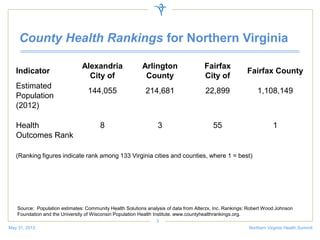
County Health Rankings for Northern Virginia
Indicator
Alexandria
City of
Arlington
County
Fairfax
City of
Fairfax County
Estimated
Population
(2012)
144,055 214,681 22,899 1,108,149
Health
Outcomes Rank
8 3 55 1
(Ranking figures indicate rank among 133 Virginia cities and counties, where 1 = best)
May 31, 2013 Northern Virginia Health Summit
3
Source: Population estimates: Community Health Solutions analysis of data from Alterzx, Inc. Rankings: Robert Wood Johnson
Foundation and the University of Wisconsin Population Health Institute. www.countyhealthrankings.org.
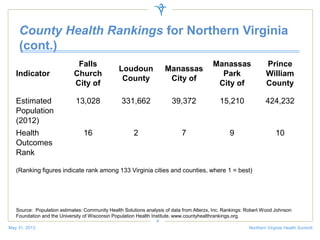
County Health Rankings for Northern Virginia
(cont.)
Indicator
Falls
Church
City of
Loudoun
County
Manassas
City of
Manassas
Park
City of
Prince
William
County
Estimated
Population
(2012)
13,028 331,662 39,372 15,210 424,232
Health
Outcomes
Rank
16 2 7 9 10
(Ranking figures indicate rank among 133 Virginia cities and counties, where 1 = best)
May 31, 2013 Northern Virginia Health Summit
4
Source: Population estimates: Community Health Solutions analysis of data from Alterzx, Inc. Rankings: Robert Wood Johnson
Foundation and the University of Wisconsin Population Health Institute. www.countyhealthrankings.org.
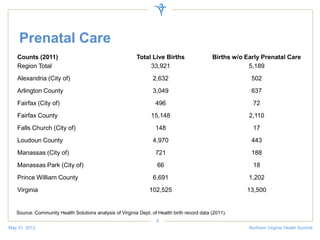
Prenatal Care
May 31, 2013 Northern Virginia Health Summit
5
Counts (2011) Total Live Births Births w/o Early Prenatal Care
Region Total 33,921 5,189
Alexandria (City of) 2,632 502
Arlington County 3,049 637
Fairfax (City of) 496 72
Fairfax County 15,148 2,110
Falls Church (City of) 148 17
Loudoun County 4,970 443
Manassas (City of) 721 188
Manassas Park (City of) 66 18
Prince William County 6,691 1,202
Virginia 102,525 13,500
Source: Community Health Solutions analysis of Virginia Dept. of Health birth record data (2011).
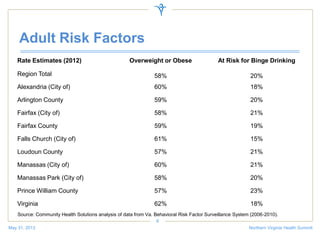
Adult Risk Factors
Rate Estimates (2012) Overweight or Obese At Risk for Binge Drinking
Region Total 58% 20%
Alexandria (City of) 60% 18%
Arlington County 59% 20%
Fairfax (City of) 58% 21%
Fairfax County 59% 19%
Falls Church (City of) 61% 15%
Loudoun County 57% 21%
Manassas (City of) 60% 21%
Manassas Park (City of) 58% 20%
Prince William County 57% 23%
Virginia 62% 18%
May 31, 2013 Northern Virginia Health Summit
6
Source: Community Health Solutions analysis of data from Va. Behavioral Risk Factor Surveillance System (2006-2010).
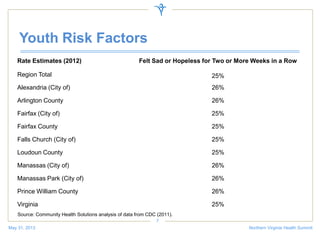
Youth Risk Factors
Rate Estimates (2012) Felt Sad or Hopeless for Two or More Weeks in a Row
Region Total 25%
Alexandria (City of) 26%
Arlington County 26%
Fairfax (City of) 25%
Fairfax County 25%
Falls Church (City of) 25%
Loudoun County 25%
Manassas (City of) 26%
Manassas Park (City of) 26%
Prince William County 26%
Virginia 25%
May 31, 2013 Northern Virginia Health Summit
7
Source: Community Health Solutions analysis of data from CDC (2011).
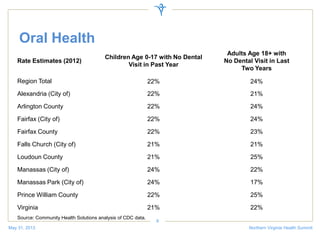
Oral Health
Rate Estimates (2012)
Children Age 0-17 with No Dental
Visit in Past Year
Adults Age 18+ with
No Dental Visit in Last
Two Years
Region Total 22% 24%
Alexandria (City of) 22% 21%
Arlington County 22% 24%
Fairfax (City of) 22% 24%
Fairfax County 22% 23%
Falls Church (City of) 21% 21%
Loudoun County 21% 25%
Manassas (City of) 24% 22%
Manassas Park (City of) 24% 17%
Prince William County 22% 25%
Virginia 21% 22%
May 31, 2013 Northern Virginia Health Summit
8
Source: Community Health Solutions analysis of CDC data.
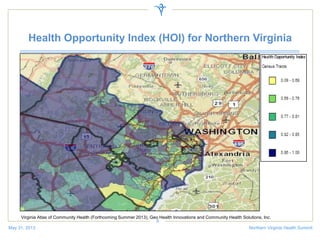
Health Opportunity Index (HOI) for Northern Virginia
May 31, 2013 Northern Virginia Health Summit
9
Virginia Atlas of Community Health (Forthcoming Summer 2013), Geo Health Innovations and Community Health Solutions, Inc.
Where Innovation Is Tradition
Health Reform:
Where is the Commonwealth
NOW?
Len M. Nichols, Ph.D.
Center for Health Policy Research and Ethics
The First Northern Virginia Health Summit
Springfield, VA
May 31, 2013
Review reform climate
• Virginia voted for Obama, twice
(and Sens. Webb and Kaine, respectively)
• McDonnell elected Governor in 2009, Rs
gained Senate split 20-20 after 2011 elections
• AG Cuccinelli first to file suit against ACA
• 26 person VHRI appointed by Gov, led by Sec.
Hazel, recommended, in December 2010:
State-run exchange
Prepare for Medicaid expansion, delivery reform
11
Where Innovation Is Tradition
Post-Supreme Court decision on ACA
• Created opportunity to oppose Obamacare in
the name of fiscal prudence for state
• Argument undercut by 3 facts:
Feds would pay 100% of expansion population
costs for 3 years, 90% thereafter
State would save money for 5-6 years, low cost
thereafter compared to economic benefit to state
Chamber of Commerce of VA came to support
Medicaid expansion
12
Where Innovation Is Tradition
De Facto Partnership on Exchange
• McDonnell decided, after SCOTUS, to NOT
apply for establishment grant for exchange
• Governor also did not want to use the word
“partnership” in deal with Feds
• Feds have signaled willingness to let Virginia
BOI do “plan management,” one key function
of partnership exchanges
13
Where Innovation Is Tradition
Medicaid possibilities
• Created by Senate split and Gov.’s desire for
transportation signature achievement
• Budget created Medicaid Innovation and Reform
Commission (MIRC)
• MIRC has 12 members, 3/5 from each house
must vote YES to judgment that:
ADEQUATE Medicaid reform progress is being
made to justify expansion in July of 2014
14
Where Innovation Is Tradition
Delegate Appointees to MIRC
• Steve Landes-R (Albemarle, Augusta,
Rockingham)
• Jimmie Massie-R (Henrico)
• John O’Bannon-R (Henrico, city of Richmond)
• Beverly Sherwood-R (Frederick, Warren, city of
Winchester)
• Johnny Joannou-D (cities of Chesepeake,
Norfolk, Portsmouth, Suffolk)
15
Where Innovation Is Tradition
Senate Appointees to MIRC
• Walter Stosch-R (Henrico, city of Richmond
• Emmet Hanger-R (Augusta, Greene, Madison,
Rockingham, cities of Staunton and Waynesboro)
• John Watkins-R (Powhatan, Chesterfield, city of
Richmond)
• Janet Howell-D (Fairfax, Arlington)
• Louise Lucas-D (Portsmouth).
16
Where Innovation Is Tradition
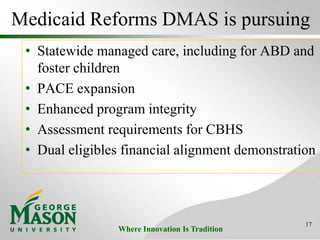
Medicaid Reforms DMAS is pursuing
• Statewide managed care, including for ABD and
foster children
• PACE expansion
• Enhanced program integrity
• Assessment requirements for CBHS
• Dual eligibles financial alignment demonstration
17
Where Innovation Is Tradition
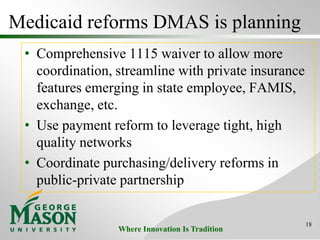
Medicaid reforms DMAS is planning
• Comprehensive 1115 waiver to allow more
coordination, streamline with private insurance
features emerging in state employee, FAMIS,
exchange, etc.
• Use payment reform to leverage tight, high
quality networks
• Coordinate purchasing/delivery reforms in
public-private partnership
18
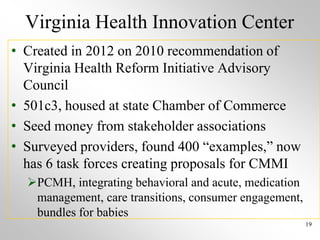
Virginia Health Innovation Center
• Created in 2012 on 2010 recommendation of
Virginia Health Reform Initiative Advisory
Council
• 501c3, housed at state Chamber of Commerce
• Seed money from stakeholder associations
• Surveyed providers, found 400 “examples,” now
has 6 task forces creating proposals for CMMI
PCMH, integrating behavioral and acute, medication
management, care transitions, consumer engagement,
bundles for babies
19
Where Innovation Is Tradition
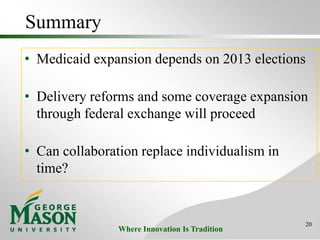
Summary
• Medicaid expansion depends on 2013 elections
• Delivery reforms and some coverage expansion
through federal exchange will proceed
• Can collaboration replace individualism in
time?
20
21
Beyond Health Care
Northern Virginia Health Summit
Fairfax, Virginia
May 31, 2013
Steven H. Woolf, MD, MPH
VCU Center on Human Needs
Department of Family Medicine and Population Health
Virginia Commonwealth University
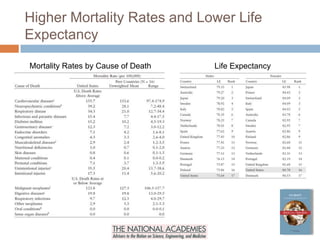
Higher Mortality Rates and Lower Life
Expectancy
Mortality Rates by Cause of Death Life Expectancy
Beyond the Clinical Setting
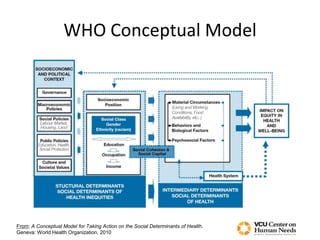
WHO Conceptual Model
From: A Conceptual Model for Taking Action on the Social Determinants of Health.
Geneva: World Health Organization, 2010
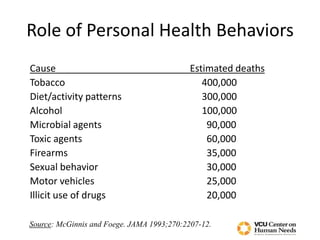
Role of Personal Health Behaviors
Cause Estimated deaths
Tobacco 400,000
Diet/activity patterns 300,000
Alcohol 100,000
Microbial agents 90,000
Toxic agents 60,000
Firearms 35,000
Sexual behavior 30,000
Motor vehicles 25,000
Illicit use of drugs 20,000
Source: McGinnis and Foege. JAMA 1993;270:2207-12.
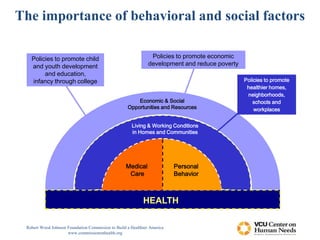
Economic & Social
Opportunities and Resources
Living & Working Conditions
in Homes and Communities
Personal
Behavior
Medical
Care
HEALTH
The importance of behavioral and social factors
Policies to promote
healthier homes,
neighborhoods,
schools and
workplaces
Policies to promote child
and youth development
and education,
infancy through college
Policies to promote economic
development and reduce poverty
Robert Wood Johnson Foundation Commission to Build a Healthier America
www.commissiononhealth.org
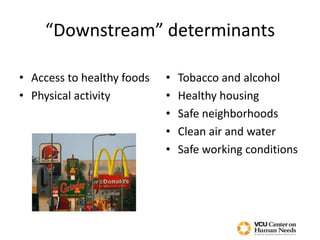
“Downstream” determinants
• Access to healthy foods
• Physical activity
• Tobacco and alcohol
• Healthy housing
• Safe neighborhoods
• Clean air and water
• Safe working conditions
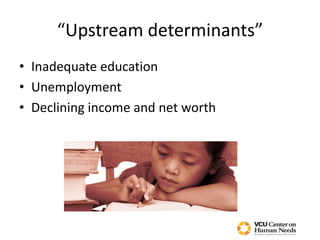
“Upstream determinants”
• Inadequate education
• Unemployment
• Declining income and net worth
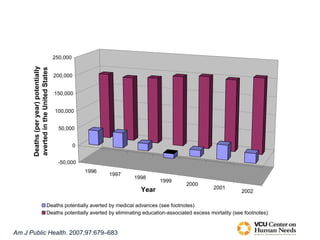
1996
1997
1998
1999
2000
2001
2002
-50,000
0
50,000
100,000
150,000
200,000
250,000
Deaths(peryear)potentially
avertedintheUnitedStates
Year
Deaths potentially averted by medical advances (see footnotes)
Deaths potentially averted by eliminating education-associated excess mortality (see footnotes)
Am J Public Health. 2007;97:679–683
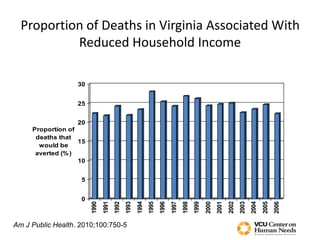
Proportion of Deaths in Virginia Associated With
Reduced Household Income
0
5
10
15
20
25
30
Proportion of
deaths that
would be
averted (%)
1990
1991
1992
1993
1994
1995
1996
1997
1998
1999
2000
2001
2002
2003
2004
2005
2006
Am J Public Health. 2010;100:750-5
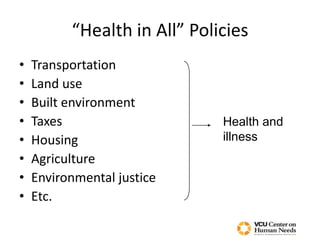
“Health in All” Policies
• Transportation
• Land use
• Built environment
• Taxes
• Housing
• Agriculture
• Environmental justice
• Etc.
Health and
illness
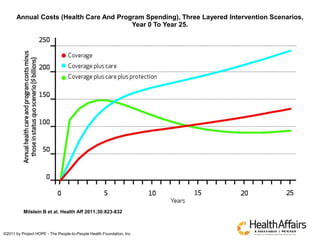
Annual Costs (Health Care And Program Spending), Three Layered Intervention Scenarios,
Year 0 To Year 25.
Milstein B et al. Health Aff 2011;30:823-832
©2011 by Project HOPE - The People-to-People Health Foundation, Inc.
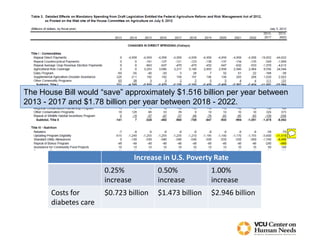
The House Bill would “save” approximately $1.516 billion per year between
2013 - 2017 and $1.78 billion per year between 2018 - 2022.
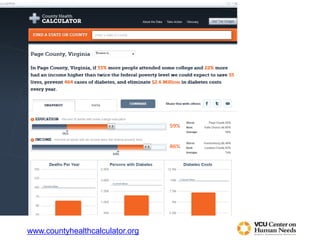
Increase in U.S. Poverty Rate
0.25%
increase
0.50%
increase
1.00%
increase
Costs for
diabetes care
$0.723 billion $1.473 billion $2.946 billion
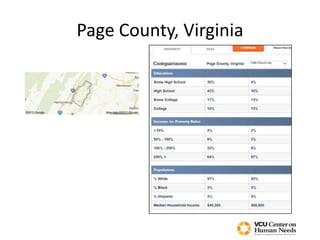
Page County, Virginia
www.countyhealthcalculator.org
Contact Information
• Steven H. Woolf, MD, MPH
Center on Human Needs
Department of Family Medicine
Virginia Commonwealth University
804-828-9625
• swoolf@vcu.edu
MOBILIZING COMMUNITY
PARTNERSHIPS TO IMPROVE
PUBLIC HEALTH
The First Northern Virginia Health Summit
Gloria Addo-Ayensu, MD, MPH
Director of Health, Fairfax County
May 31, 2013
41
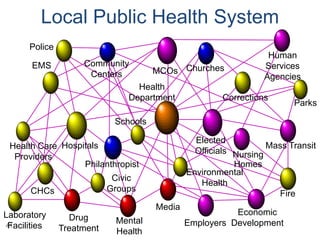
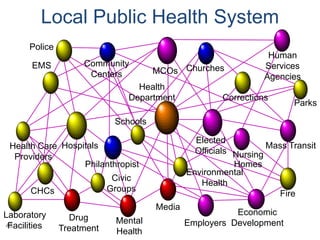
Human
Services
Agencies
Parks
Economic
Development
Mass Transit
Employers
Nursing
Homes
Mental
Health
Drug
Treatment
Civic
GroupsCHCs
Laboratory
Facilities
Hospitals
EMS
Health Care
Providers
Health
Department
Churches
Philanthropist
Elected
Officials
Media
Schools
Police
Fire
Corrections
Environmental
Health
Community
Centers MCOs
Local Public Health System
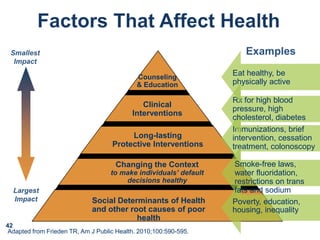
Social Determinants of Health
and other root causes of poor
health
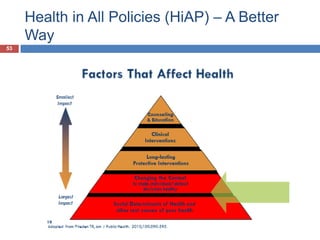
Changing the Context
to make individuals’ default
decisions healthy
Long-lasting
Protective Interventions
Clinical
Interventions
Counseling
& Education
Examples
Poverty, education,
housing, inequality
Immunizations, brief
intervention, cessation
treatment, colonoscopy
Smoke-free laws,
water fluoridation,
restrictions on trans
fats and sodium
Rx for high blood
pressure, high
cholesterol, diabetes
Eat healthy, be
physically active
Adapted from Frieden TR, Am J Public Health. 2010;100:590-595.
Smallest
Impact
Largest
Impact
42
43
Human
Services
Agencies
Parks
Economic
Development
Mass Transit
Employers
Nursing
Homes
Mental
Health
Drug
Treatment
Civic
GroupsCHCs
Laboratory
Facilities
Hospitals
EMS
Health Care
Providers
Health
Department
Churches
Philanthropist
Elected
Officials
Media
Schools
Police
Fire
Corrections
Environmental
Health
Community
Centers MCOs
Local Public Health System
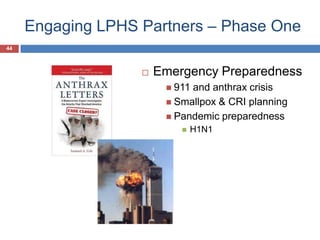
Engaging LPHS Partners – Phase One
 Emergency Preparedness
 911 and anthrax crisis
 Smallpox & CRI planning
 Pandemic preparedness
 H1N1
44
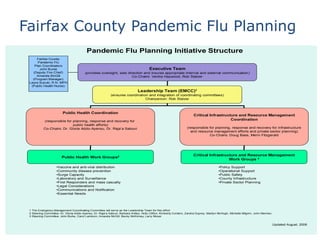
Fairfax County Pandemic Flu Planning
Pandemic Flu Planning Initiative Structure
•Vaccine and anti-viral distribution
•Community disease prevention
•Surge Capacity
•Laboratory and Surveillance
•First Responders and mass casualty
•Legal Considerations
•Communications and Notification
•Essential Needs
1 The Emergency Management Coordinating Committee will serve as the Leadership Team for this effort
2 Steering Committee: Dr. Gloria Addo-Ayensu, Dr. Raja’a Satouri, Barbara Antley, Holly Clifton, Kimberly Cordero, Zandra Duprey, Marilyn McHugh, Michelle Milgrim, John Niemiec
3 Steering Committee: John Burke, Carol Lamborn, Amanda McGill, Becky McKinney, Larry Moser
Updated August, 2006
•Policy Support
•Operational Support
•Public Safety
•County Infrastructure
•Private Sector Planning
Executive Team
(provides oversight, sets direction and insures appropriate internal and external communication)
Co-Chairs: Verdia Haywood, Rob Stalzer
Leadership Team (EMCC)1
(ensures coordination and integration of coordinating committees)
Chairperson: Rob Stalzer
Public Health Coordination
(responsible for planning, response and recovery for
public health efforts)
Co-Chairs: Dr. Gloria Addo-Ayensu, Dr. Raja’a Satouri
Critical Infrastructure and Resource Management
Coordination
(responsible for planning, response and recovery for infrastructure
and resource management efforts and private sector planning)
Co-Chairs: Doug Bass, Merni Fitzgerald
Public Health Work Groups2 Critical Infrastructure and Resource Management
Work Groups 3
Fairfax County
Pandemic Flu
Plan Coordinators
John Burke
(Deputy Fire Chief)
Amanda McGill
(Program Manager)
Laura Suzuki, R.N. MPH
(Public Health Nurse)
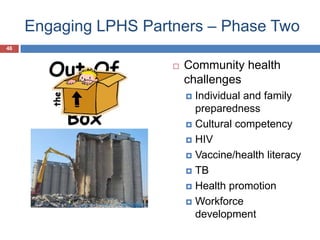
Engaging LPHS Partners – Phase Two
 Community health
challenges
 Individual and family
preparedness
 Cultural competency
 HIV
 Vaccine/health literacy
 TB
 Health promotion
 Workforce
development
46
Rationale for Engaging LPHS Partners
47
 Builds capacity for addressing public health
challenges
 Promotes cultural competency
 Provides opportunity to address gaps and root
causes of poor health
 Empowers the community to participate in
improving their own health
 Strengthens local public health system
 Improves community health
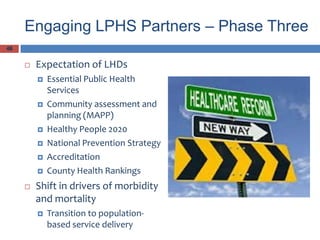
Engaging LPHS Partners – Phase Three
 Expectation of LHDs
 Essential Public Health
Services
 Community assessment and
planning (MAPP)
 Healthy People 2020
 National Prevention Strategy
 Accreditation
 County Health Rankings
 Shift in drivers of morbidity
and mortality
 Transition to population-
based service delivery
48
Principles for Successful Partnerships
49
Maintaining Effective Partnerships
50
 Build on what already exists and leverage existing
resources to minimize the need for additional
costs initially.
 Look for opportunities for early successes and set
realistic goals.
 Listen to partners and be flexible.
 Find ways to collaborate on priorities that further
each other’s mission.
 Allow sufficient time for partnership to develop
and scale up gradually.
 Make capacity building and sustainability a core
strategy of the partnership.
 Partnership building is work, but rewarding!
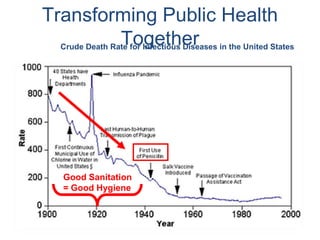
Crude Death Rate for Infectious Diseases in the United States
Good Sanitation
= Good Hygiene
Transforming Public Health
Together
Investing in Effective Partnerships is
ROI
 2001 Anthrax
 Health Department response
 2009 H1N1
 Entire LPHS participation
 Activation of County EOC
 ICS & COOP
 75,000 vaccinated
 287 clinics
 1018 MRC volunteers
 19,548 Hours
 $516,000
52
Health in All Policies (HiAP) – A Better
Way
53
Thank You54
DISCUSSION QUESTIONS
1. Where are there opportunities for
collaboration across specific silos that
might yield improved health for Northern
Virginians?
2. What can I do -- in my work and where I
live -- to improve the public’s health?
3. Complete the sheet on your table by
listing groups you know that are working
on health and health-related solutions in
the region.
July 17, 2013 Event Name
55
The First Northern Virginia
Health Summit
Where Are We, and Where Could We Go?
Friday, May 31, 2013

All final presentations 5-30-13

  • 1.
    The First NorthernVirginia Health Summit Where Are We, and Where Could We Go? Friday, May 31, 2013
  • 2.
    Where Are We?Review of Northern Virginia Health Indicators Patricia N. Mathews, President & CEO, Northern Virginia Health Foundation May 31, 2013
  • 3.
    County Health Rankingsfor Northern Virginia Indicator Alexandria City of Arlington County Fairfax City of Fairfax County Estimated Population (2012) 144,055 214,681 22,899 1,108,149 Health Outcomes Rank 8 3 55 1 (Ranking figures indicate rank among 133 Virginia cities and counties, where 1 = best) May 31, 2013 Northern Virginia Health Summit 3 Source: Population estimates: Community Health Solutions analysis of data from Alterzx, Inc. Rankings: Robert Wood Johnson Foundation and the University of Wisconsin Population Health Institute. www.countyhealthrankings.org.
  • 4.
    County Health Rankingsfor Northern Virginia (cont.) Indicator Falls Church City of Loudoun County Manassas City of Manassas Park City of Prince William County Estimated Population (2012) 13,028 331,662 39,372 15,210 424,232 Health Outcomes Rank 16 2 7 9 10 (Ranking figures indicate rank among 133 Virginia cities and counties, where 1 = best) May 31, 2013 Northern Virginia Health Summit 4 Source: Population estimates: Community Health Solutions analysis of data from Alterzx, Inc. Rankings: Robert Wood Johnson Foundation and the University of Wisconsin Population Health Institute. www.countyhealthrankings.org.
  • 5.
    Prenatal Care May 31,2013 Northern Virginia Health Summit 5 Counts (2011) Total Live Births Births w/o Early Prenatal Care Region Total 33,921 5,189 Alexandria (City of) 2,632 502 Arlington County 3,049 637 Fairfax (City of) 496 72 Fairfax County 15,148 2,110 Falls Church (City of) 148 17 Loudoun County 4,970 443 Manassas (City of) 721 188 Manassas Park (City of) 66 18 Prince William County 6,691 1,202 Virginia 102,525 13,500 Source: Community Health Solutions analysis of Virginia Dept. of Health birth record data (2011).
  • 6.
    Adult Risk Factors RateEstimates (2012) Overweight or Obese At Risk for Binge Drinking Region Total 58% 20% Alexandria (City of) 60% 18% Arlington County 59% 20% Fairfax (City of) 58% 21% Fairfax County 59% 19% Falls Church (City of) 61% 15% Loudoun County 57% 21% Manassas (City of) 60% 21% Manassas Park (City of) 58% 20% Prince William County 57% 23% Virginia 62% 18% May 31, 2013 Northern Virginia Health Summit 6 Source: Community Health Solutions analysis of data from Va. Behavioral Risk Factor Surveillance System (2006-2010).
  • 7.
    Youth Risk Factors RateEstimates (2012) Felt Sad or Hopeless for Two or More Weeks in a Row Region Total 25% Alexandria (City of) 26% Arlington County 26% Fairfax (City of) 25% Fairfax County 25% Falls Church (City of) 25% Loudoun County 25% Manassas (City of) 26% Manassas Park (City of) 26% Prince William County 26% Virginia 25% May 31, 2013 Northern Virginia Health Summit 7 Source: Community Health Solutions analysis of data from CDC (2011).
  • 8.
    Oral Health Rate Estimates(2012) Children Age 0-17 with No Dental Visit in Past Year Adults Age 18+ with No Dental Visit in Last Two Years Region Total 22% 24% Alexandria (City of) 22% 21% Arlington County 22% 24% Fairfax (City of) 22% 24% Fairfax County 22% 23% Falls Church (City of) 21% 21% Loudoun County 21% 25% Manassas (City of) 24% 22% Manassas Park (City of) 24% 17% Prince William County 22% 25% Virginia 21% 22% May 31, 2013 Northern Virginia Health Summit 8 Source: Community Health Solutions analysis of CDC data.
  • 9.
    Health Opportunity Index(HOI) for Northern Virginia May 31, 2013 Northern Virginia Health Summit 9 Virginia Atlas of Community Health (Forthcoming Summer 2013), Geo Health Innovations and Community Health Solutions, Inc.
  • 10.
    Where Innovation IsTradition Health Reform: Where is the Commonwealth NOW? Len M. Nichols, Ph.D. Center for Health Policy Research and Ethics The First Northern Virginia Health Summit Springfield, VA May 31, 2013
  • 11.
    Review reform climate •Virginia voted for Obama, twice (and Sens. Webb and Kaine, respectively) • McDonnell elected Governor in 2009, Rs gained Senate split 20-20 after 2011 elections • AG Cuccinelli first to file suit against ACA • 26 person VHRI appointed by Gov, led by Sec. Hazel, recommended, in December 2010: State-run exchange Prepare for Medicaid expansion, delivery reform 11
  • 12.
    Where Innovation IsTradition Post-Supreme Court decision on ACA • Created opportunity to oppose Obamacare in the name of fiscal prudence for state • Argument undercut by 3 facts: Feds would pay 100% of expansion population costs for 3 years, 90% thereafter State would save money for 5-6 years, low cost thereafter compared to economic benefit to state Chamber of Commerce of VA came to support Medicaid expansion 12
  • 13.
    Where Innovation IsTradition De Facto Partnership on Exchange • McDonnell decided, after SCOTUS, to NOT apply for establishment grant for exchange • Governor also did not want to use the word “partnership” in deal with Feds • Feds have signaled willingness to let Virginia BOI do “plan management,” one key function of partnership exchanges 13
  • 14.
    Where Innovation IsTradition Medicaid possibilities • Created by Senate split and Gov.’s desire for transportation signature achievement • Budget created Medicaid Innovation and Reform Commission (MIRC) • MIRC has 12 members, 3/5 from each house must vote YES to judgment that: ADEQUATE Medicaid reform progress is being made to justify expansion in July of 2014 14
  • 15.
    Where Innovation IsTradition Delegate Appointees to MIRC • Steve Landes-R (Albemarle, Augusta, Rockingham) • Jimmie Massie-R (Henrico) • John O’Bannon-R (Henrico, city of Richmond) • Beverly Sherwood-R (Frederick, Warren, city of Winchester) • Johnny Joannou-D (cities of Chesepeake, Norfolk, Portsmouth, Suffolk) 15
  • 16.
    Where Innovation IsTradition Senate Appointees to MIRC • Walter Stosch-R (Henrico, city of Richmond • Emmet Hanger-R (Augusta, Greene, Madison, Rockingham, cities of Staunton and Waynesboro) • John Watkins-R (Powhatan, Chesterfield, city of Richmond) • Janet Howell-D (Fairfax, Arlington) • Louise Lucas-D (Portsmouth). 16
  • 17.
    Where Innovation IsTradition Medicaid Reforms DMAS is pursuing • Statewide managed care, including for ABD and foster children • PACE expansion • Enhanced program integrity • Assessment requirements for CBHS • Dual eligibles financial alignment demonstration 17
  • 18.
    Where Innovation IsTradition Medicaid reforms DMAS is planning • Comprehensive 1115 waiver to allow more coordination, streamline with private insurance features emerging in state employee, FAMIS, exchange, etc. • Use payment reform to leverage tight, high quality networks • Coordinate purchasing/delivery reforms in public-private partnership 18
  • 19.
    Virginia Health InnovationCenter • Created in 2012 on 2010 recommendation of Virginia Health Reform Initiative Advisory Council • 501c3, housed at state Chamber of Commerce • Seed money from stakeholder associations • Surveyed providers, found 400 “examples,” now has 6 task forces creating proposals for CMMI PCMH, integrating behavioral and acute, medication management, care transitions, consumer engagement, bundles for babies 19
  • 20.
    Where Innovation IsTradition Summary • Medicaid expansion depends on 2013 elections • Delivery reforms and some coverage expansion through federal exchange will proceed • Can collaboration replace individualism in time? 20
  • 21.
  • 22.
    Beyond Health Care NorthernVirginia Health Summit Fairfax, Virginia May 31, 2013 Steven H. Woolf, MD, MPH VCU Center on Human Needs Department of Family Medicine and Population Health Virginia Commonwealth University
  • 23.
    Higher Mortality Ratesand Lower Life Expectancy Mortality Rates by Cause of Death Life Expectancy
  • 24.
  • 25.
    WHO Conceptual Model From:A Conceptual Model for Taking Action on the Social Determinants of Health. Geneva: World Health Organization, 2010
  • 26.
    Role of PersonalHealth Behaviors Cause Estimated deaths Tobacco 400,000 Diet/activity patterns 300,000 Alcohol 100,000 Microbial agents 90,000 Toxic agents 60,000 Firearms 35,000 Sexual behavior 30,000 Motor vehicles 25,000 Illicit use of drugs 20,000 Source: McGinnis and Foege. JAMA 1993;270:2207-12.
  • 27.
    Economic & Social Opportunitiesand Resources Living & Working Conditions in Homes and Communities Personal Behavior Medical Care HEALTH The importance of behavioral and social factors Policies to promote healthier homes, neighborhoods, schools and workplaces Policies to promote child and youth development and education, infancy through college Policies to promote economic development and reduce poverty Robert Wood Johnson Foundation Commission to Build a Healthier America www.commissiononhealth.org
  • 28.
    “Downstream” determinants • Accessto healthy foods • Physical activity • Tobacco and alcohol • Healthy housing • Safe neighborhoods • Clean air and water • Safe working conditions
  • 29.
    “Upstream determinants” • Inadequateeducation • Unemployment • Declining income and net worth
  • 30.
    1996 1997 1998 1999 2000 2001 2002 -50,000 0 50,000 100,000 150,000 200,000 250,000 Deaths(peryear)potentially avertedintheUnitedStates Year Deaths potentially avertedby medical advances (see footnotes) Deaths potentially averted by eliminating education-associated excess mortality (see footnotes) Am J Public Health. 2007;97:679–683
  • 31.
    Proportion of Deathsin Virginia Associated With Reduced Household Income 0 5 10 15 20 25 30 Proportion of deaths that would be averted (%) 1990 1991 1992 1993 1994 1995 1996 1997 1998 1999 2000 2001 2002 2003 2004 2005 2006 Am J Public Health. 2010;100:750-5
  • 32.
    “Health in All”Policies • Transportation • Land use • Built environment • Taxes • Housing • Agriculture • Environmental justice • Etc. Health and illness
  • 34.
    Annual Costs (HealthCare And Program Spending), Three Layered Intervention Scenarios, Year 0 To Year 25. Milstein B et al. Health Aff 2011;30:823-832 ©2011 by Project HOPE - The People-to-People Health Foundation, Inc.
  • 35.
    The House Billwould “save” approximately $1.516 billion per year between 2013 - 2017 and $1.78 billion per year between 2018 - 2022. Increase in U.S. Poverty Rate 0.25% increase 0.50% increase 1.00% increase Costs for diabetes care $0.723 billion $1.473 billion $2.946 billion
  • 37.
  • 38.
  • 39.
    Contact Information • StevenH. Woolf, MD, MPH Center on Human Needs Department of Family Medicine Virginia Commonwealth University 804-828-9625 • swoolf@vcu.edu
  • 40.
    MOBILIZING COMMUNITY PARTNERSHIPS TOIMPROVE PUBLIC HEALTH The First Northern Virginia Health Summit Gloria Addo-Ayensu, MD, MPH Director of Health, Fairfax County May 31, 2013
  • 41.
  • 42.
    Social Determinants ofHealth and other root causes of poor health Changing the Context to make individuals’ default decisions healthy Long-lasting Protective Interventions Clinical Interventions Counseling & Education Examples Poverty, education, housing, inequality Immunizations, brief intervention, cessation treatment, colonoscopy Smoke-free laws, water fluoridation, restrictions on trans fats and sodium Rx for high blood pressure, high cholesterol, diabetes Eat healthy, be physically active Adapted from Frieden TR, Am J Public Health. 2010;100:590-595. Smallest Impact Largest Impact 42
  • 43.
  • 44.
    Engaging LPHS Partners– Phase One  Emergency Preparedness  911 and anthrax crisis  Smallpox & CRI planning  Pandemic preparedness  H1N1 44
  • 45.
    Fairfax County PandemicFlu Planning Pandemic Flu Planning Initiative Structure •Vaccine and anti-viral distribution •Community disease prevention •Surge Capacity •Laboratory and Surveillance •First Responders and mass casualty •Legal Considerations •Communications and Notification •Essential Needs 1 The Emergency Management Coordinating Committee will serve as the Leadership Team for this effort 2 Steering Committee: Dr. Gloria Addo-Ayensu, Dr. Raja’a Satouri, Barbara Antley, Holly Clifton, Kimberly Cordero, Zandra Duprey, Marilyn McHugh, Michelle Milgrim, John Niemiec 3 Steering Committee: John Burke, Carol Lamborn, Amanda McGill, Becky McKinney, Larry Moser Updated August, 2006 •Policy Support •Operational Support •Public Safety •County Infrastructure •Private Sector Planning Executive Team (provides oversight, sets direction and insures appropriate internal and external communication) Co-Chairs: Verdia Haywood, Rob Stalzer Leadership Team (EMCC)1 (ensures coordination and integration of coordinating committees) Chairperson: Rob Stalzer Public Health Coordination (responsible for planning, response and recovery for public health efforts) Co-Chairs: Dr. Gloria Addo-Ayensu, Dr. Raja’a Satouri Critical Infrastructure and Resource Management Coordination (responsible for planning, response and recovery for infrastructure and resource management efforts and private sector planning) Co-Chairs: Doug Bass, Merni Fitzgerald Public Health Work Groups2 Critical Infrastructure and Resource Management Work Groups 3 Fairfax County Pandemic Flu Plan Coordinators John Burke (Deputy Fire Chief) Amanda McGill (Program Manager) Laura Suzuki, R.N. MPH (Public Health Nurse)
  • 46.
    Engaging LPHS Partners– Phase Two  Community health challenges  Individual and family preparedness  Cultural competency  HIV  Vaccine/health literacy  TB  Health promotion  Workforce development 46
  • 47.
    Rationale for EngagingLPHS Partners 47  Builds capacity for addressing public health challenges  Promotes cultural competency  Provides opportunity to address gaps and root causes of poor health  Empowers the community to participate in improving their own health  Strengthens local public health system  Improves community health
  • 48.
    Engaging LPHS Partners– Phase Three  Expectation of LHDs  Essential Public Health Services  Community assessment and planning (MAPP)  Healthy People 2020  National Prevention Strategy  Accreditation  County Health Rankings  Shift in drivers of morbidity and mortality  Transition to population- based service delivery 48
  • 49.
  • 50.
    Maintaining Effective Partnerships 50 Build on what already exists and leverage existing resources to minimize the need for additional costs initially.  Look for opportunities for early successes and set realistic goals.  Listen to partners and be flexible.  Find ways to collaborate on priorities that further each other’s mission.  Allow sufficient time for partnership to develop and scale up gradually.  Make capacity building and sustainability a core strategy of the partnership.  Partnership building is work, but rewarding!
  • 51.
    Crude Death Ratefor Infectious Diseases in the United States Good Sanitation = Good Hygiene Transforming Public Health Together
  • 52.
    Investing in EffectivePartnerships is ROI  2001 Anthrax  Health Department response  2009 H1N1  Entire LPHS participation  Activation of County EOC  ICS & COOP  75,000 vaccinated  287 clinics  1018 MRC volunteers  19,548 Hours  $516,000 52
  • 53.
    Health in AllPolicies (HiAP) – A Better Way 53
  • 54.
  • 55.
    DISCUSSION QUESTIONS 1. Whereare there opportunities for collaboration across specific silos that might yield improved health for Northern Virginians? 2. What can I do -- in my work and where I live -- to improve the public’s health? 3. Complete the sheet on your table by listing groups you know that are working on health and health-related solutions in the region. July 17, 2013 Event Name 55
  • 56.
    The First NorthernVirginia Health Summit Where Are We, and Where Could We Go? Friday, May 31, 2013