NUTRITION THERAPY
FOR THE CRITICALLY ILL
PATIENTS
AHMED ELMENSHAWY
MD, ALEXANDRIA
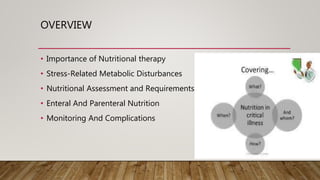
OVERVIEW
• Importance of Nutritional therapy
• Stress-Related Metabolic Disturbances
• Nutritional Assessment and Requirements
• Enteral And Parenteral Nutrition
• Monitoring And Complications
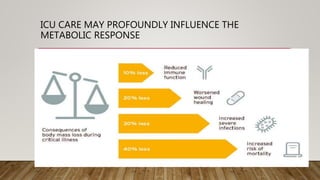
ICU CARE MAY PROFOUNDLY INFLUENCE THE
METABOLIC RESPONSE
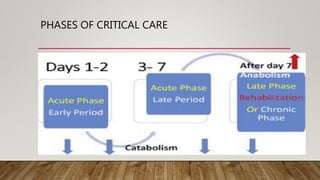
PHASES OF CRITICAL CARE
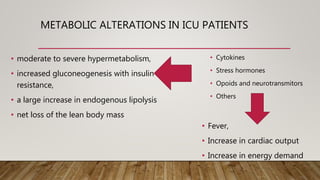
METABOLIC ALTERATIONS IN ICU PATIENTS
• moderate to severe hypermetabolism,
• increased gluconeogenesis with insulin
resistance,
• a large increase in endogenous lipolysis
• net loss of the lean body mass
• Cytokines
• Stress hormones
• Opoids and neurotransmitors
• Others
• Fever,
• Increase in cardiac output
• Increase in energy demand
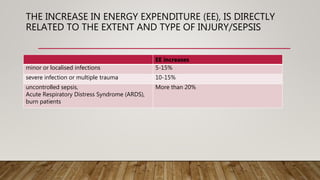
THE INCREASE IN ENERGY EXPENDITURE (EE), IS DIRECTLY
RELATED TO THE EXTENT AND TYPE OF INJURY/SEPSIS
EE increases
minor or localised infections 5-15%
severe infection or multiple trauma 10-15%
uncontrolled sepsis,
Acute Respiratory Distress Syndrome (ARDS),
burn patients
More than 20%
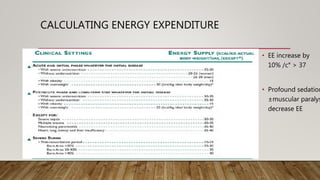
CALCULATING ENERGY EXPENDITURE
• Profound sedation
±muscular paralys
decrease EE
• EE increase by
10% /c° > 37
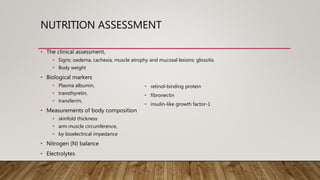
NUTRITION ASSESSMENT
• The clinical assessment,
• Signs: oedema, cachexia, muscle atrophy and mucosal lesions: glossitis
• Body weight
• Biological markers
• Plasma albumin,
• transthyretin,
• transferrin,
• Measurements of body composition
• skinfold thickness
• arm muscle circumference,
• by bioelectrical impedance
• Nitrogen (N) balance
• Electrolytes
• retinol-binding protein
• fibronectin
• insulin-like growth factor-1
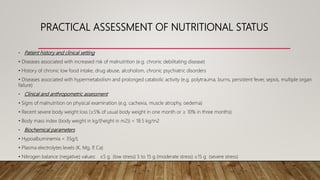
PRACTICAL ASSESSMENT OF NUTRITIONAL STATUS
• Patient history and clinical setting
• Diseases associated with increased risk of malnutrition (e.g. chronic debilitating disease)
• History of chronic low food intake, drug abuse, alcoholism, chronic psychiatric disorders
• Diseases associated with hypermetabolism and prolonged catabolic activity (e.g. polytrauma, burns, persistent fever, sepsis, multiple organ
failure)
• Clinical and anthropometric assessment
• Signs of malnutrition on physical examination (e.g. cachexia, muscle atrophy, oedema)
• Recent severe body weight loss (≥5% of usual body weight in one month or ≥ 10% in three months)
• Body mass index (body weight in kg/(height in m2)) < 18.5 kg/m2
• Biochemical parameters
• Hypoalbuminemia < 35g/L
• Plasma electrolytes levels (K, Mg, P, Ca)
• Nitrogen balance (negative) values: ≤5 g (low stress) 5 to 15 g (moderate stress) ≥15 g (severe stress)
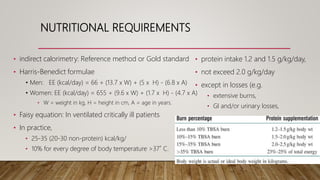
NUTRITIONAL REQUIREMENTS
• indirect calorimetry: Reference method or Gold standard
• Harris-Benedict formulae
• Men: EE (kcal/day) = 66 + (13.7 x W) + (5 x H) - (6.8 x A)
• Women: EE (kcal/day) = 655 + (9.6 x W) + (1.7 x H) - (4.7 x A)
• W = weight in kg, H = height in cm, A = age in years.
• Faisy equation: In ventilated critically ill patients
• In practice,
• 25-35 (20-30 non-protein) kcal/kg/
• 10% for every degree of body temperature >37˚ C.
• protein intake 1.2 and 1.5 g/kg/day,
• not exceed 2.0 g/kg/day
• except in losses (e.g.
• extensive burns,
• GI and/or urinary losses,
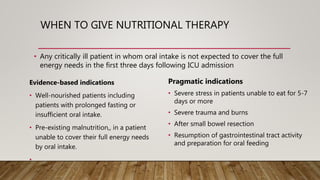
WHEN TO GIVE NUTRITIONAL THERAPY
• Any critically ill patient in whom oral intake is not expected to cover the full
energy needs in the first three days following ICU admission
Pragmatic indications
• Severe stress in patients unable to eat for 5-7
days or more
• Severe trauma and burns
• After small bowel resection
• Resumption of gastrointestinal tract activity
and preparation for oral feeding
Evidence-based indications
• Well-nourished patients including
patients with prolonged fasting or
insufficient oral intake.
• Pre-existing malnutrition,, in a patient
unable to cover their full energy needs
by oral intake.
•
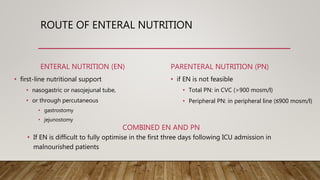
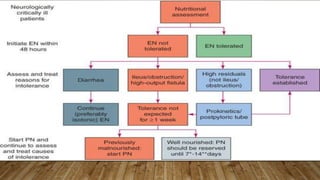
ROUTE OF ENTERAL NUTRITION
ENTERAL NUTRITION (EN)
• first-line nutritional support
• nasogastric or nasojejunal tube,
• or through percutaneous
• gastrostomy
• jejunostomy
PARENTERAL NUTRITION (PN)
• if EN is not feasible
• Total PN: in CVC (>900 mosm/l)
• Peripheral PN: in peripheral line (≤900 mosm/l)
COMBINED EN AND PN
• If EN is difficult to fully optimise in the first three days following ICU admission in
malnourished patients
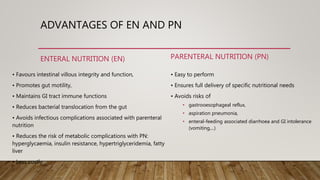
ADVANTAGES OF EN AND PN
ENTERAL NUTRITION (EN)
• Favours intestinal villous integrity and function,
• Promotes gut motility,
• Maintains GI tract immune functions
• Reduces bacterial translocation from the gut
• Avoids infectious complications associated with parenteral
nutrition
• Reduces the risk of metabolic complications with PN:
hyperglycaemia, insulin resistance, hypertriglyceridemia, fatty
liver
• Less costly
PARENTERAL NUTRITION (PN)
• Easy to perform
• Ensures full delivery of specific nutritional needs
• Avoids risks of
• gastrooesophageal reflux,
• aspiration pneumonia,
• enteral-feeding associated diarrhoea and GI intolerance
(vomiting,...)
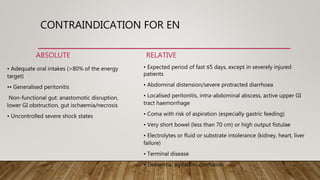
CONTRAINDICATION FOR EN
ABSOLUTE
• Adequate oral intakes (>80% of the energy
target)
•• Generalised peritonitis
Non-functional gut: anastomotic disruption,
lower GI obstruction, gut ischaemia/necrosis
• Uncontrolled severe shock states
RELATIVE
• Expected period of fast ≤5 days, except in severely injured
patients
• Abdominal distension/severe protracted diarrhoea
• Localised peritonitis, intra-abdominal abscess, active upper GI
tract haemorrhage
• Coma with risk of aspiration (especially gastric feeding)
• Very short bowel (less than 70 cm) or high output fistulae
• Electrolytes or fluid or substrate intolerance (kidney, heart, liver
failure)
• Terminal disease
• Dementia, agitation, confusion
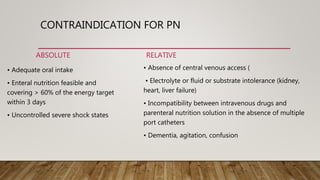
CONTRAINDICATION FOR PN
ABSOLUTE
• Adequate oral intake
• Enteral nutrition feasible and
covering > 60% of the energy target
within 3 days
• Uncontrolled severe shock states
RELATIVE
• Absence of central venous access (
• Electrolyte or fluid or substrate intolerance (kidney,
heart, liver failure)
• Incompatibility between intravenous drugs and
parenteral nutrition solution in the absence of multiple
port catheters
• Dementia, agitation, confusion
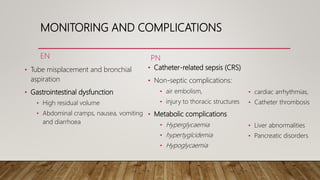
MONITORING AND COMPLICATIONS
EN
• Tube misplacement and bronchial
aspiration
• Gastrointestinal dysfunction
• High residual volume
• Abdominal cramps, nausea, vomiting
and diarrhoea
PN
• Catheter-related sepsis (CRS)
• Non-septic complications:
• air embolism,
• injury to thoracic structures
• Metabolic complications
• Hyperglycaemia
• hypertyglcidemia
• Hypoglycaemia
• cardiac arrhythmias,
• Catheter thrombosis
• Liver abnormalities
• Pancreatic disorders
Nutrition in critically ill

Nutrition in critically ill

  • 2.
    NUTRITION THERAPY FOR THECRITICALLY ILL PATIENTS AHMED ELMENSHAWY MD, ALEXANDRIA
  • 3.
    OVERVIEW • Importance ofNutritional therapy • Stress-Related Metabolic Disturbances • Nutritional Assessment and Requirements • Enteral And Parenteral Nutrition • Monitoring And Complications
  • 4.
    ICU CARE MAYPROFOUNDLY INFLUENCE THE METABOLIC RESPONSE
  • 5.
  • 6.
    METABOLIC ALTERATIONS INICU PATIENTS • moderate to severe hypermetabolism, • increased gluconeogenesis with insulin resistance, • a large increase in endogenous lipolysis • net loss of the lean body mass • Cytokines • Stress hormones • Opoids and neurotransmitors • Others • Fever, • Increase in cardiac output • Increase in energy demand
  • 7.
    THE INCREASE INENERGY EXPENDITURE (EE), IS DIRECTLY RELATED TO THE EXTENT AND TYPE OF INJURY/SEPSIS EE increases minor or localised infections 5-15% severe infection or multiple trauma 10-15% uncontrolled sepsis, Acute Respiratory Distress Syndrome (ARDS), burn patients More than 20%
  • 8.
    CALCULATING ENERGY EXPENDITURE •Profound sedation ±muscular paralys decrease EE • EE increase by 10% /c° > 37
  • 9.
    NUTRITION ASSESSMENT • Theclinical assessment, • Signs: oedema, cachexia, muscle atrophy and mucosal lesions: glossitis • Body weight • Biological markers • Plasma albumin, • transthyretin, • transferrin, • Measurements of body composition • skinfold thickness • arm muscle circumference, • by bioelectrical impedance • Nitrogen (N) balance • Electrolytes • retinol-binding protein • fibronectin • insulin-like growth factor-1
  • 10.
    PRACTICAL ASSESSMENT OFNUTRITIONAL STATUS • Patient history and clinical setting • Diseases associated with increased risk of malnutrition (e.g. chronic debilitating disease) • History of chronic low food intake, drug abuse, alcoholism, chronic psychiatric disorders • Diseases associated with hypermetabolism and prolonged catabolic activity (e.g. polytrauma, burns, persistent fever, sepsis, multiple organ failure) • Clinical and anthropometric assessment • Signs of malnutrition on physical examination (e.g. cachexia, muscle atrophy, oedema) • Recent severe body weight loss (≥5% of usual body weight in one month or ≥ 10% in three months) • Body mass index (body weight in kg/(height in m2)) < 18.5 kg/m2 • Biochemical parameters • Hypoalbuminemia < 35g/L • Plasma electrolytes levels (K, Mg, P, Ca) • Nitrogen balance (negative) values: ≤5 g (low stress) 5 to 15 g (moderate stress) ≥15 g (severe stress)
  • 11.
    NUTRITIONAL REQUIREMENTS • indirectcalorimetry: Reference method or Gold standard • Harris-Benedict formulae • Men: EE (kcal/day) = 66 + (13.7 x W) + (5 x H) - (6.8 x A) • Women: EE (kcal/day) = 655 + (9.6 x W) + (1.7 x H) - (4.7 x A) • W = weight in kg, H = height in cm, A = age in years. • Faisy equation: In ventilated critically ill patients • In practice, • 25-35 (20-30 non-protein) kcal/kg/ • 10% for every degree of body temperature >37˚ C. • protein intake 1.2 and 1.5 g/kg/day, • not exceed 2.0 g/kg/day • except in losses (e.g. • extensive burns, • GI and/or urinary losses,
  • 12.
    WHEN TO GIVENUTRITIONAL THERAPY • Any critically ill patient in whom oral intake is not expected to cover the full energy needs in the first three days following ICU admission Pragmatic indications • Severe stress in patients unable to eat for 5-7 days or more • Severe trauma and burns • After small bowel resection • Resumption of gastrointestinal tract activity and preparation for oral feeding Evidence-based indications • Well-nourished patients including patients with prolonged fasting or insufficient oral intake. • Pre-existing malnutrition,, in a patient unable to cover their full energy needs by oral intake. •
  • 13.
    ROUTE OF ENTERALNUTRITION ENTERAL NUTRITION (EN) • first-line nutritional support • nasogastric or nasojejunal tube, • or through percutaneous • gastrostomy • jejunostomy PARENTERAL NUTRITION (PN) • if EN is not feasible • Total PN: in CVC (>900 mosm/l) • Peripheral PN: in peripheral line (≤900 mosm/l) COMBINED EN AND PN • If EN is difficult to fully optimise in the first three days following ICU admission in malnourished patients
  • 14.
    ADVANTAGES OF ENAND PN ENTERAL NUTRITION (EN) • Favours intestinal villous integrity and function, • Promotes gut motility, • Maintains GI tract immune functions • Reduces bacterial translocation from the gut • Avoids infectious complications associated with parenteral nutrition • Reduces the risk of metabolic complications with PN: hyperglycaemia, insulin resistance, hypertriglyceridemia, fatty liver • Less costly PARENTERAL NUTRITION (PN) • Easy to perform • Ensures full delivery of specific nutritional needs • Avoids risks of • gastrooesophageal reflux, • aspiration pneumonia, • enteral-feeding associated diarrhoea and GI intolerance (vomiting,...)
  • 15.
    CONTRAINDICATION FOR EN ABSOLUTE •Adequate oral intakes (>80% of the energy target) •• Generalised peritonitis Non-functional gut: anastomotic disruption, lower GI obstruction, gut ischaemia/necrosis • Uncontrolled severe shock states RELATIVE • Expected period of fast ≤5 days, except in severely injured patients • Abdominal distension/severe protracted diarrhoea • Localised peritonitis, intra-abdominal abscess, active upper GI tract haemorrhage • Coma with risk of aspiration (especially gastric feeding) • Very short bowel (less than 70 cm) or high output fistulae • Electrolytes or fluid or substrate intolerance (kidney, heart, liver failure) • Terminal disease • Dementia, agitation, confusion
  • 16.
    CONTRAINDICATION FOR PN ABSOLUTE •Adequate oral intake • Enteral nutrition feasible and covering > 60% of the energy target within 3 days • Uncontrolled severe shock states RELATIVE • Absence of central venous access ( • Electrolyte or fluid or substrate intolerance (kidney, heart, liver failure) • Incompatibility between intravenous drugs and parenteral nutrition solution in the absence of multiple port catheters • Dementia, agitation, confusion
  • 19.
    MONITORING AND COMPLICATIONS EN •Tube misplacement and bronchial aspiration • Gastrointestinal dysfunction • High residual volume • Abdominal cramps, nausea, vomiting and diarrhoea PN • Catheter-related sepsis (CRS) • Non-septic complications: • air embolism, • injury to thoracic structures • Metabolic complications • Hyperglycaemia • hypertyglcidemia • Hypoglycaemia • cardiac arrhythmias, • Catheter thrombosis • Liver abnormalities • Pancreatic disorders