Nursing Education Self-Paced
Training Course
 Articulate the Nursing Education program requirements
 Analyze the requirements for Nursing Education instructors
 Formulate a course outline with dates aligned to the district calendar
 Prioritize actions that ensure compliance with federal, state, and
TDOE requirements
Objectives
2
1. Use the Nursing Education Self-Paced Training Course one-pager as
a guide for completing this course.
2. Read through the entire course to get an overview of the content.
3. Use this training course to create a content outline (with dates). This
content outline will be submitted to the Tennessee Department of
Health (TDOH) as part of the program application. Directions to
follow.
4. Complete the course test, print the certificate, and submit the
certificate with program application paperwork to Teri James at the
TDOH.
Recommendations for Self-Paced Training
3
4
Table of Contents
Block Schedule Traditional Schedule
Nursing Education Teacher and Program
Program Requirements: Slides 5-9
Nursing Education Teacher and Program
Program Requirements: Slides 5-9
Before Class Begins: Slides 11-16 Before Class Begins: Slides 11-16
First One-Two Days of Class: Slides 17-20 First One-Two Days of Class: Slides 17-20
First Month of Class: Slide 21-28 First Month of Class: Slide 21-28
Second Month of Class: Slide 29 Third-Fourth Month of Class: Slide 29
Third Month of Class: Slide 30 Sixth-Seventh Month of Class: Slide 30
Fourth Month of Class: Slide 31 Eighth-Ninth Month of Class: Slide 31
Wrapping it Up: Slide 32-34 Wrapping it Up: Slide 32-34
Resources: Slide 35 Resources: Slide 35
Contact Information: Slide 36 Contact Information: Slide 36
Nursing Education
Teacher and Program
Requirements
5
Program Registration:
 The high school program must register and receive
Department of Health, Nurse Aide Training division for its
not less than 30 days BEFORE the first day of class.
 Program packets may be obtained from Teri James at the
Health.
 Examples of how to complete the paperwork may be
Education Document Examples folder on the Health
 Any changes in the district/school program should be
days of the change to the Department of Health, Nurse
Aide Training Division at 615-253-6085 or email Teri
Teacher and Program Requirements
6
Teacher Requirements:
 The course must be taught by a registered nurse
years of experience; one year must be long-term
experience.
 If the teacher does not have one year of long-term
the district/school must contract with a coordinator
term care facility.
Teacher and Program Requirements
7
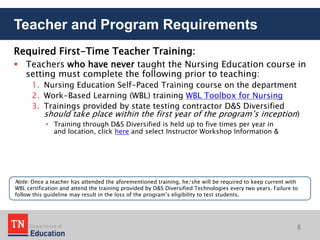
Required First-Time Teacher Training:
 Teachers who have never taught the Nursing Education course in
setting must complete the following prior to teaching:
1. Nursing Education Self-Paced Training course on the department
2. Work-Based Learning (WBL) training WBL Toolbox for Nursing
3. Trainings provided by state testing contractor D&S Diversified
should take place within the first year of the program’s inception)
• Training through D&S Diversified is held up to five times per year in
and location, click here and select Instructor Workshop Information &
Teacher and Program Requirements
8
Note: Once a teacher has attended the aforementioned training, he/she will be required to keep current with
WBL certification and attend the training provided by D&S Diversified Technologies every two years. Failure to
follow this guideline may result in the loss of the program’s eligibility to test students.
Program Requirements:
 The attendance requirement for students to qualify to take the state CNA test is
hours lecture/content delivery, 20 hours classroom lab, and 40 hours clinical with
at least 24 hours in long-term care, the other 16 hours may be in any healthcare
facility that employs CNAs. Standards for Nursing Homes Rule 1200-08-06-15
 The student to teacher ratio must be no more than 15:1. Standards for Nursing
 Each program shall have a pass rate of at least 70 percent for the state
performance exam). Failure to meet this benchmark may result in sanctions by
Standards for Nursing Homes Rule 1200-08-06-15-b
 All work Work-Based Learning policies apply to the Nursing Education course and
must be followed.
 Nursing Education students may also take the Certified Patient Care Technician
Education (C14H16) AND Clinical Internship (C14H11) when both courses are
Teacher and Program Requirements
9
Student Eligibility:
In order to qualify for participation in the Nursing Education course,
readiness expectations. An Employability Skills Checklist is available on
site. The minimum requirements for participation in Nursing Education
1. The student should have successfully completed the aligned pre-requisite courses
program of study.
2. The student should meet the readiness qualifications outlined on the employability
exhibit work readiness attitudes and skills as determined by the teacher and
3. The clinical site administrator must approve the student and sign the work based
.
Relevant WBL Policies:
Policy #6: Students must exhibit work readiness, attitudes, and skills as determined by the teacher and
employer.
Policy #36: Demonstrated Readiness. Students must exhibit work readiness attitudes and skills as determined
by the teacher and employer and consistent with the WBL Policy Guide before beginning a WBL experience.
may be used to determine a student’s readiness for a placement. Recommendations for assessing readiness
Implementation Guide. (SBE High School Policy 2.103)
Teacher and Program Requirements
10
Nursing Education
General Timeline
11
At least one semester prior to teaching the course:
 Prepare for the selection of students:
– Determine program guidelines for the student selection
• Who makes student selection decisions?
• What is the process?
• What is the criteria for selection? Deselection?
– Conduct clinical applications / interviews.
• Have students complete application process and schedule
o May invite school counselors, principal, other stakeholders to
– Ensure the clinical site approves of all student placements.
– Send approved student roster to the school counseling office if
request roster from counselors/principal.
o 15 students maximum per Tennessee Department of Health Guidelines
Timeline
12
Before end of semester prior to teaching the course:
 Verify the student roster.
 Schedule and hold student meetings.
– Discuss fees (if applicable per school)
– Requirements (both WBL and school specific) such as:
• Attendance
• Uniform/scrubs and shoes
• Transportation/auto insurance
• Health physical
• Immunizations/TB skin test
• Health insurance
• BLS card
• Social Security Card
Timeline
13
Before end of semester prior to teaching the course:
 Contact Teri James to determine if the facility where
scheduled is in good standing with the Department of
 Set specific orientation and clinical dates with the facility.
 Remember to schedule a minimum of 16 classroom
hours prior to the first clinical visit to allow time for
prior to the first patient contact:
– Communication and Interpersonal skills
– Residents Rights
– Residents Independence
– Safety and Emergency Procedures including the Heimlich Maneuver
Timeline
14
Before end of semester prior to teaching the course:
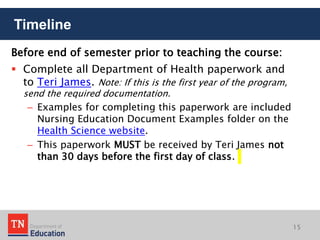
 Complete all Department of Health paperwork and
to Teri James. Note: If this is the first year of the program,
send the required documentation.
– Examples for completing this paperwork are included
Nursing Education Document Examples folder on the
Health Science website.
– This paperwork MUST be received by Teri James not
than 30 days before the first day of class.
Timeline
15
Note: Updating Paperwork
 Paperwork needs to be updated every two years or
any substantial change. Substantial changes include:
– name, address, and telephone number of the facility,
offering the program, including the clinical site;
– the program coordinator;
– statement of course objectives; or
– description of course content specifying the number of
clinical settings.
Timeline
16
For additional information, follow this link to the Department of Health website Nursing Aide
Information
One month before class begins:
 Order CNA Handbooks (order 1-2 extra). Handbooks
D&S. They can also be printed from the D&S website.
– Link: D&S - Headmaster -Candidate Handbook Order
 Create an exposure control plan.
– There is not an official form for exposure control
covering exposures students may encounter can be
www.osha.gov.
– A copy should be kept in the classroom AND in the
folder.
Timeline
17
First 1-2 Days of Class:
 Distribute handbooks.
 Review all paperwork such as:
– Copy of up-to-date immunization record
– TB test (as requested by the training facility)
– Proof of Hepatitis B series
– Proof of influenza vaccination (if required by the training facility)
– Copy of valid driver’s license and auto insurance documentation
– Copy of health insurance coverage documentation
– Current physical form cleared by physician (within a year and not to expire
– Copy of current CPR card
– Hard copy of social security card (students will need to provide this during
– Completed WBL forms; keep copies on file at school, with CTE director, and
– Class policies such as behavior and dress expectations as well as cell phone use,
 Register students with D&S Diversified Technologies, the state testing contractor.
Timeline
18
First 1-2 Days of Class: D&S Registration:
 Register students with D&S Diversified Technologies,
contractor, using the following steps:
1. Go to this link and click on “Training Program Login”.
program ID and PIN.
– If the program is new, D&S will provide this information.
existing program, obtain the ID and PIN from previous
instructor/principal/CTE Director.
– D&S can re-send information if the ID and PIN are
Timeline
19
Timeline
20
First 1-2 Days of Class: D&S Registration, continued:
2. Click the “NEW” button to add each student. Note: To make sure the
student isn’t already in the system enter the social security number into the
search box and click “DUPLICATE”.
– To ensure all information is accurate, call each student up
individually to complete his/her own information.
• Before the student selects “SUBMIT”, check to make sure all fields are
entered and correctly formatted. The name MUST match driver’s license,
social security number MUST be correct, and the email & street address
should be ones that are checked regularly. Note: Double check all fields.
If anything is blank or incorrectly formatted the student will have to re-
enter everything.
– “Date started” should be the first day of school.
– The student must also read the questions below the personal
information and “sign” (type) his/her name.
First 1-2 Days of Class: D&S Registration, continued:
3. Print a verification sheet for each student from the
D&S website to ensure the accuracy of the student’s
registration information by following these steps:
a. Enter the start date into the search field.
b. Select “Verification Sheet” from the drop-down menu.
c. Click “Print Template”.
d. Have students verify information, read and sign, then return.
These forms have each student’s PERSONAL information, so keep
confidential and secure.
Timeline
21
For any issues with verification, contact D&S for assistance.
First Month of Class - Parent Meeting:
 Schedule a meeting with parents to obtain signatures and discuss
course requirements and policies. This will allow parents and
students to understand the high level of commitment required for
success in the nursing education class.
 Possible agenda:
– Handout all paperwork; i.e., cell phone policy, course expectations, attendance
requirements, parents’ transportation responsibility, etc., discussing policies
and procedures. Obtain parent’s and student’s signatures on a policy agreement
form to keep in the student’s file. Possibly consider requiring notarization of the
signatures (this is suggested, not required).
– Explain that testing is in two sections; written and skills.
– Explain how the course workbook improves student success on the written test.
– Encourage the purchase of the D & S practice exam. It gives an accurate idea of
the student’s projected score on the written exam (within 2-3 points of test).
Cost: aproximately $8.00.
– Explain the attendance policy, and hours required to take the CNA test.
Timeline
22
Timeline
23
First Month of Class: Required Documentation:
 Compile required documents for each student’s paperwork folder:
– Documentation of current student physical (conducted within the past year)
– Current student immunization record
• Up-to-date record of all immunizations
• Hepatitis B (HBV) is required prior for placement for students expected to have patient
contact.
• Current Tuberculosis (TB) skin test results
– Documentation of student insurance
• Health insurance
• Malpractice insurance: Students may be given an opportunity for individual or
blanket malpractice insurance through the school district.
• Car insurance for student drivers
• Note: students are not eligible for unemployment insurance.
– Exposure control plan (created one month before class starts)
Note: All required documentation must be kept on record and secured for confidentiality, either in
physical form or digitally for seven years.
Timeline
24
 Begin Personalized Learning Plan (PLP) Packet (found here)
– Complete all WBL paperwork (pages 8-10 of PLP)
First Month of Class: Required Documentation, continued:
Packet for LTC facility
 Cover sheet
 Confidentiality agreement
 Notice of flu vaccine
 Elderly abuse policy
acknowledgement
 Copy of CPR card
 Skills list
 Daily report/ clinical hours
tracker
Timeline
Course documentation
 Classroom rules
 Clinical rules
 Syllabus
 Discipline plan
 Dress code
 Photographic consent
 Release to participate in
direct patient care
25
First Month of Class: Optional Documents, examples:
Note: These lists are suggestions for additional documents that might be included in the students’
paperwork folders.
First Month of Class: Planning for Testing:
 If your school is an independent testing site, contact D&S for
scheduling instructions.
– Consider becoming a testing site.
• For information on becoming a test site, click here.
 If choosing a test site other than your school, students will have
the opportunity to choose the site and date of their test
following payment submission.
Timeline
26
First Month of Class: Planning for Testing, continued:
 Start early to prepare students for the difficulty of the written
exam:
– Begin “mock” testing early in the semester.
– Have students remediate practice exams.
– Stress the importance of careful reading and the use of
test-taking strategies (ACT).
– Provide several good answers but only one “best” answer.
– Use the CNA question of the day on the D&S website.
– Practice apps (CNA prep)
– Answer questions as a CNA NOT an RN.
– Encourage students to purchase the online practice test
from D&S.
Timeline
28
Timeline
First Month of Class: Planning for Testing, continued:
 Start early to prepare students for the difficulty of the skills exam:
– Students will be responsible for all skills in the CNA handbook.
– Studies have shown that students perform better in their own environment, so consider
becoming a testing center.
– PRACTICE, PRACTICE, PRACTICE
• Pair students, prepare lists with 5 skills (one will be hand washing), have students draw a skills
list and perform while partner grades.
• Have students draw a skill and perform for the class.
• Have “mock skills tests” throughout the semester.
• Bring in outside evaluators for “mock skills test” to give students a realistic view of testing day.
First Month of Class, continued:
 Stick close to syllabus, the first month will be BUSY!
– See example syllabus in the Nursing Education Document
the Health Science website.
– Ensure a minimum 16 hours of training in the following
patient contact:
• Communication and Interpersonal Skills
• Residents Rights
• Residents Independence
• Safety and Emergency Procedures including the Heimlich Maneuver,
Timeline
29
Second Month of Class for Block Schedule/
Third-Fourth Month of Class for Traditional Schedule:
 Begin clinical rotation visits.
– Must document hours in both the classroom and clinical setting
• May use sign in sheet
• May use daily sheet
(examples in resource folder)
 Collect evidence for the PLP.
– See the WBL manual for assistance.
 Use class days for quizzes, curriculum, post-conference, skills,
 Remind students a government issued photo ID and social
mandatory requirements to test.
– Consider having students bring in cards as proof.
Timeline
30
Third Month of Class for Block Schedule/
Sixth-Seventh Month of Class for Traditional Schedule:
 Instruct students to check progress toward clinical hour requirements
days/absences as needed).
 Check D&S website for the new handbook edition (usually released in
editions may have minor changes the students need to know about.
THE CURRENT EDITION!
 Schedule a mock testing date and recruit volunteer observers.
– Skills
• Read the scripts for skills tests (from D&S) Skills Test Script.
• Use check off sheets on D&S website under “mock skills sheets”.
– Written
• Read the scripts for written tests (from D&S) Written Test Script.
Timeline
31
Fourth Month of Class for Block Schedule/
Eighth-Ninth Month of Class for Traditional Schedule:
 Continue using daily sheets and track of hours.
 Complete student PLPs.
 Use class time for content completion, post conference,
 Continue skill practice.
 Conduct a mock test day: written practice test AND skill test
to simulate the test-day experience.
Timeline
32
Before the End of the Semester:
 Enter training hours and course completion dates on D&S
1. Sign-in through “Training Program Login”.
2. Search using the program start date (Ex: 01/11/2016).
3. Click on each student’s record and enter the program end
number of hours gained.
– The program can end when at least 75 hours have been
MORE THAN 10 DAYS FROM THE SCHEDULED TEST DATE!
– Also, select “YES” where the documents asks “Graduated?”
 Submit Updates.
Timeline
33
Before the End of the Semester:
 Print Training Certificates:
1. Go to the “Training Program Login” and sign-in.
2. Enter the program start OR end date and enter search.
– The class roster should appear. Make sure the boxes in the
checked.
3. Select “Training Certificates” on the drop down menu then
next to the drop down menu that says “Print Template”.
– This should open a PDF file of student certificates.
 Distribute the D&S Testing Checklist.
Timeline
34
Note: Once students have tested, the training certificates CANNOT be printed, so print before the
test date.
Finishing the Semester:
 Ensure all students have tested.
 Obtain and review testing reports from D&S website
ID and PIN.
 Refer to the WBL Toolbox for Nursing Education for
documentation that must be saved in student files:
– Collect paperwork from students.
– File paperwork in case of audit (Department of Health/
Education).
Timeline
35
 Document Examples: look here for examples of documents you can use in your program.
Link TBD
 D&S Main Website: this page contains a question of the day, sample questions, and
practice tests. http://hdmaster.com/
 D&S Tennessee Website: website specific to the Tennessee CNA test. Here, you will find the
candidate handbook, training program interface, mock skill sheets, test scheduling.
http://hdmaster.com/testing/cnatesting/tennessee/TN_CNA_Home.htm
 The Tennessee Electronic Library: on this site, you can search certified nursing assistant,
and you will find free practice tests and flash cards. This is a favorite site of experienced
https://www.learningexpresshub.com/productengine/LELIndex.html#/learningexpresslibr
 Nursing Education & Clinical Internship Quick Reference Guide: this document is housed
on the department’s Work-Based Learning (WBL) website, and is a compilation of WBL
Nursing Education and Clinical Internship courses. Check out this document for all things
https://www.tn.gov/content/dam/tn/education/ccte/wbl/wbl_health_science_clinical_nur
Resources
36
 To obtain credit for having completed this training, you must enroll and
take a quick summative assessment.
 You have multiple opportunities to submit correct answers. In order to
receive your certificate, you must get all of the answers correct.
 When you complete the test, you will be instructed about how to print a
certificate for your records.
 For technical assistance, contact TDOE.LMS@tn.gov.
Course Completion
37
Sloan Hudson R.N., Health Science Program Manager
Division of College, Career & Technical Education
Andrew Johnson Tower, 11th Floor
710 James Robertson Parkway, Nashville, TN 37243
(615) 306-9026
Teri James, Administrative Assistant
Nurse Aide Training Programs
Office of Health Care Facilities
665 Mainstream Drive, Nashville, TN 37243
(615) 254-6085
Contact Information
38

Nursing_Ed_module_slides.pptx

  • 1.
  • 2.
     Articulate theNursing Education program requirements  Analyze the requirements for Nursing Education instructors  Formulate a course outline with dates aligned to the district calendar  Prioritize actions that ensure compliance with federal, state, and TDOE requirements Objectives 2
  • 3.
    1. Use theNursing Education Self-Paced Training Course one-pager as a guide for completing this course. 2. Read through the entire course to get an overview of the content. 3. Use this training course to create a content outline (with dates). This content outline will be submitted to the Tennessee Department of Health (TDOH) as part of the program application. Directions to follow. 4. Complete the course test, print the certificate, and submit the certificate with program application paperwork to Teri James at the TDOH. Recommendations for Self-Paced Training 3
  • 4.
    4 Table of Contents BlockSchedule Traditional Schedule Nursing Education Teacher and Program Program Requirements: Slides 5-9 Nursing Education Teacher and Program Program Requirements: Slides 5-9 Before Class Begins: Slides 11-16 Before Class Begins: Slides 11-16 First One-Two Days of Class: Slides 17-20 First One-Two Days of Class: Slides 17-20 First Month of Class: Slide 21-28 First Month of Class: Slide 21-28 Second Month of Class: Slide 29 Third-Fourth Month of Class: Slide 29 Third Month of Class: Slide 30 Sixth-Seventh Month of Class: Slide 30 Fourth Month of Class: Slide 31 Eighth-Ninth Month of Class: Slide 31 Wrapping it Up: Slide 32-34 Wrapping it Up: Slide 32-34 Resources: Slide 35 Resources: Slide 35 Contact Information: Slide 36 Contact Information: Slide 36
  • 5.
    Nursing Education Teacher andProgram Requirements 5
  • 6.
    Program Registration:  Thehigh school program must register and receive Department of Health, Nurse Aide Training division for its not less than 30 days BEFORE the first day of class.  Program packets may be obtained from Teri James at the Health.  Examples of how to complete the paperwork may be Education Document Examples folder on the Health  Any changes in the district/school program should be days of the change to the Department of Health, Nurse Aide Training Division at 615-253-6085 or email Teri Teacher and Program Requirements 6
  • 7.
    Teacher Requirements:  Thecourse must be taught by a registered nurse years of experience; one year must be long-term experience.  If the teacher does not have one year of long-term the district/school must contract with a coordinator term care facility. Teacher and Program Requirements 7
  • 8.
    Required First-Time TeacherTraining:  Teachers who have never taught the Nursing Education course in setting must complete the following prior to teaching: 1. Nursing Education Self-Paced Training course on the department 2. Work-Based Learning (WBL) training WBL Toolbox for Nursing 3. Trainings provided by state testing contractor D&S Diversified should take place within the first year of the program’s inception) • Training through D&S Diversified is held up to five times per year in and location, click here and select Instructor Workshop Information & Teacher and Program Requirements 8 Note: Once a teacher has attended the aforementioned training, he/she will be required to keep current with WBL certification and attend the training provided by D&S Diversified Technologies every two years. Failure to follow this guideline may result in the loss of the program’s eligibility to test students.
  • 9.
    Program Requirements:  Theattendance requirement for students to qualify to take the state CNA test is hours lecture/content delivery, 20 hours classroom lab, and 40 hours clinical with at least 24 hours in long-term care, the other 16 hours may be in any healthcare facility that employs CNAs. Standards for Nursing Homes Rule 1200-08-06-15  The student to teacher ratio must be no more than 15:1. Standards for Nursing  Each program shall have a pass rate of at least 70 percent for the state performance exam). Failure to meet this benchmark may result in sanctions by Standards for Nursing Homes Rule 1200-08-06-15-b  All work Work-Based Learning policies apply to the Nursing Education course and must be followed.  Nursing Education students may also take the Certified Patient Care Technician Education (C14H16) AND Clinical Internship (C14H11) when both courses are Teacher and Program Requirements 9
  • 10.
    Student Eligibility: In orderto qualify for participation in the Nursing Education course, readiness expectations. An Employability Skills Checklist is available on site. The minimum requirements for participation in Nursing Education 1. The student should have successfully completed the aligned pre-requisite courses program of study. 2. The student should meet the readiness qualifications outlined on the employability exhibit work readiness attitudes and skills as determined by the teacher and 3. The clinical site administrator must approve the student and sign the work based . Relevant WBL Policies: Policy #6: Students must exhibit work readiness, attitudes, and skills as determined by the teacher and employer. Policy #36: Demonstrated Readiness. Students must exhibit work readiness attitudes and skills as determined by the teacher and employer and consistent with the WBL Policy Guide before beginning a WBL experience. may be used to determine a student’s readiness for a placement. Recommendations for assessing readiness Implementation Guide. (SBE High School Policy 2.103) Teacher and Program Requirements 10
  • 11.
  • 12.
    At least onesemester prior to teaching the course:  Prepare for the selection of students: – Determine program guidelines for the student selection • Who makes student selection decisions? • What is the process? • What is the criteria for selection? Deselection? – Conduct clinical applications / interviews. • Have students complete application process and schedule o May invite school counselors, principal, other stakeholders to – Ensure the clinical site approves of all student placements. – Send approved student roster to the school counseling office if request roster from counselors/principal. o 15 students maximum per Tennessee Department of Health Guidelines Timeline 12
  • 13.
    Before end ofsemester prior to teaching the course:  Verify the student roster.  Schedule and hold student meetings. – Discuss fees (if applicable per school) – Requirements (both WBL and school specific) such as: • Attendance • Uniform/scrubs and shoes • Transportation/auto insurance • Health physical • Immunizations/TB skin test • Health insurance • BLS card • Social Security Card Timeline 13
  • 14.
    Before end ofsemester prior to teaching the course:  Contact Teri James to determine if the facility where scheduled is in good standing with the Department of  Set specific orientation and clinical dates with the facility.  Remember to schedule a minimum of 16 classroom hours prior to the first clinical visit to allow time for prior to the first patient contact: – Communication and Interpersonal skills – Residents Rights – Residents Independence – Safety and Emergency Procedures including the Heimlich Maneuver Timeline 14
  • 15.
    Before end ofsemester prior to teaching the course:  Complete all Department of Health paperwork and to Teri James. Note: If this is the first year of the program, send the required documentation. – Examples for completing this paperwork are included Nursing Education Document Examples folder on the Health Science website. – This paperwork MUST be received by Teri James not than 30 days before the first day of class. Timeline 15
  • 16.
    Note: Updating Paperwork Paperwork needs to be updated every two years or any substantial change. Substantial changes include: – name, address, and telephone number of the facility, offering the program, including the clinical site; – the program coordinator; – statement of course objectives; or – description of course content specifying the number of clinical settings. Timeline 16 For additional information, follow this link to the Department of Health website Nursing Aide Information
  • 17.
    One month beforeclass begins:  Order CNA Handbooks (order 1-2 extra). Handbooks D&S. They can also be printed from the D&S website. – Link: D&S - Headmaster -Candidate Handbook Order  Create an exposure control plan. – There is not an official form for exposure control covering exposures students may encounter can be www.osha.gov. – A copy should be kept in the classroom AND in the folder. Timeline 17
  • 18.
    First 1-2 Daysof Class:  Distribute handbooks.  Review all paperwork such as: – Copy of up-to-date immunization record – TB test (as requested by the training facility) – Proof of Hepatitis B series – Proof of influenza vaccination (if required by the training facility) – Copy of valid driver’s license and auto insurance documentation – Copy of health insurance coverage documentation – Current physical form cleared by physician (within a year and not to expire – Copy of current CPR card – Hard copy of social security card (students will need to provide this during – Completed WBL forms; keep copies on file at school, with CTE director, and – Class policies such as behavior and dress expectations as well as cell phone use,  Register students with D&S Diversified Technologies, the state testing contractor. Timeline 18
  • 19.
    First 1-2 Daysof Class: D&S Registration:  Register students with D&S Diversified Technologies, contractor, using the following steps: 1. Go to this link and click on “Training Program Login”. program ID and PIN. – If the program is new, D&S will provide this information. existing program, obtain the ID and PIN from previous instructor/principal/CTE Director. – D&S can re-send information if the ID and PIN are Timeline 19
  • 20.
    Timeline 20 First 1-2 Daysof Class: D&S Registration, continued: 2. Click the “NEW” button to add each student. Note: To make sure the student isn’t already in the system enter the social security number into the search box and click “DUPLICATE”. – To ensure all information is accurate, call each student up individually to complete his/her own information. • Before the student selects “SUBMIT”, check to make sure all fields are entered and correctly formatted. The name MUST match driver’s license, social security number MUST be correct, and the email & street address should be ones that are checked regularly. Note: Double check all fields. If anything is blank or incorrectly formatted the student will have to re- enter everything. – “Date started” should be the first day of school. – The student must also read the questions below the personal information and “sign” (type) his/her name.
  • 21.
    First 1-2 Daysof Class: D&S Registration, continued: 3. Print a verification sheet for each student from the D&S website to ensure the accuracy of the student’s registration information by following these steps: a. Enter the start date into the search field. b. Select “Verification Sheet” from the drop-down menu. c. Click “Print Template”. d. Have students verify information, read and sign, then return. These forms have each student’s PERSONAL information, so keep confidential and secure. Timeline 21 For any issues with verification, contact D&S for assistance.
  • 22.
    First Month ofClass - Parent Meeting:  Schedule a meeting with parents to obtain signatures and discuss course requirements and policies. This will allow parents and students to understand the high level of commitment required for success in the nursing education class.  Possible agenda: – Handout all paperwork; i.e., cell phone policy, course expectations, attendance requirements, parents’ transportation responsibility, etc., discussing policies and procedures. Obtain parent’s and student’s signatures on a policy agreement form to keep in the student’s file. Possibly consider requiring notarization of the signatures (this is suggested, not required). – Explain that testing is in two sections; written and skills. – Explain how the course workbook improves student success on the written test. – Encourage the purchase of the D & S practice exam. It gives an accurate idea of the student’s projected score on the written exam (within 2-3 points of test). Cost: aproximately $8.00. – Explain the attendance policy, and hours required to take the CNA test. Timeline 22
  • 23.
    Timeline 23 First Month ofClass: Required Documentation:  Compile required documents for each student’s paperwork folder: – Documentation of current student physical (conducted within the past year) – Current student immunization record • Up-to-date record of all immunizations • Hepatitis B (HBV) is required prior for placement for students expected to have patient contact. • Current Tuberculosis (TB) skin test results – Documentation of student insurance • Health insurance • Malpractice insurance: Students may be given an opportunity for individual or blanket malpractice insurance through the school district. • Car insurance for student drivers • Note: students are not eligible for unemployment insurance. – Exposure control plan (created one month before class starts) Note: All required documentation must be kept on record and secured for confidentiality, either in physical form or digitally for seven years.
  • 24.
    Timeline 24  Begin PersonalizedLearning Plan (PLP) Packet (found here) – Complete all WBL paperwork (pages 8-10 of PLP) First Month of Class: Required Documentation, continued:
  • 25.
    Packet for LTCfacility  Cover sheet  Confidentiality agreement  Notice of flu vaccine  Elderly abuse policy acknowledgement  Copy of CPR card  Skills list  Daily report/ clinical hours tracker Timeline Course documentation  Classroom rules  Clinical rules  Syllabus  Discipline plan  Dress code  Photographic consent  Release to participate in direct patient care 25 First Month of Class: Optional Documents, examples: Note: These lists are suggestions for additional documents that might be included in the students’ paperwork folders.
  • 26.
    First Month ofClass: Planning for Testing:  If your school is an independent testing site, contact D&S for scheduling instructions. – Consider becoming a testing site. • For information on becoming a test site, click here.  If choosing a test site other than your school, students will have the opportunity to choose the site and date of their test following payment submission. Timeline 26
  • 27.
    First Month ofClass: Planning for Testing, continued:  Start early to prepare students for the difficulty of the written exam: – Begin “mock” testing early in the semester. – Have students remediate practice exams. – Stress the importance of careful reading and the use of test-taking strategies (ACT). – Provide several good answers but only one “best” answer. – Use the CNA question of the day on the D&S website. – Practice apps (CNA prep) – Answer questions as a CNA NOT an RN. – Encourage students to purchase the online practice test from D&S. Timeline
  • 28.
    28 Timeline First Month ofClass: Planning for Testing, continued:  Start early to prepare students for the difficulty of the skills exam: – Students will be responsible for all skills in the CNA handbook. – Studies have shown that students perform better in their own environment, so consider becoming a testing center. – PRACTICE, PRACTICE, PRACTICE • Pair students, prepare lists with 5 skills (one will be hand washing), have students draw a skills list and perform while partner grades. • Have students draw a skill and perform for the class. • Have “mock skills tests” throughout the semester. • Bring in outside evaluators for “mock skills test” to give students a realistic view of testing day.
  • 29.
    First Month ofClass, continued:  Stick close to syllabus, the first month will be BUSY! – See example syllabus in the Nursing Education Document the Health Science website. – Ensure a minimum 16 hours of training in the following patient contact: • Communication and Interpersonal Skills • Residents Rights • Residents Independence • Safety and Emergency Procedures including the Heimlich Maneuver, Timeline 29
  • 30.
    Second Month ofClass for Block Schedule/ Third-Fourth Month of Class for Traditional Schedule:  Begin clinical rotation visits. – Must document hours in both the classroom and clinical setting • May use sign in sheet • May use daily sheet (examples in resource folder)  Collect evidence for the PLP. – See the WBL manual for assistance.  Use class days for quizzes, curriculum, post-conference, skills,  Remind students a government issued photo ID and social mandatory requirements to test. – Consider having students bring in cards as proof. Timeline 30
  • 31.
    Third Month ofClass for Block Schedule/ Sixth-Seventh Month of Class for Traditional Schedule:  Instruct students to check progress toward clinical hour requirements days/absences as needed).  Check D&S website for the new handbook edition (usually released in editions may have minor changes the students need to know about. THE CURRENT EDITION!  Schedule a mock testing date and recruit volunteer observers. – Skills • Read the scripts for skills tests (from D&S) Skills Test Script. • Use check off sheets on D&S website under “mock skills sheets”. – Written • Read the scripts for written tests (from D&S) Written Test Script. Timeline 31
  • 32.
    Fourth Month ofClass for Block Schedule/ Eighth-Ninth Month of Class for Traditional Schedule:  Continue using daily sheets and track of hours.  Complete student PLPs.  Use class time for content completion, post conference,  Continue skill practice.  Conduct a mock test day: written practice test AND skill test to simulate the test-day experience. Timeline 32
  • 33.
    Before the Endof the Semester:  Enter training hours and course completion dates on D&S 1. Sign-in through “Training Program Login”. 2. Search using the program start date (Ex: 01/11/2016). 3. Click on each student’s record and enter the program end number of hours gained. – The program can end when at least 75 hours have been MORE THAN 10 DAYS FROM THE SCHEDULED TEST DATE! – Also, select “YES” where the documents asks “Graduated?”  Submit Updates. Timeline 33
  • 34.
    Before the Endof the Semester:  Print Training Certificates: 1. Go to the “Training Program Login” and sign-in. 2. Enter the program start OR end date and enter search. – The class roster should appear. Make sure the boxes in the checked. 3. Select “Training Certificates” on the drop down menu then next to the drop down menu that says “Print Template”. – This should open a PDF file of student certificates.  Distribute the D&S Testing Checklist. Timeline 34 Note: Once students have tested, the training certificates CANNOT be printed, so print before the test date.
  • 35.
    Finishing the Semester: Ensure all students have tested.  Obtain and review testing reports from D&S website ID and PIN.  Refer to the WBL Toolbox for Nursing Education for documentation that must be saved in student files: – Collect paperwork from students. – File paperwork in case of audit (Department of Health/ Education). Timeline 35
  • 36.
     Document Examples:look here for examples of documents you can use in your program. Link TBD  D&S Main Website: this page contains a question of the day, sample questions, and practice tests. http://hdmaster.com/  D&S Tennessee Website: website specific to the Tennessee CNA test. Here, you will find the candidate handbook, training program interface, mock skill sheets, test scheduling. http://hdmaster.com/testing/cnatesting/tennessee/TN_CNA_Home.htm  The Tennessee Electronic Library: on this site, you can search certified nursing assistant, and you will find free practice tests and flash cards. This is a favorite site of experienced https://www.learningexpresshub.com/productengine/LELIndex.html#/learningexpresslibr  Nursing Education & Clinical Internship Quick Reference Guide: this document is housed on the department’s Work-Based Learning (WBL) website, and is a compilation of WBL Nursing Education and Clinical Internship courses. Check out this document for all things https://www.tn.gov/content/dam/tn/education/ccte/wbl/wbl_health_science_clinical_nur Resources 36
  • 37.
     To obtaincredit for having completed this training, you must enroll and take a quick summative assessment.  You have multiple opportunities to submit correct answers. In order to receive your certificate, you must get all of the answers correct.  When you complete the test, you will be instructed about how to print a certificate for your records.  For technical assistance, contact TDOE.LMS@tn.gov. Course Completion 37
  • 38.
    Sloan Hudson R.N.,Health Science Program Manager Division of College, Career & Technical Education Andrew Johnson Tower, 11th Floor 710 James Robertson Parkway, Nashville, TN 37243 (615) 306-9026 Teri James, Administrative Assistant Nurse Aide Training Programs Office of Health Care Facilities 665 Mainstream Drive, Nashville, TN 37243 (615) 254-6085 Contact Information 38