Numerical methods
By skm
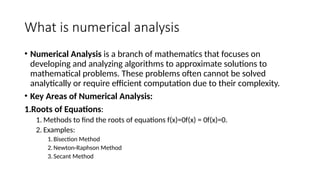
What is numerical analysis
• Numerical Analysis is a branch of mathematics that focuses on
developing and analyzing algorithms to approximate solutions to
mathematical problems. These problems often cannot be solved
analytically or require efficient computation due to their complexity.
• Key Areas of Numerical Analysis:
1.Roots of Equations:
1. Methods to find the roots of equations f(x)=0f(x) = 0f(x)=0.
2. Examples:
1.Bisection Method
2.Newton-Raphson Method
3.Secant Method
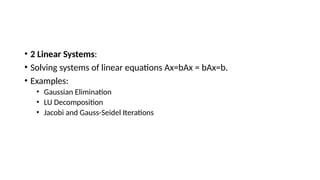
• 2 Linear Systems:
• Solving systems of linear equations Ax=bAx = bAx=b.
• Examples:
• Gaussian Elimination
• LU Decomposition
• Jacobi and Gauss-Seidel Iterations
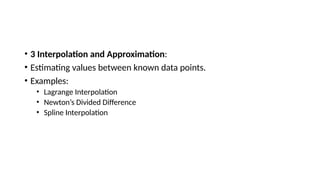
• 3 Interpolation and Approximation:
• Estimating values between known data points.
• Examples:
• Lagrange Interpolation
• Newton’s Divided Difference
• Spline Interpolation
• 4 Numerical Integration and Differentiation:
• Approximating integrals and derivatives of functions.
• Examples:
• Trapezoidal Rule
• Simpson's Rule
• Numerical Differentiation Formulas
Numerical Integration and Differentiation:
•Approximating integrals and derivatives of functions.
•Examples:
• Trapezoidal Rule
• Simpson's Rule
• Numerical Differentiation Formulas
• 5 Ordinary Differential Equations (ODEs):
• Solving ODEs numerically when analytical solutions are unavailable.
• Examples:
• Euler's Method
• Runge-Kutta Methods
• Adams-Bashforth Method
•6 Eigenvalues and Eigenvectors:
•Approximating eigenvalues and eigenvectors of matrices.
•Examples:
•Power Method
•QR Algorithm
1.Optimization:
•Finding maxima or minima of functions.
•Examples:
•Gradient Descent
•Newton's Method for Optimization
2.Numerical Solutions of Partial Differential Equations (PDEs):
•Techniques for PDEs such as heat, wave, and Laplace equations.
•Examples:
•Finite Difference Method
•Finite Element Method
•Spectral Methods
Applications:
•Engineering (e.g., simulation of physical systems)
•Physics (e.g., solving wave equations)
•Finance (e.g., modeling options pricing)
•Data Science (e.g., numerical linear algebra for machine learning)
Key Properties of Numerical Methods:
1.Convergence: Does the method converge to the correct solution as the steps are refined?
2.Stability: Is the method robust to small changes in input or intermediate results?
3.Accuracy: How close is the numerical result to the exact solution?
4.Efficiency: How computationally expensive is the method?
Let me know if you'd like to dive deeper into a specific topic or require implementation of numerical
techniques!

Numerical methods and its applicaions.pptx

  • 1.
  • 2.
    What is numericalanalysis • Numerical Analysis is a branch of mathematics that focuses on developing and analyzing algorithms to approximate solutions to mathematical problems. These problems often cannot be solved analytically or require efficient computation due to their complexity. • Key Areas of Numerical Analysis: 1.Roots of Equations: 1. Methods to find the roots of equations f(x)=0f(x) = 0f(x)=0. 2. Examples: 1.Bisection Method 2.Newton-Raphson Method 3.Secant Method
  • 3.
    • 2 LinearSystems: • Solving systems of linear equations Ax=bAx = bAx=b. • Examples: • Gaussian Elimination • LU Decomposition • Jacobi and Gauss-Seidel Iterations
  • 4.
    • 3 Interpolationand Approximation: • Estimating values between known data points. • Examples: • Lagrange Interpolation • Newton’s Divided Difference • Spline Interpolation
  • 5.
    • 4 NumericalIntegration and Differentiation: • Approximating integrals and derivatives of functions. • Examples: • Trapezoidal Rule • Simpson's Rule • Numerical Differentiation Formulas Numerical Integration and Differentiation: •Approximating integrals and derivatives of functions. •Examples: • Trapezoidal Rule • Simpson's Rule • Numerical Differentiation Formulas
  • 6.
    • 5 OrdinaryDifferential Equations (ODEs): • Solving ODEs numerically when analytical solutions are unavailable. • Examples: • Euler's Method • Runge-Kutta Methods • Adams-Bashforth Method
  • 7.
    •6 Eigenvalues andEigenvectors: •Approximating eigenvalues and eigenvectors of matrices. •Examples: •Power Method •QR Algorithm
  • 8.
    1.Optimization: •Finding maxima orminima of functions. •Examples: •Gradient Descent •Newton's Method for Optimization 2.Numerical Solutions of Partial Differential Equations (PDEs): •Techniques for PDEs such as heat, wave, and Laplace equations. •Examples: •Finite Difference Method •Finite Element Method •Spectral Methods Applications: •Engineering (e.g., simulation of physical systems) •Physics (e.g., solving wave equations) •Finance (e.g., modeling options pricing) •Data Science (e.g., numerical linear algebra for machine learning) Key Properties of Numerical Methods: 1.Convergence: Does the method converge to the correct solution as the steps are refined? 2.Stability: Is the method robust to small changes in input or intermediate results? 3.Accuracy: How close is the numerical result to the exact solution? 4.Efficiency: How computationally expensive is the method? Let me know if you'd like to dive deeper into a specific topic or require implementation of numerical techniques!