1
Muhammad Faruq Foong, Dr.
Department of Aeronautics, Automotive, & Ocean Engineering
School of Mechanical Engineering, Faculty of Engineering,
Universiti Teknologi Malaysia
Email: faruqfoong@mail.fkm.utm.my No. HP: 0137119720
Introduction to Engineering Analysis
March 2020
APPLIED NUMERICAL METHODS
SEMM/SKMM3023
2
Timetable
3
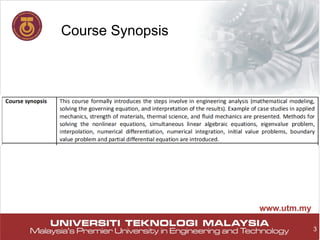
Course Synopsis
4
Course Timeline
5
Course Assesments
6
Attendance
■ Student must attend not less than 80% of lecture hours as
required for the subject
■ The student will be prohibited from attending any lecture and
assessment activities upon failure to comply the above
requirement.
■ Zero mark will be given to the subject.
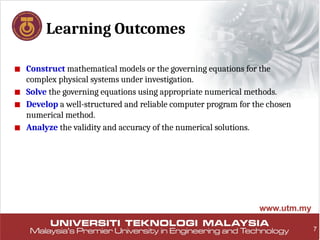
Learning Outcomes
■ Construct mathematical models or the governing equations for the
complex physical systems under investigation.
■ Solve the governing equations using appropriate numerical methods.
■ Develop a well-structured and reliable computer program for the chosen
numerical method.
■ Analyze the validity and accuracy of the numerical solutions.
7
8
1. Introduction
2. Scientific Methods
3. Bibliography
Contents for today
9
Scientific Methods
What’s the
difference?
Analytical
Method
Experimental
Method
Numerical
Method
Which is more
accurate?
10
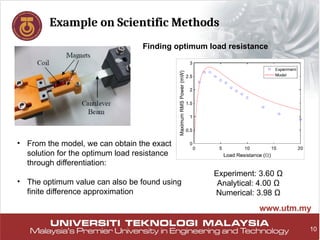
Example on Scientific Methods
• From the model, we can obtain the exact
solution for the optimum load resistance
through differentiation:
• The optimum value can also be found using
finite difference approximation
Experiment: 3.60 Ω
Analytical: 4.00 Ω
Numerical: 3.98 Ω
Finding optimum load resistance
11
Errors
■ Absolute error
■ Percentage error
Percentage errors are most commonly use to compare experiment with
analytical
12
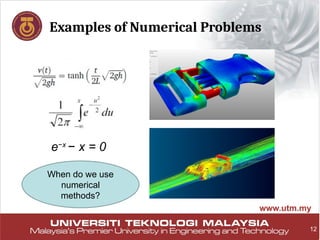
Examples of Numerical Problems
e−x
− x = 0
When do we use
numerical
methods?
13
Tools for Numerical Problems
What do you need
to solve numerical
problems?
14
Tools for Numerical Problems
■ Fortran program
■ C program
■ MATLAB
■ MATHCAD
■ Octave (free software)
■ Finite Element Software (Abaqus, Ansys)
15
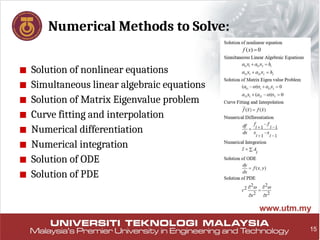
Numerical Methods to Solve:
■ Solution of nonlinear equations
■ Simultaneous linear algebraic equations
■ Solution of Matrix Eigenvalue problem
■ Curve fitting and interpolation
■ Numerical differentiation
■ Numerical integration
■ Solution of ODE
■ Solution of PDE
16
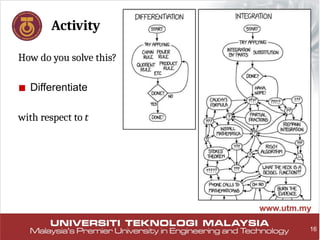
Activity
How do you solve this?
■ Differentiate
with respect to t
17
Downloads
• MATLAB software (Please use your
student account to install)
• Octave free version
18
1. STEVEN C. CHAPRA & RAYMOND P. CANALE (2009): Numerical methods
for Engineers, 6ed,ISBN 0-39-095080-7, McGraw-Hill
2. SINGIRESU S. RAO (2002): Applied Numerical Methods for Engineers and
Scientists, ISBN 0-13-089480-X, Prentice Hall
3. DAVID KINCAID & WARD CHENEY (1991): Numerical Analysis: Mathematics
of Scientific Computing, ISBN 0-534-13014-3, Brooks/Cole Publishing Co.
4. STEVEN C. CHAPRA (2012): Applied Numerical Methods with MATLAB for
Engineers and Scientists, 3ed, ISBN 978-0-07-340110-2, McGraw-Hill
5. JOHN H. MATHEWS & KURTIS D. FINK (2004): Numerical Methods Using
Matlab, 4ed, ISBN 0-13-065248-2, Prentice Hall
Bibliography

Lecture 1 Introduction to Engineering Analysis.pptx

  • 1.
    1 Muhammad Faruq Foong,Dr. Department of Aeronautics, Automotive, & Ocean Engineering School of Mechanical Engineering, Faculty of Engineering, Universiti Teknologi Malaysia Email: faruqfoong@mail.fkm.utm.my No. HP: 0137119720 Introduction to Engineering Analysis March 2020 APPLIED NUMERICAL METHODS SEMM/SKMM3023
  • 2.
  • 3.
  • 4.
  • 5.
  • 6.
    6 Attendance ■ Student mustattend not less than 80% of lecture hours as required for the subject ■ The student will be prohibited from attending any lecture and assessment activities upon failure to comply the above requirement. ■ Zero mark will be given to the subject.
  • 7.
    Learning Outcomes ■ Constructmathematical models or the governing equations for the complex physical systems under investigation. ■ Solve the governing equations using appropriate numerical methods. ■ Develop a well-structured and reliable computer program for the chosen numerical method. ■ Analyze the validity and accuracy of the numerical solutions. 7
  • 8.
    8 1. Introduction 2. ScientificMethods 3. Bibliography Contents for today
  • 9.
  • 10.
    10 Example on ScientificMethods • From the model, we can obtain the exact solution for the optimum load resistance through differentiation: • The optimum value can also be found using finite difference approximation Experiment: 3.60 Ω Analytical: 4.00 Ω Numerical: 3.98 Ω Finding optimum load resistance
  • 11.
    11 Errors ■ Absolute error ■Percentage error Percentage errors are most commonly use to compare experiment with analytical
  • 12.
    12 Examples of NumericalProblems e−x − x = 0 When do we use numerical methods?
  • 13.
    13 Tools for NumericalProblems What do you need to solve numerical problems?
  • 14.
    14 Tools for NumericalProblems ■ Fortran program ■ C program ■ MATLAB ■ MATHCAD ■ Octave (free software) ■ Finite Element Software (Abaqus, Ansys)
  • 15.
    15 Numerical Methods toSolve: ■ Solution of nonlinear equations ■ Simultaneous linear algebraic equations ■ Solution of Matrix Eigenvalue problem ■ Curve fitting and interpolation ■ Numerical differentiation ■ Numerical integration ■ Solution of ODE ■ Solution of PDE
  • 16.
    16 Activity How do yousolve this? ■ Differentiate with respect to t
  • 17.
    17 Downloads • MATLAB software(Please use your student account to install) • Octave free version
  • 18.
    18 1. STEVEN C.CHAPRA & RAYMOND P. CANALE (2009): Numerical methods for Engineers, 6ed,ISBN 0-39-095080-7, McGraw-Hill 2. SINGIRESU S. RAO (2002): Applied Numerical Methods for Engineers and Scientists, ISBN 0-13-089480-X, Prentice Hall 3. DAVID KINCAID & WARD CHENEY (1991): Numerical Analysis: Mathematics of Scientific Computing, ISBN 0-534-13014-3, Brooks/Cole Publishing Co. 4. STEVEN C. CHAPRA (2012): Applied Numerical Methods with MATLAB for Engineers and Scientists, 3ed, ISBN 978-0-07-340110-2, McGraw-Hill 5. JOHN H. MATHEWS & KURTIS D. FINK (2004): Numerical Methods Using Matlab, 4ed, ISBN 0-13-065248-2, Prentice Hall Bibliography

Editor's Notes

  • #9 See LO
  • #12 Example: FORTRAN, MATLAB, MATCAD, COBOL, BASIC, PASCAL, PHYTON, C, CGYWIN, FIRTH.FORTRAN… Data representation: Numeric data, Integer, :Constants and variables. : Nonnumeric data, character
  • #13 Example: FORTRAN, MATLAB, MATCAD, COBOL, BASIC, PASCAL, PHYTON, C, CGYWIN, FIRTH.FORTRAN… Data representation: Numeric data, Integer, :Constants and variables. : Nonnumeric data, character
  • #14 Example: FORTRAN, MATLAB, MATCAD, COBOL, BASIC, PASCAL, PHYTON, C, CGYWIN, FIRTH.FORTRAN… Data representation: Numeric data, Integer, :Constants and variables. : Nonnumeric data, character
  • #16 Try solve manually Try solve using MATLAB