Aptitude
Numbers
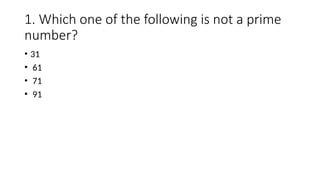
1. Which one of the following is not a prime
number?
• 31
• 61
• 71
• 91
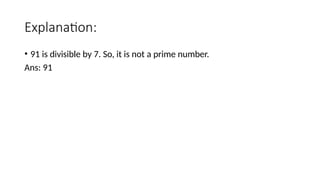
Explanation:
• 91 is divisible by 7. So, it is not a prime number.
Ans: 91
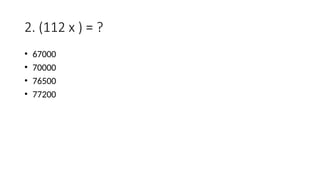
2. (112 x ) = ?
• 67000
• 70000
• 76500
• 77200
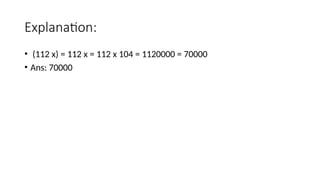
Explanation:
• (112 x) = 112 x = 112 x 104 = 1120000 = 70000
• Ans: 70000
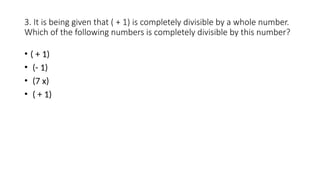
3. It is being given that ( + 1) is completely divisible by a whole number.
Which of the following numbers is completely divisible by this number?
• ( + 1)
• (- 1)
• (7 x)
• ( + 1)
Explanation:
• Let = x. Then, (+ 1) = (x + 1).
• Let (x + 1) be completely divisible by the natural number N. Then,
( + 1) = [()3
+ 1] = (x3
+ 1) = (x + 1)(x2
- x + 1), which is completely divisible
by N,
since (x + 1) is divisible by N.
Ans: (+ 1)
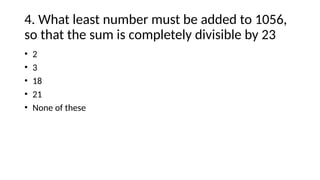
4. What least number must be added to 1056,
so that the sum is completely divisible by 23
• 2
• 3
• 18
• 21
• None of these
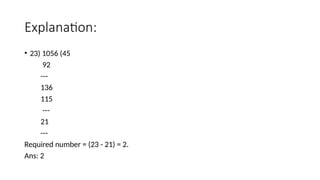
Explanation:
• 23) 1056 (45
92
---
136
115
---
21
---
Required number = (23 - 21) = 2.
Ans: 2
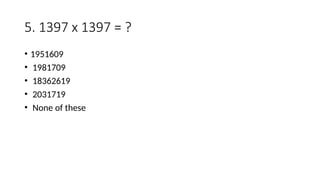
5. 1397 x 1397 = ?
• 1951609
• 1981709
• 18362619
• 2031719
• None of these
Explanation:
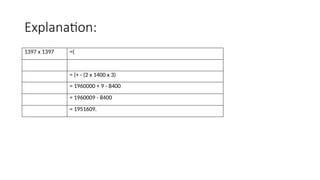
1397 x 1397 =(
= (+ - (2 x 1400 x 3)
= 1960000 + 9 - 8400
= 1960009 - 8400
= 1951609.
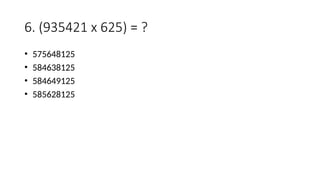
6. (935421 x 625) = ?
• 575648125
• 584638125
• 584649125
• 585628125
Explanation:
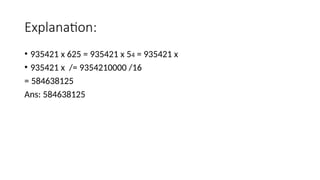
• 935421 x 625 = 935421 x 54 = 935421 x
• 935421 x /= 9354210000 /16
= 584638125
Ans: 584638125
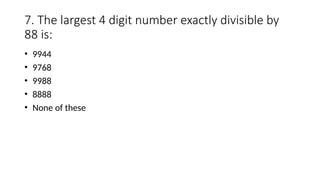
7. The largest 4 digit number exactly divisible by
88 is:
• 9944
• 9768
• 9988
• 8888
• None of these
Explanation:
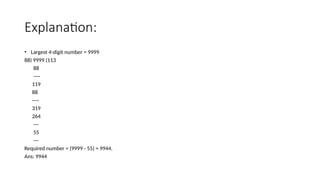
• Largest 4-digit number = 9999
88) 9999 (113
88
----
119
88
----
319
264
---
55
---
Required number = (9999 - 55) = 9944.
Ans: 9944
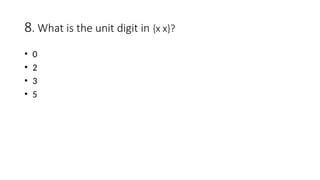
8. What is the unit digit in {x x}?
• 0
• 2
• 3
• 5
Explanation:
• Unit digit in = Unit digit in = Unit digit in [(42) 896 x 4]
= Unit digit in (6 x 4) = 4
Unit digit in (625)317 = Unit digit in (5)317 = 5
Unit digit in (341)491 = Unit digit in (1)491 = 1
Required digit = Unit digit in (4 x 5 x 1) = 0.
Ans: 0
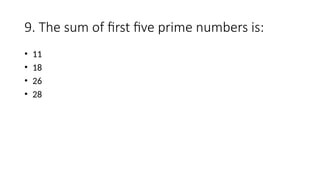
9. The sum of first five prime numbers is:
• 11
• 18
• 26
• 28
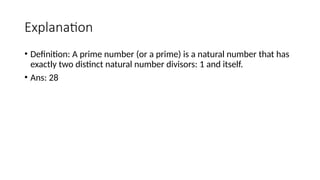
Explanation
• Definition: A prime number (or a prime) is a natural number that has
exactly two distinct natural number divisors: 1 and itself.
• Ans: 28
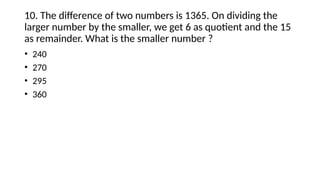
10. The difference of two numbers is 1365. On dividing the
larger number by the smaller, we get 6 as quotient and the 15
as remainder. What is the smaller number ?
• 240
• 270
• 295
• 360
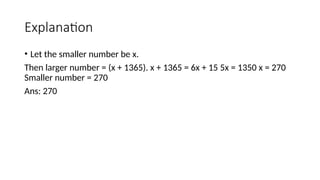
Explanation
• Let the smaller number be x.
Then larger number = (x + 1365). x + 1365 = 6x + 15 5x = 1350 x = 270
Smaller number = 270
Ans: 270
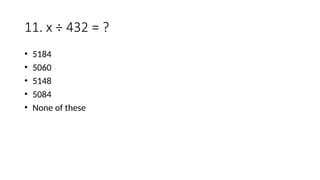
11. x ÷ 432 = ?
• 5184
• 5060
• 5148
• 5084
• None of these
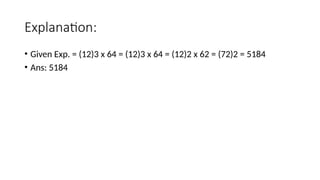
Explanation:
• Given Exp. = (12)3 x 64 = (12)3 x 64 = (12)2 x 62 = (72)2 = 5184
• Ans: 5184
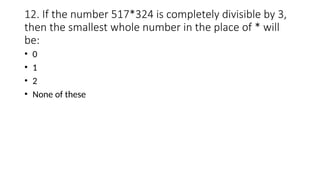
12. If the number 517*324 is completely divisible by 3,
then the smallest whole number in the place of * will
be:
• 0
• 1
• 2
• None of these
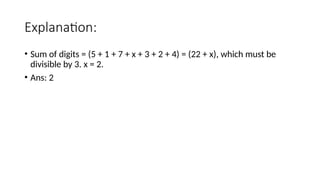
Explanation:
• Sum of digits = (5 + 1 + 7 + x + 3 + 2 + 4) = (22 + x), which must be
divisible by 3. x = 2.
• Ans: 2
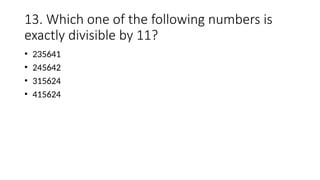
13. Which one of the following numbers is
exactly divisible by 11?
• 235641
• 245642
• 315624
• 415624
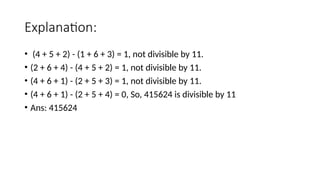
Explanation:
• (4 + 5 + 2) - (1 + 6 + 3) = 1, not divisible by 11.
• (2 + 6 + 4) - (4 + 5 + 2) = 1, not divisible by 11.
• (4 + 6 + 1) - (2 + 5 + 3) = 1, not divisible by 11.
• (4 + 6 + 1) - (2 + 5 + 4) = 0, So, 415624 is divisible by 11
• Ans: 415624
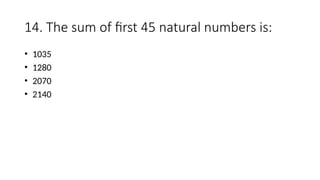
14. The sum of first 45 natural numbers is:
• 1035
• 1280
• 2070
• 2140
Explanation:
• Let Sn =(1 + 2 + 3 + ... + 45). This is an A.P. in which a =1, d =1, n = 45.
• Sn = n/2 [2a + (n - 1)d] = 45/2 x [2 x 1 + (45 - 1) x 1] = 45/ 2 x 46 = (45
x 23)
= 45 x (20 + 3)
= 45 x 20 + 45 x 3
=900 + 135 = 1035.
Ans: 1035
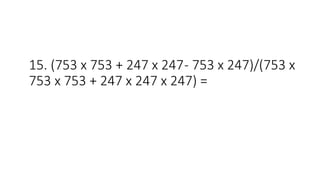
15. (753 x 753 + 247 x 247- 753 x 247)/(753 x
753 x 753 + 247 x 247 x 247) =
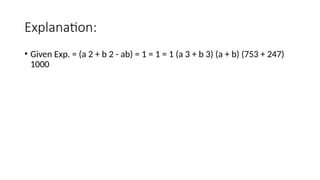
Explanation:
• Given Exp. = (a 2 + b 2 - ab) = 1 = 1 = 1 (a 3 + b 3) (a + b) (753 + 247)
1000
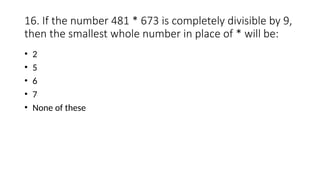
16. If the number 481 * 673 is completely divisible by 9,
then the smallest whole number in place of * will be:
• 2
• 5
• 6
• 7
• None of these
Explanation:
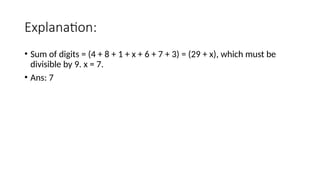
• Sum of digits = (4 + 8 + 1 + x + 6 + 7 + 3) = (29 + x), which must be
divisible by 9. x = 7.
• Ans: 7
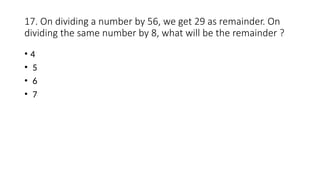
17. On dividing a number by 56, we get 29 as remainder. On
dividing the same number by 8, what will be the remainder ?
• 4
• 5
• 6
• 7
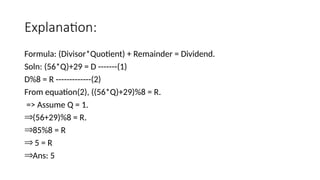
Explanation:
Formula: (Divisor*Quotient) + Remainder = Dividend.
Soln: (56*Q)+29 = D -------(1)
D%8 = R -------------(2)
From equation(2), ((56*Q)+29)%8 = R.
=> Assume Q = 1.
Þ(56+29)%8 = R.
Þ85%8 = R
Þ 5 = R
ÞAns: 5
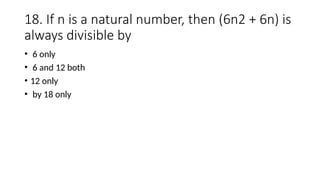
18. If n is a natural number, then (6n2 + 6n) is
always divisible by
• 6 only
• 6 and 12 both
• 12 only
• by 18 only
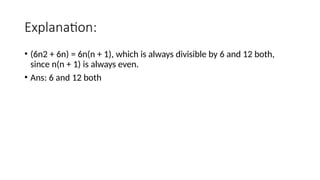
Explanation:
• (6n2 + 6n) = 6n(n + 1), which is always divisible by 6 and 12 both,
since n(n + 1) is always even.
• Ans: 6 and 12 both
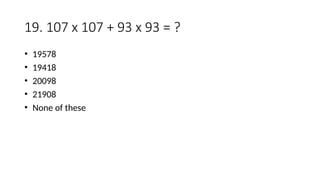
19. 107 x 107 + 93 x 93 = ?
• 19578
• 19418
• 20098
• 21908
• None of these
Explanation:
• 107 x 107 + 93 x 93 = (107)2 + (93)2
= (100 + 7)2 + (100 - 7)2
= 2 x [(100)2 + 72]
[Ref: (a + b)2 + (a - b)2 = 2(a2 + b2)]
= 20098
Ans: 20098
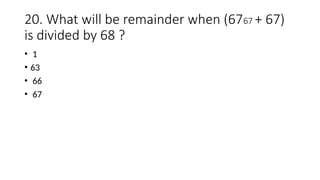
20. What will be remainder when (6767 + 67)
is divided by 68 ?
• 1
• 63
• 66
• 67
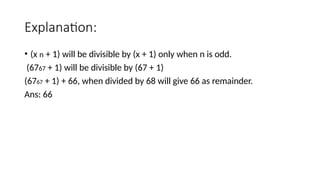
Explanation:
• (x n + 1) will be divisible by (x + 1) only when n is odd.
(6767 + 1) will be divisible by (67 + 1)
(6767 + 1) + 66, when divided by 68 will give 66 as remainder.
Ans: 66

NUMBERS in mathematics basically focusing on aptitudes

  • 1.
  • 2.
    1. Which oneof the following is not a prime number? • 31 • 61 • 71 • 91
  • 3.
    Explanation: • 91 isdivisible by 7. So, it is not a prime number. Ans: 91
  • 4.
    2. (112 x) = ? • 67000 • 70000 • 76500 • 77200
  • 5.
    Explanation: • (112 x)= 112 x = 112 x 104 = 1120000 = 70000 • Ans: 70000
  • 6.
    3. It isbeing given that ( + 1) is completely divisible by a whole number. Which of the following numbers is completely divisible by this number? • ( + 1) • (- 1) • (7 x) • ( + 1)
  • 7.
    Explanation: • Let =x. Then, (+ 1) = (x + 1). • Let (x + 1) be completely divisible by the natural number N. Then, ( + 1) = [()3 + 1] = (x3 + 1) = (x + 1)(x2 - x + 1), which is completely divisible by N, since (x + 1) is divisible by N. Ans: (+ 1)
  • 8.
    4. What leastnumber must be added to 1056, so that the sum is completely divisible by 23 • 2 • 3 • 18 • 21 • None of these
  • 9.
    Explanation: • 23) 1056(45 92 --- 136 115 --- 21 --- Required number = (23 - 21) = 2. Ans: 2
  • 10.
    5. 1397 x1397 = ? • 1951609 • 1981709 • 18362619 • 2031719 • None of these
  • 11.
    Explanation: 1397 x 1397=( = (+ - (2 x 1400 x 3) = 1960000 + 9 - 8400 = 1960009 - 8400 = 1951609.
  • 12.
    6. (935421 x625) = ? • 575648125 • 584638125 • 584649125 • 585628125
  • 13.
    Explanation: • 935421 x625 = 935421 x 54 = 935421 x • 935421 x /= 9354210000 /16 = 584638125 Ans: 584638125
  • 14.
    7. The largest4 digit number exactly divisible by 88 is: • 9944 • 9768 • 9988 • 8888 • None of these
  • 15.
    Explanation: • Largest 4-digitnumber = 9999 88) 9999 (113 88 ---- 119 88 ---- 319 264 --- 55 --- Required number = (9999 - 55) = 9944. Ans: 9944
  • 16.
    8. What isthe unit digit in {x x}? • 0 • 2 • 3 • 5
  • 17.
    Explanation: • Unit digitin = Unit digit in = Unit digit in [(42) 896 x 4] = Unit digit in (6 x 4) = 4 Unit digit in (625)317 = Unit digit in (5)317 = 5 Unit digit in (341)491 = Unit digit in (1)491 = 1 Required digit = Unit digit in (4 x 5 x 1) = 0. Ans: 0
  • 18.
    9. The sumof first five prime numbers is: • 11 • 18 • 26 • 28
  • 19.
    Explanation • Definition: Aprime number (or a prime) is a natural number that has exactly two distinct natural number divisors: 1 and itself. • Ans: 28
  • 20.
    10. The differenceof two numbers is 1365. On dividing the larger number by the smaller, we get 6 as quotient and the 15 as remainder. What is the smaller number ? • 240 • 270 • 295 • 360
  • 21.
    Explanation • Let thesmaller number be x. Then larger number = (x + 1365). x + 1365 = 6x + 15 5x = 1350 x = 270 Smaller number = 270 Ans: 270
  • 22.
    11. x ÷432 = ? • 5184 • 5060 • 5148 • 5084 • None of these
  • 23.
    Explanation: • Given Exp.= (12)3 x 64 = (12)3 x 64 = (12)2 x 62 = (72)2 = 5184 • Ans: 5184
  • 24.
    12. If thenumber 517*324 is completely divisible by 3, then the smallest whole number in the place of * will be: • 0 • 1 • 2 • None of these
  • 25.
    Explanation: • Sum ofdigits = (5 + 1 + 7 + x + 3 + 2 + 4) = (22 + x), which must be divisible by 3. x = 2. • Ans: 2
  • 26.
    13. Which oneof the following numbers is exactly divisible by 11? • 235641 • 245642 • 315624 • 415624
  • 27.
    Explanation: • (4 +5 + 2) - (1 + 6 + 3) = 1, not divisible by 11. • (2 + 6 + 4) - (4 + 5 + 2) = 1, not divisible by 11. • (4 + 6 + 1) - (2 + 5 + 3) = 1, not divisible by 11. • (4 + 6 + 1) - (2 + 5 + 4) = 0, So, 415624 is divisible by 11 • Ans: 415624
  • 28.
    14. The sumof first 45 natural numbers is: • 1035 • 1280 • 2070 • 2140
  • 29.
    Explanation: • Let Sn=(1 + 2 + 3 + ... + 45). This is an A.P. in which a =1, d =1, n = 45. • Sn = n/2 [2a + (n - 1)d] = 45/2 x [2 x 1 + (45 - 1) x 1] = 45/ 2 x 46 = (45 x 23) = 45 x (20 + 3) = 45 x 20 + 45 x 3 =900 + 135 = 1035. Ans: 1035
  • 30.
    15. (753 x753 + 247 x 247- 753 x 247)/(753 x 753 x 753 + 247 x 247 x 247) =
  • 31.
    Explanation: • Given Exp.= (a 2 + b 2 - ab) = 1 = 1 = 1 (a 3 + b 3) (a + b) (753 + 247) 1000
  • 32.
    16. If thenumber 481 * 673 is completely divisible by 9, then the smallest whole number in place of * will be: • 2 • 5 • 6 • 7 • None of these
  • 33.
    Explanation: • Sum ofdigits = (4 + 8 + 1 + x + 6 + 7 + 3) = (29 + x), which must be divisible by 9. x = 7. • Ans: 7
  • 34.
    17. On dividinga number by 56, we get 29 as remainder. On dividing the same number by 8, what will be the remainder ? • 4 • 5 • 6 • 7
  • 35.
    Explanation: Formula: (Divisor*Quotient) +Remainder = Dividend. Soln: (56*Q)+29 = D -------(1) D%8 = R -------------(2) From equation(2), ((56*Q)+29)%8 = R. => Assume Q = 1. Þ(56+29)%8 = R. Þ85%8 = R Þ 5 = R ÞAns: 5
  • 36.
    18. If nis a natural number, then (6n2 + 6n) is always divisible by • 6 only • 6 and 12 both • 12 only • by 18 only
  • 37.
    Explanation: • (6n2 +6n) = 6n(n + 1), which is always divisible by 6 and 12 both, since n(n + 1) is always even. • Ans: 6 and 12 both
  • 38.
    19. 107 x107 + 93 x 93 = ? • 19578 • 19418 • 20098 • 21908 • None of these
  • 39.
    Explanation: • 107 x107 + 93 x 93 = (107)2 + (93)2 = (100 + 7)2 + (100 - 7)2 = 2 x [(100)2 + 72] [Ref: (a + b)2 + (a - b)2 = 2(a2 + b2)] = 20098 Ans: 20098
  • 40.
    20. What willbe remainder when (6767 + 67) is divided by 68 ? • 1 • 63 • 66 • 67
  • 41.
    Explanation: • (x n+ 1) will be divisible by (x + 1) only when n is odd. (6767 + 1) will be divisible by (67 + 1) (6767 + 1) + 66, when divided by 68 will give 66 as remainder. Ans: 66