Number Jumping 
A math game by Beverly Williams (July 2015) 
 
K­3 children thrive on gross­motor games and often get frustrated with writing, so I 
adapted the game of Number Jumping.  This can be played with a mixed­ability 
group of up to 8 children from those who can’t recognize numbers to those 
successfully doing multiplication.  This can also be used as an introductory game 
to gauge each child’s ability in the following way: 
● Ask a child to jump to a number.  If the child doesn’t know how to recognize 
any number, ask another child to direct him to the number.  When the first 
child successfully does this, praise him and have him kneel by the number 
and trace it while others are jumping to other numbers. 
● If a child successfully jumps to a number and the other children do as well, 
then advance to  
○ jump to a number “one more than”, or 
○ jump to a number “one less than” their number. 
● if the latter is successful, 
○ jump to a sum, or 
○ jump to the difference 
● if the latter is successful,  
○ jump to a product  
○ jump to double, triple, or quadruple a number 
● if the latter is successful,  
○ jump to a a simple quotient 
○ jump to half, quarter, or third of a number 
○ jump to a percentage of a number 
● if the latter is successful, jump to a perfect square 
● if the latter is successful, jump to a square root. 
This is done taking turns with the children and asking them to help others.  It is OK 
if each is at a different level of number understanding. 
 
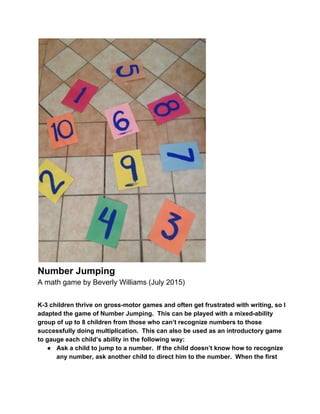
These numbers are painted on construction paper and I ask the children to remove 
their shoes to jump in stocking feet.  I have many more numbers painted to play 
multiple games. 
 
Learning to count forwards and backwards: 
● place numbers 1­10 in order on floor, 
● have a child in stocking feet jump from number to number in order with all 
the children saying the names of the numbers as one jumps on them 
● continue in the same way until all have jumped 1­10 
● repeat process jumping from 10 to 1 
● mix numbers 
● have children put numbers in (ascending or descending) order 
 
Learning to multiply by two: 
● place numbers 1­20 on floor, 
● have children remove shoes and put in pairs in neat row, 
● talk about what a “pair” is (a set of 2 similar objects) and what common 
objects come in pairs (examples:  feet, hands, ears, eyes, shoes, gloves, 
mittens, etc.) 
● count the number of pairs of shoes (let’s say:  6) 
● count the number of shoes (in this case, 12) 
● have the children collect all the numbers 1­12 
● have the children line up the numbers with the shoes 
● talk about what it means to count by twos 
● have the children hide all the alternate numbers starting with the number 1 
● have the children move the (now even) numbers in order in the middle of the 
floor in a row with room in between 
● have each child jump in order from 2 to 20 with all the children saying the 
numbers out loud until all children have jumped the row 
● have the children stand in a row and count their eyes, or ears, or hands in a 
similar fashion 
● extra:  talk about how these are “even” numbers 
● extra:  line up the other numbers in order and talk about “odd” numbers 
 
Learning to multiply by three and more: 
 
When advancing to these games, I like to find something the group of children like 
that come in multiples of the number featured.  I bring in multiple sets of that 
object­­say marbles, or blocks.  Or, I will find a book that mentions that multiple­­a 
book about three siblings, for instance, or three ducks or three marbles, or 
whatever.  I have fun reading the book aloud and then go on to the number jumping 
in a similar way to learning to multiply by two.  I generally have the children sing a 
song to help them remember the numbers in order.  At the end, having each child 
hold a multiple of the object so that they can participate in the counting.  Then, if I 
hand a second multiple of the object to one child, we can all talk about how many 
she has and how that represents having two sets of that multiple, or 2 x that 
number.  The next step is making number sentences with operands and equal signs 
painted on construction paper. 
 

NumberJumpingMathGamebyBeverlyWilliams