AUSTRALIA’S AMAZING ANIMALS MAMMALS Monotremes  Marsupials  and Placental
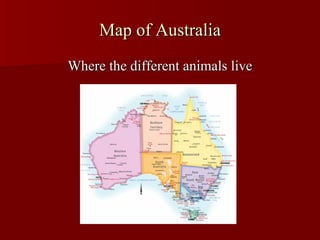
Map of Australia Where the different animals live
MONOTREMES Monotremes lay eggs instead of giving live birth. There are two living monotremes The Platypus and The Echidna Monotremes do secrete milk for their young & have hair like other mammals. Monotremes are found only in Australia & New Guinea.
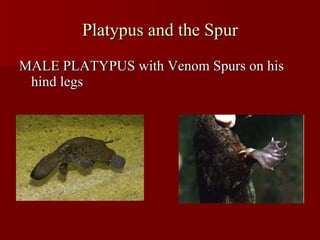
The Platypus (Male) The Platypus’ name comes from the Greek meaning broad foot for the webbed foot and lives in the eastern waterways. The Platypus has a bill that resembles a duck's bill but is actually an elongated snout covered with soft, moist, leathery skin and sensitive nerve endings.  The male Platypus has a sharp, hollow, horny spur about 15 millimeters long on the inside of both hind leg ankles.
The Platypus (Female) The females lays her eggs and then curls up to incubate them against her abdomen. The female has no teats. Milk is produced in large glands under her skin which oozes out onto a patch of fur and the young Platypus sucks it up.
Platypus and the Spur MALE PLATYPUS with Venom Spurs on his hind legs
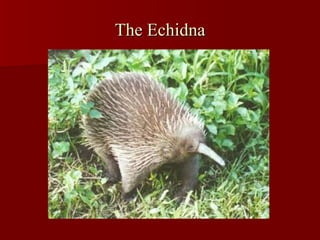
The Echidna The Echidnas are spiny anteaters that live in dry regions and the Australian Alps. They are covered with coarse hair and spines. During the breeding season, a female echidna develops a simple pouch into which she lays a single egg.  The echidna suckles her young through specialized pores inside the pouch.
The Echidna
Marsupials Marsupial means pouched animal They give live birth but do not have a long gestation time inside the mother’s body. The young animal climbs up into the mother’s pouch to suck from the nipple and grow there for months. Like other mammals, marsupials are covered with hair. Australia has most of the world’s marsupials.
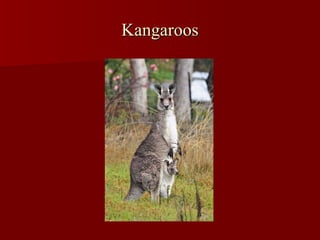
Kangaroos  Kangaroos are the largest of the Macro pods, which means large feet and they average about five feet tall in height. There are two kinds of kangaroos, the red and the grey kangaroo. The young baby kangaroos are called joeys, the male kangaroo is a boomer and the female is a doe.
Kangaroos
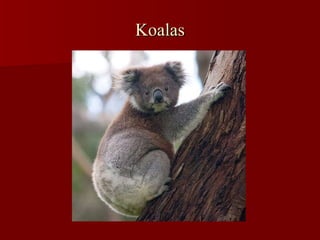
Koalas The koala is a herbivorous, plant-eating, marsupial that dwells in trees and eats Eucalyptus leaves (also known as gum leaves). It does not drink water unless it is sick or there is not enough moisture in the eucalyptus leaves. The koala is found from Queensland to Southern Victoria.
Koalas
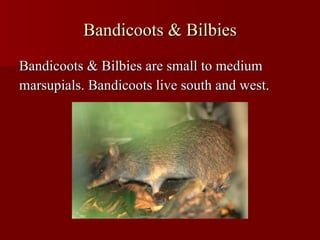
Bandicoots & Bilbies Bandicoots & Bilbies are small to medium marsupials. Bandicoots live south and west.
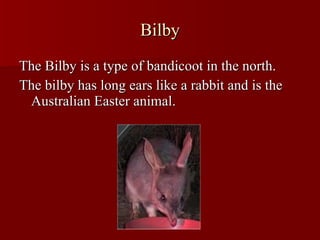
Bilby The Bilby is a type of bandicoot in the north. The bilby has long ears like a rabbit and is the Australian Easter animal.
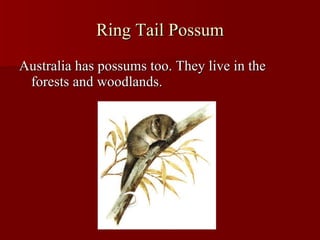
Ring Tail Possum Australia has possums too. They live in the forests and woodlands.
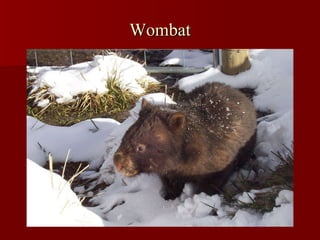
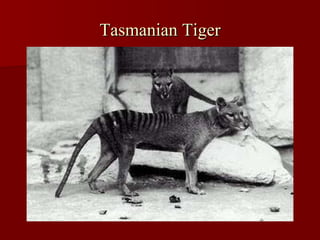
Tasmanian Devils, Wombats and the Tasmanian Tiger Wombats are large burrowing animals that look like a small bear found in the north, south and east. Tasmanian Devils resemble a small black dog and are found only in Tasmania. They were named devils due to their loud cries. The Tasmanian Tiger or Thylacine is probably extinct. The last known one died in 1936. The Thylacine resembled a wolf with stripes.
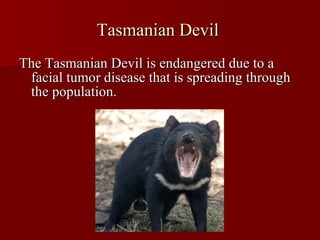
Tasmanian Devil  The Tasmanian Devil is endangered due to a facial tumor disease that is spreading through the population.
Wombat
Tasmanian Tiger
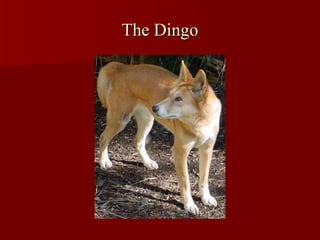
Placental Mammals The only placental animal, an animal that grows inside a sac in the mother’s body, that was in Australia before the European settlement, is the Dingo. Dingoes are not only in Australia but Southeastern Asia. They have been in Australia for over 3,000 years. They are found all over Australia particularly in the north. The Aboriginal people used them to hunt. Dingoes remain a wild dog in nature like the wolf but mixed blood Dingoes are often seen as pets .
The Dingo
Animals and Aboriginal Culture Animals were very important to the Aboriginal Culture and many of the Dreamtime stories of the beginning of time and moral stories involved animals. Animals were drawn on rock and sand by the Aborigines.
Let’s take a look at what you know True or false Monotremes have live births. Marsupial means big feet animals. Dingoes are only found in Australia. Koalas like to drink a lot of water. The female platypus has a poison spur. The Tasmanian Devil is extinct.
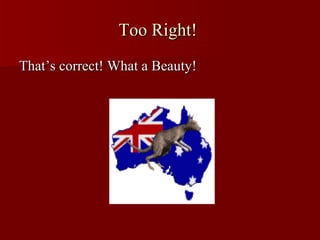
Too Right!  That’s correct! What a Beauty!
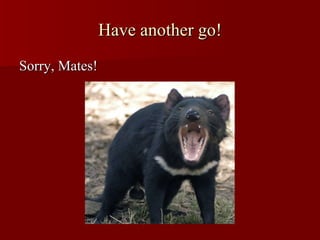
Have another go! Sorry, Mates!
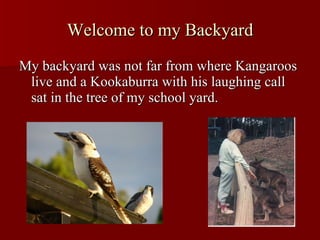
Welcome to my Backyard My backyard was not far from where Kangaroos live and a Kookaburra with his laughing call sat in the tree of my school yard.
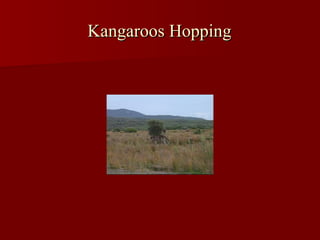
Kangaroos Hopping
Credits References for Multimedia Instructional  Presentation Aboriginal Australian Art and Culture Centre. (2007).  Art, Culture and Dreamtime .  http://aboriginalart.com.au/gallery/home2.htm   Allenbar, Campbell. (1993).  Darwin Cyclone: Bushfire/ Didgeridoo . United Kingdom: ARC Music. Activity Village of United Kingdom. (2007).  Australia Day Links .  http:// www.activityvillage.co.uk/australia_links.htm Australian Animals.Net. (2007).  Unique Australian Animals .  http://australian-animals.net/devil.htm AustralianExplorer.com. (2007).  Australian Animals . Panorama Australia Videos.  http:// www.australianexplorer.com/australian_animals.htm   Aussie Bush Band. (2001).  Bush Songs from the Australian Outback . Virginia: Legacy International. Campbell, Cameron R. (2006).  The Thylacine Museum . Natural Worlds Website.  http:// www.naturalworlds.org/thylacine
Credits Commonwealth of Australia. (2007).  Maps of Australia . Canberra:Geoscience Australia.  http:// www.ga.gov.au /map/   CyberSleuth Kids. (2006).  Information about Marsupials . http://cybersleuth kids.com/sleuth/Science/Animals/Mammals/Marsupials/index.htm  Ettamogah Wildlife Sanctuary. (2007).  Australian Animals . Australia: New South Wales.  http:// ausinternet.com/ettamogah/animals.htm   FOTOSEARCH. (2007).  Fotosearch.com.  Waukesha, Wisconsin.  http://www.fotosearch.com/clip-art/australian.html Kookaburra Song. (2007).  Children’s Lyrics : Free Music Downloads.  http://www.music-free-download.net/MP3/Childrens-Lyrics--_mp3_free_download_04046.html   McIvor, S. (2002).  Page Resources . Turtle Webs.  http:// pageresources.tripod.com/index.html Meirs, Jackie. (2007).  Australian Animals-Mammals: Links to sites on Australian Mammals.  Jackie’s Resources for Learning and Teaching. South Australia: McGill Primary School.  http:// www.teachers.ash.org.au/jmresources/ausanimallinks
Credits Museum of Paleontology. (2007).  Marsupial Mammals . Berkeley: University of California  http://www. ucmp . berkeley . edu/mammal/marsupial/marsupial .html   New South Wales National Parks and Wildlife Service. (2004).  Native animal fact   sheets . Department of Environment & Climate Change.  http://www. nationalparks . nsw . gov . au/npws . nsf/Content/Native +animal+fact+sheets+by+title   Rochedale State School. (2007).  Australian animals . Queensland: Year 5b.  http://www. rochedalss . eq . edu . au/rdale/animal . htm   Tassie Devil Website. (2007).  Save the Tasmanian devil . Hobart: University of Tasmania & the Tasmanian Government.  http://www. tassiedevil .com.au   Travel Pod. (2007).  Some sand, some snow, some kangaroos: short kangaroo video  clip.  http://www. travelpod .com   Von at Mundara.com. (2007).  Dreamtime Stories .  Australia:Mundara.com.  http: //mundara .com.au/dreamtime. htm Wikipedia Online Free Encyclopedia. (2007). Florida:  The Wikimedia Foundation .  http: //wikipedia .org

Number three australia s amazing animals

  • 1.
    AUSTRALIA’S AMAZING ANIMALSMAMMALS Monotremes Marsupials and Placental
  • 2.
    Map of AustraliaWhere the different animals live
  • 3.
    MONOTREMES Monotremes layeggs instead of giving live birth. There are two living monotremes The Platypus and The Echidna Monotremes do secrete milk for their young & have hair like other mammals. Monotremes are found only in Australia & New Guinea.
  • 4.
    The Platypus (Male)The Platypus’ name comes from the Greek meaning broad foot for the webbed foot and lives in the eastern waterways. The Platypus has a bill that resembles a duck's bill but is actually an elongated snout covered with soft, moist, leathery skin and sensitive nerve endings. The male Platypus has a sharp, hollow, horny spur about 15 millimeters long on the inside of both hind leg ankles.
  • 5.
    The Platypus (Female)The females lays her eggs and then curls up to incubate them against her abdomen. The female has no teats. Milk is produced in large glands under her skin which oozes out onto a patch of fur and the young Platypus sucks it up.
  • 6.
    Platypus and theSpur MALE PLATYPUS with Venom Spurs on his hind legs
  • 7.
    The Echidna TheEchidnas are spiny anteaters that live in dry regions and the Australian Alps. They are covered with coarse hair and spines. During the breeding season, a female echidna develops a simple pouch into which she lays a single egg. The echidna suckles her young through specialized pores inside the pouch.
  • 8.
  • 9.
    Marsupials Marsupial meanspouched animal They give live birth but do not have a long gestation time inside the mother’s body. The young animal climbs up into the mother’s pouch to suck from the nipple and grow there for months. Like other mammals, marsupials are covered with hair. Australia has most of the world’s marsupials.
  • 10.
    Kangaroos Kangaroosare the largest of the Macro pods, which means large feet and they average about five feet tall in height. There are two kinds of kangaroos, the red and the grey kangaroo. The young baby kangaroos are called joeys, the male kangaroo is a boomer and the female is a doe.
  • 11.
  • 12.
    Koalas The koalais a herbivorous, plant-eating, marsupial that dwells in trees and eats Eucalyptus leaves (also known as gum leaves). It does not drink water unless it is sick or there is not enough moisture in the eucalyptus leaves. The koala is found from Queensland to Southern Victoria.
  • 13.
  • 14.
    Bandicoots & BilbiesBandicoots & Bilbies are small to medium marsupials. Bandicoots live south and west.
  • 15.
    Bilby The Bilbyis a type of bandicoot in the north. The bilby has long ears like a rabbit and is the Australian Easter animal.
  • 16.
    Ring Tail PossumAustralia has possums too. They live in the forests and woodlands.
  • 17.
    Tasmanian Devils, Wombatsand the Tasmanian Tiger Wombats are large burrowing animals that look like a small bear found in the north, south and east. Tasmanian Devils resemble a small black dog and are found only in Tasmania. They were named devils due to their loud cries. The Tasmanian Tiger or Thylacine is probably extinct. The last known one died in 1936. The Thylacine resembled a wolf with stripes.
  • 18.
    Tasmanian Devil The Tasmanian Devil is endangered due to a facial tumor disease that is spreading through the population.
  • 19.
  • 20.
  • 21.
    Placental Mammals Theonly placental animal, an animal that grows inside a sac in the mother’s body, that was in Australia before the European settlement, is the Dingo. Dingoes are not only in Australia but Southeastern Asia. They have been in Australia for over 3,000 years. They are found all over Australia particularly in the north. The Aboriginal people used them to hunt. Dingoes remain a wild dog in nature like the wolf but mixed blood Dingoes are often seen as pets .
  • 22.
  • 23.
    Animals and AboriginalCulture Animals were very important to the Aboriginal Culture and many of the Dreamtime stories of the beginning of time and moral stories involved animals. Animals were drawn on rock and sand by the Aborigines.
  • 24.
    Let’s take alook at what you know True or false Monotremes have live births. Marsupial means big feet animals. Dingoes are only found in Australia. Koalas like to drink a lot of water. The female platypus has a poison spur. The Tasmanian Devil is extinct.
  • 25.
    Too Right! That’s correct! What a Beauty!
  • 26.
    Have another go!Sorry, Mates!
  • 27.
    Welcome to myBackyard My backyard was not far from where Kangaroos live and a Kookaburra with his laughing call sat in the tree of my school yard.
  • 28.
  • 29.
    Credits References forMultimedia Instructional Presentation Aboriginal Australian Art and Culture Centre. (2007). Art, Culture and Dreamtime . http://aboriginalart.com.au/gallery/home2.htm Allenbar, Campbell. (1993). Darwin Cyclone: Bushfire/ Didgeridoo . United Kingdom: ARC Music. Activity Village of United Kingdom. (2007). Australia Day Links . http:// www.activityvillage.co.uk/australia_links.htm Australian Animals.Net. (2007). Unique Australian Animals . http://australian-animals.net/devil.htm AustralianExplorer.com. (2007). Australian Animals . Panorama Australia Videos. http:// www.australianexplorer.com/australian_animals.htm Aussie Bush Band. (2001). Bush Songs from the Australian Outback . Virginia: Legacy International. Campbell, Cameron R. (2006). The Thylacine Museum . Natural Worlds Website. http:// www.naturalworlds.org/thylacine
  • 30.
    Credits Commonwealth ofAustralia. (2007). Maps of Australia . Canberra:Geoscience Australia. http:// www.ga.gov.au /map/ CyberSleuth Kids. (2006). Information about Marsupials . http://cybersleuth kids.com/sleuth/Science/Animals/Mammals/Marsupials/index.htm Ettamogah Wildlife Sanctuary. (2007). Australian Animals . Australia: New South Wales. http:// ausinternet.com/ettamogah/animals.htm FOTOSEARCH. (2007). Fotosearch.com. Waukesha, Wisconsin. http://www.fotosearch.com/clip-art/australian.html Kookaburra Song. (2007). Children’s Lyrics : Free Music Downloads. http://www.music-free-download.net/MP3/Childrens-Lyrics--_mp3_free_download_04046.html McIvor, S. (2002). Page Resources . Turtle Webs. http:// pageresources.tripod.com/index.html Meirs, Jackie. (2007). Australian Animals-Mammals: Links to sites on Australian Mammals. Jackie’s Resources for Learning and Teaching. South Australia: McGill Primary School. http:// www.teachers.ash.org.au/jmresources/ausanimallinks
  • 31.
    Credits Museum ofPaleontology. (2007). Marsupial Mammals . Berkeley: University of California http://www. ucmp . berkeley . edu/mammal/marsupial/marsupial .html New South Wales National Parks and Wildlife Service. (2004). Native animal fact sheets . Department of Environment & Climate Change. http://www. nationalparks . nsw . gov . au/npws . nsf/Content/Native +animal+fact+sheets+by+title Rochedale State School. (2007). Australian animals . Queensland: Year 5b. http://www. rochedalss . eq . edu . au/rdale/animal . htm Tassie Devil Website. (2007). Save the Tasmanian devil . Hobart: University of Tasmania & the Tasmanian Government. http://www. tassiedevil .com.au Travel Pod. (2007). Some sand, some snow, some kangaroos: short kangaroo video clip. http://www. travelpod .com Von at Mundara.com. (2007). Dreamtime Stories . Australia:Mundara.com. http: //mundara .com.au/dreamtime. htm Wikipedia Online Free Encyclopedia. (2007). Florida: The Wikimedia Foundation . http: //wikipedia .org