Hello, my name's  .............. and I  am ...............years old. I'm from   Motril, Granada and I hope we'll  be good friends. welcome
NUMBERS http://es.youtube.com/watch?v=_7AmBGd4tmU http://es.youtube.com/watch?v=edXQ39BdpCk http://acacia.pntic.mec.es/agip0002/auro/inicio.html
THE ALPHABET (animals) http://www.theyellowpencil.com/elalfabeto.html http://www.youtube.com/watch?v=rN3S2vrlfcU Now watch this video and write in your notebook the alphabet and the words that you are going to listen begining with each letter
C O L O U R S http://www.clicknlearn.net/
Why is The Earth  the only inhabited planet? Oxygen Water Sun Gravity Mineral salts Appropriate temperature There is
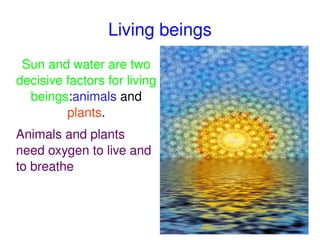
Living beings Sun and water are two decisive factors for living beings : animals  and  plants . Animals and plants need oxygen to live and to breathe
Animals and plants are born grow reproduce move eat excrete die also eat and move: eat mineral salts from the ground grow up die Animals Plants
On the Earth there are more than 10 million different living beings legs Most animals have fins wings walk They can run swim fly http://www.ieslosremedios.org/~pablo/webpablo/web1eso/7animals/listofanimals.html
Animals classification Vertebrates   animals with an internal skeleton Invertebrates  animals without a backbone 98% of animals species are invertebrates http://manassas.k12.va.us/Mayfield/Current Files/Homework Club/VFT-Classification.ppt http://www.ieslosremedios.org/~pablo/webpablo/web1eso/7animals/describinganimals.html
Play these games
Vertebrate   Invertebrate  Mammals Amphibians Reptiles Birds Fish Protozoa Annelids Echinoderms Molluskus  Arthropods Insects crustaceous arachnids http://www.bbc.co.uk/schools/ks3bitesize/science/biology/classification_3.shtml   Protozoa Annelids Echinoderms Molluskus  Protozoa Annelids Echinoderms Molluskus  Protozoa Annelids Echinoderms Molluskus  Protozoa Annelids Echinoderms Molluskus  http://www.proyectohormiga.org/udidac/anivert/animales invertebrados.html
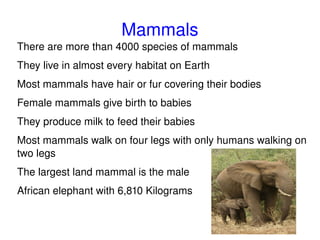
Mammals There are more than 4000 species of mammals They live in almost every habitat on Earth Most mammals have hair or fur covering their bodies Female mammals give birth to babies They produce milk to feed their babies Most mammals walk on four legs with only humans walking on two legs The largest land mammal is the male  African elephant with 6,810 Kilograms
Mammals Aquatic mammals have fins for swimming The largest mammal is  the blue whale  which   can be 30 metres long and weighs 150 tons The smallest mammal is a bat which only weighs 1.4 grams http://www.kidport.com/RefLIB/Science/Animals/Animals.htm
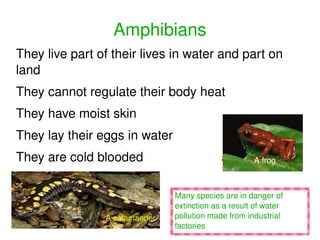
Amphibians They live part of their lives in water and part on land They cannot regulate their body heat They have moist skin They lay their eggs in water They are cold blooded  a frog A frog A salamander Many species are in danger of extinction as a result of water pollution made from industrial factories
Reptiles There are more than 6500 types of reptiles They can be found in all types of habitat except polar ice and tundra They lay eggs in holes and nests.They are oviparous They have skin covered in scales crocodiles turtle sn ake lizard
Birds They are the only animals that have feathers,wings and a beak Birds  incubate their eggs in nests Parents bring food for their children Some birds cannot fly (penguin, ostrich,kiwi) The largest bird is the ostrich which can weigh 150 kilos and their eggs 1400 grams http://www.enchantedlearning.com/subjects/birds/ ostrich parrots
Fish ¾ of the Earth is covered in water There are 20,000 different species of fish They are covered with scales They extract oxygen from the water using gills Many fish eat plants, but others eat other fish
Endangered animals http://www.greenpeace.org/espana/fungames/animations/nadando-con-ballenas The causes of the crisis are the activities of a single species: human beings http://www.bagheera.com/inthewild/classroom.htm Lynx chameleon eagle wolf dolphin turtle black vulture seal whales tigers elephant coral reefs panda cheetah gorilla http://www.kidport.com/RefLIB/Science/Environment/EndangeredAnimals.htm
Invertebrates http://www.kidport.com/RefLIB/Science/Animals/AnimalIndexInv.htm
http://www.bbc.co.uk/schools/ks3bitesize/science/biology/feeding_1.shtml http://www.kidport.com/RefLib/Science/FoodChain/FoodChain.htm Food chain
Habitat A habitat  is a place where plants and animals live and can find shelter and food Habitats can be big like a jungle Habitats can be small like a leaf Ex. Your habitat is your house and everything you need to live (food, heat, love and adults who care for you)
Animals and plants can live in one habitat but they cannot survive in another one. When a habitat changes, the animals and plants that live there, are affected. They are adapted to their habitat. For example : An elephant lives in a hot habitat and has long big ears to keep cold. A polar bear lives in a cold habitat and has thick fur to keep warm. Habitat http://www.woodlands-junior.kent.sch.uk/revision/Science/living/habitats.html
http://www.botanical-online.com/lasplantasangles.htm
The water cycle http://www.kidzone.ws/water/
Oceans http://www.enchantedlearning.com/subjects/ocean/Watercycle.shtml Oceans  cover almost 3/4 of the Earth's surface and contain roughly 97% of the Earth's water supply. Life on  Earth  originated in the salty seas, and contines to be home to an incredibly diverse web of life.  The Earth's oceans are all connected to one another. There are five oceans: the Pacific, Atlantic, Indian, Arctic, and Southern. There are also many seas (smaller branches of an ocean); seas are partly enclosed by land. The largest seas are the South China Sea, the Caribbean Sea, and the Mediterranean Sea. Why are oceans salty?
http://www.kimballmedia.com/Drippy/DrippysWorldTrialStories/ToMountainsAndBack/Entry.htm http://www.epa.gov/ogwdw/kids/flash/flash_watercycle.html
The water cycle
The water cycle http://poster.4teachers.org/worksheet/view.php?id=130669&page=1
Climate http://www.weatherwizkids.com/climate.htm
Song (environment) http://www.britishcouncil.org/kids-songs-environment.htm

Animals and plants

  • 1.
    Hello, my name's .............. and I am ...............years old. I'm from Motril, Granada and I hope we'll be good friends. welcome
  • 2.
  • 3.
    THE ALPHABET (animals)http://www.theyellowpencil.com/elalfabeto.html http://www.youtube.com/watch?v=rN3S2vrlfcU Now watch this video and write in your notebook the alphabet and the words that you are going to listen begining with each letter
  • 4.
    C O LO U R S http://www.clicknlearn.net/
  • 5.
    Why is TheEarth the only inhabited planet? Oxygen Water Sun Gravity Mineral salts Appropriate temperature There is
  • 6.
    Living beings Sunand water are two decisive factors for living beings : animals and plants . Animals and plants need oxygen to live and to breathe
  • 7.
    Animals and plantsare born grow reproduce move eat excrete die also eat and move: eat mineral salts from the ground grow up die Animals Plants
  • 8.
    On the Earththere are more than 10 million different living beings legs Most animals have fins wings walk They can run swim fly http://www.ieslosremedios.org/~pablo/webpablo/web1eso/7animals/listofanimals.html
  • 9.
    Animals classification Vertebrates animals with an internal skeleton Invertebrates animals without a backbone 98% of animals species are invertebrates http://manassas.k12.va.us/Mayfield/Current Files/Homework Club/VFT-Classification.ppt http://www.ieslosremedios.org/~pablo/webpablo/web1eso/7animals/describinganimals.html
  • 10.
  • 11.
    Vertebrate Invertebrate Mammals Amphibians Reptiles Birds Fish Protozoa Annelids Echinoderms Molluskus Arthropods Insects crustaceous arachnids http://www.bbc.co.uk/schools/ks3bitesize/science/biology/classification_3.shtml Protozoa Annelids Echinoderms Molluskus Protozoa Annelids Echinoderms Molluskus Protozoa Annelids Echinoderms Molluskus Protozoa Annelids Echinoderms Molluskus http://www.proyectohormiga.org/udidac/anivert/animales invertebrados.html
  • 12.
    Mammals There aremore than 4000 species of mammals They live in almost every habitat on Earth Most mammals have hair or fur covering their bodies Female mammals give birth to babies They produce milk to feed their babies Most mammals walk on four legs with only humans walking on two legs The largest land mammal is the male African elephant with 6,810 Kilograms
  • 13.
    Mammals Aquatic mammalshave fins for swimming The largest mammal is the blue whale which can be 30 metres long and weighs 150 tons The smallest mammal is a bat which only weighs 1.4 grams http://www.kidport.com/RefLIB/Science/Animals/Animals.htm
  • 14.
    Amphibians They livepart of their lives in water and part on land They cannot regulate their body heat They have moist skin They lay their eggs in water They are cold blooded a frog A frog A salamander Many species are in danger of extinction as a result of water pollution made from industrial factories
  • 15.
    Reptiles There aremore than 6500 types of reptiles They can be found in all types of habitat except polar ice and tundra They lay eggs in holes and nests.They are oviparous They have skin covered in scales crocodiles turtle sn ake lizard
  • 16.
    Birds They arethe only animals that have feathers,wings and a beak Birds incubate their eggs in nests Parents bring food for their children Some birds cannot fly (penguin, ostrich,kiwi) The largest bird is the ostrich which can weigh 150 kilos and their eggs 1400 grams http://www.enchantedlearning.com/subjects/birds/ ostrich parrots
  • 17.
    Fish ¾ ofthe Earth is covered in water There are 20,000 different species of fish They are covered with scales They extract oxygen from the water using gills Many fish eat plants, but others eat other fish
  • 18.
    Endangered animals http://www.greenpeace.org/espana/fungames/animations/nadando-con-ballenasThe causes of the crisis are the activities of a single species: human beings http://www.bagheera.com/inthewild/classroom.htm Lynx chameleon eagle wolf dolphin turtle black vulture seal whales tigers elephant coral reefs panda cheetah gorilla http://www.kidport.com/RefLIB/Science/Environment/EndangeredAnimals.htm
  • 19.
  • 20.
  • 21.
    Habitat A habitat is a place where plants and animals live and can find shelter and food Habitats can be big like a jungle Habitats can be small like a leaf Ex. Your habitat is your house and everything you need to live (food, heat, love and adults who care for you)
  • 22.
    Animals and plantscan live in one habitat but they cannot survive in another one. When a habitat changes, the animals and plants that live there, are affected. They are adapted to their habitat. For example : An elephant lives in a hot habitat and has long big ears to keep cold. A polar bear lives in a cold habitat and has thick fur to keep warm. Habitat http://www.woodlands-junior.kent.sch.uk/revision/Science/living/habitats.html
  • 23.
  • 24.
    The water cyclehttp://www.kidzone.ws/water/
  • 25.
    Oceans http://www.enchantedlearning.com/subjects/ocean/Watercycle.shtml Oceans cover almost 3/4 of the Earth's surface and contain roughly 97% of the Earth's water supply. Life on Earth originated in the salty seas, and contines to be home to an incredibly diverse web of life. The Earth's oceans are all connected to one another. There are five oceans: the Pacific, Atlantic, Indian, Arctic, and Southern. There are also many seas (smaller branches of an ocean); seas are partly enclosed by land. The largest seas are the South China Sea, the Caribbean Sea, and the Mediterranean Sea. Why are oceans salty?
  • 26.
  • 27.
  • 28.
    The water cyclehttp://poster.4teachers.org/worksheet/view.php?id=130669&page=1
  • 29.
  • 30.