Radiopharmaceuticals
Authorization and Inspection of Radiation Sources in
Nuclear Medicine
Module 2.2
2
Objective
To become familiar with the production and utilization of
radiopharmaceuticals used in nuclear medicine.
Authorization and Inspection of Radiation Sources in
Nuclear Medicine
Module 2.2
3
Contents
• Production of radionuclides.
• 99Mo / 99mTc generators.
• Preparation of radiopharmaceuticals.
• Good manufacturing practice.
Authorization and Inspection of Radiation Sources in
Nuclear Medicine
Module 2.2
4
• The primary radionuclide used for diagnostic nuclear
medicine procedures is Technetium-99m (99mTc).
• The primary radionuclide used for therapeutic nuclear
medicine procedures is Iodine-131 (131I).
Commonly used Radiopharmaceuticals
Authorization and Inspection of Radiation Sources in
Nuclear Medicine
Module 2.2
5
• are constructed on the principle of the decay-growth
relationship between a long-lived parent and its short-lived
daughter radionuclide.
 i.e. a long-lived parent nuclide is allowed to decay to its
short-lived daughter nuclide and the latter is then
chemically separated.
e.g. 99Mo (T½ = 66.6 hours)  99mTc (T½ = 6 hours)
Radiopharmaceutical Generators
Radiopharmaceutical generators:
Authorization and Inspection of Radiation Sources in
Nuclear Medicine
Module 2.2
6
• are easily transportable; and
• can serve as sources of short-lived radionuclides in
institutions located in remote areas where contracting the
services of a radiopharmacy is impracticable.
Radiopharmaceutical Generators (cont)
The importance of generators lies in the fact that they:
Authorization and Inspection of Radiation Sources in
Nuclear Medicine
Module 2.2
7
Technetium 99m
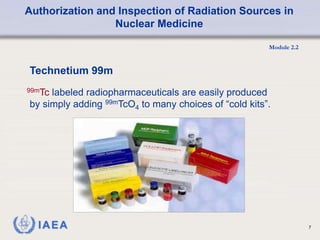
99mTc labeled radiopharmaceuticals are easily produced
by simply adding 99mTcO4 to many choices of “cold kits”.
Authorization and Inspection of Radiation Sources in
Nuclear Medicine
Module 2.2
8
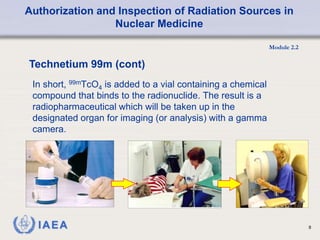
In short, 99mTcO4 is added to a vial containing a chemical
compound that binds to the radionuclide. The result is a
radiopharmaceutical which will be taken up in the
designated organ for imaging (or analysis) with a gamma
camera.
Technetium 99m (cont)
Authorization and Inspection of Radiation Sources in
Nuclear Medicine
Module 2.2
9
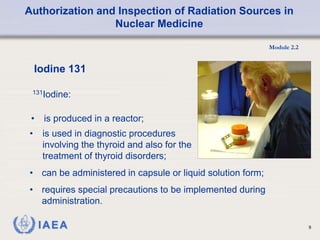
• is produced in a reactor;
Iodine 131
131Iodine:
• is used in diagnostic procedures
involving the thyroid and also for the
treatment of thyroid disorders;
• can be administered in capsule or liquid solution form;
• requires special precautions to be implemented during
administration.
Authorization and Inspection of Radiation Sources in
Nuclear Medicine
Module 2.2
10
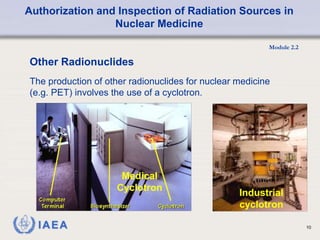
Industrial
cyclotron
Medical
Cyclotron
The production of other radionuclides for nuclear medicine
(e.g. PET) involves the use of a cyclotron.
Other Radionuclides
Authorization and Inspection of Radiation Sources in
Nuclear Medicine
Module 2.2
11
• has two components; a radionuclide and a
pharmaceutical.
Principles of Uptake (localization)
A radiopharmaceutical:
In designing a radiopharmaceutical, a pharmaceutical is
first chosen on the basis of its preferential uptake
(localization) by a given organ or its participation in the
physiological function of the organ i.e. the morphology
and / or the physiology of the organ can be assessed.
Authorization and Inspection of Radiation Sources in
Nuclear Medicine
Module 2.2
12
• As radiopharmaceuticals are intended for human
administration, it is essential that their manufacture is
subject to strict quality control procedures.
• These quality control procedures involve several specific
tests and measurements that ensure the purity, potency,
product identity, biologic safety, and efficacy of
radiopharmaceuticals.
Good Manufacturing Practice
Authorization and Inspection of Radiation Sources in
Nuclear Medicine
Module 2.2
13
• physiochemical tests which indicate the level of radionuclide
and radiochemical impurities and determine the pH, ionic
strength, osmolality and physical state of the sample,
particularly if it is a colloid.
Good Manufacturing Practice (cont)
Radiopharmaceutical quality control tests fall into two categories:
• biologic tests which establish the sterility, non-pyrogenicity, and
toxicity of the material.
Authorization and Inspection of Radiation Sources in
Nuclear Medicine
Module 2.2
14
• Quality control tests for the “kits” used to prepare
radiopharmaceuticals within a nuclear medicine
department are performed at the manufacturer’s facility.
• Generally, this is not an area of responsibility for the
regulator and therefore is not reviewed by the inspector
during a routine inspection.
Good Manufacturing Practice (cont)

NUCMED_Block_2.2_Radiopharmaceuticals_2012.ppt

  • 1.
  • 2.
    Authorization and Inspectionof Radiation Sources in Nuclear Medicine Module 2.2 2 Objective To become familiar with the production and utilization of radiopharmaceuticals used in nuclear medicine.
  • 3.
    Authorization and Inspectionof Radiation Sources in Nuclear Medicine Module 2.2 3 Contents • Production of radionuclides. • 99Mo / 99mTc generators. • Preparation of radiopharmaceuticals. • Good manufacturing practice.
  • 4.
    Authorization and Inspectionof Radiation Sources in Nuclear Medicine Module 2.2 4 • The primary radionuclide used for diagnostic nuclear medicine procedures is Technetium-99m (99mTc). • The primary radionuclide used for therapeutic nuclear medicine procedures is Iodine-131 (131I). Commonly used Radiopharmaceuticals
  • 5.
    Authorization and Inspectionof Radiation Sources in Nuclear Medicine Module 2.2 5 • are constructed on the principle of the decay-growth relationship between a long-lived parent and its short-lived daughter radionuclide.  i.e. a long-lived parent nuclide is allowed to decay to its short-lived daughter nuclide and the latter is then chemically separated. e.g. 99Mo (T½ = 66.6 hours)  99mTc (T½ = 6 hours) Radiopharmaceutical Generators Radiopharmaceutical generators:
  • 6.
    Authorization and Inspectionof Radiation Sources in Nuclear Medicine Module 2.2 6 • are easily transportable; and • can serve as sources of short-lived radionuclides in institutions located in remote areas where contracting the services of a radiopharmacy is impracticable. Radiopharmaceutical Generators (cont) The importance of generators lies in the fact that they:
  • 7.
    Authorization and Inspectionof Radiation Sources in Nuclear Medicine Module 2.2 7 Technetium 99m 99mTc labeled radiopharmaceuticals are easily produced by simply adding 99mTcO4 to many choices of “cold kits”.
  • 8.
    Authorization and Inspectionof Radiation Sources in Nuclear Medicine Module 2.2 8 In short, 99mTcO4 is added to a vial containing a chemical compound that binds to the radionuclide. The result is a radiopharmaceutical which will be taken up in the designated organ for imaging (or analysis) with a gamma camera. Technetium 99m (cont)
  • 9.
    Authorization and Inspectionof Radiation Sources in Nuclear Medicine Module 2.2 9 • is produced in a reactor; Iodine 131 131Iodine: • is used in diagnostic procedures involving the thyroid and also for the treatment of thyroid disorders; • can be administered in capsule or liquid solution form; • requires special precautions to be implemented during administration.
  • 10.
    Authorization and Inspectionof Radiation Sources in Nuclear Medicine Module 2.2 10 Industrial cyclotron Medical Cyclotron The production of other radionuclides for nuclear medicine (e.g. PET) involves the use of a cyclotron. Other Radionuclides
  • 11.
    Authorization and Inspectionof Radiation Sources in Nuclear Medicine Module 2.2 11 • has two components; a radionuclide and a pharmaceutical. Principles of Uptake (localization) A radiopharmaceutical: In designing a radiopharmaceutical, a pharmaceutical is first chosen on the basis of its preferential uptake (localization) by a given organ or its participation in the physiological function of the organ i.e. the morphology and / or the physiology of the organ can be assessed.
  • 12.
    Authorization and Inspectionof Radiation Sources in Nuclear Medicine Module 2.2 12 • As radiopharmaceuticals are intended for human administration, it is essential that their manufacture is subject to strict quality control procedures. • These quality control procedures involve several specific tests and measurements that ensure the purity, potency, product identity, biologic safety, and efficacy of radiopharmaceuticals. Good Manufacturing Practice
  • 13.
    Authorization and Inspectionof Radiation Sources in Nuclear Medicine Module 2.2 13 • physiochemical tests which indicate the level of radionuclide and radiochemical impurities and determine the pH, ionic strength, osmolality and physical state of the sample, particularly if it is a colloid. Good Manufacturing Practice (cont) Radiopharmaceutical quality control tests fall into two categories: • biologic tests which establish the sterility, non-pyrogenicity, and toxicity of the material.
  • 14.
    Authorization and Inspectionof Radiation Sources in Nuclear Medicine Module 2.2 14 • Quality control tests for the “kits” used to prepare radiopharmaceuticals within a nuclear medicine department are performed at the manufacturer’s facility. • Generally, this is not an area of responsibility for the regulator and therefore is not reviewed by the inspector during a routine inspection. Good Manufacturing Practice (cont)