NUCLEAR WEAPONS, EFFECTS
& SAFETY
Contents  Nuclear Technology History
 Atom
 Nuclear Energy
 Splitting Reaction
 Chain Reaction
 Types of Nuclear Technology
 Nuclear Fission
 Nuclear Fusion
 Where Energy Comes From?
 Construction & Working of Nuclear Reactors
 Nuclear Weapons
 Types of Fission Bombs
 Gun Triggered Fission Bombs
 Implosion Triggered Fission Bombs
 Hydrogen Bomb & Functioning & its Effects
 Incidents at Nuclear Plants
 Pros & Cons
 Precautions & Safety Measures
 Future of Nuclear Energy
 Conclusion
Nuclear technology
Nuclear technology is “the technology that involves the nuclear
reactions of atomic nuclei”. It has found applications from
smoke detectors to nuclear reactors, and from gun sights to
nuclear weapons.
History:
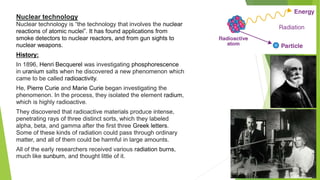
In 1896, Henri Becquerel was investigating phosphorescence
in uranium salts when he discovered a new phenomenon which
came to be called radioactivity.
He, Pierre Curie and Marie Curie began investigating the
phenomenon. In the process, they isolated the element radium,
which is highly radioactive.
They discovered that radioactive materials produce intense,
penetrating rays of three distinct sorts, which they labeled
alpha, beta, and gamma after the first three Greek letters.
Some of these kinds of radiation could pass through ordinary
matter, and all of them could be harmful in large amounts.
All of the early researchers received various radiation burns,
much like sunburn, and thought little of it.
Applications of Nuclear Technology
 Nuclear Weapon
 Electric Power Generation
 Medicine (diagnostics and radiation
treatment)
 Food Processing and Agriculture
 Industrial Applications
 Space
Nuclear Weapon
 A nuclear weapon is an explosive device that derives its destructive force
from nuclear reactions, either fission or a combination of fission and fusion.
 Nuclear reactions release vast quantities of energy from relatively small
amounts of matter.
 Even small nuclear devices can devastate a city by blast, fire, and radiation.
 Nuclear weapons are considered weapons of mass destruction, and their use
and control have been a major aspect of international policy since their
debut.
Types of Nuclear Weapons
 There are two types of Nuclear Weapons:
1) Atomic Bomb (Fission Reaction)
2) Thermonuclear Bomb (Fusion Reaction)
 Most nuclear weapons today are two-stage thermonuclear
weapons that use both Fission and Fusion.
Fission
 Fission occurs when a neutron slams into a
larger atom, forcing it to excite and split
into two smaller atoms—also known as
fission products.
 Additional neutrons are also released that
can initiate a chain reaction. When each
atom splits, a tremendous amount of
energy is released.
Fusion
 In a fusion reaction, two light nuclei merge
to form a single heavier nucleus. The
process releases energy because the total
mass of the resulting single nucleus is less
than the mass of the two original nuclei.
The leftover mass becomes energy.
The First Atomic Bomb
 The first atomic explosion was
conducted, as a test, at
Alamogordo, New Mexico, on July
16, 1945.
 US drops the first atomic bomb on
Hiroshima, Japan on August 06,
1945.
 US drops the second atomic bomb on
the city of Nagasaki, Japan on
August 09, 1945.
The First Atomic Bomb
 The uranium bomb detonated over Hiroshima on 6 August 1945 had an
explosive yield equal to 15,000 tones of TNT. It razed and burnt around 70
percent of all buildings and caused an estimated 140,000 deaths by the end of
1945, along with increased rates of cancer and chronic disease among the
survivors.
 A slightly larger plutonium bomb exploded over Nagasaki three days later
levelled 6.7 sq km. of the city and killed 74,000 people by the end of 1945.
Ground temperatures reached 4,000°C and radioactive rain poured down.
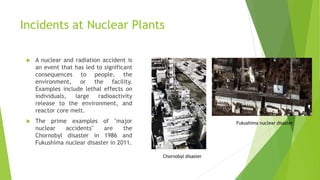
Incidents at Nuclear Plants
 A nuclear and radiation accident is
an event that has led to significant
consequences to people, the
environment, or the facility.
Examples include lethal effects on
individuals, large radioactivity
release to the environment, and
reactor core melt.
 The prime examples of "major
nuclear accidents" are the
Chornobyl disaster in 1986 and
Fukushima nuclear disaster in 2011.
Chornobyl disaster
Fukushima nuclear disaster
Effect of the Nuclear Weapons
The energy released from a nuclear weapon detonated within the lower
atmosphere can be approximately divided into four basic categories:
 the blast itself: 50% of total energy
 thermal radiation: 30–50% of total energy
 ionizing radiation: 5% of total energy (more in a neutron bomb)
 residual radiation: 5–10% of total energy with the mass of the explosion.
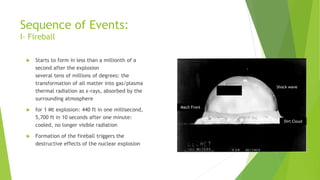
Sequence of Events:
I- Fireball
 Starts to form in less than a millionth of a
second after the explosion
several tens of millions of degrees: the
transformation of all matter into gas/plasma
thermal radiation as x-rays, absorbed by the
surrounding atmosphere
 for 1 Mt explosion: 440 ft in one millisecond,
5,700 ft in 10 seconds after one minute:
cooled, no longer visible radiation
 Formation of the fireball triggers the
destructive effects of the nuclear explosion
Fireball
Shock wave
Dirt Cloud
Mach Front
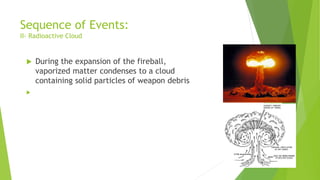
Sequence of Events:
II- Radioactive Cloud
 During the expansion of the fireball,
vaporized matter condenses to a cloud
containing solid particles of weapon debris
 Fireball becomes doughnut-shaped, violent internal
circulatory motion
Air is entrained from the bottom “mushroom” cloud if
dirt and debris sucked up from the earth’s surface
Sequence of Events:
IIi- Air Blast / Shock wave
 Pressure wave develops immediately after the
explosion and moves outward from the fireball
 After 10 seconds of 1 Mt explosion:
diameter of fireball: 5,700 ft,
distance of shock front: 3 miles
Wave is reflected from the surface, both waves merge to
create a “Mach wave”
Sequence of Events:
Iv- Thermal radiation
 Reemitted radiation from the fireball (secondary
thermal radiation)
 The first is quite short, and carries only about 1
percent of the energy; the second pulse is more
significant and is of longer duration (up to 20
seconds).
 Duration: about 10 seconds for 1 Mt explosion
(99% of total thermal energy)
Sequence of Events:
Iv- Initial Nuclear Radiation & Fall Out
 Defined as radiation releases within the first minute mostly neutrons and
gammas (directly from the explosion or from fission products
 Origin: material lifted into the fireball right after the explosion
 Mixed with radioactive residues of weapon (activated debris, fission products,
...)
 Early and delayed fallout: Depending on height of burst, weather conditions,
etc.
Safety/ Precautions
 Nuclear explosions can cause significant damage and casualties from blast,
heat, and radiation but you can keep your family safe by knowing what to do
and being prepared if it occurs.
 Get Inside
 Stay Inside
 Stay Tuned
Pros. & Cons.
List of Pros of Nuclear Weapons
1. Deters major wars from
happening
2. Negotiation becomes the first
weapon of choice
3. Increase a nation’s power
and status
4. Can be positioned in a
variety of locations i.e.
submarines & naval craft.
List of Cons of Nuclear Weapons
1. It is being used as a strategic
excuse
2. High cost and maintenance
3. Lack of morals
4. Comes with plenty of risks
5. a non-renewable resource.
6. a skilled workforce to
operate.
Conclusion
Questions & Answers

Nuclear Weapons Updated.pptx

  • 1.
  • 2.
    Contents  NuclearTechnology History  Atom  Nuclear Energy  Splitting Reaction  Chain Reaction  Types of Nuclear Technology  Nuclear Fission  Nuclear Fusion  Where Energy Comes From?  Construction & Working of Nuclear Reactors  Nuclear Weapons  Types of Fission Bombs  Gun Triggered Fission Bombs  Implosion Triggered Fission Bombs  Hydrogen Bomb & Functioning & its Effects  Incidents at Nuclear Plants  Pros & Cons  Precautions & Safety Measures  Future of Nuclear Energy  Conclusion
  • 3.
    Nuclear technology Nuclear technologyis “the technology that involves the nuclear reactions of atomic nuclei”. It has found applications from smoke detectors to nuclear reactors, and from gun sights to nuclear weapons. History: In 1896, Henri Becquerel was investigating phosphorescence in uranium salts when he discovered a new phenomenon which came to be called radioactivity. He, Pierre Curie and Marie Curie began investigating the phenomenon. In the process, they isolated the element radium, which is highly radioactive. They discovered that radioactive materials produce intense, penetrating rays of three distinct sorts, which they labeled alpha, beta, and gamma after the first three Greek letters. Some of these kinds of radiation could pass through ordinary matter, and all of them could be harmful in large amounts. All of the early researchers received various radiation burns, much like sunburn, and thought little of it.
  • 4.
    Applications of NuclearTechnology  Nuclear Weapon  Electric Power Generation  Medicine (diagnostics and radiation treatment)  Food Processing and Agriculture  Industrial Applications  Space
  • 5.
    Nuclear Weapon  Anuclear weapon is an explosive device that derives its destructive force from nuclear reactions, either fission or a combination of fission and fusion.  Nuclear reactions release vast quantities of energy from relatively small amounts of matter.  Even small nuclear devices can devastate a city by blast, fire, and radiation.  Nuclear weapons are considered weapons of mass destruction, and their use and control have been a major aspect of international policy since their debut.
  • 6.
    Types of NuclearWeapons  There are two types of Nuclear Weapons: 1) Atomic Bomb (Fission Reaction) 2) Thermonuclear Bomb (Fusion Reaction)  Most nuclear weapons today are two-stage thermonuclear weapons that use both Fission and Fusion.
  • 7.
    Fission  Fission occurswhen a neutron slams into a larger atom, forcing it to excite and split into two smaller atoms—also known as fission products.  Additional neutrons are also released that can initiate a chain reaction. When each atom splits, a tremendous amount of energy is released.
  • 8.
    Fusion  In afusion reaction, two light nuclei merge to form a single heavier nucleus. The process releases energy because the total mass of the resulting single nucleus is less than the mass of the two original nuclei. The leftover mass becomes energy.
  • 9.
    The First AtomicBomb  The first atomic explosion was conducted, as a test, at Alamogordo, New Mexico, on July 16, 1945.  US drops the first atomic bomb on Hiroshima, Japan on August 06, 1945.  US drops the second atomic bomb on the city of Nagasaki, Japan on August 09, 1945.
  • 10.
    The First AtomicBomb  The uranium bomb detonated over Hiroshima on 6 August 1945 had an explosive yield equal to 15,000 tones of TNT. It razed and burnt around 70 percent of all buildings and caused an estimated 140,000 deaths by the end of 1945, along with increased rates of cancer and chronic disease among the survivors.  A slightly larger plutonium bomb exploded over Nagasaki three days later levelled 6.7 sq km. of the city and killed 74,000 people by the end of 1945. Ground temperatures reached 4,000°C and radioactive rain poured down.
  • 12.
    Incidents at NuclearPlants  A nuclear and radiation accident is an event that has led to significant consequences to people, the environment, or the facility. Examples include lethal effects on individuals, large radioactivity release to the environment, and reactor core melt.  The prime examples of "major nuclear accidents" are the Chornobyl disaster in 1986 and Fukushima nuclear disaster in 2011. Chornobyl disaster Fukushima nuclear disaster
  • 13.
    Effect of theNuclear Weapons The energy released from a nuclear weapon detonated within the lower atmosphere can be approximately divided into four basic categories:  the blast itself: 50% of total energy  thermal radiation: 30–50% of total energy  ionizing radiation: 5% of total energy (more in a neutron bomb)  residual radiation: 5–10% of total energy with the mass of the explosion.
  • 14.
    Sequence of Events: I-Fireball  Starts to form in less than a millionth of a second after the explosion several tens of millions of degrees: the transformation of all matter into gas/plasma thermal radiation as x-rays, absorbed by the surrounding atmosphere  for 1 Mt explosion: 440 ft in one millisecond, 5,700 ft in 10 seconds after one minute: cooled, no longer visible radiation  Formation of the fireball triggers the destructive effects of the nuclear explosion Fireball Shock wave Dirt Cloud Mach Front
  • 15.
    Sequence of Events: II-Radioactive Cloud  During the expansion of the fireball, vaporized matter condenses to a cloud containing solid particles of weapon debris  Fireball becomes doughnut-shaped, violent internal circulatory motion Air is entrained from the bottom “mushroom” cloud if dirt and debris sucked up from the earth’s surface
  • 16.
    Sequence of Events: IIi-Air Blast / Shock wave  Pressure wave develops immediately after the explosion and moves outward from the fireball  After 10 seconds of 1 Mt explosion: diameter of fireball: 5,700 ft, distance of shock front: 3 miles Wave is reflected from the surface, both waves merge to create a “Mach wave”
  • 17.
    Sequence of Events: Iv-Thermal radiation  Reemitted radiation from the fireball (secondary thermal radiation)  The first is quite short, and carries only about 1 percent of the energy; the second pulse is more significant and is of longer duration (up to 20 seconds).  Duration: about 10 seconds for 1 Mt explosion (99% of total thermal energy)
  • 18.
    Sequence of Events: Iv-Initial Nuclear Radiation & Fall Out  Defined as radiation releases within the first minute mostly neutrons and gammas (directly from the explosion or from fission products  Origin: material lifted into the fireball right after the explosion  Mixed with radioactive residues of weapon (activated debris, fission products, ...)  Early and delayed fallout: Depending on height of burst, weather conditions, etc.
  • 19.
    Safety/ Precautions  Nuclearexplosions can cause significant damage and casualties from blast, heat, and radiation but you can keep your family safe by knowing what to do and being prepared if it occurs.  Get Inside  Stay Inside  Stay Tuned
  • 20.
    Pros. & Cons. Listof Pros of Nuclear Weapons 1. Deters major wars from happening 2. Negotiation becomes the first weapon of choice 3. Increase a nation’s power and status 4. Can be positioned in a variety of locations i.e. submarines & naval craft. List of Cons of Nuclear Weapons 1. It is being used as a strategic excuse 2. High cost and maintenance 3. Lack of morals 4. Comes with plenty of risks 5. a non-renewable resource. 6. a skilled workforce to operate.
  • 21.
  • 22.