Nuclear ScienceNuclear Science
Merit BadgeMerit Badge
Presented by Dr. DeDeoPresented by Dr. DeDeo
““The only reason for time is so thatThe only reason for time is so that
everything doesn't happen at once." everything doesn't happen at once." 
Albert EinsteinAlbert Einstein
I. RadiationI. Radiation
Radiation describes a process in whichRadiation describes a process in which energeticenergetic
particles orparticles or waveswaves go through a medium or space.go through a medium or space.
There are two distinct types of radiation:There are two distinct types of radiation:
ionizingionizing andand non-ionizingnon-ionizing..
The wordThe word radiationradiation is commonly used in reference tois commonly used in reference to
ionizing radiationionizing radiation only,only,
(i.e. having sufficient energy to ionize an atom =(i.e. having sufficient energy to ionize an atom =
remove electrons), but it may also refer to non-remove electrons), but it may also refer to non-
ionizing radiation (e.g.,ionizing radiation (e.g., radio wavesradio waves oror lightlight).).
Exposure vs. ContaminationExposure vs. Contamination
It is important to note thatIt is important to note that exposure toexposure to
radiationradiation does not necessarilydoes not necessarily result inresult in
contamination.contamination.
Let’s look at the definitions and theLet’s look at the definitions and the
differences between the them.differences between the them.
Both ionizing and non-ionizing radiation can beBoth ionizing and non-ionizing radiation can be
harmful toharmful to organismsorganisms and can result in changesand can result in changes
to theto the natural environmentnatural environment..
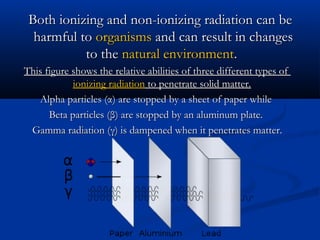
This figure shows the relative abilities of three different types ofThis figure shows the relative abilities of three different types of
ionizing radiationionizing radiation to penetrate solid matter.to penetrate solid matter.
Alpha particles (α) are stopped by a sheet of paper whileAlpha particles (α) are stopped by a sheet of paper while
Beta particles (β) are stopped by an aluminum plate.Beta particles (β) are stopped by an aluminum plate.
Gamma radiation (γ) is dampened when it penetrates matter.Gamma radiation (γ) is dampened when it penetrates matter.
Radiation ExposureRadiation Exposure
People can be exposed throughPeople can be exposed through nuclear power,nuclear power,
medical radiation, mining and backgroundmedical radiation, mining and background
radiationradiation including radon.including radon.
For most, the riskiest exposure is fromFor most, the riskiest exposure is from X-rayX-ray
and other medical testsand other medical tests. These tests usually use. These tests usually use
very, very low doses.very, very low doses.
Radon exposure for humans is commonly fromRadon exposure for humans is commonly from
basements in areas where radon is present. Tobasements in areas where radon is present. To
alleviate the risk, radon testing in homes withalleviate the risk, radon testing in homes with
basements is highly recommended.basements is highly recommended.
EnvironmentEnvironment
Background radiationBackground radiation isis radiationradiation that is constantlythat is constantly
present in the environment and is emitted from a varietypresent in the environment and is emitted from a variety
of natural and artificial sources.of natural and artificial sources.
Primary contributions come from:Primary contributions come from:
 Sources in theSources in the earthearth. Includes sources in food and water,. Includes sources in food and water,
which are incorporated in the body, and in buildingwhich are incorporated in the body, and in building
materials and products that use radioactive sources;materials and products that use radioactive sources;
 Sources fromSources from spacespace, in the form of, in the form of cosmic rayscosmic rays;;
 Sources in the atmosphere.Sources in the atmosphere. RadonRadon gas that is releasedgas that is released
from the Earth's crust and subsequently decays intofrom the Earth's crust and subsequently decays into
radioactive atoms that become attached to airborne dust.radioactive atoms that become attached to airborne dust.
Exposure to RadiationExposure to Radiation
High radiation doses tend to kill cells, while low,High radiation doses tend to kill cells, while low,
long term doses tend tolong term doses tend to damage or alter thedamage or alter the
genetic code (DNA) of irradiated cellsgenetic code (DNA) of irradiated cells..
Low, long-term exposure is rare. For example,Low, long-term exposure is rare. For example,
people, environment and wildlife can also bepeople, environment and wildlife can also be
affected byaffected by long-term mining and the use oflong-term mining and the use of
nuclear materials at a long-term facilitynuclear materials at a long-term facility..
High Dose ExposureHigh Dose Exposure
Radiation poisoningRadiation poisoning,, radiation sicknessradiation sickness or aor a
creeping dosecreeping dose, is a form of damage to organ, is a form of damage to organ
tissue caused by excessive exposure totissue caused by excessive exposure to
ionizing radiationionizing radiation. The term is generally used to. The term is generally used to
refer torefer to acuteacute problems caused by a large dosageproblems caused by a large dosage
ofof radiationradiation in a short period, though this alsoin a short period, though this also
has occurred with long term exposure.has occurred with long term exposure.
The clinical name for radiation sickness isThe clinical name for radiation sickness is acuteacute
radiation syndromeradiation syndrome ((ARSARS).).
Mining produces the greatest risks to peopleMining produces the greatest risks to people
and the environment byand the environment by::
 contamination ofcontamination of ground water and river systemsground water and river systems
with radioactive materials as well as heavy metals,with radioactive materials as well as heavy metals,
acids, etc.acids, etc.
 leaks, spills, and catastrophic failuresleaks, spills, and catastrophic failures of pipelines;of pipelines;
 the spreading ofthe spreading of radioactive dustradioactive dust, which finds its, which finds its
way into water, plants, animals, fish and humans;way into water, plants, animals, fish and humans;
 releases ofreleases of radon gas into the airradon gas into the air, which will, which will
deposit radioactive fall-out for hundreds of miles.deposit radioactive fall-out for hundreds of miles.
Low Dose ExposureLow Dose Exposure
Results of ExposureResults of Exposure
The associations between radiation contaminationThe associations between radiation contamination
and the development of cancer are mostly basedand the development of cancer are mostly based
on populations exposed to relatively high levelson populations exposed to relatively high levels
of ionizing radiation (e.g., Japanese atomic bombof ionizing radiation (e.g., Japanese atomic bomb
survivors, and recipients of selected diagnosticsurvivors, and recipients of selected diagnostic
or therapeutic medical procedures).or therapeutic medical procedures).
To avoid exposureTo avoid exposure,,
a safety principle known as ALARA was defined.a safety principle known as ALARA was defined.
ALARAALARA
ALARA stands forALARA stands for AAss LLowow AAss RReasonablyeasonably AAchievable.chievable.
 The ALARA concept is an integral part of all activities thatThe ALARA concept is an integral part of all activities that
involve the use of radiation or radioactive materials. Thisinvolve the use of radiation or radioactive materials. This
includes the design, construction and operations ofincludes the design, construction and operations of
facilities. This concept includes reducing both internal andfacilities. This concept includes reducing both internal and
external exposure to ionizing radiation.external exposure to ionizing radiation.
A CLOSER LOOK - What is "reasonable" ?A CLOSER LOOK - What is "reasonable" ?
The ALARA concept grows out of the assumption thatThe ALARA concept grows out of the assumption that
any radiation exposure carries with it some risk. Since workany radiation exposure carries with it some risk. Since work
that involves exposure is sometimes part of somethat involves exposure is sometimes part of some
beneficial endeavor, the ALARA effort tries to balance thebeneficial endeavor, the ALARA effort tries to balance the
assumed risks of radiation exposure against the benefit ofassumed risks of radiation exposure against the benefit of
performing the work. So "reasonable" means that the riskperforming the work. So "reasonable" means that the risk
from receiving the exposure is "worth" the benefit.from receiving the exposure is "worth" the benefit.
Three Principles of ALARAThree Principles of ALARA
To minimize exposure, ALARA recommends:
1) TIME – minimizing the time of exposure directly
reduces radiation dose.
2) DISTANCE – doubling the distance between your
body and the radiation source will divide the radiation
exposure by a factor of 4 (inverse square law)
3) SHIELDING - using absorber materials such as
Plexiglas for beta particles and lead for X-rays and
gamma rays is an effective way to reduce exposure.
II. Definitions of Nuclear ParticlesII. Definitions of Nuclear Particles
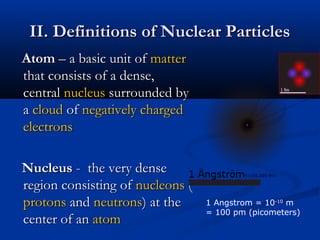
AtomAtom – a basic unit of– a basic unit of mattermatter
that consists of a dense,that consists of a dense,
centralcentral nucleusnucleus surrounded bysurrounded by
aa cloudcloud ofof negatively chargednegatively charged
electronselectrons
NucleusNucleus - the very dense- the very dense
region consisting ofregion consisting of nucleonsnucleons ((
protonsprotons andand neutronsneutrons) at the) at the
center of ancenter of an atomatom
1 Angstrom = 10-10
m
= 100 pm (picometers)
Parts of an AtomParts of an Atom
ProtonProton - a- a subatomic particlesubatomic particle with anwith an
electric chargeelectric charge of +1of +1 elementary chargeelementary charge
NeutronNeutron - a- a subatomic particlesubatomic particle with no netwith no net
electric chargeelectric charge and aand a massmass slightly larger thanslightly larger than
that of athat of a protonproton
ElectronElectron - a- a subatomic particlesubatomic particle carrying acarrying a
negativenegative electric chargeelectric charge of -1 elementary charge.of -1 elementary charge.
It has no known components or substructureIt has no known components or substructure
QuarksQuarks
QuarkQuark ––
anan elementary particleelementary particle
and fundamentaland fundamental
constituent ofconstituent of mattermatter..
Quarks combine to formQuarks combine to form
composite particlescomposite particles
calledcalled hadronshadrons, the most, the most
stable of which arestable of which are
protonsprotons andand neutronsneutrons..
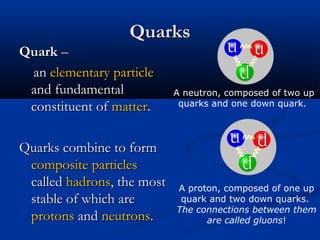
A proton, composed of one up
quark and two down quarks.
The connections between them
are called gluons!
A neutron, composed of two up
quarks and one down quark.
IsotopesIsotopes
IsotopesIsotopes - are atoms that contain the same- are atoms that contain the same
number ofnumber of protonsprotons but a different number ofbut a different number of
neutronsneutrons..
The number ofThe number of protonsprotons (the(the atomic numberatomic number) is) is
thethe samesame for each isotope, e.g.for each isotope, e.g. carbon-12carbon-12,,
carbon-13carbon-13 andand carbon-14carbon-14 each have 6 protons,each have 6 protons,
but the number of neutrons in each differs.but the number of neutrons in each differs.
This makes the total ofThis makes the total of nucleonsnucleons (protons and(protons and
neutrons) in theneutrons) in the nucleusnucleus, known as the, known as the
mass numbermass number differentdifferent, as well as the, as well as the
ParticlesParticles
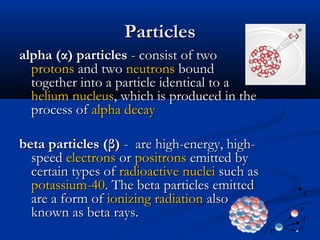
alpha (α) particlesalpha (α) particles - consist of two- consist of two
protonsprotons and twoand two neutronsneutrons boundbound
together into a particle identical to atogether into a particle identical to a
heliumhelium nucleusnucleus, which is produced in the, which is produced in the
process ofprocess of alpha decayalpha decay
beta particles (β)beta particles (β) - are high-energy, high-- are high-energy, high-
speedspeed electronselectrons oror positronspositrons emitted byemitted by
certain types ofcertain types of radioactiveradioactive nucleinuclei such assuch as
potassium-40potassium-40. The beta particles emitted. The beta particles emitted
are a form ofare a form of ionizing radiationionizing radiation alsoalso
known as beta rays.known as beta rays.
RaysRays
gamma rays (γ)gamma rays (γ) --
electromagnetic radiationelectromagnetic radiation of highof high
frequency (very short wavelength).frequency (very short wavelength).
They are produced byThey are produced by sub-atomicsub-atomic
particle interactions and areparticle interactions and are
emitted by the nucleus.emitted by the nucleus.
X-rayX-ray - A relatively high-energy- A relatively high-energy
photon. They are emitted byphoton. They are emitted by
electrons outside of the nucleus.electrons outside of the nucleus.
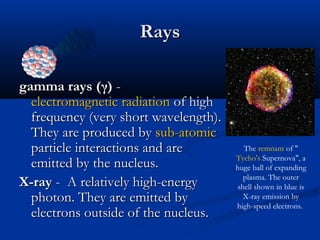
The remnant of "
Tycho's Supernova", a
huge ball of expanding
plasma. The outer
shell shown in blue is
X-ray emission by
high-speed electrons.
Other DefinitionsOther Definitions
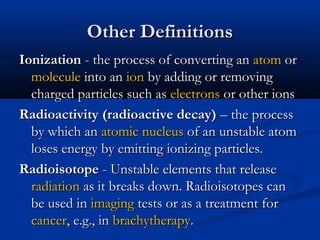
IonizationIonization - the process of converting an- the process of converting an atomatom oror
moleculemolecule into aninto an ionion by adding or removingby adding or removing
charged particles such ascharged particles such as electronselectrons or other ionsor other ions
Radioactivity (radioactive decay)Radioactivity (radioactive decay) – the process– the process
by which anby which an atomic nucleusatomic nucleus of an unstable atomof an unstable atom
loses energy by emitting ionizing particles.loses energy by emitting ionizing particles.
RadioisotopeRadioisotope - Unstable elements that release- Unstable elements that release
radiationradiation as it breaks down. Radioisotopes canas it breaks down. Radioisotopes can
be used inbe used in imagingimaging tests or as a treatment fortests or as a treatment for
cancercancer, e.g., in, e.g., in brachytherapybrachytherapy..
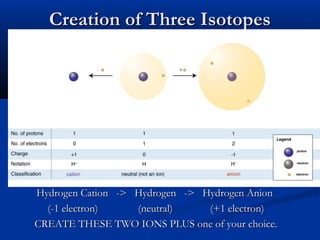
Creation of Three IsotopesCreation of Three Isotopes
Hydrogen Cation -> Hydrogen -> Hydrogen AnionHydrogen Cation -> Hydrogen -> Hydrogen Anion
(-1 electron) (neutral) (+1 electron)(-1 electron) (neutral) (+1 electron)
CREATE THESE TWO IONS PLUS one of your choice.CREATE THESE TWO IONS PLUS one of your choice.
III. Particle AcceleratorsIII. Particle Accelerators
AA particle acceleratorparticle accelerator is a device that usesis a device that uses
electromagnetic fieldselectromagnetic fields to propelto propel chargedcharged particlesparticles toto
high speeds and to contain them in beams.high speeds and to contain them in beams. AnAn
ordinaryordinary CRTCRT television set is a simple form of accelerator.television set is a simple form of accelerator.
There are two basic types:There are two basic types:
electrostatic and oscillating field accelerators.electrostatic and oscillating field accelerators.
In the early 20th century, theseIn the early 20th century, these cyclotronscyclotrons werewere
commonly referred to ascommonly referred to as atom smashersatom smashers..
Modern colliders actuallyModern colliders actually propelpropel subatomic particles.subatomic particles.
Purpose of AcceleratorsPurpose of Accelerators
PhysicistsPhysicists hope that they will help answer manyhope that they will help answer many
of the mostof the most fundamental questionsfundamental questions in physics:in physics:
questions concerning the basic laws governingquestions concerning the basic laws governing
the interactions and forces among thethe interactions and forces among the
elementary objectselementary objects, the deep structure of space, the deep structure of space
and time, especially regarding the intersection ofand time, especially regarding the intersection of
quantum mechanicsquantum mechanics andand general relativitygeneral relativity, where, where
current theories and knowledge are unclear orcurrent theories and knowledge are unclear or
break down altogether.break down altogether.
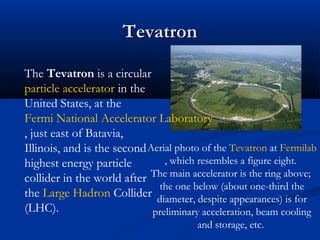
TevatronTevatron
Aerial photo of the Tevatron at Fermilab
, which resembles a figure eight.
The main accelerator is the ring above;
the one below (about one-third the
diameter, despite appearances) is for
preliminary acceleration, beam cooling
and storage, etc.
The Tevatron is a circular
particle accelerator in the
United States, at the
Fermi National Accelerator Laboratory
, just east of Batavia,
Illinois, and is the second
highest energy particle
collider in the world after
the Large Hadron Collider
(LHC).
LHCLHC
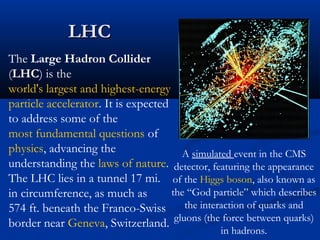
A simulated event in the CMS
detector, featuring the appearance
of the Higgs boson, also known as
the “God particle” which describes
the interaction of quarks and
gluons (the force between quarks)
in hadrons.
The Large Hadron Collider
(LHC) is the
world's largest and highest-energy
particle accelerator. It is expected
to address some of the
most fundamental questions of
physics, advancing the
understanding the laws of nature.
The LHC lies in a tunnel 17 mi.
in circumference, as much as
574 ft. beneath the Franco-Swiss
border near Geneva, Switzerland.
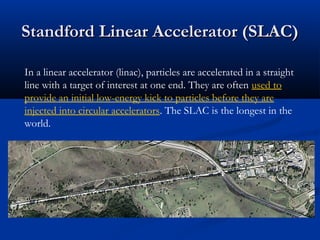
Standford Linear Accelerator (SLAC)Standford Linear Accelerator (SLAC)
In a linear accelerator (linac), particles are accelerated in a straight
line with a target of interest at one end. They are often used to
provide an initial low-energy kick to particles before they are
injected into circular accelerators. The SLAC is the longest in the
world.
IV. ExperimentsIV. Experiments
Cloud chambers are used for detecting particlesCloud chambers are used for detecting particles
ofof ionizing radiationionizing radiation. In its most basic form, a. In its most basic form, a
cloud chamber is a sealed environmentcloud chamber is a sealed environment
containing acontaining a supersaturatedsupersaturated vapor of water orvapor of water or
alcoholalcohol..
Need: Isopropyl alcohol (91-100%), blackNeed: Isopropyl alcohol (91-100%), black
construction paper, Petri dish, scissors, stickyconstruction paper, Petri dish, scissors, sticky
backed felt strip, flashlight, gloves, dry ice and abacked felt strip, flashlight, gloves, dry ice and a
radiation source.radiation source.
How Cloud Chambers WorkHow Cloud Chambers Work
When anWhen an alphaalpha oror beta particlebeta particle interacts with theinteracts with the
mixture,mixture, it ionizes it.it ionizes it. A mist will form aroundA mist will form around
the resultingthe resulting ionsions (because of condensation).(because of condensation).
The high energies of alpha and beta particlesThe high energies of alpha and beta particles
mean thatmean that a trail is lefta trail is left, due to many ions being, due to many ions being
produced along the path of the charged particle.produced along the path of the charged particle.
These tracks haveThese tracks have distinctive shapesdistinctive shapes (for(for
example, an alpha particle's track is broad andexample, an alpha particle's track is broad and
shows more evidence of deflection by collisions,shows more evidence of deflection by collisions,
while an electron's is thinner and straight.).while an electron's is thinner and straight.).
Making the Cloud ChamberMaking the Cloud Chamber
Procedure:Procedure:
1.1. Cut and fit construction paper to bottom of PetriCut and fit construction paper to bottom of Petri
dish.dish.
2.2. Adhere felt to inside edge of Petri dish. Soak felt withAdhere felt to inside edge of Petri dish. Soak felt with
alcohol (it’s ok to get some on the paper). Placealcohol (it’s ok to get some on the paper). Place
radiation source in dish and close. Warm dishradiation source in dish and close. Warm dish
between both hands for a minute.between both hands for a minute.
3.3. Place dish on top of dry ice. Turn off lights and shinePlace dish on top of dry ice. Turn off lights and shine
a flashlight across the top of the dish.a flashlight across the top of the dish.
4.4. Observe the trails!Observe the trails!
Results of Cloud ChamberResults of Cloud Chamber
Notice the trails. As the dry ice cools the air, theNotice the trails. As the dry ice cools the air, the
air can’t hold as much alcohol vapor. As theair can’t hold as much alcohol vapor. As the
radiation source decays, sends charged particlesradiation source decays, sends charged particles
through the air.through the air.
Those particles rip electrons from the molecules inThose particles rip electrons from the molecules in
the air, leaving a trail of ions (cations).the air, leaving a trail of ions (cations). This givesThis gives
the alcohol vapor a place to condensethe alcohol vapor a place to condense..
So we are seeing clouds of alcohol forming on theSo we are seeing clouds of alcohol forming on the
ion trails that are left as the particles shoot by.ion trails that are left as the particles shoot by.
ElectroscopesElectroscopes
AnAn electroscopeelectroscope is a scientific measuringis a scientific measuring
instrument thatinstrument that detects the presence of andetects the presence of an
electrical chargeelectrical charge..
Since like charges (either both negative or bothSince like charges (either both negative or both
positive) repel, thepositive) repel, the flaps on the end will moveflaps on the end will move
away from each other.away from each other.
Need:Need: Piece of copper wire (8”), tape, top of
plastic container, glass jar, aluminum foil,
scissors and a straw (cut to 2 or 3 in.).
Making an ElectroscopeMaking an Electroscope
Procedure:Procedure:
1.1. Cut a hole in the top of the plastic lid so that the strawCut a hole in the top of the plastic lid so that the straw
can fit through halfway. Secure with glue or tape.can fit through halfway. Secure with glue or tape.
2.2. Coil one end of the copper wire so that it looks like aCoil one end of the copper wire so that it looks like a
flat spiral. Insert straight end into straw halfway andflat spiral. Insert straight end into straw halfway and
bend to keep it from going all the way down.bend to keep it from going all the way down.
3.3. Cut two ½” by 1” strips of aluminum foil. Place a smallCut two ½” by 1” strips of aluminum foil. Place a small
hole towards top of strip. Make a small J-hook onhole towards top of strip. Make a small J-hook on
straight end of copper wire and place strips on thestraight end of copper wire and place strips on the
hook.hook.
4.4. Tape plastic lid with all of its parts on top of jar.Tape plastic lid with all of its parts on top of jar.
5.5. Place a static source next to coiled wire and observe!Place a static source next to coiled wire and observe!
Results of ElectroscopeResults of Electroscope
Notice that the pieces of aluminum foil moveNotice that the pieces of aluminum foil move
apart. That is because the statically charged itemapart. That is because the statically charged item
has excess electrons. When placed next to thehas excess electrons. When placed next to the
wire, thewire, the electrons in the wire move away to theelectrons in the wire move away to the
other end of the wireother end of the wire..
Those extra electrons go to both pieces ofThose extra electrons go to both pieces of
aluminum…but sincealuminum…but since they both becomethey both become
negatively charged, they repel each othernegatively charged, they repel each other!!
V. RadonV. Radon
RadonRadon is a naturally occurring gas that is emittedis a naturally occurring gas that is emitted
as uranium breaks down in the soil. It isas uranium breaks down in the soil. It is
odorless, colorless and tastelessodorless, colorless and tasteless. Everyone in the. Everyone in the
United States has some level of radon gas inUnited States has some level of radon gas in
their home. There is a very low level of radontheir home. There is a very low level of radon
even in the outside air that we breathe.even in the outside air that we breathe.
Any homeowner can simply and easily test forAny homeowner can simply and easily test for
radon gas in their home by buying a kit online.radon gas in their home by buying a kit online.
Radon TestsRadon Tests
People may purchase test kits that give themPeople may purchase test kits that give them
instructions on where to place the test, under whatinstructions on where to place the test, under what
conditions to test and how to get the results. Ifconditions to test and how to get the results. If
this is the first time a person is testing their home,this is the first time a person is testing their home,
a short-term test is a good starting point toa short-term test is a good starting point to
determine their radon level. The test lasts 2-7 days.determine their radon level. The test lasts 2-7 days.
If a home has been tested before and there is aIf a home has been tested before and there is a
desire to know year round averages, a long-termdesire to know year round averages, a long-term
test may benefit them. These tests last 91 days totest may benefit them. These tests last 91 days to
one year.one year.
Harm of RadonHarm of Radon
The EPA has determined radon gas to be theThe EPA has determined radon gas to be the
second leading cause of lung cancersecond leading cause of lung cancer in thein the
U.S. (after the act of smoking).U.S. (after the act of smoking).
Any house testing at or overAny house testing at or over
4 picocuries (pCi) per liter needs to be fixed4 picocuries (pCi) per liter needs to be fixed
per EPA recommendations.per EPA recommendations.
Radon in BuildingsRadon in Buildings
 Because radon is a gas, changes in the atmospheric pressureBecause radon is a gas, changes in the atmospheric pressure
also affect its release and its accumulation indoors.also affect its release and its accumulation indoors.
 Concrete floors and walls in the basement slow down theConcrete floors and walls in the basement slow down the
movement of radon from the soil into buildings. However,movement of radon from the soil into buildings. However,
cracks in the floor, wall slab joints, and the drainage systemcracks in the floor, wall slab joints, and the drainage system
allow radon to enter a buildingallow radon to enter a building. Sealing these areas solves the. Sealing these areas solves the
problem.problem.
 Indoor radon concentrations areIndoor radon concentrations are almost alwaysalmost always higher thanhigher than
outdoor concentrationsoutdoor concentrations. Once inside a building, the radon. Once inside a building, the radon
cannot easily escape. The sealing of buildings to conservecannot easily escape. The sealing of buildings to conserve
energy reduces the intake of outside air and worsens theenergy reduces the intake of outside air and worsens the
situation. Radon levels aresituation. Radon levels are generally highest in cellars andgenerally highest in cellars and
basementsbasements because these areas are nearest to the source andbecause these areas are nearest to the source and
are usually poorly ventilated. Ventilation can help with this.are usually poorly ventilated. Ventilation can help with this.
VI. Nuclear PowerVI. Nuclear Power
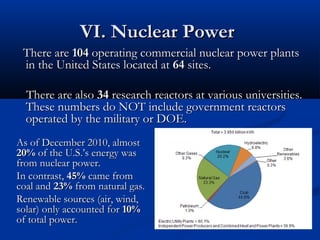
There areThere are 104104 operating commercial nuclear power plantsoperating commercial nuclear power plants
in the United States located atin the United States located at 6464 sites.sites.
There are alsoThere are also 3434 research reactors at various universities.research reactors at various universities.
These numbers do NOT include government reactorsThese numbers do NOT include government reactors
operated by the military or DOE.operated by the military or DOE.
As of December 2010, almostAs of December 2010, almost
20%20% of the U.S.’s energy wasof the U.S.’s energy was
from nuclear power.from nuclear power.
In contrast,In contrast, 45%45% came fromcame from
coal andcoal and 23%23% from natural gas.from natural gas.
Renewable sources (air, wind,Renewable sources (air, wind,
solar) only accounted forsolar) only accounted for 10%10%
of total power.of total power.
Nuclear Power in FloridaNuclear Power in Florida
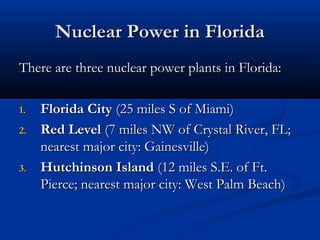
There are three nuclear power plants in Florida:There are three nuclear power plants in Florida:
1.1. Florida CityFlorida City (25 miles S of Miami)(25 miles S of Miami)
2.2. Red LevelRed Level (7 miles NW of Crystal River, FL;(7 miles NW of Crystal River, FL;
nearest major city: Gainesville)nearest major city: Gainesville)
3.3. Hutchinson IslandHutchinson Island (12 miles S.E. of Ft.(12 miles S.E. of Ft.
Pierce; nearest major city: West Palm Beach)Pierce; nearest major city: West Palm Beach)
VII. Uses for Radioactive MaterialsVII. Uses for Radioactive Materials
Radioactive materials are used in many applications suchRadioactive materials are used in many applications such
as nuclear medicine, environmental applications,as nuclear medicine, environmental applications,
industrial applications, space exploration, and radiationindustrial applications, space exploration, and radiation
therapy.therapy.
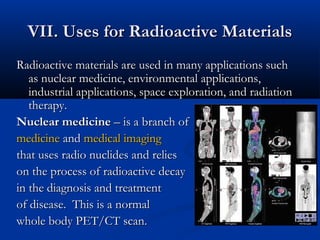
Nuclear medicineNuclear medicine – is a branch of– is a branch of
medicinemedicine andand medical imagingmedical imaging
that uses radio nuclides and reliesthat uses radio nuclides and relies
on the process of radioactive decayon the process of radioactive decay
in the diagnosis and treatmentin the diagnosis and treatment
of disease. This is a nof disease. This is a normalormal
whole body PET/CT scan.whole body PET/CT scan.
Environmental ApplicationsEnvironmental Applications
Environmental applications – Nuclear energyEnvironmental applications – Nuclear energy
holds a considerable environmental advantage: itholds a considerable environmental advantage: it
permits the production of very significantpermits the production of very significant
quantities of energyquantities of energy,, without atmosphericwithout atmospheric
discharges and without emission of greenhousedischarges and without emission of greenhouse
gasesgases..
Nuclear energy and the renewable energiesNuclear energy and the renewable energies
therefore have a major role to play in futuretherefore have a major role to play in future
years if we want to meet the obligations like theyears if we want to meet the obligations like the
Kyoto summit, which is a reduction of 5.2% inKyoto summit, which is a reduction of 5.2% in
greenhouse gases by the year 2010.greenhouse gases by the year 2010.
Industrial ApplicationsIndustrial Applications
Practically every industry uses radiation in somePractically every industry uses radiation in some
way.way.
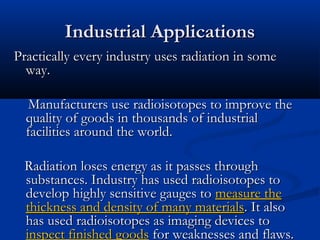
Manufacturers use radioisotopes to improve theManufacturers use radioisotopes to improve the
quality of goods in thousands of industrialquality of goods in thousands of industrial
facilities around the world.facilities around the world.
Radiation loses energy as it passes throughRadiation loses energy as it passes through
substances. Industry has used radioisotopes tosubstances. Industry has used radioisotopes to
develop highly sensitive gauges todevelop highly sensitive gauges to measure themeasure the
thickness and density of many materialsthickness and density of many materials. It also. It also
has used radioisotopes as imaging devices tohas used radioisotopes as imaging devices to
inspect finished goodsinspect finished goods for weaknesses and flaws.for weaknesses and flaws.
Industrial UsesIndustrial Uses
Industries that use radioactive materials include:Industries that use radioactive materials include:
 the automobile industry: to test steel quality inthe automobile industry: to test steel quality in
cars and obtain the proper thickness in metals.cars and obtain the proper thickness in metals.
 aircraft manufacturers: to check for flaws in jetaircraft manufacturers: to check for flaws in jet
enginesengines
 mining and petroleum companies: to locate andmining and petroleum companies: to locate and
quantify oil, natural gas and mineral depositsquantify oil, natural gas and mineral deposits
 pipeline companies: to look for defects in weldspipeline companies: to look for defects in welds
 construction crews: to gauge the density of roadconstruction crews: to gauge the density of road
surfaces and subsurfaces.surfaces and subsurfaces.
Space ExplorationSpace Exploration
The radiation environment in space differs significantlyThe radiation environment in space differs significantly
from the types of radiation on Earth. Unlike gamma rays,from the types of radiation on Earth. Unlike gamma rays,
x-rays, and other terrestrial forms of radiation,x-rays, and other terrestrial forms of radiation, spacespace
radiation contains high-energy particles that can causeradiation contains high-energy particles that can cause
fundamental cellular changes in any matter it encounters,fundamental cellular changes in any matter it encounters,
including human tissue and organs.including human tissue and organs.
As a result, space radiationAs a result, space radiation poses a number of significantposes a number of significant
health and safety riskshealth and safety risks for crewmembers in the spacefor crewmembers in the space
environment, including the possibility of cancer, visualenvironment, including the possibility of cancer, visual
disorders, radiation sickness, and hereditary effects.disorders, radiation sickness, and hereditary effects.
NASA scientists in theNASA scientists in the Space Radiation Program ElementSpace Radiation Program Element areare
working to study the impact of long-term exposure toworking to study the impact of long-term exposure to
space radiation and to develop countermeasures.space radiation and to develop countermeasures.
Radiation Therapy (XRT)Radiation Therapy (XRT)
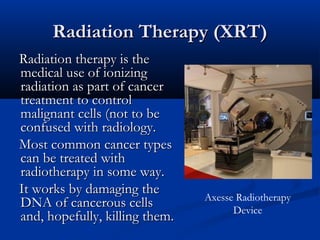
Radiation therapy is theRadiation therapy is the
medical use of ionizingmedical use of ionizing
radiation as part of cancerradiation as part of cancer
treatment to controltreatment to control
malignant cells (not to bemalignant cells (not to be
confused with radiology.confused with radiology.
Most common cancer typesMost common cancer types
can be treated withcan be treated with
radiotherapy in some way.radiotherapy in some way.
It works by damaging theIt works by damaging the
DNA of cancerous cellsDNA of cancerous cells
and, hopefully, killing them.and, hopefully, killing them.
Axesse Radiotherapy
Device
VIII. Careers in Nuclear ScienceVIII. Careers in Nuclear Science
There are hundreds of careers that involve nuclearThere are hundreds of careers that involve nuclear
science.science. Power generationPower generation,, medicinemedicine,, agricultureagriculture
and the food industryand the food industry,, mineral and nuclear gasmineral and nuclear gas
explorationexploration, nuclear, nuclear fuel manufacturingfuel manufacturing, working, working
forfor regulatory agenciesregulatory agencies,, designing reactorsdesigning reactors andand
power sources, working forpower sources, working for labslabs that use nuclearthat use nuclear
technology and other fields such astechnology and other fields such as carboncarbon
dating in archaeology, art authentication, anddating in archaeology, art authentication, and
forensic analysis.forensic analysis.
Nuclear Safety AnalystNuclear Safety Analyst
Needs DSA (Needs DSA (Safety Analysis) trainingSafety Analysis) training and supportingand supporting
analysis development for DOE facilities. Perform oneanalysis development for DOE facilities. Perform one
or more of the following:or more of the following: DSA writing, TSR writing,DSA writing, TSR writing,
accident analysis, hazards analysis, dispersion modeling,accident analysis, hazards analysis, dispersion modeling,
or chemical hazards analysis.or chemical hazards analysis.
Qualified candidate would haveQualified candidate would have 10+ years10+ years of nuclearof nuclear
experience,experience, 2+ years of DOE safety analysis2+ years of DOE safety analysis experience,experience,
and aand a bachelors degree or higherbachelors degree or higher. Advance degrees. Advance degrees
count towards the years of nuclear experience.count towards the years of nuclear experience.
Pay:Pay: Over $100,000/yr. plus benefitsOver $100,000/yr. plus benefits..
SENIOR NUCLEAR QUALITYSENIOR NUCLEAR QUALITY
ASSURANCE ENGINEERASSURANCE ENGINEER
Reviews Nuclear Project detailed schedules and WorkReviews Nuclear Project detailed schedules and Work
Breakdown Structures in order to identify activities thatBreakdown Structures in order to identify activities that
affect nuclear in order toaffect nuclear in order to develop a Nuclear Projectdevelop a Nuclear Project
Quality Assurance PlanQuality Assurance Plan for the subject Project thatfor the subject Project that
includes activities such as surveillances, reviews, andincludes activities such as surveillances, reviews, and
audits as a means ofaudits as a means of independently verifyingindependently verifying the Projectthe Project
meets Quality Assurance requirements.meets Quality Assurance requirements.
Candidate would have 5Candidate would have 5+ years+ years of nuclear experience, noof nuclear experience, no
security clearance and asecurity clearance and a bachelors degree or higherbachelors degree or higher..
Pay:Pay: Over $100,000/yr. plus benefits.Over $100,000/yr. plus benefits.
IT Analyst/Cyber SecurityIT Analyst/Cyber Security
Responsible forResponsible for developing and implementing cyberdeveloping and implementing cyber
security controlssecurity controls. Supports safe, reliable and. Supports safe, reliable and
economical operation of nuclear power stations.economical operation of nuclear power stations.
Qualified candidate would have Bachelor's degree inQualified candidate would have Bachelor's degree in
Information Technology, Computer Science, orInformation Technology, Computer Science, or
related discipline and 4+ years in the Nuclear Powerrelated discipline and 4+ years in the Nuclear Power
IT/Engineering field.IT/Engineering field.
Pay:Pay: Over $100,000/yr. plus benefitsOver $100,000/yr. plus benefits..
Which career interests YOU???Which career interests YOU???

Nuclear Science Merit Badge

  • 1.
    Nuclear ScienceNuclear Science MeritBadgeMerit Badge Presented by Dr. DeDeoPresented by Dr. DeDeo ““The only reason for time is so thatThe only reason for time is so that everything doesn't happen at once." everything doesn't happen at once."  Albert EinsteinAlbert Einstein
  • 2.
    I. RadiationI. Radiation Radiationdescribes a process in whichRadiation describes a process in which energeticenergetic particles orparticles or waveswaves go through a medium or space.go through a medium or space. There are two distinct types of radiation:There are two distinct types of radiation: ionizingionizing andand non-ionizingnon-ionizing.. The wordThe word radiationradiation is commonly used in reference tois commonly used in reference to ionizing radiationionizing radiation only,only, (i.e. having sufficient energy to ionize an atom =(i.e. having sufficient energy to ionize an atom = remove electrons), but it may also refer to non-remove electrons), but it may also refer to non- ionizing radiation (e.g.,ionizing radiation (e.g., radio wavesradio waves oror lightlight).).
  • 3.
    Exposure vs. ContaminationExposurevs. Contamination It is important to note thatIt is important to note that exposure toexposure to radiationradiation does not necessarilydoes not necessarily result inresult in contamination.contamination. Let’s look at the definitions and theLet’s look at the definitions and the differences between the them.differences between the them.
  • 4.
    Both ionizing andnon-ionizing radiation can beBoth ionizing and non-ionizing radiation can be harmful toharmful to organismsorganisms and can result in changesand can result in changes to theto the natural environmentnatural environment.. This figure shows the relative abilities of three different types ofThis figure shows the relative abilities of three different types of ionizing radiationionizing radiation to penetrate solid matter.to penetrate solid matter. Alpha particles (α) are stopped by a sheet of paper whileAlpha particles (α) are stopped by a sheet of paper while Beta particles (β) are stopped by an aluminum plate.Beta particles (β) are stopped by an aluminum plate. Gamma radiation (γ) is dampened when it penetrates matter.Gamma radiation (γ) is dampened when it penetrates matter.
  • 5.
    Radiation ExposureRadiation Exposure Peoplecan be exposed throughPeople can be exposed through nuclear power,nuclear power, medical radiation, mining and backgroundmedical radiation, mining and background radiationradiation including radon.including radon. For most, the riskiest exposure is fromFor most, the riskiest exposure is from X-rayX-ray and other medical testsand other medical tests. These tests usually use. These tests usually use very, very low doses.very, very low doses. Radon exposure for humans is commonly fromRadon exposure for humans is commonly from basements in areas where radon is present. Tobasements in areas where radon is present. To alleviate the risk, radon testing in homes withalleviate the risk, radon testing in homes with basements is highly recommended.basements is highly recommended.
  • 6.
    EnvironmentEnvironment Background radiationBackground radiationisis radiationradiation that is constantlythat is constantly present in the environment and is emitted from a varietypresent in the environment and is emitted from a variety of natural and artificial sources.of natural and artificial sources. Primary contributions come from:Primary contributions come from:  Sources in theSources in the earthearth. Includes sources in food and water,. Includes sources in food and water, which are incorporated in the body, and in buildingwhich are incorporated in the body, and in building materials and products that use radioactive sources;materials and products that use radioactive sources;  Sources fromSources from spacespace, in the form of, in the form of cosmic rayscosmic rays;;  Sources in the atmosphere.Sources in the atmosphere. RadonRadon gas that is releasedgas that is released from the Earth's crust and subsequently decays intofrom the Earth's crust and subsequently decays into radioactive atoms that become attached to airborne dust.radioactive atoms that become attached to airborne dust.
  • 7.
    Exposure to RadiationExposureto Radiation High radiation doses tend to kill cells, while low,High radiation doses tend to kill cells, while low, long term doses tend tolong term doses tend to damage or alter thedamage or alter the genetic code (DNA) of irradiated cellsgenetic code (DNA) of irradiated cells.. Low, long-term exposure is rare. For example,Low, long-term exposure is rare. For example, people, environment and wildlife can also bepeople, environment and wildlife can also be affected byaffected by long-term mining and the use oflong-term mining and the use of nuclear materials at a long-term facilitynuclear materials at a long-term facility..
  • 8.
    High Dose ExposureHighDose Exposure Radiation poisoningRadiation poisoning,, radiation sicknessradiation sickness or aor a creeping dosecreeping dose, is a form of damage to organ, is a form of damage to organ tissue caused by excessive exposure totissue caused by excessive exposure to ionizing radiationionizing radiation. The term is generally used to. The term is generally used to refer torefer to acuteacute problems caused by a large dosageproblems caused by a large dosage ofof radiationradiation in a short period, though this alsoin a short period, though this also has occurred with long term exposure.has occurred with long term exposure. The clinical name for radiation sickness isThe clinical name for radiation sickness is acuteacute radiation syndromeradiation syndrome ((ARSARS).).
  • 9.
    Mining produces thegreatest risks to peopleMining produces the greatest risks to people and the environment byand the environment by::  contamination ofcontamination of ground water and river systemsground water and river systems with radioactive materials as well as heavy metals,with radioactive materials as well as heavy metals, acids, etc.acids, etc.  leaks, spills, and catastrophic failuresleaks, spills, and catastrophic failures of pipelines;of pipelines;  the spreading ofthe spreading of radioactive dustradioactive dust, which finds its, which finds its way into water, plants, animals, fish and humans;way into water, plants, animals, fish and humans;  releases ofreleases of radon gas into the airradon gas into the air, which will, which will deposit radioactive fall-out for hundreds of miles.deposit radioactive fall-out for hundreds of miles. Low Dose ExposureLow Dose Exposure
  • 10.
    Results of ExposureResultsof Exposure The associations between radiation contaminationThe associations between radiation contamination and the development of cancer are mostly basedand the development of cancer are mostly based on populations exposed to relatively high levelson populations exposed to relatively high levels of ionizing radiation (e.g., Japanese atomic bombof ionizing radiation (e.g., Japanese atomic bomb survivors, and recipients of selected diagnosticsurvivors, and recipients of selected diagnostic or therapeutic medical procedures).or therapeutic medical procedures). To avoid exposureTo avoid exposure,, a safety principle known as ALARA was defined.a safety principle known as ALARA was defined.
  • 11.
    ALARAALARA ALARA stands forALARAstands for AAss LLowow AAss RReasonablyeasonably AAchievable.chievable.  The ALARA concept is an integral part of all activities thatThe ALARA concept is an integral part of all activities that involve the use of radiation or radioactive materials. Thisinvolve the use of radiation or radioactive materials. This includes the design, construction and operations ofincludes the design, construction and operations of facilities. This concept includes reducing both internal andfacilities. This concept includes reducing both internal and external exposure to ionizing radiation.external exposure to ionizing radiation. A CLOSER LOOK - What is "reasonable" ?A CLOSER LOOK - What is "reasonable" ? The ALARA concept grows out of the assumption thatThe ALARA concept grows out of the assumption that any radiation exposure carries with it some risk. Since workany radiation exposure carries with it some risk. Since work that involves exposure is sometimes part of somethat involves exposure is sometimes part of some beneficial endeavor, the ALARA effort tries to balance thebeneficial endeavor, the ALARA effort tries to balance the assumed risks of radiation exposure against the benefit ofassumed risks of radiation exposure against the benefit of performing the work. So "reasonable" means that the riskperforming the work. So "reasonable" means that the risk from receiving the exposure is "worth" the benefit.from receiving the exposure is "worth" the benefit.
  • 12.
    Three Principles ofALARAThree Principles of ALARA To minimize exposure, ALARA recommends: 1) TIME – minimizing the time of exposure directly reduces radiation dose. 2) DISTANCE – doubling the distance between your body and the radiation source will divide the radiation exposure by a factor of 4 (inverse square law) 3) SHIELDING - using absorber materials such as Plexiglas for beta particles and lead for X-rays and gamma rays is an effective way to reduce exposure.
  • 13.
    II. Definitions ofNuclear ParticlesII. Definitions of Nuclear Particles AtomAtom – a basic unit of– a basic unit of mattermatter that consists of a dense,that consists of a dense, centralcentral nucleusnucleus surrounded bysurrounded by aa cloudcloud ofof negatively chargednegatively charged electronselectrons NucleusNucleus - the very dense- the very dense region consisting ofregion consisting of nucleonsnucleons (( protonsprotons andand neutronsneutrons) at the) at the center of ancenter of an atomatom 1 Angstrom = 10-10 m = 100 pm (picometers)
  • 14.
    Parts of anAtomParts of an Atom ProtonProton - a- a subatomic particlesubatomic particle with anwith an electric chargeelectric charge of +1of +1 elementary chargeelementary charge NeutronNeutron - a- a subatomic particlesubatomic particle with no netwith no net electric chargeelectric charge and aand a massmass slightly larger thanslightly larger than that of athat of a protonproton ElectronElectron - a- a subatomic particlesubatomic particle carrying acarrying a negativenegative electric chargeelectric charge of -1 elementary charge.of -1 elementary charge. It has no known components or substructureIt has no known components or substructure
  • 15.
    QuarksQuarks QuarkQuark –– anan elementaryparticleelementary particle and fundamentaland fundamental constituent ofconstituent of mattermatter.. Quarks combine to formQuarks combine to form composite particlescomposite particles calledcalled hadronshadrons, the most, the most stable of which arestable of which are protonsprotons andand neutronsneutrons.. A proton, composed of one up quark and two down quarks. The connections between them are called gluons! A neutron, composed of two up quarks and one down quark.
  • 16.
    IsotopesIsotopes IsotopesIsotopes - areatoms that contain the same- are atoms that contain the same number ofnumber of protonsprotons but a different number ofbut a different number of neutronsneutrons.. The number ofThe number of protonsprotons (the(the atomic numberatomic number) is) is thethe samesame for each isotope, e.g.for each isotope, e.g. carbon-12carbon-12,, carbon-13carbon-13 andand carbon-14carbon-14 each have 6 protons,each have 6 protons, but the number of neutrons in each differs.but the number of neutrons in each differs. This makes the total ofThis makes the total of nucleonsnucleons (protons and(protons and neutrons) in theneutrons) in the nucleusnucleus, known as the, known as the mass numbermass number differentdifferent, as well as the, as well as the
  • 17.
    ParticlesParticles alpha (α) particlesalpha(α) particles - consist of two- consist of two protonsprotons and twoand two neutronsneutrons boundbound together into a particle identical to atogether into a particle identical to a heliumhelium nucleusnucleus, which is produced in the, which is produced in the process ofprocess of alpha decayalpha decay beta particles (β)beta particles (β) - are high-energy, high-- are high-energy, high- speedspeed electronselectrons oror positronspositrons emitted byemitted by certain types ofcertain types of radioactiveradioactive nucleinuclei such assuch as potassium-40potassium-40. The beta particles emitted. The beta particles emitted are a form ofare a form of ionizing radiationionizing radiation alsoalso known as beta rays.known as beta rays.
  • 18.
    RaysRays gamma rays (γ)gammarays (γ) -- electromagnetic radiationelectromagnetic radiation of highof high frequency (very short wavelength).frequency (very short wavelength). They are produced byThey are produced by sub-atomicsub-atomic particle interactions and areparticle interactions and are emitted by the nucleus.emitted by the nucleus. X-rayX-ray - A relatively high-energy- A relatively high-energy photon. They are emitted byphoton. They are emitted by electrons outside of the nucleus.electrons outside of the nucleus. The remnant of " Tycho's Supernova", a huge ball of expanding plasma. The outer shell shown in blue is X-ray emission by high-speed electrons.
  • 19.
    Other DefinitionsOther Definitions IonizationIonization- the process of converting an- the process of converting an atomatom oror moleculemolecule into aninto an ionion by adding or removingby adding or removing charged particles such ascharged particles such as electronselectrons or other ionsor other ions Radioactivity (radioactive decay)Radioactivity (radioactive decay) – the process– the process by which anby which an atomic nucleusatomic nucleus of an unstable atomof an unstable atom loses energy by emitting ionizing particles.loses energy by emitting ionizing particles. RadioisotopeRadioisotope - Unstable elements that release- Unstable elements that release radiationradiation as it breaks down. Radioisotopes canas it breaks down. Radioisotopes can be used inbe used in imagingimaging tests or as a treatment fortests or as a treatment for cancercancer, e.g., in, e.g., in brachytherapybrachytherapy..
  • 20.
    Creation of ThreeIsotopesCreation of Three Isotopes Hydrogen Cation -> Hydrogen -> Hydrogen AnionHydrogen Cation -> Hydrogen -> Hydrogen Anion (-1 electron) (neutral) (+1 electron)(-1 electron) (neutral) (+1 electron) CREATE THESE TWO IONS PLUS one of your choice.CREATE THESE TWO IONS PLUS one of your choice.
  • 21.
    III. Particle AcceleratorsIII.Particle Accelerators AA particle acceleratorparticle accelerator is a device that usesis a device that uses electromagnetic fieldselectromagnetic fields to propelto propel chargedcharged particlesparticles toto high speeds and to contain them in beams.high speeds and to contain them in beams. AnAn ordinaryordinary CRTCRT television set is a simple form of accelerator.television set is a simple form of accelerator. There are two basic types:There are two basic types: electrostatic and oscillating field accelerators.electrostatic and oscillating field accelerators. In the early 20th century, theseIn the early 20th century, these cyclotronscyclotrons werewere commonly referred to ascommonly referred to as atom smashersatom smashers.. Modern colliders actuallyModern colliders actually propelpropel subatomic particles.subatomic particles.
  • 22.
    Purpose of AcceleratorsPurposeof Accelerators PhysicistsPhysicists hope that they will help answer manyhope that they will help answer many of the mostof the most fundamental questionsfundamental questions in physics:in physics: questions concerning the basic laws governingquestions concerning the basic laws governing the interactions and forces among thethe interactions and forces among the elementary objectselementary objects, the deep structure of space, the deep structure of space and time, especially regarding the intersection ofand time, especially regarding the intersection of quantum mechanicsquantum mechanics andand general relativitygeneral relativity, where, where current theories and knowledge are unclear orcurrent theories and knowledge are unclear or break down altogether.break down altogether.
  • 23.
    TevatronTevatron Aerial photo ofthe Tevatron at Fermilab , which resembles a figure eight. The main accelerator is the ring above; the one below (about one-third the diameter, despite appearances) is for preliminary acceleration, beam cooling and storage, etc. The Tevatron is a circular particle accelerator in the United States, at the Fermi National Accelerator Laboratory , just east of Batavia, Illinois, and is the second highest energy particle collider in the world after the Large Hadron Collider (LHC).
  • 24.
    LHCLHC A simulated eventin the CMS detector, featuring the appearance of the Higgs boson, also known as the “God particle” which describes the interaction of quarks and gluons (the force between quarks) in hadrons. The Large Hadron Collider (LHC) is the world's largest and highest-energy particle accelerator. It is expected to address some of the most fundamental questions of physics, advancing the understanding the laws of nature. The LHC lies in a tunnel 17 mi. in circumference, as much as 574 ft. beneath the Franco-Swiss border near Geneva, Switzerland.
  • 25.
    Standford Linear Accelerator(SLAC)Standford Linear Accelerator (SLAC) In a linear accelerator (linac), particles are accelerated in a straight line with a target of interest at one end. They are often used to provide an initial low-energy kick to particles before they are injected into circular accelerators. The SLAC is the longest in the world.
  • 26.
    IV. ExperimentsIV. Experiments Cloudchambers are used for detecting particlesCloud chambers are used for detecting particles ofof ionizing radiationionizing radiation. In its most basic form, a. In its most basic form, a cloud chamber is a sealed environmentcloud chamber is a sealed environment containing acontaining a supersaturatedsupersaturated vapor of water orvapor of water or alcoholalcohol.. Need: Isopropyl alcohol (91-100%), blackNeed: Isopropyl alcohol (91-100%), black construction paper, Petri dish, scissors, stickyconstruction paper, Petri dish, scissors, sticky backed felt strip, flashlight, gloves, dry ice and abacked felt strip, flashlight, gloves, dry ice and a radiation source.radiation source.
  • 27.
    How Cloud ChambersWorkHow Cloud Chambers Work When anWhen an alphaalpha oror beta particlebeta particle interacts with theinteracts with the mixture,mixture, it ionizes it.it ionizes it. A mist will form aroundA mist will form around the resultingthe resulting ionsions (because of condensation).(because of condensation). The high energies of alpha and beta particlesThe high energies of alpha and beta particles mean thatmean that a trail is lefta trail is left, due to many ions being, due to many ions being produced along the path of the charged particle.produced along the path of the charged particle. These tracks haveThese tracks have distinctive shapesdistinctive shapes (for(for example, an alpha particle's track is broad andexample, an alpha particle's track is broad and shows more evidence of deflection by collisions,shows more evidence of deflection by collisions, while an electron's is thinner and straight.).while an electron's is thinner and straight.).
  • 28.
    Making the CloudChamberMaking the Cloud Chamber Procedure:Procedure: 1.1. Cut and fit construction paper to bottom of PetriCut and fit construction paper to bottom of Petri dish.dish. 2.2. Adhere felt to inside edge of Petri dish. Soak felt withAdhere felt to inside edge of Petri dish. Soak felt with alcohol (it’s ok to get some on the paper). Placealcohol (it’s ok to get some on the paper). Place radiation source in dish and close. Warm dishradiation source in dish and close. Warm dish between both hands for a minute.between both hands for a minute. 3.3. Place dish on top of dry ice. Turn off lights and shinePlace dish on top of dry ice. Turn off lights and shine a flashlight across the top of the dish.a flashlight across the top of the dish. 4.4. Observe the trails!Observe the trails!
  • 29.
    Results of CloudChamberResults of Cloud Chamber Notice the trails. As the dry ice cools the air, theNotice the trails. As the dry ice cools the air, the air can’t hold as much alcohol vapor. As theair can’t hold as much alcohol vapor. As the radiation source decays, sends charged particlesradiation source decays, sends charged particles through the air.through the air. Those particles rip electrons from the molecules inThose particles rip electrons from the molecules in the air, leaving a trail of ions (cations).the air, leaving a trail of ions (cations). This givesThis gives the alcohol vapor a place to condensethe alcohol vapor a place to condense.. So we are seeing clouds of alcohol forming on theSo we are seeing clouds of alcohol forming on the ion trails that are left as the particles shoot by.ion trails that are left as the particles shoot by.
  • 30.
    ElectroscopesElectroscopes AnAn electroscopeelectroscope isa scientific measuringis a scientific measuring instrument thatinstrument that detects the presence of andetects the presence of an electrical chargeelectrical charge.. Since like charges (either both negative or bothSince like charges (either both negative or both positive) repel, thepositive) repel, the flaps on the end will moveflaps on the end will move away from each other.away from each other. Need:Need: Piece of copper wire (8”), tape, top of plastic container, glass jar, aluminum foil, scissors and a straw (cut to 2 or 3 in.).
  • 31.
    Making an ElectroscopeMakingan Electroscope Procedure:Procedure: 1.1. Cut a hole in the top of the plastic lid so that the strawCut a hole in the top of the plastic lid so that the straw can fit through halfway. Secure with glue or tape.can fit through halfway. Secure with glue or tape. 2.2. Coil one end of the copper wire so that it looks like aCoil one end of the copper wire so that it looks like a flat spiral. Insert straight end into straw halfway andflat spiral. Insert straight end into straw halfway and bend to keep it from going all the way down.bend to keep it from going all the way down. 3.3. Cut two ½” by 1” strips of aluminum foil. Place a smallCut two ½” by 1” strips of aluminum foil. Place a small hole towards top of strip. Make a small J-hook onhole towards top of strip. Make a small J-hook on straight end of copper wire and place strips on thestraight end of copper wire and place strips on the hook.hook. 4.4. Tape plastic lid with all of its parts on top of jar.Tape plastic lid with all of its parts on top of jar. 5.5. Place a static source next to coiled wire and observe!Place a static source next to coiled wire and observe!
  • 32.
    Results of ElectroscopeResultsof Electroscope Notice that the pieces of aluminum foil moveNotice that the pieces of aluminum foil move apart. That is because the statically charged itemapart. That is because the statically charged item has excess electrons. When placed next to thehas excess electrons. When placed next to the wire, thewire, the electrons in the wire move away to theelectrons in the wire move away to the other end of the wireother end of the wire.. Those extra electrons go to both pieces ofThose extra electrons go to both pieces of aluminum…but sincealuminum…but since they both becomethey both become negatively charged, they repel each othernegatively charged, they repel each other!!
  • 33.
    V. RadonV. Radon RadonRadonis a naturally occurring gas that is emittedis a naturally occurring gas that is emitted as uranium breaks down in the soil. It isas uranium breaks down in the soil. It is odorless, colorless and tastelessodorless, colorless and tasteless. Everyone in the. Everyone in the United States has some level of radon gas inUnited States has some level of radon gas in their home. There is a very low level of radontheir home. There is a very low level of radon even in the outside air that we breathe.even in the outside air that we breathe. Any homeowner can simply and easily test forAny homeowner can simply and easily test for radon gas in their home by buying a kit online.radon gas in their home by buying a kit online.
  • 34.
    Radon TestsRadon Tests Peoplemay purchase test kits that give themPeople may purchase test kits that give them instructions on where to place the test, under whatinstructions on where to place the test, under what conditions to test and how to get the results. Ifconditions to test and how to get the results. If this is the first time a person is testing their home,this is the first time a person is testing their home, a short-term test is a good starting point toa short-term test is a good starting point to determine their radon level. The test lasts 2-7 days.determine their radon level. The test lasts 2-7 days. If a home has been tested before and there is aIf a home has been tested before and there is a desire to know year round averages, a long-termdesire to know year round averages, a long-term test may benefit them. These tests last 91 days totest may benefit them. These tests last 91 days to one year.one year.
  • 35.
    Harm of RadonHarmof Radon The EPA has determined radon gas to be theThe EPA has determined radon gas to be the second leading cause of lung cancersecond leading cause of lung cancer in thein the U.S. (after the act of smoking).U.S. (after the act of smoking). Any house testing at or overAny house testing at or over 4 picocuries (pCi) per liter needs to be fixed4 picocuries (pCi) per liter needs to be fixed per EPA recommendations.per EPA recommendations.
  • 36.
    Radon in BuildingsRadonin Buildings  Because radon is a gas, changes in the atmospheric pressureBecause radon is a gas, changes in the atmospheric pressure also affect its release and its accumulation indoors.also affect its release and its accumulation indoors.  Concrete floors and walls in the basement slow down theConcrete floors and walls in the basement slow down the movement of radon from the soil into buildings. However,movement of radon from the soil into buildings. However, cracks in the floor, wall slab joints, and the drainage systemcracks in the floor, wall slab joints, and the drainage system allow radon to enter a buildingallow radon to enter a building. Sealing these areas solves the. Sealing these areas solves the problem.problem.  Indoor radon concentrations areIndoor radon concentrations are almost alwaysalmost always higher thanhigher than outdoor concentrationsoutdoor concentrations. Once inside a building, the radon. Once inside a building, the radon cannot easily escape. The sealing of buildings to conservecannot easily escape. The sealing of buildings to conserve energy reduces the intake of outside air and worsens theenergy reduces the intake of outside air and worsens the situation. Radon levels aresituation. Radon levels are generally highest in cellars andgenerally highest in cellars and basementsbasements because these areas are nearest to the source andbecause these areas are nearest to the source and are usually poorly ventilated. Ventilation can help with this.are usually poorly ventilated. Ventilation can help with this.
  • 37.
    VI. Nuclear PowerVI.Nuclear Power There areThere are 104104 operating commercial nuclear power plantsoperating commercial nuclear power plants in the United States located atin the United States located at 6464 sites.sites. There are alsoThere are also 3434 research reactors at various universities.research reactors at various universities. These numbers do NOT include government reactorsThese numbers do NOT include government reactors operated by the military or DOE.operated by the military or DOE. As of December 2010, almostAs of December 2010, almost 20%20% of the U.S.’s energy wasof the U.S.’s energy was from nuclear power.from nuclear power. In contrast,In contrast, 45%45% came fromcame from coal andcoal and 23%23% from natural gas.from natural gas. Renewable sources (air, wind,Renewable sources (air, wind, solar) only accounted forsolar) only accounted for 10%10% of total power.of total power.
  • 38.
    Nuclear Power inFloridaNuclear Power in Florida There are three nuclear power plants in Florida:There are three nuclear power plants in Florida: 1.1. Florida CityFlorida City (25 miles S of Miami)(25 miles S of Miami) 2.2. Red LevelRed Level (7 miles NW of Crystal River, FL;(7 miles NW of Crystal River, FL; nearest major city: Gainesville)nearest major city: Gainesville) 3.3. Hutchinson IslandHutchinson Island (12 miles S.E. of Ft.(12 miles S.E. of Ft. Pierce; nearest major city: West Palm Beach)Pierce; nearest major city: West Palm Beach)
  • 39.
    VII. Uses forRadioactive MaterialsVII. Uses for Radioactive Materials Radioactive materials are used in many applications suchRadioactive materials are used in many applications such as nuclear medicine, environmental applications,as nuclear medicine, environmental applications, industrial applications, space exploration, and radiationindustrial applications, space exploration, and radiation therapy.therapy. Nuclear medicineNuclear medicine – is a branch of– is a branch of medicinemedicine andand medical imagingmedical imaging that uses radio nuclides and reliesthat uses radio nuclides and relies on the process of radioactive decayon the process of radioactive decay in the diagnosis and treatmentin the diagnosis and treatment of disease. This is a nof disease. This is a normalormal whole body PET/CT scan.whole body PET/CT scan.
  • 40.
    Environmental ApplicationsEnvironmental Applications Environmentalapplications – Nuclear energyEnvironmental applications – Nuclear energy holds a considerable environmental advantage: itholds a considerable environmental advantage: it permits the production of very significantpermits the production of very significant quantities of energyquantities of energy,, without atmosphericwithout atmospheric discharges and without emission of greenhousedischarges and without emission of greenhouse gasesgases.. Nuclear energy and the renewable energiesNuclear energy and the renewable energies therefore have a major role to play in futuretherefore have a major role to play in future years if we want to meet the obligations like theyears if we want to meet the obligations like the Kyoto summit, which is a reduction of 5.2% inKyoto summit, which is a reduction of 5.2% in greenhouse gases by the year 2010.greenhouse gases by the year 2010.
  • 41.
    Industrial ApplicationsIndustrial Applications Practicallyevery industry uses radiation in somePractically every industry uses radiation in some way.way. Manufacturers use radioisotopes to improve theManufacturers use radioisotopes to improve the quality of goods in thousands of industrialquality of goods in thousands of industrial facilities around the world.facilities around the world. Radiation loses energy as it passes throughRadiation loses energy as it passes through substances. Industry has used radioisotopes tosubstances. Industry has used radioisotopes to develop highly sensitive gauges todevelop highly sensitive gauges to measure themeasure the thickness and density of many materialsthickness and density of many materials. It also. It also has used radioisotopes as imaging devices tohas used radioisotopes as imaging devices to inspect finished goodsinspect finished goods for weaknesses and flaws.for weaknesses and flaws.
  • 42.
    Industrial UsesIndustrial Uses Industriesthat use radioactive materials include:Industries that use radioactive materials include:  the automobile industry: to test steel quality inthe automobile industry: to test steel quality in cars and obtain the proper thickness in metals.cars and obtain the proper thickness in metals.  aircraft manufacturers: to check for flaws in jetaircraft manufacturers: to check for flaws in jet enginesengines  mining and petroleum companies: to locate andmining and petroleum companies: to locate and quantify oil, natural gas and mineral depositsquantify oil, natural gas and mineral deposits  pipeline companies: to look for defects in weldspipeline companies: to look for defects in welds  construction crews: to gauge the density of roadconstruction crews: to gauge the density of road surfaces and subsurfaces.surfaces and subsurfaces.
  • 43.
    Space ExplorationSpace Exploration Theradiation environment in space differs significantlyThe radiation environment in space differs significantly from the types of radiation on Earth. Unlike gamma rays,from the types of radiation on Earth. Unlike gamma rays, x-rays, and other terrestrial forms of radiation,x-rays, and other terrestrial forms of radiation, spacespace radiation contains high-energy particles that can causeradiation contains high-energy particles that can cause fundamental cellular changes in any matter it encounters,fundamental cellular changes in any matter it encounters, including human tissue and organs.including human tissue and organs. As a result, space radiationAs a result, space radiation poses a number of significantposes a number of significant health and safety riskshealth and safety risks for crewmembers in the spacefor crewmembers in the space environment, including the possibility of cancer, visualenvironment, including the possibility of cancer, visual disorders, radiation sickness, and hereditary effects.disorders, radiation sickness, and hereditary effects. NASA scientists in theNASA scientists in the Space Radiation Program ElementSpace Radiation Program Element areare working to study the impact of long-term exposure toworking to study the impact of long-term exposure to space radiation and to develop countermeasures.space radiation and to develop countermeasures.
  • 44.
    Radiation Therapy (XRT)RadiationTherapy (XRT) Radiation therapy is theRadiation therapy is the medical use of ionizingmedical use of ionizing radiation as part of cancerradiation as part of cancer treatment to controltreatment to control malignant cells (not to bemalignant cells (not to be confused with radiology.confused with radiology. Most common cancer typesMost common cancer types can be treated withcan be treated with radiotherapy in some way.radiotherapy in some way. It works by damaging theIt works by damaging the DNA of cancerous cellsDNA of cancerous cells and, hopefully, killing them.and, hopefully, killing them. Axesse Radiotherapy Device
  • 45.
    VIII. Careers inNuclear ScienceVIII. Careers in Nuclear Science There are hundreds of careers that involve nuclearThere are hundreds of careers that involve nuclear science.science. Power generationPower generation,, medicinemedicine,, agricultureagriculture and the food industryand the food industry,, mineral and nuclear gasmineral and nuclear gas explorationexploration, nuclear, nuclear fuel manufacturingfuel manufacturing, working, working forfor regulatory agenciesregulatory agencies,, designing reactorsdesigning reactors andand power sources, working forpower sources, working for labslabs that use nuclearthat use nuclear technology and other fields such astechnology and other fields such as carboncarbon dating in archaeology, art authentication, anddating in archaeology, art authentication, and forensic analysis.forensic analysis.
  • 46.
    Nuclear Safety AnalystNuclearSafety Analyst Needs DSA (Needs DSA (Safety Analysis) trainingSafety Analysis) training and supportingand supporting analysis development for DOE facilities. Perform oneanalysis development for DOE facilities. Perform one or more of the following:or more of the following: DSA writing, TSR writing,DSA writing, TSR writing, accident analysis, hazards analysis, dispersion modeling,accident analysis, hazards analysis, dispersion modeling, or chemical hazards analysis.or chemical hazards analysis. Qualified candidate would haveQualified candidate would have 10+ years10+ years of nuclearof nuclear experience,experience, 2+ years of DOE safety analysis2+ years of DOE safety analysis experience,experience, and aand a bachelors degree or higherbachelors degree or higher. Advance degrees. Advance degrees count towards the years of nuclear experience.count towards the years of nuclear experience. Pay:Pay: Over $100,000/yr. plus benefitsOver $100,000/yr. plus benefits..
  • 47.
    SENIOR NUCLEAR QUALITYSENIORNUCLEAR QUALITY ASSURANCE ENGINEERASSURANCE ENGINEER Reviews Nuclear Project detailed schedules and WorkReviews Nuclear Project detailed schedules and Work Breakdown Structures in order to identify activities thatBreakdown Structures in order to identify activities that affect nuclear in order toaffect nuclear in order to develop a Nuclear Projectdevelop a Nuclear Project Quality Assurance PlanQuality Assurance Plan for the subject Project thatfor the subject Project that includes activities such as surveillances, reviews, andincludes activities such as surveillances, reviews, and audits as a means ofaudits as a means of independently verifyingindependently verifying the Projectthe Project meets Quality Assurance requirements.meets Quality Assurance requirements. Candidate would have 5Candidate would have 5+ years+ years of nuclear experience, noof nuclear experience, no security clearance and asecurity clearance and a bachelors degree or higherbachelors degree or higher.. Pay:Pay: Over $100,000/yr. plus benefits.Over $100,000/yr. plus benefits.
  • 48.
    IT Analyst/Cyber SecurityITAnalyst/Cyber Security Responsible forResponsible for developing and implementing cyberdeveloping and implementing cyber security controlssecurity controls. Supports safe, reliable and. Supports safe, reliable and economical operation of nuclear power stations.economical operation of nuclear power stations. Qualified candidate would have Bachelor's degree inQualified candidate would have Bachelor's degree in Information Technology, Computer Science, orInformation Technology, Computer Science, or related discipline and 4+ years in the Nuclear Powerrelated discipline and 4+ years in the Nuclear Power IT/Engineering field.IT/Engineering field. Pay:Pay: Over $100,000/yr. plus benefitsOver $100,000/yr. plus benefits.. Which career interests YOU???Which career interests YOU???