Responses to the NTIA’s RFC on the
“Benefits, Challenges, and Potential Roles
for the Government in Fostering the
Advancement of the Internet of Things”
The NTIA plans to issue an IoT “green paper” incorporating information from these responses
Thursday, June 9, 16
Outline of Presentation
• NTIA IoT Strategy Questions
• List of 132 RFC Responders
• Response Snapshots with Links
Thursday, June 9, 16
NTIA IoT Strategy Questions
Thursday, June 9, 16
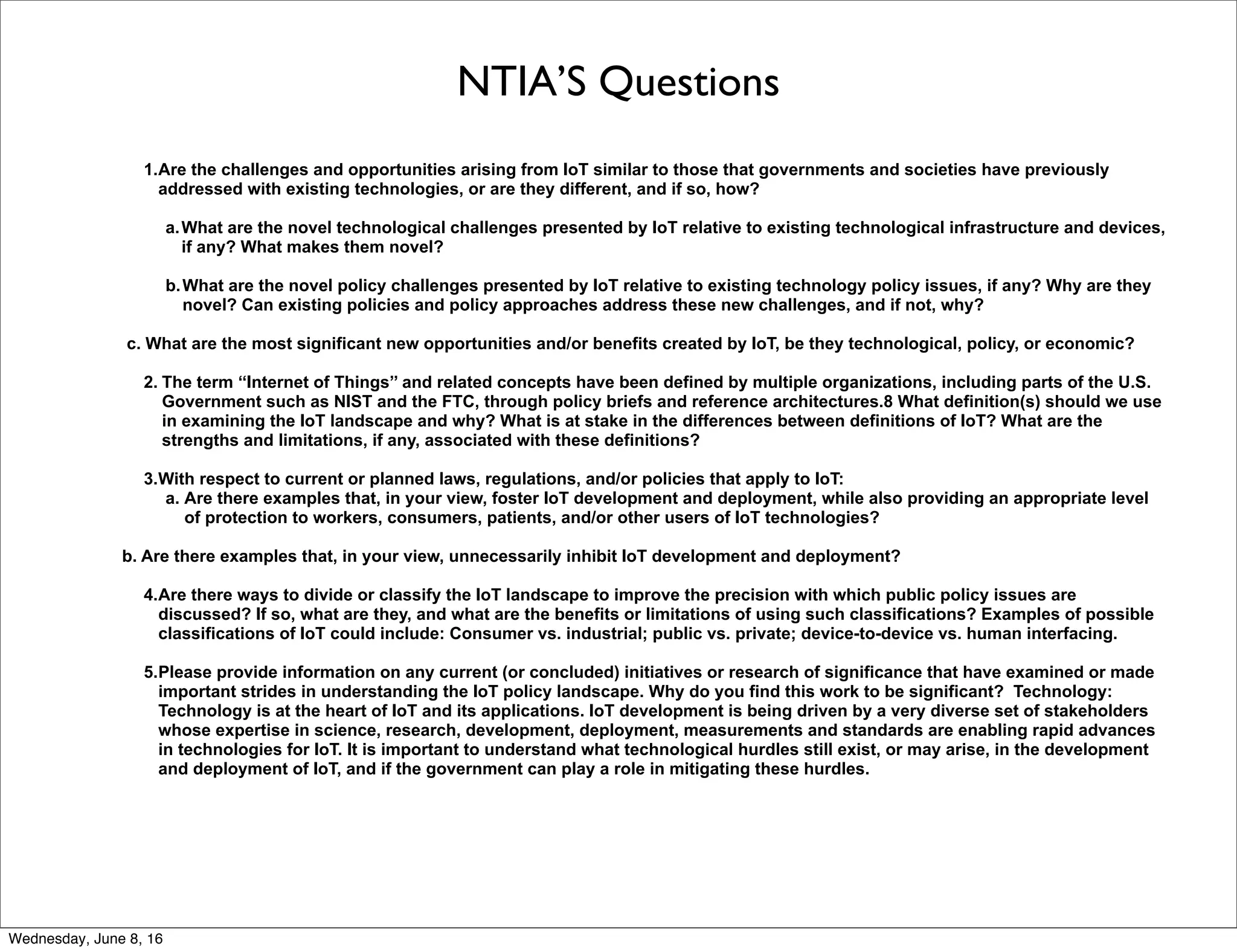
NTIA’S Questions
1.Are the challenges and opportunities arising from IoT similar to those that governments and societies have previously
addressed with existing technologies, or are they different, and if so, how?
a.What are the novel technological challenges presented by IoT relative to existing technological infrastructure and devices,
if any? What makes them novel?
b.What are the novel policy challenges presented by IoT relative to existing technology policy issues, if any? Why are they
novel? Can existing policies and policy approaches address these new challenges, and if not, why?
c. What are the most significant new opportunities and/or benefits created by IoT, be they technological, policy, or economic?
2. The term ‘‘Internet of Things’’ and related concepts have been defined by multiple organizations, including parts of the U.S.
Government such as NIST and the FTC, through policy briefs and reference architectures.8 What definition(s) should we use
in examining the IoT landscape and why? What is at stake in the differences between definitions of IoT? What are the
strengths and limitations, if any, associated with these definitions?
3.With respect to current or planned laws, regulations, and/or policies that apply to IoT:
a. Are there examples that, in your view, foster IoT development and deployment, while also providing an appropriate level
of protection to workers, consumers, patients, and/or other users of IoT technologies?
b. Are there examples that, in your view, unnecessarily inhibit IoT development and deployment?
4.Are there ways to divide or classify the IoT landscape to improve the precision with which public policy issues are
discussed? If so, what are they, and what are the benefits or limitations of using such classifications? Examples of possible
classifications of IoT could include: Consumer vs. industrial; public vs. private; device-to-device vs. human interfacing.
5.Please provide information on any current (or concluded) initiatives or research of significance that have examined or made
important strides in understanding the IoT policy landscape. Why do you find this work to be significant? Technology:
Technology is at the heart of IoT and its applications. IoT development is being driven by a very diverse set of stakeholders
whose expertise in science, research, development, deployment, measurements and standards are enabling rapid advances
in technologies for IoT. It is important to understand what technological hurdles still exist, or may arise, in the development
and deployment of IoT, and if the government can play a role in mitigating these hurdles.
Thursday, June 9, 16
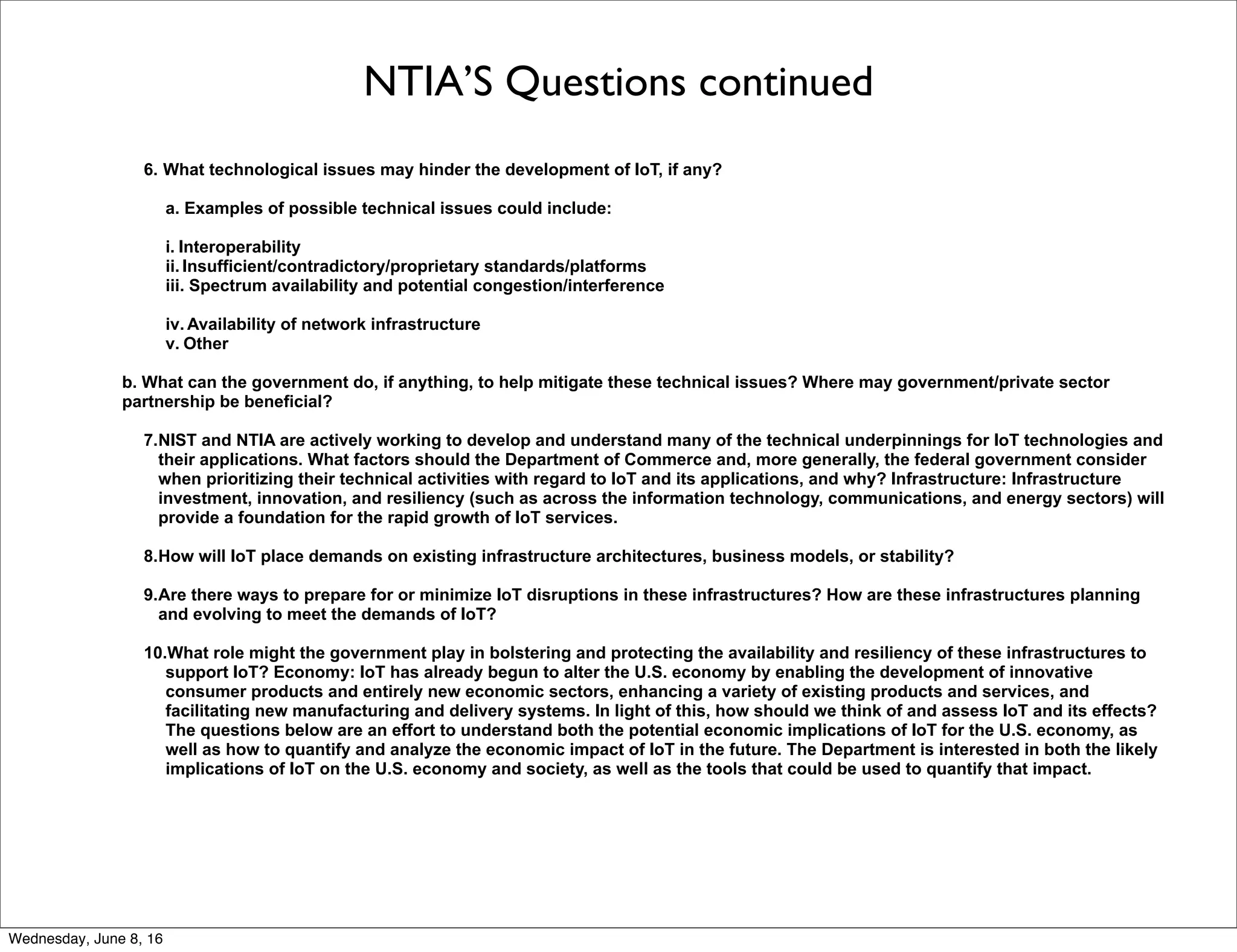
NTIA’S Questions continued
6. What technological issues may hinder the development of IoT, if any?
a. Examples of possible technical issues could include:
i. Interoperability
ii. Insufficient/contradictory/proprietary standards/platforms
iii. Spectrum availability and potential congestion/interference
iv. Availability of network infrastructure
v. Other
b. What can the government do, if anything, to help mitigate these technical issues? Where may government/private sector
partnership be beneficial?
7.NIST and NTIA are actively working to develop and understand many of the technical underpinnings for IoT technologies and
their applications. What factors should the Department of Commerce and, more generally, the federal government consider
when prioritizing their technical activities with regard to IoT and its applications, and why? Infrastructure: Infrastructure
investment, innovation, and resiliency (such as across the information technology, communications, and energy sectors) will
provide a foundation for the rapid growth of IoT services.
8.How will IoT place demands on existing infrastructure architectures, business models, or stability?
9.Are there ways to prepare for or minimize IoT disruptions in these infrastructures? How are these infrastructures planning
and evolving to meet the demands of IoT?
10.What role might the government play in bolstering and protecting the availability and resiliency of these infrastructures to
support IoT? Economy: IoT has already begun to alter the U.S. economy by enabling the development of innovative
consumer products and entirely new economic sectors, enhancing a variety of existing products and services, and
facilitating new manufacturing and delivery systems. In light of this, how should we think of and assess IoT and its effects?
The questions below are an effort to understand both the potential economic implications of IoT for the U.S. economy, as
well as how to quantify and analyze the economic impact of IoT in the future. The Department is interested in both the likely
implications of IoT on the U.S. economy and society, as well as the tools that could be used to quantify that impact.
Thursday, June 9, 16
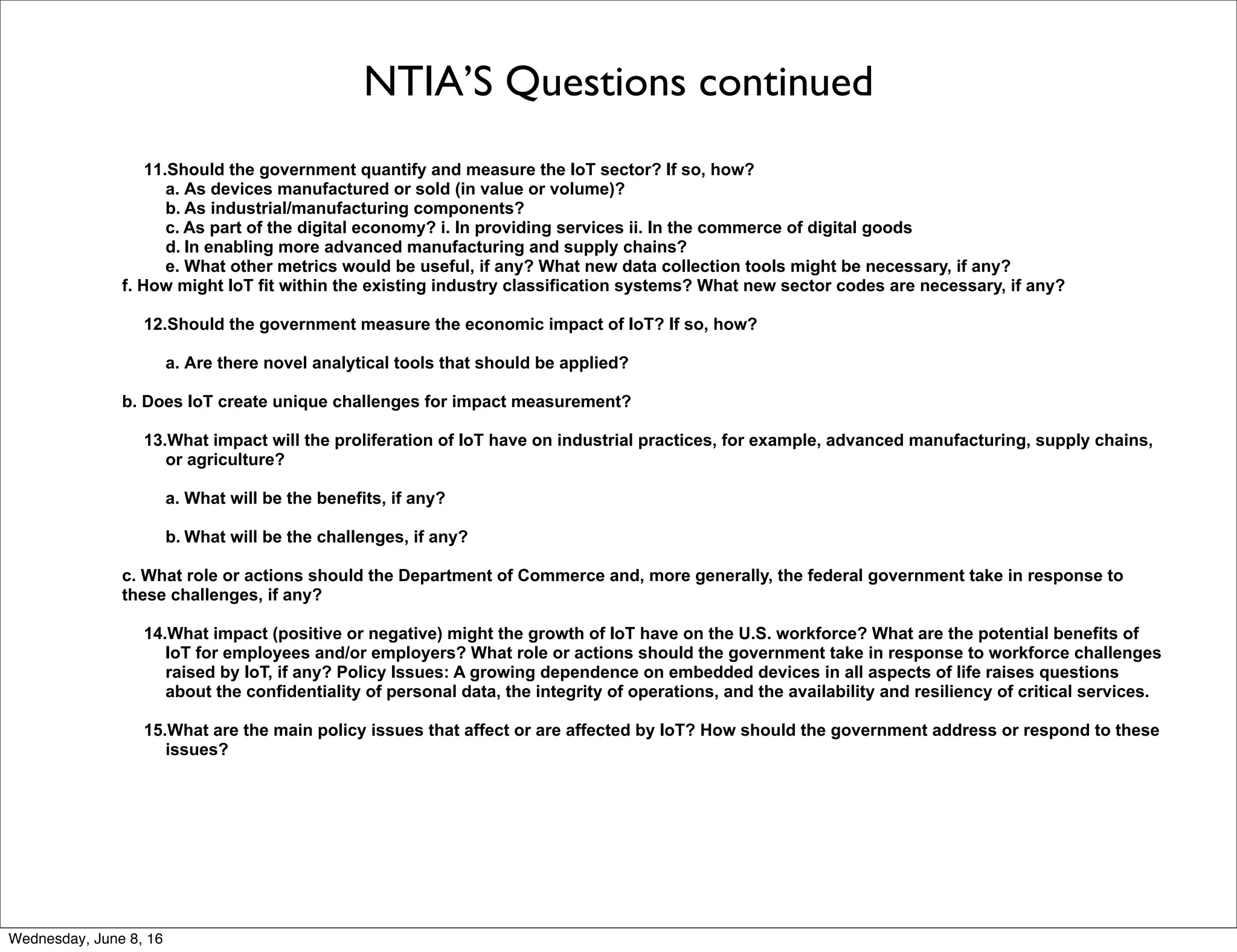
NTIA’S Questions continued
11.Should the government quantify and measure the IoT sector? If so, how?
a. As devices manufactured or sold (in value or volume)?
b. As industrial/manufacturing components?
c. As part of the digital economy? i. In providing services ii. In the commerce of digital goods
d. In enabling more advanced manufacturing and supply chains?
e. What other metrics would be useful, if any? What new data collection tools might be necessary, if any?
f. How might IoT fit within the existing industry classification systems? What new sector codes are necessary, if any?
12.Should the government measure the economic impact of IoT? If so, how?
a. Are there novel analytical tools that should be applied?
b. Does IoT create unique challenges for impact measurement?
13.What impact will the proliferation of IoT have on industrial practices, for example, advanced manufacturing, supply chains,
or agriculture?
a. What will be the benefits, if any?
b. What will be the challenges, if any?
c. What role or actions should the Department of Commerce and, more generally, the federal government take in response to
these challenges, if any?
14.What impact (positive or negative) might the growth of IoT have on the U.S. workforce? What are the potential benefits of
IoT for employees and/or employers? What role or actions should the government take in response to workforce challenges
raised by IoT, if any? Policy Issues: A growing dependence on embedded devices in all aspects of life raises questions
about the confidentiality of personal data, the integrity of operations, and the availability and resiliency of critical services.
15.What are the main policy issues that affect or are affected by IoT? How should the government address or respond to these
issues?
Thursday, June 9, 16
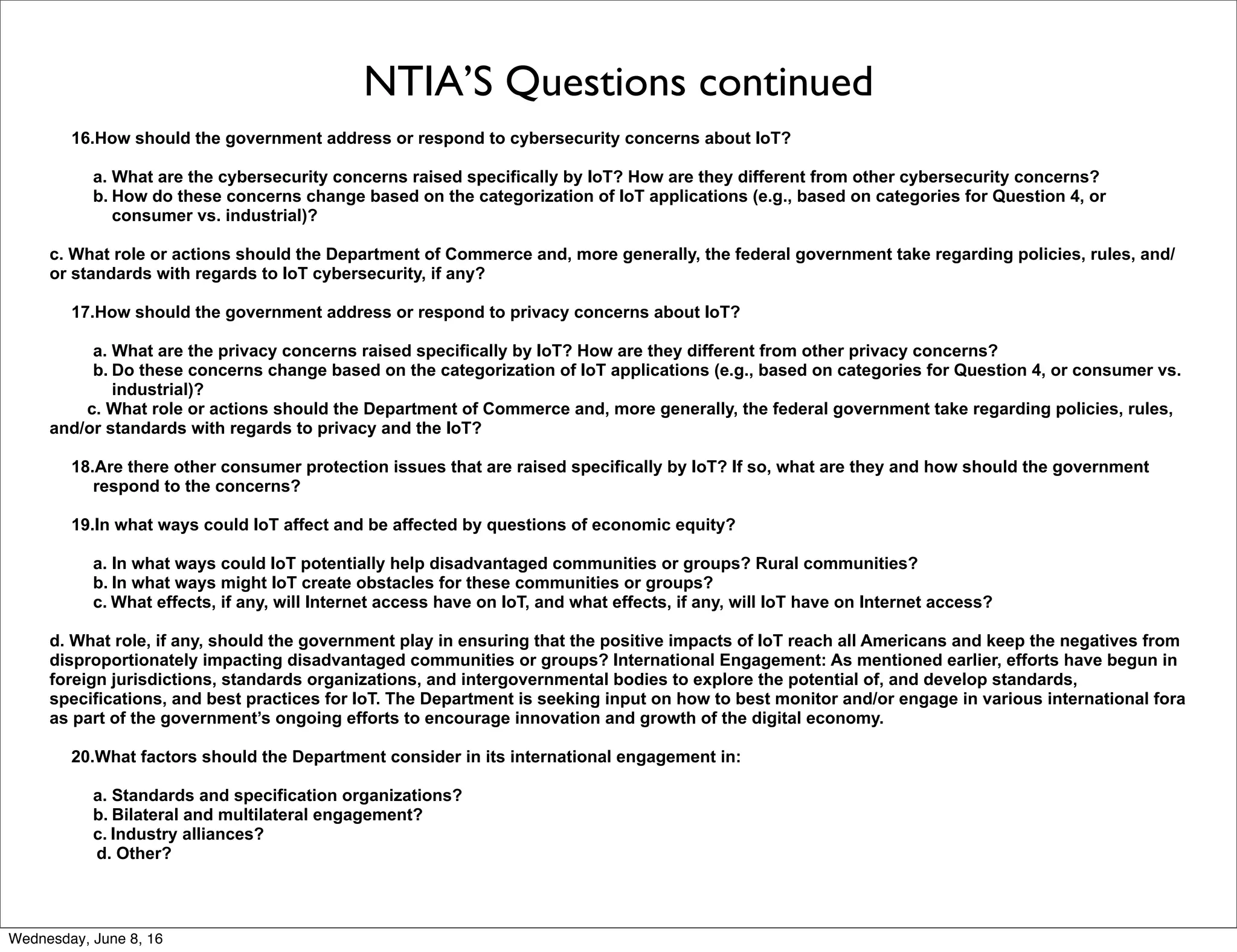
NTIA’S Questions continued
16.How should the government address or respond to cybersecurity concerns about IoT?
a. What are the cybersecurity concerns raised specifically by IoT? How are they different from other cybersecurity concerns?
b. How do these concerns change based on the categorization of IoT applications (e.g., based on categories for Question 4, or
consumer vs. industrial)?
c. What role or actions should the Department of Commerce and, more generally, the federal government take regarding policies, rules, and/
or standards with regards to IoT cybersecurity, if any?
17.How should the government address or respond to privacy concerns about IoT?
a. What are the privacy concerns raised specifically by IoT? How are they different from other privacy concerns?
b. Do these concerns change based on the categorization of IoT applications (e.g., based on categories for Question 4, or consumer vs.
industrial)?
c. What role or actions should the Department of Commerce and, more generally, the federal government take regarding policies, rules,
and/or standards with regards to privacy and the IoT?
18.Are there other consumer protection issues that are raised specifically by IoT? If so, what are they and how should the government
respond to the concerns?
19.In what ways could IoT affect and be affected by questions of economic equity?
a. In what ways could IoT potentially help disadvantaged communities or groups? Rural communities?
b. In what ways might IoT create obstacles for these communities or groups?
c. What effects, if any, will Internet access have on IoT, and what effects, if any, will IoT have on Internet access?
d. What role, if any, should the government play in ensuring that the positive impacts of IoT reach all Americans and keep the negatives from
disproportionately impacting disadvantaged communities or groups? International Engagement: As mentioned earlier, efforts have begun in
foreign jurisdictions, standards organizations, and intergovernmental bodies to explore the potential of, and develop standards,
specifications, and best practices for IoT. The Department is seeking input on how to best monitor and/or engage in various international fora
as part of the government’s ongoing efforts to encourage innovation and growth of the digital economy.
20.What factors should the Department consider in its international engagement in:
a. Standards and specification organizations?
b. Bilateral and multilateral engagement?
c. Industry alliances?
d. Other?
Thursday, June 9, 16
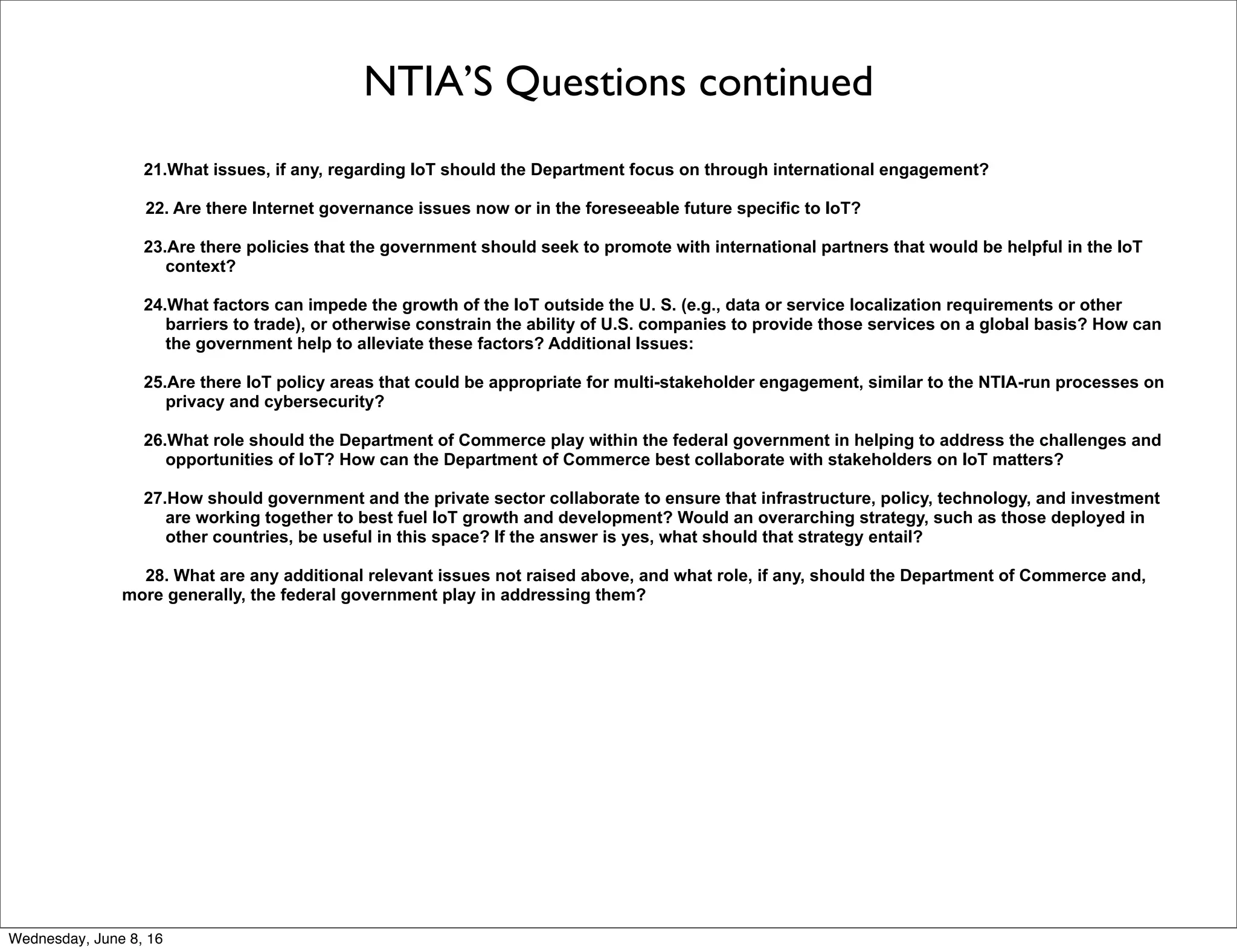
NTIA’S Questions continued
21.What issues, if any, regarding IoT should the Department focus on through international engagement?
22. Are there Internet governance issues now or in the foreseeable future specific to IoT?
23.Are there policies that the government should seek to promote with international partners that would be helpful in the IoT
context?
24.What factors can impede the growth of the IoT outside the U. S. (e.g., data or service localization requirements or other
barriers to trade), or otherwise constrain the ability of U.S. companies to provide those services on a global basis? How can
the government help to alleviate these factors? Additional Issues:
25.Are there IoT policy areas that could be appropriate for multi-stakeholder engagement, similar to the NTIA-run processes on
privacy and cybersecurity?
26.What role should the Department of Commerce play within the federal government in helping to address the challenges and
opportunities of IoT? How can the Department of Commerce best collaborate with stakeholders on IoT matters?
27.How should government and the private sector collaborate to ensure that infrastructure, policy, technology, and investment
are working together to best fuel IoT growth and development? Would an overarching strategy, such as those deployed in
other countries, be useful in this space? If the answer is yes, what should that strategy entail?
28. What are any additional relevant issues not raised above, and what role, if any, should the Department of Commerce and,
more generally, the federal government play in addressing them?
Thursday, June 9, 16
List of 132 RFC Responders
Web Site with Links to all of the Responses
Thursday, June 9, 16
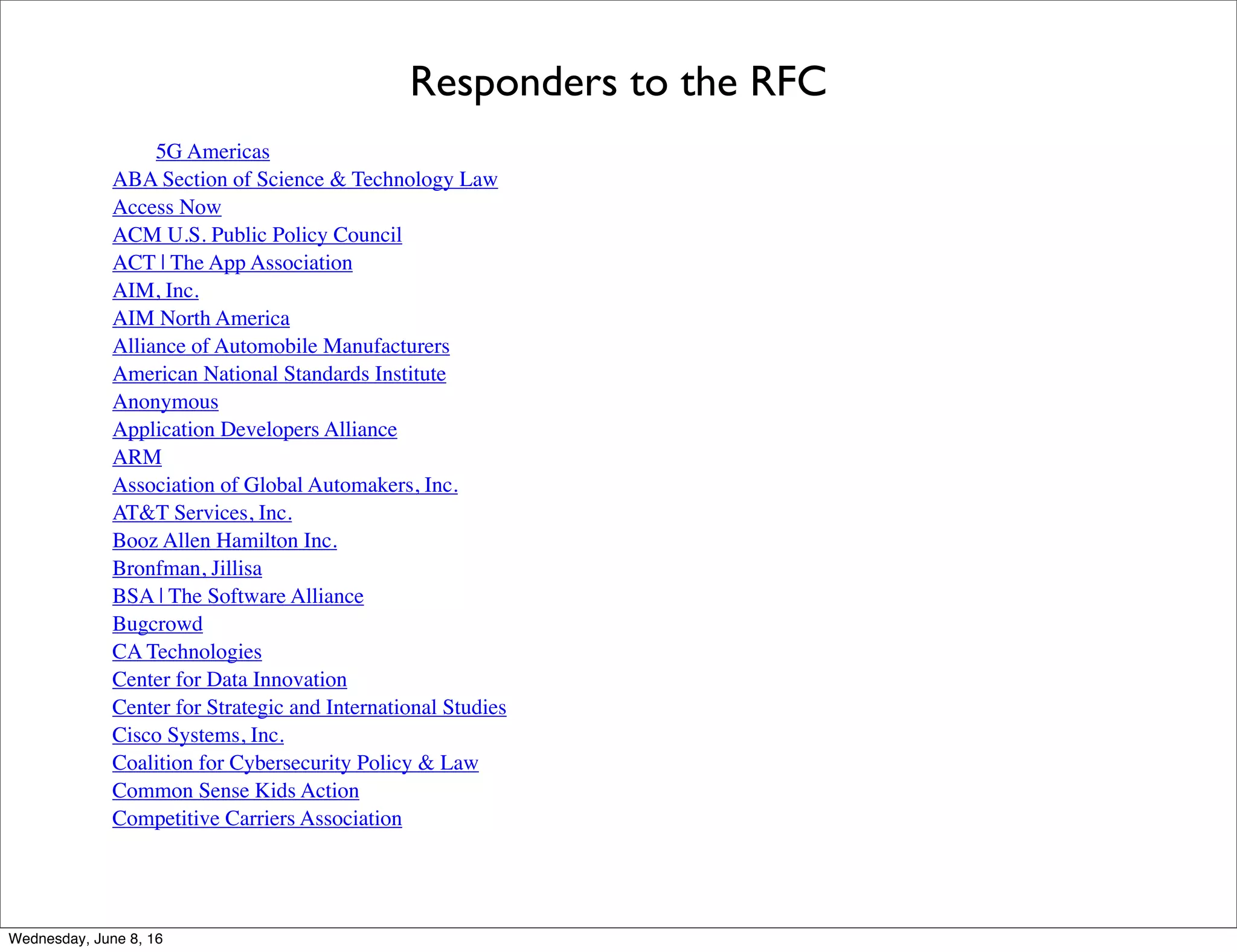
Responders to the RFC
5G Americas
ABA Section of Science & Technology Law
Access Now
ACM U.S. Public Policy Council
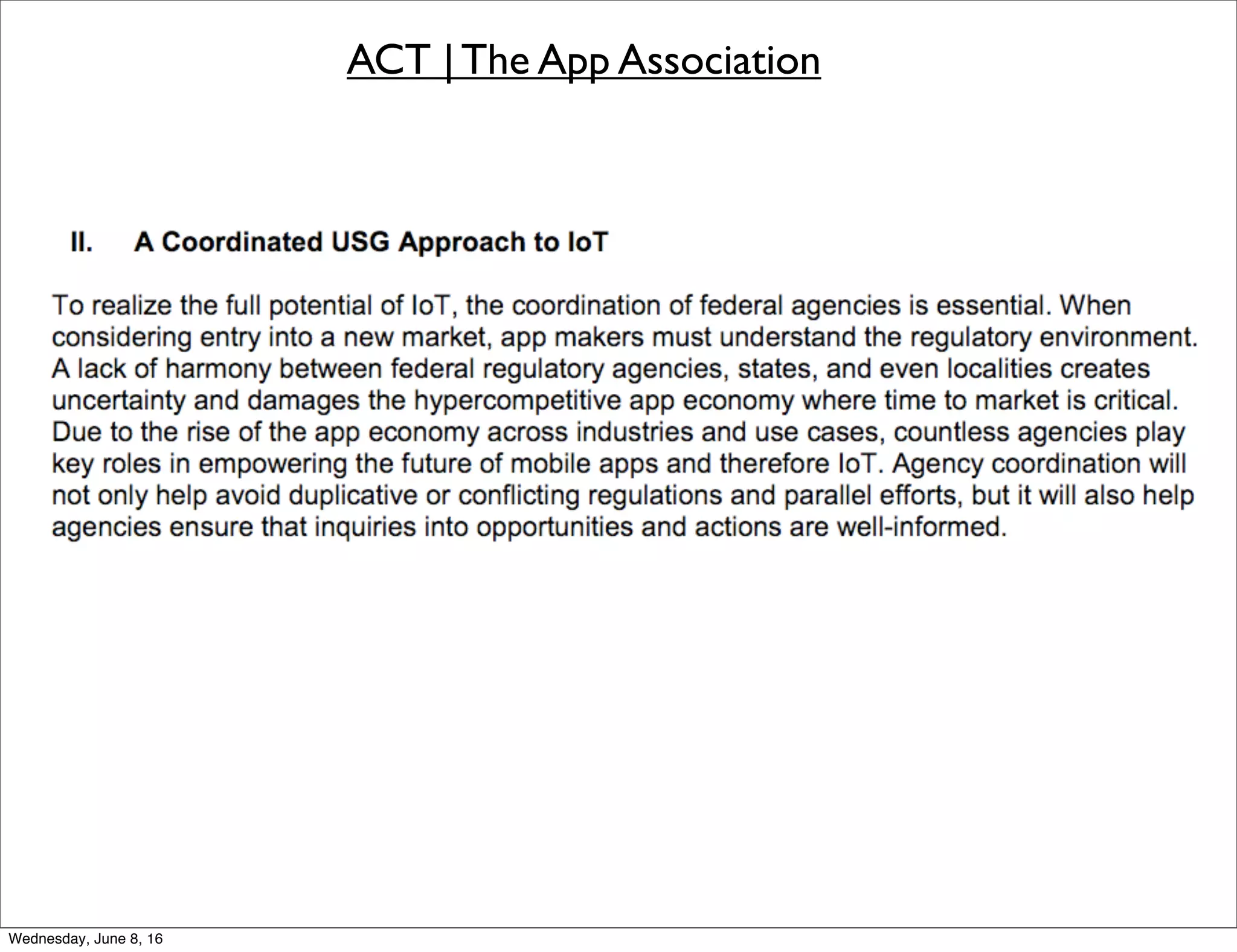
ACT | The App Association
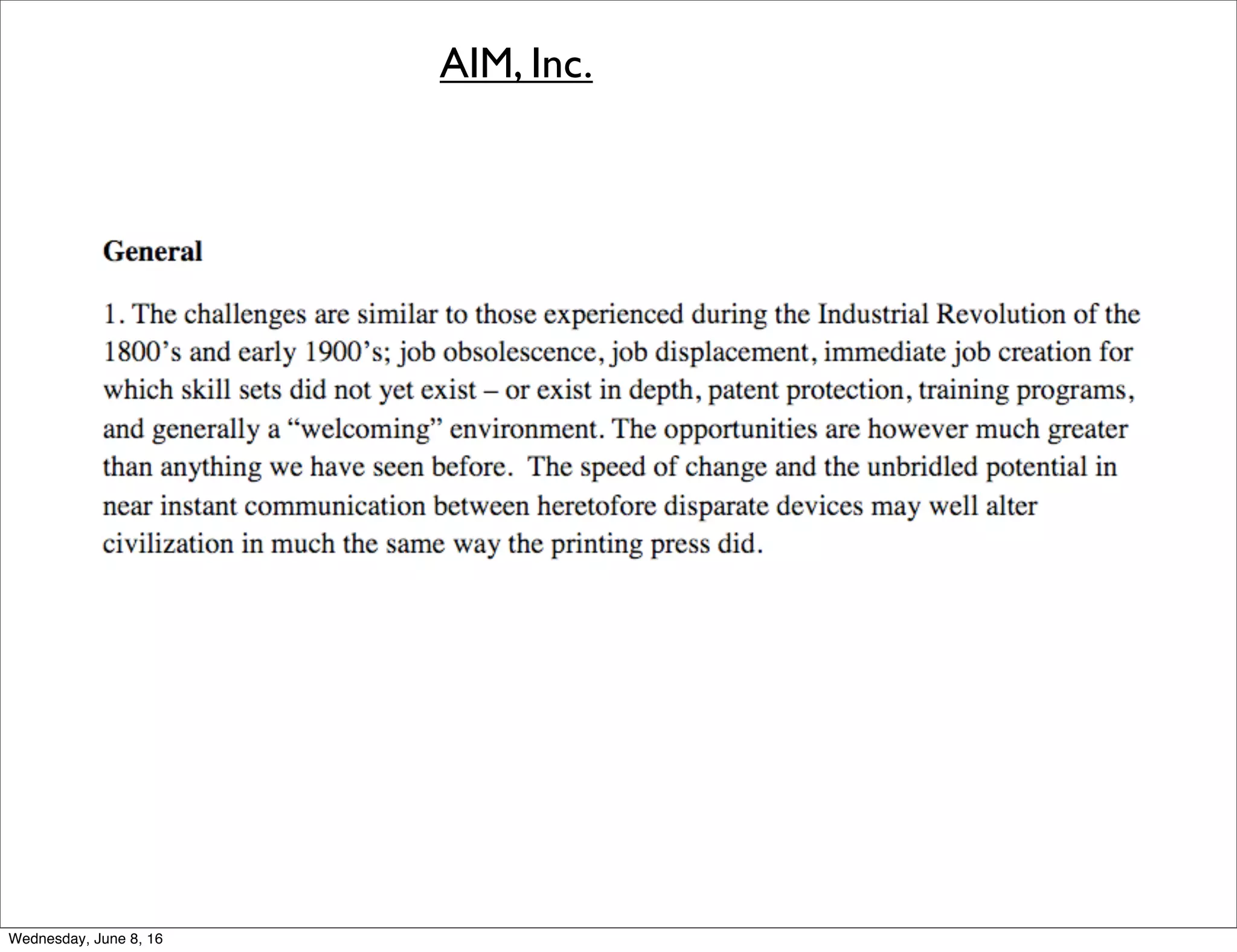
AIM, Inc.
AIM North America
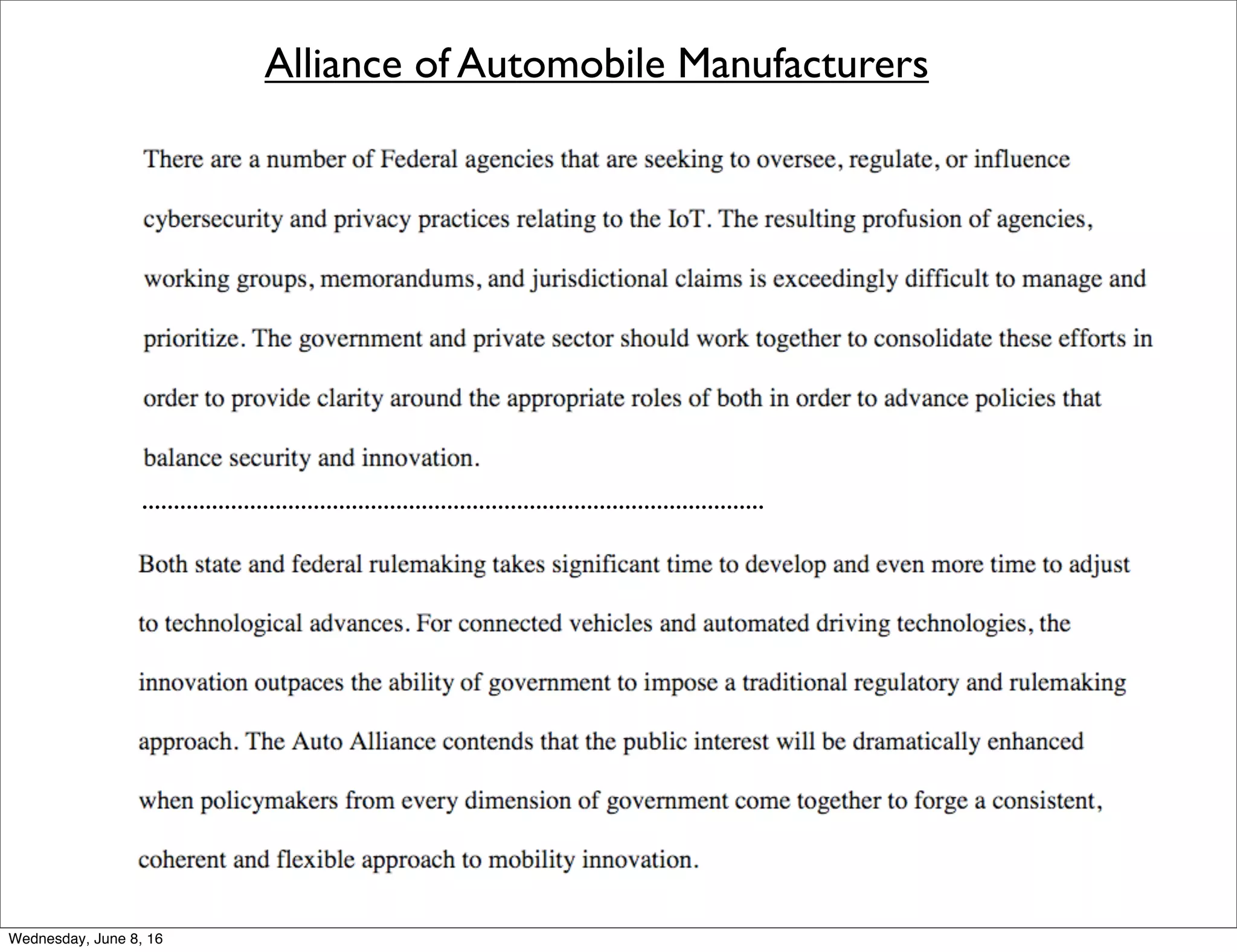
Alliance of Automobile Manufacturers
American National Standards Institute
Anonymous
Application Developers Alliance
ARM
Association of Global Automakers, Inc.
AT&T Services, Inc.
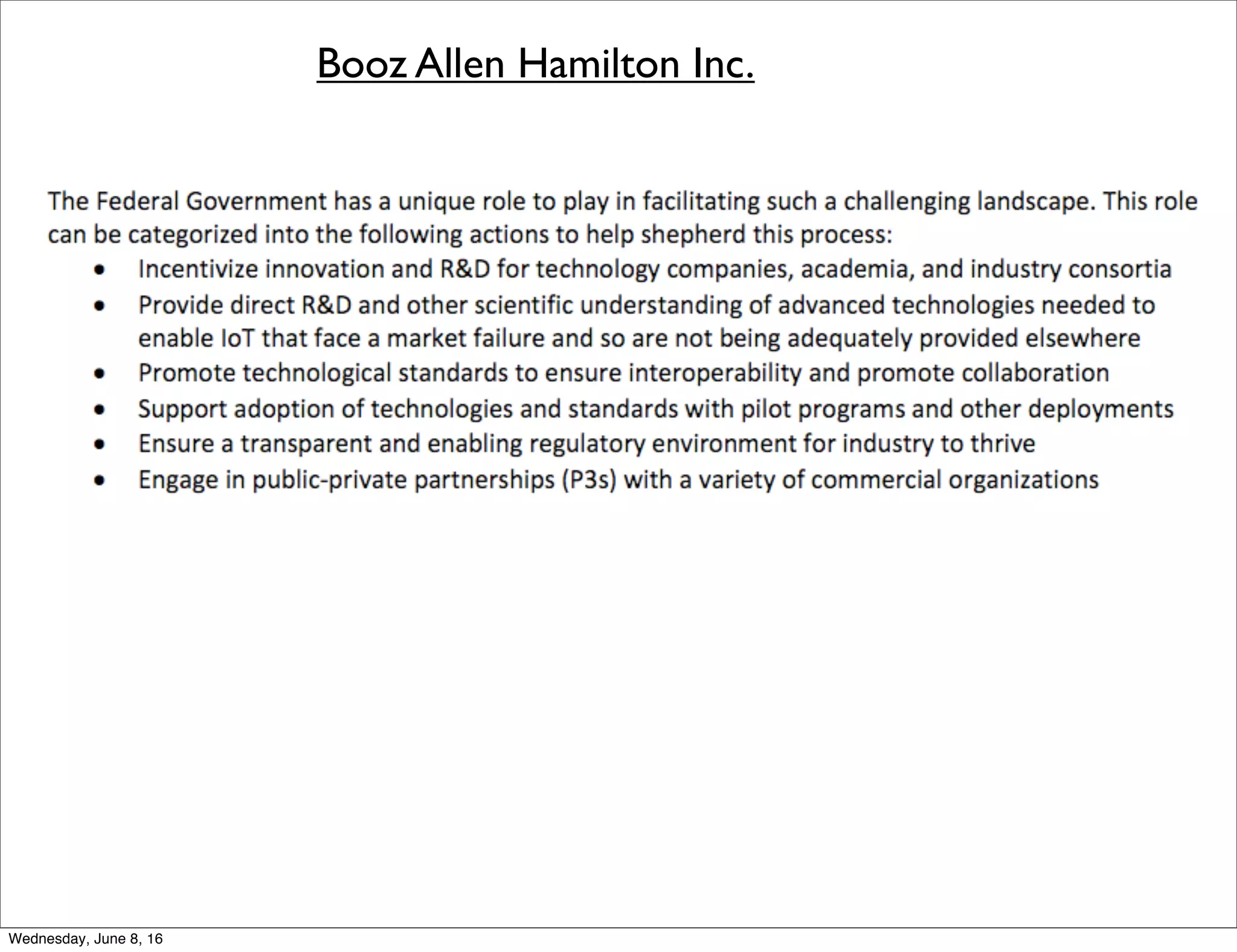
Booz Allen Hamilton Inc.
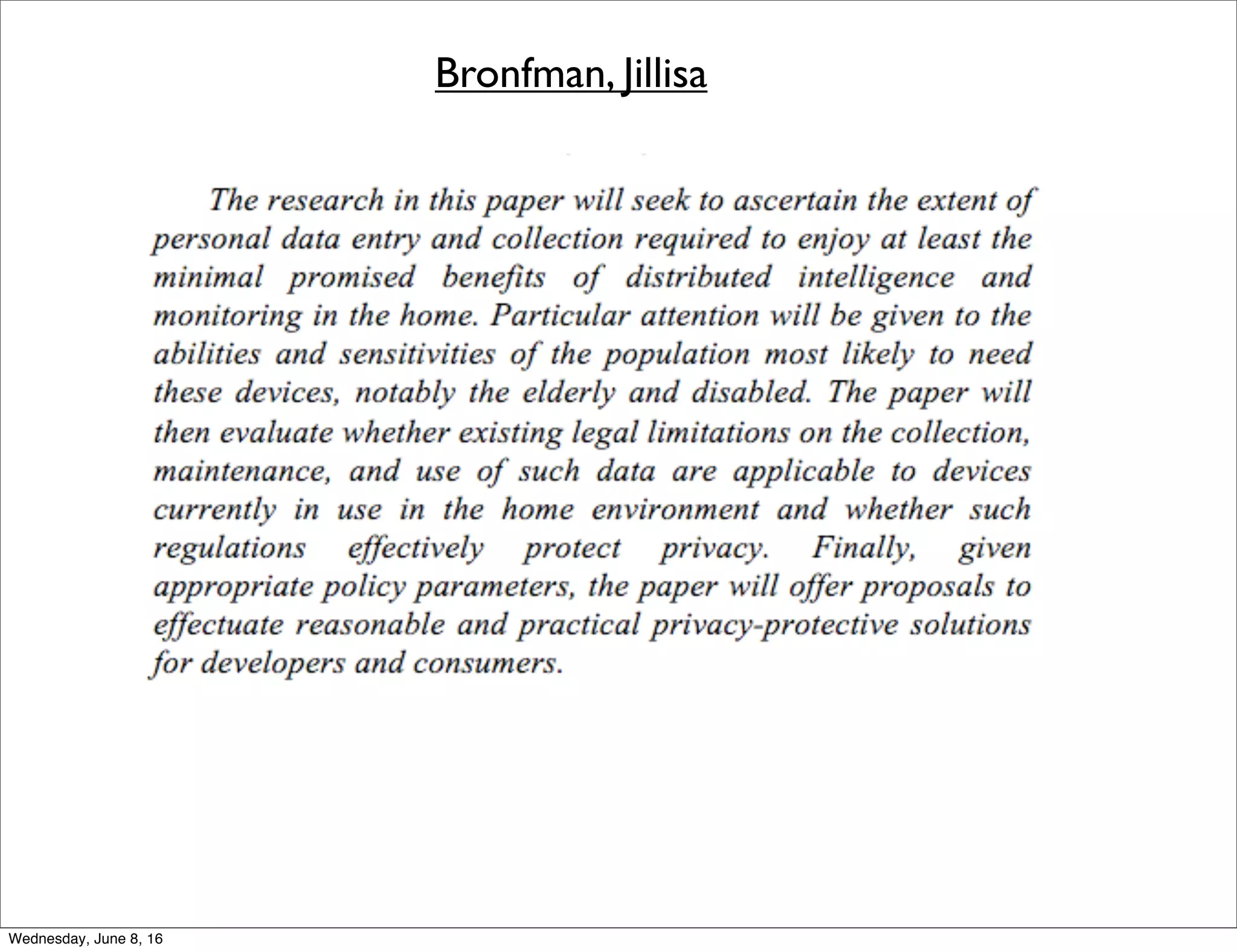
Bronfman, Jillisa
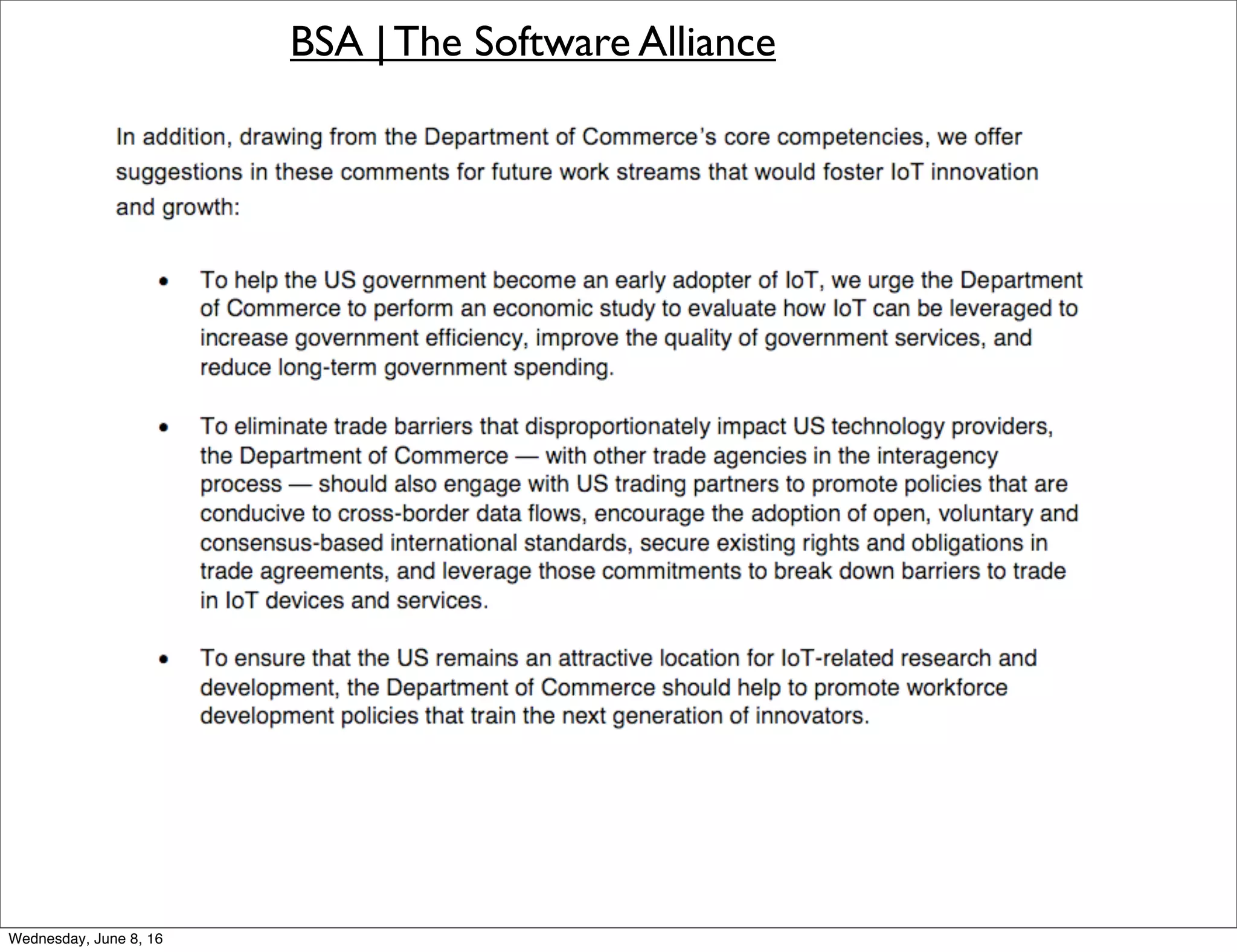
BSA | The Software Alliance
Bugcrowd
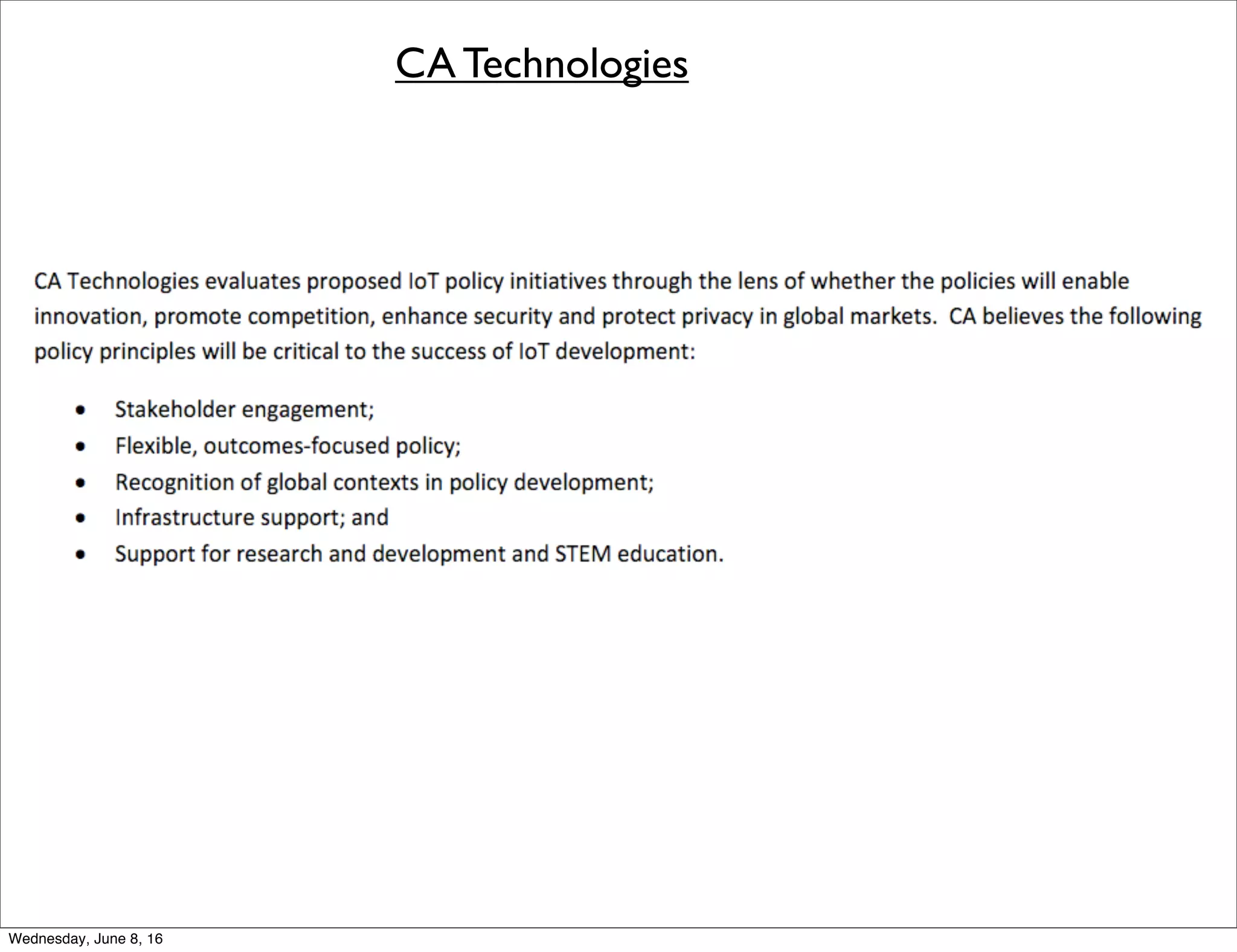
CA Technologies
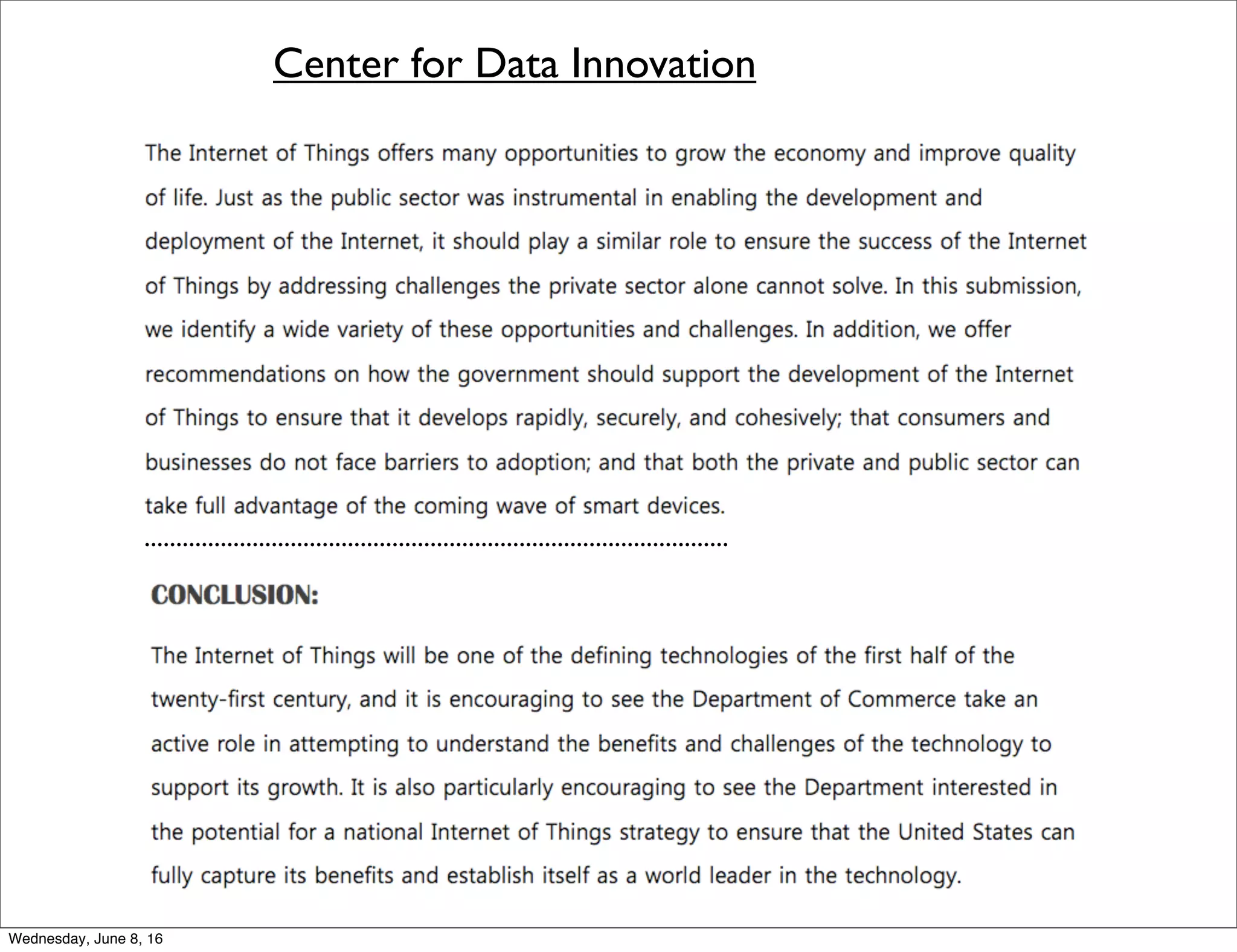
Center for Data Innovation
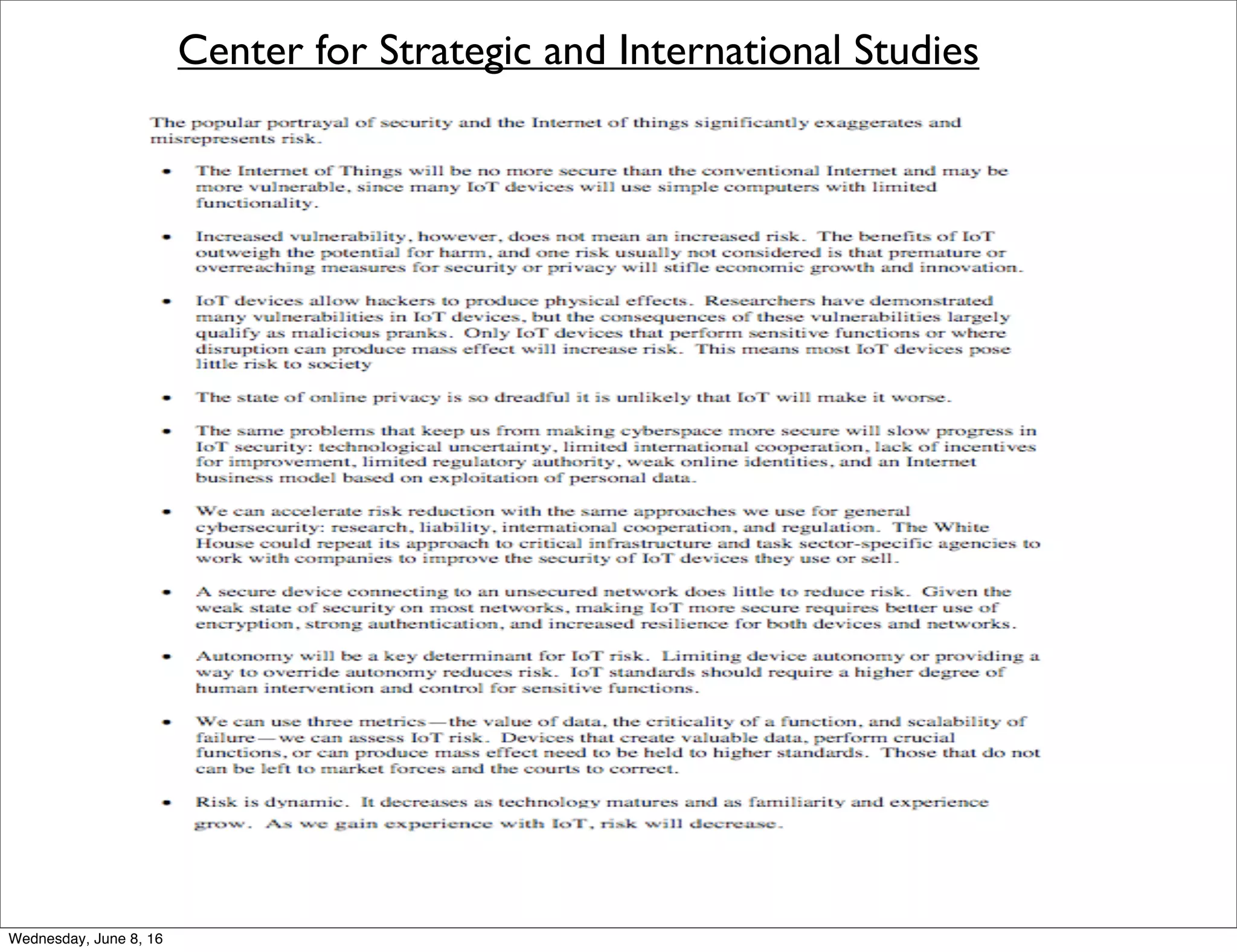
Center for Strategic and International Studies
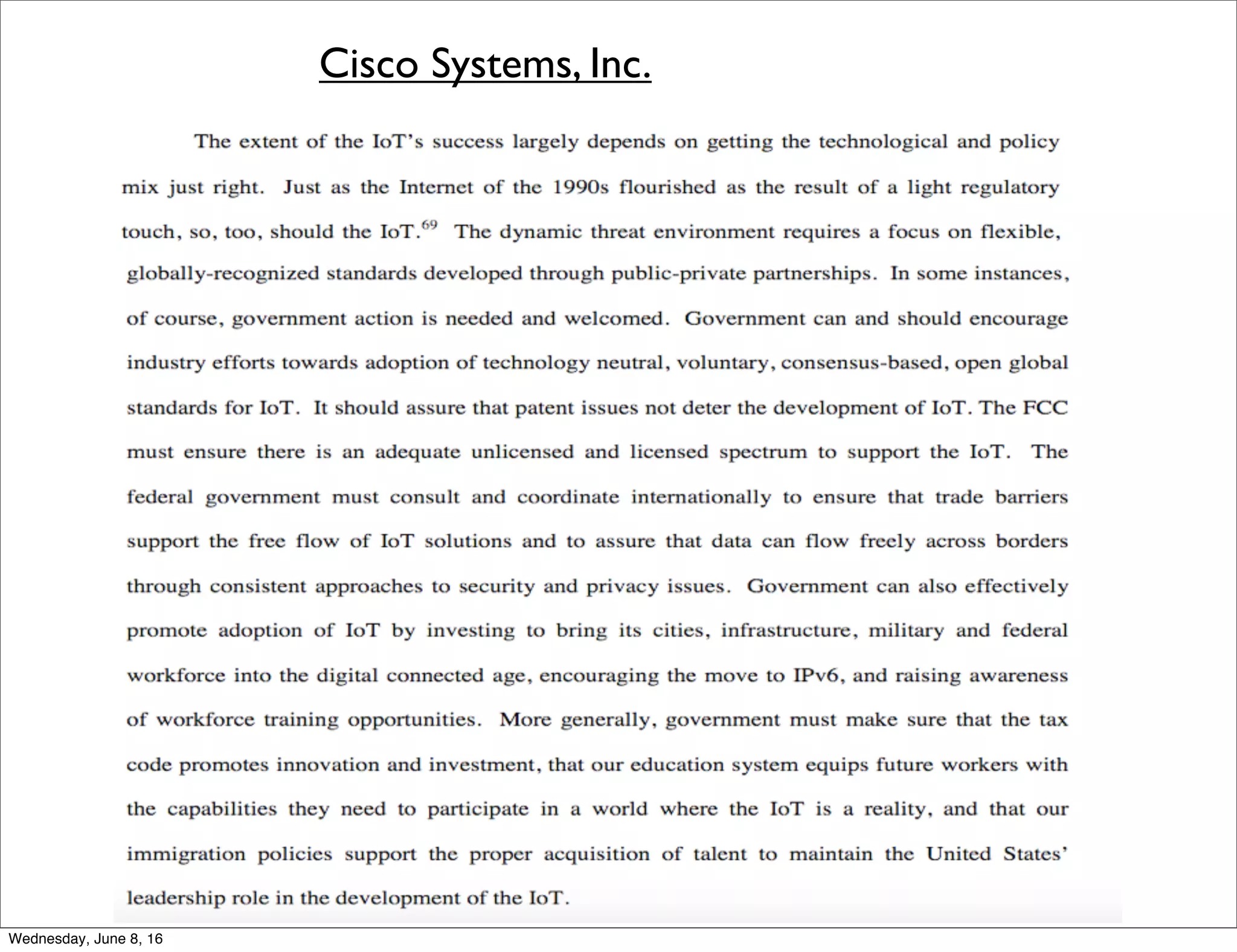
Cisco Systems, Inc.
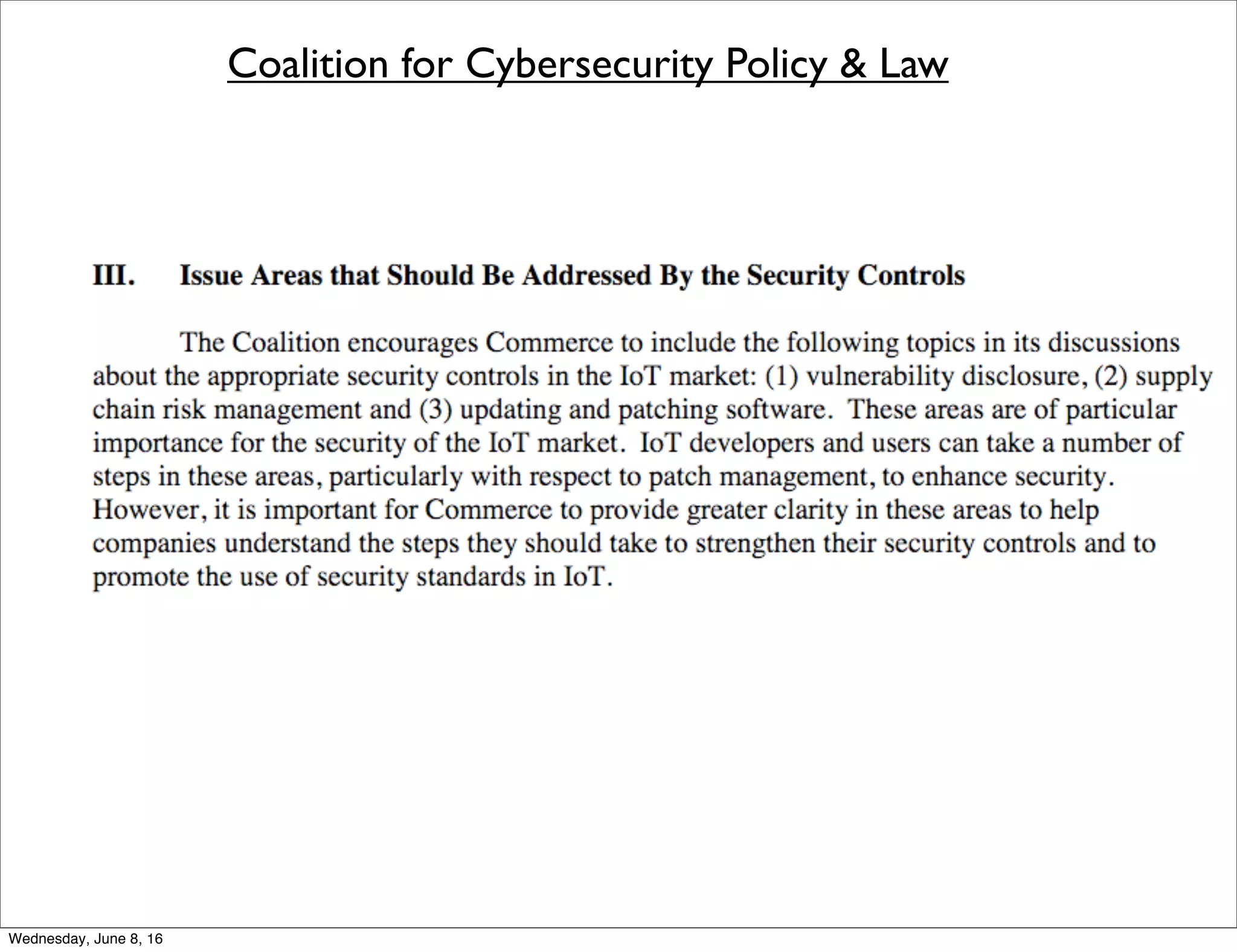
Coalition for Cybersecurity Policy & Law
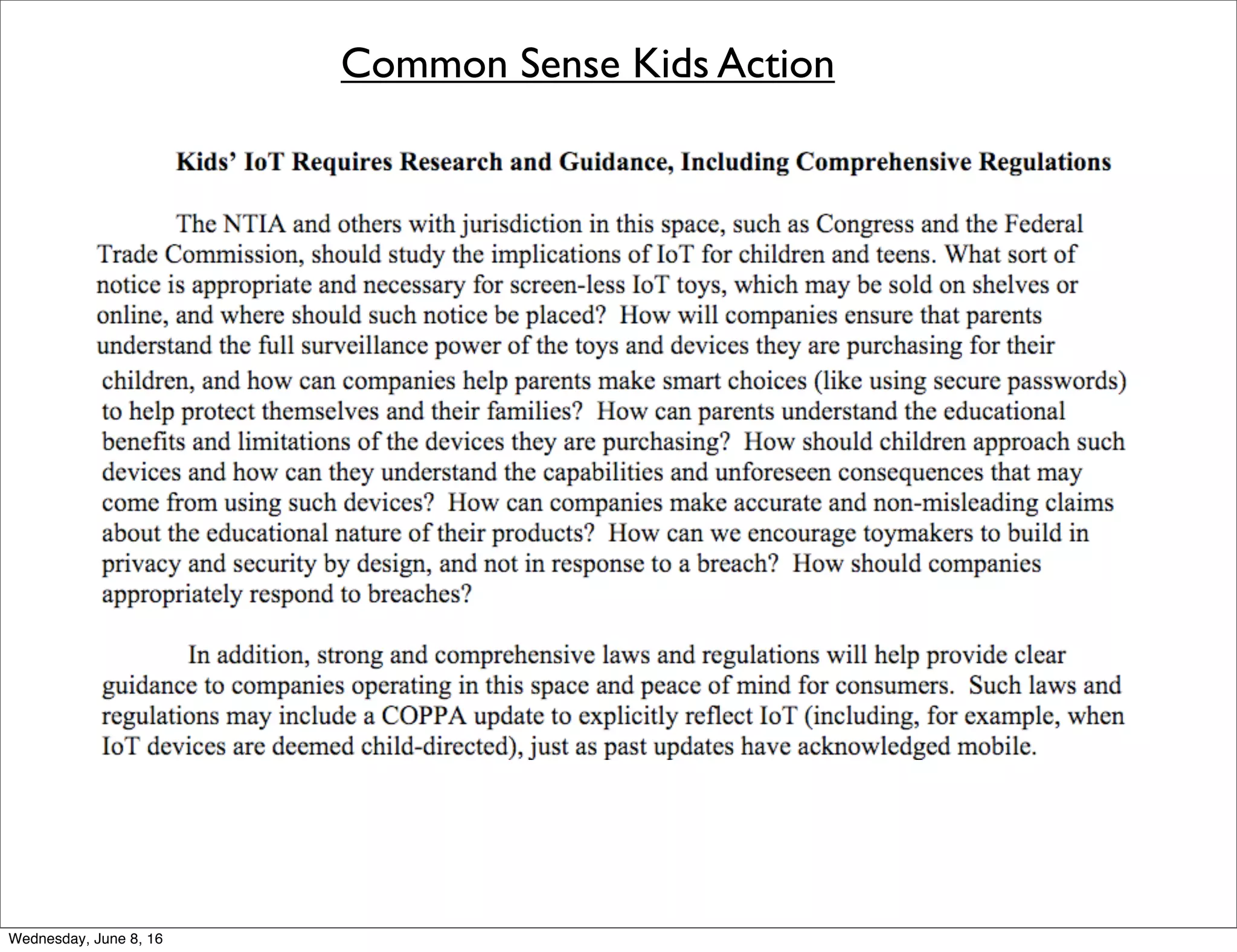
Common Sense Kids Action
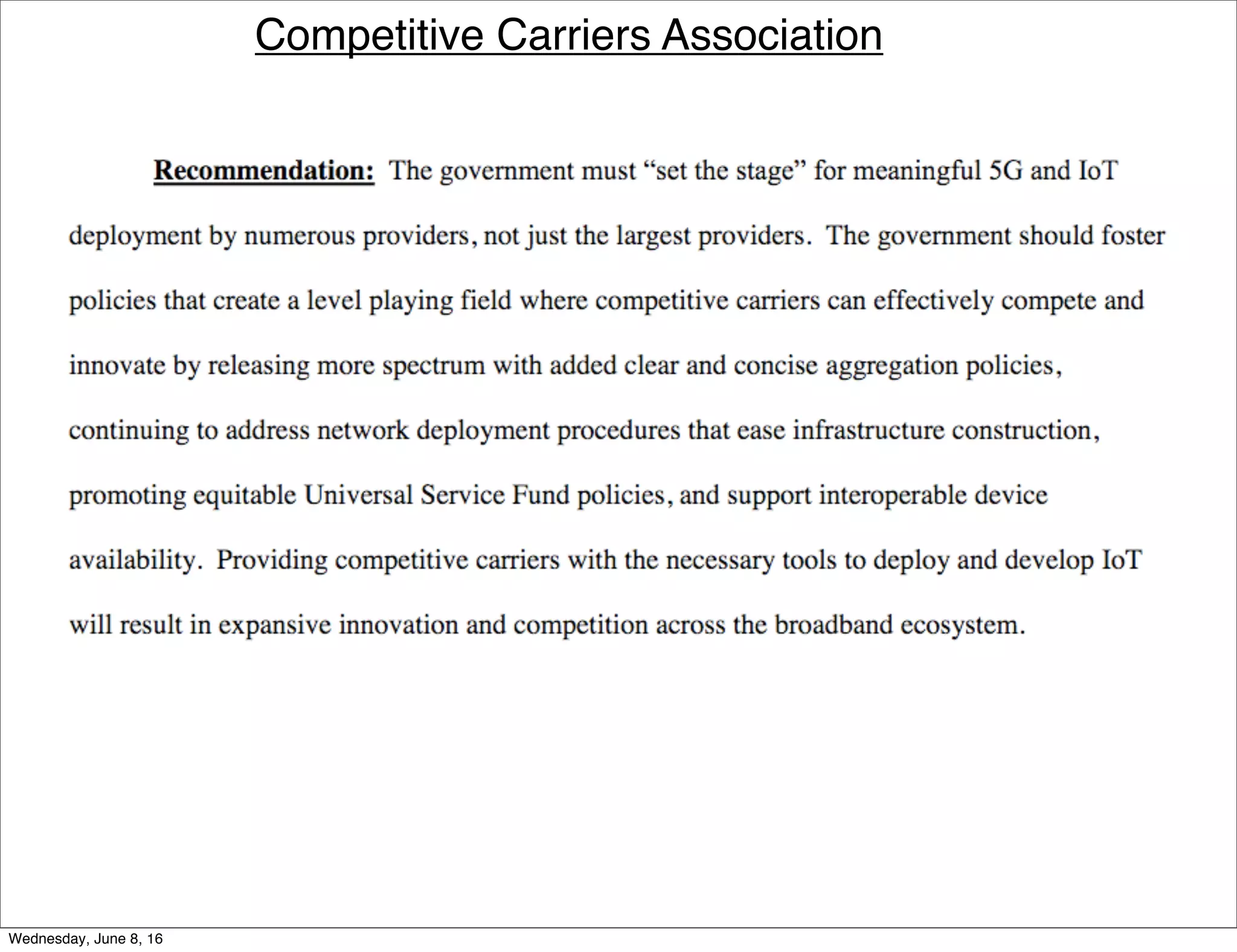
Competitive Carriers Association
Thursday, June 9, 16
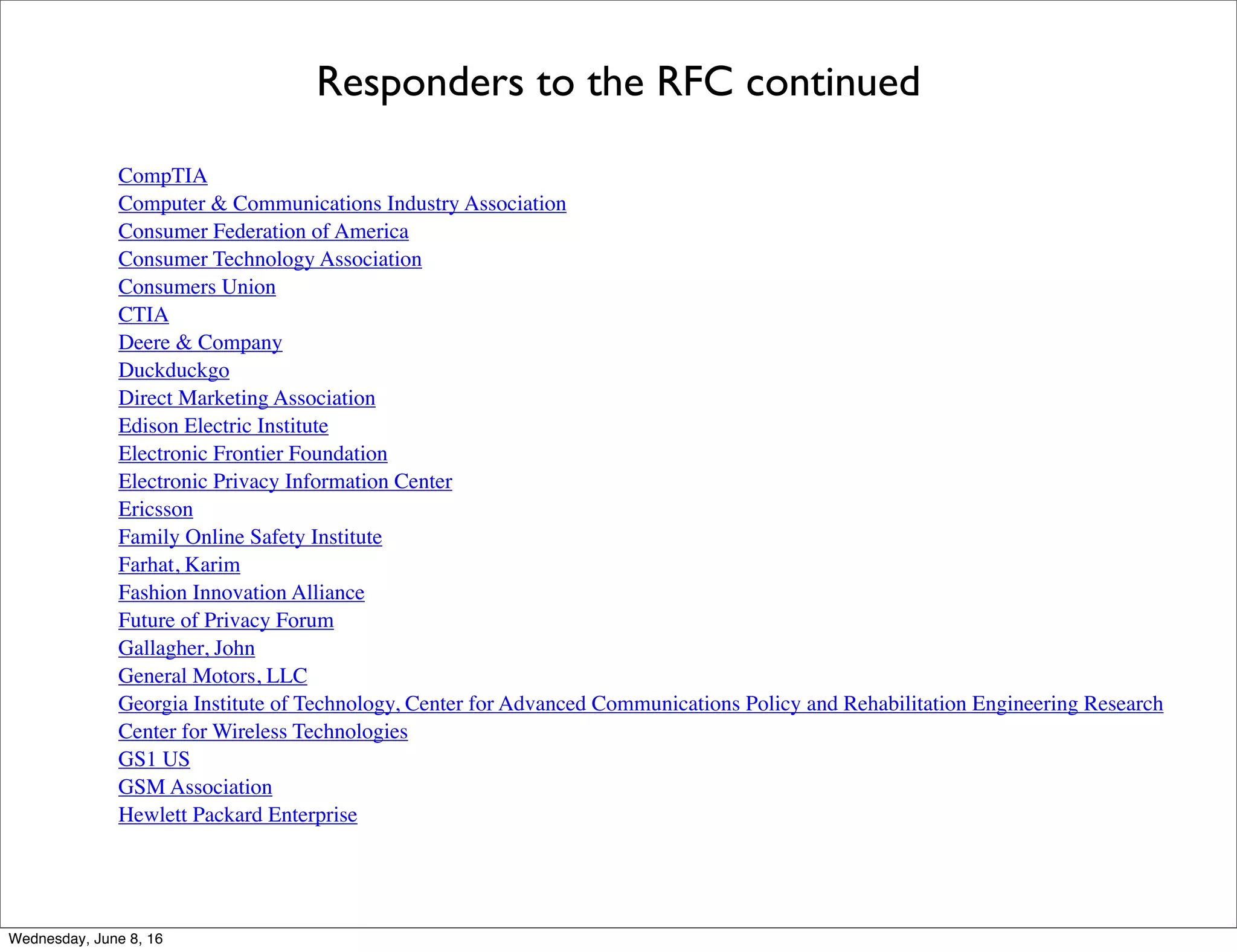
Responders to the RFC continued
CompTIA
Computer & Communications Industry Association
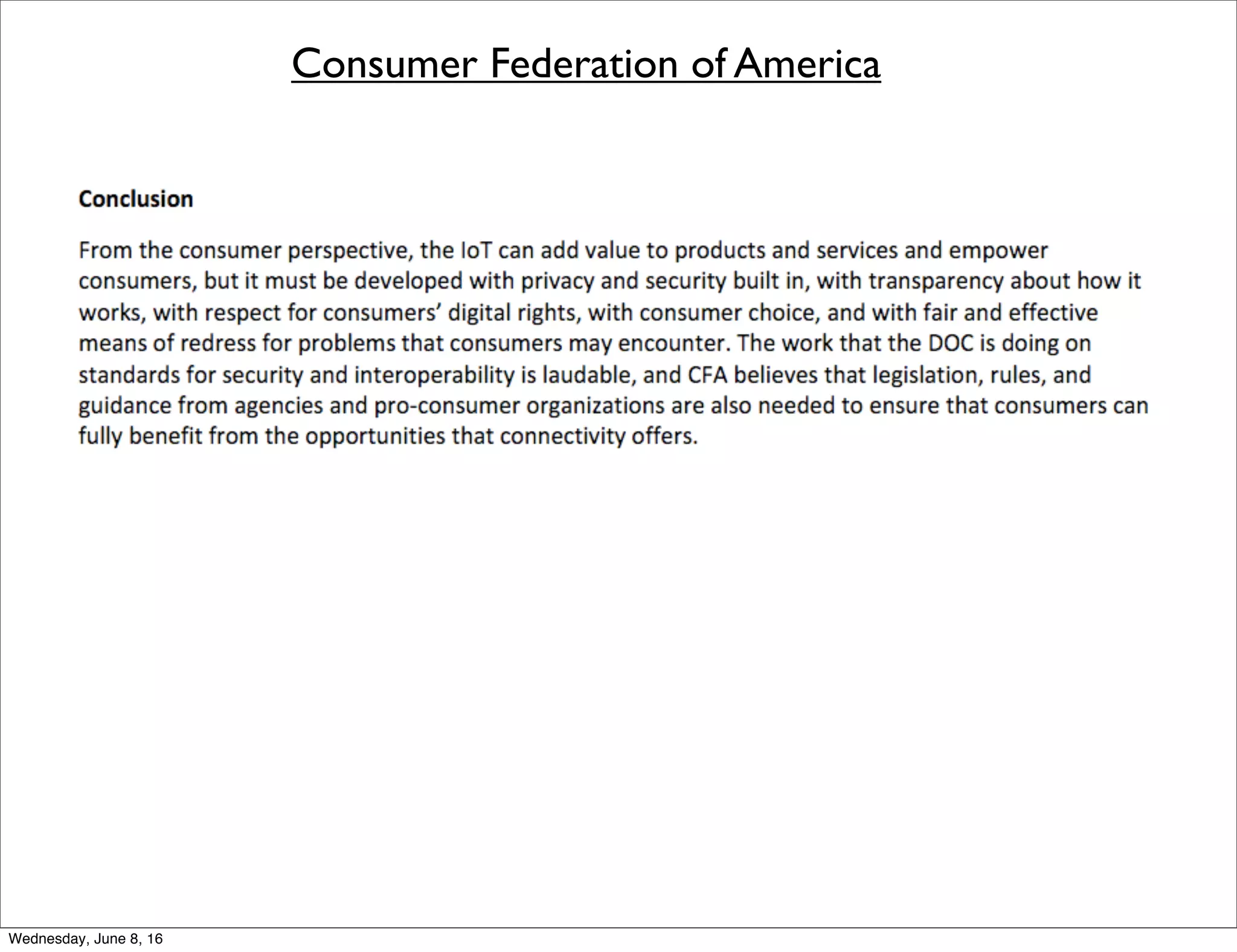
Consumer Federation of America
Consumer Technology Association
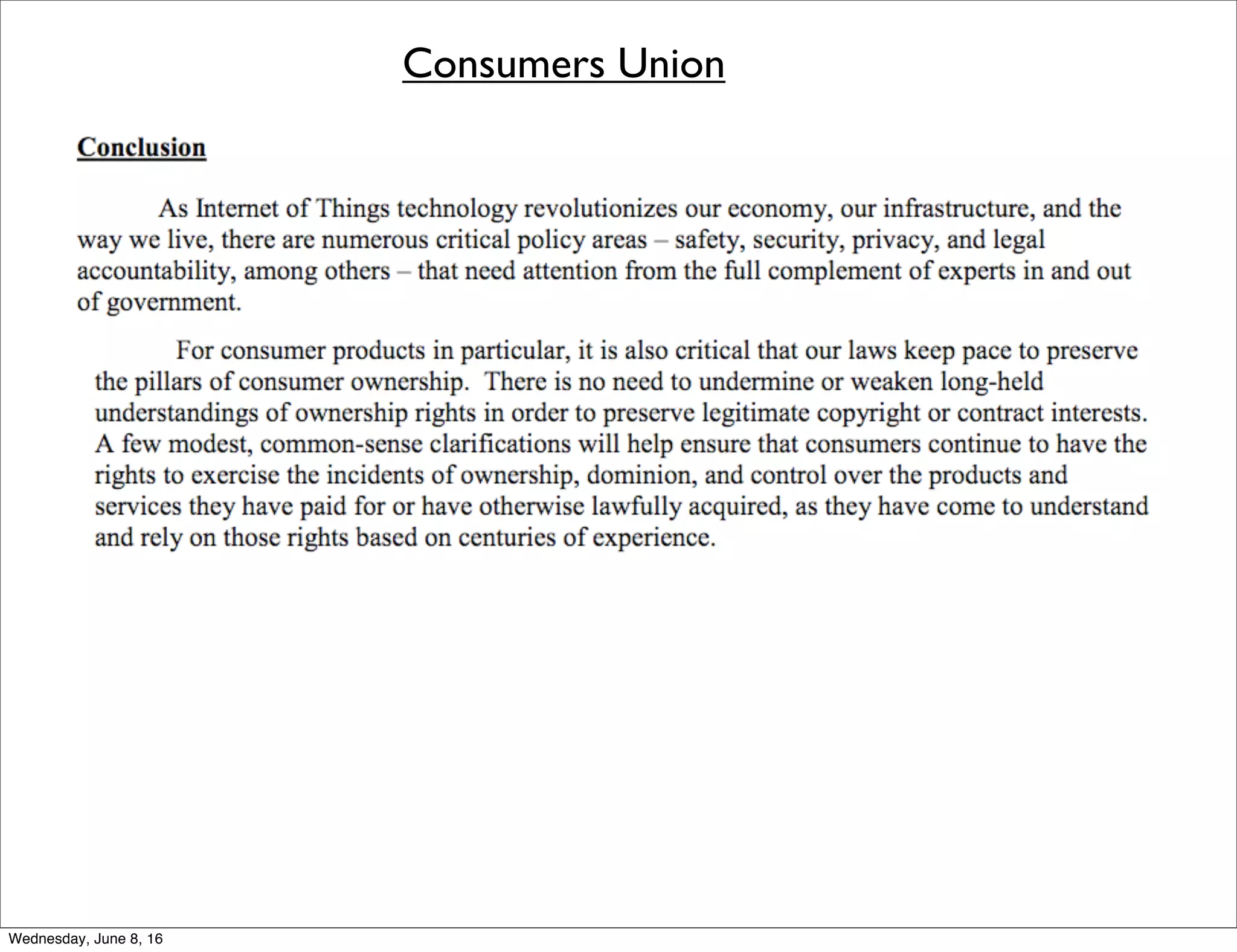
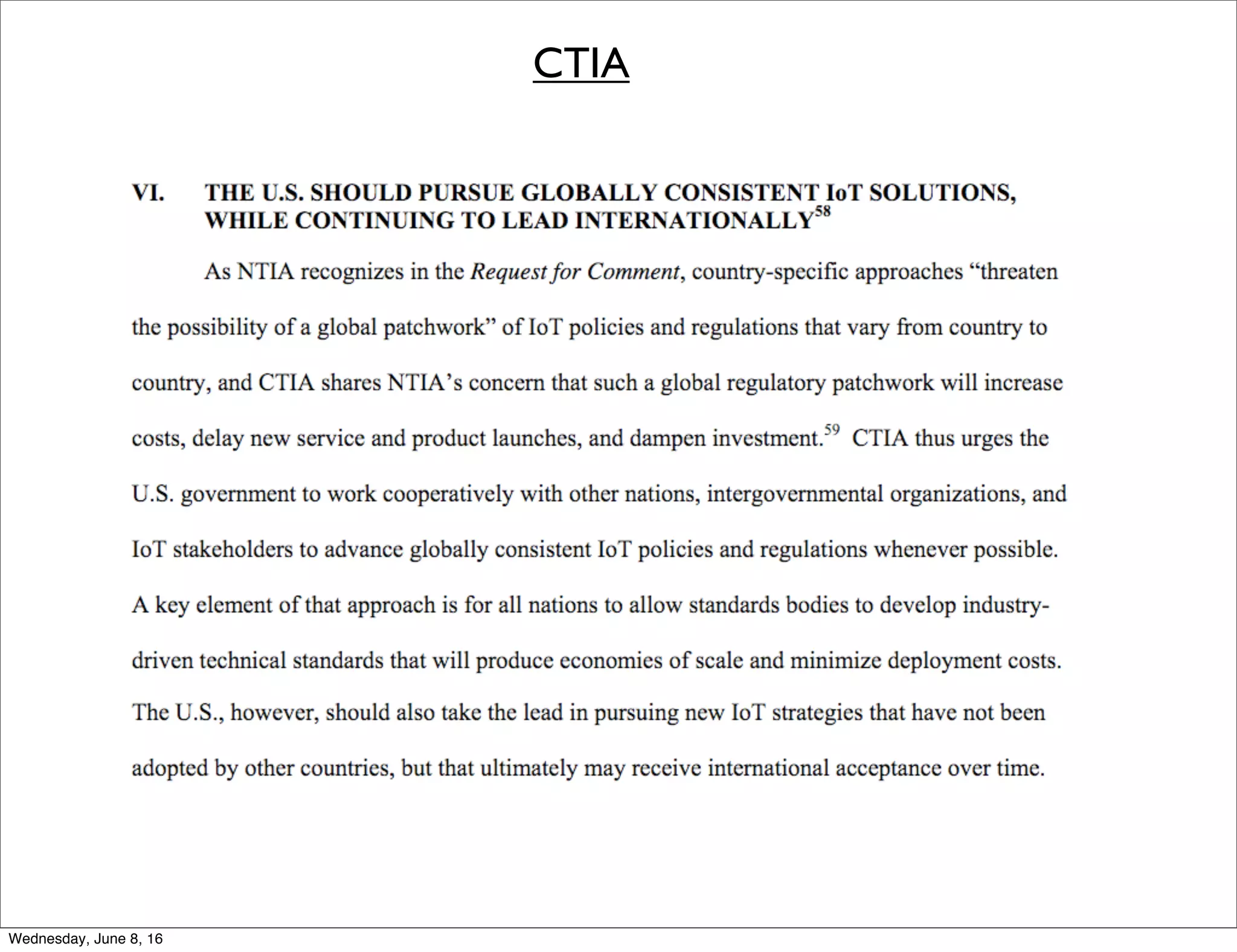
Consumers Union
CTIA
Deere & Company
Duckduckgo
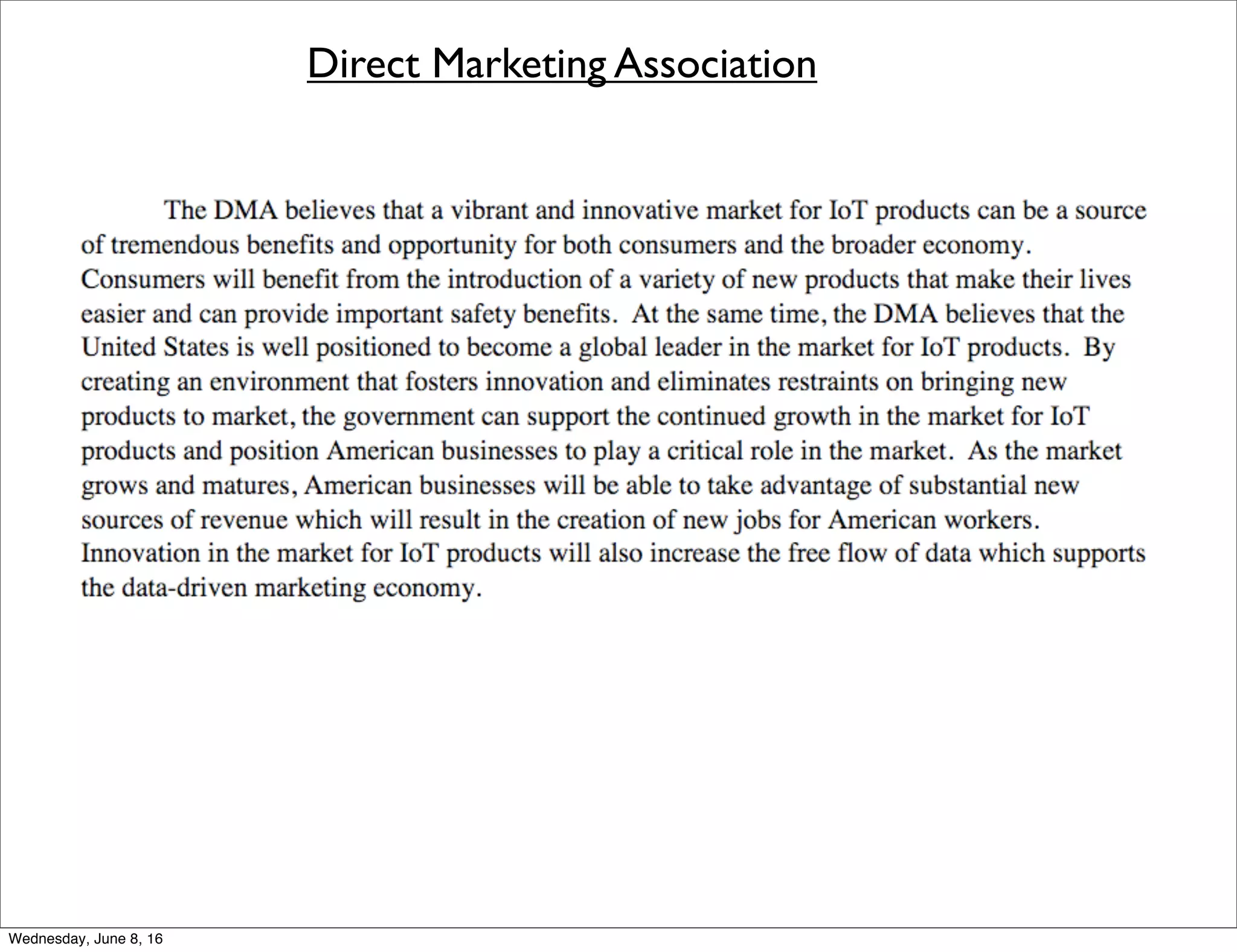
Direct Marketing Association
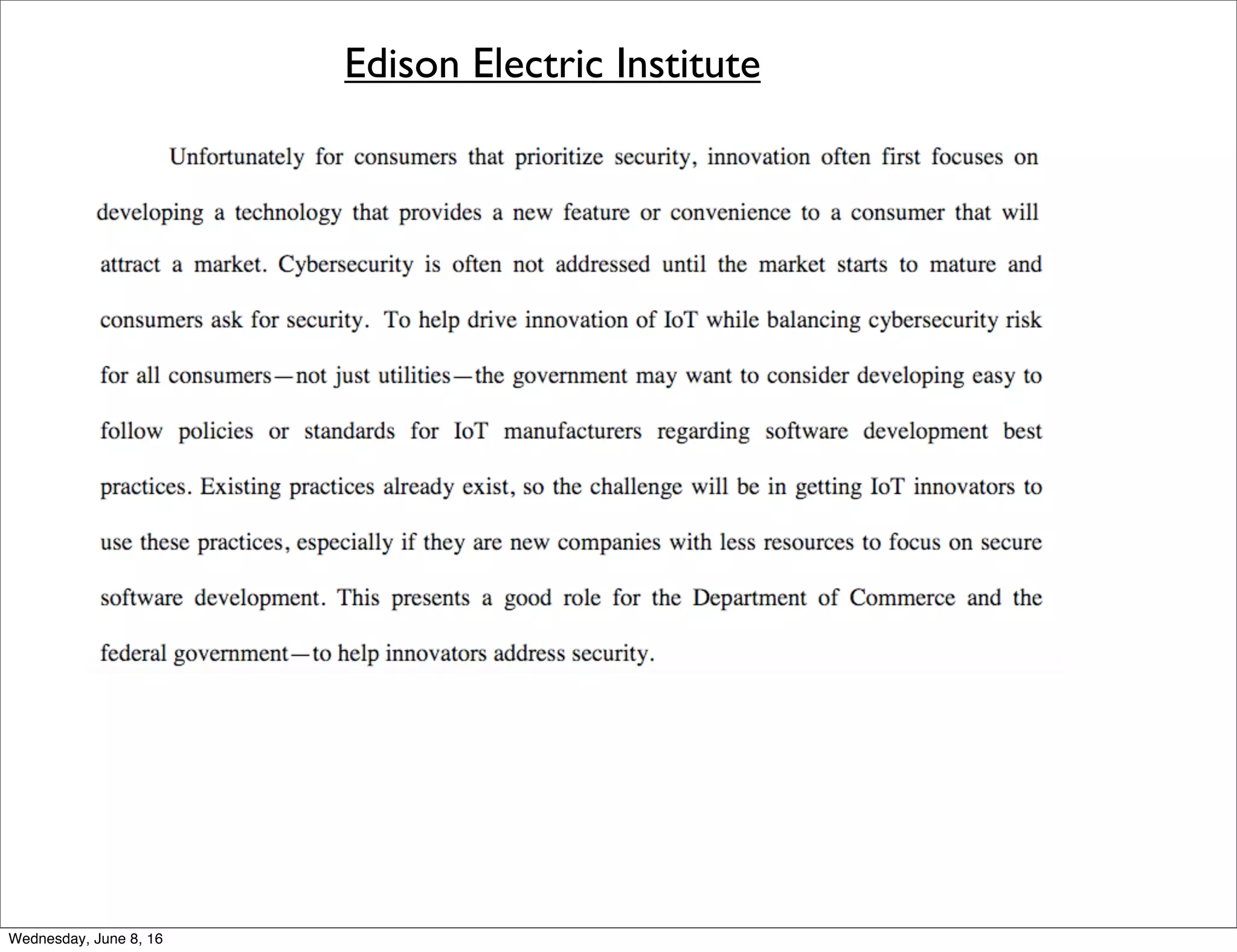
Edison Electric Institute
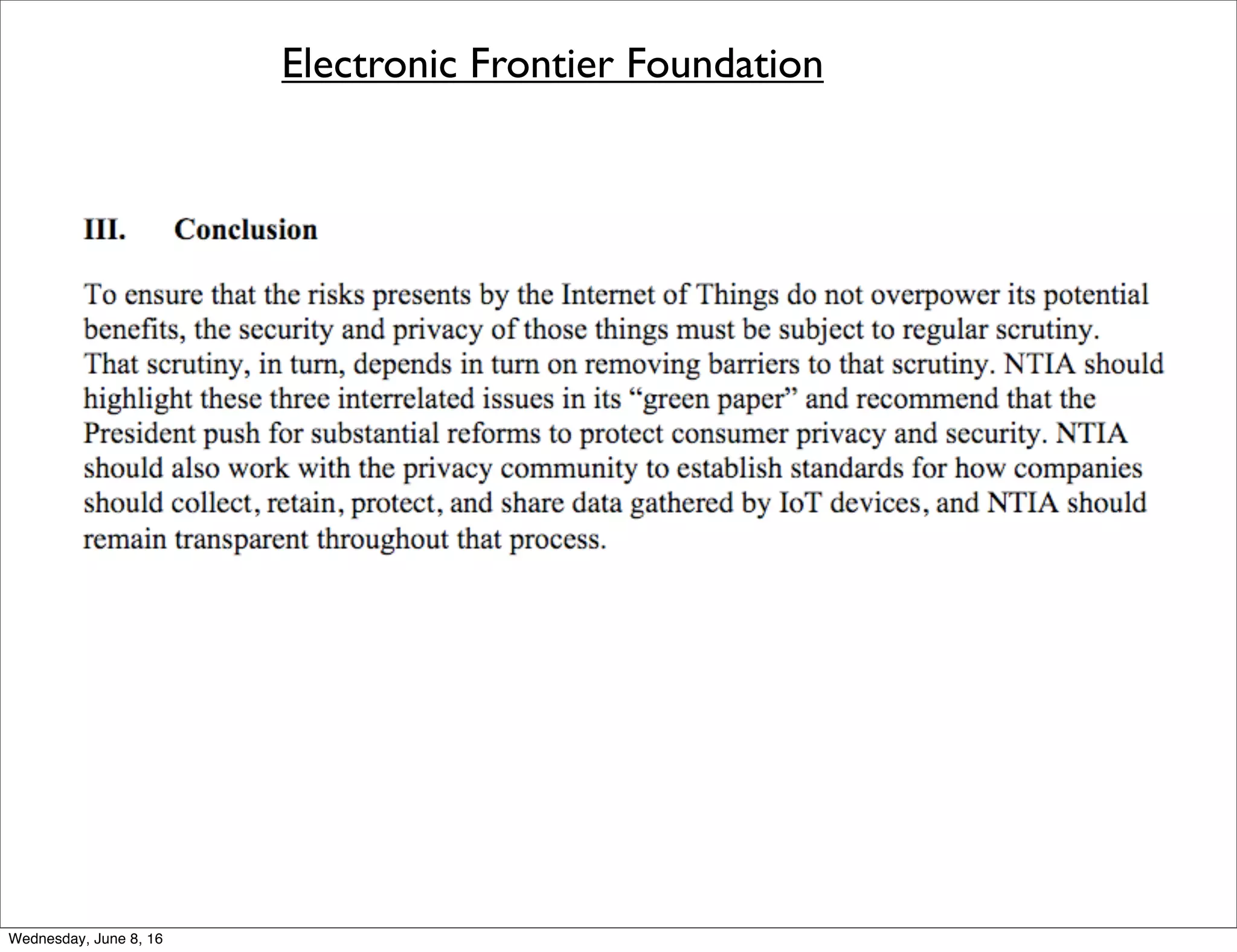
Electronic Frontier Foundation
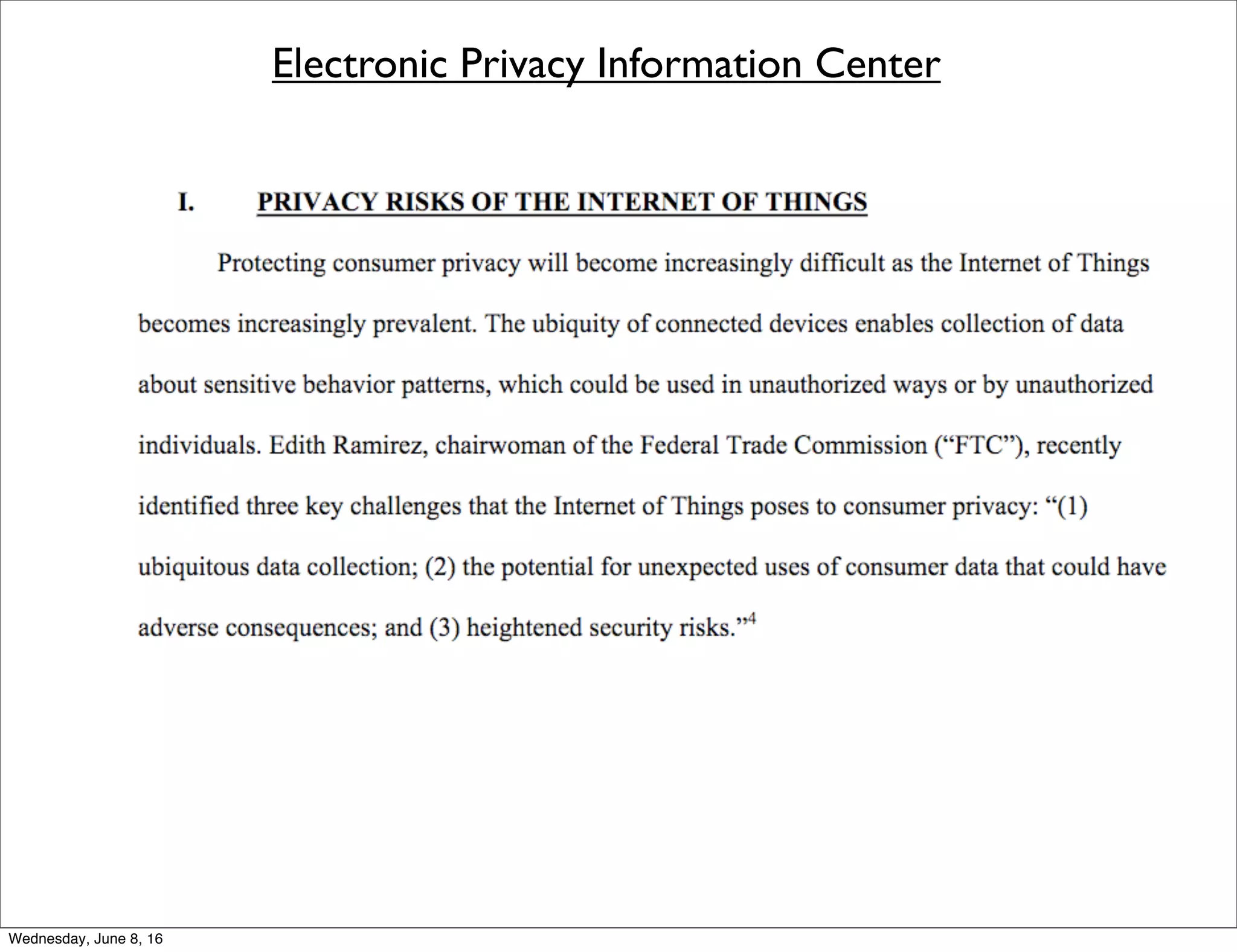
Electronic Privacy Information Center
Ericsson
Family Online Safety Institute
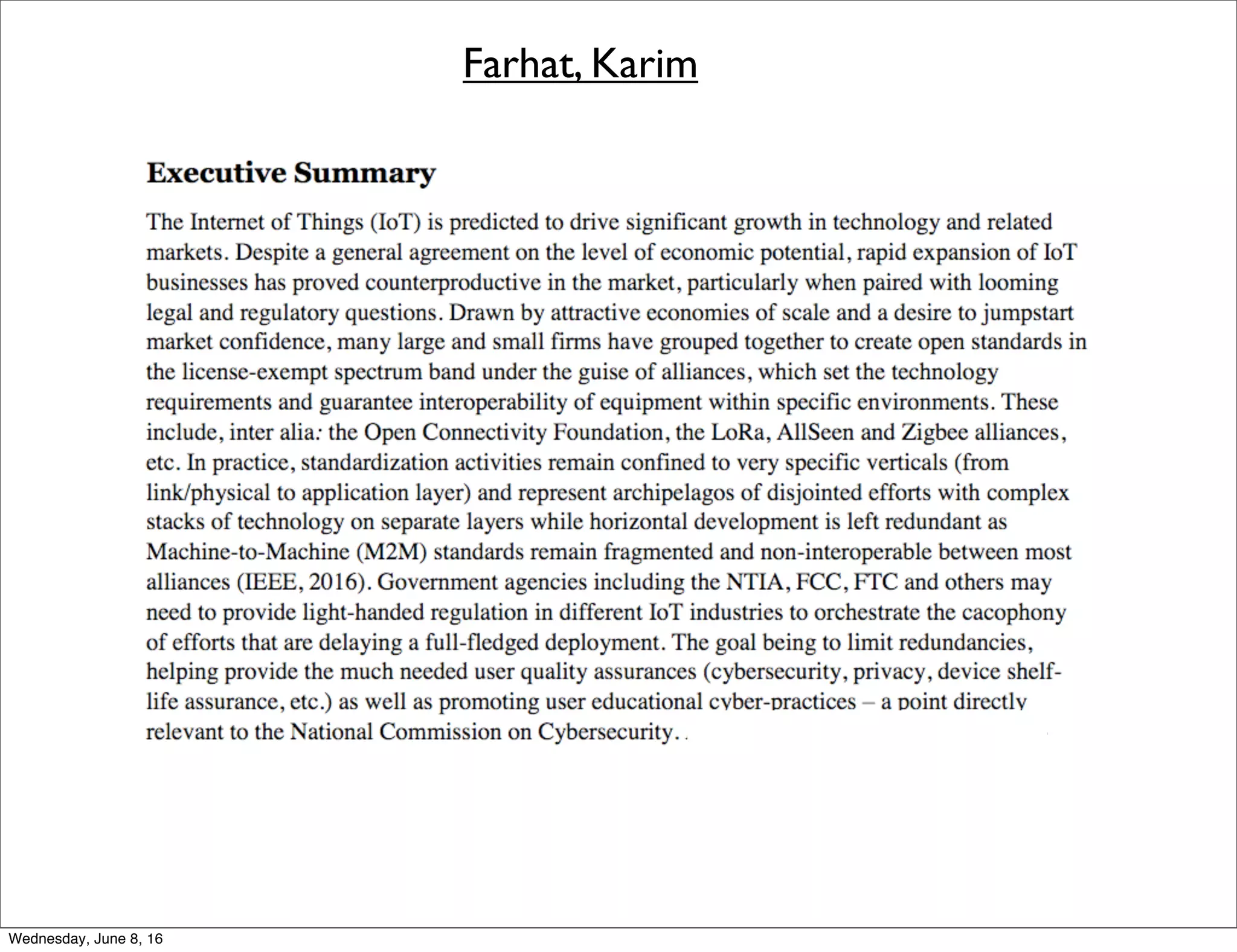
Farhat, Karim
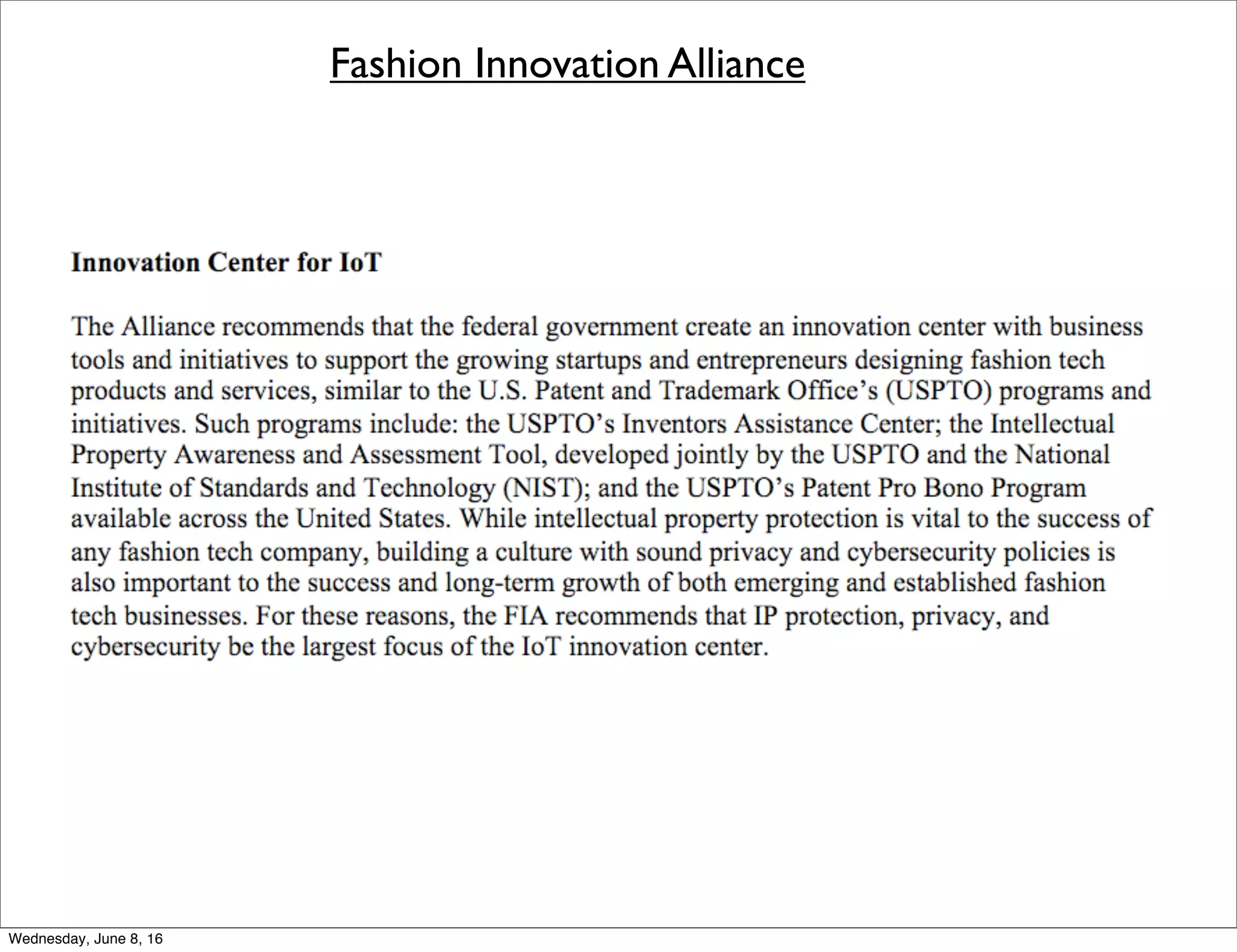
Fashion Innovation Alliance
Future of Privacy Forum
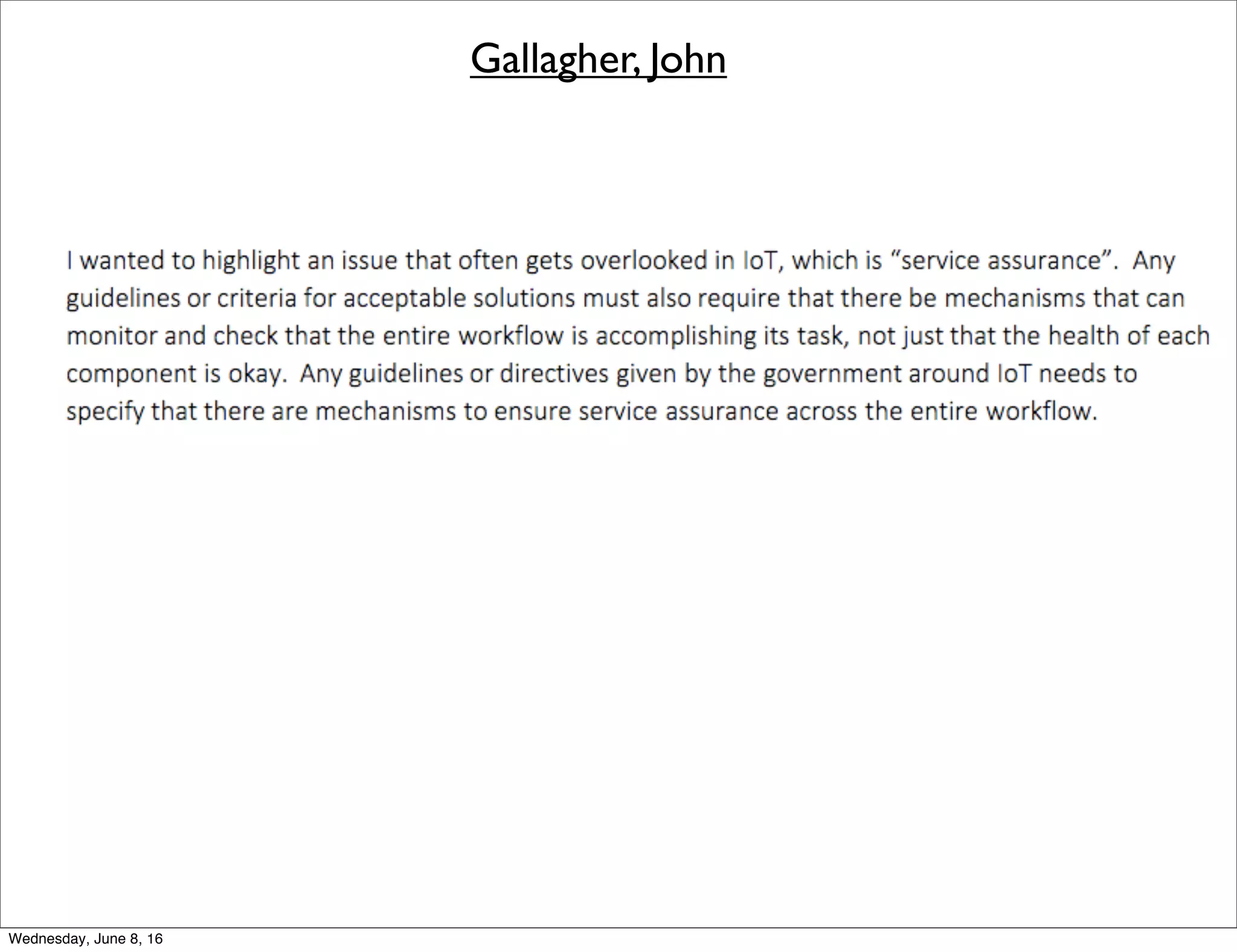
Gallagher, John
General Motors, LLC
Georgia Institute of Technology, Center for Advanced Communications Policy and Rehabilitation Engineering Research
Center for Wireless Technologies
GS1 US
GSM Association
Hewlett Packard Enterprise
Thursday, June 9, 16
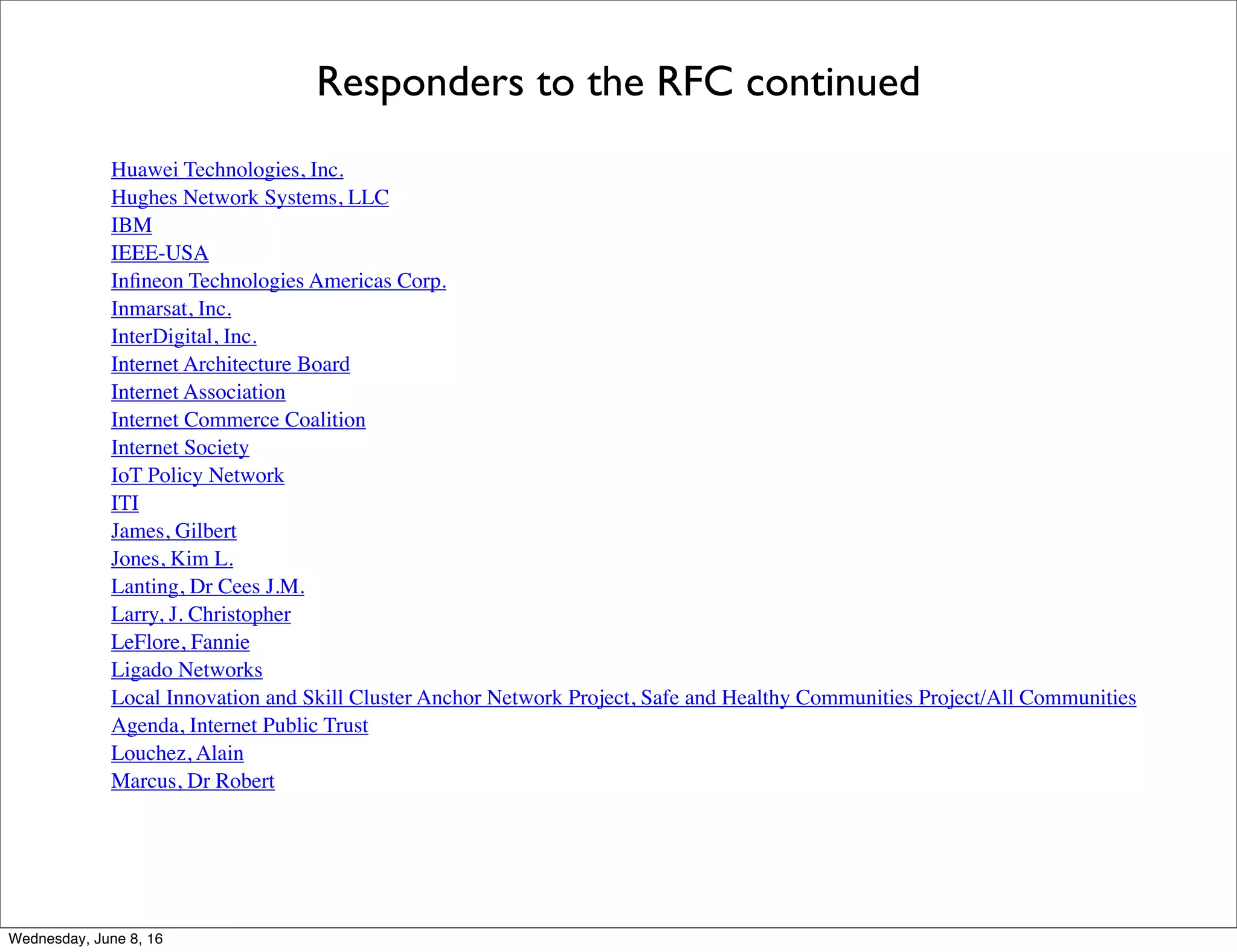
Responders to the RFC continued
Huawei Technologies, Inc.
Hughes Network Systems, LLC
IBM
IEEE-USA
Infineon Technologies Americas Corp.
Inmarsat, Inc.
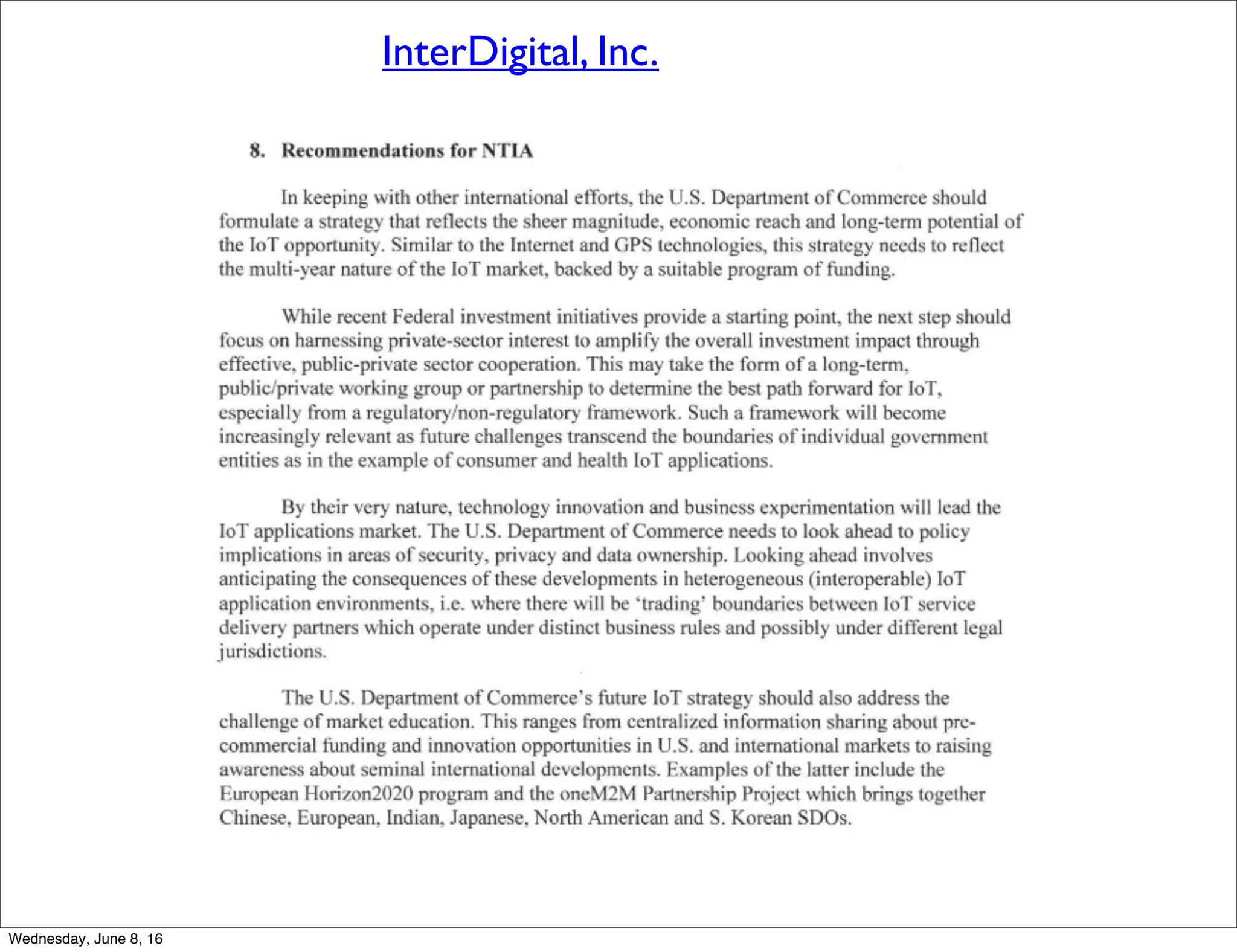
InterDigital, Inc.
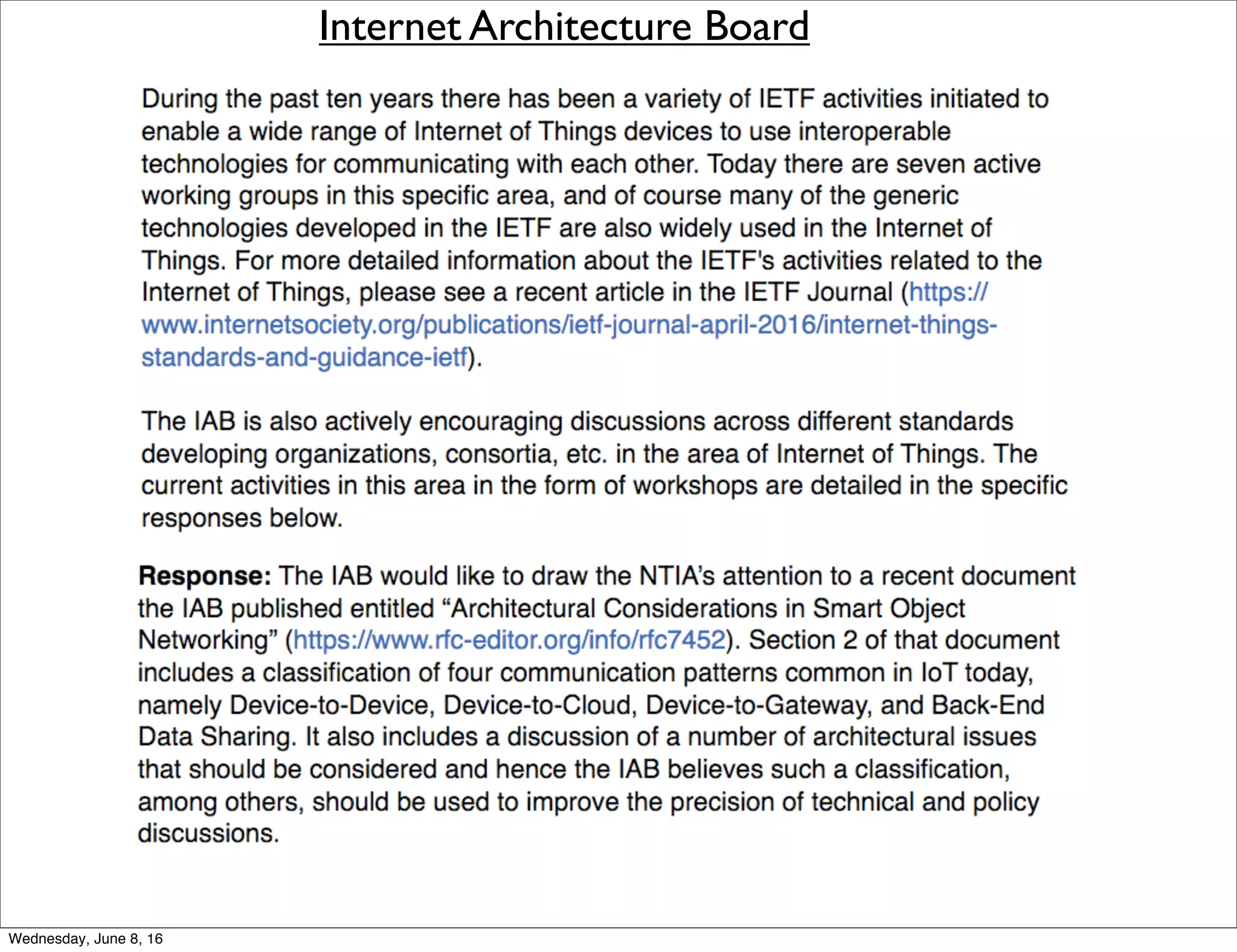
Internet Architecture Board
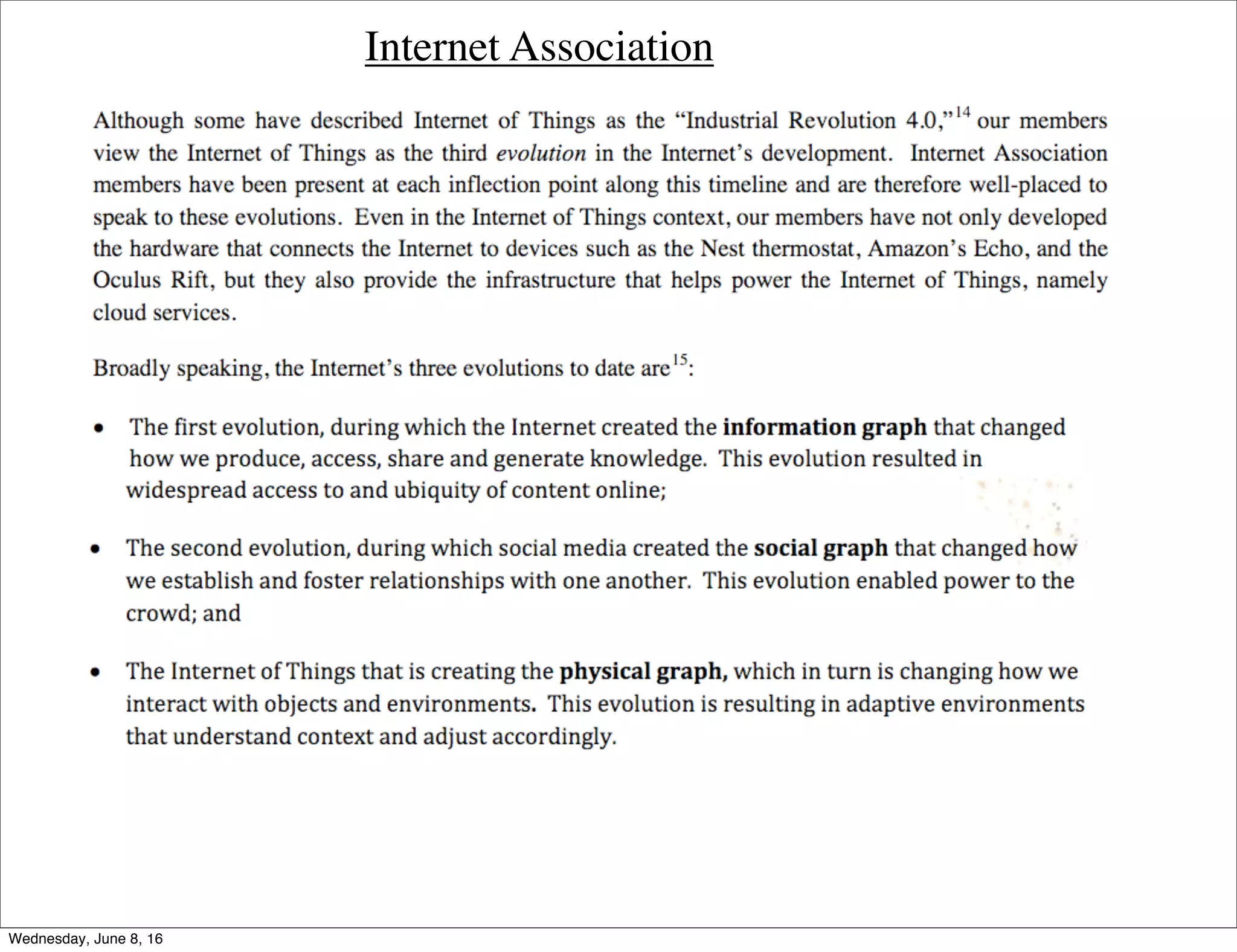
Internet Association
Internet Commerce Coalition
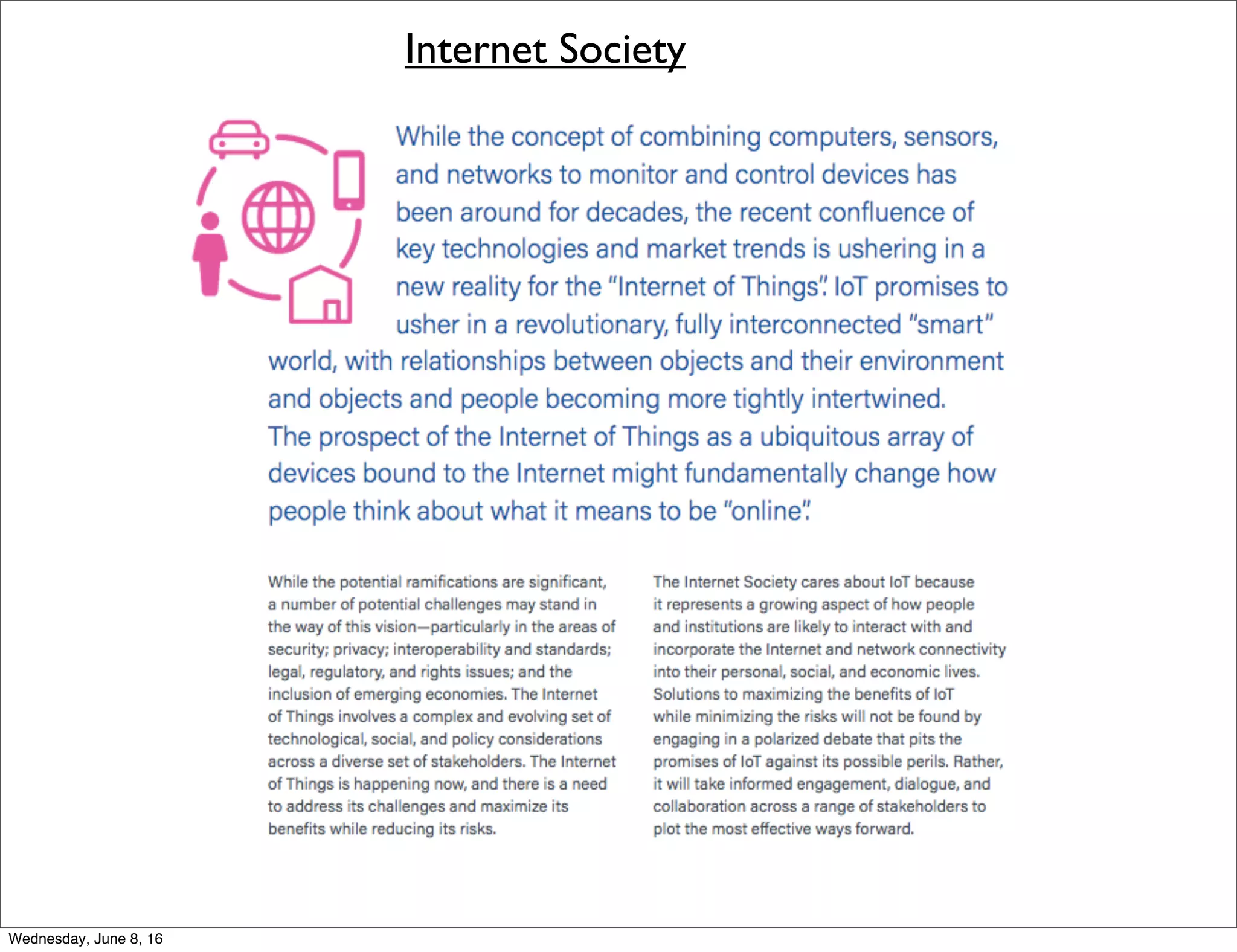
Internet Society
IoT Policy Network
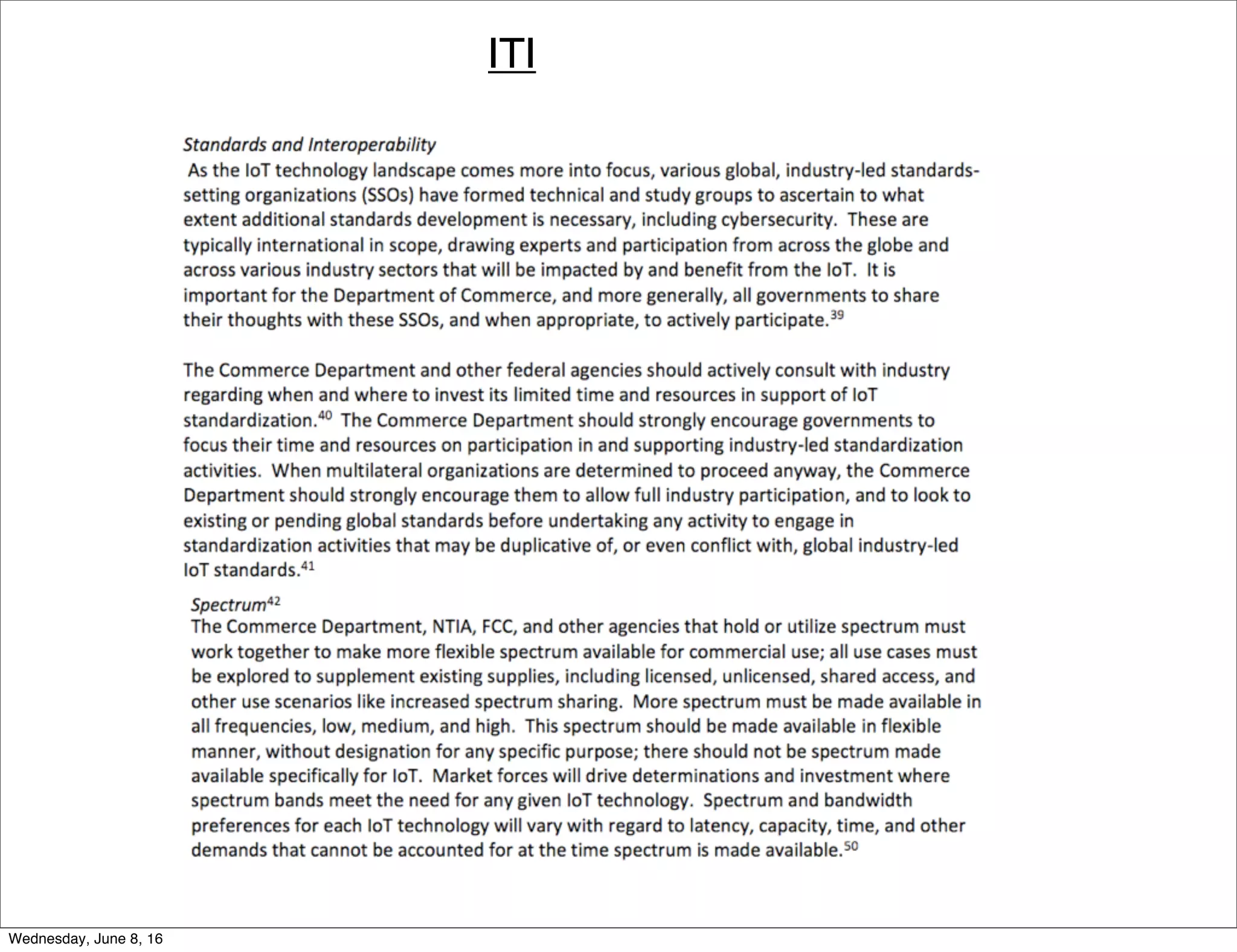
ITI
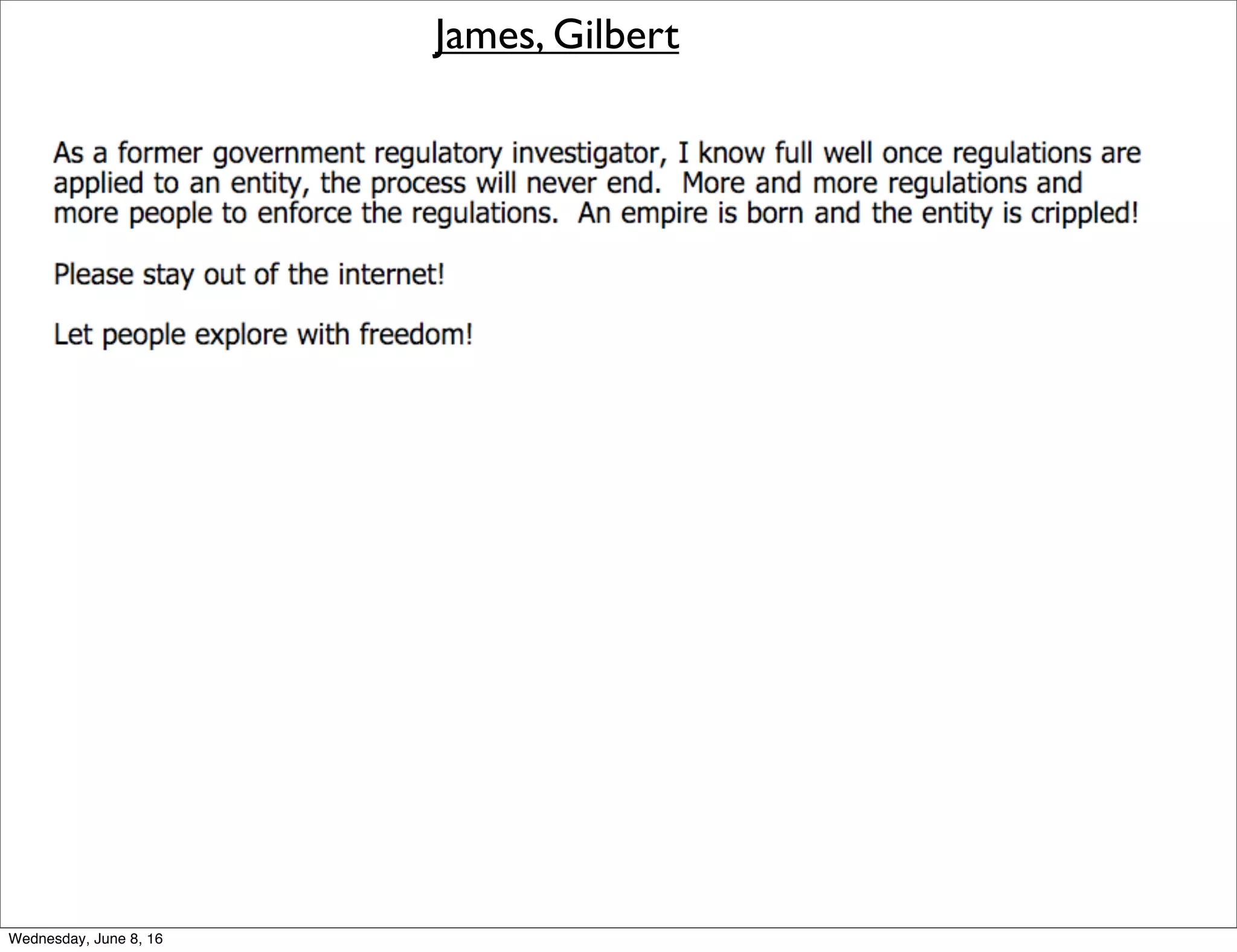
James, Gilbert
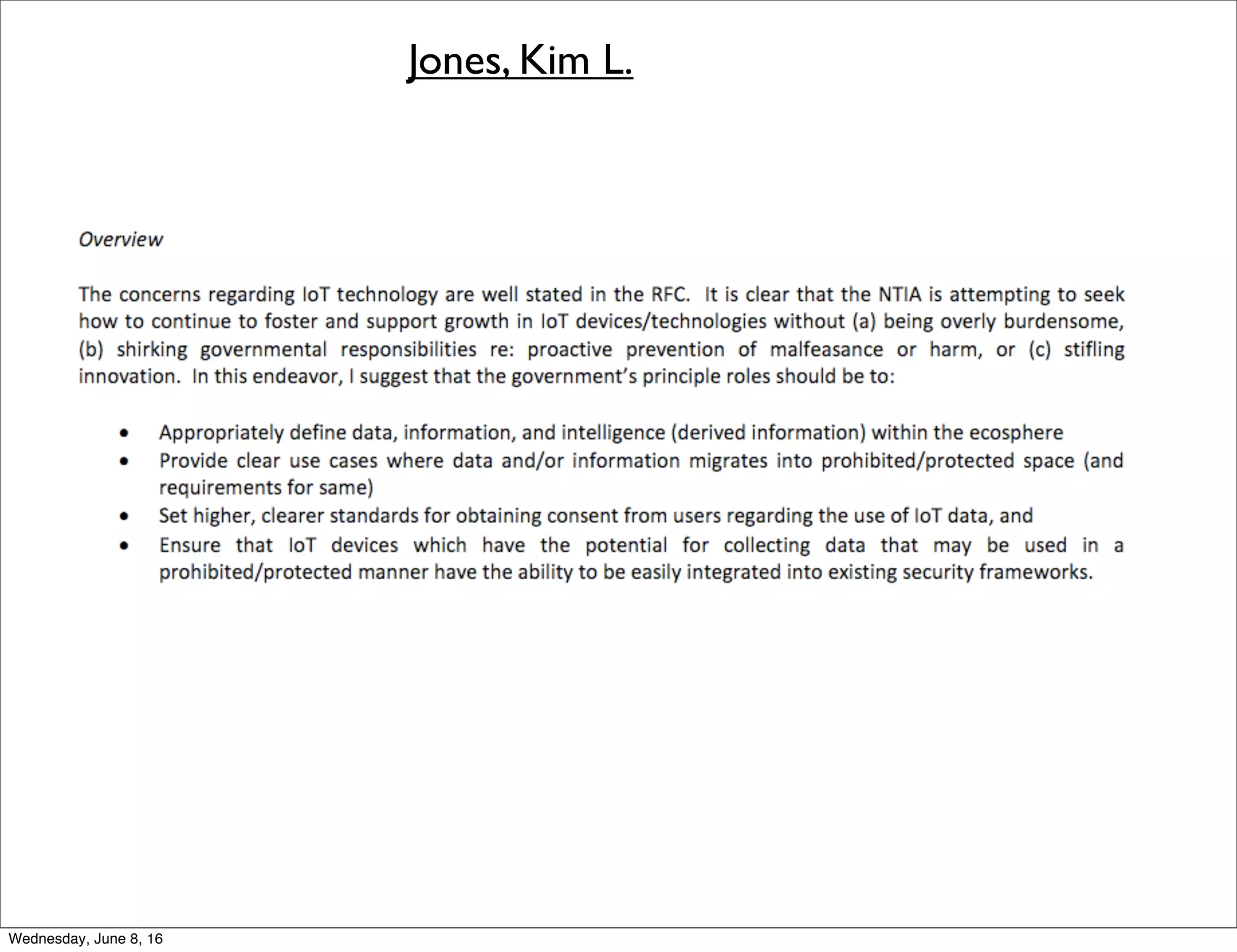
Jones, Kim L.
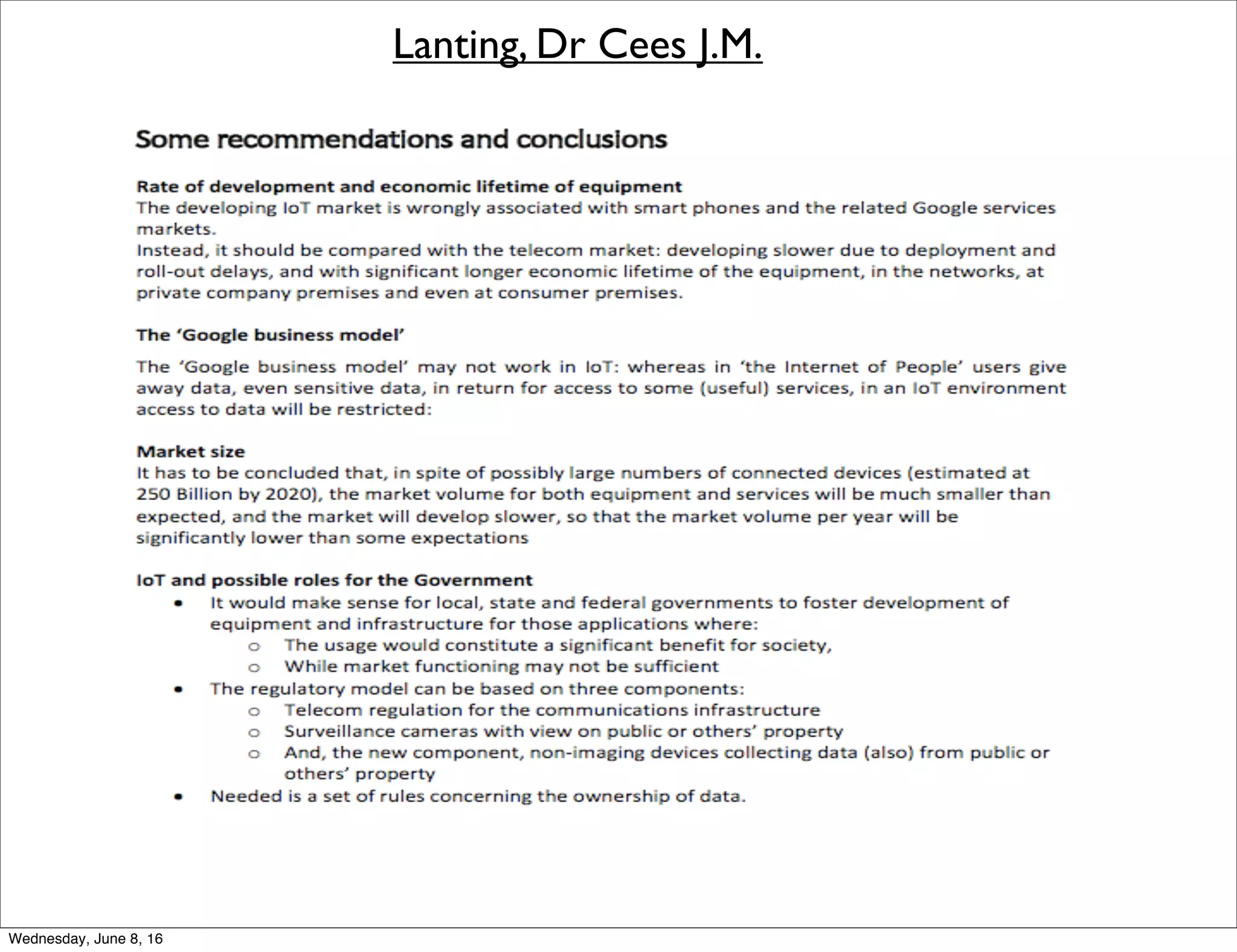
Lanting, Dr Cees J.M.
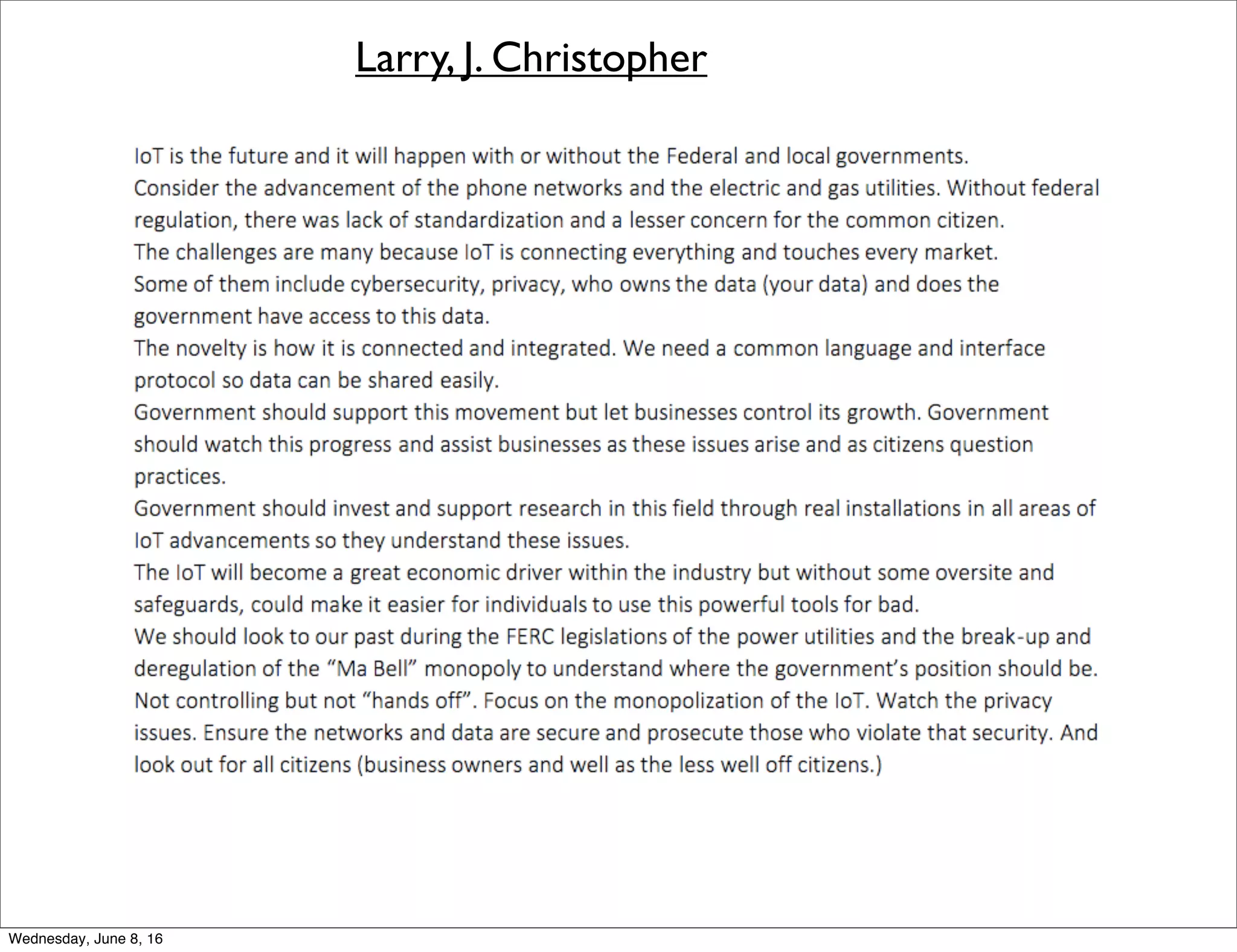
Larry, J. Christopher
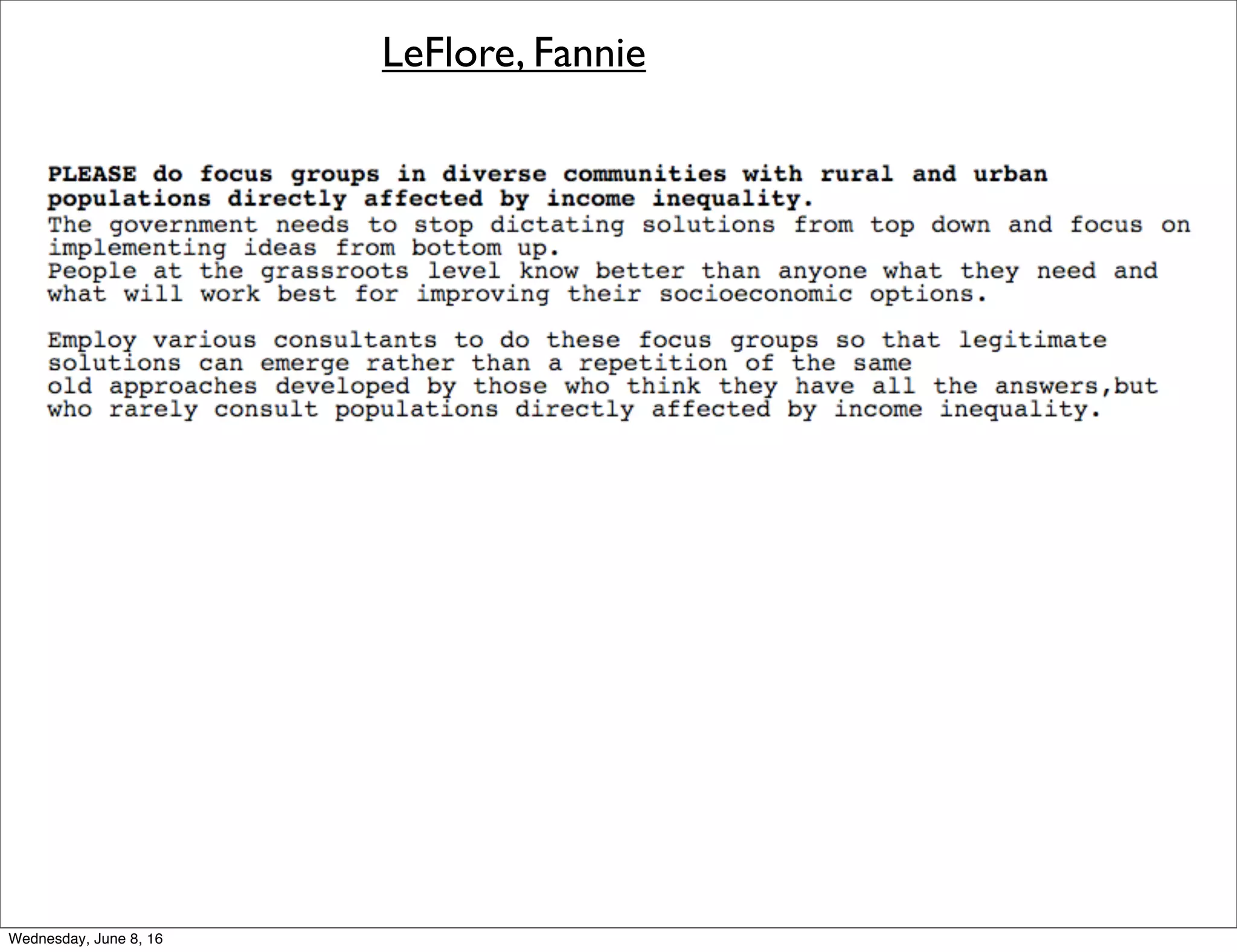
LeFlore, Fannie
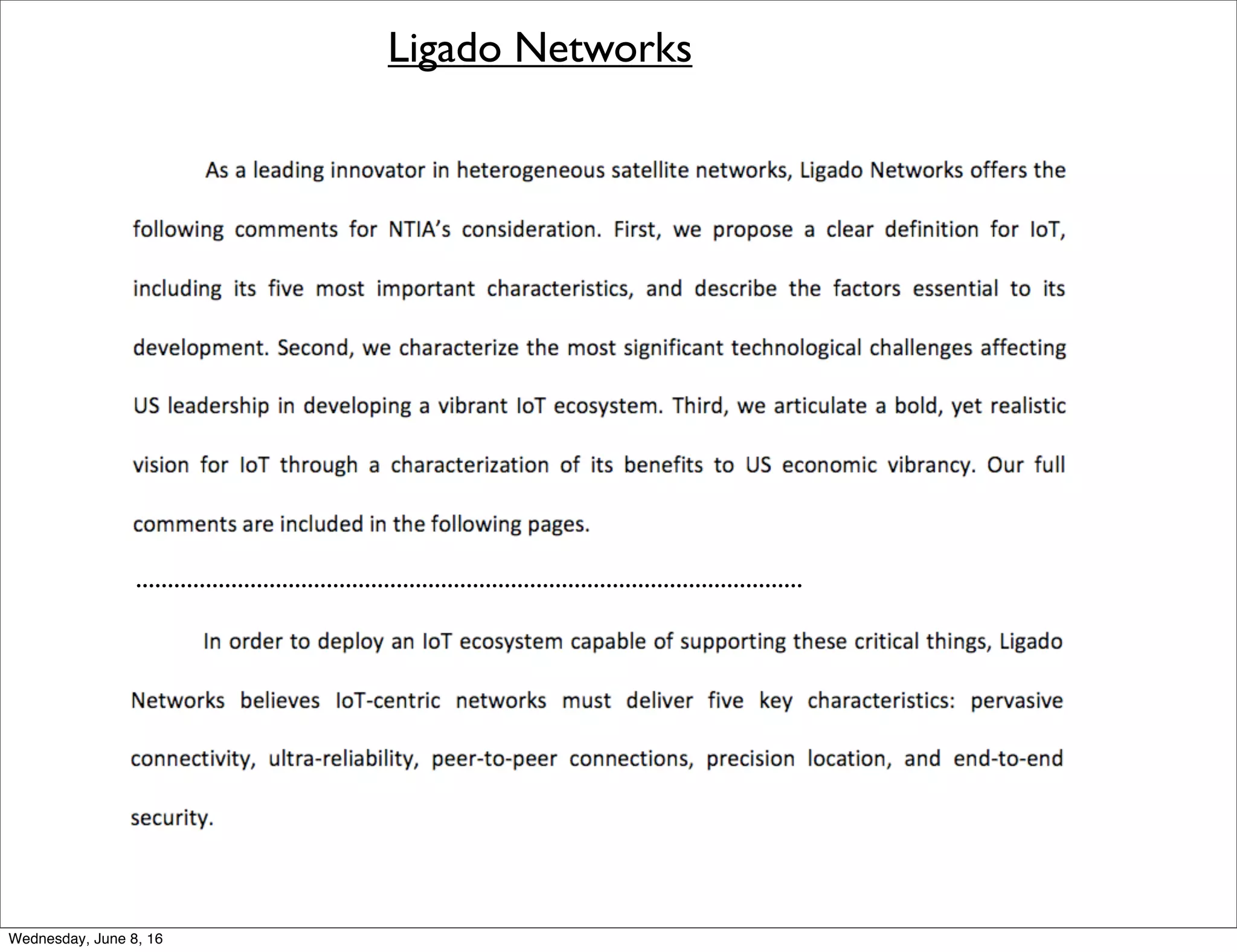
Ligado Networks
Local Innovation and Skill Cluster Anchor Network Project, Safe and Healthy Communities Project/All Communities
Agenda, Internet Public Trust
Louchez, Alain
Marcus, Dr Robert
Thursday, June 9, 16
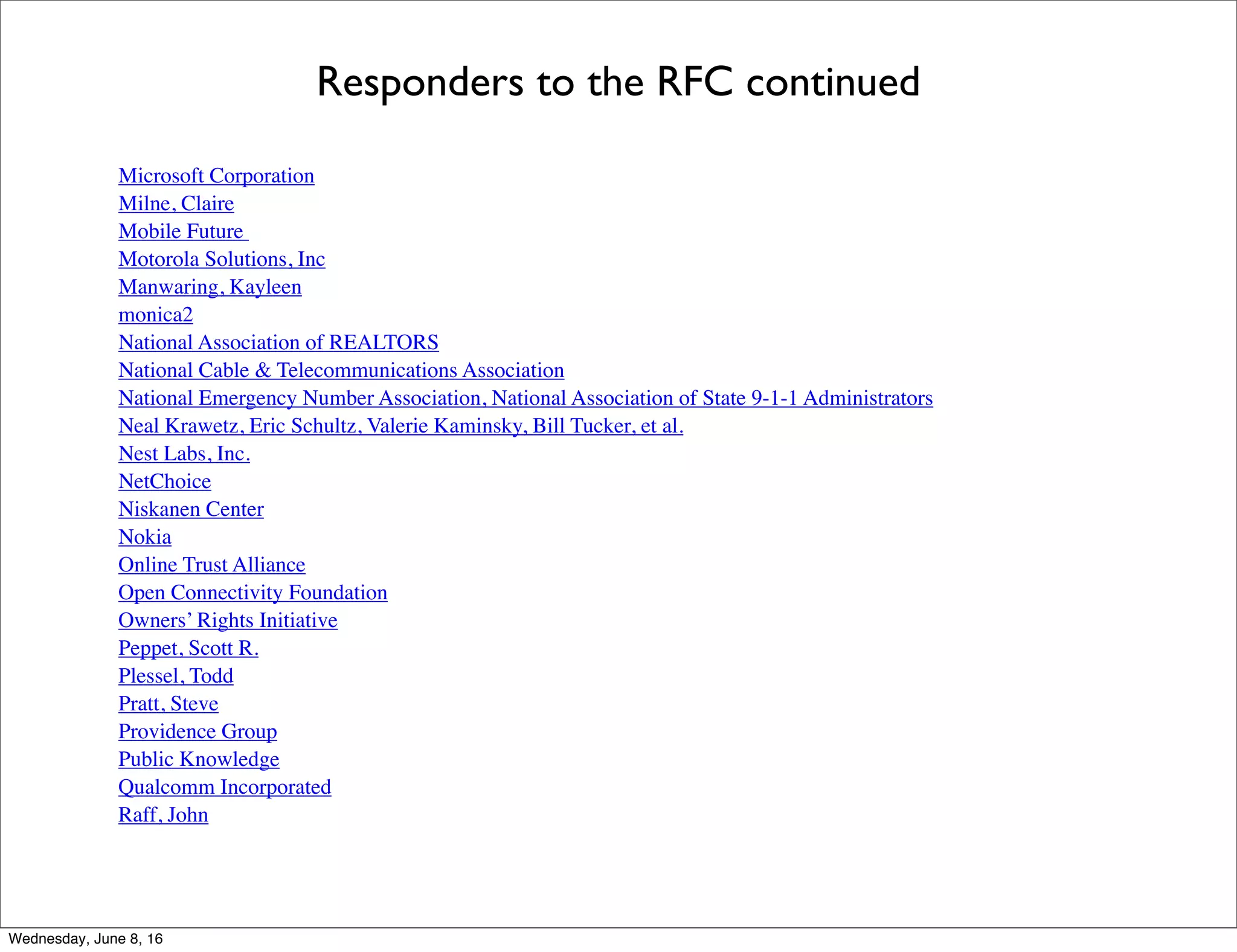
Responders to the RFC continued
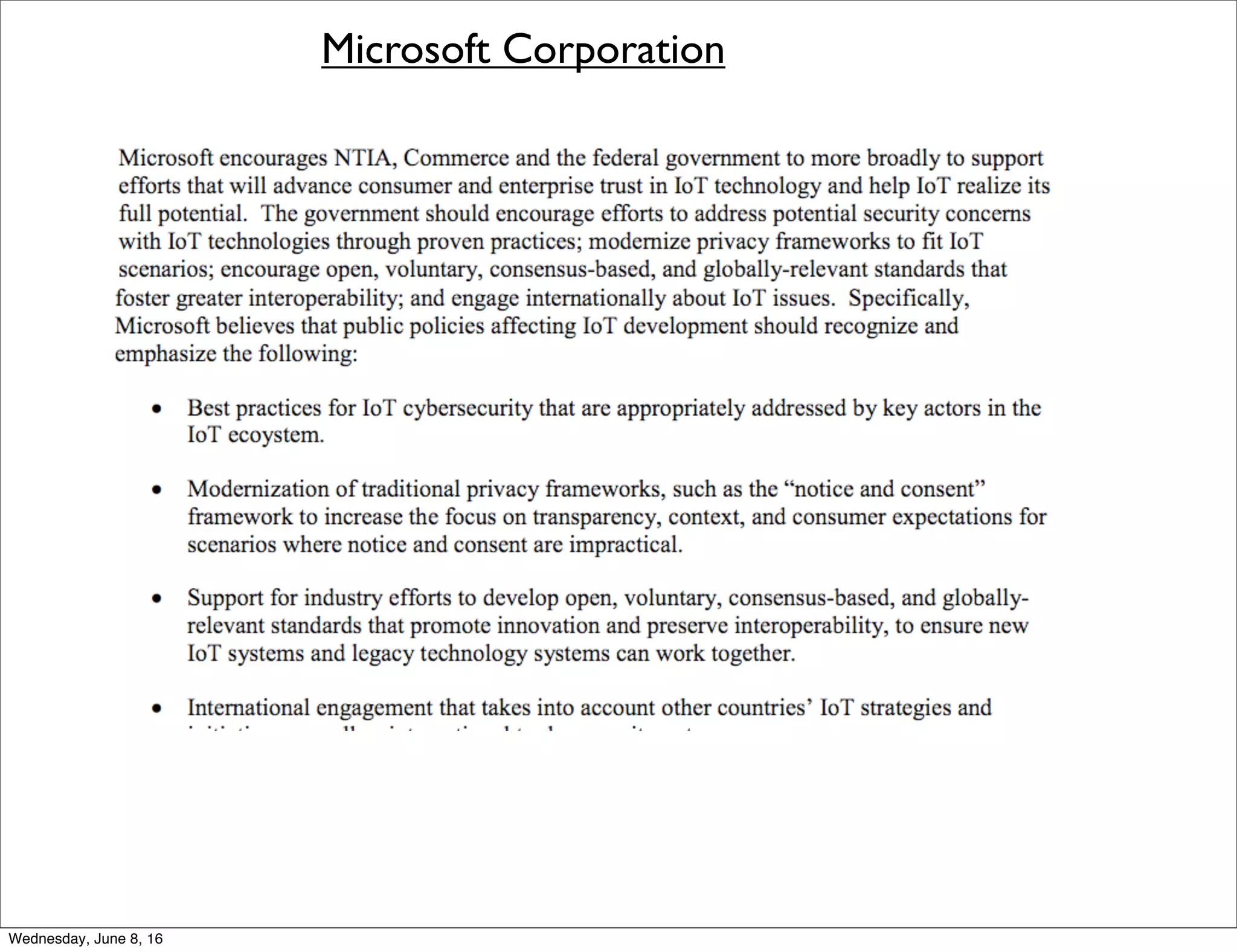
Microsoft Corporation
Milne, Claire
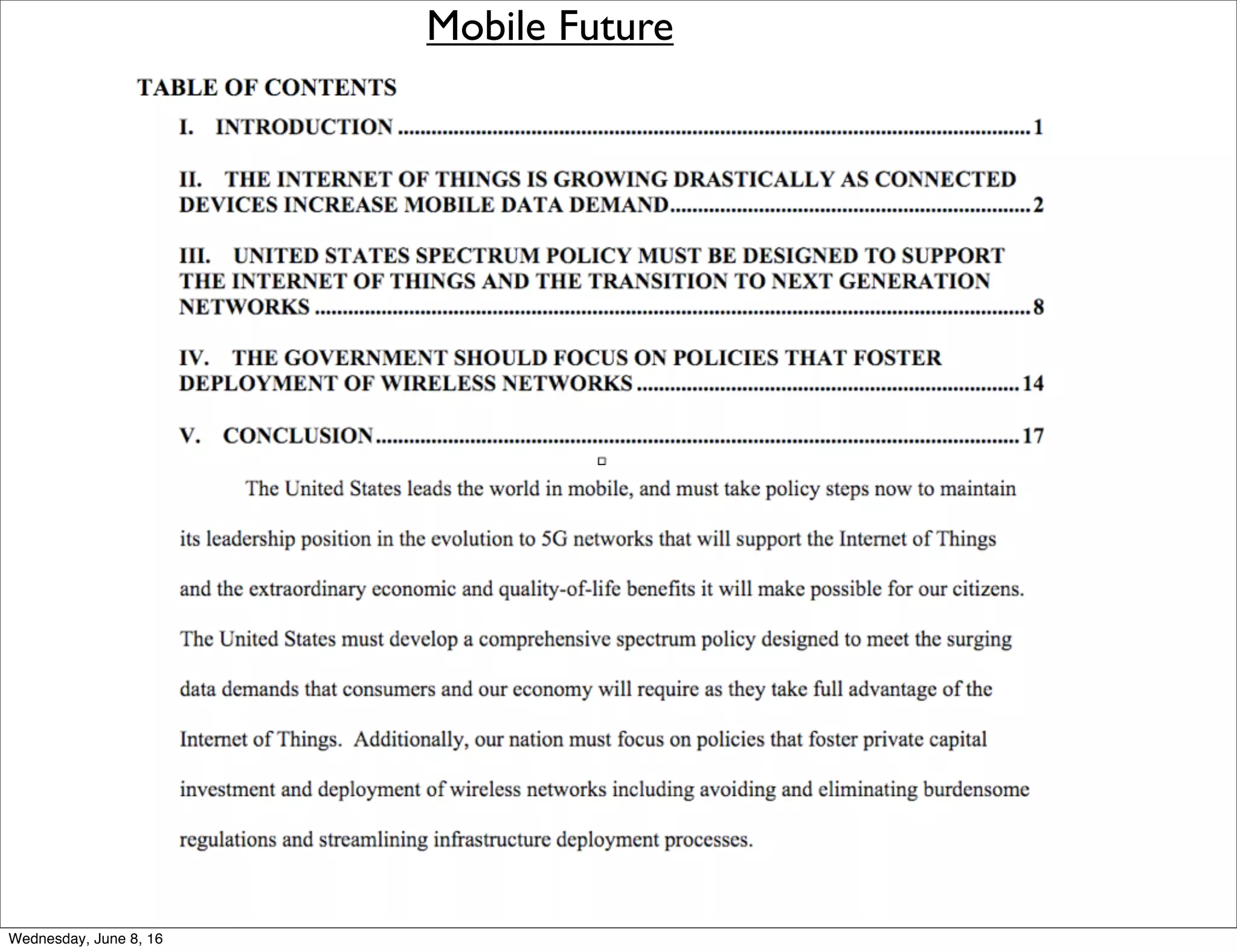
Mobile Future
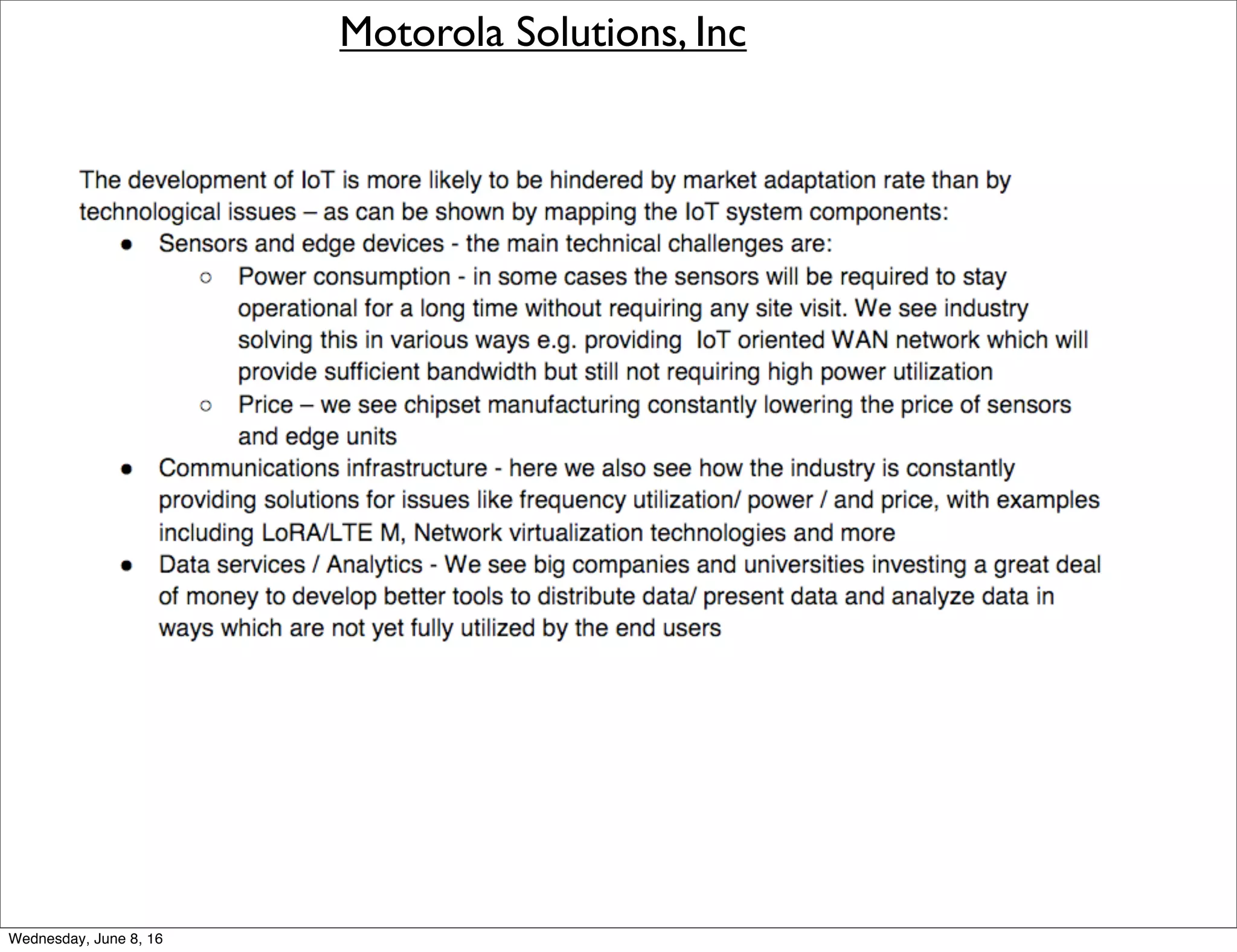
Motorola Solutions, Inc
Manwaring, Kayleen
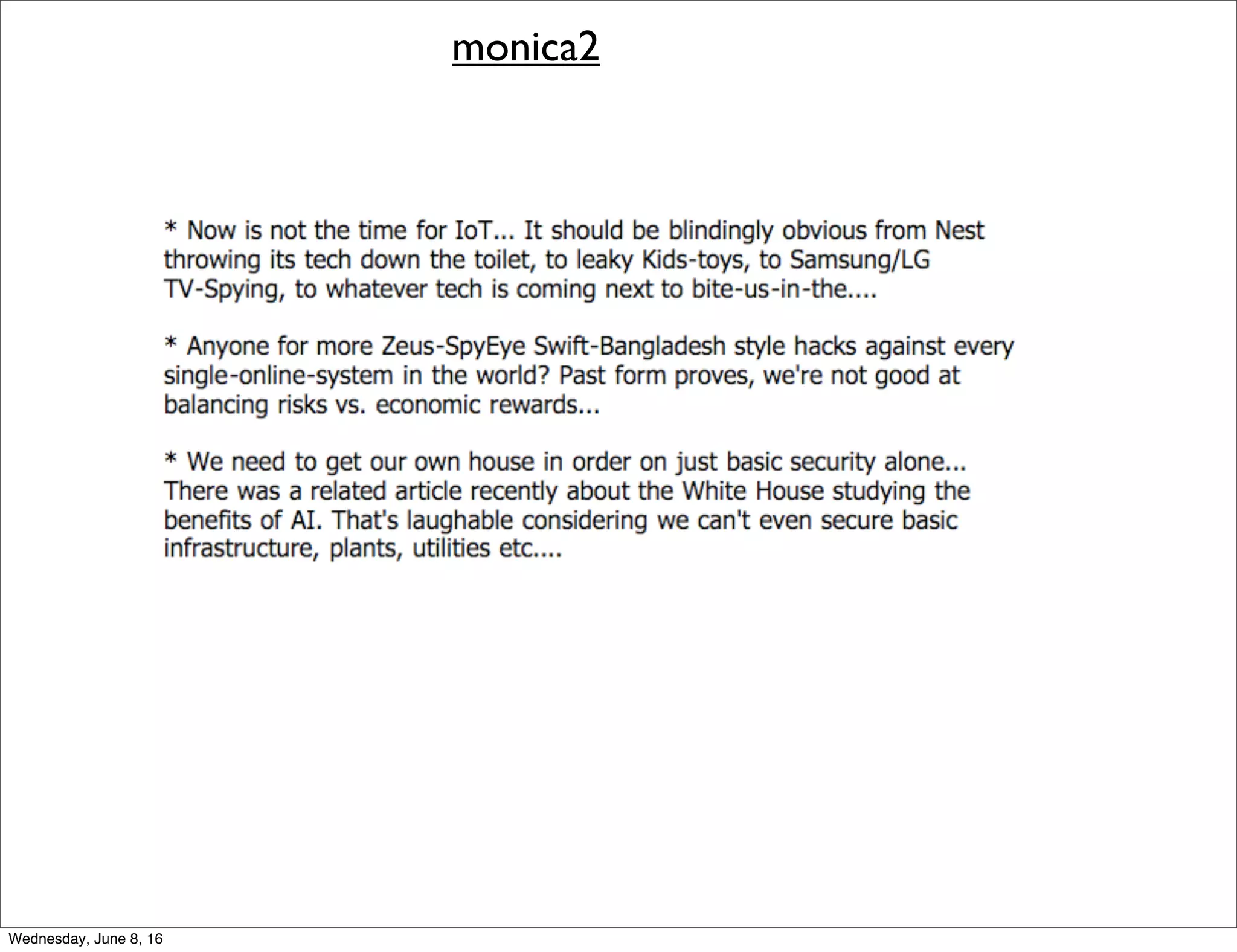
monica2
National Association of REALTORS
National Cable & Telecommunications Association
National Emergency Number Association, National Association of State 9-1-1 Administrators
Nest Labs, Inc.
NetChoice
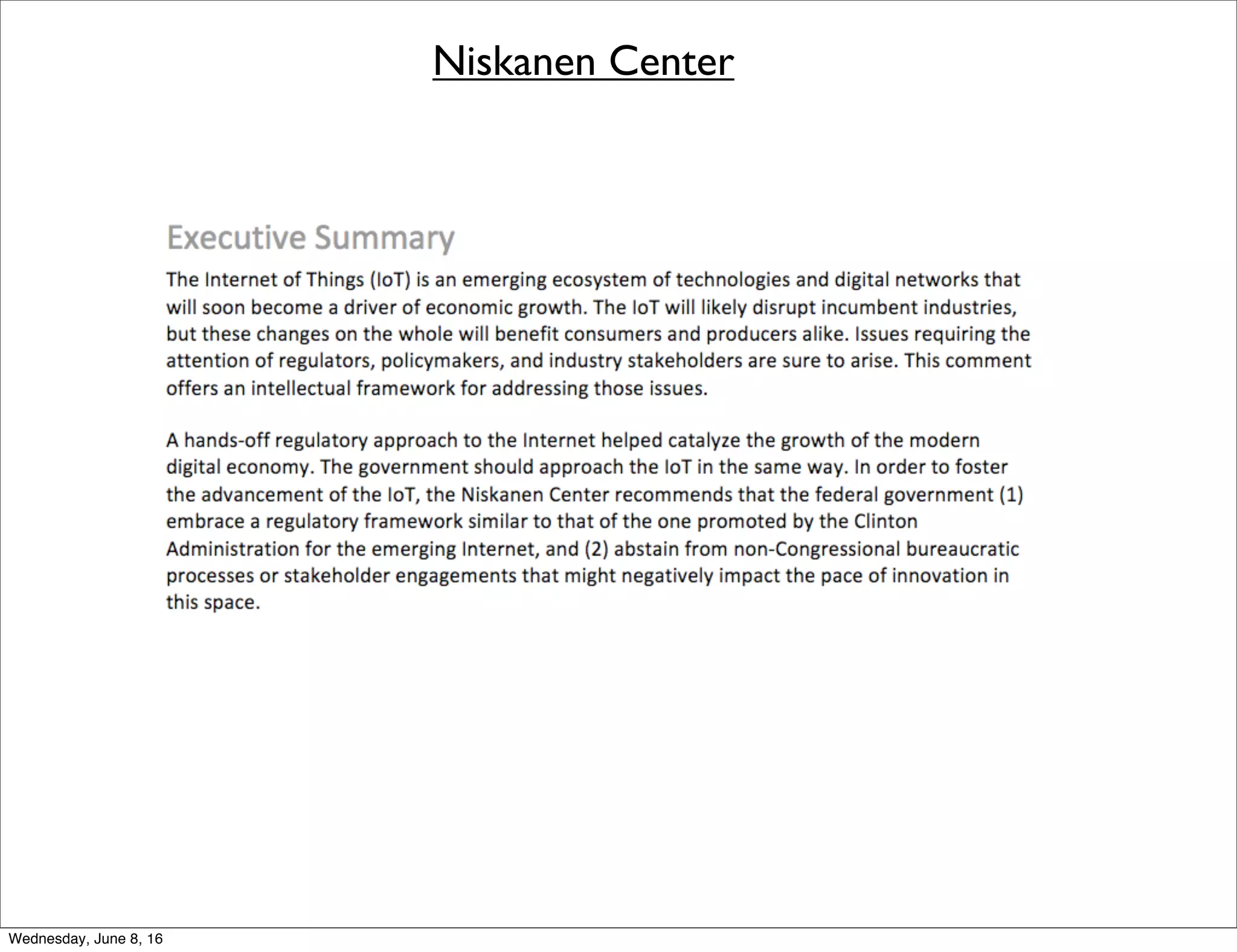
Niskanen Center
Nokia
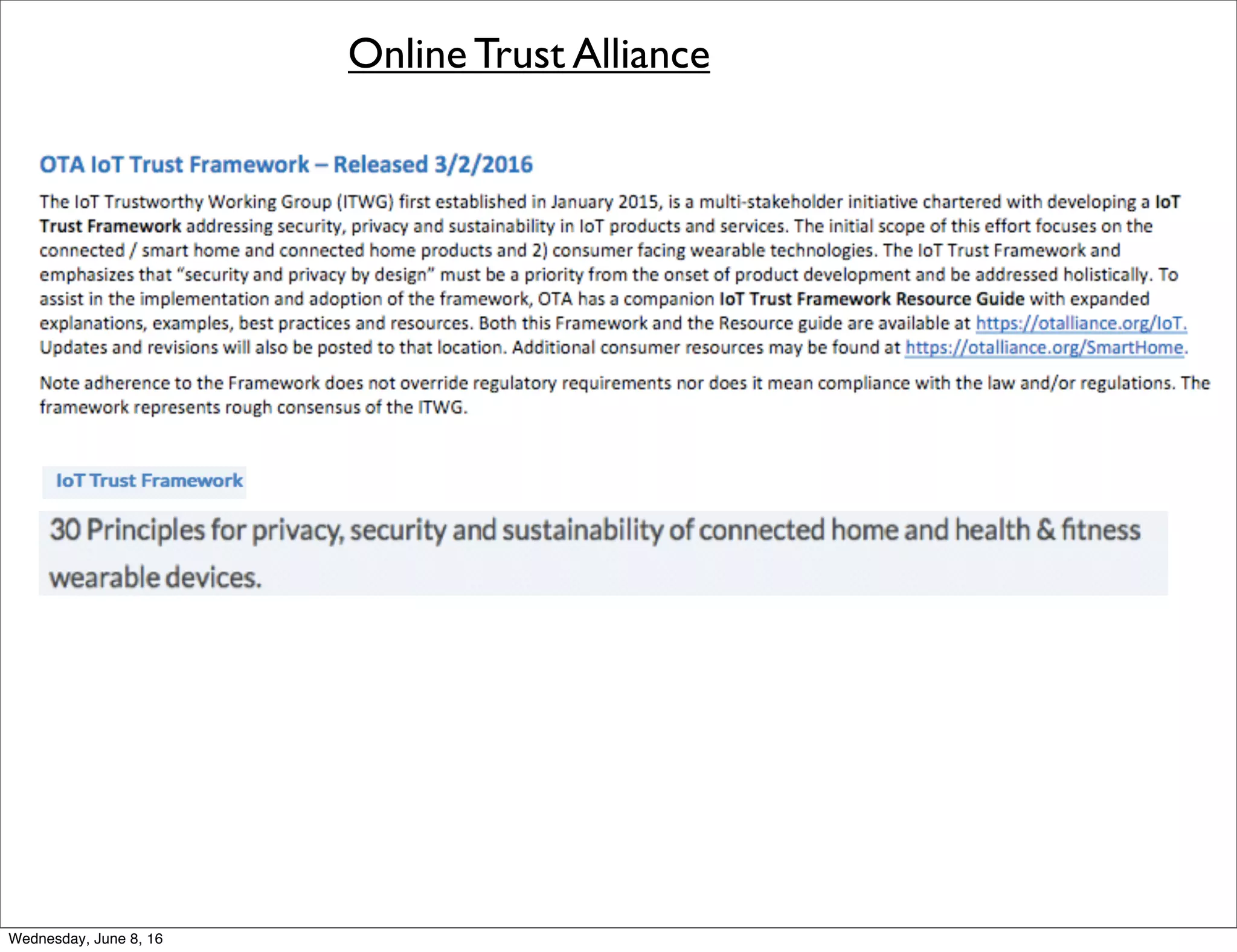
Online Trust Alliance
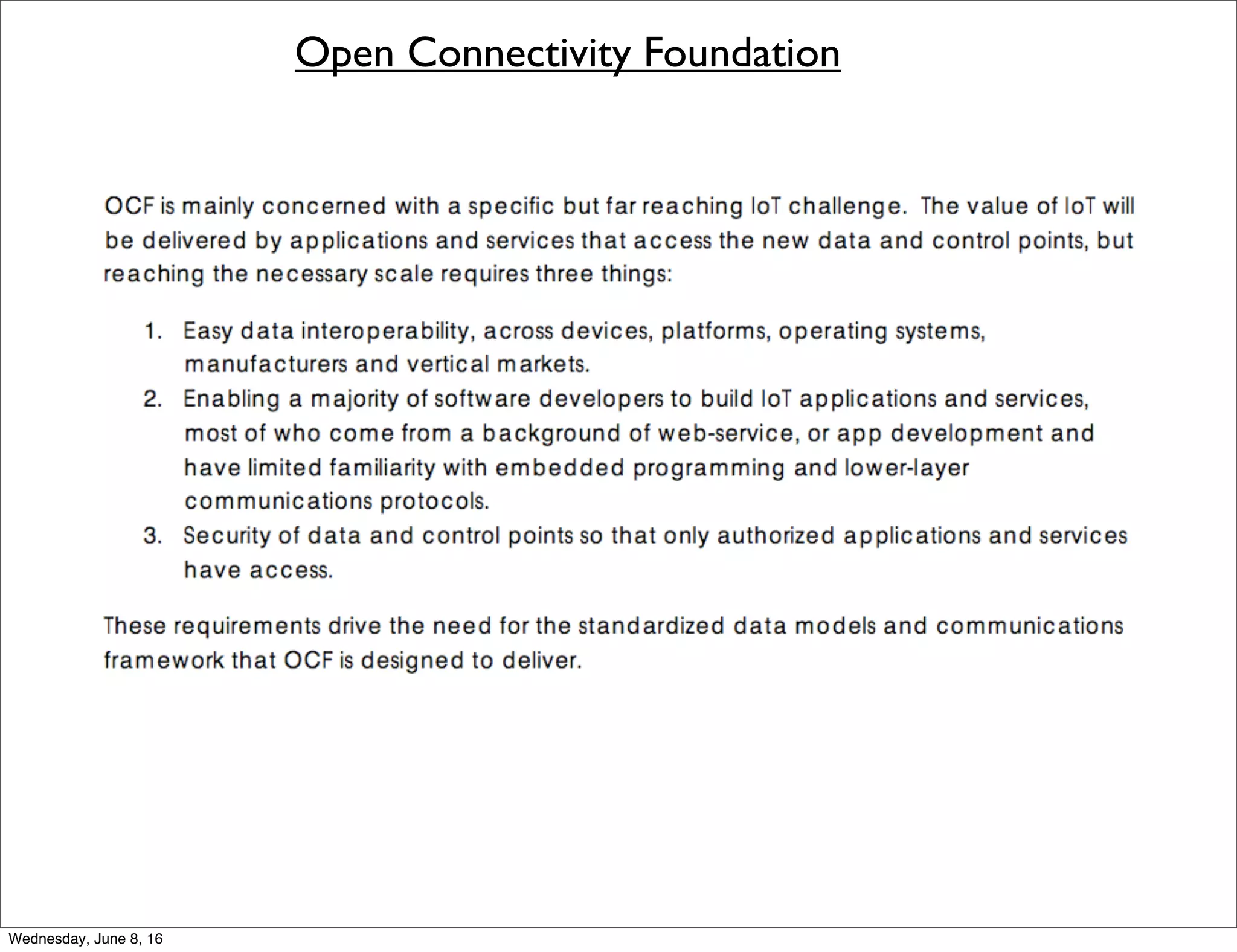
Open Connectivity Foundation
Owners’ Rights Initiative
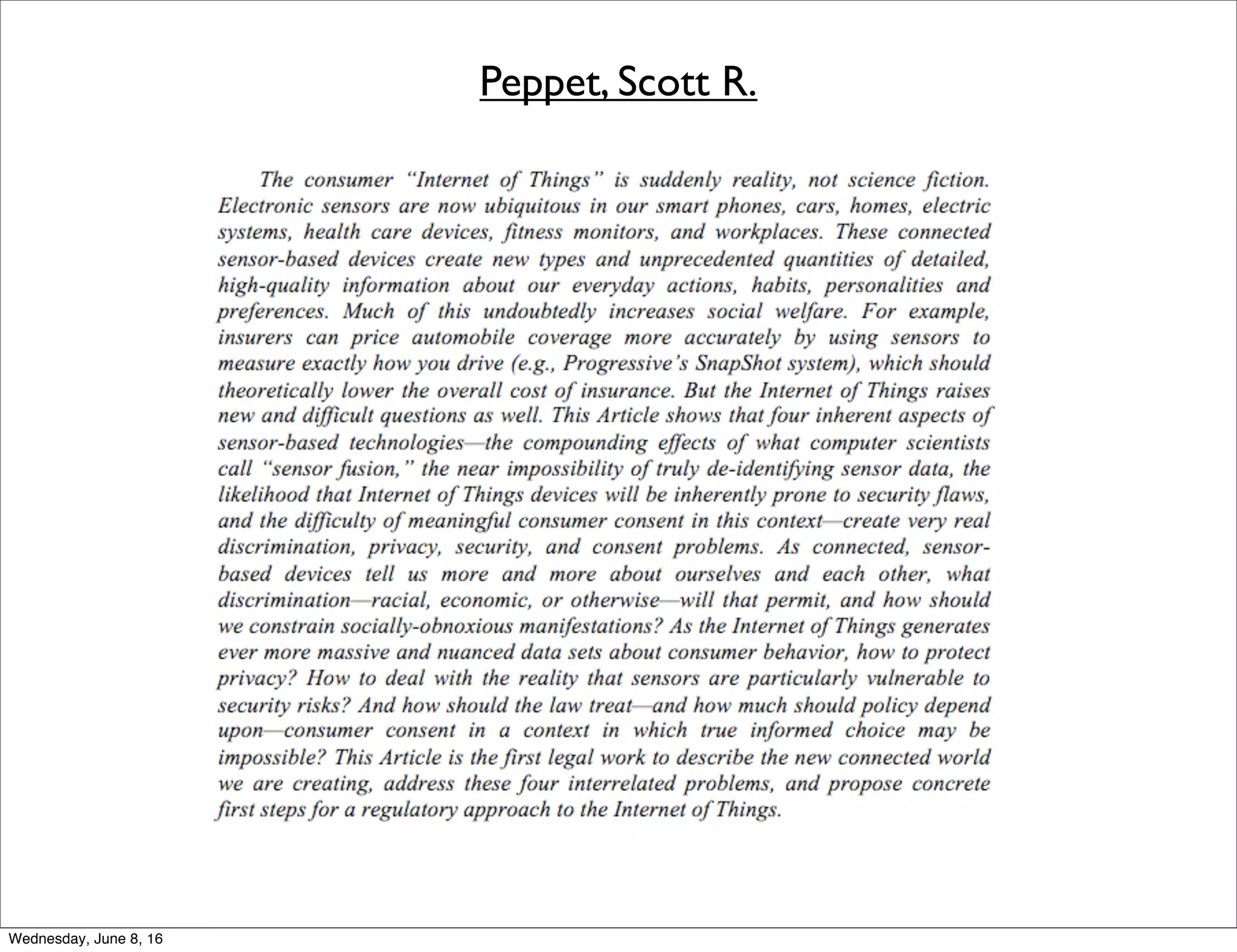
Peppet, Scott R.
Plessel, Todd
Pratt, Steve
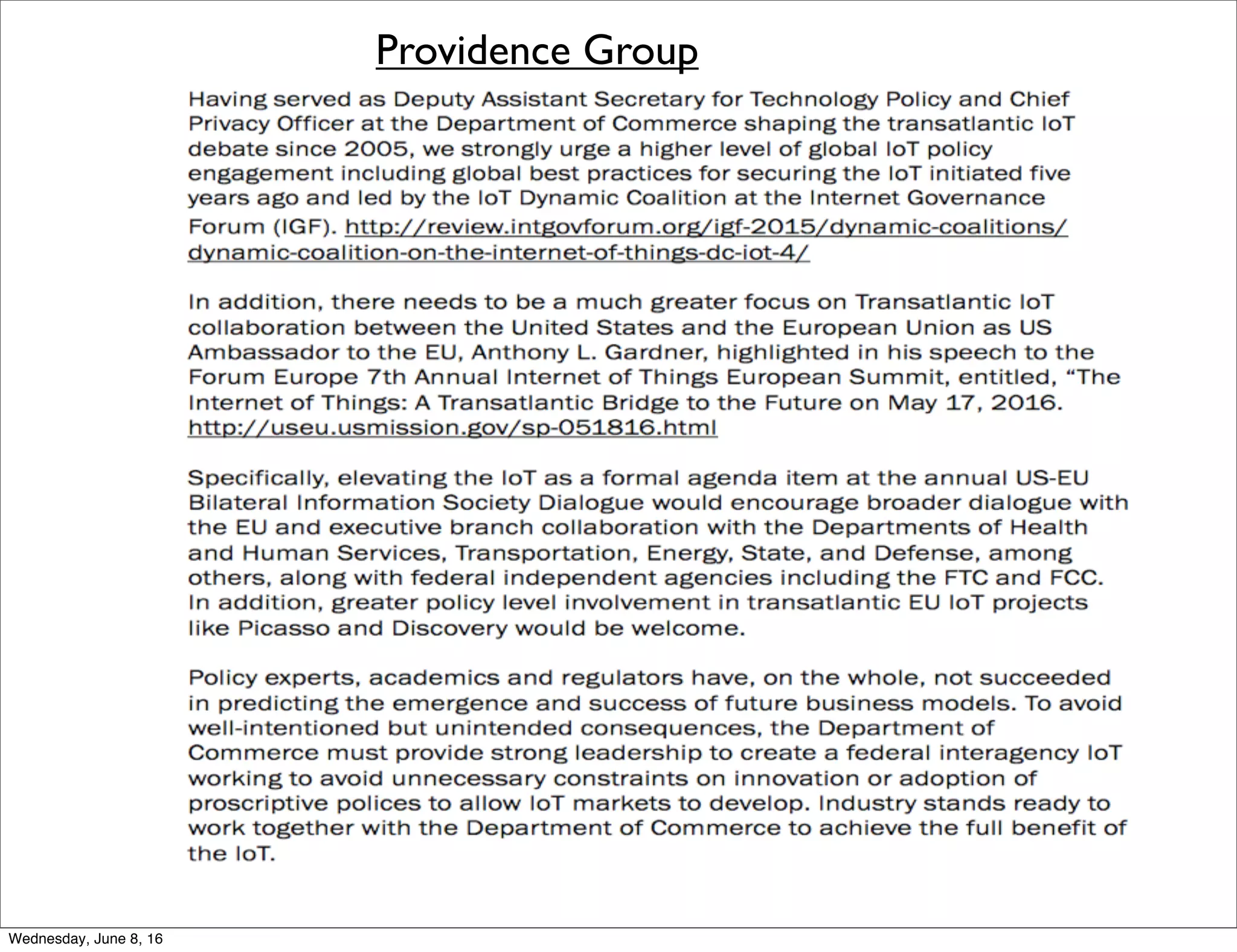
Providence Group
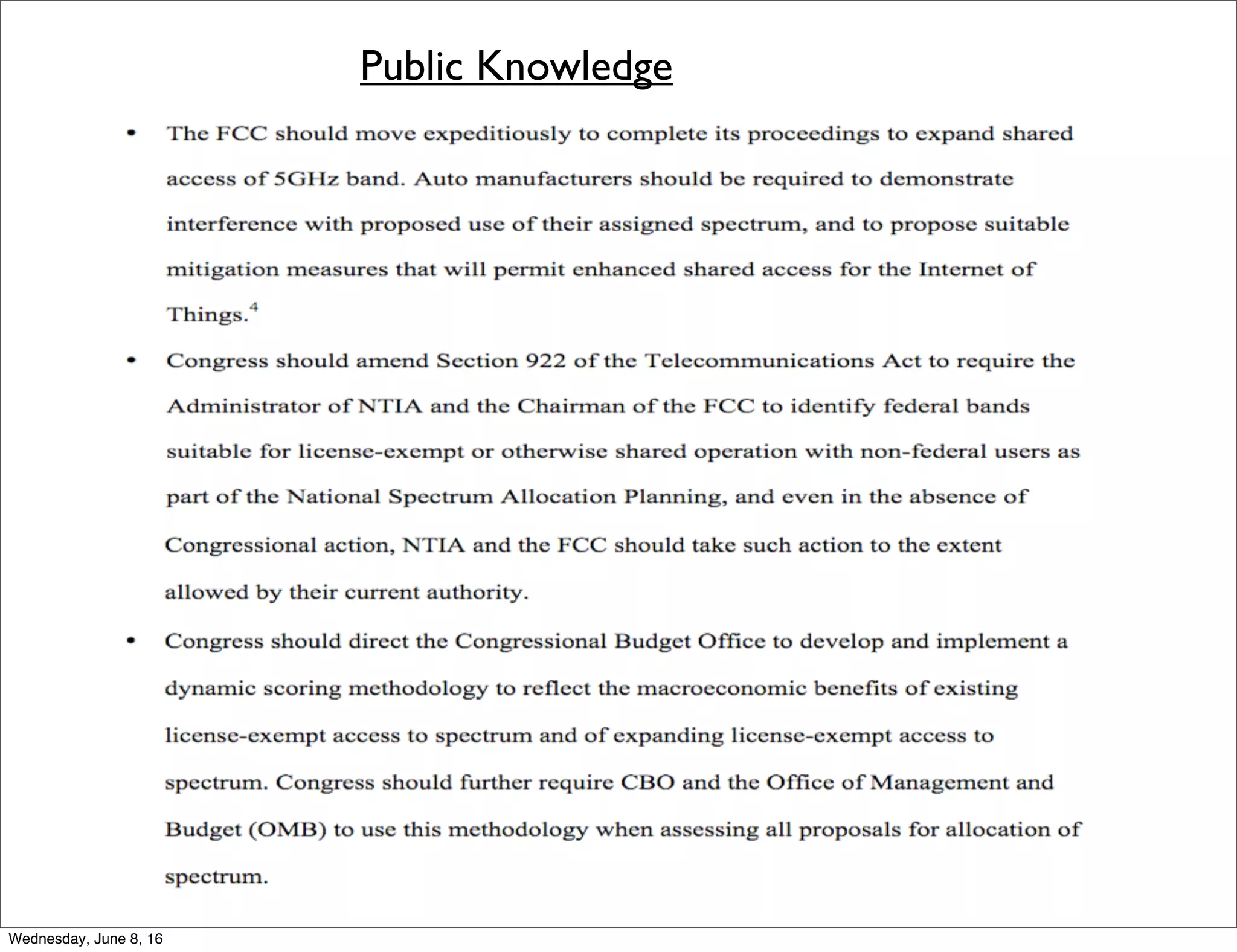
Public Knowledge
Qualcomm Incorporated
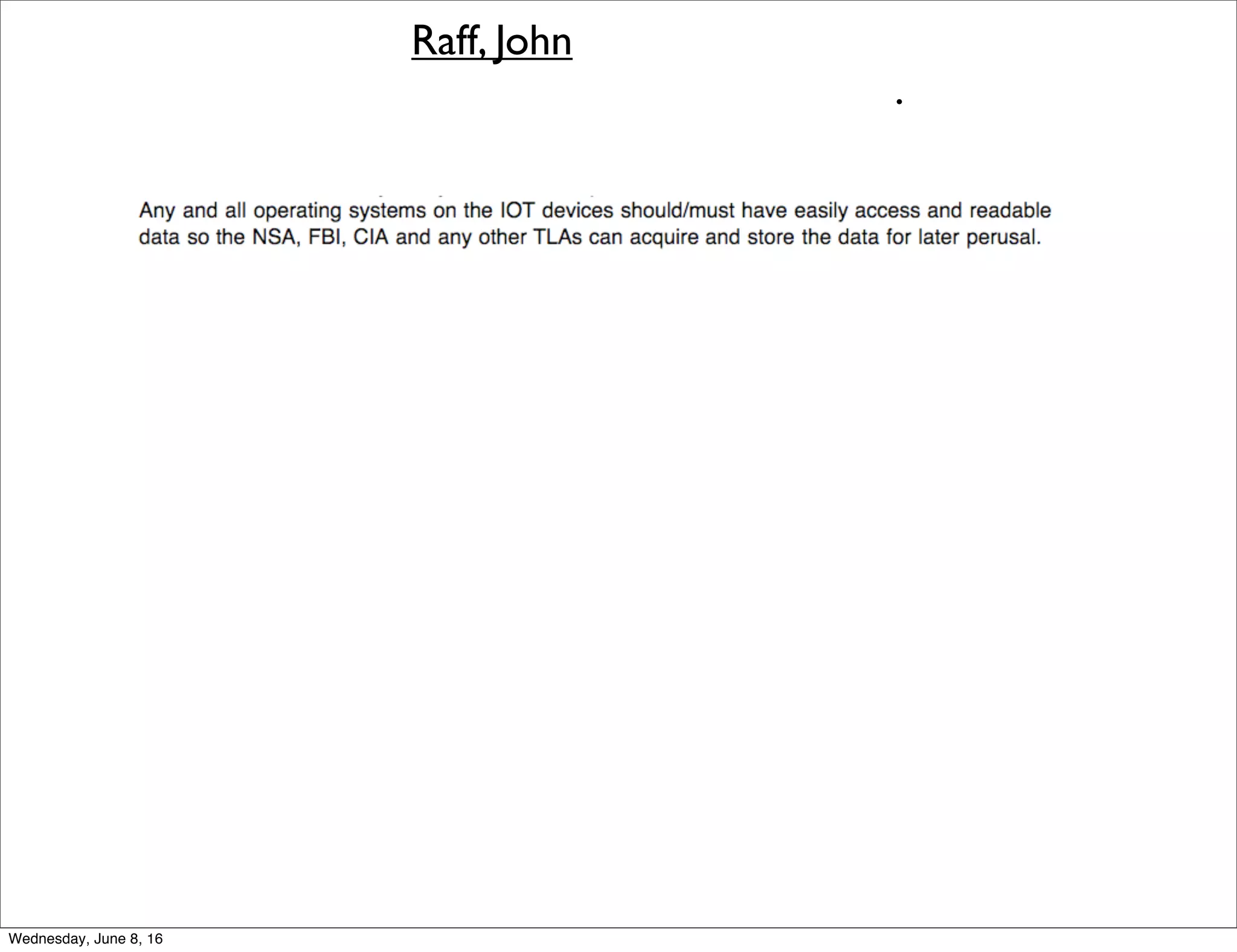
Raff, John
Thursday, June 9, 16
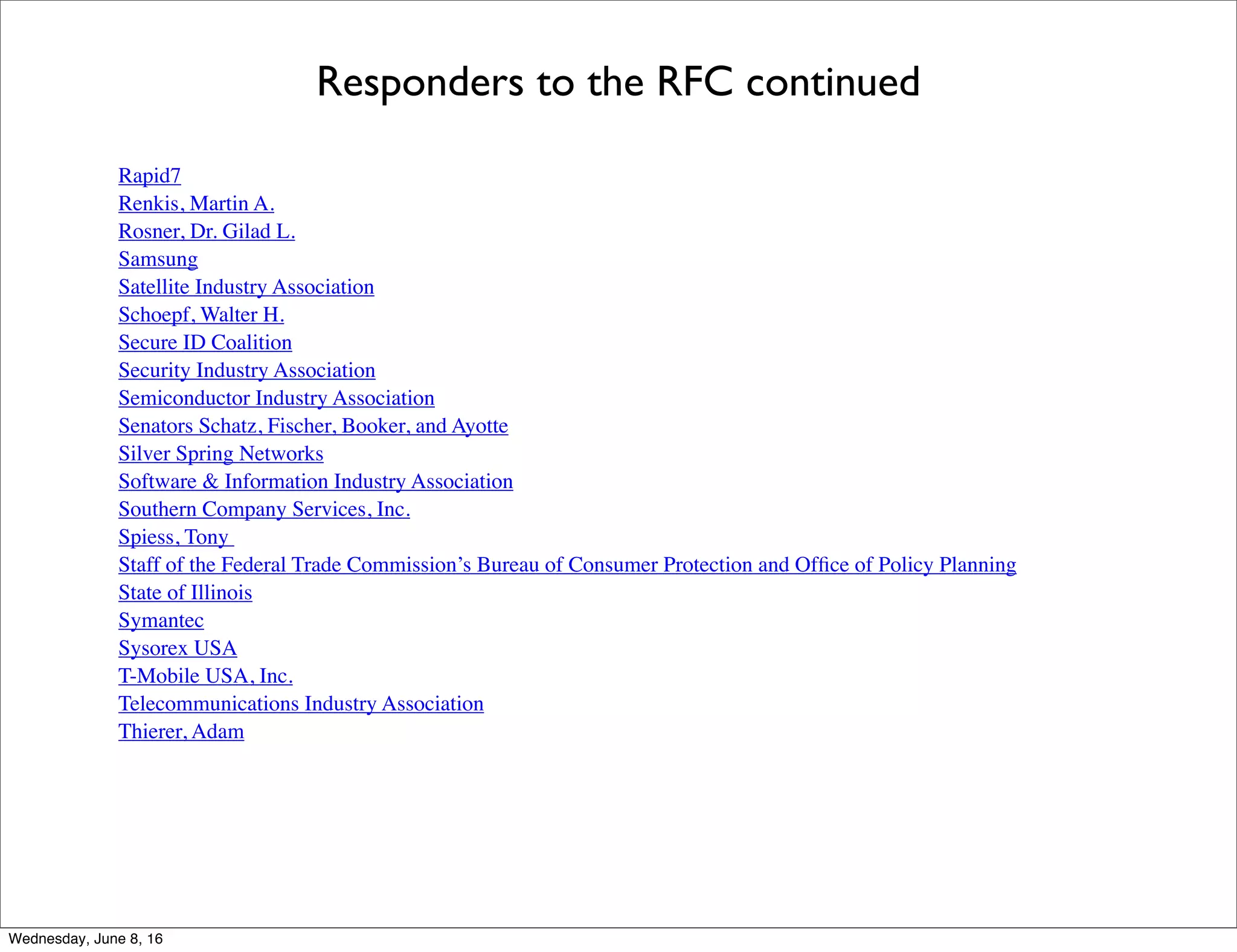
Responders to the RFC continued
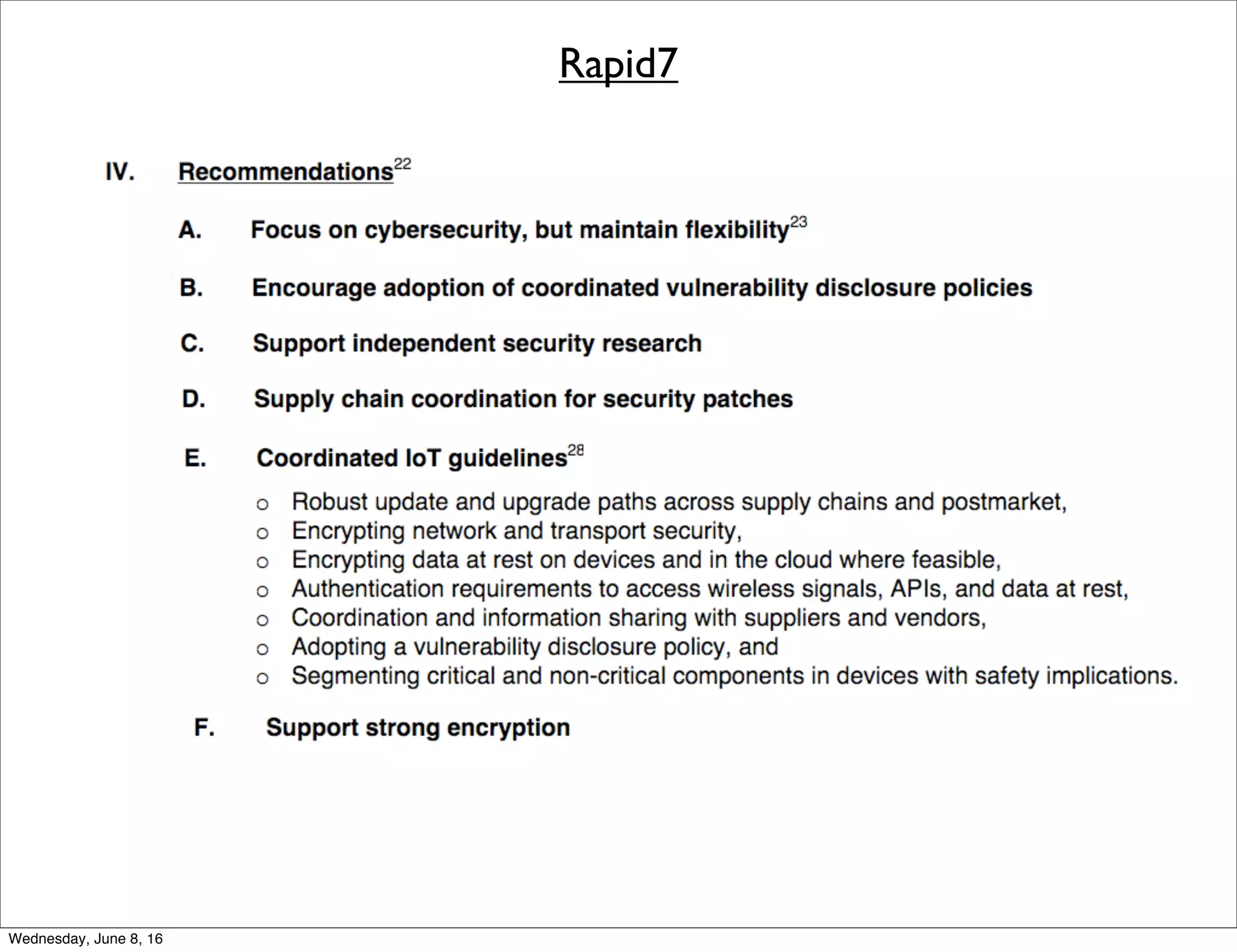
Rapid7
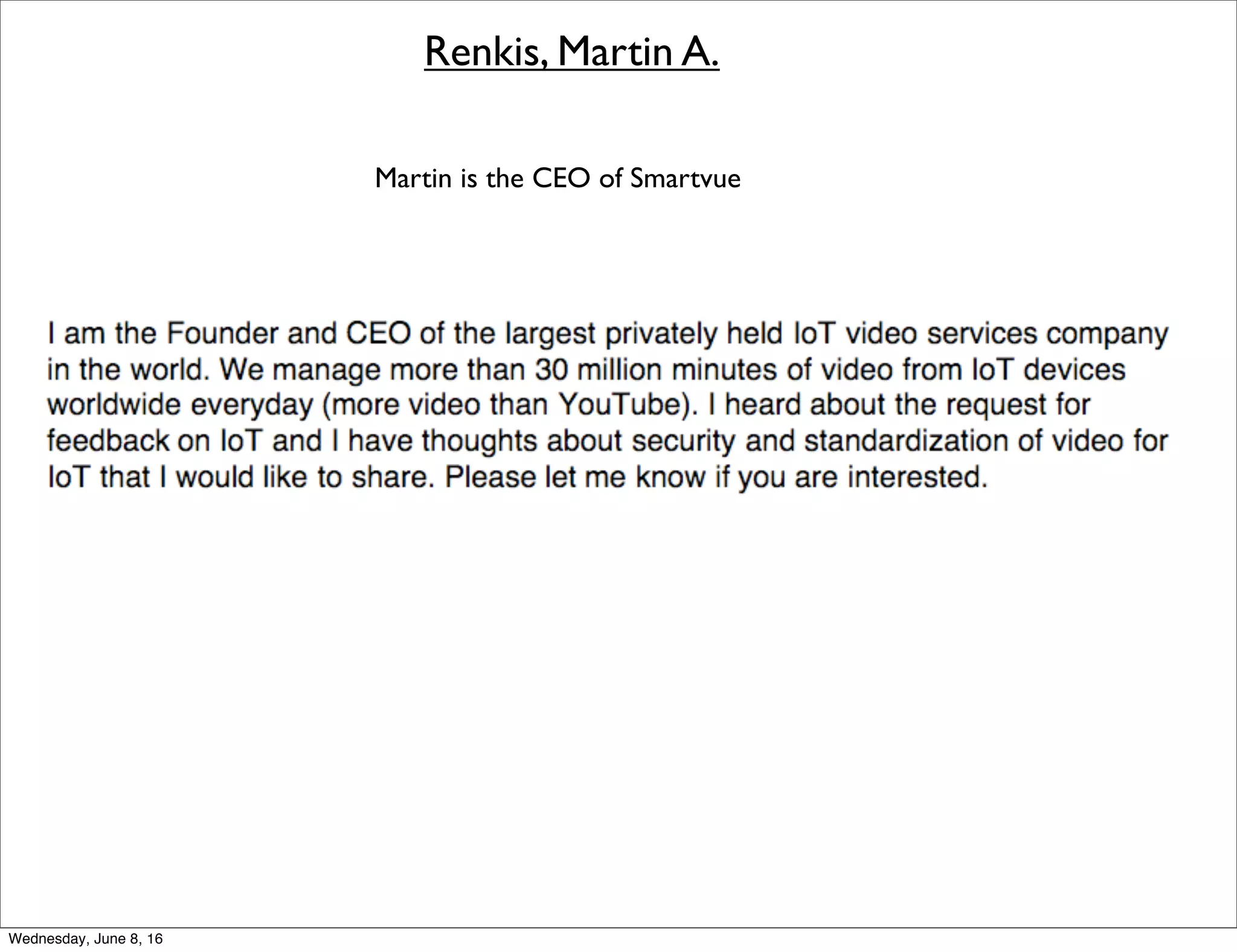
Renkis, Martin A.
Rosner, Dr. Gilad L.
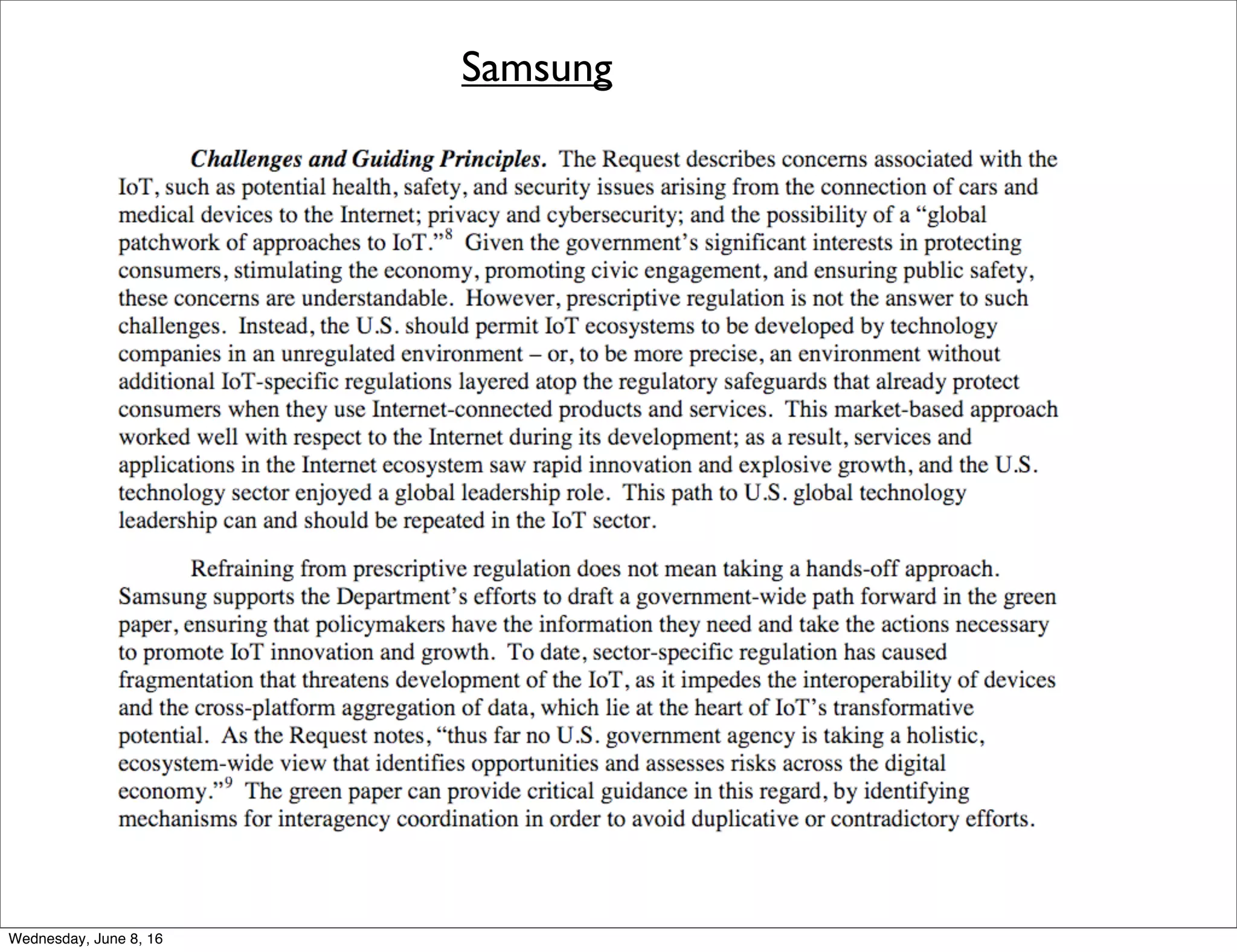
Samsung
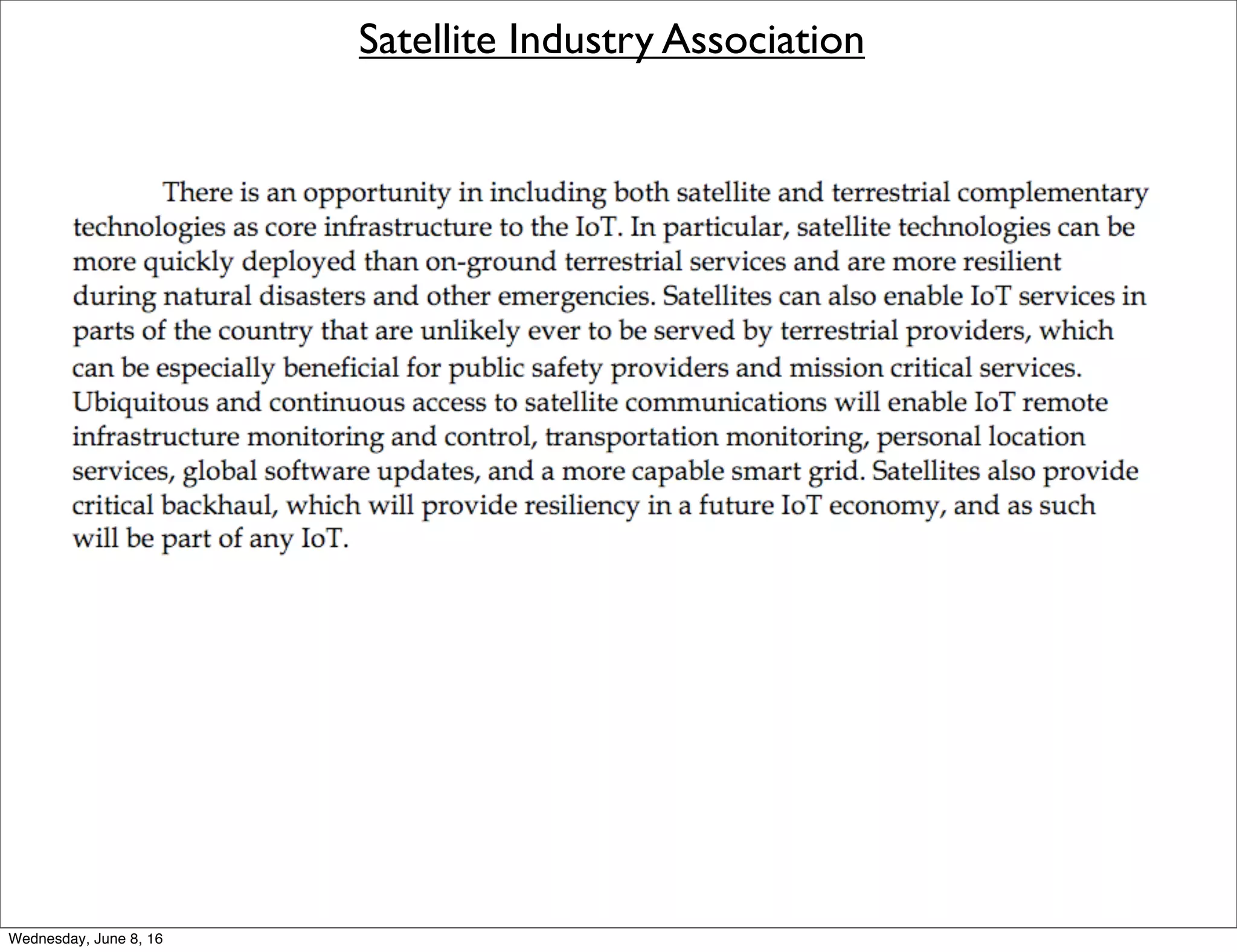
Satellite Industry Association
Schoepf, Walter H.
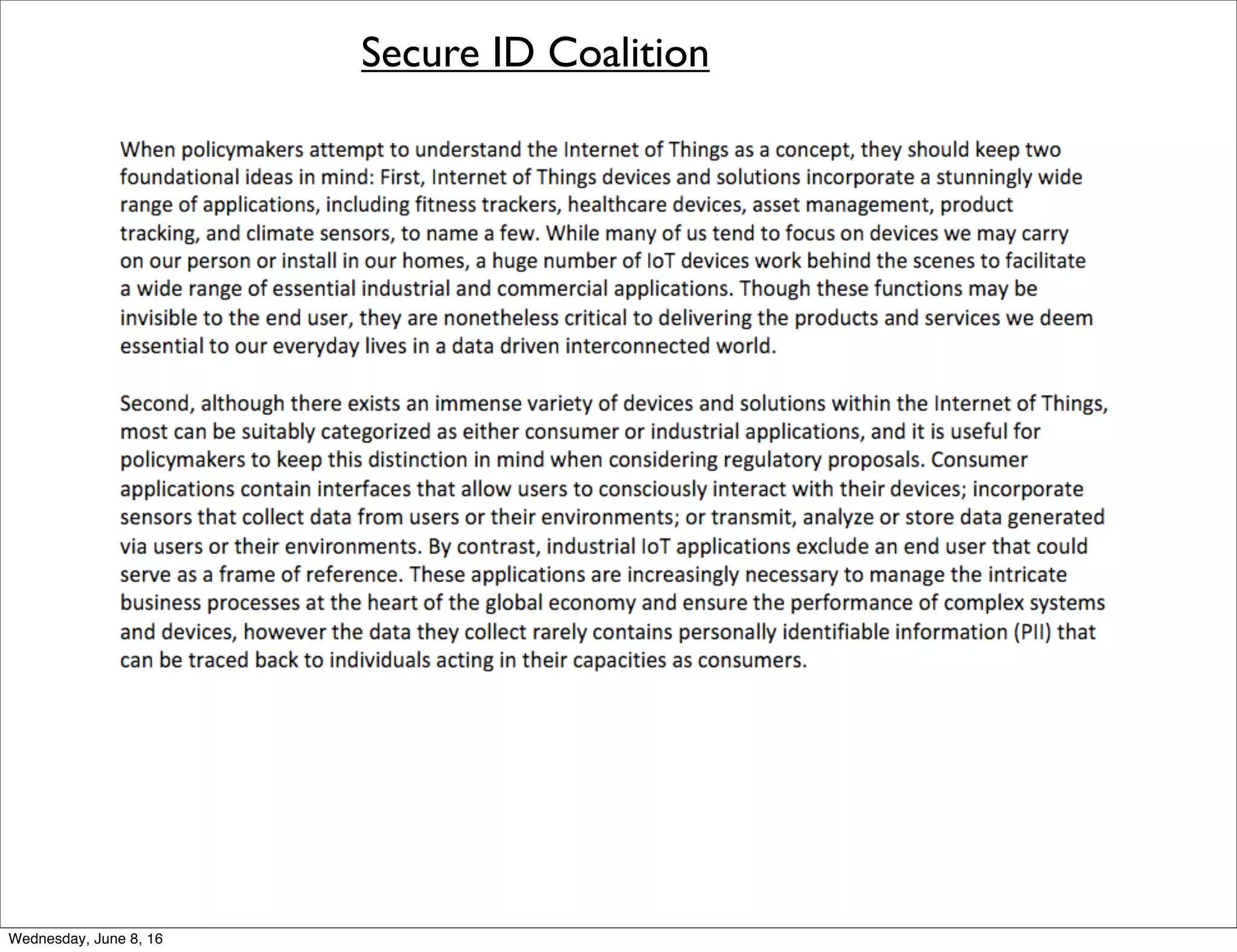
Secure ID Coalition
Security Industry Association
Semiconductor Industry Association
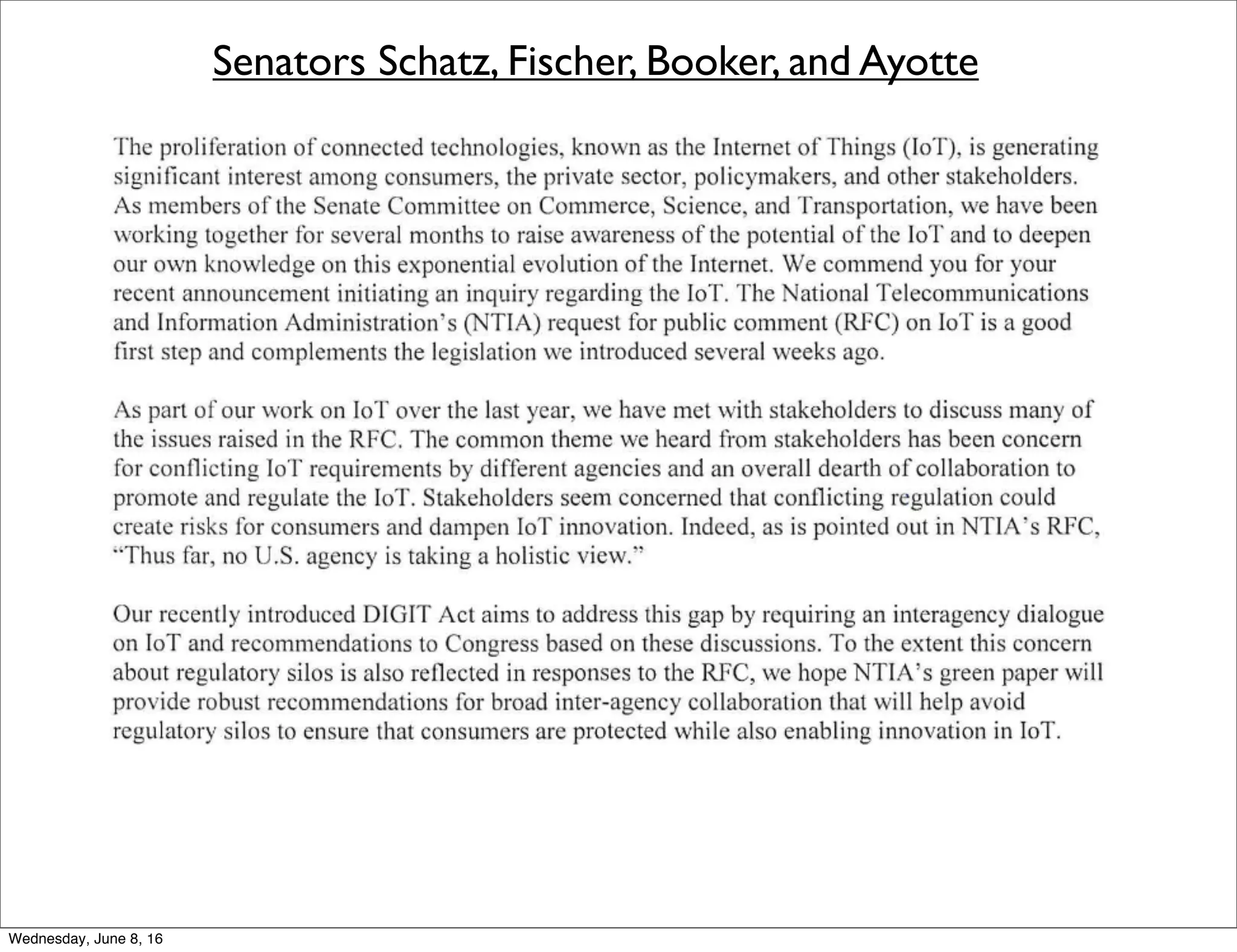
Senators Schatz, Fischer, Booker, and Ayotte
Silver Spring Networks
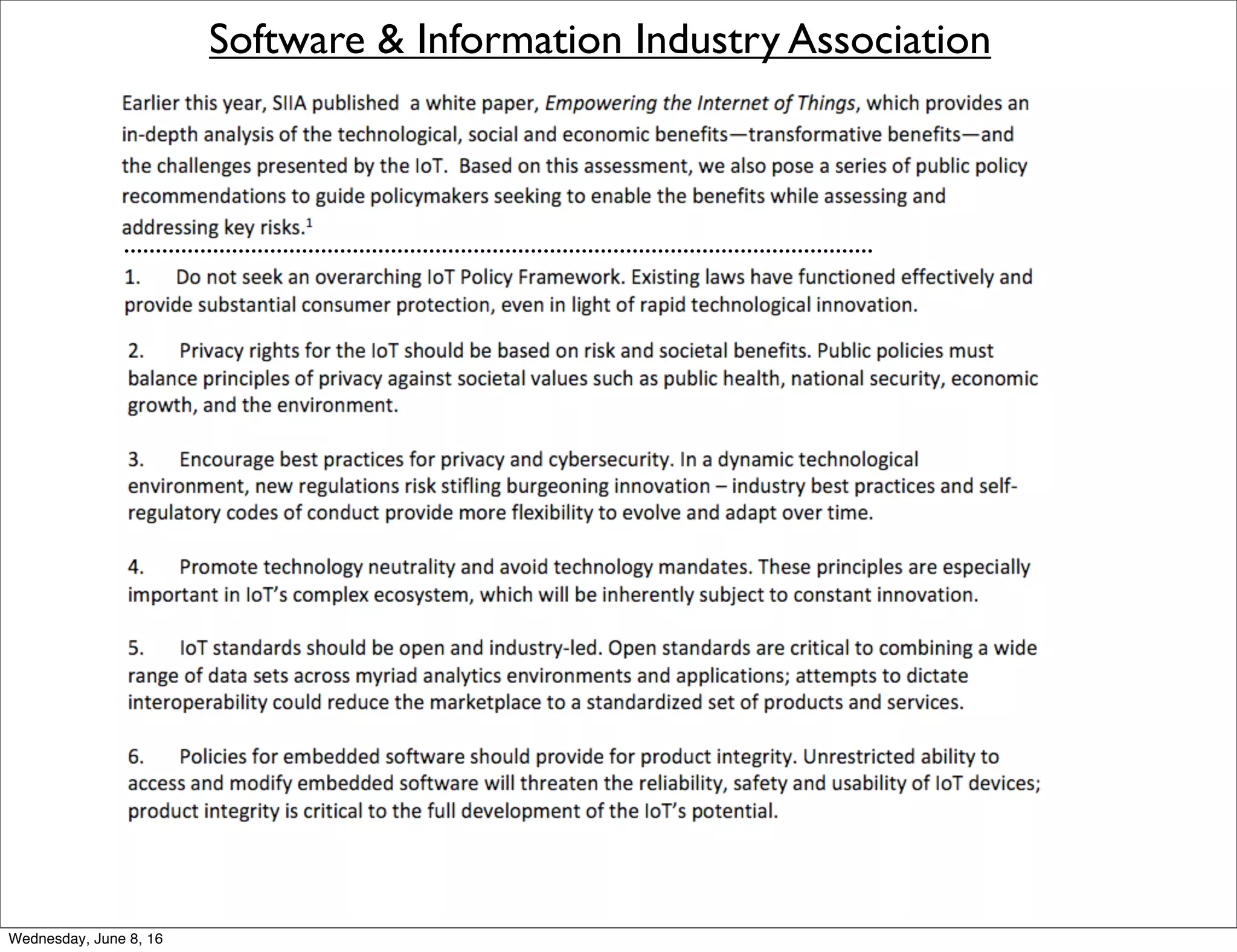
Software & Information Industry Association
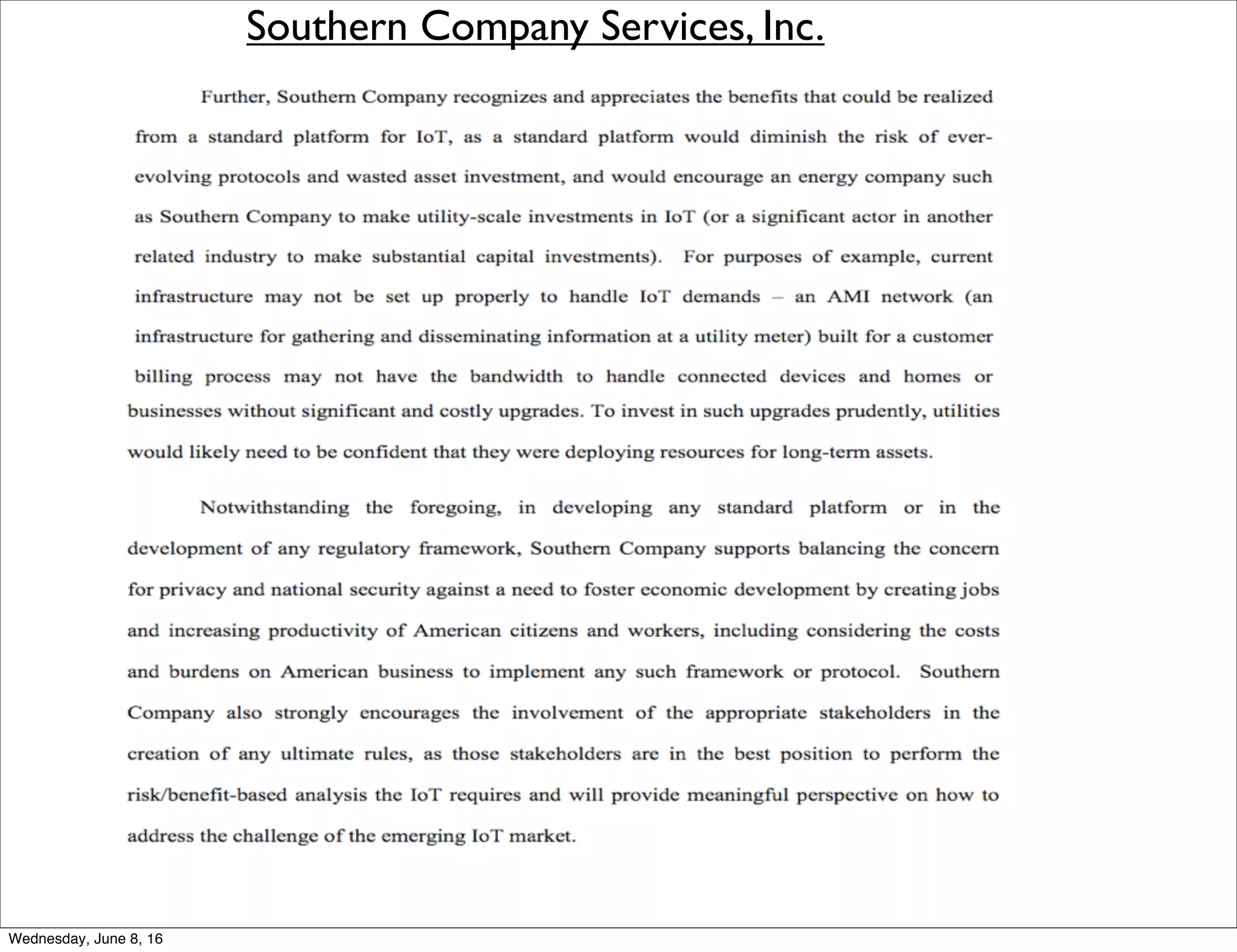
Southern Company Services, Inc.
Spiess, Tony
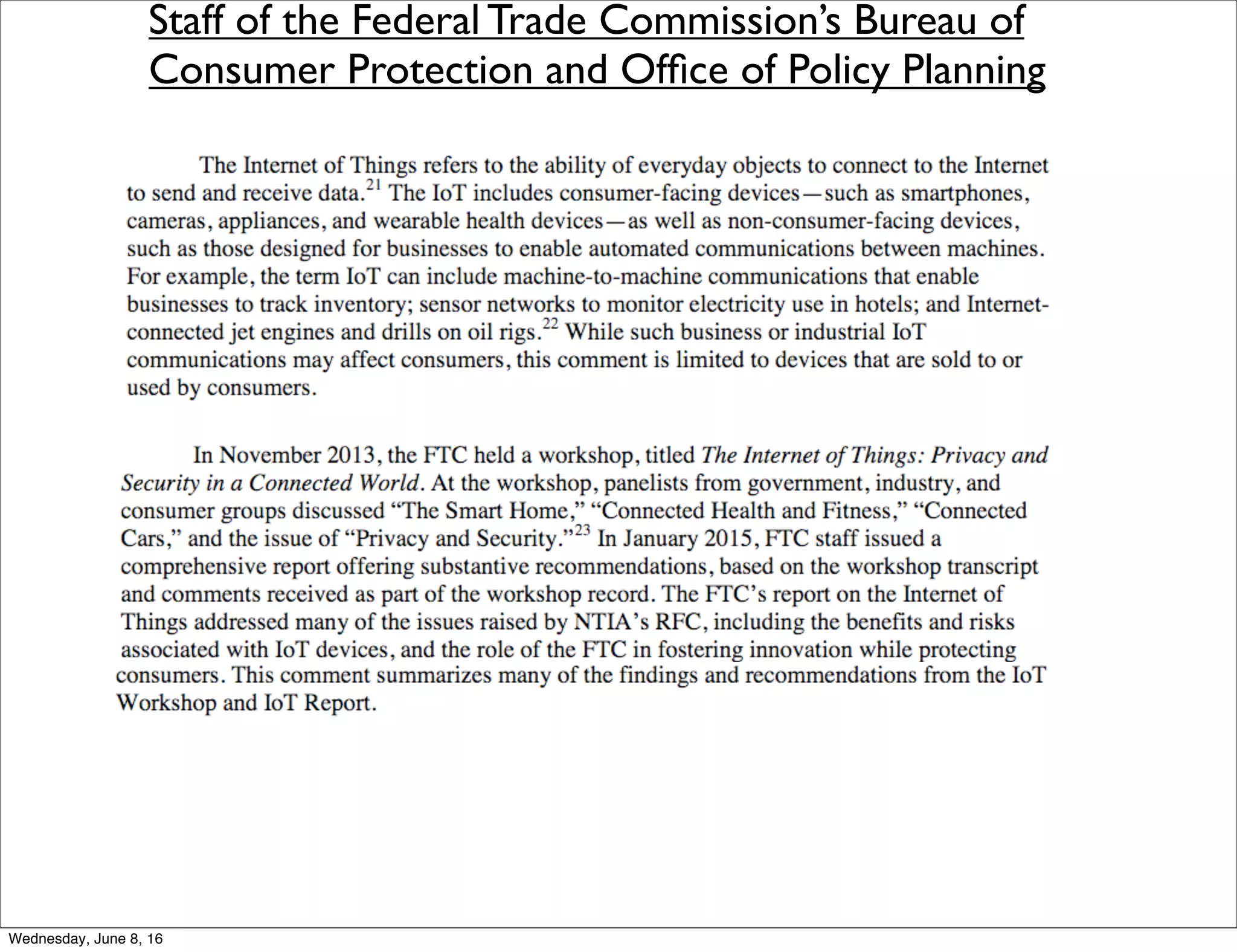
Staff of the Federal Trade Commission’s Bureau of Consumer Protection and Office of Policy Planning
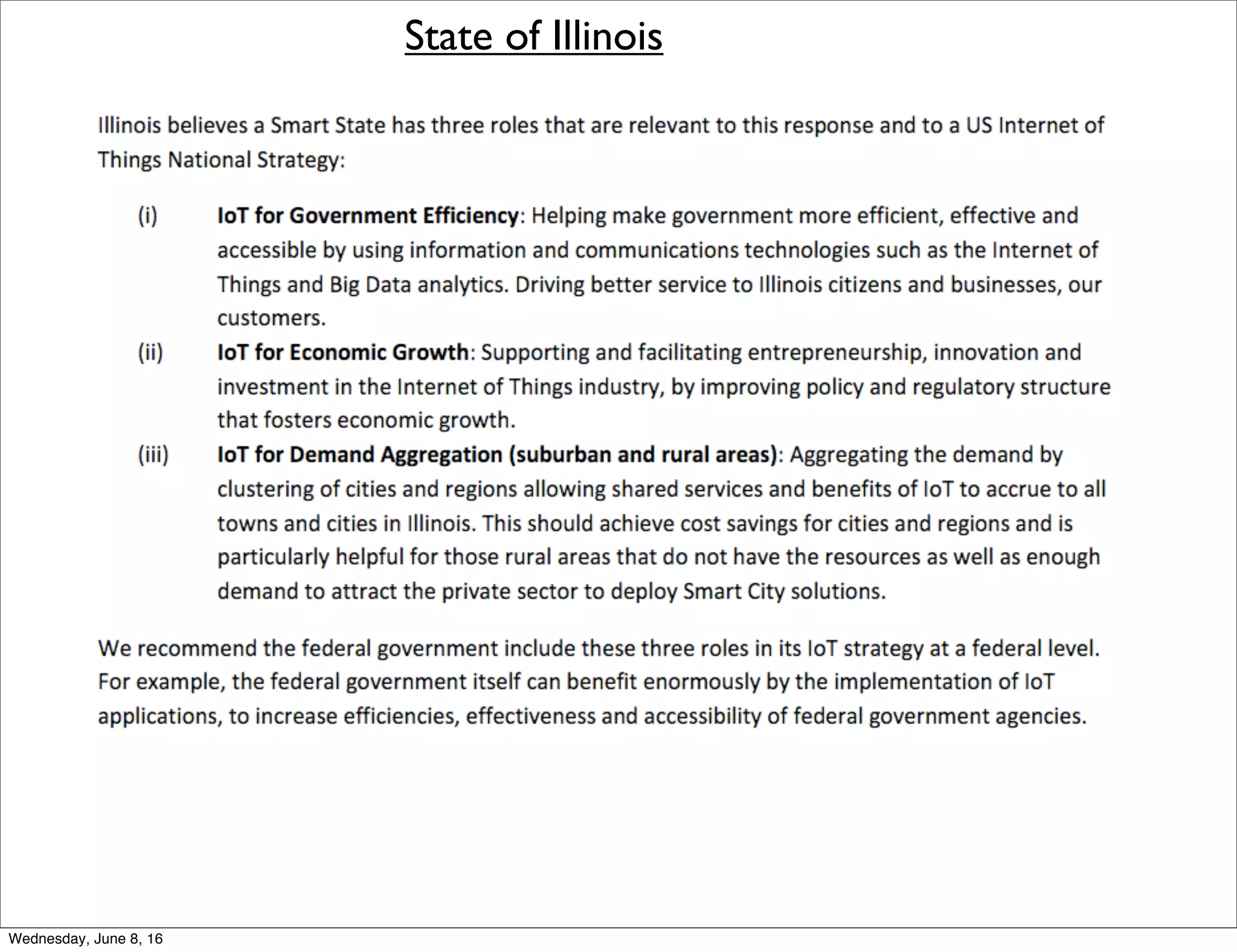
State of Illinois
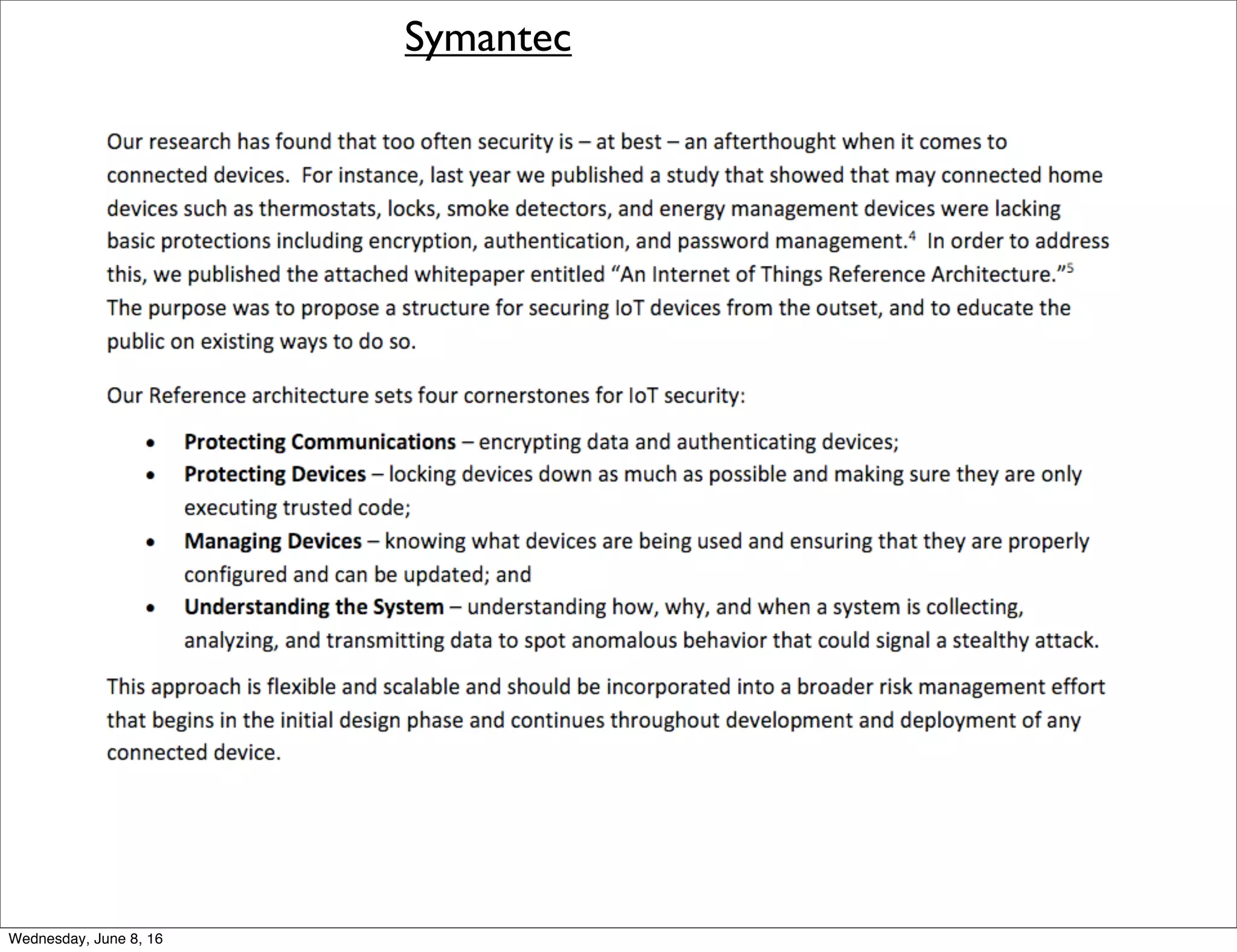
Symantec
Sysorex USA
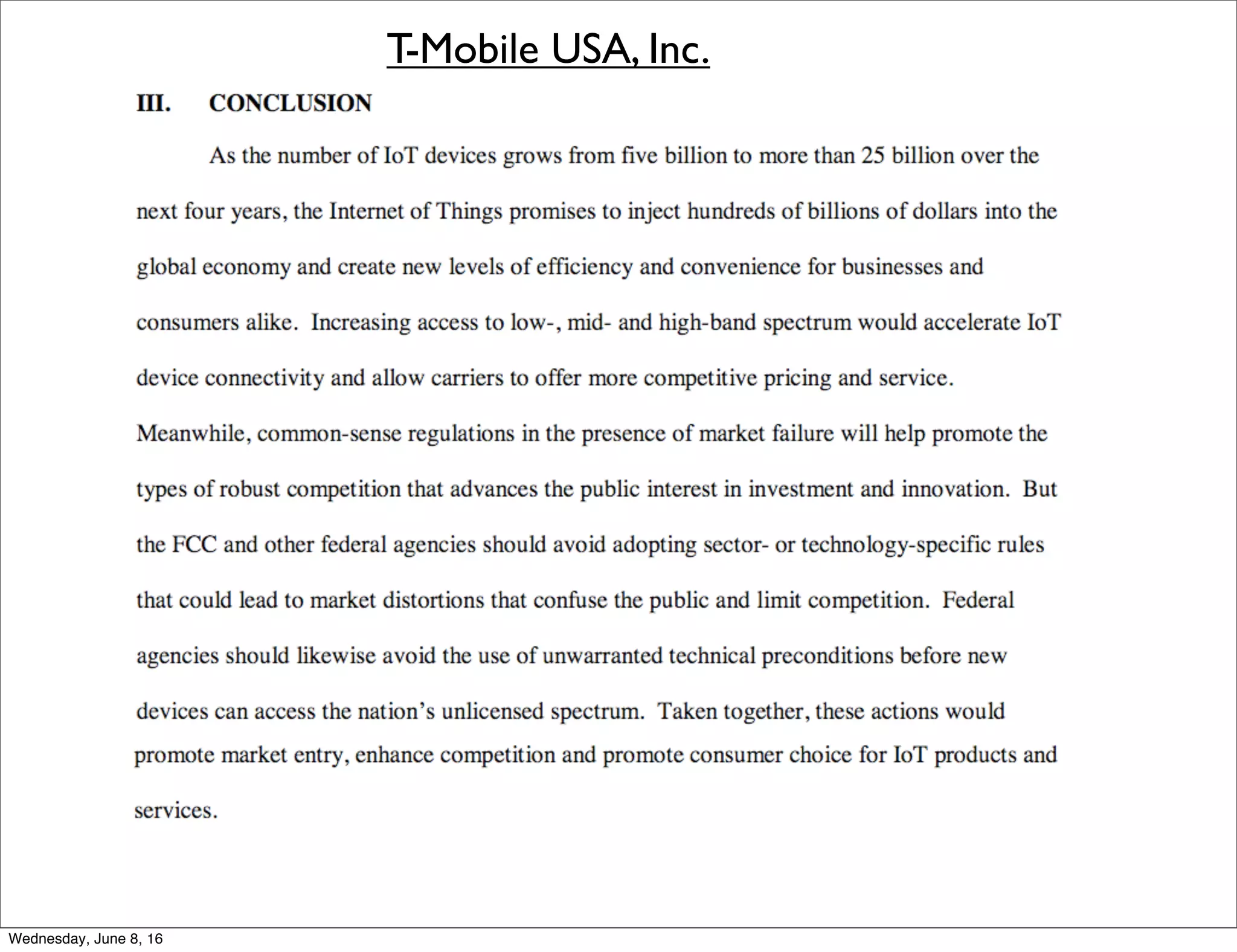
T-Mobile USA, Inc.
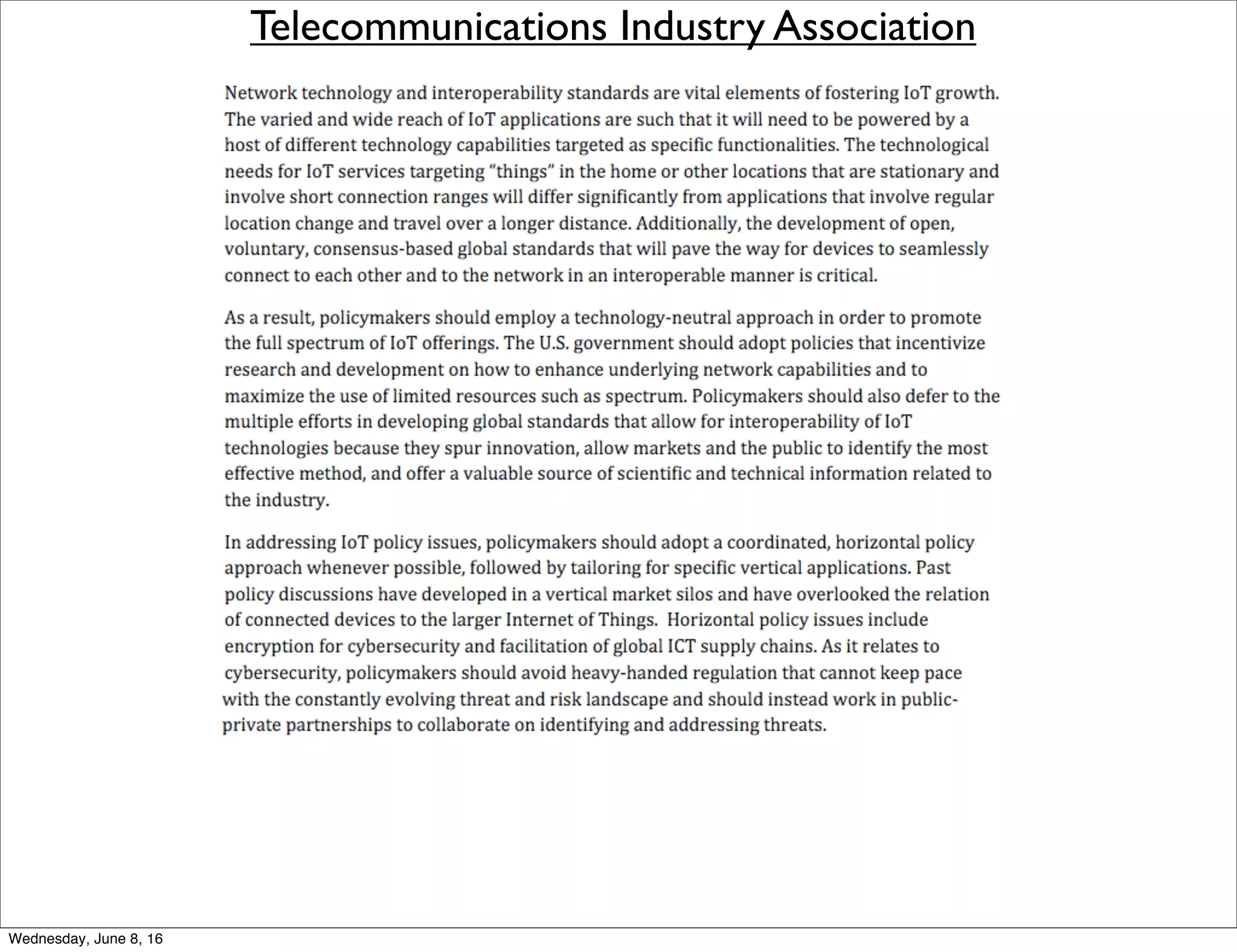
Telecommunications Industry Association
Thierer, Adam
Thursday, June 9, 16
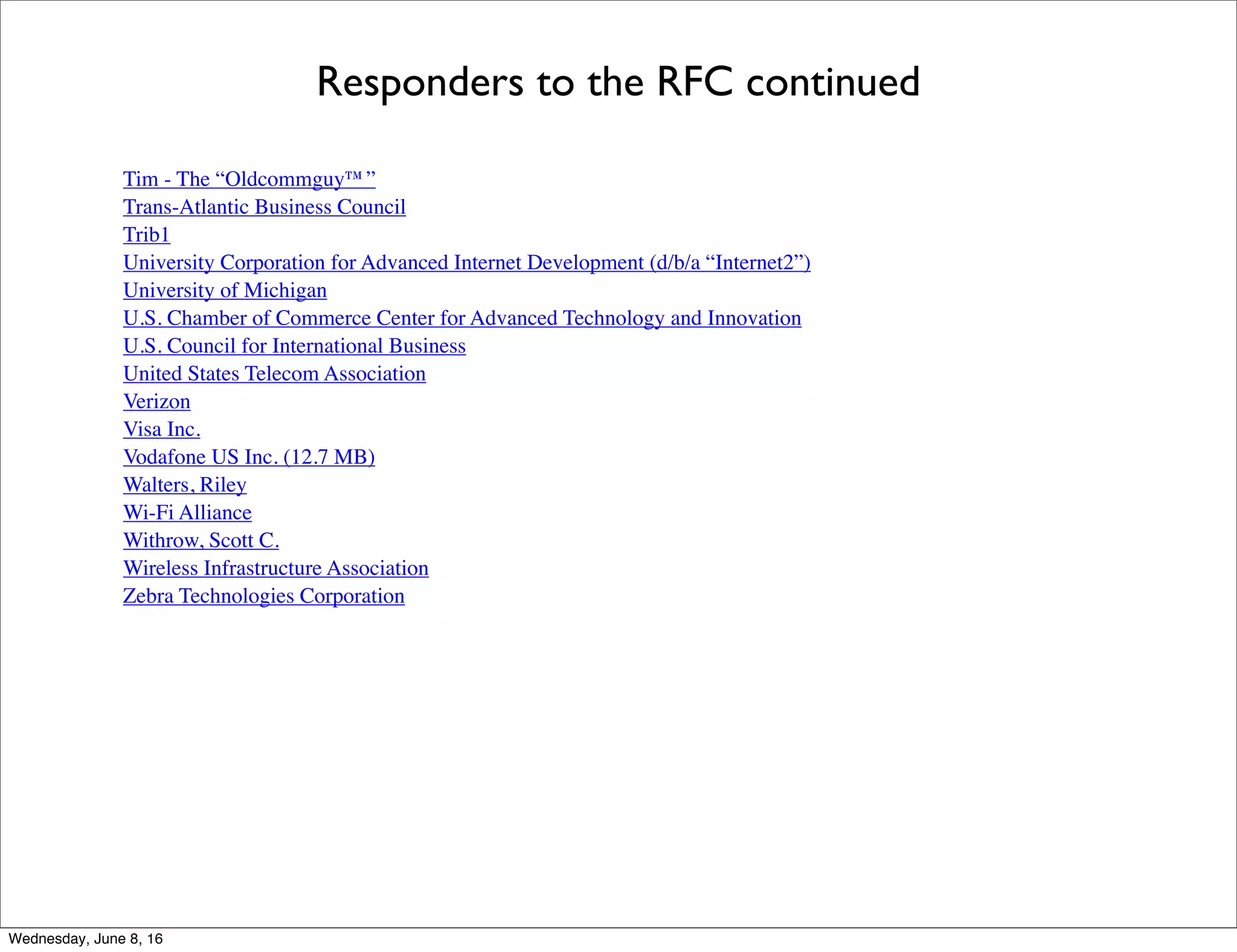
Responders to the RFC continued
Tim - The “Oldcommguy™”
Trans-Atlantic Business Council
Trib1
University Corporation for Advanced Internet Development (d/b/a “Internet2”)
University of Michigan
U.S. Chamber of Commerce Center for Advanced Technology and Innovation
U.S. Council for International Business
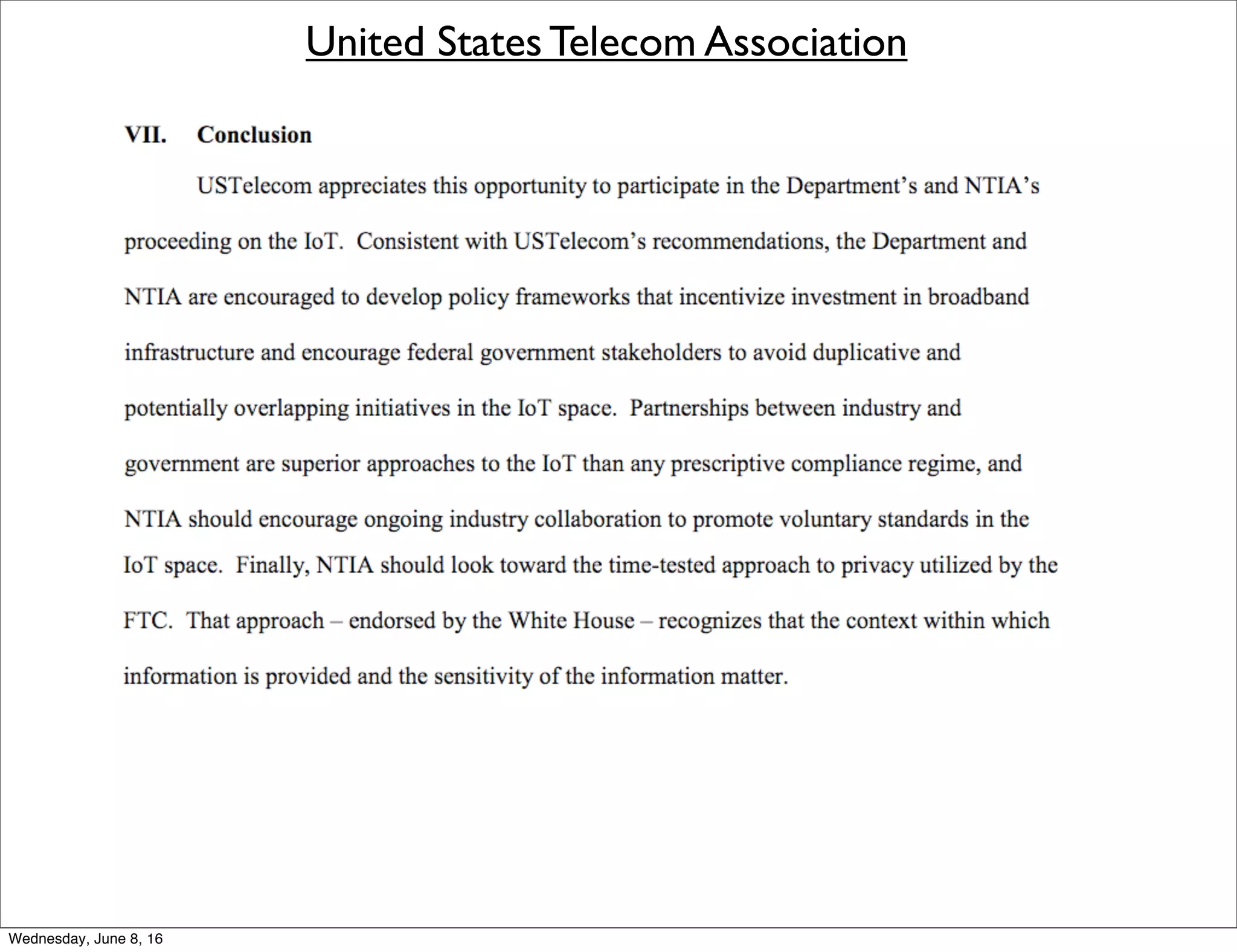
United States Telecom Association
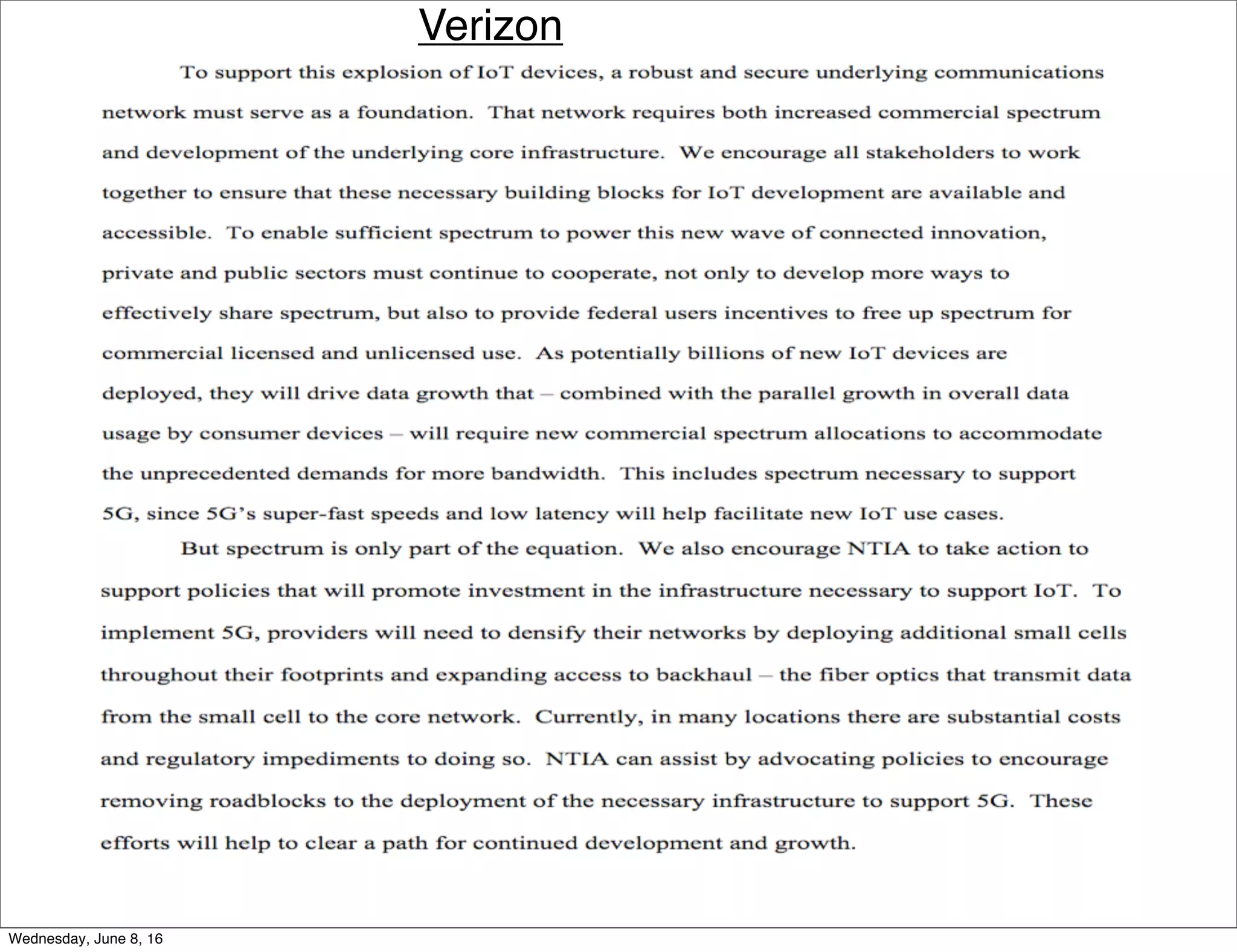
Verizon
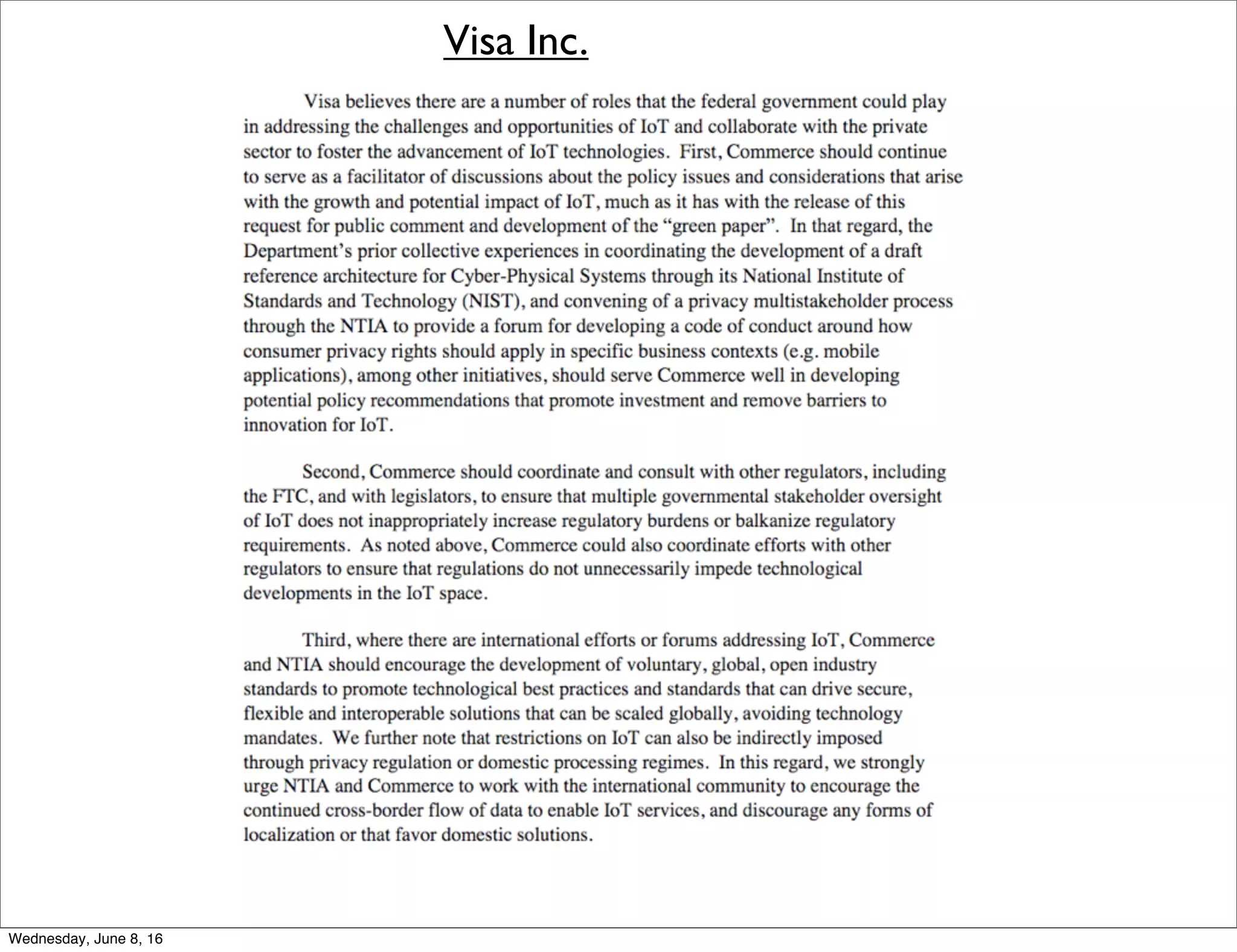
Visa Inc.
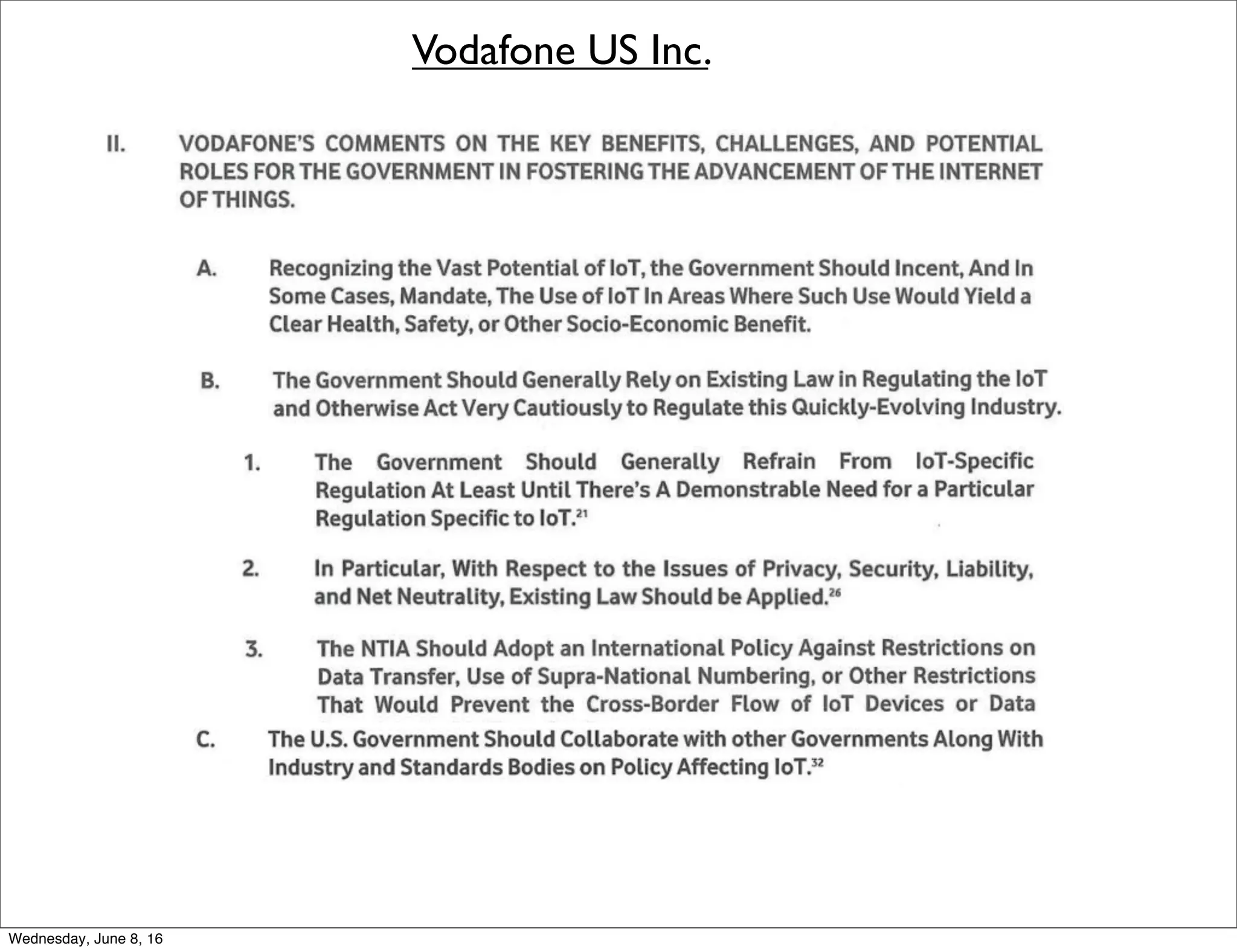
Vodafone US Inc. (12.7 MB)
Walters, Riley
Wi-Fi Alliance
Withrow, Scott C.
Wireless Infrastructure Association
Zebra Technologies Corporation
Thursday, June 9, 16
Response Snapshots
Note: These are snapshots collected by Bob Marcus to provide the flavor of the response,
Go to the full response for more details.
Thursday, June 9, 16
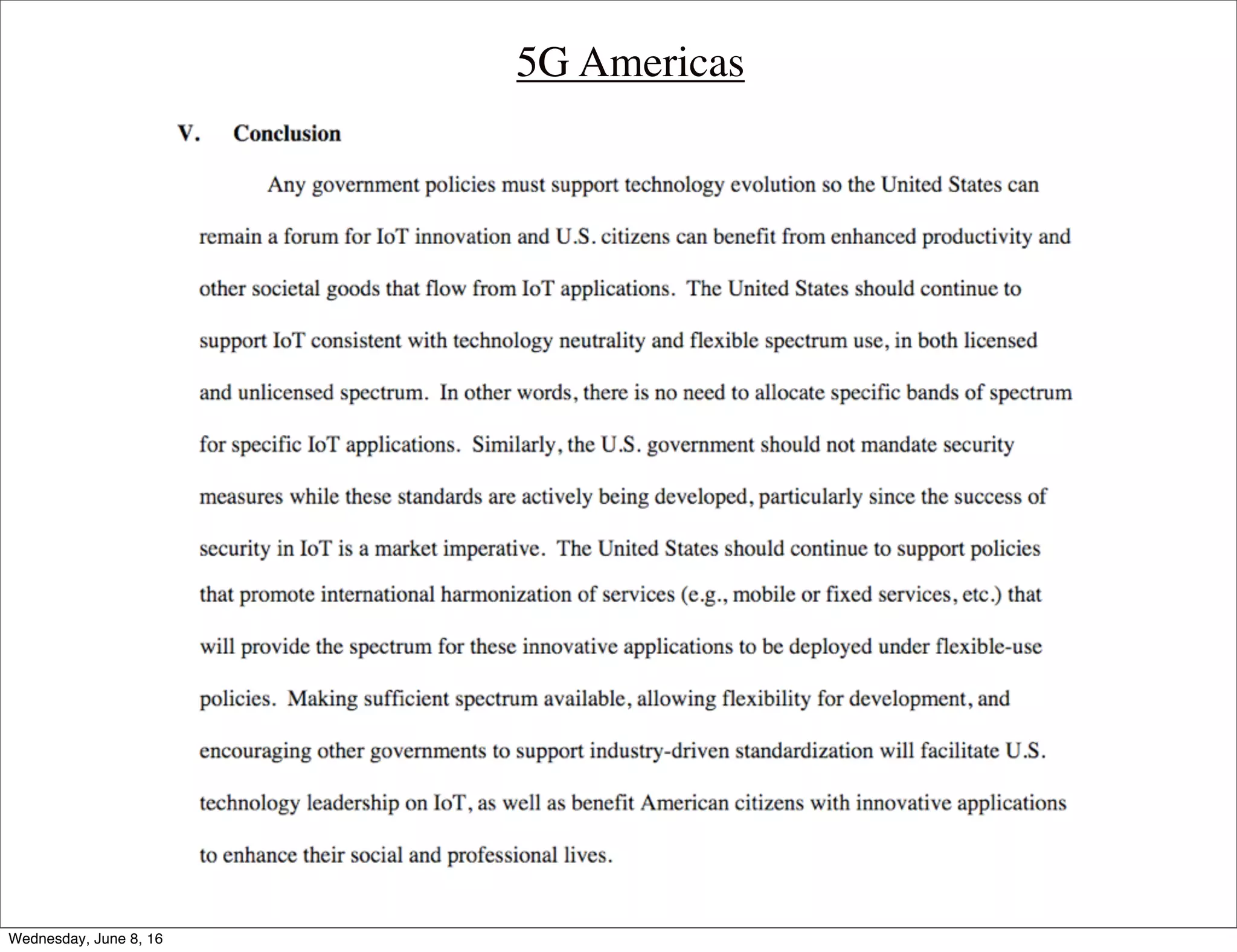
5G Americas
Thursday, June 9, 16
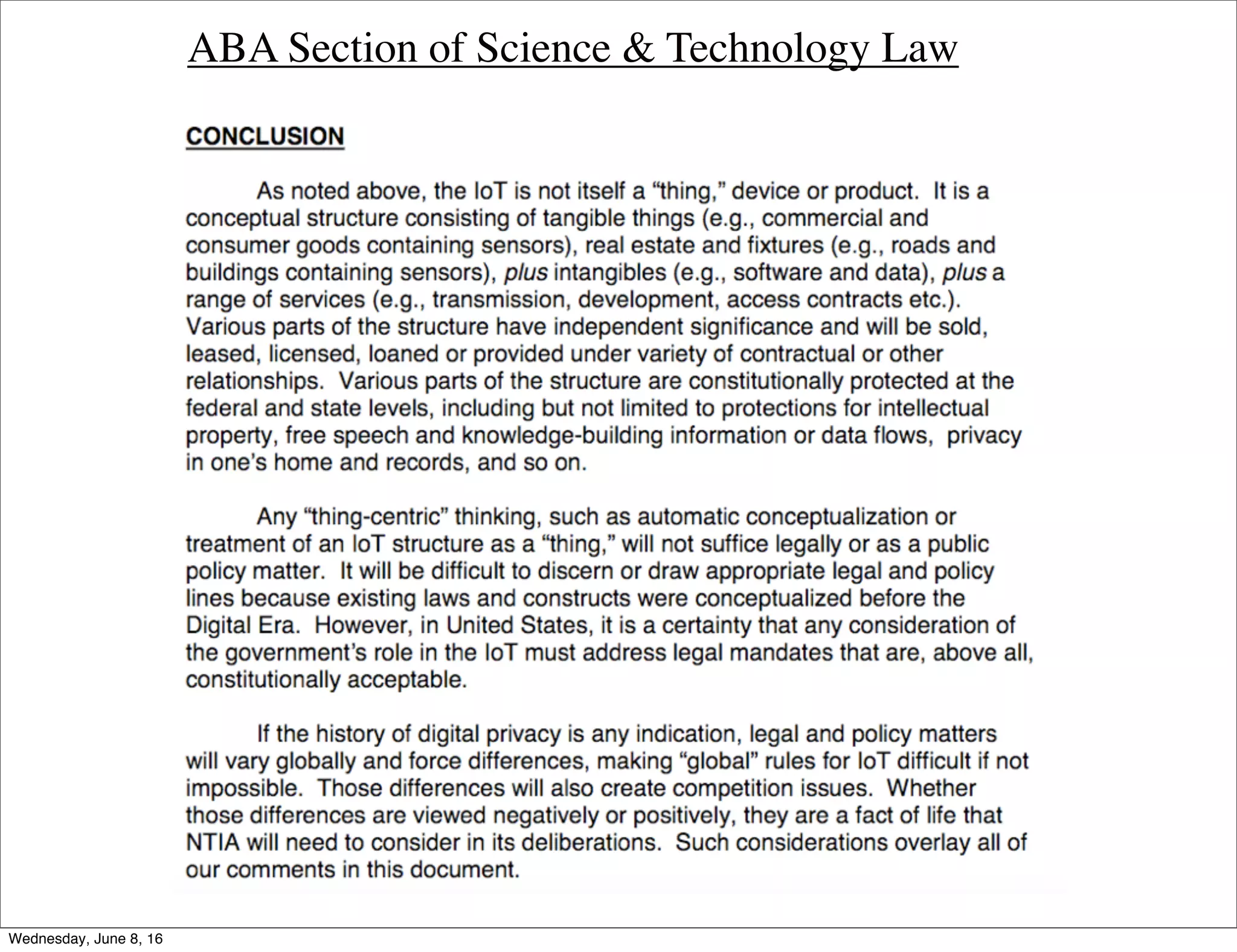
ABA Section of Science & Technology Law
Thursday, June 9, 16
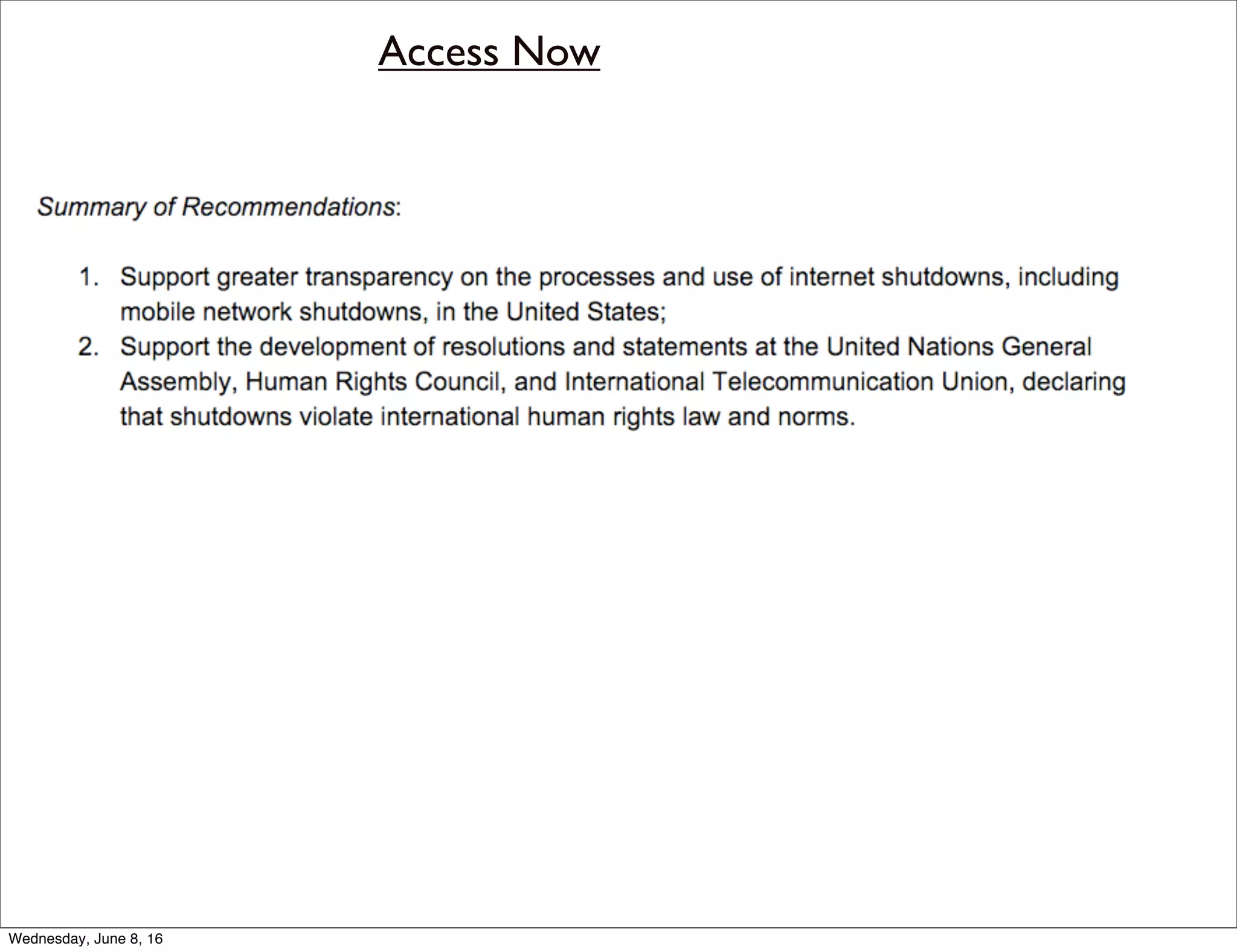
Access Now
Thursday, June 9, 16
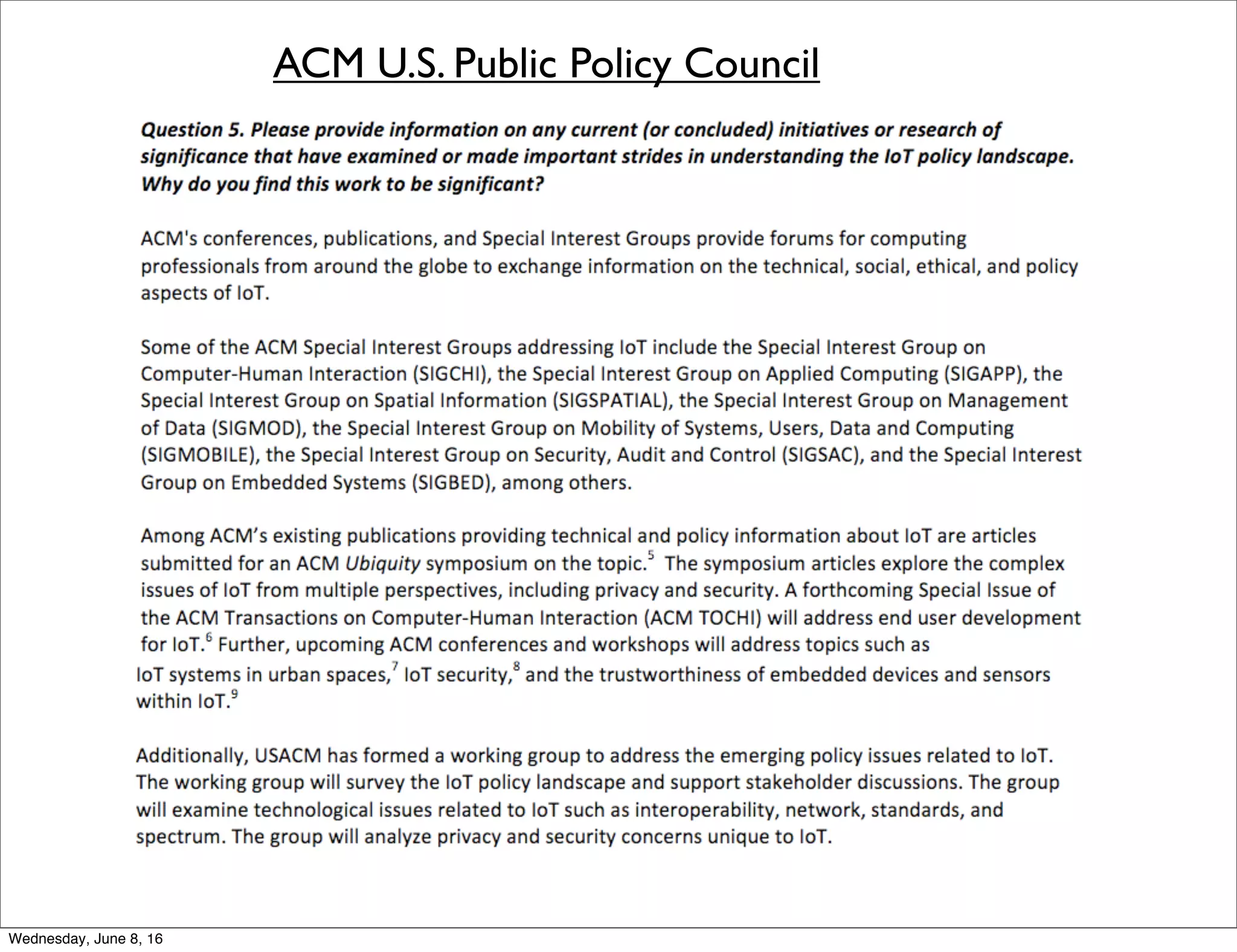
ACM U.S. Public Policy Council
Thursday, June 9, 16
ACT | The App Association
Thursday, June 9, 16
AIM, Inc.
Thursday, June 9, 16
AIM North America (same as AIM)
Thursday, June 9, 16
Alliance of Automobile Manufacturers
..................................................................................................
Thursday, June 9, 16
American National Standards Institute
Thursday, June 9, 16
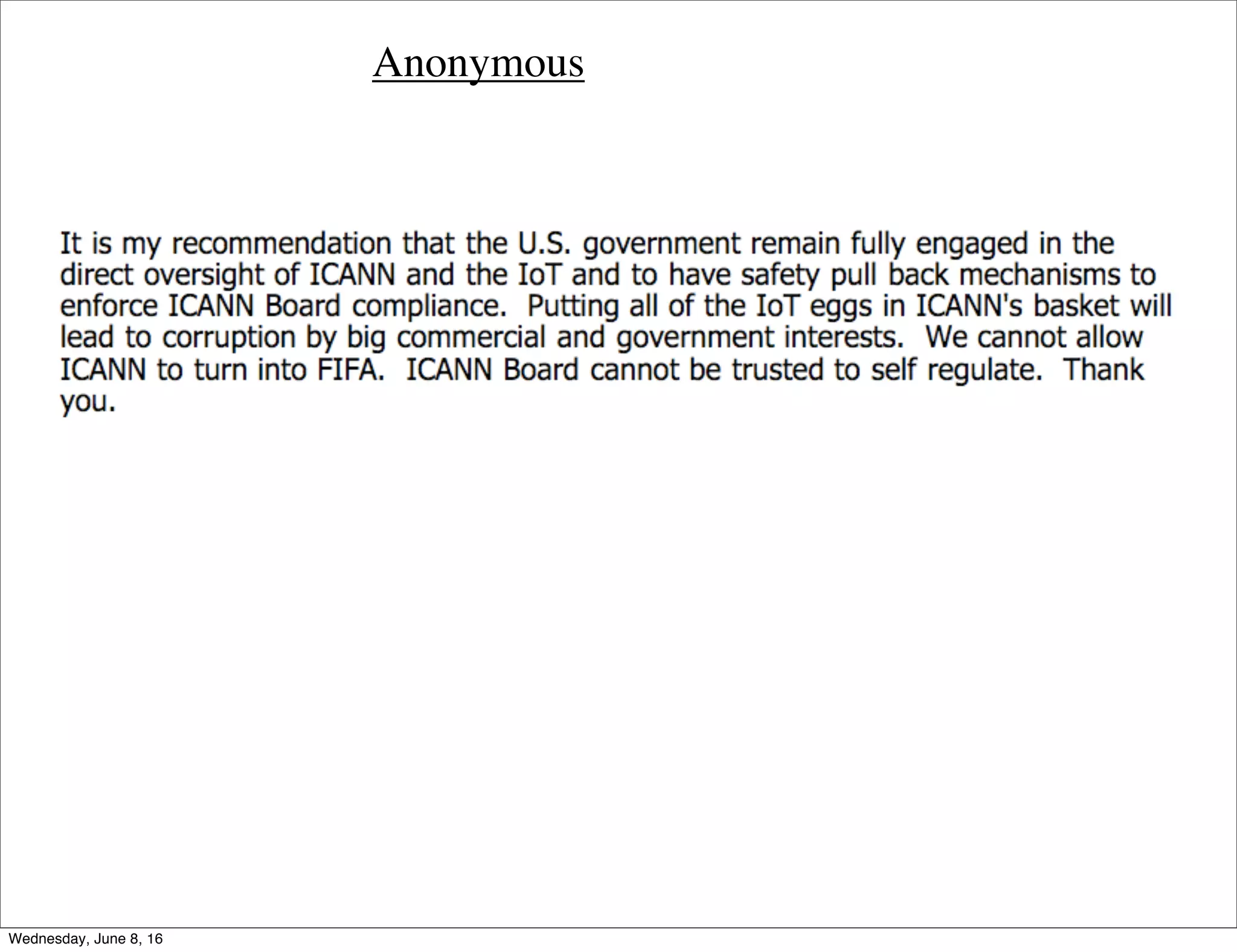
Anonymous
Thursday, June 9, 16
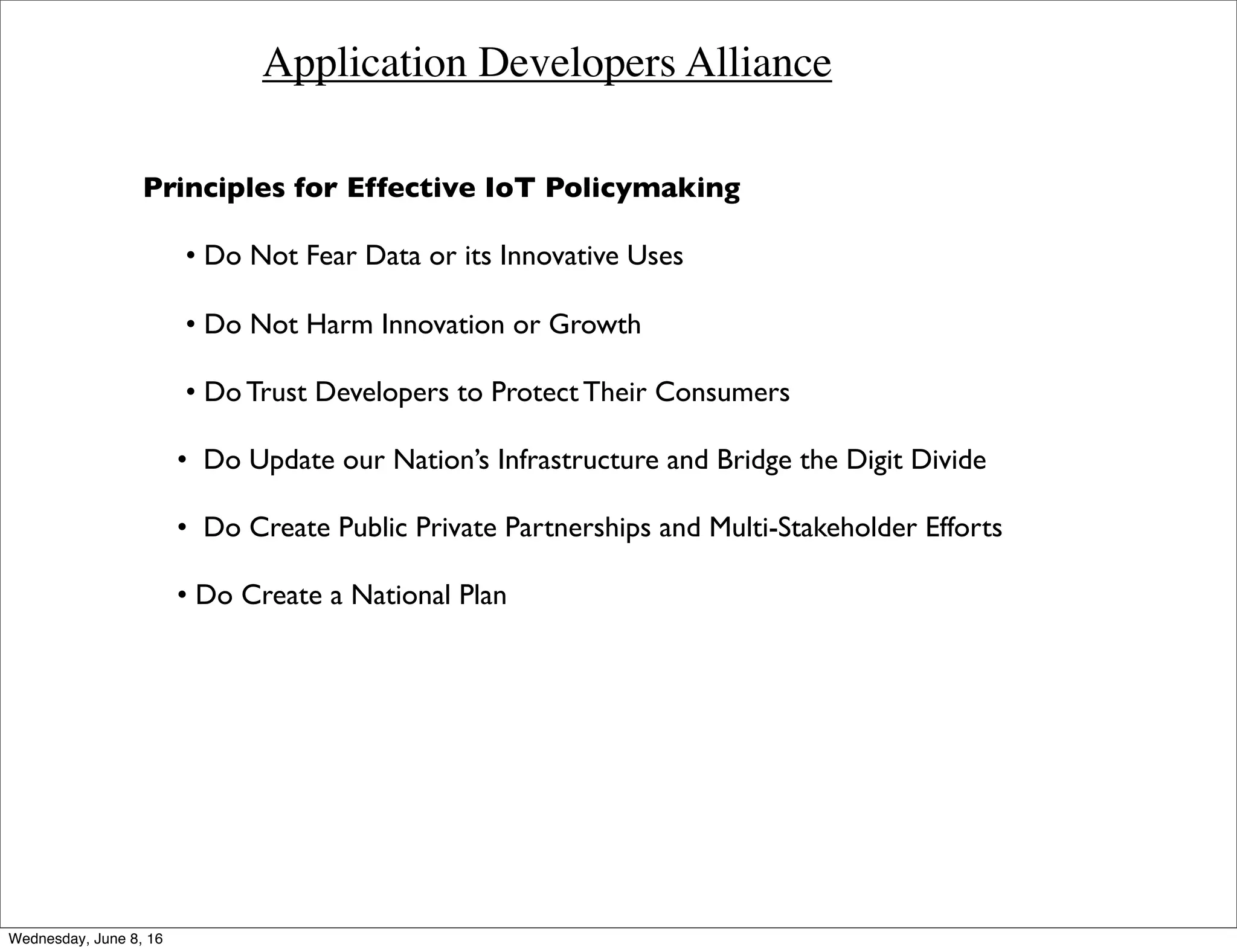
Application Developers Alliance
Principles for Effective IoT Policymaking
• Do Not Fear Data or its Innovative Uses
• Do Not Harm Innovation or Growth
• Do Trust Developers to Protect Their Consumers
• Do Update our Nation’s Infrastructure and Bridge the Digit Divide
• Do Create Public Private Partnerships and Multi-Stakeholder Efforts
• Do Create a National Plan
Thursday, June 9, 16
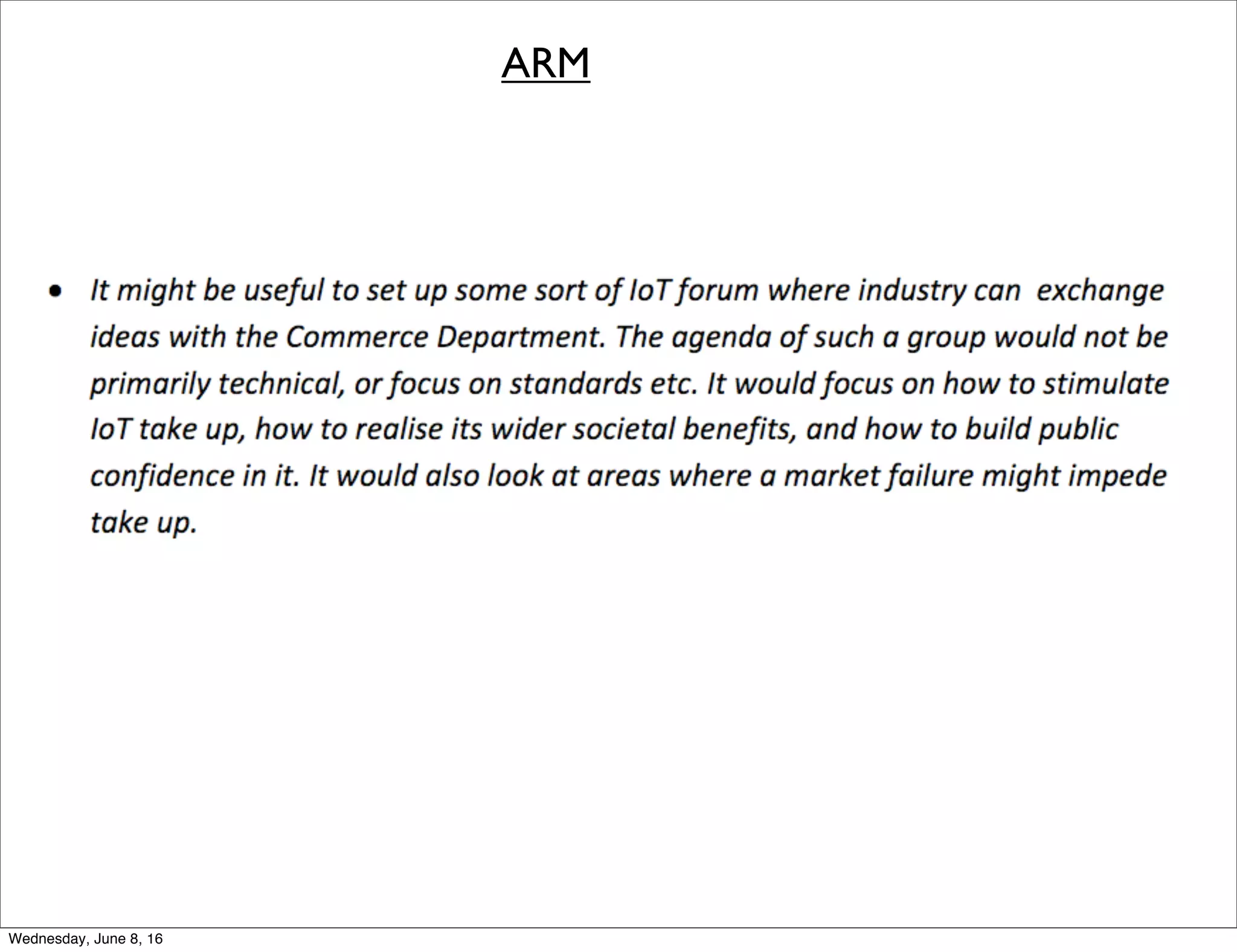
ARM
Thursday, June 9, 16
Association of Global Automakers, Inc.
A. MotorVehicles Are Becoming Increasingly Automated And Connected
B. The Federal Government Must Support DSRC Technology By Finalizing The Mandate
And Protecting The Spectrum
C. The Federal Government Should Take A Leadership Role In AutomatedVehicles
D. The Federal Government Should Continue Its Support For The Testing Of Automated
And ConnectedVehicles
E. The Federal Government Should Support Industry-Led Efforts To Enhance Motor
Vehicle Cybersecurity
F. The Federal Government Should Support Industry-Led Efforts To Protect
Consumer Privacy
G. Connected And AutomatedVehicles Will Have A Significant Positive Impact On
The U.S. Economy
Thursday, June 9, 16
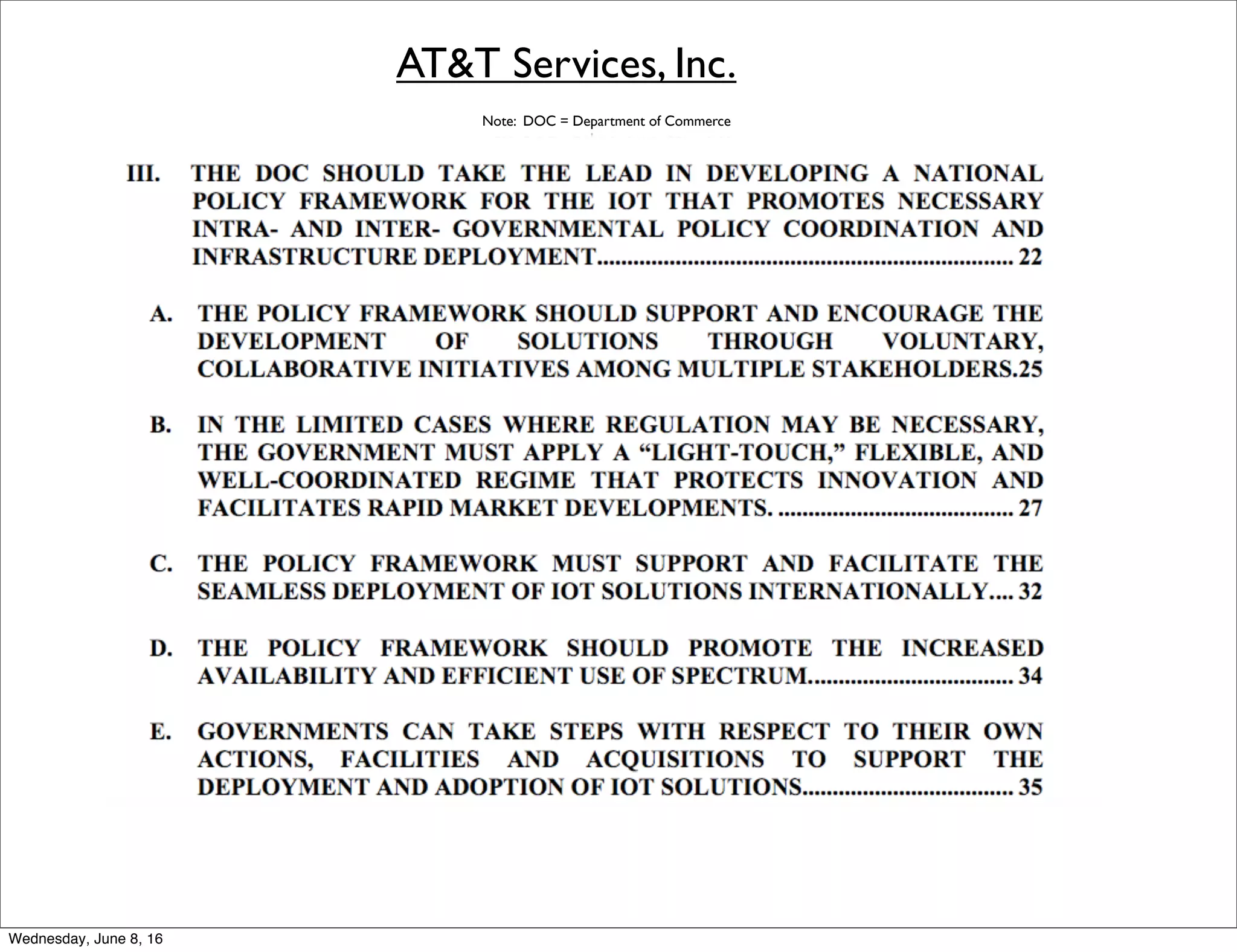
AT&T Services, Inc.
Note: DOC = Department of Commerce
Thursday, June 9, 16
Booz Allen Hamilton Inc.
Thursday, June 9, 16
Bronfman, Jillisa
Thursday, June 9, 16
BSA | The Software Alliance
Thursday, June 9, 16
Bugcrowd
Thursday, June 9, 16
CA Technologies
Thursday, June 9, 16
Camp, L Jean; Henry, Ryan; Myers, Steven ; Russo, Gianpaolo
Thursday, June 9, 16
Center for Data Innovation
............................................................................................
Thursday, June 9, 16
Center for Strategic and International Studies
Thursday, June 9, 16
Cisco Systems, Inc.
Thursday, June 9, 16
Coalition for Cybersecurity Policy & Law
Thursday, June 9, 16
Common Sense Kids Action
Thursday, June 9, 16
Competitive Carriers Association
Thursday, June 9, 16
CompTIA
Thursday, June 9, 16
Computer & Communications Industry Association
Thursday, June 9, 16
Consumer Federation of America
Thursday, June 9, 16
Consumer Technology Association
Thursday, June 9, 16
Consumers Union
Thursday, June 9, 16
CTIA
Thursday, June 9, 16
Deere & Company
Thursday, June 9, 16
Duckduckgo
Thursday, June 9, 16
Direct Marketing Association
Thursday, June 9, 16
Edison Electric Institute
Thursday, June 9, 16
Electronic Frontier Foundation
Thursday, June 9, 16
Electronic Privacy Information Center
Thursday, June 9, 16
Ericsson
Thursday, June 9, 16
Family Online Safety Institute
Thursday, June 9, 16
Farhat, Karim
Thursday, June 9, 16
Fashion Innovation Alliance
Thursday, June 9, 16
Future of Privacy Forum
Thursday, June 9, 16
Gallagher, John
Thursday, June 9, 16
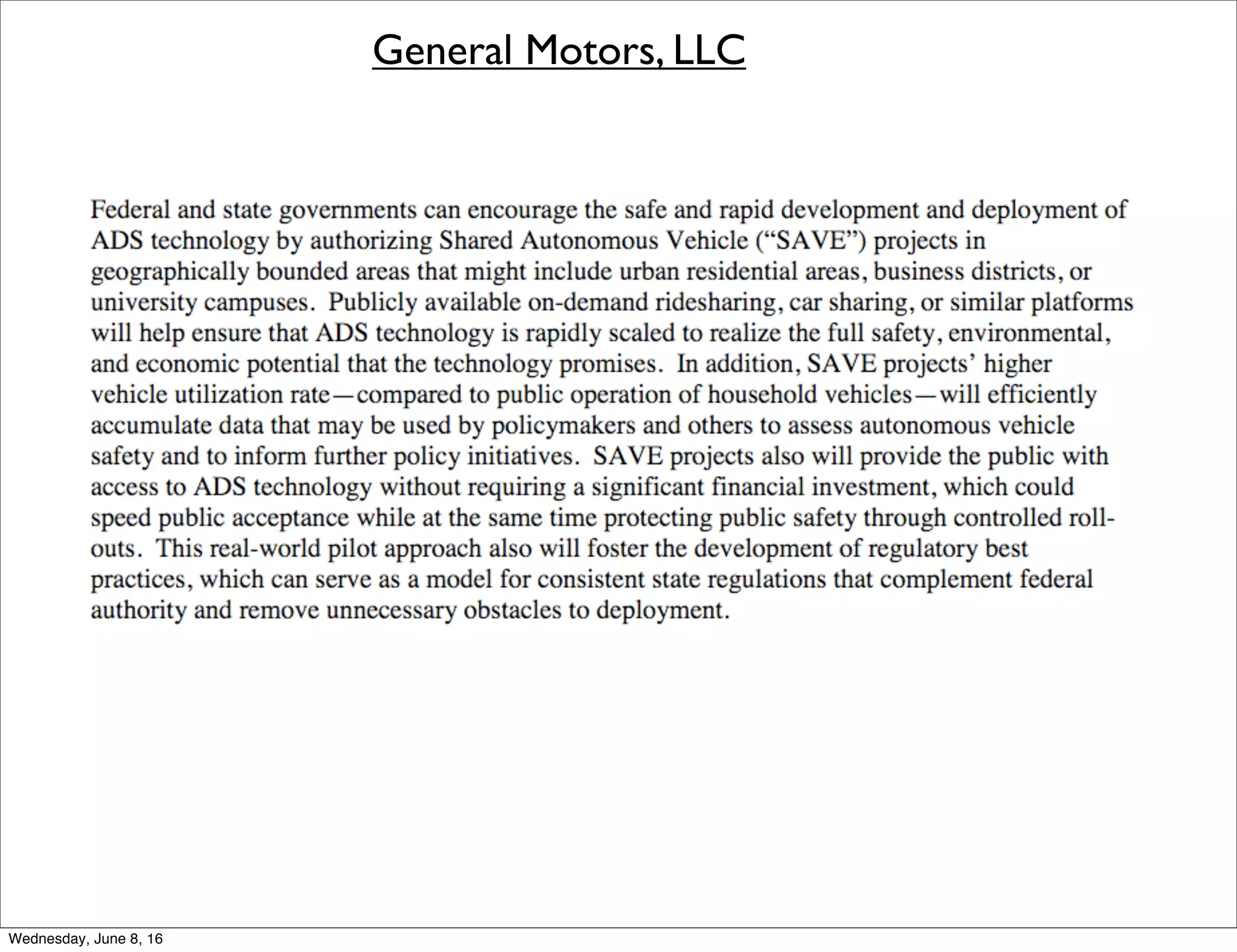
General Motors, LLC
Thursday, June 9, 16
Georgia Institute of Technology
Thursday, June 9, 16
GS1 US
Thursday, June 9, 16
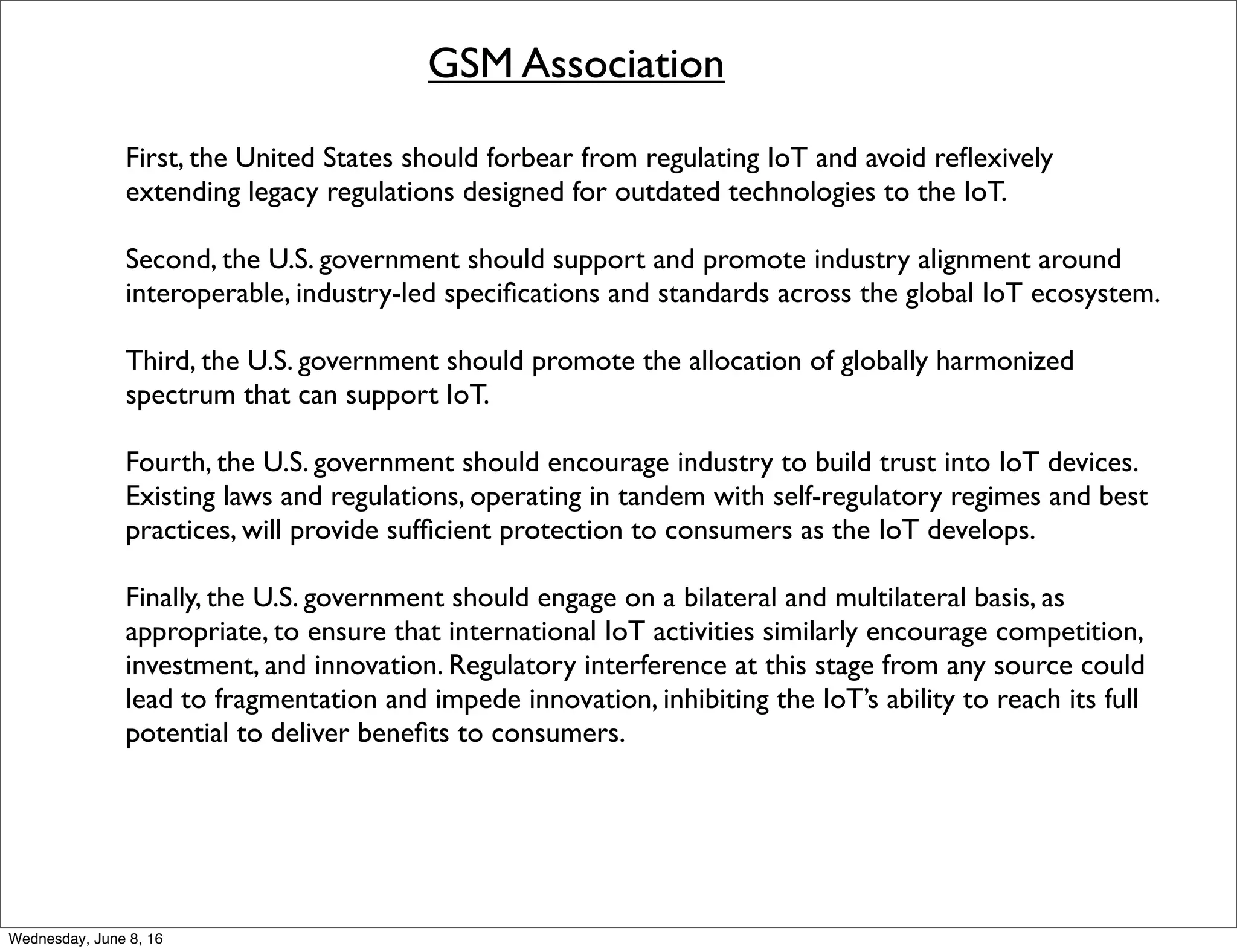
GSM Association
First, the United States should forbear from regulating IoT and avoid reflexively
extending legacy regulations designed for outdated technologies to the IoT.
Second, the U.S. government should support and promote industry alignment around
interoperable, industry-led specifications and standards across the global IoT ecosystem.
Third, the U.S. government should promote the allocation of globally harmonized
spectrum that can support IoT.
Fourth, the U.S. government should encourage industry to build trust into IoT devices.
Existing laws and regulations, operating in tandem with self-regulatory regimes and best
practices, will provide sufficient protection to consumers as the IoT develops.
Finally, the U.S. government should engage on a bilateral and multilateral basis, as
appropriate, to ensure that international IoT activities similarly encourage competition,
investment, and innovation. Regulatory interference at this stage from any source could
lead to fragmentation and impede innovation, inhibiting the IoT’s ability to reach its full
potential to deliver benefits to consumers.
Thursday, June 9, 16
Hewlett Packard Enterprise
Thursday, June 9, 16
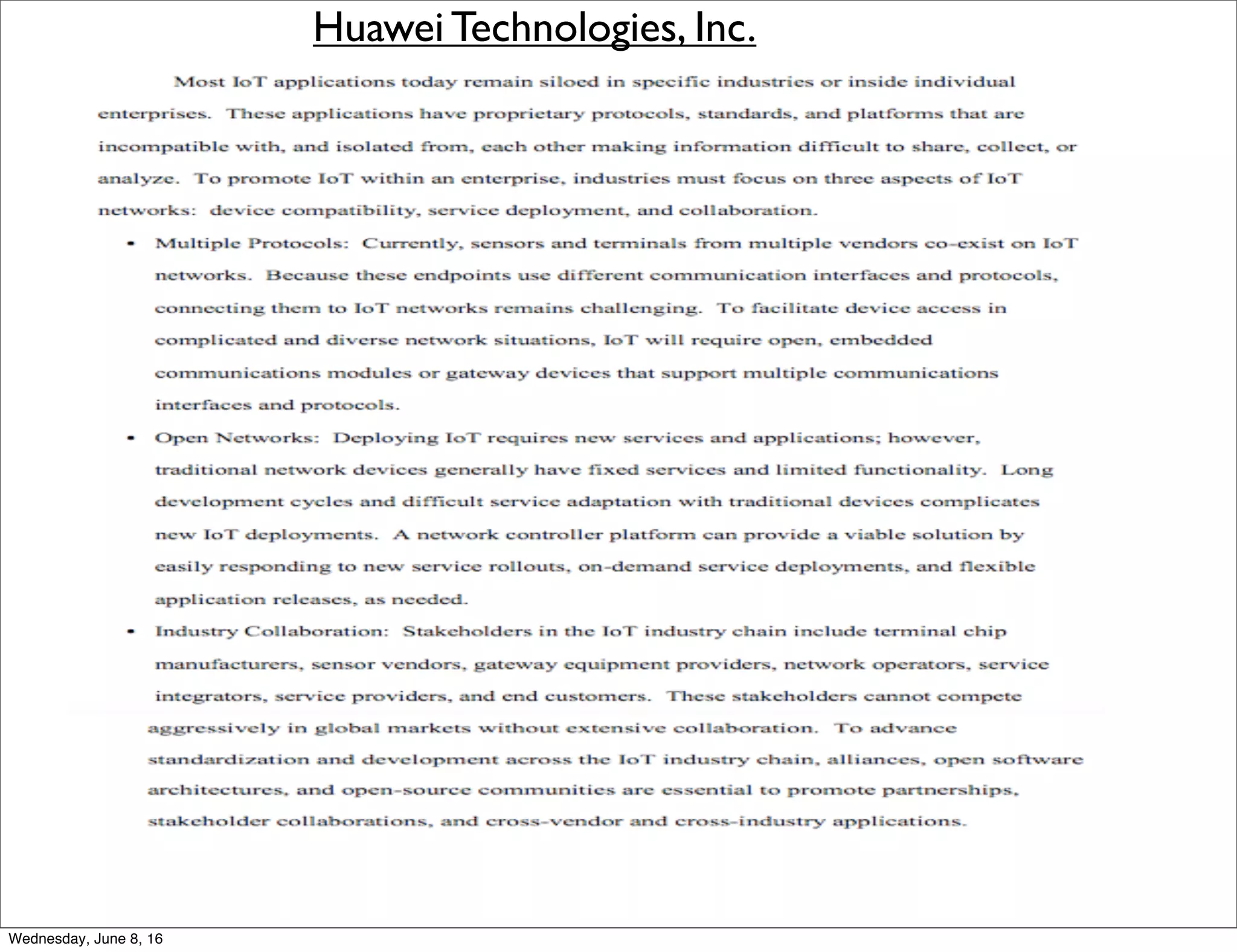
Huawei Technologies, Inc.
Thursday, June 9, 16
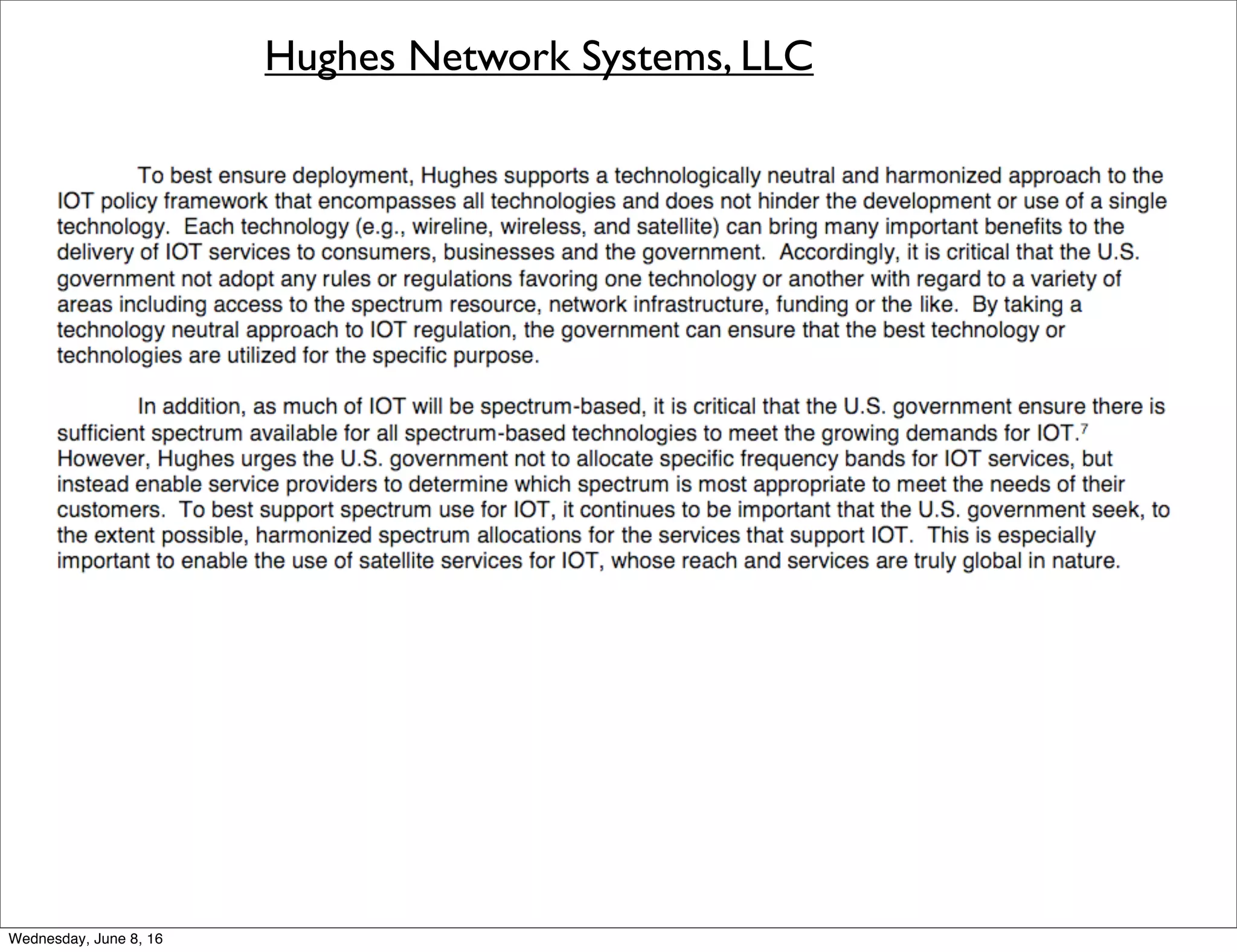
Hughes Network Systems, LLC
Thursday, June 9, 16
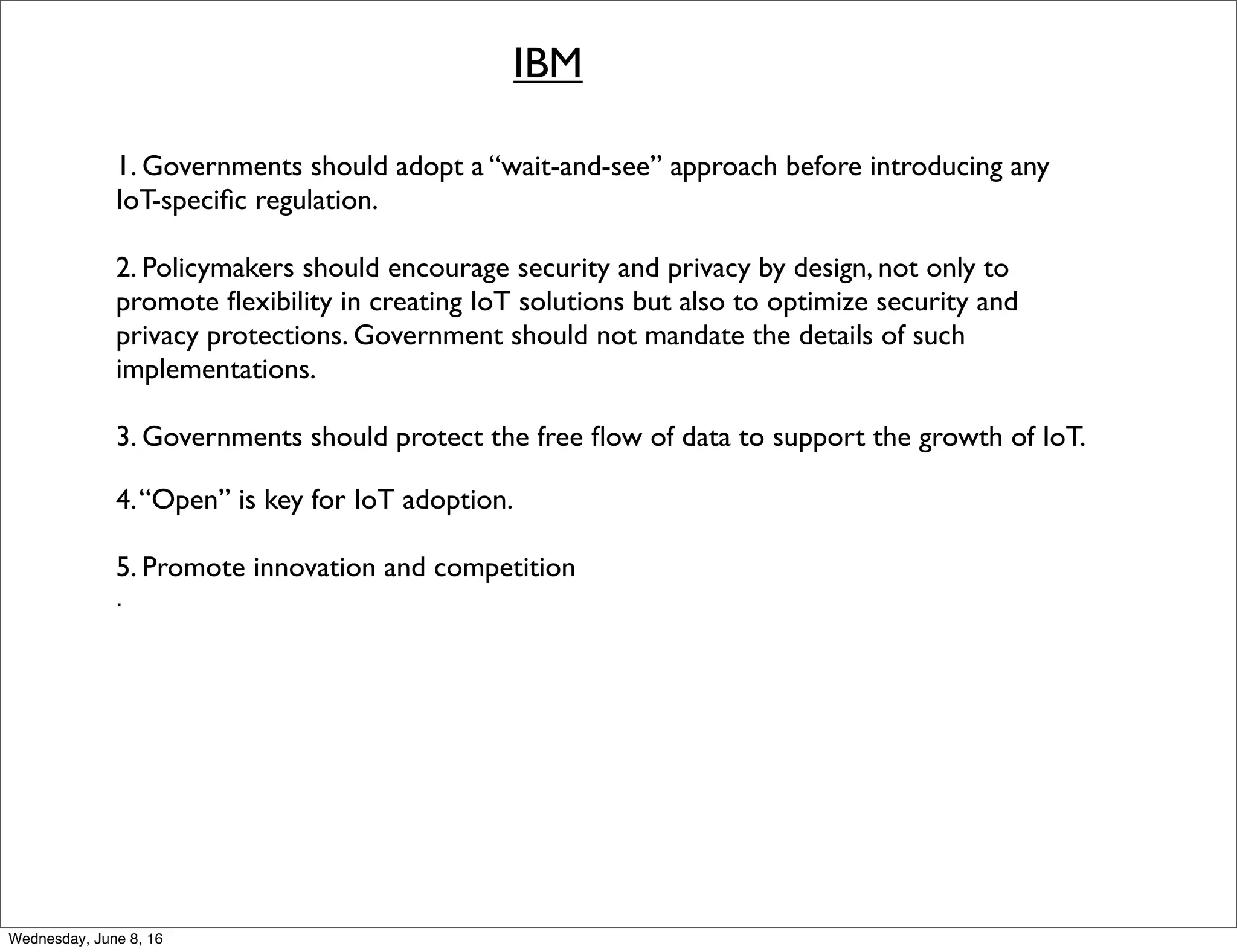
IBM
1. Governments should adopt a “wait-and-see” approach before introducing any
IoT-specific regulation.
2. Policymakers should encourage security and privacy by design, not only to
promote flexibility in creating IoT solutions but also to optimize security and
privacy protections. Government should not mandate the details of such
implementations.
3. Governments should protect the free flow of data to support the growth of IoT.
4.“Open” is key for IoT adoption.
5. Promote innovation and competition
.
Thursday, June 9, 16
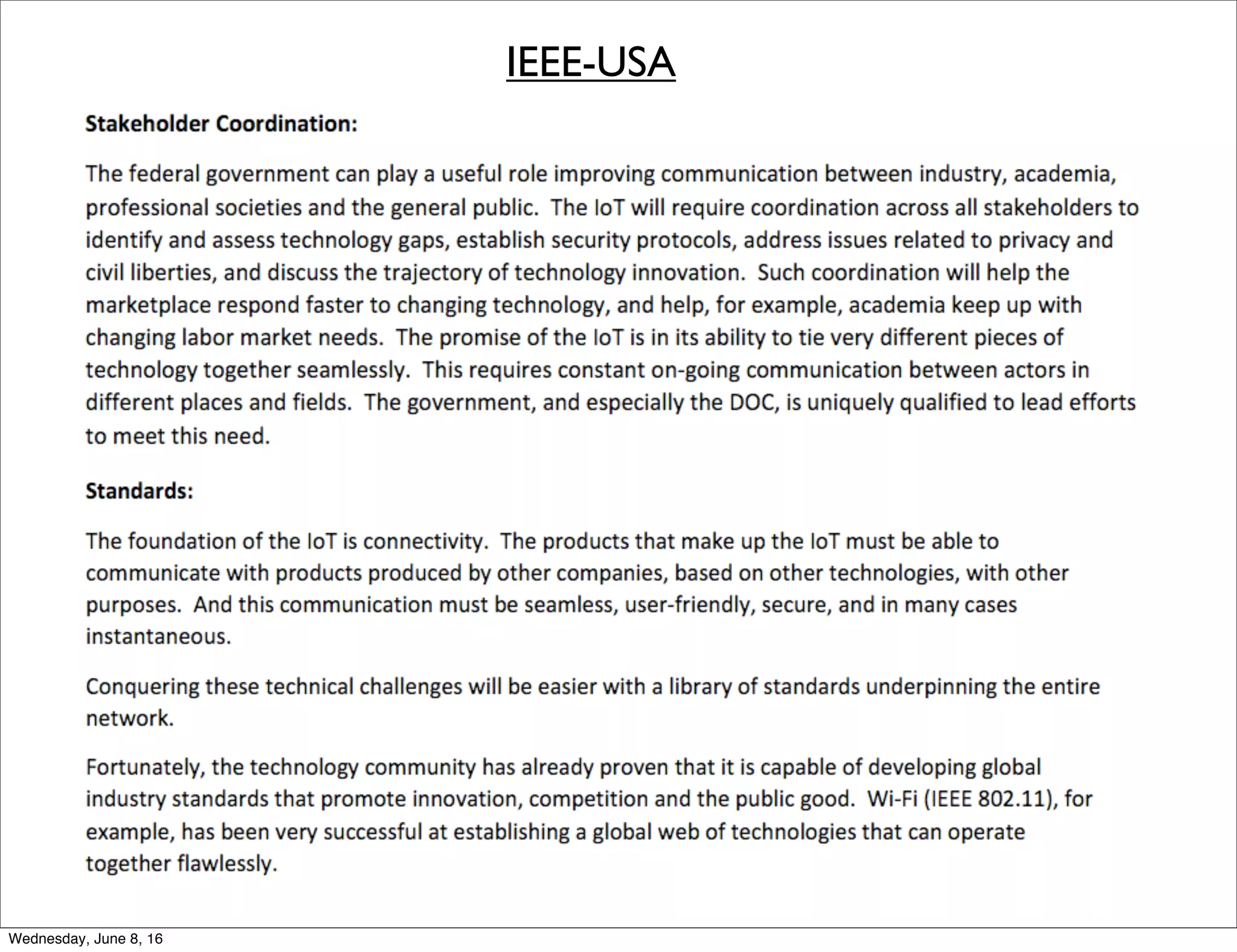
IEEE-USA
Thursday, June 9, 16
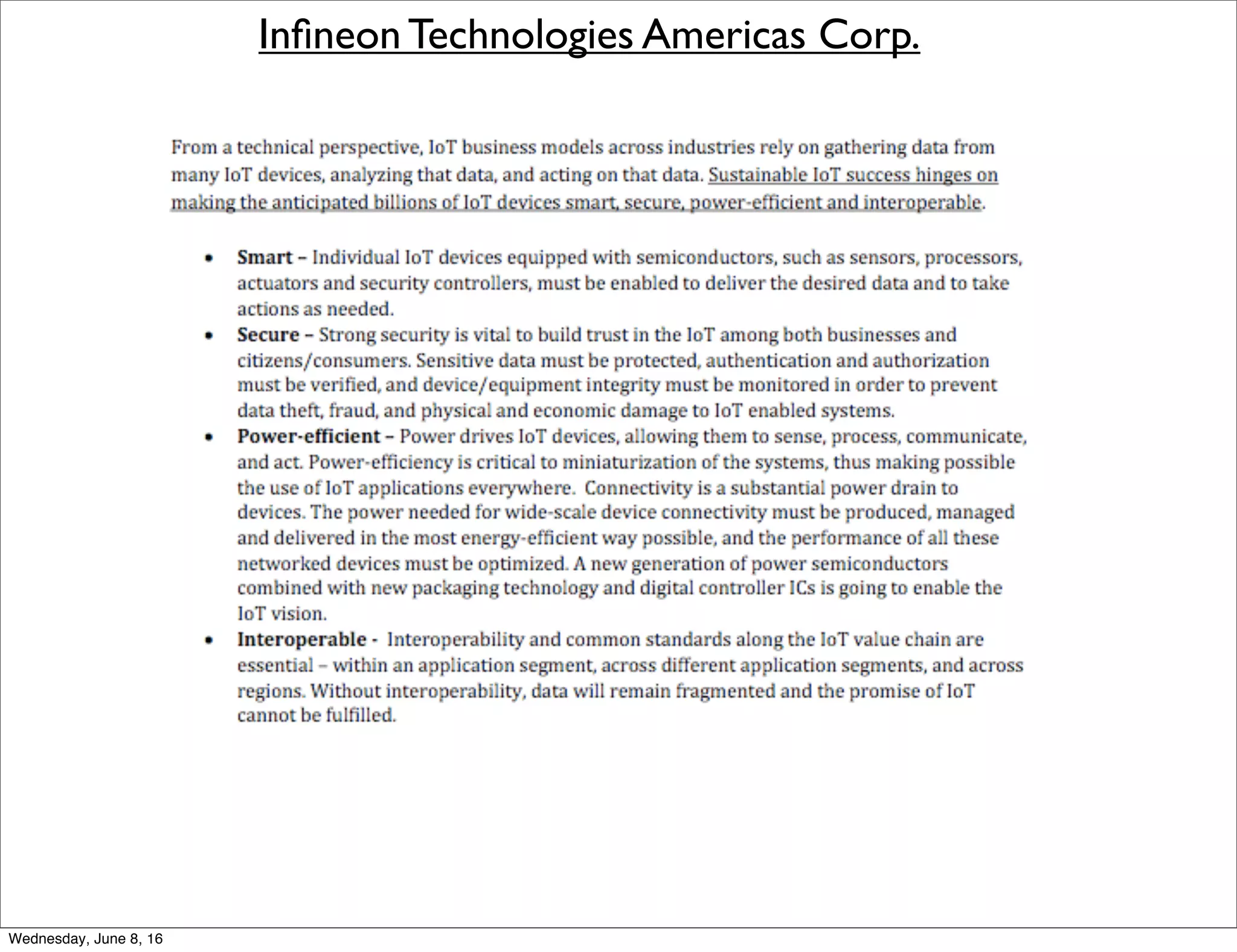
Infineon Technologies Americas Corp.
Thursday, June 9, 16
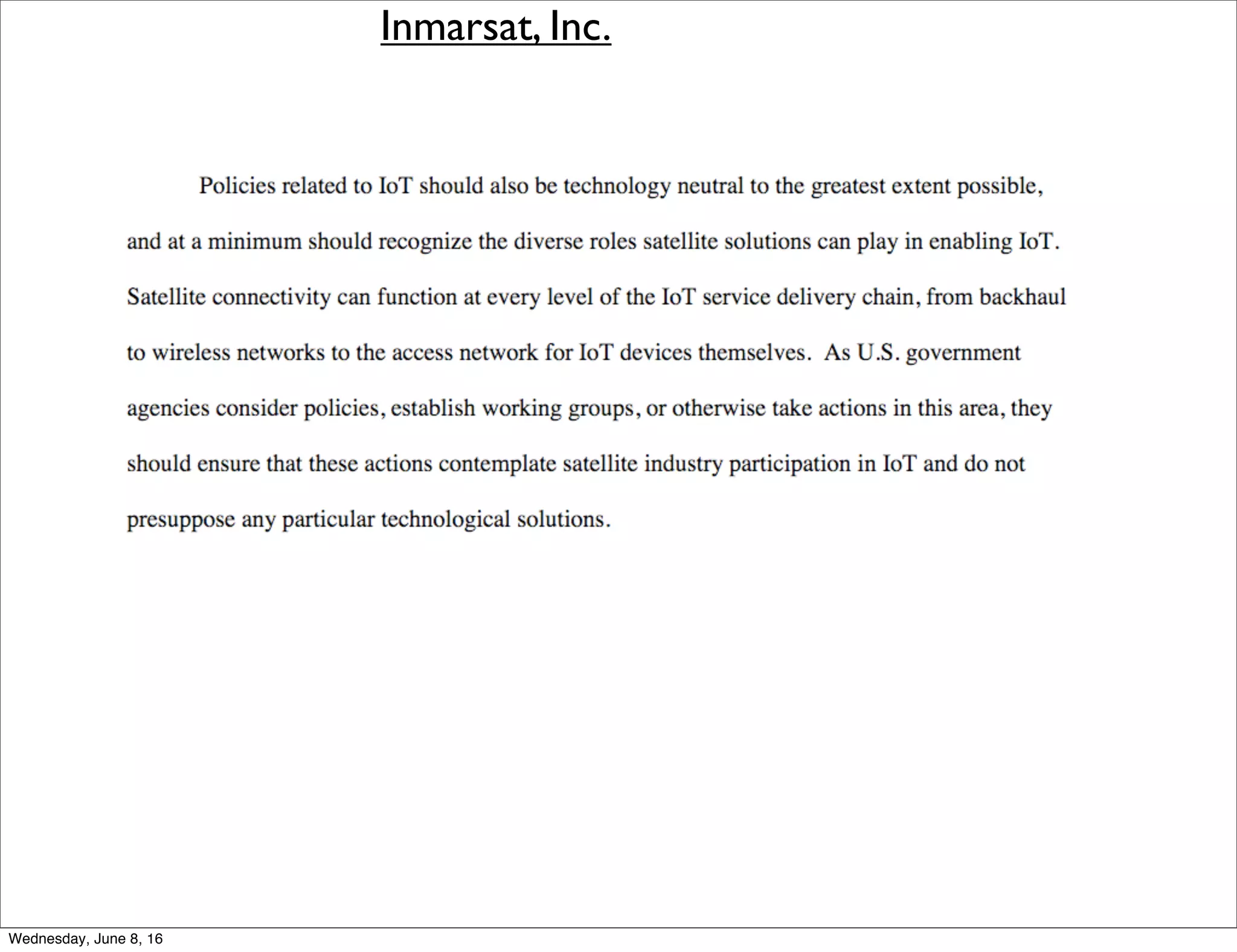
Inmarsat, Inc.
Thursday, June 9, 16
InterDigital, Inc.
Thursday, June 9, 16
Internet Architecture Board
Thursday, June 9, 16
Internet Association
Thursday, June 9, 16
Internet Commerce Coalition
NTIA SHOULD ESTABLISH PRINCIPLES TO GUIDE THE GOVERNMENT’S
APPROACH TO IOT
A.The green paper should encourage the preemption of agency-by-agency, sectorial
regulation through the principle of tech neutrality
B.The green paper should include a principle on process outcomes for security
and privacy
C.The green paper should include a principle establishing that privacy protections
must be based upon the sensitivity of information.
D.The green paper should include a principle of flexibility for future use of IoT data
The principles should be developed by the Internet Policy Task Force
The Department of Commerce should initiate a dialogue to reduce international
barriers to IoT deployment and use.
Thursday, June 9, 16
Internet Society
Thursday, June 9, 16
IoT Policy Network
Thursday, June 9, 16
ITI
Thursday, June 9, 16
James, Gilbert
Thursday, June 9, 16
Jones, Kim L.
Thursday, June 9, 16
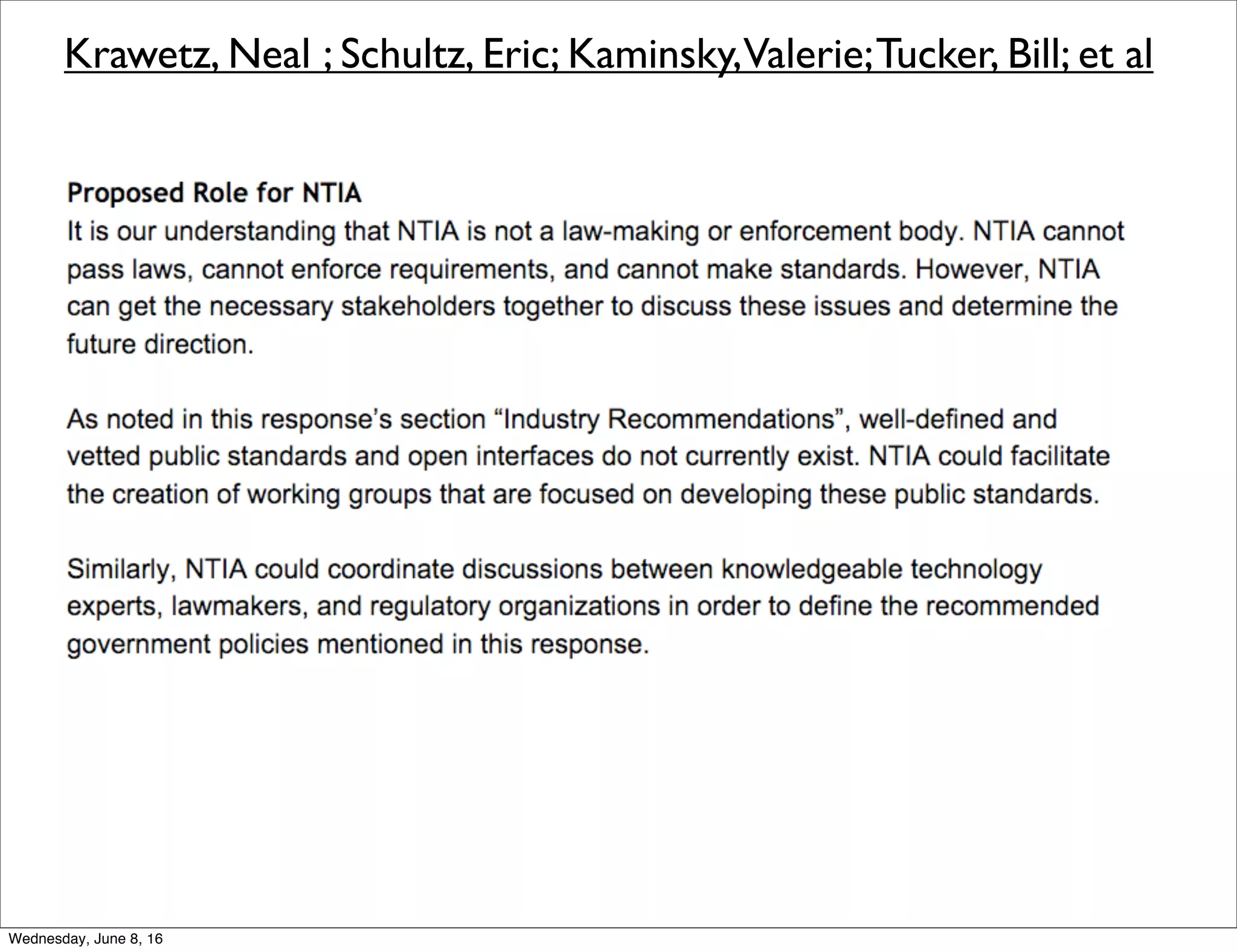
Krawetz, Neal ; Schultz, Eric; Kaminsky,Valerie;Tucker, Bill; et al
Thursday, June 9, 16
Lanting, Dr Cees J.M.
Thursday, June 9, 16
Larry, J. Christopher
Thursday, June 9, 16
LeFlore, Fannie
Thursday, June 9, 16
Ligado Networks
.........................................................................................................
Thursday, June 9, 16
Local Innovation and Skill Cluster Anchor Network etc.
Thursday, June 9, 16
Louchez,Alain
Thursday, June 9, 16
Marcus, Dr Robert
Thursday, June 9, 16
Microsoft Corporation
Thursday, June 9, 16
Milne, Claire
Thursday, June 9, 16
Mobile Future
Thursday, June 9, 16
Motorola Solutions, Inc
Thursday, June 9, 16
Manwaring, Kayleen
Thursday, June 9, 16
monica2
Thursday, June 9, 16
National Association of REALTORS
Thursday, June 9, 16
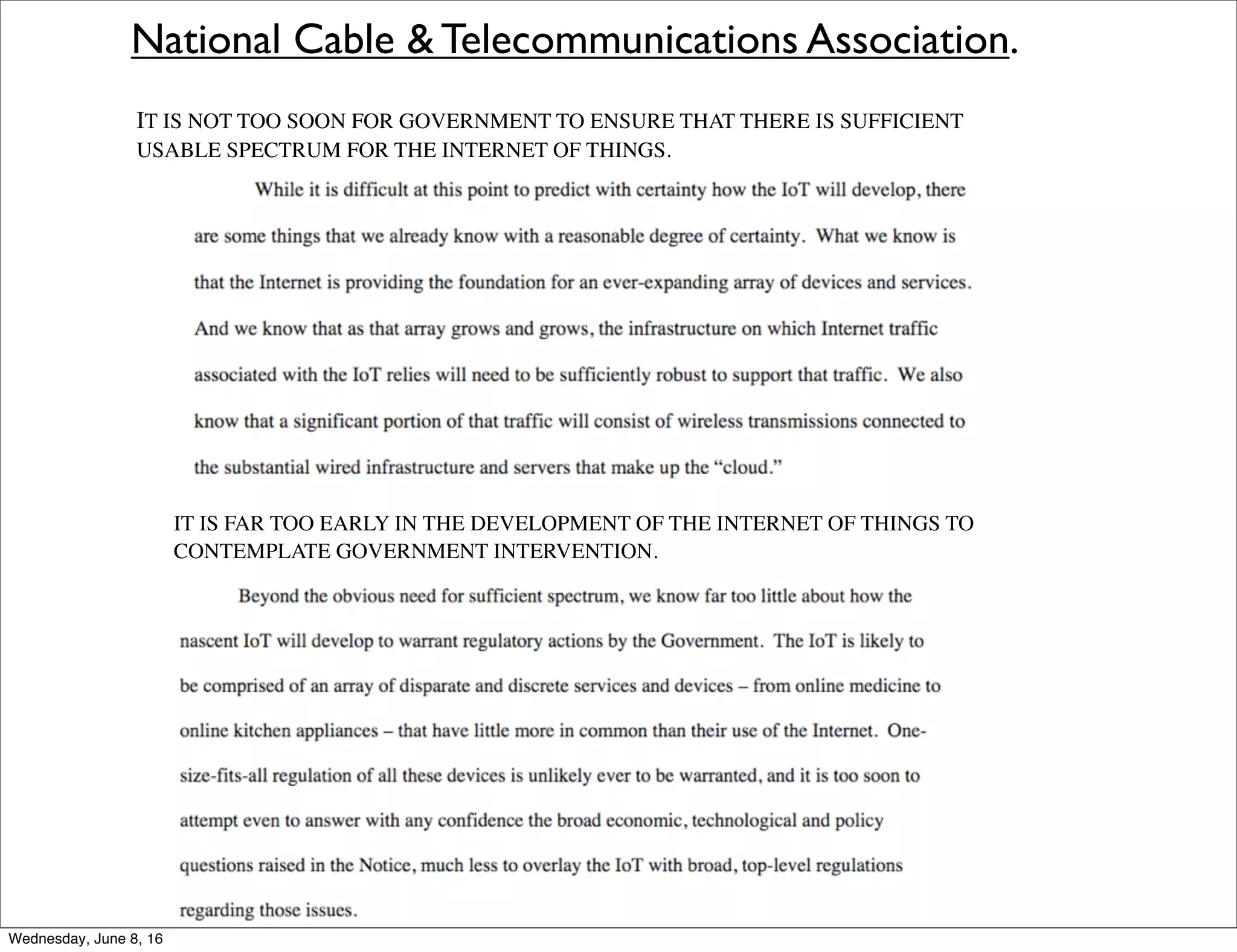
National Cable & Telecommunications Association.
IT IS FAR TOO EARLY IN THE DEVELOPMENT OF THE INTERNET OF THINGS TO
CONTEMPLATE GOVERNMENT INTERVENTION.
IT IS NOT TOO SOON FOR GOVERNMENT TO ENSURE THAT THERE IS SUFFICIENT
USABLE SPECTRUM FOR THE INTERNET OF THINGS.
Thursday, June 9, 16
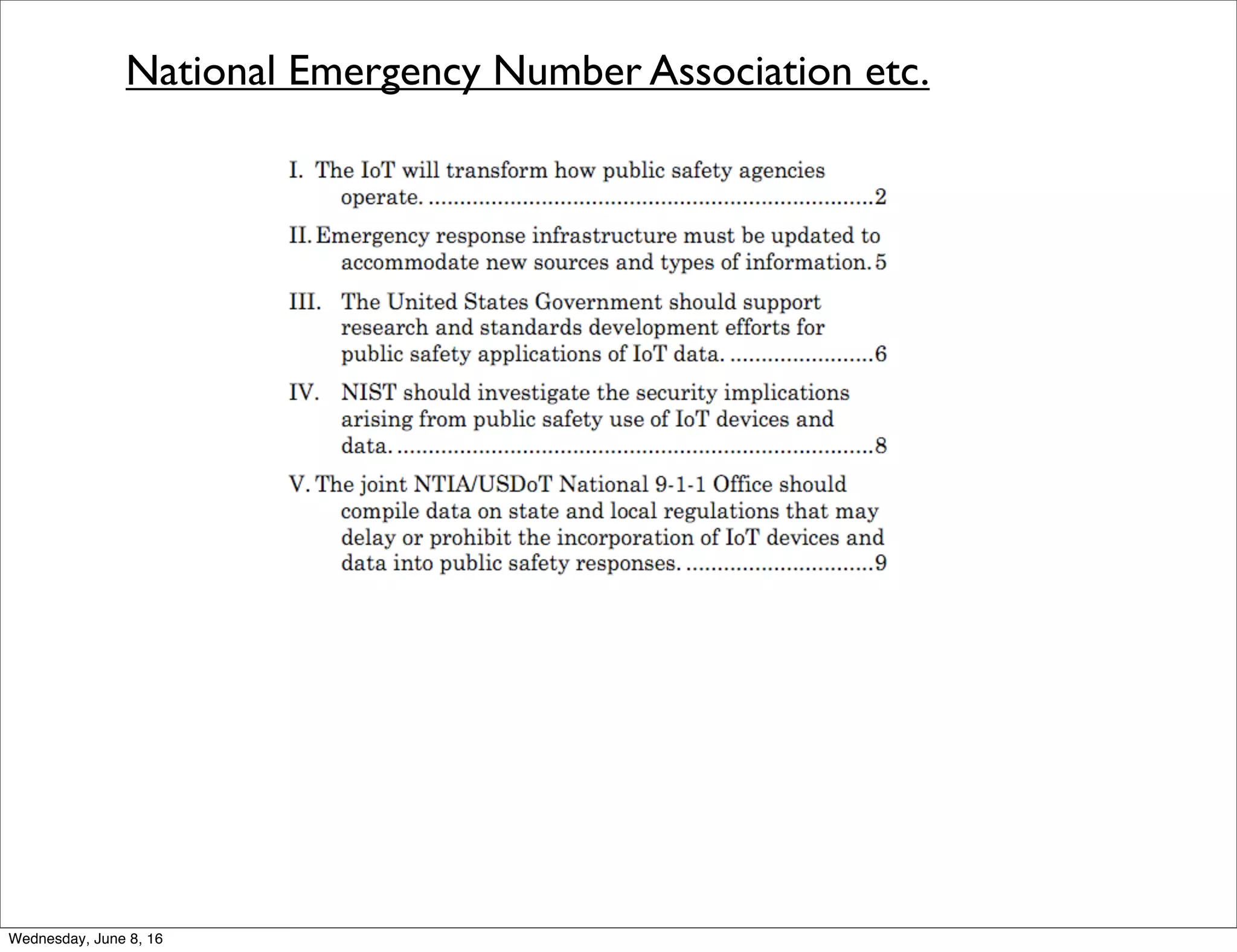
National Emergency Number Association etc.
Thursday, June 9, 16
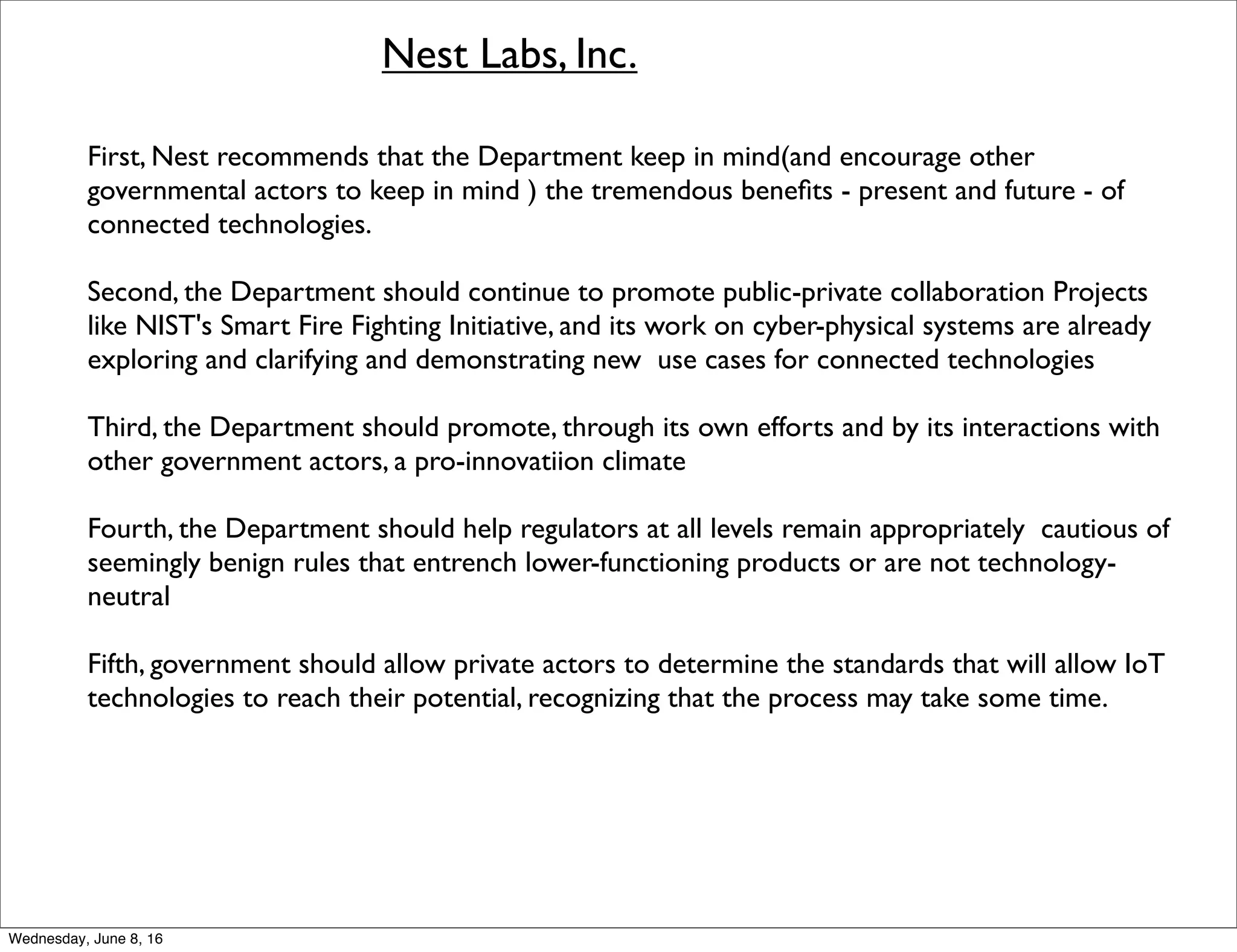
Nest Labs, Inc.
First, Nest recommends that the Department keep in mind(and encourage other
governmental actors to keep in mind ) the tremendous benefits - present and future - of
connected technologies.
Second, the Department should continue to promote public-private collaboration Projects
like NIST's Smart Fire Fighting Initiative, and its work on cyber-physical systems are already
exploring and clarifying and demonstrating new use cases for connected technologies
Third, the Department should promote, through its own efforts and by its interactions with
other government actors, a pro-innovatiion climate
Fourth, the Department should help regulators at all levels remain appropriately cautious of
seemingly benign rules that entrench lower-functioning products or are not technology-
neutral
Fifth, government should allow private actors to determine the standards that will allow IoT
technologies to reach their potential, recognizing that the process may take some time.
Thursday, June 9, 16
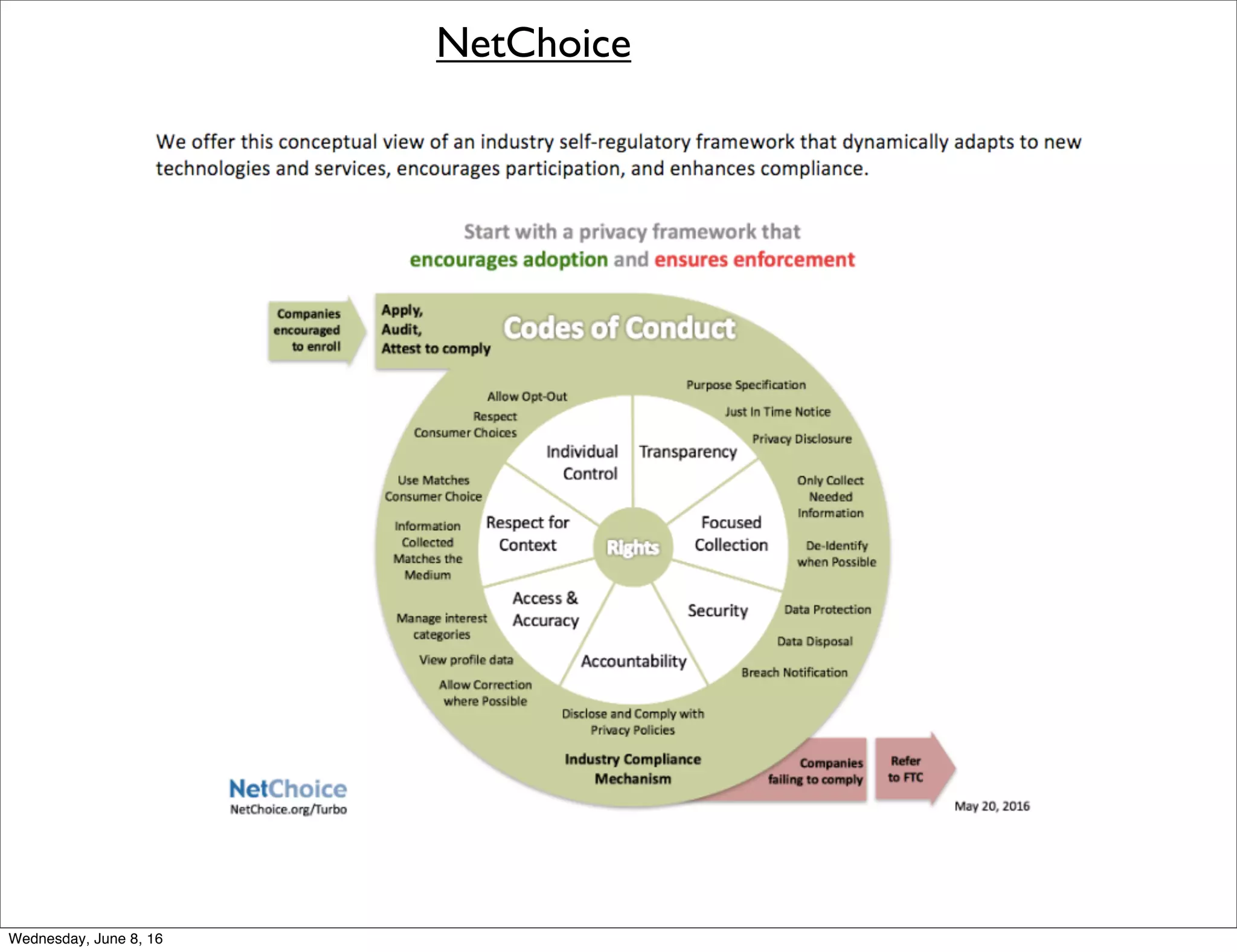
NetChoice
Thursday, June 9, 16
Niskanen Center
Thursday, June 9, 16
Nokia
Thursday, June 9, 16
Online Trust Alliance
Thursday, June 9, 16
Open Connectivity Foundation
Thursday, June 9, 16
Owners’ Rights Initiative
DMCA = Digital Millennium Copyright Act
Thursday, June 9, 16
Peppet, Scott R.
Thursday, June 9, 16
Plessel,Todd
Thursday, June 9, 16
Pratt, Steve
Thursday, June 9, 16
Providence Group
Thursday, June 9, 16
Public Knowledge
Thursday, June 9, 16
Qualcomm Incorporated
First and foremost, NTIA, the FCC, and the federal agencies with spectrum needs
should redouble their efforts to free up additional spectrum resources that can be
used for the IoT and other types of wireless applications and services.
Second, to best support successful IoT growth, the U.S. Government should
maintain its policy of technology neutrality to facilitate the virtuous cycle of
innovation fueling the mobile revolution.
Third, the U.S. Government should continue to support industry-led
standardization processes to continue U.S. technology leadership on IoT.
Fourth, Qualcomm encourages NTIA and other U.S. government agencies to
continue their dialogue and engagement with their counterpart agencies in other
countries, with particular emphasis on the aforementioned priorities of spectrum
allocation, industry-led standards, and pro-competitive investment policies
Finally, the U.S. Government should continue to enact policies that support
investment in IoT technology development and streamline the deployment of
wireless infrastructure for IoT by reducing unnecessary regulatory burdens.
.
Thursday, June 9, 16
Raff, John
.
Thursday, June 9, 16
Rapid7
Thursday, June 9, 16
Renkis, Martin A.
Martin is the CEO of Smartvue
Thursday, June 9, 16
Rosner, Dr. Gilad L.
Thursday, June 9, 16
Samsung
Thursday, June 9, 16
Satellite Industry Association
Thursday, June 9, 16
Schoepf,Walter H.
Thursday, June 9, 16
Secure ID Coalition
Thursday, June 9, 16
Security Industry Association
...............................................................................................................
Thursday, June 9, 16
Semiconductor Industry Association
Thursday, June 9, 16
Senators Schatz, Fischer, Booker, and Ayotte
Thursday, June 9, 16
Silver Spring Networks
Thursday, June 9, 16
Software & Information Industry Association
......................................................................................................................
Thursday, June 9, 16
Southern Company Services, Inc.
Thursday, June 9, 16
Spiess,Tony
Thursday, June 9, 16
Staff of the Federal Trade Commission’s Bureau of
Consumer Protection and Office of Policy Planning
Thursday, June 9, 16
State of Illinois
Thursday, June 9, 16
Symantec
Thursday, June 9, 16
Sysorex USA
Thursday, June 9, 16
T-Mobile USA, Inc.
Thursday, June 9, 16
Telecommunications Industry Association
Thursday, June 9, 16
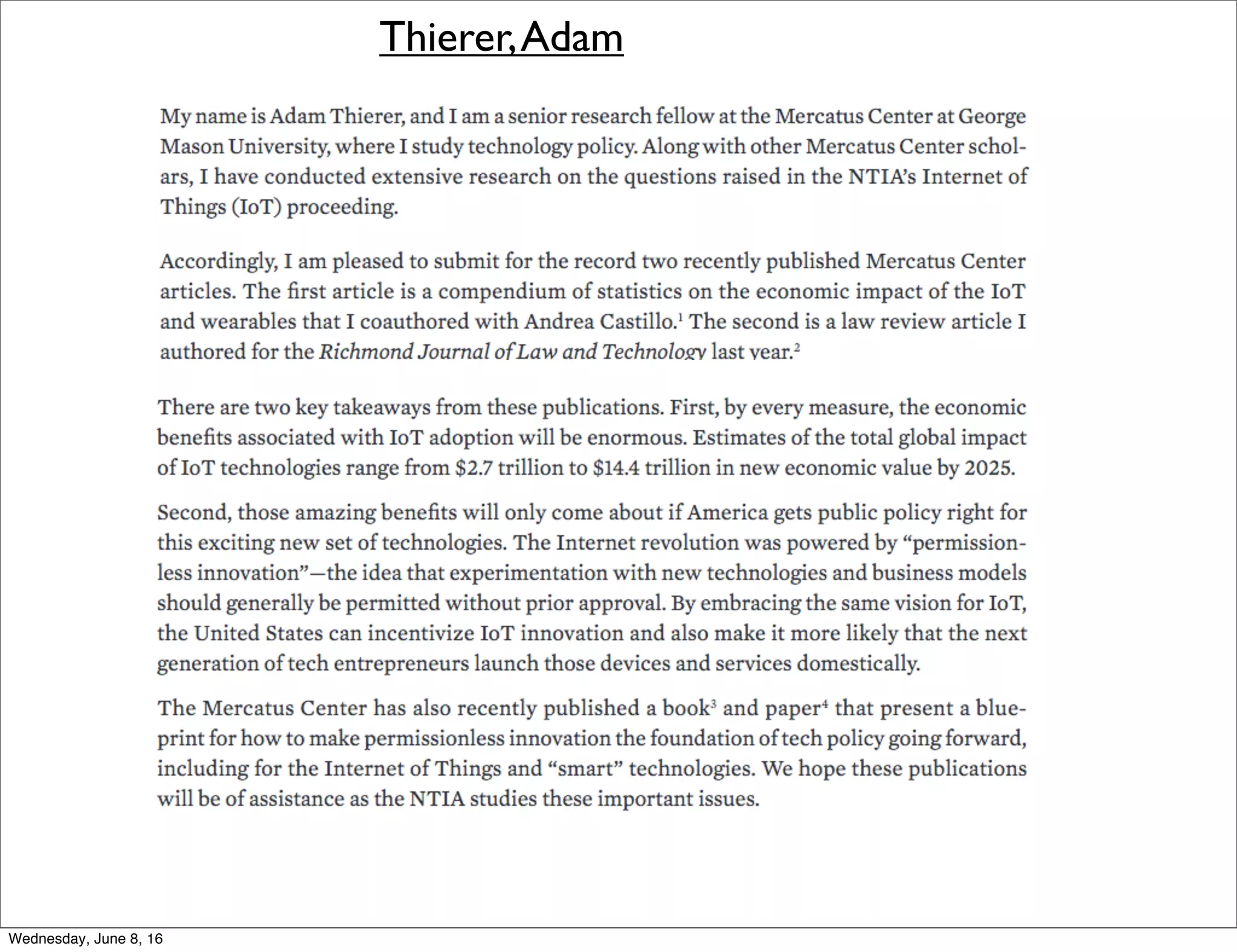
Thierer,Adam
Thursday, June 9, 16
Tim - The “Oldcommguy™”
Thursday, June 9, 16
Trans-Atlantic Business Council
Thursday, June 9, 16
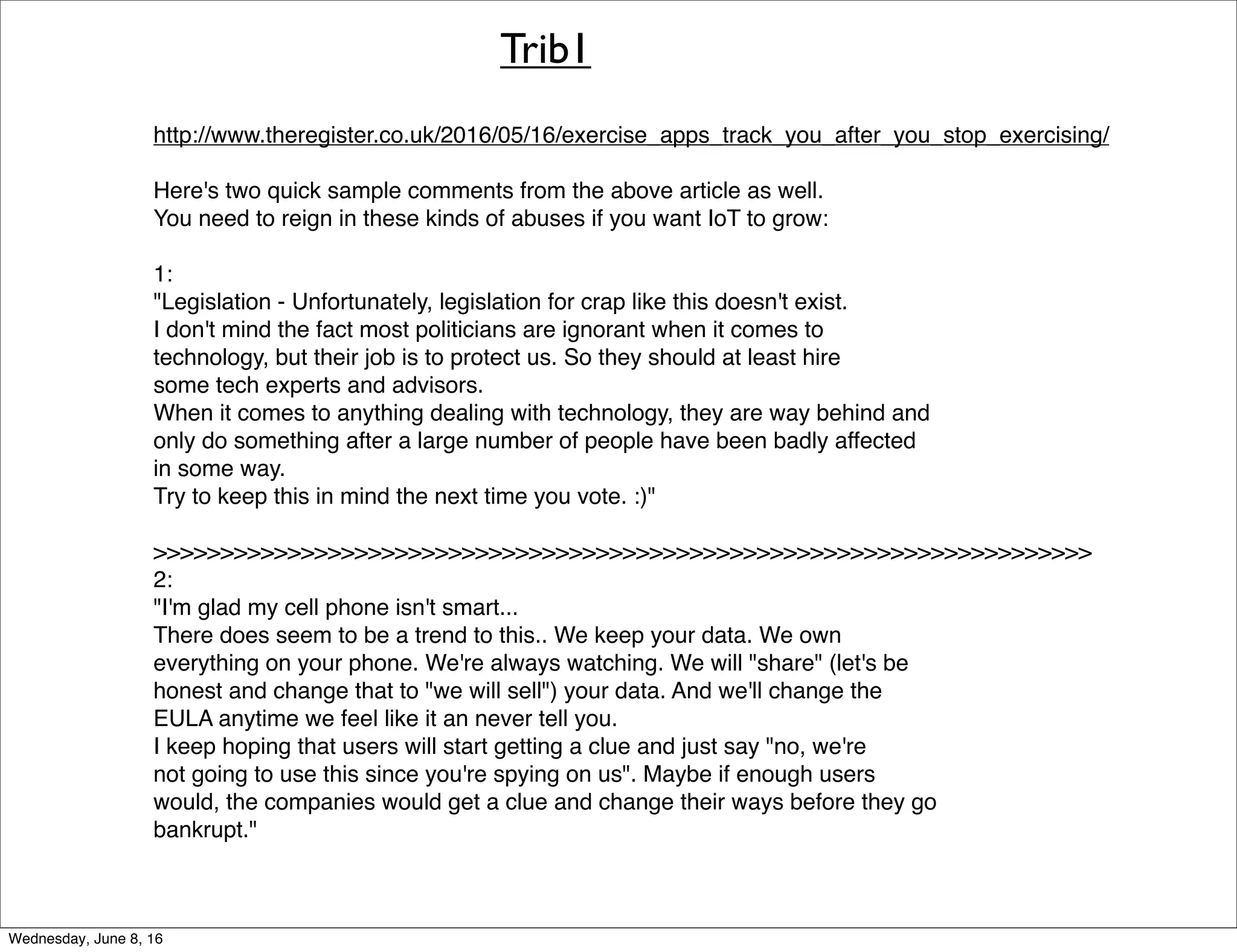
Trib1
http://www.theregister.co.uk/2016/05/16/exercise_apps_track_you_after_you_stop_exercising/
Here's two quick sample comments from the above article as well.
You need to reign in these kinds of abuses if you want IoT to grow:
1:
"Legislation - Unfortunately, legislation for crap like this doesn't exist.
I don't mind the fact most politicians are ignorant when it comes to
technology, but their job is to protect us. So they should at least hire
some tech experts and advisors.
When it comes to anything dealing with technology, they are way behind and
only do something after a large number of people have been badly affected
in some way.
Try to keep this in mind the next time you vote. :)"
>>>>>>>>>>>>>>>>>>>>>>>>>>>>>>>>>>>>>>>>>>>>>>>>>>>>>>>>>>>>>>>>>>>>>>
2:
"I'm glad my cell phone isn't smart...
There does seem to be a trend to this.. We keep your data. We own
everything on your phone. We're always watching. We will "share" (let's be
honest and change that to "we will sell") your data. And we'll change the
EULA anytime we feel like it an never tell you.
I keep hoping that users will start getting a clue and just say "no, we're
not going to use this since you're spying on us". Maybe if enough users
would, the companies would get a clue and change their ways before they go
bankrupt."
Thursday, June 9, 16
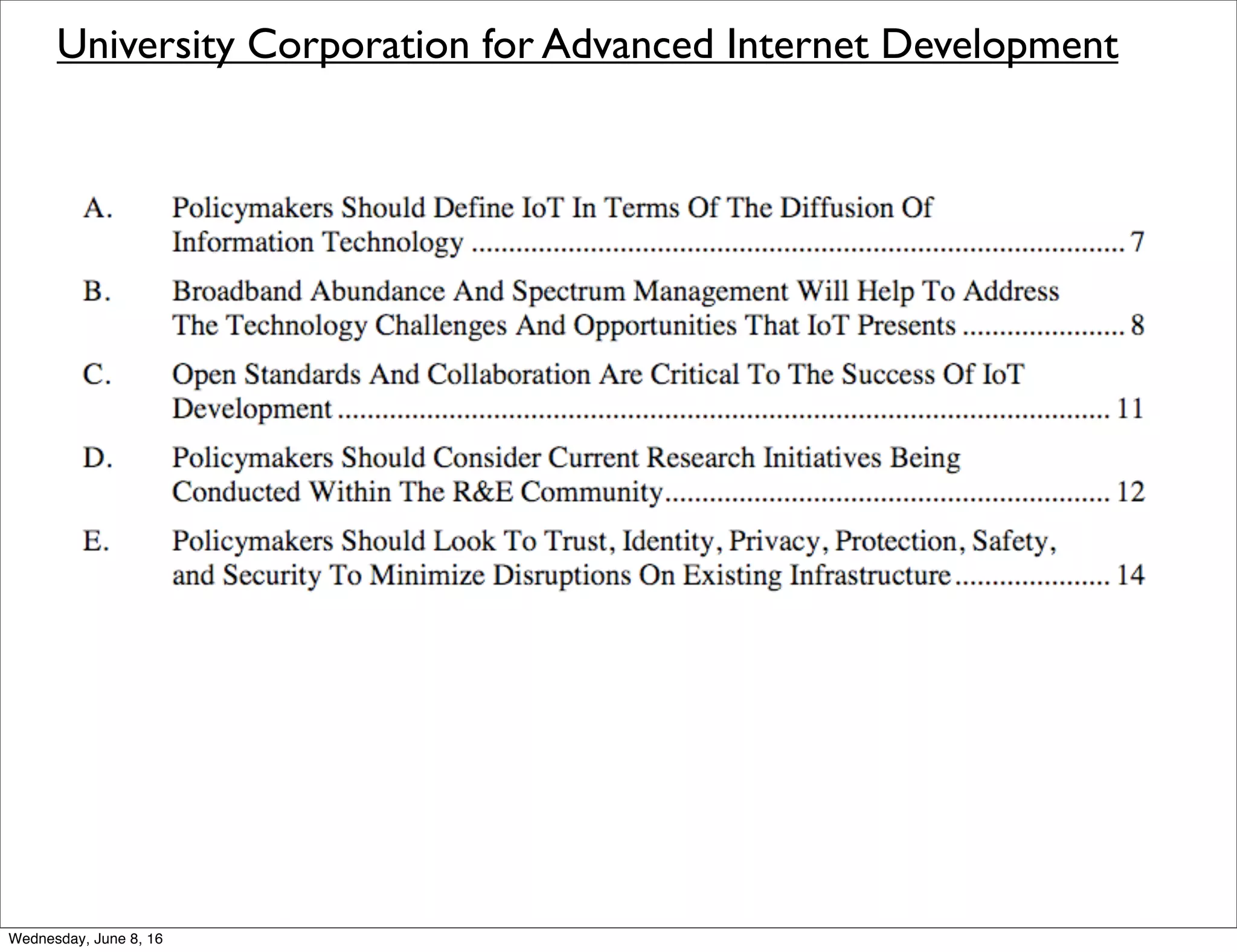
University Corporation for Advanced Internet Development
Thursday, June 9, 16
University of Michigan
Thursday, June 9, 16
U.S. Chamber of Commerce
Thursday, June 9, 16
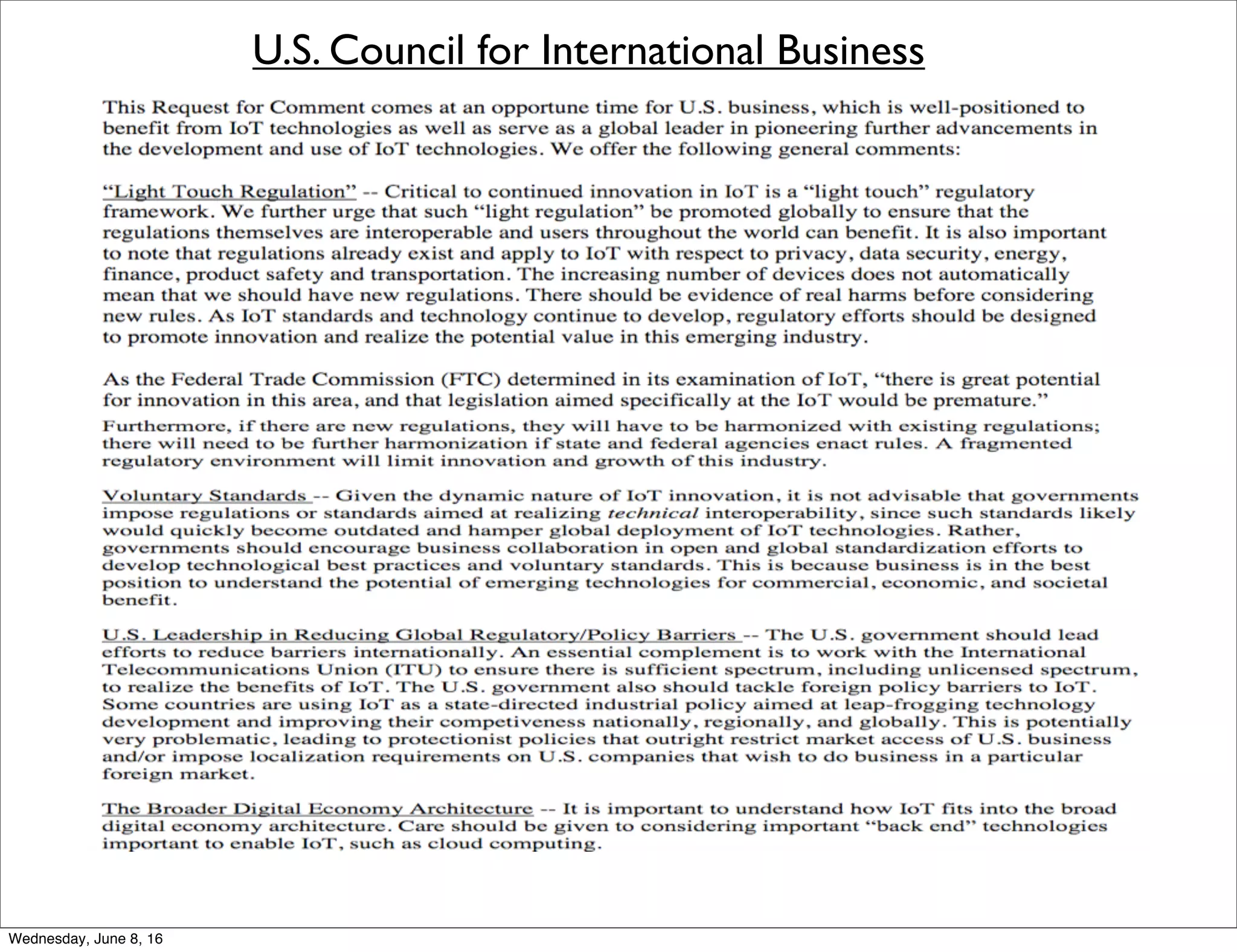
U.S. Council for International Business
Thursday, June 9, 16
United States Telecom Association
Thursday, June 9, 16
Verizon
Thursday, June 9, 16
Visa Inc.
Thursday, June 9, 16
Vodafone US Inc.
Thursday, June 9, 16
Walters, Riley
Thursday, June 9, 16
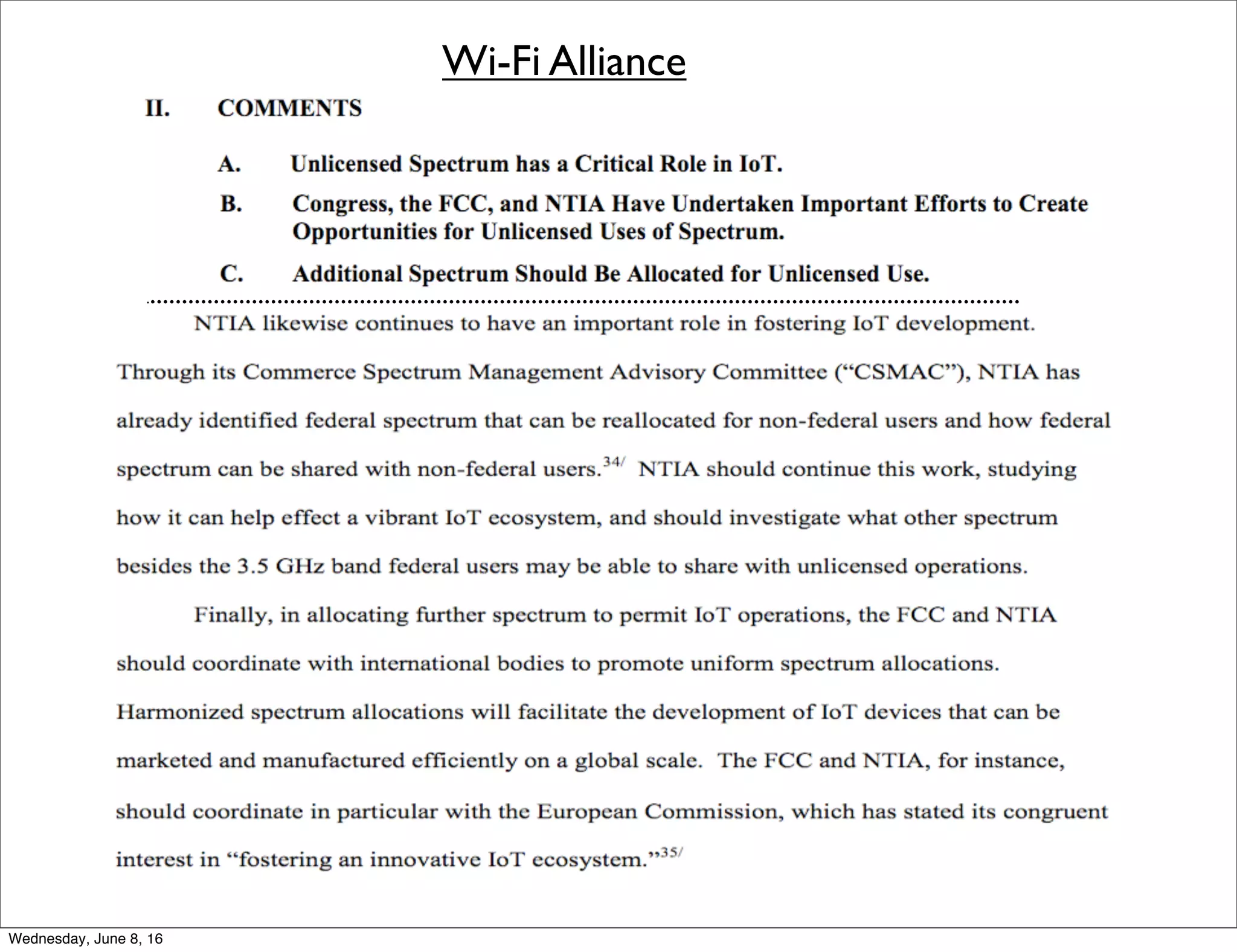
Wi-Fi Alliance
..........................................................................................................................................
Thursday, June 9, 16
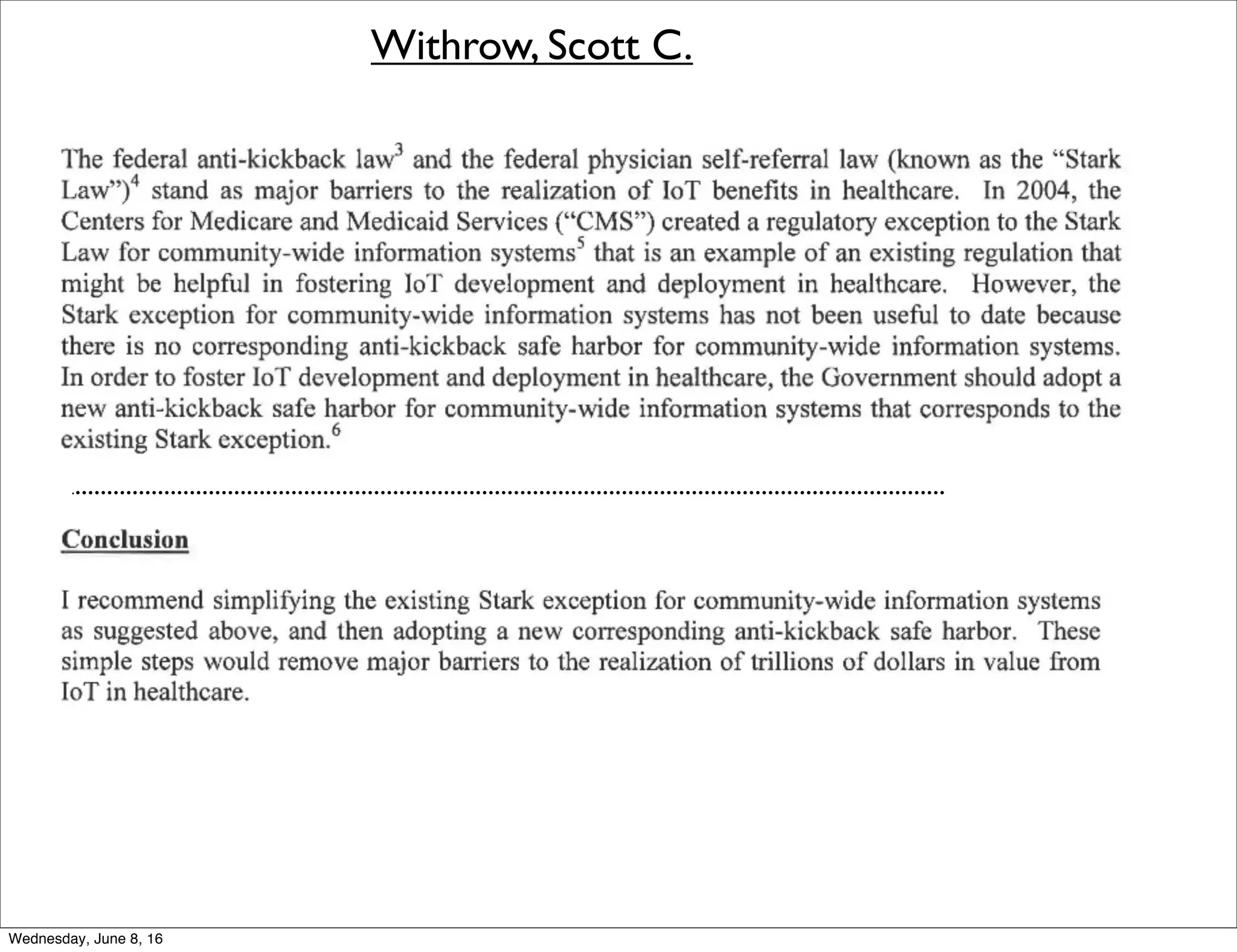
Withrow, Scott C.
..........................................................................................................................................
Thursday, June 9, 16
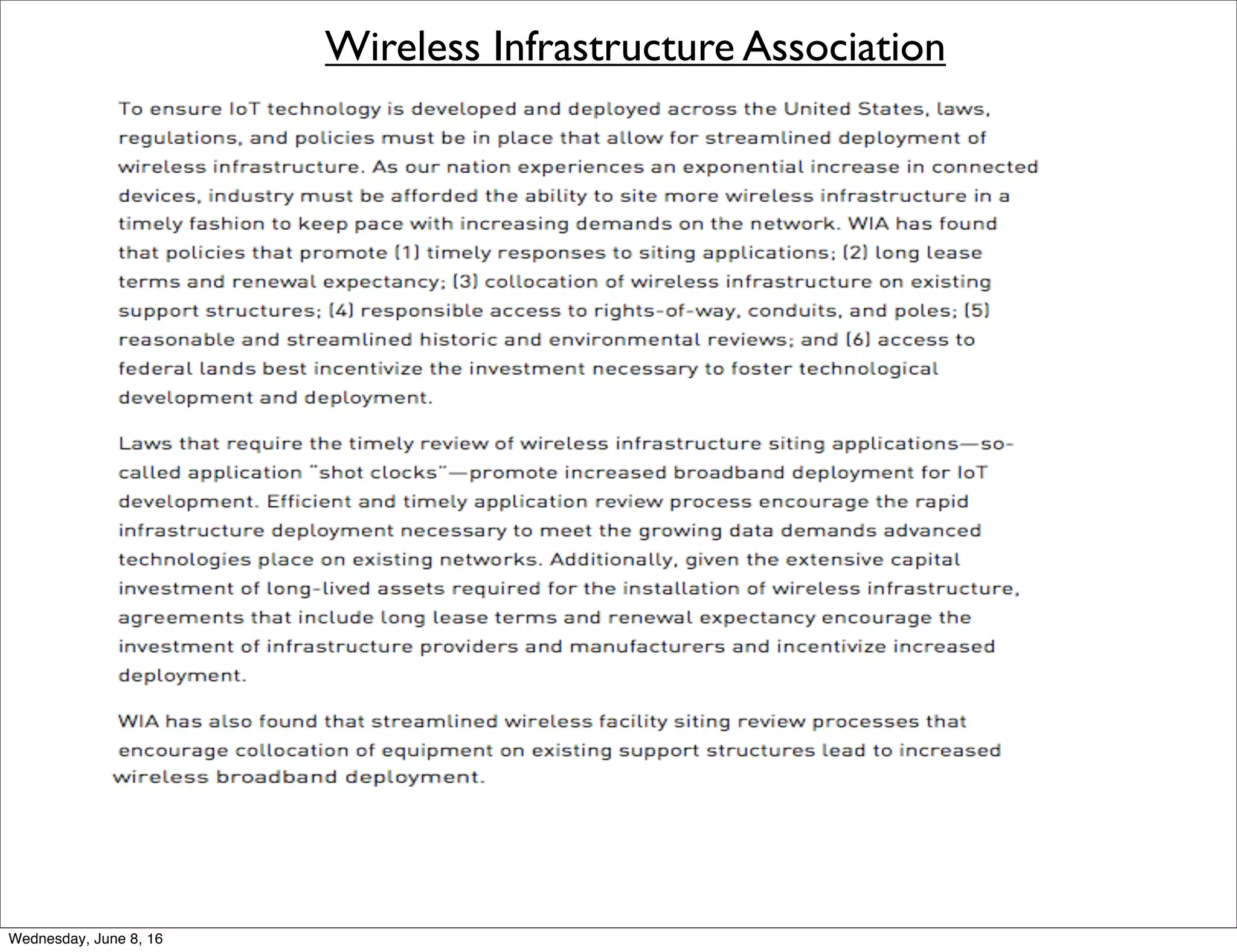
Wireless Infrastructure Association
Thursday, June 9, 16
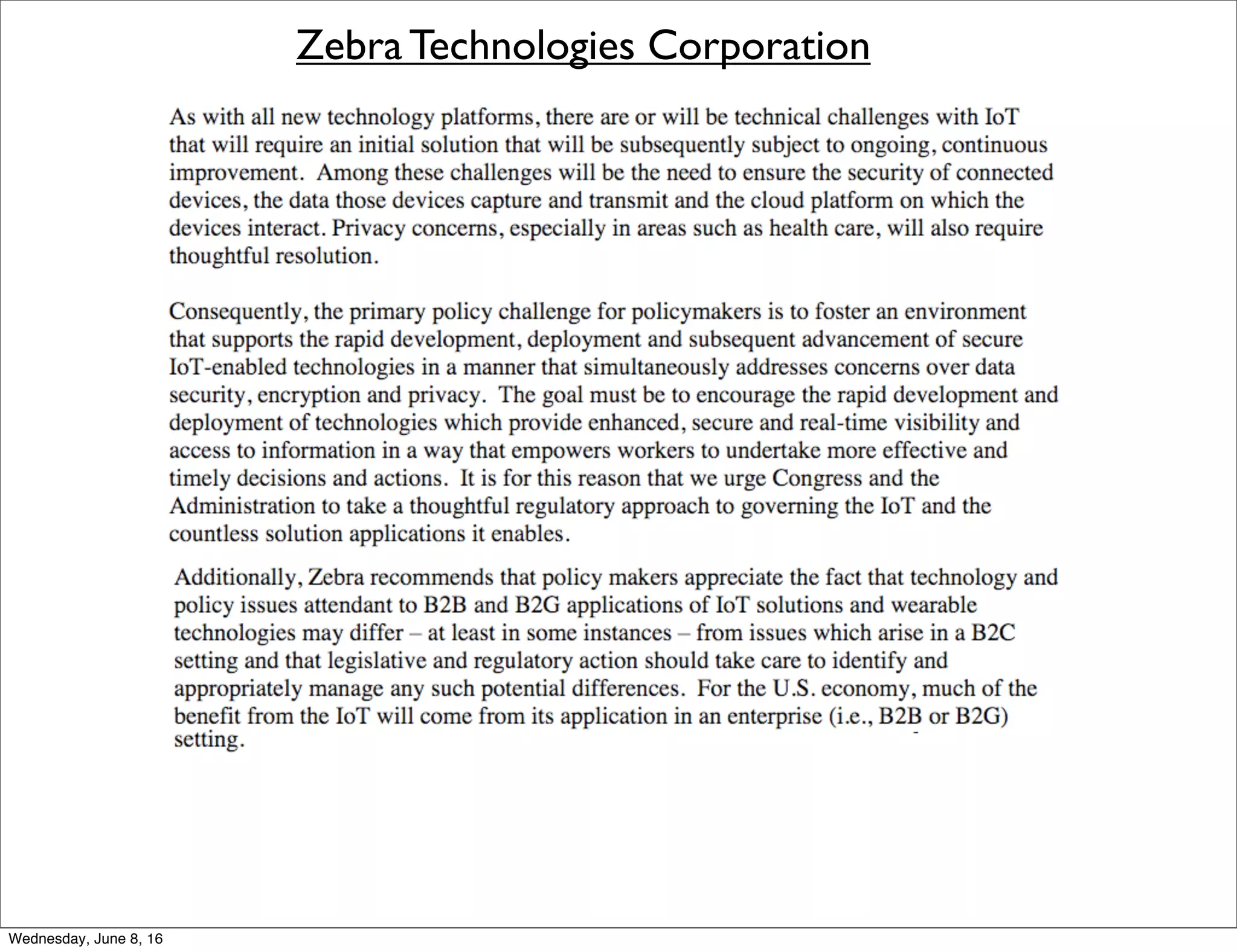
Zebra Technologies Corporation
Thursday, June 9, 16

NTIA IoT RFC Responses

  • 1.
    Responses to theNTIA’s RFC on the “Benefits, Challenges, and Potential Roles for the Government in Fostering the Advancement of the Internet of Things” The NTIA plans to issue an IoT “green paper” incorporating information from these responses Thursday, June 9, 16
  • 2.
    Outline of Presentation •NTIA IoT Strategy Questions • List of 132 RFC Responders • Response Snapshots with Links Thursday, June 9, 16
  • 3.
    NTIA IoT StrategyQuestions Thursday, June 9, 16
  • 4.
    NTIA’S Questions 1.Are thechallenges and opportunities arising from IoT similar to those that governments and societies have previously addressed with existing technologies, or are they different, and if so, how? a.What are the novel technological challenges presented by IoT relative to existing technological infrastructure and devices, if any? What makes them novel? b.What are the novel policy challenges presented by IoT relative to existing technology policy issues, if any? Why are they novel? Can existing policies and policy approaches address these new challenges, and if not, why? c. What are the most significant new opportunities and/or benefits created by IoT, be they technological, policy, or economic? 2. The term ‘‘Internet of Things’’ and related concepts have been defined by multiple organizations, including parts of the U.S. Government such as NIST and the FTC, through policy briefs and reference architectures.8 What definition(s) should we use in examining the IoT landscape and why? What is at stake in the differences between definitions of IoT? What are the strengths and limitations, if any, associated with these definitions? 3.With respect to current or planned laws, regulations, and/or policies that apply to IoT: a. Are there examples that, in your view, foster IoT development and deployment, while also providing an appropriate level of protection to workers, consumers, patients, and/or other users of IoT technologies? b. Are there examples that, in your view, unnecessarily inhibit IoT development and deployment? 4.Are there ways to divide or classify the IoT landscape to improve the precision with which public policy issues are discussed? If so, what are they, and what are the benefits or limitations of using such classifications? Examples of possible classifications of IoT could include: Consumer vs. industrial; public vs. private; device-to-device vs. human interfacing. 5.Please provide information on any current (or concluded) initiatives or research of significance that have examined or made important strides in understanding the IoT policy landscape. Why do you find this work to be significant? Technology: Technology is at the heart of IoT and its applications. IoT development is being driven by a very diverse set of stakeholders whose expertise in science, research, development, deployment, measurements and standards are enabling rapid advances in technologies for IoT. It is important to understand what technological hurdles still exist, or may arise, in the development and deployment of IoT, and if the government can play a role in mitigating these hurdles. Thursday, June 9, 16
  • 5.
    NTIA’S Questions continued 6.What technological issues may hinder the development of IoT, if any? a. Examples of possible technical issues could include: i. Interoperability ii. Insufficient/contradictory/proprietary standards/platforms iii. Spectrum availability and potential congestion/interference iv. Availability of network infrastructure v. Other b. What can the government do, if anything, to help mitigate these technical issues? Where may government/private sector partnership be beneficial? 7.NIST and NTIA are actively working to develop and understand many of the technical underpinnings for IoT technologies and their applications. What factors should the Department of Commerce and, more generally, the federal government consider when prioritizing their technical activities with regard to IoT and its applications, and why? Infrastructure: Infrastructure investment, innovation, and resiliency (such as across the information technology, communications, and energy sectors) will provide a foundation for the rapid growth of IoT services. 8.How will IoT place demands on existing infrastructure architectures, business models, or stability? 9.Are there ways to prepare for or minimize IoT disruptions in these infrastructures? How are these infrastructures planning and evolving to meet the demands of IoT? 10.What role might the government play in bolstering and protecting the availability and resiliency of these infrastructures to support IoT? Economy: IoT has already begun to alter the U.S. economy by enabling the development of innovative consumer products and entirely new economic sectors, enhancing a variety of existing products and services, and facilitating new manufacturing and delivery systems. In light of this, how should we think of and assess IoT and its effects? The questions below are an effort to understand both the potential economic implications of IoT for the U.S. economy, as well as how to quantify and analyze the economic impact of IoT in the future. The Department is interested in both the likely implications of IoT on the U.S. economy and society, as well as the tools that could be used to quantify that impact. Thursday, June 9, 16
  • 6.
    NTIA’S Questions continued 11.Shouldthe government quantify and measure the IoT sector? If so, how? a. As devices manufactured or sold (in value or volume)? b. As industrial/manufacturing components? c. As part of the digital economy? i. In providing services ii. In the commerce of digital goods d. In enabling more advanced manufacturing and supply chains? e. What other metrics would be useful, if any? What new data collection tools might be necessary, if any? f. How might IoT fit within the existing industry classification systems? What new sector codes are necessary, if any? 12.Should the government measure the economic impact of IoT? If so, how? a. Are there novel analytical tools that should be applied? b. Does IoT create unique challenges for impact measurement? 13.What impact will the proliferation of IoT have on industrial practices, for example, advanced manufacturing, supply chains, or agriculture? a. What will be the benefits, if any? b. What will be the challenges, if any? c. What role or actions should the Department of Commerce and, more generally, the federal government take in response to these challenges, if any? 14.What impact (positive or negative) might the growth of IoT have on the U.S. workforce? What are the potential benefits of IoT for employees and/or employers? What role or actions should the government take in response to workforce challenges raised by IoT, if any? Policy Issues: A growing dependence on embedded devices in all aspects of life raises questions about the confidentiality of personal data, the integrity of operations, and the availability and resiliency of critical services. 15.What are the main policy issues that affect or are affected by IoT? How should the government address or respond to these issues? Thursday, June 9, 16
  • 7.
    NTIA’S Questions continued 16.Howshould the government address or respond to cybersecurity concerns about IoT? a. What are the cybersecurity concerns raised specifically by IoT? How are they different from other cybersecurity concerns? b. How do these concerns change based on the categorization of IoT applications (e.g., based on categories for Question 4, or consumer vs. industrial)? c. What role or actions should the Department of Commerce and, more generally, the federal government take regarding policies, rules, and/ or standards with regards to IoT cybersecurity, if any? 17.How should the government address or respond to privacy concerns about IoT? a. What are the privacy concerns raised specifically by IoT? How are they different from other privacy concerns? b. Do these concerns change based on the categorization of IoT applications (e.g., based on categories for Question 4, or consumer vs. industrial)? c. What role or actions should the Department of Commerce and, more generally, the federal government take regarding policies, rules, and/or standards with regards to privacy and the IoT? 18.Are there other consumer protection issues that are raised specifically by IoT? If so, what are they and how should the government respond to the concerns? 19.In what ways could IoT affect and be affected by questions of economic equity? a. In what ways could IoT potentially help disadvantaged communities or groups? Rural communities? b. In what ways might IoT create obstacles for these communities or groups? c. What effects, if any, will Internet access have on IoT, and what effects, if any, will IoT have on Internet access? d. What role, if any, should the government play in ensuring that the positive impacts of IoT reach all Americans and keep the negatives from disproportionately impacting disadvantaged communities or groups? International Engagement: As mentioned earlier, efforts have begun in foreign jurisdictions, standards organizations, and intergovernmental bodies to explore the potential of, and develop standards, specifications, and best practices for IoT. The Department is seeking input on how to best monitor and/or engage in various international fora as part of the government’s ongoing efforts to encourage innovation and growth of the digital economy. 20.What factors should the Department consider in its international engagement in: a. Standards and specification organizations? b. Bilateral and multilateral engagement? c. Industry alliances? d. Other? Thursday, June 9, 16
  • 8.
    NTIA’S Questions continued 21.Whatissues, if any, regarding IoT should the Department focus on through international engagement? 22. Are there Internet governance issues now or in the foreseeable future specific to IoT? 23.Are there policies that the government should seek to promote with international partners that would be helpful in the IoT context? 24.What factors can impede the growth of the IoT outside the U. S. (e.g., data or service localization requirements or other barriers to trade), or otherwise constrain the ability of U.S. companies to provide those services on a global basis? How can the government help to alleviate these factors? Additional Issues: 25.Are there IoT policy areas that could be appropriate for multi-stakeholder engagement, similar to the NTIA-run processes on privacy and cybersecurity? 26.What role should the Department of Commerce play within the federal government in helping to address the challenges and opportunities of IoT? How can the Department of Commerce best collaborate with stakeholders on IoT matters? 27.How should government and the private sector collaborate to ensure that infrastructure, policy, technology, and investment are working together to best fuel IoT growth and development? Would an overarching strategy, such as those deployed in other countries, be useful in this space? If the answer is yes, what should that strategy entail? 28. What are any additional relevant issues not raised above, and what role, if any, should the Department of Commerce and, more generally, the federal government play in addressing them? Thursday, June 9, 16
  • 9.
    List of 132RFC Responders Web Site with Links to all of the Responses Thursday, June 9, 16
  • 10.
    Responders to theRFC 5G Americas ABA Section of Science & Technology Law Access Now ACM U.S. Public Policy Council ACT | The App Association AIM, Inc. AIM North America Alliance of Automobile Manufacturers American National Standards Institute Anonymous Application Developers Alliance ARM Association of Global Automakers, Inc. AT&T Services, Inc. Booz Allen Hamilton Inc. Bronfman, Jillisa BSA | The Software Alliance Bugcrowd CA Technologies Center for Data Innovation Center for Strategic and International Studies Cisco Systems, Inc. Coalition for Cybersecurity Policy & Law Common Sense Kids Action Competitive Carriers Association Thursday, June 9, 16
  • 11.
    Responders to theRFC continued CompTIA Computer & Communications Industry Association Consumer Federation of America Consumer Technology Association Consumers Union CTIA Deere & Company Duckduckgo Direct Marketing Association Edison Electric Institute Electronic Frontier Foundation Electronic Privacy Information Center Ericsson Family Online Safety Institute Farhat, Karim Fashion Innovation Alliance Future of Privacy Forum Gallagher, John General Motors, LLC Georgia Institute of Technology, Center for Advanced Communications Policy and Rehabilitation Engineering Research Center for Wireless Technologies GS1 US GSM Association Hewlett Packard Enterprise Thursday, June 9, 16
  • 12.
    Responders to theRFC continued Huawei Technologies, Inc. Hughes Network Systems, LLC IBM IEEE-USA Infineon Technologies Americas Corp. Inmarsat, Inc. InterDigital, Inc. Internet Architecture Board Internet Association Internet Commerce Coalition Internet Society IoT Policy Network ITI James, Gilbert Jones, Kim L. Lanting, Dr Cees J.M. Larry, J. Christopher LeFlore, Fannie Ligado Networks Local Innovation and Skill Cluster Anchor Network Project, Safe and Healthy Communities Project/All Communities Agenda, Internet Public Trust Louchez, Alain Marcus, Dr Robert Thursday, June 9, 16
  • 13.
    Responders to theRFC continued Microsoft Corporation Milne, Claire Mobile Future Motorola Solutions, Inc Manwaring, Kayleen monica2 National Association of REALTORS National Cable & Telecommunications Association National Emergency Number Association, National Association of State 9-1-1 Administrators Nest Labs, Inc. NetChoice Niskanen Center Nokia Online Trust Alliance Open Connectivity Foundation Owners’ Rights Initiative Peppet, Scott R. Plessel, Todd Pratt, Steve Providence Group Public Knowledge Qualcomm Incorporated Raff, John Thursday, June 9, 16
  • 14.
    Responders to theRFC continued Rapid7 Renkis, Martin A. Rosner, Dr. Gilad L. Samsung Satellite Industry Association Schoepf, Walter H. Secure ID Coalition Security Industry Association Semiconductor Industry Association Senators Schatz, Fischer, Booker, and Ayotte Silver Spring Networks Software & Information Industry Association Southern Company Services, Inc. Spiess, Tony Staff of the Federal Trade Commission’s Bureau of Consumer Protection and Office of Policy Planning State of Illinois Symantec Sysorex USA T-Mobile USA, Inc. Telecommunications Industry Association Thierer, Adam Thursday, June 9, 16
  • 15.
    Responders to theRFC continued Tim - The “Oldcommguy™” Trans-Atlantic Business Council Trib1 University Corporation for Advanced Internet Development (d/b/a “Internet2”) University of Michigan U.S. Chamber of Commerce Center for Advanced Technology and Innovation U.S. Council for International Business United States Telecom Association Verizon Visa Inc. Vodafone US Inc. (12.7 MB) Walters, Riley Wi-Fi Alliance Withrow, Scott C. Wireless Infrastructure Association Zebra Technologies Corporation Thursday, June 9, 16
  • 16.
    Response Snapshots Note: Theseare snapshots collected by Bob Marcus to provide the flavor of the response, Go to the full response for more details. Thursday, June 9, 16
  • 17.
  • 18.
    ABA Section ofScience & Technology Law Thursday, June 9, 16
  • 19.
  • 20.
    ACM U.S. PublicPolicy Council Thursday, June 9, 16
  • 21.
    ACT | TheApp Association Thursday, June 9, 16
  • 22.
  • 23.
    AIM North America(same as AIM) Thursday, June 9, 16
  • 24.
    Alliance of AutomobileManufacturers .................................................................................................. Thursday, June 9, 16
  • 25.
    American National StandardsInstitute Thursday, June 9, 16
  • 26.
  • 27.
    Application Developers Alliance Principlesfor Effective IoT Policymaking • Do Not Fear Data or its Innovative Uses • Do Not Harm Innovation or Growth • Do Trust Developers to Protect Their Consumers • Do Update our Nation’s Infrastructure and Bridge the Digit Divide • Do Create Public Private Partnerships and Multi-Stakeholder Efforts • Do Create a National Plan Thursday, June 9, 16
  • 28.
  • 29.
    Association of GlobalAutomakers, Inc. A. MotorVehicles Are Becoming Increasingly Automated And Connected B. The Federal Government Must Support DSRC Technology By Finalizing The Mandate And Protecting The Spectrum C. The Federal Government Should Take A Leadership Role In AutomatedVehicles D. The Federal Government Should Continue Its Support For The Testing Of Automated And ConnectedVehicles E. The Federal Government Should Support Industry-Led Efforts To Enhance Motor Vehicle Cybersecurity F. The Federal Government Should Support Industry-Led Efforts To Protect Consumer Privacy G. Connected And AutomatedVehicles Will Have A Significant Positive Impact On The U.S. Economy Thursday, June 9, 16
  • 30.
    AT&T Services, Inc. Note:DOC = Department of Commerce Thursday, June 9, 16
  • 31.
    Booz Allen HamiltonInc. Thursday, June 9, 16
  • 32.
  • 33.
    BSA | TheSoftware Alliance Thursday, June 9, 16
  • 34.
  • 35.
  • 36.
    Camp, L Jean;Henry, Ryan; Myers, Steven ; Russo, Gianpaolo Thursday, June 9, 16
  • 37.
    Center for DataInnovation ............................................................................................ Thursday, June 9, 16
  • 38.
    Center for Strategicand International Studies Thursday, June 9, 16
  • 39.
  • 40.
    Coalition for CybersecurityPolicy & Law Thursday, June 9, 16
  • 41.
    Common Sense KidsAction Thursday, June 9, 16
  • 42.
  • 43.
  • 44.
    Computer & CommunicationsIndustry Association Thursday, June 9, 16
  • 45.
    Consumer Federation ofAmerica Thursday, June 9, 16
  • 46.
  • 47.
  • 48.
  • 49.
  • 50.
  • 51.
  • 52.
  • 53.
  • 54.
    Electronic Privacy InformationCenter Thursday, June 9, 16
  • 55.
  • 56.
    Family Online SafetyInstitute Thursday, June 9, 16
  • 57.
  • 58.
  • 59.
    Future of PrivacyForum Thursday, June 9, 16
  • 60.
  • 61.
  • 62.
    Georgia Institute ofTechnology Thursday, June 9, 16
  • 63.
  • 64.
    GSM Association First, theUnited States should forbear from regulating IoT and avoid reflexively extending legacy regulations designed for outdated technologies to the IoT. Second, the U.S. government should support and promote industry alignment around interoperable, industry-led specifications and standards across the global IoT ecosystem. Third, the U.S. government should promote the allocation of globally harmonized spectrum that can support IoT. Fourth, the U.S. government should encourage industry to build trust into IoT devices. Existing laws and regulations, operating in tandem with self-regulatory regimes and best practices, will provide sufficient protection to consumers as the IoT develops. Finally, the U.S. government should engage on a bilateral and multilateral basis, as appropriate, to ensure that international IoT activities similarly encourage competition, investment, and innovation. Regulatory interference at this stage from any source could lead to fragmentation and impede innovation, inhibiting the IoT’s ability to reach its full potential to deliver benefits to consumers. Thursday, June 9, 16
  • 65.
  • 66.
  • 67.
    Hughes Network Systems,LLC Thursday, June 9, 16
  • 68.
    IBM 1. Governments shouldadopt a “wait-and-see” approach before introducing any IoT-specific regulation. 2. Policymakers should encourage security and privacy by design, not only to promote flexibility in creating IoT solutions but also to optimize security and privacy protections. Government should not mandate the details of such implementations. 3. Governments should protect the free flow of data to support the growth of IoT. 4.“Open” is key for IoT adoption. 5. Promote innovation and competition . Thursday, June 9, 16
  • 69.
  • 70.
    Infineon Technologies AmericasCorp. Thursday, June 9, 16
  • 71.
  • 72.
  • 73.
  • 74.
  • 75.
    Internet Commerce Coalition NTIASHOULD ESTABLISH PRINCIPLES TO GUIDE THE GOVERNMENT’S APPROACH TO IOT A.The green paper should encourage the preemption of agency-by-agency, sectorial regulation through the principle of tech neutrality B.The green paper should include a principle on process outcomes for security and privacy C.The green paper should include a principle establishing that privacy protections must be based upon the sensitivity of information. D.The green paper should include a principle of flexibility for future use of IoT data The principles should be developed by the Internet Policy Task Force The Department of Commerce should initiate a dialogue to reduce international barriers to IoT deployment and use. Thursday, June 9, 16
  • 76.
  • 77.
  • 78.
  • 79.
  • 80.
  • 81.
    Krawetz, Neal ;Schultz, Eric; Kaminsky,Valerie;Tucker, Bill; et al Thursday, June 9, 16
  • 82.
    Lanting, Dr CeesJ.M. Thursday, June 9, 16
  • 83.
  • 84.
  • 85.
  • 86.
    Local Innovation andSkill Cluster Anchor Network etc. Thursday, June 9, 16
  • 87.
  • 88.
  • 89.
  • 90.
  • 91.
  • 92.
  • 93.
  • 94.
  • 95.
    National Association ofREALTORS Thursday, June 9, 16
  • 96.
    National Cable &Telecommunications Association. IT IS FAR TOO EARLY IN THE DEVELOPMENT OF THE INTERNET OF THINGS TO CONTEMPLATE GOVERNMENT INTERVENTION. IT IS NOT TOO SOON FOR GOVERNMENT TO ENSURE THAT THERE IS SUFFICIENT USABLE SPECTRUM FOR THE INTERNET OF THINGS. Thursday, June 9, 16
  • 97.
    National Emergency NumberAssociation etc. Thursday, June 9, 16
  • 98.
    Nest Labs, Inc. First,Nest recommends that the Department keep in mind(and encourage other governmental actors to keep in mind ) the tremendous benefits - present and future - of connected technologies. Second, the Department should continue to promote public-private collaboration Projects like NIST's Smart Fire Fighting Initiative, and its work on cyber-physical systems are already exploring and clarifying and demonstrating new use cases for connected technologies Third, the Department should promote, through its own efforts and by its interactions with other government actors, a pro-innovatiion climate Fourth, the Department should help regulators at all levels remain appropriately cautious of seemingly benign rules that entrench lower-functioning products or are not technology- neutral Fifth, government should allow private actors to determine the standards that will allow IoT technologies to reach their potential, recognizing that the process may take some time. Thursday, June 9, 16
  • 99.
  • 100.
  • 101.
  • 102.
  • 103.
  • 104.
    Owners’ Rights Initiative DMCA= Digital Millennium Copyright Act Thursday, June 9, 16
  • 105.
  • 106.
  • 107.
  • 108.
  • 109.
  • 110.
    Qualcomm Incorporated First andforemost, NTIA, the FCC, and the federal agencies with spectrum needs should redouble their efforts to free up additional spectrum resources that can be used for the IoT and other types of wireless applications and services. Second, to best support successful IoT growth, the U.S. Government should maintain its policy of technology neutrality to facilitate the virtuous cycle of innovation fueling the mobile revolution. Third, the U.S. Government should continue to support industry-led standardization processes to continue U.S. technology leadership on IoT. Fourth, Qualcomm encourages NTIA and other U.S. government agencies to continue their dialogue and engagement with their counterpart agencies in other countries, with particular emphasis on the aforementioned priorities of spectrum allocation, industry-led standards, and pro-competitive investment policies Finally, the U.S. Government should continue to enact policies that support investment in IoT technology development and streamline the deployment of wireless infrastructure for IoT by reducing unnecessary regulatory burdens. . Thursday, June 9, 16
  • 111.
  • 112.
  • 113.
    Renkis, Martin A. Martinis the CEO of Smartvue Thursday, June 9, 16
  • 114.
    Rosner, Dr. GiladL. Thursday, June 9, 16
  • 115.
  • 116.
  • 117.
  • 118.
  • 119.
  • 120.
  • 121.
    Senators Schatz, Fischer,Booker, and Ayotte Thursday, June 9, 16
  • 122.
  • 123.
    Software & InformationIndustry Association ...................................................................................................................... Thursday, June 9, 16
  • 124.
    Southern Company Services,Inc. Thursday, June 9, 16
  • 125.
  • 126.
    Staff of theFederal Trade Commission’s Bureau of Consumer Protection and Office of Policy Planning Thursday, June 9, 16
  • 127.
  • 128.
  • 129.
  • 130.
  • 131.
  • 132.
  • 133.
    Tim - The“Oldcommguy™” Thursday, June 9, 16
  • 134.
  • 135.
    Trib1 http://www.theregister.co.uk/2016/05/16/exercise_apps_track_you_after_you_stop_exercising/ Here's two quicksample comments from the above article as well. You need to reign in these kinds of abuses if you want IoT to grow: 1: "Legislation - Unfortunately, legislation for crap like this doesn't exist. I don't mind the fact most politicians are ignorant when it comes to technology, but their job is to protect us. So they should at least hire some tech experts and advisors. When it comes to anything dealing with technology, they are way behind and only do something after a large number of people have been badly affected in some way. Try to keep this in mind the next time you vote. :)" >>>>>>>>>>>>>>>>>>>>>>>>>>>>>>>>>>>>>>>>>>>>>>>>>>>>>>>>>>>>>>>>>>>>>> 2: "I'm glad my cell phone isn't smart... There does seem to be a trend to this.. We keep your data. We own everything on your phone. We're always watching. We will "share" (let's be honest and change that to "we will sell") your data. And we'll change the EULA anytime we feel like it an never tell you. I keep hoping that users will start getting a clue and just say "no, we're not going to use this since you're spying on us". Maybe if enough users would, the companies would get a clue and change their ways before they go bankrupt." Thursday, June 9, 16
  • 136.
    University Corporation forAdvanced Internet Development Thursday, June 9, 16
  • 137.
  • 138.
    U.S. Chamber ofCommerce Thursday, June 9, 16
  • 139.
    U.S. Council forInternational Business Thursday, June 9, 16
  • 140.
    United States TelecomAssociation Thursday, June 9, 16
  • 141.
  • 142.
  • 143.
  • 144.
  • 145.
  • 146.
  • 147.
  • 148.