RESOURCE MANAGEMENT IN FORESTRY
What is Forest Economics?
• It is branch of applied economics is mainly focused on sustainable
yield timber management, resource extraction and commodity
production, excluding a wide range of forest values
• The forest is viewed as a storable renewable resource and forestry as
an investment with long rotation (production) periods and easily
measurable stock growth.
• The task of forestry economics is to help determine a level and
pattern of forest use which maximizes the present value of forest rent
Forestry vs. Fishery
• The economics of forest resources are very similar to the dynamic
management of a fishery:
• Both forests and fisheries are renewable resource systems
• The economic principles that determine optimal management are
very much the same
• The major difference between the economics of a forest vs. A fishery
resource are related to biological principles
• The forest problem is a problem of divestment, which means the
solution calculates the optimal time to consolidate and sell the entire
stock and begin the next rotation
• The analogy of a forest rotation is that of a conventional crop which
does not get harvested every season;
• That is, the growth cycle of a forest resource is so long that resource
owners get really impatient and discounting/ dynamic analysis is
important.
Characteristics of Forest
 Extensive, visible and "open" resources
 Renewable resources
 Production capacity
 Multiple use
 Forests are both ecosystems and production systems
 Geographical and biological varieties
 Long rotation times
• Forest cultivation is a long term production cyclic process
• Time taken to complete one production cycle is determined by
following factors
• Timber species
• Land and soil type
• Geo- diversification
• Level of Management
• Plant density
• When managing a forest , 2 main problems arise…
1. How to identify the level that maximize economic rent
2. How to identify the optimum age of harvesting
• Forest can be seen by dual aspects
1.Economic aspects 2.Biological
aspects
Biological Aspects
Growth pattern for a single tree
Maturity stage
Timber
volume
Timber age
growth levels off
as trees reach
maximum size
rapid growth in volume
volume growth is
slow as trees are
very small
Growth Pattern Of Timber Volume
• Forest volume is an increasing function of time before the point of
biological maturity
• After that volume declines
• During the period of over maturity of stand which is characterized
by volume reductions
• Volume of Wood=f(time)
Properties of Growth Function
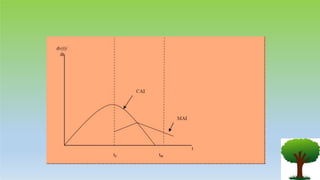
1.Current Annual Increment(CAI)
2.Mean Annual Increment(MAI)
Current Annual Increment (CAI)
• CAI = Current Annual Increment
• It’s like a marginal product curve
• Shows Incremental periodic change in volume year by year
• CAI = f’(t)
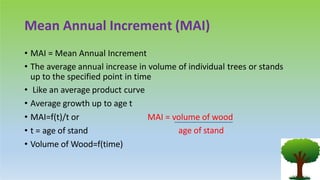
Mean Annual Increment (MAI)
• MAI = Mean Annual Increment
• The average annual increase in volume of individual trees or stands
up to the specified point in time
• Like an average product curve
• Average growth up to age t
MAI = volume of wood
age of stand
• MAI=f(t)/t or
• t = age of stand
• Volume of Wood=f(time)
MAI and CAI
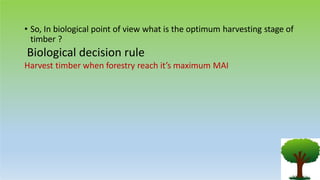
• So, In biological point of view what is the optimum harvesting stage of
timber ?
Biological decision rule
Harvest timber when forestry reach it’s maximum MAI
Economic Aspects
• According to economic aspects, The purpose of Forestry is maximize
economic rent
• Economic rent:
Is any payment to a factor of production in excess of the cost
needed to bring that factor into production..
Vo= value of wood if forest were harvested this year
V1= value of wood if harvested is delayed 1 YEAR
….V=V1-V0 =Value of 1st year growth increment
C=HARVEST cost
R-Discount rate
S-selling price of land
Forest is harvested this yr (Vo-C) +S
Harvest is delayed until nxt yr Vo + ….V-C +S
-------------------
( 1 + r)
Benefits of waiting until next yr > BENEFITS of harvesting this yr and
vice versa when the forest get older
(Vo + V)-C +S
-------------------> (Vo-c)+s
( 1 + r)
..V=( VO-S) r + S r is a COST
Factors that missed when analyzing the problem in biological point of
view;
1. Following costs are incurred when separating a forest as a
cultivation land.
• Maintenance cost
• Opportunity cost
2.Forest cultivation is economically effective when economical rent of
forest cultivation is greater than or equal to economical rent of other
alternatives.
• According to above factors optimum harvesting age can be calculated
follows:
• Marginal economic rent =
(increased timber volume X unit price of timber) – Cost
• Growth rate of forestry is continuously changing, Thereby
Marginal economic rent also change with the time
• When consider one year of time, increased timber volume is that
year’s Current Annual Increment (CAI)
• When unit price of timber and cost are constant,
Marginal economic rate α CAI
Rotation Problem
• A basic problem in forest economics is how long to let a tree grow
before cutting it down
The answer is……
• Cut the trees down when they are growing at the rate of interest
• The exact point at which our timber investment should be changed into
another investment is when it has slowed down to a rate of growth
exactly equal to the rate of interest
Rate of growth = Rate of interest
Benefit in correct t harvesting > benefit for keep to future harvesting
• This benefit is received according to total timber volume at harvesting
age
• If it save for future ,growth of timber volume will occur
• Proportionate increase of growth…..
• TIPPING POINT; At which time the benefits of harvesting are equal to
those of waiting.this is the time to harvest the forest…
CAI = MAI
• Clear cut the forest, when the current annual increment (CAI) is equal
to the mean annual increment (MAI)
• Nowadays, forestry is guided by this (or some similar rule) that is
often justified to guarantee sustainability instead of economic
efficiency.
Government of India launched “Integrated Forest Protection Scheme”, commencing from the
year 2002-2003.
This scheme has now been renamed as “Intensification of Forest Management Scheme”. The scheme makes
judicious use of all available methods for better protection and conservation of forest resources of the
country.
National Afforestation Programme (NAP) scheme is ecological restoration of degraded forests
and to develop the forest resources with peoples' participation, with focus on improvement in
livelihoods of the forest-fringe communities, especially the poor.
This policy sets a national objective of expanding the forest and tree cover of India to 33
percent of the total area of the country.
FOREST MANAGEMENT SCHEME….
NR forestry.pptx

NR forestry.pptx

  • 1.
  • 2.
    What is ForestEconomics? • It is branch of applied economics is mainly focused on sustainable yield timber management, resource extraction and commodity production, excluding a wide range of forest values • The forest is viewed as a storable renewable resource and forestry as an investment with long rotation (production) periods and easily measurable stock growth. • The task of forestry economics is to help determine a level and pattern of forest use which maximizes the present value of forest rent
  • 3.
    Forestry vs. Fishery •The economics of forest resources are very similar to the dynamic management of a fishery: • Both forests and fisheries are renewable resource systems • The economic principles that determine optimal management are very much the same • The major difference between the economics of a forest vs. A fishery resource are related to biological principles
  • 4.
    • The forestproblem is a problem of divestment, which means the solution calculates the optimal time to consolidate and sell the entire stock and begin the next rotation • The analogy of a forest rotation is that of a conventional crop which does not get harvested every season; • That is, the growth cycle of a forest resource is so long that resource owners get really impatient and discounting/ dynamic analysis is important.
  • 5.
    Characteristics of Forest Extensive, visible and "open" resources  Renewable resources  Production capacity  Multiple use  Forests are both ecosystems and production systems  Geographical and biological varieties  Long rotation times
  • 6.
    • Forest cultivationis a long term production cyclic process • Time taken to complete one production cycle is determined by following factors • Timber species • Land and soil type • Geo- diversification • Level of Management • Plant density
  • 7.
    • When managinga forest , 2 main problems arise… 1. How to identify the level that maximize economic rent 2. How to identify the optimum age of harvesting • Forest can be seen by dual aspects 1.Economic aspects 2.Biological aspects
  • 8.
    Biological Aspects Growth patternfor a single tree Maturity stage
  • 9.
    Timber volume Timber age growth levelsoff as trees reach maximum size rapid growth in volume volume growth is slow as trees are very small Growth Pattern Of Timber Volume
  • 10.
    • Forest volumeis an increasing function of time before the point of biological maturity • After that volume declines • During the period of over maturity of stand which is characterized by volume reductions • Volume of Wood=f(time)
  • 11.
    Properties of GrowthFunction 1.Current Annual Increment(CAI) 2.Mean Annual Increment(MAI)
  • 12.
    Current Annual Increment(CAI) • CAI = Current Annual Increment • It’s like a marginal product curve • Shows Incremental periodic change in volume year by year • CAI = f’(t)
  • 13.
    Mean Annual Increment(MAI) • MAI = Mean Annual Increment • The average annual increase in volume of individual trees or stands up to the specified point in time • Like an average product curve • Average growth up to age t MAI = volume of wood age of stand • MAI=f(t)/t or • t = age of stand • Volume of Wood=f(time)
  • 14.
  • 17.
    • So, Inbiological point of view what is the optimum harvesting stage of timber ? Biological decision rule Harvest timber when forestry reach it’s maximum MAI
  • 18.
    Economic Aspects • Accordingto economic aspects, The purpose of Forestry is maximize economic rent • Economic rent: Is any payment to a factor of production in excess of the cost needed to bring that factor into production..
  • 19.
    Vo= value ofwood if forest were harvested this year V1= value of wood if harvested is delayed 1 YEAR ….V=V1-V0 =Value of 1st year growth increment C=HARVEST cost R-Discount rate S-selling price of land Forest is harvested this yr (Vo-C) +S Harvest is delayed until nxt yr Vo + ….V-C +S ------------------- ( 1 + r)
  • 20.
    Benefits of waitinguntil next yr > BENEFITS of harvesting this yr and vice versa when the forest get older (Vo + V)-C +S -------------------> (Vo-c)+s ( 1 + r) ..V=( VO-S) r + S r is a COST
  • 21.
    Factors that missedwhen analyzing the problem in biological point of view; 1. Following costs are incurred when separating a forest as a cultivation land. • Maintenance cost • Opportunity cost 2.Forest cultivation is economically effective when economical rent of forest cultivation is greater than or equal to economical rent of other alternatives.
  • 22.
    • According toabove factors optimum harvesting age can be calculated follows: • Marginal economic rent = (increased timber volume X unit price of timber) – Cost • Growth rate of forestry is continuously changing, Thereby Marginal economic rent also change with the time • When consider one year of time, increased timber volume is that year’s Current Annual Increment (CAI) • When unit price of timber and cost are constant, Marginal economic rate α CAI
  • 23.
    Rotation Problem • Abasic problem in forest economics is how long to let a tree grow before cutting it down The answer is…… • Cut the trees down when they are growing at the rate of interest • The exact point at which our timber investment should be changed into another investment is when it has slowed down to a rate of growth exactly equal to the rate of interest Rate of growth = Rate of interest
  • 24.
    Benefit in correctt harvesting > benefit for keep to future harvesting • This benefit is received according to total timber volume at harvesting age • If it save for future ,growth of timber volume will occur • Proportionate increase of growth…..
  • 25.
    • TIPPING POINT;At which time the benefits of harvesting are equal to those of waiting.this is the time to harvest the forest… CAI = MAI • Clear cut the forest, when the current annual increment (CAI) is equal to the mean annual increment (MAI) • Nowadays, forestry is guided by this (or some similar rule) that is often justified to guarantee sustainability instead of economic efficiency.
  • 26.
    Government of Indialaunched “Integrated Forest Protection Scheme”, commencing from the year 2002-2003. This scheme has now been renamed as “Intensification of Forest Management Scheme”. The scheme makes judicious use of all available methods for better protection and conservation of forest resources of the country. National Afforestation Programme (NAP) scheme is ecological restoration of degraded forests and to develop the forest resources with peoples' participation, with focus on improvement in livelihoods of the forest-fringe communities, especially the poor. This policy sets a national objective of expanding the forest and tree cover of India to 33 percent of the total area of the country. FOREST MANAGEMENT SCHEME….