Ms. Mills
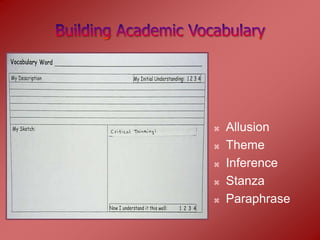
   Allusion
   Theme
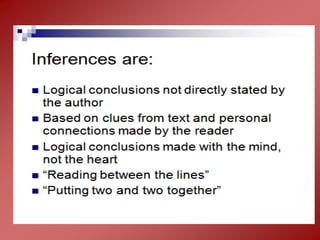
   Inference
   Stanza
   Paraphrase
Reading Between the Lines


     Making Inferences
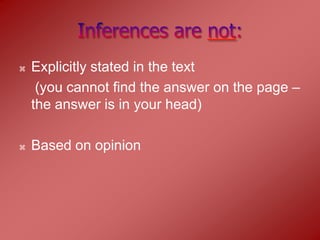
   Explicitly stated in the text
     (you cannot find the answer on the page –
    the answer is in your head)

   Based on opinion
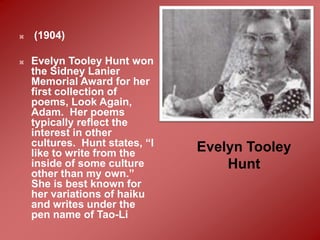
   (1904)

   Evelyn Tooley Hunt won
    the Sidney Lanier
    Memorial Award for her
    first collection of
    poems, Look Again,
    Adam. Her poems
    typically reflect the
    interest in other
    cultures. Hunt states, “I   Evelyn Tooley
    like to write from the
    inside of some culture          Hunt
    other than my own.”
    She is best known for
    her variations of haiku
    and writes under the
    pen name of Tao-Li
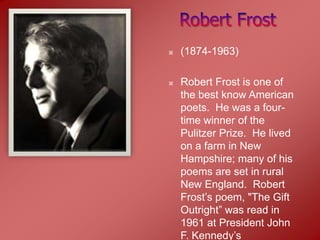
   (1874-1963)

   Robert Frost is one of
    the best know American
    poets. He was a four-
    time winner of the
    Pulitzer Prize. He lived
    on a farm in New
    Hampshire; many of his
    poems are set in rural
    New England. Robert
    Frost’s poem, "The Gift
    Outright” was read in
    1961 at President John
    F. Kennedy’s
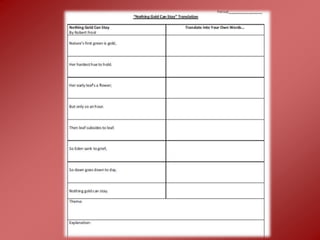
   Partner read the poem

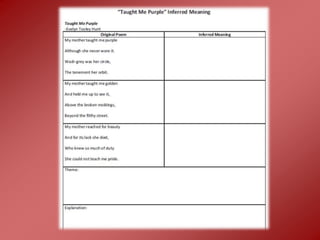
   As you and your partner read, record the
    inferences made for each stanza and pair of
    lines on the right side of the T-Chart.

   Write an essential message (main idea) of
    the poem, based on your inferences.
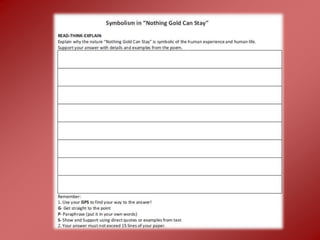
Nature's first green is gold,
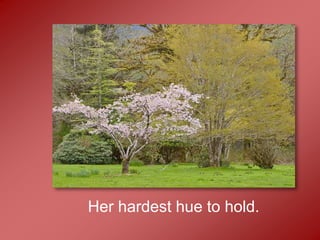
Her hardest hue to hold.
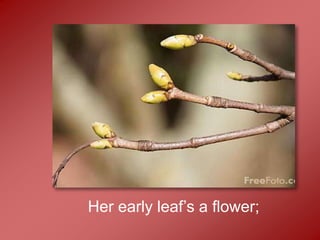
Her early leaf's a flower;
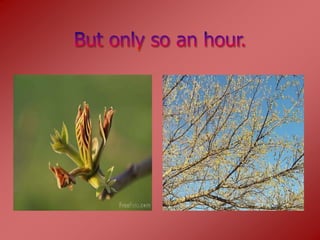
But only so an hour.
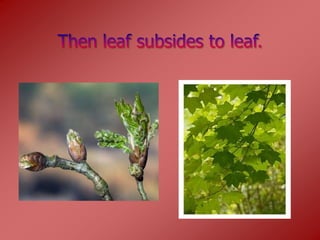
Then leaf subsides to leaf.
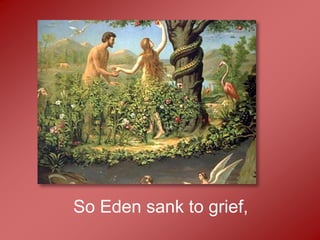
So Eden sank to grief,
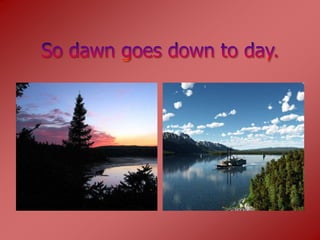
So dawn goes down to day.
Nothing gold can stay.
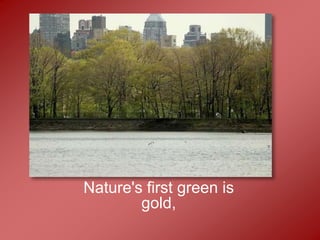
Nature's first green is
        gold,
Her hardest hue to hold.
Her early leaf’s a flower;
So Eden sank to grief,
   How do we learn lessons about life?

   Define beauty. Is it tangible or
    intangible?

   Think of some colors, what do
    specific colors represent?
   Partners read the poem

   As you and your partner read, record the
    inferences made for each stanza and pair
    of lines on the right side of the T-Chart.

   Write an essential message (main idea) of
    the poem, based on your inferences.
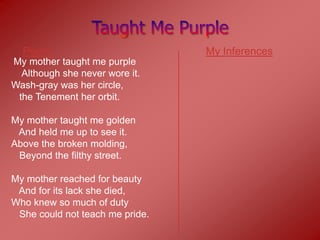
Poem                           My Inferences
My mother taught me purple
  Although she never wore it.
Wash-gray was her circle,
 the Tenement her orbit.

My mother taught me golden
 And held me up to see it.
Above the broken molding,
 Beyond the filthy street.

My mother reached for beauty
 And for its lack she died,
Who knew so much of duty
 She could not teach me pride.
   Copy and Answer the questions on the
    back of your paper.

   (Exit Ticket) “In Taught Me Purple, what
    does the speaker say her mother taught
    her? What does each color represent to
    the speaker”
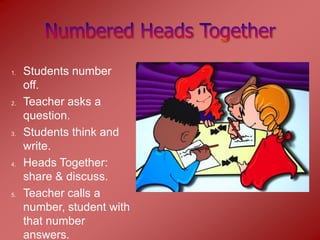
1.   Students number
     off.
2.   Teacher asks a
     question.
3.   Students think and
     write.
4.   Heads Together:
     share & discuss.
5.   Teacher calls a
     number, student with
     that number
     answers.
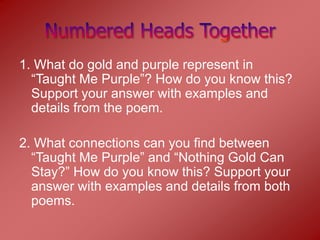
1. What do gold and purple represent in
  “Taught Me Purple”? How do you know this?
  Support your answer with examples and
  details from the poem.

2. What connections can you find between
  “Taught Me Purple” and “Nothing Gold Can
  Stay?” How do you know this? Support your
  answer with examples and details from both
  poems.
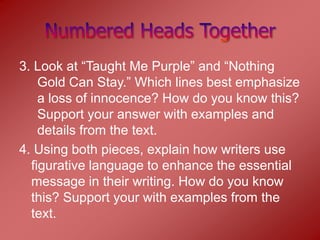
3. Look at “Taught Me Purple” and “Nothing
    Gold Can Stay.” Which lines best emphasize
    a loss of innocence? How do you know this?
    Support your answer with examples and
    details from the text.
4. Using both pieces, explain how writers use
  figurative language to enhance the essential
  message in their writing. How do you know
  this? Support your with examples from the
  text.
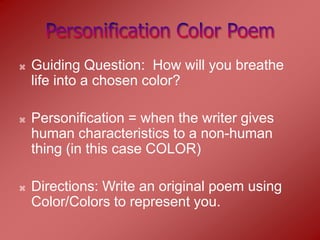
   Guiding Question: How will you breathe
    life into a chosen color?

   Personification = when the writer gives
    human characteristics to a non-human
    thing (in this case COLOR)

   Directions: Write an original poem using
    Color/Colors to represent you.
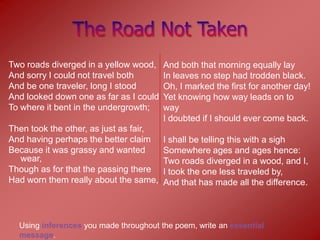
Two roads diverged in a yellow wood,    And both that morning equally lay
And sorry I could not travel both       In leaves no step had trodden black.
And be one traveler, long I stood       Oh, I marked the first for another day!
And looked down one as far as I could   Yet knowing how way leads on to
To where it bent in the undergrowth;    way
                                        I doubted if I should ever come back.
Then took the other, as just as fair,
And having perhaps the better claim     I shall be telling this with a sigh
Because it was grassy and wanted        Somewhere ages and ages hence:
  wear,                                 Two roads diverged in a wood, and I,
Though as for that the passing there    I took the one less traveled by,
Had worn them really about the same,    And that has made all the difference.


  Using inferences you made throughout the poem, write an essential
  message.

Nothing gold, taught me purple

  • 1.
  • 2.
    Allusion  Theme  Inference  Stanza  Paraphrase
  • 3.
    Reading Between theLines Making Inferences
  • 5.
    Explicitly stated in the text (you cannot find the answer on the page – the answer is in your head)  Based on opinion
  • 7.
    (1904)  Evelyn Tooley Hunt won the Sidney Lanier Memorial Award for her first collection of poems, Look Again, Adam. Her poems typically reflect the interest in other cultures. Hunt states, “I Evelyn Tooley like to write from the inside of some culture Hunt other than my own.” She is best known for her variations of haiku and writes under the pen name of Tao-Li
  • 8.
    (1874-1963)  Robert Frost is one of the best know American poets. He was a four- time winner of the Pulitzer Prize. He lived on a farm in New Hampshire; many of his poems are set in rural New England. Robert Frost’s poem, "The Gift Outright” was read in 1961 at President John F. Kennedy’s
  • 9.
    Partner read the poem  As you and your partner read, record the inferences made for each stanza and pair of lines on the right side of the T-Chart.  Write an essential message (main idea) of the poem, based on your inferences.
  • 11.
    Nature's first greenis gold, Her hardest hue to hold. Her early leaf's a flower; But only so an hour. Then leaf subsides to leaf. So Eden sank to grief, So dawn goes down to day. Nothing gold can stay.
  • 12.
  • 13.
  • 14.
  • 17.
    So Eden sankto grief,
  • 21.
    How do we learn lessons about life?  Define beauty. Is it tangible or intangible?  Think of some colors, what do specific colors represent?
  • 22.
    Partners read the poem  As you and your partner read, record the inferences made for each stanza and pair of lines on the right side of the T-Chart.  Write an essential message (main idea) of the poem, based on your inferences.
  • 24.
    Poem My Inferences My mother taught me purple Although she never wore it. Wash-gray was her circle, the Tenement her orbit. My mother taught me golden And held me up to see it. Above the broken molding, Beyond the filthy street. My mother reached for beauty And for its lack she died, Who knew so much of duty She could not teach me pride.
  • 25.
    Copy and Answer the questions on the back of your paper.  (Exit Ticket) “In Taught Me Purple, what does the speaker say her mother taught her? What does each color represent to the speaker”
  • 26.
    1. Students number off. 2. Teacher asks a question. 3. Students think and write. 4. Heads Together: share & discuss. 5. Teacher calls a number, student with that number answers.
  • 27.
    1. What dogold and purple represent in “Taught Me Purple”? How do you know this? Support your answer with examples and details from the poem. 2. What connections can you find between “Taught Me Purple” and “Nothing Gold Can Stay?” How do you know this? Support your answer with examples and details from both poems.
  • 28.
    3. Look at“Taught Me Purple” and “Nothing Gold Can Stay.” Which lines best emphasize a loss of innocence? How do you know this? Support your answer with examples and details from the text. 4. Using both pieces, explain how writers use figurative language to enhance the essential message in their writing. How do you know this? Support your with examples from the text.
  • 29.
    Guiding Question: How will you breathe life into a chosen color?  Personification = when the writer gives human characteristics to a non-human thing (in this case COLOR)  Directions: Write an original poem using Color/Colors to represent you.
  • 30.
    Two roads divergedin a yellow wood, And both that morning equally lay And sorry I could not travel both In leaves no step had trodden black. And be one traveler, long I stood Oh, I marked the first for another day! And looked down one as far as I could Yet knowing how way leads on to To where it bent in the undergrowth; way I doubted if I should ever come back. Then took the other, as just as fair, And having perhaps the better claim I shall be telling this with a sigh Because it was grassy and wanted Somewhere ages and ages hence: wear, Two roads diverged in a wood, and I, Though as for that the passing there I took the one less traveled by, Had worn them really about the same, And that has made all the difference. Using inferences you made throughout the poem, write an essential message.
Editor's Notes

  • #4 Show United Streaming Video
  • #6 Practice with Remembrance of a Friend- Naming the World
  • #10 Prior to reading have students do PollEverywhere.com (inference)
  • #11 “Explain Robert Frost’s argument in the poem, Nothing Gold Can Stay.”
  • #31 If time remains… for ADVANCED class ONLY See also “Acquainted with the Night” poem by Frost