1
Computer Communication &
Networks
Lecture2
Introduction to Data Communication
http://web.uettaxila.edu.pk/CMS/coeCCNbsSp09/index.asp
Waleed Ejaz
waleed.ejaz@uettaxila.edu.pk
2.
2
Data Communications
Theterm
term telecommunication
telecommunication means
means
communication at a distance. The word
communication at a distance. The word data
data
refers to information presented in whatever
refers to information presented in whatever
form is agreed upon by the parties creating
form is agreed upon by the parties creating
and using the data.
and using the data. Data communications
Data communications are
are
the exchange of data between two devices
the exchange of data between two devices
via some form of transmission medium such
via some form of transmission medium such
as a wire cable.
as a wire cable.
3.
3
Fundamental Characteristics
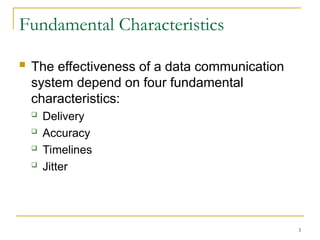
Theeffectiveness of a data communication
system depend on four fundamental
characteristics:
Delivery
Accuracy
Timelines
Jitter
4.
4
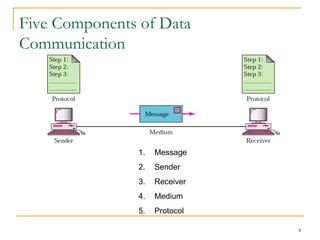
Five Components ofData
Communication
1. Message
2. Sender
3. Receiver
4. Medium
5. Protocol
6
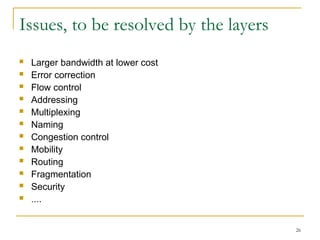
Networks: key issues
Network criteria
Performance
Throughput
Delay
Reliability
Data transmitted are identical to data received.
Measured by the frequency of failure
The time it takes a link to recover from a failure
Security
Protecting data from unauthorized access
7.
7
Terminology
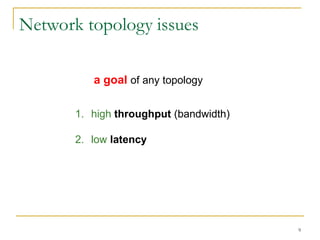
The throughputor bandwidth of a channel is
the number of bits it can transfer per second
The latency or delay of a channel is the time
that elapses between sending information and
the earliest possible reception of it
10
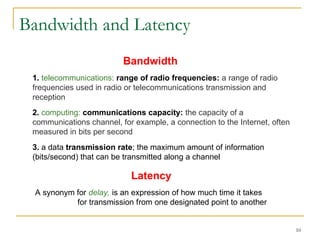
Bandwidth and Latency
1.telecommunications: range of radio frequencies: a range of radio
frequencies used in radio or telecommunications transmission and
reception
2. computing: communications capacity: the capacity of a
communications channel, for example, a connection to the Internet, often
measured in bits per second
3. a data transmission rate; the maximum amount of information
(bits/second) that can be transmitted along a channel
Latency
A synonym for delay, is an expression of how much time it takes
for transmission from one designated point to another
Bandwidth
16
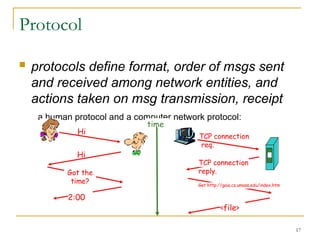
What’s a protocol?
humanprotocols:
“what’s the time?”
“I have a question”
introductions
… specific msgs sent
… specific actions taken when msgs received, or other events
network protocols:
machines rather than humans
all communication activity in Internet governed by protocols
17.
17
Protocol
protocols defineformat, order of msgs sent
and received among network entities, and
actions taken on msg transmission, receipt
a human protocol and a computer network protocol:
Hi
Hi
Got the
time?
2:00
TCP connection
req.
TCP connection
reply.
Get http://gaia.cs.umass.edu/index.htm
<file>
time
18.
18
Standard
Essential increating and maintaining an open
and competitive market for equipment
manufacturers
Guaranteeing national & international
interoperability of data & telecommunication
technology & process.
20
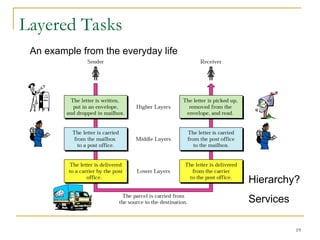
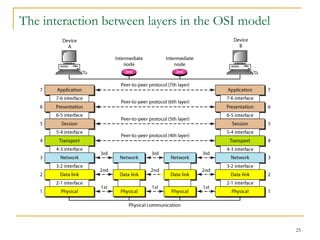
Why layered communication?
To reduce complexity of communication task
by splitting it into several layered small tasks
Functionality of the layers can be changed as
long as the service provided to the layer
above stays unchanged
makes easier maintenance & updating
Each layer has its own task
Each layer has its own protocol
22
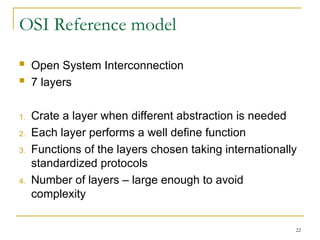
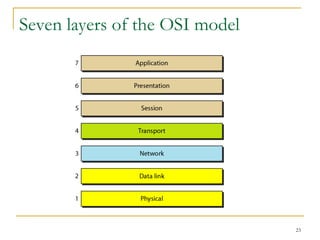
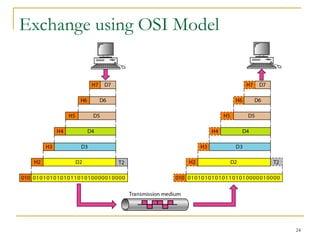
OSI Reference model
Open System Interconnection
7 layers
1. Crate a layer when different abstraction is needed
2. Each layer performs a well define function
3. Functions of the layers chosen taking internationally
standardized protocols
4. Number of layers – large enough to avoid
complexity
28
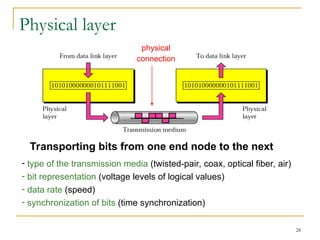
Physical layer
Transporting bitsfrom one end node to the next
- type of the transmission media (twisted-pair, coax, optical fiber, air)
- bit representation (voltage levels of logical values)
- data rate (speed)
- synchronization of bits (time synchronization)
physical
connection
29.
29
The physical layeris responsible for movements of
individual bits from one hop (node) to the next.
Note
30.
30
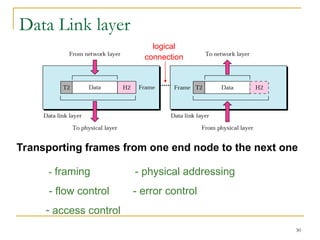
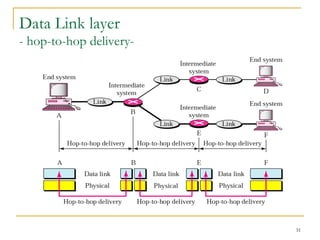
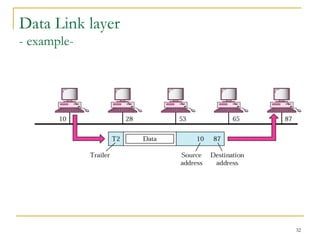
Data Link layer
Transportingframes from one end node to the next one
logical
connection
- framing - physical addressing
- flow control - error control
- access control


![01_-_W01L01_-_Introduction[1].pp free tx](https://cdn.slidesharecdn.com/ss_thumbnails/01-w01l01-introduction1-240627064011-cf787583-thumbnail.jpg?width=640&height=640&fit=bounds)


