ARTICLE TWO Requirements, Duties, and Characteristics of the Executive Branch
Article II - The Executive Branch Article II  of the Constitution specifies the powers of the executive branch. Note
The President Article 2, Section 1: … executive Power shall be vested in a President of the United States of America.  Note1   Note2 Term: 4 Years Vice-President chosen for the same Term Each State shall appoint, in such Manner as the Legislature thereof may direct, a Number of Electors, equal to the whole Number of Senators and Representatives to which the State may be entitled in the Congress: but no Senator or Representative, or Person holding an Office of Trust or Profit under the United States, shall be appointed an Elector.
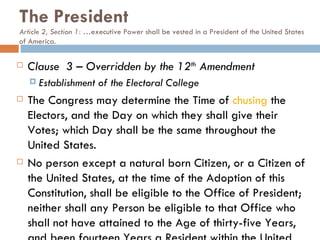
The President Article 2, Section 1: … executive Power shall be vested in a President of the United States of America.  Clause  3 – Overridden by the 12 th  Amendment Establishment of the Electoral College The Congress may determine the Time of  chusing  the Electors, and the Day on which they shall give their Votes; which Day shall be the same throughout the United States. No person except a natural born Citizen, or a Citizen of the United States, at the time of the Adoption of this Constitution, shall be eligible to the Office of President; neither shall any Person be eligible to that Office who shall not have attained to the Age of thirty-five Years, and been fourteen Years a Resident within the United States.
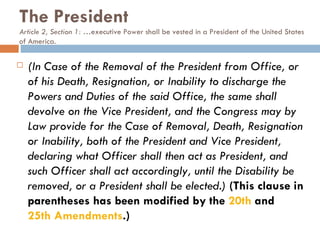
The President Article 2, Section 1: … executive Power shall be vested in a President of the United States of America.  (In Case of the Removal of the President from Office, or of his Death, Resignation, or Inability to discharge the Powers and Duties of the said Office, the same shall devolve on the Vice President, and the Congress may by Law provide for the Case of Removal, Death, Resignation or Inability, both of the President and Vice President, declaring what Officer shall then act as President, and such Officer shall act accordingly, until the Disability be removed, or a President shall be elected.)   (This clause in parentheses has been modified by the  20th  and  25th Amendments .)
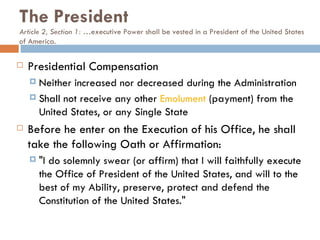
The President Article 2, Section 1: … executive Power shall be vested in a President of the United States of America.  Presidential Compensation Neither increased nor decreased during the Administration  Shall not receive any other  Emolument  (payment) from the United States, or any Single State Before he enter on the Execution of his Office, he shall take the following Oath or Affirmation: "I do solemnly swear (or affirm) that I will faithfully execute the Office of President of the United States, and will to the best of my Ability, preserve, protect and defend the Constitution of the United States."
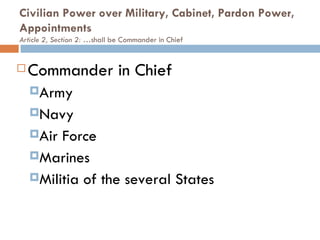
Civilian Power over Military, Cabinet, Pardon Power, Appointments  Article 2, Section 2: … shall be Commander in Chief Commander in Chief Army  Navy  Air Force Marines Militia of the several States
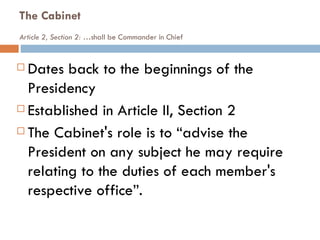
The Cabinet Article 2, Section 2: … shall be Commander in Chief Dates back to the beginnings of the Presidency Established in Article II, Section 2 The Cabinet's role is to “advise the President on any subject he may require relating to the duties of each member's respective office”.
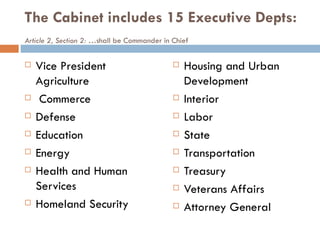
The Cabinet includes 15 Executive Depts:   Article 2, Section 2: … shall be Commander in Chief Vice President Agriculture Commerce Defense Education Energy Health and Human Services Homeland Security Housing and Urban Development Interior Labor State Transportation Treasury Veterans Affairs  Attorney General
The Cabinet includes 15 Executive Depts:   Article 2, Section 2: … shall be Commander in Chief http://www.whitehouse.gov/administration/cabinet
Civilian Power over Military, Cabinet, Pardon Power, Appointments  Article 2, Section 2: … shall be Commander in Chief Pardon Power
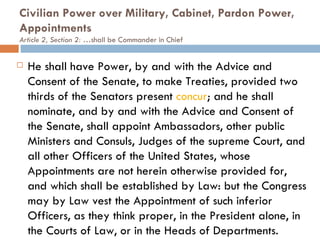
Civilian Power over Military, Cabinet, Pardon Power, Appointments  Article 2, Section 2: … shall be Commander in Chief He shall have Power, by and with the Advice and Consent of the Senate, to make Treaties, provided two thirds of the Senators present  concur ; and he shall nominate, and by and with the Advice and Consent of the Senate, shall appoint Ambassadors, other public Ministers and Consuls, Judges of the supreme Court, and all other Officers of the United States, whose Appointments are not herein otherwise provided for, and which shall be established by Law: but the Congress may by Law vest the Appointment of such inferior Officers, as they think proper, in the President alone, in the Courts of Law, or in the Heads of Departments.
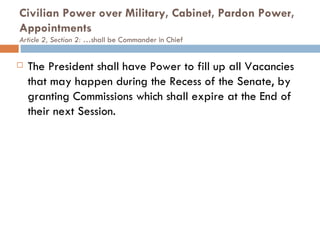
Civilian Power over Military, Cabinet, Pardon Power, Appointments  Article 2, Section 2: … shall be Commander in Chief The President shall have Power to fill up all Vacancies that may happen during the Recess of the Senate, by granting Commissions which shall expire at the End of their next Session.
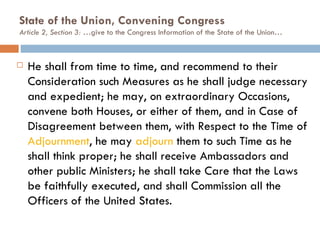
State of the Union, Convening Congress  Article 2, Section 3: … give to the Congress Information of the State of the Union… He shall from time to time, and recommend to their Consideration such Measures as he shall judge necessary and expedient; he may, on extraordinary Occasions, convene both Houses, or either of them, and in Case of Disagreement between them, with Respect to the Time of  Adjournment , he may  adjourn  them to such Time as he shall think proper; he shall receive Ambassadors and other public Ministers; he shall take Care that the Laws be faithfully executed, and shall Commission all the Officers of the United States.
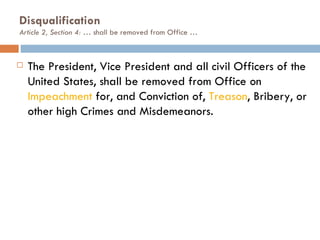
Disqualification  Article 2, Section 4: …  shall be removed from Office … The President, Vice President and all civil Officers of the United States, shall be removed from Office on  Impeachment  for, and Conviction of,  Treason , Bribery, or other high Crimes and Misdemeanors.
 

Notes constitution article two

  • 1.
    ARTICLE TWO Requirements,Duties, and Characteristics of the Executive Branch
  • 2.
    Article II -The Executive Branch Article II of the Constitution specifies the powers of the executive branch. Note
  • 3.
    The President Article2, Section 1: … executive Power shall be vested in a President of the United States of America. Note1 Note2 Term: 4 Years Vice-President chosen for the same Term Each State shall appoint, in such Manner as the Legislature thereof may direct, a Number of Electors, equal to the whole Number of Senators and Representatives to which the State may be entitled in the Congress: but no Senator or Representative, or Person holding an Office of Trust or Profit under the United States, shall be appointed an Elector.
  • 4.
    The President Article2, Section 1: … executive Power shall be vested in a President of the United States of America. Clause 3 – Overridden by the 12 th Amendment Establishment of the Electoral College The Congress may determine the Time of chusing the Electors, and the Day on which they shall give their Votes; which Day shall be the same throughout the United States. No person except a natural born Citizen, or a Citizen of the United States, at the time of the Adoption of this Constitution, shall be eligible to the Office of President; neither shall any Person be eligible to that Office who shall not have attained to the Age of thirty-five Years, and been fourteen Years a Resident within the United States.
  • 5.
    The President Article2, Section 1: … executive Power shall be vested in a President of the United States of America. (In Case of the Removal of the President from Office, or of his Death, Resignation, or Inability to discharge the Powers and Duties of the said Office, the same shall devolve on the Vice President, and the Congress may by Law provide for the Case of Removal, Death, Resignation or Inability, both of the President and Vice President, declaring what Officer shall then act as President, and such Officer shall act accordingly, until the Disability be removed, or a President shall be elected.) (This clause in parentheses has been modified by the 20th and 25th Amendments .)
  • 6.
    The President Article2, Section 1: … executive Power shall be vested in a President of the United States of America. Presidential Compensation Neither increased nor decreased during the Administration Shall not receive any other Emolument (payment) from the United States, or any Single State Before he enter on the Execution of his Office, he shall take the following Oath or Affirmation: "I do solemnly swear (or affirm) that I will faithfully execute the Office of President of the United States, and will to the best of my Ability, preserve, protect and defend the Constitution of the United States."
  • 7.
    Civilian Power overMilitary, Cabinet, Pardon Power, Appointments Article 2, Section 2: … shall be Commander in Chief Commander in Chief Army Navy Air Force Marines Militia of the several States
  • 8.
    The Cabinet Article2, Section 2: … shall be Commander in Chief Dates back to the beginnings of the Presidency Established in Article II, Section 2 The Cabinet's role is to “advise the President on any subject he may require relating to the duties of each member's respective office”.
  • 9.
    The Cabinet includes15 Executive Depts: Article 2, Section 2: … shall be Commander in Chief Vice President Agriculture Commerce Defense Education Energy Health and Human Services Homeland Security Housing and Urban Development Interior Labor State Transportation Treasury Veterans Affairs Attorney General
  • 10.
    The Cabinet includes15 Executive Depts: Article 2, Section 2: … shall be Commander in Chief http://www.whitehouse.gov/administration/cabinet
  • 11.
    Civilian Power overMilitary, Cabinet, Pardon Power, Appointments Article 2, Section 2: … shall be Commander in Chief Pardon Power
  • 12.
    Civilian Power overMilitary, Cabinet, Pardon Power, Appointments Article 2, Section 2: … shall be Commander in Chief He shall have Power, by and with the Advice and Consent of the Senate, to make Treaties, provided two thirds of the Senators present concur ; and he shall nominate, and by and with the Advice and Consent of the Senate, shall appoint Ambassadors, other public Ministers and Consuls, Judges of the supreme Court, and all other Officers of the United States, whose Appointments are not herein otherwise provided for, and which shall be established by Law: but the Congress may by Law vest the Appointment of such inferior Officers, as they think proper, in the President alone, in the Courts of Law, or in the Heads of Departments.
  • 13.
    Civilian Power overMilitary, Cabinet, Pardon Power, Appointments Article 2, Section 2: … shall be Commander in Chief The President shall have Power to fill up all Vacancies that may happen during the Recess of the Senate, by granting Commissions which shall expire at the End of their next Session.
  • 14.
    State of theUnion, Convening Congress Article 2, Section 3: … give to the Congress Information of the State of the Union… He shall from time to time, and recommend to their Consideration such Measures as he shall judge necessary and expedient; he may, on extraordinary Occasions, convene both Houses, or either of them, and in Case of Disagreement between them, with Respect to the Time of Adjournment , he may adjourn them to such Time as he shall think proper; he shall receive Ambassadors and other public Ministers; he shall take Care that the Laws be faithfully executed, and shall Commission all the Officers of the United States.
  • 15.
    Disqualification Article2, Section 4: … shall be removed from Office … The President, Vice President and all civil Officers of the United States, shall be removed from Office on Impeachment for, and Conviction of, Treason , Bribery, or other high Crimes and Misdemeanors.
  • 16.