ACADEMIC WRITING
(SCLE6014)
ACADEMIC PAPERS
 Writing academic papers require accurate
interpretation of assignment instructions
 Reading instructions in the English language might be
tricky sometimes
 Academic papers require planning writing tasks and
generating initial ideas
 Academic papers require interpreting assignment
instructions and taking desired actions to achieve the set
objective(s).
Understanding Instructions
 There are various task swords in academic writing
which require specific actions.
 Understanding and interpreting instructions is
essential for effective academic writing for research
 The specific actions performed would help you to
satisfy the academic writing requirements
 Task words in academic writing may include examples
such as;
Academic Writing Task Words
Analyse/Explore/Critique/Discuss/Review
 Any of the above task words in the instructions would
imply;
 a) Breaking down a problem and examining the parts
in detail
 b) Presenting perspectives of good and weak aspects,
limitations and contributions, arguments for and
against
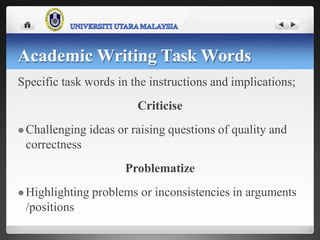
Specific task words in the instructions and implications;
Criticise
 Challenging ideas or raising questions of quality and
correctness
Problematize
 Highlighting problems or inconsistencies in arguments
/positions
Academic Writing Task Words
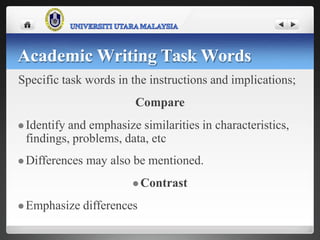
Specific task words in the instructions and implications;
Compare
 Identify and emphasize similarities in characteristics,
findings, problems, data, etc
 Differences may also be mentioned.
 Contrast
 Emphasize differences
Academic Writing Task Words
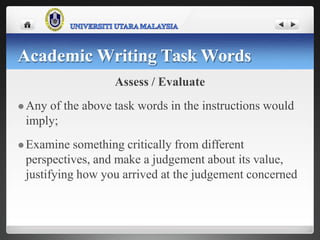
Assess / Evaluate
 Any of the above task words in the instructions would
imply;
 Examine something critically from different
perspectives, and make a judgement about its value,
justifying how you arrived at the judgement concerned
Academic Writing Task Words
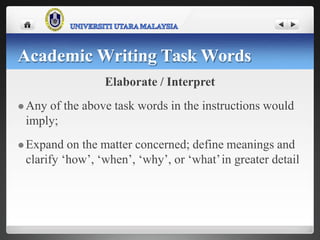
Elaborate / Interpret
 Any of the above task words in the instructions would
imply;
 Expand on the matter concerned; define meanings and
clarify ‘how’, ‘when’, ‘why’, or ‘what’in greater detail
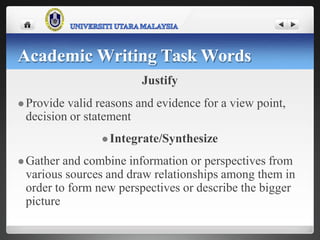
Academic Writing Task Words
Justify
 Provide valid reasons and evidence for a view point,
decision or statement
 Integrate/Synthesize
 Gather and combine information or perspectives from
various sources and draw relationships among them in
order to form new perspectives or describe the bigger
picture
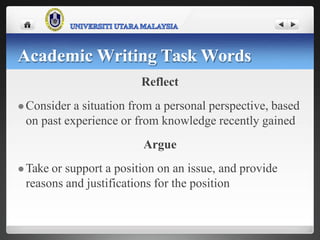
Academic Writing Task Words
Reflect
 Consider a situation from a personal perspective, based
on past experience or from knowledge recently gained
Argue
 Take or support a position on an issue, and provide
reasons and justifications for the position
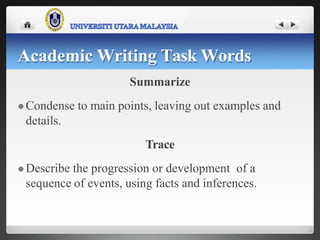
Academic Writing Task Words
Summarize
 Condense to main points, leaving out examples and
details.
Trace
 Describe the progression or development of a
sequence of events, using facts and inferences.
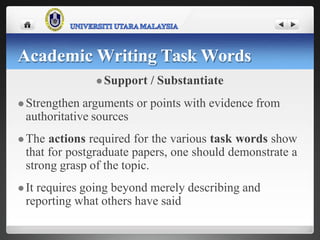
Academic Writing Task Words
 Support / Substantiate
 Strengthen arguments or points with evidence from
authoritative sources
 The actions required for the various task words show
that for postgraduate papers, one should demonstrate a
strong grasp of the topic.
 It requires going beyond merely describing and
reporting what others have said
Academic Writing Task Words
Argumentative paper
 Atype of library research paper which addresses a specific issue
or controversy in the field.
 It requires taking a clear position or side
 Information from multiple references are evaluated and
incorporated to shape arguments and convince readers to accept
a particular position
Types of postgraduate writing assignments
Tasks include;
 Discuss, review, evaluate, synthesize, argue, interpret, explain,
substantiate
Book / article review or critique
 It includes a summary and evaluation of the merits and demerits of an
academic book or journal article
 It incorporates evidences to support opinions
Tasks Include;
 Summarize, critique, assess, elaborate, synthesize, justify, reflect
Types of postgraduate writing assignments
Literature review paper
 It includes surveying existing published literature on a topic to
answer a specific question or to critique current developments
in the field
Tasks include;
 Analyse, interpret, summarize, discuss, critique, compare and
contrast, evaluate
Types of postgraduate writing assignments
Case study
 It includes a description and an in-depth analysis of a given
scenario or problem, followed by recommended solutions and
decisions.
Tasks include;
 Analyse, problematize, evaluate, discuss, compare-contrast,
trace, integrate, substantiate
Types of postgraduate writing assignments
Research project report
 It includes a description, in a prescribed format, of a project or
experiment, usually small scale and undertaken by a group.
Tasks include;
 Explain, compare, contrast, interpret, discuss, summarize,
integrate
Types of postgraduate writing assignments
Research proposal
 It includes a research plan, justifying the need to conduct
research and proposing how the research will be undertaken.
Tasks include;
 Discuss, review, evaluate, summarize, synthesize, argue,
interpret, explain, critique
Types of postgraduate writing assignments
Purpose and audience
 There are several purposes of academic writing
 Main purpose is to provide information with a clear, appropriate
and thoughtful image of that specific topic
 There are many types of academic writing and each one serves a
specific purpose.
 However the overall purposes are as follows;
Accuracy
 Writing with facts and figures is considered more
accurate and authentic
 Unclear word combinations like “many people say” or
“once a person said” are not considered accurate in
academic writing
 Hence statistics are given more value in academic
writing and considered authentic
Purpose and audience
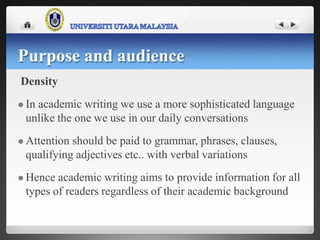
Density
 In academic writing we use a more sophisticated language
unlike the one we use in our daily conversations
 Attention should be paid to grammar, phrases, clauses,
qualifying adjectives etc.. with verbal variations
 Hence academic writing aims to provide information for all
types of readers regardless of their academic background
Purpose and audience
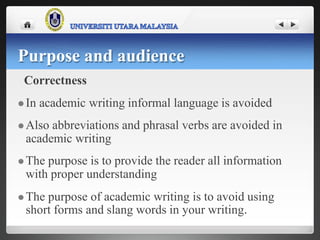
Correctness
 In academic writing informal language is avoided
 Also abbreviations and phrasal verbs are avoided in
academic writing
 The purpose is to provide the reader all information
with proper understanding
 The purpose of academic writing is to avoid using
short forms and slang words in your writing.
Purpose and audience
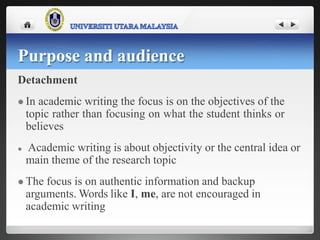
Detachment
 In academic writing the focus is on the objectives of the
topic rather than focusing on what the student thinks or
believes
 Academic writing is about objectivity or the central idea or
main theme of the research topic
 The focus is on authentic information and backup
arguments. Words like I, me, are not encouraged in
academic writing
Purpose and audience
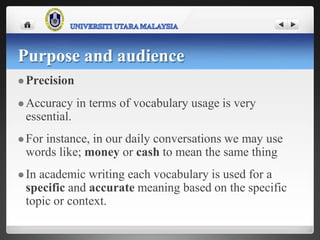
 Precision
 Accuracy in terms of vocabulary usage is very
essential.
 For instance, in our daily conversations we may use
words like; money or cash to mean the same thing
 In academic writing each vocabulary is used for a
specific and accurate meaning based on the specific
topic or context.
Purpose and audience

NOTE_ACADEMIC PAPER.pdf

  • 1.
  • 2.
    ACADEMIC PAPERS  Writingacademic papers require accurate interpretation of assignment instructions  Reading instructions in the English language might be tricky sometimes  Academic papers require planning writing tasks and generating initial ideas  Academic papers require interpreting assignment instructions and taking desired actions to achieve the set objective(s).
  • 3.
    Understanding Instructions  Thereare various task swords in academic writing which require specific actions.  Understanding and interpreting instructions is essential for effective academic writing for research  The specific actions performed would help you to satisfy the academic writing requirements  Task words in academic writing may include examples such as;
  • 4.
    Academic Writing TaskWords Analyse/Explore/Critique/Discuss/Review  Any of the above task words in the instructions would imply;  a) Breaking down a problem and examining the parts in detail  b) Presenting perspectives of good and weak aspects, limitations and contributions, arguments for and against
  • 5.
    Specific task wordsin the instructions and implications; Criticise  Challenging ideas or raising questions of quality and correctness Problematize  Highlighting problems or inconsistencies in arguments /positions Academic Writing Task Words
  • 6.
    Specific task wordsin the instructions and implications; Compare  Identify and emphasize similarities in characteristics, findings, problems, data, etc  Differences may also be mentioned.  Contrast  Emphasize differences Academic Writing Task Words
  • 7.
    Assess / Evaluate Any of the above task words in the instructions would imply;  Examine something critically from different perspectives, and make a judgement about its value, justifying how you arrived at the judgement concerned Academic Writing Task Words
  • 8.
    Elaborate / Interpret Any of the above task words in the instructions would imply;  Expand on the matter concerned; define meanings and clarify ‘how’, ‘when’, ‘why’, or ‘what’in greater detail Academic Writing Task Words
  • 9.
    Justify  Provide validreasons and evidence for a view point, decision or statement  Integrate/Synthesize  Gather and combine information or perspectives from various sources and draw relationships among them in order to form new perspectives or describe the bigger picture Academic Writing Task Words
  • 10.
    Reflect  Consider asituation from a personal perspective, based on past experience or from knowledge recently gained Argue  Take or support a position on an issue, and provide reasons and justifications for the position Academic Writing Task Words
  • 11.
    Summarize  Condense tomain points, leaving out examples and details. Trace  Describe the progression or development of a sequence of events, using facts and inferences. Academic Writing Task Words
  • 12.
     Support /Substantiate  Strengthen arguments or points with evidence from authoritative sources  The actions required for the various task words show that for postgraduate papers, one should demonstrate a strong grasp of the topic.  It requires going beyond merely describing and reporting what others have said Academic Writing Task Words
  • 13.
    Argumentative paper  Atypeof library research paper which addresses a specific issue or controversy in the field.  It requires taking a clear position or side  Information from multiple references are evaluated and incorporated to shape arguments and convince readers to accept a particular position Types of postgraduate writing assignments
  • 14.
    Tasks include;  Discuss,review, evaluate, synthesize, argue, interpret, explain, substantiate Book / article review or critique  It includes a summary and evaluation of the merits and demerits of an academic book or journal article  It incorporates evidences to support opinions Tasks Include;  Summarize, critique, assess, elaborate, synthesize, justify, reflect Types of postgraduate writing assignments
  • 15.
    Literature review paper It includes surveying existing published literature on a topic to answer a specific question or to critique current developments in the field Tasks include;  Analyse, interpret, summarize, discuss, critique, compare and contrast, evaluate Types of postgraduate writing assignments
  • 16.
    Case study  Itincludes a description and an in-depth analysis of a given scenario or problem, followed by recommended solutions and decisions. Tasks include;  Analyse, problematize, evaluate, discuss, compare-contrast, trace, integrate, substantiate Types of postgraduate writing assignments
  • 17.
    Research project report It includes a description, in a prescribed format, of a project or experiment, usually small scale and undertaken by a group. Tasks include;  Explain, compare, contrast, interpret, discuss, summarize, integrate Types of postgraduate writing assignments
  • 18.
    Research proposal  Itincludes a research plan, justifying the need to conduct research and proposing how the research will be undertaken. Tasks include;  Discuss, review, evaluate, summarize, synthesize, argue, interpret, explain, critique Types of postgraduate writing assignments
  • 19.
    Purpose and audience There are several purposes of academic writing  Main purpose is to provide information with a clear, appropriate and thoughtful image of that specific topic  There are many types of academic writing and each one serves a specific purpose.  However the overall purposes are as follows;
  • 20.
    Accuracy  Writing withfacts and figures is considered more accurate and authentic  Unclear word combinations like “many people say” or “once a person said” are not considered accurate in academic writing  Hence statistics are given more value in academic writing and considered authentic Purpose and audience
  • 21.
    Density  In academicwriting we use a more sophisticated language unlike the one we use in our daily conversations  Attention should be paid to grammar, phrases, clauses, qualifying adjectives etc.. with verbal variations  Hence academic writing aims to provide information for all types of readers regardless of their academic background Purpose and audience
  • 22.
    Correctness  In academicwriting informal language is avoided  Also abbreviations and phrasal verbs are avoided in academic writing  The purpose is to provide the reader all information with proper understanding  The purpose of academic writing is to avoid using short forms and slang words in your writing. Purpose and audience
  • 23.
    Detachment  In academicwriting the focus is on the objectives of the topic rather than focusing on what the student thinks or believes  Academic writing is about objectivity or the central idea or main theme of the research topic  The focus is on authentic information and backup arguments. Words like I, me, are not encouraged in academic writing Purpose and audience
  • 24.
     Precision  Accuracyin terms of vocabulary usage is very essential.  For instance, in our daily conversations we may use words like; money or cash to mean the same thing  In academic writing each vocabulary is used for a specific and accurate meaning based on the specific topic or context. Purpose and audience