Not Another Connected (Autonomous) Vehicle Paper!
Joe Gillis
May 20, 2016
Submitted to Georgia Section ITE
Technical Paper Contest
2
Table of Contents
1. Introduction........................................................................................................................................................3
2. Connected Vehicles versus Autonomous Vehicles.............................................................................................4
3. Three Stakeholder Groups..................................................................................................................................7
4. Keys to Deployment ...........................................................................................................................................9
5. Barriers to Success........................................................................................................................................... 12
6. Conclusion ....................................................................................................................................................... 14
3
1. Introduction
Looking around, one can hardly read a newspaper, watch a TV news report, browse a blog, or scan
Twitter without seeing a story or a post about something from either the Connected Vehicle or the
Autonomous Vehicle space. Maybe it is something about Mcity1
, one place where connected vehicle
systems are tested for safety application, or maybe the Google self-driving car2
. Maybe it is someone
selling the benefits of creating more usable urban space when parking is no longer needed as much or at
all3
, or else, someone warning the masses about hackers and security breaches taking over your car and
causing harm.
The Federal Government has taken a huge role4
in the promotion and testing of potential connected
vehicle systems. The amount of information on their web sites is extensive. They have developed day-
long webinars to be distributed to interested groups of eager watchers in the transportation field.
Recently, the USDOT has been sponsoring a Smart City Initiative5
which will provide a $40M grant to
the winner to develop a smart city. Much of this will involve the deployment of connected and
autonomous vehicle technology. In an on-line Town Hall on May 11th
of this year, Secretary of
Transportation Anthony Foxx6
was asked about autonomous vehicles and the role of the USDOT (and
therefore state DOT’s). His answer was brief and merely mentioned the ability to provide cheaper
vehicle transportation for the poor and also transportation for the disabled. I presume that for now,
connected vehicles are the main focus at the Federal and state government level.
1
http://www.mtc.umich.edu/test-facility- University of Michigan Smart City
2
https://www.google.com/selfdrivingcar/
3
http://usa.streetsblog.org/2014/03/26/how-the-self-driving-car-could-spell-the-end-of-parking-craters/
4
http://www.its.dot.gov/connected_vehicle/connected_vehicle_research.htm
5
https://www.transportation.gov/smartcity - USDOT Smart Cities Initiative
6
https://americansecuritytoday.com/national-virtual-town-hall/ - Anthony Foxx Webinar
4
Google, Microsoft7
and several automobile manufacturers, including Volvo and Mercedes Benz, have
taken a lead role in promoting Autonomous Vehicle technology. Tesla is already allowing their vehicles
to drive autonomously (a system called Autopilot8
) in some locations on Interstate highways.
Universities, including several of the ones we call Alma Mater, (Georgia Tech9
, Clemson10
, Auburn11
)
are “all-in” for autonomous vehicle technology, also known as self-driving vehicles.
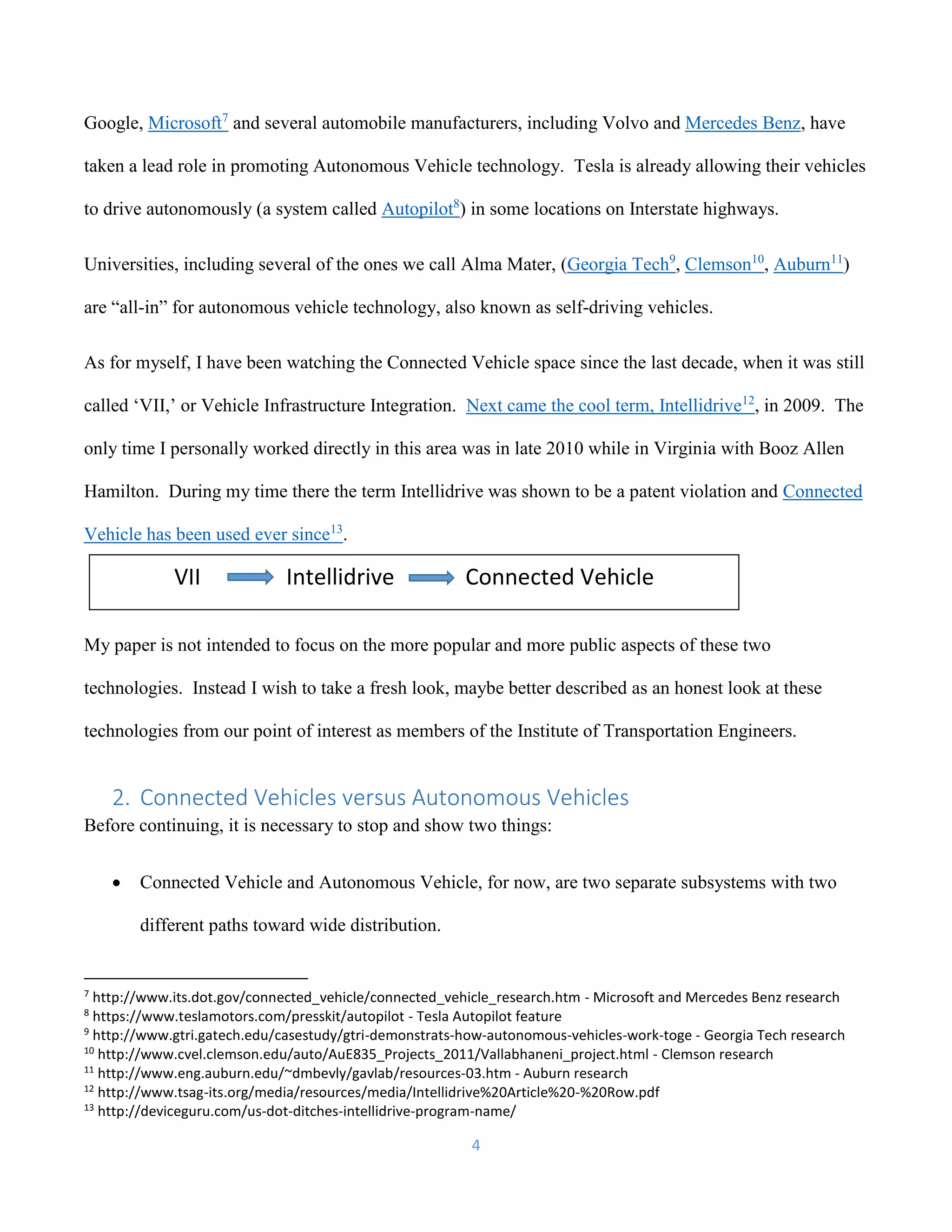
As for myself, I have been watching the Connected Vehicle space since the last decade, when it was still
called ‘VII,’ or Vehicle Infrastructure Integration. Next came the cool term, Intellidrive12
, in 2009. The
only time I personally worked directly in this area was in late 2010 while in Virginia with Booz Allen
Hamilton. During my time there the term Intellidrive was shown to be a patent violation and Connected
Vehicle has been used ever since13
.
My paper is not intended to focus on the more popular and more public aspects of these two
technologies. Instead I wish to take a fresh look, maybe better described as an honest look at these
technologies from our point of interest as members of the Institute of Transportation Engineers.
2. Connected Vehicles versus Autonomous Vehicles
Before continuing, it is necessary to stop and show two things:
 Connected Vehicle and Autonomous Vehicle, for now, are two separate subsystems with two
different paths toward wide distribution.
7
http://www.its.dot.gov/connected_vehicle/connected_vehicle_research.htm - Microsoft and Mercedes Benz research
8
https://www.teslamotors.com/presskit/autopilot - Tesla Autopilot feature
9
http://www.gtri.gatech.edu/casestudy/gtri-demonstrats-how-autonomous-vehicles-work-toge - Georgia Tech research
10
http://www.cvel.clemson.edu/auto/AuE835_Projects_2011/Vallabhaneni_project.html - Clemson research
11
http://www.eng.auburn.edu/~dmbevly/gavlab/resources-03.htm - Auburn research
12
http://www.tsag-its.org/media/resources/media/Intellidrive%20Article%20-%20Row.pdf
13
http://deviceguru.com/us-dot-ditches-intellidrive-program-name/
VII Intellidrive Connected Vehicle
5
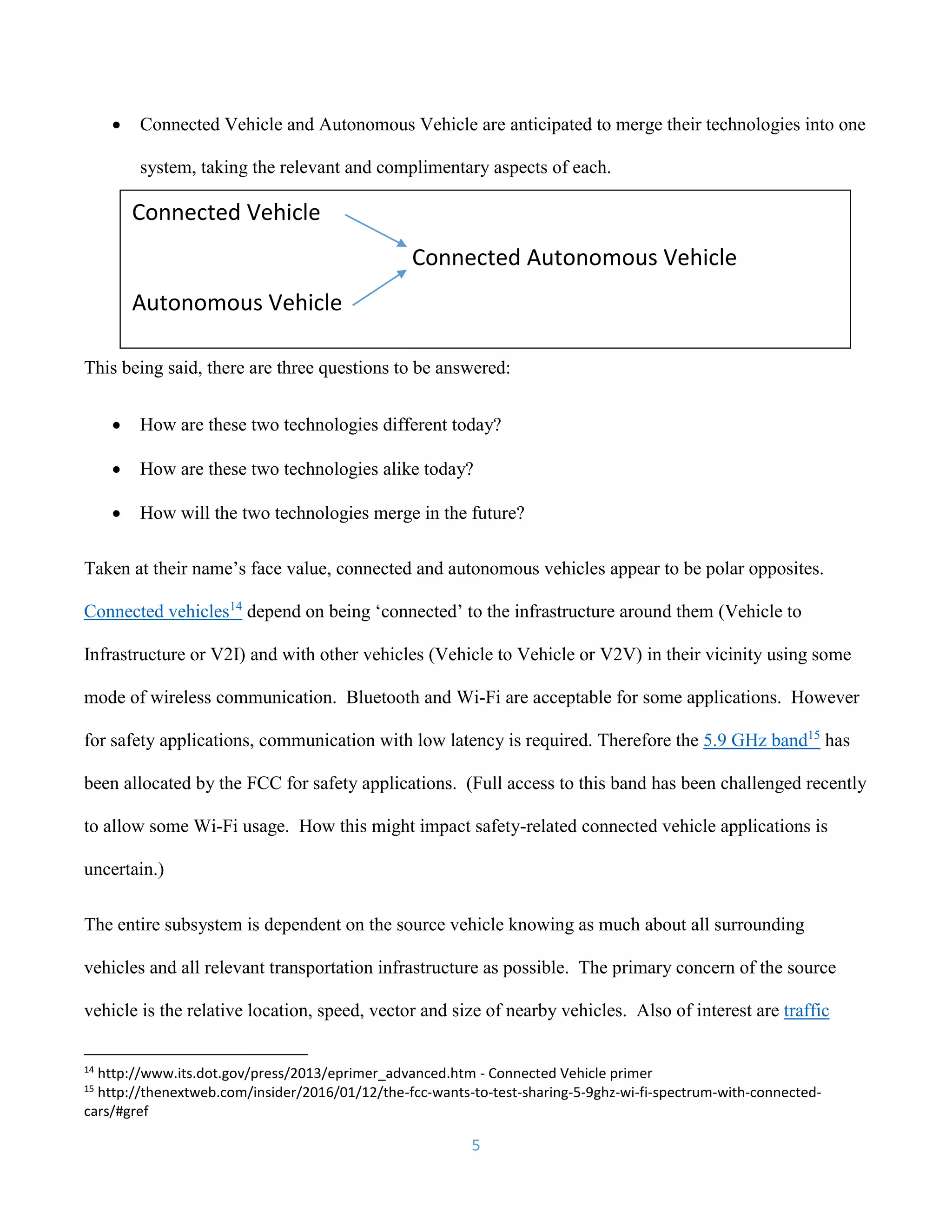
 Connected Vehicle and Autonomous Vehicle are anticipated to merge their technologies into one
system, taking the relevant and complimentary aspects of each.
This being said, there are three questions to be answered:
 How are these two technologies different today?
 How are these two technologies alike today?
 How will the two technologies merge in the future?
Taken at their name’s face value, connected and autonomous vehicles appear to be polar opposites.
Connected vehicles14
depend on being ‘connected’ to the infrastructure around them (Vehicle to
Infrastructure or V2I) and with other vehicles (Vehicle to Vehicle or V2V) in their vicinity using some
mode of wireless communication. Bluetooth and Wi-Fi are acceptable for some applications. However
for safety applications, communication with low latency is required. Therefore the 5.9 GHz band15
has
been allocated by the FCC for safety applications. (Full access to this band has been challenged recently
to allow some Wi-Fi usage. How this might impact safety-related connected vehicle applications is
uncertain.)
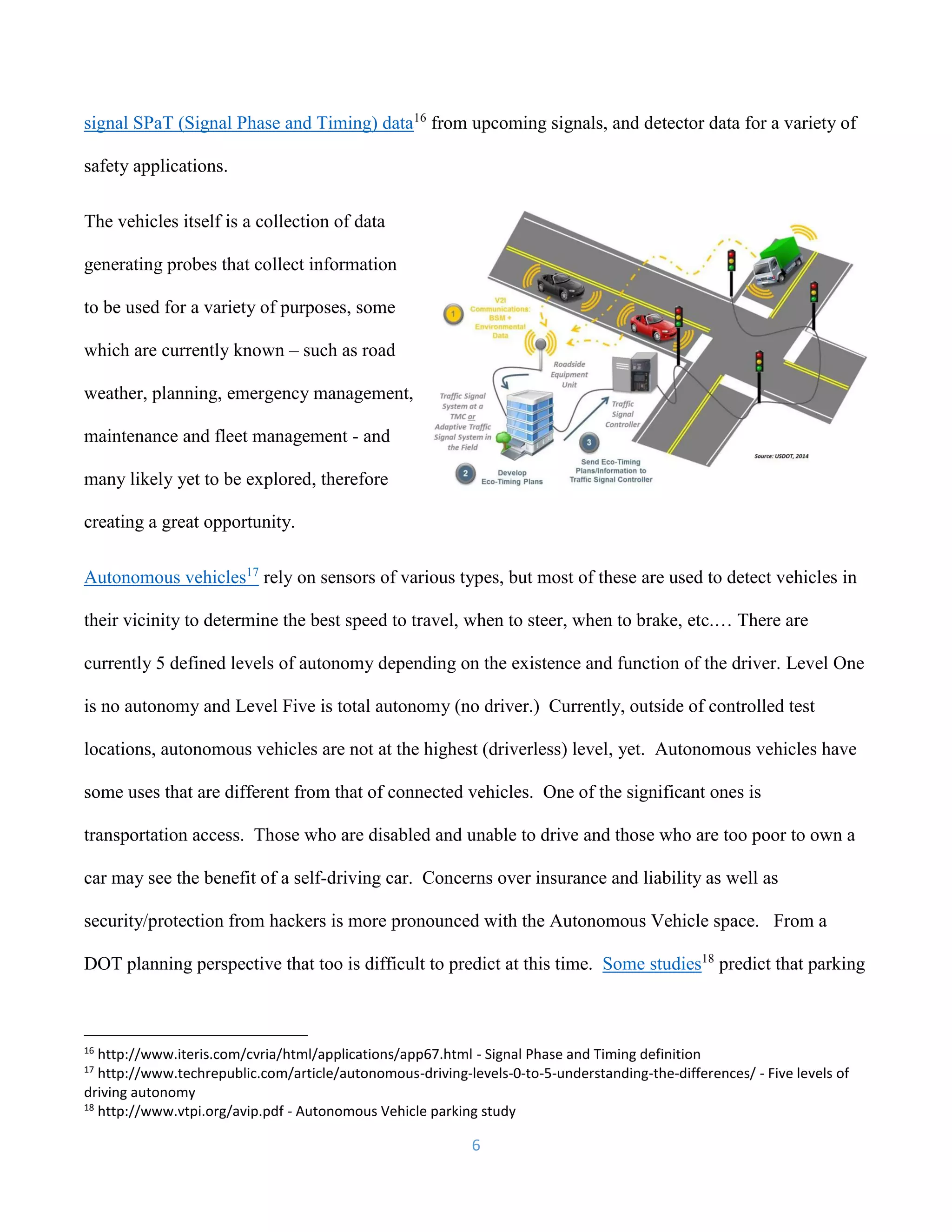
The entire subsystem is dependent on the source vehicle knowing as much about all surrounding
vehicles and all relevant transportation infrastructure as possible. The primary concern of the source
vehicle is the relative location, speed, vector and size of nearby vehicles. Also of interest are traffic
14
http://www.its.dot.gov/press/2013/eprimer_advanced.htm - Connected Vehicle primer
15
http://thenextweb.com/insider/2016/01/12/the-fcc-wants-to-test-sharing-5-9ghz-wi-fi-spectrum-with-connected-
cars/#gref
Connected Vehicle
Connected Autonomous Vehicle
Autonomous Vehicle
6
signal SPaT (Signal Phase and Timing) data16
from upcoming signals, and detector data for a variety of
safety applications.
The vehicles itself is a collection of data
generating probes that collect information
to be used for a variety of purposes, some
which are currently known – such as road
weather, planning, emergency management,
maintenance and fleet management - and
many likely yet to be explored, therefore
creating a great opportunity.
Autonomous vehicles17
rely on sensors of various types, but most of these are used to detect vehicles in
their vicinity to determine the best speed to travel, when to steer, when to brake, etc.… There are
currently 5 defined levels of autonomy depending on the existence and function of the driver. Level One
is no autonomy and Level Five is total autonomy (no driver.) Currently, outside of controlled test
locations, autonomous vehicles are not at the highest (driverless) level, yet. Autonomous vehicles have
some uses that are different from that of connected vehicles. One of the significant ones is
transportation access. Those who are disabled and unable to drive and those who are too poor to own a
car may see the benefit of a self-driving car. Concerns over insurance and liability as well as
security/protection from hackers is more pronounced with the Autonomous Vehicle space. From a
DOT planning perspective that too is difficult to predict at this time. Some studies18
predict that parking
16
http://www.iteris.com/cvria/html/applications/app67.html - Signal Phase and Timing definition
17
http://www.techrepublic.com/article/autonomous-driving-levels-0-to-5-understanding-the-differences/ - Five levels of
driving autonomy
18
http://www.vtpi.org/avip.pdf - Autonomous Vehicle parking study
7
needs will drastically decline and available usable space in urban areas will increase. Others think that
parking needs may increase – actually not parking per-se but staging – while the vehicle is waiting for
its next trip. Others are concerned that recent gains in getting people to choose transit may evaporate as
transit riders choose to take self-driving cars which can take them from point A to B without transfer.
One thing that already is common in both autonomous and connected vehicles is the need for a complete
and accurate GPS map. Without an accurate map as the backbone, either system will fail. The
connected vehicle is heavily dependent on the map since it is uses that map to understand its own
location and the relative location of other vehicles and relevant infrastructure.
The autonomous vehicle also uses a map for guidance/routing but many of the real-time driving
decisions are sensor-based. Consider that the main route may be on a path going from a pre-determined
Point A to Point B, such as when you use Google maps to choose a route, but as obstacles occur and as
lane changes or braking/acceleration is needed, the sensors determine that need and pass that command
to the vehicle.
Over time, I believe that what we will end up with is a connected car with all the applications available
from communication with other vehicles and the infrastructure that will be able to drive autonomously
with all the sensors on the vehicle providing that capability.
3. Three Stakeholder Groups
Who are we in ITE? I may leave some people out, but there are at least three stakeholder groups in ITE
that have an interest in these technologies.
 DOT/Planning agencies (State and local)
 Consultants
 Vendors
8
The first stakeholder group is looking for what to implement, why implement; what are the benefits;
what are the costs; how do we pay for it? This same could have been said of traditional Intelligent
Transportation Systems (ITS) a couple of decades ago, and now ITS has a virtually endless footprint
across the country. DOT and planning agencies realize that Connected and Autonomous vehicles have
the capability of totally disrupting the transportation and ITS business19
and changing the trajectory of
the ITS deployments in their jurisdictions.
The second stakeholder group knows there will be a market for selling their consulting services to the
first group and that they will certainly leverage similar efforts they have completed for traditional ITS to
do so. Currently, most available funding is from Federal grants, such as this $42 million grant20
made
available last year. Other funding mechanisms will likely become available once there are some
successful projects to leverage for a cost/benefit analysis. Some engineering consulting firms have been
enhancing their scope of available services to include consulting for both connected and autonomous
vehicle technologies. One can see such offerings on their corporate web sites.
The third group depends on the first and second groups to a large extent. Not only will the demand
drive the vendor’s creation and selling of existing or new products, but they will be courted by
consultants to prove their technology solutions are what they need to recommend to their clients to meet
their needs. The vendor group has an exciting future. They will have the opportunity to steer the
direction of connected and autonomous vehicle technology by investing and selling new products that
solve real issues.
19
http://geospatialworld.net/Magazine/MArticleView.aspx?aid=31625 – Transportation technology disruption predicted
20
https://www.transportation.gov/briefing-room/us-department-transportation-announces-42-million-next-generation-
connected-vehicle - Projects in NYC, Tampa and Wyoming
9
4. Keys to Deployment
Back to the subject at hand – getting DOTs and other agencies their applications, getting consultants
their work and getting products from vendors. Agencies are looking mostly to deploy Connected
Vehicle applications, while keeping one eye focused on accommodating changes to their transportation
networks and transportation planning process brought on by self-driving cars.
The DOTs and other transportation agencies are focused on these main questions regarding connected or
autonomous vehicles:
 What to implement – interface with consultants and vendors
 When and where to implement – programming- what are the needs? What are the problems that
need a solution?
 How to implement – cost/benefit ratio, performance measures, Federal grant money
The Federal Government has prepared webinars21
that are available to agencies to give them the step-by-
step instructions on how to plan Connected Vehicle deployments. These workshops are good, but it can
be difficult to try to program a technology that is not yet deployed other than in test environments.
Lessons learned in the last decade, when deployment of roadside units (RSE’s) were being heavily
promoted, was that state governments are not prepared to fund mass implementation of RSE’s. Today,
the implementation of RSE’s is limited22
and vehicle to vehicle technologies are more feasible. Vehicle
to Infrastructure technologies currently face funding challenges not met by vehicle to vehicle
technologies. Connected Vehicle technology can assist in safety, mobility, and environmental
applications. Safety applications include red light and stop sign warning, left turn assist and other
21
https://www.transportation.gov/briefing-room/us-department-transportation-announces-42-million-next-generation-
connected-vehicle - Connected Vehicle webinars
22
http://www.gao.gov/assets/680/672548.pdf - Benefits with Deployment challenges
10
applications aimed at avoiding accidents. These applications typically alert the driver they are about to
commit an error that could lead to an accident. Mobility applications focus on items such as SPaT data
being used to reduce red light delays at intersections and queue detection being used to improve freeway
operations. One game changer for mobility that is possible is to create headway reducing platoons of
fleets or through traffic around a city. Environmental applications may be deployed to help drivers save
fuel and reduce emissions from idling installed traffic. Some of these applications may be important to a
DOT or other agency and are therefore a candidate for programming. Autonomous Vehicle applications
are not typically going to be programmed by a DOT or agency, instead these applications will be
deployed mostly by auto manufacturers. DOTs however will need to know how to accommodate the
changes that will occur when self-driving cars are common. Parking and transit needs may be radically
changed and with that, land use in urban areas might be forever changed.
What about the consultants? What role will they play? The first thing that consultants can do is assist
State, regional and local agencies with updates to their ITS Architecture and any other systems
engineering23
documents that need to be revised to include connected vehicle components.
 Systems Engineering Plan
 ITS Architecture (updated to address connected vehicles)
 Concept of Operations
 Strategic Deployment and Business Plan
The systems engineering process can help identify connected vehicle solutions. Once a solution or set
of solutions is identified, consultants can work through the process of implementation. Consultants need
23
http://transportationops.org/blog/headline-news/usdot-updates-connected-vehicle-reference-implementation-
architecture-and-systems - Related ITS Architecture updates
11
to be students of connected and autonomous vehicle technology. It will be important to know how to
best make recommendations to DOT’s and other transportation agencies and organizations.
Vendors will be providing equipment for any roadside applications as well as in-vehicle sensors and
apps for smart phones that put the control of these devices in the consumers’ hands. These include
traffic controllers that reside in cabinets and other roadside safety equipment. Automotive companies
will continue to invest heavily in autonomous vehicles but there is opportunity for other vendors to
provide OEM sensor and probe solutions. Software companies will have the ability to create relevant
on-board and smartphone apps. Internet of Things (IoT)24
technology is expanding and there are likely
many more opportunities that haven’t been thought of yet. IoT is a fancy term that simply refers to
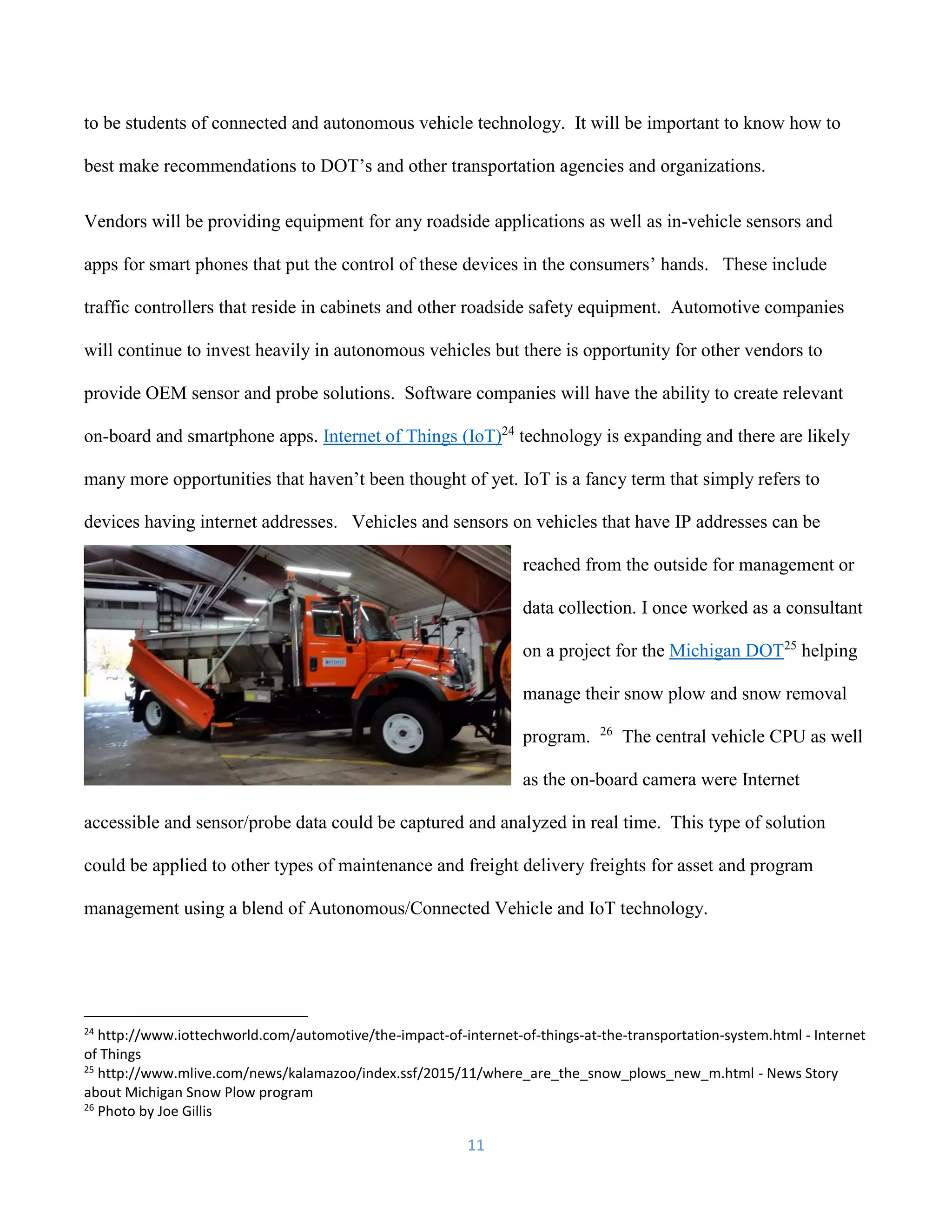
devices having internet addresses. Vehicles and sensors on vehicles that have IP addresses can be
reached from the outside for management or
data collection. I once worked as a consultant
on a project for the Michigan DOT25
helping
manage their snow plow and snow removal
program. 26
The central vehicle CPU as well
as the on-board camera were Internet
accessible and sensor/probe data could be captured and analyzed in real time. This type of solution
could be applied to other types of maintenance and freight delivery freights for asset and program
management using a blend of Autonomous/Connected Vehicle and IoT technology.
24
http://www.iottechworld.com/automotive/the-impact-of-internet-of-things-at-the-transportation-system.html - Internet
of Things
25
http://www.mlive.com/news/kalamazoo/index.ssf/2015/11/where_are_the_snow_plows_new_m.html - News Story
about Michigan Snow Plow program
26
Photo by Joe Gillis
12
5. Barriers to Success
There is a lot of opportunity for everyone as the Autonomous and Connected Vehicle technologies
advance and likely merge. However, the path is not completely clear. There are some items that will
have to be addressed and/or overcome:
 Cost of non-vehicle deployment
 Liability of autonomous driving
 Data security and privacy
 Emotional attachment to car ownership
As alluded to earlier in the paper, most of the early deployments of both Autonomous and Connected
Vehicles will be confined to vehicles themselves. This may be sensors on a single vehicle or
applications that utilize communication between two or more vehicles. The cost of these types of
applications is somewhat hidden in the cost of the vehicle or in the cost of the mobile phone app or the
ads that support free apps. Deployment of Connected Vehicle-ready traffic signal controllers is likely
the first roadside deployment because such controllers are a natural upgrade to a device what is
ubiquitous in all cities already. Any deployment that requires a DOT to look for funding to deploy
something new is going to have a tougher path to success. This is
why a number of cities applied for the $40 Million Smart Cites
Challenge grant and the competition among the seven finalists will
be fierce. This is a golden opportunity for some fortunate city to be
able to deploy roadside equipment and come up with some creative possibly ground-breaking
applications.
13
Another item that has to be dealt with is liability27
. When a vehicle is partially or totally under the
control of a software system under the jurisdiction of a DOT for example, and there is an accident, who
is to blame. Will DOTs have to get liability insurance? What will happen to individual premiums?
Theoretically the technology added to both Connected and Autonomous Vehicles makes travel safer and
should lead to few accidents. However, when there is an accident, liability can be a big issue.
Security of connected vehicles28
has become a significant concern. Just like any other Internet-
connected device, a connected car is open to the same type of hacking and malicious attacks. Although
such attacks may frequently be juvenile in nature, hacking into vehicle with an intent to cause a wreck
by taking over the steering or accelerator in heavy traffic, for example, could lead to a terrible outcome.
Full deployment and acceptance will likely not occur until the public feels reasonably safe that such an
event is unlikely to occur.
One other thing to think about is how the public will emotionally accept not having their own personal
vehicle. (Certainly car ownership will be available but there will be less need for it.) Most keep a lot of
“stuff” in their cars and they are almost like second homes. (A comparison might be to the recent
phenomenon in Corporate America called ‘hoteling’ where employees don’t have their own office but
instead reserve a space a week at a time, that is not their own space where they can store their personal
items.) How quickly people decide they do not have to have their own car may have an impact on how
quickly particularly autonomous vehicle technology advances.
27
http://www.thefederation.org/documents/04.Glancy%20-%20AutonomousCars.pdf – Article about Insurance and
Liability
28
http://www.veracode.com/sites/default/files/Resources/Whitepapers/idc-veracode-connected-car-research-
whitepaper.pdf - Article on security issues
14
6. Conclusion
Twenty to twenty-five years ago, most DOTs and consultants were focused on building roads and
installing and configuring traffic signals. There was some ITS (actually the term of the day was IVHS)
in larger cities. That was about to change. There was an explosion of research and testing of ITS and
then came a wave of deployment over the next 2 decades. In a similar manner, over the last 8 to 10
years, the research and testing has continued to escalate into what we see today with Connected and
Autonomous Vehicles. This explosion is not going away any time soon. I suggest that ITS will be
forever shaped and disrupted by these technologies and that any agency, consultant or vendor that
ignores this will do so at their own financial peril. That said, we all have to work together to move this
technology at the right pace. We will then reap the benefits of a powerful flexible new technology that
will ultimately change the way we all view automobile transportation.

Not Another Connected Vehicle paper

  • 1.
    Not Another Connected(Autonomous) Vehicle Paper! Joe Gillis May 20, 2016 Submitted to Georgia Section ITE Technical Paper Contest
  • 2.
    2 Table of Contents 1.Introduction........................................................................................................................................................3 2. Connected Vehicles versus Autonomous Vehicles.............................................................................................4 3. Three Stakeholder Groups..................................................................................................................................7 4. Keys to Deployment ...........................................................................................................................................9 5. Barriers to Success........................................................................................................................................... 12 6. Conclusion ....................................................................................................................................................... 14
  • 3.
    3 1. Introduction Looking around,one can hardly read a newspaper, watch a TV news report, browse a blog, or scan Twitter without seeing a story or a post about something from either the Connected Vehicle or the Autonomous Vehicle space. Maybe it is something about Mcity1 , one place where connected vehicle systems are tested for safety application, or maybe the Google self-driving car2 . Maybe it is someone selling the benefits of creating more usable urban space when parking is no longer needed as much or at all3 , or else, someone warning the masses about hackers and security breaches taking over your car and causing harm. The Federal Government has taken a huge role4 in the promotion and testing of potential connected vehicle systems. The amount of information on their web sites is extensive. They have developed day- long webinars to be distributed to interested groups of eager watchers in the transportation field. Recently, the USDOT has been sponsoring a Smart City Initiative5 which will provide a $40M grant to the winner to develop a smart city. Much of this will involve the deployment of connected and autonomous vehicle technology. In an on-line Town Hall on May 11th of this year, Secretary of Transportation Anthony Foxx6 was asked about autonomous vehicles and the role of the USDOT (and therefore state DOT’s). His answer was brief and merely mentioned the ability to provide cheaper vehicle transportation for the poor and also transportation for the disabled. I presume that for now, connected vehicles are the main focus at the Federal and state government level. 1 http://www.mtc.umich.edu/test-facility- University of Michigan Smart City 2 https://www.google.com/selfdrivingcar/ 3 http://usa.streetsblog.org/2014/03/26/how-the-self-driving-car-could-spell-the-end-of-parking-craters/ 4 http://www.its.dot.gov/connected_vehicle/connected_vehicle_research.htm 5 https://www.transportation.gov/smartcity - USDOT Smart Cities Initiative 6 https://americansecuritytoday.com/national-virtual-town-hall/ - Anthony Foxx Webinar
  • 4.
    4 Google, Microsoft7 and severalautomobile manufacturers, including Volvo and Mercedes Benz, have taken a lead role in promoting Autonomous Vehicle technology. Tesla is already allowing their vehicles to drive autonomously (a system called Autopilot8 ) in some locations on Interstate highways. Universities, including several of the ones we call Alma Mater, (Georgia Tech9 , Clemson10 , Auburn11 ) are “all-in” for autonomous vehicle technology, also known as self-driving vehicles. As for myself, I have been watching the Connected Vehicle space since the last decade, when it was still called ‘VII,’ or Vehicle Infrastructure Integration. Next came the cool term, Intellidrive12 , in 2009. The only time I personally worked directly in this area was in late 2010 while in Virginia with Booz Allen Hamilton. During my time there the term Intellidrive was shown to be a patent violation and Connected Vehicle has been used ever since13 . My paper is not intended to focus on the more popular and more public aspects of these two technologies. Instead I wish to take a fresh look, maybe better described as an honest look at these technologies from our point of interest as members of the Institute of Transportation Engineers. 2. Connected Vehicles versus Autonomous Vehicles Before continuing, it is necessary to stop and show two things:  Connected Vehicle and Autonomous Vehicle, for now, are two separate subsystems with two different paths toward wide distribution. 7 http://www.its.dot.gov/connected_vehicle/connected_vehicle_research.htm - Microsoft and Mercedes Benz research 8 https://www.teslamotors.com/presskit/autopilot - Tesla Autopilot feature 9 http://www.gtri.gatech.edu/casestudy/gtri-demonstrats-how-autonomous-vehicles-work-toge - Georgia Tech research 10 http://www.cvel.clemson.edu/auto/AuE835_Projects_2011/Vallabhaneni_project.html - Clemson research 11 http://www.eng.auburn.edu/~dmbevly/gavlab/resources-03.htm - Auburn research 12 http://www.tsag-its.org/media/resources/media/Intellidrive%20Article%20-%20Row.pdf 13 http://deviceguru.com/us-dot-ditches-intellidrive-program-name/ VII Intellidrive Connected Vehicle
  • 5.
    5  Connected Vehicleand Autonomous Vehicle are anticipated to merge their technologies into one system, taking the relevant and complimentary aspects of each. This being said, there are three questions to be answered:  How are these two technologies different today?  How are these two technologies alike today?  How will the two technologies merge in the future? Taken at their name’s face value, connected and autonomous vehicles appear to be polar opposites. Connected vehicles14 depend on being ‘connected’ to the infrastructure around them (Vehicle to Infrastructure or V2I) and with other vehicles (Vehicle to Vehicle or V2V) in their vicinity using some mode of wireless communication. Bluetooth and Wi-Fi are acceptable for some applications. However for safety applications, communication with low latency is required. Therefore the 5.9 GHz band15 has been allocated by the FCC for safety applications. (Full access to this band has been challenged recently to allow some Wi-Fi usage. How this might impact safety-related connected vehicle applications is uncertain.) The entire subsystem is dependent on the source vehicle knowing as much about all surrounding vehicles and all relevant transportation infrastructure as possible. The primary concern of the source vehicle is the relative location, speed, vector and size of nearby vehicles. Also of interest are traffic 14 http://www.its.dot.gov/press/2013/eprimer_advanced.htm - Connected Vehicle primer 15 http://thenextweb.com/insider/2016/01/12/the-fcc-wants-to-test-sharing-5-9ghz-wi-fi-spectrum-with-connected- cars/#gref Connected Vehicle Connected Autonomous Vehicle Autonomous Vehicle
  • 6.
    6 signal SPaT (SignalPhase and Timing) data16 from upcoming signals, and detector data for a variety of safety applications. The vehicles itself is a collection of data generating probes that collect information to be used for a variety of purposes, some which are currently known – such as road weather, planning, emergency management, maintenance and fleet management - and many likely yet to be explored, therefore creating a great opportunity. Autonomous vehicles17 rely on sensors of various types, but most of these are used to detect vehicles in their vicinity to determine the best speed to travel, when to steer, when to brake, etc.… There are currently 5 defined levels of autonomy depending on the existence and function of the driver. Level One is no autonomy and Level Five is total autonomy (no driver.) Currently, outside of controlled test locations, autonomous vehicles are not at the highest (driverless) level, yet. Autonomous vehicles have some uses that are different from that of connected vehicles. One of the significant ones is transportation access. Those who are disabled and unable to drive and those who are too poor to own a car may see the benefit of a self-driving car. Concerns over insurance and liability as well as security/protection from hackers is more pronounced with the Autonomous Vehicle space. From a DOT planning perspective that too is difficult to predict at this time. Some studies18 predict that parking 16 http://www.iteris.com/cvria/html/applications/app67.html - Signal Phase and Timing definition 17 http://www.techrepublic.com/article/autonomous-driving-levels-0-to-5-understanding-the-differences/ - Five levels of driving autonomy 18 http://www.vtpi.org/avip.pdf - Autonomous Vehicle parking study
  • 7.
    7 needs will drasticallydecline and available usable space in urban areas will increase. Others think that parking needs may increase – actually not parking per-se but staging – while the vehicle is waiting for its next trip. Others are concerned that recent gains in getting people to choose transit may evaporate as transit riders choose to take self-driving cars which can take them from point A to B without transfer. One thing that already is common in both autonomous and connected vehicles is the need for a complete and accurate GPS map. Without an accurate map as the backbone, either system will fail. The connected vehicle is heavily dependent on the map since it is uses that map to understand its own location and the relative location of other vehicles and relevant infrastructure. The autonomous vehicle also uses a map for guidance/routing but many of the real-time driving decisions are sensor-based. Consider that the main route may be on a path going from a pre-determined Point A to Point B, such as when you use Google maps to choose a route, but as obstacles occur and as lane changes or braking/acceleration is needed, the sensors determine that need and pass that command to the vehicle. Over time, I believe that what we will end up with is a connected car with all the applications available from communication with other vehicles and the infrastructure that will be able to drive autonomously with all the sensors on the vehicle providing that capability. 3. Three Stakeholder Groups Who are we in ITE? I may leave some people out, but there are at least three stakeholder groups in ITE that have an interest in these technologies.  DOT/Planning agencies (State and local)  Consultants  Vendors
  • 8.
    8 The first stakeholdergroup is looking for what to implement, why implement; what are the benefits; what are the costs; how do we pay for it? This same could have been said of traditional Intelligent Transportation Systems (ITS) a couple of decades ago, and now ITS has a virtually endless footprint across the country. DOT and planning agencies realize that Connected and Autonomous vehicles have the capability of totally disrupting the transportation and ITS business19 and changing the trajectory of the ITS deployments in their jurisdictions. The second stakeholder group knows there will be a market for selling their consulting services to the first group and that they will certainly leverage similar efforts they have completed for traditional ITS to do so. Currently, most available funding is from Federal grants, such as this $42 million grant20 made available last year. Other funding mechanisms will likely become available once there are some successful projects to leverage for a cost/benefit analysis. Some engineering consulting firms have been enhancing their scope of available services to include consulting for both connected and autonomous vehicle technologies. One can see such offerings on their corporate web sites. The third group depends on the first and second groups to a large extent. Not only will the demand drive the vendor’s creation and selling of existing or new products, but they will be courted by consultants to prove their technology solutions are what they need to recommend to their clients to meet their needs. The vendor group has an exciting future. They will have the opportunity to steer the direction of connected and autonomous vehicle technology by investing and selling new products that solve real issues. 19 http://geospatialworld.net/Magazine/MArticleView.aspx?aid=31625 – Transportation technology disruption predicted 20 https://www.transportation.gov/briefing-room/us-department-transportation-announces-42-million-next-generation- connected-vehicle - Projects in NYC, Tampa and Wyoming
  • 9.
    9 4. Keys toDeployment Back to the subject at hand – getting DOTs and other agencies their applications, getting consultants their work and getting products from vendors. Agencies are looking mostly to deploy Connected Vehicle applications, while keeping one eye focused on accommodating changes to their transportation networks and transportation planning process brought on by self-driving cars. The DOTs and other transportation agencies are focused on these main questions regarding connected or autonomous vehicles:  What to implement – interface with consultants and vendors  When and where to implement – programming- what are the needs? What are the problems that need a solution?  How to implement – cost/benefit ratio, performance measures, Federal grant money The Federal Government has prepared webinars21 that are available to agencies to give them the step-by- step instructions on how to plan Connected Vehicle deployments. These workshops are good, but it can be difficult to try to program a technology that is not yet deployed other than in test environments. Lessons learned in the last decade, when deployment of roadside units (RSE’s) were being heavily promoted, was that state governments are not prepared to fund mass implementation of RSE’s. Today, the implementation of RSE’s is limited22 and vehicle to vehicle technologies are more feasible. Vehicle to Infrastructure technologies currently face funding challenges not met by vehicle to vehicle technologies. Connected Vehicle technology can assist in safety, mobility, and environmental applications. Safety applications include red light and stop sign warning, left turn assist and other 21 https://www.transportation.gov/briefing-room/us-department-transportation-announces-42-million-next-generation- connected-vehicle - Connected Vehicle webinars 22 http://www.gao.gov/assets/680/672548.pdf - Benefits with Deployment challenges
  • 10.
    10 applications aimed atavoiding accidents. These applications typically alert the driver they are about to commit an error that could lead to an accident. Mobility applications focus on items such as SPaT data being used to reduce red light delays at intersections and queue detection being used to improve freeway operations. One game changer for mobility that is possible is to create headway reducing platoons of fleets or through traffic around a city. Environmental applications may be deployed to help drivers save fuel and reduce emissions from idling installed traffic. Some of these applications may be important to a DOT or other agency and are therefore a candidate for programming. Autonomous Vehicle applications are not typically going to be programmed by a DOT or agency, instead these applications will be deployed mostly by auto manufacturers. DOTs however will need to know how to accommodate the changes that will occur when self-driving cars are common. Parking and transit needs may be radically changed and with that, land use in urban areas might be forever changed. What about the consultants? What role will they play? The first thing that consultants can do is assist State, regional and local agencies with updates to their ITS Architecture and any other systems engineering23 documents that need to be revised to include connected vehicle components.  Systems Engineering Plan  ITS Architecture (updated to address connected vehicles)  Concept of Operations  Strategic Deployment and Business Plan The systems engineering process can help identify connected vehicle solutions. Once a solution or set of solutions is identified, consultants can work through the process of implementation. Consultants need 23 http://transportationops.org/blog/headline-news/usdot-updates-connected-vehicle-reference-implementation- architecture-and-systems - Related ITS Architecture updates
  • 11.
    11 to be studentsof connected and autonomous vehicle technology. It will be important to know how to best make recommendations to DOT’s and other transportation agencies and organizations. Vendors will be providing equipment for any roadside applications as well as in-vehicle sensors and apps for smart phones that put the control of these devices in the consumers’ hands. These include traffic controllers that reside in cabinets and other roadside safety equipment. Automotive companies will continue to invest heavily in autonomous vehicles but there is opportunity for other vendors to provide OEM sensor and probe solutions. Software companies will have the ability to create relevant on-board and smartphone apps. Internet of Things (IoT)24 technology is expanding and there are likely many more opportunities that haven’t been thought of yet. IoT is a fancy term that simply refers to devices having internet addresses. Vehicles and sensors on vehicles that have IP addresses can be reached from the outside for management or data collection. I once worked as a consultant on a project for the Michigan DOT25 helping manage their snow plow and snow removal program. 26 The central vehicle CPU as well as the on-board camera were Internet accessible and sensor/probe data could be captured and analyzed in real time. This type of solution could be applied to other types of maintenance and freight delivery freights for asset and program management using a blend of Autonomous/Connected Vehicle and IoT technology. 24 http://www.iottechworld.com/automotive/the-impact-of-internet-of-things-at-the-transportation-system.html - Internet of Things 25 http://www.mlive.com/news/kalamazoo/index.ssf/2015/11/where_are_the_snow_plows_new_m.html - News Story about Michigan Snow Plow program 26 Photo by Joe Gillis
  • 12.
    12 5. Barriers toSuccess There is a lot of opportunity for everyone as the Autonomous and Connected Vehicle technologies advance and likely merge. However, the path is not completely clear. There are some items that will have to be addressed and/or overcome:  Cost of non-vehicle deployment  Liability of autonomous driving  Data security and privacy  Emotional attachment to car ownership As alluded to earlier in the paper, most of the early deployments of both Autonomous and Connected Vehicles will be confined to vehicles themselves. This may be sensors on a single vehicle or applications that utilize communication between two or more vehicles. The cost of these types of applications is somewhat hidden in the cost of the vehicle or in the cost of the mobile phone app or the ads that support free apps. Deployment of Connected Vehicle-ready traffic signal controllers is likely the first roadside deployment because such controllers are a natural upgrade to a device what is ubiquitous in all cities already. Any deployment that requires a DOT to look for funding to deploy something new is going to have a tougher path to success. This is why a number of cities applied for the $40 Million Smart Cites Challenge grant and the competition among the seven finalists will be fierce. This is a golden opportunity for some fortunate city to be able to deploy roadside equipment and come up with some creative possibly ground-breaking applications.
  • 13.
    13 Another item thathas to be dealt with is liability27 . When a vehicle is partially or totally under the control of a software system under the jurisdiction of a DOT for example, and there is an accident, who is to blame. Will DOTs have to get liability insurance? What will happen to individual premiums? Theoretically the technology added to both Connected and Autonomous Vehicles makes travel safer and should lead to few accidents. However, when there is an accident, liability can be a big issue. Security of connected vehicles28 has become a significant concern. Just like any other Internet- connected device, a connected car is open to the same type of hacking and malicious attacks. Although such attacks may frequently be juvenile in nature, hacking into vehicle with an intent to cause a wreck by taking over the steering or accelerator in heavy traffic, for example, could lead to a terrible outcome. Full deployment and acceptance will likely not occur until the public feels reasonably safe that such an event is unlikely to occur. One other thing to think about is how the public will emotionally accept not having their own personal vehicle. (Certainly car ownership will be available but there will be less need for it.) Most keep a lot of “stuff” in their cars and they are almost like second homes. (A comparison might be to the recent phenomenon in Corporate America called ‘hoteling’ where employees don’t have their own office but instead reserve a space a week at a time, that is not their own space where they can store their personal items.) How quickly people decide they do not have to have their own car may have an impact on how quickly particularly autonomous vehicle technology advances. 27 http://www.thefederation.org/documents/04.Glancy%20-%20AutonomousCars.pdf – Article about Insurance and Liability 28 http://www.veracode.com/sites/default/files/Resources/Whitepapers/idc-veracode-connected-car-research- whitepaper.pdf - Article on security issues
  • 14.
    14 6. Conclusion Twenty totwenty-five years ago, most DOTs and consultants were focused on building roads and installing and configuring traffic signals. There was some ITS (actually the term of the day was IVHS) in larger cities. That was about to change. There was an explosion of research and testing of ITS and then came a wave of deployment over the next 2 decades. In a similar manner, over the last 8 to 10 years, the research and testing has continued to escalate into what we see today with Connected and Autonomous Vehicles. This explosion is not going away any time soon. I suggest that ITS will be forever shaped and disrupted by these technologies and that any agency, consultant or vendor that ignores this will do so at their own financial peril. That said, we all have to work together to move this technology at the right pace. We will then reap the benefits of a powerful flexible new technology that will ultimately change the way we all view automobile transportation.