STUDENT ACCESS TO A SOUND,
BASIC EDUCATION:
A WHOLE CHILD APPROACH
Focus on Specialized Instructional Support Personnel
SCHOOL COUNSELORS, SCHOOL NURSES, SCHOOL PSYCHOLOGISTS, SCHOOL SOCIAL WORKERS
1
Student Access to a Sound, Basic Education:
A Whole Child Approach
In 2015 an advisory committee to the State Board of Education, Whole Child NC,
was established to identify and review the challenges of at-risk school-aged
populations, such as poverty, safety, health, and other non-academic barriers.
The committee makes recommendations to the State Board of Education and
other state agencies and education stakeholder groups on how to best facilitate
access for all public school children to receive the opportunity for a sound basic
education.
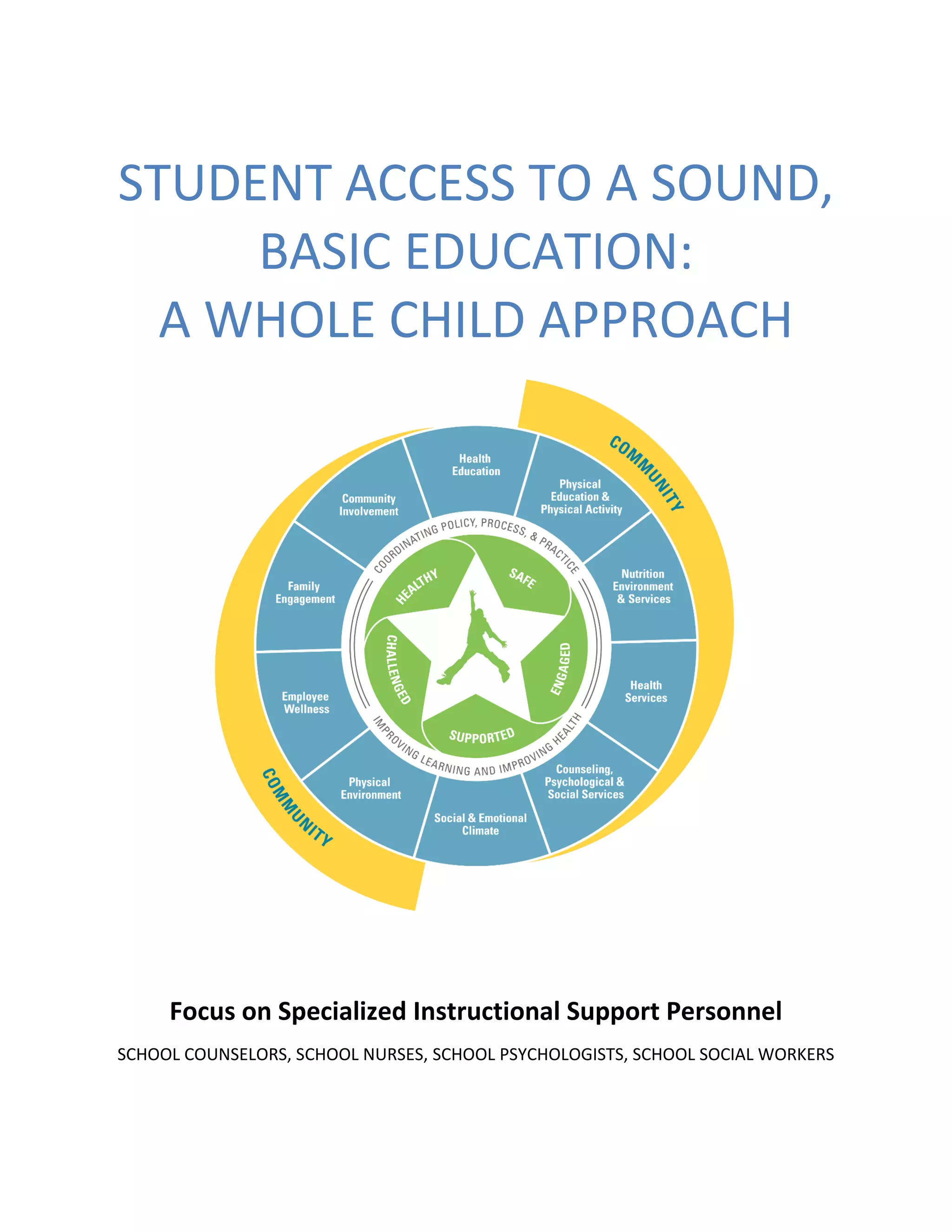
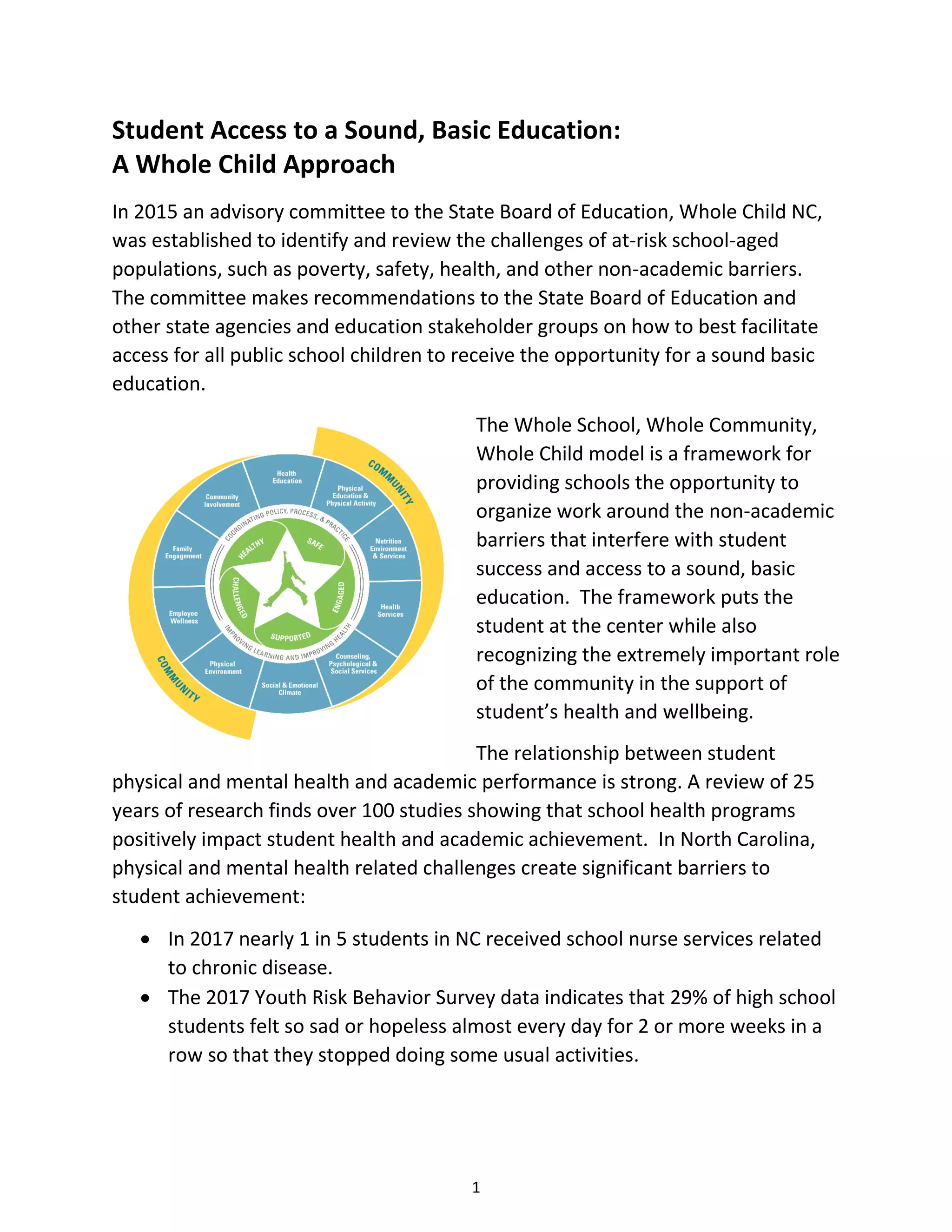
The Whole School, Whole Community,
Whole Child model is a framework for
providing schools the opportunity to
organize work around the non-academic
barriers that interfere with student
success and access to a sound, basic
education. The framework puts the
student at the center while also
recognizing the extremely important role
of the community in the support of
student’s health and wellbeing.
The relationship between student
physical and mental health and academic performance is strong. A review of 25
years of research finds over 100 studies showing that school health programs
positively impact student health and academic achievement. In North Carolina,
physical and mental health related challenges create significant barriers to
student achievement:
• In 2017 nearly 1 in 5 students in NC received school nurse services related
to chronic disease.
• The 2017 Youth Risk Behavior Survey data indicates that 29% of high school
students felt so sad or hopeless almost every day for 2 or more weeks in a
row so that they stopped doing some usual activities.
2
• Between 2007 and 2017, there was a 13% increase in reported signs of
depression among students who reported making mostly Ds and Fs.
• Sixteen percent of high school students seriously considered attempting
suicide in the past year.
These are staggering numbers and are likely to increase without appropriate staff
to intervene.
THE ROLE OF SPECIALIZED INSTRUCTIONAL SUPPORT PERSONNEL
Specialized Instructional Support Personnel (SISP) are a critical part of this model
in each school when addressing these non-academic barriers via a team approach,
particularly as they relate to the physical and mental health of our students.
School counselors, school nurses, school psychologists, and school social workers
each have unique and important roles to play in supporting students. Because of
the unique nature of each of the Specialized Instructional Support Personnel, if
any are not present as part of an integrated team providing a continuum of
services, students may not receive the support that they need to be successful.
This document provides a brief overview of the unique roles of school counselors,
school nurses, school psychologists, and school social workers. Additionally, it
provides the qualifications, recommended and current ratios, as well as resources
that can be accessed for additional information relevant to each role.
The SISP function is an integrated, team approach within schools. Each role is
equally important and interdependent with the other roles, with the shared goal
of supporting the needs of the whole child. SISP collaborate with the entire
school staff and community to ensure that students’ academic, physical, social,
emotional, and mental health needs are addressed.
Resources:
• NC ESSA Plan
• Whole School, Whole Community, Whole Child Resolution
3
School Counselors
What do school counselors do?
School counselors design and deliver comprehensive school counseling programs
that promote student success through data- and needs-based strategies. They
help all students in the areas of academic achievement, personal/social
development, and career development and collaborate to deliver services
through large group guidance, interdisciplinary curriculum development with
teachers, group and school-wide activities, and partner workshops.
School counselors facilitate individual student planning through individual or
small group advisement and counseling and coordination of ongoing systemic
activities designed to assist students in establishing personal goals and developing
future plans.
School counselors provide responsive services through consultation with
students, families, and staff; individual and small group counseling; crisis
counseling; referrals; and peer facilitation.
Additional school counselor responsibilities:
Counseling students regarding
academic, emotional or social
problems and guiding them to
potential solutions.
Collaborating with teachers to
integrate Guidance Essential Standards
into other content area lessons.
Facilitating activities to foster student
career awareness K-12.
Assisting students with college,
financial aid and job applications.
Teaching conflict resolution skills via
classroom lessons, group guidance, or
peer programs.
Providing counseling to students with
disciplinary or absentee problems.
Providing teachers with resources and
suggestions for effective classroom
management.
Coordinating referrals to school
resources and/or community service
providers.
4
What licenses and education are required for school counselors?
A master’s degree is required to be a school counselor. Current school counseling
graduate master’s programs are typically 48-60 hours of coursework. School
Counselors are licensed by the NC Department of Public Instruction. Many are
also eligible to apply for licensure by the NC Board of Licensed Professional
Counselors to practice counseling in other settings.
What are the recommended and current ratios for student to school counselors
in North Carolina?
National recommended ratio for
school counselors
North Carolina ratio for school
counselors
1:250 students 1:367 students
References and Additional Resources
NC Department of Public Instruction School Counseling web site
North Carolina Professional School Counseling Standards
North Carolina G.S. 115C-316.1 Duties of School Counselors
North Carolina School Counselor Association (NCSCA)
American School Counselor Association (ASCA)
ASCA National Model: A Framework for Schools Counseling
Role of the School Counselor
5
School Nurses
What do school nurses do?
School nurses are assigned a varying case load depending on the school district
resources and serve between one and six schools per nurse; they provide and
oversee health care delivery in schools.
School nurses assess needs, complete and oversee health care plans, and provide
related instruction and support to meet the needs of students with chronic and
acute conditions.
School nurses manage students with complex health needs involving the use of
care plans with specific goals and interventions.
Additional school nurse responsibilities:
Preventing and responding to
communicable disease outbreaks
Developing and implementing plans
for emergency health related
assistance
Planning and providing specialized
clinical services and related health
instruction
Overseeing medication and health care
procedures
Assuring care for identified health
needs after
assessment and referral
Assuring that mandated health care
activities are completed
Providing health education and health
counseling
Helping to assure a safe and healthy
school environment
6
What licenses and education are required for school nurses?
School nurses are registered nurses (RN) with varied educational preparation. In
addition to being a RN, national certification in School Nursing is the standard by
which North Carolina school nurses are assured to have the advanced knowledge
and skills required in this independent specialty practice. A baccalaureate is the
minimum degree required for certification eligibility.
What are the recommended and current ratio for student to school nurses in
North Carolina?
National recommended ratio for
school nurses
North Carolina ratio for school nurses
1 RN school nurse per school District range 1:313 to 1:2,724
References and Additional Resources
School nurses: An investment in student achievement
National Association of School Nurses
School Nurse Association of NC
7
School Psychologists
What do school psychologists do?
School psychologists assist in the development of systemic level academic and
behavioral practices effective for the majority of students and provide direct,
targeted academic and behavioral health services to individual and groups of
students in need.
School psychologists conduct evaluations, assessments and data analysis to
support the learning and behavioral needs of students and inform the
instructional practices of educators.
School psychologists assist families and school staff in understanding the learning
and behavioral health needs of children and adolescents.
Additional school psychologist responsibilities:
Providing system- and school-wide crisis
prevention and response services
Promoting safe and supportive
learning environments and
implementing strategies to improve
student engagement and learning
Providing consultation with teachers and
families by monitoring and effectively
communicating about student progress.
Assessing diverse learning needs
and providing culturally responsive
services to students and families
from diverse backgrounds.
Coordinating and collaborating with
families and community-based providers to
effectively match supports to student need
Supporting school staff in
developing data-informed decision-
making practices that impact the
learning and behavioral outcomes
of students
8
What licenses and education are required for school psychologists?
School psychologists must complete an approved program in school psychology at
the sixth year (advanced) level and achieve a qualifying score (147) on the Praxis
for NC licensure.
School psychologists are licensed by the North Carolina Department of Public
Instruction.
What are the recommended and current ratio for student to school psychologist
in North Carolina?
National recommended ratio for school
psychologists
North Carolina ratio for school
psychologists
1:500-700 students 1:2,083 students
References and Additional Resources
Addressing Shortages in School Psychology-Resource Guide (NASP)
National Association of School Psychologists – Practice Model
NC Professional School Psychology Standards
NC School Psychology Infographic
NC School Psychology Workforce Report (2017-2018)
Pay Scale Determination for School Psychologists (NASP)
Research Studies: Shortages in School Psychology (NASP)
9
School Social Workers
What do school social workers do?
School social workers are trained and licensed professionals who provide a link
between the home, school and community through support services that
positively impact the development of the whole child.
School social workers with their crisis management expertise, clinical proficiency
and leadership skills, assist all members of the educational community when a
crisis occurs.
School social workers are experts in research-based school discipline policy
development that helps to increase school connectedness and decrease incidents
of school violence.
Additional school social worker responsibilities:
Conducting home visits Overseeing IEP services for special
education
Providing case management services
including, but not limited to, referrals to
community resources, collaboration with
other professionals
Initiating and facilitating Child and
Family Team meetings
Consulting regarding home/community
factors impinging upon a student’s
education such as homelessness and child
abuse and neglect
Providing therapeutic interventions
such as individual family or group
therapy regarding specific issues
10
What licenses and education are required for school social workers?
School Social Workers may hold a bachelors (BSW) or masters (MSW) degree in
social work. Some school districts may hire Licensed Clinical Social Workers
(LCSW).
NCDPI issues licenses for practicing school social workers. Some of the approved
programs to recommend graduates for the license include: East Carolina
University, North Carolina A&T State University, North Carolina State University,
UNC-Chapel Hill, UNC Greensboro and Western Carolina University.
What are the recommended and current ratio for student to school social
worker in North Carolina?
National recommended ratio for school
social workers
North Carolina ratio for school
social workers
1:250 students 1:1,427 students
References and Additional Resources
The School Social Worker in Crisis Situations
NASW Highlights Growing Need for School Social Workers to Prevent School
Violence
NASW Standards for School Social Work Services
Social Workers in School: Occupational Profile

North Carolina SISP Overview

  • 1.
    STUDENT ACCESS TOA SOUND, BASIC EDUCATION: A WHOLE CHILD APPROACH Focus on Specialized Instructional Support Personnel SCHOOL COUNSELORS, SCHOOL NURSES, SCHOOL PSYCHOLOGISTS, SCHOOL SOCIAL WORKERS
  • 2.
    1 Student Access toa Sound, Basic Education: A Whole Child Approach In 2015 an advisory committee to the State Board of Education, Whole Child NC, was established to identify and review the challenges of at-risk school-aged populations, such as poverty, safety, health, and other non-academic barriers. The committee makes recommendations to the State Board of Education and other state agencies and education stakeholder groups on how to best facilitate access for all public school children to receive the opportunity for a sound basic education. The Whole School, Whole Community, Whole Child model is a framework for providing schools the opportunity to organize work around the non-academic barriers that interfere with student success and access to a sound, basic education. The framework puts the student at the center while also recognizing the extremely important role of the community in the support of student’s health and wellbeing. The relationship between student physical and mental health and academic performance is strong. A review of 25 years of research finds over 100 studies showing that school health programs positively impact student health and academic achievement. In North Carolina, physical and mental health related challenges create significant barriers to student achievement: • In 2017 nearly 1 in 5 students in NC received school nurse services related to chronic disease. • The 2017 Youth Risk Behavior Survey data indicates that 29% of high school students felt so sad or hopeless almost every day for 2 or more weeks in a row so that they stopped doing some usual activities.
  • 3.
    2 • Between 2007and 2017, there was a 13% increase in reported signs of depression among students who reported making mostly Ds and Fs. • Sixteen percent of high school students seriously considered attempting suicide in the past year. These are staggering numbers and are likely to increase without appropriate staff to intervene. THE ROLE OF SPECIALIZED INSTRUCTIONAL SUPPORT PERSONNEL Specialized Instructional Support Personnel (SISP) are a critical part of this model in each school when addressing these non-academic barriers via a team approach, particularly as they relate to the physical and mental health of our students. School counselors, school nurses, school psychologists, and school social workers each have unique and important roles to play in supporting students. Because of the unique nature of each of the Specialized Instructional Support Personnel, if any are not present as part of an integrated team providing a continuum of services, students may not receive the support that they need to be successful. This document provides a brief overview of the unique roles of school counselors, school nurses, school psychologists, and school social workers. Additionally, it provides the qualifications, recommended and current ratios, as well as resources that can be accessed for additional information relevant to each role. The SISP function is an integrated, team approach within schools. Each role is equally important and interdependent with the other roles, with the shared goal of supporting the needs of the whole child. SISP collaborate with the entire school staff and community to ensure that students’ academic, physical, social, emotional, and mental health needs are addressed. Resources: • NC ESSA Plan • Whole School, Whole Community, Whole Child Resolution
  • 4.
    3 School Counselors What doschool counselors do? School counselors design and deliver comprehensive school counseling programs that promote student success through data- and needs-based strategies. They help all students in the areas of academic achievement, personal/social development, and career development and collaborate to deliver services through large group guidance, interdisciplinary curriculum development with teachers, group and school-wide activities, and partner workshops. School counselors facilitate individual student planning through individual or small group advisement and counseling and coordination of ongoing systemic activities designed to assist students in establishing personal goals and developing future plans. School counselors provide responsive services through consultation with students, families, and staff; individual and small group counseling; crisis counseling; referrals; and peer facilitation. Additional school counselor responsibilities: Counseling students regarding academic, emotional or social problems and guiding them to potential solutions. Collaborating with teachers to integrate Guidance Essential Standards into other content area lessons. Facilitating activities to foster student career awareness K-12. Assisting students with college, financial aid and job applications. Teaching conflict resolution skills via classroom lessons, group guidance, or peer programs. Providing counseling to students with disciplinary or absentee problems. Providing teachers with resources and suggestions for effective classroom management. Coordinating referrals to school resources and/or community service providers.
  • 5.
    4 What licenses andeducation are required for school counselors? A master’s degree is required to be a school counselor. Current school counseling graduate master’s programs are typically 48-60 hours of coursework. School Counselors are licensed by the NC Department of Public Instruction. Many are also eligible to apply for licensure by the NC Board of Licensed Professional Counselors to practice counseling in other settings. What are the recommended and current ratios for student to school counselors in North Carolina? National recommended ratio for school counselors North Carolina ratio for school counselors 1:250 students 1:367 students References and Additional Resources NC Department of Public Instruction School Counseling web site North Carolina Professional School Counseling Standards North Carolina G.S. 115C-316.1 Duties of School Counselors North Carolina School Counselor Association (NCSCA) American School Counselor Association (ASCA) ASCA National Model: A Framework for Schools Counseling Role of the School Counselor
  • 6.
    5 School Nurses What doschool nurses do? School nurses are assigned a varying case load depending on the school district resources and serve between one and six schools per nurse; they provide and oversee health care delivery in schools. School nurses assess needs, complete and oversee health care plans, and provide related instruction and support to meet the needs of students with chronic and acute conditions. School nurses manage students with complex health needs involving the use of care plans with specific goals and interventions. Additional school nurse responsibilities: Preventing and responding to communicable disease outbreaks Developing and implementing plans for emergency health related assistance Planning and providing specialized clinical services and related health instruction Overseeing medication and health care procedures Assuring care for identified health needs after assessment and referral Assuring that mandated health care activities are completed Providing health education and health counseling Helping to assure a safe and healthy school environment
  • 7.
    6 What licenses andeducation are required for school nurses? School nurses are registered nurses (RN) with varied educational preparation. In addition to being a RN, national certification in School Nursing is the standard by which North Carolina school nurses are assured to have the advanced knowledge and skills required in this independent specialty practice. A baccalaureate is the minimum degree required for certification eligibility. What are the recommended and current ratio for student to school nurses in North Carolina? National recommended ratio for school nurses North Carolina ratio for school nurses 1 RN school nurse per school District range 1:313 to 1:2,724 References and Additional Resources School nurses: An investment in student achievement National Association of School Nurses School Nurse Association of NC
  • 8.
    7 School Psychologists What doschool psychologists do? School psychologists assist in the development of systemic level academic and behavioral practices effective for the majority of students and provide direct, targeted academic and behavioral health services to individual and groups of students in need. School psychologists conduct evaluations, assessments and data analysis to support the learning and behavioral needs of students and inform the instructional practices of educators. School psychologists assist families and school staff in understanding the learning and behavioral health needs of children and adolescents. Additional school psychologist responsibilities: Providing system- and school-wide crisis prevention and response services Promoting safe and supportive learning environments and implementing strategies to improve student engagement and learning Providing consultation with teachers and families by monitoring and effectively communicating about student progress. Assessing diverse learning needs and providing culturally responsive services to students and families from diverse backgrounds. Coordinating and collaborating with families and community-based providers to effectively match supports to student need Supporting school staff in developing data-informed decision- making practices that impact the learning and behavioral outcomes of students
  • 9.
    8 What licenses andeducation are required for school psychologists? School psychologists must complete an approved program in school psychology at the sixth year (advanced) level and achieve a qualifying score (147) on the Praxis for NC licensure. School psychologists are licensed by the North Carolina Department of Public Instruction. What are the recommended and current ratio for student to school psychologist in North Carolina? National recommended ratio for school psychologists North Carolina ratio for school psychologists 1:500-700 students 1:2,083 students References and Additional Resources Addressing Shortages in School Psychology-Resource Guide (NASP) National Association of School Psychologists – Practice Model NC Professional School Psychology Standards NC School Psychology Infographic NC School Psychology Workforce Report (2017-2018) Pay Scale Determination for School Psychologists (NASP) Research Studies: Shortages in School Psychology (NASP)
  • 10.
    9 School Social Workers Whatdo school social workers do? School social workers are trained and licensed professionals who provide a link between the home, school and community through support services that positively impact the development of the whole child. School social workers with their crisis management expertise, clinical proficiency and leadership skills, assist all members of the educational community when a crisis occurs. School social workers are experts in research-based school discipline policy development that helps to increase school connectedness and decrease incidents of school violence. Additional school social worker responsibilities: Conducting home visits Overseeing IEP services for special education Providing case management services including, but not limited to, referrals to community resources, collaboration with other professionals Initiating and facilitating Child and Family Team meetings Consulting regarding home/community factors impinging upon a student’s education such as homelessness and child abuse and neglect Providing therapeutic interventions such as individual family or group therapy regarding specific issues
  • 11.
    10 What licenses andeducation are required for school social workers? School Social Workers may hold a bachelors (BSW) or masters (MSW) degree in social work. Some school districts may hire Licensed Clinical Social Workers (LCSW). NCDPI issues licenses for practicing school social workers. Some of the approved programs to recommend graduates for the license include: East Carolina University, North Carolina A&T State University, North Carolina State University, UNC-Chapel Hill, UNC Greensboro and Western Carolina University. What are the recommended and current ratio for student to school social worker in North Carolina? National recommended ratio for school social workers North Carolina ratio for school social workers 1:250 students 1:1,427 students References and Additional Resources The School Social Worker in Crisis Situations NASW Highlights Growing Need for School Social Workers to Prevent School Violence NASW Standards for School Social Work Services Social Workers in School: Occupational Profile