1
Nonprofits, the Property Tax, and
PILOTs in New England
Adam H. Langley
December 2, 2016
2
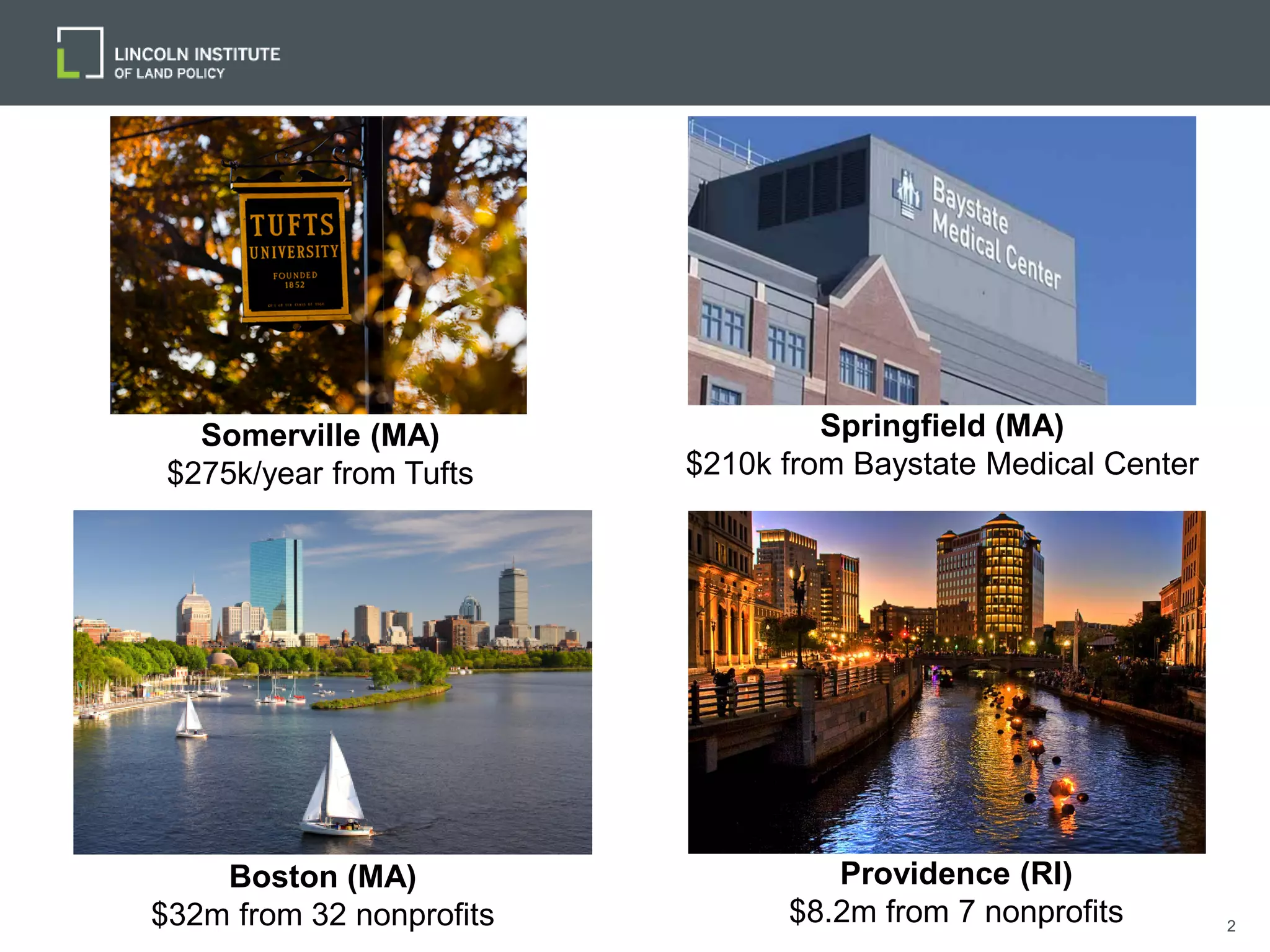
Somerville (MA)
$275k/year from Tufts
Boston (MA)
$32m from 32 nonprofits
Providence (RI)
$8.2m from 7 nonprofits
Springfield (MA)
$210k from Baystate Medical Center
3
• Fiscal challenges
→ Need new revenue sources
Growing Interest in PILOTs
4
• Fiscal challenges
→ Need new revenue sources
• Health & education sector ↑
→ Impact of tax exemption ↑
12.1%
14.1%
14.0%
15.1%
16.2%
17.6%
17.8%
18.4%
20.8%
22.8%
24.3%
24.8%
24.8%
25.0%
U.S.
NH
CT
ME
VT
RI
MA
2015 1990
Health & Education Sector’s Share
of Private Sector Employment
Growing Interest in PILOTs
Source: Current Employment Statistics (BLS).
5
• Fiscal challenges
→ Need new revenue sources
• Health & education sector ↑
→ Impact of tax exemption ↑
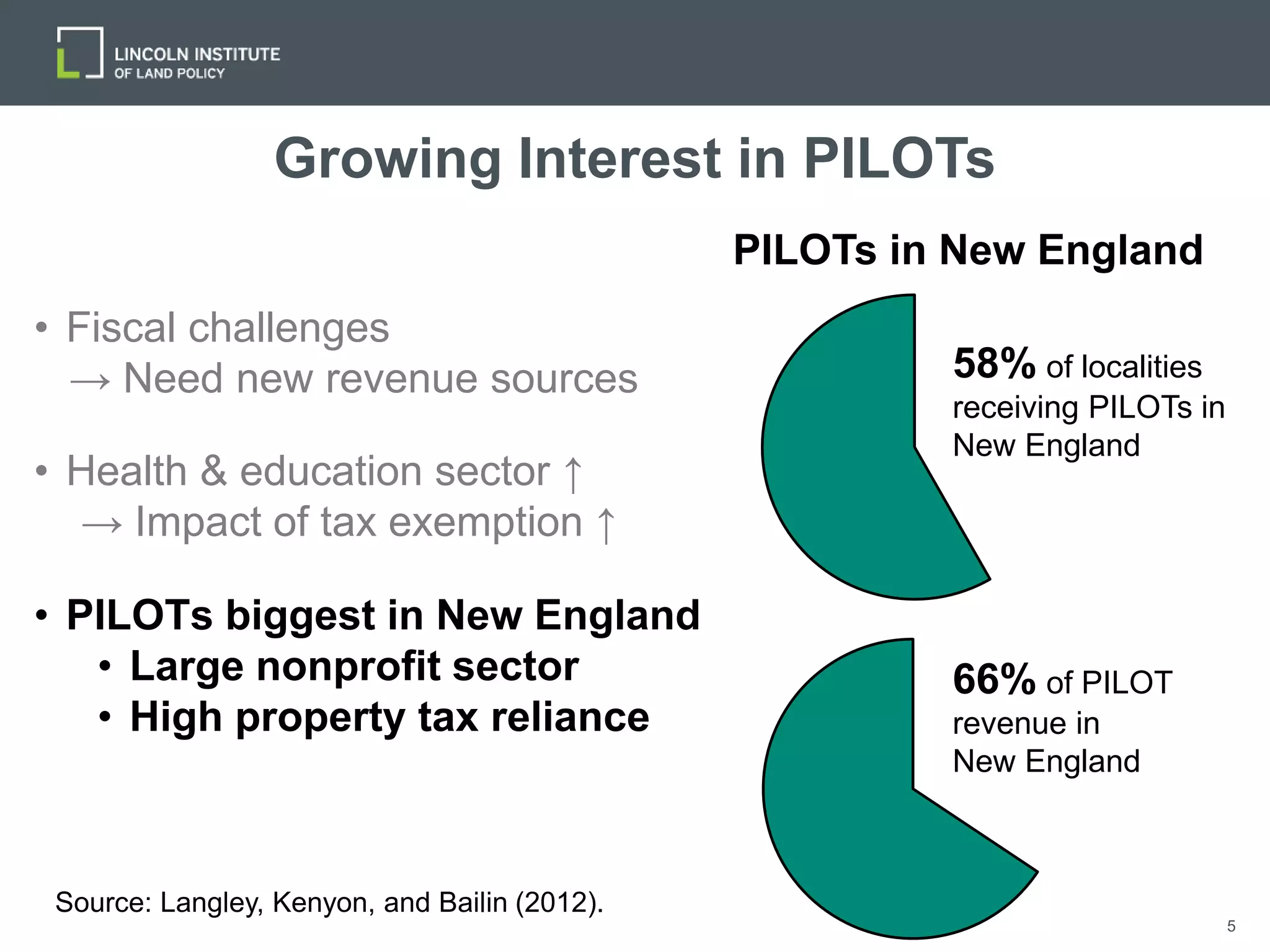
• PILOTs biggest in New England
• Large nonprofit sector
• High property tax reliance
Growing Interest in PILOTs
Source: Langley, Kenyon, and Bailin (2012).
PILOTs in New England
58% of localities
receiving PILOTs in
New England
66% of PILOT
revenue in
New England
6
Outline
1. Arguments For and Against PILOTs
2. Collaborative Approach to PILOTs
7
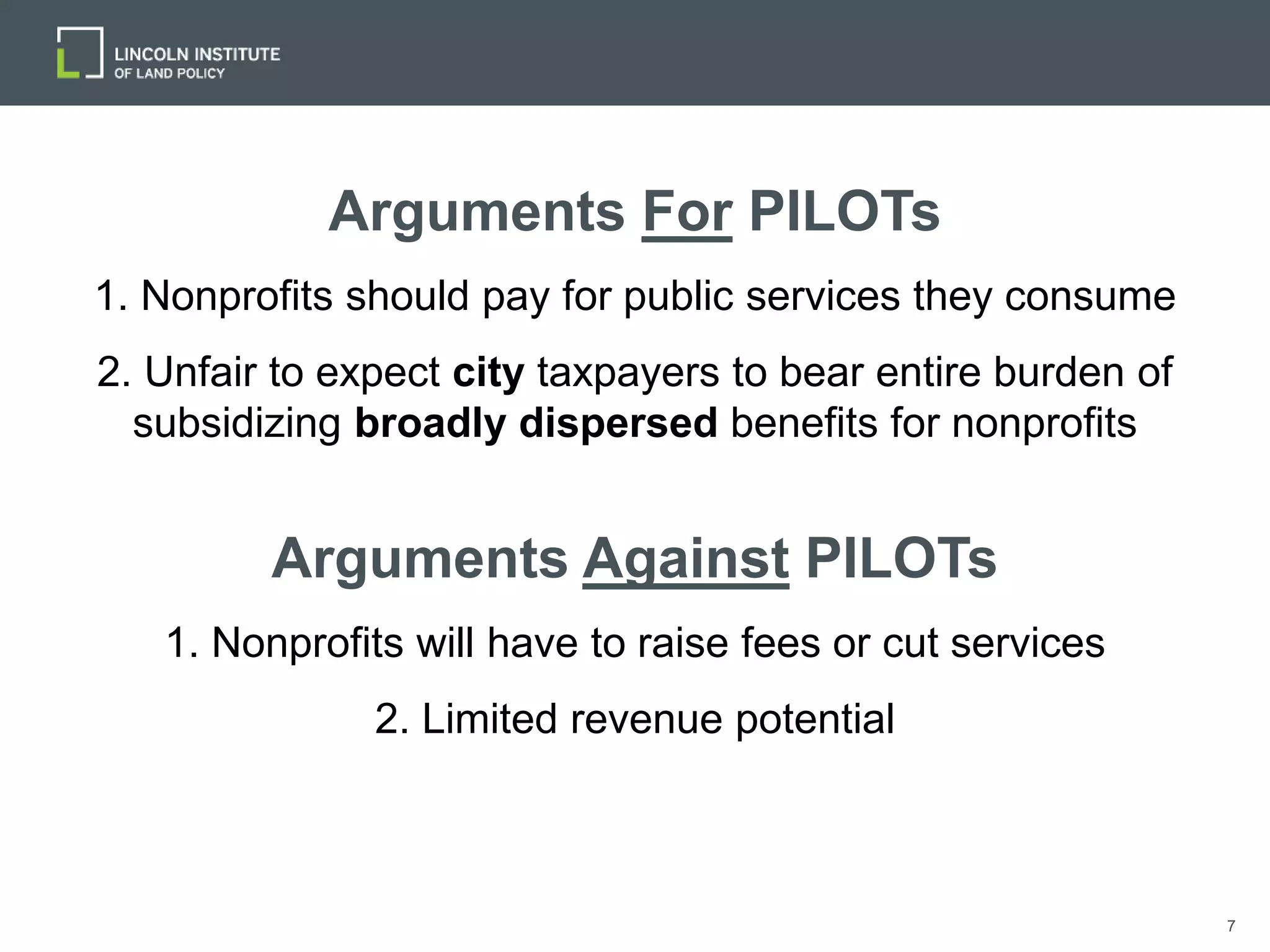
Arguments For PILOTs
1. Nonprofits should pay for public services they consume
2. Unfair to expect city taxpayers to bear entire burden of
subsidizing broadly dispersed benefits for nonprofits
Arguments Against PILOTs
1. Nonprofits will have to raise fees or cut services
2. Limited revenue potential
8
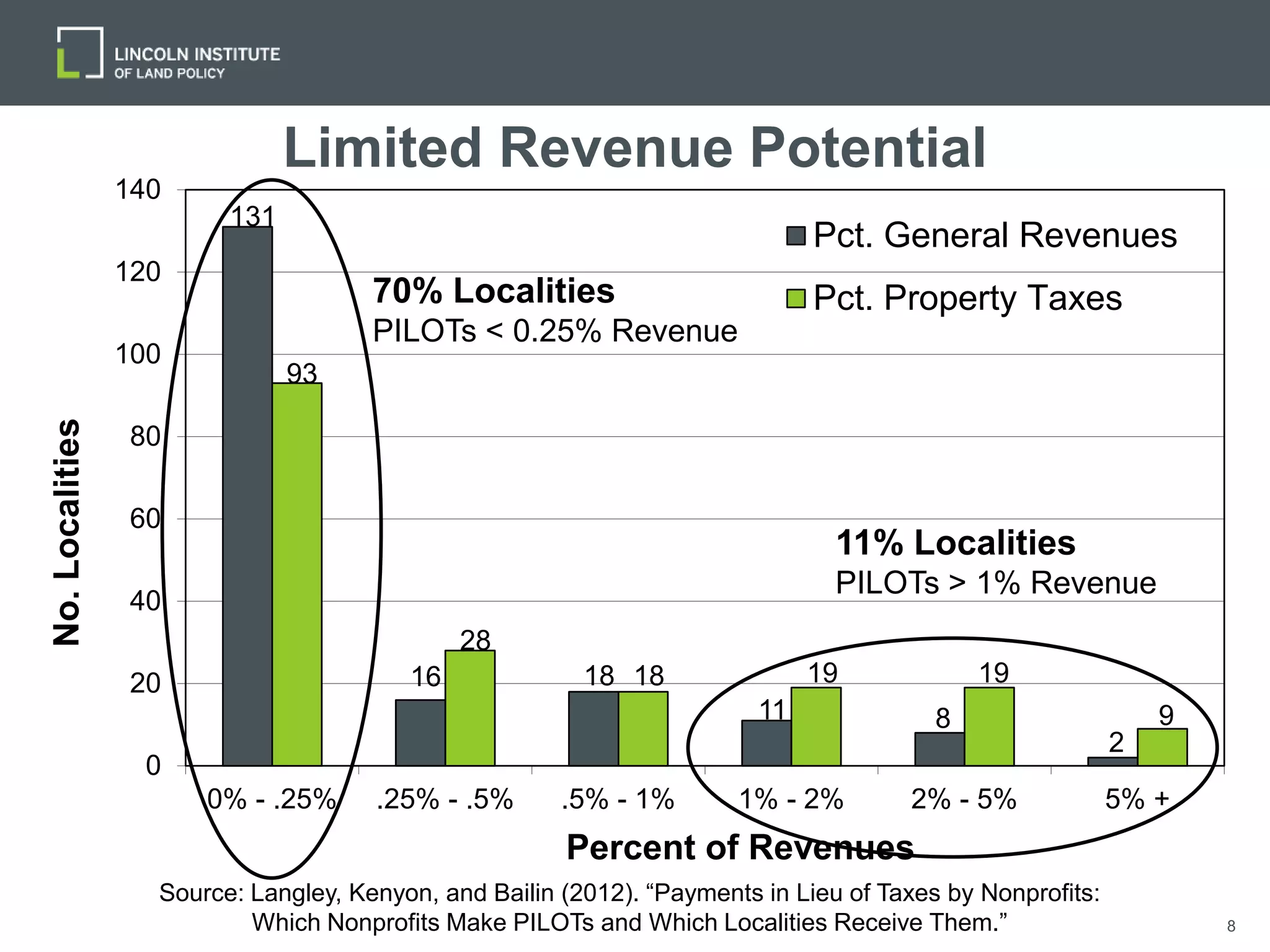
Limited Revenue Potential
131
16 18
11 8
2
93
28
18 19 19
9
0
20
40
60
80
100
120
140
0% - .25% .25% - .5% .5% - 1% 1% - 2% 2% - 5% 5% +
No.Localities
Percent of Revenues
Pct. General Revenues
Pct. Property Taxes
Source: Langley, Kenyon, and Bailin (2012). “Payments in Lieu of Taxes by Nonprofits:
Which Nonprofits Make PILOTs and Which Localities Receive Them.”
70% Localities
PILOTs < 0.25% Revenue
11% Localities
PILOTs > 1% Revenue
9
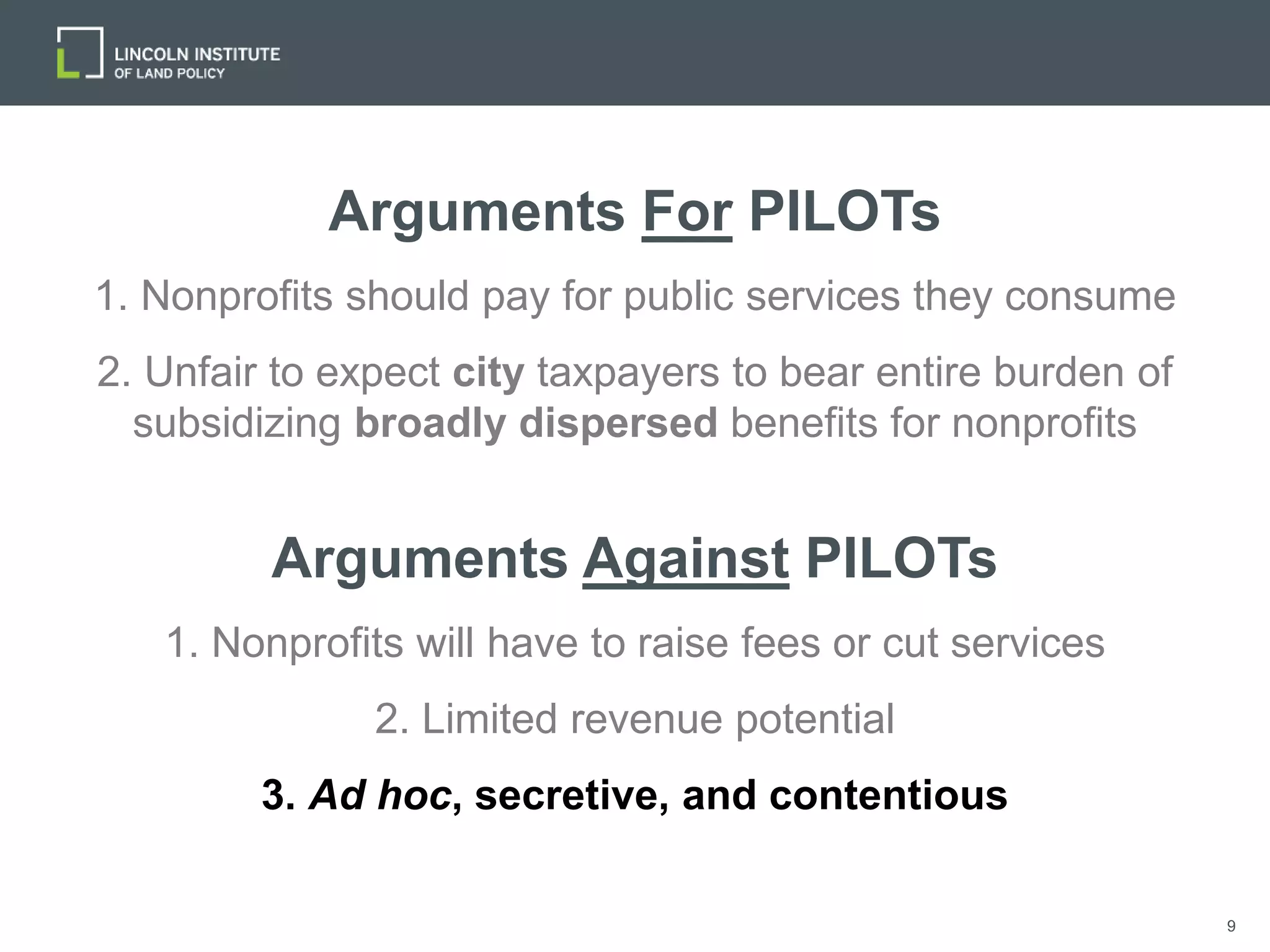
Arguments For PILOTs
1. Nonprofits should pay for public services they consume
2. Unfair to expect city taxpayers to bear entire burden of
subsidizing broadly dispersed benefits for nonprofits
Arguments Against PILOTs
1. Nonprofits will have to raise fees or cut services
2. Limited revenue potential
3. Ad hoc, secretive, and contentious
10
Collaborative Approach
to PILOTs
11
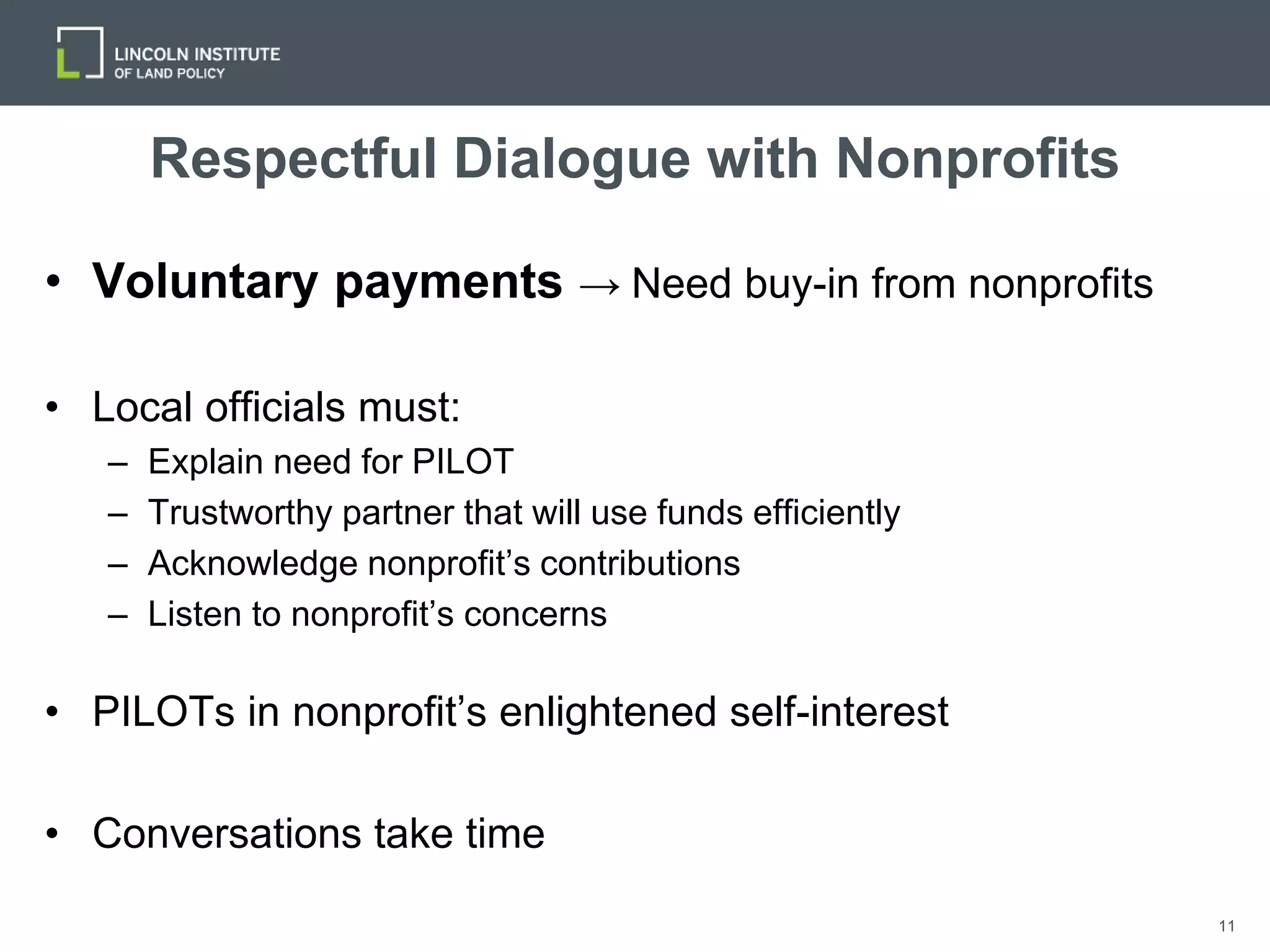
Respectful Dialogue with Nonprofits
• Voluntary payments → Need buy-in from nonprofits
• Local officials must:
– Explain need for PILOT
– Trustworthy partner that will use funds efficiently
– Acknowledge nonprofit’s contributions
– Listen to nonprofit’s concerns
• PILOTs in nonprofit’s enlightened self-interest
• Conversations take time
12
Avoid the term “PILOT”
• Worried about payments in lieu of taxes
• May be willing to make PILOTs by other names
– “Voluntary contributions”
– “Service fees”
• PILOT agreements
– Voluntary
– Do not undercut nonprofit’s tax-exempt status
13
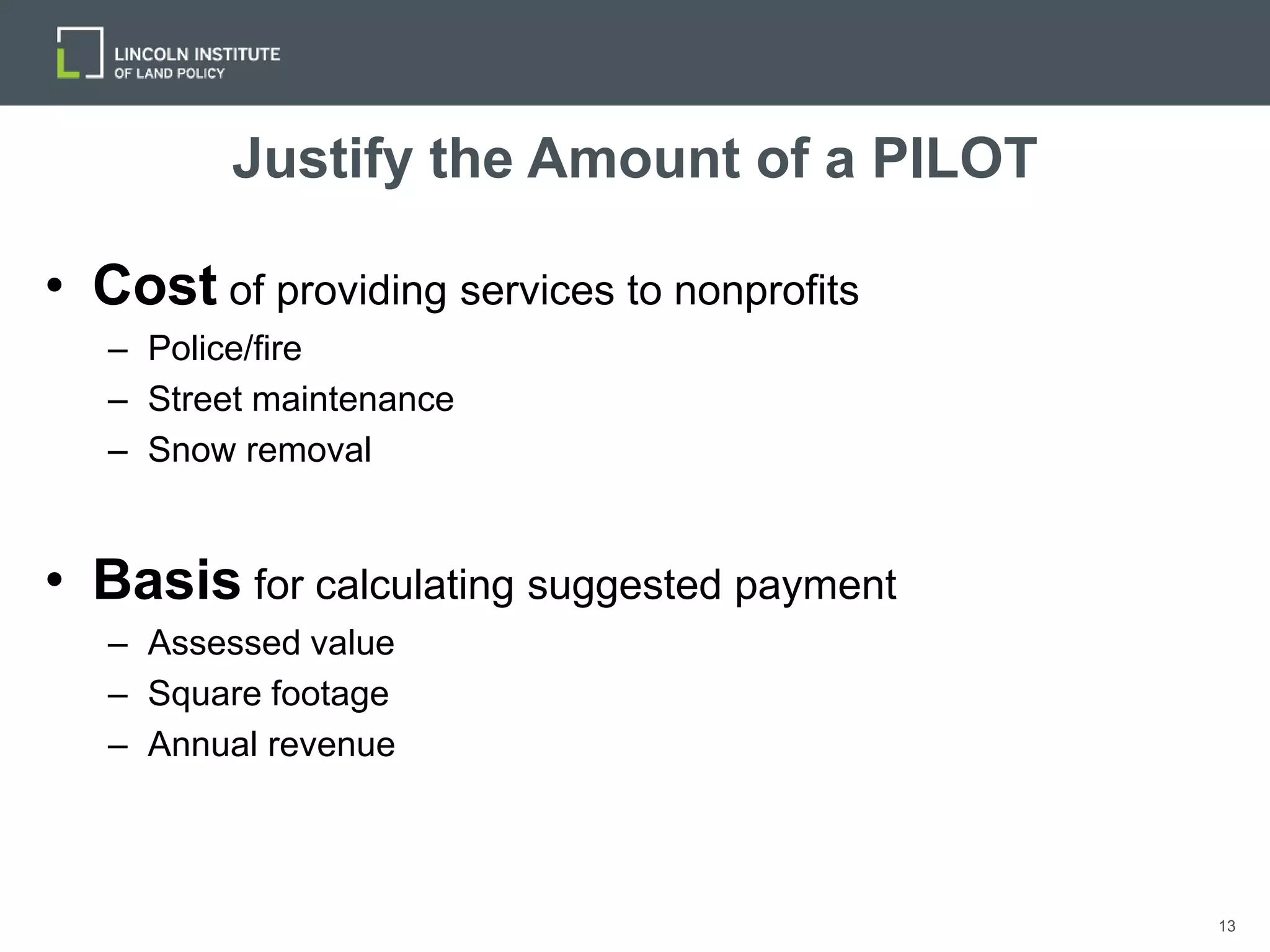
Justify the Amount of a PILOT
• Cost of providing services to nonprofits
– Police/fire
– Street maintenance
– Snow removal
• Basis for calculating suggested payment
– Assessed value
– Square footage
– Annual revenue
14
Earmark PILOT for Nonprofit Priorities
• Nonprofits more willing to make PILOTs if
– Earmarked for their priorities
– Aligned with nonprofit’s mission
– Direct connection between the PILOT and public services
benefiting the nonprofit
15
Earmarked PILOTs in Worcester (MA)
Worcester Polytechnic Institute Clark University
$9+ million over 25 years
($270,000/year with 2.5% inflator)
$6.7+ million over 20 years
($262,000/year with 2.5% inflator)
PILOT Earmarks
1) Worcester Public Library
2) Improvements to public park
adjacent to campus
PILOT Earmarks
1) Worcester Public Library
2) Improvements to public park
adjacent to campus
3) Enhancements for local area
(public safety, streetscape
improvements, etc.)
16
Long Term PILOT Agreements
• Long term agreements (5-30 years)
– Predictable revenue stream for government
– Known budget item for nonprofits
• Base year payment + annual inflator
17
Reduce Cash PILOTs to Reflect New Services
• Nonprofits prefer to provide services
• Governments prefer cash
• Compromise: Some cash, some new services
• Which services should count for offsets
– Benefit local residents
– New services? Above and beyond their business model?
– Economic benefits should NOT count
• How to do it:
– Identify services most needed that nonprofits can provide
– Local gov’t should be clear and consistent about priorities
18
Collaborative Approach to PILOTs
Respectful dialogue with nonprofits to make case for PILOT
Avoid the term “PILOTs”
Justify the amount of the PILOT
Earmark PILOTs
Long-term agreements
Reduce cash PILOTs to reflect new services
19
Thank You!
Adam H. Langley
ALangley@lincolninst.edu
617-503-2117
www.lincolninst.edu
113 BRATTLE STREET CAMBRIDGE MA 02138 LINCOLNINST.EDU @LANDPOLICY

Nonprofits, the Property Tax, and PILOTs in New England

  • 1.
    1 Nonprofits, the PropertyTax, and PILOTs in New England Adam H. Langley December 2, 2016
  • 2.
    2 Somerville (MA) $275k/year fromTufts Boston (MA) $32m from 32 nonprofits Providence (RI) $8.2m from 7 nonprofits Springfield (MA) $210k from Baystate Medical Center
  • 3.
    3 • Fiscal challenges →Need new revenue sources Growing Interest in PILOTs
  • 4.
    4 • Fiscal challenges →Need new revenue sources • Health & education sector ↑ → Impact of tax exemption ↑ 12.1% 14.1% 14.0% 15.1% 16.2% 17.6% 17.8% 18.4% 20.8% 22.8% 24.3% 24.8% 24.8% 25.0% U.S. NH CT ME VT RI MA 2015 1990 Health & Education Sector’s Share of Private Sector Employment Growing Interest in PILOTs Source: Current Employment Statistics (BLS).
  • 5.
    5 • Fiscal challenges →Need new revenue sources • Health & education sector ↑ → Impact of tax exemption ↑ • PILOTs biggest in New England • Large nonprofit sector • High property tax reliance Growing Interest in PILOTs Source: Langley, Kenyon, and Bailin (2012). PILOTs in New England 58% of localities receiving PILOTs in New England 66% of PILOT revenue in New England
  • 6.
    6 Outline 1. Arguments Forand Against PILOTs 2. Collaborative Approach to PILOTs
  • 7.
    7 Arguments For PILOTs 1.Nonprofits should pay for public services they consume 2. Unfair to expect city taxpayers to bear entire burden of subsidizing broadly dispersed benefits for nonprofits Arguments Against PILOTs 1. Nonprofits will have to raise fees or cut services 2. Limited revenue potential
  • 8.
    8 Limited Revenue Potential 131 1618 11 8 2 93 28 18 19 19 9 0 20 40 60 80 100 120 140 0% - .25% .25% - .5% .5% - 1% 1% - 2% 2% - 5% 5% + No.Localities Percent of Revenues Pct. General Revenues Pct. Property Taxes Source: Langley, Kenyon, and Bailin (2012). “Payments in Lieu of Taxes by Nonprofits: Which Nonprofits Make PILOTs and Which Localities Receive Them.” 70% Localities PILOTs < 0.25% Revenue 11% Localities PILOTs > 1% Revenue
  • 9.
    9 Arguments For PILOTs 1.Nonprofits should pay for public services they consume 2. Unfair to expect city taxpayers to bear entire burden of subsidizing broadly dispersed benefits for nonprofits Arguments Against PILOTs 1. Nonprofits will have to raise fees or cut services 2. Limited revenue potential 3. Ad hoc, secretive, and contentious
  • 10.
  • 11.
    11 Respectful Dialogue withNonprofits • Voluntary payments → Need buy-in from nonprofits • Local officials must: – Explain need for PILOT – Trustworthy partner that will use funds efficiently – Acknowledge nonprofit’s contributions – Listen to nonprofit’s concerns • PILOTs in nonprofit’s enlightened self-interest • Conversations take time
  • 12.
    12 Avoid the term“PILOT” • Worried about payments in lieu of taxes • May be willing to make PILOTs by other names – “Voluntary contributions” – “Service fees” • PILOT agreements – Voluntary – Do not undercut nonprofit’s tax-exempt status
  • 13.
    13 Justify the Amountof a PILOT • Cost of providing services to nonprofits – Police/fire – Street maintenance – Snow removal • Basis for calculating suggested payment – Assessed value – Square footage – Annual revenue
  • 14.
    14 Earmark PILOT forNonprofit Priorities • Nonprofits more willing to make PILOTs if – Earmarked for their priorities – Aligned with nonprofit’s mission – Direct connection between the PILOT and public services benefiting the nonprofit
  • 15.
    15 Earmarked PILOTs inWorcester (MA) Worcester Polytechnic Institute Clark University $9+ million over 25 years ($270,000/year with 2.5% inflator) $6.7+ million over 20 years ($262,000/year with 2.5% inflator) PILOT Earmarks 1) Worcester Public Library 2) Improvements to public park adjacent to campus PILOT Earmarks 1) Worcester Public Library 2) Improvements to public park adjacent to campus 3) Enhancements for local area (public safety, streetscape improvements, etc.)
  • 16.
    16 Long Term PILOTAgreements • Long term agreements (5-30 years) – Predictable revenue stream for government – Known budget item for nonprofits • Base year payment + annual inflator
  • 17.
    17 Reduce Cash PILOTsto Reflect New Services • Nonprofits prefer to provide services • Governments prefer cash • Compromise: Some cash, some new services • Which services should count for offsets – Benefit local residents – New services? Above and beyond their business model? – Economic benefits should NOT count • How to do it: – Identify services most needed that nonprofits can provide – Local gov’t should be clear and consistent about priorities
  • 18.
    18 Collaborative Approach toPILOTs Respectful dialogue with nonprofits to make case for PILOT Avoid the term “PILOTs” Justify the amount of the PILOT Earmark PILOTs Long-term agreements Reduce cash PILOTs to reflect new services
  • 19.
    19 Thank You! Adam H.Langley ALangley@lincolninst.edu 617-503-2117 www.lincolninst.edu 113 BRATTLE STREET CAMBRIDGE MA 02138 LINCOLNINST.EDU @LANDPOLICY