Non-Metal Materials
By : Goutam S. Gachhinakatti
Date : 01st Aug 2023
Webinar Session Part-I
1
Contents
 What is Non-metal?
 How Plastics Are Made
• Monomer
• Polymer
• Plastic Synthesis
• Plastic Life Cycle
 Non-Metal Classification
 Thermoplastic
 Crystalline and Amorphous
 Thermoset
 Monomers
2
3
What is Non-metal?
• Non-Metal is referred to the chemical elements which are volatile, insulated to heat and electricity and lack
of the metallic attributes.
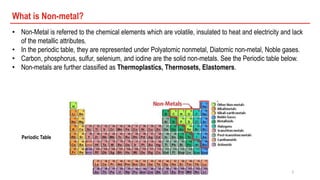
• In the periodic table, they are represented under Polyatomic nonmetal, Diatomic non-metal, Noble gases.
• Carbon, phosphorus, sulfur, selenium, and iodine are the solid non-metals. See the Periodic table below.
• Non-metals are further classified as Thermoplastics, Thermosets, Elastomers.
Periodic Table
4
How Plastics Are Made
Monomer
• A monomer is a single atom, small molecule, or molecular fragment.
• The word monomer comes from the Greek word “mono,” meaning “one,” and “meros,” meaning “part.”
• Examples of the monomers that are found in many plastics include organic compounds like Ethylene,
Propylene, Styrene, Phenol, Acetonitrile, Formaldehyde .
Polymer
• Polymer is a large molecule, or macromolecule, composed of small repeating singular molecular structural
units called monomers.
• The word polymer comes from the Greek “poly” (many) and “meros” (part).
• The repeating molecular units are joined together chemically through covalent bonds.
• In material sciences, the terms ‘polymer’ and ‘plastic’ are used interchangeably.
• Silk, cotton and wool are examples of natural polymers.
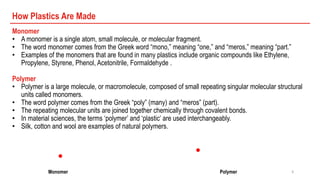
Monomer Polymer
5
How Plastics Are Made
Plastic Synthesis
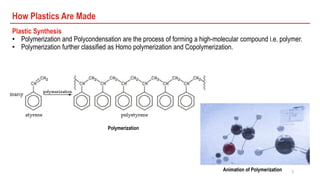
• Polymerization and Polycondensation are the process of forming a high-molecular compound i.e. polymer.
• Polymerization further classified as Homo polymerization and Copolymerization.
Polymerization
Animation of Polymerization
6
How Plastics Are Made
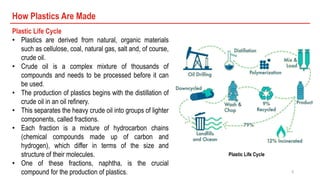
Plastic Life Cycle
• Plastics are derived from natural, organic materials
such as cellulose, coal, natural gas, salt and, of course,
crude oil.
• Crude oil is a complex mixture of thousands of
compounds and needs to be processed before it can
be used.
• The production of plastics begins with the distillation of
crude oil in an oil refinery.
• This separates the heavy crude oil into groups of lighter
components, called fractions.
• Each fraction is a mixture of hydrocarbon chains
(chemical compounds made up of carbon and
hydrogen), which differ in terms of the size and
structure of their molecules.
• One of these fractions, naphtha, is the crucial
compound for the production of plastics.
Plastic Life Cycle
7
How Plastics Are Made
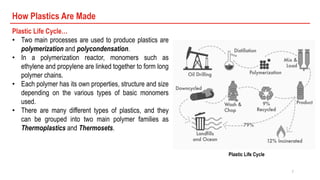
Plastic Life Cycle…
• Two main processes are used to produce plastics are
polymerization and polycondensation.
• In a polymerization reactor, monomers such as
ethylene and propylene are linked together to form long
polymer chains.
• Each polymer has its own properties, structure and size
depending on the various types of basic monomers
used.
• There are many different types of plastics, and they
can be grouped into two main polymer families as
Thermoplastics and Thermosets.
Plastic Life Cycle
8
Non-Metal Classification
Thermoplastic
• Thermoplastics soften and melt when heated and harden when cooled.
• These resins can be injection molded, extruded or formed via other molding techniques.
• This behavior also allows production scrap - runners and trimmings, for instance - to be reground and
reused.
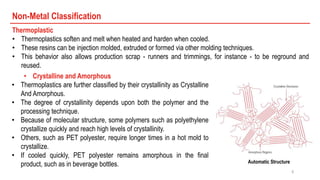
• Crystalline and Amorphous
• Thermoplastics are further classified by their crystallinity as Crystalline
And Amorphous.
• The degree of crystallinity depends upon both the polymer and the
processing technique.
• Because of molecular structure, some polymers such as polyethylene
crystallize quickly and reach high levels of crystallinity.
• Others, such as PET polyester, require longer times in a hot mold to
crystallize.
• If cooled quickly, PET polyester remains amorphous in the final
product, such as in beverage bottles. Automatic Structure
9
Non-Metal Classification
History
• Innovation in new plastic materials explodes in 1950 and 1960s.
• Polyamides, commonly called nylons, were the first commercial thermoplastic engineering polymers.
• PA66 made its commercial debut as a fiber in 1938 with its first use in bristles for toothbrushes and later in
women’s hosiery.
• After nylon, the next engineering polymers to be commercially introduced were polyacetals.
• Polyacetals are polymerized from formaldehyde and are also referred to as polyoxymethylenes (POM).
10
Non-Metal Classification
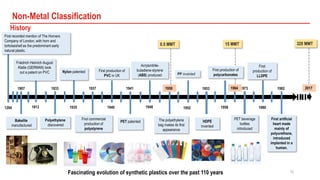
History
1284 1913
First recorded mention of The Horners
Company of London, with horn and
tortoiseshell as the predominant early
natural plastic.
Friedrich Heinrich August
Klatte (GERMAN) took
out a patent on PVC
1933
Polyethylene
discovered
1935
Nylon patented
1937
First commercial
production of
polystyrene
First production of
PVC in UK
1940
1941
1948
1950
PET patented
Acrylonitrile-
butadiene-styrene
(ABS) produced
The polyethylene
bag makes its first
appearance
PP invented
HDPE
invented
First production of
polycarbonates
PET beverage
bottles
introduced
First
production of
LLDPE
First artificial
heart made
mainly of
polyurethane,
introduced
implanted in a
human.
1952 1958 1980
1953 1973 1982
Bakelite
manufactured
1907 1964 2017
0.5 MMT 15 MMT 320 MMT
Fascinating evolution of synthetic plastics over the past 110 years
Non-Metal Classification
Continued in Part 2….
12
Thank you for your attention!
Goutam S. Gachhinakatti
An Engineer By Profession
Spread the Knowledge : Make this Helpful Presentation
Count by Liking, Commenting, and Sharing

Non-Metal Materials

  • 1.
    Non-Metal Materials By :Goutam S. Gachhinakatti Date : 01st Aug 2023 Webinar Session Part-I 1
  • 2.
    Contents  What isNon-metal?  How Plastics Are Made • Monomer • Polymer • Plastic Synthesis • Plastic Life Cycle  Non-Metal Classification  Thermoplastic  Crystalline and Amorphous  Thermoset  Monomers 2
  • 3.
    3 What is Non-metal? •Non-Metal is referred to the chemical elements which are volatile, insulated to heat and electricity and lack of the metallic attributes. • In the periodic table, they are represented under Polyatomic nonmetal, Diatomic non-metal, Noble gases. • Carbon, phosphorus, sulfur, selenium, and iodine are the solid non-metals. See the Periodic table below. • Non-metals are further classified as Thermoplastics, Thermosets, Elastomers. Periodic Table
  • 4.
    4 How Plastics AreMade Monomer • A monomer is a single atom, small molecule, or molecular fragment. • The word monomer comes from the Greek word “mono,” meaning “one,” and “meros,” meaning “part.” • Examples of the monomers that are found in many plastics include organic compounds like Ethylene, Propylene, Styrene, Phenol, Acetonitrile, Formaldehyde . Polymer • Polymer is a large molecule, or macromolecule, composed of small repeating singular molecular structural units called monomers. • The word polymer comes from the Greek “poly” (many) and “meros” (part). • The repeating molecular units are joined together chemically through covalent bonds. • In material sciences, the terms ‘polymer’ and ‘plastic’ are used interchangeably. • Silk, cotton and wool are examples of natural polymers. Monomer Polymer
  • 5.
    5 How Plastics AreMade Plastic Synthesis • Polymerization and Polycondensation are the process of forming a high-molecular compound i.e. polymer. • Polymerization further classified as Homo polymerization and Copolymerization. Polymerization Animation of Polymerization
  • 6.
    6 How Plastics AreMade Plastic Life Cycle • Plastics are derived from natural, organic materials such as cellulose, coal, natural gas, salt and, of course, crude oil. • Crude oil is a complex mixture of thousands of compounds and needs to be processed before it can be used. • The production of plastics begins with the distillation of crude oil in an oil refinery. • This separates the heavy crude oil into groups of lighter components, called fractions. • Each fraction is a mixture of hydrocarbon chains (chemical compounds made up of carbon and hydrogen), which differ in terms of the size and structure of their molecules. • One of these fractions, naphtha, is the crucial compound for the production of plastics. Plastic Life Cycle
  • 7.
    7 How Plastics AreMade Plastic Life Cycle… • Two main processes are used to produce plastics are polymerization and polycondensation. • In a polymerization reactor, monomers such as ethylene and propylene are linked together to form long polymer chains. • Each polymer has its own properties, structure and size depending on the various types of basic monomers used. • There are many different types of plastics, and they can be grouped into two main polymer families as Thermoplastics and Thermosets. Plastic Life Cycle
  • 8.
    8 Non-Metal Classification Thermoplastic • Thermoplasticssoften and melt when heated and harden when cooled. • These resins can be injection molded, extruded or formed via other molding techniques. • This behavior also allows production scrap - runners and trimmings, for instance - to be reground and reused. • Crystalline and Amorphous • Thermoplastics are further classified by their crystallinity as Crystalline And Amorphous. • The degree of crystallinity depends upon both the polymer and the processing technique. • Because of molecular structure, some polymers such as polyethylene crystallize quickly and reach high levels of crystallinity. • Others, such as PET polyester, require longer times in a hot mold to crystallize. • If cooled quickly, PET polyester remains amorphous in the final product, such as in beverage bottles. Automatic Structure
  • 9.
    9 Non-Metal Classification History • Innovationin new plastic materials explodes in 1950 and 1960s. • Polyamides, commonly called nylons, were the first commercial thermoplastic engineering polymers. • PA66 made its commercial debut as a fiber in 1938 with its first use in bristles for toothbrushes and later in women’s hosiery. • After nylon, the next engineering polymers to be commercially introduced were polyacetals. • Polyacetals are polymerized from formaldehyde and are also referred to as polyoxymethylenes (POM).
  • 10.
    10 Non-Metal Classification History 1284 1913 Firstrecorded mention of The Horners Company of London, with horn and tortoiseshell as the predominant early natural plastic. Friedrich Heinrich August Klatte (GERMAN) took out a patent on PVC 1933 Polyethylene discovered 1935 Nylon patented 1937 First commercial production of polystyrene First production of PVC in UK 1940 1941 1948 1950 PET patented Acrylonitrile- butadiene-styrene (ABS) produced The polyethylene bag makes its first appearance PP invented HDPE invented First production of polycarbonates PET beverage bottles introduced First production of LLDPE First artificial heart made mainly of polyurethane, introduced implanted in a human. 1952 1958 1980 1953 1973 1982 Bakelite manufactured 1907 1964 2017 0.5 MMT 15 MMT 320 MMT Fascinating evolution of synthetic plastics over the past 110 years
  • 11.
  • 12.
    12 Thank you foryour attention! Goutam S. Gachhinakatti An Engineer By Profession Spread the Knowledge : Make this Helpful Presentation Count by Liking, Commenting, and Sharing