NONLINEAR HYDRODYNAMIC
         FORCES
MANUFACTURE AND TRANSDUCER
        SELECTION


          By Sachindra Max
                2010
Overview of the Project
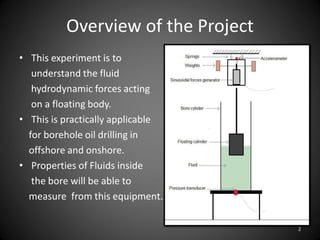
• This experiment is to
   understand the fluid
   hydrodynamic forces acting
   on a floating body.
• This is practically applicable
  for borehole oil drilling in
  offshore and onshore.
• Properties of Fluids inside
   the bore will be able to
  measure from this equipment.

                                    2
Overview of the Project
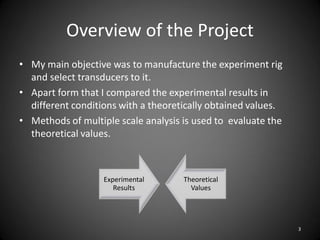
• My main objective was to manufacture the experiment rig
  and select transducers to it.
• Apart form that I compared the experimental results in
  different conditions with a theoretically obtained values.
• Methods of multiple scale analysis is used to evaluate the
  theoretical values.


                   Experimental      Theoretical
                      Results          Values


                                                               3
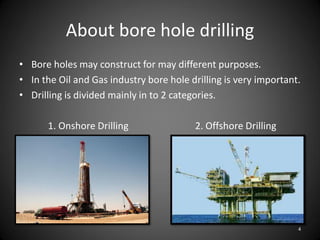
About bore hole drilling
• Bore holes may construct for may different purposes.
• In the Oil and Gas industry bore hole drilling is very important.
• Drilling is divided mainly in to 2 categories.

      1. Onshore Drilling                2. Offshore Drilling


                                                                  4
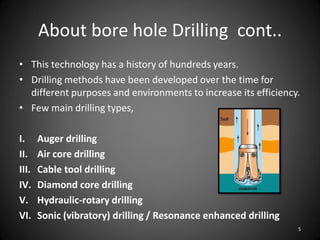
About bore hole Drilling cont..
• This technology has a history of hundreds years.
• Drilling methods have been developed over the time for
  different purposes and environments to increase its efficiency.
• Few main drilling types,

I.     Auger drilling
II.    Air core drilling
III.   Cable tool drilling
IV.    Diamond core drilling
V.     Hydraulic-rotary drilling
VI.    Sonic (vibratory) drilling / Resonance enhanced drilling
                                                                  5
Manufacturing of apparatus


                             6
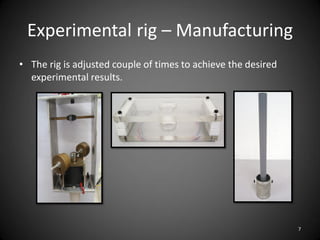
Experimental rig – Manufacturing
• The rig is adjusted couple of times to achieve the desired
  experimental results.


                                                               7
Transducer Selection
Transducer Selection – Linear variable
       displacement transducer


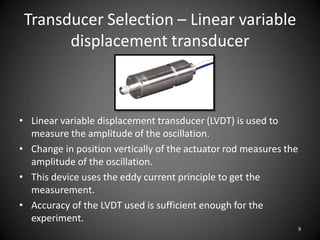
• Linear variable displacement transducer (LVDT) is used to
  measure the amplitude of the oscillation.
• Change in position vertically of the actuator rod measures the
  amplitude of the oscillation.
• This device uses the eddy current principle to get the
  measurement.
• Accuracy of the LVDT used is sufficient enough for the
  experiment.
                                                                   9
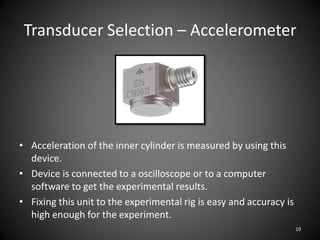
Transducer Selection – Accelerometer


• Acceleration of the inner cylinder is measured by using this
  device.
• Device is connected to a oscilloscope or to a computer
  software to get the experimental results.
• Fixing this unit to the experimental rig is easy and accuracy is
  high enough for the experiment.
                                                                     10
Transducer Selection – Pressure
               Transducer


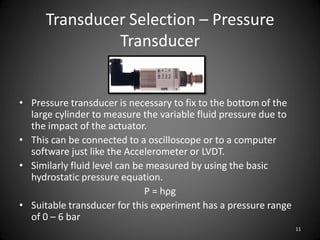
• Pressure transducer is necessary to fix to the bottom of the
  large cylinder to measure the variable fluid pressure due to
  the impact of the actuator.
• This can be connected to a oscilloscope or to a computer
  software just like the Accelerometer or LVDT.
• Similarly fluid level can be measured by using the basic
  hydrostatic pressure equation.
                              P = hρg
• Suitable transducer for this experiment has a pressure range
  of 0 – 6 bar
                                                                 11
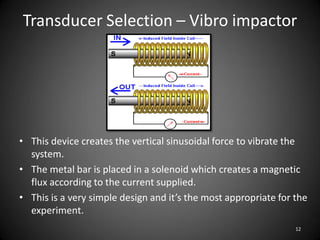
Transducer Selection – Vibro impactor


• This device creates the vertical sinusoidal force to vibrate the
  system.
• The metal bar is placed in a solenoid which creates a magnetic
  flux according to the current supplied.
• This is a very simple design and it’s the most appropriate for the
  experiment.
                                                                 12
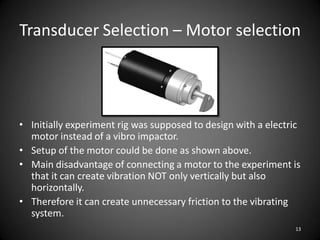
Transducer Selection – Motor selection


• Initially experiment rig was supposed to design with a electric
  motor instead of a vibro impactor.
• Setup of the motor could be done as shown above.
• Main disadvantage of connecting a motor to the experiment is
  that it can create vibration NOT only vertically but also
  horizontally.
• Therefore it can create unnecessary friction to the vibrating
  system.
                                                               13
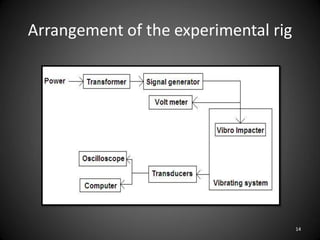
Arrangement of the experimental rig


                                      14
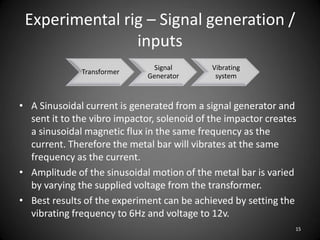
Experimental rig – Signal generation /
                inputs
                               Signal        Vibrating
              Transformer
                              Generator       system


• A Sinusoidal current is generated from a signal generator and
  sent it to the vibro impactor, solenoid of the impactor creates
  a sinusoidal magnetic flux in the same frequency as the
  current. Therefore the metal bar will vibrates at the same
  frequency as the current.
• Amplitude of the sinusoidal motion of the metal bar is varied
  by varying the supplied voltage from the transformer.
• Best results of the experiment can be achieved by setting the
  vibrating frequency to 6Hz and voltage to 12v.
                                                                15
Experimental rig – Results / data
                outputs
              Oscilloscope                  Vibrating
                             Transducers
              / Computer                     system


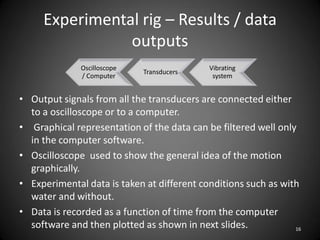
• Output signals from all the transducers are connected either
  to a oscilloscope or to a computer.
• Graphical representation of the data can be filtered well only
  in the computer software.
• Oscilloscope used to show the general idea of the motion
  graphically.
• Experimental data is taken at different conditions such as with
  water and without.
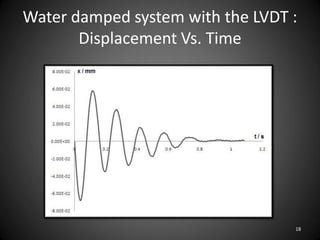
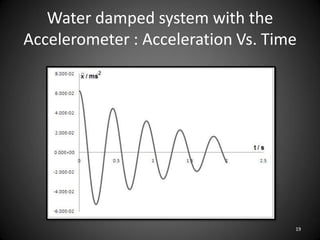
• Data is recorded as a function of time from the computer
  software and then plotted as shown in next slides.            16
Data acquisition for various cycles


                                      17
Water damped system with the LVDT :
       Displacement Vs. Time


                                  18
Water damped system with the
Accelerometer : Acceleration Vs. Time


                                    19
Mathematical model for the
           experimental results


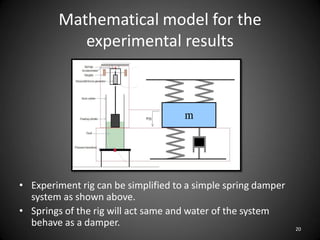
• Experiment rig can be simplified to a simple spring damper
  system as shown above.
• Springs of the rig will act same and water of the system
  behave as a damper.                                          20
Transient motion of the system
              without water
• Suspended system is lifted up n released manually with a
  magnetic system and let the system vibrate freely with no
  external forced applied.
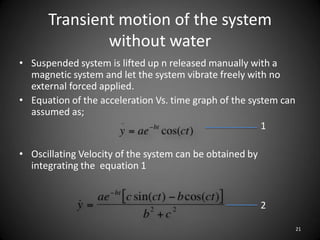
• Equation of the acceleration Vs. time graph of the system can
  assumed as;
                                                        1

• Oscillating Velocity of the system can be obtained by
  integrating the equation 1


                                                          2

                                                                  21
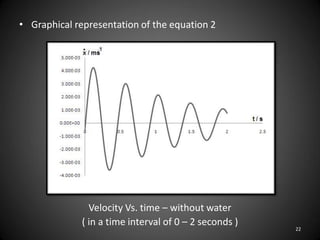
• Graphical representation of the equation 2


                Velocity Vs. time – without water
              ( in a time interval of 0 – 2 seconds )
                                                        22
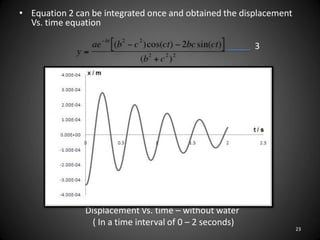
• Equation 2 can be integrated once and obtained the displacement
  Vs. time equation

                                                          3


               Displacement Vs. time – without water
                 ( In a time interval of 0 – 2 seconds)
                                                                    23
Theoretical model for the system


                                   24
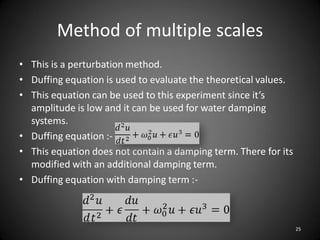
Method of multiple scales
• This is a perturbation method.
• Duffing equation is used to evaluate the theoretical values.
• This equation can be used to this experiment since it’s
  amplitude is low and it can be used for water damping
  systems.
• Duffing equation :-
• This equation does not contain a damping term. There for its
  modified with an additional damping term.
• Duffing equation with damping term :-


                                                                 25
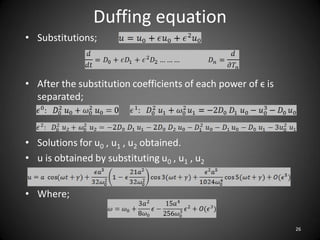
Duffing equation
• Substitutions;


• After the substitution coefficients of each power of ϵ is
  separated;


• Solutions for u0 , u1 , u2 obtained.
• u is obtained by substituting u0 , u1 , u2


• Where;


                                                              26
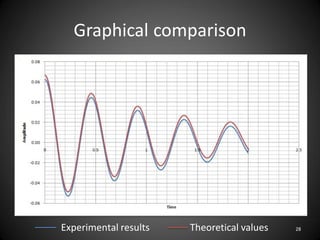
Comparison
• Data obtained experimentally and numerically needs to
  compared.
• Amplitude of the oscillation will be lower in experiment
  values due to the friction acting at contacting points.
• The values can be compared as shown in the next slide.


                                                             27
Graphical comparison


Experimental results   Theoretical values   28
Conclusion
• Properties of water such as the damping term can be
  evaluated by comparing the two methods.
• Accuracy of the system can be increased buy remanufacturing
  some parts. And by using proper rigid connections.
• Experiment rig needs to be modified further for real life
  applications.


                                                            29
Thank you.
Any Questions ?


                  30

Nonlinear hydrodynamic forces - manufacture and transducer selection

  • 1.
    NONLINEAR HYDRODYNAMIC FORCES MANUFACTURE AND TRANSDUCER SELECTION By Sachindra Max 2010
  • 2.
    Overview of theProject • This experiment is to understand the fluid hydrodynamic forces acting on a floating body. • This is practically applicable for borehole oil drilling in offshore and onshore. • Properties of Fluids inside the bore will be able to measure from this equipment. 2
  • 3.
    Overview of theProject • My main objective was to manufacture the experiment rig and select transducers to it. • Apart form that I compared the experimental results in different conditions with a theoretically obtained values. • Methods of multiple scale analysis is used to evaluate the theoretical values. Experimental Theoretical Results Values 3
  • 4.
    About bore holedrilling • Bore holes may construct for may different purposes. • In the Oil and Gas industry bore hole drilling is very important. • Drilling is divided mainly in to 2 categories. 1. Onshore Drilling 2. Offshore Drilling 4
  • 5.
    About bore holeDrilling cont.. • This technology has a history of hundreds years. • Drilling methods have been developed over the time for different purposes and environments to increase its efficiency. • Few main drilling types, I. Auger drilling II. Air core drilling III. Cable tool drilling IV. Diamond core drilling V. Hydraulic-rotary drilling VI. Sonic (vibratory) drilling / Resonance enhanced drilling 5
  • 6.
  • 7.
    Experimental rig –Manufacturing • The rig is adjusted couple of times to achieve the desired experimental results. 7
  • 8.
  • 9.
    Transducer Selection –Linear variable displacement transducer • Linear variable displacement transducer (LVDT) is used to measure the amplitude of the oscillation. • Change in position vertically of the actuator rod measures the amplitude of the oscillation. • This device uses the eddy current principle to get the measurement. • Accuracy of the LVDT used is sufficient enough for the experiment. 9
  • 10.
    Transducer Selection –Accelerometer • Acceleration of the inner cylinder is measured by using this device. • Device is connected to a oscilloscope or to a computer software to get the experimental results. • Fixing this unit to the experimental rig is easy and accuracy is high enough for the experiment. 10
  • 11.
    Transducer Selection –Pressure Transducer • Pressure transducer is necessary to fix to the bottom of the large cylinder to measure the variable fluid pressure due to the impact of the actuator. • This can be connected to a oscilloscope or to a computer software just like the Accelerometer or LVDT. • Similarly fluid level can be measured by using the basic hydrostatic pressure equation. P = hρg • Suitable transducer for this experiment has a pressure range of 0 – 6 bar 11
  • 12.
    Transducer Selection –Vibro impactor • This device creates the vertical sinusoidal force to vibrate the system. • The metal bar is placed in a solenoid which creates a magnetic flux according to the current supplied. • This is a very simple design and it’s the most appropriate for the experiment. 12
  • 13.
    Transducer Selection –Motor selection • Initially experiment rig was supposed to design with a electric motor instead of a vibro impactor. • Setup of the motor could be done as shown above. • Main disadvantage of connecting a motor to the experiment is that it can create vibration NOT only vertically but also horizontally. • Therefore it can create unnecessary friction to the vibrating system. 13
  • 14.
    Arrangement of theexperimental rig 14
  • 15.
    Experimental rig –Signal generation / inputs Signal Vibrating Transformer Generator system • A Sinusoidal current is generated from a signal generator and sent it to the vibro impactor, solenoid of the impactor creates a sinusoidal magnetic flux in the same frequency as the current. Therefore the metal bar will vibrates at the same frequency as the current. • Amplitude of the sinusoidal motion of the metal bar is varied by varying the supplied voltage from the transformer. • Best results of the experiment can be achieved by setting the vibrating frequency to 6Hz and voltage to 12v. 15
  • 16.
    Experimental rig –Results / data outputs Oscilloscope Vibrating Transducers / Computer system • Output signals from all the transducers are connected either to a oscilloscope or to a computer. • Graphical representation of the data can be filtered well only in the computer software. • Oscilloscope used to show the general idea of the motion graphically. • Experimental data is taken at different conditions such as with water and without. • Data is recorded as a function of time from the computer software and then plotted as shown in next slides. 16
  • 17.
    Data acquisition forvarious cycles 17
  • 18.
    Water damped systemwith the LVDT : Displacement Vs. Time 18
  • 19.
    Water damped systemwith the Accelerometer : Acceleration Vs. Time 19
  • 20.
    Mathematical model forthe experimental results • Experiment rig can be simplified to a simple spring damper system as shown above. • Springs of the rig will act same and water of the system behave as a damper. 20
  • 21.
    Transient motion ofthe system without water • Suspended system is lifted up n released manually with a magnetic system and let the system vibrate freely with no external forced applied. • Equation of the acceleration Vs. time graph of the system can assumed as; 1 • Oscillating Velocity of the system can be obtained by integrating the equation 1 2 21
  • 22.
    • Graphical representationof the equation 2 Velocity Vs. time – without water ( in a time interval of 0 – 2 seconds ) 22
  • 23.
    • Equation 2can be integrated once and obtained the displacement Vs. time equation 3 Displacement Vs. time – without water ( In a time interval of 0 – 2 seconds) 23
  • 24.
    Theoretical model forthe system 24
  • 25.
    Method of multiplescales • This is a perturbation method. • Duffing equation is used to evaluate the theoretical values. • This equation can be used to this experiment since it’s amplitude is low and it can be used for water damping systems. • Duffing equation :- • This equation does not contain a damping term. There for its modified with an additional damping term. • Duffing equation with damping term :- 25
  • 26.
    Duffing equation • Substitutions; •After the substitution coefficients of each power of ϵ is separated; • Solutions for u0 , u1 , u2 obtained. • u is obtained by substituting u0 , u1 , u2 • Where; 26
  • 27.
    Comparison • Data obtainedexperimentally and numerically needs to compared. • Amplitude of the oscillation will be lower in experiment values due to the friction acting at contacting points. • The values can be compared as shown in the next slide. 27
  • 28.
  • 29.
    Conclusion • Properties ofwater such as the damping term can be evaluated by comparing the two methods. • Accuracy of the system can be increased buy remanufacturing some parts. And by using proper rigid connections. • Experiment rig needs to be modified further for real life applications. 29
  • 30.