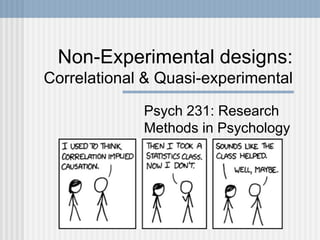
Non-Experimental designs:
Correlational & Quasi-experimental
Psych 231: Research
Methods in Psychology
Non-Experimental designs:
Correlational & Quasi-experimental
Psych 231: Research
Methods in Psychology
Announcements
 Lab attendance is critical this week because group projects are
being administered
 Attendance will be taken.
 Bring what you need (e.g., flash drives & copies of materials)
 Don’t forget Quiz 8 due on Friday at midnight
 Also don’t forget that you can take quizzes late once each
 Post Exam 2 extra credit opportunity (8 points) – posted on
ReggieNet, due in-class on Wednesday (11/7)
Non-Experimental designs
 Sometimes you just can’t perform a fully controlled
experiment
 Because of the issue of interest
 Limited resources (not enough subjects, observations are too
costly, etc).
• Surveys
• Correlational
• Quasi-Experiments
• Developmental designs
• Small-N designs
 This does NOT imply that they are bad designs
 Just remember the advantages and disadvantages of each
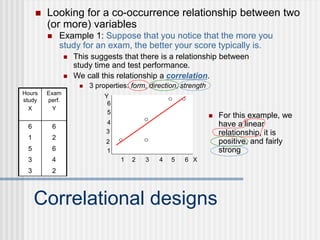
 For this example, we
have a linear
relationship, it is
positive, and fairly
strong
Correlational designs
 Looking for a co-occurrence relationship between two
(or more) variables
 Example 1: Suppose that you notice that the more you
study for an exam, the better your score typically is.
 This suggests that there is a relationship between
study time and test performance.
 We call this relationship a correlation.
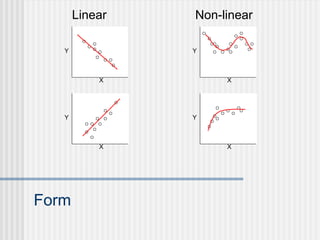
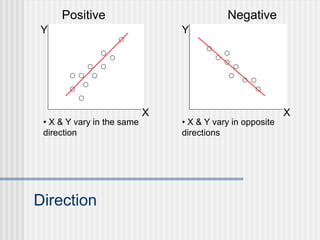
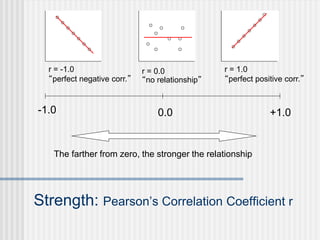
 3 properties: form, direction, strength
Y
X
1
2
3
4
5
6
1 2 3 4 5 6
Hours
study
X
Exam
perf.
Y
6 6
1 2
5 6
3 4
3 2
Form
Non-linear
Linear
Y
X
Y
X
Y
X
Y
X
Direction
Positive
• X & Y vary in the same
direction
Y
X
Negative
• X & Y vary in opposite
directions
Y
X
Strength: Pearson’s Correlation Coefficient r
r = 1.0
“perfect positive corr.”
r = -1.0
“perfect negative corr.”
r = 0.0
“no relationship”
-1.0 0.0 +1.0
The farther from zero, the stronger the relationship
Correlational designs
 Advantages:
 Doesn’t require manipulation of variable
• Sometimes the variables of interest can’t be manipulated
 Allows for simple observations of variables in
naturalistic settings (increasing external validity)
 Can look at a lot of variables at once
Want some examples?
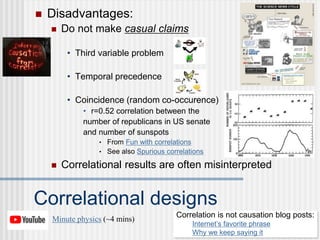
 Disadvantages:
 Do not make casual claims
• Third variable problem
• Temporal precedence
• Coincidence (random co-occurence)
• r=0.52 correlation between the
number of republicans in US senate
and number of sunspots
• From Fun with correlations
• See also Spurious correlations
Correlational designs
 Correlational results are often misinterpreted
Correlation is not causation blog posts:
Internet’s favorite phrase
Why we keep saying it
Minute physics (~4 mins)
Misunderstood Correlational designs
 Example 2: Suppose that you notice that kids
who sit in the front of class typically get higher
grades.
 This suggests that there is a relationship between
where you sit in class and grades.
Daily Gazzett
Children who sit in the
back of the classroom
receive lower grades
than those who sit in
the front.
Possibly implied: “[All] Children who sit in the
back of the classroom [always] receive lower
grades than those [each and every child] who sit
in the front.”
Incorrect interpretation: Sitting in the back of the
classroom causes lower grades.
Better way to say it: “Researchers X and Y found
that children who sat in the back of the
classroom were more likely to receive lower
grades than those who sat in the front.”
Other examples:
Psych you mind | PsyBlog
Non-Experimental designs
 Sometimes you just can’t perform a fully controlled
experiment
 Because of the issue of interest
 Limited resources (not enough subjects, observations are too
costly, etc).
• Surveys
• Correlational
• Quasi-Experiments
• Developmental designs
• Small-N designs
 This does NOT imply that they are bad designs
 Just remember the advantages and disadvantages of each
Quasi-experiments
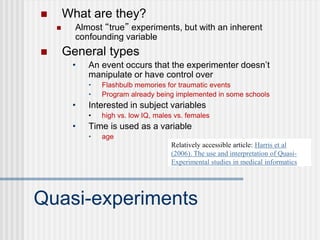
 What are they?
 Almost “true” experiments, but with an inherent
confounding variable
 General types
• An event occurs that the experimenter doesn’t
manipulate or have control over
• Flashbulb memories for traumatic events
• Program already being implemented in some schools
• Interested in subject variables
• high vs. low IQ, males vs. females
• Time is used as a variable
• age
Relatively accessible article: Harris et al
(2006). The use and interpretation of Quasi-
Experimental studies in medical informatics
Quasi-experimental designs
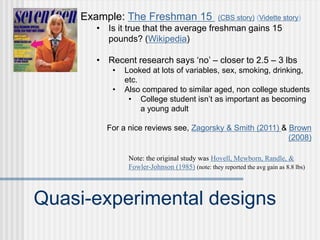
Example: The Freshman 15 (CBS story) (Vidette story)
• Is it true that the average freshman gains 15
pounds? (Wikipedia)
• Recent research says ‘no’ – closer to 2.5 – 3 lbs
• Looked at lots of variables, sex, smoking, drinking,
etc.
• Also compared to similar aged, non college students
• College student isn’t as important as becoming
a young adult
For a nice reviews see, Zagorsky & Smith (2011) & Brown
(2008)
Note: the original study was Hovell, Mewborn, Randle, &
Fowler-Johnson (1985) (note: they reported the avg gain as 8.8 lbs)
Quasi-experiments
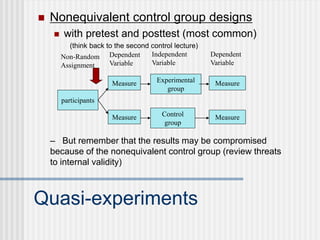
 Nonequivalent control group designs
 with pretest and posttest (most common)
(think back to the second control lecture)
participants
Experimental
group
Control
group
Measure
Measure
Non-Random
Assignment
Independent
Variable
Dependent
Variable
Measure
Measure
Dependent
Variable
– But remember that the results may be compromised
because of the nonequivalent control group (review threats
to internal validity)
Quasi-experiments
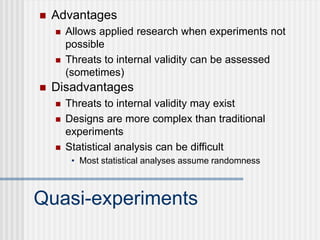
 Advantages
 Allows applied research when experiments not
possible
 Threats to internal validity can be assessed
(sometimes)
 Disadvantages
 Threats to internal validity may exist
 Designs are more complex than traditional
experiments
 Statistical analysis can be difficult
• Most statistical analyses assume randomness
Quasi-experiments
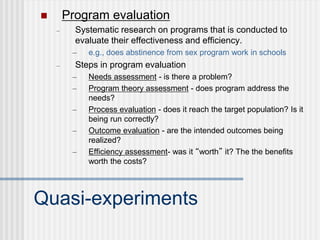
 Program evaluation
– Systematic research on programs that is conducted to
evaluate their effectiveness and efficiency.
– e.g., does abstinence from sex program work in schools
– Steps in program evaluation
– Needs assessment - is there a problem?
– Program theory assessment - does program address the
needs?
– Process evaluation - does it reach the target population? Is it
being run correctly?
– Outcome evaluation - are the intended outcomes being
realized?
– Efficiency assessment- was it “worth” it? The the benefits
worth the costs?
Developmental designs
 Used to study changes in behavior that occur
as a function of age changes
 Age typically serves as a quasi-independent
variable
 Three major types
 Cross-sectional
 Longitudinal
 Cohort-sequential
Video lecture (~10 mins)
Developmental designs
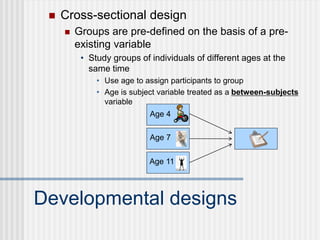
 Cross-sectional design
 Groups are pre-defined on the basis of a pre-
existing variable
• Study groups of individuals of different ages at the
same time
• Use age to assign participants to group
• Age is subject variable treated as a between-subjects
variable
Age 4
Age 7
Age 11
 Cross-sectional design
Developmental designs
 Advantages:
• Can gather data about different groups (i.e., ages)
at the same time
• Participants are not required to commit for an
extended period of time
 Cross-sectional design
Developmental designs
 Longitudinal design
Developmental designs
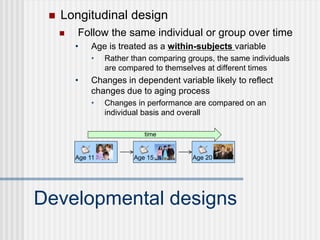
 Follow the same individual or group over time
• Age is treated as a within-subjects variable
• Rather than comparing groups, the same individuals
are compared to themselves at different times
• Changes in dependent variable likely to reflect
changes due to aging process
• Changes in performance are compared on an
individual basis and overall
Age 11
time
Age 20
Age 15
Longitudinal Designs
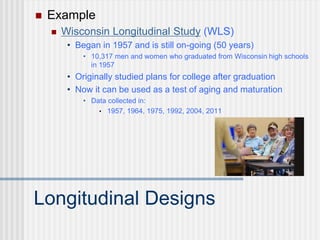
 Example
 Wisconsin Longitudinal Study (WLS)
• Began in 1957 and is still on-going (50 years)
• 10,317 men and women who graduated from Wisconsin high schools
in 1957
• Originally studied plans for college after graduation
• Now it can be used as a test of aging and maturation
• Data collected in:
• 1957, 1964, 1975, 1992, 2004, 2011
 Longitudinal design
Developmental designs
 Advantages:
• Can see developmental changes clearly
• Can measure differences within individuals
• Avoid some cohort effects (participants are all from
same generation, so changes are more likely to be
due to aging)
 Longitudinal design
Developmental designs
 Disadvantages
• Can be very time-consuming
• Can have cross-generational effects:
• Conclusions based on members of one generation may
not apply to other generations
• Numerous threats to internal validity:
• Attrition/mortality
• History
• Practice effects
• Improved performance over multiple tests may be due to
practice taking the test
• Cannot determine causality
 Baby boomers
 Generation X
 Mellennials
 Generation Z
Developmental designs
 Measure groups of participants as they age
• Example: measure a group of 5 year olds, then the
same group 10 years later, as well as another group
of 5 year olds
 Age is both between and within subjects
variable
• Combines elements of cross-sectional and longitudinal
designs
• Addresses some of the concerns raised by other designs
• For example, allows to evaluate the contribution of cohort
effects
 Cohort-sequential design
Developmental designs
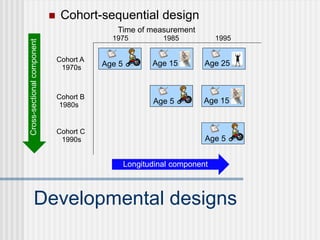
 Cohort-sequential design
Time of measurement
1975 1985 1995
Cohort A
Cohort B
Cohort C
Cross-sectional
component
1970s
1980s
1990s
Age 5 Age 15 Age 25
Age 5 Age 15
Age 5
Longitudinal component
Developmental designs
 Advantages:
• Get more information
• Can track developmental changes to individuals
• Can compare different ages at a single time
• Can measure generation effect
• Less time-consuming than longitudinal (maybe)
 Disadvantages:
• Still time-consuming
• Need lots of groups of participants
• Still cannot make causal claims
 Cohort-sequential design
Non-Experimental designs
 Sometimes you just can’t perform a fully controlled
experiment
 Because of the issue of interest
 Limited resources (not enough subjects, observations are too
costly, etc).
• Surveys
• Correlational
• Quasi-Experiments
• Developmental designs
• Small-N designs
 This does NOT imply that they are bad designs
 Just remember the advantages and disadvantages of each
Small N designs
 What are they?
 Historically, these were the typical kind of design
used until 1920’s when there was a shift to using
larger sample sizes
 Even today, in some sub-areas, using small N
designs is common place
• (e.g., psychophysics, clinical settings, animal studies,
expertise, etc.)
Small N designs
 In contrast to Large N-designs (comparing aggregated
performance of large groups of participants)
 One or a few participants
 Data are typically not analyzed statistically; rather rely
on visual interpretation of the data
Small N designs
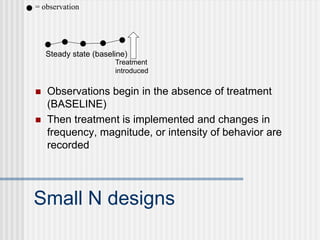
 Observations begin in the absence of treatment
(BASELINE)
 Then treatment is implemented and changes in
frequency, magnitude, or intensity of behavior are
recorded
Steady state (baseline)
= observation
Treatment
introduced
Small N designs
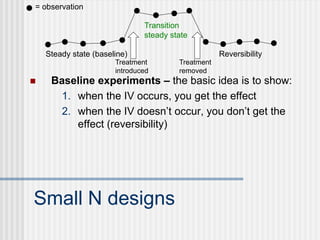
 Baseline experiments – the basic idea is to show:
1. when the IV occurs, you get the effect
2. when the IV doesn’t occur, you don’t get the
effect (reversibility)
Steady state (baseline)
Transition
steady state
= observation
Treatment
introduced
Reversibility
Treatment
removed
Small N designs
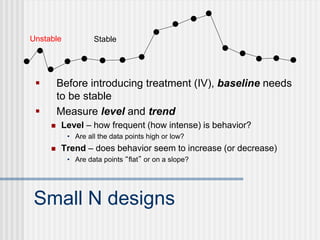
 Before introducing treatment (IV), baseline needs
to be stable
 Measure level and trend
 Level – how frequent (how intense) is behavior?
• Are all the data points high or low?
 Trend – does behavior seem to increase (or decrease)
• Are data points “flat” or on a slope?
Unstable Stable
ABA design
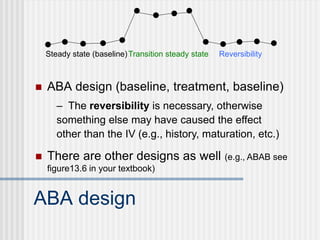
 ABA design (baseline, treatment, baseline)
– The reversibility is necessary, otherwise
something else may have caused the effect
other than the IV (e.g., history, maturation, etc.)
Steady state (baseline)Transition steady state Reversibility
 There are other designs as well (e.g., ABAB see
figure13.6 in your textbook)
Small N designs
 Advantages
 Focus on individual performance, not fooled by
group averaging effects
 Focus is on big effects (small effects typically
can’t be seen without using large groups)
 Avoid some ethical problems – e.g., with non-
treatments
 Allows to look at unusual (and rare) types of
subjects (e.g., case studies of amnesics, experts
vs. novices)
 Often used to supplement large N studies, with
more observations on fewer subjects
Small N designs
 Disadvantages
 Difficult to determine how generalizable the effects
are
 Effects may be small relative to variability of situation
so NEED more observation
 Some effects are by definition between subjects
• Treatment leads to a lasting change, so you don’t get
reversals
Small N designs
 Some researchers have argued that Small N
designs are the best way to go.
 The goal of psychology is to describe behavior
of an individual
 Looking at data collapsed over groups “looks”
in the wrong place
 Need to look at the data at the level of the
individual

non experimental

  • 1.
    Non-Experimental designs: Correlational &Quasi-experimental Psych 231: Research Methods in Psychology
  • 2.
    Non-Experimental designs: Correlational &Quasi-experimental Psych 231: Research Methods in Psychology
  • 3.
    Announcements  Lab attendanceis critical this week because group projects are being administered  Attendance will be taken.  Bring what you need (e.g., flash drives & copies of materials)  Don’t forget Quiz 8 due on Friday at midnight  Also don’t forget that you can take quizzes late once each  Post Exam 2 extra credit opportunity (8 points) – posted on ReggieNet, due in-class on Wednesday (11/7)
  • 4.
    Non-Experimental designs  Sometimesyou just can’t perform a fully controlled experiment  Because of the issue of interest  Limited resources (not enough subjects, observations are too costly, etc). • Surveys • Correlational • Quasi-Experiments • Developmental designs • Small-N designs  This does NOT imply that they are bad designs  Just remember the advantages and disadvantages of each
  • 5.
     For thisexample, we have a linear relationship, it is positive, and fairly strong Correlational designs  Looking for a co-occurrence relationship between two (or more) variables  Example 1: Suppose that you notice that the more you study for an exam, the better your score typically is.  This suggests that there is a relationship between study time and test performance.  We call this relationship a correlation.  3 properties: form, direction, strength Y X 1 2 3 4 5 6 1 2 3 4 5 6 Hours study X Exam perf. Y 6 6 1 2 5 6 3 4 3 2
  • 6.
  • 7.
    Direction Positive • X &Y vary in the same direction Y X Negative • X & Y vary in opposite directions Y X
  • 8.
    Strength: Pearson’s CorrelationCoefficient r r = 1.0 “perfect positive corr.” r = -1.0 “perfect negative corr.” r = 0.0 “no relationship” -1.0 0.0 +1.0 The farther from zero, the stronger the relationship
  • 9.
    Correlational designs  Advantages: Doesn’t require manipulation of variable • Sometimes the variables of interest can’t be manipulated  Allows for simple observations of variables in naturalistic settings (increasing external validity)  Can look at a lot of variables at once Want some examples?
  • 10.
     Disadvantages:  Donot make casual claims • Third variable problem • Temporal precedence • Coincidence (random co-occurence) • r=0.52 correlation between the number of republicans in US senate and number of sunspots • From Fun with correlations • See also Spurious correlations Correlational designs  Correlational results are often misinterpreted Correlation is not causation blog posts: Internet’s favorite phrase Why we keep saying it Minute physics (~4 mins)
  • 11.
    Misunderstood Correlational designs Example 2: Suppose that you notice that kids who sit in the front of class typically get higher grades.  This suggests that there is a relationship between where you sit in class and grades. Daily Gazzett Children who sit in the back of the classroom receive lower grades than those who sit in the front. Possibly implied: “[All] Children who sit in the back of the classroom [always] receive lower grades than those [each and every child] who sit in the front.” Incorrect interpretation: Sitting in the back of the classroom causes lower grades. Better way to say it: “Researchers X and Y found that children who sat in the back of the classroom were more likely to receive lower grades than those who sat in the front.” Other examples: Psych you mind | PsyBlog
  • 12.
    Non-Experimental designs  Sometimesyou just can’t perform a fully controlled experiment  Because of the issue of interest  Limited resources (not enough subjects, observations are too costly, etc). • Surveys • Correlational • Quasi-Experiments • Developmental designs • Small-N designs  This does NOT imply that they are bad designs  Just remember the advantages and disadvantages of each
  • 13.
    Quasi-experiments  What arethey?  Almost “true” experiments, but with an inherent confounding variable  General types • An event occurs that the experimenter doesn’t manipulate or have control over • Flashbulb memories for traumatic events • Program already being implemented in some schools • Interested in subject variables • high vs. low IQ, males vs. females • Time is used as a variable • age Relatively accessible article: Harris et al (2006). The use and interpretation of Quasi- Experimental studies in medical informatics
  • 14.
    Quasi-experimental designs Example: TheFreshman 15 (CBS story) (Vidette story) • Is it true that the average freshman gains 15 pounds? (Wikipedia) • Recent research says ‘no’ – closer to 2.5 – 3 lbs • Looked at lots of variables, sex, smoking, drinking, etc. • Also compared to similar aged, non college students • College student isn’t as important as becoming a young adult For a nice reviews see, Zagorsky & Smith (2011) & Brown (2008) Note: the original study was Hovell, Mewborn, Randle, & Fowler-Johnson (1985) (note: they reported the avg gain as 8.8 lbs)
  • 15.
    Quasi-experiments  Nonequivalent controlgroup designs  with pretest and posttest (most common) (think back to the second control lecture) participants Experimental group Control group Measure Measure Non-Random Assignment Independent Variable Dependent Variable Measure Measure Dependent Variable – But remember that the results may be compromised because of the nonequivalent control group (review threats to internal validity)
  • 16.
    Quasi-experiments  Advantages  Allowsapplied research when experiments not possible  Threats to internal validity can be assessed (sometimes)  Disadvantages  Threats to internal validity may exist  Designs are more complex than traditional experiments  Statistical analysis can be difficult • Most statistical analyses assume randomness
  • 17.
    Quasi-experiments  Program evaluation –Systematic research on programs that is conducted to evaluate their effectiveness and efficiency. – e.g., does abstinence from sex program work in schools – Steps in program evaluation – Needs assessment - is there a problem? – Program theory assessment - does program address the needs? – Process evaluation - does it reach the target population? Is it being run correctly? – Outcome evaluation - are the intended outcomes being realized? – Efficiency assessment- was it “worth” it? The the benefits worth the costs?
  • 18.
    Developmental designs  Usedto study changes in behavior that occur as a function of age changes  Age typically serves as a quasi-independent variable  Three major types  Cross-sectional  Longitudinal  Cohort-sequential Video lecture (~10 mins)
  • 19.
    Developmental designs  Cross-sectionaldesign  Groups are pre-defined on the basis of a pre- existing variable • Study groups of individuals of different ages at the same time • Use age to assign participants to group • Age is subject variable treated as a between-subjects variable Age 4 Age 7 Age 11
  • 20.
     Cross-sectional design Developmentaldesigns  Advantages: • Can gather data about different groups (i.e., ages) at the same time • Participants are not required to commit for an extended period of time
  • 21.
  • 22.
     Longitudinal design Developmentaldesigns  Follow the same individual or group over time • Age is treated as a within-subjects variable • Rather than comparing groups, the same individuals are compared to themselves at different times • Changes in dependent variable likely to reflect changes due to aging process • Changes in performance are compared on an individual basis and overall Age 11 time Age 20 Age 15
  • 23.
    Longitudinal Designs  Example Wisconsin Longitudinal Study (WLS) • Began in 1957 and is still on-going (50 years) • 10,317 men and women who graduated from Wisconsin high schools in 1957 • Originally studied plans for college after graduation • Now it can be used as a test of aging and maturation • Data collected in: • 1957, 1964, 1975, 1992, 2004, 2011
  • 24.
     Longitudinal design Developmentaldesigns  Advantages: • Can see developmental changes clearly • Can measure differences within individuals • Avoid some cohort effects (participants are all from same generation, so changes are more likely to be due to aging)
  • 25.
     Longitudinal design Developmentaldesigns  Disadvantages • Can be very time-consuming • Can have cross-generational effects: • Conclusions based on members of one generation may not apply to other generations • Numerous threats to internal validity: • Attrition/mortality • History • Practice effects • Improved performance over multiple tests may be due to practice taking the test • Cannot determine causality  Baby boomers  Generation X  Mellennials  Generation Z
  • 26.
    Developmental designs  Measuregroups of participants as they age • Example: measure a group of 5 year olds, then the same group 10 years later, as well as another group of 5 year olds  Age is both between and within subjects variable • Combines elements of cross-sectional and longitudinal designs • Addresses some of the concerns raised by other designs • For example, allows to evaluate the contribution of cohort effects  Cohort-sequential design
  • 27.
    Developmental designs  Cohort-sequentialdesign Time of measurement 1975 1985 1995 Cohort A Cohort B Cohort C Cross-sectional component 1970s 1980s 1990s Age 5 Age 15 Age 25 Age 5 Age 15 Age 5 Longitudinal component
  • 28.
    Developmental designs  Advantages: •Get more information • Can track developmental changes to individuals • Can compare different ages at a single time • Can measure generation effect • Less time-consuming than longitudinal (maybe)  Disadvantages: • Still time-consuming • Need lots of groups of participants • Still cannot make causal claims  Cohort-sequential design
  • 29.
    Non-Experimental designs  Sometimesyou just can’t perform a fully controlled experiment  Because of the issue of interest  Limited resources (not enough subjects, observations are too costly, etc). • Surveys • Correlational • Quasi-Experiments • Developmental designs • Small-N designs  This does NOT imply that they are bad designs  Just remember the advantages and disadvantages of each
  • 30.
    Small N designs What are they?  Historically, these were the typical kind of design used until 1920’s when there was a shift to using larger sample sizes  Even today, in some sub-areas, using small N designs is common place • (e.g., psychophysics, clinical settings, animal studies, expertise, etc.)
  • 31.
    Small N designs In contrast to Large N-designs (comparing aggregated performance of large groups of participants)  One or a few participants  Data are typically not analyzed statistically; rather rely on visual interpretation of the data
  • 32.
    Small N designs Observations begin in the absence of treatment (BASELINE)  Then treatment is implemented and changes in frequency, magnitude, or intensity of behavior are recorded Steady state (baseline) = observation Treatment introduced
  • 33.
    Small N designs Baseline experiments – the basic idea is to show: 1. when the IV occurs, you get the effect 2. when the IV doesn’t occur, you don’t get the effect (reversibility) Steady state (baseline) Transition steady state = observation Treatment introduced Reversibility Treatment removed
  • 34.
    Small N designs Before introducing treatment (IV), baseline needs to be stable  Measure level and trend  Level – how frequent (how intense) is behavior? • Are all the data points high or low?  Trend – does behavior seem to increase (or decrease) • Are data points “flat” or on a slope? Unstable Stable
  • 35.
    ABA design  ABAdesign (baseline, treatment, baseline) – The reversibility is necessary, otherwise something else may have caused the effect other than the IV (e.g., history, maturation, etc.) Steady state (baseline)Transition steady state Reversibility  There are other designs as well (e.g., ABAB see figure13.6 in your textbook)
  • 36.
    Small N designs Advantages  Focus on individual performance, not fooled by group averaging effects  Focus is on big effects (small effects typically can’t be seen without using large groups)  Avoid some ethical problems – e.g., with non- treatments  Allows to look at unusual (and rare) types of subjects (e.g., case studies of amnesics, experts vs. novices)  Often used to supplement large N studies, with more observations on fewer subjects
  • 37.
    Small N designs Disadvantages  Difficult to determine how generalizable the effects are  Effects may be small relative to variability of situation so NEED more observation  Some effects are by definition between subjects • Treatment leads to a lasting change, so you don’t get reversals
  • 38.
    Small N designs Some researchers have argued that Small N designs are the best way to go.  The goal of psychology is to describe behavior of an individual  Looking at data collapsed over groups “looks” in the wrong place  Need to look at the data at the level of the individual