NODE MCU CONTROLLER
BY:
MUTHU SELVAM
What is Node MCU controller?
 Previous presentation we learnt about Arduino UNO’s
applications and its advantages.
 Basically we use Ardiuno and microcontroller because it
can works automatically.
 An open source development board based on the
ESP8266 Wifi module. Featuring the micro controller
 It provides the feature of developing IOT applications
using Lua scripting language.
 With compact size, low power consumption and
extensive community support.It is a versatile solution for
building advanced IOT systems.
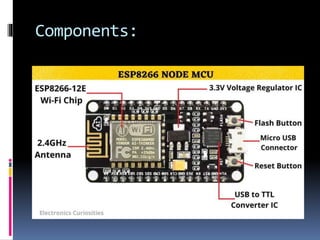
Components:
Key feartures:
 IntegratedWifi connectivity for seamless IOT
communications.
 Lua scripting language for rapid prototyping
and development.
 GPIO pins for connecting sensors,acutators
and other peripherals.
 Compatibility with popular IOT platforms like
Arduino and Raspberry Pi.
 OTA firmware updates for remote device
management.
Benefits and Advantages:
 Cost-effective solutions compared to
traditional microcontrollers.
 Easy to program and Lua scripting language.
 Integration with popular IOT platforms and
frameworks.It is breadboard friendly and
compact.
 Compact size and low power consumption.
 Flexible and coustamizable for a wide range
of IOT applications.
Applications:
The node MCU controller finds applications in
various industries including
• Home automation and smart devices.
• Industrial monitoring and control systems.
• Environmental sensing and data logging.
• Agriculture and farming automation.
• Smart cities and infrastructure management.
Comparing Arduino Nano and node
MCU
Arduino Nano:
a)32kb flash memory ,16MHz clock ,8kb
SRAM
b)mini-B USB connector.
c)No wireless pheripherals and it has 8 bit
microcontroller.
Node MCU:
a)4mb of flash memory,80MHz clock,50kb
RAM
b)micro-B USB connector,On boardWifi
connectivity 32 bit microcontroller.
Limitations:
 The pins are not 5V tolerant ,applying more
than 3.6Von any pin will kill the chip.
 The maximum current drawn from the single
GPIO pin is 12mA.

NODE MCU controller for internet of things

  • 1.
  • 2.
    What is NodeMCU controller?  Previous presentation we learnt about Arduino UNO’s applications and its advantages.  Basically we use Ardiuno and microcontroller because it can works automatically.  An open source development board based on the ESP8266 Wifi module. Featuring the micro controller  It provides the feature of developing IOT applications using Lua scripting language.  With compact size, low power consumption and extensive community support.It is a versatile solution for building advanced IOT systems.
  • 3.
  • 4.
    Key feartures:  IntegratedWificonnectivity for seamless IOT communications.  Lua scripting language for rapid prototyping and development.  GPIO pins for connecting sensors,acutators and other peripherals.  Compatibility with popular IOT platforms like Arduino and Raspberry Pi.  OTA firmware updates for remote device management.
  • 5.
    Benefits and Advantages: Cost-effective solutions compared to traditional microcontrollers.  Easy to program and Lua scripting language.  Integration with popular IOT platforms and frameworks.It is breadboard friendly and compact.  Compact size and low power consumption.  Flexible and coustamizable for a wide range of IOT applications.
  • 6.
    Applications: The node MCUcontroller finds applications in various industries including • Home automation and smart devices. • Industrial monitoring and control systems. • Environmental sensing and data logging. • Agriculture and farming automation. • Smart cities and infrastructure management.
  • 7.
    Comparing Arduino Nanoand node MCU Arduino Nano: a)32kb flash memory ,16MHz clock ,8kb SRAM b)mini-B USB connector. c)No wireless pheripherals and it has 8 bit microcontroller. Node MCU: a)4mb of flash memory,80MHz clock,50kb RAM b)micro-B USB connector,On boardWifi connectivity 32 bit microcontroller.
  • 8.
    Limitations:  The pinsare not 5V tolerant ,applying more than 3.6Von any pin will kill the chip.  The maximum current drawn from the single GPIO pin is 12mA.