“
”
A PROJECT REVIEW
ON
IOT BASED HOME AUTOMATION
SYSTEM
BY
K.RAJESH (20G31A0214)
G.VINOD KUMAR (21G35A0205)
K.YUGANDAR (21G35A0205)
B.BHASKAR (20G31A0204)
ST.JOHNS COLLEGE OF ENGINEERING AND TECHNOLOGY
YERRAKOTA
YEMMIGANUR-518360
Under The Esteemed Guidance Of
Prof. Dr. D. B. Ameer Suhail M. Tech
Assistant Professor
DEPARTMENT OF ELECTRICAL & ELECTRONICS ENGINEERING
Contents
 ABSTRACT
 INTRODUCTION
 OVERVIEW OF PROJECT
 PROJECT LAYOUT
 MODULE DISCRIPION
 WORKING OPERATION
 RESULT
 OUT PUT
 CONCLUSION
 FUTURE SCOPE
Abstract
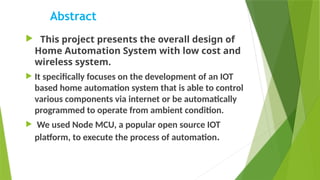
 This project presents the overall design of
Home Automation System with low cost and
wireless system.
 It specifically focuses on the development of an IOT
based home automation system that is able to control
various components via internet or be automatically
programmed to operate from ambient condition.
 We used Node MCU, a popular open source IOT
platform, to execute the process of automation.
INTRODUCTION
 Control most of your home appliances
using laptop or phones remotely.
 Get feedback about the status of your
home via internet.
 Provide an easily and comfortable way
to control your home devices from any
place.
OVERVIEW OF PROJECT
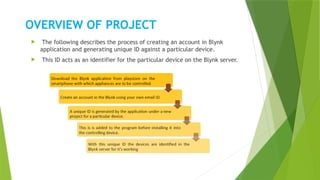
 The following describes the process of creating an account in Blynk
application and generating unique ID against a particular device.
 This ID acts as an identifier for the particular device on the Blynk server.
PROJECT LAYOUT
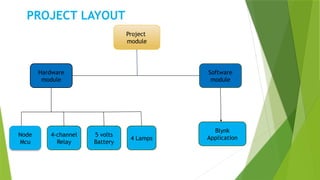
Project
module
Hardware
module
Software
module
Node
Mcu
4-channel
Relay
5 volts
Battery
4 Lamps
Blynk
Application
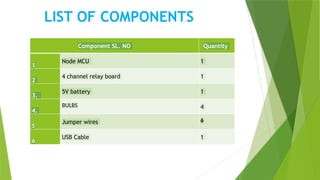
LIST OF COMPONENTS
Component SL. NO Quantity
1
Node MCU 1
2
4 channel relay board 1
3.
5V battery 1
4.
BULBS 4
5
Jumper wires 6
6
USB Cable 1
Module description
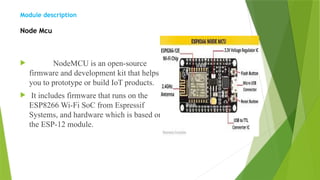
Node Mcu
 NodeMCU is an open-source
firmware and development kit that helps
you to prototype or build IoT products.
 It includes firmware that runs on the
ESP8266 Wi-Fi SoC from Espressif
Systems, and hardware which is based on
the ESP-12 module.
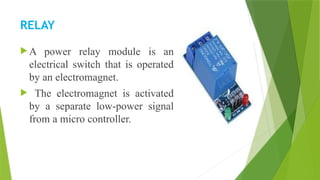
RELAY
 A power relay module is an
electrical switch that is operated
by an electromagnet.
 The electromagnet is activated
by a separate low-power signal
from a micro controller.
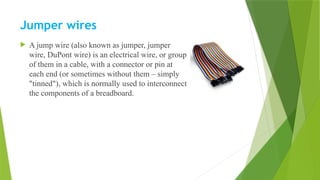
Jumper wires
 A jump wire (also known as jumper, jumper
wire, DuPont wire) is an electrical wire, or group
of them in a cable, with a connector or pin at
each end (or sometimes without them – simply
"tinned"), which is normally used to interconnect
the components of a breadboard.
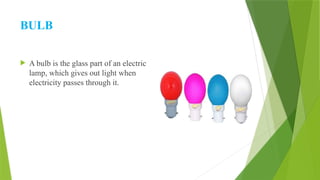
BULB
 A bulb is the glass part of an electric
lamp, which gives out light when
electricity passes through it.
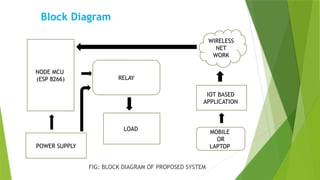
Block Diagram
FIG: BLOCK DIAGRAM OF PROPOSED SYSTEM
NODE MCU
(ESP 8266)
POWER SUPPLY
RELAY
LOAD
IOT BASED
APPLICATION
MOBILE
OR
LAPTOP
WIRELESS
NET
WORK
WORKING OPERATION
 Node MCU is an open source IOT platform.
 It includes firmware which runs on the ESP8266
Wi-Fi SoC from Espressif Systems, and hardware
which is based on the ESP-12 module.
 The term “Node MCU” by default refers to the
firmware rather than the development kits.
 The firmware uses the Lua scripting language.
 It is based on the eLua project, and built on the
Espressif Non-OS SDK for ESP8266.
ADVANTAGES
 SAVE MONEY AND INCREASES CONVENIENCE
 SAVE TIME
 HIGH RELABILIATY
 EASY TO CONTROL
APPLICATIONS
 SMART HOMES
 HEALTH CARE
 AGRICULTURE
 INDUSTRIES
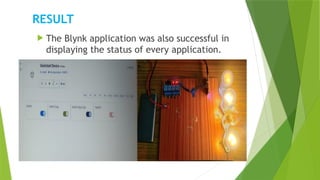
RESULT
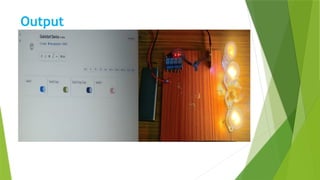
 The Blynk application was also successful in
displaying the status of every application.
Output
CONCLUSTION
 By using this we can reduce cost and
can control or monitoring the home
appliances from anywhere
 Can create wireless network in house
and reduce wiring.
 Hence, this system is scalable and
flexible.
FUTURE SCOPE
 Using this system as framework, the system can be expanded to
include various other options which could include home security
feature like capturing the photo of a person moving around the
house and storing it onto the cloud.
 This will reduce the data storage than using the CCTV camera
which will record all the time and stores it. The system can be
expanded for energy monitoring
Thank YOU
Any Questions

IOT BASED HOME AUTOMATION SYSTEM rrrrrrrr

  • 1.
    “ ” A PROJECT REVIEW ON IOTBASED HOME AUTOMATION SYSTEM BY K.RAJESH (20G31A0214) G.VINOD KUMAR (21G35A0205) K.YUGANDAR (21G35A0205) B.BHASKAR (20G31A0204) ST.JOHNS COLLEGE OF ENGINEERING AND TECHNOLOGY YERRAKOTA YEMMIGANUR-518360 Under The Esteemed Guidance Of Prof. Dr. D. B. Ameer Suhail M. Tech Assistant Professor DEPARTMENT OF ELECTRICAL & ELECTRONICS ENGINEERING
  • 2.
    Contents  ABSTRACT  INTRODUCTION OVERVIEW OF PROJECT  PROJECT LAYOUT  MODULE DISCRIPION  WORKING OPERATION  RESULT  OUT PUT  CONCLUSION  FUTURE SCOPE
  • 3.
    Abstract  This projectpresents the overall design of Home Automation System with low cost and wireless system.  It specifically focuses on the development of an IOT based home automation system that is able to control various components via internet or be automatically programmed to operate from ambient condition.  We used Node MCU, a popular open source IOT platform, to execute the process of automation.
  • 4.
    INTRODUCTION  Control mostof your home appliances using laptop or phones remotely.  Get feedback about the status of your home via internet.  Provide an easily and comfortable way to control your home devices from any place.
  • 5.
    OVERVIEW OF PROJECT The following describes the process of creating an account in Blynk application and generating unique ID against a particular device.  This ID acts as an identifier for the particular device on the Blynk server.
  • 6.
  • 7.
    LIST OF COMPONENTS ComponentSL. NO Quantity 1 Node MCU 1 2 4 channel relay board 1 3. 5V battery 1 4. BULBS 4 5 Jumper wires 6 6 USB Cable 1
  • 8.
    Module description Node Mcu NodeMCU is an open-source firmware and development kit that helps you to prototype or build IoT products.  It includes firmware that runs on the ESP8266 Wi-Fi SoC from Espressif Systems, and hardware which is based on the ESP-12 module.
  • 9.
    RELAY  A powerrelay module is an electrical switch that is operated by an electromagnet.  The electromagnet is activated by a separate low-power signal from a micro controller.
  • 10.
    Jumper wires  Ajump wire (also known as jumper, jumper wire, DuPont wire) is an electrical wire, or group of them in a cable, with a connector or pin at each end (or sometimes without them – simply "tinned"), which is normally used to interconnect the components of a breadboard.
  • 11.
    BULB  A bulbis the glass part of an electric lamp, which gives out light when electricity passes through it.
  • 12.
    Block Diagram FIG: BLOCKDIAGRAM OF PROPOSED SYSTEM NODE MCU (ESP 8266) POWER SUPPLY RELAY LOAD IOT BASED APPLICATION MOBILE OR LAPTOP WIRELESS NET WORK
  • 13.
    WORKING OPERATION  NodeMCU is an open source IOT platform.  It includes firmware which runs on the ESP8266 Wi-Fi SoC from Espressif Systems, and hardware which is based on the ESP-12 module.  The term “Node MCU” by default refers to the firmware rather than the development kits.  The firmware uses the Lua scripting language.  It is based on the eLua project, and built on the Espressif Non-OS SDK for ESP8266.
  • 14.
    ADVANTAGES  SAVE MONEYAND INCREASES CONVENIENCE  SAVE TIME  HIGH RELABILIATY  EASY TO CONTROL
  • 15.
    APPLICATIONS  SMART HOMES HEALTH CARE  AGRICULTURE  INDUSTRIES
  • 16.
    RESULT  The Blynkapplication was also successful in displaying the status of every application.
  • 17.
  • 18.
    CONCLUSTION  By usingthis we can reduce cost and can control or monitoring the home appliances from anywhere  Can create wireless network in house and reduce wiring.  Hence, this system is scalable and flexible.
  • 19.
    FUTURE SCOPE  Usingthis system as framework, the system can be expanded to include various other options which could include home security feature like capturing the photo of a person moving around the house and storing it onto the cloud.  This will reduce the data storage than using the CCTV camera which will record all the time and stores it. The system can be expanded for energy monitoring

  • 20.