
Arkansas Career Pathways Initiative Arkansas Department of Higher Education Community Development Society 41 st  Annual International Conference July 27, 2009 Claudia Griffin Director, Career Pathways Initiative University of Arkansas Community College at Hope
Arkansas  Career Pathways Initiative Charts a course for leveraging resources, improving linkages among public systems, and complementing existing services with new ones.
Purpose Provide an educational,  work-based program  that will assist low-income people to gain skills that lead to  self-sufficiency.  Encourage  upward educational  and  career mobility  for the target group of low-skilled, low-wage workers.
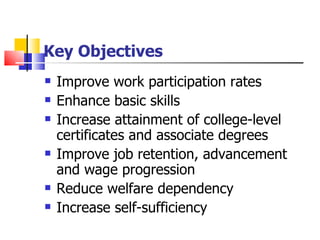
Key Objectives Improve work participation rates Enhance basic skills Increase attainment of college-level certificates and associate degrees Improve job retention, advancement and wage progression Reduce welfare dependency Increase self-sufficiency
Why Career Pathways Initiative? Arkansas was 49 th  in per capita income. Arkansas ’ s economy directly related to level of education of citizens. Only 29% of 18-24 year-old Arkansans are enrolled in college.  Low-income young adults — twice as likely not to attend college.
Arkansas Net Migration by Degree Level and Age Group Source:  U.S. Census Bureau, 2000 Public Use Microdata Samples (based on 2000 Decennial Census) 22- to 29-Year-Olds 30- to 64-Year-Olds Less than High School High School Some College Associate Bachelor’s Graduate/Professional Total
Arkansas Per Capita Personal Income  as a Percent of U.S. Average  1960-2005 Source:  Regional Economic Information System, Bureau of Economic Analysis, U.S. Department of Commerce
Per Capita Personal Income  2004 Source:  Bureau of Economic Analysis Carroll Prairie Monroe Phillips Arkansas Jefferson Grant Pulaski Saline Conway Faulkner Woodruff Crittenden Jackson Independence Cleburne Van Buren Stone Izard Sharp Lawrence Craighead Mississippi Randolph Baxter Marion Madison Johnson Yell Garland Montgomery Pike Dallas Cleveland Lincoln Desha Chicot Bradley Union Calhoun Ouachita Nevada Columbia Lafayette Miller Hempstead Howard Little River Sevier Sebastian Franklin Crawford Washington Benton Newton Ashley Boone Clark Clay Cross Drew Fulton Greene Hot Spring Lee Logan Lonoke Perry Poinsett Polk Pope Scott Searcy St. Francis White 24,990 to  35,264 23,141 to  24,990 22,221 to  23,141 20,851 to  22,221 17,618 to  20,851
Relationship Between Educational Attainment and Personal Income  2000 Source:  U.S. Census Bureau, 2000 Census Per Capita Income Percent with Bachelor’s Degree or Higher 14.8 33.2 15,853 28,766 AL AK AZ AR CA CO CT DE FL GA HI ID IL IN IA KS KY LA ME MD MA MI MN MS MO MT NE NV NH NJ NM NY NC ND OH OK OR PA RI SC SD TN TX UT VT VA WV WI WY 14.8 15,853 28,766 AL AK AR CA CO CT DE GA HI IL IN KS KY LA MD MA MS MO MT NV NH NJ NM OH OK OR RI SC TN UT VT VA WV WY WA
Median Earnings by Degree Level 2005 Note: Data represent persons age 25-64 with positive earnings working 35+ hours per week.  Source:  U.S. Census Bureau, 2005 PUMS
  Arkansas Educational Attainment and    Rank (Percent) Among States   2005 Source:  U.S. Census Bureau, 2005 American Community Survey (ACS) 80.3% 6.5% 84.9% 6.2% 20.3%
Eligibility … Approximately 200,000 adults in Arkansas  meet eligibility requirements for the TANF funds that are providing for the  Career Pathways Initiative.
Why Focus on Low-Income Adults? Working adults do not fit into traditional higher education models. Few Arkansas programs are developed for low-income working adults. Benefits accrue to everyone in state.
Arkansas  Career Pathways Initiative $8 million for each state fiscal year from July 1, 2005  –  June 30, 2007. $12 million for each state fiscal year from July 1, 2007  –  June 30, 2009. $12 million for FY10 Twenty-five sites at community colleges and technical institutes.
Grant Awards to 25 Sites Grants range from $178,000-$663,000  (Based on Institutional Performance) Case-management model Curriculum re-design Student support services (Transportation, childcare, materials and supplies, tuition/fees and textbooks) Academic support services (Tutoring, mentoring, internships, assessment)
Program Successes   Student success rate of 90%  Average cost of $1,000 per student in 08-09 Almost 15,000 adults enrolled since beginning. Over 9,000 certificate and degrees awarded.
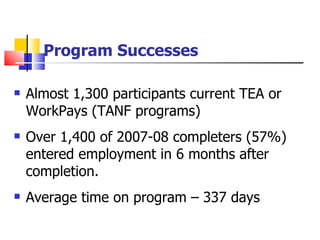
Program Successes   Almost 1,300 participants current TEA or WorkPays (TANF programs) Over 1,400 of 2007-08 completers (57%) entered employment in 6 months after completion. Average time on program – 337 days
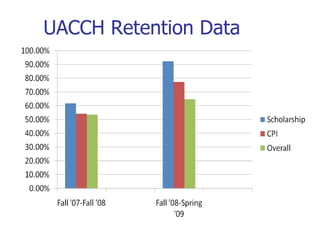
UACCH Retention Data
What are Career Pathways? A framework for connecting a series of educational programs with integrated work experience and student support. Enhanced student support services. Investments made in education are directly linked to increased earnings through employer partnerships.  A new way of doing business in our high schools, colleges, and communities.
Features … Redesign of curriculum and maps for each career targeted for the Pathways program. Enhanced  “ wrap around ”  student services to increase student success. Partnerships and Employer Involvement.
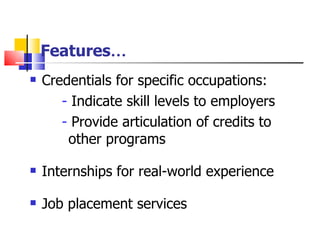
Features … Credentials for specific occupations: -  Indicate skill levels to employers -  Provide articulation of credits to   other programs Internships for real-world experience Job placement services
Customized Curriculum Modular curriculum Multiple entry/exit points More flexible scheduling Alternative delivery systems Credential programs in series of modules recognized by employers Seamless transition between program levels
Customized Curriculum Accelerated learning Shorter units of study — Frequent testing Course work applied to job  Classes at the workplace Seamless transition between programs Coordination with student support services
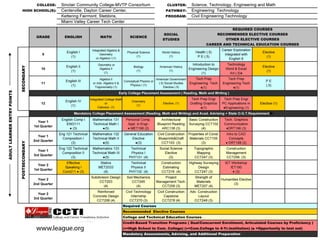
Redesigning  Curriculum-Mapping Pathway Starts with employability skills and adult education. “ Bridge ”  programs  –  Applied learning in developmental or basic skills courses. Curriculum applied to local jobs. Conveniently scheduled classes for working parents.
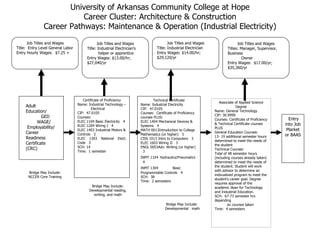
University of Arkansas Community College at Hope Career Cluster: Architecture & Construction Career Pathways: Maintenance & Operation (Industrial Electricity) Job Titles and Wages Title:  Entry Level General Labor Entry Hourly Wages:  $7.25 + Job Titles and Wages Title: Industrial Electrician’s  helper or apprentice  Entry Wages: $13.00/hr; $27,040/yr Certificate of Proficiency Name: Industrial Technology –  Electrical CIP:  47.0105 Courses: ELEC 1104 Basic Electricity  4 ELEC 1204 Wiring I  4 ELEC 1403 Industrial Motors & Controls  3 ELEC 1303 National Elect. Code  3 SCH: 14 Time:  1 semester Technical Certificate Name: Industrial Electricity CIP:  47.0105 Courses:  Certificate of Proficiency courses PLUS: ELEC 1404 Mechanical Devices & Systems  4 MATH 0013Introduction to College Mathematics (or higher)  3 CISS 1013 Intro to Computers  3 ELEC 1603 Wiring II  3 ENGL 0053Adv. Writing (or higher)  3 INMT 1104   Hydraulics/Pneumatics  4 INMT 1304  Basic Programmable Controls  4 SCH:  38 Time:  2 semesters Adult Education/ GED WAGE/ Employability/ Career Readiness  Certificate (CRC) Job Titles and Wages Title: Industrial Electrician  Entry Wages: $14.00/hr; $29,120/yr Job Titles and Wages Titles: Manager, Supervisor, Business  Owner  Entry Wages:  $17.00/yr; $35,360/yr Associate of Applied Science Degree Name: General Technology CIP: 30.9999  Courses: Certificate of Proficiency & Technical Certificate courses PLUS General Education Courses:  13- 19 additional semester hours determined to meet the needs of the student Technical Courses: Total of 48 semester hours (including courses already taken) determined to meet the needs of the student. Student will work with advisor to determine an indivualized program to meet the student’s career goal. Degree requires approval of the academic dean for Technology and Industrial Education. SCH:  67-73 semester hrs depending  on courses taken  Time:  4 semesters Entry into Job Market or BAAS Bridge May Include: NCCER Core Training Bridge May Include: Developmental reading, writing, and math Bridge May Include: Developmental  math
 
 
Carl D. Perkins CTE Program Integration of technical and academic study Strengthen linkages between high school, college, and employment in high skill, high wage, high demand occupations Prepare students for nontraditional occupations Serve the needs of special populations Improve professional development opportunities for teachers and faculty Promote partnerships between education and industry
Arkansas  Targeted Job Categories Manufacturing Health care and social assistance Transportation and warehousing Professional and technical services Management of companies and enterprises
Partnerships  and Employer Involvement Active partnerships for student support Economic Development strategy Employer validation of educational pathways Employer involvement Employers support for graduates
Enhanced Student Support Student Advising and Career Planning Internships College and Workforce Readiness and Prep Case Management Job Seeking
Sustainability Leadership at all levels Replicable models Utilize all funding sources Alignment of state and federal policy
Keys to Our Success   Changing the Nature of On-Ground Service Delivery. Identifying the Needs of the Economy and Adapting to Rapid Change. Performance Measures and Incentive Funding. Reaching Out to TANF-eligible Workers and Branding the Programs. Improving Support Services for low-income and low-skill adults. A Dedicated Staff.
Areas of Strategies Pathways Partnerships Removing Obstacles Intrusive Advising
9 Steps to Implement this Model in Your Community Determine the population that is being left behind. Determine the higher-wage, in-demand jobs in your area.  For immediate results, start with the ones that require the shortest training. Focus also on types of work that a part of pathways where each level is in demand.
9 Steps (continued) Partner with employers to determine the curriculum. Partner with community-based representatives to recruit students and obtain funding. Provide intrusive advising and counseling to coordinate services and remove obstacles.
9 Steps (continued) Provide tutors and developmental programs. Don’t forget employability skills. Help obtain employment. Celebrate successes.
Contact Information www.arpathways.com www.ahaprocess.com www.pbs.org/peoplelikeus www.bls.gov Reference Links: Monieca West, Coordinator of Federal Programs Carl D. Perkins Program Arkansas Department of Higher Education 114 East Capitol Avenue Little Rock, AR  72201  501.371.2018 [email_address] www.adheperkins.com Claudia Griffin, Career Pathways Director UA Community College at Hope 2500 South Main PO Box 140 Hope, AR 71802-0140 870.722.8526 [email_address] www.uacch.edu

No Worker Left Behind

  • 1.
    Arkansas Career PathwaysInitiative Arkansas Department of Higher Education Community Development Society 41 st Annual International Conference July 27, 2009 Claudia Griffin Director, Career Pathways Initiative University of Arkansas Community College at Hope
  • 2.
    Arkansas CareerPathways Initiative Charts a course for leveraging resources, improving linkages among public systems, and complementing existing services with new ones.
  • 3.
    Purpose Provide aneducational, work-based program that will assist low-income people to gain skills that lead to self-sufficiency. Encourage upward educational and career mobility for the target group of low-skilled, low-wage workers.
  • 4.
    Key Objectives Improvework participation rates Enhance basic skills Increase attainment of college-level certificates and associate degrees Improve job retention, advancement and wage progression Reduce welfare dependency Increase self-sufficiency
  • 5.
    Why Career PathwaysInitiative? Arkansas was 49 th in per capita income. Arkansas ’ s economy directly related to level of education of citizens. Only 29% of 18-24 year-old Arkansans are enrolled in college. Low-income young adults — twice as likely not to attend college.
  • 6.
    Arkansas Net Migrationby Degree Level and Age Group Source: U.S. Census Bureau, 2000 Public Use Microdata Samples (based on 2000 Decennial Census) 22- to 29-Year-Olds 30- to 64-Year-Olds Less than High School High School Some College Associate Bachelor’s Graduate/Professional Total
  • 7.
    Arkansas Per CapitaPersonal Income as a Percent of U.S. Average 1960-2005 Source: Regional Economic Information System, Bureau of Economic Analysis, U.S. Department of Commerce
  • 8.
    Per Capita PersonalIncome 2004 Source: Bureau of Economic Analysis Carroll Prairie Monroe Phillips Arkansas Jefferson Grant Pulaski Saline Conway Faulkner Woodruff Crittenden Jackson Independence Cleburne Van Buren Stone Izard Sharp Lawrence Craighead Mississippi Randolph Baxter Marion Madison Johnson Yell Garland Montgomery Pike Dallas Cleveland Lincoln Desha Chicot Bradley Union Calhoun Ouachita Nevada Columbia Lafayette Miller Hempstead Howard Little River Sevier Sebastian Franklin Crawford Washington Benton Newton Ashley Boone Clark Clay Cross Drew Fulton Greene Hot Spring Lee Logan Lonoke Perry Poinsett Polk Pope Scott Searcy St. Francis White 24,990 to 35,264 23,141 to 24,990 22,221 to 23,141 20,851 to 22,221 17,618 to 20,851
  • 9.
    Relationship Between EducationalAttainment and Personal Income 2000 Source: U.S. Census Bureau, 2000 Census Per Capita Income Percent with Bachelor’s Degree or Higher 14.8 33.2 15,853 28,766 AL AK AZ AR CA CO CT DE FL GA HI ID IL IN IA KS KY LA ME MD MA MI MN MS MO MT NE NV NH NJ NM NY NC ND OH OK OR PA RI SC SD TN TX UT VT VA WV WI WY 14.8 15,853 28,766 AL AK AR CA CO CT DE GA HI IL IN KS KY LA MD MA MS MO MT NV NH NJ NM OH OK OR RI SC TN UT VT VA WV WY WA
  • 10.
    Median Earnings byDegree Level 2005 Note: Data represent persons age 25-64 with positive earnings working 35+ hours per week. Source: U.S. Census Bureau, 2005 PUMS
  • 11.
    ArkansasEducational Attainment and Rank (Percent) Among States 2005 Source: U.S. Census Bureau, 2005 American Community Survey (ACS) 80.3% 6.5% 84.9% 6.2% 20.3%
  • 12.
    Eligibility … Approximately200,000 adults in Arkansas meet eligibility requirements for the TANF funds that are providing for the Career Pathways Initiative.
  • 13.
    Why Focus onLow-Income Adults? Working adults do not fit into traditional higher education models. Few Arkansas programs are developed for low-income working adults. Benefits accrue to everyone in state.
  • 14.
    Arkansas CareerPathways Initiative $8 million for each state fiscal year from July 1, 2005 – June 30, 2007. $12 million for each state fiscal year from July 1, 2007 – June 30, 2009. $12 million for FY10 Twenty-five sites at community colleges and technical institutes.
  • 15.
    Grant Awards to25 Sites Grants range from $178,000-$663,000 (Based on Institutional Performance) Case-management model Curriculum re-design Student support services (Transportation, childcare, materials and supplies, tuition/fees and textbooks) Academic support services (Tutoring, mentoring, internships, assessment)
  • 16.
    Program Successes Student success rate of 90% Average cost of $1,000 per student in 08-09 Almost 15,000 adults enrolled since beginning. Over 9,000 certificate and degrees awarded.
  • 17.
    Program Successes Almost 1,300 participants current TEA or WorkPays (TANF programs) Over 1,400 of 2007-08 completers (57%) entered employment in 6 months after completion. Average time on program – 337 days
  • 18.
  • 19.
    What are CareerPathways? A framework for connecting a series of educational programs with integrated work experience and student support. Enhanced student support services. Investments made in education are directly linked to increased earnings through employer partnerships. A new way of doing business in our high schools, colleges, and communities.
  • 20.
    Features … Redesignof curriculum and maps for each career targeted for the Pathways program. Enhanced “ wrap around ” student services to increase student success. Partnerships and Employer Involvement.
  • 21.
    Features … Credentialsfor specific occupations: - Indicate skill levels to employers - Provide articulation of credits to other programs Internships for real-world experience Job placement services
  • 22.
    Customized Curriculum Modularcurriculum Multiple entry/exit points More flexible scheduling Alternative delivery systems Credential programs in series of modules recognized by employers Seamless transition between program levels
  • 23.
    Customized Curriculum Acceleratedlearning Shorter units of study — Frequent testing Course work applied to job Classes at the workplace Seamless transition between programs Coordination with student support services
  • 24.
    Redesigning Curriculum-MappingPathway Starts with employability skills and adult education. “ Bridge ” programs – Applied learning in developmental or basic skills courses. Curriculum applied to local jobs. Conveniently scheduled classes for working parents.
  • 25.
    University of ArkansasCommunity College at Hope Career Cluster: Architecture & Construction Career Pathways: Maintenance & Operation (Industrial Electricity) Job Titles and Wages Title: Entry Level General Labor Entry Hourly Wages: $7.25 + Job Titles and Wages Title: Industrial Electrician’s helper or apprentice Entry Wages: $13.00/hr; $27,040/yr Certificate of Proficiency Name: Industrial Technology – Electrical CIP: 47.0105 Courses: ELEC 1104 Basic Electricity 4 ELEC 1204 Wiring I 4 ELEC 1403 Industrial Motors & Controls 3 ELEC 1303 National Elect. Code 3 SCH: 14 Time: 1 semester Technical Certificate Name: Industrial Electricity CIP: 47.0105 Courses: Certificate of Proficiency courses PLUS: ELEC 1404 Mechanical Devices & Systems 4 MATH 0013Introduction to College Mathematics (or higher) 3 CISS 1013 Intro to Computers 3 ELEC 1603 Wiring II 3 ENGL 0053Adv. Writing (or higher) 3 INMT 1104 Hydraulics/Pneumatics 4 INMT 1304 Basic Programmable Controls 4 SCH: 38 Time: 2 semesters Adult Education/ GED WAGE/ Employability/ Career Readiness Certificate (CRC) Job Titles and Wages Title: Industrial Electrician Entry Wages: $14.00/hr; $29,120/yr Job Titles and Wages Titles: Manager, Supervisor, Business Owner Entry Wages: $17.00/yr; $35,360/yr Associate of Applied Science Degree Name: General Technology CIP: 30.9999 Courses: Certificate of Proficiency & Technical Certificate courses PLUS General Education Courses: 13- 19 additional semester hours determined to meet the needs of the student Technical Courses: Total of 48 semester hours (including courses already taken) determined to meet the needs of the student. Student will work with advisor to determine an indivualized program to meet the student’s career goal. Degree requires approval of the academic dean for Technology and Industrial Education. SCH: 67-73 semester hrs depending on courses taken Time: 4 semesters Entry into Job Market or BAAS Bridge May Include: NCCER Core Training Bridge May Include: Developmental reading, writing, and math Bridge May Include: Developmental math
  • 26.
  • 27.
  • 28.
    Carl D. PerkinsCTE Program Integration of technical and academic study Strengthen linkages between high school, college, and employment in high skill, high wage, high demand occupations Prepare students for nontraditional occupations Serve the needs of special populations Improve professional development opportunities for teachers and faculty Promote partnerships between education and industry
  • 29.
    Arkansas TargetedJob Categories Manufacturing Health care and social assistance Transportation and warehousing Professional and technical services Management of companies and enterprises
  • 30.
    Partnerships andEmployer Involvement Active partnerships for student support Economic Development strategy Employer validation of educational pathways Employer involvement Employers support for graduates
  • 31.
    Enhanced Student SupportStudent Advising and Career Planning Internships College and Workforce Readiness and Prep Case Management Job Seeking
  • 32.
    Sustainability Leadership atall levels Replicable models Utilize all funding sources Alignment of state and federal policy
  • 33.
    Keys to OurSuccess Changing the Nature of On-Ground Service Delivery. Identifying the Needs of the Economy and Adapting to Rapid Change. Performance Measures and Incentive Funding. Reaching Out to TANF-eligible Workers and Branding the Programs. Improving Support Services for low-income and low-skill adults. A Dedicated Staff.
  • 34.
    Areas of StrategiesPathways Partnerships Removing Obstacles Intrusive Advising
  • 35.
    9 Steps toImplement this Model in Your Community Determine the population that is being left behind. Determine the higher-wage, in-demand jobs in your area. For immediate results, start with the ones that require the shortest training. Focus also on types of work that a part of pathways where each level is in demand.
  • 36.
    9 Steps (continued)Partner with employers to determine the curriculum. Partner with community-based representatives to recruit students and obtain funding. Provide intrusive advising and counseling to coordinate services and remove obstacles.
  • 37.
    9 Steps (continued)Provide tutors and developmental programs. Don’t forget employability skills. Help obtain employment. Celebrate successes.
  • 38.
    Contact Information www.arpathways.comwww.ahaprocess.com www.pbs.org/peoplelikeus www.bls.gov Reference Links: Monieca West, Coordinator of Federal Programs Carl D. Perkins Program Arkansas Department of Higher Education 114 East Capitol Avenue Little Rock, AR 72201 501.371.2018 [email_address] www.adheperkins.com Claudia Griffin, Career Pathways Director UA Community College at Hope 2500 South Main PO Box 140 Hope, AR 71802-0140 870.722.8526 [email_address] www.uacch.edu