CATALYST
Vol 43 Issue 2
November 2015
Competency
Based Education
The Importance Of
Competency Based
Education and the
Role it Plays in the
Completion Agenda
Page 4
2015
Annual
Conference
Highlights
Spurring us forward!
Page 6
Exemplary
Awards and
National
Leadership
Award
Recipients
Page 8
OFFICIAL PUBLICATION OF THE NATIONAL COUNCIL FOR CONTINUING EDUCATION & TRAINING
2015 Explarary Award
Recipients
2The National Organization for Leaders in Workforce, Community and Economic Development
President’s Page 3
Competency Based Education and
the Role it Plays in the Completion
Agenda
4
2015 Annual Conference 6
2015 Award Recipients 8
Engage in Solutions Through
Networking
9
Responding to and Collaborating
with the Private Sector
10
Technical Rescue Squads for the
Gas/Oil Drilling Industry
15
Parnerships Between Industry and
Education Provide Opportunities
for Success
17
About NCCET 19
The CATALYST is published by the National Council for
Continuing Education and Training (NCCET). The CATALYST
is reviewed and indexed in the Current Index To Journals In
Education (CIJE) and in the Educational Resources Information
Center (ERIC). The CATALYST is also available in microfilm and
microfiche from University Microfilms International. Since July
2009 the journal is available in an electronic format only. The
library subscription price for the CATALYST is $120.00 per year.
Subscription requests should be sent to the NCCET Executive
Office at nccet@nccet.org or PO Box 2916, Columbus, OH
43216-2916. Manuscripts are to be submitted as a Word
document to nccet@nccet.org with “Catalyst Submission” in the
subject line. Manuscripts accepted for publication are subject to
editing.
NCCET Membership is open to all individuals involved in or
committed to the fields of community services, continuing
education and/or workforce training in higher education. Annual
dues for Individual Membership are $90.00, and include the
services and benefits of NCCET, voting and office-holding
rights and privileges, and NCCET publications. Institutional
Membership, which provides membership for unlimited numbers
of persons within a single college or university, is $399.00.
WWW.NCCET.ORG / NCCET@NCCET.ORG / (888) 771-0179
TABLE OF CONTENTS
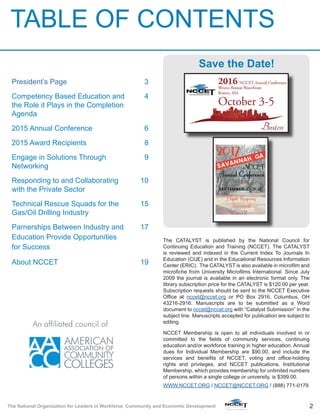
Save the Date!
3The National Organization for Leaders in Workforce, Community and Economic Development
To our members
who attended this
year’s NCCET
Annual Conference–
THANK YOU!
Because of your
involvement it was
one of the best we
have held! The presentations were
outstanding and we had very positive
feedback from every session. Our
members are very appreciative that
you took the time to share your best
practices with others. We all walked
away with many more tools in our toolkit
to take back home and implement
immediately. We encourage our
presenters to submit your presentations
for future NCCET webinars, Catalyst
articles and white papers.
In addition, we hope that you are
encouraged to get more involved
by joining one of our seven sub-
committees. It is through the sub-
committees that we typically select our
NCCET Board members.
The presentations, other than
the keynotes, are available to our
membership in the member’s only
section of the website so that those
members who could not make it this
year can still benefit.
To our corporate partners,
sponsors, exhibitors –
THANK YOU!
This year we had the highest quality
of services and products represented.
I personally plan to follow up with many of
you and I am sure so will my colleagues.
You are all experts in your fields and we
enjoyed your enthusiasm each day. We
hope that your time will lead to many
new business relationships.
To all of you from the great city
of Portland and state of Oregon–
THANK YOU!
We could not have painted more
picturesque landscaping and mountain
top views. Those of us who participated
in the social events, walked off more
than we ate….well, almost.
To our Executive Director, Jennifer
Starkey, and her team – THANK YOU!
Wow. You could teach the class in
event planning and management at any
of our community colleges, anytime!
To our Board – THANK YOU!
It is our combined vision that we
selected the excellent keynote speakers
and reached out to the best experts
in continuing education, community
education, and contract training in the
United States to play a role in this year’s
conference.
Please remember to:
1.	 Take one great new idea to your
college president that you want to
implement at your college.
2.	 Connect with at least one new
colleague from another college.
3.	 Get involved with NCCET!
Please reach out to me directly if I can
help you with your important work at
your campus.
In appreciation,
PRESIDENT’S PAGE
By Linda Head
Lone Star College System
Linda Head
President, NCCET
Our primary mission is to share best
practices among our members,providing
“Solutions Through Networking”.
The NCCET Conference is a dynamic
event where individuals attend to
learn, network, and take away valuable
information that they can use in their
current work. Keep up-to-date on new
trends, help maintain a personal and
professional network, and access the
latest leading-edge programs throughout
the country.
A blend of stylish sophistication and rich
history awaits you in BOSTON, MA
during the 2016 NCCET Conference.
This vibrant city is renowned for its
cultural facilities,world-class educational
institutions,champion sports franchises,
as well as its place at the very forefront
of American history.
Fast forward to 2017 and experience
the southern hospitality that awaits
you in beautiful SAVANNAH, GA.
Quaint cobblestone streets and majestic
architecture are sure to please.
So mark your calendars now to join us
in BOSTON and SAVANNAH!
CLICK HERE to get involved!
View conference presentations
at NCCET.org
4The National Organization for Leaders in Workforce, Community and Economic Development
There are trends
and realities facing
leaders in Higher
Education that
we can no longer
ignore. With
declining numbers
of high-school
graduates (in much
of the country),
reduced state and federal spending
on higher education and increased
competition for students, we have to
expand our efforts as we recruit, retain,
and get students to complete what they
start at our institutions.
Competency Based Education (CBE)
focuses more on what students
learn, rather than where or how long
the learning takes place. Instead of
evaluating a student’s progress in a
course or the amount of time they’ve
spent in a classroom, students can
receive college credit based on their
actual demonstration of skills learned.
With traditional education, time is
fixed and mastery is variable. In CBE,
mastery is fixed, and time is variable.
In 2011, the United States Secretary of
Education, Arne Duncan, was quoted
from the New York Times saying, “While
competency-based programs are now
the exception, I want them to be the
norm.”
While there are some on-line programs
that are 100% competency based, I
support the flexibility of competency-
based strategies to increase and
accelerate students’ completion goals.
Credits can be earned or awarded
with the following: online learning,
blended learning, continuing education
credit, dual enrollment, early college
high school, project-based learning,
community-based learning, credit
recovery, and others. Furthermore,
if students possess certifications or
licenses in their profession and have an
American Council on Education (ACE)
documented transcript, they could
receive college credit for numerous
courses without having to acquire
seat time in courses when they’ve
already mastered the material and can
demonstrate the skills.
If institutions want to go full fledge,
federal funding is an option. Schools
that offer direct assessment programs
must apply to the Department of
Education to be considered for Title
IV eligibility. According to The United
States Department of Education’s Office
of the Inspector General, “As of January
23, 2014, only five schools (Argosy
University, Capella University, Northern
Arizona University, Southern New
Hampshire University, and University
of Wisconsin Colleges) had submitted
direct assessment program applications
to the Department. Capella University
and Southern New Hampshire
University were the only two schools
whose applications the Department
had approved.”
Schools must submit applications
that describe the credential offered,
how the program is structured, how
student learning will be assessed,
the methodology used to determine
credit-or clock-hour equivalencies for
the program, and proof of an evaluation
from the institution’s accrediting agency.
Most higher education institutions are
poised to increase student completion
by promoting CBE and already have
pieces in place to assess students for
credit: Achieved Prior Learning (APL);
College Level Examination Program
(CLEP); and Proficiency Exams.
Students who could benefit most from
CBE are often adults with extensive
work experience and those with
military experience. Adults with
years of work experience could earn
competencies and quickly complete
credentials. Reduced time to earn
credentials means that students will
be able to maintain other personal and
professional obligations as long as they
possess self-discipline.
The idea that there is a lack of academic
rigor is a common concern among
faculty members when transitioning to
CBE programs. To avoid this pitfall,
faculty inclusion and input into the
development of competencies builds
support and enthusiasm for change.
Competency-based curriculum
development can be
implemented in three phases:
1.	 Faculty committees select
core competencies from
existing course syllabi;
2.	 Faculty develops
competency assignments
and assessments;
3.	 and Department chair
reviews final curriculum
proposals to evaluate
rigor of the course and/or
program.
The Education Advisory Board (EAB)
shared a competency credit equivalent
equation suggesting that “program
directors map every competency
directly from a course objective using a
simple equation to determine the value
of each competency. To determine the
credit equivalency of a competency,
divide the total credits of the course
by the total number of competencies
included in the course.”
Continued on page 5
Competency Based Education and
The Role it Plays in the Completion Agenda
by Lisa M. Bly, Assistant Dean, Workforce Development & Community Service
Moraine Valley Community College
5The National Organization for Leaders in Workforce, Community and Economic Development
With growing public scrutiny that
questions the value and relevance of
college credentials, leaders in higher
education should make it a priority to
remove barriers for completing and/
or returning students in pursuit of
certificates or degrees beyond high
school.
Players in the academic marketplace
continue to expand exponentially,
including philanthropic foundations
funding educational programs. When
programs are funded and others
partner with academic institutions, the
expectations are that specific outcomes
will be met in a timely manner that may
not always fit nicely and/or neatly in our
current academic structure.
If we strategically decide to promote
competency-based education and
create agreements with four year
institutions, it might be possible to
develop a new pool of students and
increase college graduates across the
country.
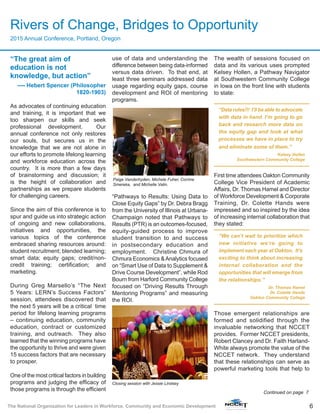
Source: Quick Facts from the
US Census Bureau
USA High school graduate or
higher, percent of persons age
25+ (2009 – 2013) 86%
OPPORTUNITIES FOR US
USA Bachelor’s degree
or higher, percent of persons age
25+
(2009 – 2013) 	 28.8%
If colleges can show students an
accelerated pathway to completion,
higher education no longer appears
daunting, never-ending and beyond their
reach. As we consistently support our
students with creative and innovative
approaches, we collectively contribute
to the National Completion Goal to be
met by 2020.
Continued from page 4
6The National Organization for Leaders in Workforce, Community and Economic Development
Rivers of Change, Bridges to Opportunity
2015 Annual Conference, Portland, Oregon
“The great aim of
education is not
knowledge, but action”
---- Hebert Spencer (Philosopher
1820-1903)
As advocates of continuing education
and training, it is important that we
too sharpen our skills and seek
professional development. Our
annual conference not only restores
our souls, but secures us in the
knowledge that we are not alone in
our efforts to promote lifelong learning
and workforce education across the
country. It is more than a few days
of brainstorming and discussion; it
is the height of collaboration and
partnerships as we prepare students
for challenging careers.
Since the aim of this conference is to
spur and guide us into strategic action
of ongoing and new collaborations,
initiatives and opportunities, the
various topics of the conference
embraced sharing resources around:
student recruitment; blended learning;
smart data; equity gaps; credit/non-
credit training; certification; and
marketing.
During Greg Marsello’s “The Next
5 Years: LERN’s Success Factors”
session, attendees discovered that
the next 5 years will be a critical time
period for lifelong learning programs
– continuing education, community
education, contract or customized
training, and outreach. They also
learned that the winning programs have
the opportunity to thrive and were given
15 success factors that are necessary
to prosper.
One of the most critical factors in building
programs and judging the efficacy of
those programs is through the efficient
use of data and understanding the
difference between being data-informed
versus data driven. To that end, at
least three seminars addressed data
usage regarding equity gaps, course
development and ROI of mentoring
programs.
“Pathways to Results: Using Data to
Close Equity Gaps” by Dr. Debra Bragg
from the University of Illinois at Urbana-
Champaign noted that Pathways to
Results (PTR) is an outcomes-focused,
equity-guided process to improve
student transition to and success
in postsecondary education and
employment. Christine Chmura of
Chmura Economics &Analytics focused
on “Smart Use of Data to Supplement &
Drive Course Development”, while Rod
Bourn from Harford Community College
focused on “Driving Results Through
Mentoring Programs” and measuring
the ROI.
The wealth of sessions focused on
data and its various uses prompted
Kelsey Hollen, a Pathway Navigator
at Southwestern Community College
in Iowa on the front line with students
to state:
“Data rules!!! I’ll be able to advocate
with data in hand. I’m going to go
back and research more data on
the equity gap and look at what
processes we have in place to try
and eliminate some of them.”
Kelsey Hollen
Southwestern Community College
First time attendees Oakton Community
College Vice President of Academic
Affairs, Dr. Thomas Hamel and Director
of Workforce Development & Corporate
Training, Dr. Colette Hands were
impressed and so inspired by the idea
of increasing internal collaboration that
they stated:
“We can’t wait to prioritize which
new initiative we’re going to
implement each year at Oakton. It’s
exciting to think about increasing
internal collaboration and the
opportunities that will emerge from
the relationships.”
Dr. Thomas Hamel
Dr. Colette Hands
Oakton Community College
Those emergent relationships are
formed and solidified through the
invaluable networking that NCCET
provides. Former NCCET presidents,
Robert Clancey and Dr. Faith Harland-
White always promote the value of the
NCCET network. They understand
that these relationships can serve as
powerful marketing tools that help to
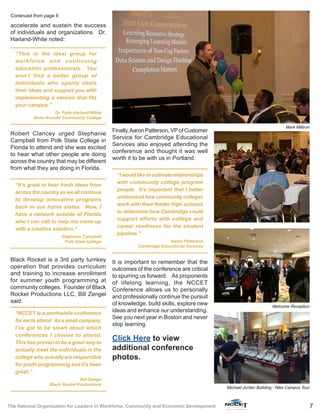
Paige Vanderhyden, Michele Fuher, Corrine
Smereka, and Michelle Valin.
Closing session with Jessie Lindsey
Continued on page 7
7The National Organization for Leaders in Workforce, Community and Economic Development
accelerate and sustain the success
of individuals and organizations. Dr.
Harland-White noted:
“This is the ideal group for
workforce and continuing
education professionals. You
won’t find a better group of
individuals who openly share
their ideas and support you with
implementing a version that fits
your campus.”
Dr. Faith Harland-White
Anne Arundel Community College
Robert Clancey urged Stephanie
Campbell from Polk State College in
Florida to attend and she was excited
to hear what other people are doing
across the country that may be different
from what they are doing in Florida.
“It’s great to hear fresh ideas from
across the country as we all continue
to develop innovative programs
back in our home states. Now, I
have a network outside of Florida
who I can call to help me come up
with a creative solution.”
Stephanie Campbell
Polk State College
Black Rocket is a 3rd party turnkey
operation that provides curriculum
and training to increase enrollment
for summer youth programming at
community colleges. Founder of Black
Rocket Productions LLC, Bill Zengel
said:
“NCCET is a worthwhile conference
for me to attend. As a small company,
I’ve got to be smart about which
conferences I choose to attend.
This has proven to be a great way to
actually meet the individuals in the
college who actually are responsible
for youth programming and it’s been
great.”
Bill Zengel
Black Rocket Productions
Finally,Aaron Patterson, VPof Customer
Service for Cambridge Educational
Services also enjoyed attending the
conference and thought it was well
worth it to be with us in Portland.
“I would like to cultivate relationships
with community college program
people. It’s important that I better
understand how community colleges
work with their feeder high schools
to determine how Cambridge could
support efforts with college and
career readiness for the student
pipeline.”
Aaron Patterson
Cambridge Educational Services
It is important to remember that the
outcomes of the conference are critical
to spurring us forward. As proponents
of lifelong learning, the NCCET
Conference allows us to personally
and professionally continue the pursuit
of knowledge, build skills, explore new
ideas and enhance our understanding.
See you next year in Boston and never
stop learning.
Continued from page 6
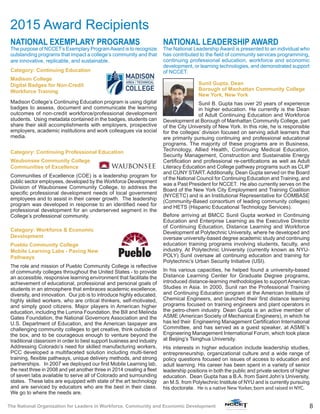
Mark Milliron
Welcome Reception
Click Here to view
additional conference
photos.
Michael Jordan Building - Nike Campus Tour
8The National Organization for Leaders in Workforce, Community and Economic Development
NATIONAL EXEMPLARY PROGRAMS
The purpose of NCCET’s Exemplary ProgramAward is to recognize
outstanding programs that impact a college’s community and that
are innovative, replicable, and sustainable.
Category: Continuing Education
Madison College
Digital Badges for Non-Credit
Workforce Training
Madison College’s Continuing Education program is using digital
badges to assess, document and communicate the learning
outcomes of non-credit workforce/professional development
students. Using metadata contained in the badges, students can
share their skill accomplishments with employers, prospective
employers, academic institutions and work colleagues via social
media.
Category: Continuing Professional Education
Waubonsee Community College
Communities of Excellence
Communities of Excellence (COE) is a leadership program for
public sector employees, developed by the Workforce Development
Division of Waubonsee Community College, to address the
specific professional development needs of local government
employees and to assist in their career growth. The leadership
program was developed in response to an identified need for
professional development for an underserved segment in the
College’s professional community.
Category: Workforce & Economic
Development
Pueblo Community College
Mobile Learning Labs - Paving New
Pathways
The role and mission of Pueblo Community College is reflective
of community colleges throughout the United States - to provide
an accessible, responsive learning environment that facilitate the
achievement of educational, professional and personal goals of
students in an atmosphere that embraces academic excellence,
diversity, and innovation. Our job is to introduce highly educated,
highly skilled workers, who are critical thinkers, self-motivated,
and simply good citizens. Major players in American higher
education, including the Lumina Foundation, the Bill and Melinda
Gates Foundation, the National Governors Association and the
U.S. Department of Education, and the American taxpayer are
challenging community colleges to get creative, think outside of
the box, and to be courageous enough to venture beyond the
traditional classroom in order to best support business and industry
Addressing Colorado’s need for skilled manufacturing workers,
PCC developed a multifaceted solution including multi-tiered
training, flexible pathways, unique delivery methods, and strong
partnerships. In 2007 we deployed our first Mobile Learning lab,
the next three in 2008 and yet another three in 2014 creating a fleet
of seven labs available to serve all of Colorado and surrounding
states. These labs are equipped with state of the art technology
and are serviced by educators who are the best in their class.
We go to where the needs are.
NATIONAL LEADERSHIP AWARD
The National Leadership Award is presented to an individual who
has contributed to the field of community services programming,
continuing professional education, workforce and economic
development, or learning technologies, and demonstrated support
of NCCET.
Sunil Gupta, Dean
Borough of Manhattan Community College
New York, New York
Sunil B. Gupta has over 20 years of experience
in higher education. He currently is the Dean
of Adult Continuing Education and Workforce
Development at Borough of Manhattan Community College, part
of the City University of New York. In this role, he is responsible
for the colleges’ division focused on serving adult learners that
are primarily pursuing continuing and professional educational
programs. The majority of these programs are in Business,
Technology, Allied Health, Continuing Medical Education,
Security Management, Construction and Sustainable Energy
Certification and professional re-certifications as well as Adult
Literacy Education and College pathway programs such as CLIP
and CUNY START. Additionally, Dean Gupta served on the Board
of the National Council for Continuing Education and Training, and
was a Past President for NCCET. He also currently serves on the
Board of the New York City Employment and Training Coalition
(NYCETC) and is an Institutional Representative for COMBASE
(Community-Based consortium of leading community colleges)
and HETS (Hispanic Educational Technology Services).
Before arriving at BMCC Sunil Gupta worked in Continuing
Education and Enterprise Learning as the Executive Director
of Continuing Education, Distance Learning and Workforce
Development at Polytechnic University, where he developed and
oversaw university-based degree academic study and continuing
education training programs involving students, faculty, and
industry. At Polytechnic University (currently known as NYU-
POLY) Sunil oversaw all continuing education and training for
Polytechnic’s Urban Security Initiative (USI).
In his various capacities, he helped found a university-based
Distance Learning Center for Graduate Degree programs,
introduced distance-learning methodologies to support American
Studies in Asia. In 2000, Sunil ran the Professional Training
and Continuing Education program at the American Institute of
Chemical Engineers, and launched their first distance learning
programs focused on training engineers and plant operators in
the petro-chem industry. Dean Gupta is an active member of
ASME (American Society of Mechanical Engineers), in which he
has led their Engineering Management Certification International
Committee, and has served as a guest speaker, at ASME’s
Engineering Management International Forum, which took place
at Beijing’s Tsinghua University.
His interests in higher education include leadership studies,
entrepreneurship, organizational culture and a wide range of
policy questions focused on issues of access to education and
adult learning. His career has been spent in a variety of senior
leadership positions in both the public and private sectors of higher
education. Dean Gupta has a B.A. from Saint John’s University,
an M.S. from Polytechnic Institute of NYU and is currently pursuing
his doctorate. He is a native New Yorker, born and raised in NYC.
2015 Award Recipients
9The National Organization for Leaders in Workforce, Community and Economic Development
Engage in Solutions Through Networking
by Jennifer Starkey, NCCET Executive Director
During the 2015
Annual Conference
in Portland, OR
the NCCET Board
o f D i r e c t o r s
announced a
new tag line and
branding. “NCCET
– Solutions Through
Networking”. Those
in attendance had many opportunities
to network with colleagues they know
and make new networking connections.
Did you know, there are many more
opportunities available through your
NCCET membership to expand your
network? I’d like to tell you about a
few of these Member’s Only benefits
and invite you to engage in Solutions
Through Networking.
Community
The NCCET online community is a
private social networking site developed
just for members of NCCET. If you have
been a member of NCCET for a while,
you will remember the old listserv where
the “replies-to-all” bogged down and
filled your email. That technology is
gone! The new online community puts
you in control of how often you receive
updates from the community. To gain
this control, you must first “opt-in” by
accepting the invitation in your email.
Didn’t receive the invitation? – contact
the NCCET Executive Office. Once you
have joined the community – engage;
create a new post, share a best practice,
or ask your colleagues a question.
Committees
Do you like to roll-up your sleeves and dig
into the details? There are opportunities
in a wide variety of committees to get
more involved in the inner workings
of NCCET, network with colleagues,
and maybe even lay the foundation
for future leadership opportunities with
the Board of Directors. The 2015-2016
committees are:
•	 Annual Conference Planning
•	 Awards Committee
•	 Business Development
•	 Communications
•	 Membership
•	 Nominations
•	 Policy
If one of these committees sounds
interesting to you, Click Here to
complete the online volunteer form
and the committee chair will be in
touch with you.
Webinars
Don’t let personal development stop
now that the conference is over. Keep
an eye out for the NCCET Webinar
series to start again after the first of
the year. Have a topic you would like
to hear more about, or one you would
like to present? Reach out to Tracy
Curvin, NCCET’s Director of Events at
tracy@executive-office.org.
Catalyst
Connect through the written word by
authoring an article in an upcoming
issue of Catalyst. Your continuing
education program, best practice, or
community education project may be
just the solution your colleagues are
seeking. Contact Ruth Handelman,
NCCET’s Director of Communications
at ruth@executive-office.org to learn
more about how you can contribute.
If you have other ideas of benefits or
networking opportunities you would like
to share, please don’t hesitate to send
an email to nccetdirector@nccet.org or
give me a call at (888) 771-0179.
We look forward to hearing from you!
Jennifer Starkey
Executive Director
Stay tuned for the NCCET
Webinar series to start again
after the first of the year.
CLICK HERE and tell us what
topics or ideas you have for
upcoming webinars.
On-Demand Webinars
at nccet.org
View these educational
opportunitiesonYOURschedule.
Available 24/7 in the Members
Only section of NCCET.ORG.
CLICK HERE to view on-demand
webinars.
NCCET Seeks
Contributors to
CATALYST
2016 Article Submission
Deadlines
•	 February Issue
December 30, 2015
•	 June Issue
May 1, 2016
•	 October Issue
September 3, 2016
Contact Ruth at the executive
office at (888) 771--179 or
ruth@executive-office.org
10The National Organization for Leaders in Workforce, Community and Economic Development
Broader Middle East and North
Africa–U.S. Community College
Initiative
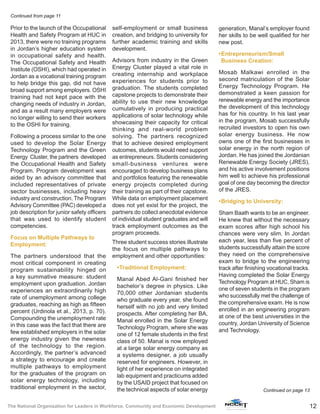
AUTHORS
Joan Smith
Dean and Executive Director
Rocky Mountain Education Center
Red Rocks Community College
Colorado
Dr. Ayman Maqableh
Dean
Al Quds College
Amman, Jordan
Rula Sabbagh-Kawar
Senior HR Specialist Training
Consolidated Contractors Company
Amman, Jordan
EDITOR
Matthew Kuehl
Senior Program Specialist
Higher Education for Development
INTRODUCTION
In the context of a need for greater
employment opportunities for youth
in Jordan and prompted by a shared
belief in engaging private industry and
sustaining their involvement in the
design of workforce education training,
Al-Huson University College (HUC) in
Jordan and Red Rocks Community
College (RRCC) in the United States,
collaborated to develop new workforce
education programs in the emerging
renewable energy and occupational
health and safety sectors in Jordan.
The project began in 2010 when
Dr. Ayman Maqableh, an associate
professor at Al-Huson University
College, contacted Red Rocks
Community College Dean Joan W.
Smith regarding RRCC’s success in
developing solar energy technicians
in Colorado. Their initial conversations
focused on HUC’s innovative idea for a
proposed renewable energy program,
the Green Energy Cluster, in which
employers and other stakeholders
would provide curriculum oversight,
guest lecturing, and student internships.
One novel aspect of the Cluster concept
that RRCC found particularly intriguing
is that it sought industry input prior to
the establishment of a degree program.
The Green Energy Cluster became
the foundation for a five-year project
developed by the two institutions and
funded by USAID through a Higher
Education for Development sub-
award and scale-up totaling just over
$500,000.
The authentic engagement in the
Cluster by private industry and regional
stakeholders greatly expedited the work
of the partners in this effort and, just
one year after their initial conversation,
students were enrolling in the HUC
Solar Energy Technology Program in
Irbid, Jordan. This paper describes
the process of working with industry
stakeholders and how the two partners
leveraged both public and private sector
support to successfully implement new
degree programs at HUC.
Continued on page 11
Responding to and Collaborating With the
Private Sector:
A Road Map To Stakeholder Engagement In Workforce Development In Jordan
11The National Organization for Leaders in Workforce, Community and Economic Development
PARTNER INSTITUTIONS
Red Rocks Community College,
opened in 1969, is one of 17 colleges
in the Colorado Community College
System. RRCC has campuses in
Lakewood and Arvada, Colorado,
both suburbs of Denver. RRCC
averages an annual enrollment of
12,000 students and offers more than
650 technical certificate programs in
addition to associate degrees in the
arts and applied sciences. RRCC also
developed the first Bachelor of Applied
Science to be conferred by a community
college in Colorado, in water quality
management. Joan W. Smith, the RRCC
representative for the partnership, is
dean and executive director of technical
programs at RRCC, including the
renewable energy technology and the
water quality management programs.
Ms. Smith leads the continuing
education division of the college as
the executive director of the Rocky
Mountain Education Center, which is
authorized by the U.S. Department of
Labor Occupational Safety and Health
Administration (OSHA) as a regional
OSHA Education and Training Institute.
Al-Huson University College (HUC),
located in Irbid, is one of 43 two-
year colleges in Jordan. The Al Balqa
Applied University System oversees
the two-year schools, which include
both public and private institutions.
Program approval authority is vested
in the Deans Council of the Al Balqa
Applied University System. HUC has a
track record of successfully working with
USAID Jordan since 2007, when the
USAID Jordan Economic Development
Program funded the establishment of
the Al-Huson Career Development
Center, the first of its kind at any
academic institute in Jordan. Dr.Ayman
Maqableh, the HUC representative to
the partnership, served as director
of the Career Development Center,
which connects with private industry
to help students find jobs. HUC also
previously participated in public-private
partnerships through the USAID/
Jordan SHARAKA initiatives, which
matched vocational trainees and
students with labor market demands
by offering graduates internships,
scholarships, and on-the-job training
in cooperation with the public sector.
Private partners began looking to HUC
for specific workforce training (e.g., the
Consolidated Contractors Company
supporting the Piping Technology
Training Program at the HUC campus),
and partners leveraged and expanded
these private/public partnership models
at HUC under the new HED funding.
CONTEXT IN JORDAN AND
DEVELOPMENT OF THE
PROJECT
The workforce programs developed by
the partners were grounded in Jordan’s
policies and economic development
goals and designed with student
employment outcomes in mind.
Solar Energy Technology Program:
The Jordanian Energy Strategy,
issued in 2007, sought to address the
unmanageable cost of the country’s
energy consumption, which had
reached 20 percent of Jordan’s annual
gross domestic product. The strategy
set a goal to increase the share
of renewable energy in its energy-
use portfolio to 10 percent by 2020
(International Energy Agency, 2013).
The generation of electricity from
solar has been comparatively slow in
coming to the Middle East, however the
Renewable Energy and Efficiency Law,
passed by the Jordanian parliament in
2011, (GreenPeace, 2013, p. 4) pushed
the country toward wider adoption of
renewable sources of power, including
solar.
The Green Energy Cluster (GEC),
formed by HUC in 2010, engaged
new and developing solar energy
companies and stakeholders that have
a vested interest in creating a technical
workforce to achieve ambitious goals for
renewable energy production in Jordan.
The GEC was modeled after existing
public/private partnerships in higher
education developed at HUC through
previous initiatives, such as the USAID-
funded Career Development Center, the
SHARAKA project’s efforts to promote
relations between the European Union
and the Gulf Cooperation Council, and
a piping technology training program
supported by the Consolidated
Contractors Company.
Through the GEC, the private sector
supported HUC and RRCC staff and
faculty in adapting a curriculum provided
by RRCC to employer expectations and
working conditions in Jordan.
Occupational Health and Safety
Program:
Following successful networking with
and feedback from the employers and
stakeholders engaged in the Solar
Energy Technology Program, the
partners also undertook to develop a
program in occupational health and
safety.
Jordan’s Labour Code includes
provisions for stiff penalties for
workplace violations that result in
worker injury or death, including the
permanent closing of a business. Under
the Code, and as part of a national
strategy to improve worker safety and
health, the Minister of Labour may
appoint safety supervisors to be present
at worksites (ILO, 1996). Estimates of
the number of safety supervisors that
are needed in Jordan exceed 5,000.
To date these positions have not been
fully filled primarily due to a lack of
qualified personnel. The occupational
safety and health professionals that
do work in Jordan tend to be foreign
nationals that have been brought to
Jordan by an employer that contracts
with non-Jordanian companies that
require worker safety programs.
Continued from page 10
Continued on page 12
12The National Organization for Leaders in Workforce, Community and Economic Development
Prior to the launch of the Occupational
Health and Safety Program at HUC in
2013, there were no training programs
in Jordan’s higher education system
in occupational safety and health.
The Occupational Safety and Health
Institute (OSHI), which had operated in
Jordan as a vocational training program
to help bridge this gap, did not have
broad support among employers. OSHI
training had not kept pace with the
changing needs of industry in Jordan,
and as a result many employers were
no longer willing to send their workers
to the OSHI for training.
Following a process similar to the one
used to develop the Solar Energy
Technology Program and the Green
Energy Cluster, the partners developed
the Occupational Health and Safety
Program. Program development was
aided by an advisory committee that
included representatives of private
sector businesses, including heavy
industry and construction. The Program
Advisory Committee (PAC) developed a
job description for junior safety officers
that was used to identify student
competencies.
Focus on Multiple Pathways to
Employment:
The partners understood that the
most critical component in creating
program sustainability hinged on
a key summative measure: student
employment upon graduation. Jordan
experiences an extraordinarily high
rate of unemployment among college
graduates, reaching as high as fifteen
percent (Urdinola et al., 2013, p. 70).
Compounding the unemployment rate
in this case was the fact that there are
few established employers in the solar
energy industry given the newness
of the technology to the region.
Accordingly, the partner’s advanced
a strategy to encourage and create
multiple pathways to employment
for the graduates of the program on
solar energy technology, including
traditional employment in the sector,
self-employment or small business
creation, and bridging to university for
further academic training and skills
development.
Advisors from industry in the Green
Energy Cluster played a vital role in
creating internship and workplace
experiences for students prior to
graduation. The students completed
capstone projects to demonstrate their
ability to use their new knowledge
cumulatively in producing practical
applications of solar technology while
showcasing their capacity for critical
thinking and real-world problem
solving. The partners recognized
that to achieve desired employment
outcomes, students would need support
as entrepreneurs. Students considering
small-business ventures were
encouraged to develop business plans
and portfolios featuring the renewable
energy projects completed during
their training as part of their capstone.
While data on employment placement
does not yet exist for the project, the
partners do collect anecdotal evidence
of individual student graduates and will
track employment outcomes as the
program proceeds.
Three student success stories illustrate
the focus on multiple pathways to
employment and other opportunities:
•	Traditional Employment:
Manal Abed Al-Gani finished her
bachelor’s degree in physics. Like
70,000 other Jordanian students
who graduate every year, she found
herself with no job and very limited
prospects. After completing her BA,
Manal enrolled in the Solar Energy
Technology Program, where she was
one of 12 female students in the first
class of 50. Manal is now employed
at a large solar energy company as
a systems designer, a job usually
reserved for engineers. However, in
light of her experience on integrated
lab equipment and practicums added
by the USAID project that focused on
the technical aspects of solar energy
generation, Manal’s employer found
her skills to be well qualified for her
new post.
•	Entrepreneurism/Small
Business Creation:
Mosab Malkawi enrolled in the
second matriculation of the Solar
Energy Technology Program. He
demonstrated a keen passion for
renewable energy and the importance
the development of this technology
has for his country. In his last year
in the program, Mosab successfully
recruited investors to open his own
solar energy business. He now
owns one of the first businesses in
solar energy in the north region of
Jordan. He has joined the Jordanian
Renewable Energy Society (JRES),
and his active involvement positions
him well to achieve his professional
goal of one day becoming the director
of the JRES.
•	Bridging to University:
Sham Baath wants to be an engineer.
He knew that without the necessary
exam scores after high school his
chances were very slim. In Jordan
each year, less than five percent of
students successfully attain the score
they need on the comprehensive
exam to bridge to the engineering
track after finishing vocational tracks.
Having completed the Solar Energy
Technology Program at HUC, Sham is
one of seven students in the program
who successfully met the challenge of
the comprehensive exam. He is now
enrolled in an engineering program
at one of the best universities in the
country, Jordan University of Science
and Technology.
Continued on page 13
Continued from page 11
13The National Organization for Leaders in Workforce, Community and Economic Development
RECOMMENDATIONS
The partners have distilled three
primary recommendations targeted
primarily for those involved in or
considering educational strategies that
seek to improve participant employment
outcomes.
When Enrolling Students, Use a
Rigorous Selection Process Aligned
With Employer Needs:
The partnership successfully added the
Solar Energy Technology Program to
the engineering pathway, which helped
to ensure that student applicants had
educational backgrounds and English
language skills equal to the rigor of
the level of study in that program.
Also, procedures were put into place
that allowed the program to accept
students with higher scores on the
Tawjihi, Jordan’s general secondary
national exam, and students who had
already obtained a bachelor’s degree.
The ability to accept highly qualified
students was key to the program’s
early success in retaining students and
exceeding graduation goals within the
program’s first three years.
As discussed above, decisions made
outside of the partnership posed
challenges for the Occupational
Health and Safety Program when that
program was classified as part of the
liberal arts versus engineering pathway.
One result of that decision was that
students applying for the Occupational
Health and Safety Program lacked
the requisite educational background
and English language skills that the
program required. The partnership
responded by modifying the program’s
assessment and instruction strategies.
However, the partnership did not
consider this modification a long term
solution, and continued to advocate
for its classification in the engineering
pathway to ensure the appropriate
pre-requisite knowledge. The current
class of students in the program is not
expected to graduate at the same rate
as students in the solar technology
program; however, future incoming
students to the Occupational Health
and Safety Program will enter with more
appropriate skills after its classification
in engineering.
Develop Instructional Staff Before
Program Launch and Include Detailed
Plans for Training of Trainers as Part
of Program Development:
As new programs are created,
consideration must be given to the
availability of instructional staff long-
term. While the engineering focus of
the program on solar energy technology
helped it attract qualified faculty, the
experience with the program on
occupational health and safety was
different. The latter program requires
faculty with formal education in the
management of health and safety in the
workplace as well as field experience
in industry. In the Irbid region,
individuals with such skills are found
only in industry and do not have formal
training in teaching at the university
level. The launch of the Occupational
Health and Safety Program was
therefore significantly challenged by
the lack of qualified faculty. While the
private sector partner CCC stepped
forward to offer a competitive salary to
allow recruitment of an instructor from
industry, which allowed the program
to launch as scheduled, this strategy
cannot be considered a long-term
solution given that the associated cost
structure is not sustainable. Efforts are
under way to create a train-the-trainer
opportunity with a new commitment
from Al-Balqa Applied University to
refocus efforts on recruiting instructors
for the Occupational Health and Safety
Program who can participate in intensive
training prior to classroom instruction.
The partnership sought involvement
from a broad range of stakeholders to
ensure the currency of the programs
with regard to employer demands
and expectations. Industry advisory
members were engaged from the
beginning of program development
to guide the curricula objectives and
teaching strategies. The advisory
members have been instrumental in
providing workplace experiences to
students prior to graduation. Advisors
for the program on solar energy
technology have included NOOR Solar
and Philadelphia Solar. Advisors for the
program on occupational health and
safety have included PepsiCo, PETRA
HVAC, Consolidated Contractors
Company, and the As-Samra
Wastewater Treatment Plant. Faculty in
the program on solar energy technology
have taken advantage of industry-
recognized training opportunities to
increase their knowledge of evolving
renewable energy technologies. Faculty
participated in a two-week training
from renewable energy companies in
Germany, and the HUC partnership
director Dr.Ayman Maqableh completed
HSE training in OSHAstandards during
a J-1 visa visit to the U.S. partner.
FURTHER OBSERVATIONS
In closing, two further observations
warrant mentioning.
The Implicit Value of Engagement
by Industry Partners Cannot be
Overstated:
The strong tradition of workforce
development at community colleges
offers many opportunities to engage
with the private sector. Employers
have a vested interest in increasing the
relevancy of technical and vocational
degree programs and aligning the
skills of graduates with the needs of
industry. Public-private partnerships
build mutually-beneficial relationships
by engaging employers with higher
education institutions through such
activities as developing curriculum,
designing and equipping lab space,
or creating internships and pathways
to employment. Many private-sector
partners have an interest not just in
creating better-trained graduates, but
in creating a legacy of contributing
Continued on page 14
Continued from page 12
14The National Organization for Leaders in Workforce, Community and Economic Development
value to their industry. For example, the
development of the new solar energy
lab space on the HUC campus and
renovation of an entireAl-BalqaApplied
University campus for the Occupational
Health and Safety Program by
Consolidated Contractors Company
were invaluable in engendering
enthusiasm among students for
the opening of the programs. The
value of this participation cannot be
overstated—indeed, it is vital for a
program’s success.
All Program Partners Must Agree to
Help Ensure Successful Program
Outcomes:
While unemployment in Jordan
affects the working class the most, it
also afflicts the middle class. Given
this context, training must take into
consideration the potential societal
effect of the instruction. If students are
not employable at the end of a program,
the training may be considered worse
than no program at all.
Unless every stakeholder—including
government, private industry, higher
education, and program participants—
agrees and commits to the outcome of
training, individuals who successfully
complete educational programs
may still find themselves unable to
find employment. Direct employer
engagement at every stage of the
student’s learning experience through
internships, guest lecturing, job
shadowing, mentoring, and engagement
with faculty helps to ensure that
students are job-ready at graduation.
Toward these goals, the partners
sought and received commitments
from industry, educational institutions,
and the Jordanian government prior
to developing and implementing the
programs. The partners were successful
in sustaining these commitments
because students had the skills upon
graduation that employers requested
and expected. To further help ensure
successful student outcomes, the
program partners emphasized
diversification in student learning,
including development of portfolios
and skills in marketing themselves to
potential employers.
AUGUST 2015
This case study is made possible by
the generous support of the American
people through the United States
Agency for International Development
(USAID) and the Higher Education
for Development (HED) program.
The authors’ views expressed in this
publication do not necessarily reflect
the views of HED, USAID, or the United
States Government.
REFERENCES
Angel-Urdinola, D., Kuddo, A., & Sem-
lali, A. (Eds.). (2013). Building Effective
Employment Programs for Unemployed
Youth in the Middle East and North Afri-
ca. Directions in Development: Human
Development. Retrieved August 31,
2015, from https://openknowledge.world-
bank.org/bitstream/handle/10986/15805/
792620PUB0EPI10Box0377371B00Pub-
lic0.pdf?sequence=1
Helmore, K., & Jamal, Z. (Eds.). (2003).
Arab Human Development Report 2003:
Building a Knowledge Society. Retrieved
August 31, 2015, from http://www.ar-
ab-hdr.org/publications/other/ahdr/ah-
dr2003e.pdf
Jordan Labour codes, general labour
and employment acts. (1996, April
16). Retrieved August 31, 2015, from
http://www.ilo.org/dyn/natlex/natlex4.
detail?p_lang=en&p_isn=45676&p_
count=96239&p_classification=01.02&p_
classcount=1073
Jordan’s Future Engergy. (2013, Febru-
ary 1). Retrieved August 31, 2015, from
http://www.greenpeace.org/arabic/Page-
Files/481146/Jordan_Report2013.pdf
Renewable Energy & Efficiency (Law No.
13). (2013, July 23). Retrieved August
31, 2015, from http://www.iea.org/poli-
ciesandmeasures/pams/jordan/name-
36862-en.php
Continued from page 13
Click Here for details
Contact MarCee at the Executive Office
at (888) 771-0179, or
marcee@executive-office.org
SHOWCASE YOUR BUSINESS OR ORGANIZATION!
Catalyst is the official publication of NCCET. It is published tri-annually and distributed to members, participating
institutions, and others in the field of continuing educaton and training. There are currently 1500+ member and non-
member subscribers, both national and international. Each issue is archived and accessible via the members-only
section of nccet.org.
15The National Organization for Leaders in Workforce, Community and Economic Development
As the oil and gas industry cycles
up and down, our community and
technical colleges continue to
provide critical training for workers
in this industry. Safety remains the
fundamental part of training in both
continuing education and college
credit programming for this and
related industries. The following
article focuses on just one area of
opportunity community colleges have to provide training
that will help mitigate risk and reduce injuries and mortality
in the petroleum industry.
WHAT ARE THE CHALLENGES THAT THE GAS/
OIL INDUSTRY FACE WHEN EVALUATING
RESCUE NEEDS FOR RURAL JOB SITES?
•	 An emergency situation that requires a timely response
in a rural setting can be effected by how rural EMS/VFD
responders are staffed.
•	 Many rural departments have smaller crews that are
staffed by volunteers that have other jobs and likely
delay the response time.
•	 Some areas have limited or no basic 911 service which
add to lengthier response times.
•	 The number of trained responders or lack of trained
responders.
•	 The effectiveness of rescue teams or rescue services.
•	 Activation to an emergency response can be effected
by bad weather.
•	 Location and accessibility increase response time.
THE GOLDEN HOUR
Dr. Cowley at the University of Maryland Medical Center in
Baltimore first described the “Golden Hour”, recognizing that
the sooner a trauma patient received care within the first
60 minutes the chance of survival was better. In evaluating
the need for rescue services and teams, the ‘Golden Hour”
should be a considering factor.
Industrial Fire Brigades and Technical Rescue Squads are
first line of defense in the event of an incident at their facilities.
SITUATIONAL AWARENESS
What role does “situational awareness” (i.e. knowing what
is going on around us) play when we talk about rescue
teams for the gas and oil industry?
by Tom Baughman, Industrial Safety Specialist, Butler County Community College
Technical Rescue Squads for the
Gas/Oil Drilling Industry
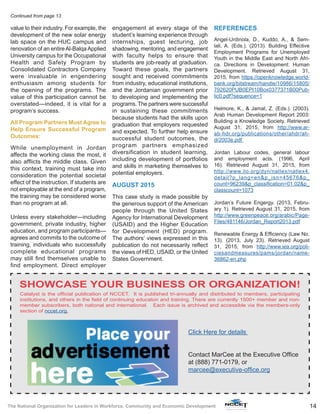
Accident: 202470357 - Employee Is Killed During
Disassembly of Drilling Rig
OSHA Report ID: 0950643
“Emergency medical services were called, but due
to the remote location, it took medical personnel
approximately 45 minutes to reach the accident
site.”
29 CFR 1910.146(k)(1) Evaluate a prospective
rescuer’s ability to respond to a rescue summons
in a timely manner
“It is therefore important for employers to select rescue
services or teams, either on-site or off-site that are
equipped and capable “
“For all rescue teams or services, the employer’s
evaluation should consist of two components: an
initial evaluation, in which employers decide whether
a potential rescue service or team is adequately
trained and equipped to perform permit space
rescues of the kind needed at the facility and
whether such rescuers can respond in a timely
manner, and a performance evaluation, in which
employers measure the performance of the team
or service during an actual or practice rescue. “
(1910.146 App F)
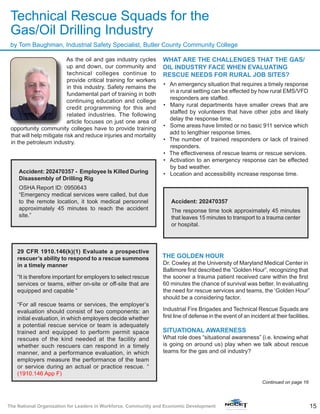
Accident: 202470357
The response time took approximately 45 minutes
that leaves 15 minutes to transport to a trauma center
or hospital.
Continued on page 16
16The National Organization for Leaders in Workforce, Community and Economic Development
How can we ensure situational awareness with municipal
responders? Municipal first responders may respond to a well
site incident using the same techniques when responding
to a fire or a car accident that may not be appropriate for
a well site. They may also not be aware of what can harm
them or help them. Who responds can change depending
on who is available at any given time.
What is the make-up of the responding team?
Have they worked together before?
What is the skill level of each responding member?
We may now need to rescue the rescuers.
Companies that are training their own workers that are
familiar with the daily workings and hazards of a well site
or pipeline excavation will have a heightened situational
awareness and are much less likely to put themselves or
others in a hazardous or unsafe situation. They are more
likely to be proactive than reactive in their everyday work
by being alert and knowing what can go wrong.
Technical Rescue Squads possess the skills and knowledge
that provide a layer of protection that can be an asset to
any well site, pipeline excavation, or facilities that would
provide a safer work environment.
Industrial Fire Brigades (IFB) are usually comprised of
workers that have volunteered to be an IFB member and
sometimes additional compensation is included or sometimes
it is just a part of their duties. Being a member of an IFB is
often considered to be a prestigious opportunity and many
companies that I work with have waiting lists for recruitment.
The Technical Rescue Squads and Industrial Fire Brigades
can save lives and money. Community and technical colleges
can support these important first responder groups in the
oil and gas industry by designing and delivering training
that incorporates the key concepts of the “Golden Hour”,
“Situational Awareness”, and other related concepts in their
continuing education, contract training, and credit workforce
programming.
Continued from page 15
17The National Organization for Leaders in Workforce, Community and Economic Development
T h e r e h a v e
been numerous
d i s c u s s i o n s
among industry
professionals and
educators about
the growing need
for skilled workers.
The synergy created
by working together
was at the foundation of a strategy to
take a collaborative approach. Joliet
Junior College (JCC) partnered with
local companies to develop the new
Operations Engineering & Technician
(OET) program.
Amy Murphy, JJC Director of Corporate
& Community Services explained that
partnerships between industry and
education are essential to successfully
prepare the next generation of workers.
Murphy said, “We are so thankful to the
industry partners who have supported
our OET program. This collaborative
effort will ensure that students are
prepared with the skills that employers
need.” She added, “The common theme
among employers has been their need
to have a talented labor pool that are
workforce ready. Our new OET program
is taking a proactive approach towards
this initiative.”
The OET program was designed to
prepare students for challenging
careers in the petrochemical, nuclear,
and manufacturing industries. Local
companies were at the forefront of
driving this initiative. JJC worked
closely with Exelon Generation
(Braidwood Station, Dresden Station
and LaSalle Station), Aux Sable Liquid
Products, LyondellBassell, GrundyArea
Vocational Center, Coal City School
District, Grundy Economic Development
Council, and State Senator Sue Rezin
to develop this innovative degree
program.
TransCanada also showed their support
to the OET program when company
representatives visited JJC this past
July to present a donation of $10,000
to college officials that will be used
to purchase new equipment. The
event affirmed that the partnerships
established between industry and
education are essential in order to meet
industry’s need for a skilled workforce in
sectors such as energy. TransCanada
Government Relations Director, Peter
Jaskowski said, “TransCanada supports
these types of programs and that’s
really why we’re here today to help
support this particular program at Joliet
Junior College.”
He added, “What we’re finding in the
marketplace out there as employers is
that we need to have skilled employees
ready to come to the job to perform the
increasingly sophisticated duties that
are related to the energy industry.”
Illinois State Secretary of Education
Elizabeth Purvis attended the
presentation event. She expressed
gratitude toward businesses who have
partnered with educators to invest in
youth. In regard to JJC’s new program,
she said, “Here we have a model of a
community college responding to the
needs of the community in much the
way they were designed.” She added,
“It is through partnerships like this that
we can continue the proud tradition of
the state.”
ABOUT THE OET PROGRAM
The Operations Engineering &
Technician (OET) program, which
begins Fall 2015, has two associate
degree tracks available that prepare
students for an entry-level career in the
nuclear, petrochemical or manufacturing
industries.
Training is available to earn Associate
of Applied Science (A.A.S.) degrees
in either the Operations Engineer or
the Operations Technician career
pathways. Each of these positions has
different responsibilities but both offer
challenging careers with the potential
for advancement.
Operations Engineers are responsible
for the monitoring and operation of
plant equipment. They evaluate the
unit’s operating status and perform
troubleshooting of processes and
equipment in order to maximize unit
reliability and quality production. The
average salary range is $65,000 to
$95,000. Employment of operations
engineers is projected to grow 15
percent from 2012 to 2022, faster than
the average for all occupations.1
An Operations Technician maintains
and repairs equipment and industrial
machinery. Technicians install,
dismantle, repair, reassemble, and
move machinery in manufacturing
facilities and power plants. The average
salary range is $45,000 to $75,000.
Employment of industrial machinery
mechanics and maintenance workers
Continued on page 18
Partnerships Between Industry and Education
Provide Opportunities for Success
by Melissa Lachcik, Continuing Education Development Coordinator, Joliet Junior College
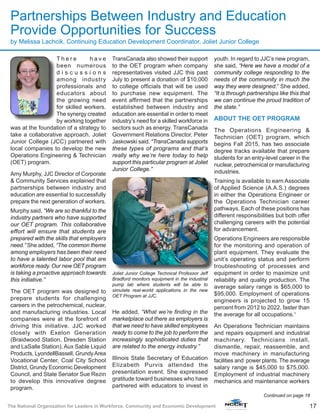
Joliet Junior College Technical Professor Jeff
Bradford monitors equipment in the industrial
pump lab where students will be able to
simulate real-world applications in the new
OET Program at JJC.
18The National Organization for Leaders in Workforce, Community and Economic Development
is projected to grow 17 percent from
2012 to 2022, faster than the average
for all occupations. 1
With the evolution of this new program,
students will now be able to train locally
for well-paying careers that are available
in their local communities. Students will
no longer have to travel out of state to
receive training or find jobs. This factor
alone should have positive ripple effects
on local economic development.
At a kick-off meeting held earlier this
year to announce the program’s launch,
JJC President Dr. Debra Daniels shared
her perspectives about the positive
impact of this program. Dr. Daniels
said, “We are proud to introduce this
new program that articulates a clear
career pathway for our students.” She
added, “We are grateful for the valuable
relationships we have with our local
legislators and area employers that
were essential to the development of
this program.”
PROGRAM CURRICULUM
The Operations Engineering &
Technician (OET) program is targeted
towards high school seniors and will
provide them with a viable option to
a career in one of these industries.
Students need to go through an
application process in order to
participate in this program. A unique
aspect to this inaugural program is that
students will attend their classes as a
cohort.
In addition to the classroom setting,
students will also participate in a
summer internship after their freshman
year. This hands-on learning opportunity
will provide students with real-world
experiences and provide them with an
opportunity to apply what they learned
in the classroom.
The program is also designed to have
students learn soft skills that are so
important to employers. For example,
to emphasize the importance of
punctuality students will be required
to wear a badge and clock in/out like
employees have to do on the job. The
students will also learn the value of
teamwork and how to work together
to troubleshoot a problem. In addition,
students will need to complete a
background check and drug screening,
similar to the employment process.
The curriculum places heavy emphasis
on technical skills in math, physics and
chemistry. Many of the technical classes
in the degree program were already
in existence. However, a few classes
such as the all-new Introduction to Plant
Operations and Thermo Dynamics were
created in order to prepare students
with additional knowledge and insight.
One notable highlight is that curriculum
for this program was developed and
approved through the Illinois Community
College Board (ICCB) in less than a
year. The accelerated pace at which
this program went through the approval
process is virtually unheard of, but
speaks volumes to the significance of
this type of program.
PARTNERING WITH EDUCATORS
Educators from local school districts
were also very excited about the
opportunity to be involved with the
development of this new degree
program. High school seniors will serve
as the primary pipeline into this program
and it’s a valuable opportunity for them
to train for a rewarding career.
Lance Copes, Director of Grundy Area
Vocational Center said, “When you
can be a part of linking high school
students to further training/education
that leads directly to employment
opportunities, I get very excited.” He
added, “Career and college readiness
is a big conversation point today and
this program is a perfect model.”
Kent Bugg, Superintendent of Coal
City School District #1, added, “After
watching our graduates make the trip
out of state for many years, I began to
advocate for a similar program to be
offered at one of our local educational
institutions. JJC was the logical fit, and
I am very pleased that our students can
now stay closer to home to receive this
training.”
PREPARING FOR THE FUTURE
Another objective of this program is
to prepare local students with the
training and skills they need to become
qualified job candidates when they are
competing against applicants from other
institutions.
Russell Coon, Exelon Nuclear Vice
President of Accreditation and Training
Strategy, explained, “The JJC program
will help us build the next generation of
nuclear professionals by preparing local
students to enter the industry armed
with the knowledge and skills to meet
our workforce needs.”
Since today’s workforce is ever-
changing, it has become increasingly
important for industry and educators
to collaborate and discover the best
approach to adapt and respond. The
Operations Engineering & Technician
program is one initiative that’s driven by
the needs of industry to bridge the skills
gap and prepare for the road ahead.
REFERENCES:
Bureau of Labor Statistics, U.S.
Department of Labor, Occupational
Outlook Handbook, 2014-15 Edition,
http://www.bls.gov/ooh/
For more information about the OET program, call
(815) 280-1418 or email engineertech@jjc.edu.
Visit www.jjc.edu/info/operationsengineeringtech
for program details.
Continued from page 17
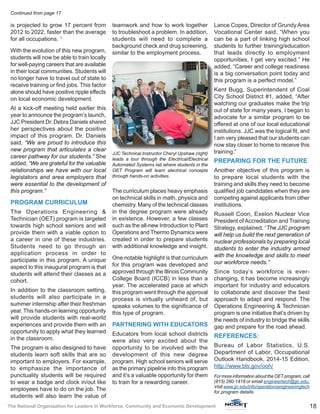
JJC Technical Instructor Cheryl Upshaw (right)
leads a tour through the Electrical/Electrical
Automated Systems lab where students in the
OET Program will learn electrical concepts
through hands-on activities.
19The National Organization for Leaders in Workforce, Community and Economic Development
OVERVIEW
The National Council for Continuing Education &
Training (NCCET) is committed to providing its
members with benefits that keep them current
on new trends, help maintain a personal and
professional network, and give access to the
latest leading-edge programs throughout the
country. The NCCET leadership is active on
the national scene, working with American
Association of Community Colleges (AACC)
Commissions, including the Commissions
on Economic and Workforce Development.
NCCET actively contributes to national policy
development through our sponsorship of national
colloquia on certification and credentialing (2001)
and transcripting (2003), as well as authorship
of white papers on these important topics. Our
constituents are continuing education leaders,
professionals,and innovators in community
and junior colleges and technical schools.
Other important stakeholders are our corporate
partners and our parent organization, the AACC.
Contact Us
NCCET
PO Box 2916
Columbus, OH 43216-2916
(888) 771-0179
Fax: (877) 835-5798
nccet@nccet.org
www.nccet.org
Executive Office
Executive Director, Jennifer Starkey
Deputy Executive Director, Lance Silburn
Director of Events,Tracy Curvin
Development Director, MarCee Gerdes
Membership Director, Misha Lawson
Communications Director, Ruth Handelman
Administrative Assistant, Kelly Silburn
NCCET 2015-2016 BOARD
OF DIRECTORS
Executive Committee
President
Linda L. Head
Associate Vice Chancellor for Workforce
Development
Lone Star College System, TX
President Elect
Martha O’Keefe
Dean of Workforce and Professional
Development
Germanna Community College, VA
Vice President, Finance
Bo Garcia
Dean of Community Education and
Workforce Development Division
Lansing Community College, MI
Vice President, Governance
Alfred L. McCambry Jr.
Dean of Workforce Development
Gulf Coast State College, FL
Immediate Past President
Dr. Paul J. Koehnke
Dean, Central Campus
Central Piedmont
National Directors
Brianna Bendotti, Maricopa Corporate College, AZ
Lisa M. Bly, Moraine Valley Community College, IL
Carla Hixson, Bismarck State College, ND
Jenette Kane, Lane Community College, OR
Dianne Palter Gill, North Shore Community College, MA
Louise Slezak, Community College of Baltimore County, MD
*Paige Vanderhyden, Educational Outreach Consultant, MI
*Kirk P. White, RN, MSN, Houston Community College, TX
*At-Large Board Member
ABOUT NCCET
“Solutions Through Networking”
Learn more about the NCCET
leadership team at nccet.org.

catalyst_volume_43_issue_2_reduced_size

  • 1.
    CATALYST Vol 43 Issue2 November 2015 Competency Based Education The Importance Of Competency Based Education and the Role it Plays in the Completion Agenda Page 4 2015 Annual Conference Highlights Spurring us forward! Page 6 Exemplary Awards and National Leadership Award Recipients Page 8 OFFICIAL PUBLICATION OF THE NATIONAL COUNCIL FOR CONTINUING EDUCATION & TRAINING 2015 Explarary Award Recipients
  • 2.
    2The National Organizationfor Leaders in Workforce, Community and Economic Development President’s Page 3 Competency Based Education and the Role it Plays in the Completion Agenda 4 2015 Annual Conference 6 2015 Award Recipients 8 Engage in Solutions Through Networking 9 Responding to and Collaborating with the Private Sector 10 Technical Rescue Squads for the Gas/Oil Drilling Industry 15 Parnerships Between Industry and Education Provide Opportunities for Success 17 About NCCET 19 The CATALYST is published by the National Council for Continuing Education and Training (NCCET). The CATALYST is reviewed and indexed in the Current Index To Journals In Education (CIJE) and in the Educational Resources Information Center (ERIC). The CATALYST is also available in microfilm and microfiche from University Microfilms International. Since July 2009 the journal is available in an electronic format only. The library subscription price for the CATALYST is $120.00 per year. Subscription requests should be sent to the NCCET Executive Office at nccet@nccet.org or PO Box 2916, Columbus, OH 43216-2916. Manuscripts are to be submitted as a Word document to nccet@nccet.org with “Catalyst Submission” in the subject line. Manuscripts accepted for publication are subject to editing. NCCET Membership is open to all individuals involved in or committed to the fields of community services, continuing education and/or workforce training in higher education. Annual dues for Individual Membership are $90.00, and include the services and benefits of NCCET, voting and office-holding rights and privileges, and NCCET publications. Institutional Membership, which provides membership for unlimited numbers of persons within a single college or university, is $399.00. WWW.NCCET.ORG / NCCET@NCCET.ORG / (888) 771-0179 TABLE OF CONTENTS Save the Date!
  • 3.
    3The National Organizationfor Leaders in Workforce, Community and Economic Development To our members who attended this year’s NCCET Annual Conference– THANK YOU! Because of your involvement it was one of the best we have held! The presentations were outstanding and we had very positive feedback from every session. Our members are very appreciative that you took the time to share your best practices with others. We all walked away with many more tools in our toolkit to take back home and implement immediately. We encourage our presenters to submit your presentations for future NCCET webinars, Catalyst articles and white papers. In addition, we hope that you are encouraged to get more involved by joining one of our seven sub- committees. It is through the sub- committees that we typically select our NCCET Board members. The presentations, other than the keynotes, are available to our membership in the member’s only section of the website so that those members who could not make it this year can still benefit. To our corporate partners, sponsors, exhibitors – THANK YOU! This year we had the highest quality of services and products represented. I personally plan to follow up with many of you and I am sure so will my colleagues. You are all experts in your fields and we enjoyed your enthusiasm each day. We hope that your time will lead to many new business relationships. To all of you from the great city of Portland and state of Oregon– THANK YOU! We could not have painted more picturesque landscaping and mountain top views. Those of us who participated in the social events, walked off more than we ate….well, almost. To our Executive Director, Jennifer Starkey, and her team – THANK YOU! Wow. You could teach the class in event planning and management at any of our community colleges, anytime! To our Board – THANK YOU! It is our combined vision that we selected the excellent keynote speakers and reached out to the best experts in continuing education, community education, and contract training in the United States to play a role in this year’s conference. Please remember to: 1. Take one great new idea to your college president that you want to implement at your college. 2. Connect with at least one new colleague from another college. 3. Get involved with NCCET! Please reach out to me directly if I can help you with your important work at your campus. In appreciation, PRESIDENT’S PAGE By Linda Head Lone Star College System Linda Head President, NCCET Our primary mission is to share best practices among our members,providing “Solutions Through Networking”. The NCCET Conference is a dynamic event where individuals attend to learn, network, and take away valuable information that they can use in their current work. Keep up-to-date on new trends, help maintain a personal and professional network, and access the latest leading-edge programs throughout the country. A blend of stylish sophistication and rich history awaits you in BOSTON, MA during the 2016 NCCET Conference. This vibrant city is renowned for its cultural facilities,world-class educational institutions,champion sports franchises, as well as its place at the very forefront of American history. Fast forward to 2017 and experience the southern hospitality that awaits you in beautiful SAVANNAH, GA. Quaint cobblestone streets and majestic architecture are sure to please. So mark your calendars now to join us in BOSTON and SAVANNAH! CLICK HERE to get involved! View conference presentations at NCCET.org
  • 4.
    4The National Organizationfor Leaders in Workforce, Community and Economic Development There are trends and realities facing leaders in Higher Education that we can no longer ignore. With declining numbers of high-school graduates (in much of the country), reduced state and federal spending on higher education and increased competition for students, we have to expand our efforts as we recruit, retain, and get students to complete what they start at our institutions. Competency Based Education (CBE) focuses more on what students learn, rather than where or how long the learning takes place. Instead of evaluating a student’s progress in a course or the amount of time they’ve spent in a classroom, students can receive college credit based on their actual demonstration of skills learned. With traditional education, time is fixed and mastery is variable. In CBE, mastery is fixed, and time is variable. In 2011, the United States Secretary of Education, Arne Duncan, was quoted from the New York Times saying, “While competency-based programs are now the exception, I want them to be the norm.” While there are some on-line programs that are 100% competency based, I support the flexibility of competency- based strategies to increase and accelerate students’ completion goals. Credits can be earned or awarded with the following: online learning, blended learning, continuing education credit, dual enrollment, early college high school, project-based learning, community-based learning, credit recovery, and others. Furthermore, if students possess certifications or licenses in their profession and have an American Council on Education (ACE) documented transcript, they could receive college credit for numerous courses without having to acquire seat time in courses when they’ve already mastered the material and can demonstrate the skills. If institutions want to go full fledge, federal funding is an option. Schools that offer direct assessment programs must apply to the Department of Education to be considered for Title IV eligibility. According to The United States Department of Education’s Office of the Inspector General, “As of January 23, 2014, only five schools (Argosy University, Capella University, Northern Arizona University, Southern New Hampshire University, and University of Wisconsin Colleges) had submitted direct assessment program applications to the Department. Capella University and Southern New Hampshire University were the only two schools whose applications the Department had approved.” Schools must submit applications that describe the credential offered, how the program is structured, how student learning will be assessed, the methodology used to determine credit-or clock-hour equivalencies for the program, and proof of an evaluation from the institution’s accrediting agency. Most higher education institutions are poised to increase student completion by promoting CBE and already have pieces in place to assess students for credit: Achieved Prior Learning (APL); College Level Examination Program (CLEP); and Proficiency Exams. Students who could benefit most from CBE are often adults with extensive work experience and those with military experience. Adults with years of work experience could earn competencies and quickly complete credentials. Reduced time to earn credentials means that students will be able to maintain other personal and professional obligations as long as they possess self-discipline. The idea that there is a lack of academic rigor is a common concern among faculty members when transitioning to CBE programs. To avoid this pitfall, faculty inclusion and input into the development of competencies builds support and enthusiasm for change. Competency-based curriculum development can be implemented in three phases: 1. Faculty committees select core competencies from existing course syllabi; 2. Faculty develops competency assignments and assessments; 3. and Department chair reviews final curriculum proposals to evaluate rigor of the course and/or program. The Education Advisory Board (EAB) shared a competency credit equivalent equation suggesting that “program directors map every competency directly from a course objective using a simple equation to determine the value of each competency. To determine the credit equivalency of a competency, divide the total credits of the course by the total number of competencies included in the course.” Continued on page 5 Competency Based Education and The Role it Plays in the Completion Agenda by Lisa M. Bly, Assistant Dean, Workforce Development & Community Service Moraine Valley Community College
  • 5.
    5The National Organizationfor Leaders in Workforce, Community and Economic Development With growing public scrutiny that questions the value and relevance of college credentials, leaders in higher education should make it a priority to remove barriers for completing and/ or returning students in pursuit of certificates or degrees beyond high school. Players in the academic marketplace continue to expand exponentially, including philanthropic foundations funding educational programs. When programs are funded and others partner with academic institutions, the expectations are that specific outcomes will be met in a timely manner that may not always fit nicely and/or neatly in our current academic structure. If we strategically decide to promote competency-based education and create agreements with four year institutions, it might be possible to develop a new pool of students and increase college graduates across the country. Source: Quick Facts from the US Census Bureau USA High school graduate or higher, percent of persons age 25+ (2009 – 2013) 86% OPPORTUNITIES FOR US USA Bachelor’s degree or higher, percent of persons age 25+ (2009 – 2013) 28.8% If colleges can show students an accelerated pathway to completion, higher education no longer appears daunting, never-ending and beyond their reach. As we consistently support our students with creative and innovative approaches, we collectively contribute to the National Completion Goal to be met by 2020. Continued from page 4
  • 6.
    6The National Organizationfor Leaders in Workforce, Community and Economic Development Rivers of Change, Bridges to Opportunity 2015 Annual Conference, Portland, Oregon “The great aim of education is not knowledge, but action” ---- Hebert Spencer (Philosopher 1820-1903) As advocates of continuing education and training, it is important that we too sharpen our skills and seek professional development. Our annual conference not only restores our souls, but secures us in the knowledge that we are not alone in our efforts to promote lifelong learning and workforce education across the country. It is more than a few days of brainstorming and discussion; it is the height of collaboration and partnerships as we prepare students for challenging careers. Since the aim of this conference is to spur and guide us into strategic action of ongoing and new collaborations, initiatives and opportunities, the various topics of the conference embraced sharing resources around: student recruitment; blended learning; smart data; equity gaps; credit/non- credit training; certification; and marketing. During Greg Marsello’s “The Next 5 Years: LERN’s Success Factors” session, attendees discovered that the next 5 years will be a critical time period for lifelong learning programs – continuing education, community education, contract or customized training, and outreach. They also learned that the winning programs have the opportunity to thrive and were given 15 success factors that are necessary to prosper. One of the most critical factors in building programs and judging the efficacy of those programs is through the efficient use of data and understanding the difference between being data-informed versus data driven. To that end, at least three seminars addressed data usage regarding equity gaps, course development and ROI of mentoring programs. “Pathways to Results: Using Data to Close Equity Gaps” by Dr. Debra Bragg from the University of Illinois at Urbana- Champaign noted that Pathways to Results (PTR) is an outcomes-focused, equity-guided process to improve student transition to and success in postsecondary education and employment. Christine Chmura of Chmura Economics &Analytics focused on “Smart Use of Data to Supplement & Drive Course Development”, while Rod Bourn from Harford Community College focused on “Driving Results Through Mentoring Programs” and measuring the ROI. The wealth of sessions focused on data and its various uses prompted Kelsey Hollen, a Pathway Navigator at Southwestern Community College in Iowa on the front line with students to state: “Data rules!!! I’ll be able to advocate with data in hand. I’m going to go back and research more data on the equity gap and look at what processes we have in place to try and eliminate some of them.” Kelsey Hollen Southwestern Community College First time attendees Oakton Community College Vice President of Academic Affairs, Dr. Thomas Hamel and Director of Workforce Development & Corporate Training, Dr. Colette Hands were impressed and so inspired by the idea of increasing internal collaboration that they stated: “We can’t wait to prioritize which new initiative we’re going to implement each year at Oakton. It’s exciting to think about increasing internal collaboration and the opportunities that will emerge from the relationships.” Dr. Thomas Hamel Dr. Colette Hands Oakton Community College Those emergent relationships are formed and solidified through the invaluable networking that NCCET provides. Former NCCET presidents, Robert Clancey and Dr. Faith Harland- White always promote the value of the NCCET network. They understand that these relationships can serve as powerful marketing tools that help to Paige Vanderhyden, Michele Fuher, Corrine Smereka, and Michelle Valin. Closing session with Jessie Lindsey Continued on page 7
  • 7.
    7The National Organizationfor Leaders in Workforce, Community and Economic Development accelerate and sustain the success of individuals and organizations. Dr. Harland-White noted: “This is the ideal group for workforce and continuing education professionals. You won’t find a better group of individuals who openly share their ideas and support you with implementing a version that fits your campus.” Dr. Faith Harland-White Anne Arundel Community College Robert Clancey urged Stephanie Campbell from Polk State College in Florida to attend and she was excited to hear what other people are doing across the country that may be different from what they are doing in Florida. “It’s great to hear fresh ideas from across the country as we all continue to develop innovative programs back in our home states. Now, I have a network outside of Florida who I can call to help me come up with a creative solution.” Stephanie Campbell Polk State College Black Rocket is a 3rd party turnkey operation that provides curriculum and training to increase enrollment for summer youth programming at community colleges. Founder of Black Rocket Productions LLC, Bill Zengel said: “NCCET is a worthwhile conference for me to attend. As a small company, I’ve got to be smart about which conferences I choose to attend. This has proven to be a great way to actually meet the individuals in the college who actually are responsible for youth programming and it’s been great.” Bill Zengel Black Rocket Productions Finally,Aaron Patterson, VPof Customer Service for Cambridge Educational Services also enjoyed attending the conference and thought it was well worth it to be with us in Portland. “I would like to cultivate relationships with community college program people. It’s important that I better understand how community colleges work with their feeder high schools to determine how Cambridge could support efforts with college and career readiness for the student pipeline.” Aaron Patterson Cambridge Educational Services It is important to remember that the outcomes of the conference are critical to spurring us forward. As proponents of lifelong learning, the NCCET Conference allows us to personally and professionally continue the pursuit of knowledge, build skills, explore new ideas and enhance our understanding. See you next year in Boston and never stop learning. Continued from page 6 Mark Milliron Welcome Reception Click Here to view additional conference photos. Michael Jordan Building - Nike Campus Tour
  • 8.
    8The National Organizationfor Leaders in Workforce, Community and Economic Development NATIONAL EXEMPLARY PROGRAMS The purpose of NCCET’s Exemplary ProgramAward is to recognize outstanding programs that impact a college’s community and that are innovative, replicable, and sustainable. Category: Continuing Education Madison College Digital Badges for Non-Credit Workforce Training Madison College’s Continuing Education program is using digital badges to assess, document and communicate the learning outcomes of non-credit workforce/professional development students. Using metadata contained in the badges, students can share their skill accomplishments with employers, prospective employers, academic institutions and work colleagues via social media. Category: Continuing Professional Education Waubonsee Community College Communities of Excellence Communities of Excellence (COE) is a leadership program for public sector employees, developed by the Workforce Development Division of Waubonsee Community College, to address the specific professional development needs of local government employees and to assist in their career growth. The leadership program was developed in response to an identified need for professional development for an underserved segment in the College’s professional community. Category: Workforce & Economic Development Pueblo Community College Mobile Learning Labs - Paving New Pathways The role and mission of Pueblo Community College is reflective of community colleges throughout the United States - to provide an accessible, responsive learning environment that facilitate the achievement of educational, professional and personal goals of students in an atmosphere that embraces academic excellence, diversity, and innovation. Our job is to introduce highly educated, highly skilled workers, who are critical thinkers, self-motivated, and simply good citizens. Major players in American higher education, including the Lumina Foundation, the Bill and Melinda Gates Foundation, the National Governors Association and the U.S. Department of Education, and the American taxpayer are challenging community colleges to get creative, think outside of the box, and to be courageous enough to venture beyond the traditional classroom in order to best support business and industry Addressing Colorado’s need for skilled manufacturing workers, PCC developed a multifaceted solution including multi-tiered training, flexible pathways, unique delivery methods, and strong partnerships. In 2007 we deployed our first Mobile Learning lab, the next three in 2008 and yet another three in 2014 creating a fleet of seven labs available to serve all of Colorado and surrounding states. These labs are equipped with state of the art technology and are serviced by educators who are the best in their class. We go to where the needs are. NATIONAL LEADERSHIP AWARD The National Leadership Award is presented to an individual who has contributed to the field of community services programming, continuing professional education, workforce and economic development, or learning technologies, and demonstrated support of NCCET. Sunil Gupta, Dean Borough of Manhattan Community College New York, New York Sunil B. Gupta has over 20 years of experience in higher education. He currently is the Dean of Adult Continuing Education and Workforce Development at Borough of Manhattan Community College, part of the City University of New York. In this role, he is responsible for the colleges’ division focused on serving adult learners that are primarily pursuing continuing and professional educational programs. The majority of these programs are in Business, Technology, Allied Health, Continuing Medical Education, Security Management, Construction and Sustainable Energy Certification and professional re-certifications as well as Adult Literacy Education and College pathway programs such as CLIP and CUNY START. Additionally, Dean Gupta served on the Board of the National Council for Continuing Education and Training, and was a Past President for NCCET. He also currently serves on the Board of the New York City Employment and Training Coalition (NYCETC) and is an Institutional Representative for COMBASE (Community-Based consortium of leading community colleges) and HETS (Hispanic Educational Technology Services). Before arriving at BMCC Sunil Gupta worked in Continuing Education and Enterprise Learning as the Executive Director of Continuing Education, Distance Learning and Workforce Development at Polytechnic University, where he developed and oversaw university-based degree academic study and continuing education training programs involving students, faculty, and industry. At Polytechnic University (currently known as NYU- POLY) Sunil oversaw all continuing education and training for Polytechnic’s Urban Security Initiative (USI). In his various capacities, he helped found a university-based Distance Learning Center for Graduate Degree programs, introduced distance-learning methodologies to support American Studies in Asia. In 2000, Sunil ran the Professional Training and Continuing Education program at the American Institute of Chemical Engineers, and launched their first distance learning programs focused on training engineers and plant operators in the petro-chem industry. Dean Gupta is an active member of ASME (American Society of Mechanical Engineers), in which he has led their Engineering Management Certification International Committee, and has served as a guest speaker, at ASME’s Engineering Management International Forum, which took place at Beijing’s Tsinghua University. His interests in higher education include leadership studies, entrepreneurship, organizational culture and a wide range of policy questions focused on issues of access to education and adult learning. His career has been spent in a variety of senior leadership positions in both the public and private sectors of higher education. Dean Gupta has a B.A. from Saint John’s University, an M.S. from Polytechnic Institute of NYU and is currently pursuing his doctorate. He is a native New Yorker, born and raised in NYC. 2015 Award Recipients
  • 9.
    9The National Organizationfor Leaders in Workforce, Community and Economic Development Engage in Solutions Through Networking by Jennifer Starkey, NCCET Executive Director During the 2015 Annual Conference in Portland, OR the NCCET Board o f D i r e c t o r s announced a new tag line and branding. “NCCET – Solutions Through Networking”. Those in attendance had many opportunities to network with colleagues they know and make new networking connections. Did you know, there are many more opportunities available through your NCCET membership to expand your network? I’d like to tell you about a few of these Member’s Only benefits and invite you to engage in Solutions Through Networking. Community The NCCET online community is a private social networking site developed just for members of NCCET. If you have been a member of NCCET for a while, you will remember the old listserv where the “replies-to-all” bogged down and filled your email. That technology is gone! The new online community puts you in control of how often you receive updates from the community. To gain this control, you must first “opt-in” by accepting the invitation in your email. Didn’t receive the invitation? – contact the NCCET Executive Office. Once you have joined the community – engage; create a new post, share a best practice, or ask your colleagues a question. Committees Do you like to roll-up your sleeves and dig into the details? There are opportunities in a wide variety of committees to get more involved in the inner workings of NCCET, network with colleagues, and maybe even lay the foundation for future leadership opportunities with the Board of Directors. The 2015-2016 committees are: • Annual Conference Planning • Awards Committee • Business Development • Communications • Membership • Nominations • Policy If one of these committees sounds interesting to you, Click Here to complete the online volunteer form and the committee chair will be in touch with you. Webinars Don’t let personal development stop now that the conference is over. Keep an eye out for the NCCET Webinar series to start again after the first of the year. Have a topic you would like to hear more about, or one you would like to present? Reach out to Tracy Curvin, NCCET’s Director of Events at tracy@executive-office.org. Catalyst Connect through the written word by authoring an article in an upcoming issue of Catalyst. Your continuing education program, best practice, or community education project may be just the solution your colleagues are seeking. Contact Ruth Handelman, NCCET’s Director of Communications at ruth@executive-office.org to learn more about how you can contribute. If you have other ideas of benefits or networking opportunities you would like to share, please don’t hesitate to send an email to nccetdirector@nccet.org or give me a call at (888) 771-0179. We look forward to hearing from you! Jennifer Starkey Executive Director Stay tuned for the NCCET Webinar series to start again after the first of the year. CLICK HERE and tell us what topics or ideas you have for upcoming webinars. On-Demand Webinars at nccet.org View these educational opportunitiesonYOURschedule. Available 24/7 in the Members Only section of NCCET.ORG. CLICK HERE to view on-demand webinars. NCCET Seeks Contributors to CATALYST 2016 Article Submission Deadlines • February Issue December 30, 2015 • June Issue May 1, 2016 • October Issue September 3, 2016 Contact Ruth at the executive office at (888) 771--179 or ruth@executive-office.org
  • 10.
    10The National Organizationfor Leaders in Workforce, Community and Economic Development Broader Middle East and North Africa–U.S. Community College Initiative AUTHORS Joan Smith Dean and Executive Director Rocky Mountain Education Center Red Rocks Community College Colorado Dr. Ayman Maqableh Dean Al Quds College Amman, Jordan Rula Sabbagh-Kawar Senior HR Specialist Training Consolidated Contractors Company Amman, Jordan EDITOR Matthew Kuehl Senior Program Specialist Higher Education for Development INTRODUCTION In the context of a need for greater employment opportunities for youth in Jordan and prompted by a shared belief in engaging private industry and sustaining their involvement in the design of workforce education training, Al-Huson University College (HUC) in Jordan and Red Rocks Community College (RRCC) in the United States, collaborated to develop new workforce education programs in the emerging renewable energy and occupational health and safety sectors in Jordan. The project began in 2010 when Dr. Ayman Maqableh, an associate professor at Al-Huson University College, contacted Red Rocks Community College Dean Joan W. Smith regarding RRCC’s success in developing solar energy technicians in Colorado. Their initial conversations focused on HUC’s innovative idea for a proposed renewable energy program, the Green Energy Cluster, in which employers and other stakeholders would provide curriculum oversight, guest lecturing, and student internships. One novel aspect of the Cluster concept that RRCC found particularly intriguing is that it sought industry input prior to the establishment of a degree program. The Green Energy Cluster became the foundation for a five-year project developed by the two institutions and funded by USAID through a Higher Education for Development sub- award and scale-up totaling just over $500,000. The authentic engagement in the Cluster by private industry and regional stakeholders greatly expedited the work of the partners in this effort and, just one year after their initial conversation, students were enrolling in the HUC Solar Energy Technology Program in Irbid, Jordan. This paper describes the process of working with industry stakeholders and how the two partners leveraged both public and private sector support to successfully implement new degree programs at HUC. Continued on page 11 Responding to and Collaborating With the Private Sector: A Road Map To Stakeholder Engagement In Workforce Development In Jordan
  • 11.
    11The National Organizationfor Leaders in Workforce, Community and Economic Development PARTNER INSTITUTIONS Red Rocks Community College, opened in 1969, is one of 17 colleges in the Colorado Community College System. RRCC has campuses in Lakewood and Arvada, Colorado, both suburbs of Denver. RRCC averages an annual enrollment of 12,000 students and offers more than 650 technical certificate programs in addition to associate degrees in the arts and applied sciences. RRCC also developed the first Bachelor of Applied Science to be conferred by a community college in Colorado, in water quality management. Joan W. Smith, the RRCC representative for the partnership, is dean and executive director of technical programs at RRCC, including the renewable energy technology and the water quality management programs. Ms. Smith leads the continuing education division of the college as the executive director of the Rocky Mountain Education Center, which is authorized by the U.S. Department of Labor Occupational Safety and Health Administration (OSHA) as a regional OSHA Education and Training Institute. Al-Huson University College (HUC), located in Irbid, is one of 43 two- year colleges in Jordan. The Al Balqa Applied University System oversees the two-year schools, which include both public and private institutions. Program approval authority is vested in the Deans Council of the Al Balqa Applied University System. HUC has a track record of successfully working with USAID Jordan since 2007, when the USAID Jordan Economic Development Program funded the establishment of the Al-Huson Career Development Center, the first of its kind at any academic institute in Jordan. Dr.Ayman Maqableh, the HUC representative to the partnership, served as director of the Career Development Center, which connects with private industry to help students find jobs. HUC also previously participated in public-private partnerships through the USAID/ Jordan SHARAKA initiatives, which matched vocational trainees and students with labor market demands by offering graduates internships, scholarships, and on-the-job training in cooperation with the public sector. Private partners began looking to HUC for specific workforce training (e.g., the Consolidated Contractors Company supporting the Piping Technology Training Program at the HUC campus), and partners leveraged and expanded these private/public partnership models at HUC under the new HED funding. CONTEXT IN JORDAN AND DEVELOPMENT OF THE PROJECT The workforce programs developed by the partners were grounded in Jordan’s policies and economic development goals and designed with student employment outcomes in mind. Solar Energy Technology Program: The Jordanian Energy Strategy, issued in 2007, sought to address the unmanageable cost of the country’s energy consumption, which had reached 20 percent of Jordan’s annual gross domestic product. The strategy set a goal to increase the share of renewable energy in its energy- use portfolio to 10 percent by 2020 (International Energy Agency, 2013). The generation of electricity from solar has been comparatively slow in coming to the Middle East, however the Renewable Energy and Efficiency Law, passed by the Jordanian parliament in 2011, (GreenPeace, 2013, p. 4) pushed the country toward wider adoption of renewable sources of power, including solar. The Green Energy Cluster (GEC), formed by HUC in 2010, engaged new and developing solar energy companies and stakeholders that have a vested interest in creating a technical workforce to achieve ambitious goals for renewable energy production in Jordan. The GEC was modeled after existing public/private partnerships in higher education developed at HUC through previous initiatives, such as the USAID- funded Career Development Center, the SHARAKA project’s efforts to promote relations between the European Union and the Gulf Cooperation Council, and a piping technology training program supported by the Consolidated Contractors Company. Through the GEC, the private sector supported HUC and RRCC staff and faculty in adapting a curriculum provided by RRCC to employer expectations and working conditions in Jordan. Occupational Health and Safety Program: Following successful networking with and feedback from the employers and stakeholders engaged in the Solar Energy Technology Program, the partners also undertook to develop a program in occupational health and safety. Jordan’s Labour Code includes provisions for stiff penalties for workplace violations that result in worker injury or death, including the permanent closing of a business. Under the Code, and as part of a national strategy to improve worker safety and health, the Minister of Labour may appoint safety supervisors to be present at worksites (ILO, 1996). Estimates of the number of safety supervisors that are needed in Jordan exceed 5,000. To date these positions have not been fully filled primarily due to a lack of qualified personnel. The occupational safety and health professionals that do work in Jordan tend to be foreign nationals that have been brought to Jordan by an employer that contracts with non-Jordanian companies that require worker safety programs. Continued from page 10 Continued on page 12
  • 12.
    12The National Organizationfor Leaders in Workforce, Community and Economic Development Prior to the launch of the Occupational Health and Safety Program at HUC in 2013, there were no training programs in Jordan’s higher education system in occupational safety and health. The Occupational Safety and Health Institute (OSHI), which had operated in Jordan as a vocational training program to help bridge this gap, did not have broad support among employers. OSHI training had not kept pace with the changing needs of industry in Jordan, and as a result many employers were no longer willing to send their workers to the OSHI for training. Following a process similar to the one used to develop the Solar Energy Technology Program and the Green Energy Cluster, the partners developed the Occupational Health and Safety Program. Program development was aided by an advisory committee that included representatives of private sector businesses, including heavy industry and construction. The Program Advisory Committee (PAC) developed a job description for junior safety officers that was used to identify student competencies. Focus on Multiple Pathways to Employment: The partners understood that the most critical component in creating program sustainability hinged on a key summative measure: student employment upon graduation. Jordan experiences an extraordinarily high rate of unemployment among college graduates, reaching as high as fifteen percent (Urdinola et al., 2013, p. 70). Compounding the unemployment rate in this case was the fact that there are few established employers in the solar energy industry given the newness of the technology to the region. Accordingly, the partner’s advanced a strategy to encourage and create multiple pathways to employment for the graduates of the program on solar energy technology, including traditional employment in the sector, self-employment or small business creation, and bridging to university for further academic training and skills development. Advisors from industry in the Green Energy Cluster played a vital role in creating internship and workplace experiences for students prior to graduation. The students completed capstone projects to demonstrate their ability to use their new knowledge cumulatively in producing practical applications of solar technology while showcasing their capacity for critical thinking and real-world problem solving. The partners recognized that to achieve desired employment outcomes, students would need support as entrepreneurs. Students considering small-business ventures were encouraged to develop business plans and portfolios featuring the renewable energy projects completed during their training as part of their capstone. While data on employment placement does not yet exist for the project, the partners do collect anecdotal evidence of individual student graduates and will track employment outcomes as the program proceeds. Three student success stories illustrate the focus on multiple pathways to employment and other opportunities: • Traditional Employment: Manal Abed Al-Gani finished her bachelor’s degree in physics. Like 70,000 other Jordanian students who graduate every year, she found herself with no job and very limited prospects. After completing her BA, Manal enrolled in the Solar Energy Technology Program, where she was one of 12 female students in the first class of 50. Manal is now employed at a large solar energy company as a systems designer, a job usually reserved for engineers. However, in light of her experience on integrated lab equipment and practicums added by the USAID project that focused on the technical aspects of solar energy generation, Manal’s employer found her skills to be well qualified for her new post. • Entrepreneurism/Small Business Creation: Mosab Malkawi enrolled in the second matriculation of the Solar Energy Technology Program. He demonstrated a keen passion for renewable energy and the importance the development of this technology has for his country. In his last year in the program, Mosab successfully recruited investors to open his own solar energy business. He now owns one of the first businesses in solar energy in the north region of Jordan. He has joined the Jordanian Renewable Energy Society (JRES), and his active involvement positions him well to achieve his professional goal of one day becoming the director of the JRES. • Bridging to University: Sham Baath wants to be an engineer. He knew that without the necessary exam scores after high school his chances were very slim. In Jordan each year, less than five percent of students successfully attain the score they need on the comprehensive exam to bridge to the engineering track after finishing vocational tracks. Having completed the Solar Energy Technology Program at HUC, Sham is one of seven students in the program who successfully met the challenge of the comprehensive exam. He is now enrolled in an engineering program at one of the best universities in the country, Jordan University of Science and Technology. Continued on page 13 Continued from page 11
  • 13.
    13The National Organizationfor Leaders in Workforce, Community and Economic Development RECOMMENDATIONS The partners have distilled three primary recommendations targeted primarily for those involved in or considering educational strategies that seek to improve participant employment outcomes. When Enrolling Students, Use a Rigorous Selection Process Aligned With Employer Needs: The partnership successfully added the Solar Energy Technology Program to the engineering pathway, which helped to ensure that student applicants had educational backgrounds and English language skills equal to the rigor of the level of study in that program. Also, procedures were put into place that allowed the program to accept students with higher scores on the Tawjihi, Jordan’s general secondary national exam, and students who had already obtained a bachelor’s degree. The ability to accept highly qualified students was key to the program’s early success in retaining students and exceeding graduation goals within the program’s first three years. As discussed above, decisions made outside of the partnership posed challenges for the Occupational Health and Safety Program when that program was classified as part of the liberal arts versus engineering pathway. One result of that decision was that students applying for the Occupational Health and Safety Program lacked the requisite educational background and English language skills that the program required. The partnership responded by modifying the program’s assessment and instruction strategies. However, the partnership did not consider this modification a long term solution, and continued to advocate for its classification in the engineering pathway to ensure the appropriate pre-requisite knowledge. The current class of students in the program is not expected to graduate at the same rate as students in the solar technology program; however, future incoming students to the Occupational Health and Safety Program will enter with more appropriate skills after its classification in engineering. Develop Instructional Staff Before Program Launch and Include Detailed Plans for Training of Trainers as Part of Program Development: As new programs are created, consideration must be given to the availability of instructional staff long- term. While the engineering focus of the program on solar energy technology helped it attract qualified faculty, the experience with the program on occupational health and safety was different. The latter program requires faculty with formal education in the management of health and safety in the workplace as well as field experience in industry. In the Irbid region, individuals with such skills are found only in industry and do not have formal training in teaching at the university level. The launch of the Occupational Health and Safety Program was therefore significantly challenged by the lack of qualified faculty. While the private sector partner CCC stepped forward to offer a competitive salary to allow recruitment of an instructor from industry, which allowed the program to launch as scheduled, this strategy cannot be considered a long-term solution given that the associated cost structure is not sustainable. Efforts are under way to create a train-the-trainer opportunity with a new commitment from Al-Balqa Applied University to refocus efforts on recruiting instructors for the Occupational Health and Safety Program who can participate in intensive training prior to classroom instruction. The partnership sought involvement from a broad range of stakeholders to ensure the currency of the programs with regard to employer demands and expectations. Industry advisory members were engaged from the beginning of program development to guide the curricula objectives and teaching strategies. The advisory members have been instrumental in providing workplace experiences to students prior to graduation. Advisors for the program on solar energy technology have included NOOR Solar and Philadelphia Solar. Advisors for the program on occupational health and safety have included PepsiCo, PETRA HVAC, Consolidated Contractors Company, and the As-Samra Wastewater Treatment Plant. Faculty in the program on solar energy technology have taken advantage of industry- recognized training opportunities to increase their knowledge of evolving renewable energy technologies. Faculty participated in a two-week training from renewable energy companies in Germany, and the HUC partnership director Dr.Ayman Maqableh completed HSE training in OSHAstandards during a J-1 visa visit to the U.S. partner. FURTHER OBSERVATIONS In closing, two further observations warrant mentioning. The Implicit Value of Engagement by Industry Partners Cannot be Overstated: The strong tradition of workforce development at community colleges offers many opportunities to engage with the private sector. Employers have a vested interest in increasing the relevancy of technical and vocational degree programs and aligning the skills of graduates with the needs of industry. Public-private partnerships build mutually-beneficial relationships by engaging employers with higher education institutions through such activities as developing curriculum, designing and equipping lab space, or creating internships and pathways to employment. Many private-sector partners have an interest not just in creating better-trained graduates, but in creating a legacy of contributing Continued on page 14 Continued from page 12
  • 14.
    14The National Organizationfor Leaders in Workforce, Community and Economic Development value to their industry. For example, the development of the new solar energy lab space on the HUC campus and renovation of an entireAl-BalqaApplied University campus for the Occupational Health and Safety Program by Consolidated Contractors Company were invaluable in engendering enthusiasm among students for the opening of the programs. The value of this participation cannot be overstated—indeed, it is vital for a program’s success. All Program Partners Must Agree to Help Ensure Successful Program Outcomes: While unemployment in Jordan affects the working class the most, it also afflicts the middle class. Given this context, training must take into consideration the potential societal effect of the instruction. If students are not employable at the end of a program, the training may be considered worse than no program at all. Unless every stakeholder—including government, private industry, higher education, and program participants— agrees and commits to the outcome of training, individuals who successfully complete educational programs may still find themselves unable to find employment. Direct employer engagement at every stage of the student’s learning experience through internships, guest lecturing, job shadowing, mentoring, and engagement with faculty helps to ensure that students are job-ready at graduation. Toward these goals, the partners sought and received commitments from industry, educational institutions, and the Jordanian government prior to developing and implementing the programs. The partners were successful in sustaining these commitments because students had the skills upon graduation that employers requested and expected. To further help ensure successful student outcomes, the program partners emphasized diversification in student learning, including development of portfolios and skills in marketing themselves to potential employers. AUGUST 2015 This case study is made possible by the generous support of the American people through the United States Agency for International Development (USAID) and the Higher Education for Development (HED) program. The authors’ views expressed in this publication do not necessarily reflect the views of HED, USAID, or the United States Government. REFERENCES Angel-Urdinola, D., Kuddo, A., & Sem- lali, A. (Eds.). (2013). Building Effective Employment Programs for Unemployed Youth in the Middle East and North Afri- ca. Directions in Development: Human Development. Retrieved August 31, 2015, from https://openknowledge.world- bank.org/bitstream/handle/10986/15805/ 792620PUB0EPI10Box0377371B00Pub- lic0.pdf?sequence=1 Helmore, K., & Jamal, Z. (Eds.). (2003). Arab Human Development Report 2003: Building a Knowledge Society. Retrieved August 31, 2015, from http://www.ar- ab-hdr.org/publications/other/ahdr/ah- dr2003e.pdf Jordan Labour codes, general labour and employment acts. (1996, April 16). Retrieved August 31, 2015, from http://www.ilo.org/dyn/natlex/natlex4. detail?p_lang=en&p_isn=45676&p_ count=96239&p_classification=01.02&p_ classcount=1073 Jordan’s Future Engergy. (2013, Febru- ary 1). Retrieved August 31, 2015, from http://www.greenpeace.org/arabic/Page- Files/481146/Jordan_Report2013.pdf Renewable Energy & Efficiency (Law No. 13). (2013, July 23). Retrieved August 31, 2015, from http://www.iea.org/poli- ciesandmeasures/pams/jordan/name- 36862-en.php Continued from page 13 Click Here for details Contact MarCee at the Executive Office at (888) 771-0179, or marcee@executive-office.org SHOWCASE YOUR BUSINESS OR ORGANIZATION! Catalyst is the official publication of NCCET. It is published tri-annually and distributed to members, participating institutions, and others in the field of continuing educaton and training. There are currently 1500+ member and non- member subscribers, both national and international. Each issue is archived and accessible via the members-only section of nccet.org.
  • 15.
    15The National Organizationfor Leaders in Workforce, Community and Economic Development As the oil and gas industry cycles up and down, our community and technical colleges continue to provide critical training for workers in this industry. Safety remains the fundamental part of training in both continuing education and college credit programming for this and related industries. The following article focuses on just one area of opportunity community colleges have to provide training that will help mitigate risk and reduce injuries and mortality in the petroleum industry. WHAT ARE THE CHALLENGES THAT THE GAS/ OIL INDUSTRY FACE WHEN EVALUATING RESCUE NEEDS FOR RURAL JOB SITES? • An emergency situation that requires a timely response in a rural setting can be effected by how rural EMS/VFD responders are staffed. • Many rural departments have smaller crews that are staffed by volunteers that have other jobs and likely delay the response time. • Some areas have limited or no basic 911 service which add to lengthier response times. • The number of trained responders or lack of trained responders. • The effectiveness of rescue teams or rescue services. • Activation to an emergency response can be effected by bad weather. • Location and accessibility increase response time. THE GOLDEN HOUR Dr. Cowley at the University of Maryland Medical Center in Baltimore first described the “Golden Hour”, recognizing that the sooner a trauma patient received care within the first 60 minutes the chance of survival was better. In evaluating the need for rescue services and teams, the ‘Golden Hour” should be a considering factor. Industrial Fire Brigades and Technical Rescue Squads are first line of defense in the event of an incident at their facilities. SITUATIONAL AWARENESS What role does “situational awareness” (i.e. knowing what is going on around us) play when we talk about rescue teams for the gas and oil industry? by Tom Baughman, Industrial Safety Specialist, Butler County Community College Technical Rescue Squads for the Gas/Oil Drilling Industry Accident: 202470357 - Employee Is Killed During Disassembly of Drilling Rig OSHA Report ID: 0950643 “Emergency medical services were called, but due to the remote location, it took medical personnel approximately 45 minutes to reach the accident site.” 29 CFR 1910.146(k)(1) Evaluate a prospective rescuer’s ability to respond to a rescue summons in a timely manner “It is therefore important for employers to select rescue services or teams, either on-site or off-site that are equipped and capable “ “For all rescue teams or services, the employer’s evaluation should consist of two components: an initial evaluation, in which employers decide whether a potential rescue service or team is adequately trained and equipped to perform permit space rescues of the kind needed at the facility and whether such rescuers can respond in a timely manner, and a performance evaluation, in which employers measure the performance of the team or service during an actual or practice rescue. “ (1910.146 App F) Accident: 202470357 The response time took approximately 45 minutes that leaves 15 minutes to transport to a trauma center or hospital. Continued on page 16
  • 16.
    16The National Organizationfor Leaders in Workforce, Community and Economic Development How can we ensure situational awareness with municipal responders? Municipal first responders may respond to a well site incident using the same techniques when responding to a fire or a car accident that may not be appropriate for a well site. They may also not be aware of what can harm them or help them. Who responds can change depending on who is available at any given time. What is the make-up of the responding team? Have they worked together before? What is the skill level of each responding member? We may now need to rescue the rescuers. Companies that are training their own workers that are familiar with the daily workings and hazards of a well site or pipeline excavation will have a heightened situational awareness and are much less likely to put themselves or others in a hazardous or unsafe situation. They are more likely to be proactive than reactive in their everyday work by being alert and knowing what can go wrong. Technical Rescue Squads possess the skills and knowledge that provide a layer of protection that can be an asset to any well site, pipeline excavation, or facilities that would provide a safer work environment. Industrial Fire Brigades (IFB) are usually comprised of workers that have volunteered to be an IFB member and sometimes additional compensation is included or sometimes it is just a part of their duties. Being a member of an IFB is often considered to be a prestigious opportunity and many companies that I work with have waiting lists for recruitment. The Technical Rescue Squads and Industrial Fire Brigades can save lives and money. Community and technical colleges can support these important first responder groups in the oil and gas industry by designing and delivering training that incorporates the key concepts of the “Golden Hour”, “Situational Awareness”, and other related concepts in their continuing education, contract training, and credit workforce programming. Continued from page 15
  • 17.
    17The National Organizationfor Leaders in Workforce, Community and Economic Development T h e r e h a v e been numerous d i s c u s s i o n s among industry professionals and educators about the growing need for skilled workers. The synergy created by working together was at the foundation of a strategy to take a collaborative approach. Joliet Junior College (JCC) partnered with local companies to develop the new Operations Engineering & Technician (OET) program. Amy Murphy, JJC Director of Corporate & Community Services explained that partnerships between industry and education are essential to successfully prepare the next generation of workers. Murphy said, “We are so thankful to the industry partners who have supported our OET program. This collaborative effort will ensure that students are prepared with the skills that employers need.” She added, “The common theme among employers has been their need to have a talented labor pool that are workforce ready. Our new OET program is taking a proactive approach towards this initiative.” The OET program was designed to prepare students for challenging careers in the petrochemical, nuclear, and manufacturing industries. Local companies were at the forefront of driving this initiative. JJC worked closely with Exelon Generation (Braidwood Station, Dresden Station and LaSalle Station), Aux Sable Liquid Products, LyondellBassell, GrundyArea Vocational Center, Coal City School District, Grundy Economic Development Council, and State Senator Sue Rezin to develop this innovative degree program. TransCanada also showed their support to the OET program when company representatives visited JJC this past July to present a donation of $10,000 to college officials that will be used to purchase new equipment. The event affirmed that the partnerships established between industry and education are essential in order to meet industry’s need for a skilled workforce in sectors such as energy. TransCanada Government Relations Director, Peter Jaskowski said, “TransCanada supports these types of programs and that’s really why we’re here today to help support this particular program at Joliet Junior College.” He added, “What we’re finding in the marketplace out there as employers is that we need to have skilled employees ready to come to the job to perform the increasingly sophisticated duties that are related to the energy industry.” Illinois State Secretary of Education Elizabeth Purvis attended the presentation event. She expressed gratitude toward businesses who have partnered with educators to invest in youth. In regard to JJC’s new program, she said, “Here we have a model of a community college responding to the needs of the community in much the way they were designed.” She added, “It is through partnerships like this that we can continue the proud tradition of the state.” ABOUT THE OET PROGRAM The Operations Engineering & Technician (OET) program, which begins Fall 2015, has two associate degree tracks available that prepare students for an entry-level career in the nuclear, petrochemical or manufacturing industries. Training is available to earn Associate of Applied Science (A.A.S.) degrees in either the Operations Engineer or the Operations Technician career pathways. Each of these positions has different responsibilities but both offer challenging careers with the potential for advancement. Operations Engineers are responsible for the monitoring and operation of plant equipment. They evaluate the unit’s operating status and perform troubleshooting of processes and equipment in order to maximize unit reliability and quality production. The average salary range is $65,000 to $95,000. Employment of operations engineers is projected to grow 15 percent from 2012 to 2022, faster than the average for all occupations.1 An Operations Technician maintains and repairs equipment and industrial machinery. Technicians install, dismantle, repair, reassemble, and move machinery in manufacturing facilities and power plants. The average salary range is $45,000 to $75,000. Employment of industrial machinery mechanics and maintenance workers Continued on page 18 Partnerships Between Industry and Education Provide Opportunities for Success by Melissa Lachcik, Continuing Education Development Coordinator, Joliet Junior College Joliet Junior College Technical Professor Jeff Bradford monitors equipment in the industrial pump lab where students will be able to simulate real-world applications in the new OET Program at JJC.
  • 18.
    18The National Organizationfor Leaders in Workforce, Community and Economic Development is projected to grow 17 percent from 2012 to 2022, faster than the average for all occupations. 1 With the evolution of this new program, students will now be able to train locally for well-paying careers that are available in their local communities. Students will no longer have to travel out of state to receive training or find jobs. This factor alone should have positive ripple effects on local economic development. At a kick-off meeting held earlier this year to announce the program’s launch, JJC President Dr. Debra Daniels shared her perspectives about the positive impact of this program. Dr. Daniels said, “We are proud to introduce this new program that articulates a clear career pathway for our students.” She added, “We are grateful for the valuable relationships we have with our local legislators and area employers that were essential to the development of this program.” PROGRAM CURRICULUM The Operations Engineering & Technician (OET) program is targeted towards high school seniors and will provide them with a viable option to a career in one of these industries. Students need to go through an application process in order to participate in this program. A unique aspect to this inaugural program is that students will attend their classes as a cohort. In addition to the classroom setting, students will also participate in a summer internship after their freshman year. This hands-on learning opportunity will provide students with real-world experiences and provide them with an opportunity to apply what they learned in the classroom. The program is also designed to have students learn soft skills that are so important to employers. For example, to emphasize the importance of punctuality students will be required to wear a badge and clock in/out like employees have to do on the job. The students will also learn the value of teamwork and how to work together to troubleshoot a problem. In addition, students will need to complete a background check and drug screening, similar to the employment process. The curriculum places heavy emphasis on technical skills in math, physics and chemistry. Many of the technical classes in the degree program were already in existence. However, a few classes such as the all-new Introduction to Plant Operations and Thermo Dynamics were created in order to prepare students with additional knowledge and insight. One notable highlight is that curriculum for this program was developed and approved through the Illinois Community College Board (ICCB) in less than a year. The accelerated pace at which this program went through the approval process is virtually unheard of, but speaks volumes to the significance of this type of program. PARTNERING WITH EDUCATORS Educators from local school districts were also very excited about the opportunity to be involved with the development of this new degree program. High school seniors will serve as the primary pipeline into this program and it’s a valuable opportunity for them to train for a rewarding career. Lance Copes, Director of Grundy Area Vocational Center said, “When you can be a part of linking high school students to further training/education that leads directly to employment opportunities, I get very excited.” He added, “Career and college readiness is a big conversation point today and this program is a perfect model.” Kent Bugg, Superintendent of Coal City School District #1, added, “After watching our graduates make the trip out of state for many years, I began to advocate for a similar program to be offered at one of our local educational institutions. JJC was the logical fit, and I am very pleased that our students can now stay closer to home to receive this training.” PREPARING FOR THE FUTURE Another objective of this program is to prepare local students with the training and skills they need to become qualified job candidates when they are competing against applicants from other institutions. Russell Coon, Exelon Nuclear Vice President of Accreditation and Training Strategy, explained, “The JJC program will help us build the next generation of nuclear professionals by preparing local students to enter the industry armed with the knowledge and skills to meet our workforce needs.” Since today’s workforce is ever- changing, it has become increasingly important for industry and educators to collaborate and discover the best approach to adapt and respond. The Operations Engineering & Technician program is one initiative that’s driven by the needs of industry to bridge the skills gap and prepare for the road ahead. REFERENCES: Bureau of Labor Statistics, U.S. Department of Labor, Occupational Outlook Handbook, 2014-15 Edition, http://www.bls.gov/ooh/ For more information about the OET program, call (815) 280-1418 or email engineertech@jjc.edu. Visit www.jjc.edu/info/operationsengineeringtech for program details. Continued from page 17 JJC Technical Instructor Cheryl Upshaw (right) leads a tour through the Electrical/Electrical Automated Systems lab where students in the OET Program will learn electrical concepts through hands-on activities.
  • 19.
    19The National Organizationfor Leaders in Workforce, Community and Economic Development OVERVIEW The National Council for Continuing Education & Training (NCCET) is committed to providing its members with benefits that keep them current on new trends, help maintain a personal and professional network, and give access to the latest leading-edge programs throughout the country. The NCCET leadership is active on the national scene, working with American Association of Community Colleges (AACC) Commissions, including the Commissions on Economic and Workforce Development. NCCET actively contributes to national policy development through our sponsorship of national colloquia on certification and credentialing (2001) and transcripting (2003), as well as authorship of white papers on these important topics. Our constituents are continuing education leaders, professionals,and innovators in community and junior colleges and technical schools. Other important stakeholders are our corporate partners and our parent organization, the AACC. Contact Us NCCET PO Box 2916 Columbus, OH 43216-2916 (888) 771-0179 Fax: (877) 835-5798 nccet@nccet.org www.nccet.org Executive Office Executive Director, Jennifer Starkey Deputy Executive Director, Lance Silburn Director of Events,Tracy Curvin Development Director, MarCee Gerdes Membership Director, Misha Lawson Communications Director, Ruth Handelman Administrative Assistant, Kelly Silburn NCCET 2015-2016 BOARD OF DIRECTORS Executive Committee President Linda L. Head Associate Vice Chancellor for Workforce Development Lone Star College System, TX President Elect Martha O’Keefe Dean of Workforce and Professional Development Germanna Community College, VA Vice President, Finance Bo Garcia Dean of Community Education and Workforce Development Division Lansing Community College, MI Vice President, Governance Alfred L. McCambry Jr. Dean of Workforce Development Gulf Coast State College, FL Immediate Past President Dr. Paul J. Koehnke Dean, Central Campus Central Piedmont National Directors Brianna Bendotti, Maricopa Corporate College, AZ Lisa M. Bly, Moraine Valley Community College, IL Carla Hixson, Bismarck State College, ND Jenette Kane, Lane Community College, OR Dianne Palter Gill, North Shore Community College, MA Louise Slezak, Community College of Baltimore County, MD *Paige Vanderhyden, Educational Outreach Consultant, MI *Kirk P. White, RN, MSN, Houston Community College, TX *At-Large Board Member ABOUT NCCET “Solutions Through Networking” Learn more about the NCCET leadership team at nccet.org.