Presented by:
Chandan Malik (801431006)
NO SQL- Non Relational Database
• No SQL provides a mechanism for storage and
retrieval of data that is modelled in means
other than tabular relations.
Why Cloud Data Stores
 Explosion of social media sites (Facebook,
Twitter) with large data needs
 Explosion of storage needs in large web sites
such as Google, Yahoo
 Much of the data is not files
 Rise of cloud-based solutions such as Amazon
S3 (simple storage solution)
 Shift to dynamically-typed data with frequent
schema changes
Scaling
 Best way to provide ACID and a rich query model is
to have the dataset on a single machine
 RDBMS were not designed to be distributed
 As database grows, rate of number of transactions
per second falls.
 One solution is partitioning of large tables that is to
scale out the database across a cluster of separate
database servers.
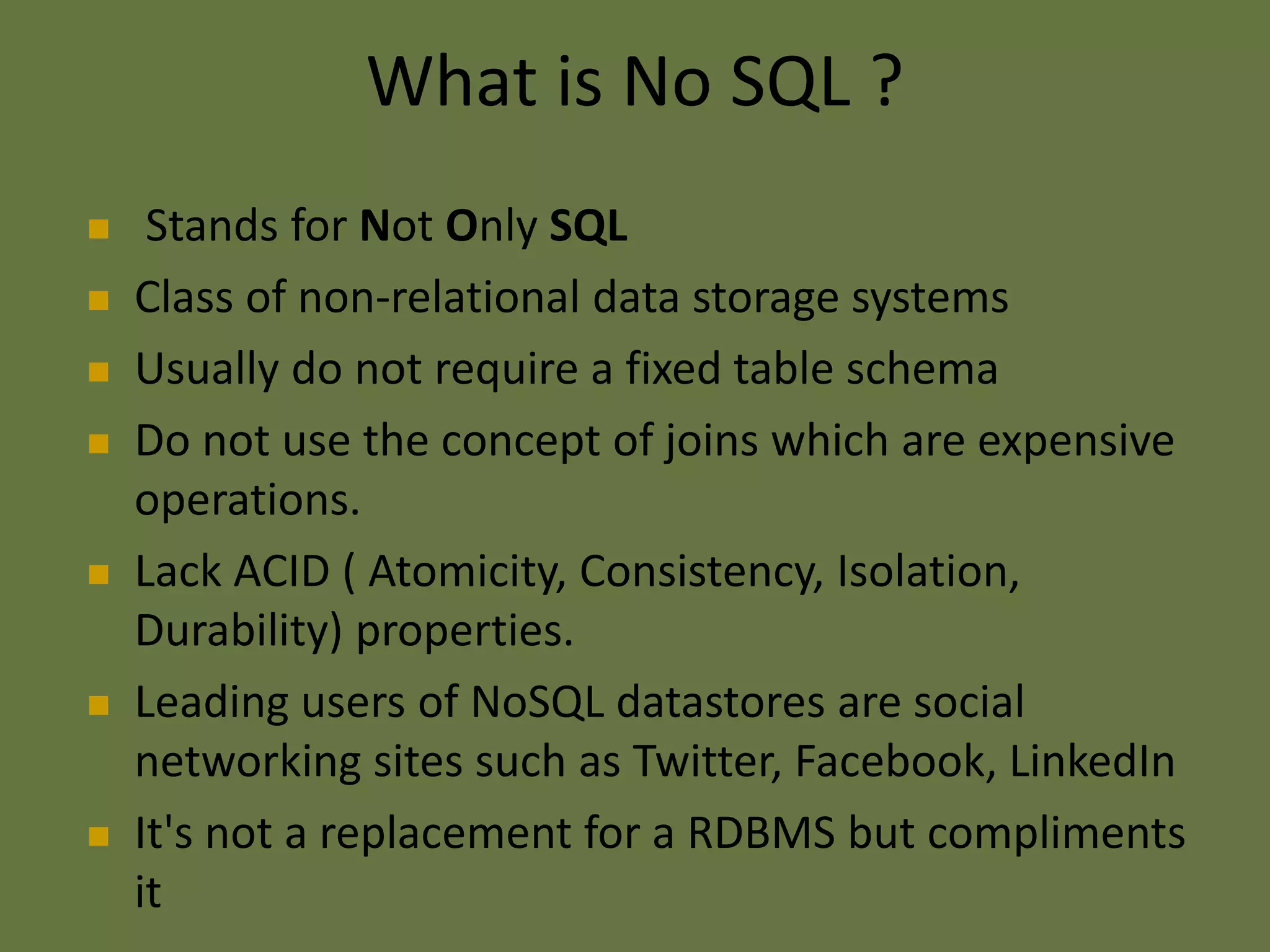
What is No SQL ?
 Stands for Not Only SQL
 Class of non-relational data storage systems
 Usually do not require a fixed table schema
 Do not use the concept of joins which are expensive
operations.
 Lack ACID ( Atomicity, Consistency, Isolation,
Durability) properties.
 Leading users of NoSQL datastores are social
networking sites such as Twitter, Facebook, LinkedIn
 It's not a replacement for a RDBMS but compliments
it
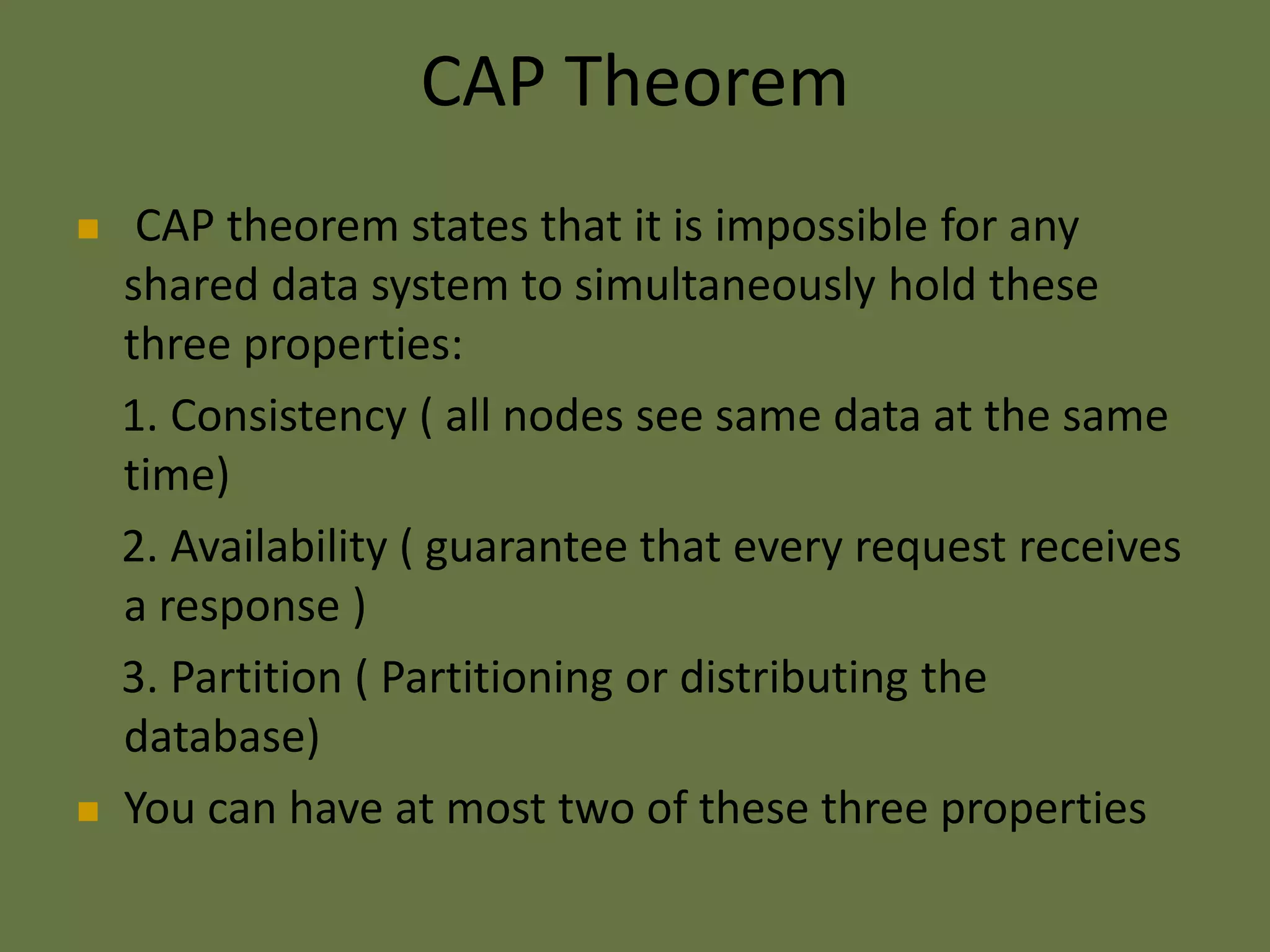
CAP Theorem
 CAP theorem states that it is impossible for any
shared data system to simultaneously hold these
three properties:
1. Consistency ( all nodes see same data at the same
time)
2. Availability ( guarantee that every request receives
a response )
3. Partition ( Partitioning or distributing the
database)
 You can have at most two of these three properties
CAP Theorem
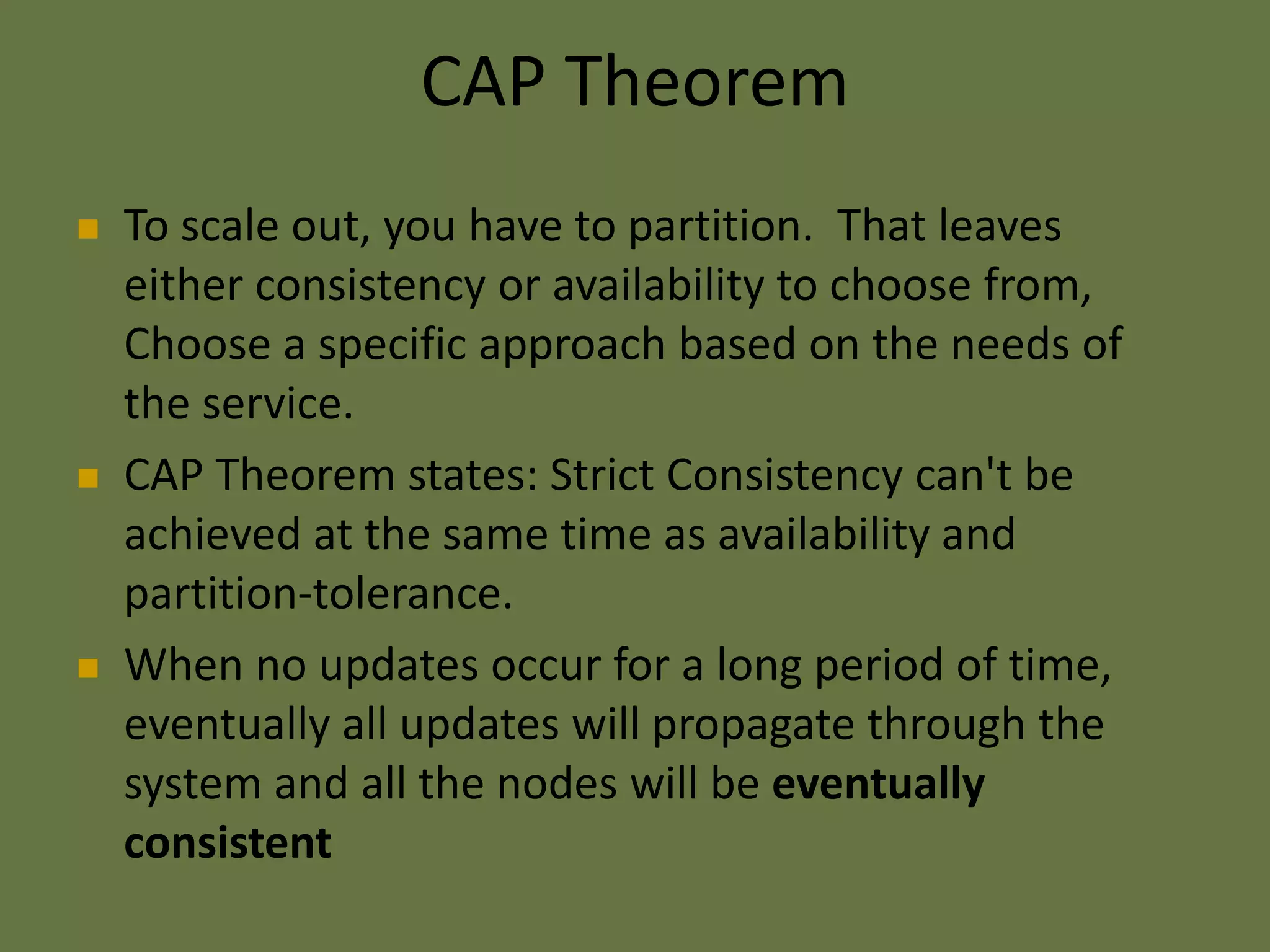
 To scale out, you have to partition. That leaves
either consistency or availability to choose from,
Choose a specific approach based on the needs of
the service.
 CAP Theorem states: Strict Consistency can't be
achieved at the same time as availability and
partition-tolerance.
 When no updates occur for a long period of time,
eventually all updates will propagate through the
system and all the nodes will be eventually
consistent
BASE
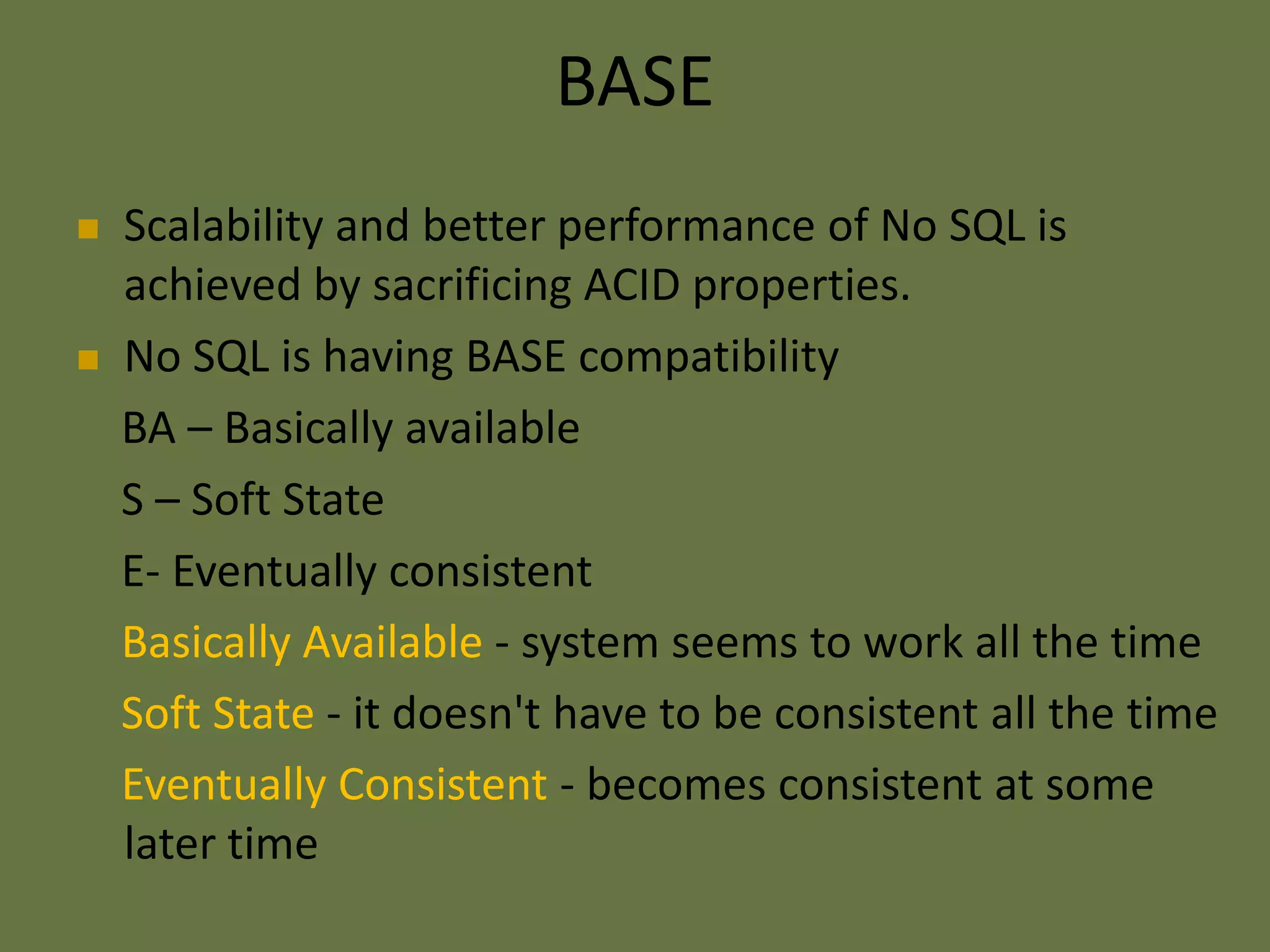
 Scalability and better performance of No SQL is
achieved by sacrificing ACID properties.
 No SQL is having BASE compatibility
BA – Basically available
S – Soft State
E- Eventually consistent
Basically Available - system seems to work all the time
Soft State - it doesn't have to be consistent all the time
Eventually Consistent - becomes consistent at some
later time
Types of No Sql databases
1. Key-value data model
2. Document-data model
3. Column family data model
4. Graph data model
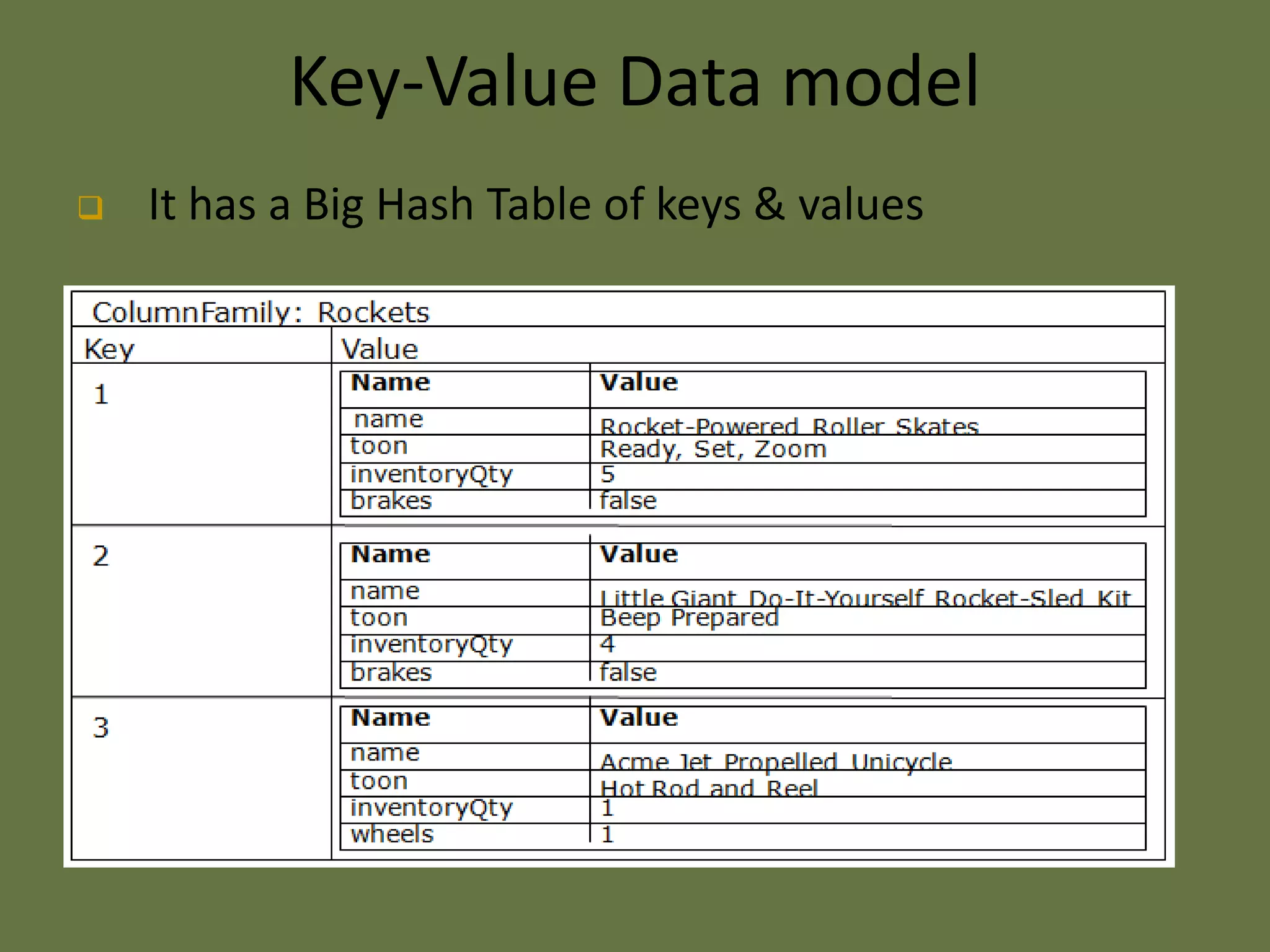
Key-Value Data model
 It has a Big Hash Table of keys & values
Key-Value Data model
 The key can be auto-generated while the value can be
String, JSON, BLOB (basic large object) etc
 This key/value type database allow clients to read and
write values using the key as follows:
1. get(key) -- Extract the value given a key
2. put(key, value) -- Create or update the value given
its key
3. delete(key) -- Remove the key and its associated
value
4. execute(key, operation, parameters) -- Invoke an
operation to the value (given its key) which is a
special data structure (e.g. List, Set, Map .... etc).
Key-Value Data model
 Performance is enhanced to a great degree because of
the cache mechanisms that accompany the mappings
 Eg: Amazon DynamoDB is a fully managed
proprietary No SQL database service that is offered
by Amazon.com as part of the Amazon Web
Services portfolio
No SQL distinguishing Characteristics
 Suitable for applications that supports large amount of
unstructured data.
 Schema-less
 Do not support Joins
 Do not follow ACID properties
 Scalable
 Data is replicated to multiple nodes (therefore
identical and fault-tolerant) and can be partitioned
THANK YOU

no sql presentation

  • 1.
  • 2.
    NO SQL- NonRelational Database • No SQL provides a mechanism for storage and retrieval of data that is modelled in means other than tabular relations.
  • 3.
    Why Cloud DataStores  Explosion of social media sites (Facebook, Twitter) with large data needs  Explosion of storage needs in large web sites such as Google, Yahoo  Much of the data is not files  Rise of cloud-based solutions such as Amazon S3 (simple storage solution)  Shift to dynamically-typed data with frequent schema changes
  • 4.
    Scaling  Best wayto provide ACID and a rich query model is to have the dataset on a single machine  RDBMS were not designed to be distributed  As database grows, rate of number of transactions per second falls.  One solution is partitioning of large tables that is to scale out the database across a cluster of separate database servers.
  • 5.
    What is NoSQL ?  Stands for Not Only SQL  Class of non-relational data storage systems  Usually do not require a fixed table schema  Do not use the concept of joins which are expensive operations.  Lack ACID ( Atomicity, Consistency, Isolation, Durability) properties.  Leading users of NoSQL datastores are social networking sites such as Twitter, Facebook, LinkedIn  It's not a replacement for a RDBMS but compliments it
  • 6.
    CAP Theorem  CAPtheorem states that it is impossible for any shared data system to simultaneously hold these three properties: 1. Consistency ( all nodes see same data at the same time) 2. Availability ( guarantee that every request receives a response ) 3. Partition ( Partitioning or distributing the database)  You can have at most two of these three properties
  • 7.
    CAP Theorem  Toscale out, you have to partition. That leaves either consistency or availability to choose from, Choose a specific approach based on the needs of the service.  CAP Theorem states: Strict Consistency can't be achieved at the same time as availability and partition-tolerance.  When no updates occur for a long period of time, eventually all updates will propagate through the system and all the nodes will be eventually consistent
  • 8.
    BASE  Scalability andbetter performance of No SQL is achieved by sacrificing ACID properties.  No SQL is having BASE compatibility BA – Basically available S – Soft State E- Eventually consistent Basically Available - system seems to work all the time Soft State - it doesn't have to be consistent all the time Eventually Consistent - becomes consistent at some later time
  • 9.
    Types of NoSql databases 1. Key-value data model 2. Document-data model 3. Column family data model 4. Graph data model
  • 10.
    Key-Value Data model It has a Big Hash Table of keys & values
  • 11.
    Key-Value Data model The key can be auto-generated while the value can be String, JSON, BLOB (basic large object) etc  This key/value type database allow clients to read and write values using the key as follows: 1. get(key) -- Extract the value given a key 2. put(key, value) -- Create or update the value given its key 3. delete(key) -- Remove the key and its associated value 4. execute(key, operation, parameters) -- Invoke an operation to the value (given its key) which is a special data structure (e.g. List, Set, Map .... etc).
  • 12.
    Key-Value Data model Performance is enhanced to a great degree because of the cache mechanisms that accompany the mappings  Eg: Amazon DynamoDB is a fully managed proprietary No SQL database service that is offered by Amazon.com as part of the Amazon Web Services portfolio
  • 13.
    No SQL distinguishingCharacteristics  Suitable for applications that supports large amount of unstructured data.  Schema-less  Do not support Joins  Do not follow ACID properties  Scalable  Data is replicated to multiple nodes (therefore identical and fault-tolerant) and can be partitioned
  • 14.