NMNT 2013


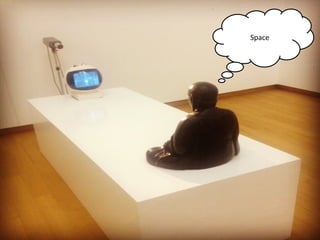
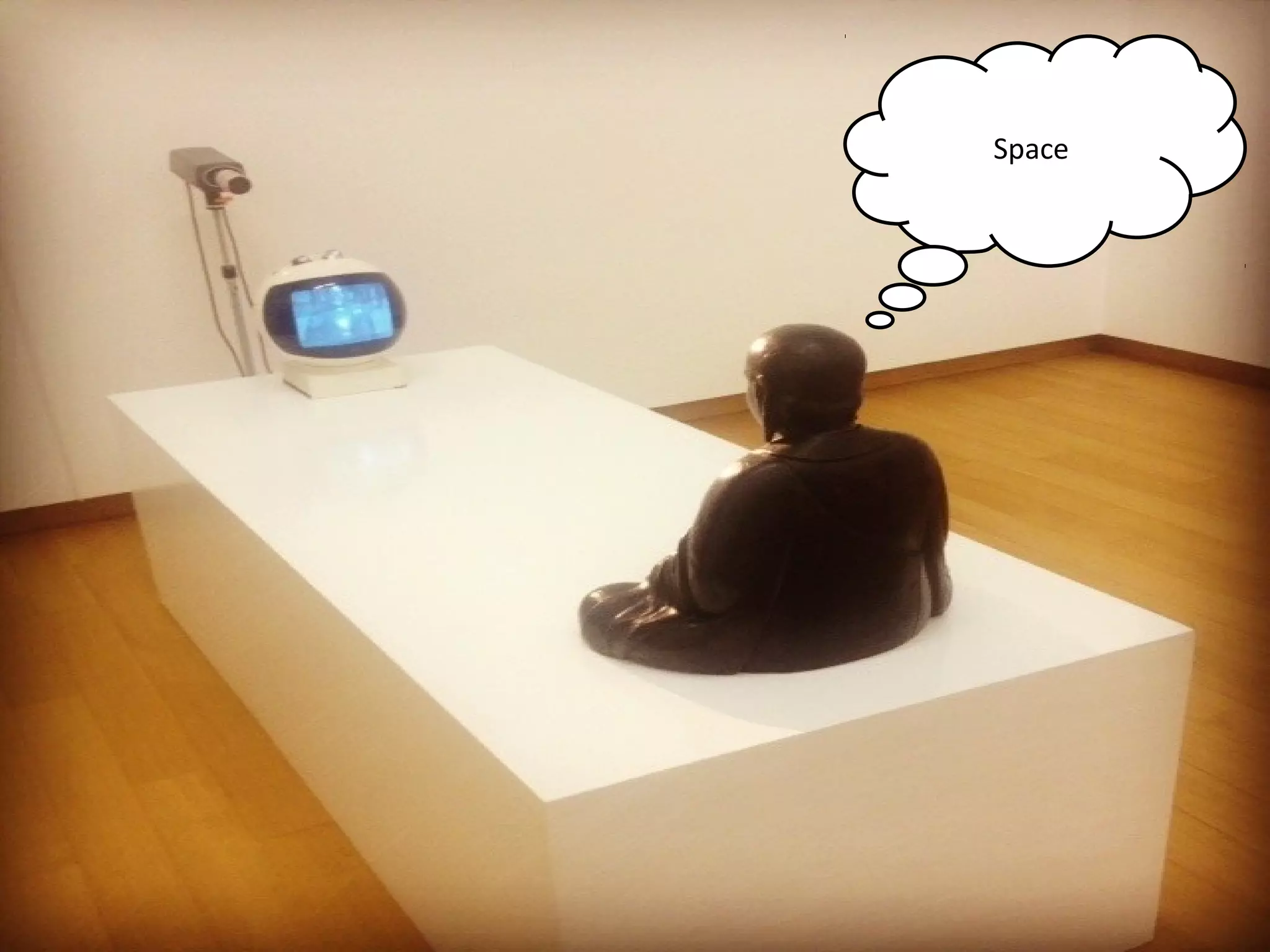
Space
NMNT 2013


Before we begin….
NMNT 2013


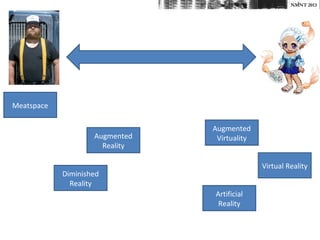
Meatspace

                                Augmented
                    Augmented    Virtuality
                      Reality

                                              Virtual Reality
            Diminished
              Reality
                                Artificial
                                 Reality
NMNT 2013


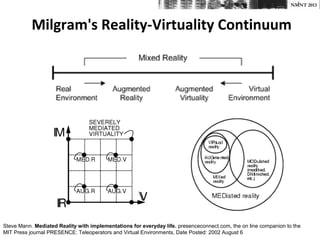
           Milgram's Reality-Virtuality Continuum


Steve Mann. Mediated Reality with implementations for everyday life. presenceconnect.com, the on line companion to the
MIT Press journal PRESENCE: Teleoperators and Virtual Environments, Date Posted: 2002 August 6
NMNT 2013


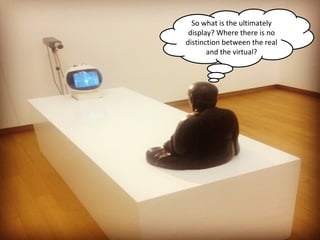
  So what is the ultimately
 display? Where there is no
distinction between the real
       and the virtual?
NMNT 2013


          The Ultimate Display
         Ivan Sutherland, 1965
‘The ultimate display would, of course, be a
  room within which the computer can control
  the existence of matter. A chair displayed in
  such a room would be good enough to sit in.
  Handcuffs displayed in such a room would be
  confining, and a bullet displayed in such a
  room would be fatal. With appropriate
  programming such a display could literally be
  the Wonderland into which Alice walked.’
NMNT 2013


Building blocks for the reality engine

       To rebuild reality? No.
To gain familiarity with concepts not
  realizable in the physical world.
NMNT 2013


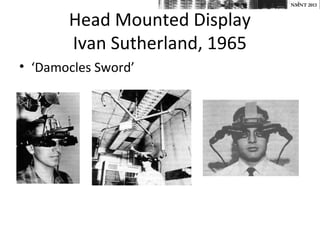
       Head Mounted Display
       Ivan Sutherland, 1965
• ‘Damocles Sword’
NMNT 2013


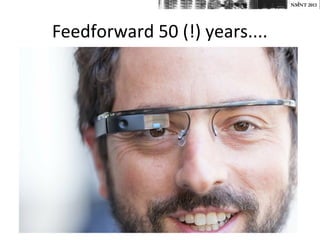
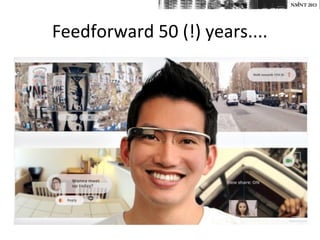
Feedforward 50 (!) years....
NMNT 2013


Feedforward 50 (!) years....
NMNT 2013


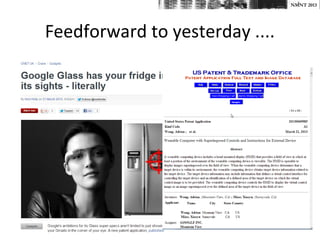
Feedforward to yesterday ....
NMNT 2013


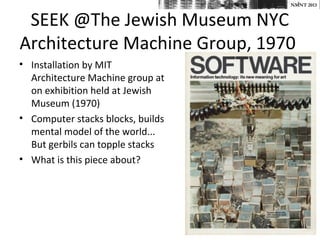
 SEEK @The Jewish Museum NYC
Architecture Machine Group, 1970
• Installation by MIT
  Architecture Machine group at
  on exhibition held at Jewish
  Museum (1970)
• Computer stacks blocks, builds
  mental model of the world...
  But gerbils can topple stacks
• What is this piece about?
NMNT 2013

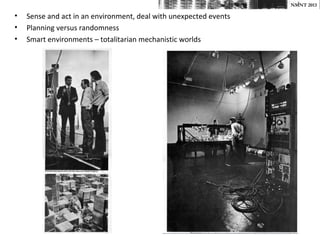
•   Sense and act in an environment, deal with unexpected events
•   Planning versus randomness
•   Smart environments – totalitarian mechanistic worlds
NMNT 2013


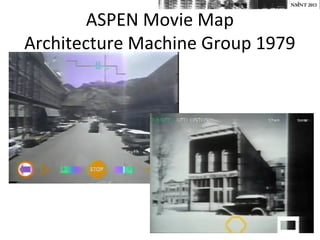
        ASPEN Movie Map
Architecture Machine Group 1979
NMNT 2013


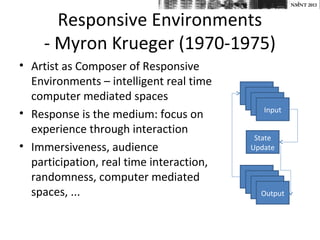
       Responsive Environments
     - Myron Krueger (1970-1975)
• Artist as Composer of Responsive
  Environments – intelligent real time
  computer mediated spaces
                                             Input
• Response is the medium: focus on
  experience through interaction
                                           State
• Immersiveness, audience                 Update
  participation, real time interaction,
  randomness, computer mediated
  spaces, ...                               Output
NMNT 2013


         Responsive Environments
             - Myron Krueger
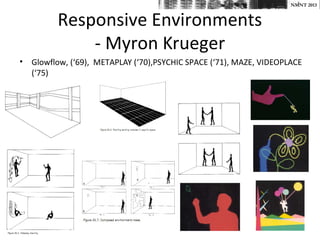
• Glowflow, (‘69), METAPLAY (‘70),PSYCHIC SPACE (‘71), MAZE, VIDEOPLACE
  (‘75)
NMNT 2013


Response is the medium
  Beauty of aural and visual response is secondary

Composing responsive environments at a meta level

                 Artificial Realities

              Learning and adaptation

                Personal Amplifiers

Cooperation and frustration – meaningful interaction

                        Play

  Creative Science applications such as psychology
NMNT 2013


Augmented Reality:
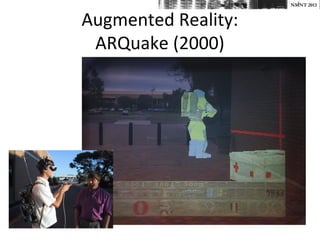
 ARQuake (2000)
NMNT 2013


 Augmented Reality:
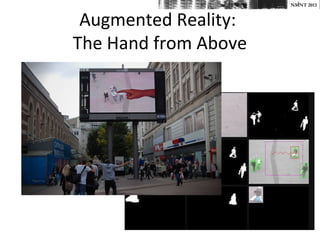
The Hand from Above
NMNT 2013
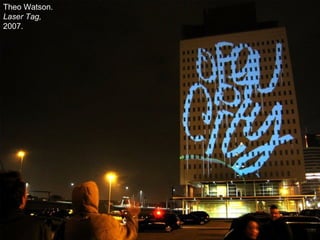
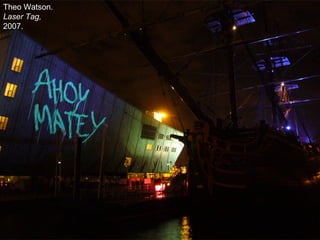
Theo Watson.
Laser Tag,
2007.
NMNT 2013
Theo Watson.
Laser Tag,
2007.
NMNT 2013


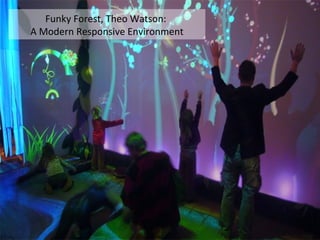
Modern Responsive Environment
   Funky Forest, Theo Watson:
A Modern Responsive Environment
        Example: Funky Forest
NMNT 2013


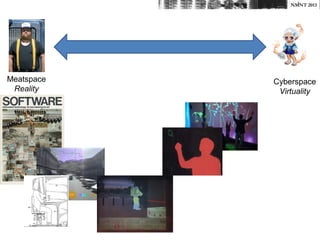
Meatspace   Cyberspace
 Reality     Virtuality
NMNT 2013


…
NMNT 2013


…

New Media New Technologies - 2013 - Workshop 2 - Space

  • 1.
  • 2.
  • 3.
    NMNT 2013 Meatspace Augmented Augmented Virtuality Reality Virtual Reality Diminished Reality Artificial Reality
  • 4.
    NMNT 2013 Milgram's Reality-Virtuality Continuum Steve Mann. Mediated Reality with implementations for everyday life. presenceconnect.com, the on line companion to the MIT Press journal PRESENCE: Teleoperators and Virtual Environments, Date Posted: 2002 August 6
  • 5.
    NMNT 2013 So what is the ultimately display? Where there is no distinction between the real and the virtual?
  • 6.
    NMNT 2013 The Ultimate Display Ivan Sutherland, 1965 ‘The ultimate display would, of course, be a room within which the computer can control the existence of matter. A chair displayed in such a room would be good enough to sit in. Handcuffs displayed in such a room would be confining, and a bullet displayed in such a room would be fatal. With appropriate programming such a display could literally be the Wonderland into which Alice walked.’
  • 7.
    NMNT 2013 Building blocksfor the reality engine To rebuild reality? No. To gain familiarity with concepts not realizable in the physical world.
  • 8.
    NMNT 2013 Head Mounted Display Ivan Sutherland, 1965 • ‘Damocles Sword’
  • 9.
  • 10.
  • 11.
  • 12.
    NMNT 2013 SEEK@The Jewish Museum NYC Architecture Machine Group, 1970 • Installation by MIT Architecture Machine group at on exhibition held at Jewish Museum (1970) • Computer stacks blocks, builds mental model of the world... But gerbils can topple stacks • What is this piece about?
  • 13.
    NMNT 2013 • Sense and act in an environment, deal with unexpected events • Planning versus randomness • Smart environments – totalitarian mechanistic worlds
  • 14.
    NMNT 2013 ASPEN Movie Map Architecture Machine Group 1979
  • 15.
    NMNT 2013 Responsive Environments - Myron Krueger (1970-1975) • Artist as Composer of Responsive Environments – intelligent real time computer mediated spaces Input • Response is the medium: focus on experience through interaction State • Immersiveness, audience Update participation, real time interaction, randomness, computer mediated spaces, ... Output
  • 16.
    NMNT 2013 Responsive Environments - Myron Krueger • Glowflow, (‘69), METAPLAY (‘70),PSYCHIC SPACE (‘71), MAZE, VIDEOPLACE (‘75)
  • 17.
    NMNT 2013 Response isthe medium Beauty of aural and visual response is secondary Composing responsive environments at a meta level Artificial Realities Learning and adaptation Personal Amplifiers Cooperation and frustration – meaningful interaction Play Creative Science applications such as psychology
  • 18.
  • 19.
    NMNT 2013 AugmentedReality: The Hand from Above
  • 20.
  • 21.
  • 22.
    NMNT 2013 Modern ResponsiveEnvironment Funky Forest, Theo Watson: A Modern Responsive Environment Example: Funky Forest
  • 23.
    NMNT 2013 Meatspace Cyberspace Reality Virtuality
  • 24.
  • 25.

Editor's Notes

  • #3 http://www.youtube.com/watch?v=HypmW4Yd7SY John Cage. 4’33’’
  • #6 Relate to Gesamtkunstwerk
  • #8 Creator of Sketchpad – the guys had to use oscilloscope based screen for his writing program because there were no freaking pixel based CRTs yet! Marrying computer to design navigation and habitation of virtual worlds. Essay of his vision.
  • #10 1965-1970
  • #13 http://crave.cnet.co.uk/gadgets/google-glass-has-your-fridge-in-its-sights-literally-50010721/
  • #16 http://www.youtube.com/watch?v=Hf6LkqgXPMU
  • #18 Glowflow – fluorescerent tubes etc. darkened room in which glowing lines of light defined an illusory space (Figure 25.1). The display was accomplished by pumping phosphorescent particles through transparent tubes attached to the gallery walls. These tubes passed through opaque columns concealing lights which excited the phosphors. A pressure sensitive pad in front of each of the six columns enabled the computer to respond to footsteps by lighting different tubes or changing the sounds generated by a Moog synthesizer or the origin of these sounds. However, the artists’ attitude toward the capacity for response was ambivalent. They felt that it was important that the environment respond, but not that the audience be aware of it. Delays were introduced between the detection of a participant and the computer’s response so that the contemplative mood of the environment would not be destroyed by frantic attempts to elicit more responses. Metaplay METAPLAY’S focus reflected my reactions to GLOWFLOW. Interaction between the participants and the environment was emphasized; the computer was used to facilitate a unique real-time relationship between the artist and the participant. An 8′ by 10′rear-projection video screen dominated the gallery. The live video image of the viewer and a computer graphic image drawn by an artist, who was in another building 1 mile away, were superimposed on this screen. Both the viewer and the artist could respond to the resulting image. Live graffiti. Psychic space PSYCHIC SPACE was both an instrument for musical expression and a richly composed, interactive, visual experience. Participants could become involved in a softshoe duet with the environment, or they could attempt to match witswith the computer by walking an unpredictable maze 16-24 grid of sensing tiles. After a longer period of time an additional feature came into play. If the computer discovered that a person’s behavior was characterized by a short series of steps punctuated by relatively long pauses, it would use the pause to establish a new kind of relationship. The sequence of steps was responded to with a series of notes as before; however, during the pause the computer would repeat these notes again. If the person remained still during the pause, the computer assumed that the relationship was understood. The next sequence of steps was echoed at a noticeably higher pitch. Subsequent sequences were repeated several times with variations each time. This interaction was experimental and extremely difficult to introduce clearly with feedback alone, i.e., without explicit instructions Maze The maze program focused on the interaction between one individual and the environment. The participant was lured into attempting to navigate a projected maze. The intrigue derived from the maze’s responses, a carefully composed sequence of relations designed to constitute a unique and coherent experience. Videoplace VIDEOPLACE is a conceptual environment with no physical existence. It unites people in separate locations in a common visual experience, allowing them to interact in unexpected ways through the video medium. The term VIDEOPLACE is based on the premise that the act of communication creates a place that consists of all the information that the participants share at that moment. http://jtnimoy.net/itp/newmediahistory/videoplace/
  • #22 http://www.theowatson.com/site_docs/work.php?id=40