QUESTIONING ART
HISTORY:
LOCATING RELIGIOUS
IDENTITIES
Archaeology versus Architectural
History?
• 19th century: evidence of form and style
(Fergusson); text-aided archaeology
(Cunningham).
• 20th century & writing of socio-economic history:
temple providing legitimisation to the state.
• Temple reinforced social demarcation &
hegemonies.
• Claims of the nation-state : art history bearer of
the nation’s unique artistic self!
Objectives of presentation
• Querying the structure of new disciplines
that emerged in 19th century India.
• To shift focus from dichotomies between
art history and archaeology to
understanding of religious structures.
• To highlight changing perceptions of
religious identity with reference to a study
of architecture in ancient period.
J. Fergusson, & J. Burgess, Cave
Temples of India, London 1880
• Written record in India imperfect and
cannot be relied upon for study of the past,
hence importance of architectural history.
• Cyclical notion of time inconsistent with
historical reasoning: emphasis on
chronology.
• Monuments located within religious-racial
framework, e.g. Dravidian architecture.
J. Fergusson, & J. Burgess, Cave
Temples of India, London 1880
• The Western Deccan caves … show how
Buddhist religion rose and spread, and its
form afterwards became corrupt and
idolatrous.
• They explain how it consequently came to
be superseded by the nearly cognate form of
Jainism and the antagonistic development of
the revived religion of the Brahmins.
19th century framework
• Documentation the basis of Architectural
History.
• Histories of monuments governed by linear
time.
• Plans indicators of religious affiliation.
• Changes in legislation relating to
conservation introduce new methods of
control.
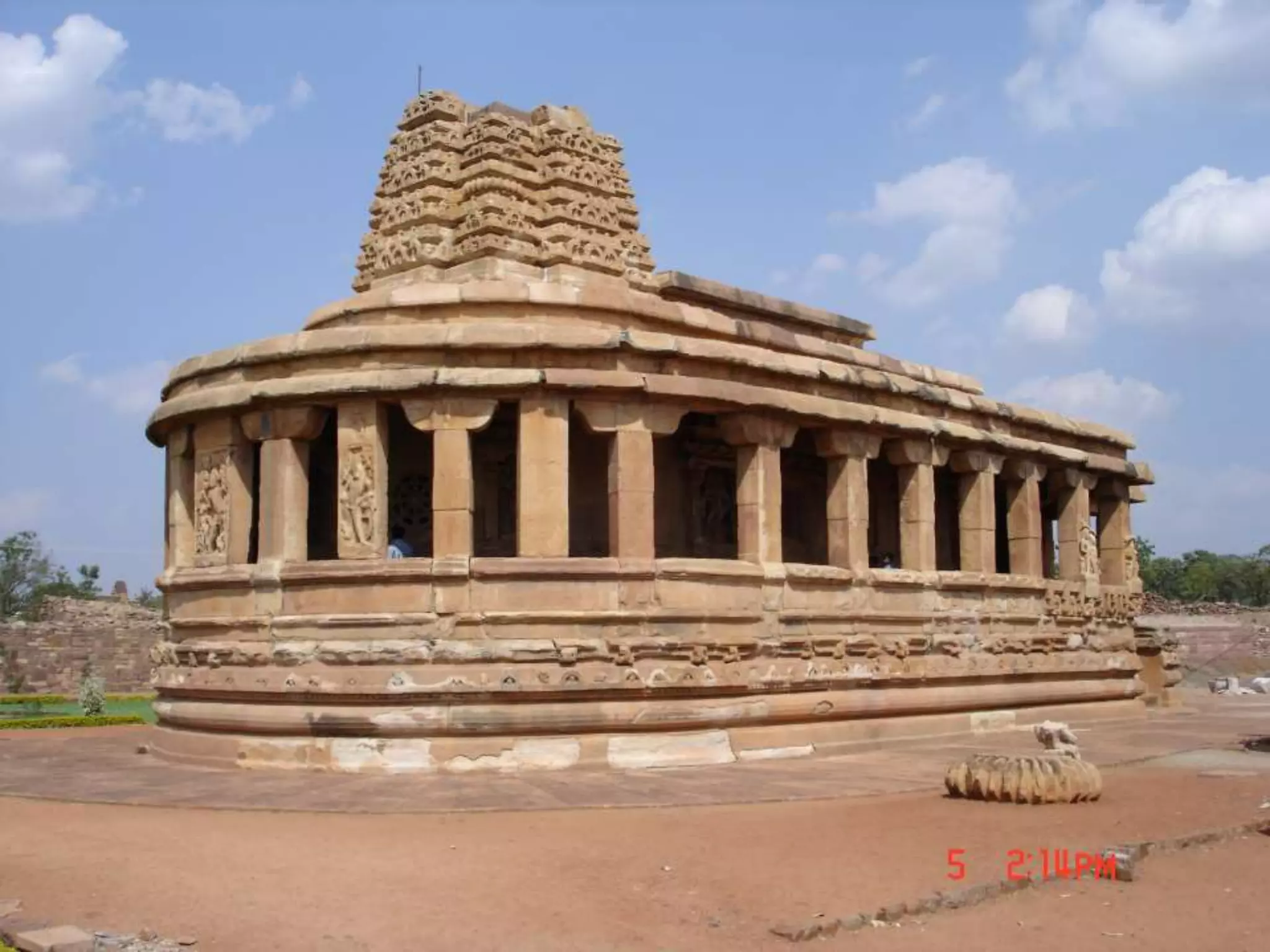
Durga temple at Aihole
• 19th century photographs by Colonel Biggs show it as
Siva temple.
• James Fergusson: apsidal form was Buddhist in origin –
subsequent Brahmanical take-over of the temple.
• 20th century writings by several Indian scholars: Durga
temple at Aihole, apsidal shrines at Ter and Chezerla -
structural versions of Buddhist caitya, later converted.
• M. Rama Rao & K.V. Soundara Rajan questioned this
identification based on Agamas, inscriptions, imagery.
Mahisasura-
mardini image
in Durga
temple at
Aihole
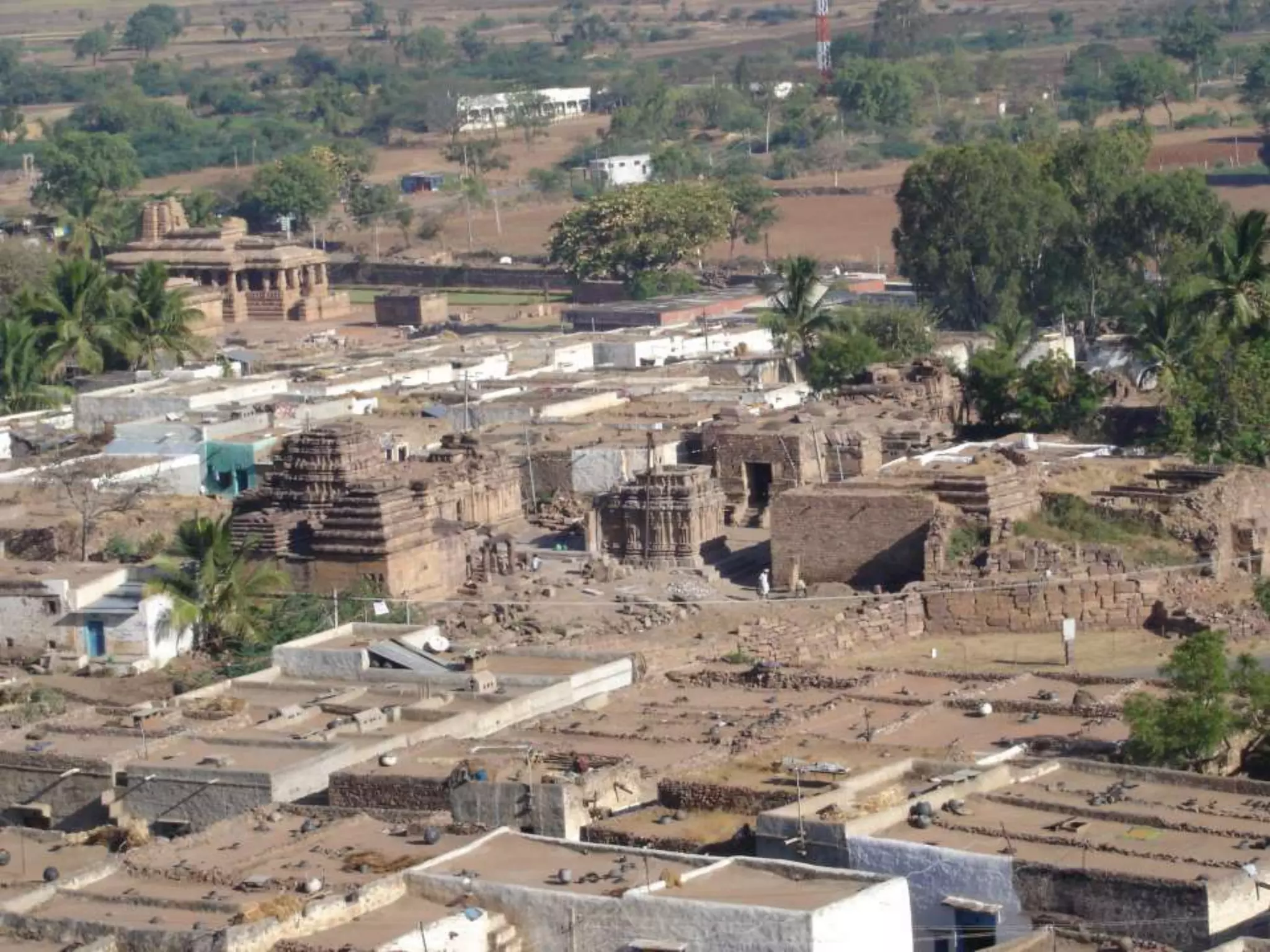
Diverse religious development at
Aihole (6th – 12th century AD)
• Megalithic structures on Meguti hill.
• Buddhist and Jain caves on Meguti hill.
• Jain temples in close proximity to Hindu shrines.
• Location of shrines near water-bodies.
• Inscriptions on temples refer to religious
festivities.
• Range of donors and patrons.
• 1914-8: shift from temples to ‘66 protected
monuments.’
Jina image at
Aihole
Archaeology of a temple:
Parasuramesvara temple, Gudimallam,
Chittoor district
• 2nd century BC: setting up of the Siva linga.
• 1st-3rd centuries AD: apsidal brick temple raised
around it.
• 9th century: elaborate arrangements for ritual.
• AD 845 to 989: inscriptions record donations and
gifts to the temple.
• AD 1127: construction of the temple in stone.
Siva linga enshrined as
object of worship at
Gudimallam
Narayanaswami temple at
Melkote near Mysore
• Most sacred Vaisnava temple.
• Puranas trace origins to Brahma who procured
the image from lord Narayana.
• 13th century texts: Ramanujacarya came from
Tamilnadu and recovered the image.
• 1117 and 1128 AD: renovation of temple by
Hoysala generals.
• 15th-16th centuries: donations by Vijayanagara
rulers.
Ethno-historic research
• Crucial role of ascetics and charismatic
renouncers in starting worship in temples.
• Complex relationship between the shrine and the
ruling polity.
• No ready attribution of caste or community
patronage.
• Temple of Kesariyaji south of Udaipur: Jains
worship image as Jina Adinath, while local Bhils,
identify the image as Kalaji or Karia.
• Regional histories, social time, cultural memory.
Inter-dependence of the arts, i.e.
architecture, sculpture, performing arts
• While each art has autonomy, this autonomy is
only relative; no form is seen in isolation.
• Attributes of architect: sakala-guna-āśraya
(abode of virtuous qualities) sarvasiddhi-ācārya;
aneka pura vāstu Pitamahan (the creator of
many cities and houses).
• Ācārya or architect: averted excommunication
(balligavarte) of the skilful people of this
district.
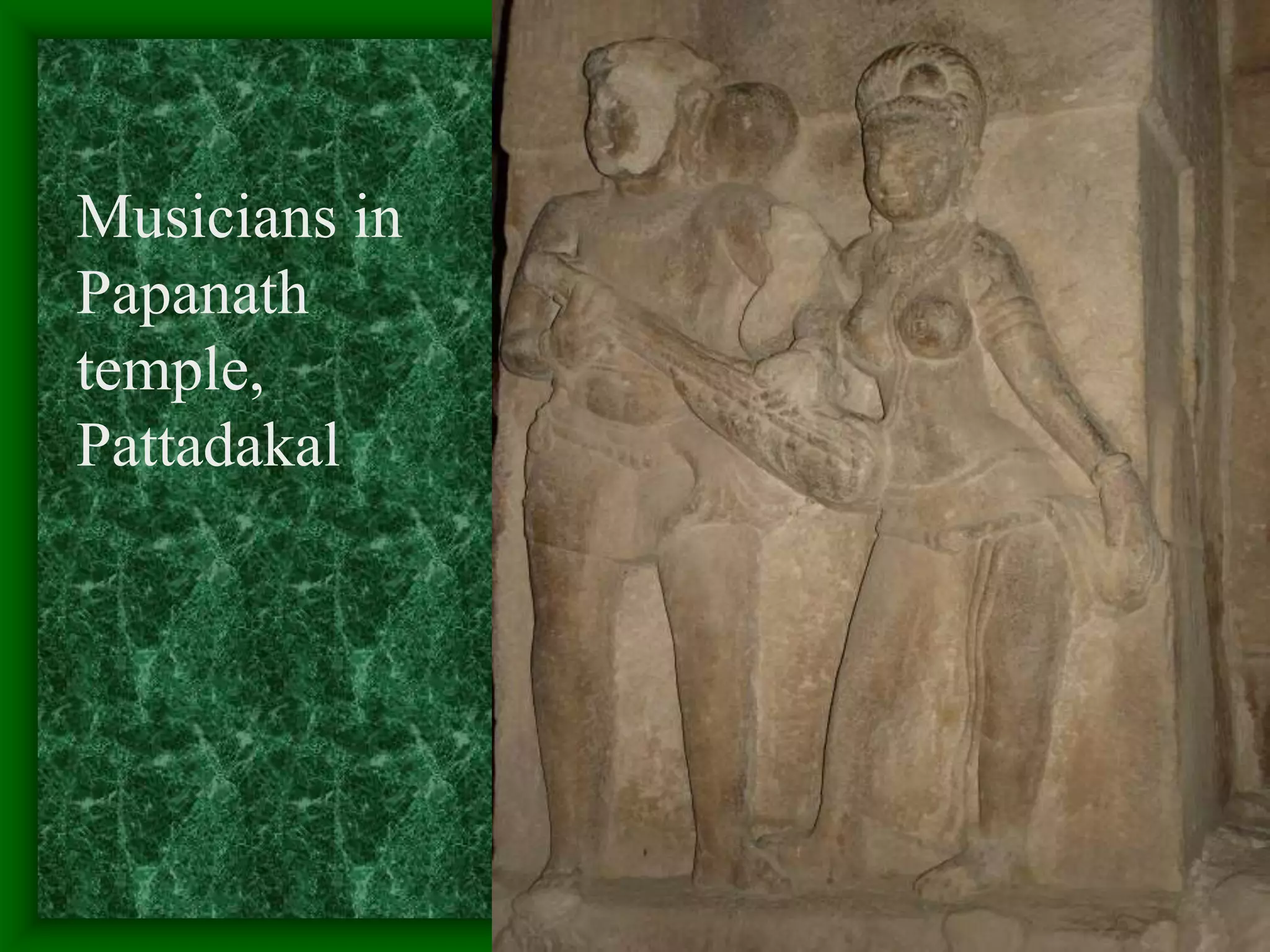
Musicians in
Papanath
temple,
Pattadakal
Archaeological insights
• Continuity of settlement from prehistoric
period onwards, though marked by shifts
and changes.
• Diversity in the nature of worship with
rock-shelters coexisting with shrine
complexes.
• Religious identity within expanding
cultural frontiers- pan-Indian/ Asian.
Nagarjunakonda valley:
100 sites in 15 sq. kms.
• Neolithic (3rd millennium BC) to 16th century.
• Megalithic stone circles.
• 30 Buddhist establishments; 19 Hindu brick
temples; medieval Jain shrines.
• Asvamedha tank; memorial pillars
• Citadel, residential space, ghats
• Complex patterning of secular & religious
space.
Sati stone from
Nagarjunakonda
Vijayapuri (Nagarjunakonda):
Pattern of Patronage
• Located within fertile Krishna valley, but also
within larger maritime network.
• Buddhist monasteries: grants from queens,
upasikas, setthis, etc.
• 19 temples: only three with royal records.
• Elite association with memorial pillars; setting up
of lajja-gauri images.
The Asian Milieu
• Language as indicator of cultural identity
across Asia, e.g. Sanskrit/ Tamil/ Pali.
• Architectural manifestations and
transformations in South and Southeast
Asia.
• Recitation from sacred texts, such as the
Epics.
• Commonality of motifs, forms and
symbolism.
Quintessential
Buddha-type
that spread
across Asia
Emerging trends
• Locating monuments within social time.
• Interdependence of the arts.
• Relationship with texts and ritual
requirements.
• Use of inscriptions in understanding
community networks, rather than chronology.
• Asian context of early religious architecture in
India.

NMI 2006.ppt

  • 1.
  • 2.
    Archaeology versus Architectural History? •19th century: evidence of form and style (Fergusson); text-aided archaeology (Cunningham). • 20th century & writing of socio-economic history: temple providing legitimisation to the state. • Temple reinforced social demarcation & hegemonies. • Claims of the nation-state : art history bearer of the nation’s unique artistic self!
  • 3.
    Objectives of presentation •Querying the structure of new disciplines that emerged in 19th century India. • To shift focus from dichotomies between art history and archaeology to understanding of religious structures. • To highlight changing perceptions of religious identity with reference to a study of architecture in ancient period.
  • 4.
    J. Fergusson, &J. Burgess, Cave Temples of India, London 1880 • Written record in India imperfect and cannot be relied upon for study of the past, hence importance of architectural history. • Cyclical notion of time inconsistent with historical reasoning: emphasis on chronology. • Monuments located within religious-racial framework, e.g. Dravidian architecture.
  • 5.
    J. Fergusson, &J. Burgess, Cave Temples of India, London 1880 • The Western Deccan caves … show how Buddhist religion rose and spread, and its form afterwards became corrupt and idolatrous. • They explain how it consequently came to be superseded by the nearly cognate form of Jainism and the antagonistic development of the revived religion of the Brahmins.
  • 6.
    19th century framework •Documentation the basis of Architectural History. • Histories of monuments governed by linear time. • Plans indicators of religious affiliation. • Changes in legislation relating to conservation introduce new methods of control.
  • 7.
    Durga temple atAihole • 19th century photographs by Colonel Biggs show it as Siva temple. • James Fergusson: apsidal form was Buddhist in origin – subsequent Brahmanical take-over of the temple. • 20th century writings by several Indian scholars: Durga temple at Aihole, apsidal shrines at Ter and Chezerla - structural versions of Buddhist caitya, later converted. • M. Rama Rao & K.V. Soundara Rajan questioned this identification based on Agamas, inscriptions, imagery.
  • 9.
  • 10.
    Diverse religious developmentat Aihole (6th – 12th century AD) • Megalithic structures on Meguti hill. • Buddhist and Jain caves on Meguti hill. • Jain temples in close proximity to Hindu shrines. • Location of shrines near water-bodies. • Inscriptions on temples refer to religious festivities. • Range of donors and patrons. • 1914-8: shift from temples to ‘66 protected monuments.’
  • 12.
  • 13.
    Archaeology of atemple: Parasuramesvara temple, Gudimallam, Chittoor district • 2nd century BC: setting up of the Siva linga. • 1st-3rd centuries AD: apsidal brick temple raised around it. • 9th century: elaborate arrangements for ritual. • AD 845 to 989: inscriptions record donations and gifts to the temple. • AD 1127: construction of the temple in stone.
  • 14.
    Siva linga enshrinedas object of worship at Gudimallam
  • 15.
    Narayanaswami temple at Melkotenear Mysore • Most sacred Vaisnava temple. • Puranas trace origins to Brahma who procured the image from lord Narayana. • 13th century texts: Ramanujacarya came from Tamilnadu and recovered the image. • 1117 and 1128 AD: renovation of temple by Hoysala generals. • 15th-16th centuries: donations by Vijayanagara rulers.
  • 16.
    Ethno-historic research • Crucialrole of ascetics and charismatic renouncers in starting worship in temples. • Complex relationship between the shrine and the ruling polity. • No ready attribution of caste or community patronage. • Temple of Kesariyaji south of Udaipur: Jains worship image as Jina Adinath, while local Bhils, identify the image as Kalaji or Karia. • Regional histories, social time, cultural memory.
  • 17.
    Inter-dependence of thearts, i.e. architecture, sculpture, performing arts • While each art has autonomy, this autonomy is only relative; no form is seen in isolation. • Attributes of architect: sakala-guna-āśraya (abode of virtuous qualities) sarvasiddhi-ācārya; aneka pura vāstu Pitamahan (the creator of many cities and houses). • Ācārya or architect: averted excommunication (balligavarte) of the skilful people of this district.
  • 18.
  • 19.
    Archaeological insights • Continuityof settlement from prehistoric period onwards, though marked by shifts and changes. • Diversity in the nature of worship with rock-shelters coexisting with shrine complexes. • Religious identity within expanding cultural frontiers- pan-Indian/ Asian.
  • 20.
    Nagarjunakonda valley: 100 sitesin 15 sq. kms. • Neolithic (3rd millennium BC) to 16th century. • Megalithic stone circles. • 30 Buddhist establishments; 19 Hindu brick temples; medieval Jain shrines. • Asvamedha tank; memorial pillars • Citadel, residential space, ghats • Complex patterning of secular & religious space.
  • 21.
  • 22.
    Vijayapuri (Nagarjunakonda): Pattern ofPatronage • Located within fertile Krishna valley, but also within larger maritime network. • Buddhist monasteries: grants from queens, upasikas, setthis, etc. • 19 temples: only three with royal records. • Elite association with memorial pillars; setting up of lajja-gauri images.
  • 23.
    The Asian Milieu •Language as indicator of cultural identity across Asia, e.g. Sanskrit/ Tamil/ Pali. • Architectural manifestations and transformations in South and Southeast Asia. • Recitation from sacred texts, such as the Epics. • Commonality of motifs, forms and symbolism.
  • 24.
  • 25.
    Emerging trends • Locatingmonuments within social time. • Interdependence of the arts. • Relationship with texts and ritual requirements. • Use of inscriptions in understanding community networks, rather than chronology. • Asian context of early religious architecture in India.